Archive for Pawnee Farm Arlinda Chief

Walkway Chief Mark: The Backup Bull Behind Seven Percent of Every Holstein Cow

Half a million lost calves. Thirty billion dollars in milk. One bull at the center of both: Walkway Chief Mark.
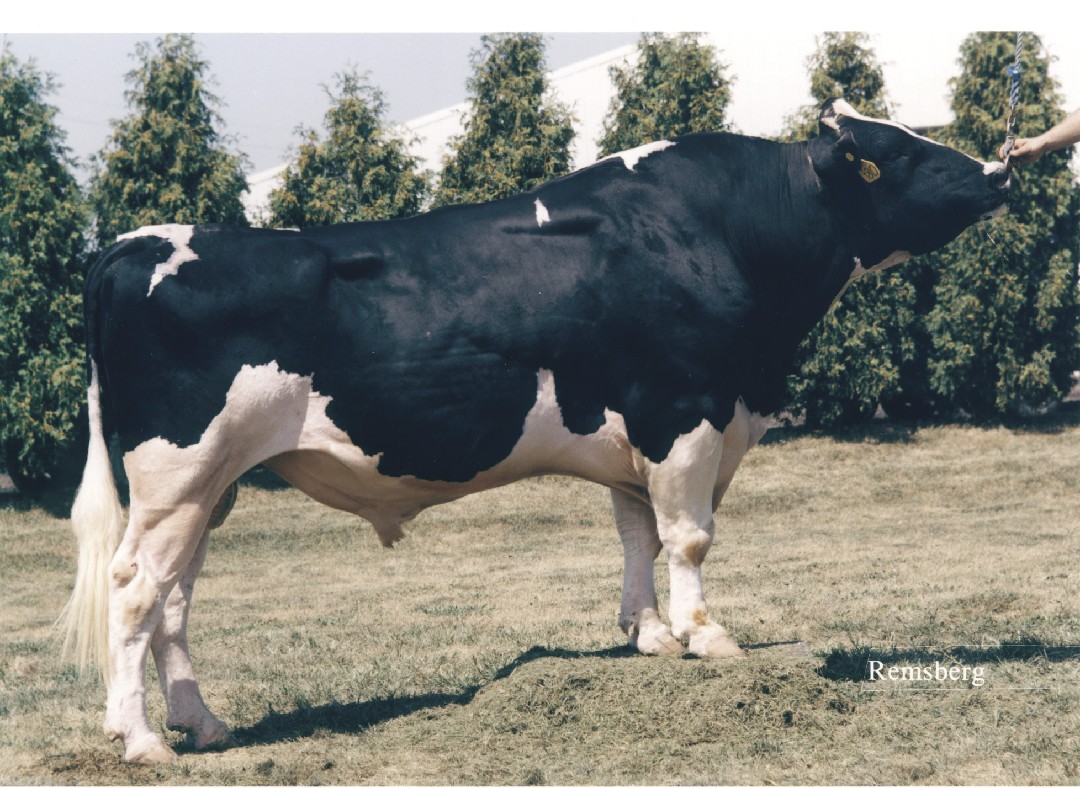
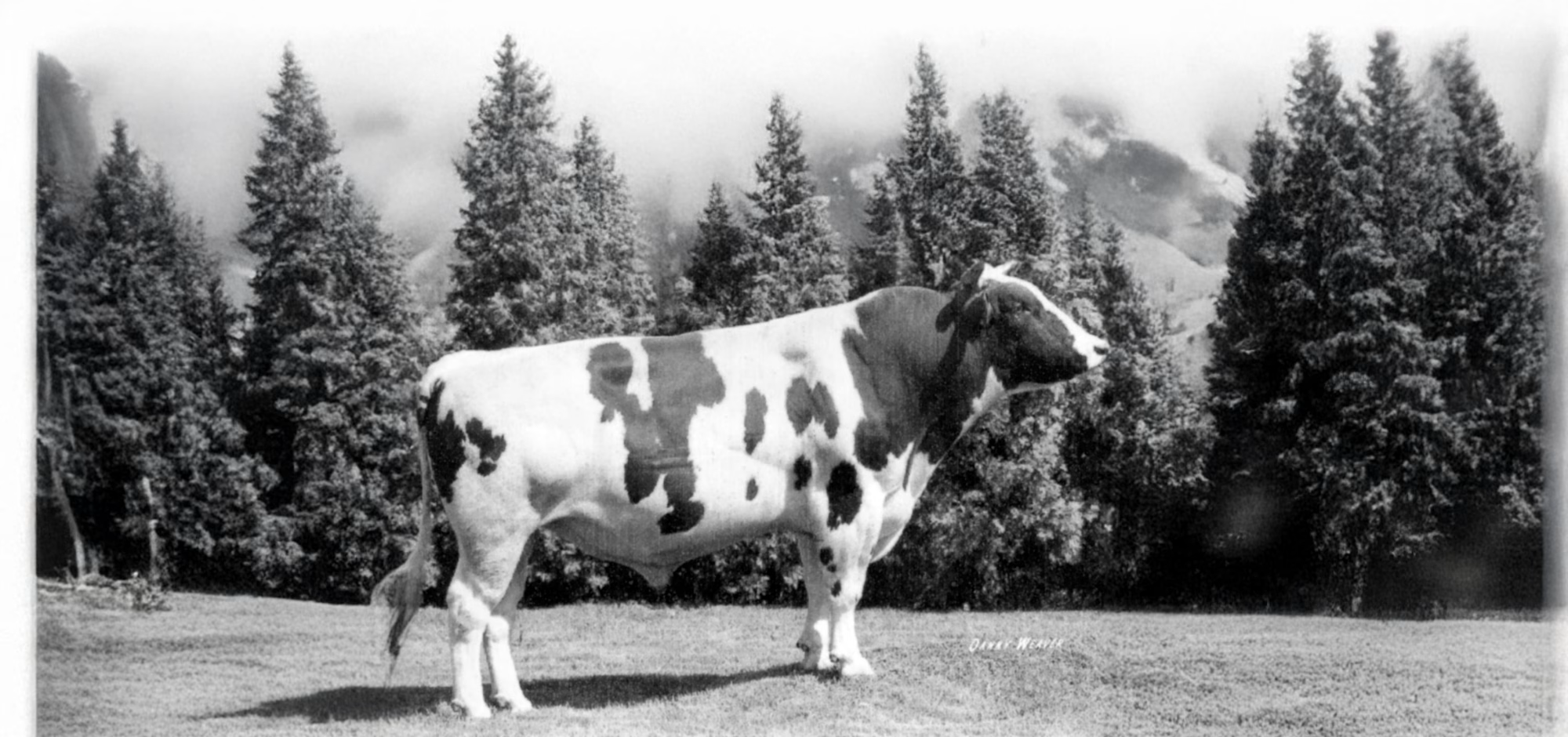
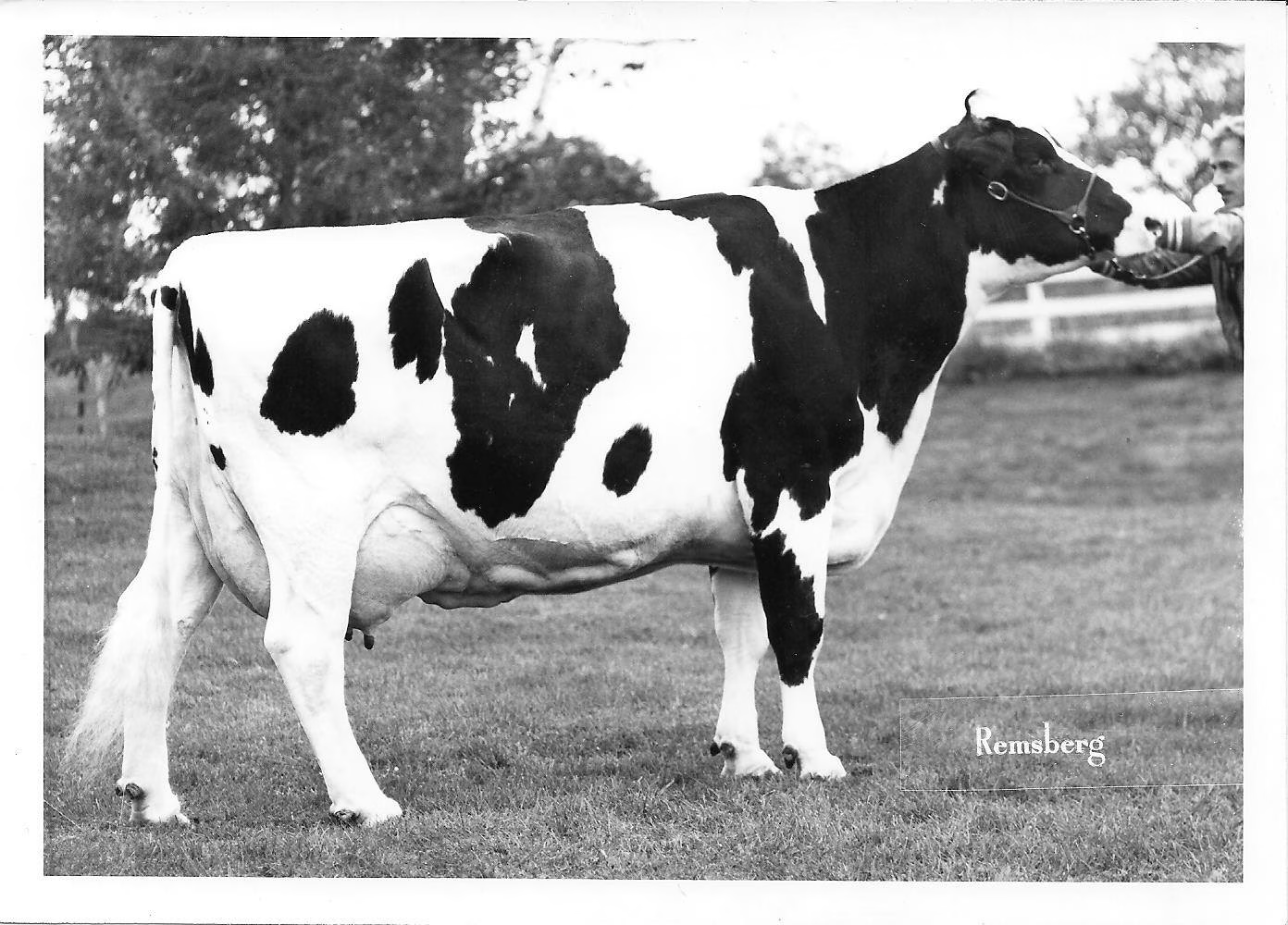
Walkway Chief Mark (VG-87-GM) — the backup bull from Foster Walk’s Neoga, Illinois herd whose genetics now account for roughly seven percent of every Holstein genome in North America. Named one of Select Sires’ “Impact Sires of the Breed,” his udder-transmitting brilliance and structural trade-offs shaped the modern Holstein in ways nobody saw coming when this photo was taken.

Walk into any Holstein barn in North America tonight. Pick out the best-uddered cow in the string — the one whose fore attachment makes you stop mid-stride, the one pushing components that keep surprising you. Trace her pedigree back far enough, and you’ll almost certainly land on the same bull.

A bull who was never supposed to be sampled. A bull who got his shot because his brother died.

His name was Walkway Chief Mark. He accounts for roughly seven percent of every Holstein genome on this continent. And his story is the strangest, most consequential accident in the history of dairy cattle breeding.

A Farmer’s Eye and a Dead Brother

Foster Walk farmed outside Neoga, Illinois — a speck of a town in Cumberland County where the land flattens out and the horizon stretches until it gives up. This was the late 1970s. Corn ran under two bucks a bushel, Elevation daughters were the standard everyone measured type against, and most breeding decisions happened on gut instinct and a phone call to your AI rep. Genomic testing? That was science fiction nobody had dreamed up yet. 

Foster had what the old cattlemen call “the eye.” While big-name breeders flew to national sales and bid top dollar on headline animals, Foster worked the margins. He’d buy groups of heifers at 21 cents a pound — bargain-bin stock by any standard — and somehow spot genetic potential hiding under less-than-perfect frames. Diamonds in the rough. That was his phrase, and he had an infuriating tendency to be right about it. 

Walkway Farm wasn’t some fly-by-night operation, either. Foster had been advertising registered Holsteins in Holstein World as far back as 1958 — two full decades before his most famous calf hit the ground. When a cow in his herd hit a production milestone, the Journal Gazette and Times-Courier out of Mattoon ran it: Walkway Janice Prince, 20,511 pounds of milk and 876 pounds of butterfat in 365 days. This was a working dairy with the Walkway prefix on real cattle making real milk, not just a pedigree footnote.

Foster Walk (left) and his son Tom at Walkway Farm near Neoga, Illinois, 1983 — the year Chief Mark daughters were already hitting milking strings across the country. Behind every bull that reshapes a breed, there’s a family that bred the cow that made him.

A young sire analyst named Charlie Will had grown up in the same neighborhood. He’d graduated from the University of Illinois in 1974 and tried to get hired at Select Sires. They turned him down. He took a sales territory in Wisconsin that nobody else wanted, worked it until a sire analyst position finally opened in 1978, and got his shot — the same year Chief Mark was born.

Charlie had his eye on Foster’s operation, but not for the calf who’d change everything. He wanted Monroe — Chief Mark’s older brother. The contract was signed and the collection schedule set. Monroe was the plan.

Then Monroe died during test services. ​

One phone call. Charlie Will — the analyst who’d been rejected himself — decided to gamble on the younger full brother. Born June 13, 1978, registration HOUSA000001773417, a Pawnee Farm Arlinda Chief son out of a EX-90 No-Na-Me Fond Matt daughter named Walkway Matt Mamie (EX-90 GMD DOM). Mark was the first bull Charlie ever bought for Select Sires. (Read more: Charlie Will’s Comeback: How One Rejection Letter Created Holstein History)

A rejected analyst picking a replacement bull from a neighbor’s farm as his very first acquisition. You can’t make this stuff up.

Whether Foster or Charlie imagined what that calf would become, the record doesn’t say. But that replacement bull would go on to sire 57,654 daughters and reshape the genetic architecture of an entire breed.

The Contradiction

When Chief Mark’s first daughter proofs came back through Select Sires — coded 7HO980 in every AI catalog in the country — the reaction wasn’t celebration. It was bewilderment. 
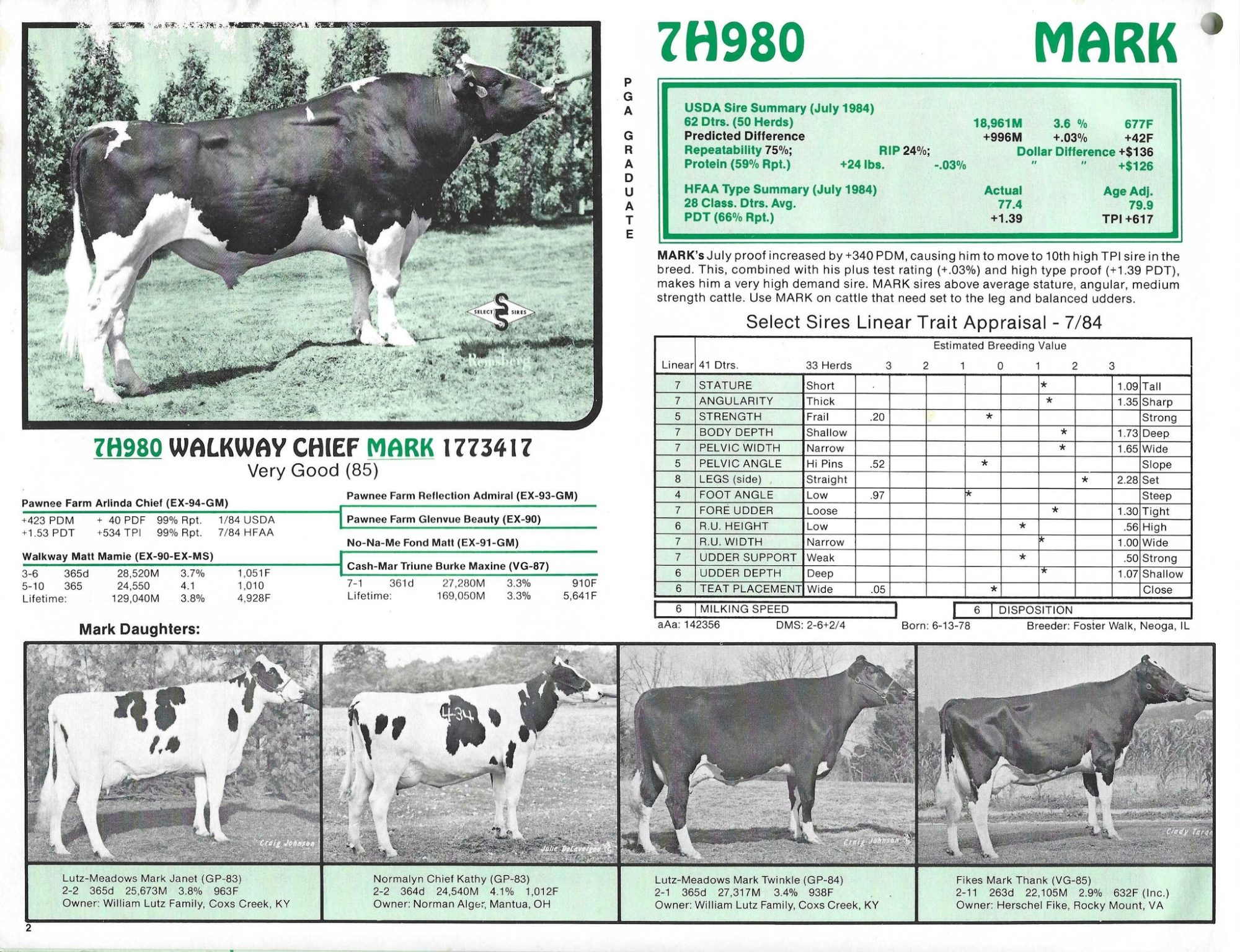
Chief Mark’s July 1984 Select Sires catalog page — the proof sheet that launched a paradox. Just 62 daughters in, and the description already told breeders exactly what they were getting into: “Use MARK on cattle that need set to the leg and balanced udders.” The udder magic and the structural trade-off were both right there in black and green from the very first proof. Note the early daughter photos at bottom — all GP or low VG first-calvers that gave no hint of the EX-90+ mammary systems his mature daughters would carry. (Select Sires, July 1984)

You have to understand how breeding evaluation worked in the early 1980s. There were no genomic predictions. No SNP chips. You bred daughters, waited years, measured them against their contemporaries, and published the deviations. Everything was relative — how much better or worse did this bull’s daughters perform compared to the current cow population?

Relative to the Holstein cows of that era, Chief Mark’s udder transmitting ability was a leap forward, unlike anything the breed had seen at that scale. Fore attachments, rear attachments, teat placement, udder depth — all trending dramatically above what anyone else in the lineup was producing. Breeders who saw his early daughters in person talk about them with a specific kind of reverence: large, sharply attached mammary systems with long, clean necks into the body wall, deep angular ribbing, dairy character you could spot from across the yard. One breeder on a Holstein forum captured it perfectly: “When they come into the show, you love them”. 
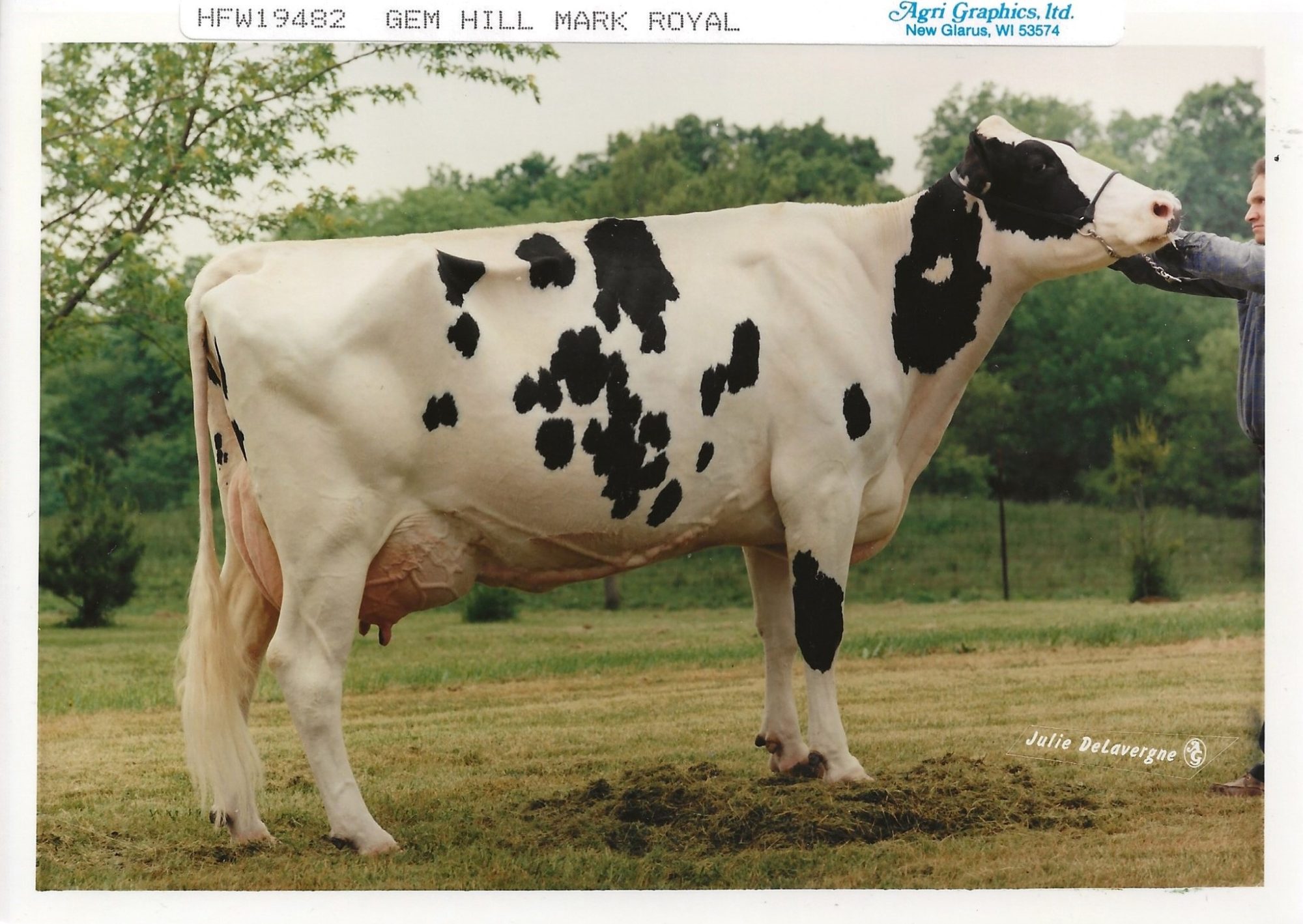
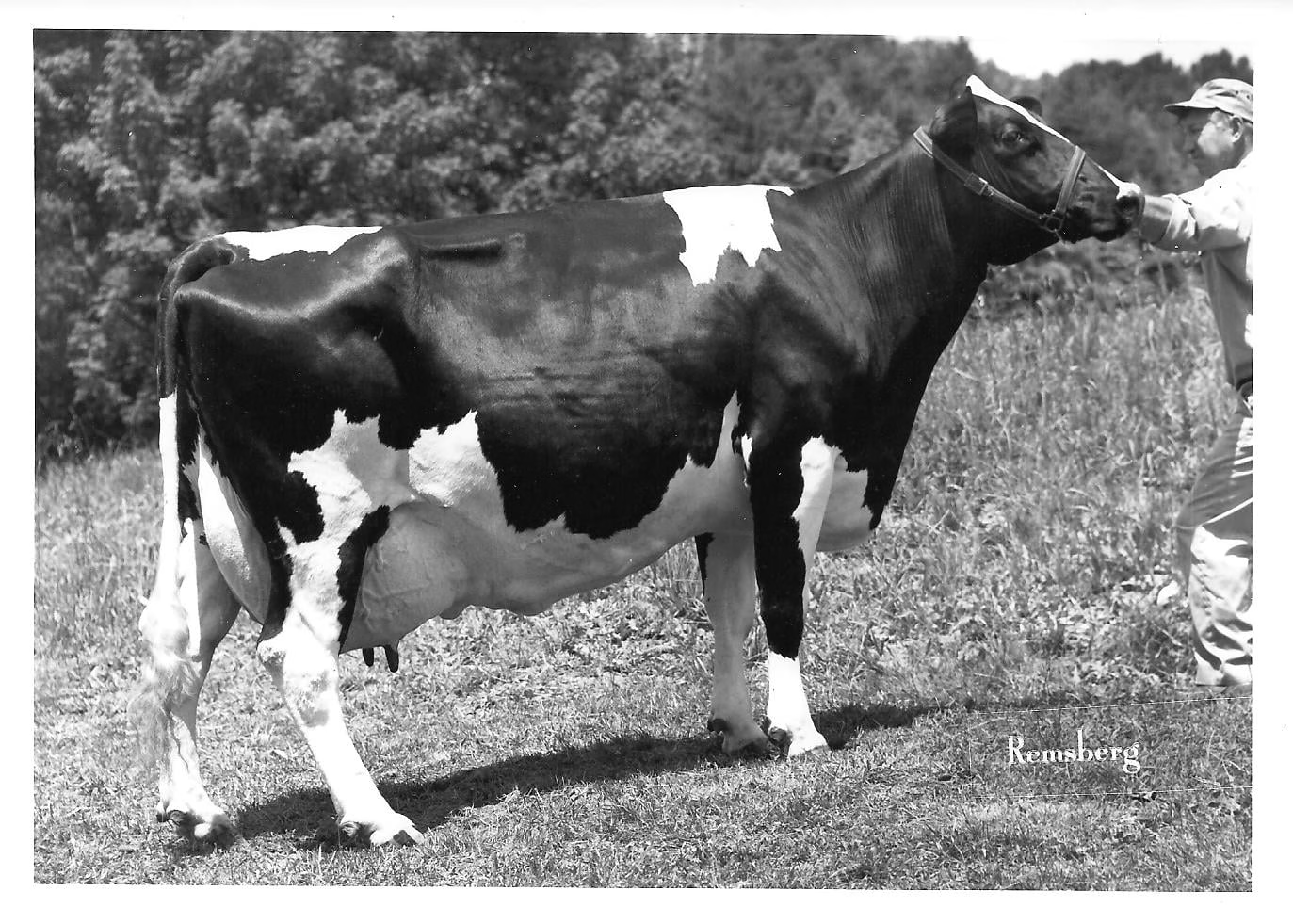
Gem-Hill Mark Royal EX-96 — Chief Mark’s highest-classified daughter. Bred by Brightbill-Gem Hill Farms, Loudonville, Ohio, she embodied everything breeders gambled on when they punched Chief Mark’s code into their breeding programs: the stature, the dairy character, and the mammary system that made his proof sheets famous.

Then he finished the thought: “however when they turned side way, you see the legs and high pins”. 

There it was. The paradox.

Because when you flipped to the structural data, even on a relative basis, the numbers were devastating. Shallow heels. Weak pasterns. The structural curse traced back through his maternal line, through No-Na-Me Fond Matt, like a family inheritance nobody could outrun. 

Measured against the cows of his era, the greatest udder improver of his generation was also one of the worst structural sires alive. The same genetics that built those magnificent mammary systems wrecked the feet beneath them.

And breeders had a decision to make.

The Deal with Fine Print

They took it. By the thousands.

Ask anyone who milked Chief Mark daughters in the ’90s, and they’ll tell you the same thing: best udders in the barn, worst feet in the barn. Some guys swore by him. Some guys swore at him. Most did both.

Smart breeders figured out the workaround. As one veteran put it, “you would have to protect the mating”—use Chief Mark on cow families with strong feet and legs, and let the udder magic do its work. The strategy wasn’t perfect, but it worked often enough to justify the gamble. When it worked, the daughters were jaw-dropping.
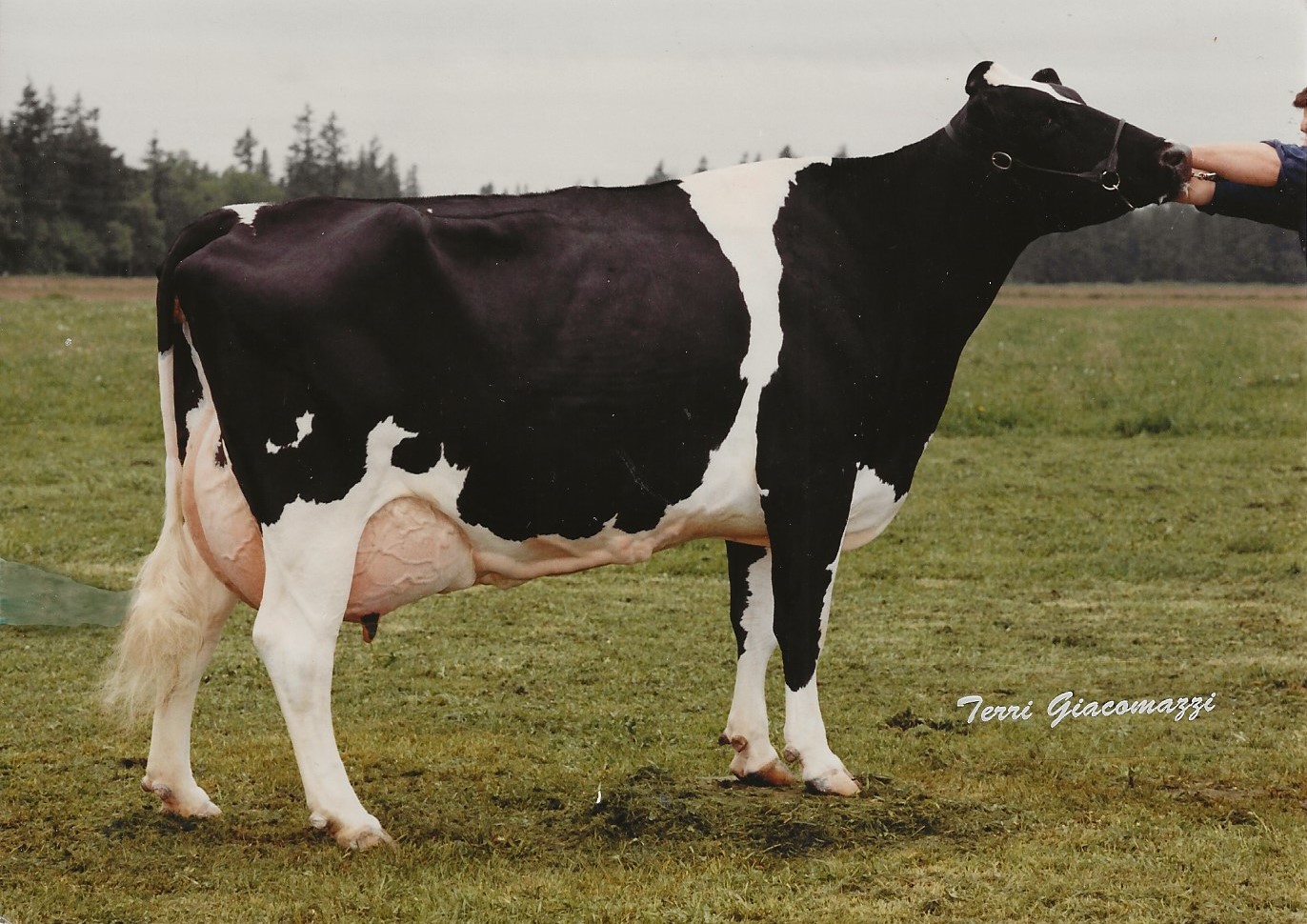
 

Mainstream Mark Harmony EX-93 — bred by Randy Kortus at Mainstream Holsteins, Lynden, Washington, and born in 1986 out of the Gold Medal Dam Mainstream Bell Honor VG-88 GMD DOM. This is what happened when Chief Mark’s udder genetics landed on a cow family with Elevation Celebrity blood behind it: the kind of daughter that made breeders forgive those feet-and-leg numbers.

By the mid-1990s, the NAAB database would eventually show 57,654 production-tested daughters carrying his genetics across American herds. Most AI studs don’t produce that many daughters from their entire lineup in a decade. Chief Mark did it from a single catalog entry. 
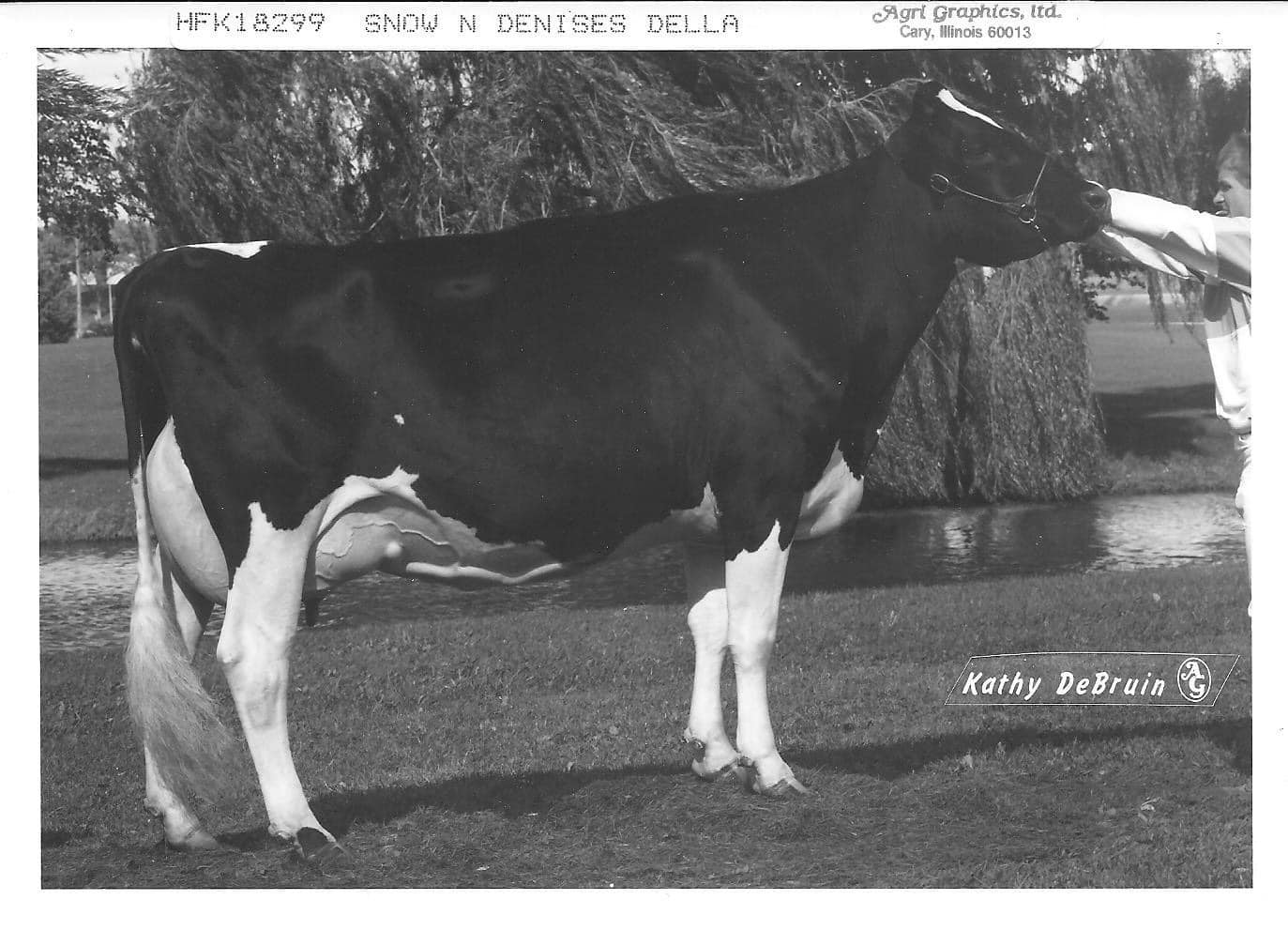
Snow-N Denises Dellia EX-95-3E GMD DOM 5 — Chief Mark’s most famous daughter and arguably the most influential brood cow of the modern Holstein era. Born in 1986 on Bob Snow’s Wisconsin farm and later the cornerstone of Regancrest Farm in Waukon, Iowa, she produced Durham, Die-Hard, and Million, along with 76 registered daughters and 44 AI-sampled sons. Named Holstein International Global Cow of the Year in 2005, Dellia was living proof that Chief Mark’s udder genetics, crossed on the right cow family, could reshape the breed for generations. (Read more: Snow-N Denises Dellia: The Holstein Legend Who Redefined Dairy Genetics)

But genetics always collects its debts.

On larger operations that used him heavily without careful mating management, the structural toll was brutal. By the third lactation, the feet caught up. Trimming schedules accelerated. Digital dermatitis became a constant battle. You’d walk through a pen of Chief Mark daughters, making 90-pound peaks — udders attached like textbook illustrations, production numbers rewriting the farm’s economics — and half of them were sore-footed.

You don’t want to ship a cow making that kind of milk. But you can’t keep a cow that can’t stand up.

The Hidden Killer Nobody Knew About

The scope of Chief Mark’s influence becomes truly staggering when you trace it back to his father.

Pawnee Farm Arlinda Chief was born in 1962 and produced 16,000 daughters, 500,000 granddaughters, and more than 2 million great-granddaughters. His chromosomes account for almost 14 percent of the genome in the current U.S. Holstein population. Chief Mark, as one of Chief’s most prolific sons, carried and amplified that genetic footprint through a massive daughter population of his own. 
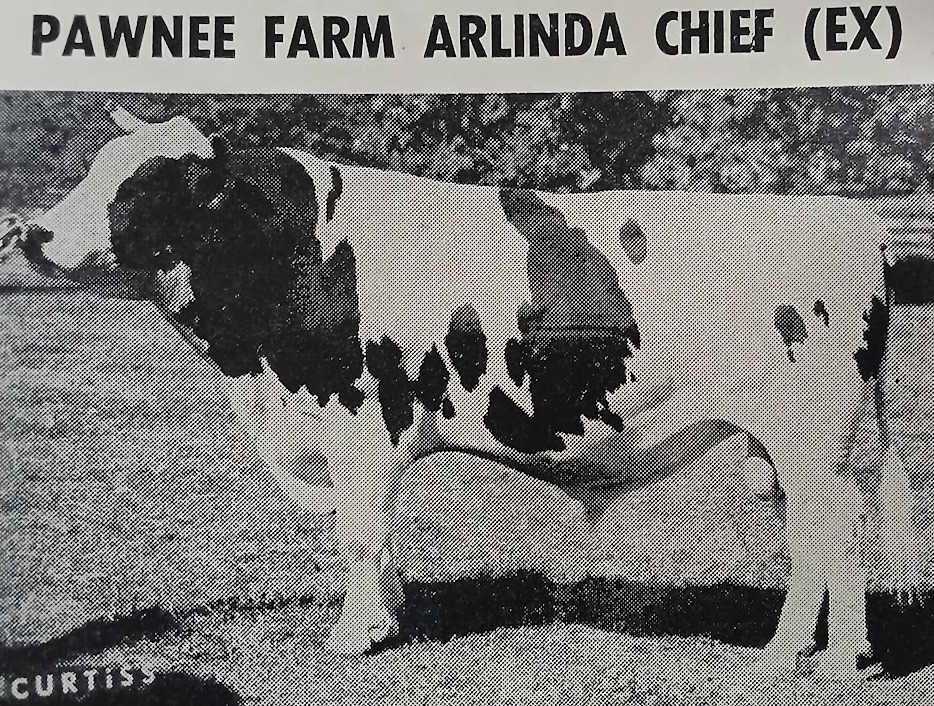
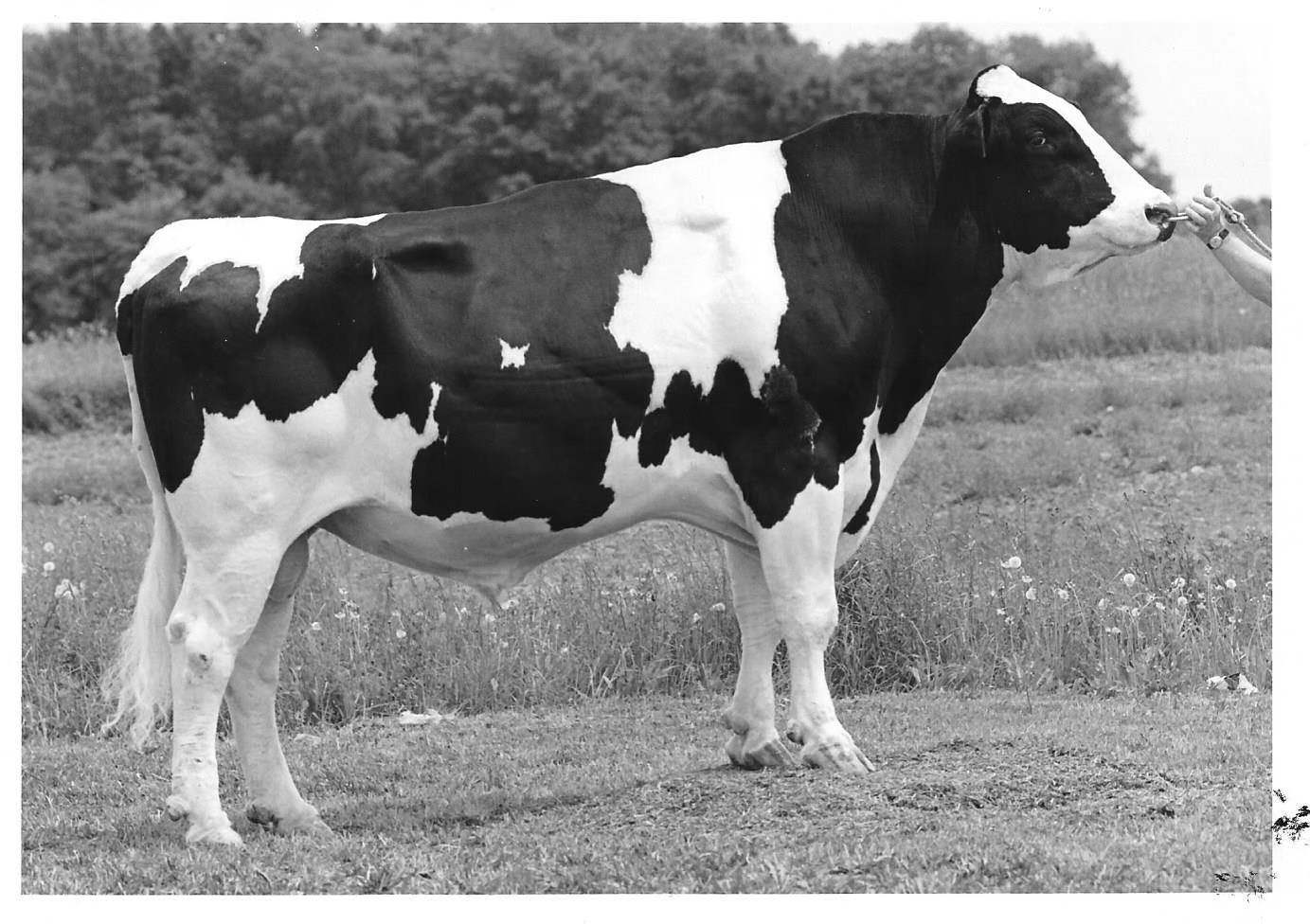
Pawnee Farm Arlinda Chief EX-91 — Chief Mark’s sire, and the bull whose chromosomes account for nearly 15% of the modern Holstein genome. Born in 1962, he produced 16,000 daughters, 500,000 granddaughters, and over 2 million great-granddaughters through Curtiss Breeding Service. He gave the breed unprecedented milk production — and unknowingly passed along the APAF1 mutation that would cost the industry an estimated 500,000 calves before researchers finally identified it in 2011. Chief Mark inherited both the gift and the curse. (Read more: The $4,300 Gamble That Reshaped Global Dairy Industry: The Pawnee Farm Arlinda Chief Story and Four Bulls That Changed the Holstein Breed: Genius, Gambles, and the Price We’re Still Paying)

What nobody knew — for three decades — was that Chief had given his descendants something besides production and udder quality.

In 2011, USDA researchers identified a problematic haplotype on chromosome 5 in Holstein cows that was associated with lower fertility and embryo loss. They traced it back to Chief. They contacted Harris Lewin, a geneticist who had sequenced both Chief and Chief Mark at the University of Illinois in 2009, and asked whether his team could identify a candidate mutation. 

Lewin and co-author Heather Adams found it in less than 24 hours. 

“It was a Eureka moment!” Lewin said. 

The mutation sat in a gene called APAF1 — a “nonsense” mutation that shortens an amino acid chain critical for protein-to-protein interactions. One copy makes a calf a carrier. Two copies — one from each parent — kill the embryo. Among more than 246,000 Holsteins tested, researchers found zero animals carrying APAF1 from both parents. Every double-copy pregnancy ended before the calf drew a breath. 

The numbers were staggering. Over 30 years, the APAF1 mutation caused an estimated 500,000 spontaneous abortions worldwide — more than 100,000 in the United States alone. A single midterm abortion costs a dairy about $800. Total estimated loss: approximately $420 million. 

Think about that for a second. For decades, every time a farmer milking Chief descendants saw an unexplained pregnancy loss, they shrugged, logged it as bad luck, and moved on — that was APAF1. One bull’s hidden genetic tax, collected silently across thousands of operations for a generation.

But the math cuts both directions. Chief’s beneficial genetic contributions — the production, the udders, the overall improvement — are estimated at roughly $30 billion in increased milk production over the same period. Thirty billion against $420 million. The value outpaced the cost seventy-to-one. 

And now breeders can test for APAF1 and avoid mating two carriers while keeping everything that made the lineage great. The curse has been identified and neutralized. The gifts remain. 

Both Sides of the Pedigree

When analysts traced the pedigrees of the breed’s top 10 GTPI females they kept running into the same name. Mark. Forty-two times across those ten pedigrees, with Starbuck the only other bull in the same league at thirty-five. And here’s the telling detail: thirty-three of those Mark appearances were as sire of a female in the lineage, while nine were as sire of the male. He dominated both sides of the pedigree. 

Only a handful of bulls in Holstein history have earned what The Bullvine’s own analysis calls the distinction of “sons and daughters both extraordinary”. Chief Mark was one of them. 
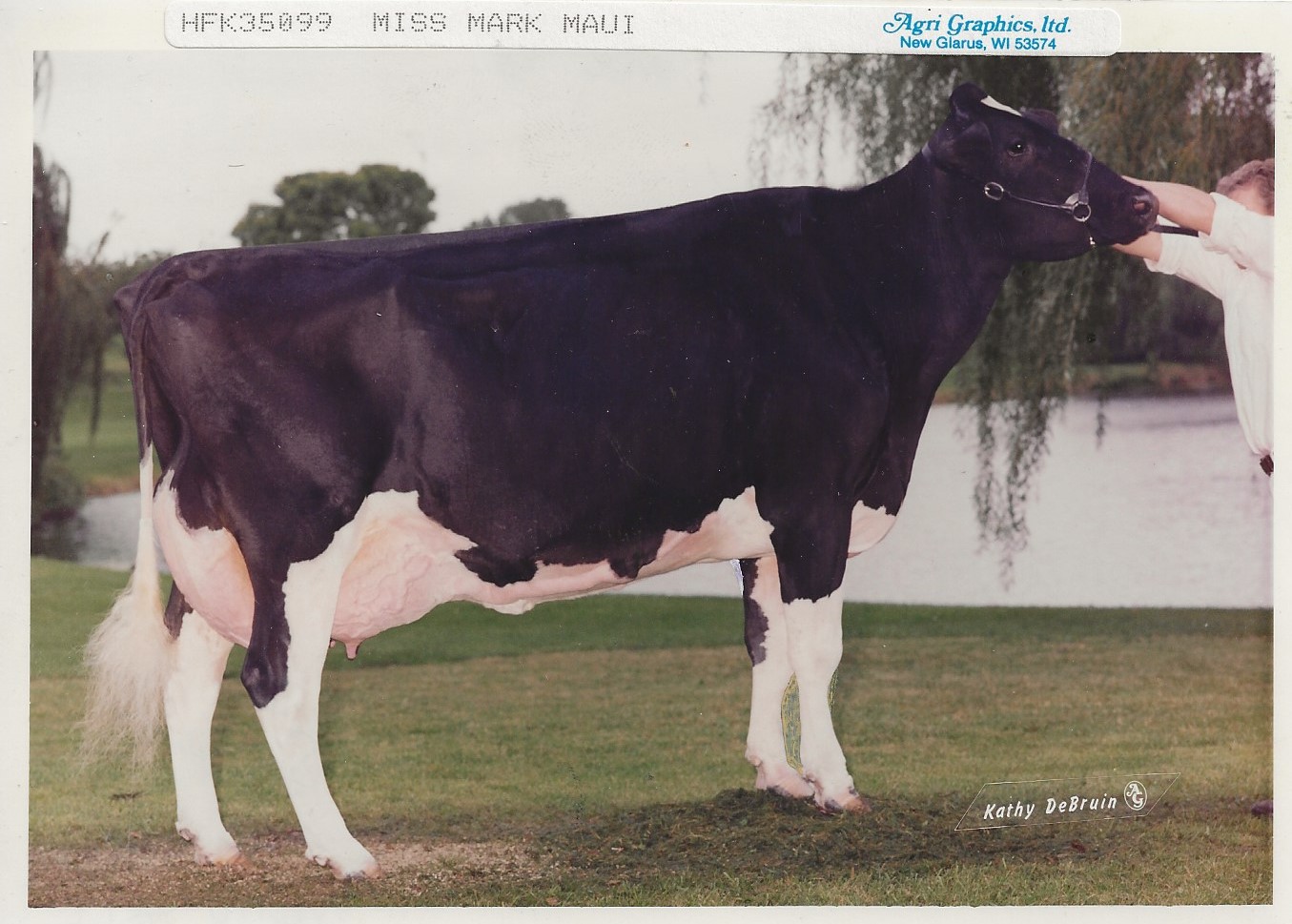
Miss Mark Maui EX-95-2E GMD DOM — the 1994 All-American Junior 2-Year-Old, showing the mammary quality and dairy character that would define her career. Sired by Chief Mark out of Gettinger Maggie EX-93 GMD DOM, she produced over 252,000 pounds of lifetime milk, flushed Excellent daughters by Lee, Rudolph, Durham, and Starbuck, and sent sons including Mr Millennium to AI. Owned by Kietzman, Sigwarth, and Breitbach of Iowa, she was the kind of Mark daughter breeders built entire cow families around. 

And the most consequential genetic river flowing from Chief Mark ran through a son named Mark CJ Gilbrook Grand.

The Goldwyn Connection

Grand’s name doesn’t ring bells with most modern breeders. But it should. Because Grand sired Shoremar James. And Shoremar James sired Braedale Goldwyn. 

In Goldwyn’s lineage were three crosses to Walkway Chief Mark: Shoremar James and Braedale Gypsy Grand were both by Mark CJ Gillbrook Grand, a Chief Mark son; while Gypsy’s maternal granddam was Sunnylodge Chief Vick (VG 2*), a Chief Mark daughter”. 

Three crosses. Three separate paths through one pedigree, all converging on a backup bull from Neoga, Illinois.

RF Goldwyn Hailey EX-97-5E 6 — two-time World Dairy Expo Grand Champion (2012, 2014) and one of only seven cows in Expo history to win the Grand title twice. Bred by R&F Livestock and Chilliwack Cattle Company, exhibited by Gen-Com Holsteins of Quebec, and pictured here at Madison in 2014 claiming her second crown. Three crosses of Walkway Chief Mark flow through the Goldwyn pedigree she carried into that ring — the backup bull from Neoga, under the lights at the Coliseum.

Goldwyn — bred by Braedale Holsteins at Cumberland, Ontario — became arguably the most decorated show sire in modern Holstein history. Premier Sire at the World Dairy Expo ten times. His daughters, RF Goldwyn Hailey (EX-97) and Eastside Lewisdale Gold Missy (EX-95) became the most famous show cows of their generation. By October 2018, he’d produced 3,415 Excellent daughters in Canada alone, according to Holstein Canada. Goldwyn died in 2008, just eight years old, but his genetics kept sweeping classes at Madison and the Royal for another decade and beyond. 
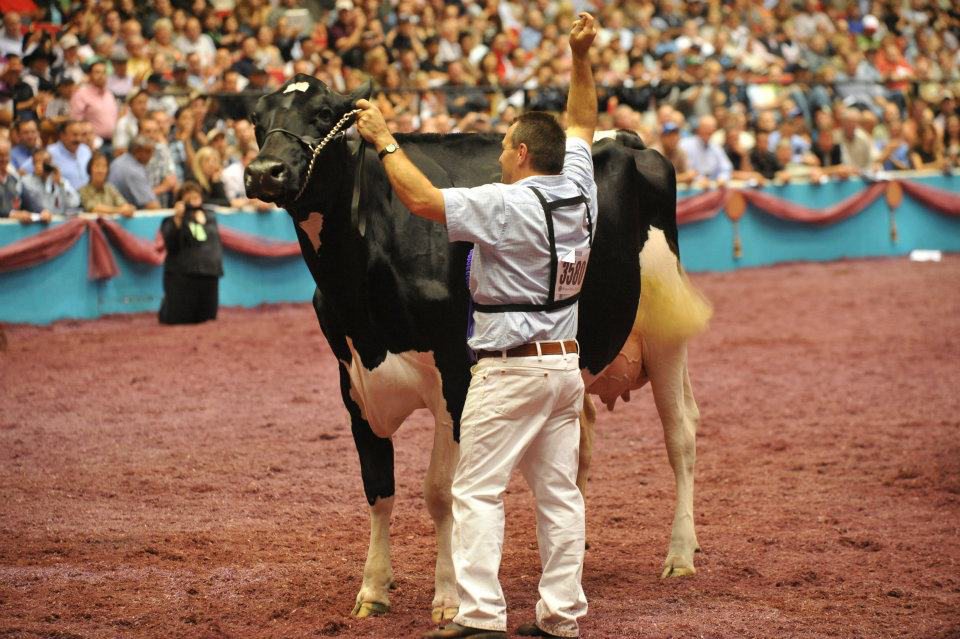
Eastside Lewisdale Gold Missy EX-95-2E 30 — Supreme Champion at both World Dairy Expo and the Royal Winter Fair in 2011, Holstein Canada Cow of the Year in 2012, and the $1.2 million cow who became the most expensive Holstein on the planet. Bred on Prince Edward Island by Eastside Holsteins and Lewisdale, she carried Goldwyn’s genetics — and through him, three crosses of Walkway Chief Mark — to the highest stage the breed has ever known.

Woven through all of it — three times in every Goldwyn pedigree — was Walkway Chief Mark.

The Supersire Empire

Chief Mark’s genetics didn’t just flow through the show ring.

Through maternal pedigree lines — including Jeanlu Louange Chief Mark (VG-87), a Chief Mark daughter deep in the maternal line — his influence reached Seagull-Bay Supersire, a Robust son bred by the Andersen family in American Falls, Idaho, and owned by Select Sires. 
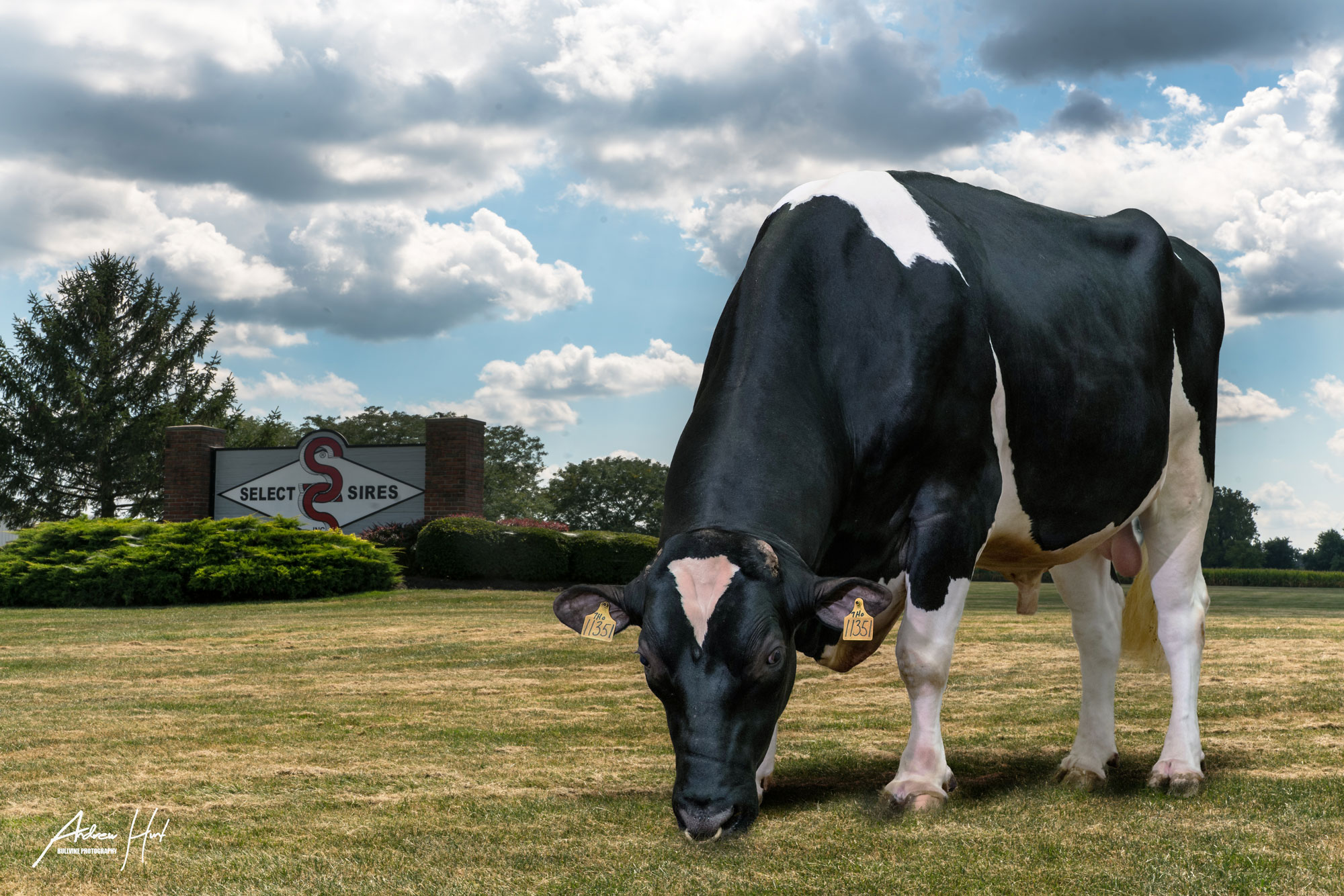
Seagull-Bay Supersire-ET EX-90-GM — grazing at Select Sires headquarters in Plain City, Ohio, where he stood as the breed’s No. 1 GTPI sire and sold over one million doses of semen. A Robust son bred by the Andersen family in American Falls, Idaho, Supersire’s maternal line traces back through Wesswood-HC Rudy Missy — the $8,100 “auction reject” who became 2014 Global Cow of the Year — and further still to Jeanlu Louange Chief Mark VG-87, a Chief Mark daughter quietly anchoring the empire from generations back.

Supersire debuted as the breed’s No. 1 GTPI sire in April 2015 and reigned as the breed leader for four consecutive genetic evaluations. He’d scored 2530 gTPI as a genomic young sire back in December 2012; six years and 33,087 daughters later, his proven TPI came in at 2518. Holstein International called it “right in the DNA bull’s eye” and named him a “milk transmitter par excellence” — the world’s 55th millionaire sire and Select Sires’ eleventh bull to sell one million units of semen. 

“The beautiful thing about SUPERSIRE daughters is they outproduce the herd while doing it in a healthy fashion,” said Rick VerBeek, Holstein sire analyst at Select Sires. “SUPERSIRE should be regarded as one of the all-time great profit generators of his generation!” 

In 2019, more than 60 percent of bulls on the Select Sires active lineup carried Supersire in their pedigree. Sixty percent of an entire AI organization’s catalog, tracing back through a genetic chain that started with a second-choice bull and a phone call about a dead brother. 

Supersire passed away in late 2021. His legacy was already secure. But buried in that pedigree — quiet, easy to miss, generations back on the maternal side — was the ghost of Walkway Chief Mark, still shaping the breed he’d accidentally been invited to improve. 

Twenty-Five Times

And then came Lambda.

In 2024, an analysis that made even seasoned geneticists pause. They’d been tracing the pedigree of Farnear Delta-Lambda — one of the most influential contemporary sires in the global breed, the bull behind Siemers Paris 27856 EX-91, Global Cow of the Year in 2023, and her high-ranking son Parfect. 

When they finished mapping Lambda’s ancestry, they found Walkway Chief Mark appeared twenty-five times.  Twenty-five separate lines of descent converging in a single pedigree, all flowing back to a replacement bull born on a modest Illinois farm in June of 1978.
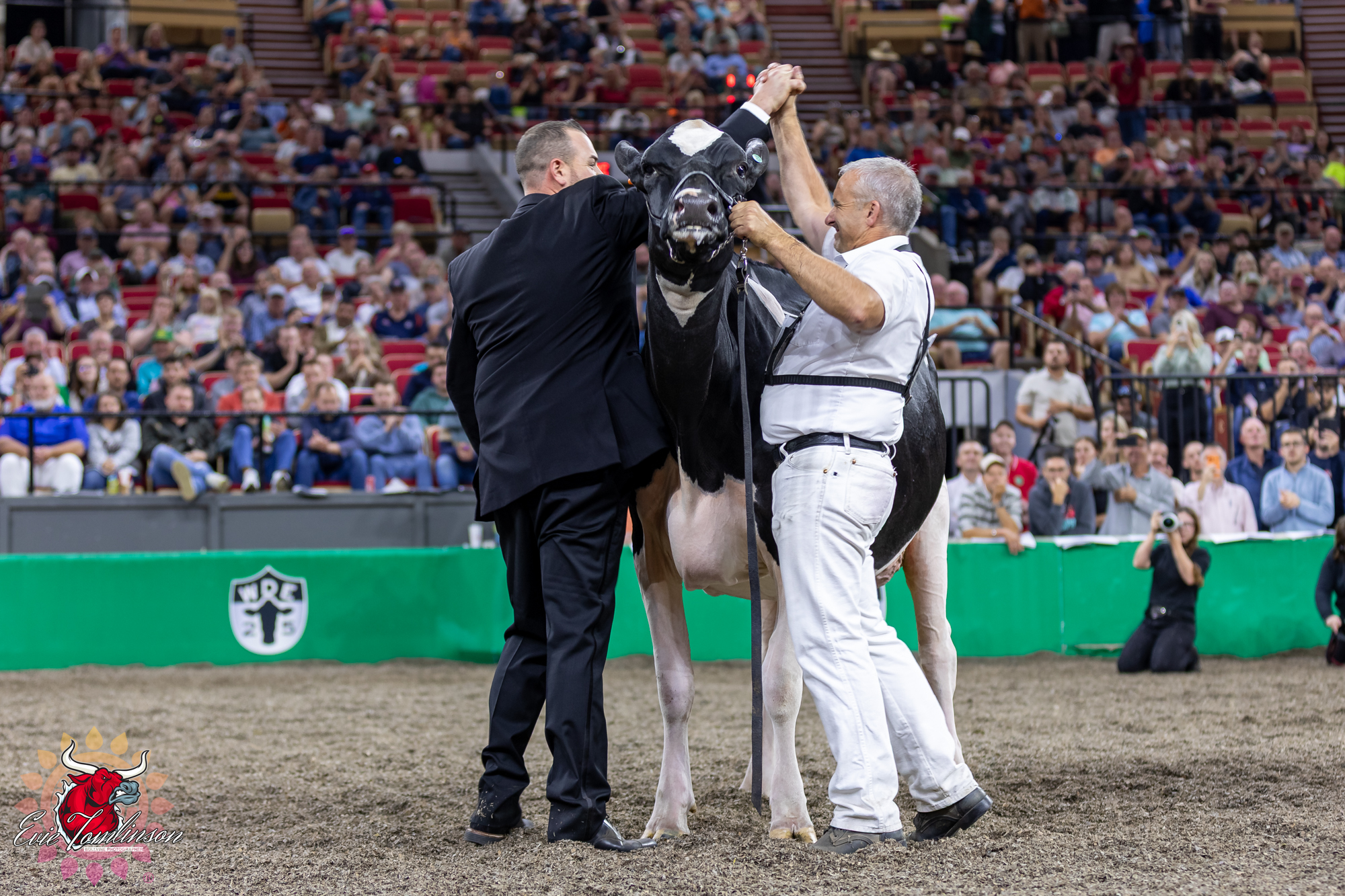
West-Adub Lambda Sadie — Intermediate Champion and Reserve Grand Champion of the 2025 International Holstein Show at World Dairy Expo, exhibited by Butlerview Farm of Chebanse, Illinois. Sired by Farnear Delta-Lambda — the bull who carries Walkway Chief Mark 25 times in his pedigree — she stood on the red shavings at Madison just 100 miles from Neoga, proof that a backup bull’s genetic echo is still shaping champions nearly five decades later.

Holstein International called it “the righteous revenge of Walkway Chief Mark.” Together with Lambda mania, they wrote, “we can also talk about Mark mania”. 

Forty-seven years after a dead brother opened the door, the backup plan’s roar is louder than ever.

The Ghost at 4 AM

Chief Mark’s story doesn’t come with a tidy ending. There’s no dispersal sale to narrate, no final show-ring walk, no sunset-lit portrait. His semen was collected, stored, and distributed across the globe, and his physical life passed quietly while his genetic life was only beginning its exponential expansion. The NAAB database lists him as “Inactive” — a status that says everything about bureaucracy and nothing about legacy. 

Whether Foster Walk lived to see the full scope of what his backup bull built, the record doesn’t tell us. But his eye for diamonds in the rough — that eye is now validated in 57,654 daughters, seven percent of a continental genome, and 25 appearances in the pedigree of one of the breed’s most influential modern sires. 

What the record also tells us: three crosses in the pedigree of the most decorated show sire in modern Holstein history. A Chief Mark daughter deep in the maternal line of a millionaire sire who reshaped global dairy genetics. A hidden lethal mutation — half a million dead calves — was identified and neutralized because someone had the foresight to sequence his DNA back in 2009. And a reputation as an udder improver that, decades and multiple base changes later, still echoes in the mammary quality of his descendants’ descendants’ descendants. 

He arrived as a replacement. He became irreplaceable.

Every breeding decision echoes forward through time. Most of those echoes fade within a generation or two — diluted, selected against, bred out. Chief Mark’s didn’t fade. It amplified. Seven percent of a continental genome, a frequency so deep it has become the baseline hum of the breed itself. The backup plan from Neoga, Illinois, built an empire nobody saw coming. 

Next time you’re walking your barn before dawn — flashlight cutting through the steam rising off a hundred backs, bulk tank humming in the parlor, a fresh cow somewhere letting down for the first time — look at the udders. Look at the attachments. Look at the dairy character carved into the ribs and flanks of your best animals. You’re looking at Foster Walk’s diamond in the rough, still paying dividends nearly five decades and fifty-seven thousand daughters later. Still proving what every breeder who ever took a chance on an unlikely animal already knows in their bones: in this business, the ones who change everything aren’t always the ones you planned on.

Key Takeaways:

  • Walkway Chief Mark started as the backup bull from Foster Walk’s Neoga, Illinois herd, sampled only after his brother Monroe died — but his genes now account for about 7% of every Holstein on the continent.
  • He gave breeders one of the biggest trade‑offs in Holstein history: daughters with era‑setting udders and some of the weakest relative feet and legs, forcing anyone who used him to “protect the mating” or live with the consequences.
  • Together with his sire Pawnee Farm Arlinda Chief, he helped define modern Holstein genetics on both sides of the ledger — huge gains in type and production, and the APAF1 lethal mutation later linked to roughly 500,000 spontaneous abortions worldwide before it was identified and managed. ​
  • His blood now threads through three confirmed crosses in Braedale Goldwyn’s pedigree, deep in the maternal line of Seagull‑Bay Supersire, and an astonishing 25 times in Farnear Delta‑Lambda’s ancestry, tying one small Illinois farm to many of today’s most influential sires.
  • The piece leaves readers in a pre‑dawn barn with a simple realization: when you study the best udders in your herd today, you’re almost certainly looking at the long shadow of a once‑overlooked bull from Neoga.

Executive Summary: 

Walkway Chief Mark was never meant to be a legend; he was the backup bull from Foster Walk’s Neoga, Illinois herd, sampled only because his brother Monroe died — yet his DNA now sits in roughly seven percent of every Holstein you milk. His proof told a story every breeder understands: daughters with era-changing udders riding on some of the weakest relative feet and legs in the book, forcing people to “protect the mating” if they wanted the magic without the wreckage below the hocks. The article walks through that reality in the barn, then zooms out to show how Chief Mark and his sire Pawnee Farm Arlinda Chief helped build the modern Holstein genome — for better (udder quality, production, show-ring type) and for worse, through the APAF1 mutation tied to an estimated 500,000 spontaneous abortions before scientists pinned it down in 2011. From there, it follows his blood into names everyone knows today: three confirmed crosses in Braedale Goldwyn’s pedigree, deep maternal influence in Seagull-Bay Supersire, and an almost unbelievable 25 Chief Mark appearances in Farnear Delta-Lambda’s ancestry. Along the way, Foster Walk steps out of the shadows as a real dairyman — a guy whose Walkway cows showed up in Holstein World ads and local production records long before anyone dreamed of genomic percentiles. It all ends back in a quiet 4 a.m. barn, inviting readers to study the best udders in their own string and realize that, whether they planned it or not, they’re still working with a once-forgotten bull from Neoga whose influence just won’t let go.

Complete references and supporting documentation are available upon request by contacting the editorial team at editor@thebullvine.com.

Continue the Story

  • Charlie Will: A Career Spent at the Top of the Chart – Experience the era through the eyes of the man who risked his early reputation on a neighbor’s backup bull, proving that the breed’s greatest genetic leaps often come from analysts with the guts to trust their eye.
  • Pawnee Farm Arlinda Chief – Genetic Giant – Step back into the world that birthed an empire and explore the massive shadow cast by Mark’s sire, a bull who fundamentally rewrote the Holstein blueprint and set the stage for a global genomic revolution.
  • Durham vs. Goldwyn: A Clash of Two Titans – Trace the lineage from Foster Walk’s quiet Illinois farm to the bright lights of Madison, where Mark’s genetic influence finally found its ultimate expression in a show-ring rivalry that defined a whole generation of breeders.

The Sunday Read Dairy Professionals Don’t Skip.

Every week, thousands of producers, breeders, and industry insiders open Bullvine Weekly for genetics insights, market shifts, and profit strategies they won’t find anywhere else. One email. Five minutes. Smarter decisions all week.

NewsSubscribe
First
Last
Consent

The Maternal Mastermind: How Douglas Dunton’s Breeding Philosophy Revolutionized Holstein Genetics

How did one Canadian farmer’s obsession with “breeding warm” create maternal lines so powerful they still dominate Holstein genetics eight decades later?

Douglas Dunton (center) with sons Earl (left) and Ralph (right) at Glenvue Farm in Brampton, Ontario. This multi-generational partnership earned their second Master Breeder shield in 1964 as D.S. Dunton & Sons, exemplifying the family commitment to developing influential Holstein maternal lines that would shape the breed worldwide.

Douglas Dunton wasn’t just another successful Holstein breeder—he was a genetic architect who developed extraordinary maternal lines that revolutionized dairy cattle breeding worldwide. His methodical linebreeding approach and emphasis on balanced traits created cow families that anchored some of the most influential sires in Holstein history, including Pawnee Farm Arlinda Chief and Round Oak Rag Apple Elevation. His breeding philosophy offers valuable lessons for today’s dairy producers navigating genomic selection and seeking to build profitable, sustainable herds.

If you’re milking Holsteins today, you benefit from Douglas Dunton’s work, whether you realize it or not. While browsing pedigrees at a recent dairy show, I noticed “Glenvue” appearing repeatedly in the deep ancestry of today’s elite animals. This sent me investigating the man behind those genetics, and what I discovered was eye-opening.

Dunton wasn’t just another successful Canadian Holstein breeder—he was a visionary who developed transmitting maternal lines so potent that the late Dave Morrow of Holstein-Friesian World called him “Canada’s greatest breeder of brood cows.” Many would extend this designation further, considering him perhaps the most excellent breeder of transmitting dams in Holstein’s history.

What makes Dunton’s story especially relevant today isn’t just his historical significance. His approach to linebreeding, his patience with developing cow families, and his focus on balanced traits offer valuable lessons for modern breeders navigating genomic selection and seeking to build sustainable genetic programs. Let’s explore how this mid-20th-century breeder created a foundation that still influences dairy profitability today.

Glenvue Farm residence in Brampton, Ontario, home of Douglas Stewart Dunton and his family. This historic property, established when Dunton’s grandfather James arrived in Canada in 1828, became the birthplace of some of Holstein breeding’s most influential maternal lines. From this farmhouse, Dunton developed cow families that would impact dairy genetics worldwide through legendary sires like Pawnee Farm Arlinda Chief and Round Oak Rag Apple Elevation.

BUILDING GREATNESS: DUNTON’S JOURNEY FROM SHORTHORNS TO HOLSTEIN LEGENDS

Douglas Dunton’s Holstein journey began in 1920 when he enrolled in a dairy short course by the Ontario Department of Agriculture. Until then, he and his father had been cross-breeding with Dual Purpose Shorthorns with limited success on their family farm, established in 1828 when Dunton’s grandfather James arrived in Canada as a United Empire Loyalist.

During the course, Dunton visited several impressive Holstein herds that inspired him to purchase his first Holstein cow. He was convinced when she produced 80 pounds of milk daily—twice what his Shorthorns gave. This dramatic production difference prompted Dunton and his father to purchase four more Holsteins, with three coming from Lorne Davidson’s Bruach Farm at Meadowvale. Two of these cows—Bruach Noelle and Bruach Luella Acme—became the foundation for what would become the legendary Glenvue herd.

You have to appreciate what breeding success meant in that era. When Dunton began breeding Holsteins, there was no classification system, genomic testing, or production indices—none of the tools you rely on today. Without seeing an animal’s ancestors directly to evaluate type and transmission patterns, breeders were essentially working blind. Yet despite these limitations, Dunton developed a remarkably effective system for selecting breeding stock through careful observation and strategic matings.

The Dunton family’s commitment to Holstein breeding spanned generations. When sons Ralph and Earl joined as partners in the 1950s, they earned their second Master Breeder shield in 1964 as D.S. Dunton & Sons. Urban sprawl forced the dispersal of the original herd in 1966, but Ralph and their son Jim retained the Glenvue prefix and relocated to Inglewood, Ontario. Starting with a new foundation, they earned a third Master Breeder shield in 1987—a record matched only by the Shivelys of Forest Lee Farm. Has your family achieved similar multi-generational breeding success? It’s worth considering what principles allow such sustained excellence across decades.

MASTERING “BREEDING WARM”: WHY DUNTON’S LINEBREEDING STRATEGY STILL MATTERS

At the heart of Dunton’s approach was his unwavering belief in what he called “breeding warm”—strategic linebreeding that stands in fascinating contrast to the outcross mentality that often dominates commercial breeding today. From the outset, he focused intensely on the King Tortilla Acme bloodline, combining it with Rag Apple genetics to create intriguing genetic patterns throughout his herd.

This approach parallels modern genomic mating programs that use relationship matrices to balance genetic progress with inbreeding management, though Dunton accomplished this through phenotypic selection rather than SNP markers. When asked about outcrossing, Dunton famously stated that he had tried an outcross bull only once, and while “he didn’t do much harm, neither did he do much good.” That pragmatic assessment still resonates with breeders evaluating complementary matings today.

Table 1: Dunton’s Historical Breeding Approach vs. Modern Methods

Breeding AspectDunton’s Approach (1930s-1960s)Modern Equivalent (2025)
Genetic Selection“Breeding warm” – strategic linebreeding focused on King Toitilla Acme and Rag Apple bloodlinesGenomic mating programs using SNP markers to optimize genetic gain while controlling inbreeding at molecular level
Type vs. Production Balance“It takes longer to breed type than production, but once you get type, it is not so difficult to get higher production”Balanced breeding indexes (TPI, LPI, NM$) weighting both type and production traits
Selection TimelinePatient development of females; two-year-olds not pushed (1,000 lbs milk monthly considered satisfactory)Accelerated generation intervals with genomic selection of young animals
Beyond-Pedigree TraitsEmphasized temperament, milking ease, and longevity – “factors not mentioned in pedigrees”Comprehensive genomic evaluations for health, fertility, and functional traits

Perhaps most revolutionary for his era was Dunton’s emphasis on type overproduction at a time when many breeders pursued milk records at all costs. His conviction that “it takes longer to breed type than production, but once you get type, it is not so difficult to get higher production” reveals his understanding of the genetic architecture underlying these traits. This philosophy anticipated today’s balanced breeding approach using comprehensive merit indices.

Beyond classification traits, Dunton prioritized three practical factors often overlooked in pedigrees of his era: temperament, milking ease, and longevity. Does this sound familiar? These are precisely the functional traits modern breeding programs value for lifetime profitability! Dunton was selected for cow comfort, milk ability, and productive life decades before these became formalized traits in our evaluation systems.

THE FANTASTIC FOUR: THE COW FAMILIES THAT CHANGED HOLSTEIN HISTORY

Every great breeding program starts with exceptional foundation females, and Dunton’s was centered around four extraordinary cows: A.B.C. Inka May EX, Glenvue Nettie Jemima EX-13, Glenvue Noelle Inka EX-4, and Glenvue Jean Inka B VG-2. These weren’t just show winners—they were genetic powerhouses whose influence continues reverberating through Holstein breeding today.

Table 2: Influential Glenvue Foundation Females

FemaleClassificationNotable OffspringKey Contribution to Breed
A.B.C. Inka MayEXA.B.C. Reflection Sovereign EX-ExtraDam of influential sire for both type and production; All-Canadian four-year-old (1947); Record: 24,141 lbs milk, 1,128 lbs fat
Glenvue Nettie JemimaEX-13Rosafe Citation R. EX-Extra, Rosafe Centurion EX-Extra, Rosafe Magician EX-GM, Rosafe Signet EX-ST, Rosafe Magic EX-STAll-Canadian aged cow (1954); Dam of six Excellent offspring; Maternal connection to Round Oak Rag Apple Elevation
Glenvue Noelle InkaEX-4Elmcroft Voyageur M. VGRoyal grand champion (1947); All-Canadian and All-American aged cow (1947)
Glenvue Jean Inka B.VG-2A.B.C. Bonnie Renown VG-4, Rosafe Shamrock Rosamond VG-4Maternal line connection to Pawnee Farm Arlinda Chief through offspring

What’s remarkable is that all four descended from those initial purchases from Lorne Davidson. Talk about maximizing your investment! These foundation females became some of Holstein’s most influential brood cows, demonstrating Dunton’s knack for identifying, developing, and transmitting maternal lines.

A.B.C. Inka May: The $400 Twist of Fate

A.B.C. Inka May (EX), photographed after becoming All-Canadian four-year-old in 1947. This remarkable daughter of Inka Supreme Reflection exemplifies Dunton’s breeding genius despite never residing in his herd. Bred by Dunton but born at A.B.C. Farms following the sale of her pregnant dam for $400, she produced 1,128 lbs of butterfat as a four-year-old. Her greatest contribution came through her son A.B.C. Reflection Sovereign (EX), considered by many to be one of the most influential sires in Holstein history. A.B.C. Inka May demonstrates how Dunton’s genetic influence sometimes traveled through unexpected channels to reshape the breed.

The story of A.B.C. Inka May reads like a dairy cattle soap opera! In March 1943, Dunton purchased Temple Farm May VG-2 from R.S. MacKinnon. While Dunton was changing clothes, Elgin Armstrong of A.B.C. Farm stopped by Glenvue with his herdsman Cliff Chant and Jack Fraser. Fraser spotted the pregnant May in a box stall and quickly purchased her from Dunton for $400, selling her to Armstrong before the day ended.

Dunton agreed to keep the cow through her calving, and on March 10, 1943, she delivered a heifer calf by Inka Supreme Reflection. Since Armstrong now owned May, the calf was registered as A.B.C. Inka May under A.B.C. Farms’ prefix. This “one that got away” became an All-Canadian four-year-old in 1947 and produced 24,141 lbs of milk with 1,128 lbs of fat that same year.

Her most significant contribution was her son A.B.C. Reflection Sovereign EX-Extra by Montvic Rag Apple Sovereign, who became one of the most influential sires of all time for both type and production. Have you ever sold an animal that went on to greatness elsewhere? Dunton’s experience shows that your breeding program’s most significant impact is sometimes through unexpected channels.

The Get of Inka Supreme Reflection (EX), Honourable Mention All-Canadian, 1947. From left: Glenvue Inka Rose Marie (VG), Glenvue Noelle Inka (EX), Glenvue Carrie Inka (GP), and A.B.C. Inka May (EX). These daughters of Dunton’s cornerstone herd sire demonstrate his skill in developing consistently superior maternal lines. Two of these females—Glenvue Noelle Inka and A.B.C. Inka May—would become foundation cows whose genetic influence through sons like A.B.C. Reflection Sovereign and Elmcroft Voyageur M. continues to shape modern Holstein breeding eight decades later.

Glenvue Nettie Jemima: The Ultimate Brood Cow

Glenvue Nettie Jemima (EX-13*), photographed after being named All-Canadian aged cow in 1954. This daughter of Strathaven Top Grade (VG) from the Bruach Noelle family epitomizes Dunton’s breeding genius, producing over 200,000 lbs of milk in her lifetime. As one of the breed’s most influential brood cows, she produced six Excellent offspring, including sons Rosafe Magician, Rosafe Centurion, Rosafe Signet, and Rosafe Citation R. – all bulls of “universal impact.” Through her son Centurion, Nettie created the genetic pathway to Round Oak Rag Apple Elevation, demonstrating how Dunton’s maternal lines shaped Holstein genetics for generations to come.

If you’re looking for the ultimate brood cow, Glenvue Nettie Jemima EX-13 deserves her own Hall of Fame wing. A daughter of Strathaven Top Grade VG from Glenvue Nancy Palmyra VG-2 (tracing back to Bruach Noelle), she wasn’t just good—she was spectacular. Nettie became an All-Canadian-aged cow in 1954, but her real legacy came through her offspring.

She produced six Excellent offspring, including perhaps the most illustrious list of sons in Holstein history: Rosafe Citation R. EX-Extra, Rosafe Centurion EX-Extra, Rosafe Magician EX-GM, Rosafe Signet EX-ST, and Rosafe Magic EX-ST. That’s not lucky breeding—that’s a cow that consistently stamped her offspring with superior genetics.

Through her son Rosafe Centurion, Nettie’s bloodline reached Round Oak Rag Apple Elevation. Centurion sired Glenafton Gaiety, who sired the maternal grand-dam of Elevation. This shows how great maternal genetics can travel through multiple generations without losing potency—a lesson worth considering when evaluating female lines in your herd.

Round Oak Rag Apple Elevation (EX-GM), photographed in 1965, stands as one of the most influential Holstein sires of the 20th century. His genetic pathway traces back to Douglas Dunton’s breeding program through Rosafe Centurion, who sired Glenafton Gaiety, the bull that sired Elevation’s maternal granddam. Together with Pawnee Farm Arlinda Chief, Elevation’s genetics revolutionized Holstein breeding worldwide, primarily through his son Hanoverhill Starbuck. His balanced conformation and strong transmitting ability exemplify the “breeding warm” philosophy that made Dunton’s Glenvue program so influential across generations.

CONNECTING TO GREATNESS: HOW DUNTON’S BREEDING SHAPED LEGENDARY SIRES

The most concrete testimony to Dunton’s breeding genius lies in his connection to two transformational Holstein sires of the 20th century: Pawnee Farm Arlinda Chief and Round Oak Rag Apple Elevation. These iconic bulls, whose genetics pervade virtually every modern Holstein pedigree, trace significant genetic influence through Dunton’s breeding program.

Table 3: Genetic Pathways from Glenvue to Industry-Changing Sires

Influential SireDirect Dunton ConnectionPathway to Industry Impact
Pawnee Farm Arlinda ChiefGlenvue Clipper VG (bred by Dunton)Glenvue Clipper → Pawnee Farm Glenvue Beauty EX → Pawnee Farm Arlinda Chief EX-GM → S-W-D Valiant EX-GM and Walkway Chief Mark VG-GM
Round Oak Rag Apple ElevationRosafe Centurion EX-Extra (from Glenvue Nettie Jemima)Rosafe Centurion → Glenafton Gaiety → (maternal granddam of) Round Oak Rag Apple Elevation EX-GM → Hanoverhill Starbuck EX-Extra

Chief Connection: From Nebraska to Breed-Wide Impact

Pawnee Farm Arlinda Chief (EX-GM), photographed in his prime. Born May 9, 1962, this legendary bull became one of the most influential production sires in Holstein history with his first proof showing +1982 pounds of milk. His maternal lineage traces directly to Douglas Dunton’s breeding program through his dam Pawnee Farm Glenvue Beauty EX, who was sired by Dunton’s bull Glenvue Clipper. Chief’s genetics spread worldwide through sons like Walkway Chief Mark and S-W-D Valiant, demonstrating how Dunton’s focus on maternal line development created multi-generational impact. His descendants appear in virtually every modern Holstein pedigree, making him one of the most significant bulls of the 20th century.

The pathway from Glenvue to Chief is straightforward and illustrates the sometimes serendipitous nature of genetic influence. Dunton bred Glenvue Clipper VG, a son of Rosafe Prefect EX and Glenvue Colleen Monogram GP, who would go on to sire Pawnee Farm Glenvue Beauty EX, who became the dam of Pawnee Farm Arlinda Chief EX-GM when bred to Pawnee Farm Reflection Admiral.

The story of how Clipper’s genetics reached Chief shows how breeding decisions can have unexpected consequences. Lester Fishler, a Nebraska breeder focused on “strictly Rag Apple” genetics, purchased Clipper from Dunton in 1956. Despite Clipper’s impressive physical stature—he eventually weighed a massive 2,880 pounds at slaughter, so tall that “his head touched the ground from the slaughterhouse rail”—Fishler eventually sent him to slaughter because “his daughters were low testers.”

Table 4: Glenvue Clipper’s Production Impact on Daughters

Animal GroupMilk Production (lbs)Butterfat %Butterfat (lbs)Net Change
Clipper Daughters (average of 8)18,5043.40%629+3,101 lbs milk, -0.26% butterfat, +64 lbs fat
Dams of Clipper Daughters15,4033.66%565Baseline

Looking at this data, would you have kept Clipper in your breeding program? While his daughters showed a substantial milk increase of 3,101 pounds, their butterfat percentage dropped enough to make him undesirable to AI organizations in an era obsessed with component percentages. Today’s more comprehensive economic indices likely would have valued Clipper’s milk volume boost and the structural correctness he transmitted.

Despite Clipper’s fate, his genetic legacy continued through an exceptional daughter, Pawnee Farm Glenvue Beauty EX, out of Pawnee Farm Man-O-War Betty GP-84. When Fishler dispersed his herd in 1962, Beauty was pregnant to Pawnee Farm Reflection Admiral and was purchased for $4,300 by Wally Lindskoog of Arlinda Farms in California. The resulting calf, born May 9, 1962, was Pawnee Farm Arlinda Chief, who would become one of the most influential production sires in Holstein history, with his first summary showing a remarkable +1982 pounds of milk, +79 pounds of fat and +0.61 type.

Chief’s influence spread through sons such as Walkway Chief Mark, S-W-D Valiant, Glendell Arlinda Chief, and Milu Betty Ivanhoe Chief, creating a genetic legacy that continues to influence modern bloodlines through descendants like Donnandale Skychief, described as “one of the most highly acclaimed North American sires” at the turn of the century with eleven A.B.C. crosses in his pedigree.

FROM DUNTON TO COMESTAR: MATERNAL LINE MASTERS ACROSS GENERATIONS

Marc Comtois (far right) and the Comestar family accepting the 2022 Cow of the Year award for Comestar Lamadona Doorman EX-94 at the Holstein Canada convention. This prestigious recognition highlights the continued excellence of the Laurie Sheik maternal line, exemplifying how Comestar’s balanced breeding approach—like Dunton’s maternal line focus generations earlier—creates lasting genetic impact. Lamadona represents the 12th generation of this remarkable cow family, which has produced multiple millionaire sires and continues to influence Holstein populations worldwide through sons like Comestar Lemagic.
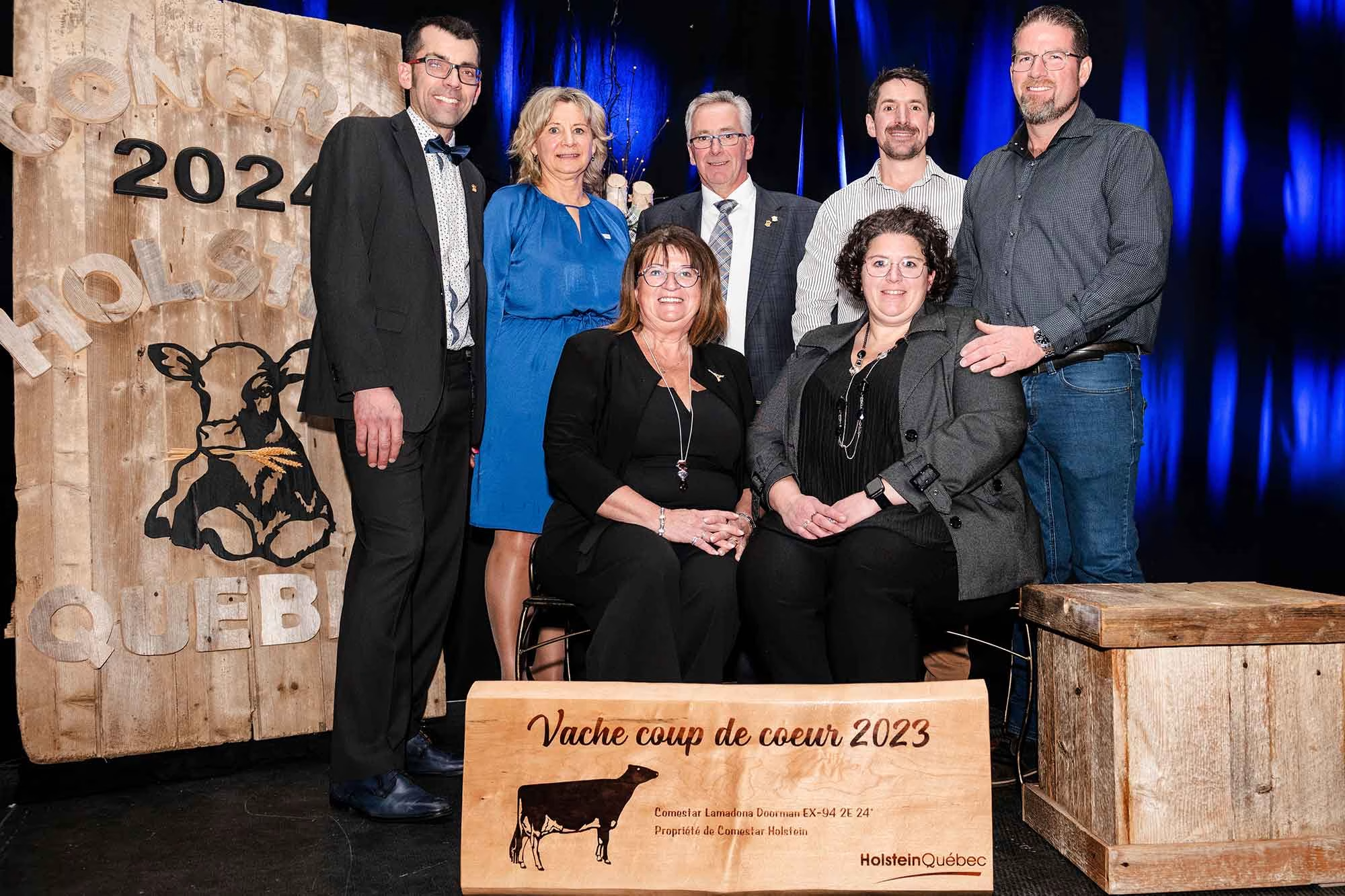
Marc Comtois (center back row) and the Comestar family accepting the 2023 Cow of the Year award for Comestar Lamadona Doorman EX-94 at the Holstein Quebec convention. This prestigious recognition highlights the continued excellence of the Laurie Sheik maternal line, exemplifying how Comestar’s balanced breeding approach—like Dunton’s maternal line focus generations earlier—creates lasting genetic impact. Lamadona represents the 12th generation of this remarkable cow family, which has produced multiple millionaire sires and continues to influence Holstein populations worldwide through sons like Comestar Lemagic.

When discussing extraordinary maternal line builders in Holstein history, a fascinating parallel emerges between Douglas Dunton’s mid-century achievements and the more contemporary success of Marc Comtois and Comestar Holsteins. Though separated by decades, these two Canadian breeders share a remarkably similar approach to developing influential cow families—albeit with distinct applications reflecting their respective eras.

Like Dunton, Marc Comtois built his program around exceptional foundation females, most notably Comestar Laurie Sheik VG-88 27*. The parallels between these two breeders’ approaches are striking. Both demonstrated an uncanny ability to identify foundation females with extraordinary transmitting power. Just as Dunton’s quartet of foundation cows (A.B.C. Inka May, Glenvue Nettie Jemima, Glenvue Noelle Inka, and Glenvue Jean Inka B) revolutionized the breed through their descendants, Laurie Sheik’s influence has been equally profound since her birth in 1986.

Marc and France Comtois have always been firmly committed to a philosophy of logical, balanced breeding. This echoes Dunton’s balanced approach to selection, with both breeders prioritizing conformation while maintaining production—though their methodologies reflect their different eras.

Contrasting Breeding Approaches: Linebreeding vs. Strategic Outcrossing

A key difference emerges in their approaches to genetic concentration. While Dunton was a staunch advocate of strategic linebreeding—his “breeding warm” philosophy—Comtois has taken a different approach with the Laurie Sheik family. Rather than intensifying specific bloodlines, Comestar has excelled at identifying complementary crosses that enhance the family’s strengths while introducing new genetic diversity.

Their “golden cross” moment came when Comtois bred Laurie Sheik to Blackstar, the number one bull in the U.S. at the time. This produced multiple exceptional animals, including Comestar L’or Black (dam of Outside), Comestar Laura Black (dam of Lee and Lheros), and Comestar Lausan Black (dam of Stormatic). This approach of seeking complementary outcrosses differs from Dunton’s methodology but achieves similar results regarding influential progeny.

“A trademark of these bulls was that they had strong conformation and good vitality with Leader, Lee, Lheros, and Outside each producing over a million doses of semen! Four millionaire sires from the same family certainly distinguish the Laurie Sheiks!”. This parallels the impact of Dunton’s breeding program, which similarly produced influential sires that reshaped the breed.

Multi-Generational Influence: The Common Thread

The most striking similarity between these breeders is the remarkable staying power of their maternal lines. Just as Glenvue genetics continue to “bubble” through elite Holstein pedigrees decades after Dunton’s original breeding work, the Laurie Sheik family remains at the forefront of the breed nearly four decades after her birth.

Comestar Lamadona Doorman EX-94, Canada’s Cow of the Year 2022, represents the Laurie Sheik family’s continuing evolution and influence. Now, the grandsons and great-grandsons are creating a new surge of excitement. Bulls like Comestar Lemagic (Chief x Impression) exemplify the family’s continued relevance in today’s genomic era—12 generations after Laurie Sheik herself.

This generational persistence mirrors what we’ve seen with Dunton’s influence. However, Comestar has had the advantage of modern breeding technologies, marketing opportunities, and global embryo distribution channels that weren’t available during Dunton’s era. Indeed, the spread of Laurie Sheik genetics to leading herds worldwide, including developing a European branch through the Pussemier family in Belgium, showcases how modern reproductive technologies have expanded the potential reach of exceptional maternal lines.

Different Eras, Similar Principles

If Dunton were breeding today, he might appreciate the Comestar approach. Both breeders have shown a commitment to long-term vision and balanced breeding goals. Both recognized that chasing the latest trends or highest numbers isn’t sufficient for creating lasting impact. And both have demonstrated remarkable skill in identifying and developing the kinds of maternal lines that breed actual generation after generation.

Marc Comtois, reflecting the needs of the modern era, has placed greater emphasis on showcasing his genetics through the show ring and high-profile marketing than Dunton did in his time. The success of animals like Comestar Lautamie Titanic (2nd Jr. 2-Year-Old at the Royal Winter Fair and Canada’s #1 LPI cow) demonstrates how Comestar has balanced index merit with show ring appeal—something that wasn’t as critical in Dunton’s era before the global marketing of genetics became so sophisticated.

Yet despite these differences, both breeders share a fundamental understanding that great maternal lines are the cornerstone of breed improvement. Whether through Dunton’s strategic linebreeding or Comtois’s complementary outcrossing, both have demonstrated exceptional skill in developing cow families that reliably transmit their superior qualities across generations.

For today’s breeders, these parallel success stories across different eras reinforce a timeless truth: regardless of the technological tools available, identifying and developing superior maternal lines remains the surest path to lasting influence in Holstein breeding. The legacies of both Dunton and Comtois challenge us to look beyond individual animals to consider how we build families that will influence the breed for future generations.

APPLYING DUNTON’S PRINCIPLES TODAY: WHAT THIS MEANS FOR YOUR BREEDING PROGRAM

How might Douglas Dunton approach breeding in today’s genomic era, and what lessons can you extract from his methodical approach? While the technological landscape has transformed dramatically since Dunton’s time, the fundamental genetic principles he intuitively understood remain unchanged.

Balance Technical Tools with Breeder Intuition

Dunton’s emphasis on linebreeding—carefully concentrating desirable genetics while managing inbreeding—finds modern expression in genomic mating programs that use SNP markers to optimize genetic gain while controlling inbreeding at the molecular level. The analytical tools have changed, but the genetic principles remain remarkably similar.

Are you balancing the power of genomic data with breeder observation in your herd? Consider how Dunton would approach today’s breeding landscape—he’d likely embrace genomics while maintaining his focus on seeing the whole animal and understanding family patterns.

Value Development Time for Young Animals

Dunton’s patience in developing his program, allowing slower-maturing animals time to express their full genetic potential, offers a valuable counterbalance to the acceleration of generation intervals in the genomic era. His two-year-olds were never pushed—if they produced 1,000 pounds of milk monthly, that satisfied him.

Are you giving promising young animals enough time to develop or making culling decisions too quickly based on first-lactation performance in your operation? Dunton’s success suggests there’s value in patience with genetically promising animals that may need time to express their full potential.

Building Maternal Power Remains Essential

Perhaps most relevant to your breeding strategy is Dunton’s focus on building extraordinary maternal lines rather than chasing individual phenotypes. While genomic evaluations can identify elite individuals early in life, developing consistently transmitting maternal families still requires the same patient, multi-generational approach that characterized Dunton’s program.

His success challenges you to look beyond individual genomic numbers to consider how animals perform as part of genetic lineages. Are you identifying and developing your best cow families or focusing solely on individual animal metrics? The Glenvue legacy suggests that building strong maternal lines remains fundamental to sustainable genetic progress, even in the genomic era.

THE BOTTOM LINE: LESSONS FROM A MASTER BREEDER FOR TODAY’S DAIRY PRODUCERS

Douglas Dunton’s breeding career offers valuable insights for your Holstein breeding program. His success derived not from chasing individual records or following fashionable bloodlines but from systematically building maternal families with consistent transmitting ability across generations. This focus on genetic foundations created a legacy that influenced Holstein’s breeding worldwide.

What can you apply from Dunton’s approach today?

  1. Develop a clear breeding philosophy and stick with it. Dunton’s consistent application of linebreeding principles, emphasis on balanced traits, and focus on maternal families created a coherent genetic direction that amplified his influence far beyond the size of his operation.
  2. Look beyond genomic numbers to evaluate family patterns. While genomics provides unprecedented insights into genetic potential, building sustainable genetic progress still requires attention to how genetics express themselves across generations.
  3. Balance type and production in your selection decisions. Dunton’s insight that “it takes longer to breed type than production, but once you get type, it is not so difficult to get higher production” remains relevant in an era of comprehensive selection indices.
  4. Value the practical traits that drive profitability. Dunton stressed temperament, milking ease, and longevity—factors directly impacting your bottom line through reduced labor, improved efficiency, and extended productive life.
  5. Be patient with promising genetic lines. Dunton recognized that genetic expression takes time and was willing to allow promising animals to develop fully.

As you navigate the complexities of genomic selection and evolving market demands, Dunton’s methodical, patient approach to breeding offers a valuable framework for building a sustainable, profitable herd. The Glenvue legacy, still evident in Holstein pedigrees worldwide, is testimony to the enduring power of thoughtful breeding built on fundamental genetic principles.

What would Douglas Dunton think about today’s dairy breeding landscape? He’d likely appreciate our technological advances while reminding us that the foundation of excellent breeding remains unchanged: identify exceptional cow families, concentrate their best genetics through strategic matings, and select for balanced traits that create profitable, functional dairy cows. Some wisdom never goes out of style.

Is your breeding program building the maternal strength that will influence the breed for generations to come? That’s the accurate measure of breeding success that Douglas Dunton’s legacy challenges us to achieve.

Key Takeaways

  • Linebreeding with purpose works: Dunton’s strategic “breeding warm” approach concentrated desirable genetics while managing inbreeding, showing that thoughtful linebreeding can be more effective than indiscriminate outcrossing when building consistent family traits.
  • Maternal power outweighs individual merit: The most enduring genetic contributions come through families, not individuals. Dunton’s focus on developing and transmitting maternal lines created a multi-generational impact that continues eight decades later—a blueprint for sustainable breeding programs.
  • Balance traits for lasting influence: Dunton prioritized balanced trait selection, believing “it takes longer to breed type than production, but once you get type, it is not so difficult to get higher production”—a philosophy that anticipated today’s comprehensive selection indices.
  • Patience yields greater rewards: Dunton never pushed young animals, allowing two-year-olds producing just 1,000 pounds monthly to remain in his program. This patience with promising genetics offers a valuable counterbalance to the accelerated generation intervals of the genomic era.
  • Clear breeding philosophy creates coherent results: Whether through Dunton’s linebreeding or Comestar’s complementary outcrossing, successful breeders develop and consistently apply a clear breeding philosophy rather than chasing trends.

Executive Summary

Douglas Dunton revolutionized Holstein breeding through his methodical development of extraordinary maternal lines that anchored legendary sires like Pawnee Farm Arlinda Chief and Round Oak Rag Apple Elevation. His “breeding warm” philosophy—strategic linebreeding focused on balanced traits—created cow families whose influence continues to pervade modern Holstein pedigrees worldwide. Unlike many contemporaries who chased milk records, Dunton prioritized type, temperament, milking ease, and longevity, anticipating today’s comprehensive merit indices decades before they existed. This patient, family-focused approach starkly contrasts the rapid-turnover mentality of the genomic era yet offers valuable counterbalance for today’s breeders seeking sustainable genetic progress. Comparing Dunton with Marc Comtois of Comestar Holsteins reveals how foundational breeding principles transcend technological eras while demonstrating that strong maternal lines remain the cornerstone of lasting breed impact.

Join the Revolution!

Join over 30,000 successful dairy professionals who rely on Bullvine Daily for their competitive edge. Delivered directly to your inbox each week, our exclusive industry insights help you make smarter decisions while saving precious hours every week. Never miss critical updates on milk production trends, breakthrough technologies, and profit-boosting strategies that top producers are already implementing. Subscribe now to transform your dairy operation’s efficiency and profitability—your future success is just one click away.

NewsSubscribe
First
Last
Consent

The $4,300 Gamble That Reshaped Global Dairy Industry: The Pawnee Farm Arlinda Chief Story

The $4,300 gamble revolutionized dairy farming: How one bull’s genes reshaped the Holstein breed and transformed global milk production forever.

Pawnee Farm Arlinda Chief didn’t just change dairy breeding—he completely rewrote what was possible for milk production in Holsteins. Born on May 9, 1962, this extraordinary bull revolutionized milk production capabilities worldwide, fundamentally altering the economics and genetic landscape of dairy farming. According to the 2020 Pedigree Analysis of Holstein Sires, Chief’s genetic influence exceeded that of any other sire except Elevation, with his genetic contribution estimated at 14.95. His story represents the tremendous potential of strategic selective breeding and the sobering reality of what happens when a single bloodline becomes too dominant.

Pawnee Farm Arlinda Chief, born May 9, 1962, stands as one of the most influential Holstein sires in history, contributing nearly 15% to the breed’s genome. His legacy revolutionized milk production and reshaped global dairy genetics.

The Visionary Breeder: Lester Fishler’s Holstein Legacy

The story of Chief begins with a visionary breeder whose remarkable eye for cattle would change dairy farming forever. Lester Fishler was no ordinary dairyman. Born near Morse Bluffs, Nebraska, in 1911, Fishler overcame early hardship—losing his father at age eight and his mother three years later—to become what industry experts would later describe as a “Holstein breeding wizard” who combined practical farming knowledge with a deep intellectual understanding of genetics.

Operating his Pawnee Farm on the southern edge of Central City, Nebraska (practically within the city limits), Fishler proudly maintained a “strictly Rag Apple” herd. His journey with registered Holsteins began in 1950, prompted by his children’s interest in FFA and 4-H work. That same year, he purchased Tabur Sovereign Man-O-War, a two-day-old bull calf and grandson of Montvic Rag Apple Sovereign, at the T.A. Burgeson Dispersal and brought him home in a pickup truck—a journey of some 400 miles.

Motivated by Man-O-War’s exceptional performance as a breeding bull—producing a show-winning get of sire that included Pawnee Farm Man-O-War Arlene (EX), a Nebraska state production champion—Fishler began making strategic trips to Canada. Crossing the border every two years in search of exceptional genetics, he eventually bought bulls from prominent Canadian breeders, including J.J.E. McCague, Fred Snyder, and Steve Roman.

The pivotal acquisition came in 1956 when Fishler secured Glenvue Clipper from Doug Dunton’s renowned Glenvue Farm in Ontario. Clipper, a massive white bull with good legs and a square rump, was sired by Rosafe Prefect, an Inka Supreme Reflection son. Though Clipper would later be sent to slaughter after his breeding career (weighing an astounding 2,880 pounds at the abattoir), his genetic contribution was already sealed through one remarkable daughter: Pawnee Farm Glenvue Beauty. Clipper’s daughters were known for their “beautiful rumps, tremendous size, respectable udders” but were low testers for butterfat content, which is why “none of the studs were interested in him.”

The April 14, 1962 Sale: A Turning Point in Dairy History

Pawnee Farm Glenvue Beauty (EX-90), photographed dry on the day of the sale, April 14, 1962, alongside breeder Lester Fishler, buyer Merlin Carlson (Arlinda Farms), and second-last bidder Cash Bottema. Very pregnant with Pawnee Farm Arlinda Chief, Beauty would soon give birth to the bull that revolutionized Holstein genetics.

On April 14, 1962, near Central City, Nebraska, potential Holstein buyers from seven states gathered for the Pawnee Farm dispersal sale. This was no ordinary auction—it represented one of the most significant moments in Holstein breeding history, though few realized it then.

The sale average turned out to be the second highest that year, reflecting the exceptional quality of Fishler’s herd. Among the highlights:

  • Pawnee Farm Royal Master, a yearling bull by Carnation Royal Master, sold for $3,000 to John Blank from Kansas.
  • Pawnee Farm Man-O-War Arlene, an 8-year-old cow and dam of Royal Master, sold for $2,100.
  • Pawnee Farm Reflection Admiral, Beauty’s service sire and Chief’s eventual sire, had already earned acclaim as a “Gold Medal Sire” at AI Midwest Breeders in Wisconsin.

The sale star was Pawnee Farm Glenvue Beauty (EX-90), who was four years and seven months old at the time and very pregnant with Chief. Her photograph in the sale catalog had drawn significant attention from breeders nationwide.

California dairyman Wally Lindskoog was explicitly seeking a successor for his herd sire Ideal Burke Elsie Leader, who sired show type, dairyness and rump width, but not enough stature. Concerned that the trend toward a more dairy-type cow had resulted in breed frailty, Lindskoog sought a bull mother with front-end width combined with a broad, clean rump—characteristics he saw in Beauty’s photo.

Lindskoog dispatched his farm manager, Merlin Carlson, to Nebraska with instructions to purchase Beauty. After fierce bidding between Cash Bottema and Carlson, Beauty sold for $4,300—a substantial sum in 1962 that would be perhaps the most consequential investment in dairy genetics history.

Beauty then traveled by train to Turlock, California, a journey spanning 1,152 miles (2,483 km). On May 9, 1962, 25 days after her sale, she gave birth to Pawnee Farm Arlinda Chief.

Plushanski Chief Faith (4E-94 GMD), one of Pawnee Farm Arlinda Chief’s most famous and influential daughters, exemplified genetic excellence. Out of Ady Whirlhill Frona, a Kingpin dam, Faith became a cornerstone of modern Holstein breeding.

The Birth of a Legend: Pawnee Farm Arlinda Chief

Chief’s pedigree reflected Fishler’s meticulous breeding strategy. His sire (Reflection Admiral) and dam (Glenvue Beauty) were second-generation descendants of Tabur Sovereign Man-O-War—the bull that laid the foundation for Fishler’s herd. Tragically, Fishler never lived to see Chief’s success; he passed away on September 30, 1964—just as Chief’s first calves were born.

The naming of Chief came through a fortuitous visit by Dave Risling, head of the Dairy Department at Modesto Junior College and a Native American active in national native affairs. When Risling visited Arlinda Farms with his class and asked what the calf would be named, Lindskoog replied, “We’ll name him after you, Chief.”

The young bull nearly didn’t survive to fulfill his destiny. At eight months of age, Chief battled a severe case of bloat that almost claimed his life. This dramatic moment—which could have dramatically altered dairy breeding history had it gone differently—was just the first chapter in Chief’s extraordinary story. Fortunately, he recovered and developed into a deep-bodied bull with substantial bone and what would later become his trademark characteristic—a ravenous appetite he would famously pass to his daughters.

The Recognition of Greatness: Expert Perspectives on Chief’s Extraordinary Impact

Chief’s genetic potential became evident almost immediately, leaving even experienced herdsmen astonished by his daughters’ capabilities. Lindskoog’s herdsman, Joe Silva, was so impressed by the production of Chief’s first four daughters that he declared to his employer: “We’ve got here one of the great milk bulls of all time.” This assessment proved remarkably prescient—within just two years, dairy industry computers had verified Silva’s prediction, with Chief achieving a Predicted Difference of plus 2,000 pounds of milk.

The artificial insemination industry quickly took notice. Morris Ewing, sire analyst with Curtiss Breeding Service, carefully tracked Chief’s results, while Doug Wilson at American Breeders’ Service immediately began using Chief and his daughters for contract matings.

After extended negotiations with Lindskoog, Curtiss Breeding Service manager Mel Kenley finally decided to acquire Chief. During their discussions, Kenley reviewed a summary of 24 tested Chief daughters that showed 23,028 milk and 816 fat with a Predicted Difference of +1845 milk and +70 fat. The daughters were also pleasing for type, showing a difference from expectancy of +2.25. Recognizing the historic opportunity, Kenley remarked, “Curtiss has made money every time we have dealt with Arlinda. I’m ready to sign.”

In 1968, Pawnee Farm Arlinda Chief joined the Curtiss battery on a lease arrangement. At his new home in Cary, Illinois, he shared top billing with Paclamar Astronaut. Chief’s September 1971 official summary, which included his first AI daughters, confirmed his exceptional status with figures of +1982 milk, +79 fat, and +0.61 Predicted Difference for type—solidifying his position as one of the top milk bulls in breed history.

Pete Blodgett, a sire analyst at Landmark Sires, identified Chief’s key strengths: “Pounds of milk, fat percentage, pounds of fat, width and depth (the correct combination of dairyness and strength) and feet and legs.” Blodgett further pointed out that Chief offered the ideal outcross for the Burke and Ormsby bloodlines that were dominant then.

Zehrview Arlinda Polly (EX-96 GMD), born June 12, 1969, was sired by Pawnee Farm Arlinda Chief and out of a modest pedigree featuring GP-81 Clanyard Admiral Jim Bey and Good-77 Gill-Ard Ru-Leta Master Jack. Despite her ordinary lineage, Polly became an extraordinary cow, showcasing the transformative power of Chief’s genetics. Five other Chief daughters from the Zehrview herd classified between 80 and 73 points.

The “Always Hungry” Daughters: A New Paradigm in Milk Production

Chief’s daughters were instantly recognizable in dairy herds: wide-fronted cows with deep ribs, correct feet and legs, and, most importantly, an extraordinary will to milk. Industry professionals noted that when evaluating a group of cows, the Chief daughters stood out immediately for their physical characteristics and remarkable production capabilities.

Beecher Arlinda Ellen exemplified the potential production the Chief passed to his offspring. At five years of age, she completed a record of 55,661 pounds of milk, making her the first cow in the breed to produce over 55,000 pounds in a year and the U.S. national champion. This achievement vividly illustrated the revolutionary genetic potential that Chief transmitted.

A charming anecdote illustrates the Chief daughters’ famous appetite for production: When Lindskoog brought a special flower-decorated blanket to place across Ellen’s shoulders during a celebration of her record at the Beecher family farm in Indiana, she immediately began eating the flowers, prompting an excited Lindskoog to proclaim, “The Chiefs are always hungry!”

Not everyone immediately recognized the value of Chief’s daughters. At the 1969 National Convention in California, one visitor called Arlinda Chief Linda “that big, white brute” and predicted she wouldn’t last long. Having reached 12 years and produced 211,000 pounds of milk, Linda proved that skeptic decisively wrong.

No bull passes, only perfection, however. Chief daughters sometimes lacked angularity as heifers (though this typically improved after calving), and their udders could be problematic—sometimes poorly shaped and weakly attached, with more swelling than average that persisted longer. Yet these shortcomings were typically overlooked because of their extraordinary milk production capabilities.

The Canadian Connection: Doug Dunton’s Genetic Legacy

Chief’s extraordinary genetic potential didn’t emerge from nowhere—it resulted from generations of thoughtful breeding, mainly through the Canadian connection established by Lester Fishler. Chief’s maternal grandfather, Glenvue Clipper, came from Doug Dunton’s renowned Glenvue Farm in Ontario, Canada.

Dunton was a legendary breeder, described by Dave Morrow of Holstein-Friesian World magazine as “Canada’s greatest breeder of brood cows”—though many considered him “the greatest breeder of transmitting dams in the history of the Holstein breed.” His breeding philosophy created the foundation upon which Chief’s genetic empire would be built.

The late Dave Morrow once wrote that all present-day Holsteins can be traced to a Glenvue animal, showing the extraordinary reach of Dunton’s breeding program. The Glenvue influence was first felt in the Holstein industry during the 1950s and ’60s with the advent of A.B.C. Reflection Sovereign and Spring Farm Fond Hope. This influence continued unabated through the partial Americanization of the Canadian breed when breed-changing sires like Pawnee Farm Arlinda Chief and Round Oak Rag Apple Elevation rose to prominence. Doug Dunton was among that elite group of breeders whose animals appear close up in the pedigrees of these influential bulls.

As the curtain was brought down in the twentieth century, the Glenvue blood was still prominent in the Holstein breed. Three North American cow families which in the 1990s were consistently producing bulls for AI service were all influenced by Chief’s lineage: the Dellias of Regancrest Farms in Iowa, the Martha family of Ricecrest in Pennsylvania, and the tribe of black and white cattle at Comestar Farm in Quebec that descended from Elysa Anthony Lea.

S-W-D Valiant (EX-95 GM), born June 28, 1973, was one of Pawnee Farm Arlinda Chief’s most influential sons. Out of Allied Admiral Rose Vivian VG-85 (by Irvington Pride Admiral), Valiant became a breed-changing sire known for transmitting show-ring type and production.

Building a Genetic Empire: The Sons That Changed Everything

Chief’s influence expanded exponentially through his exceptional sons, who became breed-changing sires. His most influential sons included Walkway Chief Mark (VG-GM), S-W-D Valiant (EX-GM), Glendell Arlinda Chief, and Milu Betty Ivanhoe Chief. Each transmitted different aspects of their sire’s genetic package: Walkway Chief Mark excelled in udders and production but left questionable legs; S-W-D Valiant could produce show-ring type but had weaknesses in udder conformation.

There was remarkable variation in how these sons transmitted Chief’s genetics. Glendell Arlinda Chief, the maternal grandsire of Emprise Bell Elton and Ronnybrook Prelude, was one of the most influential Chief sons. Glendell also sired Arlinda Rotate. Arlinda Chief Rose, Rotate’s dam, was likewise a Chief offspring. Rotate, an extreme milk transmitter who needed protection on udders, was the sire of Arlinda Melwood and, in turn, the sire of Maizefield Bellwood, whose son, Mara-Thon BW Marshall, completed one of the strongest paternal lines of production sires that the breed has known.

As one industry expert noted, “When it came to production, Chief’s impact was unparalleled.” His influence was transmitted through these high-impact sons, creating entire families of exceptional producers. The Milu bull, for example, sired Cal-Clark Board Chairman, who in turn sired To-Mar Blackstar—extending Chief’s influence through multiple generations.

The influence continued through successive generations, creating some of North America’s most influential cow families. The Dellia family at Regancrest Farms in Iowa (descended from a Walkway Chief Mark daughter) and the Martha family of Ricecrest in Pennsylvania (with the dam of Wa-Del RC Blackstar Martha being a Chief Mark daughter) became two of North America’s most influential cow families, regularly producing sons for AI service.

The 14% Solution: Managing Chief’s Unprecedented Genetic Concentration

According to the 2020 Holstein Pedigree Analysis, Chief’s genetic influence exceeded that of any other sire, except Elevation (15.28%). His bloodline, combined with that of Round Oak Rag Apple Elevation, pervaded the Holstein breed to an unprecedented degree. This level of genetic concentration—with Chief’s contribution estimated at 14.95% of the Holstein genome—raises essential questions about maintaining genetic diversity in the Holstein population.

This genetic dominance creates a challenging paradox for modern breeders: Chief’s genetics revolutionized milk production capabilities, adding billions of dollars in value to the dairy industry through increased efficiency. However, the concentration of his genes throughout the breed requires careful management to preserve genetic diversity.

Today, the typical Holstein cow produces more than twice the milk volume of cows from the 1960s, with Chief’s genetics playing a significant role in this transformation. However, as breeders and geneticists have come to recognize, maintaining genetic diversity is essential for long-term population health.

Modern breeding programs employ sophisticated genomic testing and more balanced selection approaches that focus on production and health, fertility, longevity, and genetic diversity. The goal is maintaining the production gains achieved through Chief’s genetics while ensuring sufficient genetic diversity for future generations.

Northcroft Ella Elevation (EX-97 4E GMD DOM), born February 26, 1974, exemplifies Holstein excellence. Sired by Round Oak Rag Apple Elevation and out of an EX-91 GMD DOM Pawnee Farm Arlinda Chief daughter, Ella represents the perfect blend of two legendary bloodlines that shaped modern dairy genetics.

BREED SHAPERS: The Dynamic Duo That Transformed Holstein Genetics

TraitPawnee Farm Arlinda ChiefRound Oak Rag Apple Elevation
Birth Year19621965
Genetic Contribution~14.95% of Holstein genome~15% of Holstein genome
Primary StrengthMilk productionType improvement
Key Transmitting TraitsDeep bodies, wide fronts, extraordinary milk volumeDairy strength, frame improvement, superior udders
Notable WeaknessUdder conformation issuesLess extreme production
Major Bloodline PathThrough sons Walkway Chief Mark & S-W-D ValiantThrough son Hanoverhill Starbuck
Maternal ConnectionBoth trace to Glenvue breeding and Nettie Jemima influence
Modern LegacyProduction potentialConformation excellence

While Chief revolutionized milk production capabilities with daughters known for their “will to milk,” Elevation improved type traits and conformation. Together, they created the foundation for the modern Holstein cow that could be produced at high levels while maintaining the physical structure to support that production.

Chiefs were known for wide front ends, deep ribs, and tremendous production, yet sometimes struggled with udder attachments. Elevation’s superior udder traits and overall conformation strength perfectly complemented Chief’s production power.

The combination of these bloodlines became the foundation for virtually every significant Holstein sire line of the late 20th century. Modern breeding programs continue to balance these traits, seeking the productivity Chief made possible with the structural soundness Elevation provided.

A Legacy That Challenges Today’s Breeders: Expert Insights

Pawnee Farm Arlinda Chief lived to the impressive age of 14, but his genetic contribution continues to shape the dairy industry decades after his passing. The combination of traits he passed to his offspring—especially their remarkable will to milk and the strength to sustain production at high levels—created a new paradigm for what was possible in dairy production.

Pete Blodgett’s analysis that Chief offered “the correct combination of dairyness and strength” highlights Chief’s balanced approach to breeding. While many bulls excelled in either production or conformation, Chief managed to advance both simultaneously, though not without some tradeoffs in udder conformation.

As the dairy industry faces evolving challenges in sustainability, efficiency, and animal welfare, the lessons from Chief’s legacy remain profoundly relevant. His story reminds us that genetic progress is powerful but must be managed with careful attention to long-term population health and genetic diversity.

The modern Holstein breeder faces a significant challenge: continuing to build on the production gains achieved through Chief’s genetics while ensuring sufficient genetic diversity for future generations. This balance requires thoughtful selection decisions that consider not just production traits but the overall genetic health of the population.

O’Katy, a stunning 3-year-old Stantons Chief daughter and descendant of the legendary Decrausaz Iron O’Kalibra, shines as Grand Champion at Schau der Besten 2025, proudly carrying on Chief’s enduring legacy in modern Holstein breeding.

Actionable Takeaways for Today’s Breeders

  1. Balance Production with Diversity: While selecting for production traits that Chief made famous, intentionally incorporate genetic outcrosses to maintain diversity.
  2. Utilize Genomic Testing: Leverage modern genomic tools to identify the beneficial aspects of Chief’s genetics while avoiding excessive inbreeding.
  3. Consider Complete Genetic Merit: Look beyond production figures to evaluate animals’ health traits, longevity, and fertility—areas where some diversity beyond Chief’s genetics may be beneficial.
  4. Understand Your Herd’s Genetic Makeup: Know the percentage of Chief’s genetics in your herd and make mating decisions that complement rather than concentrate on these genetics.
  5. Learn from History: Study how Chief’s genetics transformed the breed to understand the benefits of strategic breeding and the risks of genetic concentration.
Maxima de Bois Seigneur, a striking daughter of Stantons Chief—a direct descendant of Pawnee Farm Arlinda Chief—showcases the enduring legacy of Chief’s genetics in modern Holstein breeding
Maxima de Bois Seigneur, a striking daughter of Stantons Chief—a direct descendant of Pawnee Farm Arlinda Chief—showcases the enduring legacy of Chief’s genetics in modern Holstein breeding.

The Lessons of the Chief Revolution: A Call to Action for Modern Breeders

Chief’s extraordinary story offers vital lessons for dairy breeders and industry professionals today. His legacy demonstrates the remarkable power of selective breeding to transform an entire breed and industry, but it also reminds us of the responsibility that comes with such power.

Chief’s story provides inspiration and caution for today’s Holstein breeders. The production gains his genetics made possible have transformed dairy farming economics. Still, the concentration of his genetics in the breed requires careful management to maintain genetic diversity for future generations.

The challenge for modern breeders is applying these lessons in their breeding programs: pursuing genetic improvement for economically essential traits while maintaining sufficient genetic diversity. By carefully balancing these objectives, breeders can build on Chief’s revolutionary legacy while ensuring the long-term health and sustainability of the Holstein breed.

Whether you’re breeding for production, type, or a balance of traits, understanding the full impact of Chief’s genetics provides valuable perspective on the potential and responsibility of selective breeding. As you make your next mating decisions, consider how your choices contribute to genetic progress and genetic diversity—the dual legacy of Pawnee Farm Arlinda Chief’s revolutionary impact on dairy cattle breeding.

NOE PENSYLVANI (Delta Lambda x G. Dreams), crowned Grand Champion at SPACE 2024, exemplifies excellence with bloodlines tracing back to the legendary Pawnee Farm Arlinda Chief through Delta Lambda’s rich genetic heritage.

What Genomics Could Have Changed: Chief’s Legacy in the Modern Era

His genetic story might have unfolded differently if Chief had been born in the genomic era rather than in 1962. Modern genomic testing—which allows breeders to identify specific genetic markers associated with desirable traits—could have amplified Chief’s extraordinary strengths while potentially mitigating his weaknesses.

According to recent research on genomic selection effectiveness, the reliability of genomic estimated breeding values (GEBVs) shows significant improvement over traditional methods, particularly for young bulls without progeny records—increasing accuracy by approximately 17% for milk yield traits compared to conventional evaluations. This might have meant Chief’s exceptional production potential would have been identified even earlier and with greater precision, potentially accelerating his influence on the Holstein breed.

More importantly, genomic testing might have flagged Chief’s udder conformation weaknesses before they became widespread. Search results reveal that “poor udder and teat conformation has been reported to reduce profitability in dairy herds” and “impacts the incidence of mastitis at calving and leads to decreased productivity.” Genomic tools could have allowed breeders to make more strategic mating decisions, pairing Chief with cows specifically selected to complement his udder conformation weaknesses while maximizing his production strengths.

Perhaps most significantly, could genomic tools have prevented the challenges associated with extreme genetic concentration? With Chief’s genetics ultimately contributing nearly 15% to the Holstein genome, a level of dominance unprecedented in livestock breeding, modern genomic approaches might have identified other complementary bloodlines earlier. This could have enabled a more balanced distribution of genetic influence while still capturing Chief’s revolutionary production capabilities.

Recent dairy research has discussed integrating genomic and phenotypic evaluation, which shows “great promise in enhancing the accuracy of predicting udder-related traits and improving dairy cattle selection.” For a bull of Chief’s caliber, this combined approach might have resulted in a more targeted deployment of his genetics, balancing immediate production gains with long-term genetic diversity.

Would Chief still have become the most influential Holstein sire in history if today’s genomic tools had been available? The answer is likely yes—but his influence might have been more strategically directed, potentially avoiding genetic concentration challenges while still revolutionizing milk production capabilities worldwide.

Raypien Lambda Adou, 1st place Summer Two-Year-Old at the International Holstein Show 2024, showcases elite genetics. Sired by Lambda, a descendant of Pawnee Farm Arlinda Chief through multiple influential bloodlines, Adou represents the enduring legacy of Chief’s impact on modern Holstein breeding.

A Revolutionary Legacy That Continues Today

Pawnee Farm Arlinda Chief lived to age 14 but left an indelible mark on dairy farming worldwide. His daughters’ will to milk, paired with their strength, created a new standard for Holstein productivity—and his sons carried this legacy forward across generations.

As breeders face evolving challenges like sustainability and genetic diversity today, Chief’s story remains deeply relevant—a reminder that while genetic progress is powerful, it must be managed responsibly for long-term success.

His name is one of history’s most influential sires—a legend whose impact still shapes every Holstein cow alive today. The question for today’s breeders isn’t whether to use Chief’s genetics—they’re already present in virtually every Holstein—but how to balance their benefits with the maintenance of genetic diversity needed for future generations.

KEY TAKEAWAYS:

  • Chief’s genetics revolutionized milk production, doubling average yields and adding billions in value to the dairy industry.
  • His 14.95% contribution to the Holstein genome highlights breeding success and genetic diversity concerns.
  • Modern genomic tools offer ways to amplify the strengths and mitigate the weaknesses of influential sires like Chief.
  • Balancing production gains with genetic diversity remains a crucial challenge for today’s breeders.
  • Chief’s story underscores the long-term impact of breeding decisions and the need for strategic genetic management.

EXECUTIVE SUMMARY

Pawnee Farm Arlinda Chief, born in 1962, became the most influential Holstein sire in history, contributing nearly 15% to the breed’s current genome. His extraordinary milk production traits passed down through over 16,000 daughters and countless descendants, fundamentally altered dairy economics worldwide. Chief’s legacy demonstrates both the power of selective breeding and the risks of genetic concentration. His story, from a fortuitous sale in Nebraska to global impact, offers vital lessons for modern breeders on balancing genetic progress with diversity. Today, as genomic tools reshape breeding strategies, Chief’s influence continues to challenge and inspire the dairy industry.

LEARN MORE

Join the Revolution!

Join over 30,000 successful dairy professionals who rely on Bullvine Daily for their competitive edge. Delivered directly to your inbox each week, our exclusive industry insights help you make smarter decisions while saving precious hours every week. Never miss critical updates on milk production trends, breakthrough technologies, and profit-boosting strategies that top producers are already implementing. Subscribe now to transform your dairy operation’s efficiency and profitability—your future success is just one click away.

NewsSubscribe
First
Last
Consent

Send this to a friend