







Mid-sized dairies stuck in automation limbo? Afimilk’s under-belly robots could rewrite the rules-but is this revolution ready for your parlor?
EXECUTIVE SUMMARY: Afimilk’s Synergy robotic milking system targets the underserved 500-5,000-cow dairy segment with a radical design: mobile robots operating beneath cows in conventional parallel parlors. By retrofitting existing infrastructure, it promises labor savings (1 supervisor vs. 8+ milkers), integrates with Afimilk’s sensor-driven ecosystem, and maintains batch milking workflows. Yet early adoption risks remain-limited commercial data, unproven reliability in manure-heavy pits, and fierce competition from DeLaval’s batch-ready VMS. For medium operations, Synergy could bridge the gap between small-farm robots and mega-rotaries, but only if the math works and cows tolerate the under-belly hustle.
KEY TAKEAWAYS:
- Automation’s Missing Middle: Synergy fills the gap for 500-5,000-cow dairies-too big for VMS, too small for rotaries-by automating within existing parallel parlors.
- Labor Crunch Fix: Cuts milking labor by ~75% (1 supervisor/shift), but demands tech-savvy staff for robot maintenance and data analysis.
- Retrofit Reality: Avoids new barn costs but requires precise parlor dimensions; early adopters report 40% labor savings in Israeli trials.
- Data Dominance: Ties into Afimilk’s health/farm management tech (AfiCollar, AfiLab) for real-time herd insights beyond just milking.
- Prove-It Phase: Lacks published performance stats; faces rival DeLaval’s established VMS Batch system in the race for parlor automation supremacy.
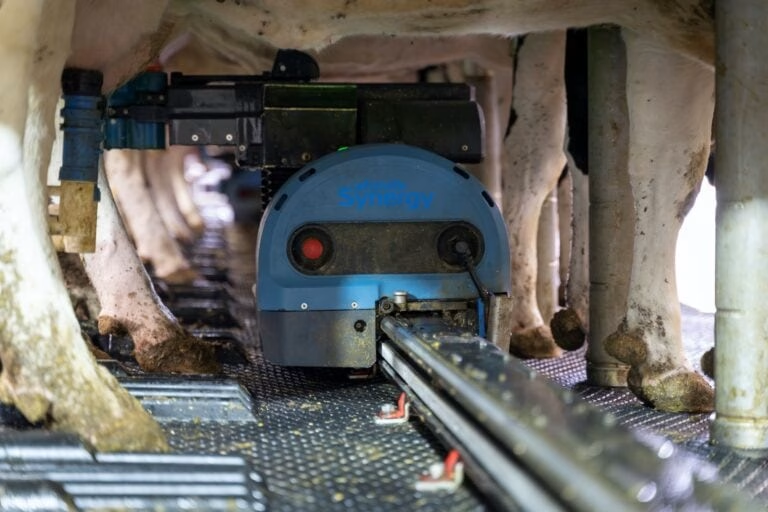
For decades, medium-sized dairy operations (500-5,000 cows) have been caught in an automation no-man’s-land. These operations have struggled to find robotic solutions that fit their scale and parlor setup. They are too large for traditional robotic VMS systems to be practical yet too small to justify the massive investment in rotary platforms. Israeli-based Afimilk has unveiled a radically different approach that could change everything – robots that travel BENEATH the cows in conventional parallel parlors.
The Technology Gap That’s Draining Your Profits
Let’s face it – the dairy automation revolution has left mid-sized operations in the dust. While small farms happily install individual VMS units and mega-dairies build elaborate rotary systems, operations in the 500-5,000 cow range have faced a frustrating reality: adapt to technology that doesn’t fit your scale or keep throwing labor at a problem that technology should solve.
“For 120 cows, it’s a perfect solution,” says Oren Drori, Afimilk’s VP Product, referring to traditional VMS systems. “For 600 dairy cows, it’s pretty difficult. For 2,000 cows, it’s impossible.”
This technology gap didn’t happen by accident. The economics of traditional robotic milking systems, where each station typically handles 55-65 cows, become increasingly problematic as herd size grows. The capital investment multiplies linearly with herd size, quickly reaching unsustainable levels for mid-sized operations. Meanwhile, the sophisticated cow traffic management required by free-flow VMS systems becomes exponentially more complex as herds expand.
At the other end of the spectrum, rotary robotic systems represent “a multimillion-dollar sledgehammer to crack a nut.” Too big, too costly, and still requiring significant human staffing, these systems only make financial sense for the largest operations.
The result? Thousands of mid-sized dairy farms are stuck with conventional milking technology and all the labor challenges that come with it. In an era of chronic labor shortages and rising wage pressures, this technological stagnation threatens the viability of this critical segment of the dairy industry.
What If Robots Came to the Cows, Not Cows to the Robots?
The fundamental limitation of both VMS and rotary systems is their approach to the cow-robot interaction. VMS requires cows to enter individual robotic stalls, while rotaries position fixed robots around a rotating platform. Both demand purpose-built facilities and radically altered cow movement patterns.
But what if we could bring robotics to conventional parlors where cows are already comfortable being milked in batches?
This seemingly simple question led Afimilk to develop a radically different solution: the Synergy robotic milking system. After five years and a reported $30 million in development, Afimilk unveiled a system that operates on a fundamentally different principle – multiple robotic units that travel on rails beneath the cows in a conventional parallel parlor.
“We are now replacing almost all the people with milking robots, and we only need one supervisor to look after the entire system,” explains Drori.
The concept directly addresses the mid-sized dairy dilemma. By retrofitting existing parallel parlors – the most common configuration in this farm segment – with under-belly robots, farms can maintain familiar batch milking routines while dramatically reducing labor requirements. No new buildings are required, and there are no complex cow traffic systems to manage; automation is just inserted into an existing workflow.
But can robots navigate the challenging environment beneath a cow during milking? Afimilk claims its sophisticated technology makes it not just possible but highly effective.
How Does This Under-Belly Revolution Work?
The Synergy system’s approach is unlike anything previously seen in commercial dairy robotics. Rather than the side-approach or rear-approach arms common in VMS or the fixed-position robots in rotaries, Synergy deploys compact robots that operate directly beneath the cow.
Mobile Robot Design: These robots run on a dedicated rail system installed in the milking pit, allowing them to travel between the fore and hind legs of cows in parallel stalls. Each mobile unit can serve multiple stalls – potentially up to seven, according to early reports – allowing fewer robots to handle more cows.
Vision and Intelligence: The system employs sophisticated 3D vision systems, micro-optics, micro-electronics, and spatial identification algorithms combined with machine learning to identify and locate each teat precisely. This advanced sensing capability allows the robots to adapt to different udder conformations and operate effectively in the challenging environment beneath the cow.
The operational sequence follows the familiar pattern of conventional milking but with robots handling the repetitive tasks:
- Cows enter the parallel parlor in batches, just as they would in a conventional system
- Mobile robots deploy to their assigned stalls
- The robots use sophisticated 3D vision technology to locate and clean teats with brushes
- Robotic arms attach milking cups, which are stored on the wall of the milking pit
- When milking is complete, automatic take-offs remove the cups
- The robot applies an optional post-milking teat dip
- Cows exit in groups, and the next batch enters
This process maintains the group rhythm most medium and large dairies rely on while eliminating the most labor-intensive aspects of the milking routine. The system is designed specifically for retrofitting existing parallel parlors, potentially requiring only minor renovations to accommodate the rail system in the pit.
The Brain Behind the Brawn: Data Integration That Makes Sense
Synergy isn’t just mechanical automation – it’s a key component in Afimilk’s comprehensive dairy management ecosystem. With roots tracing back to the world’s first electronic milk meter introduced by Afimilk in 1979, the system leverages decades of the company’s sensor and software innovation.
Advanced Technology Backbone: The robots incorporate sophisticated technologies including:
- 3D vision systems for teat identification
- Spatial identification algorithms for precise positioning
- Machine learning capabilities that likely improve over time
- Micro-electronics and micro-optics for sensing and control
What truly sets the system apart is its integration with Afimilk’s broader technology suite. Data from the Synergy robots combines with information from other Afimilk systems like:
- AfiLab milk analyzers: Evaluate milk components in real-time, detecting issues like ketosis, nutritional problems, and mastitis
- AfiAct II pedometers: Provide accurate heat detection, calving alerts, rest monitoring, and reliable animal identification
- AfiFarm software: Interprets data from all components to provide comprehensive, actionable information for management decisions
This integration transforms Synergy from a labor-saving device into a comprehensive management tool. Farms can use the system to reduce labor costs and monitor individual cow health, optimize nutrition, improve reproduction, and make more informed culling decisions.
Will This Finally Solve Your Labor Nightmare?
Let’s address the elephant in the parlor: labor. Finding and retaining qualified milking staff has become the most pressing challenge for many dairy operations. Conventional parlors demand multiple skilled milkers per shift, three times daily, 365 days a year. As wages rise and willing workers dwindle, this model is increasingly unsustainable.
Synergy promises to reduce this labor dependency dramatically. According to Afimilk, the system can operate with just one supervisor overseeing the robotic process. This person monitors system function, intervenes if necessary, and manages the flow of cows, but doesn’t perform the physical milking tasks.
“People don’t want to milk cows,” says Drori bluntly. “Just like people don’t want to pick cotton or harvest wheat. The cost of labor is secondary. The main problem is that people don’t want to do it.”
Are we finally admitting what we’ve known for years? The conventional milking parlor staffing model is dying. The question isn’t if you’ll automate but when and how.
However, this shift requires different skills. While fewer manual milkers are needed, farms will require personnel capable of supervising technology, performing maintenance, and interpreting data. The ideal Synergy supervisor combines technical aptitude with knowledge of dairy husbandry – a profile different from that of the traditional milker.
For many operations, this represents a positive evolution rather than a drawback. Technical positions often attract more stable, career-oriented employees than conventional milking jobs. The challenge isn’t finding labor anymore – it’s training existing staff to work with sophisticated technology, not against it.
Does the Math Work? The Real Economics of Under-Belly Automation
The compelling labor-saving potential of Synergy means nothing if the economics don’t make sense. While Afimilk hasn’t publicly disclosed pricing, the system represents a significant capital investment.
The development cost of $30 million suggests sophisticated technology that won’t come cheap. However, the architecture of fewer robots, each servicing multiple stalls, may offer better economics than traditional VMS systems for medium to large herds.
Real-World ROI Example: 800-Cow Dairy
Let’s examine how the numbers might work for an 800-cow operation currently milking in a conventional parallel parlor:
Current Labor Costs:
- 8 milkers across three shifts (2-3 per shift) at $18/hour
- Annual labor cost: approximately $378,000 (8 × $18 × 7 hours × 365 days)
Projected Synergy Impact:
- Reduction to 3 supervisors (1 per shift) at $25/hour
- New annual labor cost: approximately $192,000 (3 × $25 × 7 hours × 365 days)
- Annual labor savings: $186,000
Potential Production Benefits:
- Research on comparable robotic systems shows milk yield increases of up to 15% due to more consistent milking and reduced stress
- For an 800-cow herd averaging 75 lbs/day, an additional 9,000 lbs daily (at 15% improvement)
- At $20/cwt, that’s additional annual revenue of $657,000
Maintenance and Operating Costs:
- Annual maintenance is estimated at 5-7% of the system cost
- Additional electricity and consumables
Projected Payback Period:
- Based on labor savings alone: 3-5 years (depending on system cost)
- When including production benefits, potentially under 2 years
These figures are approximations based on industry averages for robotic milking systems, as specific Synergy performance data is not yet widely available. However, they illustrate the potential financial impact that makes automation increasingly attractive as labor costs rise and availability falls.
According to one Afimilk distributor, a herd size of approximately 400 cows would be necessary for the system to be competitively profitable. However, this threshold varies greatly depending on local labor costs and availability.
Synergy vs. DeLaval: The Battle for Batch Milking Dominance
The unique design of Synergy raises an obvious question: how does it compare to established automation solutions and emerging alternatives? Most notably, DeLaval’s VMS Batch Milking system, launched in early 2024, targets a similar market segment with a different technological approach.
Fundamentally Different Approaches to the Same Problem
While both systems aim to bring robotics to batch milking, their technological approaches differ dramatically:
Afimilk Synergy deploys mobile robots on rails beneath cows in a conventional parallel parlor. These robots move to the cows, each unit potentially servicing up to seven stalls. The robots retrieve milking cups from stations on the pit wall.
DeLaval VMS Batch Milking arranges multiple standard VMS V300 robot units in parallel rows, resembling a parlor layout. Cows enter individual VMS stalls in batches, but each cow is serviced by its dedicated VMS unit – the same units used in traditional voluntary milking setups. After milking, cows follow an exit lane guided by selection gates.
Key Differences in Implementation
| Feature | Afimilk Synergy | DeLaval VMS Batch Milking |
| Robot Design | Mobile units traveling beneath cows | Modified standard VMS V300 robots (stationary) |
| Infrastructure | Retrofits existing parallel parlors | Requires specialized facility layout |
| Cow Positioning | Standard parallel stalls | Individual VMS stalls arranged in rows |
| Scalability | Add robots (each serving multiple stalls) | Add individual VMS units (one per stall) |
| Market Maturity | Launched 2024/2025 installations in Israel and Europe | Launched January 2024, 10+ installations worldwide with 10,000+ cows |
| Notable Installations | Test farms in Israel, installations in the Czech Republic and Italy | Rancho Pepper Dairy (Texas) – 22 units milking 2,000 cows |
Commercial Momentum
DeLaval has gained significant early traction with its system. Their first US implementation at Rancho Pepper Dairy in Texas features 22 VMS V300 units milking 2,000 organic cows. Dawn Dial, the Rancho Pepper dairy manager, noted: “These cows are very relaxed, and I feel that they are more relaxed than any parallel [parlor] I have ever seen. I would do this again.”
DeLaval reports over 10 installations milking approximately 10,000 cows worldwide within just months of their January 2024 launch. Their approach leverages their proven VMS technology, potentially offering reliability advantages over Afimilk’s novel under-belly design.
The key question: which approach will ultimately deliver better economics, reliability, and user experience for medium-sized dairies? The answer may depend on whether you’re retrofitting an existing parlor (advantage: Synergy) or building a new one (potential advantage: DeLaval VMS Batch).
Early Adopter Insights: What Farmers Are Saying
While comprehensive performance data for the Synergy system remains limited due to its recent commercial introduction, insights from early installations provide valuable perspectives.
Initial Feedback from Israel: Farmers testing the system in Israel have reported significant labor reductions, with operations transitioning from multiple milkers to a single supervisor per shift. One farm manager noted: “The consistency of the milking routine is remarkable. Every cow gets the same high-quality preparation every time, regardless of who’s supervising.”
European Adoption: A Czech Republic installation has drawn visitors from across Europe, with observers noting the system’s ability to integrate into existing parlor infrastructure with relatively minor modifications. Danish dairy consultant Martin Grønnebæk commented that the system could represent “a viable automation pathway specifically for medium-sized operations that want to automate without rebuilding their entire facility.”
Expert Assessments: Industry experts evaluating Synergy and DeLaval’s approach note that choosing systems may depend on farm-specific factors. “For operations with substantial investment in well-designed parallel parlors, Synergy’s retrofit capability could offer significant advantages,” one European dairy consultant notes. “However, farms considering entirely new facilities might find DeLaval’s approach more straightforward.”
These early insights suggest that while the technology is still proving itself, initial reception has been positive, particularly regarding labor savings and cow comfort. As more installations come online throughout 2025, expect a wealth of additional real-world data to emerge.
Is the Technology Ready for Your Farm?
Despite its promising design, Synergy is still early in its commercial journey. The system was officially launched in early 2025, with initial installations concentrated in Israel and Europe.
As of early 2025, Afimilk reports having installed two systems in Israel, with plans for a third, plus completed or ongoing installations in the Czech Republic and Italy. Their goal is to install between 10 and 20 systems in 2025, focusing primarily on the Israeli and European markets.
This deliberate, controlled rollout suggests Afimilk is proceeding cautiously – a prudent approach for a system introducing such novel technology. The company acknowledges that farmers are generally conservative about adopting new technology, particularly for mission-critical operations like milking.
“It’s a big revolution on the farm, and it’s in the farmer’s mission-critical spot,” explains Drori. “So, the farmer has to have high trust in the technology to commit to it.”
For North American dairy producers, this means waiting a bit longer. While Afimilk has a well-established presence in the US and Canada through Afimilk USA Inc. (headquartered in Wisconsin), no specific timeline has been announced for Synergy’s availability in North America.
This cautious approach has its benefits. Early adopters in Israel and Europe will help identify and resolve issues before broader deployment, potentially resulting in a more reliable product for later markets. However, it also means that comprehensive performance data and user feedback remain limited.
Will Under-Belly Robots Transform the Future of Your Dairy?
The emergence of Synergy and similar batch milking concepts signals a potential shift in dairy automation philosophy. Rather than forcing farms to adapt to robotic systems, these new approaches bring robotics to the familiar parlor environment where cows are already comfortable being milked in groups.
This could finally provide a viable automation pathway for medium-sized operations – the backbone of dairy production in many regions. The ability to retrofit existing infrastructure rather than building a new represents a potentially more accessible entry point to robotics, especially for farms with substantial investments in conventional parlors.
The dairy industry has been too slow to acknowledge a fundamental truth: one size does NOT fit all regarding automation. Small farms, medium operations, and mega-dairies have different needs, management styles, and infrastructure realities. Technology providers have often pushed farms to adapt to their systems rather than designing systems that adapt to farms.
Synergy represents a philosophically different approach – bringing robotics to an existing parlor flow rather than demanding farms completely reinvent their operation. This flexibility reflects a broader trend toward more adaptable automation in agriculture.
Isn’t it time technology worked around YOUR farm’s needs, not the other way around?
The Bottom Line: Is Synergy Right for Your Operation?
Afimilk’s Synergy system represents a genuinely innovative approach to dairy automation, specifically targeting the underserved medium-sized segment with a unique under-belly robot design for parallel parlors. Maintaining familiar batch milking routines while dramatically reducing labor requirements addresses a critical industry need.
However, the technology remains in early commercial deployment, with limited installations in Israel and Europe. Performance data, pricing information, and long-term reliability assessments are not widely available. North American availability has not been specifically announced.
For dairy producers considering future automation options, Synergy deserves serious attention – particularly for operations with 500-5,000 cows utilizing parallel parlors. The potential to retrofit existing infrastructure rather than building new facilities could offer significant advantages over other robotic approaches.
The prudent approach is to:
- Monitor the system’s commercial performance as more installations come online
- Engage with Afimilk or authorized dealers to understand potential retrofit requirements for your specific parlor configuration
- Calculate potential ROI based on labor savings and other benefits once pricing becomes available
- Consider how the technology aligns with your long-term farm strategy and management goals
It’s time to demand automation that works with your farm, not against it. For too long, medium-sized dairies have been forced to choose between insufficient small-farm solutions and overengineered mega-dairy systems. The under-belly revolution may finally offer a middle path – robotic efficiency without abandoning the batch-milking approach that suits your management style.
Don’t settle for automation designed for someone else’s operation. As labor challenges intensify and technology advances, the question isn’t whether you’ll automate – it’s whether you’ll choose technology that truly fits your farm’s unique needs and structure.
Learn more:
- 2024 Exposed Dairy Tech Truths: See What Paid Off (And What Flopped). Spoiler: Robots aren’t magic bullets.
Unpacks the real-world ROI of robotic milking, automated feeding, and health sensors, spotlighting why execution and management-not just tech-drive success. - Maximize Dairy Farm Efficiency: How Robots Can Cut Costs When Managed Properly
Explores how robotic automation boosts productivity and slashes labor costs for small and mid-sized dairies, with practical tips for successful integration. - Robotic Milking
A deep dive into the rise of automated milking systems, their impact on labor, cow health, and management, and what it takes for farms to thrive in the automation era.
 Join the Revolution!
 Join the Revolution!
Join over 30,000 successful dairy professionals who rely on Bullvine Weekly for their competitive edge. Delivered directly to your inbox each week, our exclusive industry insights help you make smarter decisions while saving precious hours every week. Never miss critical updates on milk production trends, breakthrough technologies, and profit-boosting strategies that top producers are already implementing. Subscribe now to transform your dairy operation’s efficiency and profitability—your future success is just one click away.




