Archive for Holstein Association USA

The Quiet Revolution: Two Young Dairy People Who Refused to Choose Between Love and Survival

Rachel Craun and Jon Chapman didn’t inherit easy paths. They’re carving new ones—and in doing so, they’re teaching us what loyalty to an industry really looks like.
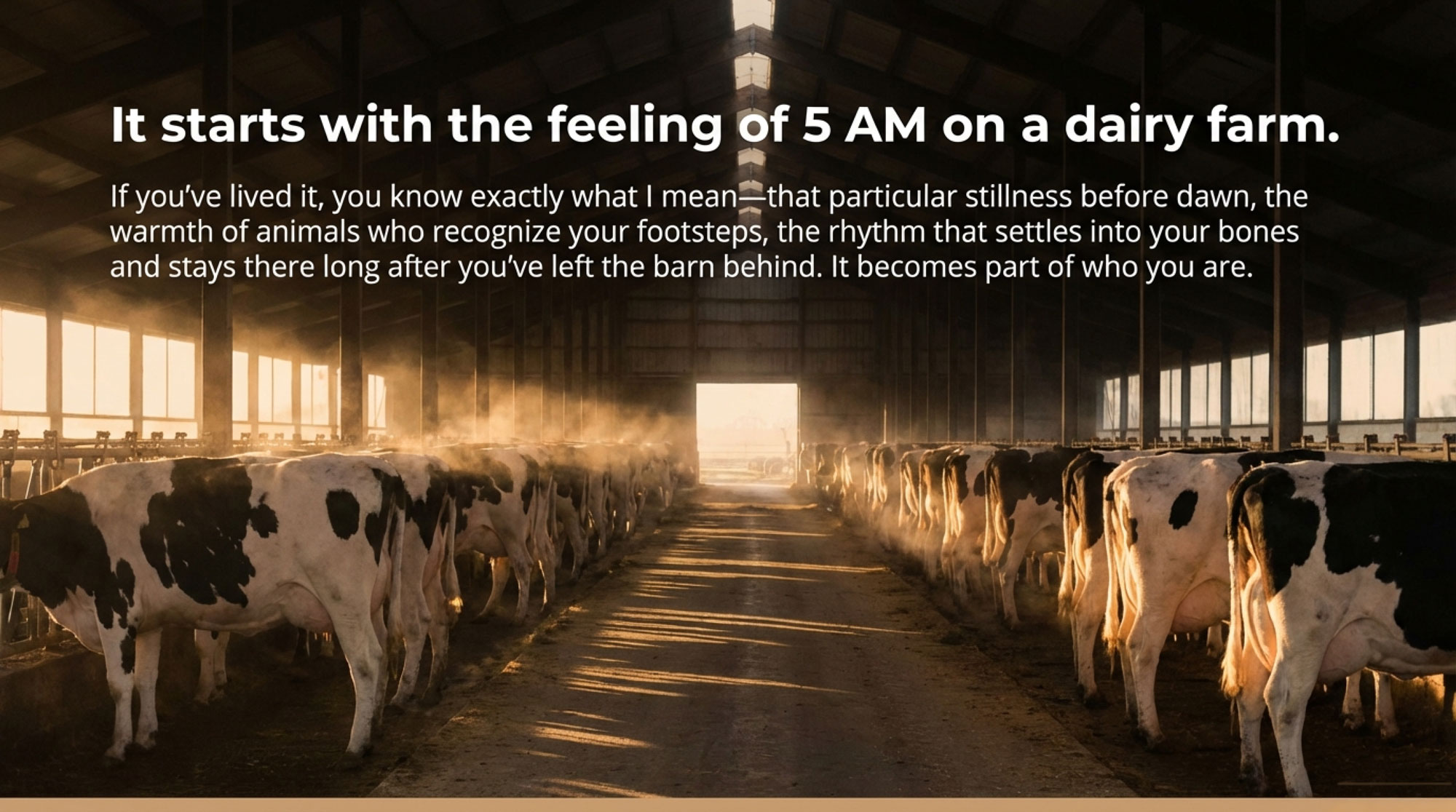
There’s something about 5 AM on a dairy farm that never leaves you.

If you’ve lived it, you know exactly what I mean—that particular stillness before dawn, the warmth of animals who recognize your footsteps, the rhythm that settles into your bones and stays there long after you’ve left the barn behind. It becomes part of who you are in ways you can’t quite explain to anyone who hasn’t experienced it.

Rachel Craun knows that rhythm intimately. She’s been living it since childhood on her family’s dairy operation in Mount Crawford, Virginia. Now she’s at Purdue University, active in the Dairy Club and finding real success on the Collegiate Dairy Judging team.

The Virginia mornings are behind her, at least geographically.

But over a dozen years of dairy farming rhythms? Those don’t care about geography. They travel with you wherever you go.
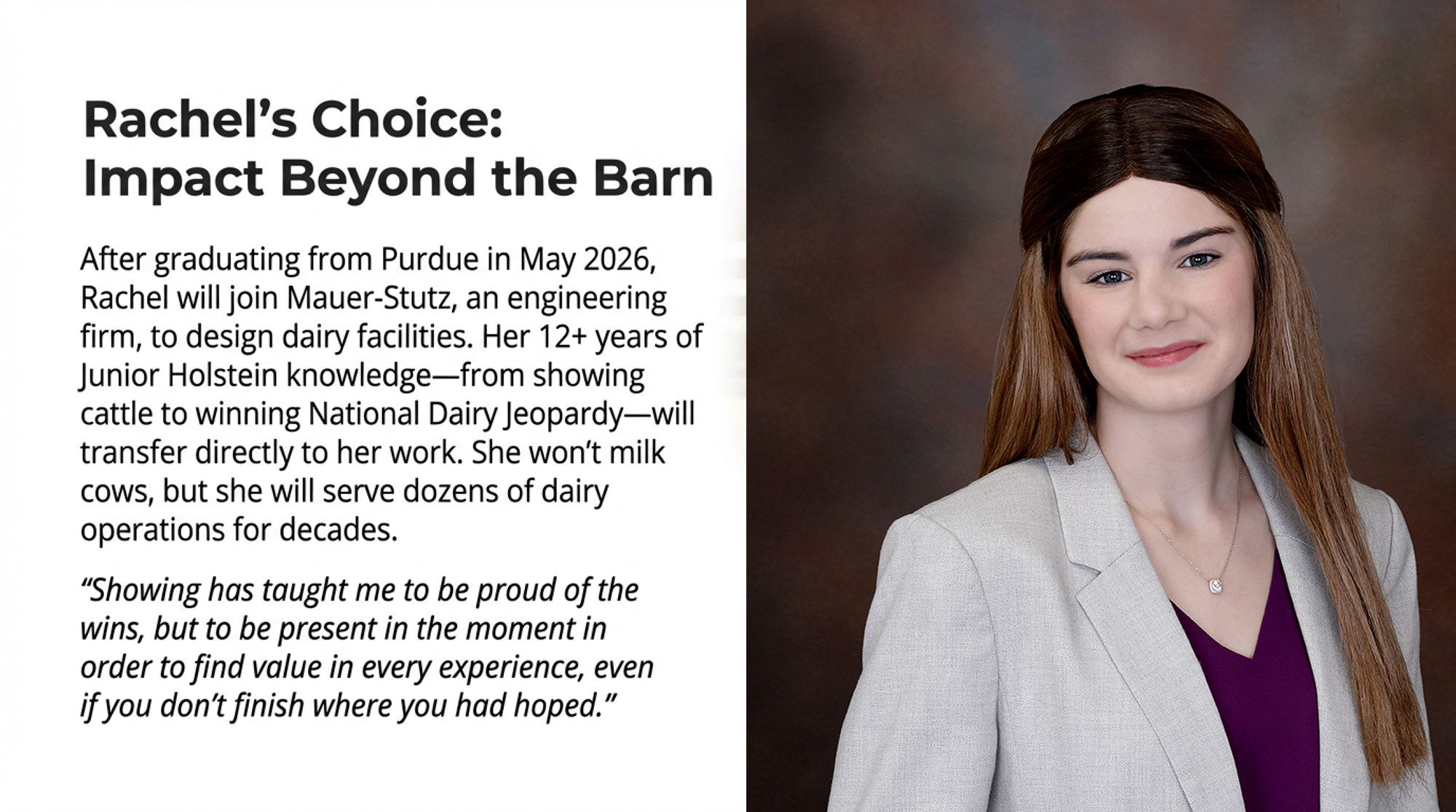
Rachel Craun, Mount Crawford, Virginia — First place National Dairy Jeopardy, first place National Virtual Interview, Distinguished Junior Member finalist, and future dairy facility engineer at Mauer-Stutz. Twelve years of Junior Holstein commitment led her here. Photo: Holstein Association USA

“Showing has taught me to be proud of the wins,” Rachel says, “but to be present in the moment in order to find value in every experience, even if you don’t finish where you had hoped.”

I’ve read that quote several times now, and what moves me most isn’t the words themselves—it’s how much living must be packed into them. Over a dozen years of Junior Holstein involvement. More than a decade of early mornings, weekend shows, long drives home after placings that didn’t go the way she’d hoped. The kind of quiet, persistent commitment that shapes who you become when nobody’s watching.
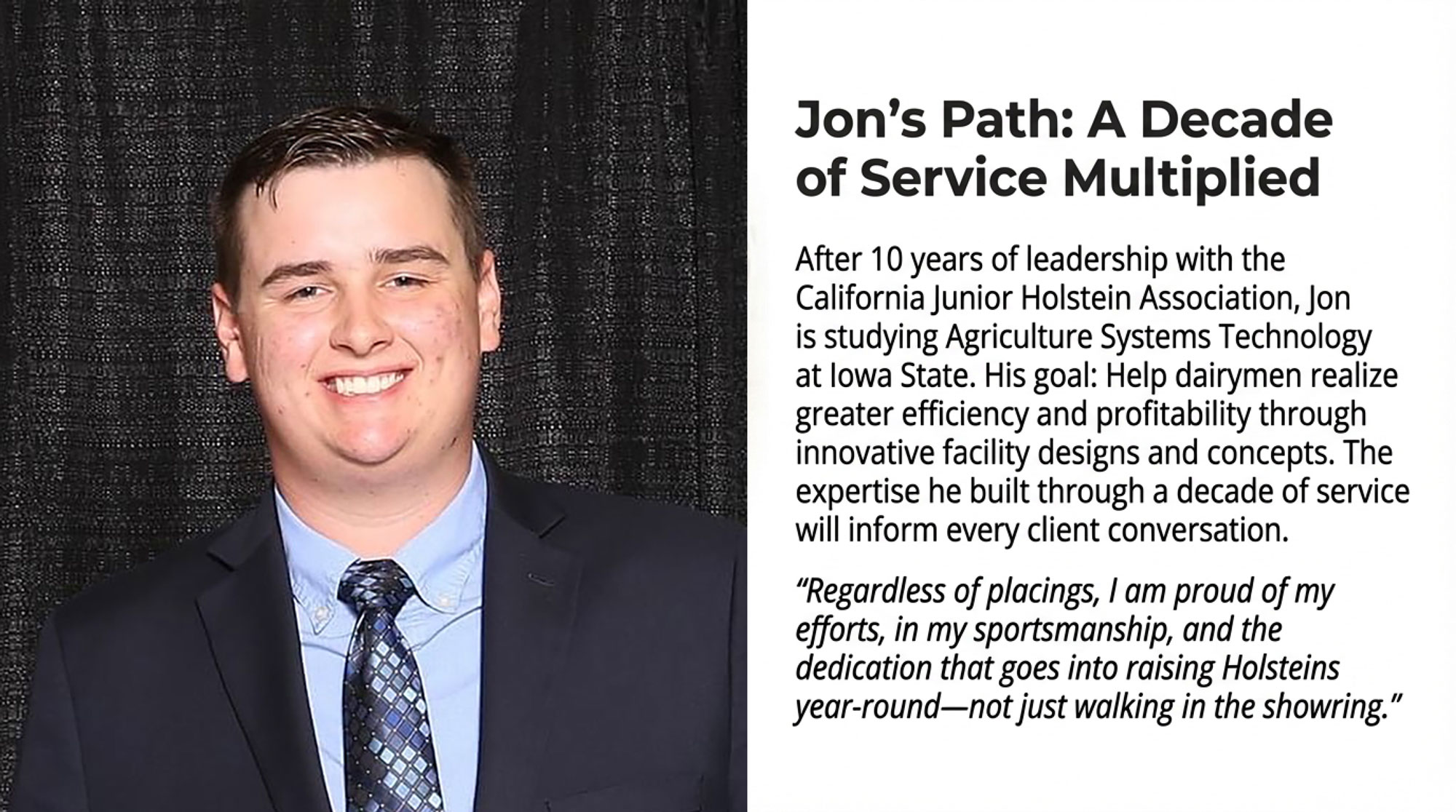
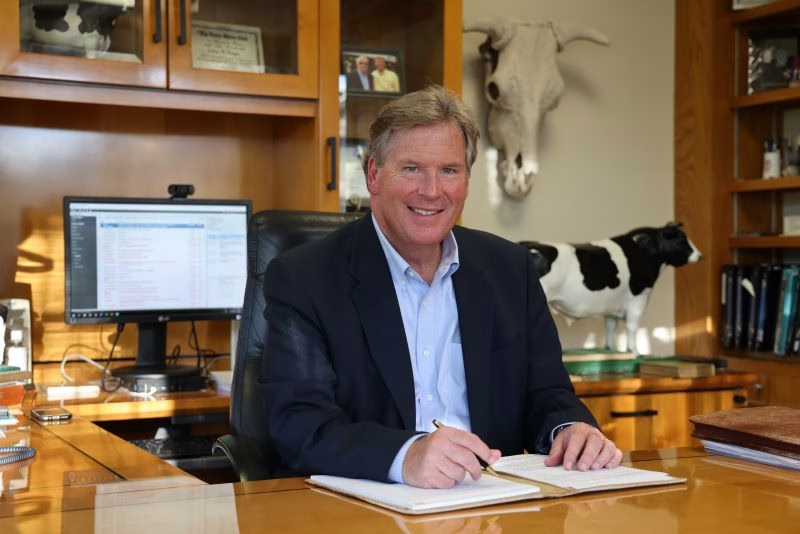
Jon Chapman, Keyes, California — Ten years as a California Junior Holstein officer, current Junior Advisory Committee Chairman, and two-time International Junior Holstein Show competitor. He’s studying Agriculture Systems Technology at Iowa State to serve the dairies he grew up loving. Photo: Holstein Association USA

Three thousand miles away in Keyes, California, Jon Chapman carries a similar weight in his heart. His family operates a Holstein dairy in the Central Valley, and Jon has been part of it since he could walk.

Ten years. Let that sink in for a moment. Ten years serving on the officer team for the California Junior Holstein Association. He’s currently serving as chairman of the Junior Advisory Committee, representing dairy youth across the entire West Coast. He’s competed at the International Junior Holstein Show at World Dairy Expo twice—because once, apparently, wasn’t enough to satisfy his love for this industry.

“Regardless of placings,” Jon says, “I am proud of my efforts, in my sportsmanship, and the dedication that goes into raising Holsteins year-round—not just walking in the showring.”

There it is again. That word: dedication. Not to winning. Not to trophies. To showing up.

This past year, Rachel and Jon received the Judi Collinsworth Memorial Scholarship—Rachel receiving the top $1,000 scholarship, Jon receiving the $500 scholarship. The amounts seem modest against the backdrop of modern education costs.

But what moved me most about researching their stories wasn’t the scholarship itself.

It was understanding what these two remarkable young people represent—and the uncomfortable questions their choices force us to ask about what it actually means to invest in dairy’s future.

The Woman Who Saw What Others Missed

Judi Collinsworth dedicated her career to Holstein Association USA in Brattleboro, Vermont. As Executive Director of Member and Industry Relations, she was responsible for telemarketing, member programs, and—this is the part that matters most—spending a great deal of her time improving and expanding the programs available to Holstein youth.

She passed away in late 2023.

What she left behind can’t be measured in program budgets or press releases. It’s something far more precious than that.

She built something harder to name. Call it permission. Call it space. Call it the radical, beautiful idea that you could love dairy with your whole heart and still have a life beyond the barn.

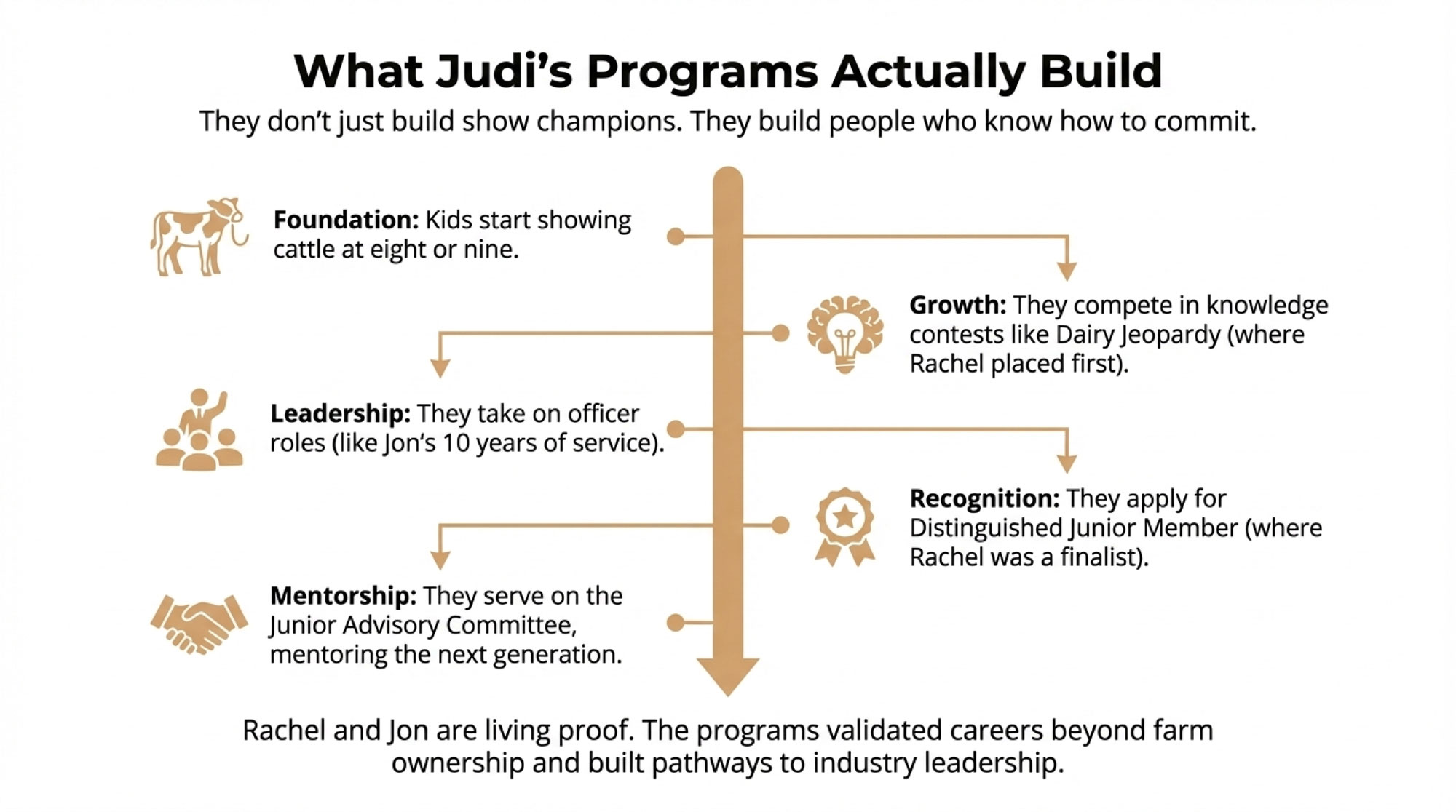
Think about what that means for a young person growing up on a farm. The programs Judi championed fostered an identity formation that unfolds over the years, layer by layer. Kids start showing cattle at eight or nine—nervous, uncertain, not yet knowing what they’re becoming part of. By their early teens, they’re taking on officer roles, competing in knowledge contests, and learning to win and lose with grace. By high school, they’re applying for Distinguished Junior Member, standing before judges who’ve read their entire dairy journey in a book they wrote themselves.

By their early twenties? They’re serving on the Junior Advisory Committee, mentoring the nervous kids who remind them of themselves at eight.

Rachel Craun walked every step of that path. And here’s where her story takes my breath away.

She placed first in the National Dairy Jeopardy contest. First. In a competition that requires you to care enough about this industry to fill your head with knowledge most people will never need. She placed first in the National Virtual Interview, too.

Then came Distinguished Junior Member. Rachel was named a finalist—one of only six young people in the entire country selected for that honor. Six. Out of everyone who applied, everyone who dreamed, everyone who worked for years toward that recognition.

She served in officer roles on the Virginia Holstein Association. She competed at the International Junior Holstein Show at World Dairy Expo in 2025—a goal she’d set for herself years ago and then actually achieved.

Jon Chapman walked the same path, just from the other side of the country. A full decade of officer service. Two-time International Junior Holstein Show competitor. Currently, the chairman of the Junior Advisory Committee.

These aren’t résumé lines. They’re evidence of something rare and beautiful: young people who kept showing up when nobody was watching. When it would have been easier to quit. When the world offered a thousand other things to care about.

Judi Collinsworth would have recognized them immediately.

Not because they won everything.

Because they never stopped coming back.
The Math Nobody Wants to Talk About

I need to be honest about something, because this is where the story gets complicated—and painful. It’s the part that keeps me up at night when I think about the future of this industry.

Rachel knows her family’s farm the way you only know a place you’ve grown up in. The sounds. The rhythms. The particular way a barn feels in early morning when the animals are stirring and the day hasn’t quite started yet. That bone-deep connection that becomes part of your soul.

But knowing a place and being able to buy it are entirely different things.
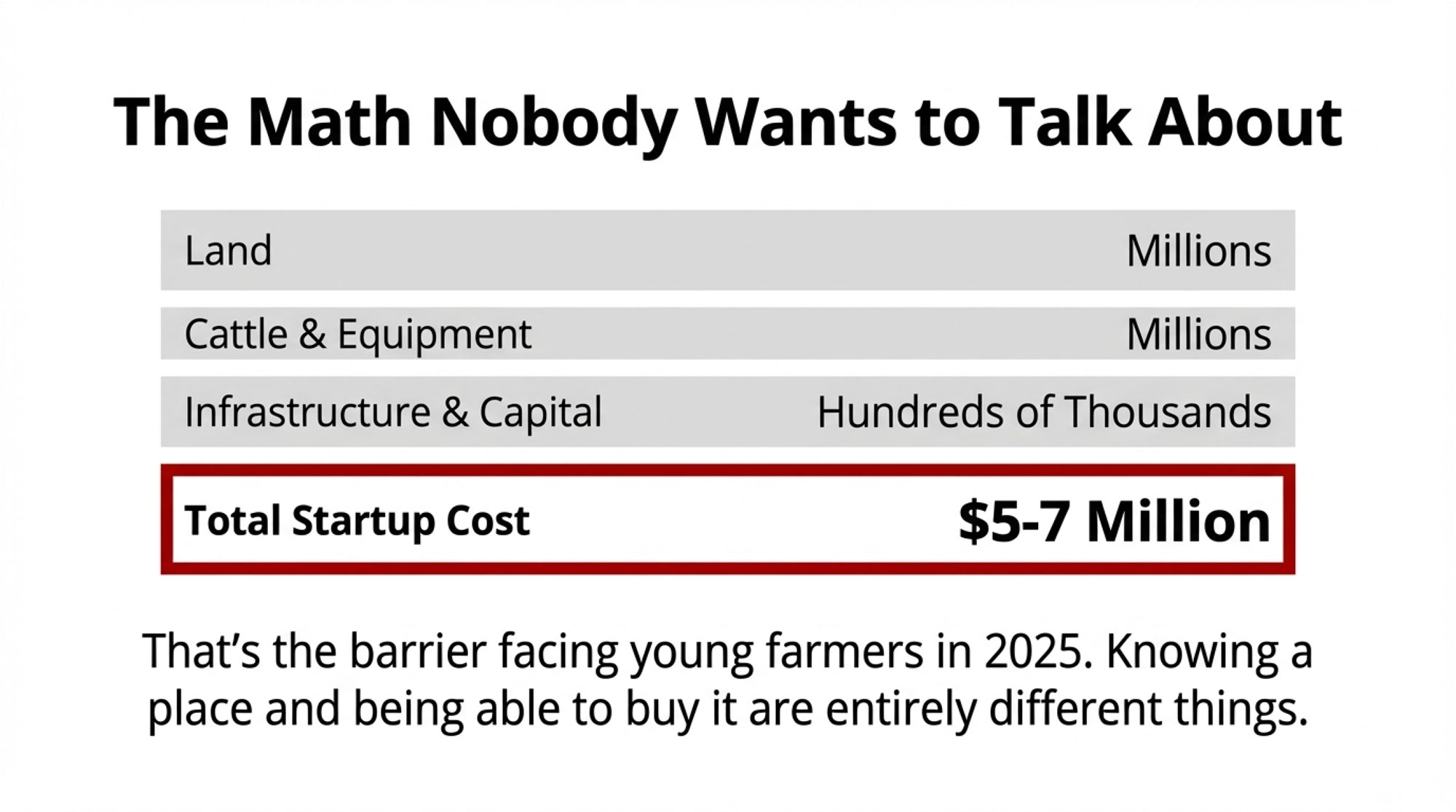
Let’s look at what it actually takes to acquire a dairy operation in 2025. Land alone, at current prices in productive dairy regions: millions of dollars. Add cattle, and you’re deeper in. Machinery. Buildings. Infrastructure. Operating capital for the first year, when everything feels uncertain.

By the time you’ve accounted for everything required actually run a dairy, you’re looking at capital requirements that can easily exceed $5-7 million for a viable operation. We’ve been tracking these numbers throughout 2025—in pieces like “What Lactalis’s 270-Farm Cut Really Means for Every Producer” and “The Four Numbers Every Dairy Producer Needs to Calculate This Week“—and they keep moving in the same direction.

After graduating in May 2026, Rachel plans to work full time for the agricultural division of Mauer-Stutz, an engineering firm based in Peoria, Illinois.

I don’t have to tell you what that math means.

You already know.

Jon faces the same impossible arithmetic in California, where land prices run even higher. His family’s operation represents capital accumulation across generations—the kind of investment that no 22-year-old can replicate, no matter how deep their commitment. No matter how many trophies they’ve earned. No matter how much they love this with everything they have.

So Jon is studying Agriculture Systems Technology at Iowa State University. He hopes to help dairymen realize greater efficiency and profitability through innovative facility designs and concepts.

Both of them love Holsteins.

Both of them are staying in the dairy industry.

Neither of them is becoming a dairy farmer.

Sit with that for a moment. Because I think it tells us something important—and heartbreaking—about where we are.

What a Decade of Saturdays Actually Looks Like

I want to stay with Jon’s story for a moment, because I think it illuminates something important about the quiet heroism of showing up.

Ten years serving on the officer team.

What does that actually mean? It means Saturday mornings when he could have slept in like his friends. Meetings in towns he’d never otherwise visit. Phone calls to coordinate volunteer coverage for the next show. Budget reviews that nobody will ever thank you for. The thousand small decisions that keep youth organizations functioning—decisions that matter enormously and earn almost no recognition.

California’s Central Valley isn’t far from the coast. While Jon was organizing junior Holstein events, plenty of his peers were spending summer weekends at the beach. Nobody would have blamed him for making a different choice.

But something kept him coming back. Year after year. Meeting after meeting. Something in his heart that wouldn’t let go.

“Regardless of placings, I am proud of my efforts, in my sportsmanship, and the dedication that goes into raising Holsteins year-round—not just walking in the showring.” — Jon Chapman, JAC Chairman

The return on a decade of service isn’t trophies. It’s something harder to measure, but infinitely more valuable.

It’s the nervous first-time exhibitor who discovers she can actually speak in front of a crowd. It’s the kid who almost quit but didn’t, because someone made him feel like he belonged. It’s the programs and pathways that help the next generation find their place—pathways Jon helped build with ten years of Saturdays.

Two Paths to Staying in Dairy

 Traditional PathNew Professional Path
Entry PointInherit family operationYouth programs, education, and industry service
Capital Required$5-7 million+Education investment
Daily WorkMilking, feeding, and managing the herdDesigning facilities, consulting, systems optimization
Industry ImpactOne operationDozens of operations over a career
ExamplePrevious generationsRachel Craun (Mauer-Stutz engineering) and Jon Chapman (Agriculture Systems Technology)

That’s what service multiplies.

That’s what showing up creates.

We wrote about this same truth earlier this year in “This Was Never About the Cattle: What the TD 4-H Classic Really Teaches at 5:47 AM.” The pattern holds: what youth programs actually build isn’t show champions. It’s people who know how to commit.

What a Generation Had (And What Changed)

To understand what’s different now, you need to understand what dairy farming used to offer—and what’s been lost.

There was a time—within living memory, within your grandparents’ memory—when inheriting a farm meant inheriting a community. When the neighbor who helped you fix the fence in April was the same neighbor whose hay you helped bring in come August. When everyone in a ten-mile radius knew whose cows were whose, and that knowledge itself was a kind of wealth you couldn’t put a price on.

That world made different choices possible.

A young farmer starting out didn’t need to finance everything alone, because they weren’t alone. They stepped into a web of relationships that had been forming since before they were born. When disaster struck—a barn fire, a failed crop, a death in the family—the community showed up. Not out of charity, but out of reciprocity. You helped because someday you’d need help too.

That mutual obligation functioned as a kind of informal insurance. It reduced capital needs. It created resilience that individual families couldn’t achieve alone.

That world is largely gone now.

Thousands of dairy farms have closed in recent years. The remaining operations grow larger, more capital-intensive, and more dependent on professional management and specialized expertise. The web of relationships that held earlier generations has thinned and frayed.

I understand why Rachel and Jon made different choices.

The infrastructure that held their grandparents’ generation simply isn’t there to hold them.

What Judi Actually Built

So what did Judi Collinsworth create, knowing the world was changing faster than anyone wanted to admit?

She made space.

Space for young people like Rachel and Jon to love dairy and still have lives. To serve the industry without being crushed by the economics that make farm ownership impossible for most. To be dairy people in whatever form that identity could survive.

The programs Judi championed didn’t promise anyone a farm. They promised something more durable: a sense of belonging that could survive career pivots, geographic moves, and economic impossibility. A home in this industry that wasn’t dependent on owning land.

Rachel can work in Peoria, designing facilities for dairy operations, and still be a dairy person. Her knowledge doesn’t disappear because she’s not milking cows. It transfers—to facility designs that actually work for farm families, because she understands how farm families actually live.

Jon can consult for California dairies and still bring 10 years of officer service to every client conversation. He knows what matters to producers because he grew up as one.

The scholarship named in Judi’s honor does exactly what she designed her programs to do. It recognizes sustained commitment. It validates alternative pathways. It signals that the industry values expertise even when that expertise doesn’t come with a barn attached.

The Investment Nobody Calculates
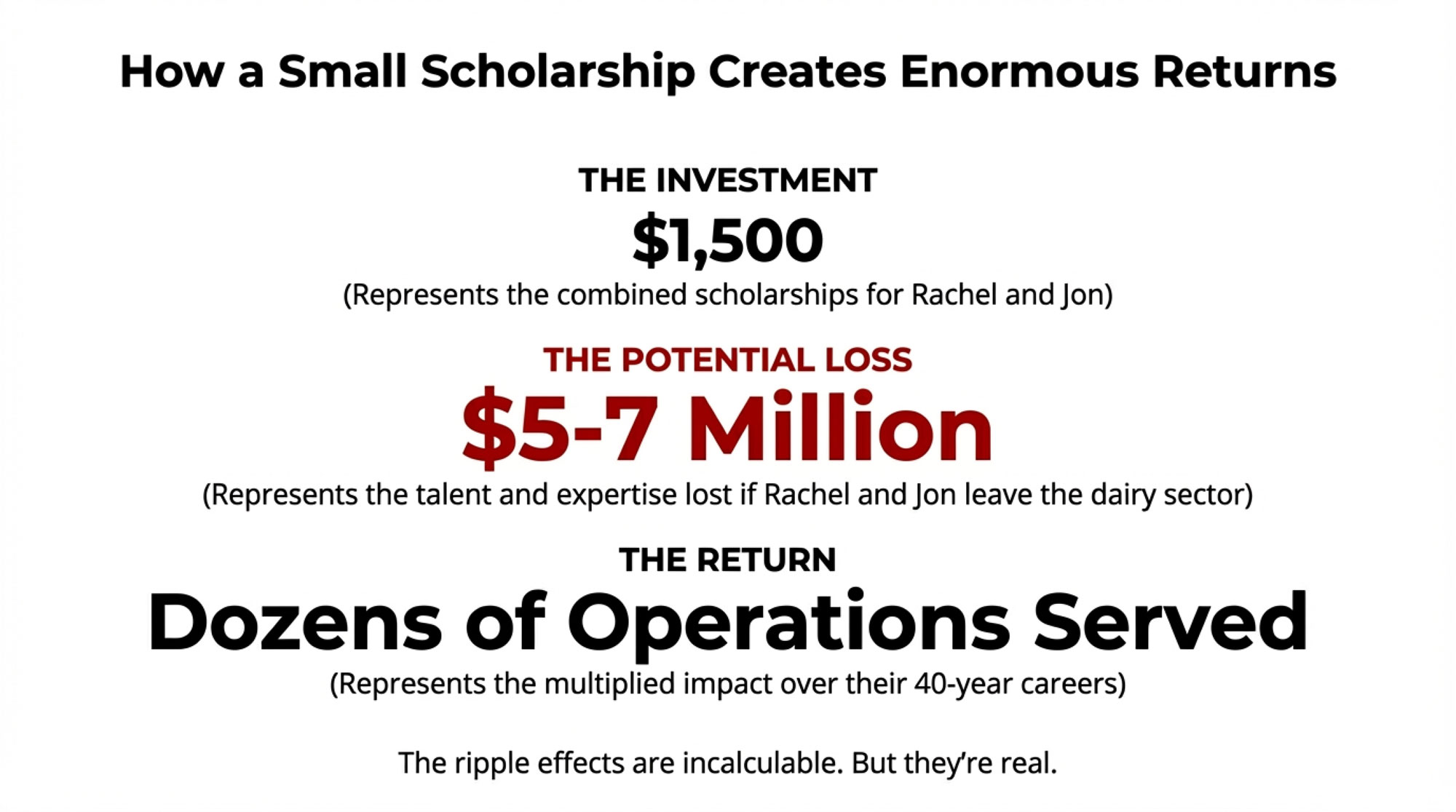
What does $1,500 in scholarships actually buy?

Not farm owners. Not solutions to the capital barrier. Not a reversal of the consolidation reshaping the industry.

But consider what that modest investment actually creates.

Rachel, without validation from her industry, might have taken her engineering skills somewhere else entirely. Designing facilities for companies that process soybeans, corn, anything but dairy. Her deep knowledge—earned through twelve years of showing cattle, competing, serving—flowing to sectors that had nothing to do with the cows she grew up loving.

Jon, without recognition for his decade of service, might have applied his systems expertise to Silicon Valley startups. Agricultural technology serving every sector, dairy is just one line item among many.

Instead, they’re staying.

Not as farmers. But as professionals who will serve dozens of operations over their careers. Engineers and consultants who bring genuine dairy knowledge to their work because they lived it before they studied it.

Rachel will spend her career designing agricultural facilities. Each one will work better because she knows what the rhythm of a dairy operation feels like from the inside.

Jon will help California dairies implement technologies that actually fit their operations—because he understands producer decision-making from a decade of serving producers.

The ripple effects are incalculable.

But they’re real.

What Stays With You

Ask what over a dozen years of showing cattle, competing in knowledge contests, and serving in leadership roles actually taught Rachel and Jon, and certain truths emerge:

Sustained commitment matters more than occasional brilliance. Anyone can show up once. Showing up for a decade—through middle school awkwardness, high school social pressure, college course loads—proves something about who you are.

Resilience isn’t about winning. It’s about finding value in every experience, especially the losses. The placings you hoped for and didn’t get. The classes where nothing went right. The years that tested whether you really loved this.

Service creates ripples you’ll never fully see. Ten years of officer meetings. Programming that helped young people discover confidence they didn’t know they had. That’s how commitment multiplies—in ways the person serving may never know about.

The Bottom Line

The dairy industry stands at a crossroads it didn’t choose and can’t avoid.

Farm ownership has become economically impossible for most young people, no matter how deep their commitment. The capital requirements have outpaced anything individual families can accumulate. The support structures that once made small operations viable have changed fundamentally.

We can rage against this reality.

Or we can adapt to it.

Rachel Craun and Jon Chapman represent adaptation. Not abandonment—never abandonment—but evolution. A new way of serving an industry they love, sustainable across a 40-year career, creating value for dozens of operations instead of struggling to save one.

The Judi Collinsworth Memorial Scholarship recognizes that evolution. It says to every Junior Holstein member watching: You can love this industry and still have a life. You can honor your heritage without destroying yourself. There are multiple pathways to being a dairy person.

An earlier generation had one path: inherit the farm, work the land, pass it to your children. That path created something beautiful, and its transformation deserves to be mourned.

But Rachel and Jon are creating something new. Professionals rooted in dairy knowledge, serving an industry in transition, carrying forward the values that matter even as the structures change.

Somewhere, Rachel is preparing for graduation—ready to join Mauer-Stutz and build the kind of expertise that will help dairy facilities work better for the families who use them.

And somewhere, Jon is thinking about the next generation of junior members. The nervous kids who’ll discover, as he did, that service matters more than trophies.

They’re not abandoning dairy.

They’re ensuring it has a future.

And watching them build it—two young people who found a way to love this industry without being destroyed by it—I think Judi Collinsworth would recognize exactly what she helped create.

Not the future anyone imagined.

But maybe the only one that was ever possible.

If you know a young person wrestling with how to stay in dairy when farming isn’t possible, share this with them. Sometimes knowing you’re not alone changes everything.

The National Holstein Foundation administers the Judi Collinsworth Memorial Scholarship. Learn about youth scholarship opportunities and how to support the next generation of dairy professionals at holsteinusa.com/future_dairy_leaders.

KEY TAKEAWAYS

  • $5-7 million says it all: That’s what a viable dairy startup costs now. Loving this industry and owning a farm are no longer the same thing—and pretending otherwise fails the next generation.
  • One farm or dozens of clients? Rachel Craun will design dairy facilities. Jon Chapman will optimize dairy systems. Over 40-year careers, they’ll serve more operations than any single farm ever could.
  • Youth programs build professionals, not just champions: Rachel’s 12+ years of Junior Holstein involvement and Jon’s decade as a California officer created expertise that transfers directly to careers serving this industry.
  • What Judi Collinsworth actually built: Programs that let young people love dairy without being crushed by its economics. Rachel and Jon are living proof.
  • If your kid loves dairy but can’t afford to farm: They haven’t failed. There’s a path forward. Share this with them.

EXECUTIVE SUMMARY: 

What happens when young people who’ve dedicated their lives to dairy can’t afford to farm? Rachel Craun and Jon Chapman just answered that question. Craun won National Dairy Jeopardy, won National Virtual Interview, became one of only six Distinguished Junior Member finalists nationally, and after graduating from Purdue in May 2026, she’ll design dairy facilities at Mauer-Stutz engineering, not milk cows. Chapman served 10 years on the California Junior Holstein officer team, now chairs the national Junior Advisory Committee, and is studying at Iowa State to help dairies he’ll never own run better. Both just received the Judi Collinsworth Memorial Scholarship, honoring the Holstein Association USA executive who built programs that let young people love dairy without being crushed by its economics. With farm startups demanding $5-7 million in capital, they represent a new path: professionals who’ll serve dozens of operations over a lifetime, rather than struggling to save one. They’re not leaving dairy—they’re the reason it will survive.

Learn More

Join the Revolution!

Join over 30,000 successful dairy professionals who rely on Bullvine Weekly for their competitive edge. Delivered directly to your inbox each week, our exclusive industry insights help you make smarter decisions while saving precious hours every week. Never miss critical updates on milk production trends, breakthrough technologies, and profit-boosting strategies that top producers are already implementing. Subscribe now to transform your dairy operation’s efficiency and profitability—your future success is just one click away.

NewsSubscribe
First
Last
Consent

How Will the Updated Holstein USA Stature Scale Impact Your Herd?

Explore how Holstein Association USA’s updated stature scale affects your breeding program.

Holstein stature scale, dairy farming practices, genetic analysis Holsteins, herd health productivity, cattle marketability, Holstein Association USA, breeding decisions profitability, revised linear scale, genetic improvement programs, herd evaluation strategies

The height of a cow isn’t just a number on a measuring stick—it’s a critical factor that can influence everything from feed efficiency to comfort and milk production. Enter the Holstein Association USA with a transformative revision of the linear scale for Holstein’s stature. Reflecting the larger size of modern Holsteins, this new scale enhances data quality for genetic analysis. It empowers farmers to make informed decisions to boost herd health and productivity. This pivotal change acknowledges the evolving stature of cows and how cattle are much taller, especially in the Holstein breed.

Shifting the Measurement Paradigm: The Holstein Association’s Crucial Role in Modern Dairy Genetics

The Holstein Association USA plays a critical role in the dairy industry, stewarding the breed’s genetic integrity and marketability. Their Classification program is indispensable for dairy farmers, offering an unbiased evaluation of cattle based on conformation and genetic merit. The program assesses 17 individual traits, providing a comprehensive look at each animal’s strengths and weaknesses. Farmers rely on these evaluations to make informed decisions that affect herd management and profitability. 

Until now, the stature scale in the Classification program, which ranged from 51 to 61 inches, served as a tool for measuring the size of Holstein cows. Over time, however, this scale no longer accurately reflected the average sizes in current herds. It was Dr. Jeffrey Bewley’s 2023 study that highlighted the discrepancy. His research pointed out that Holsteins have become very tall, necessitating an update to the measurement criteria. The Holstein Association USA led this revision process to ensure a fair representation of stature across the population, aligning the scale with current biological realities and enhancing the precision of genetic and conformation evaluations.

Bridging Tradition and Modernity: Embracing the New Stature Scale in Holstein Genetics

The shift to a new stature scale from 55″ to 65″ marks a deliberate step towards more accurately capturing the growth and genetic potential present in today’s Holstein population. Each one-inch increment on this scale now equals a five-point boost, creating a more transparent, precise classification framework. This adjustment recognizes that earlier measurements underestimated the stature range of modern Holstein cows, reflecting changes in breeding strategies and nutritional advancements that have influenced average sizes over the years. 

The rationale behind this update lies in aligning the scale with present-day genetic trends and dairy farming practices. By adopting this new range, classifiers are better equipped to assign scores that genuinely mirror the stature variations in the Holstein breed. This empowerment not only enhances the quality of data for genetic analysis but also aids farmers in making informed management choices that could influence breeding decisions and, subsequently, the profitability of their herds.

Balancing Heritage and Progress: The Critical Role of Data Accuracy in Holstein Advancements

Delving deeper into the ramifications of the revised linear scale, Dr. Jeffrey Bewley emphasizes the need for accuracy in data collection as paramount to sustaining genetic advancements. This emphasis on data accuracy ensures that the new scale is reliable and can be trusted, providing a secure foundation for future breeding decisions. 

In agreement with this sentiment, The Bullvine’s industry analyst, Murray Hunt, emphasizes, “The revised scale signifies an essential progression in acknowledging the growth patterns seen within the Holstein population. Adjustments like these ensure breeding choices reflect the present realities while setting the stage for future challenges.” 

The Conformation Advisory Committee’s discernment played a crucial role in this transformation. This committee, tasked with overseeing conformation traits, initiated this change, recognizing that modern Holsteins had outgrown the constraints of the previous scale. Their insights were pivotal, contributing to their recommendation, which garnered the approval of the Holstein Association USA Board of Directors. The Board’s endorsement underscores their commitment to aligning traditional evaluations with contemporary genetic evidence, bridging past practices and future innovations. 

Towering Giants of the Dairy World: Rethinking Stature in Holstein Genetics 

With every stride down the milking parlor, today’s Holstein cows grace dairy farms with their towering presence—quite literally. The stature of Holstein cows has seen a noticeable incline over the past few decades, driven by genetic advancements and selective breeding. Many dairy farmers now face the problem of whether bigger is always better. The discourse around cow height raises crucial questions about productivity, health, and farm infrastructure. 

“The modern Holstein cow has grown taller. The focus on stature as a sign of show ring elegance overlooks the practical challenges of managing these larger animals,” Murray Hunt, Genetic Consultant The Bullvine.

While larger Holsteins can potentially lead to higher milk yields, the implications for housing, feeding, and overall health cannot be ignored. Here are key points of consideration: 

  • Increased height can strain barn facilities that are not designed for larger animals.
  • Larger cows may face more skeletal and mobility issues, impacting longevity.
  • A balance between stature and health should guide future breeding programs.

 Read more:  Are Today’s Holstein Cows Too Tall?

Unveiling the “Magic Number” in Holstein Heights: The Case for 60 Inches 

When we discuss Holstein cows’ stature, a magic number often emerges: 60 inches. This measurement is heralded as the ideal height for optimal dairy production. Why, you ask? Well, let’s consider some key factors. A cow at 60 inches maintains a sweet spot in milk production versus structural capacity. Taller Holsteins, while impressive, may face challenges like increased feed costs and potential health issues linked to excessive height. 

“While towering heights in Holsteins might appear majestic, they’ve been linked to inefficiencies and health complications. It’s crucial to balance stature with desired production capabilities.”

Keeping your Holstein within this ideal range supports better health and aligns with efficiency and productivity goals. Dairy professionals argue that exceeding this height can inadvertently lead to struggles in herd management, including space limitations in barns and increased stress on cow legs and feet, ultimately affecting longevity and productivity.  (Read more:  The Perfect Height: Why Your Holstein Cow Shouldn’t Exceed 60 Inches for Optimal Dairy Production)

The Bottom Line

The revised linear scale for Holstein’s stature signifies more than just an adjustment of numbers—it marks a pivotal shift towards a deeper understanding and representation of modern genetic realities in dairy cattle. By embracing scientific findings and adjusting longstanding measurement systems, the Holstein Association USA is again leading the charge in aligning tradition with innovation. Dairy farmers nationwide stand to benefit from more accurate data, enhancing both herd management and marketability. 

As the dairy industry looks to the future, one must ask: How will ongoing innovations and data-driven decisions shape the genetics of Holstein cows and the very landscape of dairy farming? Maintaining heritage while embracing progress remains crucial. To explore or get involved with the evolving classification program, visit the Holstein Association USA website. The future is as promising as it is challenging, demanding bold, informed steps forward.

Key Takeaways:

  • Holstein Association USA will implement the revised linear scale for Stature on December 1, 2024.
  • This change is based on the findings from a 2023 cow measurement project by Dr. Jeffrey Bewley.
  • The updated scale reflects a stature range from 55” to 65”, revising the previous range of 51” to 61”.
  • Each additional inch in stature equates to a five-point increment on the scale.
  • The adjustment aims to achieve a normal distribution of stature scores and accurately represent today’s Holstein cow population.
  • The Conformation Advisory Committee recommended this update, with subsequent approval by the Holstein Association USA Board of Directors.
  • This classification program plays a significant role in enhancing dairy cattle management and marketability.

Summary:

The Holstein Association USA is set to redefine dairy farming with a revised linear scale for scoring stature, effective December 1, 2024. Driven by Dr. Jeffrey Bewley’s 2023 study, this update addresses the mismatch in current stature scoring—now spanning 55 to 65 inches from the previous 51 to 61 inches—to align with the actual size distribution of modern Holsteins. Dr. Bewley notes that these changes will enable classifiers to provide scores reflective of current cattle, thus improving data for conformation and genetic analyses. With each inch translating to five points, this recalibration supports breeders with precise assessments that are adaptive to today’s genetic trends and farming practices. It’s a strategic leap, endorsed by the Conformation Advisory Committee, aimed at empowering farmers with enhanced data to guide management decisions, boost herd health, and strengthen marketability. Now’s the time for farmers to reassess herd strategies and optimize for profitability by leveraging this updated framework.

Learn more:

Join the Revolution!

Bullvine Daily is your essential e-zine for staying ahead in the dairy industry. With over 30,000 subscribers, we bring you the week’s top news, helping you manage tasks efficiently. Stay informed about milk production, tech adoption, and more, so you can concentrate on your dairy operations. 

NewsSubscribe
First
Last
Consent

Ayrshire Breeders Association Transitioning Registry Work to Holstein Association USA

Learn how the Ayrshire Breeders Association’s move to Holstein Association USA affects your farm. What’s the impact on Ayrshire breeders? Read on.

http://www.usayrshire.com/index.htm

Significant changes are coming for Ayrshire breeders! The Ayrshire Breeders Association (ABA) has transitioned its registry work to the Holstein Association USA (HAUSA). This strategic move aims to improve operations and offer better services for Ayrshire breeders. 

So, why the change? The ABA Board of Directors believes partnering with HAUSA will help align their goals and streamline processes. “We are excited about the future this will present for Ayrshire breeders and appreciate our members’ support during this transition period,” noted the Board. 

Stephanie Mack will continue to assist you throughout this transition. You can reach her at 614-335-0020 or via email at info@usayrshire.com.

What’s next for you? First, stay informed. Second, don’t hesitate to ask questions. The board members welcome any concerns or inquiries you might have. 

  • Enhanced operations
  • Better alignment with strategic goals
  • Continued support from Stephanie Mack

This partnership with HAUSA could begin a new era for Ayrshire breeders. Look for more updates, and feel free to connect with the ABA to discuss your thoughts and answer your questions.

Successful 2024 National Holstein Convention in Utah: Highlights, Events, and Future Plans

Explore what made the 2024 National Holstein Convention in Utah special. From fun seminars to networking events, see why this year’s gathering was unforgettable.

 Trent Hendrickson was recognized with the 2024 Distinguished Young Holstein Breeder Award during the Awards Luncheon at National Holstein Convention on Wednesday, June 26. Pictured from left to right are Holstein Association CEO John Meyer, Trent and Kelsey Hendrickson, and outgoing President Jonathan Lamb.

Ever wondered what drives the dairy industry? For Holstein cattle enthusiasts, the National Holstein Convention is the highlight of the year. The 2024 event, themed “Udderly Utah,” was held in Salt Lake City and welcomed 700 attendees from the US, Puerto Rico, Canada, and Mexico. 

This article aims to highlight the key moments of the 2024 National Holstein Convention, sharing attendees’ experiences, innovative events, and vital discussions about the breed’s future. We argue that the 2024 convention was a massive success, showcasing valuable industry insights and high engagement. 

Understanding the convention’s discussions and experiences is crucial for anyone in the dairy industry. It offers a glimpse into the Holstein Association USA‘s direction, challenges, and growth opportunities. 

The 2024 National Holstein Convention was more than a meeting—it was a celebration of community, heritage, and the promising future of Holstein cattle.

A New Era of Hosting

This year marked a big change as Holstein Association USA hosted the National Holstein Convention for the first time, instead of state associations. The goal was to streamline and enhance the attendee experience. 

“We’ve received many positive comments about our new format,” shared CEO John Meyer. 

Meyer added, “As always, the best part is the people. It’s fantastic to reconnect with old friends and meet new ones!”

Exploring Salt Lake City: A Blend of History and Adventure

On Monday, June 24, Holstein enthusiasts kicked off the National Holstein Convention with exciting activities in Salt Lake City. Attendees explored local attractions and Utah’s unique heritage.  

One group visited Utah’s Antique and Classic Power Museum, where they admired antique vehicles and explored a pioneer village, getting a nostalgic glimpse into the past.  

Another group enjoyed This is the Place Heritage Park, with demonstrations, train rides, and gold mining, highlighting Utah’s pioneering spirit.  

Junior members had a thrilling adventure at Impact Ninja Gym, tackling obstacle courses. Afterwards, they joined others at This is the Place Heritage Park, fostering camaraderie.  

The combination of educational tours, historical exploration, and physical activities set a positive tone for the Convention.

Holstein Horizons: A New Gateway to Dairy Industry Expertise

This year’s Convention introduced Holstein Horizons, an engaging forum held on June 25. These seminars, led by dairy industry experts, provided deep insights into different sector aspects. 

Participants explored topics like on-farm processing, beef opportunities for Holsteins, genetics history focusing on inbreeding, and advanced technology. The on-farm processing panel featured Jeff King (Kings-Ransom Farm, NY), Todd Koch (TMK Creamery, OR), and Michael Turley (Rolling Lawns Farm, IL), offering diverse and valuable perspectives. 

Dr. Arquimides Reyes (University of Wisconsin – River Falls) discussed beef opportunities, while Dr. Roger Shanks (Holstein Association USA) delved into genetics history. Dr. Tad Sonstegard (Acceligen) presented on genome editing’s future, and Dr. Jeffrey Bewley concluded with insights from the WKU SmartHolstein Lab. The sessions were expertly moderated by Lisa Behnke (World Dairy Expo). 

Attendees praised the experience. Matt Hoff from New Windsor, MD, noted, “Holstein Horizons was very educational. The producer panel featured three distinct on-farm creameries. Learning about industry advancements is always beneficial.”

Bonds Beyond Business: Social Events that Foster Genuine Connections

The Convention wasn’t just about seminars and meetings. Attendees enjoyed plenty of socializing and networking through various events. 

On Monday evening, Cutting Edge Connections in downtown Salt Lake City featured axe throwing and casual conversations, perfect for reconnecting with old friends and meeting new ones. 

Tuesday evening’s Mountain View Mingle offered a laid-back atmosphere with dairy-themed trivia, laughter, and camaraderie, further strengthening the Holstein community. 

These informal gatherings were crucial in fostering connections, enhancing the inclusive spirit of the National Holstein Convention.

Youthful Excellence: Junior Members Shine at the Convention

National Junior Holstein Association members shined brightly at this year’s convention, showcasing their skills and forming invaluable connections. Engaging contests and workshops offered a mix of competition and networking opportunities. 

A highlight was the Monday evening workshop with past Distinguished Junior Member (DJM) finalists. Andrew King, David J. Lentz, and Michele Ruby shared their experiences, illustrating how Junior Holstein membership shaped their lives. 

Contests like the dairy bowl, public speaking, and project showcases challenged junior members while promoting learning and teamwork. 

“The National Junior Holstein Convention is a fantastic opportunity for youth to compete, network, and create lasting memories,” said DJM finalist Courtney Glenna from Amery, Wisconsin. 

Social activities further helped junior members bond, ensuring a community feel beyond the competitive events. Overall, the junior activities balanced education, competition, and social interaction, preparing the next generation of Holstein professionals.

Leadership Reflections, Future Directions: Highlights from the 138th Annual Meeting

The 138th Annual Meeting of Holstein Association USA kicked off with detailed reports from the leadership team. President Jonathan Lamb, CEO John Meyer, and CFO/Treasurer Barbara Casna shared last year’s highlights from the 2023 Annual Report, 20 Years of Growth

Vice President John Burket discussed the upcoming leadership change. CEO John Meyer will retire on December 31, 2024, with current COO Lindsey Worden stepping in as CEO on January 1, 2025. 

Committee reports followed, along with recognition for 40-Year Members and awards for the 2023 Herds of Excellence and Star of the Breed. Dr. Jeffrey Bewley’s talk on the CowSignals program stressed the importance of understanding cows’ responses for better management practices

The meeting also honored three retiring board members: outgoing President Jonathan Lamb (Oakfield, NY), Region 7 Director Dwight Rokey (Sabetha, KS), and Region 3 Director Steve Moff (Columbiana, OH). John Burket was elected as President, and Dwight Rokey as Vice President, with Paul R. Haskins (Butler, OH) and Alfred Brandt (Linn, MO) joining the board. Re-elected were Region 2 Director Dean W. Jackson (Columbia Cross Roads, PA) and At-Large Director Tony Brey (Sturgeon Bay, WI).

The Excitement Doesn’t End Here! 

The excitement doesn’t end here! Mark your calendars for the 2025 National Holstein Convention, June 23-26, in vibrant St. Louis, Missouri. Whether you’re a seasoned attendee or new, this convention offers a perfect mix of learning, networking, and fun. 

Stay updated at www.holsteinconvention.com. See you there!

Holstein Association USA Announces Leadership Transition: COO Lindsey Worden to Succeed CEO John Meyer

Discover the leadership transition at Holstein Association USA as COO Lindsey Worden prepares to succeed CEO John Meyer. How will this change shape the future?

Holstein Association USA (HAUSA) has announced a significant leadership transition. John M. Meyer, the current Chief Executive Officer (CEO), will be retiring on December 31st, leaving space for Lindsey Worden, the Chief Operating Officer (COO), to follow him as the next CEO beginning January 1, 2025. This change represents a turning point for the company, which Meyer has been guiding for the last 23 years. Having served with HAUSA for 17 years, Lindsey Worden will be the 10th Executive Secretary since its founding in 1885. The world’s biggest dairy breed organization is projected to see ongoing success from the flawless changeover.

John M. Meyer: A Legacy of Growth and Innovation at Holstein Association USA 

Under John M. Meyer’s 23-year leadership, Holstein Association USA reached several benchmarks and saw significant expansion. Meyer committed himself to raising Holstein cow genetic potential and profitability. He instituted cutting-edge mating procedures and sophisticated genetic projects, including genomic testing. Meyer also added more goods and services to the Association, helping dairy companies worldwide. His efforts confirmed HAUSA’s ranking as the biggest dairy breed association worldwide, therefore guaranteeing a bright future for 25,000 members.

The conference in which CEO John M. Meyer revealed his retirement intentions was emotional. Meyer told HAUSA President Jonathan Lamb and Vice President John Burket his intention to retire by the year’s end, giving time for transition preparation.

Following Meyer’s speech, the emphasis shifted to the next generation of leaders. Following a protracted interview process, the HAUSA Board of Directors selected COO Lindsey Worden to take over beginning January 1, 2025. President Lamb valued the Board’s deliberate approach, guaranteeing a seamless transfer and ongoing success for HAUSA.

Celebrating Past Leadership and Embracing a Promising Future

HAUSA President Jonathan Lamb said in the statement made by the board of directors, “I want to congratulate John Meyer for his 23 years of committed service. His efforts have shaped the success of the Holstein Association USA. Lindsey Worden’s capacity to guide the company forward excites us equally. Her great background and dedication to our cause make her the perfect replacement.

Lindsey Worden, a graduate of the University of Wisconsin-Madison who also works in the dairy business as the Council on Dairy Cattle Breeding Board Chair, National Pedigrained Livestock Council Director, and Councilor on the World Holstein Friesian Federation, said, “I am humbled to follow in John’s footsteps and have been grateful to work alongside him and witness many of the significant achievements our organization has enjoyed under his leadership.” Her upcoming promotion marks Respect and honoring of our organization’s rich legacy; I am privileged to be chosen as Holstein Association USA’s new CEO and am eager to negotiate the possibilities and challenges that will drive us into the future.

When John Meyer reflected on the smooth change, he said, “I’m happy about it. For the last 17 years, Lindsey and I have collaborated well as partners. Seeing Lindsey’s amazing development at the Association from undergraduate intern to CEO has been fun. Meyer stressed his faith in Worden’s leadership. He said, “Lindsey, along with HAUSA’s outstanding Chief Financial Officer and Treasurer Barbara Casna, and I will continue to work closely together, and with the HAUSA Board of Directors, to ensure the continuity of the transition along with the continuous success of HAUSA.” Meyer noted the teamwork, “Moreover, I’m also happy for the Holstein team, including staff, the Board of Directors, Association members, and the dairy industry at large.”

Having collaborated with Meyer for more than 16 years, Worden brings a lot of knowledge and expertise to her new position. Her tight cooperation with Casna, the company’s Chief Financial Officer and Treasurer with twenty-one years of experience, guarantees a degree of financial control vital for such a major change. This cooperation assures HAUSA’s stability and readiness for future expansion and creative output.

Meyer, Worden, and CFO Barbara Casna work closely to guarantee a seamless transfer, whose combined experience and skills ensure the HAUSA Board of Directors’ active participation, which helps reinforce this cooperative effort. Together, they want to preserve the continuity and prosperity of the most significant dairy breed association worldwide. Using every leader’s abilities helps the team ensure HAUSA stays strong both during and after the change. Meyer emphasizes the value of teamwork and notes that this group effort includes the “entire Holstein team, including staff, the Board of Directors, Association members, and the dairy industry at large.”

Under the direction of President Jonathan Lamb, the HAUSA Board of Directors is essential at this time of transition. Overseeing the whole change process has been much aided by the Board’s strategic vision and determination. Involving many stakeholders, their cooperative approach shows a dedication to openness and accuracy.

The Bottom Line

The transition in leadership from John M. Meyer to Lindsey Worden marks a pivotal moment for the Holstein Association USA (HAUSA) and its members. This change not only celebrates the remarkable legacy of Meyer’s 23 years of service but also heralds a future guided by Worden’s fresh perspective and extensive industry expertise. Under new leadership, HAUSA continues to position itself as a leader in the dairy industry, striving for enhanced genetics and improved profitability for its members. With Worden at the helm, the association looks forward to navigating upcoming opportunities and challenges while honoring its rich history. 

Visit HAUSA’s official website to learn more about its programs and how they can benefit your dairy operation. You can also stay updated by following its social media platforms, InstagramFacebook, and Twitter.

Key Takeaways:

  • HAUSA CEO John M. Meyer to retire on December 31st, succeeded by COO Lindsey Worden from January 1, 2025.
  • CEO retirement plans were shared with HAUSA President Jonathan Lamb and VP John Burket well in advance.
  • After a comprehensive interview, Lindsey Worden was selected as CEO, becoming the 10th Executive Secretary since 1885.
  • Lindsey Worden holds multiple positions within the dairy industry and is a University of Wisconsin-Madison graduate.
  • Meyer praises Worden’s growth and their 17-year partnership, welcoming the transition.
  • Meyer expresses gratitude to the HAUSA team and the whole dairy industry, ensuring a smooth transition alongside CFO Barbara Casna.
  • Holstein Association USA serves around 25,000 members, enhancing dairy genetics and profitability through various programs and services.

Summary:

Holstein Association USA (HAUSA) is set to change its leadership after John M. Meyer, who has been its CEO for 23 years, retires. The new CEO, Lindsey Worden, will take over on January 1, 2025. Meyer’s tenure has seen HAUSA grow significantly, focusing on increasing Holstein cow genetic potential and profitability. He introduced advanced mating procedures and genetic projects, including genomic testing, and expanded the Association’s offerings to support dairy companies worldwide. HAUSA’s ranking as the largest dairy breed association worldwide ensures a bright future for its 25,000 members. Worden, a graduate of the University of Wisconsin-Madison and a Council on Dairy Cattle Breeding Board Chair, expressed her humbleness and eagerness to follow in Meyer’s footsteps.

Send this to a friend