







Meet the Minnesota dairy farmer who sold her cows but kept her calling—and why her story matters more than you think for the industry’s future.
Michele Schroeder hits the snooze button. Once or twice. It’s 4:50 a.m. in south-central Minnesota, and despite 35 years of wearing contacts, she still hates putting them in this early. But at Scott and Jackie Rickeman’s farm—45 minutes away, where she’ll milk for five straight days every July—there’s no negotiating with the Holstein cows waiting in the barn.
“I hate wet shoes from the dew,” she mutters, religiously following the gravel driveway to avoid the grass. Behind her, 16-year-old Alex clutches a Mountain Dew like medicine. Thirteen-year-old Aiden shuffles along half-asleep. They carry clean milk rags from the house to the barn—a simple ritual that somehow feels sacred in the Minnesota darkness.
This wasn’t supposed to be Michele’s life. The University of Minnesota dairy science graduate, member of the 1997 dairy judging team, was supposed to be milking her own cows on the Schroeder family’s historic dairy farm. Instead, she’s become something entirely different: south-central Minnesota’s most sought-after relief milker, teaching the next generation through other people’s barns while her own stands empty.
The Quiet Girl Who Found Her Voice Through Holsteins
Growing up as the oldest of four kids on a 40-cow dairy farm an hour west of the Twin Cities, Michele Dammann was painfully shy. That changed in fifth grade, when she joined 4-H as a first-generation member—no one in her family had ever done so.
“4-H opened my eyes to a whole new world,” Michele recalls. “I went from being shy and quiet to outgoing and very interested in agriculture.”
At her first county fair in 1988, she showed a registered Holstein fall calf. The transformation was immediate and profound. Soon she was deep into FFA, the Minnesota Junior Holstein Association, and eventually headed to the University of Minnesota-Twin Cities for a dairy science degree. Making the 1997 U of M Dairy Judging Team validated everything—she belonged in this industry.
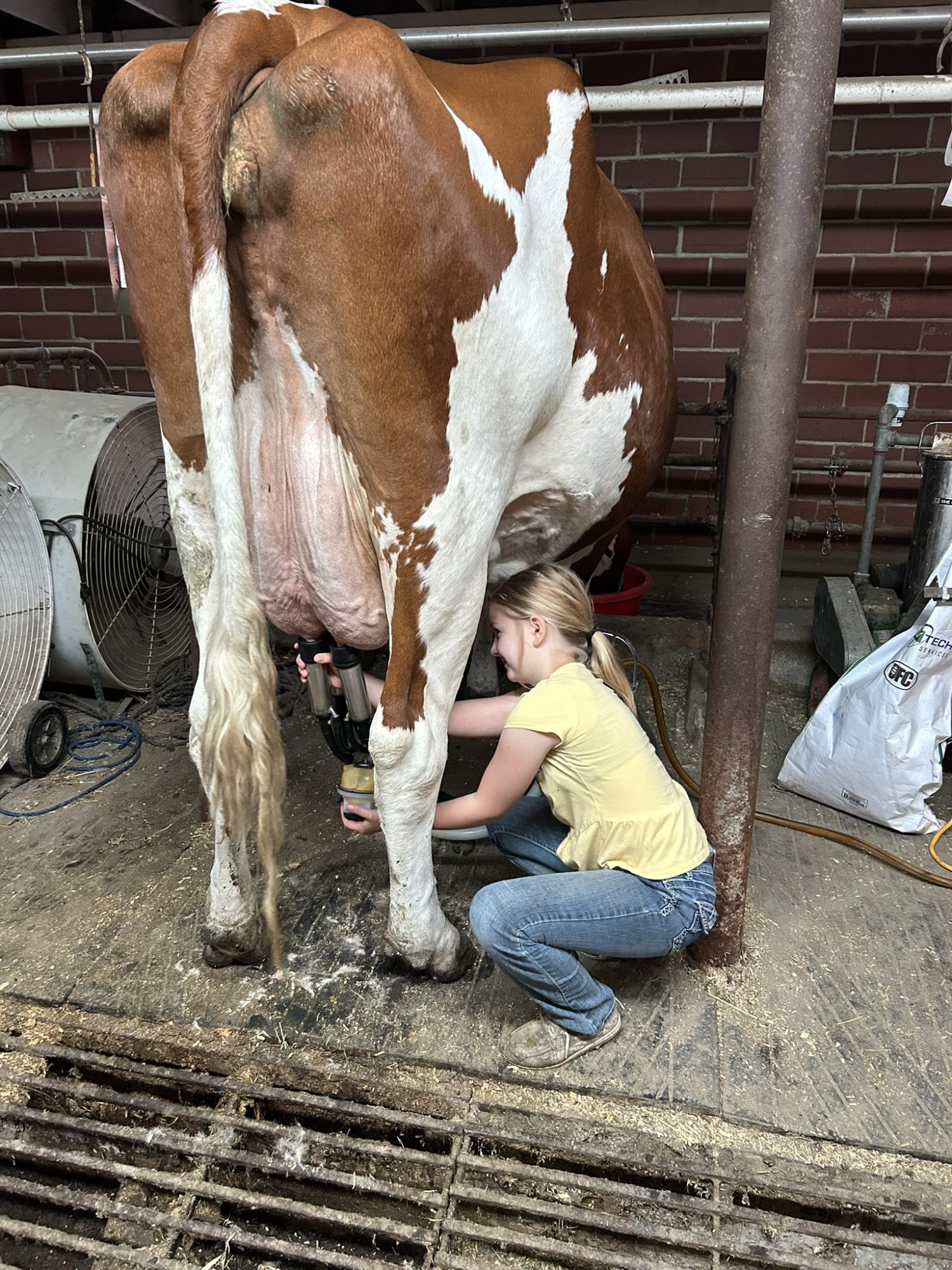
The summer between her first and second years of high school, Michele started relief milking. It was 1992, no cell phones, just trust and responsibility. She’d milk before school, after school, sometimes both. The work suited her—the rhythm, the routine, the twice-daily check on every animal.
“I liked milking cows,” she says simply. “I was part of the dairy industry, would often learn something, meet people, learn new things or ideas I could borrow and take home.”
Love, Marriage, and Deep Dairy Roots
When Michele married Jason Schroeder, she married into a family with deep dairy roots. Jason himself had spent 30 years milking in the family barn. Michele stopped relief milking when they got engaged, focusing instead on building their own operation and starting a family.
Alex came first, then Aiden, then April. Michele worked off-farm as a rural property appraiser from 2011 until January 2021, when her company sold, leaving at 5:00 p.m. to pick up kids while Jason finished evening milking by 7:15. It was the classic dairy farm juggle—one parent always missing something.
But by 2017, with milk at rock-bottom prices and their tie-stall barn in need of major repairs, they made a strategic pivot. They’d build a 3,000-head hog finishing barn for steady income and keep just 25 milk cows—enough to teach the kids everything a dairy farmer’s child should know.
Then 2018 happened. With milk prices at rock bottom and futures looking worse, the bulk tank needed to be replaced. At least one silo had to go. “The writing was on the wall,” Michele says quietly.
The Night the Barn Went Silent
November 2018. The cows left in stages. Eight loaded onto a cattle jockey’s trailer, destination unknown. Then the main herd—two gooseneck loads on consecutive brisk days to a Registered Holstein operation in South Dakota. The buyer called later, said he was happy. Small comfort.
For nearly two weeks, they milked just ten cows. The barn felt wrong, too quiet. Michele remembers the distinctive cows that left—some headed to new homes, others destined for sale. The night before the last cows left, all five Schroeders milked together.
“There were tears—some of us more than others,” Michele admits. “Who would have thought that years of working every day without a break, the stress of paying bills, dealing with bitter cold and extreme heat day in and day out would result in tears at the end? Funny, but it did”.
Alex, then 9, took it hardest. The morning one of the older cows went to market, five-year-old April wanted one last picture before school. Jason walked through the empty barn the next day and found it eerie, cold. Only cats lived there now.
The Call That Changed Everything
April 2019, at the Hoese Holsteins Dispersal Sale—another farm going under. Michele stood watching genetics scatter when Jackie Rickeman approached: Would Michele milk their cows that July?
“I told Jackie yes, but I’d need to bring my children since Jason was gone for a work trip, and we’d need to stay at their house due to distance.”
Jackie agreed, though she later asked Michele, “Why would we leave home and travel about 45 minutes to milk someone else’s cows?” The question revealed how unusual Michele’s path was becoming.
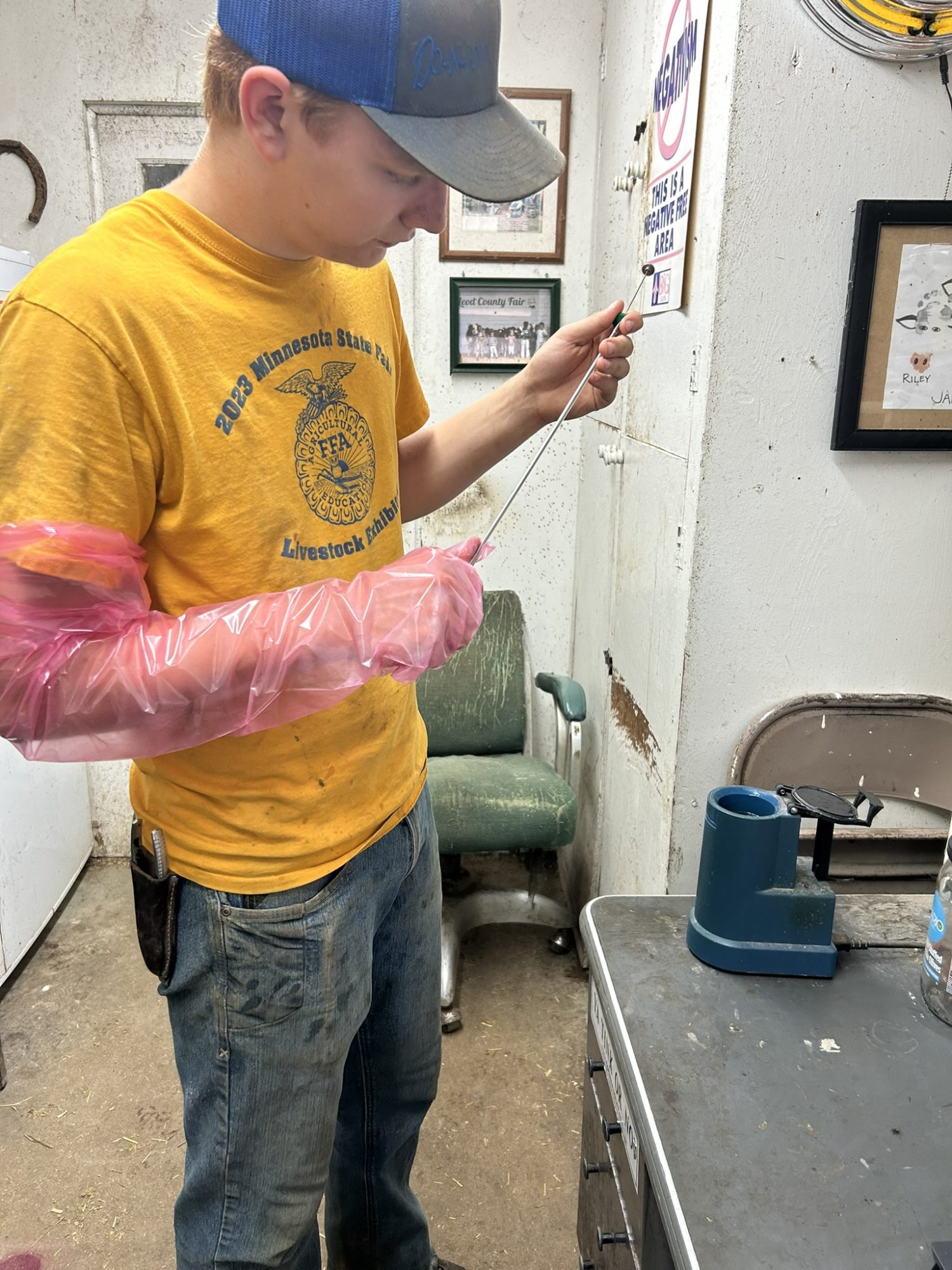
Michele’s first relief job after selling their herd was actually Memorial Day weekend 2019, helping a neighbor. But that July at the Rickemans’ was baptism by fire. A new calf is born almost every day, including twins on the final day. Ten-year-old Alex learned to give oxytocin injections in the milk vein. Six-and-a-half-year-old Aiden helped move fresh cows.

“Alex told me that he thought watering flowers at this farm meant it would be watering about five flower pots, not as much as we actually had to water!” Michele laughs about that first intense week.
Teaching Through Loss
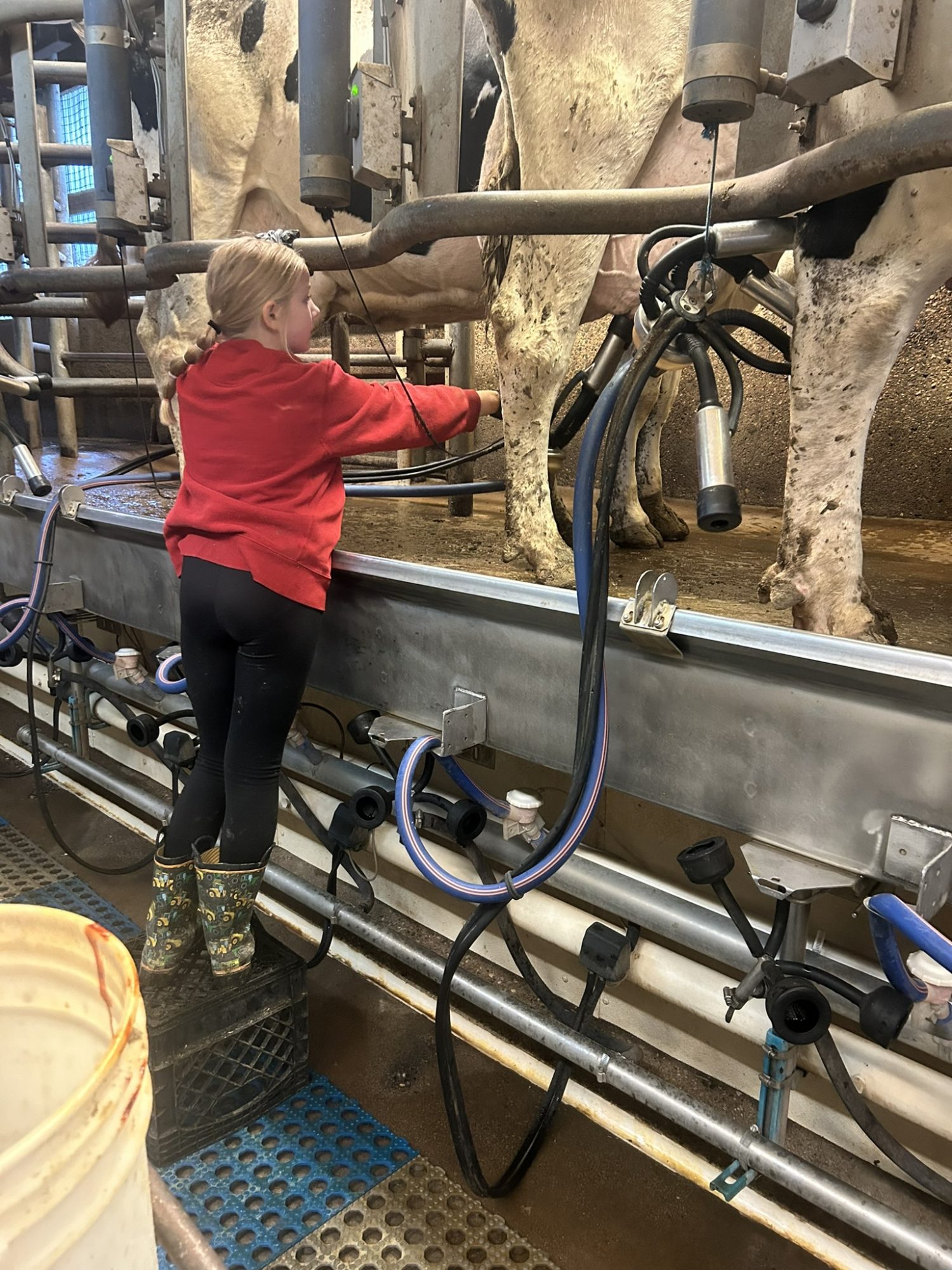
What makes Michele’s approach unique isn’t just that she relief milks—it’s how she’s turned it into a comprehensive dairy education for her children. Each farm teaches different lessons. Tiestalls teach patience. Herringbone parlors teach rhythm. Parallel parlors teach speed. Two-hundred-cow operations teach efficiency.

She listens to KNUJ AM 860 from New Ulm while milking, noise-canceling headphones on 95% of the time, staying connected to the agricultural community even in someone else’s barn. The station’s farm news and markets keep her grounded in the industry she still serves.
Michele has discovered there’s something profound about teaching her children responsibility through someone else’s trust. When farmers hand over their keys, it’s a powerful statement: they are trusting the Schroeders with everything they’ve built.
The deeper lessons come unexpectedly. Like when Alex grabbed a welder to fix a scraper that had been broken for months. Or when Aiden taught his friend Jackson how to prep cows in Jackson’s own family parlor—because a son should know how to do chores at his own farm. There was that time Alex drove the tractor to a relief milking job before he had his license, showing initiative that would make any parent proud and nervous at the same time.

“What’s that pink thing that keeps coming out under his stomach?” Aiden once asked about a bull in someone’s parlor. Michele didn’t hesitate and gave him the anatomical term straight. His eyes widened, he paused, then went back to prepping cows. Farm kids learn differently.

The Expo Moment That Defined Everything
World Dairy Expo 2025. While Alex showed his Ayrshire cow in Madison—a cow almost sold as a springing heifer—Michele stood in a stranger’s living room 300 miles away, watching on livestream.
“There were several times I thought Alex was overworking his cow,” she recalls. “I yelled at the TV, ‘Stop overworking her!’ Good thing I was alone.”
She stood ON the coffee table, taking photos through the glare, texted the photos to Alex after class, and watched her son compete against the eventual Grand Champion. When Alex placed 12th, Michele thought: “I’m glad I wasn’t there. It was done, I didn’t have a long drive back home, and I saw what I needed to see. I was not the showman—Alex was”.
Both Alex and Aiden have won the Nicollet County Holstein Association Outstanding Junior Boy award—remarkable for children who don’t milk their own cows daily. Together, the three children own 15 animals, plus three more that Alex owns independently, and one in partnership with family friends.
The Economics Nobody Discusses
During their kitchen remodel in the fall of 2020, Michele milked nearly every Friday and Saturday night for a neighbor. “It helped me escape the chaos and mess of construction, plus earned extra money for our project,” she says. She’d planned to use some of the relief milking money to buy Jason a father’s ring for Christmas—personal goals wrapped into professional service.
What she didn’t know at the time: the farmer’s father was dying of pancreatic cancer. Every milking she covered meant the family could continue harvest. They found out only at the funeral.
“I feel it’s important for dairy farmers to take a break for their mental health,” Michele insists. “I saw the difference it made for Jason when he joined the township board. He was thinking and doing something completely different—had a mental break from the stress of dairy farming”.

The Man Who Won’t Milk Anymore
Jason Schroeder doesn’t relief milk. After 30 years in the family barn, Jason’s milking days ended when the last cow left. He’ll help at friends’ farms during emergencies, but regular relief work isn’t his path. His teaching comes through South Central College now, as a Farm Business Management Instructor.
“Jason did his time—30 years. He was ready to be done,” Michele says, but ready and reconciled are different things entirely.
What Michele Knows That We Don’t
Michele maps out the next five years with precision. Alex will finish 4-H, complete his FFA showing career, and wrap up as a junior at the Minnesota State Holstein Show. Aiden, who currently has a lawn-mowing job for a neighbor, will be a senior and will drive himself to relief jobs. April, who helps an older woman with mobility issues with odd jobs, will be getting her farmer’s permit and considering dairy princess opportunities.
Looking ahead, the family is already planning the sesquicentennial celebration of their farm, set to take place around 2030—150 years since the land entered the family, even if the cows left before that milestone. They’re planning a breakfast-on-the-farm celebration.
“The sky’s the limit for these kids,” Michele says with absolute conviction. “At a young age, they started building their resume working both on and off our farm, learning responsibility early”.
April dreams of becoming a veterinarian. Alex talks about a cattle boarding business. Aiden watches his options carefully, the way he predicts which calf pen won’t hold a jumpy Holstein.
The Wisdom in the Dawn
At 5 a.m. in someone else’s barn, unplugging trainers to avoid getting shocked, Michele Schroeder embodies a truth the industry hasn’t quite named: sometimes the most important dairy farmers don’t own dairy cows.
She’s there when a farm family needs to attend their daughter’s wedding. When harvest runs late. When a father is dying and every moment matters. She’s there in the ordinary emergencies that make farm life extraordinary.
“I am probably the only relief milker they will ever meet who wears capris or shorts, a Hard Rock Café visor or headband, and old tennis shoes,” Michele laughs. She doesn’t look like a traditional farmer. Maybe that’s exactly the point.

In February 2025, Michele accepted a part-time position as District Outreach Representative for Congressman Brad Finstad, limiting her availability for relief milking. She’s stopped taking new clients, though she maintains relationships with the farms that sustained her family through transition. She stays involved with the Farm-City Hub Club in New Ulm, keeping those agricultural connections strong.
The Truth Michele Learned
Ask Michele what she’d tell a family that just sold their herd and feels lost, and she doesn’t hesitate:
“Take some time to reconnect with your spouse and family. You’ve just spent years milking cows twice a day, every day. The cows are gone, but the people are still there. There’s no better way to thank the people who stood by you than the gift of your time”.
She pauses, then adds the harder truth: “Have a plan. Saying ‘I’m resting after selling the cows’ can only be done for so long. Everyone needs something to do in life—a purpose, an activity, a plan”.
Standing in the Rickemans’ parlor as the sun finally rises, Michele finishes another milking, loads her children—her legacy—into the car, and heads home to their empty barn. Tomorrow she’ll do it again, as long as farms need her and her children need to learn.
Because this is what love looks like in dairy country now: showing up for others when you can’t show up for yourself anymore, teaching the next generation through borrowed barns and other people’s cows, keeping the knowledge alive even when your own milk check stopped coming years ago.
The alarm will lie again tomorrow morning, promising just a few more minutes of sleep. Michele will ignore it again, put it in her contacts, and head into the darkness. Because somewhere in Minnesota, a farm family needs to know that someone understands their cows, their exhaustion, their dreams.
And Michele Schroeder—relief milker, mother, keeper of generations of dairy wisdom—will be there when they need her most.
KEY TAKEAWAYS
- Relief milking fills a critical industry gap — With labor turnover near 40% and thousands of farms closing annually, qualified relief milkers provide essential coverage that most operations desperately need but can’t find.
- Selling your herd doesn’t mean leaving dairy — Michele Schroeder’s story proves that dairy expertise and passion can continue serving the industry in new, sometimes more impactful ways than traditional ownership.
- Multi-farm experience creates superior education — The Schroeder children are winning awards and building exceptional resumes by learning across tiestalls, parlors, and operations of varying sizes—an education no single farm could provide.
- Farmer mental health depends on relief options — Relief milkers don’t just fill labor gaps; they enable the breaks that prevent burnout, preserve families, and keep operations sustainable long-term.
- Agricultural legacy evolves rather than ends — The Schroeders are planning their farm’s 150-year celebration in 2030, proving that family heritage continues even when the business model changes.
 The Sunday Read Dairy Professionals Don’t Skip.
 The Sunday Read Dairy Professionals Don’t Skip.
Every week, thousands of producers, breeders, and industry insiders open Bullvine Weekly for genetics insights, market shifts, and profit strategies they won’t find anywhere else. One email. Five minutes. Smarter decisions all week.




