





5,100 herds left. Fewer barns, same milk. The real story? The nights when the barn lights stay on—and who pulls in the driveway.
Executive Summary: Wisconsin starts 2026 with about 5,100 licensed dairy herds—roughly half as many as ten years ago and only a third of what there were two decades back. The cows and the milk are still there; what’s changing is which farm lanes the milk truck turns into, and how those roads feel when it stops coming to one more yard. This feature takes readers into the kitchens, barns, and sale rings where neighbors quietly scrub parlors on last‑milk days, pull into yards when barn lights stay on too late, and line rural roads with headlights when one family can’t carry it alone. It shows how consolidation, beef‑on‑dairy economics, and aging owners collide with real tools like Wisconsin’s Farmer Wellness Program, 4‑H and FFA projects for non‑farm kids, and lease‑to‑own and non‑family succession paths that keep some barns in use a little longer. The heart of the story isn’t the numbers—it’s the people: farm families, youth, vets, nutritionists, pastors, and co‑op folks who refuse to let each other fall alone. And it closes with simple, realistic ways any reader can strengthen their own road, from checking on late barn lights to opening their barn to one more kid who wants to learn.
Author’s Note: The scenes in this article are composite narratives—distilled from years of conversations and patterns seen across Wisconsin dairy communities. While no single family is portrayed, the moments here reflect a shared reality. The data is current; the emotions are real; and these acts of community happen far more often than the outside world ever sees.
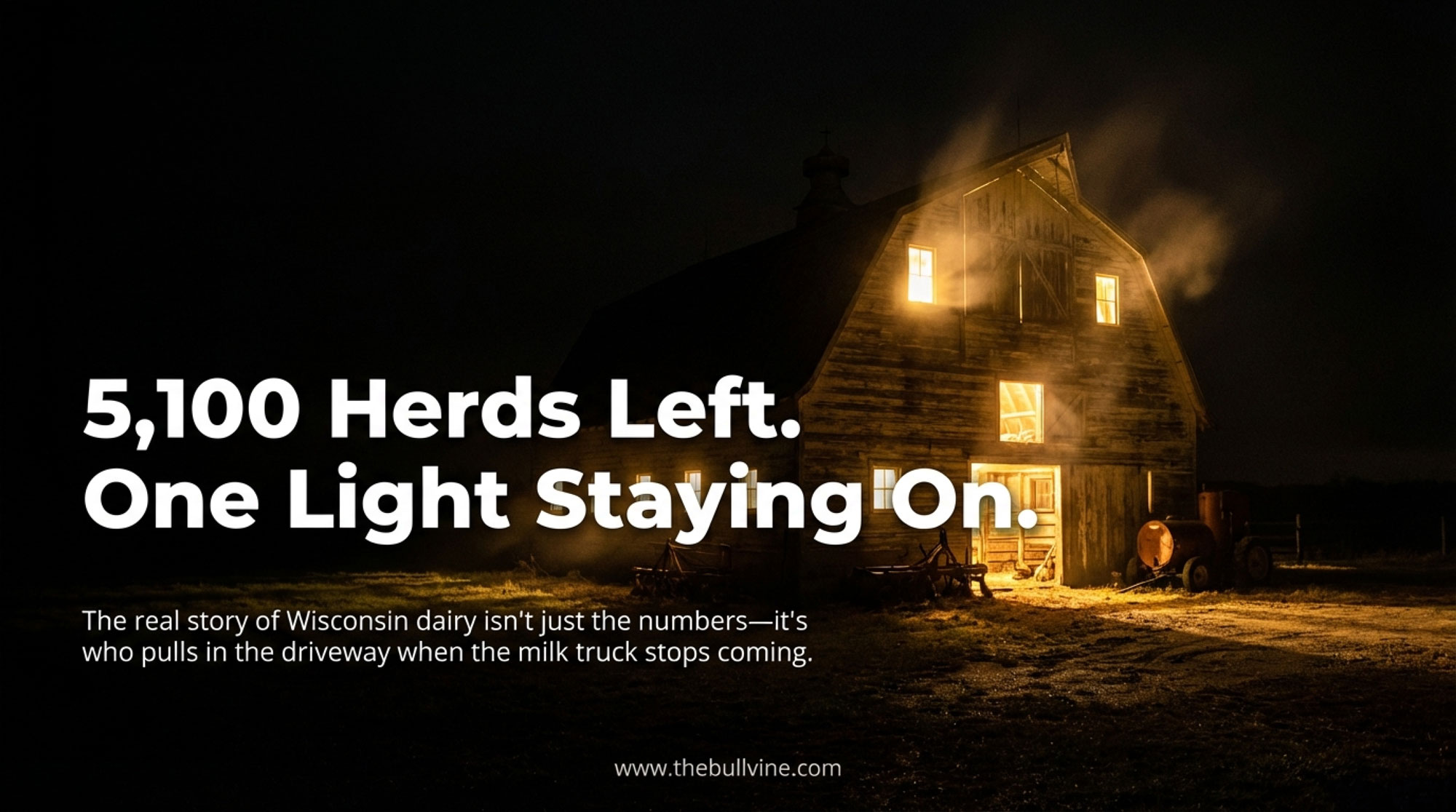
I’ll never forget sitting at a kitchen table in western Wisconsin, steam rolling off a coffee mug that had already been reheated twice between chores. The farmer across from me stared out at a road he’d driven his whole life and said, “There used to be 13 dairies down this stretch. Now we’re down to two.”
Outside, the barns were still there. Silos still reached into the sky. But a lot of those bulk tanks were cold now. No fresh milk truck tracks in the gravel. No kids racing to the bus in chore clothes. Just a road that used to echo with the sound of milk pumps and skid steers, now a little too quiet.
If you’ve milked cows in this state for a while, you don’t need anyone to explain the numbers. Wisconsin has started 2026 with right around 5,100 licensed dairy herds—the fewest in decades and just over half the number that were operating about ten years ago, roughly a third of what there were a couple of decades back. The total number of cows being milked across the state has stayed close to the same, and milk production keeps inching upward as more milk comes from larger, higher‑yield herds. The milk is still coming. It’s just coming from fewer farm lanes and fewer kitchen tables.
On paper, the reasons look straightforward: high costs that squeeze small and mid‑size farms, consolidation into larger herds, and a lot of older farmers deciding they can’t keep doing this level of work into their sixties and seventies. Strong demand for beef and beef‑on‑dairy has nudged some herds toward different choices, too—cull checks and beef cross calves sometimes make selling out or shifting focus a little less painful than it would’ve been a generation ago. The charts and reports will tell you all of that.
What they can’t really show is how it feels when those numbers land on your own road—or how, against all odds, the people on that road keep finding ways to show up for each other.
When Neighbors Became Family
The call to the neighbor came before dawn.
On a short dead‑end road not all that different from yours, everyone knew a family’s last load of milk was scheduled. The signs had been there for a while—fewer replacements in the heifer yard, an auction flyer tucked under a magnet on the fridge, conversations drifting from “next year’s ration” to “how long can we keep this up?”
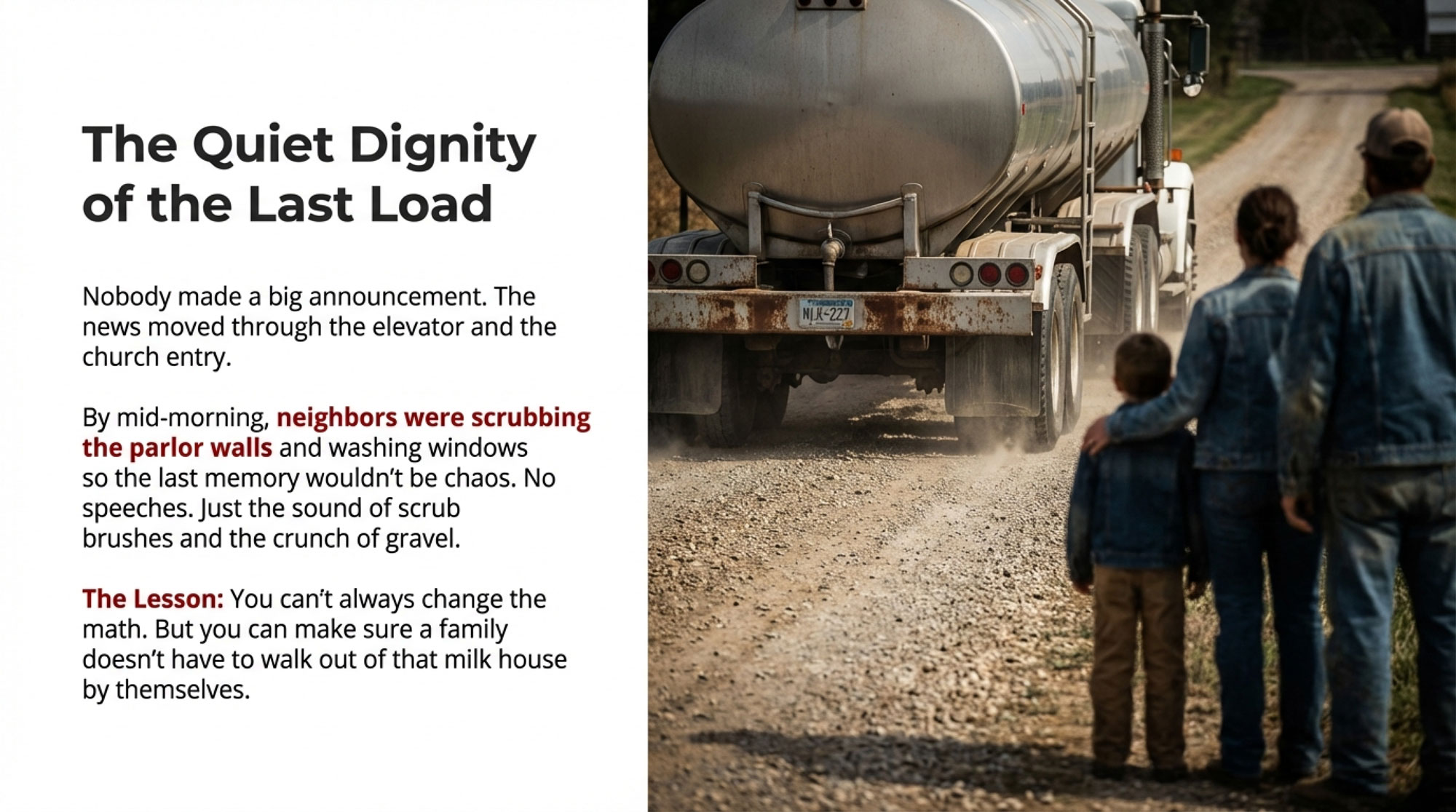
Nobody made a big announcement. The news moved the old‑fashioned way—mentioned at the elevator, in the church entry, over a pickup hood in the school parking lot.
By mid‑morning, that yard felt different.
One neighbor backed in with a skid steer on a trailer because he knew there’d be pens to clean, gates to move, heavy things to lift. Another truck pulled up and a friend climbed out with a couple of casseroles and a stack of paper plates. She just said, “You’re not going to want to cook tonight,” and set them on the counter. Someone else walked straight to the milk house, opened the door, and started wiping down the tank and washing windows so the last memories in that room wouldn’t be of clutter and chaos.
What moved everyone most was how quietly people walked into that space and got to work. No speeches. No “you should’ve done this or that.” Just steady hands on scrub brushes, someone sweeping the parlor, somebody else checking that the light bulbs worked and the breakers were labeled so the next person who came along would be able to find their way.
A couple of neighbors made sure the kids had somewhere else to be that afternoon—a cousin’s house, a 4‑H leader’s place—so they didn’t have to stand in the yard and watch the milk truck pull away.
When the time came, a few people stood with the family at the end of the lane as the stainless trailer eased down the driveway. Nobody said much. There were a few stories about “that old cow who always kicked off the unit” and a little laughter through tears, the way you do when you’re trying to hold it together. Then there was just the sound of the truck, the crunch of gravel under tires, and a quiet that felt heavier than usual.
Over coffee at the co‑op a few days later, a neighbor tried to put words to it. He said you can’t always change the math, but you can make sure a family doesn’t have to walk out of that milk house by themselves. Everyone around the table just nodded. They knew exactly what he meant.
Most of you reading this have seen some version of that day. Maybe you’ve stood in the yard. Maybe you’ve been the one backing in with the skid steer. Either way, it’s the kind of day that changes how you look at the road you live on.
Standing in the Parlor, Not Alone
The text from the neighbor could’ve gone unnoticed on any other night.
It was one of those bitter January evenings when the wind drives snow under every door and makes the short walk from the house to the barn feel a mile long. The cows were milked. The line was washed. But a dairyman found himself just standing in the parlor, staring at a small stack of unpaid bills on the shelf by the wash sink, feeling that tight, heavy weight that doesn’t care how strong your back is.
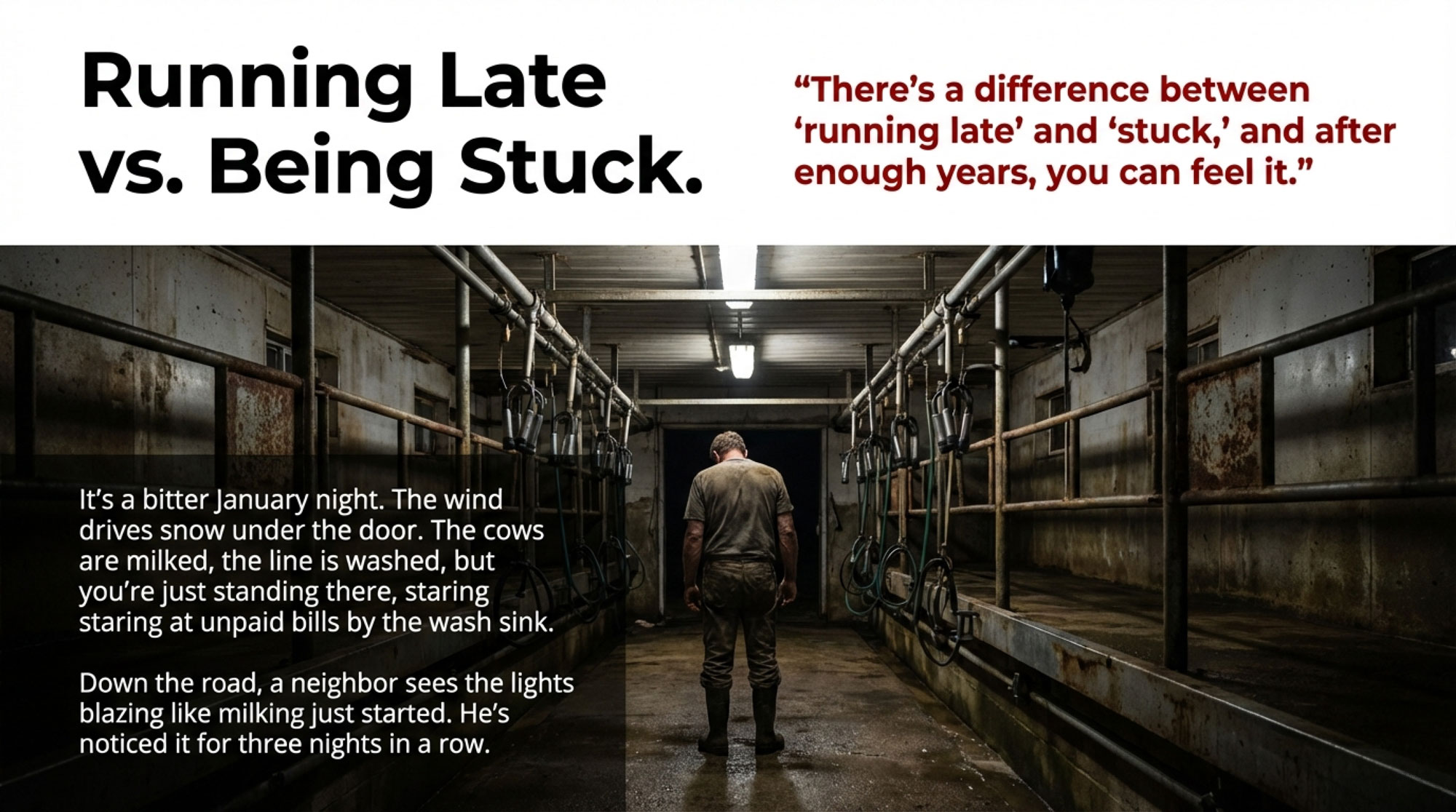
Down the road, a neighbor drove past and saw the lights still blazing like milking had just started instead of being long finished. He’d noticed it the night before. And the night before that. There’s a difference between “running late” and “stuck,” and after enough years in the neighborhood, you can feel it.
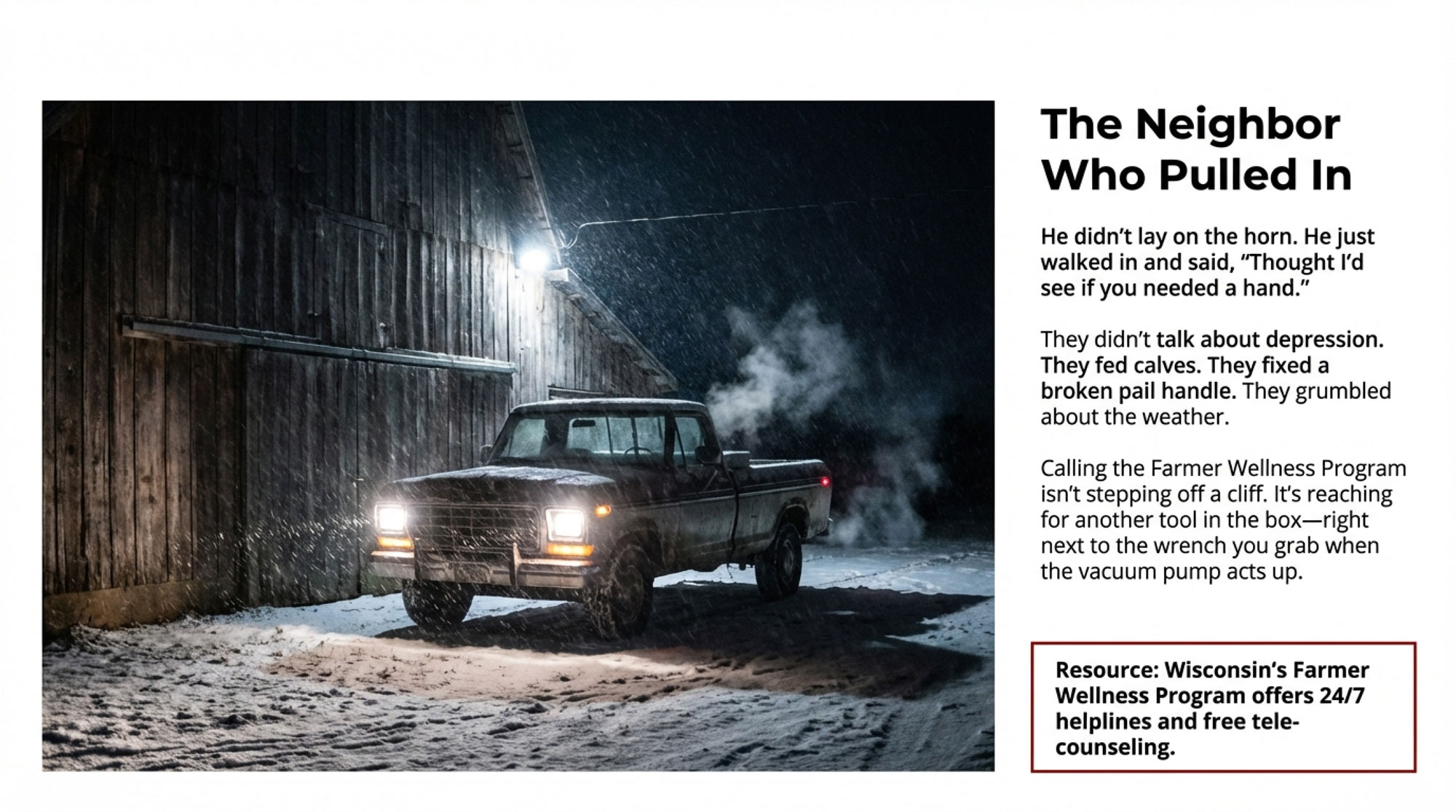
A little while later, that neighbor’s truck rolled into the yard. He didn’t lay on the horn or make a big entrance. He pulled in, shut the truck off, and walked into the barn. He nodded and said something along the lines of, “You done with calves yet? Thought I’d see if you needed a hand.”
They didn’t launch into a deep talk about depression or interest rates. They fed calves together. They grumbled about the weather. They fixed a broken pail handle. The next night, the neighbor came back at the same time. And the next. They didn’t solve everything, not even close. But the chores got done, and the silence didn’t feel quite so sharp.
Somewhere between talking about dry cow shots and the next co‑op meeting, the farmer said, “You know that number they talked about at that meeting? I think I’m going to call it.”
In recent years, Wisconsin has put real muscle behind those numbers. Through the Farmer Wellness Program and the Farm Center, the state offers a 24/7 helpline for farmers and their families, free tele‑counseling sessions you can do from the kitchen table, counseling vouchers that cover in‑person visits with local providers, and online support groups designed specifically for farmers and farm couples. It’s all free to Wisconsin farm families, no matter the size of the operation.
The debt didn’t disappear when he picked up the phone. The milk price didn’t jump. But calling for help stopped feeling like stepping off a cliff and started feeling more like reaching for another tool in the box—right there next to the wrench you grab when the vacuum pump acts up.
We’ve all been taught to tough it out and fix things ourselves. On a lot of farms now, the bravest move isn’t working another couple of hours in the barn. It’s admitting you can’t fix it alone.
Most of you know that feeling, either because you’ve had someone show up for you, or because you’ve pulled into a driveway when the lights were on too late and just said, “Hey, I’m here.”
Programs and hotlines matter. They save lives. But they work best in communities where it’s already normal to keep an eye out for each other, to notice when the barn lights stay on too long, and to show up without making a big deal out of it.
Raising Kids, Cows, and Community
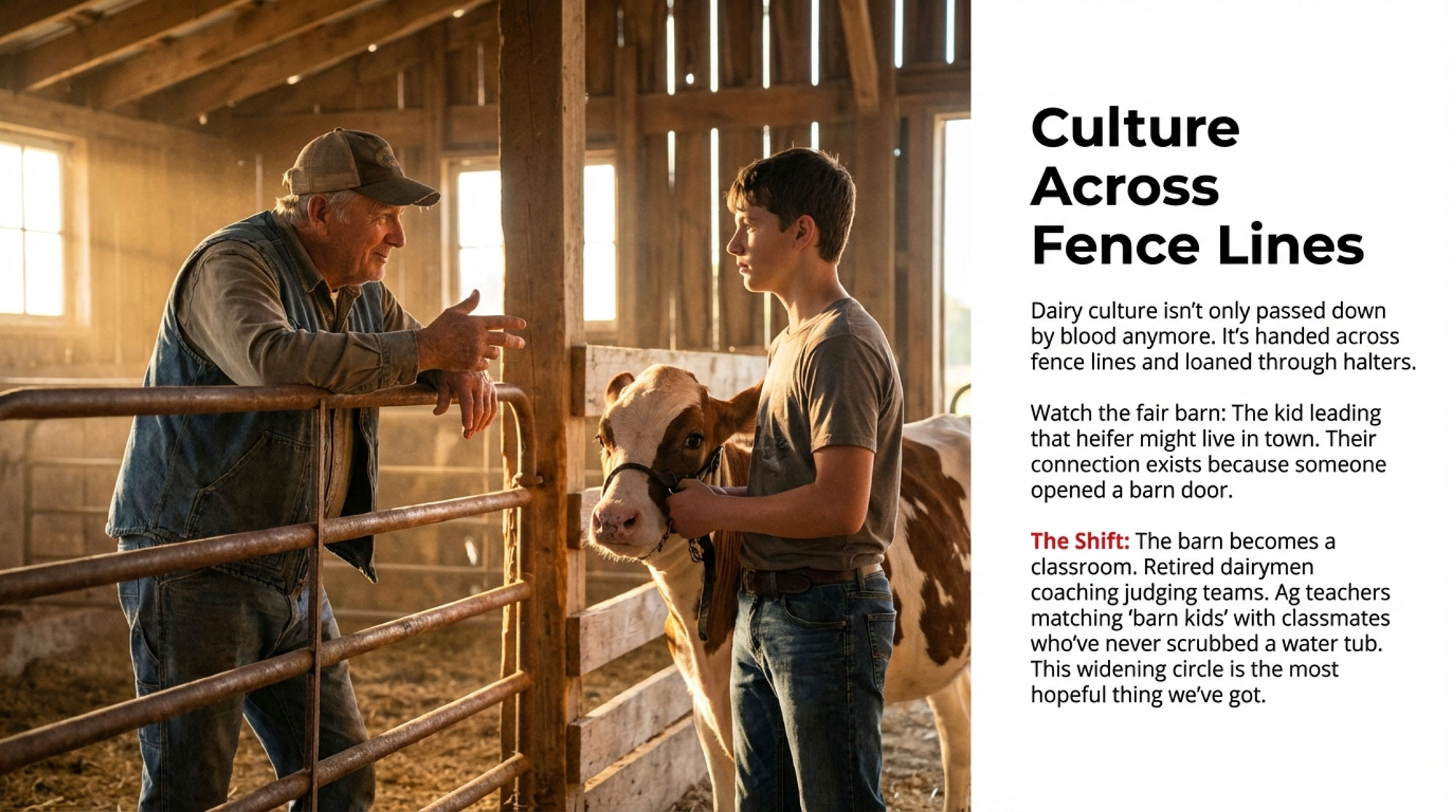
The first time you watch a kid from town lead a heifer into the show ring, you realize something important: dairy culture isn’t only passed down by blood. It’s handed across fence lines, loaned through halters, and shared in the corners of fair barns that smell like shavings, coffee, and nerves.
If you really want to see how this works, spend a day in a Wisconsin dairy barn at fair time or sit in on a 4‑H dairy project meeting.
You’ll see the familiar scenes: kids in white jeans wrestling with halters, parents trying to keep a nervous heifer clean, ag teachers and 4‑H leaders juggling clipboards, show schedules, and pep talks. You’ll hear the usual ring talk about udders and toplines and who’s judging this year.
Listen a little closer, though, and you’ll notice how many of those kids don’t live on working dairies anymore. Plenty come from town. Others live on farms that crop now instead of milk. Their connection to cows exists because somebody with a barn decided to open the door.
In a lot of counties, ag teachers and 4‑H leaders lean into that reality. They match “barn kids” who grew up knowing how to mix milk replacer and clip heifers with classmates who’ve never scrubbed a water tub but are eager to learn.
The conversations start small. A text from a farm kid: “Can I bring a friend to chores tomorrow?” A 4‑H leader saying, “We’ve got a family with an extra calf—anyone want to learn how to work with her?”
Before long, you’ve got a couple of extra pairs of boots in the mud room before school. A kid from town learning how to set up a milking stall. A former dairyman, now retired, volunteering to help coach dairy judging because he misses talking about cows and wants to pass something on.
At the next 4‑H meeting, you can feel the difference. The kids who used to hang back at the edge of the barn are suddenly talking about feed, show strings, and cow families. One signs up for dairy bowl. Another spends Saturday mornings milking for a neighbor. A few just carry the experience with them, knowing they were trusted in a barn when it really counted.
The barn starts to look less like a place for one family and more like a gathering place for a whole community—a barn that helped raise the kids, whether those kids lived on the farm or not. And in a state where the number of farms keeps shrinking, that widening circle might be one of the most hopeful things we’ve got.
The Question at the Kitchen Table
The hardest conversations often start after chores.
You know the scene. Barn boots lined up by the back door. Kids finally in bed. The hum of the refrigerator louder than usual in a quiet farm kitchen. Somewhere between the last bite of supper and the first bill on the table, someone says it.
“We can’t keep doing this forever. So what happens next?”
Over the last several years, that question has stopped being hypothetical for a lot of dairy families. Owners are getting older. Backs and knees don’t bounce the way they used to. The next generation is juggling off‑farm jobs, spouses’ careers, school events, and sports schedules. The cost of buying into a dairy—land, cows, equity in the business—is enough to make even the most determined young person swallow hard.
At the same time, there are young folks who would love nothing more than to get their own herd started. Some grew up on dairies that sold their cows. Others discovered their love for cows through 4‑H or FFA and never had a family farm to go back to. They’re hungry for a chance, but the numbers and the structures don’t always make it easy.
In that gap, more extension educators and farm business advisors have started helping families talk through options: lease‑to‑own agreements where a younger producer rents facilities and gradually buys into the herd, non‑family partnerships with clear roles and exit plans, or longer‑term land leases that keep ground in agriculture even if the parlor goes quiet. None of these paths are perfect. They’re messy, full of hard conversations and what‑ifs. But at least they open a door that used to stay shut.
At one meeting, a producer stood up and said he didn’t walk away from milking because he stopped loving cows. He stepped away because he loved his family too much to keep them under that level of pressure forever. The room went quiet for a moment. Then you could see heads nodding all around. Most of the people there had run those same calculations across their own kitchen tables.
Not every story ends with a perfect handoff and a young couple moving into the farmhouse. Some end in a sale ring crowded with neighbors who come to buy a gate or a water tank and end up standing a little longer than they need to, just to say thank you. But more families are getting the chance to write that ending with intention, and more neighbors are learning how to show up for both the ones who stay and the ones who step away.
The Night the Road Filled With Headlights
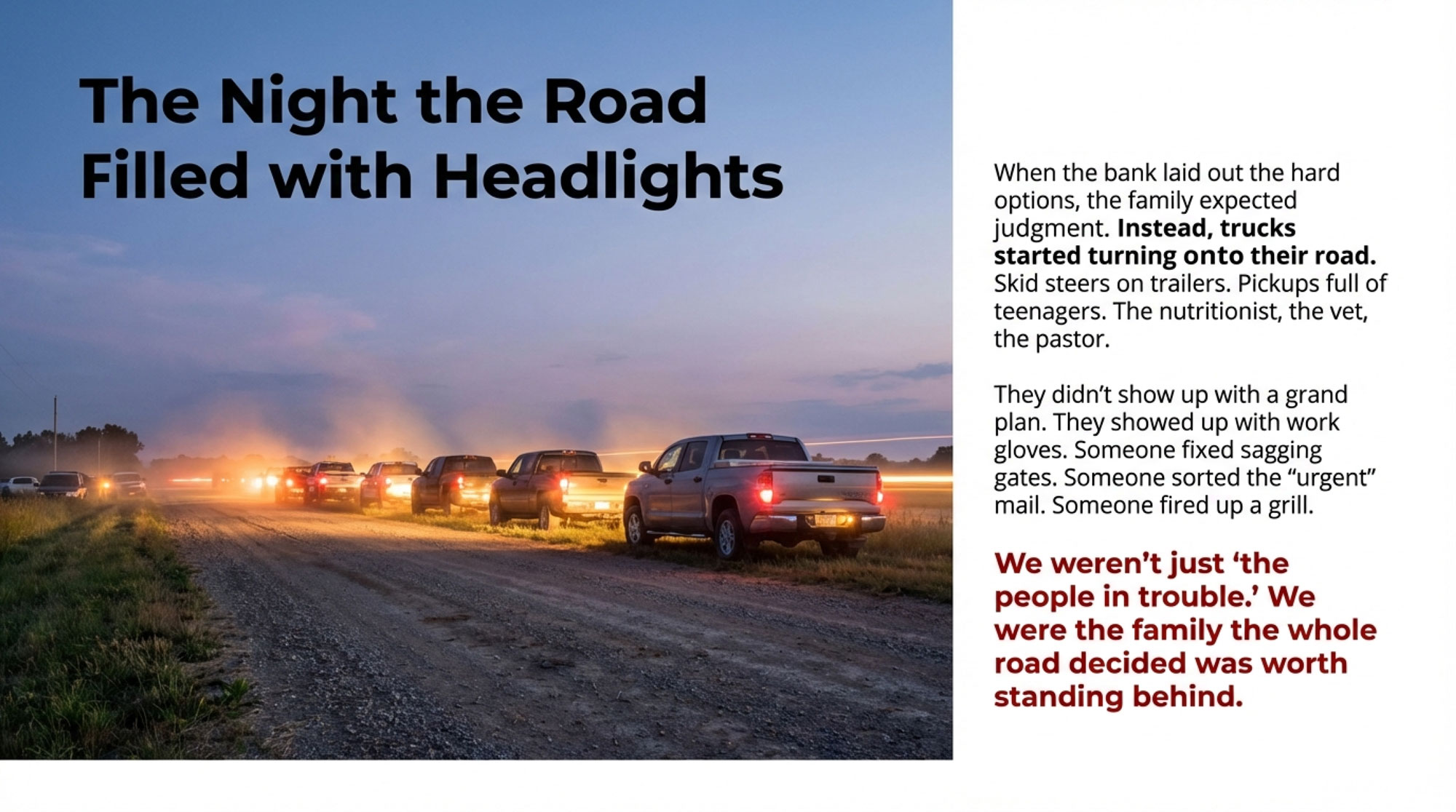
Nobody expected the whole road to line up with headlights that night.
In one dairy community, folks had been watching a family wrestle with a tough stretch. You could see it in their faces at the feed mill, in the way they left meetings early, in the number of times they said, “We’ll see,” instead of “See you next year.”
Then the news settled into something heavier. The bank had laid out a few options, and none of them were easy or pretty. The family hadn’t asked for help. They were still doing what dairy folks do—putting their heads down and trying to outwork the problem.
But the community had been talking, too.
A cousin quietly set up an online fundraiser. A friend who worked with a lender said, “If they’re willing, I’ll ask my boss to look things over.” The pastor mentioned it at the end of church: “If you’ve got some time or tools next weekend, there’s a family that could use a hand.” A 4‑H leader sent a message to the parents’ group: “We’re going to the farm on Saturday. If your kids want to help, bring boots and gloves.”
By late afternoon, as the sun dropped behind the silos, trucks started turning onto their road. Skid steers on trailers. Pickups full of teenagers in hoodies. Hired hands from neighboring operations who’d finished their own chores and came anyway. The nutritionist’s car. The vet’s truck. Co‑op folks, church families, 4‑H kids, neighbors from up and down the line.
They didn’t show up with a grand plan. They showed up with work gloves.
Someone tackled the broken boards and sagging gates that had been bugging everyone for months. A couple of people sat at the kitchen table with the family, sorting mail into piles—“urgent,” “call about this,” “we’ll figure this out later.” Others took over feeding calves and bedding pens so the owners could sit for a couple of hours and have real conversations with the banker and the advisor who’d stopped in. At some point, someone fired up a grill. Kids ran parts and fetched tools. People drifted in and out of the house and barn, carrying both coffee and paperwork.
What happened next didn’t erase the debt. It didn’t suddenly double the milk price. But it changed something deeper.
“It made it easier to go into town after that,” one of them said later. “We weren’t just ‘the people in trouble.’ We were the family the whole road decided was worth standing behind.”
They still had sleepless nights. The story is still being written. But that night, in the glow of those headlights, everyone there got a clearer picture of what kind of community they lived in—a community that refused to let them fall alone.
And in the months that followed, that same family showed up when someone else’s barn roof needed shoveling, and when a younger neighbor wanted to talk through a lease‑to‑own offer on a small herd. The help didn’t just land in one yard and stop. It kept moving, in ways none of them expected when those first trucks pulled in.
What You Can Do on Your Road
All of this can sound big and far away until you ask a simple question: “Okay, so what can we actually do where we live?”
It doesn’t have to be complicated. It might look like:
- Noticing when a neighbor’s barn lights are on much later than usual for a few nights in a row, and choosing to pull in instead of just wondering.
- Bringing one non‑farm kid into your barn this year through 4‑H, FFA, or your own show string, so they can learn what it feels like to be trusted in that space.
- Keeping the farmer wellness numbers where you and your neighbors can find them—on the fridge, in the milk house, taped to the bulletin board in the shop—so calling for help feels like using a tool, not admitting defeat.
- If you’re thinking about succession, talking with your lender, extension, or a farm business advisor about options like leasing, non‑family buy‑ins, or gradual transitions before a health scare or a bad year forces your hand.
- Checking in, now and then, with the folks who left dairying in your area—inviting them to the fair, the breakfast on the farm, or the next co‑op meeting—so they know they’re still part of the story.
- Saying “yes” when the pastor, the 4‑H leader, or the co‑op board asks if you’ll show up at a meeting about farm stress or succession, because your voice might be the one that helps somebody else take the next step.
None of these things fix the structural pressures on dairy. They don’t rewrite market reports or change how many zeroes are on the check from the plant. But they change what it feels like to live through those pressures. They turn lonely math into shared load‑bearing.
Community and Legacy: What This Means for All of Us
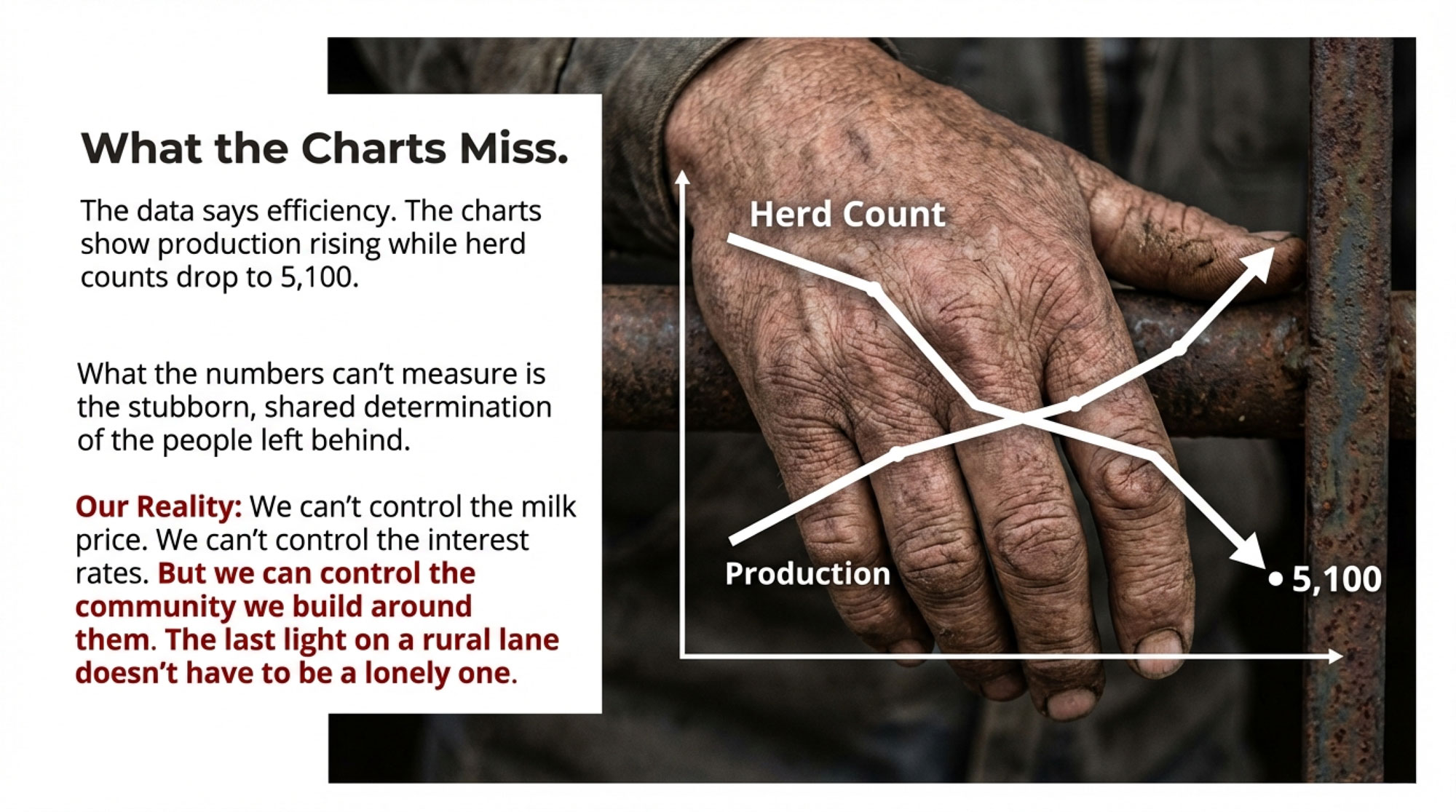
Over the last decade, Wisconsin has watched its dairy herd count slide to levels that would’ve sounded impossible when a lot of today’s producers were kids. You can see it in the empty yards, the lone silos, the “For Sale” signs at the ends of lanes that used to have cows in every window. At the same time, statewide data keeps showing roughly the same total number of cows and steady or rising milk production, as animals move into larger herds and farms lean harder on efficiency.
That’s the big picture. But if you sit at enough kitchen tables and walk through enough barns and community halls, you start to see something those numbers can’t measure: a stubborn, shared determination that even if we can’t save every farm, we can make sure the people on those farms don’t have to go through this alone.
We can’t control the markets, but we can control whether we notice when a neighbor’s barn lights are on too late and check in.
We can’t guarantee a successor for every farm, but we can help kids from town and from former dairy families find their way into the barn through 4‑H, FFA, or a neighbor’s show string.
We can’t erase every hard decision, but we can make sure families who leave dairying still feel welcome at the co‑op, in the sale barn café, and in the fair barn aisles.
You know who your “call list” is—the people you’d phone if something really went wrong at your place. Maybe this week is the time to add one more name to that list. Or to be that name for somebody else.
Most of you reading this have your own version of these stories. A time when someone showed up for you. A time when you dropped everything to show up for someone else. A moment when it hit you that what kept you going wasn’t just the cows—it was the people around you.
- The last light on a rural lane doesn’t have to be a lonely one. It’s up to all of us, up and down these roads, to decide whether we’re just watching from a distance—or pulling in the driveway when it matters.
Key Takeaways
- The numbers are stark: Wisconsin starts 2026 with about 5,100 dairy herds—half as many as a decade ago, a third of twenty years back—while cow numbers and milk production hold steady as larger operations absorb the volume.
- The pressures haven’t changed: high costs squeezing margins, consolidation into bigger herds, owners aging out, and beef‑on‑dairy economics that sometimes make stepping away less painful than holding on.
- Community still shows up: neighbors scrubbing parlors on last‑milk days, pulling into driveways when barn lights stay on too late, lining rural roads with headlights when one family can’t carry it alone—and then paying it forward when the next neighbor needs a hand.
- Help is available and free: Wisconsin’s Farmer Wellness Program offers a 24/7 helpline, tele‑counseling, counseling vouchers, and online support groups at no cost to farmers and their families.
- You can strengthen your own road today: notice late barn lights and check in, bring a non‑farm kid into your barn through 4‑H or FFA, post wellness numbers where neighbors can see them, and keep ex‑dairy families part of the community.
Complete references and supporting documentation are available upon request by contacting the editorial team at editor@thebullvine.com.
Continue the Story
- Beyond the Milk Check: Finding Hope in the Hardest Seasons – This story walks a similar path, following a family that wrestled with the same weight of tradition versus survival. It proves that while the milk truck may stop, the identity of the farmer remains rooted in the community.
- The Consolidation Crossroads: Understanding the Numbers Behind the Barn Doors – This piece deepens our understanding of the economic forces shaped by 2025’s market shifts. It explains the “lonely math” of consolidation, showing how larger herds and genetic efficiency are fundamentally rewriting the landscape of America’s Dairyland.
- Leasing the Legacy: The New Wave of Non-Family Farm Successions – Linking directly to the next chapter of our story, this article explores the young producers carrying forward the work of those without heirs. It’s a hopeful look at how the barn doors stay open through creative, non-traditional handoffs.
 The Sunday Read Dairy Professionals Don’t Skip.
 The Sunday Read Dairy Professionals Don’t Skip.
Every week, thousands of producers, breeders, and industry insiders open Bullvine Weekly for genetics insights, market shifts, and profit strategies they won’t find anywhere else. One email. Five minutes. Smarter decisions all week.




