







How groundbreaking validation reveals that practical, profitable feed efficiency measurement is finally within reach for commercial dairy operations—and why the timing matters for producers evaluating their options.
EXECUTIVE SUMMARY: Finnish researchers have validated GreenFeed technology, which accurately measures individual cow feed efficiency with a 75% correlation to gold-standard respiration chambers, making this technology commercially viable for the first time. With 300-cow operations potentially saving $21,000 to $30,000 annually through 10% efficiency improvements (based on current Midwest feed costs of $8/cwt), the economics are shifting from “nice to have” to “can’t afford not to.” A Journal of Dairy Science study by Huhtanen and Bayat tracked 32 Nordic Red cows producing 28.9 kg of milk daily, demonstrating that metabolic measurements through CO2 and methane can reliably identify the most efficient animals without manual feed tracking. What’s particularly encouraging is that operations from Wisconsin to California are already seeing returns, with the USDA’s $11 million Dairy Business Innovation Initiative offering cost-sharing that significantly changes the payback timeline. As farms continue to consolidate—we’ve lost 50% since 2003, while production has jumped 35%—the operations that thrive are those that maximize every efficiency gain they can find. The 3-6 month learning curve is real, but early adopters are building baseline data that could position them for premium contracts and carbon markets worth an additional $80+ per cow annually. Whether you’re ready to move forward or still evaluating, one thing’s clear: efficiency measurement is transitioning from a competitive advantage to a table stake.

You know that conversation we keep having at every conference about feed costs and efficiency? Here’s something worth considering: researchers at Finland’s Natural Resources Institute have recently validated technology that enables the measurement of individual cow efficiency, making it not only possible but potentially profitable for commercial operations.
The timing is indeed interesting. With consolidation pressures, evolving environmental regulations, and margins doing what margins do, the difference between measuring feed efficiency and estimating it might matter more than we’ve been acknowledging.
The Discovery That’s Getting Attention
What Pekka Huhtanen and Ali-Reza Bayat published online ahead of print in the Journal of Dairy Science this past July really caught my attention. Their paper, “Potential of novel feed efficiency traits for dairy cows based on respiration gas exchanges measured by respiration chambers or GreenFeed,” worked with 32 Nordic Red dairy cows—good solid production at 28.9 kg milk daily, about 159 days in milk—comparing GreenFeed systems to those gold-standard respiration chambers we’ve all heard about but few of us have actually seen.
Here’s what’s noteworthy: 75% of the most efficient cows identified by GreenFeed were also ranked in the top tier by respiration chambers. Now, that’s not perfect correlation, but for on-farm application? That level of accuracy starts to look commercially viable.
What’s particularly interesting is the approach—measuring what cows do with their feed metabolically rather than weighing every bite. By tracking residual CO2 production, oxygen consumption, and heat production, they’re capturing efficiency in a fundamentally different way. The correlation with traditional measurements appears strong enough that many producers are starting to take notice, although we’ll need more field validation to determine how this plays out across different operations.
Understanding the Economics (Because That’s What Matters)
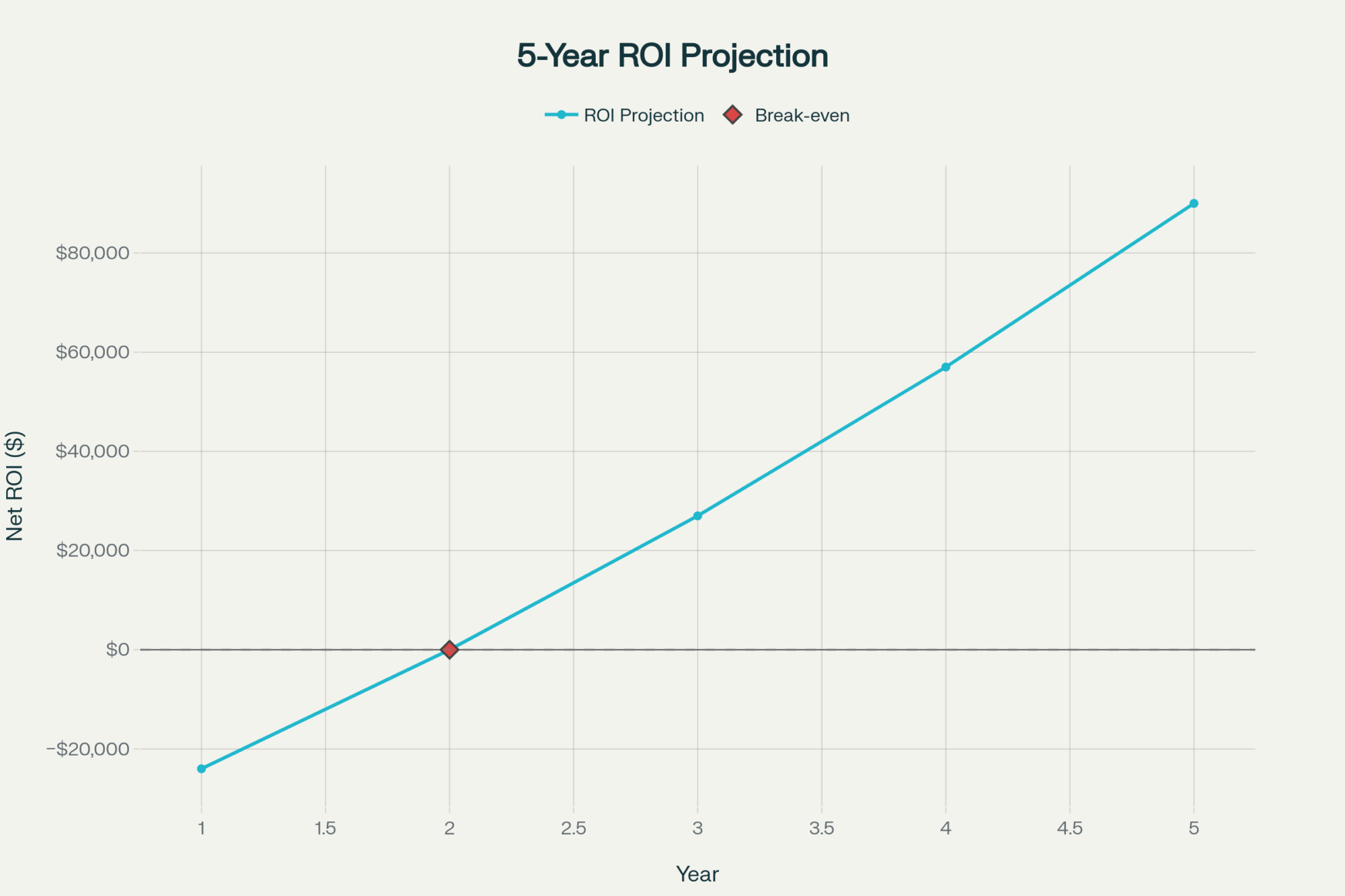
Economic analyses suggest that improving efficiency from 1.5 to 1.75 kg milk per kg dry matter intake could deliver meaningful returns. Let me walk you through some rough estimates here, keeping in mind these are ballpark figures that’ll vary based on your specific situation…
Say you’ve got a 300-cow operation. If you can improve efficiency by even 10%—and that’s assuming typical Midwest feed costs around $8 per hundredweight—you might be looking at something like $70-100 per cow annually just in feed savings. Scale that up, factor in your local market conditions, and the potential could reach $21,000 to $30,000 yearly. But honestly? Your mileage will vary. Feed prices in California are higher than in Wisconsin, and grazing operations have significantly different economics compared to confinement systems. Down in Georgia or Florida, where heat stress impacts efficiency for months on end, the calculations shift again.

C-Lock Inc. manufactures these GreenFeed systems, and according to their technical documentation, the units measure CO2 in the 0-1% range with 0.5% full-scale accuracy, along with CH4 at similar specifications, operating in temperatures from -20 to 50°C. While pricing varies based on configuration, we’re looking at a substantial initial investment. However, that is also the case when all the components are factored in.
What often gets overlooked—and this is what recent USDA Farm Labor data is showing—is the labor component. Wisconsin farms saw wages increase from $18.40 per hour in July 2024 to $19.46 by October. Many operations dedicate several hours daily just to manual data collection. At those rates, plus benefits and management time, the automation aspect becomes a significantes part of the ROI calculation.
The methane reduction angle adds another dimension. Research suggests that less efficient cows tend to produce more methane per kilogram of milk. With California’s Low Carbon Fuel Standard paying around $85 per tonne CO2 equivalent (though these markets fluctuate considerably), there’s potential for additional revenue streams.
How the Technology Actually Works

The simplicity is actually quite appealing. Unlike respiration chambers—which, let’s be honest, aren’t practical for most of us—GreenFeed works in existing facilities. Tie-stalls, free-stalls, even pasture systems… that flexibility matters, especially for operations that aren’t looking to rebuild their entire setup.
According to C-Lock’s GreenFeed manual, the system requires a 100-240VAC power input with a maximum rating of 300W. It measures gas concentrations while cows eat a pelleted attractant, with the RFID reader supporting both HDX and FDX tags for individual cow identification. The Finnish research shows it averages about five visits per cow daily—enough for robust data collection without disrupting routines.
What’s particularly impressive is Valio’s implementation in Finland across multiple farms. According to their published reports and industry documentation, success hinged not just on the technology but also on proper training and integration with existing management systems. They treated it as part of their overall approach, not a magic bullet.
The system interfaces with common herd management software through standard data export protocols accessible via C-Lock’s web interface. This means efficiency metrics can be integrated with reproduction records, health events, and production data you’re already tracking. Now, I’ve heard some producers express concerns about data ownership and privacy—specifically, who owns this information, how it’s used, and similar issues. It’s worth asking those questions upfront.
Breaking Through the Hesitation
We all know the three barriers to any new technology: money, complexity, and whether it actually works. What’s changing is how producers are evaluating these factors.
On the financial side, the USDA allocated $11.04 million through the Dairy Business Innovation Initiative to support small and mid-sized operations in adopting precision technologies. Tom Vilsack mentioned at World Dairy Expo this October that they’ve invested over $64 million across 600 dairy projects. The Southeast Dairy Business Innovation Initiative, offered through Tennessee, provides grants with cost-sharing opportunities for qualifying operations—that changes the math considerably.
The complexity issue? As Dr. Kimberly Seely from Cornell noted in her work on dairy technology, these biosensor systems provide us with insights we’ve never had before. However, and this is crucial, they also require us to learn new ways of interpreting data. It’s not plug-and-play, but it’s also not rocket science. Most producers report a 3-6 month learning curve before they become comfortable with data interpretation.
The Changing Landscape
What’s clear from industry data is the divergence developing between operations. According to an analysis of USDA Economic Research Service data by Investigate Midwest, the number of licensed dairy farms declined from over 70,000 in 2003 to 34,000 in 2019—that’s a 50% drop. Meanwhile, milk production increased roughly 35% over a similar period. Are the operations thriving through this consolidation? They’re generally finding ways to maximize efficiency.
Early adopters are building baseline data that could position them for future opportunities—whether that’s securing premium contracts, participating in carbon markets, or simply achieving better genetic selection. Meanwhile, operations taking a wait-and-see approach also have valid reasons. There’s wisdom in both approaches, depending on your situation.
The Next Generation’s Perspective
Surveys of young farmers returning to dairy operations show that they view efficiency measurement differently than many of us who’ve been in this field for decades. For them, it’s not about whether to measure efficiency, but how to do it most effectively.
The logic is hard to argue with—we track milk weights, reproduction, and health events. Why wouldn’t we track efficiency? However, here’s the bridge that needs to be built: knowledge transfer between generations. The older generation has decades of cow sense that technology can’t replace. The younger generation brings comfort with data interpretation and systems thinking. Successful operations are finding ways to combine both perspectives.
Looking Ahead

The Finnish validation study, along with complementary research such as the 2024 study “Evaluating GreenFeed and respiration chambers for daily and intraday measurements,” also published in the Journal of Dairy Science, suggests that technical barriers to feed efficiency measurement are being overcome. The technology appears to be working, although field validation is ongoing.
Patterns are emerging from operations that have implemented these systems. The first few months typically focus on establishing baselines. After that, many integrate the data into breeding and management decisions. Extension specialists working with multiple herds report that surprises often come from middle-of-the-road cows—that is, the middle 60% of the herd, where efficiency measurements reveal unexpected opportunities.
Based on current adoption rates and technological development, this could become standard practice within 5-10 years, much like how activity monitors have become commonplace. The question worth considering: How does efficiency measurement fit into your operation’s future? Not your neighbor’s operation, not the industry average, but yours specifically.
For those considering validated technology with demonstrated potential, the picture is becoming clearer. But like most decisions in dairy, there’s no universal answer. Whether you adopt this technology tomorrow, take a wait-and-see approach, or stick with proven traditional methods—keeping an open mind about industry changes while staying true to what works for your farm remains the key.
What’s your take on feed efficiency measurement technology? Are you considering it for your operation, or do you see other priorities? Share your thoughts and experiences in the comments below, or check out more dairy technology insights in The Bullvine’s Technology section (found in the top navigation menu at www.thebullvine.com).
KEY TAKEAWAYS:
- Proven accuracy delivers real savings: 75% correlation between GreenFeed and respiration chambers means you can identify efficient cows reliably, with potential feed savings of $70-100 per cow annually (varying by region—California higher, Wisconsin moderate, Southeast factoring heat stress)
- Implementation pathway is clearer than expected: Start with baseline measurement on your top pen, integrate with existing DairyComp or PCDART systems through C-Lock’s web interface, and expect 3-6 months before you’re confidently using the data for breeding and culling decisions
- Labor savings amplify the ROI: With farm wages hitting $19.46/hour in Wisconsin (October 2024 USDA data), automating daily feed efficiency tracking saves 3-5 hours that can be redirected to management decisions that actually move the needle
- Carbon markets are becoming real money: California’s Low Carbon Fuel Standard at $85/tonne CO2 equivalent means documenting methane reductions from efficiency improvements adds another revenue stream—early adopters are already banking credits
- Generational opportunity for technology adoption: USDA’s Dairy Business Innovation Initiative and Southeast programs offer cost-sharing that fundamentally changes the economics, while young farmers returning to operations see this as essential infrastructure, not optional technology
Complete references and supporting documentation are available upon request by contacting the editorial team at editor@thebullvine.com.
Learn More:
- Unlock the Secrets to Maximizing Rumen Feed Efficiency: The Ultimate Guide for Dairy Farmers – This guide provides actionable strategies for optimizing rumen health and nutrient balance, directly helping you implement immediate, practical changes to boost your herd’s feed conversion efficiency and reduce costly waste.
- 2025 Dairy Market Reality Check: Why Everything You Think You Know About This Year’s Outlook is Wrong – This article reveals the strategic, market-wide forces—from component economics to policy volatility—that make investing in efficiency a survival necessity, giving you the high-level context to justify smart capital expenditures and long-term planning.
- AI and Precision Tech: What’s Actually Changing the Game for Dairy Farms in 2025? – This piece provides a forward-looking perspective on the ROI of emerging technologies like robotic milking and AI health monitoring, offering a blueprint for modernizing your operation and capturing the long-term profitability that innovation provides.
 The Sunday Read Dairy Professionals Don’t Skip.
 The Sunday Read Dairy Professionals Don’t Skip.
Every week, thousands of producers, breeders, and industry insiders open Bullvine Weekly for genetics insights, market shifts, and profit strategies they won’t find anywhere else. One email. Five minutes. Smarter decisions all week.




