







That 10% retained placenta rate you accept as ‘normal’? It’s costing you $20,000/year. Here’s how to cut it in half for $5,000.
EXECUTIVE SUMMARY: You’re likely losing $20,000 annually to a problem you think costs $75 per case—retained placenta actually drains $389 when you count lost milk, open days, and cascade diseases. Progressive dairy operations have cracked the code, cutting rates from 10% to 4% with one simple change: dual calcium bolusing at $10 per cow. The game-changer is understanding that retained placenta isn’t mechanical—it’s an immune system failure caused by subclinical hypocalcemia, which affects 25-50% of fresh cows. Farms implementing this evidence-based protocol consistently achieve 307% ROI, banking $15,000+ net profit annually on a 500-cow operation. Research from Cornell, Wisconsin, and USDA confirms what leading producers already know: preventing retained placenta isn’t about treating problems better; it’s about stopping them before they start. With payback in under 4 months and proven results across North America, the only question is whether you’ll capture this value now or continue accepting ‘normal’ losses.

Progressive farms are discovering that a simple calcium protocol delivers 307% ROI while cutting fresh cow disorders in half—here’s what they’re learning about transition cow economics
There’s a conversation happening in milk houses and conference rooms across the dairy industry right now, and it’s about something most of us thought we had figured out: retained placenta.
You know how it is. For generations, we’ve accepted that 8-12% of fresh cows will retain their placentas. Just another cost of doing business—like bedding expenses or fuel prices. But here’s what’s interesting: that acceptance might be costing your operation far more than you realize.
What I’ve been seeing across operations from Wisconsin to California is that retained placenta is actually running about $389 per case when you factor in all the downstream impacts. That figure comes from research published in the Journal of Dairy Science, and it’s been consistent with what Dairy Herd Management and other industry analysts have been documenting. For a typical 500-cow operation, addressing this one issue could mean the difference between breaking even and banking an extra $15,000 annually.
“We’ve spent decades selecting for higher production. Now we need to ensure our management systems support the remarkable cows we’ve created.”
The Economics Nobody’s Been Calculating
So here’s what really caught my attention. When researchers from the University of Guelph and Ontario Veterinary College dug into the true cost of retained placenta across multiple herds, they uncovered something remarkable. That immediate vet expense—the $75 bill most of us focus on—it’s just a tiny piece of the actual economic impact.
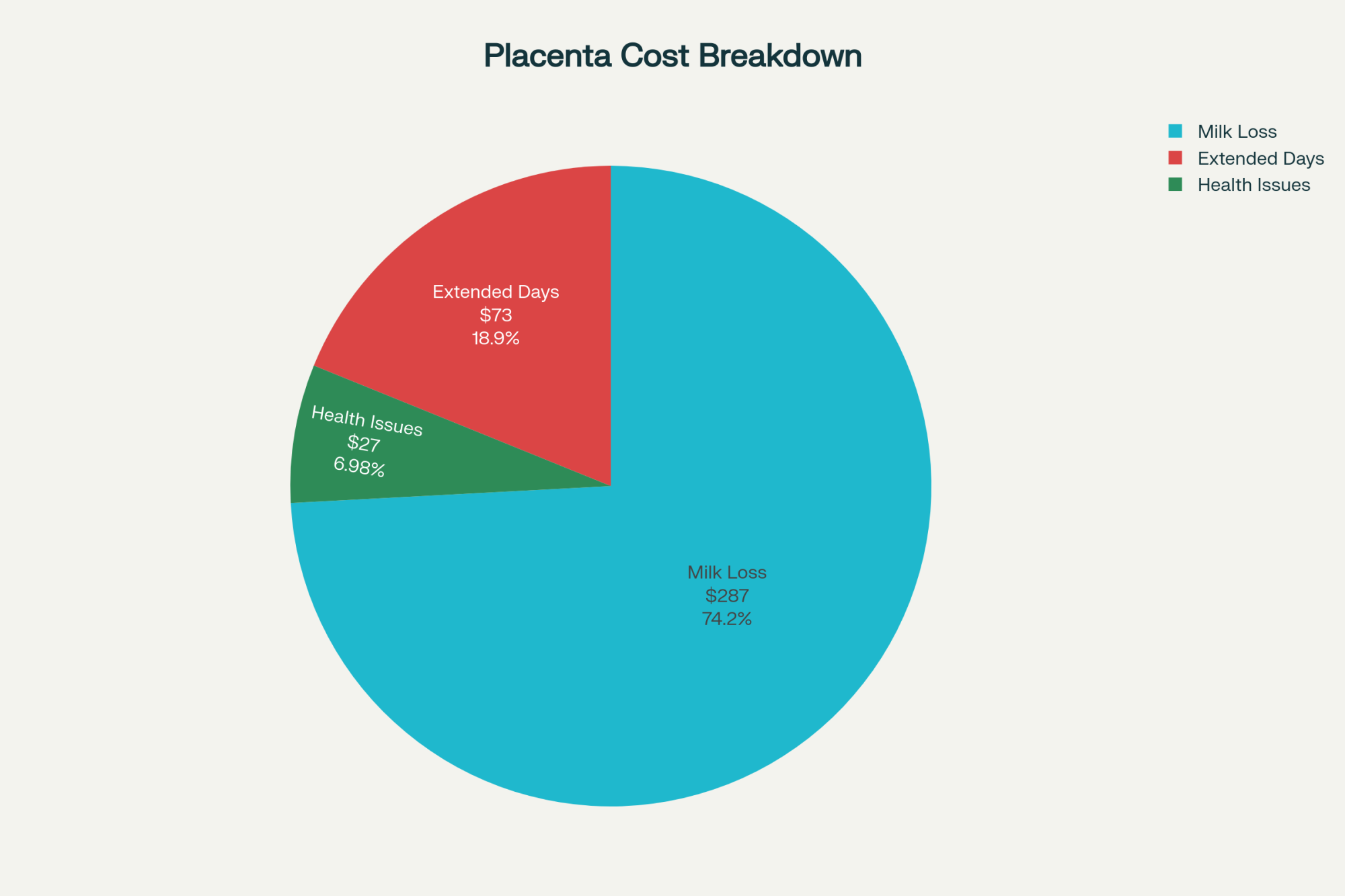
The breakdown tells an interesting story:
- Direct milk production losses account for $287 per case (that’s roughly 74% of your total cost)
- Extended time to pregnancy adds another $73, about 19% of the impact
- Increased susceptibility to other diseases contributes $25-29 per case
What’s worth noting is the loss in milk production. These cows produce 300-500 kg less milk across their entire lactation—we’re talking 660 to 1,100 pounds that never makes it to your bulk tank. At current component-adjusted prices in most regions, you’re looking at $150-250 in lost revenue per affected cow.
And the reproductive piece… well, that’s where it really adds up. Research from Tanzania and several other countries tracking dairy herds shows that retained-placenta cows average around 52 more days open than their healthy herdmates. They need about 2.9 services per conception compared to 1.9 for unaffected cows.
You probably know this already, but each open day costs between $3 and $5, depending on your market. So that extended time to pregnancy alone can run $150-260 per affected cow. These aren’t theoretical numbers—they’re showing up in actual herd records from coast to coast.
Cost Breakdown: Where Your Money Goes
For each retained placenta case:
- Milk production loss: $287 (74%)
- Extended days open: $73 (19%)
- Secondary health issues: $25-29 (7%)
- Total: $389 per case
Understanding the Biological Transformation
To really appreciate why retained placenta has become such a challenge, we need to consider how dramatically our cows have changed.
I was talking with a dairyman the other day—third generation, been in the business his whole life—and he pulled out production records from the 1980s. His grandfather’s best cows were producing 12,000-14,000 pounds per lactation. Today? His herd averages over 26,000 pounds. That’s not just more milk. That’s a complete biological transformation.
Peak production has climbed from 60 pounds daily to routinely exceeding 120 pounds in well-managed herds. And the metabolic demands this places on transition cows? They’re unprecedented in the history of dairy farming.
Here’s where the science gets really interesting. Research from Dr. Kayoko Kimura’s team at the USDA’s National Animal Disease Center in Ames has revealed something that changes our entire understanding of retained placenta. Rather than being a mechanical failure—you know, the placenta simply being “stuck”—it’s fundamentally an immune system dysfunction.
The neutrophils (those white blood cells responsible for separating placental tissue from the uterine wall) show a 41% reduced response in cows destined to retain their placentas. These same animals have interleukin-8 concentrations averaging just 51 picograms per milliliter, compared to 134 in healthy cows.
What’s that mean for us in practical terms? Well, if retained placenta results from immune dysfunction rather than mechanical attachment, then our traditional approach of manually removing these membranes… it might be misguided. In fact, recent systematic reviews suggest it could actually be counterproductive.
The Calcium Connection: A Management Breakthrough
One of the most encouraging developments in transition cow management involves our understanding of calcium’s role beyond just milk fever prevention. Research from multiple institutions shows that subclinical hypocalcemia dramatically increases the risk of retained placenta risk.
And we’re not talking about clinical milk fever, that’s obvious to spot. This is the 25-50% of fresh cows with low blood calcium who appear perfectly normal during your morning walk-through.
Dr. Jessica McArt’s work at Cornell has really helped clarify calcium’s multiple roles in the transition period. Beyond muscle contraction (which we all know about), calcium is essential for immune cell function, influences stress hormone regulation, and affects rumen motility—which directly impacts dry matter intake.
The challenge, as many of us have seen, is that as milk production has intensified, our traditional calcium management strategies haven’t kept pace. A cow producing over 100 pounds of milk daily? She’s facing metabolic demands that would’ve been unimaginable just two decades ago.
Learning from High-Performing Operations
What I find encouraging is seeing operations achieving retained placenta rates below 4%—less than half the industry average. While each farm has its unique approach, they share several management strategies worth considering.
The Evolution of Calcium Supplementation
Here’s what’s working for many operations, particularly in California and the upper Midwest. Instead of the traditional single calcium treatment at calving, they’ve implemented what’s being called a dual-bolus protocol.
The approach is straightforward: administer the first dose within an hour of calving—two boluses of calcium chloride. Then return 12-24 hours later with two more boluses. That second dose catches the delayed hypocalcemia that often triggers problems two or three days after calving.
The research supports this approach. A comprehensive meta-analysis published this year demonstrated that while single bolusing addresses immediate calcium needs, it’s the second dose that prevents the delayed hypocalcemia associated with many fresh cow disorders.
The economics work out to about $10 per cow for the protocol, and many operations are seeing retained placenta rates drop from 10-11% down to 4-5% within months of implementation. That’s a pretty solid return.
The Critical Importance of DCAD Verification
You know what’s been eye-opening? How many farms believe they’re feeding an effective negative DCAD program when they’re actually not.
I was working with a nutritionist in Wisconsin recently, and she shared her experience testing urine pH on farms claiming to run negative DCAD programs. About half the time, when they actually test urine pH, it’s running 7.5 to 8.0—nowhere near the 6.0 to 6.5 target for Holsteins (or 5.5 to 6.0 for Jerseys).
The issue often traces back to high potassium levels in forages that overwhelm the anionic salts being fed. The solution typically involves adjusting the forage base to include lower-potassium feeds. Corn silage, wheat straw, and certain grass hays—these can help achieve the mineral balance needed for effective DCAD programs.
Rethinking Stocking Density in Transition Facilities
Research from the University of British Columbia, combined with extensive field observations from Wisconsin and New York operations, has really clarified the relationship between overcrowding and fresh cow health.
Here’s what we’re seeing: operations that thought they were being efficient running close-up pens at 120% capacity often see fresh cow health issues—including retained placenta—decrease by about a third when they drop to 80% stocking density.
The most successful operations typically maintain:
- No more than 80% stocking density based on feed bunk space
- At least 30 inches of bunk space per cow
- Between 100 and 160 square feet per cow in bedded pack systems
And here’s something crucial—these farms size their transition facilities for 140% of the average monthly calving rate. Because, as we all know, calvings aren’t uniform throughout the year.
Quick Reference: Dual Calcium Bolus Protocol
Initial Dose: Within 1 hour of calving
- 2 boluses of acidogenic calcium (chloride or sulfate form)
- Provides 50-75g elemental calcium
Follow-up Dose: 12-24 hours post-calving
- 2 additional boluses of the same product
- Addresses delayed hypocalcemia risk
Investment: Approximately $10 per cow Expected outcome: 40-60% reduction in retained placenta incidence
Reconsidering Traditional Treatment Approaches
Perhaps the most surprising development—at least for those of us who’ve been doing this a while—involves our understanding of how to manage retained placenta when it does occur.
Multiple systematic reviews and surveys of veterinary practices across Europe and North America are challenging the long-standing practice of manual removal. Dr. Carlos Risco’s work at the University of Florida has been documenting outcomes from what he calls conservative management.
Management Approach | Traditional Management | Evidence-Based Protocol | Impact |
|---|---|---|---|
| Philosophy | Treat problems after they occur | Prevent immune dysfunction | Paradigm shift: mechanical → metabolic |
| Intervention Timing | Wait 24-48 hours post-calving | Within 1 hour + 12-24h follow-up | 60% reduction in cases |
| Treatment Protocol | Manual placenta removal + antibiotics | Dual calcium bolus ($10/cow) | 88% treatment success when needed |
| Target Blood Calcium | Accept subclinical hypocalcemia | Maintain >8.5 mg/dL throughout | 50% of cows affected without symptoms |
| Expected RP Rate | 10-12% | 4-5% | 60% fewer cases = 25 cows saved/year |
| Annual Cost (500 cows) | $19,450 in losses | $15,345 net profit | $34,795 total swing |
| ROI | Negative | 307% ($3 back per $1) | Payback in 3.9 months |
The approach is simple: monitor cows for signs of systemic illness—fever, depression, reduced appetite. If the cow is otherwise healthy, leave the placenta alone. About 40% resolve without any intervention, with membranes typically passing within 2-11 days.
I’ll admit, this represents a significant departure from what most of us were taught. But farms implementing this approach are reporting fewer cases of metritis and improved long-term reproductive performance. The evidence is getting harder to ignore.
Traditional vs. Conservative Treatment: Making the Choice
Looking at the comparison between approaches, the shift in thinking becomes clear:
Traditional Manual Removal:
- Immediate intervention within 24-48 hours
- Physical removal of retained membranes
- Often followed by intrauterine antibiotics
- Higher risk of uterine contamination and trauma
- Increased metritis rates have been reported in recent studies
Conservative Management:
- Monitor for systemic signs only
- Leave the placenta to separate naturally
- Treat only if fever, depression, or reduced appetite develops
- 40% spontaneous resolution without intervention
- Lower metritis incidence and improved fertility outcomes
The data’s compelling enough that many progressive operations are making the switch, though it does require a mindset shift for both staff and veterinarians.
Calculating Return on Investment
Let’s look at the economics using real-world data from operations that have implemented comprehensive calcium management protocols. And these aren’t just projections—these are actual results we’re seeing.

For a typical 500-cow dairy operation:
What You’ll Invest:
- Dual calcium bolus protocol: $5,000 annually
- Urine pH monitoring supplies: About $200
- Staff training time: Maybe 4 hours total
- Total investment: $5,200
What You Can Expect Back:
- Reduced retained placenta cases (from 10% to 5%): 25 fewer cases × $389 = $9,725
- Decreased metritis incidence: 15 fewer cases × $280 = $4,200
- Fewer displaced abomasums: 6 cases × $470 = $2,820
- Reduced ketosis: 18 cases × $200 = $3,600
- Total annual savings: $20,345
Net profit increase: $15,345 Return on investment: 307% Payback period: 3.9 months
Most operations report achieving these results within their first year of implementation.
Monitoring Success: The Fresh Cow Disorder Rate
Here’s what separates successful operations from those just hoping for the best—they track what’s commonly called the Fresh Cow Disorder Rate. That’s the percentage of cows experiencing any clinical disease during the first 21 days in milk.

Analysis of data from multiple herds reveals pretty consistent patterns:
- Leading operations (top 10%): Less than 15% disorder rate
- Average performance: 25-35% disorder rate
- Operations needing improvement: Over 40% disorder rate
Track this metric weekly, calculate a 90-day rolling average, and you’ll know within one quarter whether your investment is delivering expected returns.
Regional Adaptations and Seasonal Considerations
Now, it’s important to recognize that these protocols need adjustment based on where you’re farming. What works in Wisconsin doesn’t always translate directly to Arizona or Texas.
Field observations across various regions indicate that heat stress can significantly increase the risk of retained placenta. Some operations see rates increase from 7-8% during cooler months to 13% or higher during summer heat stress. If you’re in the Southwest or Southeast, you might need more aggressive calcium supplementation during the summer months.
I’ve noticed that Florida dairies, dealing with year-round heat and humidity, often run their calcium protocols more aggressively from May through October. One producer near Okeechobee told me they actually triple-dose during their worst heat—though that’s based on their specific conditions and vet recommendations.
Feed availability varies, too. Operations in regions where corn silage is limited or expensive face additional challenges in achieving that low-potassium forage base necessary for effective negative DCAD programs. Some Western operations have found success using wheat straw or importing specific grass hays to achieve an appropriate mineral balance.
The key is adapting these principles to your specific circumstances rather than trying to apply a one-size-fits-all approach.
Emerging Technologies and Future Directions
While current calcium management strategies offer immediate opportunities, several developments promise further to transform transition cow management over the coming decade.
Research teams at the University of Wisconsin-Madison and Michigan State University have been identifying blood biomarkers that can predict retained placenta risk weeks before calving. Dr. Heather White’s group at UW-Madison reports identifying specific metabolites in blood samples collected at dry-off with approximately 85% accuracy, flagging high-risk cows.
Sensor technology continues to advance as well. The latest generation of rumen boluses continuously monitors pH, temperature, and motility patterns. When combined with machine learning algorithms, these systems can identify metabolic problems days before clinical signs appear.
Within the next 5-10 years, we’re likely to see:
- Practical on-farm biomarker testing for under $50 per cow
- AI-driven risk scoring based on sensor data
- Precision interventions targeted to individual cow needs
- Industry-wide fresh cow disorder rates below 10%
Implementation Timeline: Your 90-Day Roadmap
For those ready to capture these opportunities, here’s a methodical approach that’s been working well:
Week 1-2: Assessment Phase
- Review records from the past 90 days
- Calculate the current fresh cow disorder rate
- Order calcium boluses
- Set up tracking system (whiteboard works fine)
- Schedule staff training
Week 3-8: Implementation Phase
- Begin dual calcium bolus protocol
- Start weekly urine pH testing (if feeding negative DCAD)
- Evaluate close-up pen stocking density
- Calculate and post weekly disorder rates
- Monitor compliance and troubleshoot
Week 9-12: Refinement Phase
- Compare the disorder rate to the baseline
- Calculate cases prevented
- Document cost savings
- Refine protocols based on results
- Plan additional improvements
The consistent message from successful operations: reliable execution of simple protocols outperforms sporadic attempts at complex interventions every time.
The Bottom Line: Are You Leaving Money on the Table?
As we navigate today’s challenging economic environment—volatile milk prices, rising input costs—the question isn’t whether we can afford to invest in better transition cow management. It’s whether we can afford to leave $15,000 or more in annual returns uncaptured.
The science supporting these approaches is robust, with dozens of peer-reviewed studies confirming both the biological mechanisms and economic benefits. The protocols are practical enough for any motivated operation to implement. And perhaps most importantly, these improvements align with broader industry goals around animal welfare and reduced antibiotic use.
You know, a thoughtful producer said something to me recently that really stuck: “We’ve spent decades selecting for higher production. Now we need to ensure our management systems support the remarkable cows we’ve created. This isn’t about revolution—it’s about evolution, about adapting our practices to match biological reality.”
The tools and knowledge exist today. The only variable is whether individual operations will choose to implement them. For those who do, the rewards—both financial and in terms of animal health—are substantial and sustainable.
So here’s my question for you: If you could reduce retained placenta rates by half and bank an extra $15,000 annually with a $5,200 investment, what’s stopping you from starting this week?
Implementation of these protocols should be done in consultation with your herd veterinarian and nutritionist to ensure adaptation to your specific operational circumstances. Success depends on consistent execution and systematic outcome monitoring. The research and examples cited represent common industry findings and experiences; individual results will vary based on management, facilities, and regional factors.
KEY TAKEAWAYS
- True Cost Exposed: Retained placenta drains $389/case in lost milk, open days, and cascade diseases—turning your “normal” 10% rate into a $20,000 annual bleed
- The $10 Solution: Dual calcium bolusing (at calving + 12-24 hours later) cuts retained placenta rates 60%, from 10% down to 4% within 90 days
- Guaranteed ROI: $5,000 investment returns $20,000 in prevented losses = $15,000 net profit with 3.9-month payback (307% ROI)
- The Science: Retained placenta isn’t mechanical—it’s immune dysfunction from subclinical hypocalcemia hiding in 25-50% of “healthy” fresh cows
- Start Monday: Order calcium boluses, schedule 4-hour staff training, implement protocol, track Fresh Cow Disorder Rate weekly—see results within 30 days
Complete references and supporting documentation are available upon request by contacting the editorial team at editor@thebullvine.com.
Learn More:
- Transition Cow Success: Winning The High-Stakes Game That Makes or Breaks Your Dairy’s Profit Margin – Master the complete 90-day transition window with precision nutrition strategies, proactive health monitoring protocols, and housing innovations that can unlock 10-20% milk yield gains while dramatically reducing metabolic disasters like ketosis and hypocalcemia.
- Negative DCAD Diets: The Proven Strategy for Healthier Transition Cows, Higher Profits – Discover the gold standard approach to preventing milk fever through dietary cation-anion balance, including specific urine pH monitoring protocols, parity-specific recommendations, and documented $640+/cow profit potential from implementing this scientifically validated nutritional strategy.
- How 3D Printed Sensors Detect Subclinical Hypocalcemia in Cows Instantly – Explore cutting-edge diagnostic technology that identifies hidden calcium deficiencies in under 10 seconds, offering dairy farmers an affordable, on-farm solution to catch subclinical hypocalcemia affecting 25-80% of cows before it impacts production and health.
 The Sunday Read Dairy Professionals Don’t Skip.
 The Sunday Read Dairy Professionals Don’t Skip.
Every week, thousands of producers, breeders, and industry insiders open Bullvine Weekly for genetics insights, market shifts, and profit strategies they won’t find anywhere else. One email. Five minutes. Smarter decisions all week.




