Archive for dairy manure management

Why Dairy Farmers Are Still Treating Gold Like Garbage: The $3,000-Per-Cow Revolution They’re Ignoring

99% of dairy farmers are flushing $3,000/cow down the drain. Smart operators partner for digester profits while competitors debate ‘risk.

EXECUTIVE SUMMARY: Stop treating your manure like waste when it’s worth more than most dairy operations’ annual profit margins – 99.35% of American dairy farmers are missing a $3,000-per-cow revenue opportunity while European competitors cash in on biogas partnerships. New analysis reveals that 80% of successful digester operations don’t own their systems, shattering the myth that digesters require massive capital investment from individual farms. California’s LCFS credits alone generate $1,800 per cow annually, while co-digestion with food waste can boost production by 400% and add tipping fees of $15-75 per ton. With only 260 digesters operating across 40,000 US dairy farms, the industry’s risk-averse mentality is literally costing billions while methane regulations tighten globally. Smart partnerships with third-party developers are transforming manure management from cost center to profit powerhouse – but only for operators bold enough to think beyond 1990s commodity mindsets. Time to calculate whether you’re still flushing money or finally ready to capture the renewable energy goldmine flowing through your barns daily.

KEY TAKEAWAYS

  • Revenue Reality Check: Progressive operations generate $3,000 per cow annually through strategic digester partnerships, with California LCFS credits worth $1,800/cow and federal RFS credits adding $1,000/cow – yet 99.35% of dairy farms ignore this opportunity due to outdated ownership assumptions.
  • Partnership Over Ownership: 80% of successful digesters use third-party ownership models, eliminating the $400K-$8.6M capital barrier while maintaining odor reduction, regulatory compliance, and revenue sharing – proving smart farmers partner with energy companies rather than become them.
  • Co-Digestion Multiplier Effect: Food waste co-digestion boosts biogas production by 25-400% while generating $15-75/ton tipping fees, transforming dairy operations into regional waste processing hubs with multiple revenue streams beyond traditional milk sales.
  • Market Volatility Demands Strategy: LCFS credit prices crashed from $200 to $60 per metric ton (2021-2024), making long-term contracts and risk management essential for capturing digester profits while competitors wait for “perfect” market conditions that never arrive.
  • Competitive Disadvantage Accelerating: European operations achieve widespread digester integration through policy stability, while US farmers debate “proven technology” – creating a growing gap in operational efficiency, environmental compliance, and revenue diversification as methane regulations intensify globally.
anaerobic digesters dairy, dairy manure management, farm waste revenue, dairy sustainability profits, biogas production dairy

While your neighbors complain about tight margins and federal programs losing steam, the dairy industry’s most profitable opportunity sits rotting in lagoons across America. Anaerobic digesters can generate $3,000 per cow annually while slashing emissions by 80% – yet 99.35% of dairy operations are still flushing money down the drain. Here’s why the industry’s risk-averse mentality is costing billions.

Let’s start with an uncomfortable truth: Your manure is worth more than most dairy farmers’ annual profit margins. While you’re obsessing over milk protein percentages and feed conversion ratios, you’re sitting on a goldmine that most of the industry is too conservative or stubborn to exploit.

As of 2022, only 260 anaerobic digesters operate across America’s 40,000 dairy farms – a penetration rate that would be laughable in any other industry faced with this kind of profit opportunity. In Europe, where farmers aren’t afraid of technology that works, the widespread integration of biodigesters has transformed large operations into energy powerhouses. Meanwhile, American dairy farmers still debate whether the “new” technology is “proven enough.”

Proven enough? Let’s talk about what’s actually proven.

The Inconvenient Math Your Consultant Won’t Show You

Here’s what the industry doesn’t want you calculating: Every 1,000-cow operation produces roughly 82,000 pounds of manure daily. Without a digester, that’s 29.9 million pounds annually of methane-generating liability. With a digester, it becomes a revenue stream worth more than selling an additional 8-10 hundredweight of milk daily.

The revenue breakdown that should terrify traditional thinkers:

  • California LCFS Credits: $1,800 per cow annually
  • Federal RFS Credits: $1,000 per cow annually
  • On-farm energy savings: $200-500 per cow annually

But here’s where it gets interesting – and where most feasibility studies miss the boat entirely. The smart money stopped betting on electricity generation years ago. The real returns hide in pipeline-quality renewable natural gas (RNG) production is where the real returns hide, because RNG from dairy manure ranks among the lowest-carbon fuel sources available.

Why aren’t more farms capturing this opportunity? Because the industry suffers from what we’ll call “1990s commodity producer syndrome” – the inability to think beyond traditional revenue streams even when the math screams otherwise.

The Co-Digestion Gold Rush: Why You’re Missing the Biggest Opportunity

While traditionalists debate digester economics using manure-only calculations, progressive operators are already running regional waste processing hubs. Co-digestion with external organic wastes can boost biogas production by 25% to 400%.

The tipping fee reality:

  • Food processing waste: $15-45/ton
  • Restaurant scraps: $25-60/ton
  • Brewery waste: $20-40/ton
  • Municipal organics: $30-75/ton

One Massachusetts operation takes in roughly 18,000 gallons of food waste daily, making digesters feasible for farms as small as 180 cows. But here’s the catch most miss: total nitrogen can increase by 57% in co-digestion operations.

Translation: You’re not just buying a digester – you’re becoming a regional waste management hub. Are you prepared for that business transformation, or are you still thinking like a traditional dairy farmer?

Why the “We Can’t Afford It” Excuse Is Killing Your Future

Let’s destroy the biggest myth in the digester debate: the capital requirements argument.

Yes, projects range from $400,000 to $5 million. A 2,500-cow operation mentioned in industry research cost $8.6 million in 2023. But here’s what risk-averse operators miss: 80% of successful digester operations don’t own their systems.

Think about it: You don’t need to own the local utility to access electricity. You don’t need to own a feed mill to feed your cows. Why do you think you need to own a digester to capture its benefits?

Third-party developers build, own, and operate systems while farmers provide manure and collect checks. Companies like Brightmark have partnered with seven farms across West Michigan, with four facilities already in full production.

The partnership reality: You’re essentially entering a 20-year marriage with an energy company. Joint-venture partner Chevron recently received a $100 million tax-exempt bond to reimburse project costs. That’s the kind of capital backing serious operations attract – not the mom-and-pop energy dreams of individual farmers.

The Environmental Wins That Actually Matter

Forget the feel-good sustainability marketing. Digesters deliver quantifiable environmental benefits that translate into regulatory compliance and market premiums:

Verified environmental impacts:

  • 58% to 80% greenhouse gas reduction from manure management systems
  • 50% to 85% reduction in volatile organic compounds
  • Over 90% reduction in disease-causing bacteria

Every year, current West Michigan operations offset enough greenhouse gases to be equivalent to planting over 179,000 acres of forest.

Scale impact: Widespread digester adoption could cut agricultural emissions by 2.45 to 6.46 million metric tons of CO2 equivalent annually. That’s like permanently removing 1.4 million cars from roads.

Here’s why this matters for your operation: Digesters can mean the difference between expansion approval and permit denials in regions with strict environmental regulations. It’s environmental compliance insurance with revenue generation.

The Policy Dependency Reality Check

Here’s the uncomfortable truth most promoters won’t tell you: Economic viability heavily relies on government policies and compliance markets rather than natural gas sales alone.

California’s Low Carbon Fuel Standard and improvements to turn methane into renewable natural gas caused a surge in facilities over the past decade. However, LCFS credit prices crashed from $200 per metric ton in 2021 to around $60 in 2024.

Are you comfortable betting your farm’s future on policy stability? Because that’s essentially what you’re doing with current digester economics.

As one industry analyst notes: “A lot of it depends on policy and state regulations and whether these markets will continue to exist. “..”The future of dairy digester projects is contingent on continuing federal and state incentive programs.

Why 99.35% of Dairy Farms Are Still Missing Out

The real question isn’t whether digesters work – it’s why American dairy farmers are so slow to adopt profitable technology.

In the US, approximately 425 digesters operate on dairy farms out of 24,000 total. Compare that to Denmark and California, which boast widespread integration due to “steadfast policy support.”

The adoption barriers aren’t technical – they’re psychological:

  1. Risk-averse mentality: Dairy farmers prefer “proven” approaches, even when new technology offers superior returns
  2. Traditional thinking: Still viewing manure as waste rather than resource
  3. Scale bias: Assuming only mega-dairies can benefit, ignoring cooperative and partnership models
  4. Policy fear: Overestimating regulatory risk while underestimating profit potential

According to industry experts, “There is still interest, we’re seeing more states kind of look at these types of markets”. The question is whether you’ll be an early adopter or another cautionary tale about missed opportunities.

The Technology Divide: Matching Systems to Reality

Not all digesters work for every operation, but most farms don’t even understand their options:

Manure SystemOptimal TechnologyCapital RangeBest Applications
Flush SystemsCovered lagoons$400K-$1.2MWarm climates, existing infrastructure
Scrape SystemsComplete-mix reactors$1.2M-$3MNorthern operations, consistent feedstock
Large Operations (2,500+ cows)Heated tank digesters$3M-$8.6MMaximum gas production

Climate reality: Covered lagoons work like outdoor freestall barns – excellent in California, problematic in Wisconsin winters. Northern operations need heated systems with higher costs, just like cold-weather facilities require more robust management.

Making the Call: Are You Ready to Stop Leaving Money on the Table?

Before you dismiss this as “too risky” or “not for our operation,” ask these hard questions:

Scale reality: Sub-1,000 cow operations can participate through co-digestion with food waste or cooperative models

Partnership evaluation: Your developer becomes a 20-year business partner – choose with the same care you’d use selecting a genetics program

Risk management: Market volatility demands sophisticated risk management tools like LCFS futures contracts

Operational readiness: Can you handle additional complexity while maintaining milk quality and production standards?

The Bottom Line: Stop Making Excuses

More than 250 dairies across the U.S. already use some type of anaerobic digester system. The technology works, the environmental benefits are real, and the revenue opportunities remain significant – if you can stop thinking like a 1990s commodity producer.

Your strategic options:

  1. Partner with experienced developers – track record matters more than ownership fantasies
  2. Focus on RNG production over electricity for maximum returns
  3. Plan for co-digestion – but only if you can handle operational complexity
  4. Lock in long-term agreements – market volatility requires professional risk management
  5. Think like an energy entrepreneur – not a traditional dairy farmer

The next five years will separate digester winners from the excuse-makers. Operators who embrace partnerships, understand markets, and manage risks will capture significant value. Those who keep waiting for “perfect conditions” or “better incentives” will watch competitors capture the opportunities they were too conservative to pursue.

Your manure keeps flowing regardless of your decision. The only question is whether you’ll finally recognize it as the renewable resource it actually is – or keep treating gold like garbage while your neighbors cash the checks you could be earning.

What’s your next move? Because while you’re still debating, progressive operators are already banking their third year of digester profits.

Learn More:

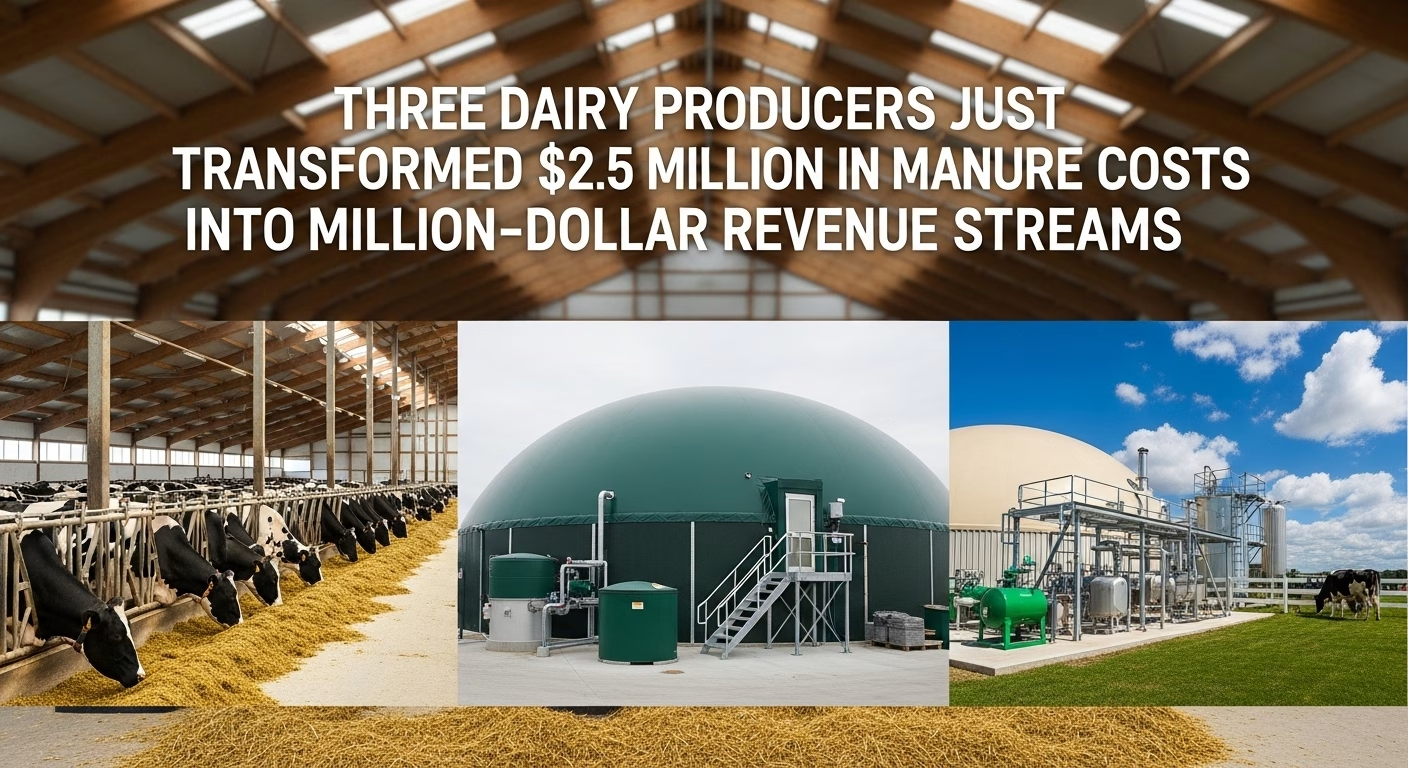
Three Dairy Producers Just Transformed $2.5 Million in Manure Costs into Million-Dollar Revenue Streams

Stop treating manure as waste disposal. Three producers just turned $2.5M in annual costs into million-dollar revenue streams. Here’s their blueprint.

EXECUTIVE SUMMARY: The dairy industry’s biggest lie? That manure is an expensive disposal problem instead of your most valuable untapped revenue stream. Three pioneering producers at the 2025 Midwest Manure Summit just proved this conventional wisdom dead wrong, transforming what costs most farmers 6 per cow annually into integrated systems generating up to ,912 per ton in revenue. Scott Hynds’ membrane technology creates precision fertilizer blends from liquid manure, John Rosenow’s 25-year compost operation ships 42 semi-loads annually to premium markets, and Brent Cousin’s 8,500-cow biorefinery produces renewable natural gas while reducing bedding costs by -75 per cow. With biochar production alone valued at ,828-,912 per ton and one operation saving .5 million compared to conventional methods, these aren’t isolated success stories—they’re proof that manure valorization can fundamentally transform your farm‘s economic model. While milk prices face volatility, these producers built diversified income streams that generate revenue regardless of commodity fluctuations. The question isn’t whether manure monetization works—it’s how much longer you can afford to literally dump money in your lagoons while competitors capture value from the same resource you’re paying to dispose of.

KEY TAKEAWAYS

  • Transform $100,000-$400,000 annual disposal costs into revenue streams: Traditional manure management bleeds $306 per cow annually through storage, hauling, and application, but integrated valorization systems like anaerobic digestion with RNG production create multiple income sources while reducing bedding costs by $50-75 per cow.
  • Membrane technology delivers precision nutrition worth premium prices: Instead of spreading liquid manure that’s 90% water, Scott Hynds’ membrane separation creates custom-tailored fertilizer blends for specific crop applications, transforming inefficient bulk hauling into precision agriculture solutions that neighboring farmers actively seek.
  • Biochar production generates $1,828-$1,912 per ton while sequestering carbon: Dairy manure biochar contains twice the nutrient content of original manure by mass and three times by volume, with nutrient value reaching $240-$340 per ton plus carbon value of $1,580 per ton—creating markets that reward both productivity and sustainability.
  • Scale-appropriate solutions exist for every operation size: From 200-cow dairies using co-digestion with food waste (viable at $20/ton tip fees) to 2,500+ cow operations running integrated biorefineries, the Summit data proves profitable pathways exist across all herd sizes with proper technology matching.
  • Strategic monitoring drives $2.5 million savings potential: Brent Cousin’s approach of taking 60-100 annual manure samples to guarantee exact nutrient content builds customer trust while optimizing application strategies—one dairy saved $20,000 per 200 cows compared to conventional methods, scaling to $2.5 million savings for larger operations.
dairy manure management, manure monetization, dairy profitability, anaerobic digestion, dairy revenue streams

At the 2025 Midwest Manure Summit, three pioneering producers proved that what most farmers see as their biggest liability can become their most profitable enterprise. Their integrated systems are generating revenue streams worth up to $1,912 per ton while solving environmental headaches – and their blueprints could revolutionize your operation’s bottom line.

Look, I’ll be straight with you. If you’re still treating manure as a disposal problem, you’re literally flushing money down the drain. The producers who spoke at Green Bay’s Midwest Manure Summit this year aren’t just managing waste – they’re running sophisticated bio-refineries that would make any CFO jealous.

The numbers don’t lie. Your average Holstein dumps 150 pounds of manure daily. For a 1,000-cow herd, traditional manure management costs can range from $100,000 to $400,000 annually – costs that escalate from $399 for small herds to over $1.9 million for operations with 5,000+ cows. That’s not management – that’s financial hemorrhaging.

Why Your Current Manure Strategy Is Bleeding Money – And Why Most Farmers Are Getting This Dead Wrong

Here’s the uncomfortable truth: the dairy industry has been conditioned to accept manure as a necessary evil for decades. But what if this entire paradigm is fundamentally flawed?

Think about it like this: you’re essentially paying premium prices to haul away what could be your most valuable crop. It’s like a corn farmer paying someone to remove grain from his bins while neighbors build ethanol plants. When did you last calculate the true opportunity cost of your current manure management system?

Research shows the average farm spends 6.13 per cow annually just on storing, hauling, and applying manure – that’s .33 per hundredweight of milk produced. For a 500-cow operation, that’s over $153,000 annually just to get rid of what these Summit producers are turning into gold.

But here’s what really gets me fired up: while you’re paying to haul away this “waste,” your neighbors are starting to see dollar signs. The paradigm shift is happening whether you’re on board or not.

The wake-up call? Three producers at the Summit proved that manure valorization isn’t some pie-in-the-sky concept. It’s happening right now, generating serious revenue while solving environmental challenges.

The Membrane Revolution: Scott Hynds’ Clean Water Cash Machine

Scott Hynds from Aqua Innovations LLC is rewriting the rules of liquid manure management. His membrane technology doesn’t just clean up discharge water – it creates two distinct, valuable revenue streams that traditional systems completely miss.

“We know how to make water. We don’t know crap about crap,” Hynds joked at the Summit, but his results are dead serious. By partitioning nutrients like phosphorus and nitrogen into separate streams, producers can create custom-tailored fertilizer blends for specific land applications.

Here’s the genius: Instead of hauling diluted, inconsistent manure with 90% water content across your fields, you deliver precision nutrition exactly where crops need it. Think of it like switching from feeding a total mixed ration to precision feeding based on individual cow requirements – the efficiency gains are massive.

“When you have two unique nutrient streams that you can commingle and custom-tailor your nutrient blend per land application, it creates flexibility that wasn’t there previously,” Hynds explained.

Challenge the conventional wisdom: Why are we still spreading liquid manure that’s 90% water when membrane technology can separate valuable nutrients from discharge water? The traditional approach is like shipping ice cubes to Alaska – you’re paying premium freight costs to move mostly water.

The 25-Year Proof: John Rosenow’s Compost Cash Cow

Here’s a story that should make every 600-cow dairy producer pay attention. John Rosenow’s Rosenow Dairy and Cowsmo Compost operation has been quietly printing money for 25 years by processing manure from his farm plus a neighboring 150-cow operation.

“We don’t compost our manure for fun. We do it for money,” Rosenow stated bluntly at the Summit. “Now, let’s say it’s a nice income source when milk prices are lousy, and we count on it quite a bit.”

The numbers tell the whole story: Rosenow ships compost by semi-loads to the Twin Cities area – 42 loads to one account alone last year. Diversified income streams like compost become critical profit centers with volatile milk prices.

The marketing evolution reveals everything. Rosenow initially avoided using “manure” on product labels because consumers shied away. Now? “We have it on our label because the word has become very popular. When we’re selling to gardeners and people like that, they want to know if it’s from dairy manure. And then it’s a positive, and their eyes light up”.

But here’s the reality check: Rosenow faces three major challenges that every producer considering manure monetization should understand:

  • Regulatory compliance: His 1997-designed facility now violates current DNR rules
  • Marketing evolution: Traditional trade shows are dead; digital marketing is essential
  • Labor retention: Current political rhetoric makes keeping good employees increasingly difficult

Are you ready to confront the uncomfortable truth? Most of us are still thinking like waste managers instead of resource processors. Rosenow’s success proves that consumer perception has already shifted – the question is whether your business model has kept pace.

The RNG Revenue Revolution: Brent Cousin’s $8,500-Cow Empire

Brent Cousin’s Holsum Dairies showcases how scale changes everything. Managing 8,500 cows across two sites, Cousin has built an integrated manure-to-energy-to-fertilizer system that maximizes every molecule.

The anaerobic digesters producing renewable natural gas (RNG) hit the jackpot when California fuel credits and federal renewable fuel standards created premium markets. “There were times and years when electrical generation did very well. That fell off, but at no point did it ever become a cost,” Cousin explained. “But then, with California fuel credits and RNG, it has really become a great diversity of our overall income.”

Here’s the cascade approach genius: biogas for energy, solid separation for bedding, and strategic nutrient application based on precise composition analysis. Cousin’s team takes 60 to 100 manure samples annually to guarantee exact nutrient content to crop growers.

Think of it like precision feeding for your crops – instead of applying a generic TMR equivalent to your fields, you deliver exactly what each field needs based on soil tests and crop requirements.

Here’s where most producers miss the boat: They think anaerobic digestion is just about biogas production. Cousin’s operation proves it’s about creating multiple revenue streams from the same feedstock while reducing input costs across the entire operation.

The Technology Stack That’s Changing Everything – Beyond the Hype

The most successful operations aren’t betting on single technologies – they’re building integrated systems. Consider these verified performance metrics:

Biochar Production: Dairy manure biochar possesses approximately twice the nutrient content of the original manure by mass and more than three times by volume. The nutrient value alone reaches $240-$340 per ton, while the carbon value hits $1,580 per ton. Combined? You’re looking at $1,828 to $1,912 per ton.

Struvite Recovery: Pilot-scale studies show 30% to 32% phosphorus recovery rates, with production costs ranging from $613-$1,500 per tonne versus $320 for conventional MAP fertilizers.

Energy Integration: Energy production from anaerobic digestion increases by 42% when coupled with pyrolysis, creating efficient closed-loop systems.

The Uncomfortable Reality: Why 87% of Farm Digesters Struggle

Here’s the controversial reality nobody discusses: research indicates that a significant percentage of farm methane digesters haven’t been profitable without grants. However, that’s changing as innovation and multinational energy companies pump dollars into farm projects.

The economic viability of anaerobic digestion, particularly for small and medium-sized dairy farms, hinges on a multi-revenue stacking strategy. For example, a 300-cow dairy can achieve economic feasibility for its AD system only when food waste is co-digested in an equal volume with manure, alongside tip fees reaching $20 per ton and biomethane valued at $25 per million BTU.

Critical question for every producer: Are you still considering manure management as a single-solution problem, or are you ready to embrace the biorefinery concept that maximizes value at every step?

Market Forces Driving the Transformation – The Money Trail

The economic drivers extend far beyond farm gates. Aemetis Biogas completed $1.6 million in LCFS credit sales in April 2024 alone, with federal Section 45Z production tax credits for dairy RNG beginning in January 2025. Programs like Carbon by Indigo return 75% of carbon credit purchase prices directly to farmers.

Government support is accelerating adoption. The USDA’s Transform F2C project includes a $70 million Dairy Manure Management Incentive Program, offering up to $1 million per farm entity with potential 100% project budget coverage.

Implementation Realities: What Success Actually Looks Like

Based on verified performance data from the Summit producers, here’s what actually works:

Cousin’s monitoring approach: “For manure generation, we look at how much manure we apply yearly. We only get that number once a year. We evaluate that on a per-cow basis just to monitor how we’re doing year over year, trying to limit that as much as possible”.

Key performance indicators successful operations track:

  • Manure generation per cow annually
  • Application methods (hose vs. truck percentages)
  • Bedding dryer performance through milk quality metrics (SCC, clinical mastitis)
  • Biogas production quality and volume
  • Operational performance data with smart sensors

Here’s the hard truth most consultants won’t tell you: Success isn’t just about installing equipment – it’s about fundamentally changing how you think about every molecule that leaves your cows. Are you measuring the right metrics or still focused on outdated disposal-focused KPIs?

The Challenges Nobody Talks About – Confronting the Uncomfortable Realities

Capital costs for advanced systems range significantly. Struvite recovery systems designed for 60,000 gallons of manure daily cost $75 to $125 per cow in capital investment, with operating costs of $80 to $140 per cow annually.

Initial setup costs for algae cultivation can range from $180,000 to over $600,000, depending on scale and location. Biochar production capital costs can vary dramatically, from $1 million for small-scale plants to $90 million for large-scale facilities.

The permitting maze is real. Anaerobic digestion facilities need permits from local administrative bodies for building construction, air pollution control, hazardous waste management, and water discharge.

But, the successful producers understand that these challenges are temporary obstacles, not permanent barriers. The producers who solve them first will dominate the emerging markets.

Why This Matters for Your Operation – The Scale Economics Reality Check

The data from these three operations reveals scalable opportunities across different herd sizes:

For 200-500 Cow Operations: Research shows co-digestion with food waste becomes economically viable when tip fees reach $20 per ton and biomethane values hit $25 per MMBTU. Strategic partnerships with local food processors create dual revenue streams.

For 500-2,500 Cow Operations: Advanced anaerobic digestion with RNG production offers the sweet spot for profitability, especially with California fuel credits generating substantial monthly revenues.

For 2,500+ Cow Operations: Integrated biorefinery approaches maximizing biochar, struvite recovery, and energy production provide the highest returns. One dairy saved approximately $20,000 per 200 cows compared to conventional methods, potentially reaching $2.5 million in savings for a 2,600-cow operation.

But here’s the controversial reality: The dairy industry has been conditioned to believe that only large operations can monetize manure effectively. These Summit producers prove that’s a limiting belief that’s costing smaller operations millions in lost opportunities.

The Critical Question Every Producer Must Answer

Are you willing to challenge the fundamental assumption that manure is waste? The Summit producers didn’t just adopt new technology – they completely reimagined their relationship with every pound of manure their cows produce.

Research demonstrates that with full utilization, organic wastes could generate 2% to 4% of total electricity needs or supply 10% to 15% of statewide gasoline demand in the form of renewable natural gas.

The economic potential is staggering: widespread deployment of anaerobic digestion infrastructure could catalyze over $1.27 billion in capital investments, generate more than 12,000 construction jobs, and sustain over 1,000 long-term operational positions.

The Bottom Line: Your Strategic Decision Point

The three Summit producers demonstrated conclusively that manure transforms from liability to asset when approached strategically. With milk production facing dynamic changes, diversified revenue streams become essential.

Your action plan starts now:

  1. Calculate your true manure handling costs – most producers underestimate annual expenses. If you spend more than $306 per cow annually on manure management, you’re bleeding money that could generate revenue.
  2. Assess your local market conditions – proximity to crop growers, food processors, and energy infrastructure. With manure nutrient value ranging significantly depending on application rates and fertilizer prices, local markets can dramatically impact your ROI.
  3. Evaluate your scale – different technologies optimize at different herd sizes. The Summit data proves that every operation size has viable options, but the approach must match your scale and local conditions.
  4. Explore partnerships – third-party build/own/operate models eliminate financial risk while capturing benefits. Strategic alliances with energy companies, waste management firms, and technology developers can accelerate implementation while reducing risk.

The fundamental choice: Will you continue paying to dispose of what could be your most profitable crop, or will you join the producers who are building the future of dairy profitability?

The question isn’t whether manure monetization works – the Summit producers proved that beyond doubt. How much longer can you afford to dump money in your lagoons while your competitors build revenue streams from the same resource you’re paying to dispose of?

The transformation is happening. The only choice you have is whether you’ll lead it or watch from the sidelines while others capture the value you’re currently throwing away.

The window for early adoption advantages is closing fast. As more producers recognize manure’s revenue potential, competition for premium markets will intensify. The farmers establishing these systems now will control the best customer relationships and command premium pricing.

Your move starts today. Because in five years, the question won’t be whether you should have monetized your manure – it’ll be why you waited so long to start.

Learn More:

Join the Revolution!

Join over 30,000 successful dairy professionals who rely on Bullvine Weekly for their competitive edge. Delivered directly to your inbox each week, our exclusive industry insights help you make smarter decisions while saving precious hours every week. Never miss critical updates on milk production trends, breakthrough technologies, and profit-boosting strategies that top producers are already implementing. Subscribe now to transform your dairy operation’s efficiency and profitability—your future success is just one click away.

NewsSubscribe
First
Last
Consent

Why In-Season Manure Application Will Transform Your Dairy’s Bottom Line

Ditch old manure woes! In-season application turns waste into liquid gold, boosting yields & your dairy’s bottom line. Unlock manure’s true power.

EXECUTIVE SUMMARY: Traditional dairy manure management often leads to nutrient loss, environmental concerns, and missed economic opportunities. This article argues for a shift towards in-season manure application, leveraging technologies like dragline systems, hard hose reels, and high-clearance applicators to apply nutrients when crops need them most. By adopting these innovative methods, dairy producers can significantly enhance nutrient use efficiency, potentially increase crop yields by 10-15%, reduce reliance on synthetic fertilizers, and lessen their environmental footprint, particularly through reduced methane emissions and nutrient runoff. While initial investment and operational learning curves present challenges, the long-term economic and sustainability benefits position in-season application as a critical strategy for transforming manure from a liability into a valuable farm asset. Ultimately, it calls for a re-evaluation of conventional practices to unlock the “liquid gold” within dairy operations.

KEY TAKEAWAYS:

  • Transform Manure into an Asset: In-season application allows dairy farms to maximize the nutrient value of manure (N, P, K, organic matter), reducing fertilizer costs and improving soil health.
  • Key Technologies Unlock Potential: Dragline systems, hard hose reels (e.g., Cadman CMA), and high-clearance applicators extend application windows into the growing season, enabling nutrient delivery when crops are actively uptaking.
  • Significant Yield and Efficiency Gains: Properly timed in-season application, especially with incorporation, can lead to notable crop yield increases (reported 10-15% in some cases) and better nutrient utilization compared to traditional methods.
  • Environmental Benefits: In-season application can reduce nutrient losses (leaching, runoff, volatilization) and methane emissions from storage, contributing to more sustainable dairy farming.
  • Economic Viability Requires Analysis: While offering substantial long-term ROI through savings and yield, these systems require significant initial investment and careful farm-specific economic assessment.
in-season manure application, dairy manure management, dragline manure application, nutrient use efficiency, sustainable dairy farming

The hard truth? Most dairy producers are squandering millions in potential profits through outdated manure handling practices. While you’re busy treating manure as a disposal problem, forward-thinking producers are using revolutionary in-season application methods to slash fertilizer costs, boost yields by as much as 10-15% in some cases, and transform their operation’s environmental footprint. The dairy industry’s most valuable untapped resource isn’t genetics or feed efficiency being pumped into your lagoon.

If you’re still relying on traditional fall and spring manure applications, you’re watching money leach away with every rainfall, and you might as well be pouring milk down the drain. Just as precision feed management revolutionized ration formulation, innovative in-season application methods are helping progressive producers capture more value from every gallon of effluent while simultaneously addressing parlor-to-field labor bottlenecks and environmental concerns. But which system makes sense for your operation? And what’s the real ROI when milk margins are already razor-thin?

The Uncomfortable Truth About How You’re Currently Handling Manure

Truthfully, traditional manure management approaches aren’t just outdated; they’re fundamentally broken. The average Holstein produces about 150 pounds of manure daily, creating a constant management challenge that grows exponentially with herd size. When your slurry is 90% water, you’re essentially paying to transport and apply mostly H₂O, making the nutrient-to-mass ratio painfully inefficient.

Most dairy operations still follow their grandfathers’ decades-old model: store manure in lagoons through the growing season, then apply it all during narrow windows in fall or early spring when fields are empty. This approach creates multiple problems:

  1. Massive nutrient losses through ammonia volatilization, nitrate leaching, and phosphorus runoff.
  2. Concentrated labor demands during already busy planting and harvest times.
  3. Elevated greenhouse gas emissions from extended storage periods.
  4. Soil compaction from heavy equipment on wet spring fields.
  5. Wasted opportunity to match nutrient availability with crop demand.

The numbers don’t lie: A typical slurry dairy manure may contain 25 pounds of N, 11 pounds of P₂O₅, and 33 pounds of K₂O, for a potential nutrient value of around $30 per 1,000 gallons. However, poor application timing and methods mean you capture only a fraction of that value. A critical issue is the N:P ratio imbalance in manure. Crops typically require an N:P ratio nearer to 8:1, while manure is often closer to 1:1. Applying manure to meet nitrogen needs often leads to phosphorus over-application and buildup, increasing runoff risk.

How much money are you flushing away annually? For a 1,000-cow dairy, if not managed effectively, this could represent foregoing significant soil amendment value. Consider that the Iowa State University study by Kliebenstein and Luvsandagva (2021) found the total nutrient value in applied manure averaged 2.03 per cow per year. Yet many farms continue business as usual, seemingly content to watch nutrients and profits evaporate into thin air.

Research from the University of Nebraska-Lincoln (UNL Water Program) has shown that simply shifting from fall to spring pre-plant manure application reduced nitrogen leaching by 6% and increased corn yields by 4%. But that’s the beginning of what’s possible when you rethink your manure application approach.

The In-Season Revolution: Application Methods That Challenge Convention

Progressive dairy producers are breaking free from the traditional application window constraints by adopting systems that allow manure application during the growing season, when crops need nutrients. Three primary technologies are leading this revolution:

Dragline/Umbilical Systems

These systems pump liquid manure directly from storage (pit or lagoon) through a main supply line to the field edge, then through a flexible drag hose to a tractor-mounted applicator toolbar. This eliminates the need for heavy tankers traversing your fields, with flow rates often reaching up to 2,500 gallons per minute.

Why aren’t more dairy farmers utilizing this technology? While initial investment is a factor, the real innovation is how these systems can be adapted for in-season application. Research led by Glen Arnold at Ohio State University has extensively documented that draglines can effectively side-dress corn up to the V4 growth stage (four collared leaves). Applying beyond this stage, such as at V5, has resulted in significant yield reductions, around 40-50 bushels per acre in some trials, due to hose damage to plants. Key advantages include:

  • Impressively high flow rates, allowing rapid application.
  • Significantly reduced soil compaction compared to tanker systems.
  • Lower labor requirements (typically 1.5-2 people can operate the system).
  • Compatibility with various incorporation tools like Dribble bars, shallow disk injectors (coulter injectors), and sweep injectors, minimizing odor and N loss.

The limitations? You’re generally restricted to earlier crop growth stages, and fields ideally need to be relatively close to manure storage (though some operators pump up to three miles or use frac tanks). Sand-laden manure can also create challenges, and firm soil conditions are preferred to prevent hose scouring or crop damage.

Hard Hose Reel Systems

Systems like the Cadman Continuous Manure Applicator (CMA) represent the next evolution, allowing application in significantly taller crops. These feature a large-diameter, semi-rigid hose wound onto a mobile reel unit. The hose is pulled out by a tractor with an injector toolbar, and the reel actively rewinds it on the return pass.

This approach extends the application window considerably, allowing side-dressing of manure in crops up to 3-4 feet tall. That’s a game-changer for timing nutrients. Cadman literature suggests this is optimal timing for corn nutrient uptake.

Farmers using the Cadman CMA system have reported yield increases of 10-15% in crops like corn and soybeans due to timely side-dressing. These systems also minimize crop damage thanks to features like a patented swivel arm managing the hose during turns.

High-Clearance Applicators

High-clearance machines provide the answer for the latest possible in-season application timing—these specialized units, self-propelled or trailed implements, are explicitly designed to operate in tall, standing crops.

Manufacturers like Hagie (now part of John Deere) produce self-propelled sprayers (e.g., Hagie STS series) with exceptional ground clearance (up to 72 inches), which can be retrofitted with specialized toolbars for side-dressing manure. These machines allow nutrient delivery during critical crop development stages when nutrient demand peaks, well beyond the V4/V5 corn stage.

While these systems represent the highest capital investment, they offer unmatched flexibility for late-season application.

Why Your Soil and Crops Will Thank You (And Your Banker Will Too)

The benefits of in-season application extend far beyond operational efficiency. When you align manure application with active crop growth, you fundamentally change how nutrients cycle through your farming system.

Enhanced Nutrient Utilization

By injecting manure directly into the soil during the growing season, you deliver nutrients exactly when crops need them. Research from Virginia Tech demonstrated that shallow coulter-type injection of dairy slurry could nearly double the amount of first-year plant-available nitrogen (PAN) recovered by corn compared to surface broadcasting. Glen Arnold’s work at Ohio State University showed that when manure was incorporated at side-dress, corn yields were approximately 15 bushels per acre higher than when side-dressed in 28% Urea Ammonium Nitrate (UAN). Conversely, surface-applied manure yielded about 20 bushels per acre lower than UAN.

Is your nutrient management plan working, or just creating paperwork? The evidence suggests most farms are still operating on outdated nutrient availability and timing assumptions.

Greenhouse Gas Reductions That Matter (With a Catch)

More frequent manure removal for in-season application can interrupt anaerobic decomposition in storage, reducing methane (CH₄) emissions. This aligns with the Innovation Center for U.S. Dairy’s 2050 carbon neutrality pledge. However, be aware of the “GHG seesaw” effect. Practices that reduce CH₄ by promoting aerobic conditions (like soil injection or composting) can sometimes lead to increased nitrous oxide (N₂O) emissions, a more potent GHG. A holistic assessment is necessary.

Building Soil That Performs

Manure isn’t just about NPK- it’s a powerful soil builder. Regular manure applications significantly increase Soil Organic Matter (SOM). One long-term study documented an increase in SOM from a baseline of 1.6% to 2.7% in manured plots. This improves soil structure, water retention (organic matter can hold up to 90% of its weight in water), and infiltration. Research has shown an approximate 7% increase in plant-available water content in soils receiving manure applications. Manure also stimulates soil microbial biomass two- to four-fold, crucial for nutrient cycling.

Real Farmers, Real Results

The proof of any innovation comes from those implementing it in the real world.

Mulligan Farm’s Dragline Conversion (Avon, NY)

Mulligan Farm, a 1,200-cow dairy, transitioned from traditional spreaders to a drag hose system. Their motivations included worn-out equipment, road time, field compaction, and general inefficiency. After the switch, their application rate increased from approximately 24,000 gallons per hour (two tankers, two people) to around 50,000 gallons per hour with the drag hose, requiring only 1.5 people. Benefits included reduced soil compaction, less reliance on commercial fertilizers, and noticeable odor reduction.

Hard Hose Success Stories

Farmers using the Cadman CMA system have reported 10-15% yield increases in corn and soybeans when manure is side-dressed at 3-4 feet tall. Initially conceptualized by the Alig Brothers of Ohio, the system is praised for enabling one-person operation, replacing synthetic fertilizer needs, and eliminating significant soil compaction.

The Economic Reality: Does In-Season Application Pay?

Let’s talk dollars and cents. The initial investment in advanced application technology is substantial. But here’s what the equipment dealers won’t tell you: the economics can pencil out surprisingly well when considering all factors.

For large-scale operations (e.g., 20 million gallons per year), owning a dragline system can offer a favorable ROI in approximately three years compared to custom application costs (which might range from $260,000-$350,000 annually for such volumes). Operational costs for dragline application have been estimated between $0.005 and $0.01 per gallon.

Hard hose systems like the Cadman CMA claim a payback period of two pumping seasons or less under favorable conditions, driven by yield increases and fertilizer savings.

The Iowa State University study by Kliebenstein and Luvsandagva (2021) found the total cost of storing, hauling, and applying manure averaged $306.13 per cow per year. After subtracting the nutrient value of $202.03 per cow, the net cost averaged $104.10 per cow. Improving nutrient capture directly impacts this.

What’s Stopping You? Overcoming the Hurdles

It’s not all smooth sailing. Real barriers exist:

  • High Initial Capital Costs: Specialized equipment is expensive.
  • Skilled Labor: Operating and maintaining these systems requires expertise, which can be scarce.
  • Narrow Operational Windows: Application is constrained by crop stage, weather, and firm soil conditions.
  • Learning Curve: Mulligan Farm noted that there’s an initial “solid week of frustration” mastering new systems.
  • Manure Variability: Nutrient content isn’t consistent, requiring regular testing for accurate application.
  • Farm Layout & Topography: Not all fields are suited for every system.

Before You Invest, Ask These Questions:

  • What is your current annual fertilizer bill for relevant acres?
  • What are your current custom manure application costs or the operational costs of your owned system?
  • What is your actual manure volume, and how far do the fields lie from storage?
  • Do you have the labor and skills, or can you acquire them, for a new system?
  • What are your specific soil types and compaction risks?
  • What is a realistic projection of yield impact and fertilizer savings for your operation?

A critical but often overlooked economic factor: In-season application dramatically reduces peak labor demands during the already hectic planting and harvest seasons. Why are we still cramming all manure work into two narrow windows when labor is already thin? By spreading manure work throughout the growing season, you’re making more efficient use of your workforce.

The Future Is Here: Precision Manure Management

While the systems we’ve discussed represent significant advances, we’re just scratching the surface. The next frontier combines these application methods with precision agriculture technologies:

  • IoT, AI, Sensors, and Robotics: Automated systems like robotic scrapers and intelligent pumps are improving efficiency. On-the-go manure constituent sensors are a key area of interest.
  • Plasma Treatment for Nutrient Enhancement: GEA Farm Technologies is developing plasma systems to treat liquid manure, prevent ammonia loss, and stabilize nitrogen.
  • Manure Granulation/Pelletization: Creating denser, uniform products for easier handling and precise application.
  • Variable Rate Technology (VRT): Combining flow meters, GPS, and potentially real-time sensing to adjust application rates across fields based on specific needs.

These technologies transform what was once considered a waste management problem into a precisely managed nutrient resource.

The Bottom Line: Transform Your Manure Liability into an Asset

The dairy industry has been stuck in the past for too long regarding manure management. In-season manure application represents one of the most significant opportunities for dairy operations to improve profitability and environmental sustainability. The days of treating manure as merely a waste disposal problem is over. Progressive producers now consider it a valuable nutrient resource that demands careful management.

If you’re considering these technologies:

  1. Conduct a thorough farm assessment of volumes, storage, field layouts, soil types, labor, and capital.
  2. Invest in Testing: Regular manure nutrient analysis and soil testing are fundamental.
  3. Perform a Farm-Specific Economic Study: Costs, benefits, savings, yield impacts.
  4. Consider a Phased Approach: Start smaller, adapt existing equipment, or use custom applicators first.
  5. Prioritize Soil Health & Minimize Compaction: Choose systems and practices accordingly.
  6. Seek Knowledge: Consult extension specialists, experienced applicators, and other farmers.
  7. Ensure Operator Training & Safety: Crucial for efficiency and minimizing risks.

While challenges exist, the potential benefits make in-season manure application a compelling frontier.

The question isn’t whether you should consider in-season manure applications and how quickly you can implement them before your competitors gain the edge. As fertilizer prices remain volatile and regulatory pressures increase, those who master manure as a precision nutrient source will be positioned for long-term success.

It’s time to challenge the status quo of your manure handling system. Your next technological leap might not be in the parlor or the barn, but in how you manage what emerges from them. Will you continue with practices from the last century, or join the progressive producers turning manure from a liability into liquid gold?

Learn more:

  • Flush Your Profits Down the Drain? How Manure Millionaires Are Cashing In This article highlights how innovative farmers are turning manure from a costly necessity into a profit center through various technologies, including in-season application, and contrasts this with traditional practices. It aligns well by showcasing the broader economic potential of advanced manure management.
  • Unlock the Secret Manure Strategy Boosting Dairy Farm Yields This piece focuses specifically on manure injection techniques, a key method often used in conjunction with in-season application systems. It delves into how injecting manure improves nutrient absorption, soil health, and crop yields, offering a deeper dive into one of the application methods discussed.
  • Manure Management Systems in Dairy Farming: Sustainable Practices for Environmental Stewardship This article provides a broader overview of various manure management systems, including anaerobic digestion and composting, alongside land application. It sets the context for why innovative application methods are crucial within the larger framework of sustainable dairy farming and environmental responsibility.

Join the Revolution!

Join over 30,000 successful dairy professionals who rely on Bullvine Weekly for their competitive edge. Delivered directly to your inbox each week, our exclusive industry insights help you make smarter decisions while saving precious hours every week. Never miss critical updates on milk production trends, breakthrough technologies, and profit-boosting strategies that top producers are already implementing. Subscribe now to transform your dairy operation’s efficiency and profitability—your future success is just one click away.

NewsSubscribe
First
Last
Consent
Send this to a friend