Archive for Dairy labor crisis

Drumgoon Dairy Lost 38 Workers in One I-9 Audit. Your Operation Could Be 72 Hours Away.

One I-9 audit resulted in the dismissal of 38 workers at Drumgoon Dairy. If ICE knocked tomorrow, how long could your parlor run?

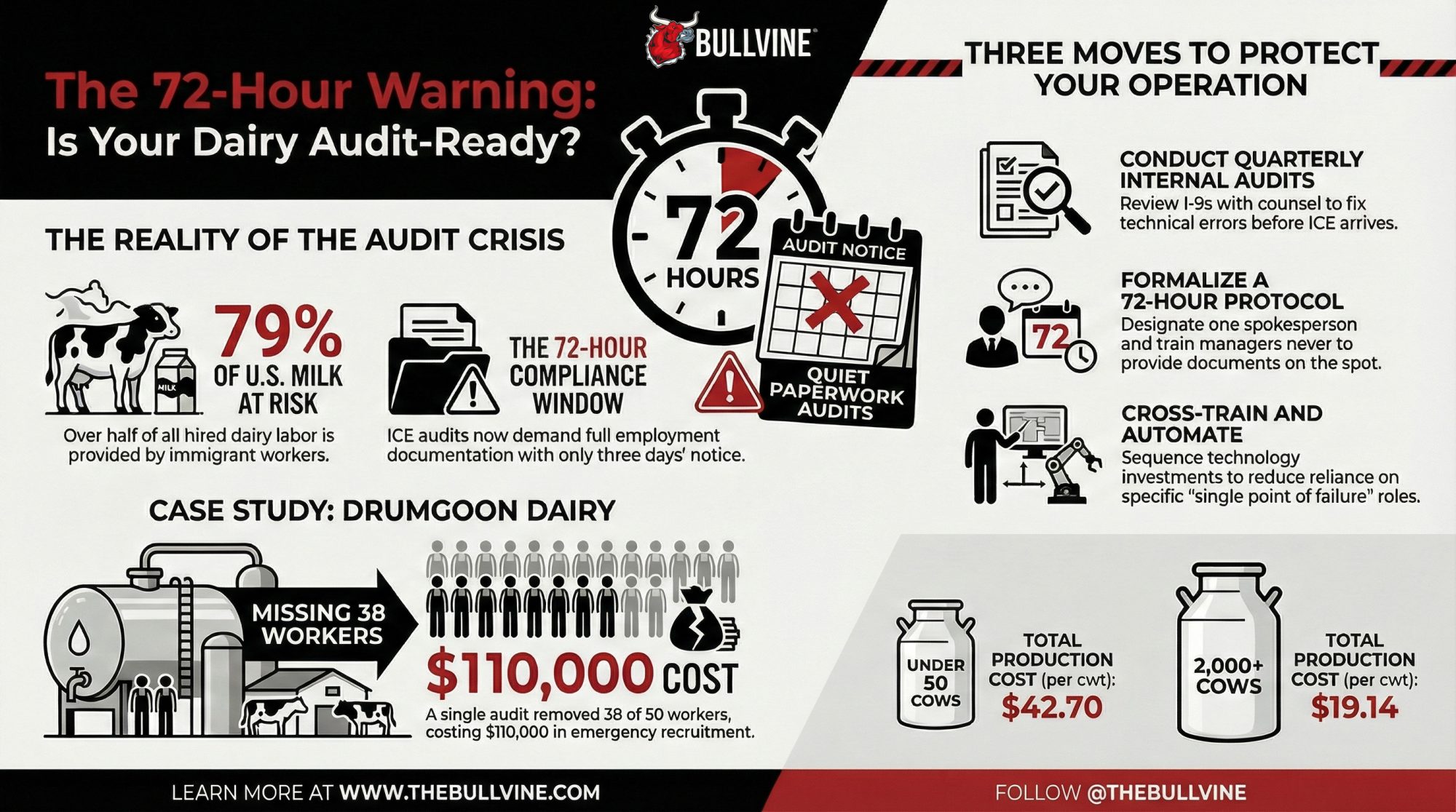
Executive Summary: Immigrant workers provide 51% of hired dairy labor and help produce 79% of U.S. milk, but there’s still no visa designed for year‑round dairy work. One I‑9 audit at Drumgoon Dairy in South Dakota removed 38 employees — about 70% of its crew — in a matter of days, showing how fast a paperwork review can turn into a production and animal‑care emergency. USDA’s latest cost‑of‑production data puts small herds under 50 cows at $42.70/cwt versus $19.14/cwt for 2,000‑plus‑cow herds, so the farms least able to absorb a labor shock are already on the wrong side of the cost curve. The Farm Workforce Modernization Act and the Dignity Act of 2025 would legalize some existing workers and modestly expand year‑round visas, but together they still cover only a fraction of dairy’s foreign‑born workforce. That’s why more operators are treating immigration enforcement like any other major business risk: they’re auditing I‑9s with counsel, training managers for a 72‑hour response, cross‑training crews, and modeling what happens if they lose 25%, 50%, or even 70% of their people. The operations that come through this period will be the ones that can show good‑faith compliance on paper, keep their parlors running when the crew changes overnight, and use automation and legal visas where they lower their true cost per cwt.

dairy I-9 audit compliance

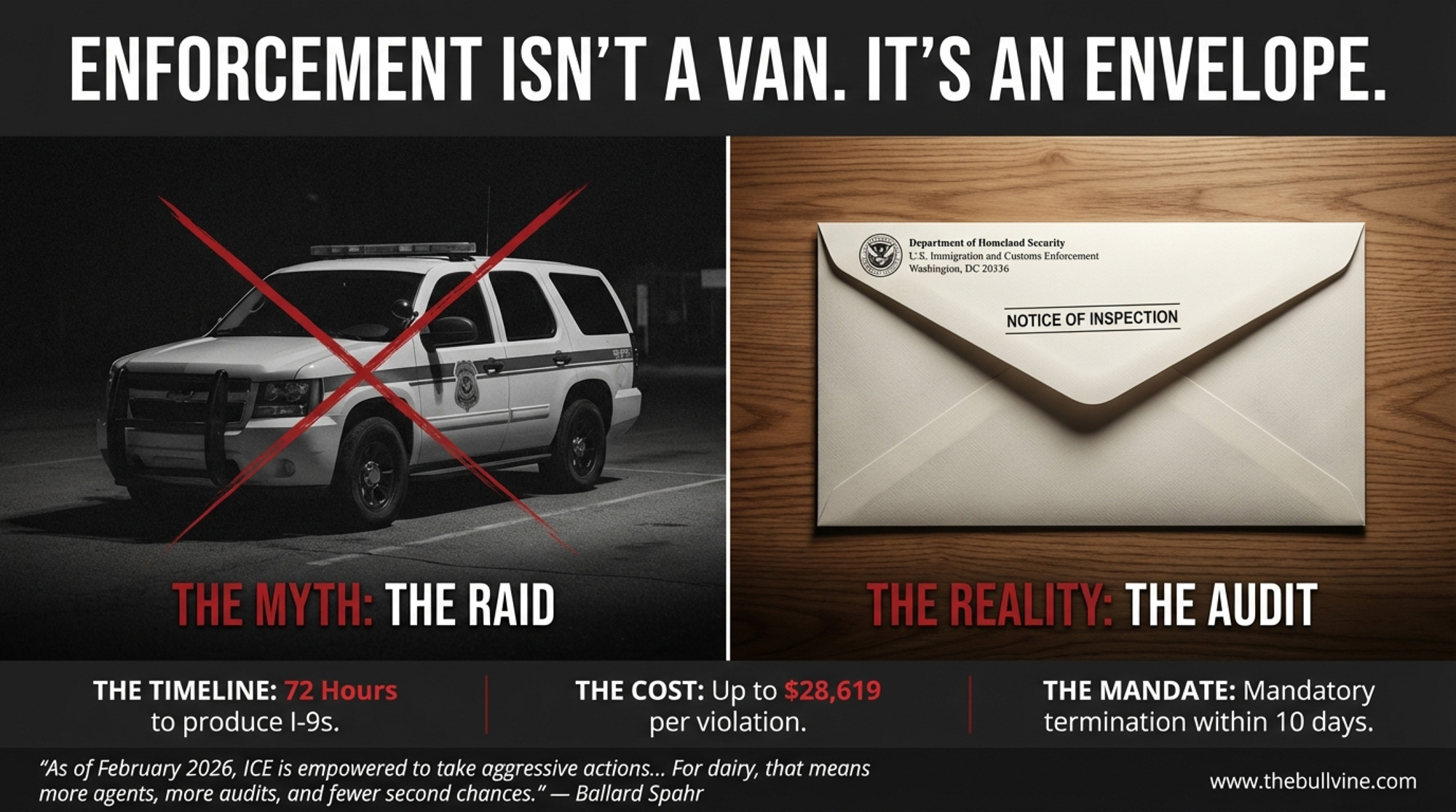
Dairy immigration enforcement doesn’t look like what you think it does. The ICE van at the farm gate makes the news. But the real damage in 2025 and into 2026 arrives in envelopes — formal I-9 audits that give operators 72 hours to produce employment documentation for every worker on the payroll, with fines up to $28,619 per violation and mandatory termination of employees whose paperwork doesn’t hold up. As of February 2026, law firm Ballard Spahr confirms ICE continues to be “empowered to take aggressive actions to enforce immigration laws,” with major enforcement events expanding beyond agriculture into manufacturing, education, and healthcare (Ballard Spahr, February 3, 2026). For dairy, that means more agents, more audit experience, and fewer second chances.
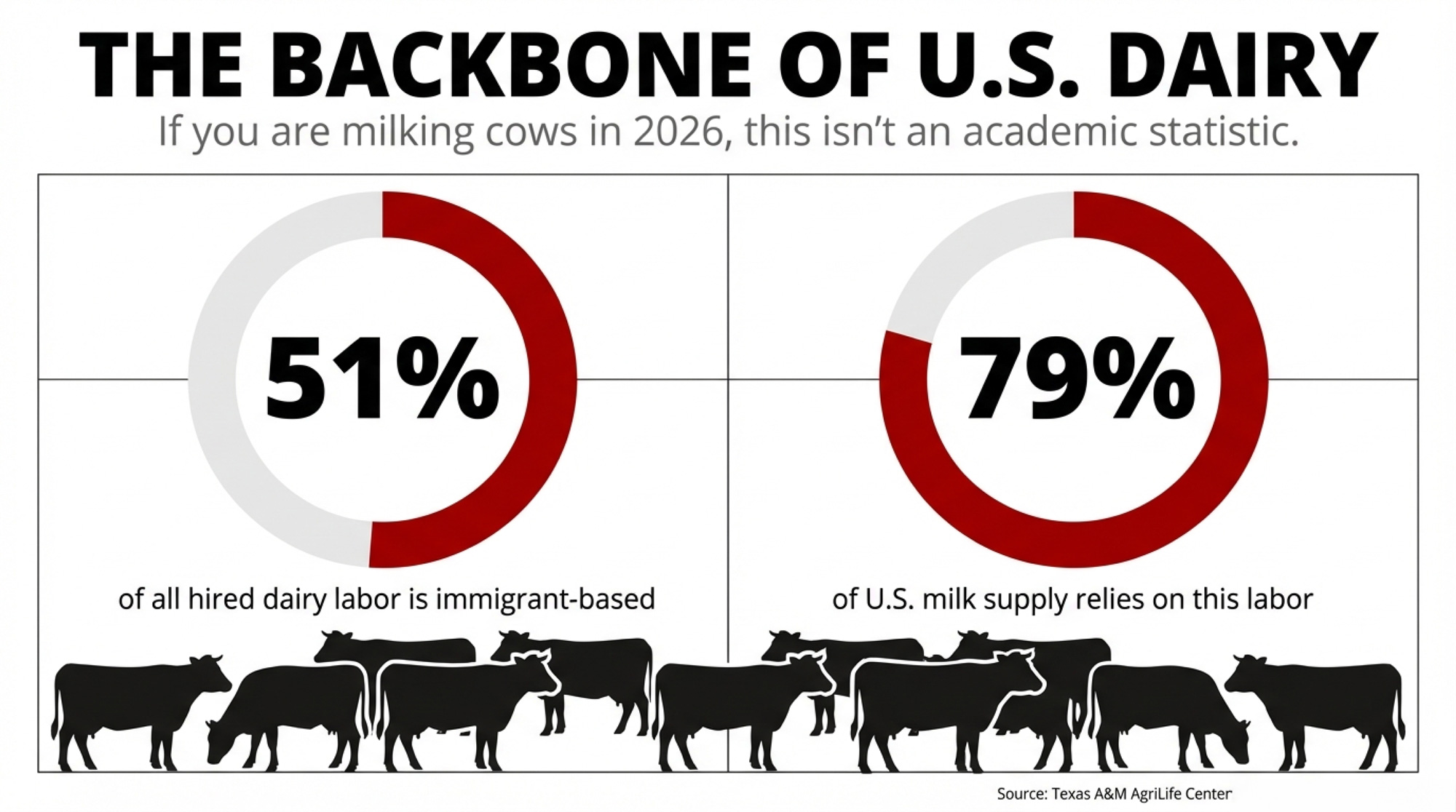
According to a NMPF-commissioned study conducted by Texas A&M AgriLife Research — the most recent comprehensive national dairy workforce survey available, based on 2014 data from 1,223 U.S. dairy farms and published in September 2015 — immigrant workers make up 51% of all hired dairy labor, and dairies employing them produce 79% of the total U.S. milk supply.
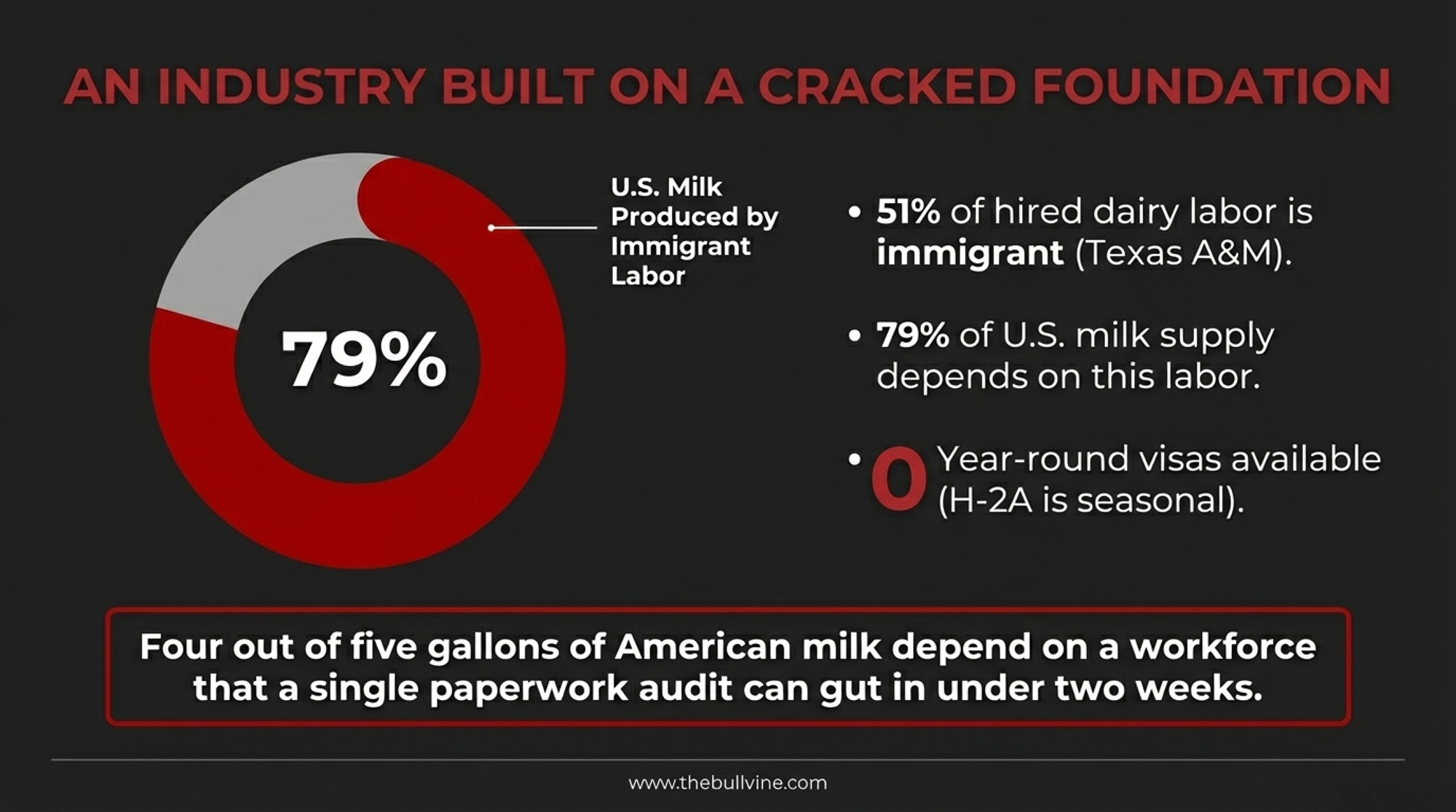
An NMPF comparison released in December 2018 found that immigrant workers on dairy farms increased 35% between 2009 and 2015, suggesting the current share is likely higher still. Dr. Robert Hagevoort of New Mexico State University, speaking at the Dairy Cattle Reproduction Council Annual Meetings in Arlington, Texas, in November 2024, said he believes the true percentage has continued to grow as herd sizes and employee counts have expanded. Four out of five gallons of American milk depend on a workforce with no dedicated legal visa channel — and one that a single paperwork audit can gut in under two weeks.

The Enforcement Shift: I-9 Audits, Staffing Sweeps, and Transportation Choke Points

The visible workplace raid still happens. Homeland Security agents hit a New Mexico dairy near Lovington in mid-2025, arresting nearly a dozen workers and forcing the immediate termination of two dozen more. But that kind of action is now the minority of enforcement events reaching dairy.

Three quieter channels do most of the damage.
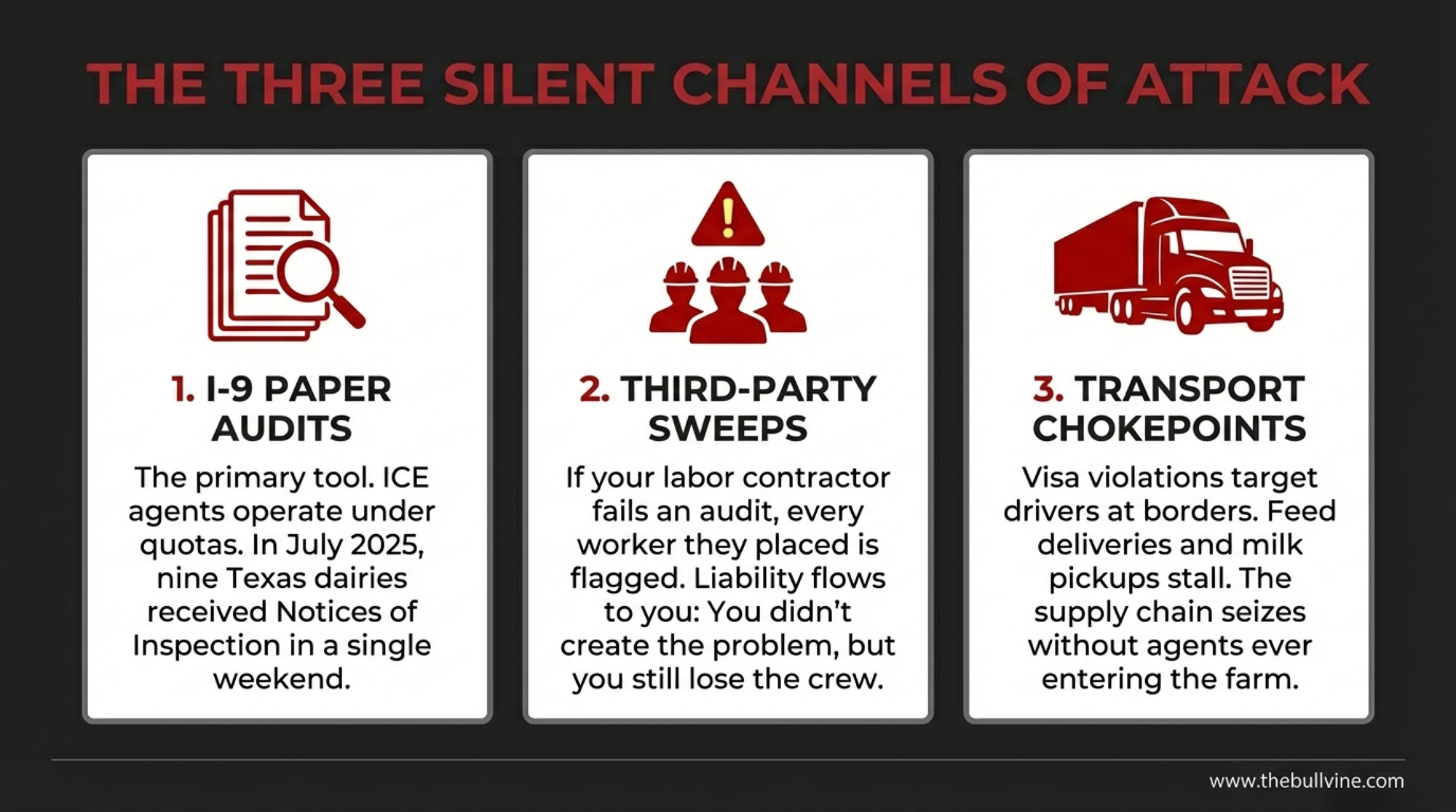
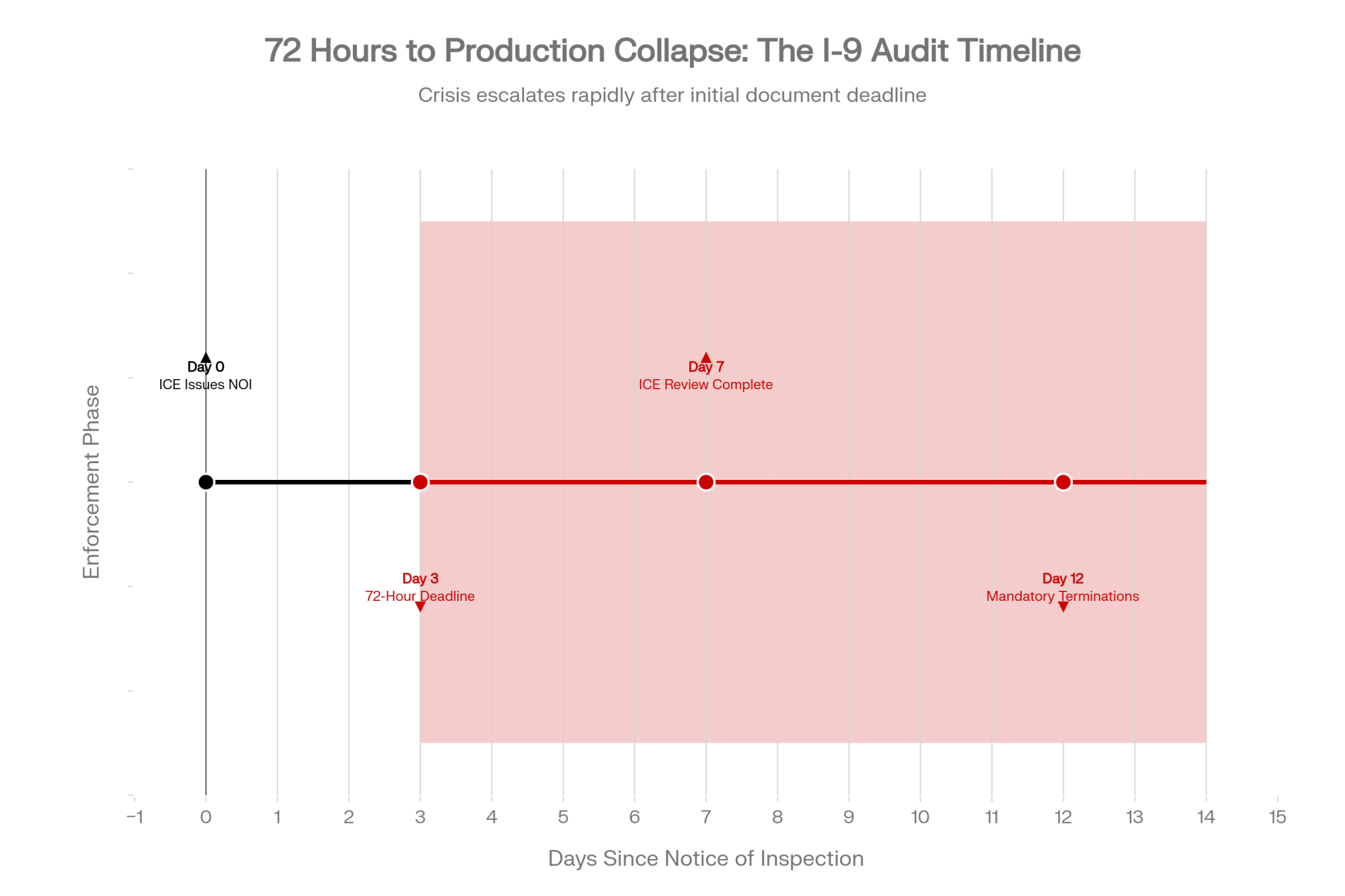
I-9 paper audits have become the primary tool. ICE issues a Notice of Inspection demanding that every I-9 on file be produced, with a 72-hour compliance window. According to compliance-tracking firm I-9 Intelligence (August 2025), field agents now operate under quarterly worksite inspection quotas, with agriculture designated as a priority sector. In July 2025, at least nine Texas dairies received NOIs over a single weekend, as reported by Dairy Herd Management’s Tyne Morgan on July 15, 2025. Employees with deficient documentation must be terminated within 10 business days.
Third-party staffing audits blindside operators who use labor contractors. When the staffing company fails an audit, every worker they placed on your farm gets flagged — even though you never completed their paperwork. You didn’t create the problem. You still lose the crew.

Transportation enforcement targets visa violations among truck drivers at border crossings. When haulers get sidelined, feed deliveries, bulk milk pickup, and livestock transport all stall. No one sets foot on your dairy, but your supply chain seizes up anyway.

Drumgoon Dairy: 38 Workers Gone in Days

If you want to understand what this enforcement shift actually does to a working dairy, look at Drumgoon Dairy near Lake Norden, South Dakota.
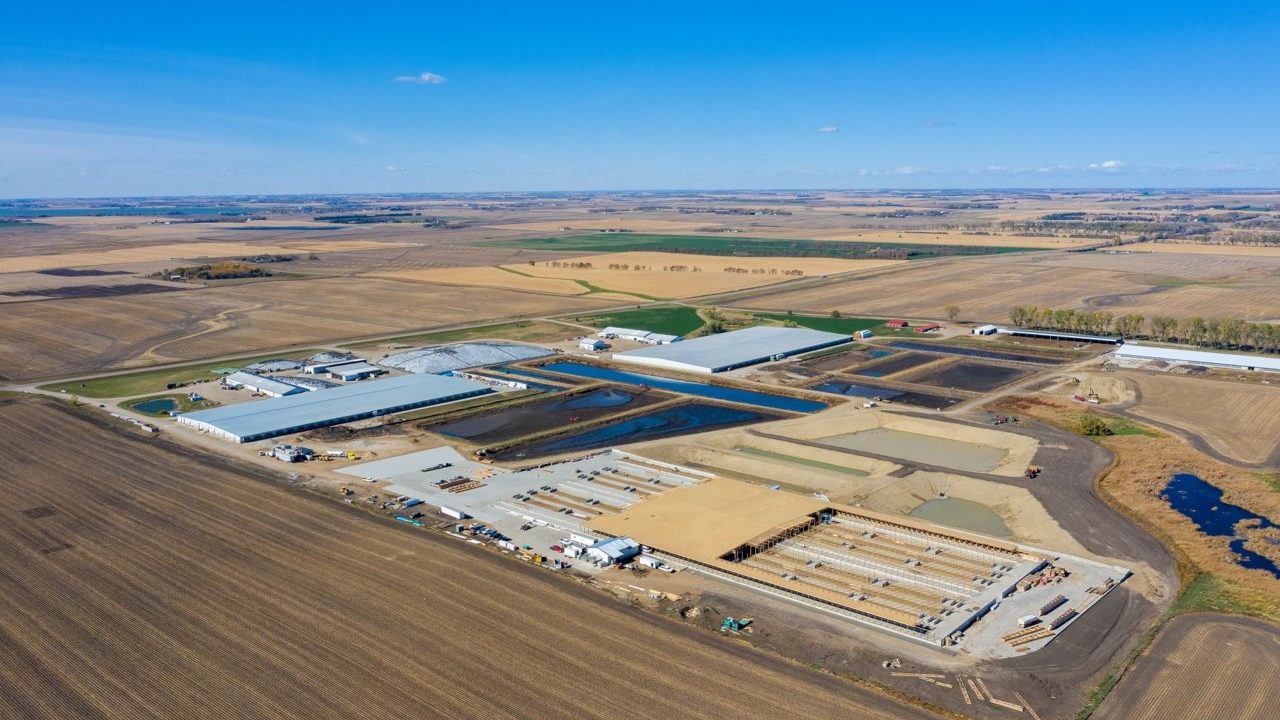
Rodney and Dorothy Elliott moved from Northern Ireland to South Dakota in 2006 and built Drumgoon Dairy — named after their home townland in Co. Fermanagh — into a 6,500-cow enterprise with more than 50 employees over nearly two decades. Some staff had been with the operation since its earliest years. As Elliott told the South Dakota Searchlight (October 2025), she reviewed applicants’ documents personally and turned candidates away “a dozen times over the years” when IDs looked questionable — the standard the law sets for employers. Drumgoon had never been audited before.
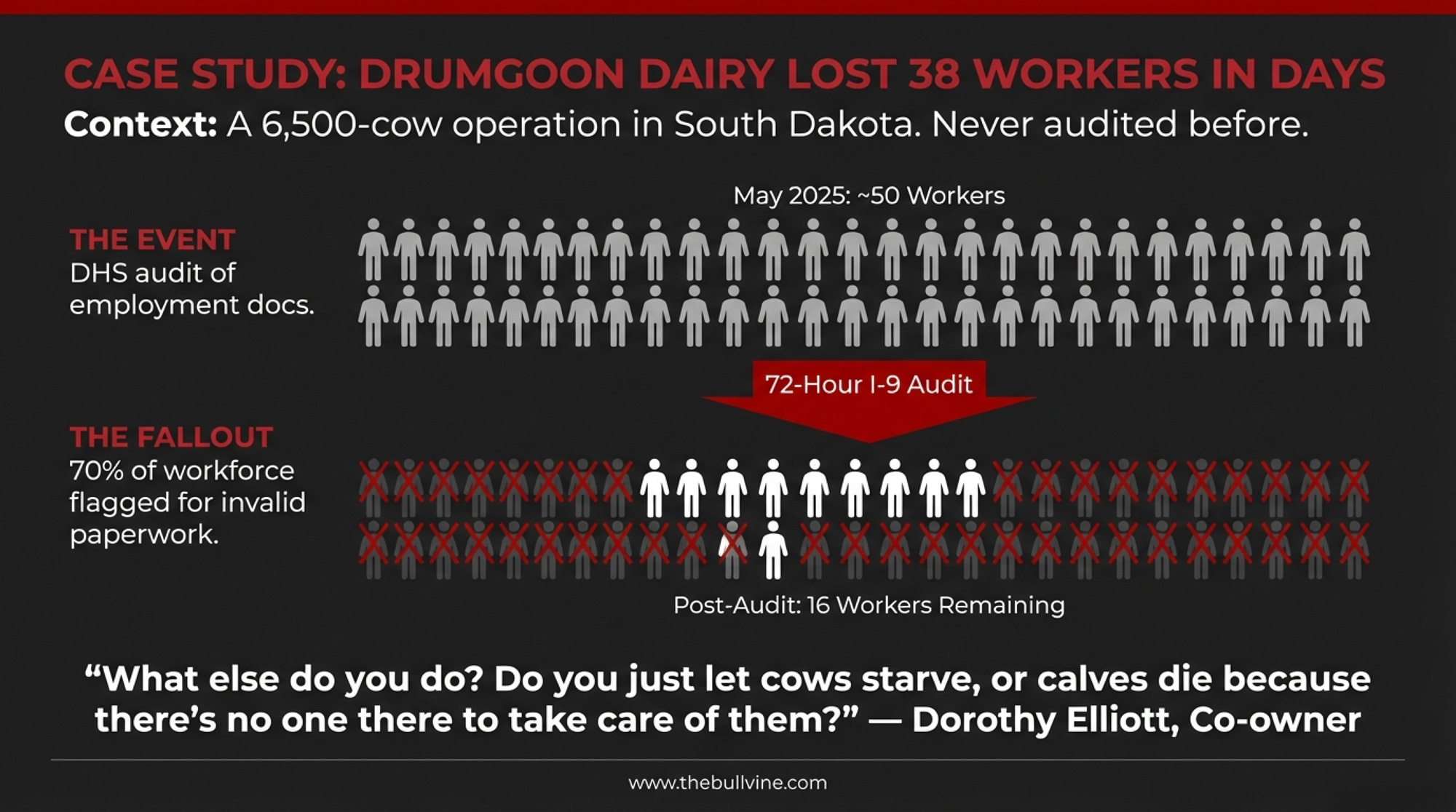
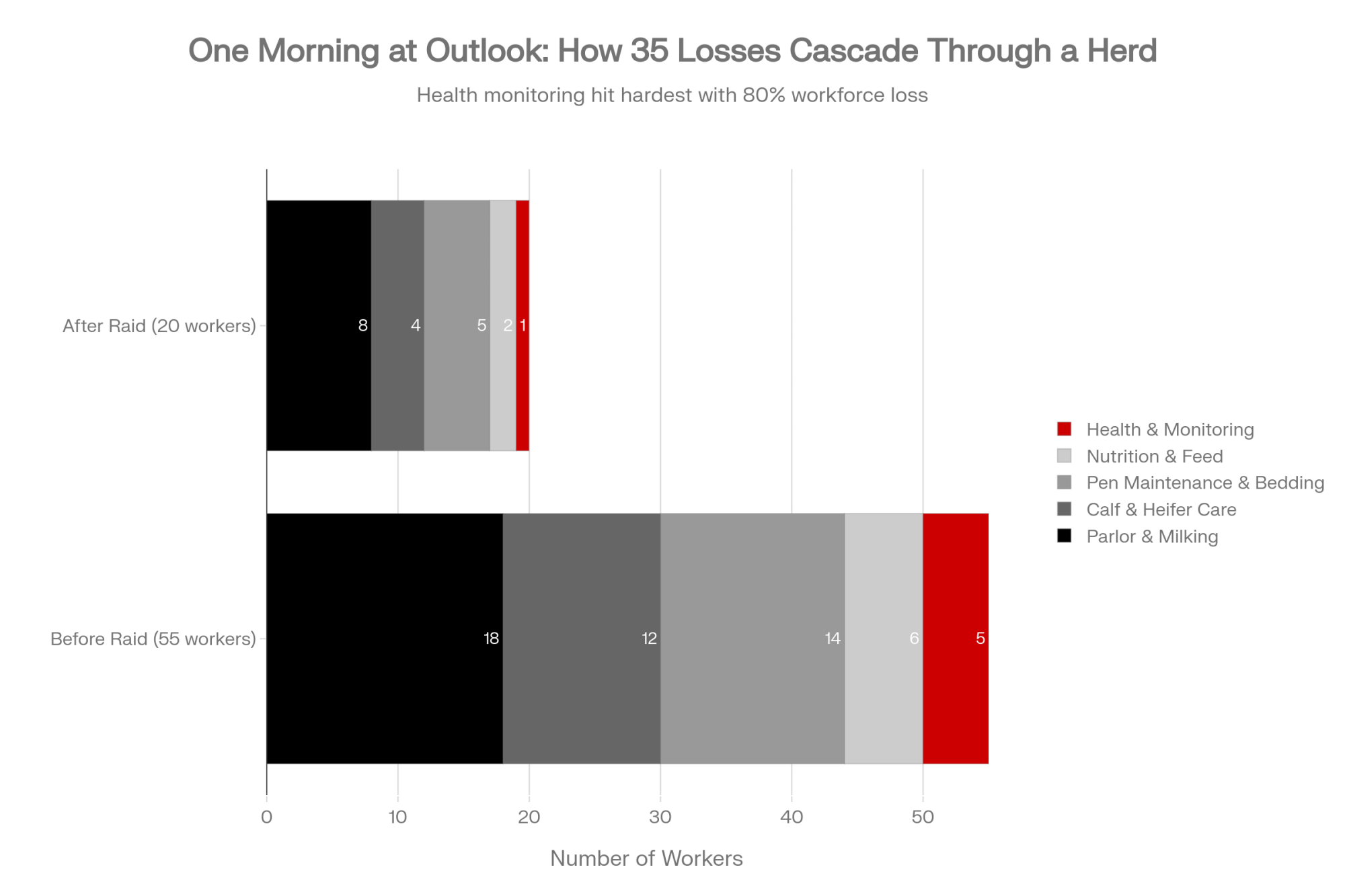
In late May 2025, DHS audited Drumgoon’s employment documentation and determined that 38 workers had inaccurate, outdated, or incomplete proof of work authorization. Elliott asked them to provide updated documents. Most couldn’t. The workforce dropped from over 50 to 16.

The aftermath tested the operation’s limits. Elliott told the South Dakota Searchlight that remaining employees were making mistakes from the long hours — including reversing a payloader into a manure pond — or because they were new to farm work. Some got just one or two days off in a 15-day stretch. Nearby farms sent workers to help for a couple of days at a time over the summer. Elliott and her husband spent over $110,000 on recruiters and transportation to hire 22 visa workers from Mexico — but the visas came with restrictions on the types of jobs those workers could do, so the Elliotts still needed to hire a dozen more locally and wanted another 10 to 15 beyond that.

“What else do you do? Do you just let cows starve, or calves die because there’s no one there to take care of them?” — Dorothy Elliott, co-owner, Drumgoon Dairy (South Dakota Searchlight, October 2025)
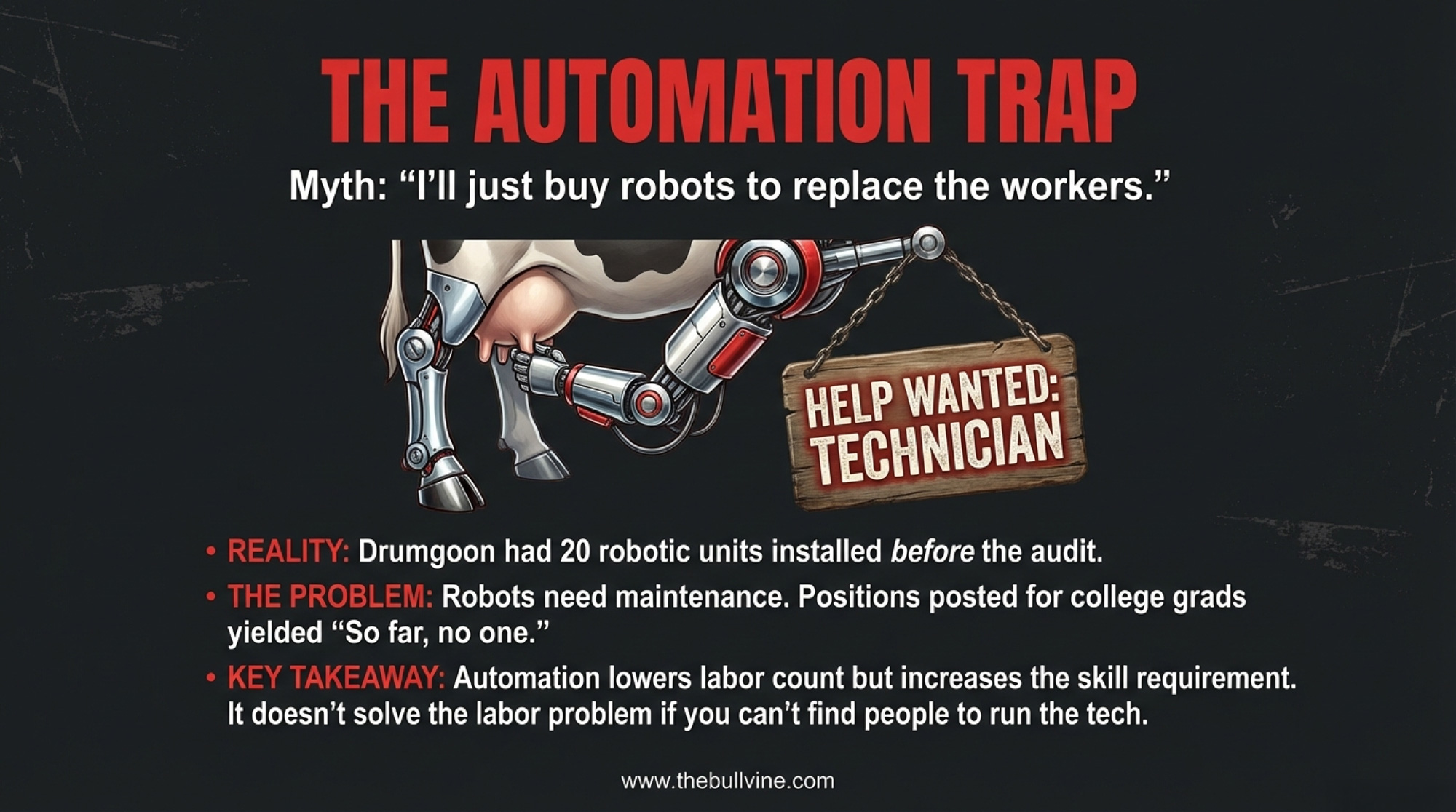
Elliott had already invested in automation before the audit hit. Drumgoon installed 20 robotic units and posted maintenance positions to attract graduates from the Lake Area College program. The response, as she told reporters: “So far, no one.” Automation helps. It doesn’t solve the labor problem by itself when you can’t find people to maintain the technology.

South Dakota Farm Bureau president Scott VanderWal confirmed that dairy audits in the state have increased significantly compared to prior years. Texas Association of Dairymen executive director Darren Turley has called the audits “without a doubt the biggest issue today for the Texas dairy industry.” Drumgoon isn’t an outlier. It’s a preview.

MetricBefore I-9 Audit (May 2025)After Audit + Recovery Effort (Oct 2025)
Total Workforce50+ employees16 workers remaining → rebuilt to ~38 (22 H-2A visa, 16 local/temp)
Herd Size6,500 cows6,500 cows (unchanged)
Robotic Milking Units20 units installed20 units (but no qualified maintenance staff hired)
Recruitment & Visa CostsNormal payroll operations$110,000+ spent on recruiters, transport, visa processing
Operational StatusStable, 20-year operationEmployees working 13-15 day stretches; mistakes from fatigue (payloader into manure pond); neighbors sending temporary help

Why the $23/cwt Cost Spread Makes Smaller Farms Most Exposed
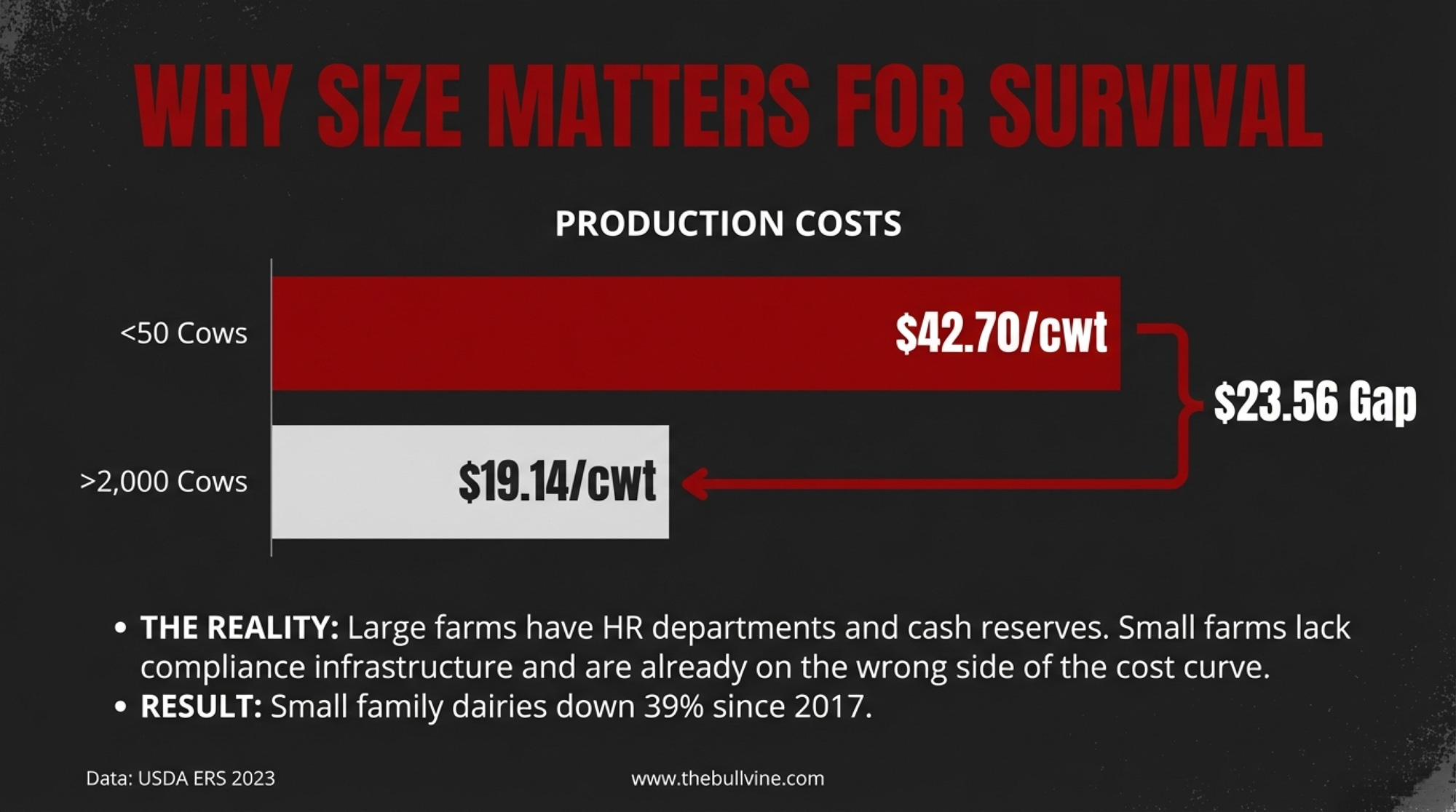
The enforcement risk isn’t distributed evenly. It concentrates on the operations least equipped to absorb it.

USDA’s Economic Research Service, using its 2021 Agricultural Resource Management Survey (the most recent available, published in 2023), reports total production cost per hundredweight of $42.70 for herds under 50 cows versus $19.14 for herds of 2,000 or more. That $23 spread isn’t primarily about feed. Operations above 2,000 cows posted cash costs $1.50/cwt below the all-size average, with the majority of the savings coming from lower nonfeed costs — including labor.

When an audit hits, the 5,000-cow dairy with an HR department, immigration counsel on retainer, and reserves to absorb a two-week disruption survives. It’s damaged, but it has institutional resources. The 200-cow family dairy that loses six of eight employees, with no HR infrastructure and no capital to automate, often doesn’t recover.

The 2022 Census of Agriculture recorded 24,082 dairy operations, down 39% from 39,303 in 2017, while total milk production increased 5% (USDA NASS, 2024). Farms with 1,000-plus head — just 8% of operations — now produce approximately 67-68% of U.S. milk by volume. Enforcement that disproportionately hits smaller operations with fewer compliance resources accelerates that consolidation. Rabobank senior dairy analyst Lucas Fuess projects that small dairies will remain numerically, but their production share will keep shrinking.

The Compliance Trap You Can’t Solve Under Current Law

Here’s the bind every dairy operator is sitting in, whether they’ve named it or not.

RequirementWhat H-2A Visa OffersWhat Dairy Operations Need
Job DurationSeasonal/Temporary work ONLYYear-round, permanent labor (cows need milking 365 days/year)
Application Timeline75-day minimum before start date; 30-day certification lead time; 4+ months in practiceWorkers needed immediately when audit removes crew
Housing RequirementEmployer must provide compliant housing at no cost to workerMany mid-size operations lack capital for housing infrastructure
Annual Cap for DairyFWMA proposes 10,000 dairy-specific visas (if passed)Estimated 150,000+ immigrant dairy workers currently employed
Current Coverage~8-9% of workforce (if FWMA passes)51% of hired dairy labor is foreign-born

Federal law requires you to accept documents that “reasonably appear genuine” during the I-9 process. You can’t demand extra documentation beyond what the form specifies — that could constitute discrimination. But when those same documents fail under audit scrutiny years later, you’re liable for having accepted them. Exposure runs in both directions.

The H-2A visa program — the only agricultural worker visa — is limited to seasonal and temporary labor. NMPF’s Jaime Castaneda has confirmed: “Dairy farmers largely have not been able to use H-2A visas because the current program is limited only to the temporary and seasonal labor needs of agricultural employers” (Hoard’s Dairyman, July 2021). Ohio State’s Margaret Jodlowski backs this up at the farm level: “If they are trying to get workers through the H-2A program, their applications are often turned down. Their labor needs are constant.”

Even where H-2A technically applies to seasonal dairy tasks, the timeline is brutal. DOL regulations require applications filed at least 75 days before the start date of need, and certification must be issued 30 days before workers arrive (DOL Office of Foreign Labor Certification, flag.dol.gov). In practice, Sarah Black of Great Lakes Ag Labor Services told Brownfield Ag News (December 2024) that farmers should “plan ahead at least four months before you want the guys to arrive, because you’ve got to figure out housing and get it inspected, and there are a lot of pieces that have to be in place before you even file.” When the federal government shut down in late 2025, Black reported a 40-plus-day processing blackout during which no applications were filed at all (Brownfield Ag News, November 18, 2025).

Elliott’s experience at Drumgoon proves the point. She spent $110,000 to bring in 22 visa workers from Mexico — and still couldn’t fill every role because the visas restricted what jobs they could do. That’s the system working as designed. It just wasn’t designed for dairy.

Your lender expects regulatory compliance. Your processor needs a consistent volume. Federal law mandates I-9 verification. And the labor market delivers a workforce where roughly half carry documentation that won’t survive scrutiny. You can’t satisfy all four simultaneously. The system doesn’t work. It can’t — not as long as the visa program ignores the way dairy actually operates.

What the FWMA and the Dignity Act Fix — and What They Don’t

Two legislative vehicles are attempting to close this gap, and both may have a better shot in 2026 than in any prior session.
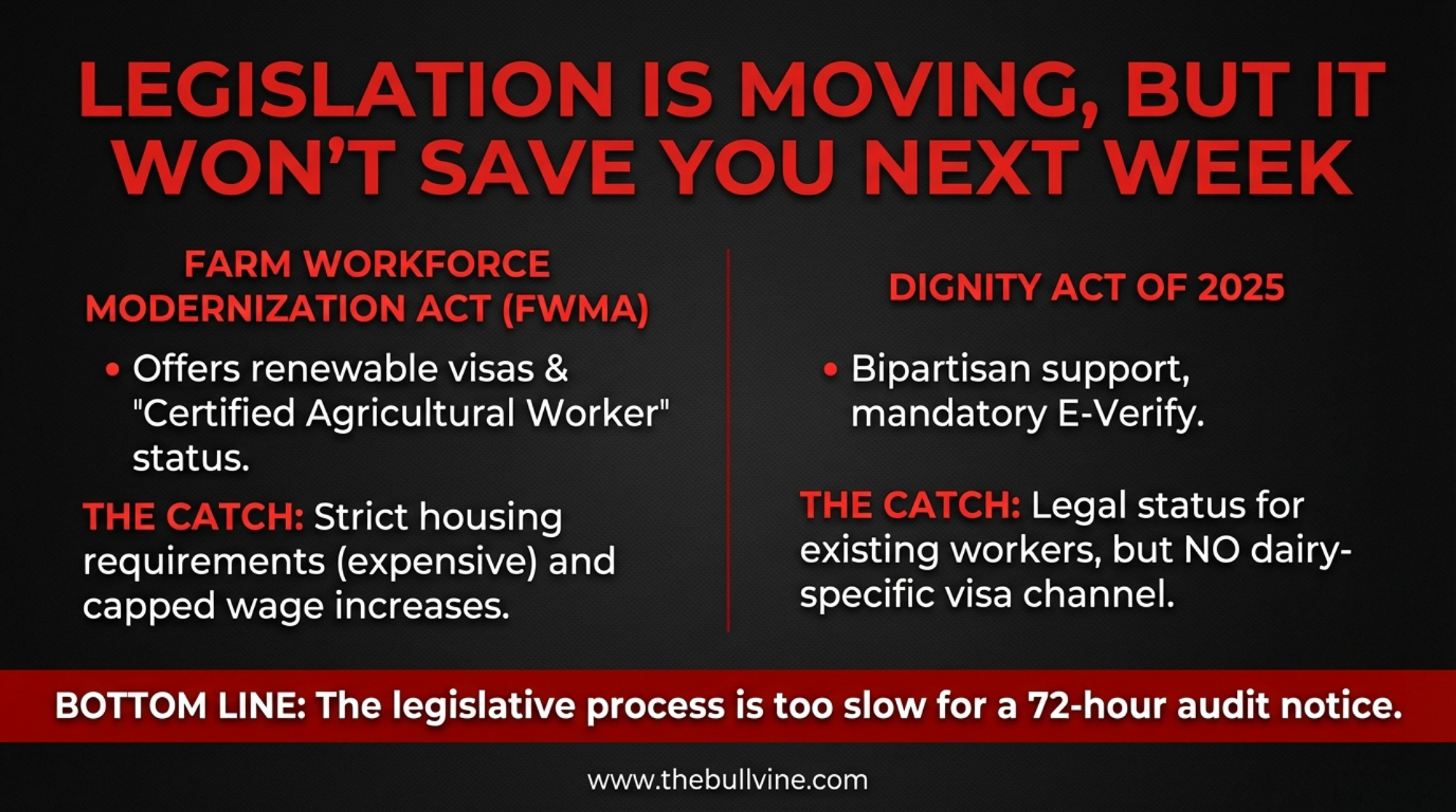
The Farm Workforce Modernization Act (H.R. 3227, 119th Congress, introduced May 2025) is the industry’s most direct ask. Title I creates Certified Agricultural Worker (CAW) status for undocumented farmworkers who can prove 180 days of agricultural labor in the prior two years, with a path to permanent residency after 8-10 years. Had this existed, the 38 workers Drumgoon lost could have applied based on their years of documented service. Title II opens H-2A to year-round operations, with a cap of 20,000 workers — half designated for dairy — on visas extendable for up to 3 years, with electronic filing and wage rate increases capped at 3.25% annually through 2030.

The Dignity Act of 2025 (H.R. 4393), introduced July 14, 2025, by Reps. María Elvira Salazar (R-FL) and Veronica Escobar (D-TX) takes a broader approach — mandatory E-Verify for all employers, an earned legal status program for long-term undocumented residents with clean records, and asylum system reforms. As of January 27, 2026, it had secured 35 bipartisan cosponsors and 60 national stakeholder endorsements, support spanning from Florida to Washington state — up from 25 cosponsors in early December 2025 — making it the fastest-growing immigration reform proposal in Congress.

Both are meaningful but incomplete for dairy. The FWMA’s 10,000 dairy-specific visas cover roughly 8-9% of the foreign-born dairy workforce. The housing requirement — employers must provide compliant housing at no cost — adds a real estate obligation many mid-size operations will struggle to absorb. The Dignity Act would stabilize existing workers, but doesn’t create a dairy-specific visa channel.

The political ground, though, is shifting faster than it has in a decade. A Pew Research Center survey published April 15, 2025 (5,123 adults, February 24–March 2) found that 42% of Americans — including 41% of independents — expect deportations to increase food prices in their area. On June 17, 2025, Rep. Andy Harris (R-MD), chair of the House Freedom Caucus and the House Appropriations Subcommittee on Agriculture, joined an American Business Immigration Coalition call and said: “We need to revise and expand visa categories like H-2A and H-2B, or create a new visa program to meet economic demands.” In September 2025, the Trump administration reversed its own July directive and streamlined H-2A visa renewals, allowing returning workers to skip in-person consulate interviews.

Mike Stranz, Vice President of Advocacy for the National Farmers Union, put the 2026 outlook this way in December 2025: “With the seeming improvements to border security concerns, paired with the greater emphasis we’ve all had on the need for a secure and reliable farm workforce, that adds up to a better shot for the Farm Workforce Modernization Act to move forward. I think that reaches across both parties, and it could be an opportunity to make some real headway in 2026” (AgInfo, December 7, 2025). Whether the window stays open long enough for legislation actually to pass is another question entirely.
Five Risk Reduction Moves You Can Start This Week

No strategy eliminates the underlying risk while the legal framework stays broken. But several approaches measurably reduce your exposure.

  • Conduct an internal I-9 audit with legal counsel this quarter. Pull every form. Correct technical errors with a single line-through, initial, and date — never white-out. Identify substantive gaps before ICE does. Ballard Spahr’s February 2026 compliance guidance confirms that “internal audits demonstrate good faith compliance in the event of an I-9 government audit.” Operations with 15-plus employees should have immigration counsel on retainer; smaller operations should budget for at least an annual external review — agricultural attorneys typically charge $150-$500 per hour (Farmland Access Legal Toolkit), so a focused I-9 audit for a small dairy may run a few thousand dollars.
  • Build a one-page enforcement response protocol and train every manager on it. Designate one person to interact with agents. Exercise the 72-hour window — you’re not required to produce documents on the spot. ICE agents don’t have an automatic right to enter nonpublic areas of your facilities without a judicial warrant signed by a judge, not an administrative warrant (Ballard Spahr, February 2026). Penn State agricultural law attorney Brook Duer put it this way: “You should have people whose roles on your payroll are already established in terms of what they are going to do — who’s going to handle the auditors directly. That person should be well-rehearsed” (Dairy Reporter, June 2025). Post the protocol in the farm office. Run it once out loud, like a fire drill.
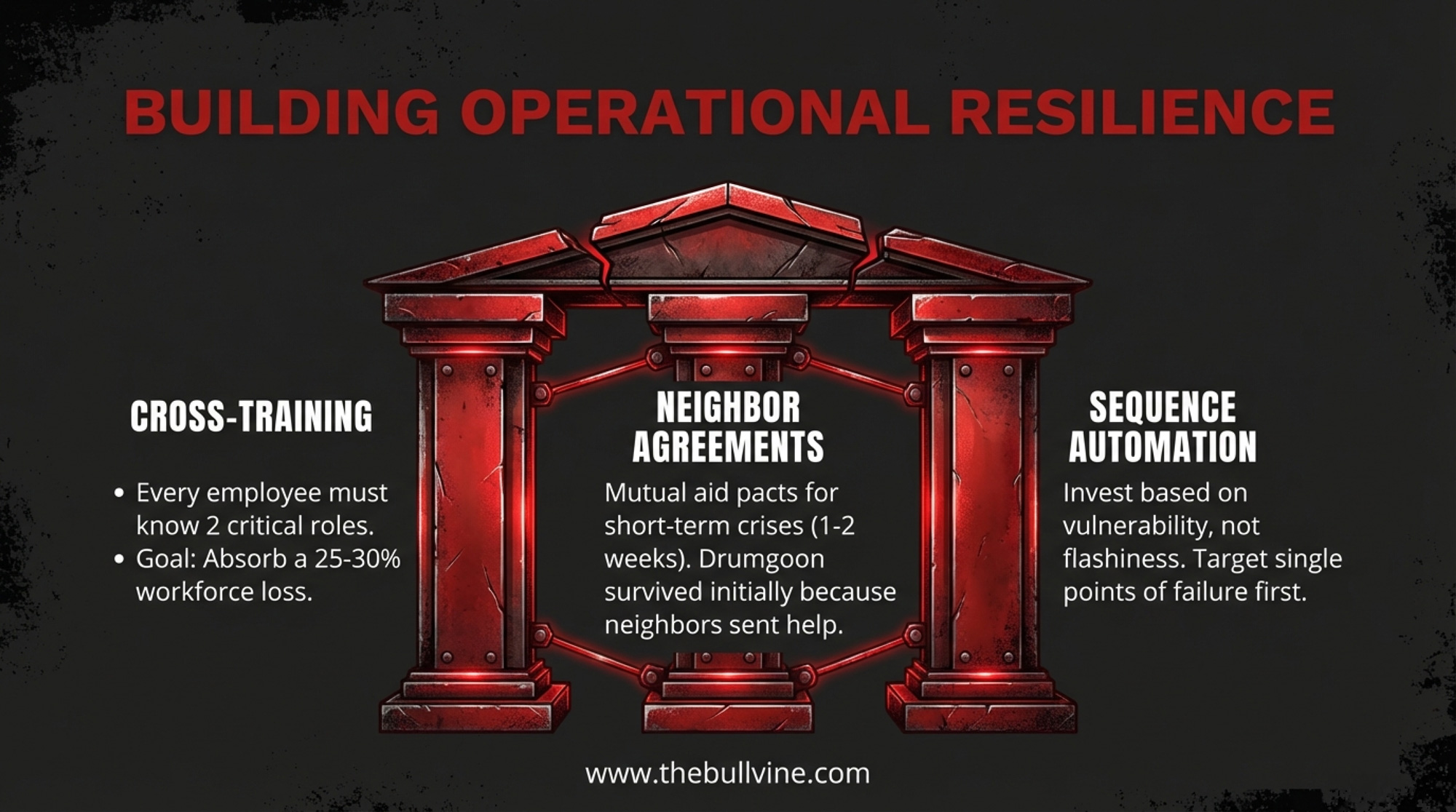
  • Cross-train every employee on at least two critical functions. Document SOPs for milking, feeding, calf care, and manure handling. You’re not making everyone an expert at everything—you’re building a minimum viable operation that can absorb a 25-30% workforce loss without immediate animal welfare collapse. Drumgoon’s actual loss was roughly 70%. Run the scenario for your operation honestly.
  • Establish emergency labor-sharing agreements with 2-3 neighboring dairies. Drumgoon’s neighbors sent workers over for a couple of days at a time during summer 2025 — it helped, but it wasn’t a permanent fix. Mutual aid works for short disruptions of one to two weeks. For longer recovery, identify staffing agencies with verified E-Verify compliance before you need them, not the morning after the NOI lands. Build that network when nobody’s in crisis.
  • Sequence automation investment by vulnerability, not by flashiness. Robotic milking systems reduce direct milking labor by approximately 60% while typically increasing production 15-20%. Capital runs $430,000-$740,000 for two units serving 100-120 cows, with breakeven at five to seven years under optimized management. With the 2025 all-milk price forecast at $22.25/cwt (USDA ERS, July 2024 outlook), breakeven sits toward the middle of that range. But Drumgoon’s experience is a reality check: Elliott installed 20 robots and posted maintenance positions targeting Lake Area College graduates. “So far, no one,” she told reporters. Automation lowers your labor count. You still need people who can keep the technology running.

What This Means for Your Operation

Every item below can be started this month with no capital expenditure except the attorney review.

  • Start with one honest question: what percentage of your crew is foreign-born? If it’s more than a third, enforcement preparation isn’t a someday project — it belongs in your top three management priorities right now.
  • Know your I-9 exposure before ICE does. If you haven’t audited your files in the last 12 months, you’re running blind on your single largest operational risk.
  • Audit your staffing agencies. Ask for their E-Verify compliance paperwork. If they can’t produce it, you need a different agency before their problem becomes yours.
  • Map your single points of failure. If losing four specific people would shut down your operation, those four represent an existential risk you need to mitigate by cross-training, documenting, or automating their roles.
  • Model the enforcement scenario. What happens to your milk volume if you lose 25% of your workforce in a week? What about 50%? Drumgoon lost roughly 70%. Run the numbers for your herd size and your crew.
  • Tell your story to your legislators — now, while the window is open. Contact your representative and both senators—not a form letter. A specific, numbers-driven account of your operation, your workforce, and what an enforcement event would mean for your production and your community. Idaho Dairymen’s Association CEO Rick Naerebout says there’s more traction than ever: “We’ve not had this kind of traction with an administration ever on this issue… but we’re cautiously optimistic.”
  • Engage any available visa pathway. USDA began accepting H-2A applications for dairy operations on a pilot basis in select states in late 2025. Sarah Black of Great Lakes Ag Labor Services warns that the process takes a minimum of 4 months from the first filing to the worker’s arrival (Brownfield Ag News, December 2024). Each legal visa worker is permanently audit-proof — and the housing cost, which could run six figures, still compares favorably to the $110,000 the Elliotts spent on recruiters and transport just to fill the gap partially.
Key Takeaways

  • The dominant enforcement channel hitting dairy has shifted from visible raids to I-9 paper audits, staffing company sweeps, and transportation documentation checks — all operating below the headlines but producing the same workforce losses. As of February 2026, ICE enforcement continues to expand.
  • Drumgoon Dairy lost 38 of roughly 50 employees to a single documentation audit, then spent over $110,000 on recruiters and transportation to partially rebuild — and still couldn’t fill every position. The “never been audited” era is over.
  • The $23.56/cwt cost-of-production spread between the smallest and largest herds (USDA ERS, 2021 ARMS data) means enforcement pressure concentrates on the operations least able to absorb it — accelerating consolidation that’s already taken 39% of U.S. dairy farms off the map since 2017.
  • Two legislative vehicles — the FWMA (dairy-specific visas) and the Dignity Act (35 bipartisan cosponsors as of January 2026) — are advancing with more momentum than at any point in the past decade, but neither has reached a floor vote.
  • Every dairy that hasn’t conducted an internal I-9 audit, verified staffing agency compliance, and built a workforce disruption contingency plan is carrying unquantified risk on its balance sheet.

The Bottom Line

Rodney and Dorothy Elliott moved from a 140-cow farm in Fermanagh to build something bigger in South Dakota. Twenty years, 6,500 cows, 20 robots, and more than 50 employees later, a federal audit removed roughly 70% of that workforce in days.

“All the time, money, effort, investment, and hard work that has gone into it will be null and void if there isn’t a workforce,” she told reporters.

Every morning, 9.4 million dairy cows need milking. The question for your operation isn’t whether Congress will eventually act. It’s whether you’ll have the crew — and the plan — to keep milking if the envelope arrives before they do.

Complete references and supporting documentation are available upon request by contacting the editorial team at editor@thebullvine.com.

Learn More

The Sunday Read Dairy Professionals Don’t Skip.

Every week, thousands of producers, breeders, and industry insiders open Bullvine Weekly for genetics insights, market shifts, and profit strategies they won’t find anywhere else. One email. Five minutes. Smarter decisions all week.
NewsSubscribe
First
Last
Consent

79% of U.S. Milk Runs on Immigrant Labor. If Yours Vanishes, You Have 72 Hours.

79% of U.S. milk runs on immigrant labor. One Idaho dairy lost a third of its crew in 3 weeks—no raid, just fear from one 50 miles away. You have 72 hours.

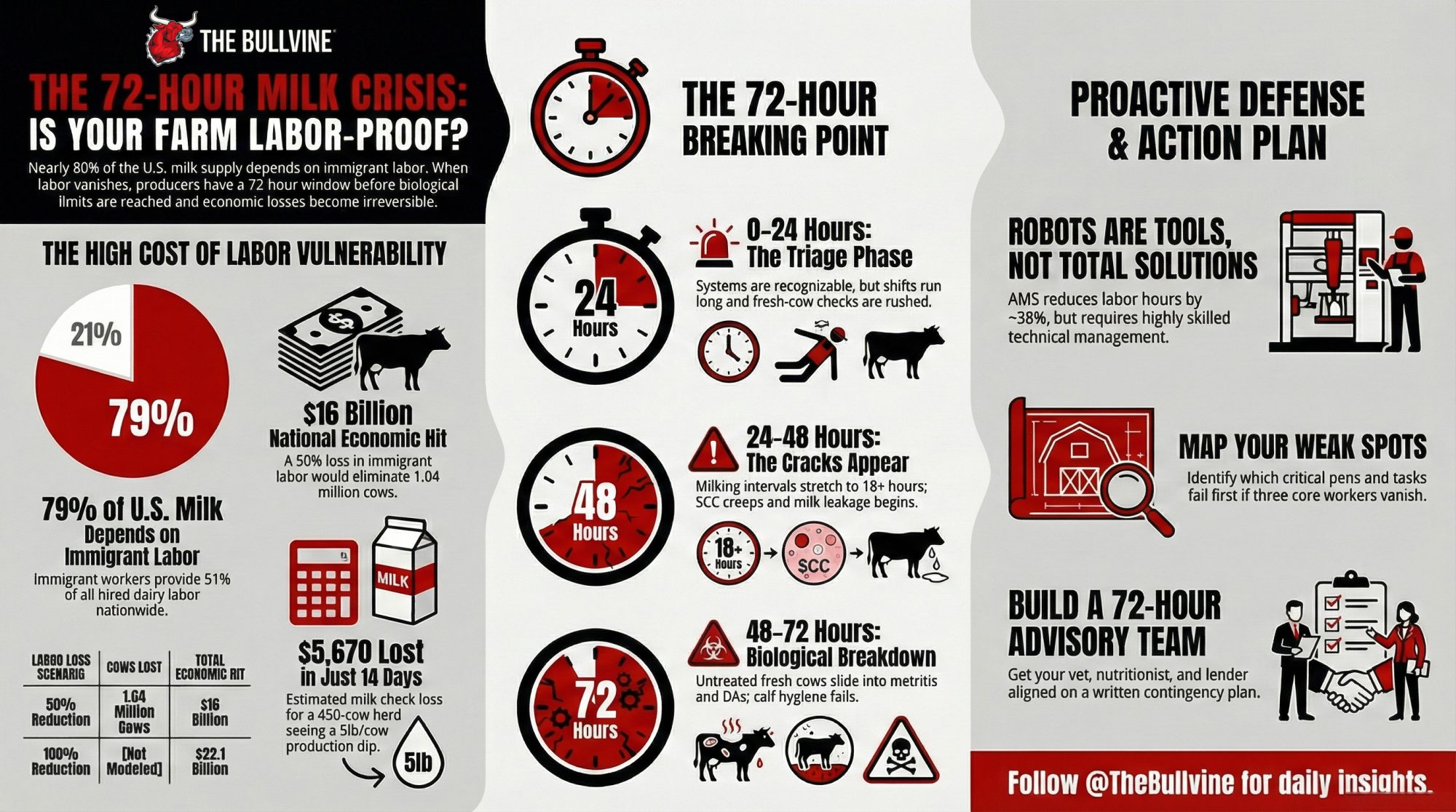
Executive Summary: Seventy-nine percent of U.S. milk comes from farms that depend on immigrant labor. When that labor vanishes, you don’t have weeks to pivot—you have 72 hours before milking intervals stretch, SCC climbs, and fresh cows slide into DAs and metritis while you’re too short-staffed to catch them. A Texas A&M modeling study found that losing half of immigrant dairy workers would eliminate 1.04 million cows and 24.2 billion pounds of milk, causing $16 billion in economic damage. One Idaho dairy saw a third of its crew disappear in three weeks—not from a raid on their farm, but from fear after enforcement hit a plant 50 miles away. For a 450-cow herd at $18/cwt Class III, losing 5 lb/cow/day for two weeks means $5,670 off the milk check before you count the fresh cows that went south. This article delivers a working 72-hour contingency plan: map your weak spots, quantify your labor exposure, stress-test your AMS assumptions, build a crisis reserve, and get your vet, nutritionist, and lender in the same room before you need them.

dairy labor crisis
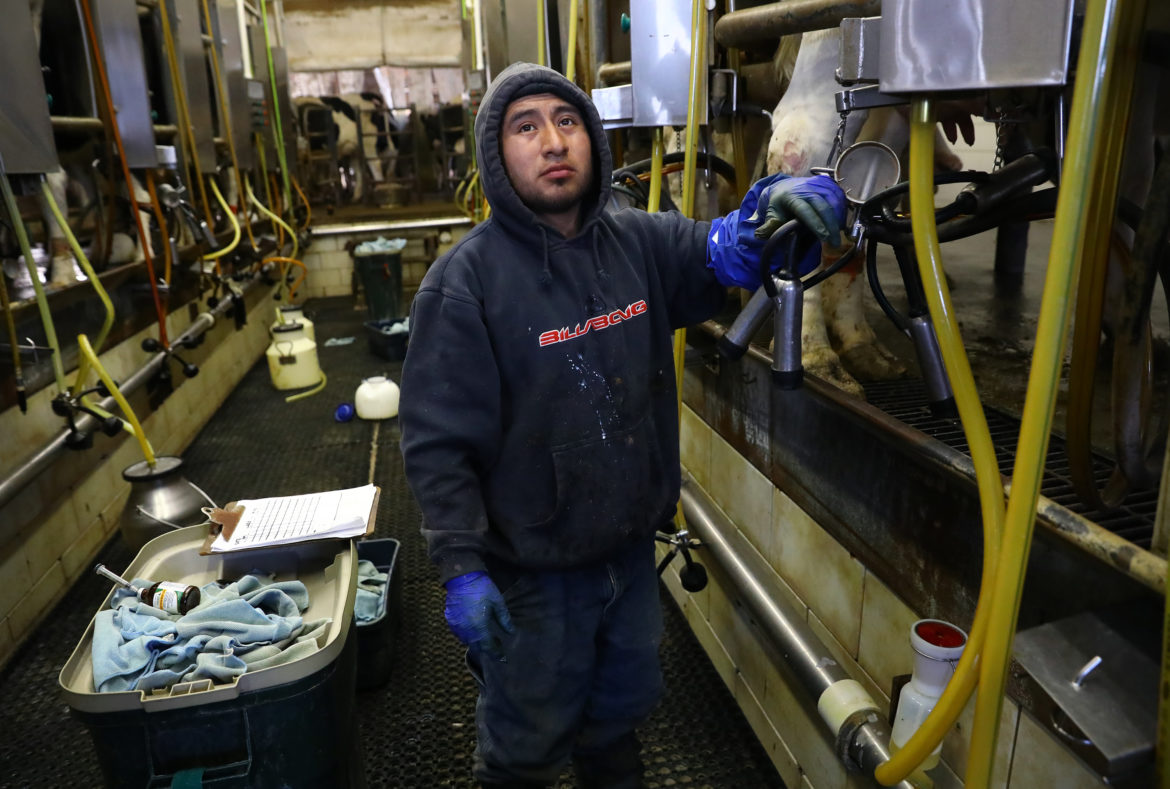
Armando, a Mexican employee at Rosenholm Farm in Cochrane, Wis, works in the milking parlor. He asked that his last name not be used because of his immigration status. Armando is among the estimated 51 percent of all dairy workers nationwide who are immigrants. His boss, John Rosenow, says that if his foreign-born employees were deported, or decided to look for work elsewhere, Americans would lose their jobs too, because the farm would be forced to shut down.

If you’re milking cows in 2026, the fact that immigrant workers provide about 51% of hired dairy labor and help produce roughly 79% of U.S. milk isn’t an academic statistic—it’s the foundation of your pay price. When that foundation cracks, you don’t have months to pivot. You have a 72-hour window before your herd health and your balance sheet start taking hits.

How Exposed Is Your Operation?

The Texas A&M AgriLife Center for North American Studies surveyed 973 dairies across 18 states to quantify who’s actually doing the work on U.S. farms. Their findings still anchor most labor discussions:

  • Immigrant labor accounts for about 51% of all dairy labor.
  • Farms employing immigrant workers ship nearly 80% of the U.S. milk supply.
  • Compared with earlier surveys, both the immigrant share of the labor force and milk production had increased, not decreased.

That’s the national backbone. How it lands on your farm depends on where you milk and how you’re set up.

Wisconsin: Fewer Herds, More Cows Per Farm

Wisconsin had about 5,661 licensed dairy herds as of January 2024—down from 9,304 in 2017 and roughly 29,000 in 1995. Average herd size climbed from roughly 138 cows in 2017 to about 224 cows in 2023.

That’s 86 more cows per farm in six years. Nobody added 86 new family members to the payroll.

Consultants working with 300–600-cow freestall dairies in the Fox Valley and central Wisconsin see a consistent pattern: farms that used to run on family plus a couple of locals now rely heavily on immigrant workers. The larger ones simply don’t operate without them.

Northeast: Smaller Herds, Same Reliance

In New York and Vermont, herd sizes tend to run smaller on average, but labor dependence looks familiar once you hit commercial scale. Research on Latino dairy workers in both states shows they’re concentrated in milking, cow-side treatment, bedding, and health-spotting roles.

Vermont-focused studies estimate roughly 1,000–1,200 Latinx immigrant farmworkers support that state’s dairy sector at any given time.

Those workers don’t show up in your DHIA printout. They show up in whether the parlor, fresh pen, and calf barn stay on schedule when somebody disappears.

West and Southwest: Thousands of Cows, 24/7 Systems

In Texas, Idaho, New Mexico, and Arizona, many dairies run herds in the thousands across multiple sites. Multi-shift parlors, feed centers, and hospital pens operate around the clock. Foreign-born workers sit at the center of that system.

Take that labor away, and the math turns ugly fast.

Bottom Line: If immigrant labor wobbles, it doesn’t just hit someone else’s mega-dairy. It hits the backbone of the U.S. milk supply and any herd depending on hired help to keep parlors, fresh cows, and calves on schedule.

The Big Math

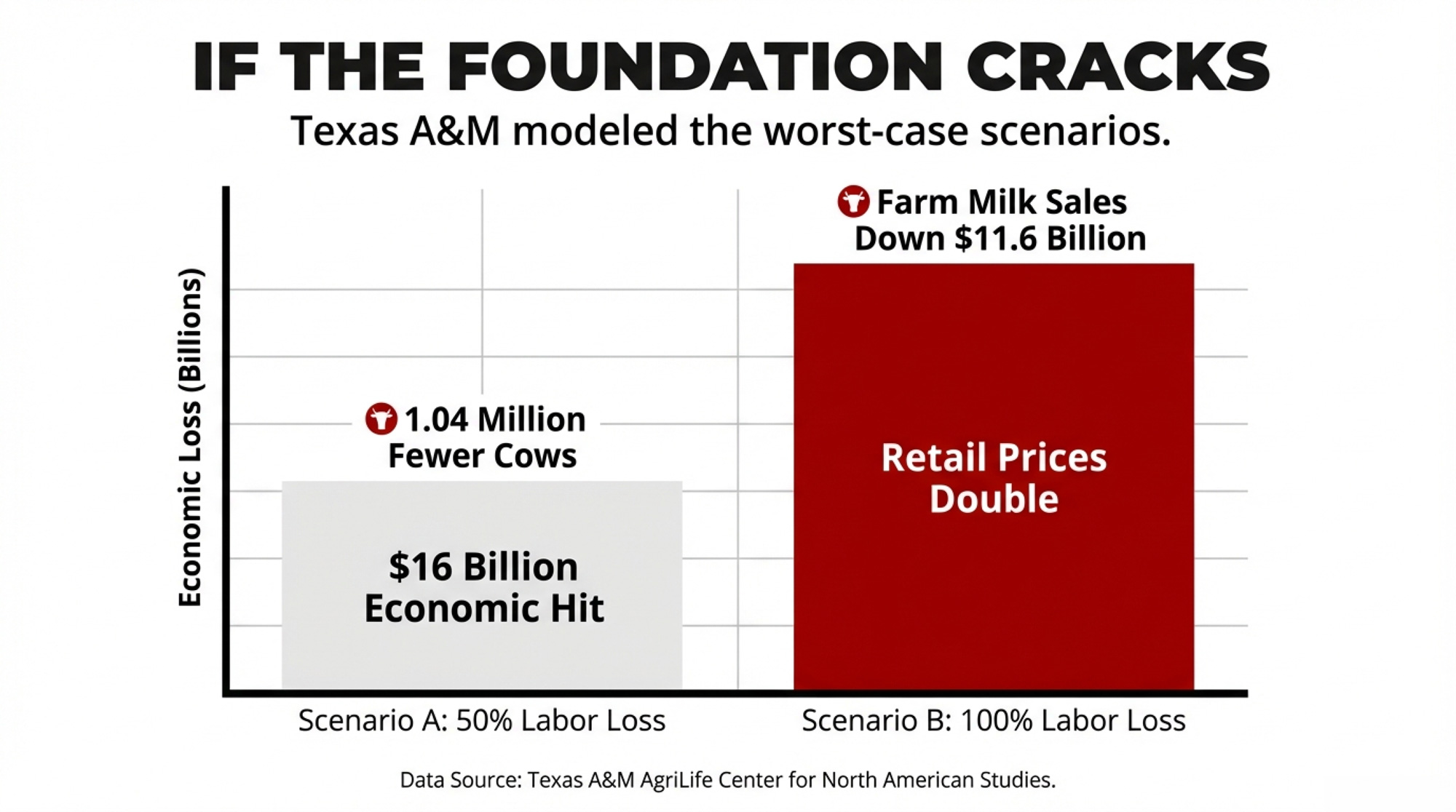
Texas A&M stress-tested what would happen if immigrant labor dropped. Here’s what the models show:

ScenarioCows LostMilk Production ChangeEconomic HitRetail Impact
50% labor loss1.04 million−24.2 billion lb (−11.7%)−$16 billionModerate increase
100% labor lossNot modeledFarm sales down $11.6B−$32.1 billion totalPrices nearly double

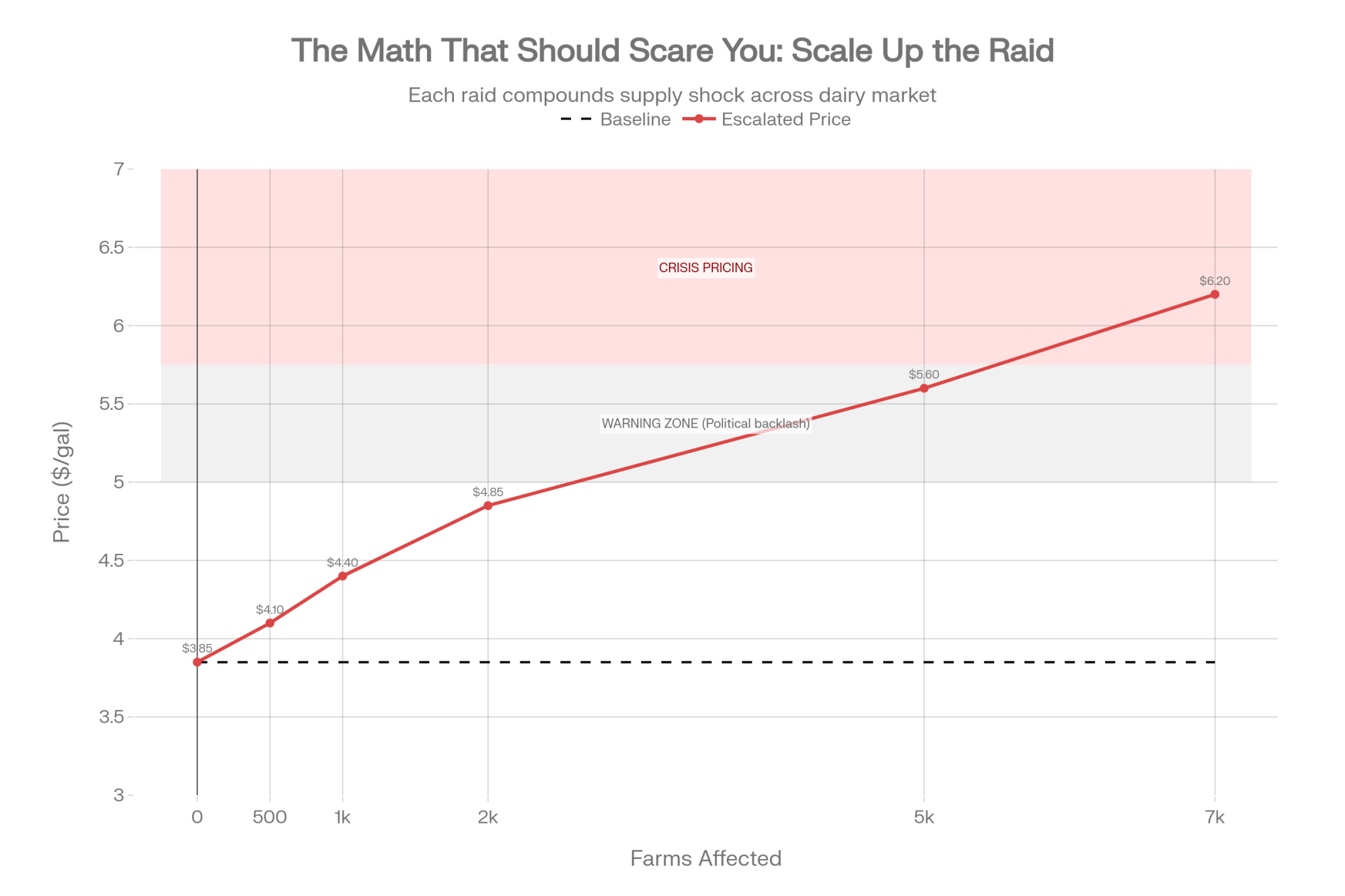
These are modeled scenarios, not guarantees. But they frame what’s on the line when policy shifts—or enforcement heats up.

Your Parlor, Your Numbers

Say you’re milking 450 cows at 80 lb/cow/day. A labor shock doesn’t close your doors, but it drags your routine enough to cost you 5 lb/cow/day for two weeks:

  • 450 cows × 5 lb × 14 days = 31,500 lb less milk
  • 31,500 lb ÷ 100 = 315 cwt
Herd SizeLost Milk (cwt)Milk Price ($/cwt)Milk Check Loss
300 cows210$18.00−$3,780
450 cows315$18.00−$5,670
1,000 cows700$18.00−$12,600

The November 2025 Class III price hit $17.18/cwt, $2.77 below the November 2024 price. The 2025 benchmark Class III averaged about $18.01/cwt. At $18:

  • 315 cwt × $18 = $5,670 off your milk check in 14 days

That’s just the volume loss. It doesn’t count fresh cows sliding into DAs or metritis while you were short-staffed, or calves getting shorted on bedding.

Bottom Line: The national models tie immigrant labor to millions of cows and tens of billions of dollars. At the farm level, a modest production slip in a 450-cow herd means a four-figure hit in two weeks—before you count health and calf costs.

When Enforcement Heats Up: The Fear Effect

A working paper on 2025 ICE raids in California’s Oxnard/Ventura County estimated what happens when immigration enforcement ramps up in an agricultural region:

  • 20–40% reduction in available agricultural workers
  • $3–$7 billion in modeled crop losses
  • 5–12% retail price increases for some produce

Those are estimates, not line-by-line ledgers. But they match what farmworker researchers describe as the “chilling effect.” Once enforcement becomes visible—raids, news footage, community chatter—workers don’t just leave the farm that got visited. They leave the region, the sector, or the country.

The total workforce loss ends up being multiple times the number of people actually detained.

A nutritionist servicing several 1,000-cow freestalls in Jerome County, Idaho, reports one client saw its workforce shrink by roughly a third within three weeks of a high-profile enforcement action at a nearby packing plant. Nobody came to the dairy. Workers simply decided the risk picture had changed.

You don’t need flashing lights in your driveway to wake up short-handed.

Even if agents never set foot on your yard, enforcement actions in your region can strip out a big share of the labor pool in weeks. Your exposure is bigger than the names on your own payroll.

Why 72 Hours Is the Breaking Point

On a well-run herd, milking locks in at 12-hour intervals for 2× herds, or tighter for 3× herds. Push high-yield cows beyond that, and you pay with SCC, mastitis risk, and lost milk.

Vets and consultants who’ve walked herds through blizzards, flu waves, and bad luck report a similar 72-hour patternwhen crews shrink faster than you can replace them:

0–24 hours: Scrambling, but intact. Every pen still gets milked and fed. Shifts run long. Fresh checks get rushed. Calf feeding technically happens, but not how you’d like. You’re triaging, but your system is still recognizable.

24–48 hours: Cracks appear. Some pens stretch to 16–18 hours between milkings. Over-full udders and milk leakage show up. SCC creeps. Fresh cows that were “a bit off” yesterday now have fevers or poor appetite, and you don’t have enough eyes to sort through them. Calf hygiene slips.

48–72 hours: You’re not running the same herd. Low-priority groups can slip beyond 24 hours between milkings if you’re not ruthless about priorities. Untreated fresh cows slide into full-blown metritis, severe ketosis, or DAs. Calf scours or pneumonia spikes.

Those three days are the difference between “we had a brutal week” and “we’re still digging out a year later.”

Then there’s welfare and legal risk. States like California and Wisconsin have clear animal care standards. If a vet or inspector walks in on day three and sees over-distended udders, untreated down cows, and underfed calves, they’re not seeing a rough patch. They’re seeing whether you had a plan.

You don’t control when a labor crisis hits. You control whether those first 72 hours are organized around a written plan—or around panic and hope.

Robots: Strong Tools, Not Magic Exits

Whenever labor risk comes up, robots aren’t far behind. The real question: what can automatic milking systems (AMS) actually do in a 72-hour crisis—and what can’t they do?

What the Data Shows

A University of Wisconsin Extension survey of 50 U.S. farms that installed AMS found:

  • Labor hours per cow dropped by about 38% on average
  • Labor hours per cwt dropped by about 43%
  • At $15/hr, that’s roughly $1.50/cwt in labor savings

But the same work shows wide variation:

  • Around 8% of respondents reported no labor savings—maintenance and management ate the gains
  • About 25% reported savings above $2.40/cwt at $15/hr

Producer comments make the point bluntly: “Still need experienced labor to keep robots running” and “AMS is not stress free… mentally stressful.”

Robots don’t replace management. They expose it.

The Capital Side

AMS projects can run into the high six- to low seven-figure range once you factor in robots, construction, electrical, and barn changes. Divide by cows, and you’re often looking at several thousand dollars per head.

For a modern 500–1,000-cow freestall with good records and a lender who understands dairy, AMS often pencils as a labor tool. For a 150–250-cow herd in an older barn, the math is tighter—those projects hinge as much on succession and lifestyle as on pure labor savings.

In a 72-hour crisis, robots keep milking. But they don’t fix weak fresh-cow protocols, poor cow traffic, or a lack of cross-training on feeding and troubleshooting. They lower your day-to-day labor needs. If you lose the few people who understand the system, the risk just changes shape.

Robots take real pressure off labor in milking, but they shift risk to capital and technical management. They’re a tool in your labor strategy, not an escape hatch.

Region by Region: Same Biology, Different Wrappers

The biology doesn’t care where you live. The economics and options do.

  • Upper Midwest and Northeast: Many herds run 50–300 cows in older barns that have been upgraded over time. Deep processor relationships, tight land limits, and a mix of family and hired labor, where losing two or three key people can cripple the system. Their questions: How do we stay resilient without overleveraging? Where do we modernize without betting the whole place?
  • Southwest and Mountain West: Larger herds, often multiple sites and shifts. Heavy reliance on immigrant crews. Strict water and environmental rules. Their playbook leans into formal HR and immigration counsel, larger capital projects, and multi-site risk management.
  • Canada: Supply management and quota, with Temporary Foreign Worker (TFW) and provincial nominee programs. Federal and provincial reports show livestock sectors rely significantly on temporary foreign workers and wrestle with housing, retention, and program uncertainty. For an Ontario herd under quota, the labor crunch might first show up as missed butterfat targets and under-used quota days.

Quota or not, 50 cows or 5,000—the labor risk lands the same way. If key people vanish, you’re fighting biology and welfare expectations on a short clock.

RegionTypical Herd SizeLabor DependencePolicy/Program ToolsRisk Level
Upper Midwest / Northeast (WI, NY, VT)50–600 cowsModerate to high; mix of family + immigrant workersLimited H-2A access; state labor regs varyHigh
Southwest / Mountain West (TX, ID, NM, AZ)500–5,000+ cowsVery high; multi-shift operations heavily reliantSome H-2A use; strict environmental/water rulesVery High
Canada (ON, QC, AB)50–300 cows (quota)Moderate; TFW + provincial nominees fill gapsTFW program, provincial nominees; quota stabilityModerate
California1,000–10,000+ cowsExtremely high; industrial-scale relianceH-2A limited for dairy; strict labor + animal welfare lawsExtreme

The 72-Hour Contingency Plan

Treat this as a working plan, not just a read.

  • Map your weak spots. Write out: if three core workers didn’t show tomorrow, which cows, pens, and tasks would be at risk within 72 hours? Make sure at least two people besides you know that plan and where it’s kept.
  • Size your exposure. Look at how many critical roles are held by immigrant workers versus others. You don’t need to label anyone’s status—just understand where your labor risk actually lives.
  • Run the math with your numbers. Plug your herd size, production, and current pay price into the 5 lb/cow/day scenario. If that milk-check hit makes you flinch, that’s your starting point for crisis-reserve and staffing goals.
  • Treat AMS as one option, not salvation. If you’re considering robots, insist on farm-specific budgets, conservative labor-savings assumptions, and a clear plan for who will manage the system on day 1, day 100, and day 1,000.
  • Use your advisory team together. Bring your vet, nutritionist, and lender into one conversation. Lay out your 72-hour plan, your crisis-reserve goals, and your automation ideas. Ask them where they see your blind spots.
  • Benchmark by region and system, not emotion. Compare your staffing and cows-per-worker to operations like yours—same region, similar size and system—not just the biggest herd in the next state.

Key Takeaways

  • Your labor risk isn’t theoretical. Immigrant workers are behind about half of the hired dairy labor and nearly 80% of U.S. milk. When enforcement heats up, that dependence can translate fast into fewer cows, less milk, and higher prices.
  • The 72-hour window is real. Within two to three days of losing key workers, biology and welfare rules start calling the shots more than your intentions do.
  • Robots lower labor, not responsibility. AMS can significantly reduce milking labor on average, but some farms see no savings, and many need more skilled staff.
  • A crisis reserve buys decisions, not miracles. Money set aside for labor and legal shocks doesn’t guarantee a soft landing. It buys choices—legal help, overtime, temporary support—so you’re not making bad decisions because the account is empty.
  • Cross-training and culling are cheap, powerful levers. Teaching extra people to handle key tasks and moving out cows that don’t fit your system cost far less than a new barn or robots.

The Bottom Line

A third-generation dairyman from Clark County, Wisconsin—someone who’s lived through the 1980s interest squeeze, the 2009 crash, and 2020’s chaos—put it this way at a winter meeting: he can’t control Washington or Ottawa, but he can control how hard his own farm is to knock over.

You don’t get to choose when the phone rings with bad news about your crew. You do get to choose whether that call lands on a blank slate—or on a 72-hour contingency plan, some cash in reserve, and a herd that actually fits the people you have.

Complete references and supporting documentation are available upon request by contacting the editorial team at editor@thebullvine.com.

Learn More

The Sunday Read Dairy Professionals Don’t Skip.

Every week, thousands of producers, breeders, and industry insiders open Bullvine Weekly for genetics insights, market shifts, and profit strategies they won’t find anywhere else. One email. Five minutes. Smarter decisions all week.
NewsSubscribe
First
Last
Consent

38.8% Turnover Is Bleeding Dairies Dry. These Dairy Neighbours Turned Kitchen Tables into Labor Plans.

If 38.8% turnover feels normal on your farm, you’re not broken. The dairies that are surviving just moved the labor crisis to the kitchen table—and brought neighbours with them.

The neighbour’s text came before sunrise.

“Heard you lost a couple of good guys lately. I’ve got someone you should talk to. Coffee at the diner when you’re done milking?”

It was still dark outside. Steam rolled off the backs of the cows as they shifted in the holding pen. In the milk house, under the hum of the cooling compressor, Mark wiped his hands on his coveralls and stared at his phone.

Milking was only halfway through. His mind was already racing ahead to a feed delivery, a meeting with the banker, and a scraper chain that had started thumping again. He’d lost more good people in a year than in the decade before, and he was out of ideas. It was the labor crunch he’d been trying not to think about showing up in his own milk house.

The message was from his neighbour, Dave. Dave farms on the next road over. He’s ten years older, the kind of guy who’s seen enough tight years and hard decisions to read trouble from a distance. He’d noticed the steady stream of new faces in and out of Mark’s barn.

Mark thumbed out a reply.

“Yeah. I’ll be there.”

Standing in that milk house, still in the middle of the first milking, he felt something he hadn’t let himself feel in a while.

Maybe they didn’t have to figure this out alone.

He wasn’t the only one.

I’ve heard that same moment described at more than one kitchen table these last few years: a pressure point that feels impossible, someone finally saying out loud that they’re in over their head, and then—almost in spite of everything stacked against them—the neighbours start to show up.

What kept these families going wasn’t just the cows.

It was the people around them.

Editor’s Note: The farm stories in this article blend real interviews, conversations, and events from the last few years. Names and identifying details have been changed to protect privacy, and individual scenes and dialogue are composites drawn from multiple farms, not a single family. The situations and community patterns are real, used with permission, and told with care. If you see yourself in Mark, Jennifer, or Jake and Emily, that’s the point—they’re built from the stories we keep hearing at kitchen tables across dairy country, not from just one farm. Every scene and decision in this piece is drawn from real conversations with producers, workers, vets, and advisors. We’ve blended details to protect privacy, not to soften the truth.

The Dairy Labor Crisis by the Numbers

Here’s what’s really going on behind these stories.

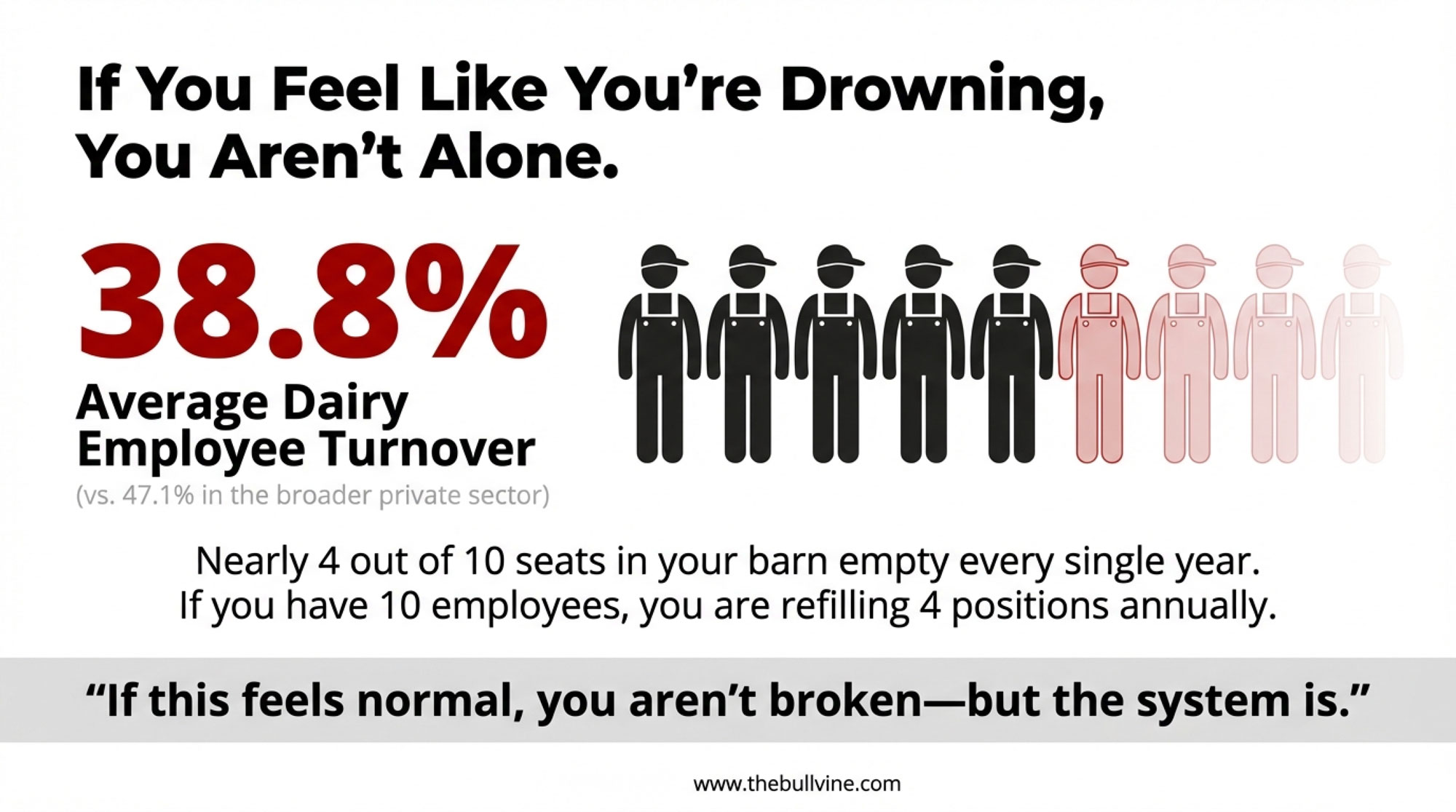
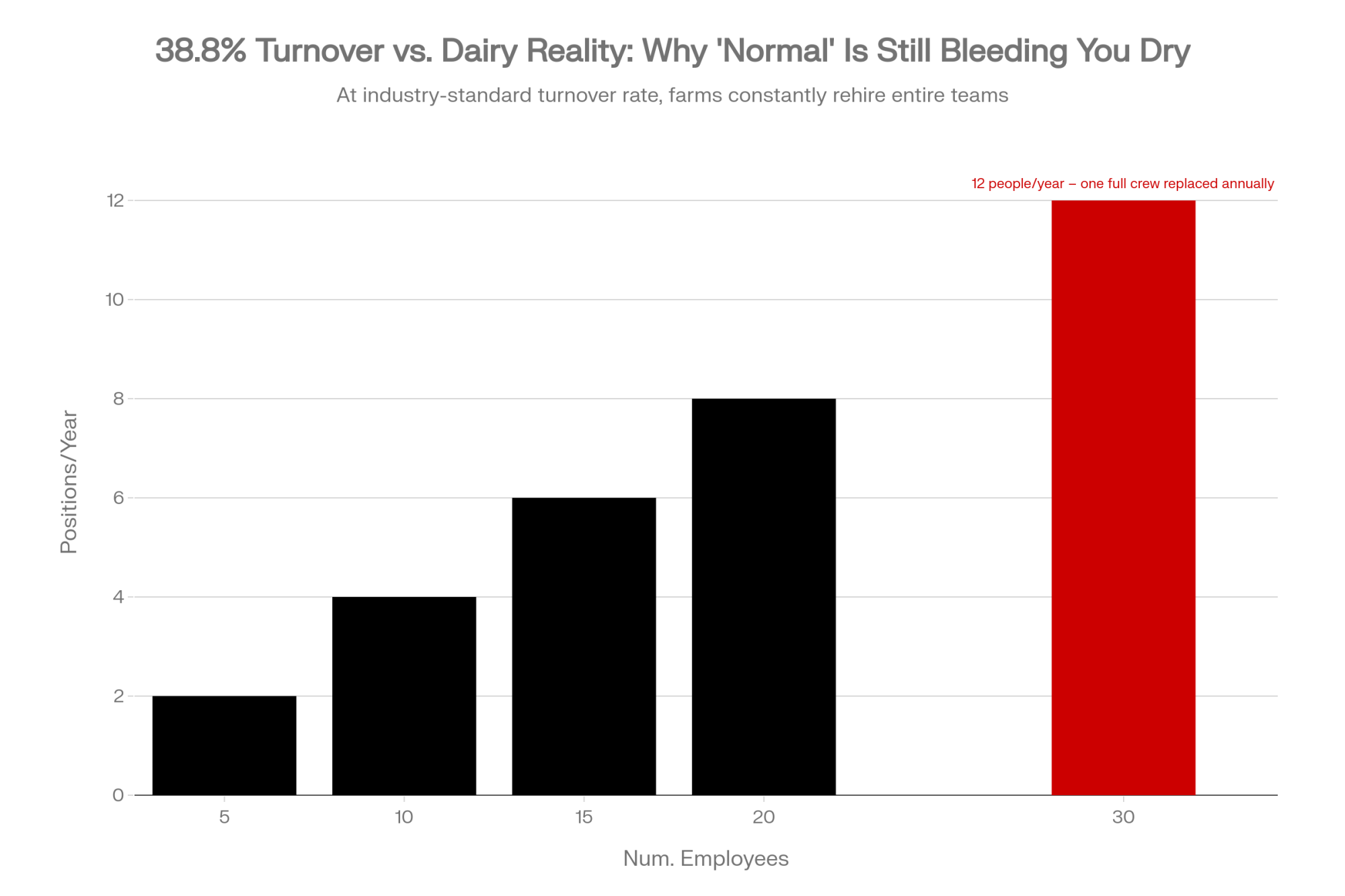
In the FARM Program’s nationwide dairy labor survey, conducted by Texas A&M’s Center for North American Studies and published in 2019, U.S. dairies reported an average employee turnover rate of 38.8 percent, compared with 47.1 percent in the broader private sector. That still means nearly 4 out of 10 positions are turning over every year on the typical dairy. If you’ve got 10 employees, you’re basically refilling almost four seats a year. 

Labor is already one of your biggest line items. Michigan State University Extension notes that labor typically accounts for around 14 percent of total cash expenses on dairies, with the exact share varying by herd size and region. When the people you’re investing that money in keep cycling out the door, the quiet bleed on profit and herd performance is worse than most budgets show. 

At the same time, the workforce you depend on is structurally fragile. A national survey of dairy farms conducted for the National Milk Producers Federation in 2014 found that immigrant workers accounted for about 51 percent of all dairy labor, and dairies that employed immigrant labor produced roughly 79 percent of the U.S. milk supply. In key dairy states, that reliance runs even higher. If anything shakes that foundation—policy changes, enforcement swings, or fear—it hits your parlor and your bulk tank, not just a headline. 

North of the border, the Canadian Agricultural Human Resource Council’s recent forecasts for 2023–2030 show agriculture facing persistent and growing labor shortages, with dairy among the sectors expected to see higher vacancy rates if nothing changes. Whether you’re shipping to a U.S. cooperative or a Canadian board‑regulated plant, the story is the same: there aren’t enough people lining up to do this work under status‑quo conditions.

So if you feel like you’re constantly training, constantly short, constantly one resignation away from a crisis—you’re not imagining it. You’re sitting right in the middle of the math.

When Neighbours Became Teachers

The diner was half empty by the time Mark walked in. The smell of bacon and coffee hung in the air. Dawn was just starting to pull over the hills.

Dave was already in the corner booth, two mugs on the table.

“I remember he didn’t start with advice,” Mark said. “He just looked at me and asked, ‘How are you sleeping?’ And I laughed, because I thought he was joking. But he wasn’t.”

Mark let out a slow breath.

“I told him the truth. ‘Not great.'”

Over eggs and toast, the conversation drifted from milk prices and weather to the thing they’d both been circling around: people leaving.

“I can’t keep anybody,” Mark admitted. “The ones I really trust, the ones who know fresh cow routines and don’t miss heifer heats, they’re the ones living with the most fear.”

Over the years, he’d watched more than one trusted employee disappear almost overnight. One day, they were putting in a new group of fresh cows, and the next day, their bunk was empty. Families who’d become part of the rhythm of his barn packed up quietly and left, tired of living with the feeling that one traffic stop or one letter in the mail could change everything.

“There wasn’t even a chance to say goodbye,” he said quietly. “Their kids played with my kids. We just…lost them.”

Dave nodded. His eyes went to the window for a second.

“We had that happen here, too,” he said. “You don’t forget it.”

Research across dairy regions confirms what guys like Mark and Dave are living: immigrant and foreign‑born workers are the backbone of modern dairy, and policy uncertainty isn’t an abstract debate—it shows up as fear, turnover, and empty bunks in the bunkhouse. 

In the mid‑2020s, when the labor crunch and immigration stalemate seemed to tighten another notch every season, Dave tried one of the legal paths dairy farms can use to give long‑time workers some real footing. It felt like a maze of forms, fees, and deadlines.

“It’s expensive, it’s slow, and the paperwork might as well be written in a different language the first time you see it,” he told Mark. “But it’s one of the only ways we can look somebody in the eye and say, ‘We’re willing to stand beside you.'”

He slid a business card across the table. The name on it was an immigration attorney who’d grown up on a small dairy and knew enough Spanish and farm talk to bridge both worlds.

“She knows cows,” Dave said. “She knows the law. And she’ll tell you what you don’t want to hear, not just what sounds good.”

That night, Mark and his wife spread the first stack of papers out on their kitchen table. They looked at the fees. They thought about the time they’d already poured into training people, about the families who’d already left, about their own kids and the way it shook them every time someone they loved simply vanished from the lane.

They decided to try.

But they also decided they weren’t going to walk that path by themselves.

The next week, they invited a few neighbours over for supper. A handful of couples and a single farmer crowded around the table. The attorney joined on a laptop screen at the end, her face propped between salt and pepper shakers.

They asked every question they could think of.

What if a case gets denied? How long does this really take? What happens if the rules change in the middle? How do we even start talking about this with our workers?

Nobody had a neat, tidy answer for everything. What they did have was a room full of people nodding along.

“By the end of that night, none of us had a clean roadmap,” Mark said. “But we all knew we didn’t want to keep pretending the way things were was okay.”

That kitchen‑table meeting turned into a regular thing. Once a month, after evening chores or on a rainy Sunday, more trucks crowd into the driveway than the yard was ever designed for. People bring casseroles and cookies. Kids drift in and out, grabbing snacks and listening from the stairs.

Around that table, they swap stories.

Someone passes a letter from the government around, the paper soft from being folded and unfolded. Someone else talks about a worker whose case is stuck somewhere in the system and how they’re trying to keep his hopes grounded. The co‑op field rep sits in sometimes, mostly to listen.

“I thought I understood ‘labor issues’ before I sat at that table,” he admitted one night. “I didn’t. Not really.”

He started talking differently at co‑op meetings after that.

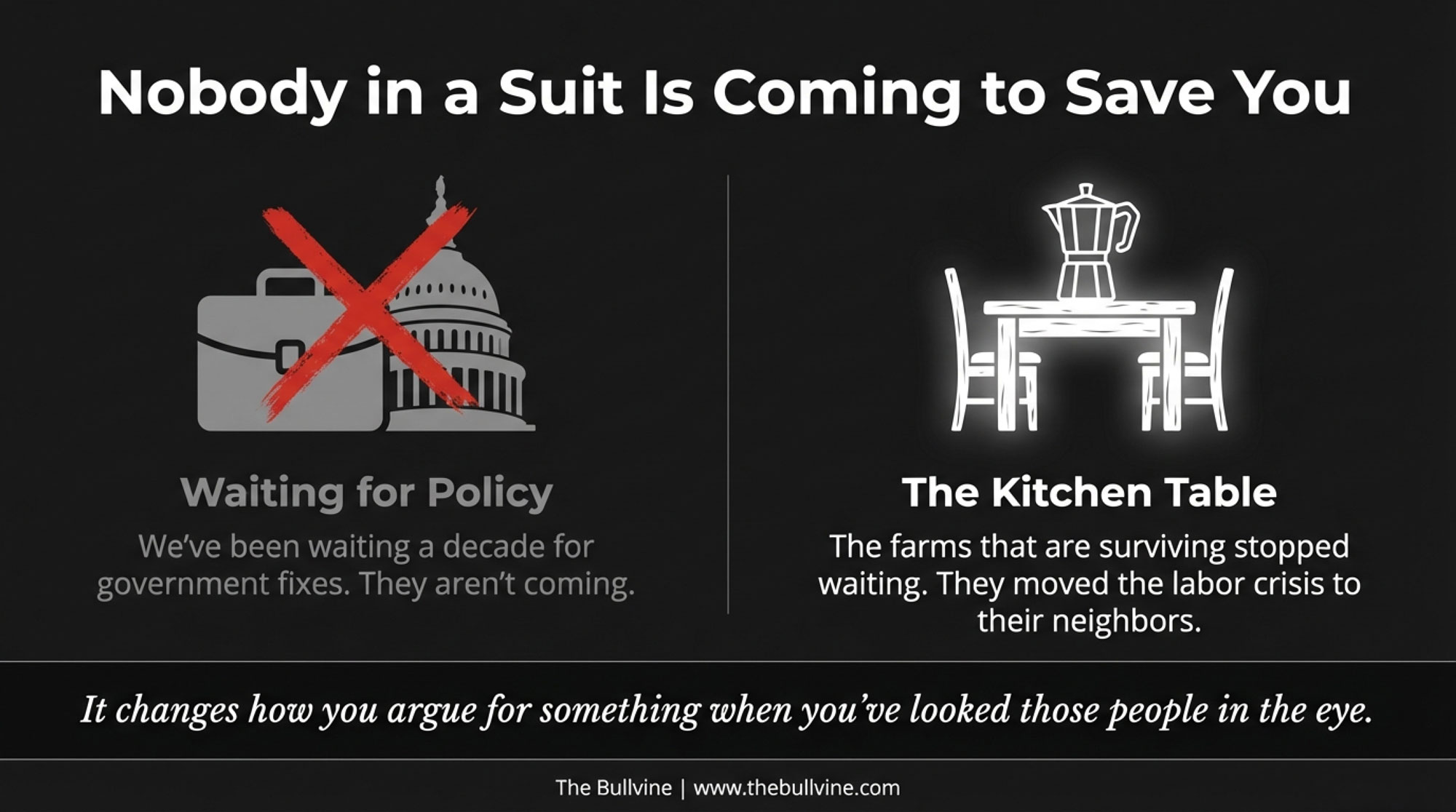
“I told them, ‘You think this is a policy issue. Our members are living this at their kitchen tables,” he said. “It changes how you argue for something when you’ve looked those people in the eye.”

Every now and then, an extension educator joins them, too, listening more than talking and jotting notes on what farmers actually need from the next round of workshops.

Over time, farms in that little circle have helped a number of long‑time workers start some kind of legal path forward. Not every case has gone smoothly. There have been delays that felt like gut punches. There have been nights when someone came in ready to give up.

“And then you have three other farmers saying, ‘Yeah, we hit that wall too. Here’s how we got through it—or how we’re still trying,” Mark said. “That’s when it feels less like you versus the system and more like all of us, together, trying to do right by our people.”

One afternoon, long after the paperwork marathon had started, a worker walked into the parlor, holding an envelope as if it were a fragile calf.

Mark took one look and knew what kind it was.

“We just stood there,” he said. “He handed it to me with both hands. He couldn’t say much at first.”

When he found the words, he said something Mark won’t forget: “My daughter can grow up here now.”

Later, someone in the group mentioned that the worker’s child had drawn a picture of the farm at school and told the teacher, “This is where we get to stay now.” That simple comment said more than any thank‑you card ever could.

On rough mornings, when a pump won’t prime, or a heifer finds a new way to wedge herself where she shouldn’t, Mark thinks about that kid.

“I still worry about what might change in town or in the capital,” he said. “But I don’t wake up every day wondering who’s going to be in the parlor anymore. That alone feels different.”

Somewhere in that same valley, another worker’s case is still sitting in a stack of files. The group hasn’t forgotten him. His name comes up at every meeting. Somebody always volunteers to make the next call.

Raising Kids, Cows, and Community in Minnesota

The night everything came to a head for Tom and Sarah, the house was too quiet.

They’d finished evening milking late. Their roughly 200‑plus cows were settled, the parlor was washed, and the pipeline was humming as it cooled. Upstairs, their daughter was sprawled across her bed with textbooks open and earbuds in.

Sarah set a plate of reheated casserole on the table and poured herself a cup of tea, which she never did drink. Tom sat down across from her, shoulders slumped in a way she’d started to see more and more.

“I remember staring at that plate and thinking, ‘If I try to eat this, I’m going to fall asleep right here,'” she said. “I was that tired.”

Over the past months, a string of milkers had come and gone. One left for a job with benefits in town. Another found work with more predictable hours. Others just drifted away. Each time, they scrambled. Each time, they told themselves they’d figure it out.

That night, Sarah finally said what had been rattling around in her head for weeks.

“I don’t even know who’s on the schedule tomorrow,” she told Tom. “I just know I’m bracing for a text at five a.m. that says, ‘Sorry, can’t come.’ And I’m so tired of training people who are already looking for the next thing.”

When they’d asked their daughter not long before if she’d ever think about coming back to the farm after college, she didn’t sugarcoat it. She talked about what she saw: her parents exhausted, a schedule that never let up, and friends working in town who had predictable shifts and benefits.

“She wasn’t trying to hurt us,” Tom said. “She was just telling us what it looked like from where she sat.”

That night at the table, he set his fork down.

“We can’t keep doing this,” he said quietly. “Not to ourselves. Not to them.”

There was a long pause. The clock on the wall ticked louder than usual.

The next day, between vet checks and feeding calves, they started talking seriously about robots.

They’d heard all the stories. Some neighbours swore their automatic milking systems had saved their backs and their marriages. Others grumbled about never‑ending alarms and cows that refused to cooperate. The dealer had glossy brochures full of graphs and smiling families.

Tom and Sarah made a choice that surprised even them. They didn’t start by calling the dealer.

They started by calling their people.

They invited their herd vet, their nutritionist, a neighbour who’d installed robots a couple of years earlier, and their pastor to the farm for a Sunday afternoon.

“It felt a little strange at first,” Sarah admitted. “Like, why is the pastor in the shop talking about robots? But he knew us. He’d seen what the last few years had done to our family. That mattered as much as the numbers.”

They sat on folding chairs in the machine shed with two whiteboards, a pot of coffee, and more nervous energy than any of them wanted to admit. The wind rattled the overhead door. A few calves bawled outside.

They talked about what a bigger loan would really mean for their debt load. They talked about how many hours they could realistically take out of the parlor. They talked about what it would look like for their crew—who might be excited, who might be nervous. They talked about what it would mean for their kids if the farm started to look like something they could actually imagine being part of.

Their vet didn’t sugarcoat it.

“A robot can’t fix a bad ration or a bad attitude,” he told them. “It can change your workload. It might change your stress. But the biggest question is, what do you want your life to look like five years from now?”

Their pastor asked a different question.

“Who are you going to call when something breaks at two in the morning?” he said. “Because it will. And you two can’t be the only answer to that.”

They made a list. The neighbour with robots. The dealer techs. The vet. A couple of younger producers in the area who’d talked about wanting to learn more about AMS. One of their farm‑credit advisors offered to run worst‑case and best‑case cash‑flow scenarios so they weren’t guessing in the dark.

They also did something they hadn’t done before.

They put emergency mental‑health contacts where they could see them—farm stress hotline numbers, their doctor’s office, their pastor’s cell—right on the fridge. Just in case.

The robots did come. The first weeks were rough. Cows balked at the new lanes. Alarms went off for reasons no one could explain. There were nights when Sarah, standing in the glow of a robot screen at three a.m., wondered if they’d made a terrible mistake.

But slowly, the work started to shift.

They sat down with their crew and told them the truth.

“We’re not replacing you,” Tom said. “We’re asking you to work differently.”

They asked who might be interested in learning more about health, breeding, and data.

A quiet milker who’d been with them for a few years raised her hand.

“I don’t want to wash units forever,” she said with a small smile. “Teach me something else.”

They did.

She began working closely with the vet, learning how to read the robot’s reports—conductivity graphs, milk‑flow patterns, visits per cow. A few months in, she noticed that one group’s milking times were creeping up, and the conductivity in a couple of quarters was just a tick higher than normal.

“I thought, ‘Something’s going on in that pen,'” she said. They pulled a few samples and found the beginnings of a mastitis issue they could get ahead of.

The vet shook his head, smiling.

“The robot gave us numbers,” he said. “She gave us insight. That’s the part you can’t buy in a crate.”

TaskPre‑Robot HoursPost‑Robot Hours
Milking / Parlor Work166
Cow Health & Repro Tasks46
Data & Planning13

Upstairs in the farmhouse, something else was shifting. Their daughter, who’d sworn she’d never come back, started wandering into the office when she was home on weekends. At first, she just clicked around the software because it looked like a game. Then she started asking questions about cull rates, reproductive performance, and which cows were actually paying for their stall.

As her daughter dug into the robot data, she also started asking which cows were actually paying for their stall and which matings were producing the kind of trouble‑free cows the robots love.

“For the first time,” she said, “the farm started to look like a place where I could use my brain, not just my back.”

At her university’s dairy club, she found herself helping younger 4‑H members figure out their own families’ robot reports. On show day, she’d be leaning over laptops with twelve‑year‑olds in belts and boots, explaining how to read a graph of milkings per day and why a cow dropping to 1.5 visits needs eyes on her fast.

A few months after that, a neighbour, thinking about robots, called late one night, overwhelmed by costs and alarms he’d heard about.

“Tom sat at the kitchen table and just walked him through the first week,” Sarah said. “We remembered how it felt to sit where he was. It felt good not to let him sit there alone.”

The robots didn’t fix everything. The debt still sat on the balance sheet, heavy as a silo. There were still nights when alarms went off at the worst possible time. There were still hard conversations about who was going to be “on call” over Christmas.

But there were more evenings when the family sat around the table before nine p.m., and more mornings when Tom and Sarah woke up feeling like they hadn’t been run over.

“I won’t pretend it’s all sunshine,” Sarah said. “But we’re not as close to the edge as we were. And the farm looks more like a place our kids might want to come back to, instead of a place they want to run from.”

Down the road, a smaller tie‑stall couple with no real interest in robots at all drove home from one of those barn days and told each other, “We’re not the only ones struggling with labor. That helps.” Their solution looks different—tighter shifts, a shared weekend milker with a neighbour—but they still came away with the same thing.

They’re not alone.

What Fair Wages Really Built in Vermont

The wind cut across the Vermont hillside, blowing fine snow into the ends of the freestall barn. Cows stood in rows, chewing calmly, their breath hanging in the air. In the farmhouse kitchen, a pot of coffee gurgled and the old radiators hissed to life.

Jennifer spread a stack of pay stubs and scribbled notes across the table. Across from her sat two of her employees.

“I want you to understand how we got here,” she told them. “Because this isn’t charity. This is math. And it’s also about what kind of place we want this to be.”

A few years earlier, her roughly 150‑cow organic dairy had started to feel like a revolving door. On paper, the farm looked fine. Good components. Strong butterfat. Pastures that made the milk truck driver smile. But the people side was bleeding.

“I was paying what everyone around here was paying,” she said. “And still, every time I turned around, somebody was leaving.”

She sat down with her accountant and her dad—who’d milked cows on that hill before her—and really looked at the numbers.

The Real Cost of Employee Turnover

Here’s the math Jennifer was staring at, stripped of wishful thinking.

A 2025 Michigan State University Extension analysis estimates turnover costs at 100–150 percent of annual salary for hourly dairy positions, and shows how a $25,000–$30,000 job can generate $37,500–$45,000 in replacement costs when you factor in hiring, training, and lost productivity. On a 20‑employee dairy with 10 percent turnover, that adds up to $75,000–$90,000 per year

The FARM Workforce Development resources and related industry analysis often use a baseline of about one‑third of annual salary per replacement. With experienced dairy employees commonly earning around $40,000–$42,000 per year, that puts visible replacement costs in the $13,000–$14,000 range before you even count subtle herd impacts. 

A number of farm workforce studies and extension resources suggest that $15,000–$25,000 per experienced worker is a realistic minimum once you add up recruiting, training, lower efficiency, and those ripple effects on SCC, reproduction, and cull rates. 

To make it a little easier to picture, here’s a simplified breakdown you can lay beside your own numbers:

CategoryEstimated Cost (USD)What It Includes
Recruitment & Hiring$500–$2,000Advertising, interviewing time, background checks, and management hours
Training (First 90 Days)$3,000–$6,000Lower efficiency, mentor’s lost time, errors during the learning curve
Lost Productivity & Herd Impact$5,000–$12,000Higher SCC, missed heats, protocol slips, extra vet work, milk loss
Transition Disruption$2,000–$5,000Coverage gaps, overtime, and burnout risk in the remaining crew
Total Per Departure (Conservative)$10,500–$25,000+Varies by farm size and role complexity
ScenarioWage/workerTurnoverTurnover cost (10‑employee crew)
Status quo – low wage$38,00040%$60,000
Slight raise, no benefits$40,00030%$45,000
High‑retention wage + basic housing$45,00015%$22,500
Jennifer‑style full package$50,00010%$15,000

That’s the “hidden math” behind a help‑wanted ad that never seems to come down.

Jennifer and her dad realized that on a farm, even with three or four key positions turning over regularly, they were quietly burning through more money than it would cost to make those jobs worth keeping.

It wasn’t a fancy spreadsheet. It was a pen, a legal pad, and a lot of honest math.

Her dad slid his coffee mug to the side, like he was making room for something important.

“If you can’t afford to treat people right,” he said, “you can’t afford to be in business.”

It wasn’t a lecture. It was the plain truth of someone who’d seen what happens when you don’t.

So they did something that felt a little crazy.

They rebuilt their labor plan from the ground up.

They landed on a pay and benefit package that worked out to roughly the mid‑twenties an hour for full‑time work once you factored in housing and basics. They decided to include family housing on the farm, with heat. They added health and dental insurance. They put in paid vacation and sick time. And they set aside money each year per employee household for education, whatever that meant to that family.

Then came the harder part: sitting down with their crew and walking through it.

“We’re not used to bosses opening the books,” one of them said later. “She showed us what the farm could pay, what it cost when people left, what it would mean if we stayed.”

That conversation changed something.

It didn’t magically solve every problem, but it shifted the ground under their feet. Suddenly, this wasn’t just a job that might disappear in six months. It was a place willing to put its money and trust where its words were.

A while later, Jennifer checked in with one of her employees about his son. The boy had been struggling in school; teachers had been sending notes home about focus and math.

“We were worried all the time,” the dad said. “When you don’t know if you’ll have a job next month, it’s hard to think about anything else.”

Jennifer suggested using some of the education support to pay for extra help through the school. At first, he hesitated. He’d never had an employer offer something like that.

They tried it.

Over the following months, the boy’s confidence grew. The grades came up. But what stuck with Jennifer wasn’t one report card moment. It was watching the strain slowly ease from the parents’ faces and hearing them talk about their son’s future with something besides fear.

“I realized I wasn’t just cutting paychecks and hoping people showed up,” she said. “I was part of their family’s story, and they were part of mine.”

That new sense of responsibility started to show up in other places, too.

One summer, a neighbour with a small tie‑stall herd found himself short‑handed with almost no notice. The loss of a key milker came at the worst possible time—middle of the growing season, no backup plan, and real fear about how he’d manage.

Jennifer heard about it from her crew before she saw anything online.

“They came to me and said, ‘We can cover his weekends for a while,'” she said. “They’d already talked it over among themselves. They had a little schedule written out.”

For several weekends, one of her employees pulled into that neighbour’s driveway in the dark, milked his cows, washed his pipeline, and headed back to their own jobs. They refused extra pay.

“We told him, ‘Someday it’ll be somebody else. You’ll be the one showing up in their yard,” one of them said.

In the middle of that neighbour’s fear, when he could barely face walking into that barn alone, his neighbours showed up anyway.

It didn’t fix every problem. It didn’t make the bills go away. But it meant he didn’t have to face that barn alone.

Twice a year, Jennifer opens her kitchen to other farmers. She calls it a “labor open house,” but it feels more like a neighbourhood gathering. There’s chili or soup. Kids run up and down the hallway. Spouses lean on counters with coffee mugs.

She lays out what she pays, what she offers, what it’s costing her, and what she feels like it’s saving her.

The first time she did it, one of the older farmers looked at the numbers and shook his head.

“I can’t pay like that,” he said.

“Maybe not,” Jennifer answered. “But maybe you can do something else. Maybe it’s housing. Maybe it’s one extra day off a month. All I know is, doing nothing is costing us more than we think.”

A little while later, that same farmer teamed up with two neighbours to fix up a worn‑out farmhouse at the end of their road. They turned it into shared housing for families who worked across their farms. The floors creak. The paint is old. But the walls are insulated, the furnace works, and the kids who live there get to stay in the same school all year.

One of the moms who moved in told him, “We’ve never had heat we could count on before. The kids sleep through the night now.”

For those three farms, that farmhouse has become more than just a rental. It’s a promise that they’re planning for people, not just hoping someone will show up.

“It’s not about copying what we do dollar for dollar,” Jennifer said. “It’s about deciding that people are worth planning for, not just hoping for.”

Finding Family in Unexpected Places

On a cold November morning in Wisconsin, the gravel road to Jake and Emily’s farm was lined with bare trees and frost‑covered fence posts. Their couple of hundred cows were already halfway through the morning milking. The skid steer beeped in the yard as someone pushed feed up.

Inside the parlor, an older employee named Pete was rinsing units when a man with a navy stocking cap and a careful smile stepped in.

This was the new hire’s first winter on the farm.

When the call came from a local refugee resettlement agency asking if Jake would consider interviewing someone with livestock experience from halfway around the world, his first reaction had been a knot in his stomach.

“I thought, ‘We’re already behind. I can’t add language barriers and paperwork on top of this,” he said. “But I also thought, ‘We can’t keep doing what we’re doing.'”

Two local high school kids had left for college. A long‑time worker had retired. Ads on the bulletin board at the feed store weren’t getting calls anymore.

So he said yes to a short trial.

On the first morning, there were awkward moments. Communication was harder than anyone expected. At one point, Pete got frustrated trying to explain a change in the feeding routine, and Jake worried the whole thing was about to fall apart.

Then Pete pulled out his phone and opened a translation app. What could have been the end of the trial became the beginning of a solution. They went back and forth like that for a while—half gestures, half phone screen, half shared cow sense. By the end of the week, the two of them had found a rhythm.

“That guy knew more about cattle than half the people I’ve worked with,” Pete said later. “We just had to figure out how to talk to each other.”

Back home, in another country and another climate, the new hire had grown up tending cattle and goats. The cows here were different. The barn was different. The weather could cut you in half. But the animals were still animals.

“I didn’t come here to be saved,” he said. “I came here to work and to build something again. They gave me a chance. I want to make good on it.”

Months later, his wife and kids arrived. They were among the few newcomer families in the little town.

“The first day of school, I walked my daughter in and felt every eye on us,” his wife said. “It was…a lot.”

The principal stepped forward, shook her hand, and said, “We’re glad you’re here.” It wasn’t a speech. It was just one sentence in a crowded hallway, but it mattered.

Emily noticed her hanging back at school pick‑up, hovering near the door. She recognized that careful watching—the way you assess a new situation before committing. One afternoon, she walked over and invited her for coffee.

They sat at Emily’s kitchen table, the same one where so many farm bills had been paid and so many 4‑H posters had dried, and traded stories—with help from a phone app and a lot of gestures. Emily asked if she’d teach her how to make one of her favorite dishes. In return, Emily showed her how she planned meals around milking and chores.

“What started as me trying to help,” Emily said, “turned into me realizing how much I had to learn.”

Out of those visits came the idea for a “cultural night” in the machine shed.

They swept out one bay, set up folding tables, and plugged in slow cookers and coffee pots. The new family brought their food. Emily made chili and apple crisp. Pete brought venison sausage. Somebody else showed up with a pan of bars.

A small crowd of neighbours, a couple of other farmers, a teacher, the mail carrier, and one notoriously private uncle who almost never leaves his own place came that first year.

They didn’t do speeches. There were no name tags. People just ate. Kids ran around the tractors. Someone pulled out a guitar. At one point, the new worker pulled out his phone and showed photos of the cows and fields from home. A few people recognized the look in his eyes when he talked about weather and crop failures. Different country, same worry.

The shift in the neighbourhood didn’t come from one dramatic moment. It came from a hundred small ones. Conversations at the feed mill sounded different. People who’d been quietly skeptical started asking practical questions about how the partnership was working—housing, schedules, school.

“It wasn’t like a switch flipped,” Jake said. “It was more like people kept showing up, and over time, everybody relaxed a little.”

In the months that followed, word spread quietly. A couple of other farms were called the same resettlement agency. One hired someone with small‑ruminant experience to help with calves and yard work. Another found a woman who’d worked at a dairy co‑op overseas and wanted to be back around cows.

Not everything went smoothly. There were miscommunications—about time off, about holidays, about small things that felt big in the moment. Once, a misunderstanding about a schedule change left a pen of calves bedded later than they should’ve been. It took a couple of uncomfortable conversations, more translation‑app back‑and‑forths, and a lot of listening to sort it out.

“But we got there,” Jake said. “We messed up. We apologized. They messed up. They apologized. That’s how families work. That’s how communities work, too.”

Some of those connections stretch beyond the road now. One of the FFA kids who helped set up tables started a group chat with other local farm kids and a few she met at a state conference. They trade photos of calves, swap ideas for farm safety projects, and send “You okay?” messages on the rough weeks.

When you drive past Jake and Emily’s place now, it’s not unusual to see their kids and the newcomer kids racing their bikes down the lane together, or a group of parents—old neighbours and new ones—standing by the yard gate talking about school and silage in the same breath.

A local FFA student who helped set up tables last year tried to put it into words.

“I’ve been to a lot of meetings in that shed,” she said. “I’ve never seen that many different people in here at once, just talking and laughing. It made me want to stick around and see what we build next.”

“What kept us going wasn’t some big plan,” Emily said. “It was small decisions, over and over, to show up for each other.”

Four Models of Community Support: What These Farms Built

Each of the farms in this story found a different path through the labor crisis. None of them had a perfect playbook. But together, they offer a menu of approaches you can adapt.

ModelCore StrategyKey InvestmentMain Labor ImpactBest Fit For
Valley Network – Immigration CircleMonthly kitchen‑table legal meetingsShared legal fees + timeStabilizes long‑term immigrant staff; cuts fear‑driven exitsFarms with core immigrant crews under status pressure
Tech + People – Robot TransitionCommunity‑guided AMS adoptionCapital for robots + support networkReduces parlor hours; shifts staff into higher‑skill rolesMid‑size herds facing burnout and succession questions
High‑Retention Wages & HousingAbove‑market pay, housing, benefits, open booksHigher wage line, housing, benefit adminDramatically lower churn; stronger loyalty and peer supportSolid herds with margin willing to trade cash for stability
Refugee Partnership & Cultural BridgeWork with resettlement programs; invest in integrationTime, patience, school and town relationshipsAccess to new skilled workers; revitalized rural communitiesAreas with shallow local labor but active newcomer programs

These models aren’t mutually exclusive. A high‑retention wage farm can still partner with a refugee program. A robot barn can still host immigration nights. The point isn’t to copy anyone line‑for‑line. It’s to stop pretending the labor crisis is something you can “manage” with one more ad, one more meeting, or one more guilt trip on your kids.

The Ripple Effect Nobody Put in a Plan

None of these families sat down and wrote a mission statement about community.

Most days, they were just trying to keep their heads above water and get the cows milked on time.

That group in the valley didn’t set out to create an “immigration network.” They just didn’t want to see any more bunks emptied in the middle of the night. The monthly meetings around that kitchen table grew because one farm after another realized it was better to face those letters and forms with a crowd than alone.

The co‑op rep, who had mostly come to listen, found himself talking differently in board meetings.

“I told them, ‘You think this is a policy issue. Our members are living this at their kitchen tables,” he said. “It changes how you argue for something when you’ve looked those people in the eye.”

A few months later, the co‑op quietly added an immigration Q&A and a mental‑health resource slide to its winter producer meeting, not because a consultant told them to, but because members wouldn’t stop bringing it up.

In Minnesota, Tom and Sarah’s robot decision turned into something bigger than their own barn. The neighbour who’d advised them at that first shop meeting invited them to a barn day the next year. They rotated host farms. People walked through robot rooms, talked about fresh cow management and butterfat performance, and stood quietly in corners, admitting they were tired.

“One young couple with a small tie‑stall herd came just to listen,” Sarah said. “They’re not ready for robots. They might never be. But on the drive home, they told us, ‘Just knowing we’re not the only ones struggling with labor made the day worth it.'”

In Vermont, the twice‑yearly labor open houses became a kind of community checkup.

“I thought the first one would be two people,” Jennifer said. “We ended up with farms from across the road and the next valley over around the table. A couple of months later, I started hearing about people changing their schedules, looking for housing, and talking to their kids about what the farm will look like ten years from now. That’s when it hit me—this isn’t just about us.”

One neighbour who’d always sworn he would never commit to a regular day off started guaranteeing his main milker one Sunday a month with his kids.

“He told me, ‘I thought I’d lose production. What I lost was a lot of resentment. He comes in on Monday happier. So do I,” she said.

The shared farmhouse down the road—patched roof, new wiring, coats and backpacks on hooks by the door—became a symbol of that shift. Three farms, who once mostly talked about milk prices at the diner, now sit together sorting out who will pay for which plumbing repair and how to share a worker’s time fairly.

For some much bigger herds a few counties over, the details look different—more formal HR, larger bunkhouses instead of one old farmhouse—but the questions are the same: Who will work here? How will we treat them? And will our kids ever want to carry on this work?

Whether you’re milking 40 cows in a tie‑stall or 2,000 in six rows of freestalls, the math looks different, but the people questions don’t let you off the hook.

Back in Wisconsin, that simple night in the machine shed has turned into an annual event. The second year, the local FFA chapter helped set up tables. The 4‑H dairy club did a little showmanship demonstration for the younger kids. The school principal brought new staff and told Emily, “This is my favorite night of the year now.”

The pastor came too. At the end, he said, quietly, “I didn’t know what I was walking into. What I walked into was community.”

A teenager looked around that second year and said, “I didn’t realize how much our town had changed until I saw everybody in this shed together.”

Some of these connections now cross roads and county lines. A handful of the farmers and families in this story stay in touch through group texts and online producer forums, trading advice about labor, paperwork, and those 2 a.m. robot alarms that never seem to ring at a good time. Once in a while, someone they first met in a comment thread ends up sharing coffee in the stands at a show or sitting beside them at a co‑op meeting, and another piece of this informal network clicks into place.

None of this came from a government program or a glossy industry campaign. It came from kitchen tables and machine sheds, because farmers got tired of waiting for someone else to fix what was breaking them.

Nobody wrote any of that into a strategic plan.

They just made food, opened doors, and let people be people.

The Bottom Line

If you’ve read this far, you don’t need another graph to convince you there’s a dairy labor crisis. You’re living it. You’re fielding texts at 4 a.m. You’re watching good people leave because the system around them is broken. You’re wondering if your kids will ever want to step into your boots.

These farms don’t have all the answers. They’re still wrestling with debt, with time, with rules that don’t quite fit the way dairy actually works. They still have hard days. They still get blindsided by life. Some of them will still have to sell out someday, even with all this support.

But they did something simple and brave.

They started talking.

They let the cracks show. They told the truth about how exhausted and scared they were. And instead of turning inward, they opened their doors—to a neighbour, to an attorney, to a vet, to a pastor, to a resettlement worker, to an employee’s family, to the kid who said she couldn’t see a future on the farm as things stood.

What came out of those conversations wasn’t perfection.

It was a connection.

It was the valley kitchen table crowded with farmers passing around a letter from the government and saying, “You’re not the first. You won’t be the last. Here’s how we handled it.”

It was the Minnesota shop full of whiteboards and coffee and nervous laughter as a family talked about robots and burnout in the same breath, and their pastor asked, “Who are you going to call at two in the morning?”

It was the Vermont parlor where a dad looked at the progress his son was making in school and realized—for once—the farm had made something easier at home instead of harder.

It was the Wisconsin machine shed where a newcomer family and long‑time neighbours ended up swapping recipes, farm stories, and school concerns under the same roof.

Sometimes, even with all the coffee and kitchen tables in the world, a farm still has to sell out. Community matters there too—the neighbours who show up on sale day, the friend who helps polish a résumé, the church ladies who make sure there’s a pan of lasagna in the fridge when the last cow leaves.

Small, Realistic Things You Can Try

So what can you actually do with all this?

Not a list of “10 easy steps to fix labor.” Those don’t exist.

But there are small, realistic things almost any dairy community can try:

  • Pick one neighbour and invite them over for supper—or coffee at the diner at an odd hour—and talk honestly about labor. Not just wages. The stress. The fear. The kids. The times you’ve thought, “Maybe we’re done.” Start with, “What’s one part of labor that’s keeping you up at night?”
  • Open your kitchen table once with an expert—an attorney, a vet, someone from extension, someone from a resettlement agency—and a couple of neighbours. Put a real letter, contract, or form in the middle of the table and ask, “What are we not seeing clearly about this?”
  • Look at what you can offer families, not just workers. Maybe it’s shared housing with a neighbour. Maybe it’s one weekend off a month. Maybe it’s helping an employee’s child get to 4‑H meetings or FFA events because those things take time and gas money that some families don’t have.
  • Ask your co‑op or processor, “What are you doing to help us with labor?” and be ready with realistic suggestions—immigration/legal clinics, translation help, training sessions, mental‑health resources at winter meetings. If your co‑op shrugs, that’s still data. It tells you who’s willing to sit at your kitchen table and who isn’t.
  • Look around your area for a refugee resettlement group or newcomer program. One phone call—”If you ever have someone with farm or livestock experience who needs a job, give us a call”—can start a whole new chapter.
  • Take rural mental health seriously. If Tom and Sarah’s late‑night kitchen table sounds too familiar, write a number on a sticky note and put it on your own fridge. Talk to your doctor, your pastor, your spouse, your neighbour, and say the words, “I’m not okay,” and see who shows up.
  • Decide that if you’ve had more than a couple of core employees leave in a year, that’s your signal—not just to grumble—but to call one neighbour and start a different kind of conversation about what needs to change.
  • If there’s nobody on your road you feel close to yet, start with someone you met at a meeting or in an online dairy group. Swap phone numbers. Once in a while, send a message that just says, “How’s your week going, really?”

Honestly, if you don’t have time to do all of this, start with the one thing your own turnover math is screaming for—whether that’s a wage rethink, a housing conversation, or one kitchen‑table meeting with the people on your road.

None of that will fix everything.

There will still be long days and short nights. There will still be bills that don’t care how tired you are. There will still be cows calving at the worst possible moment and kids with homework due the same day.

But the work feels different when you know you’re not the only one carrying it.

When a neighbour’s truck shows up in your driveway before daylight.

When a worker walks into the parlor holding an envelope like it’s made of glass and says, “We can stay.”

When a robot alarm goes off, and you’re not the only name on the list.

When the road to your farm fills up—not with headlights for a funeral, but with people coming to learn, to eat, to help, to see each other.

The labor crisis is real. The exhaustion is real. The grief is real.

So is a worn‑out kitchen table, a pot of coffee, and a few neighbours who refuse to walk away.

It won’t fix milk prices or rewrite policy. Nobody in a suit is coming to fix this for you. That’s the bad news.

The good news is, you don’t have to wait for them.

We’ve been waiting a decade for policy solutions that never came. These farmers stopped waiting.

That steady, stubborn decision—shared across fence lines and county lines and sometimes language lines—to keep showing up for each other when the industry shrugs and says, “That’s just how it is,” is already part of the reason some barns are still lit tonight.

  • They may not say it out loud, but every time they show up for each other, the message is pretty simple: we’re not done yet.

Key Takeaways:

  • 38.8% turnover is bleeding you dry: Replacing one experienced worker costs $15,000–$25,000+ when you add up recruiting, training, lost productivity, and herd hits like SCC spikes and missed heats.
  • Four playbooks are actually working: immigration support circles, community-backed robot transitions, high-retention wage/housing models, and refugee partnerships—all built by neighbours, not policy.
  • The difference isn’t robots or wages alone—it’s who’s at your table: Farms stabilizing labor brought vets, pastors, attorneys, and neighbours into the conversation and started treating people decisions like breeding decisions.
  • You don’t need a 10-step plan—you need one honest conversation: Invite a neighbour for coffee, put a real problem on the table, and ask who else should be in the room.
  • Nobody in a suit is coming to fix this: The dairies still lit tonight stopped waiting and started showing up for each other.

EXECUTIVE SUMMARY: 

Average dairy employee turnover is 38.8% a year, and this story goes inside the barns and kitchen tables of composite families who decided they weren’t going to face that alone. It walks through four real‑world playbooks—an immigration support circle, a community‑driven robot transition, a high‑retention wage and housing model, and a refugee partnership—that turn constant churn into more stable, skilled teams. Along the way, it shows how honest conversations about turnover math, debt, mental health, and kids’ futures reshape labor decisions just as much as any robot or new ration. For you as an owner or manager, the piece connects people decisions directly to profitability, risk, and whether anyone in the next generation actually wants your keys. It finishes with concrete, low‑drama steps—who to invite, what to put on the table, and when your own turnover should be a stop‑sign—not just “be nicer to employees” theory. 

Complete references and supporting documentation are available upon request by contacting the editorial team at editor@thebullvine.com.

Continue the Story

  • Is Your Dairy Farm a Great Place to Work? – Wrestling with the same management shifts as Jennifer, this story proves that moving from a “hiring boss” to a true leader isn’t just about kindness—it’s the only way to build a farm that survives the current churn.
  • The Human Side of Robotic Milking – Much like Tom and Sarah’s kitchen-table epiphany, this piece explores the world where technology and human emotion meet, showing how automation can either bridge the generational gap or create a whole new set of burdens.
  • The Modern Dairy Farm: It’s All About People – Carrying forward the spirit of the Wisconsin machine shed, this narrative proves that our industry’s true legacy won’t be found in the bulk tank, but in the stubborn, shared commitment of the people standing beside us.

The Sunday Read Dairy Professionals Don’t Skip.

Every week, thousands of producers, breeders, and industry insiders open Bullvine Weekly for genetics insights, market shifts, and profit strategies they won’t find anywhere else. One email. Five minutes. Smarter decisions all week.
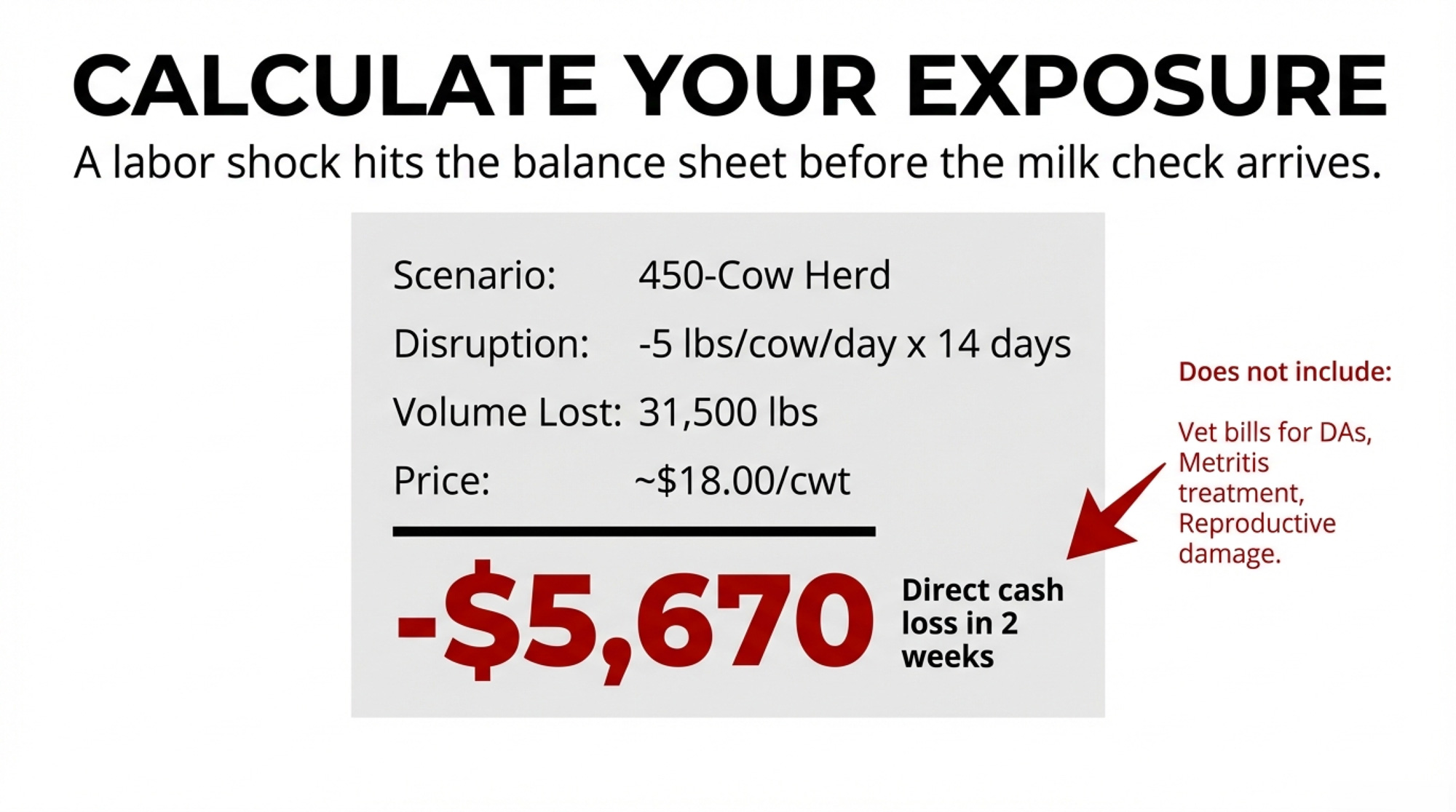
NewsSubscribe
First
Last
Consent

One ICE Raid. 35 Workers Gone. A New Mexico Dairy Learned What Community Really Means.

One ICE raid stopped a dairy cold. 35 workers gone. But it also revealed who neighbours really are.

I’ll never forget the first time someone told this story in a room full of dairy people.

It was one of those meetings where the coffee’s lukewarm, the jokes are familiar, and everyone’s half‑listening while thinking about the next milking. Then someone said, “Did you hear about the dairy in New Mexico that lost 35 workers in one morning?”

The whole room went quiet.

Every person at that table started doing their own math. What would that look like here? On our lane? With our crew?

June 4, 2025, started like any other hot, dry morning outside Lovington, New Mexico. The sky was already bright by the time cows lined up in the parlor at Outlook Dairy. Hoses hissed. Units clanked on and off. Spanish and English mixed over the noise in that familiar way you hear on a lot of larger dairies now.

Honestly, if you’d dropped in early that morning, it would’ve sounded a lot like a Tuesday on plenty of farms across North America.

By the end of the day, nothing about it felt ordinary.

Homeland Security Investigations trucks came down the lane with a search warrant. When they left, 11 workers were in custody. After an employment audit tied to their documents, owner Isaak Bos was told he had to fire 24 more on the spot. In the space of a few hours, Outlook Dairy lost 35 of 55 workers—almost two‑thirds of the people who kept that place running.

Bos later said milk production had “effectively ceased.” Every remaining person—family, office staff, whoever was available—and even some high school students on summer break were pulled into basic animal care just to keep the cows fed, watered, and milked at all. He put it plainly: “It takes 100% of the labor force, so no day is off right now. It’s detrimental for our cattle. We’re barely able to keep going.”

If you milk cows yourself, you don’t need a graph to understand that. Your stomach does the math for you.

When Everything Stops but the Cows

The thing about a dairy is simple and unforgiving: cows don’t stop just because your labor does.

In Lovington that week, all the routines that make a dairy hum were suddenly missing most of the people who knew them best. The workers who’d been there every day—many of them immigrants who had put down roots in the area—weren’t walking into the parlor, scraping alleys, or checking fresh cows anymore.

Across the U.S., that’s not a side note. It’s the reality of who actually milks the cows. A major industry survey found that foreign‑born workers make up roughly half of all dairy labor, and the farms that rely on them produce nearly 80% of the country’s milk. In barn language: without immigrant labor, most of America’s cows don’t get milked.

That’s true whether you’re pushing cows through a big New Mexico freestall, running a 200‑cow sand‑bedded herd in Wisconsin, or managing a couple of key foreign workers under Canada’s Temporary Foreign Worker Program. It doesn’t take many people to disappear before the whole system starts to wobble.

When an enforcement action hits a dairy, the headlines talk about arrests, charges, and policy. But in the farmhouse, the questions are more basic.

Who’s going to milk tonight?

Who’s going to catch the cow that’s about to crash?

Bos said Outlook went from “operating normally” to crisis mode overnight. People who normally handled phones and paperwork laced up boots and headed to the barn. Teenagers who figured they’d be doing odd jobs suddenly found themselves in the parlor or feeding calves. Production targets weren’t the priority anymore. The new goal was simple: keep the cows alive and limit their suffering until a crew could be rebuilt.

If you’ve ever had flu rip through your family, lost a key employee, or had one bad accident take the legs out from under your schedule, you know a smaller version of that scramble. You stretch days longer than they should be. You pick up one more milking. You cut corners you never wanted to cut because there just aren’t enough hands.

Lovington didn’t invent that feeling. It just pushed it about as far as it can go in a single morning.

The People Behind the Paperwork

From a distance, it’s easy to see “11 arrested, 24 fired” and think in terms of paperwork and status. Up close, those numbers are people.

On that farm, those 35 were workers who had been part of the daily rhythm for years—feeding cows, scraping alleys, watching fresh pens, raising calves. Bos has said all 35 lived locally. Their kids went to the same schools. Their families bought groceries at the same stores. They were neighbours long before a federal truck ever pulled into the yard.

Advocates in the region put it in terms many producers would recognize in their own communities: these aren’t just “workers,” they said. They’re “our neighbors, coworkers and friends,” people who have “contributed to our economy and enriched our culture” in southeastern New Mexico.

After the raid, Bos emphasized that the dairy itself wasn’t charged with wrongdoing. He said the employees had given them false documents and that the operation came without prior warning. Whatever you think about the legal side, you can hear in his words that this wasn’t just about forms to him. It was about people he knew and depended on.

He talked about the “intimidating effect” of the raid and worried that it would scare even more workers away. Any owner who’s spent years building a crew and a culture can feel that in their bones.

Immigrant-rights groups in New Mexico went even further, connecting what happened at Outlook to the broader local economy. They warned that raids like this “threaten the safety and economic well‑being of our communities,” in a region where immigrant workers are “powering industries from dairy farms to oil and gas.” They talked about how every time a worker disappears from a place like Outlook, that absence is felt not just in the barn but in the cash register at the grocery store, in the quiet tables at local restaurants, and in the small shops that count on regular customers from the dairies.

In other dairy regions, people who work closely with farmworkers have been describing the same kind of fear. In Vermont and beyond, organizations that advocate with dairy workers talk about how stepped‑up immigration enforcement has changed everyday life—workers limiting trips to town, skipping church, putting off doctor visits, avoiding school events—because every mile off the farm feels like another chance to end up in a patrol car instead of a pickup.

On paper, that shows up in policy reports and enforcement statistics. On the ground, it looks like people are shrinking their world to the few places that still feel somewhat safe, even as the workload doesn’t let up and the pressure quietly builds.

You don’t have to agree on every policy detail to see how that wears on a crew. And on the people who work alongside them.

What Happens to the Cows When Workers Disappear

Every producer knows this: concrete and steel don’t care for cows. People do.

When most of those people are suddenly gone, the barn feels it long before a reporter ever arrives. In Lovington, reports described remaining family members, non‑farm staff, and local high school students suddenly responsible for nearly everything—feeding, milking, bedding, and keeping an eye on fresh cows—under intense time pressure.

Training someone new in the parlor takes time, even under the best conditions. Getting them comfortable reading cow behavior, spotting a hot quarter, recognizing a twisted stomach before it’s obvious—that takes longer. Doing all of that while you’ve already lost most of your experienced crew and everyone left is exhausted is another thing entirely.

That’s when real risk sneaks in. Not because anyone cares less, but because biology doesn’t wait while people catch up.

Bos said the remaining workers were being “pushed…to the limit.” Most dairy families don’t need that explained. When you’re running on too little sleep, carrying too much worry, and trying to do three jobs at once, little things slip.

A cow that somehow still has a full quarter at the end of milking.

A dull‑eyed calf that should’ve been flagged an hour earlier.

A fresh cow that doesn’t get that second or third look you always meant to give her.

Those aren’t character flaws. They’re the predictable result of stripping away most of the people who knew the herd best and asking the ones who remain to do the impossible.

In Lovington, the raid didn’t just stress a business plan; it shattered it. It stressed a barn full of living animals that had no idea why familiar hands didn’t show up that day. And it stressed the people left behind—owners, spouses, kids, employees—in ways that still don’t fit neatly into any official report but linger in a house and a community long after the headlines move on.

A Town Watching and Worrying

The neighbour’s text came before sunrise for many folks that week: “Did you hear what happened at Outlook?”

At the feed mill, at the co‑op, at the school, people traded pieces of the story they’d heard. Some knew names, some just knew numbers, but everybody understood that losing most of your crew isn’t something you can quietly absorb.

Very quickly, the questions that started in kitchens and pickup trucks found their way into a public meeting in Hobbs. Governor Michelle Lujan Grisham came. So did local officials, church folks, school staff, and people who just needed to look someone in the eye and ask what came next.

In that room, nobody was talking in theories.

People wanted to know what happens to a family when a parent is suddenly detained or fired and there’s no paycheck coming in. They worried about what happens to kids when mom or dad disappears between breakfast and suppertime. They asked what kind of future local agriculture has if dairies can’t keep crews because everyone’s scared of who might show up in the yard.

School staff wondered how to support children who suddenly didn’t know where a parent was—or were afraid to talk about it. Church leaders were hearing from families who now felt too scared to come on Sunday. Small businesses felt the absence of regular customers. In a rural county where agriculture is a backbone, when a dairy loses 35 people in a day, there really isn’t anyone who doesn’t feel some part of the shock.

StakeholderAnnual Spending (lost)Immediate ImpactLong-term Risk
School District~$120k (tuition, meal programs, supplies)8–10 children withdrawn; reduced Title I funding; staff scheduling pressureLoss of enrollment revenue; fewer teachers retained
Churches~$45k (tithes, donations, event participation)Reduced attendance; families too stressed to participate; donation dropReduced community support capacity; programming cuts
Grocery Stores & Food Retail~$280k (weekly family shopping)“Regular customers vanished overnight”Delayed inventory restocking; profit margin erosion
Gas, Auto, Farm Services~$185k (fuel, repairs, feed supplements)~25% of typical weekly transactions disappearSmall businesses operate on thin margins; 1-2 months of losses threaten viability
Rental Housing~$210k (rent income for local landlords)20–25 rental units suddenly at risk of non-paymentRisk of foreclosure or property abandonment in already-fragile rural real estate market
Health Services & Pharmacy~$65k (clinic visits, prescriptions, insurance co-pays)Delayed care; non-payment of bills; language-barrier service lossClinic loses X-ray tech income; pharmacy reduces hours
Lovington Municipal Tax Base~$75k (property, sales tax from dairy wages)Immediate pressure on municipal budgetSchools, roads, emergency services underfunded; quality of life declines
  • TOTAL LOCAL ECONOMIC SHOCK (Direct) | ~$980k/year lost spending power | Cascades through 150+ local businesses | Potential long-term population decline |

Immigrant-rights groups in the area called the raid devastating. They said people were sorrowful, frustrated, and frightened. Those weren’t academic words. They came from organizers who were on the phone with families and workers, trying to make sense of what had happened.

At the same time, the wider dairy industry was circling around the story. Farm media across the country ran pieces on the Lovington raid. The Bullvine called it “a stark preview” of what happens when immigration enforcement collides with the reality of who actually milks America’s cows, noting that removing 64% of a workforce in one morning had effectively brought milk production to a halt. Others described it as an “overnight exodus” and underlined how fragile even large, well‑managed dairies are when labor is shaken that hard.

Put together, the voices from the meeting hall, advocacy groups, media, and the farm itself didn’t produce a neat narrative. They produced something closer to what real life in dairy country looks like.

Complicated. Heavy. And very human.

Not Just One Farm’s Vulnerability

It would be easy to look at Lovington and say, “That’s a New Mexico problem.” But the numbers refuse to keep it that tidy.

Demographic GroupNumber of Workers% of Workforce% of U.S. Milk Production
Foreign-Born Workers180,00051%79%
U.S.-Born Workers170,00049%21%
Total Dairy Workforce350,000100%100%

That 2015 national survey on immigrant labor—still the best wide‑angle view we have—estimated that if foreign‑born workers disappeared from U.S. dairies, roughly 7,000 farms would close and milk prices would spike. You don’t have to believe every line of a model to feel the point: the system isn’t built to handle that kind of loss.

In recent years, stepped‑up immigration enforcement hasn’t stayed in one state. Workplace and community raids in different parts of the country, including agriculture and food‑system jobs in states like Oregon and Wisconsin, have fed a constant undercurrent of anxiety in farm country. It’s not just packing plants and warehouses. It’s barns.

In places like Vermont, advocates who work closely with dairy workers have been saying the same thing over and over: fear of being stopped, detained, or deported has pushed many people into deeper isolation. Trips to church, doctor visits, school meetings, even basic shopping—things many of us take for granted—have been cut back or dropped entirely because the risk of being on the road feels too high.

For dairy owners and managers, that climate manifests in different ways. It looks like nights spent looking at the ceiling instead of sleeping, wondering if you’ll have enough hands for the first milking tomorrow. It looks like trying to support workers who are carrying their own fears while you’re also trying to keep the bank at bay and the cows on feed.

It shows up in the lives of farm spouses who balance payroll, kids’ schedules, and the unspoken emotional load of keeping the whole operation from flying apart. It shows up in teenagers who are suddenly taking on more barn work because there isn’t anybody else, watching the adults around them carry stress that’s hard to explain.

Lovington didn’t create that pressure. It just gave everyone a sharper, more public picture of what so many dairy communities have been quietly living with for years.

When Neighbours Became Family

The moment that sticks with a lot of people in stories like this isn’t always the raid itself. It’s what comes after, when the shock wears off, and the sheer amount of work left to do settles on the people who are still standing in the yard.

Standing in the milk house after a day like that, it would be easy to feel alone. The pipeline’s still humming. Cows still need to be fed. The phone won’t stop buzzing. You’re tired enough that the thought of asking for help feels like just one more job.

And then, in a lot of dairy communities, something small but important happens.

A text comes in from down the road: “How bad is it?”

At the feed mill, somebody says, “I heard what happened. Are they okay for help?” A nutritionist or vet decides to swing by sooner than planned. A friend at the co‑op quietly asks if there’s anything the board can do to give a bit of breathing room.

Sometimes it’s as simple as a kid asking their parents if they can go help at the other farm instead of scrolling on their phone that afternoon. On some roads, a teenager showing up to scrape alleys or bed a few pens has been the difference between a barn barely hanging on and a barn where people get to lie down for a couple of hours.

In many dairy communities, when a farm is hit with a fire, a serious illness, a bad accident—or an enforcement action like the one in Lovington—you see familiar patterns:

A neighbour swinging over after their own chores to ask what’s really needed.

A ride into town for someone who doesn’t feel safe driving alone.

A quiet envelope slipped into a hand outside the church because someone heard a family lost their income.

A plate of food left at the back door with the same simple line people have used for generations: “We made too much. Thought you might help us out.”

Most of those acts never see a camera. They don’t end up on Facebook. They don’t make a line in any official report. But for people living through the hardest days of their lives, those moments change how they see their neighbours.

Not as “the guy who runs that place down the road,” but as someone who refused to let them fall alone.

What This Story Asks of the Rest of Us

What moved a lot of people most about Lovington wasn’t just the shock of the raid. It was being forced to look straight at how dependent we’ve all become on workers who carry a lot of risk and not much protection—and at how much we lean on each other, often without saying it out loud.

Sitting at your own kitchen table, you might be thinking, “All right, but what am I supposed to do with this? I’ve got my own headaches.”

That’s fair. Nobody needs one more heavy thing to carry.

Maybe the question isn’t “How do we fix immigration policy?” Maybe it’s smaller and closer to home:

Who do we really depend on here?

Who might depend on us?

On most dairies, there’s at least one person whose cow sense you can’t imagine losing. They might be family. They might be a long‑term employee. They might be the worker who doesn’t speak much in meetings but notices every limp and every change in feed intake. Naming that out loud—and finding ways to show them they matter as a person, not just a set of hands—won’t change federal law. But it might change whether they feel alone when things get hard.

There’s also usually at least one neighbour, advisor, or friend you’d call on your worst day. If you can picture who that is, that relationship is worth investing in now, not someday.

Over supper or during a drive to pick up parts, it might be as simple as saying, “If we ever got hit with something like that New Mexico raid, you’d be one of the first people I’d call. I hope you know that.” And maybe adding, “If anything ever explodes on your place, I hope you’ll call us too.”

Sometimes the bravest thing isn’t staying strong. It’s admitting that if you lost half your crew overnight, you couldn’t do it alone.

Other small things matter more than they look like on a calendar:

Saying yes when the 4‑H leader wants to bring kids through the barn, because those kids might be your next crew—or your next neighbours.

Stopping by a meeting at the co‑op or county when you’re bone‑tired, because being there helps keep agriculture on the agenda.

Checking in on the people who carry the invisible load: the spouse who handles payroll and crisis calls, the teenager who suddenly became the extra hired hand, the worker who hasn’t left the farm in weeks.

And if Lovington has you thinking not just about barns but about the bigger picture, there’s one more step that matters. The same way you’d call a neighbour when the barn is in trouble, you can also let your local representatives know what raids like this look like from your yard. A simple, honest conversation—”Here’s who milks our cows, here’s what happens to our town when those people disappear overnight, and here’s why we need policies that keep both our herds and our communities stable”—isn’t about party lines. It’s about making sure the people writing the rules understand the human and economic reality they’re reaching into.

None of this fixes the whole system. But it does change the way it feels to live in it.

Community & Legacy: What We Build Before the Storm

Lovington is still living with what happened on that June morning. Outlook Dairy has been working to rebuild and get back to something resembling normal. Some legal and immigration cases tied to raids like that can drag on for years. Others end quickly with families separated and people gone before anyone’s ready.

The cameras left a long time ago. The day‑to‑day reality hasn’t.

For dairy people watching from a distance, the story lingers in a different way.

Every time someone mentions losing a chunk of their crew, those numbers in New Mexico—35 out of 55—come back to mind. Every time a producer talks about how much they rely on their immigrant workers, someone remembers Bos’s line: “It’s detrimental for our cattle. We’re barely able to keep going.” Every time a policy discussion treats enforcement like a clean, abstract lever, someone thinks of a parlor that went quiet for all the wrong reasons.

What happened in New Mexico didn’t create the bond between cows, workers, families, and neighbours. It revealed it—and showed how fragile that bond really is when something hits it hard.

The heart of this story isn’t that one farm had a terrible week and made the news. It’s that dairy communities everywhere are quietly being asked the same question Lovington had to face out loud:

When the barn feels empty, and the work looks impossible, will we let each other face it alone?

Most of us can’t choose if or when the next storm hits our lane. It might be enforcement. It might be a barn fire. It might be a health crisis, a brutal price year, or something nobody saw coming.

What we can choose—day in, day out, in a hundred small ways—is what kind of community we’re building long before the sirens ever show up.

The kind where it’s every farm for itself?

Or the kind where, when the worst happens, somebody already has their boots on, their truck running, and their mind made up—not because anyone called a meeting, but because that’s just what neighbours do here.

That decision doesn’t belong to policymakers, reporters, or anyone far away.

It belongs to us.

And if there’s one thing Outlook Dairy’s hardest week made hard to ignore, it’s that the time to make that decision isn’t when the lights are already flashing in the lane.

It’s now.

KEY TAKEAWAYS

  • One raid. One morning. Everything stopped. An ICE action at Outlook Dairy in New Mexico removed 35 of 55 workers—production halted, and everyone left was pulled into survival mode.
  • The math is brutal. Immigrant workers provide 51% of U.S. dairy labor and 79% of the milk. NMPF warns that losing them could close 7,000+ farms and nearly double retail prices.
  • Community didn’t ask permission. Neighbors, local teens, churches, and small businesses showed up with hands, rides, and quiet help—no politics, just presence.
  • This is your question now: If half your crew vanished tomorrow, who shows up before you call? And whose call would you answer?
  • Policy starts at your kitchen table. The people milking your cows have names, kids in local schools, and lives in your community. When you talk to representatives, remember that.

EXECUTIVE SUMMARY

When an ICE raid hit Outlook Dairy in Lovington, New Mexico, on a June morning in 2025, 35 of 55 workers were suddenly gone, milk production “had effectively ceased,” and everyone left—family, office staff, even local teens—was pulled into basic cow care just to keep the herd going. The article treats those 35 as people, not paperwork, tracing how their disappearance shook the barn and the wider town—schools, churches, grocery aisles, and small businesses that depend on dairy paycheques. It ties that one awful morning to the bigger reality that immigrant workers now provide roughly 51% of U.S. dairy labour and 79% of its milk, with NMPF modelling warning that losing them could close over 7,000 farms and nearly double retail milk prices. Against that backdrop, the heart of the story is the quiet, practical ways neighbours and community leaders show up—extra hands in the parlor, rides into town, support at church and school, and hard conversations in a Hobbs town hall—so one farm isn’t left to carry the crisis alone. It ends back at the kitchen table, asking every producer to name who they’d call if half their crew vanished, who might call them, and what to ask local representatives so the people who actually milk the cows—and the communities built around them—aren’t invisible when the next raid comes.

Complete references and supporting documentation are available upon request by contacting the editorial team at editor@thebullvine.com.

Continue the Story

The Sunday Read Dairy Professionals Don’t Skip.

Every week, thousands of producers, breeders, and industry insiders open Bullvine Weekly for genetics insights, market shifts, and profit strategies they won’t find anywhere else. One email. Five minutes. Smarter decisions all week.
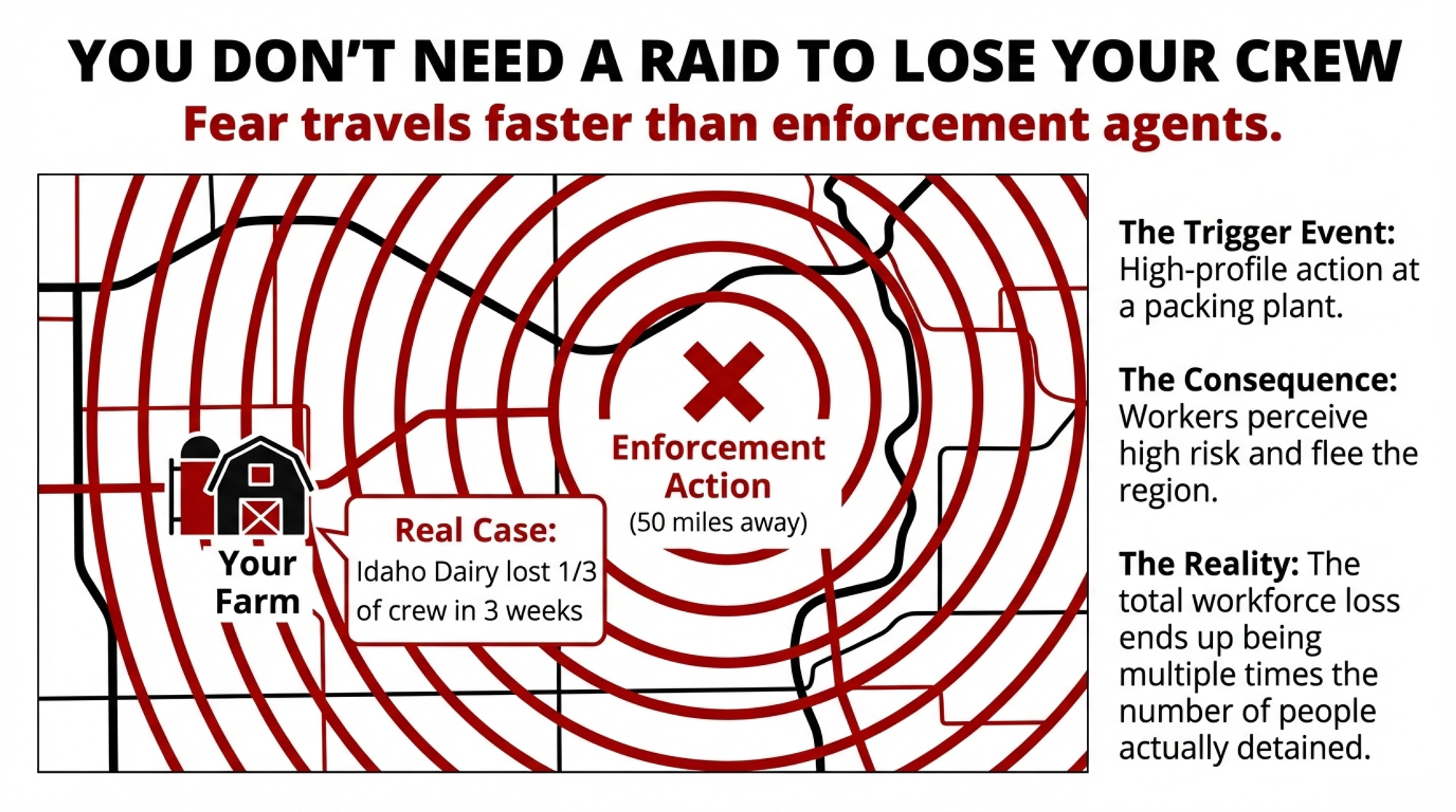
NewsSubscribe
First
Last
Consent

Are We Headed for a Farm Crisis? Land O’Lakes CEO Sounds the Alarm on Trump Policies

Trump’s policies could gut your dairy workforce and crush your exports. Land O’Lakes CEO Beth Ford isn’t sugar-coating what’s coming. Are you ready?

EXECUTIVE SUMMARY: Beth Ford is sounding the alarm that should wake up every dairy producer in America – Trump’s immigration crackdown and tariff wars threaten to simultaneously cut off your labor supply and cripple your export markets. With immigrants making up half of all farm workers and dairy particularly dependent on foreign-born labor, her warning that immigration reform is “critical” couldn’t be more timely. The situation’s getting worse as Canada has already announced 25% retaliatory tariffs on U.S. dairy products, threatening the $8.22 billion export market that’s keeping many operations afloat. Let’s face it – between labor shortages, market disruptions, and already-thin margins, dairy farmers face what Ford calls a “real concern” that demands immediate contingency planning.

KEY TAKEAWAYS

  • Labor crisis looms: Immigrants comprise roughly half of America’s farm workforce, with dairy even more dependent on foreign-born workers. Unlike seasonal crops, your year-round operation can’t use H-2A temporary visas, leaving you especially vulnerable to immigration restrictions.
  • Export markets under attack: Canada’s 25% retaliatory tariffs on U.S. dairy are just the beginning. Mexico and China – which collectively purchase over half of all U.S. dairy exports – could follow suit, potentially repeating the $2.6 billion in lost revenues dairy farmers suffered during previous trade disputes.
  • Profit margins squeezed from both sides: You’re already operating on thin margins with depressed commodity prices. Now you’re facing increased labor costs (if you can find workers at all) while simultaneously losing access to critical export markets that have been keeping many operations afloat.
  • Urgent action needed: Develop contingency plans immediately for both labor shortages and export disruptions. Can your operation survive if immigrant labor becomes unavailable or if key export markets close? The time to prepare alternative strategies is now, not when the crisis fully hits.
Dairy labor crisis, Trump immigration policies, farm export tariffs, Beth Ford, dairy workforce shortages
Land O'Lakes, Inc. Employee Beth Ford (PRNewsFoto/Land O'Lakes, Inc.)

Beth Ford isn’t mincing words: Trump’s immigration clampdown and tariff wars could wreck your dairy operation and crush our export markets. And let’s face it, farmers are already stretched thin.

Land O’Lakes CEO Beth Ford didn’t pull any punches last week when she warned that Trump’s policies on immigration and trade are raising “real concern” across America’s farm country. On April 24, she pointed out that while many farmers back the President’s economic vision, his current policies threaten to cut off your labor supply and export markets. Can your dairy operation survive that one-two punch when you’re already scraping by on thin margins?

“What needs to be recognized is the necessity that farmers have labor available,” Ford stated bluntly. “Immigration reform, broadly, is critical.”

LABOR CRISIS HITS WHERE IT HURTS

Let’s face it: the numbers tell a troubling story about your dairy operation. Immigrants comprise roughly half of America’s farm workforce, and dairy farms depend even more heavily on foreign-born workers. Haven’t we built our entire industry on this labor force? This dependence has created a vulnerability that quickly became a full-blown crisis for many operations.

“The first thing they talk to me about is labor, immigration, and the lack of available labor for their farms,” Ford noted, referring to her regular conversations with farmers across rural America.

For you dairy farmers, the situation’s especially dire. Unlike seasonal crops that can tap into H-2A temporary worker visas, your year-round labor needs leave you with few legal options for securing reliable workers. How are you supposed to milk cows twice daily with no consistent workforce?

YOUR EXPORT MARKETS UNDER FIRE

Beyond the labor headache, Ford worries about how these tariffs will reshape your trade landscape, particularly by 2026. Her alarm bells are ringing as the administration slaps significant duties on goods from America’s largest trading partners – including countries that buy tons of your dairy products.

Recent tariffs have already triggered payback. Canada’s announced 25% levies on U.S. dairy products, including yogurt and buttermilk, while Mexico and China – also major buyers of your products – may follow suit. Did anyone think these countries wouldn’t hit back where it hurts most?

“The key export market for corn is Mexico. So you can understand these trade arrangements are critical for the profitability of the American farmer,” Ford emphasized.

WHAT THIS MEANS FOR YOUR BOTTOM LINE

This perfect storm of labor shortages and market disruptions couldn’t come at a worse time for dairy producers. Commodity prices have tanked in recent years, leaving many of you struggling to generate profit. When was the last time you saw decent margins?

You’re increasingly dependent on export markets – U.S. dairy shipped out $8.22 billion in products in 2024 alone. Mexico, Canada, and China collectively buy over half of our dairy exports by value. Can your operation afford to lose these crucial markets?

We’ve seen this movie before, and it doesn’t have a happy ending – previous retaliatory tariffs from China cost U.S. dairy farms a staggering $2.6 billion in lost revenues from 2019 to 2021.

THE ECONOMIC REALITY CHECK

“I am most worried about 2026 and how duties will reshape the trade landscape,” Ford stated. This timeline gives you almost no runway to adapt to potentially massive market shifts.

The H-2A program limitations continue to frustrate the heck out of dairy producers. While other ag sectors have boosted their use of this program by 65% in just five years, you dairy farmers can’t tap into this labor source because cows don’t take seasonal breaks. Who designed a system that completely ignores the year-round reality of milk production?

Industry analysts warn even tiny market hiccups could wallop your bottom line. “Only small changes can have large impacts on price. Producers are well advised to brace for the disruption that these tariffs will likely create,” noted Mike North, president of Ever.Ag.

RURAL AMERICA DESERVES BETTER

Ford’s advocacy highlights how much rural America punches above its weight. “I like to mention that 18% to 19% of the population lives in rural America, and they comprise 47% to 48% of the military,” she said, underscoring your patriotic service that makes these policy threats particularly galling. Doesn’t rural America deserve better than this?

She’s consistently championed rural development and ag research as national security matters. Ford argues U.S. spending on agricultural research remains “at 1970s levels” while competitors like China pour money into research. Are we trying to compete in 2025 with research budgets from fifty years ago?

Without policy changes, you’re stuck with the impossible task of keeping production going with fewer workers while navigating increasingly hostile export markets. How’s that supposed to work?

THE BOTTOM LINE

As trade tensions and immigration policies evolve, you’d better prepare for disruptions. Sure, industry organizations have urged dialogue rather than escalation, but let’s face it – you need contingency plans for labor shortages and export challenges. What’s your Plan B if workers disappear or export tanks?

The International Dairy Foods Association summed up the situation: “We know the Administration understands that robust market access to Canada, Mexico, and China, three largest trading partners, is critical to the future of U.S. dairy, and we remain hopeful that the President and his Administration do everything in their power to ensure the tariffs avoid unintended impacts on our dairy farmers and processors.”

For American dairy farmers, these policy decisions won’t affect their profits – they might determine whether they survive the challenging years ahead. Isn’t it time we demanded policies that help rather than hurt our industry?

Learn more:

Join the Revolution!

Join over 30,000 successful dairy professionals who rely on Bullvine Daily for their competitive edge. Delivered directly to your inbox each week, our exclusive industry insights help you make smarter decisions while saving precious hours every week. Never miss critical updates on milk production trends, breakthrough technologies, and profit-boosting strategies that top producers are already implementing. Subscribe now to transform your dairy operation’s efficiency and profitability—your future success is just one click away.

NewsSubscribe
First
Last
Consent

Send this to a friend