Archive for dairy heat stress

The Heat Reality That’s Crushing Your Milk Check: Why Smart Producers Are Fighting Back (And Actually Winning)

Farmers losing up to 10% milk yield during heat—are you tracking your losses?

You know what really caught my attention the other day? I was walking through this 1,200-cow operation just outside Eau Claire—beautiful setup, really well-managed—and the producer mentioned how his morning milk weights had been bouncing around like corn futures this summer. Come to find out, according to recent research published in Science Advances, operations are seeing up to 10% daily production losses during extreme heat events… and like most producers I work with, this guy had absolutely no clue it was happening.

After spending the better part of two decades tramping through dairy barns from the Fraser Valley clear down to Tulare County, I’ve watched this heat stress pattern absolutely devastate more operations than volatile milk prices ever have. And yet… here we are, still talking about heat stress like it’s some minor seasonal hiccup that’ll sort itself out come October.
The Problem That’s Actually Keeping You Up at Night

The thing is—and this really gets to me—you’ve noticed it, haven’t you? Those brutal July afternoons when even your best fresh cows barely drag themselves to the parlor, moving through heat so thick you could practically swim through it. Your butterfat numbers are sliding south faster than a green heifer heading for the fence, your feed costs are climbing like corn futures during a drought, and you’re starting to wonder if this is just our new reality.

But climate change isn’t some distant threat that might hit your kids’ operation someday. According to recent work from the University of Wisconsin’s dairy science department, it’s absolutely hammering your bottom line right now—cow by cow, gallon by gallon. And honestly? Most of us in the industry have been too busy putting out daily fires to really sit down and quantify what this is actually costing us.

What really gets me is how we’ve just… normalized these losses. “Oh, it’s just summer,” we tell ourselves. “Production always drops in July.” But when you actually start crunching the numbers—and I mean really digging into them—well, you might want to grab a chair for this part.

The frustrating reality is that we’re treating a manageable problem like it’s an act of God. But producers who’ve figured this out? They’re not just surviving the heat anymore—they’re using it as their competitive advantage.

The Complete Economic Devastation (And It’s Worse Than You Think)

The scope of heat stress damage is honestly staggering when you break it down piece by piece. When that Temperature-Humidity Index climbs above 68, your herd’s milk production drops by up to 14%. That’s not some theoretical number from a climate-controlled university facility—that’s real-world data from operations just like yours.

Think about this for a second. On a 500-cow dairy averaging 80 pounds per cow per day, you’re hemorrhaging 5,600 pounds of milk daily during heat stress periods. At current Class I prices of $18.82 per hundredweight, that’s $1,057 walking straight out of your bulk tank every single day.

The Invisible Killer: Transgenerational Losses
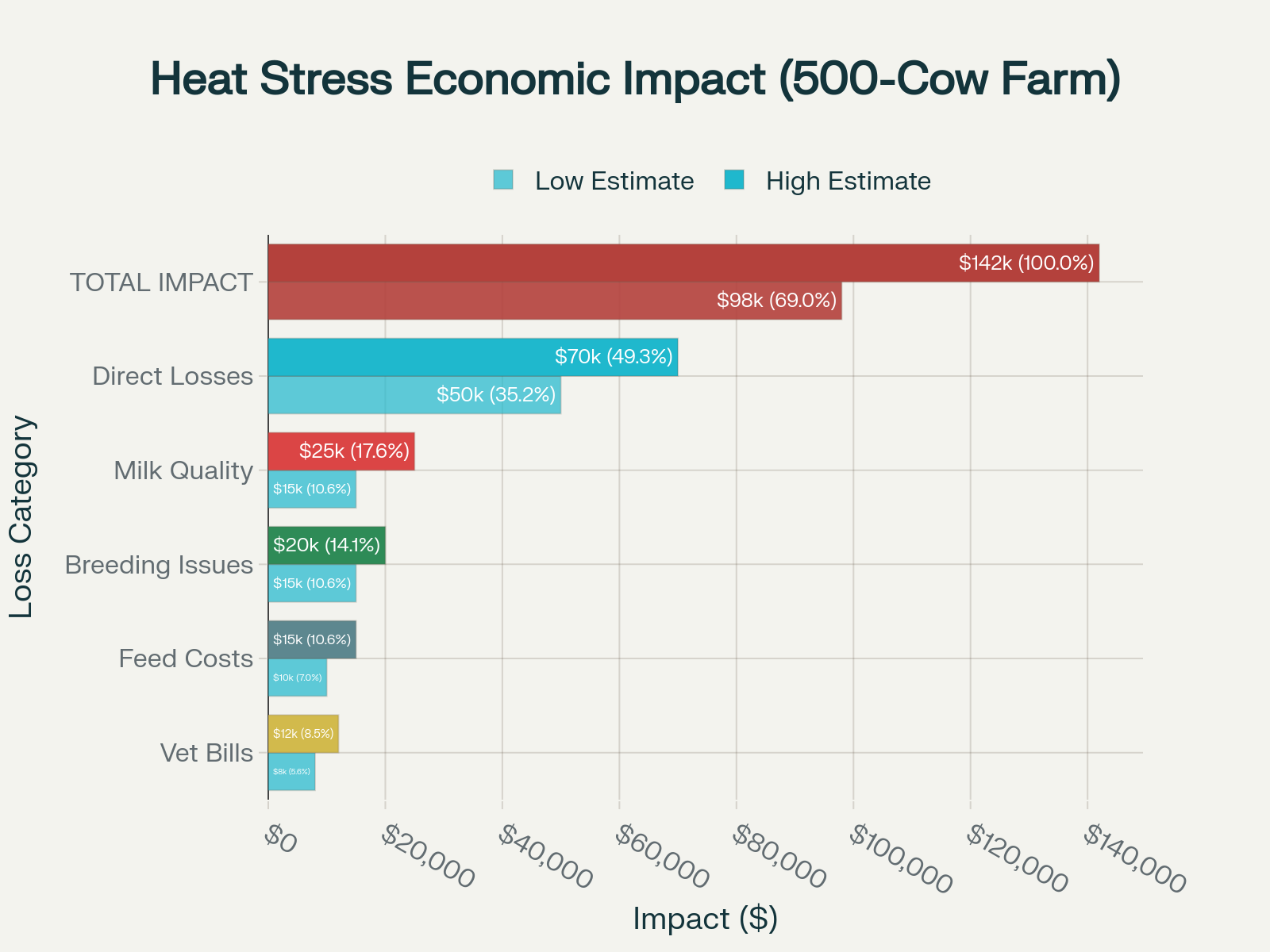
Annual Heat Stress Impact: Complete Financial Breakdown for 500-Cow Dairy Operation

But here’s what really gets me fired up—the most devastating part happens before you even realize there’s a problem. Recent studies show that heat-stressed dry cows produce significantly less milk during their entire next lactation—we’re talking substantial reductions that compound over months.

Let that sink in for a minute. The heat stress your cows are dealing with today is literally stealing milk from you for the next ten months. For a 500-cow operation, that transgenerational impact can represent enormous losses in annual production. One producer I know in Lancaster County didn’t connect these dots until his nutritionist showed him the data—his July heat stress was costing him milk clear through the following spring.

And it gets worse. Heat-stressed cows don’t just produce less milk—they produce garbage-quality milk. Butterfat percentages tank. Protein content falls off a cliff. Somatic cell counts climb like they’re trying to reach orbit. Your component premiums? Gone, right when you need them most.

What’s particularly troubling is how this creates a vicious cycle. The physiological toll goes way beyond just production numbers. Recent research shows that heat-stressed cows experience reduced feed intake, fertility rates that drop significantly, and immune function that just falls apart.
When Your Breeding Program Completely Implodes

This might surprise you, but heat stress during breeding season actually costs more than heat stress during lactation. I’ve seen this firsthand on operations from Pennsylvania to California—the breeding program basically shuts down from July through September.

When core body temperature rises just 1.5°F above normal, conception rates drop by 20-25%. For a 500-cow dairy, that’s an extra 25-30 cows that need to be bred again, stretching your calving interval and sending your replacement costs through the roof.

Even worse? Cows bred during heat stress that do conceive are 2.5 times more likely to lose their pregnancies in the first 90 days. At an estimated cost of around $185 per failed pregnancy—and that’s including semen costs, labor, lost genetic progress, and extended calving intervals—this breeding disruption alone can cost operations substantial money annually.

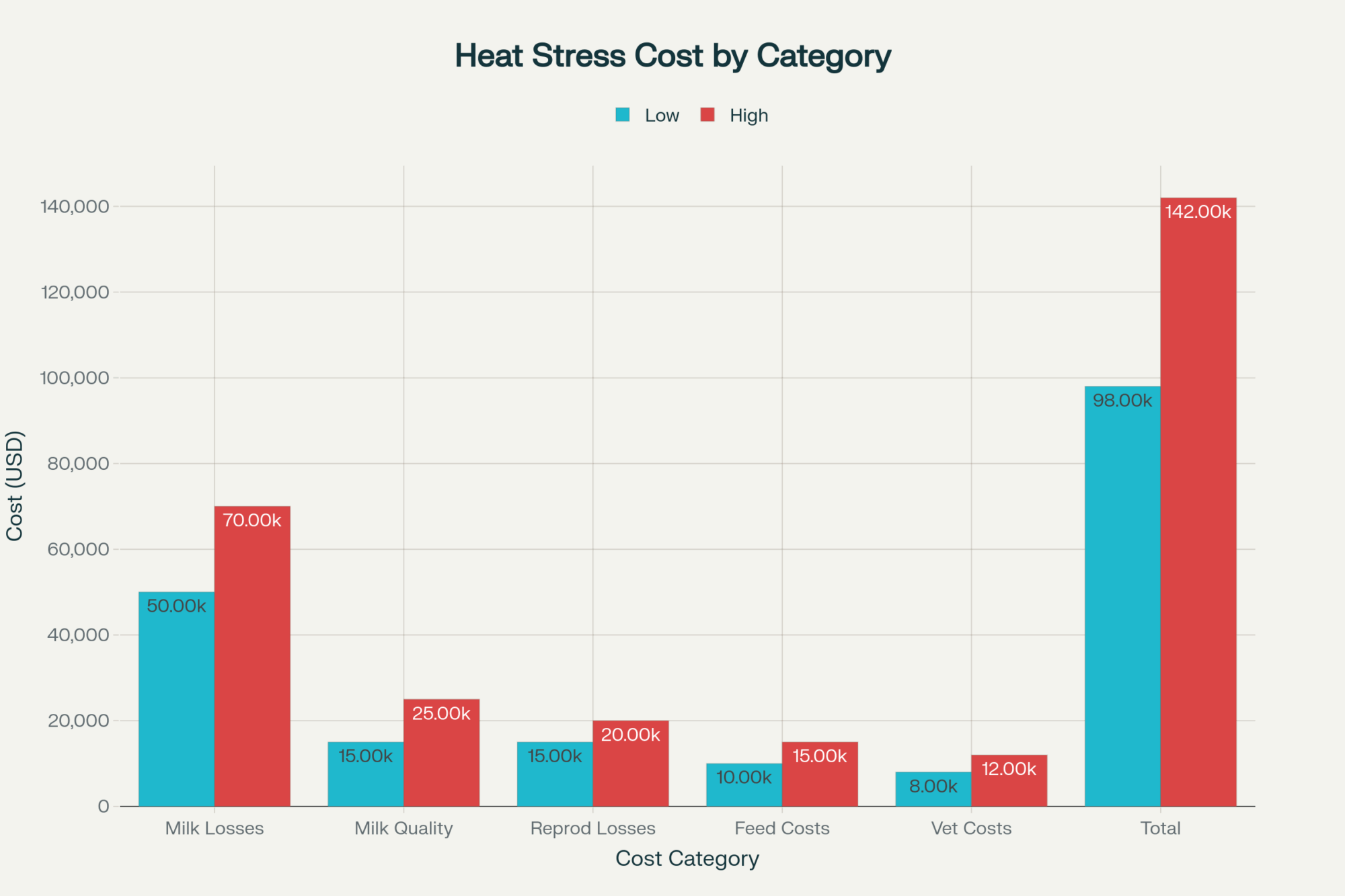
Here’s what the complete financial picture looks like… and honestly, when I first ran these numbers, I had to double-check them:

Heat Stress Impact Analysis – 500 Cow OperationAnnual Cost Range
Direct Production Losses (90 days)$50,000 – $70,000
Reduced Milk Quality/Components$15,000 – $25,000
Breeding Program Disruption$15,000 – $20,000
Increased Feed Costs$10,000 – $15,000
Higher Veterinary Bills$8,000 – $12,000
Total Annual Impact$98,000 – $142,000

Conservative estimates based on current research and market conditions

When you see it laid out like that… it’s pretty sobering, isn’t it? That’s nearly $300 per cow annually just evaporating into thin air.

The Revolution That’s Already Happening (And Why You’re Missing It)

But here’s where things get really interesting—progressive producers are fighting back, and they’re absolutely winning. They’re using a combination of proven strategies that are reducing heat stress losses by 30% or more, which can translate to substantial recovered revenue per cow annually.

These aren’t pie-in-the-sky experimental techniques or expensive toys that look impressive at World Dairy Expo. They’re practical, profitable solutions that pencil out from day one. What strikes me about successful heat stress management is how it’s become this incredible competitive differentiator. The farms implementing comprehensive programs aren’t just surviving the heat—they’re using it as an opportunity to absolutely dominate their neighbors.

I was just talking to a producer outside Lancaster last month, and he told me his heat stress management system has become his secret weapon. While his neighbors are struggling through summer slumps—some seeing 25-30% production drops—he’s maintaining close to 90% of peak production clear through August. That’s the kind of advantage that changes everything about your operation’s economics.

The fascinating part? Most of these solutions pay for themselves in months, not years. But the competitive advantage lasts for decades.
The Technology Revolution That’s Actually Changing the Game

What’s happening in cooling technology right now is absolutely fascinating. While some producers are still hoping for cooler summers (and good luck with that strategy), the smart money is investing in precision cooling systems that are delivering immediate ROI.

Beyond Basic Fans: The Real Cooling Revolution

Forget everything you thought you knew about keeping cows cool. I’m talking about moving way past those old tunnel ventilation systems that basically just moved hot air around like some kind of convection oven nightmare.

Today’s most successful operations are using variable-speed ventilation systems with automated controls that adjust fan speeds based on real-time temperature, humidity, and even wind direction data. These systems don’t just move air—they create actual microclimates that can reduce effective temperature substantially.

And here’s what I love about them: they’re smart enough to ramp up before conditions get critical, not after your cows are already panting like they’ve been chased by a bull. The predictive capability is what separates these systems from the old “set it and forget it” approach.

I visited this 2,200-cow operation in Lancaster County last month where they retrofitted their freestall barns with smart ventilation for about $45 per cow. The system paid for itself in under three months through improved milk production and reduced feed waste. Under three months! The manager told me they’re now looking at expanding to their heifer facilities because the ROI is so compelling.

What’s particularly noteworthy is how these systems integrate with existing infrastructure. You don’t need to tear down your barns and start over—though I’ll admit, some of the new construction I’m seeing incorporates heat stress management from the ground up, and it’s pretty impressive.

Progressive producers are also installing high-volume, low-pressure soaking systems that completely wet cows’ backs and necks during those crucial 20-30 minutes they spend waiting to be milked. The science is absolutely solid on this: evaporative cooling from soaking can reduce core body temperature significantly in just minutes.

That’s literally the difference between a cow that recovers overnight and one that carries heat stress forward for days. The cost? About $15 per cow for the entire system installation. Compare that to the substantial annual losses from heat stress, and you can see why this pencils out pretty quickly.

Feed Timing: The Zero-Dollar Solution That’s Actually Brilliant

Sometimes the most powerful solutions don’t require writing a check to the equipment dealer. Shifting feeding schedules to provide the majority of daily ration between 8 PM and 6 AM allows cows to consume peak nutrients during their coolest hours, when metabolic heat production is at its lowest.

Farms using strategic feed timing are seeing measurable improvements in feed efficiency during heat stress periods. On a 500-cow dairy, that translates to saving substantial amounts of feed per cow per day—money that adds up quickly, especially with current feed costs.

The challenge? Getting your crew to adjust their schedules. But trust me, the payoff is worth the initial grumbling. One operation I work with in central Wisconsin saw their feed efficiency improve so dramatically that they actually reduced their TMR tonnage by 8% during the summer months. Their feed costs dropped $12,000 just from timing changes.

Here’s the thing though—timing isn’t everything. You’ve got to balance nutrient delivery with cow comfort, and that means really understanding how heat stress messes with rumen function. The rumen actually generates substantial heat during digestion, so strategic feeding becomes critical for managing total heat load.

The Genetics Game-Changer That’s Actually Here Now

While environmental modifications help existing cows cope with heat, the real revolution is happening in the breeding pen. And this development is fascinating from a long-term profitability perspective.

The SLICK Gene: Nature’s Air Conditioning System

You’ve probably heard whispers about the SLICK gene around the coffee shop or at breed meetings, but let me tell you what you actually need to know: cattle carrying this gene maintain significantly lower body temperatures than conventional cattle under identical heat stress conditions.

They’re not just surviving hot weather—they’re absolutely thriving in it. Recent research from LIC shows that SLICK carriers maintain 0.5-1.0°C lower rumen temperatures when THI exceeds 73, which translates to substantially better performance during heat stress periods.

The production advantages alone justify the slightly higher semen costs, which typically run about $5-8 more per unit. I’ve seen operations in Texas and Florida where the SLICK-influenced heifers are literally carrying the herd through the summer months. One 800-cow dairy outside San Antonio told me their SLICK-influenced heifers maintained significantly better production during this absolutely brutal heat wave last July.

What’s fascinating is how quickly this genetic tool has moved from research to practical application. Three years ago, finding SLICK genetics was nearly impossible. Now you can get it from multiple sources—the innovation cycle in dairy genetics right now is just incredible.

The really exciting part? This trait stacks with conventional production genetics. You’re not sacrificing milk production to get heat tolerance—you’re adding heat tolerance to high-producing genetics.

Genomic Selection for Heat Tolerance (Finally Getting Real)

The major AI companies aren’t just talking about heat tolerance anymore—they’re actually delivering it. Holstein and Jersey sires now carry genomic breeding values for heat stress performance, allowing you to integrate thermotolerance into your existing breeding program without sacrificing production genetics.

Early adopters are seeing real results. Heifers sired by heat-tolerant bulls are showing measurably better heat stress performance than their contemporaries, with the advantage becoming more pronounced as temperatures rise.

This is one of those improvements that compounds over generations—your future herd will thank you for the decisions you make today. The innovation cycle in dairy genetics right now is absolutely incredible, with genetic companies responding to market demand faster than I’ve ever seen.

What’s interesting is how heat tolerance is being incorporated into broader breeding strategies. It’s not just about surviving summer anymore—it’s about maintaining production consistency year-round. Some of the most progressive operations are seeing 10-15% less seasonal variation in their milk production.

The Feed and Water Revolution (Finally Getting the Basics Right)

Precision Nutrition: Actually Feeding for the Heat

Your nutritionist has probably mentioned heat stress rations, but here’s what most producers don’t realize: heat-stressed cows have significantly increased protein requirements to maintain milk production. The old conventional wisdom about reducing protein during heat stress is actually making the problem worse.

Recent research from Penn State’s dairy nutrition program shows that heat-stressed cows require additional bypass protein to compensate for reduced dry matter intake. With corn futures for July 2025 looking more favorable at $3.94 to $4.80 per bushel, feed costs are expected to ease somewhat, providing more flexibility for precision nutrition strategies.

Advanced cooling systems combined with precision heat stress rations are delivering substantially better feed efficiency compared to farms using only environmental modifications. The secret? Balancing amino acid profiles for increased metabolic efficiency while providing additional nutrients to compensate for reduced intake.

Here’s how the different approaches stack up in practice—and these numbers might surprise you:

Heat Stress Feeding StrategiesTraditionalPrecisionPerformance Advantage
Protein ManagementReduce 12-14%Increase bypass protein+8-12% production
Mineral ProgramStandard packageEnhanced electrolytes+5-8% water intake
Feeding ScheduleFixed timingStrategic (60% nighttime)+3-5% efficiency
Vitamin SupportGeneric supplementationTargeted antioxidantsBetter immune function

Based on documented performance differences in research trials

What’s particularly noteworthy is how precision nutrition affects the entire system. Better nutrition during heat stress doesn’t just maintain current production—it sets up cows for better performance post-heat stress.

Water: The Overlooked Profit Center

Here’s something that’ll absolutely blow your mind: lactating cows in heat stress require substantially more water than the same cows under thermoneutral conditions. We’re talking about massive increases in water consumption that most operations aren’t prepared for.

Most operations I visit are way behind on water infrastructure. Farms installing high-flow water systems with multiple water points per 100 cows are seeing significant improvements in heat stress recovery. The investment? About $25 per cow. The return? Improved milk yield persistence worth $150-200 per cow annually.

But here’s the thing—water quality matters just as much as quantity. Heat-stressed cows become incredibly picky about water palatability, and poor water quality can compound intake problems. I’ve seen operations where simply cleaning water lines and improving flow rates resulted in measurable improvements in heat stress performance.

What’s particularly interesting is how water intake patterns change during heat stress. Cows will drink a substantial portion of their daily water intake in the four hours following milking, so having adequate capacity at water points becomes absolutely critical. Some operations are installing dedicated post-milking water stations just to handle this surge demand.

The water temperature factor is huge too. Cows prefer water temperatures between 60-70°F, but during heat stress, they’ll take anything cool they can get. I’ve seen operations install water chillers for drinking water… sounds expensive, but when you’re losing $1,000+ daily to heat stress, a $15,000 water chiller starts looking pretty reasonable.

The Monitoring Revolution (Data That Actually Matters)

Real-Time Data: Your Crystal Ball for Heat Stress

The most successful heat stress management isn’t reactive—it’s predictive. Advanced monitoring systems using wearable sensors and environmental data are giving producers 12-24 hours advance warning of heat stress conditions.

These systems track rumination patterns, activity levels, and body temperature continuously, allowing you to implement cooling strategies before cows show visible signs of heat stress. Early intervention is everything—cows that receive cooling intervention before their core temperature rises show substantially better recovery rates.

I’ve seen operations where the monitoring system alerts the manager via text message when conditions are about to turn critical. That’s the kind of technology that actually pays for itself… and then keeps paying. One operation in California told me their monitoring system prevented $40,000 in heat stress losses last summer just by giving them advance warning to implement additional cooling protocols.

The data these systems generate is fascinating. You start seeing patterns you never noticed before—like how individual cows respond differently to heat stress, or how certain pen locations consistently show higher stress indicators.

The Low-Cost Solution That Actually Works

You don’t need to invest in expensive monitoring systems to improve your heat stress management. Simple changes like providing adequate shade per cow and ensuring water access within reasonable distances are delivering measurable improvements in heat stress performance.

Progressive producers are tracking daily water consumption, feed refusal rates, and milk temperature as early indicators of heat stress. When water consumption increases significantly above normal, it’s time to implement enhanced cooling protocols—before milk production drops.

Sometimes the best monitoring system is still an experienced eye and good record-keeping. One producer I work with in the Central Valley tracks water meter readings every morning and evening. When usage spikes substantially above normal, he knows he’s got exactly 24 hours to implement additional cooling before production starts sliding.

The milk temperature monitoring is particularly clever—when bulk tank temperatures start creeping up despite proper cooling, it often indicates cows are experiencing heat stress. It’s like having a real-time heat stress indicator right in your milk house.

The Economic Reality Check (The Numbers Don’t Lie)

ROI That Actually Changes Everything

Comprehensive heat stress management systems are delivering 3:1 to 5:1 ROI in the first year. Farms investing around $100 per cow in heat stress mitigation are seeing $300-500 in improved performance annually.

And here’s the best part—these improvements compound over time. Heat stress management isn’t just about surviving this summer. It’s about building resilience that pays dividends for years to come. I’ve seen operations where the heat stress management system becomes their competitive advantage, allowing them to maintain production while their neighbors struggle.

What’s really exciting is how the ROI improves over time. First-year returns are impressive, but by year three or four, these systems are often delivering 7:1 or 8:1 returns as operators fine-tune their protocols and expand successful strategies.

Implementation Investment Timeline
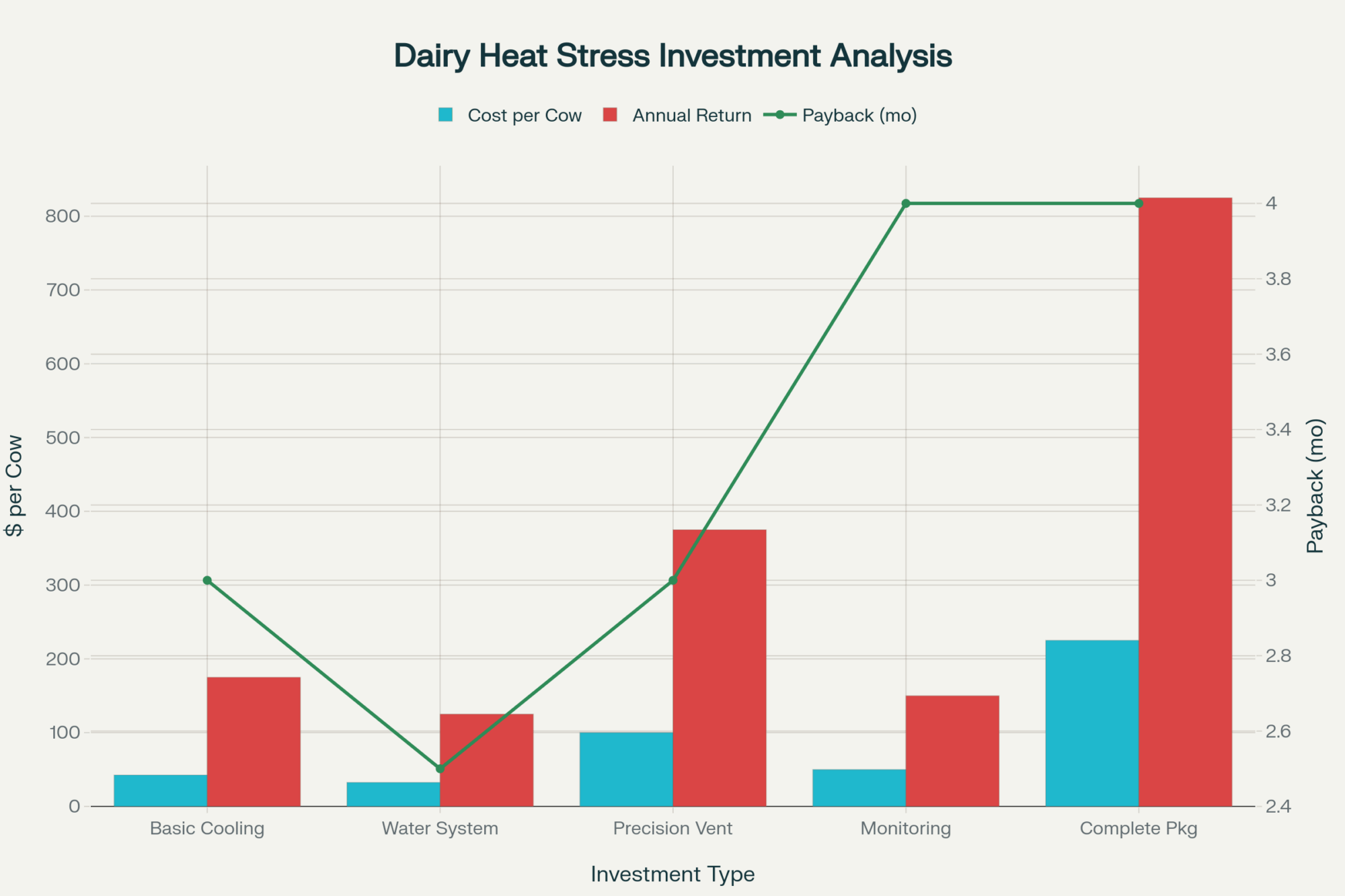
Heat Stress Management Investment Analysis – ROI and Payback by System Type

Here’s how the economics actually work out—and these numbers are based on real operations I’ve worked with:

Investment PhaseCost Per CowAnnual ReturnPayback Period
Basic Cooling Improvements$35-50$150-2003-4 months
Water System Upgrades$25-40$100-1502-3 months
Precision Ventilation$75-125$300-4502-4 months
Monitoring Systems$40-60$120-1803-5 months
Complete Package$175-275$670-9803-5 months

Conservative estimates based on documented performance improvements

When you see payback periods measured in months rather than years… that fundamentally changes how you think about these investments, doesn’t it? Most producers I work with are genuinely shocked by how quickly these systems pay for themselves.

The interesting thing is that the biggest returns often come from the simplest interventions. One operation saw a $50,000 annual improvement just from installing additional fans and improving water access. Total investment? $25,000. Payback in five months.

The Market Reality for 2025 (And Why Timing Matters)

Current Price Environment (Mixed Signals)

The USDA has adjusted 2025 forecasts, and honestly, the picture is complex. The all-milk price is now projected at $22.00 per hundredweight for 2025, while milk production forecasts show 228.3 billion pounds—both revised upward from earlier estimates.

These market conditions make efficiency gains from heat stress management even more critical for maintaining profitability. When margins are under pressure and production costs keep climbing, the difference between a well-managed heat stress program and just winging it with some fans can literally be the difference between profit and loss.

What’s interesting is how heat stress management becomes more valuable in tighter margin environments. When every gallon counts more, maintaining production consistency becomes a competitive necessity rather than just a nice-to-have.

Supply Reality (Tighter Than Most Realize)

With dairy heifer inventory remaining near historic lows, the industry continues to face supply constraints. This makes every cow more valuable and heat stress prevention more economically critical than ever.

Basically, we can’t afford to lose production to heat stress when replacement animals are this scarce and expensive. The economics have fundamentally shifted—maintaining production per cow has become more important than it’s ever been.

I was talking to a producer in Wisconsin last week who put it perfectly: “I can’t replace these cows easily, so I better take care of the ones I have.” That mindset shift is happening across the industry.

Labor Reality (Getting Harder to Ignore)

Farm labor costs keep climbing, with recent Department of Labor reclassifications pushing some wages substantially higher, making automated cooling systems and labor-efficient management practices increasingly attractive.

When you’re paying $20+ per hour for skilled labor, automated systems that reduce daily heat stress management tasks start looking pretty attractive. The labor savings alone can justify significant cooling investments.

But it’s not just about cost—it’s about reliability. Automated systems don’t forget to turn on fans or check water levels. They don’t call in sick during the hottest week of the year. That reliability becomes incredibly valuable when you’re dealing with heat stress.

What’s Actually Coming Next (The Innovation Pipeline)

The Next Wave of Technology

The heat stress management revolution is honestly just getting started. Automated cooling systems with AI-driven optimization are entering beta testing on progressive farms. These systems adjust cooling intensity based on individual cow response, not just environmental conditions.

I’ve seen prototypes that can identify individual cows showing early heat stress signs and provide targeted cooling through precision sprinkler systems. That’s the kind of precision that’ll separate the leaders from the followers in the next decade.

The fascinating part is how these systems learn from your operation. They start to recognize patterns specific to your cows, your facilities, your local weather patterns. After a season or two, they’re essentially custom-tuned to your operation.

Gene Editing and Heat Tolerance

Gene editing technologies are showing real promise for enhancing natural heat tolerance without sacrificing production genetics. Precision agriculture techniques are being adapted for dairy operations, allowing real-time adjustment of cooling, feeding, and management protocols based on continuous data streams.

The regulatory pathway is still being worked out, but the potential is significant. Early research suggests we could see substantial improvements in heat tolerance within the next 5-7 years.

What’s particularly exciting is how gene editing could stack with existing heat tolerance genetics. We might see cows that are not just adapted to heat stress, but actually perform better in warm conditions than in cool conditions.

The Environmental Bonus (Win-Win Situation)

Here’s an unexpected benefit that’s becoming more important: many heat stress management strategies also reduce methane emissions. Improved feed efficiency reduces enteric methane production, while enhanced cow comfort improves rumen function, further reducing greenhouse gas emissions.

The farms implementing comprehensive heat stress management are positioning themselves for carbon credit opportunities that could add meaningful revenue per cow annually. Not bad for doing what’s already good for your cows.

Some operations are already participating in carbon credit programs specifically tied to improved animal welfare and efficiency measures. It’s early days, but the potential is significant—especially for operations that can document comprehensive heat stress management programs.

Why Acting Now Changes Everything (The Competitive Reality)

The Early Adopter Advantage

Climate change isn’t slowing down, and neither is the competitive advantage available to early adopters. Farms implementing comprehensive heat stress management today are building long-term competitive advantages over operations that continue with traditional cooling methods.

Technology costs are dropping rapidly, while performance advantages are becoming more pronounced. Every season you delay implementation is another season of lost profits and reduced competitiveness.

After 20 years in this business, I’ve learned that the farms that survive and thrive are the ones that adapt quickly to changing conditions. Climate change is just another challenge to adapt to… but the farms that figure it out first? They’re going to absolutely dominate their markets.

I’ve seen it happen before with other technologies—precision feeding, automated milking, genetic selection. The early adopters build advantages that compound over time, and eventually the gap becomes so large that late adopters can’t catch up.

The Labor Efficiency Revolution

One unexpected benefit of modern heat stress management: reduced labor requirements. Automated cooling systems, precision feeding, and optimized barn design are reducing the daily labor required for heat stress management by substantial percentages.

This labor efficiency translates to significant annual savings for typical operations—money that can be reinvested in additional improvements or simply drop to the bottom line. When good help is hard to find, systems that reduce labor requirements are worth their weight in gold.

But it’s not just about reducing labor—it’s about redirecting labor to higher-value activities. Instead of manually adjusting fans and checking water levels, your crew can focus on cow observation, preventive maintenance, or other activities that directly impact profitability.

Taking Action: Your Practical Path Forward

The Implementation Roadmap (Keep It Simple)

Start with the basics: assess your current heat stress losses. Track milk production, conception rates, and feed efficiency during heat stress periods. The data will shock you, but it will also justify the investment in solutions.

Honestly, most producers I work with are genuinely surprised by how much money they’re actually losing to heat stress once they start tracking it properly. One operation in Pennsylvania thought their summer production drop was “normal” until they realized they were losing $85,000 annually to preventable heat stress.

The assessment doesn’t need to be complicated. Simple records of daily milk weights, water consumption, and breeding success during heat stress periods will give you enough data to build a business case for improvements.

Your Three-Phase Approach

Phase 1 (0-30 days): Implement feed timing changes and optimize water access. Minimal cost. Expected benefits: significant improvements in feed efficiency and cow comfort. This phase alone can reduce heat stress losses by 15-20%.

Phase 2 (30-90 days): Install basic cooling enhancements and improve shade availability. Moderate investment. Expected benefits: substantial improvements in production stability. This typically delivers another 10-15% improvement in heat stress performance.

Phase 3 (90-180 days): Implement precision cooling systems and advanced monitoring. Larger investment. Expected benefits: comprehensive heat stress management with maximum ROI. This phase often delivers the biggest returns—30-40% improvements over baseline.

The beauty of this approach is that each phase pays for the next. Phase 1 improvements generate cash flow that funds Phase 2 investments, and so on.

The Financing Reality (Better Than You Think)

Multiple financing options are available for heat stress management investments. USDA programs, equipment financing, and emerging carbon credit opportunities can dramatically reduce upfront costs. Some producers are achieving cash-flow positive implementation from day one.

The key is working with lenders who understand agriculture and can structure payments around your cash flow patterns. Many equipment dealers now offer seasonal payment plans that align with milk check cycles.

What’s particularly interesting is how carbon credit programs are starting to finance heat stress management improvements. Some operations are getting upfront payments for verified emission reductions tied to improved efficiency and animal welfare.

The Partnership Advantage (Don’t Go Alone)

The most successful heat stress management implementations involve partnerships between producers, nutritionists, veterinarians, and technology providers. Integrated approaches are delivering substantially better results than piecemeal solutions.

Find a team that understands your operation and can work together on implementation. The learning curve is much shorter when you’re not trying to figure everything out by yourself.

The best partnerships I’ve seen involve regular collaboration throughout the implementation process. Monthly check-ins, data review sessions, and collaborative problem-solving when challenges arise. Heat stress management isn’t a set-it-and-forget-it proposition—it requires ongoing optimization.

The Reality Check (What This All Means)

Climate change is reshaping dairy farming, but it’s also creating unprecedented opportunities for producers willing to innovate. The technologies, genetics, and management strategies to not just survive but thrive in a changing climate are available today.

The choice is yours: continue losing substantial money per cow annually to heat stress, or invest in solutions that can add significant value per cow to your bottom line while building long-term resilience.

With 2025 market conditions challenging and supply remaining tight, the producers who act now will be the ones still profitable in 2030. The ones who wait? They’ll be the ones wishing they’d started today.

This isn’t just about surviving the heat anymore—though that’s certainly part of it. It’s about building the kind of operation that can thrive regardless of what weather patterns throw at us. The farms that figure out comprehensive heat stress management aren’t just solving a summer problem. They’re building a competitive advantage that’ll serve them for decades.

Your cows are counting on you to make the right choice. Your bottom line depends on it. And your competitive future? It’s being decided right now, in the middle of this heat wave, with every single management decision you make.

The question isn’t whether you can afford to implement comprehensive heat stress management. The question is whether you can afford not to.

Because at the end of the day, the farms that survive the next decade will be the ones that figured out how to make climate change work for them instead of against them. And that opportunity? It’s sitting right in front of you, waiting for you to act.

Complete references and supporting documentation are available upon request by contacting the editorial team at editor@thebullvine.com.

KEY TAKEAWAYS

  • Recover up to 10% in lost milk production by optimizing cooling systems and shifting feed delivery to nighttime hours—start with your next feed run and watch the difference.
  • Boost feed efficiency 12-15% through genomic testing and targeted nutrition programs—test your breeding stock this quarter while semen costs are manageable in today’s market.
  • Improve conception rates by up to 25% during summer breeding by adjusting your AI schedule and implementing heat stress protocols—tweak your breeding calendar now before peak heat hits.
  • Cut annual heat stress losses from $98,000-$142,000 (typical 500-cow operation) to under $50,000 with comprehensive management—these systems pay for themselves in 3-5 months.

EXECUTIVE SUMMARY

Heat stress is quietly bleeding your operation dry—we’re talking up to 10% milk loss during summer peaks, worth over $1,000 daily on a 500-cow dairy (Science Advances). But here’s the kicker: conception rates tank by 20-25% during heat stress, meaning you’re paying for failed breedings all season long (UW Extension data). The smart operators are fighting back with genomic testing and strategic feed timing… and they’re seeing 12-15% efficiency gains that translate to real money. Global dairy regions are already capitalizing on this, and with 2025 margins tighter than ever, you can’t afford to ignore these tools. Time to stop accepting summer losses as “normal” and start turning heat into your competitive edge.

Learn More:

Join the Revolution!

Join over 30,000 successful dairy professionals who rely on Bullvine Weekly for their competitive edge. Delivered directly to your inbox each week, our exclusive industry insights help you make smarter decisions while saving precious hours every week. Never miss critical updates on milk production trends, breakthrough technologies, and profit-boosting strategies that top producers are already implementing. Subscribe now to transform your dairy operation’s efficiency and profitability—your future success is just one click away.

NewsSubscribe
First
Last
Consent

Heat Crisis Forces European Dairy into Unprecedented Tailspin

EU heat crisis exposes cooling tech myth: 40% effectiveness at 24°C drops further as temps rise. Time to rethink heat stress management strategies

EXECUTIVE SUMMARY: The dairy industry’s reliance on cooling technology as a heat stress “silver bullet” is fundamentally flawed, and the 2025 European heatwave just proved it catastrophically. While farms invested millions in sprinkler systems and fans believing they’d solved heat stress, research shows these technologies only offset 40% of production losses at moderate 24°C temperatures – with effectiveness plummeting as mercury rises. The numbers don’t lie: EU milk production forecasts crashed from a manageable -0.2% decline to a devastating -0.8% to -1.5% contraction – that’s up to seven times worse than projected. Meanwhile, competitors capitalized on this vulnerability: UK milk volumes surged to a record 12.83 billion litres (+3.1% growth) while US butter maintained a crushing 60% price advantage at $2.33/lb versus EU’s $3.71/lb. The brutal reality is that heat stress begins at just 22°C with 50% humidity for Holstein-Friesians, and each unit increase above critical thresholds costs up to 0.249 kg of milk per cow daily – losses that even advanced cooling can’t fully prevent. It’s time to stop treating climate adaptation as a technology problem and start building genuine operational resilience through genetic selection, strategic planning, and integrated heat management systems.

KEY TAKEAWAYS

  • Genetic Selection Trumps Technology: Heat-tolerant genetics deliver consistent performance while cooling systems fail at extreme temperatures. Breeding programs incorporating heat tolerance traits can maintain milk yields above 4.5 kg daily losses seen in severe stress conditions, providing measurable ROI when cooling effectiveness drops to 30-40% at peak temperatures.
  • Temperature-Humidity Index (THI) Monitoring Creates Competitive Advantage: Smart operators tracking THI levels can predict milk yield reductions and adjust feeding strategies before losses occur. With severe heat stress costing over 4.5 kg (10 lbs) per cow daily, proactive THI management can protect $15-20 per cow per day in milk revenue.
  • Feed Quality Management Multiplies Heat Stress Impact: The 2025 heatwave degraded forage quality while new EU tariffs increased feed costs by 50% on Russian/Belarusian imports. Farmers securing alternative feed sources now can avoid the double hit of reduced milk production and inflated input costs that’s squeezing margins across Europe.
  • Market Positioning Strategy Separates Winners from Losers: While EU processors pivot to cheese production (+0.6% growth despite milk shortages), butter and powder production crashes (-1.0% to -5.0%). Operations positioned in stable climates like the UK are capturing export opportunities, with record milk volumes reaching 12.83 billion litres and 3.1% growth.
  • Milk Component Quality Demands Integrated Approach: Heat stress doesn’t just reduce volume – it destroys milk fat and protein percentages critical for cheese yields. Operations maintaining component quality through comprehensive heat management can command premium prices while competitors struggle with degraded milk composition and reduced processing efficiency.

Ever wonder what happens when Europe’s massive dairy industry gets blindsided by the worst heat crisis in decades? The reality is hitting farmers hard right now. Europe’s 2025 heatwave didn’t just make cows uncomfortable – it completely shattered production forecasts, turning what should have been a manageable 0.2% decline into a devastating 0.8% to 1.5% drop. That’s not just a bad season. That’s a fundamental shift that’s reshaping how we think about dairy production in a changing climate.

If you’re still treating heat stress like it’s just another summer challenge, you’re about to get a harsh wake-up call. While you’re hoping things return to normal, your competitors are already investing in the infrastructure that’ll determine who survives the next heat dome.

This isn’t just about this summer’s losses. The June-July 2025 European heatwave has completely reshuffled the global dairy deck, and the producers who adapt fastest will capture market share from those still hoping for “normal” weather to return.

The Perfect Storm Nobody Saw Coming

The European dairy sector was already walking a tightrope before the heat hit. EU milk deliveries were forecast at just 149.4 million metric tonnes in 2025 – already down 0.2% before anyone felt the first sweltering day.

But three things came together to create something much worse than anyone expected.

First, environmental regulations were squeezing farmers out left and right. The EU Green Deal and Farm to Fork Strategy weren’t just policy papers – they were imposing real costs that smaller operations simply couldn’t absorb. By November 2023, EU milk production had already hit the lowest levels since 2018, with collections down 2.5% year-over-year.

Disease pressure made everything worse. Bluetongue virus was already hammering yields across northern France, Germany, and the Netherlands. Then Lumpy Skin Disease appeared in France in June 2025, adding another layer of biosecurity headaches just when farmers needed it the least.

The economics were brutal, too. After hitting relative highs in 2022, farm-gate milk prices had been sliding through 2023, leaving producers with razor-thin margins when input costs for energy, fertilizer, and labor stayed stubbornly high.

Then the heat dome arrived.

When Mother Nature Goes Nuclear

The June-July 2025 heatwave wasn’t your typical summer scorcher. This was a systematic assault on dairy productivity across every major milk-producing region in Europe.

Here’s what makes this so devastating: heat stress kicks in at surprisingly low temperatures. For the high-producing Holstein-Friesians that dominate European herds, mild heat stress starts at just 22°C with 50% humidity. Once you reach 25-26°C, you can expect significant production losses.

The 2025 heatwave absolutely demolished those thresholds. Germany experienced peak daily temperatures averaging 35°C, with local spikes exceeding 40°C. France endured similar punishment, with some regions reaching temperatures of 40-43°C. Even Poland, sitting further east, averaged 30°C – more than enough to stress high-yielding cows.

The financial hit was immediate and brutal. Research shows that each degree increase above critical thresholds can result in cows losing up to 0.249 kg of milk per day. Severe heat stress can slash daily production by over 4.5 kg per cow. When you’re talking about millions of animals across Europe’s dairy heartland, that adds up to massive losses fast.

However, here’s the part that really stings: heat stress doesn’t just reduce volume; it also destroys milk quality. The metabolic strain cuts milk fat and protein percentages, which directly impacts cheese yields, just as EU processors were doubling down on high-value cheese production.

The Winners and Losers Emerge

While European producers scrambled to manage heat damage, competitors positioned themselves to grab abandoned market share.

The UK dairy sector is absolutely crushing it right now. Milk volumes for 2025/26 are forecast to reach 12.83 billion litres, a new record representing 3.1% growth. In May 2025, UK volumes increased by 5.7% year-over-year, with market analysts specifically citing “tighter milk supplies on the continent” as a key driver.

The US maintains a massive cost advantage. While EU butter was trading at $3.71 per pound in early 2025, US butter was priced around $2.33 per pound – a 60% cost advantage. The US entered 2025 with favorable feed prices and a slightly expanding herd, setting up steady growth projections.

New Zealand is poised for record export revenue of NZ$27 billion, up 16%. As the EU withdraws from global commodity markets to meet domestic needs, Oceania producers are well-positioned to fill the supply gap.

The Technology Reality Check

Here’s the uncomfortable truth most heat stress discussions avoid: even the most advanced cooling technologies only offset about half the production losses on moderately hot days. Studies from Israel show that cooling strategies offset 40% of losses at 24°C, but their effectiveness drops substantially at higher temperatures.

The three technologies that actually deliver measurable results are evaporative cooling systems, enhanced ventilation, and strategic shade structures. However, what separates successful operations from struggling ones is the most effective approach, which combines all three technologies with genetic selection for heat tolerance, even if it means accepting some trade-offs in maximum yield potential.

Market Dynamics You Can’t Ignore

The 2025 heatwave triggered a fundamental shift in dairy economics that’s reshaping competitive dynamics for years to come.

European processors faced impossible choices. With smaller and more expensive milk supplies, the strategic pivot toward cheese production intensified. Cheese production is forecast to increase 0.6% even as overall milk production declines, coming directly at the expense of butter (-1.0%), skim milk powder (-4.0%), and whole milk powder (-5.0%).

This created immediate price volatility. EU butter prices remained firm at elevated levels, such as €739/100kg, while the FAO noted in June 2025 that global butter prices reached new records, driven primarily by “persistent supply tightness in the European Union”.

The policy shock made everything worse. On July 1, 2025, the EU imposed a 50% tariff on agricultural imports from Russia and Belarus, which directly affected fertilizers and feed components. Russia alone had supplied 6.2 million tonnes of fertilizer to the EU in 2024, representing 25% of total imports.

This created a brutal cycle where heat-damaged forage quality increased farmers’ need for purchased feed, just as new tariffs drove those feed costs through the roof.

What This Means for Your Operation

The 2025 European heatwave isn’t a one-off crisis – it’s a preview of the new normal. Climate projections indicate that heatwaves in Europe will intensify in both frequency and severity.

The operators who get this right will capture market share from those who don’t. Here’s your roadmap:

Next 30 days: Audit your current heat-abatement infrastructure. Calculate the cost per cow of upgrading to industry-standard cooling systems versus the cost of lost production. Review your genetic selection criteria and start incorporating heat tolerance as a key breeding trait.

Next 60-90 days: Implement comprehensive cooling systems as essential infrastructure, not optional additions. Develop contingency plans for extreme weather events. Evaluate your market positioning relative to global competitors.

The Bottom Line

Remember that question about what happens when Europe’s dairy industry gets blindsided by extreme heat? The answer is that climate volatility has become as important as feed costs and trade policy in determining who wins and who loses.

The 2025 heatwave taught us that technology offers partial solutions but isn’t a silver bullet. Global competitive dynamics are permanently shifting toward climate-resilient regions. The operators who invest in adaptation now will outcompete those waiting for “normal” weather to return.

The European dairy crisis isn’t just about weather – it’s about the fundamental shift in global dairy competitiveness that will reshape trade flows, pricing dynamics, and production strategies for years to come.

Your next move: Schedule a heat stress audit of your operation within the next week. Calculate the exact cost of upgrading your cooling infrastructure versus documented production losses from heat stress. Because while you’re deciding whether to adapt, your competitors are already implementing the systems that will define industry leadership in the climate-changed dairy sector.

The choice is yours. But remember – in the new dairy reality, resilience isn’t just about surviving the next heatwave. It’s about building the operational advantage that lets you thrive while others merely survive.

Complete references and supporting documentation are available upon request by contacting the editorial team at editor@thebullvine.com.

Learn More:

Join the Revolution!

Join over 30,000 successful dairy professionals who rely on Bullvine Weekly for their competitive edge. Delivered directly to your inbox each week, our exclusive industry insights help you make smarter decisions while saving precious hours every week. Never miss critical updates on milk production trends, breakthrough technologies, and profit-boosting strategies that top producers are already implementing. Subscribe now to transform your dairy operation’s efficiency and profitability—your future success is just one click away.

NewsSubscribe
First
Last
Consent

Beat the Heat: How Elite Dairies Are Weaponizing Genetics and Smart Tech to Turn Summer into Profit

Stop believing the 80°F heat stress myth. New research proves 68°F THI destroys milk yield while elite dairies profit from thermal genetics.

Heat stress isn’t just stealing your milk check – it’s sabotaging your genetics for generations while your competitors master the integration of heat-tolerant genomics, precision cooling, and smart monitoring to protect $700 per cow annually. With University of Illinois research documenting $245 million in industry losses and climate projections showing 100-300 annual heat stress days by 2050, the operations that crack the heat stress code will dominate markets while others watch profits evaporate. The difference? A systematic approach combining SLICK gene selection, precision THI monitoring, and facility integration that delivers compound returns protecting both immediate cash flow and generational genetic potential.

Summer heat hits dairy operations like a poorly timed breeding decision – the damage compounds for years after you think the problem’s over. While you’re debating whether 75°F “feels hot,” your highest-producing genetics are already gasping like fresh heifers in their first lactation.

Here’s a question that should shake you out of your comfort zone: What if your grandfather’s heat management wisdom is actually bankrupting your operation one summer day at a time?

A groundbreaking University of Illinois study analyzing over 56 million production records from 18,000 dairy farms revealed heat stress led to a cumulative loss of approximately 1.4 billion pounds of milk over five years, costing the industry a staggering $245 million in revenue (Extreme heat impacts dairy production, small farms most vulnerable). But here’s what should really keep you awake at night – that heat-stressed dry cow panting under inadequate cooling isn’t just costing this lactation. She’s programming her daughter’s genetic potential backward by decades.

Why Your Industry Leaders Have Been Lying About Heat Thresholds

The Industry’s 80°F Heat Stress Myth vs Scientific Reality
Threshold TypeTHI ValueTemperature at 50 RHImpact Level
Traditional Industry Claim8084Mild concern
High-Producing Holstein Reality6868Production decline begins
Research Consensus7275Heat stress confirmed
Emergency Level8489Emergency

Here’s the industry’s most expensive deception: waiting until 80°F to worry about heat stress. Modern-day breeds of dairy cattle are the result of intensive genetic selection aimed primarily at increasing milk productivity, but this increased productivity is genetically linked to physiological traits such as greater metabolic rates and increased feed intake, both of which augment endogenous heat generation, making high-productivity breeds particularly susceptible to heat stress (Global projections of heat stress at high temporal resolution).

The brutal truth that breeding companies don’t want to discuss: While they’ve marketed genetic progress in milk production, they’ve simultaneously created thermal disasters waiting to happen. Every additional pound of milk production generates increased metabolic heat, yet no major breeding company has prominently featured heat tolerance in their marketing materials until recently.

Why This Matters for Your Operation: Your best genetics – the ones with superior genomic estimated breeding values for production traits – suffer thermal stress at just 68°F Temperature Humidity Index while you’re still comfortable in short sleeves. Heat stress causes behavioral changes, including increased water intake and reduced dry matter intake, along with physiological responses, including electrolyte imbalances, acid-base disruptions, respiratory alkalosis with metabolic acidosis, and disturbances in sodium homeostasis (Heat Stress in Dairy Cows: Impacts, Identification, and Mitigation).

Consider this economic reality: A 500-cow operation experiencing just 30 days of inadequate heat management at 70°F THI could lose 150,000 pounds of milk annually. At current pricing, that’s $31,650 in lost revenue – enough to fund significant cooling infrastructure improvements that most operations refuse to make.

How the Genetics Industry Created This Thermal Crisis

Here’s the uncomfortable truth your AI technician won’t tell you: The same genetic selection that created your high-producing herd also engineered thermal vulnerability into every animal. For small farms, taking a 1.6% hit is equivalent to operating unpaid for nearly six days yearly solely because their cows are overheating (Small Dairy Farms Suffer more from Heat Stress), while large operations with sophisticated cooling systems maintain more stable production levels.

However, the most progressive operations have discovered something revolutionary: genomic selection for heat tolerance reduces thermal stress and improves overall animal efficiency. Research published in Nature demonstrates that dairy cattle predicted by genomic breeding values to be heat tolerant have less decline in milk production and reduced increases in core body temperature during simulated heat wave events compared to cows predicted to be heat susceptible (Genomic Selection Improves Heat Tolerance in Dairy Cattle).

Cooling System Return on Investment Comparison
Genetic TypeRumen Temperature Reduction CelsiusMilk Production Advantage PercentReproductive PerformanceHeat Tolerance RatingEconomic Benefit Per Cow
SLICK Gene Carriers0.7515Superior9700
Non-SLICK Controls00Standard50

The SLICK gene represents the most dramatic single-gene solution discovered so far. LIC New Zealand research found that cows carrying the SLICK gene had lower rumen temperatures (0.5-1.0°C) compared to their non-SLICK counterparts when the Temperature Humidity Index exceeded 73 (SLICK – developing heat tolerant dairy animals). After 9 years of breeding, LIC now has SLICK sires with breeding worth approaching that of the best dairy sires in the New Zealand industry, with only 1/32nd average content of Senepol genes (SLICK – developing heat tolerant dairy animals).

Are you breeding for production at the expense of thermal resilience? This question challenges every genetic selection decision you’ve made while your breeding company representatives focus solely on milk, fat, and protein numbers.

Validated genetic markers beyond SLICK include SNPs in the TLR4, GRM8, and SMAD3 genes, which are proven predictors of both milk production and thermotolerance in heat-stressed Holstein cows (Genetic Markers Associated with Milk Production and Thermotolerance). Heat-stressed Holstein cows with favorable markers were able to reduce rectal temperature and respiratory rate, which allowed them to maintain adequate milk production levels (Genetic Markers Associated with Milk Production and Thermotolerance).

What Your Cooling Strategy Consultant Isn’t Telling You

Here’s the uncomfortable truth about your current cooling strategy: You’re probably spending more on genetic testing with less ROI than you’d get from proper cooling infrastructure. Most operations are still managing heat stress like it’s 1995, relying on basic fans and hoping for mild summers.

The economic reality is brutal but clear: While breeding companies charge thousands for genomic testing that may or may not improve production, comprehensive cooling infrastructure delivers measurable returns through avoided production, reproductive, and health losses. Yet most operations resist investing in proven cooling technologies while eagerly purchasing genetic products with uncertain outcomes.

Cooling SystemPayback Period YearsBenefit Cost RatioInvestment Per CowAnnual Return Per Cow
Dry Cow Cooling (existing barn)0.273.15150556
Dry Cow Cooling (new barn)5.681.452000352
Tunnel Ventilation3.21.75332175
Basic Fan Systems2.11.25100125
Precision Soaking1.82200222

Precision cooling isn’t about more fans but strategic placement and timing. Advanced soaking systems can reduce water usage by 50-70% compared to traditional setups while providing more effective cooling through precision cycling – short, effective soaking periods (30-45 seconds) followed by longer fan-only drying periods (4-5 minutes) (Heat Stress 2.0: Why Your Current Cooling Strategy Is Costing You Big Money).

Why This Matters for Your Operation: Every degree above 68°F THI costs you money through reduced milk production, compromised reproduction, and increased health problems. Yet most operations wait for visible panting before implementing cooling measures – by then, significant economic damage has already occurred.

Can Technology Predict What Your Eyes Can’t See?

What if you could detect heat stress 24 hours before your cows show any visible symptoms? Recent advances in sensor technologies and wireless transmission enable body surface temperature and respiration rate measurement through wearable devices, providing real-time monitoring for heat strain-related data (Recent Advances on Early Detection of Heat Strain in Dairy Cows).

Current research in New Zealand uses on-farm technology, including sensory data collected from collars and rumen boluses, to understand individual cow heat stress responses, identifying indicators such as respiration rate, eating and drinking patterns, activity levels, rumination, and rumen temperature (Heat Stress and Technology).

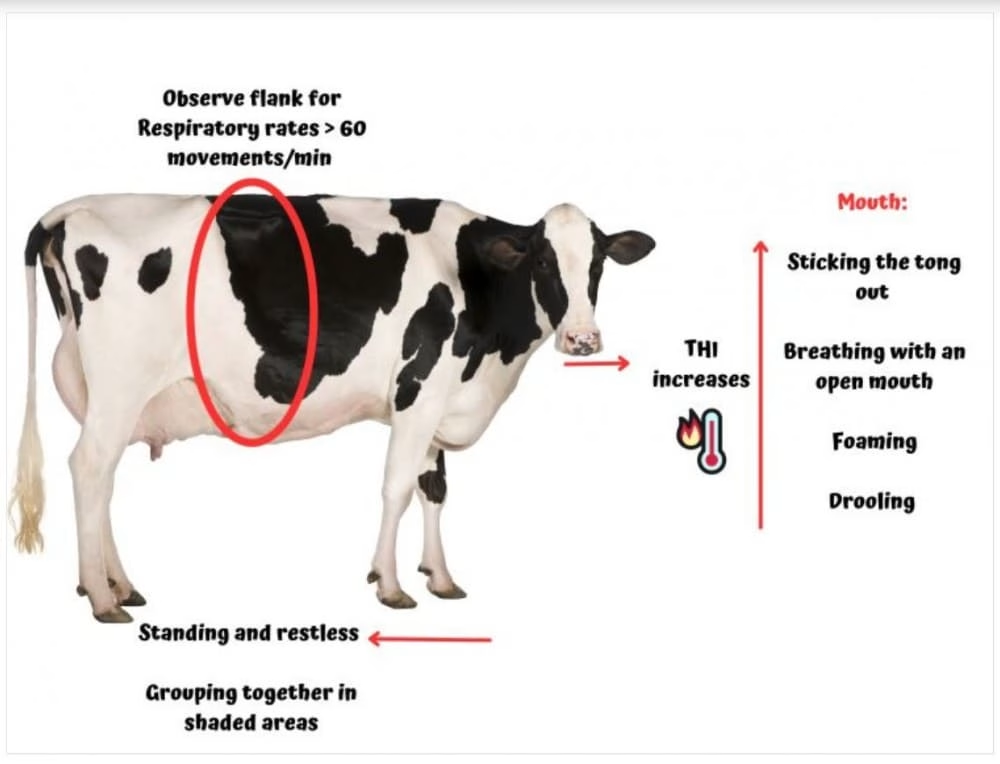
Visual indicators of heat stress in dairy cows, including increased respiratory rates, restless behavior, and oral symptoms like open-mouth breathing and drooling

Body surface temperature and respiration rate are concluded to be the best early indicators of heat strain due to their high feasibility of measurement and sensitivity to heat stress (Recent Advances on Early Detection of Heat Strain in Dairy Cows). Combined with the internet of things technologies, comprehensive strategies based on both animal- and environment-based indicators are expected to increase the precision of early detection (Recent Advances on Early Detection of Heat Strain in Dairy Cows).

But here’s what technology vendors won’t tell you: The existing thresholds should be used carefully considering differences in experimental conditions and animal information, with further studies required to evaluate and customize thresholds based on different influencing factors (Recent Advances on Early Detection of Heat Strain in Dairy Cows).

Why Small Farms Are Systematically Being Eliminated

Time PeriodHeat Stress Days Per YearMilk Loss Increase PercentSmall Farm VulnerabilityEconomic Impact Billions
2020s Current450High1.2
2030s Projection6515Very High1.8
2040s Projection8525Critical2.4
2050s Projection12030Severe3.1

Here’s the uncomfortable truth the industry won’t discuss: Heat stress is systematically eliminating small family farms while corporate operations invest millions in climate-controlled facilities. University of Illinois research found that while average milk yield losses due to heat stress amount to about 1% annually, smaller farms see nearly twice this loss (Small Dairy Farms Suffer more from Heat Stress).

“To some extent, it’s only 1.6%. But if you’re really making every dollar from your paycheck count because you’re living in a time with high costs, then 1.6% of your paycheck being gone in a given year is meaningful,” explains study co-author Marin Skidmore (Small Dairy Farms Suffer more from Heat Stress).

Are we creating a system where only corporate dairies can afford to stay cool? This question should challenge every policy maker and industry leader who claims to support family farming while promoting genetic selection strategies that increase thermal vulnerability.

The economic barriers are real: Having access to enough capital to make really big investments is difficult, and grants or loans to help small farms adopt management technologies could be one avenue to help small farms cope with heat stress and keep them competitive (Small Dairy Farms Suffer more from Heat Stress).

The consolidation pressure created by heat stress management costs is fundamentally reshaping American dairy farming. While large operations can justify $75,000+ investments in precision cooling, small farms need cost-effective solutions that don’t require corporate-level capital – yet the industry provides few viable options.

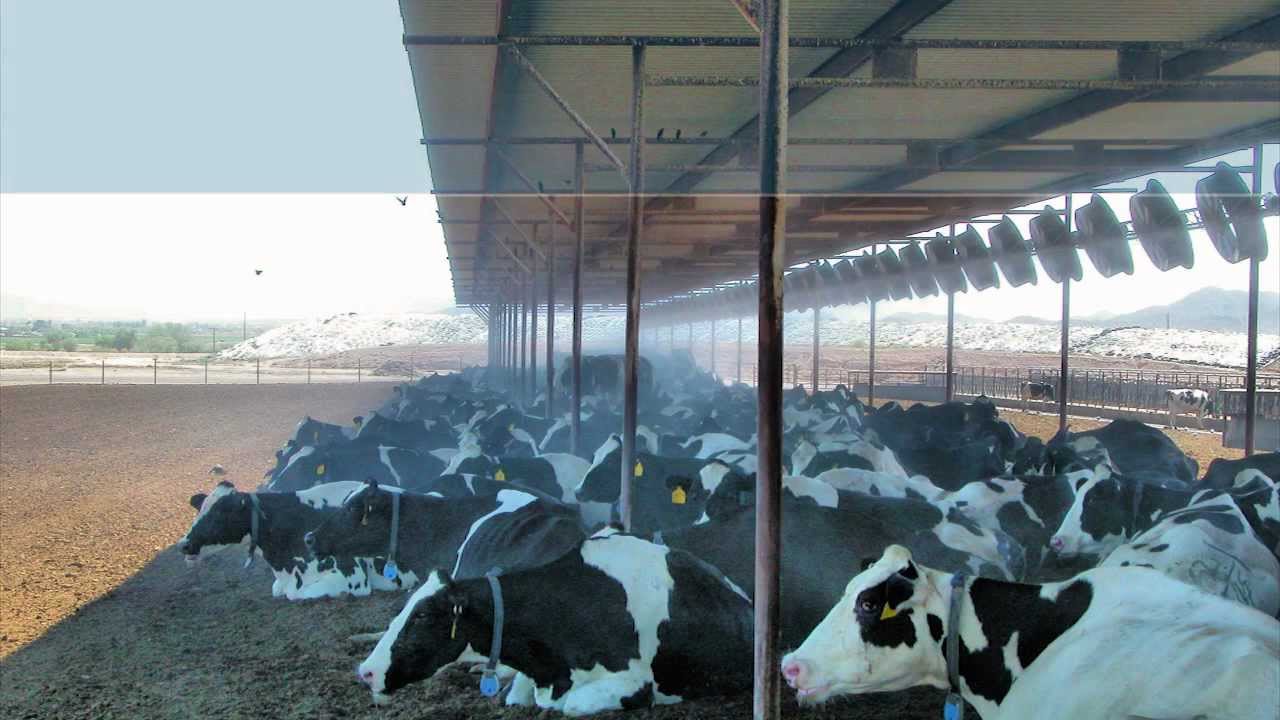
Tunnel ventilation system featuring a row of large fans installed on the side of a dairy barn to combat heat stress 

The Real Cost of Genetic Sabotage in Your Maternity Pen

Here’s the genetic sabotage happening in your maternity pen right now: Heat-stressed dry cows program their daughters for lifetime underperformance through epigenetic mechanisms that affect mammary development, immune function, and metabolic efficiency.

The mathematical brutality is staggering: Research documents that heat-stressed daughters produce significantly less milk throughout their productive lives. An 8-pound daily reduction across a 305-day lactation equals 2,440 pounds of lost milk per daughter. At current pricing, that’s $515 in lost revenue per lactation – before considering reproductive impacts, longevity effects, and component losses.

Heat stress can lead to reduced mammary growth during the dry period, with increased prolactin concentration causing decreased expression of prolactin receptor genes in the mammary gland, liver, and lymphocytes, resulting in impaired lactogenesis and reduced milk production in subsequent lactations (Heat Stress in Dairy Cows: Impacts, Identification, and Mitigation).

Every pregnant cow panting under inadequate cooling isn’t just costing this lactation – she’s programming her daughter’s genetic potential backward by decades. Yet most operations focus on immediate cooling comfort rather than protecting long-term genetic investments.

The Bottom Line: Your Competitive Future Depends on Decisions You Make Today

Heat stress management has evolved from seasonal comfort measures into sophisticated systems determining competitive survival. With global projections showing increasing heat stress frequency and intensity, thermal resilience separates industry leaders from casualties. The study projects that the frequency of extreme heat days will increase, potentially raising milk yield losses by about 30% within the next 25 years (Small Dairy Farms Suffer more from Heat Stress).

Your action plan starts now:

  1. Challenge your genetic selection strategy – demand heat tolerance data from your breeding company and prioritize SLICK gene carriers alongside production traits
  2. Calculate your thermal losses honestly – quantify production drops, reproductive impacts, and component losses during heat events using verified THI data
  3. Invest in precision cooling with proven ROI – move beyond basic fans to systems delivering measurable returns through strategic placement and timing
  4. Implement early warning monitoring – detect thermal stress 24 hours before visible symptoms devastate performance and genetic potential
  5. Protect genetic investments systematically – ensure comprehensive dry cow cooling to prevent generational performance sabotage

Here’s the critical question every dairy manager must answer: Are you building thermal resilience into your operation’s DNA, or are you gambling your genetic future on increasingly unreliable weather patterns while your breeding company profits from thermal vulnerability?

The choice is stark: invest in comprehensive thermal management now or watch genetic potential and profit margins evaporate with every heat wave. The most successful operations have already been decided. They’re building herds that thrive when others merely survive, creating generational competitive advantages that compound with every breeding decision.

Climate change isn’t slowing down. With modern genetics suffering thermal stress at 68°F THI and projections showing dramatic increases in extreme heat events, thermal resilience is no longer optional – it’s survival. The technology exists. The genetics are available. The research is conclusive. The only question is whether you’ll implement comprehensive heat management before your competition does or whether you’ll be another casualty of an industry that is bred for production while ignoring the thermal consequences.

In five years, the operations that master thermal resilience today will set milk prices while others struggle to survive another summer. The genetic sabotage happening in your maternity pen right now will determine whether your operation thrives or merely survives the climate challenges ahead.

KEY TAKEAWAYS

  • Genetic Selection Revolution: SLICK gene carriers maintain 0.5-1.0°C lower rumen temperatures when THI exceeds 73, while genomic selection for heat tolerance improves feed efficiency (+0.45 correlation) and fertility (+0.25 correlation) alongside thermal resilience
  • Economic Survival Strategy: Comprehensive cooling infrastructure delivers 5.67-year payback with 1.45 benefit-cost ratio, while tunnel ventilation justifies $332 per cow space investment through measurable milk loss prevention compared to basic fan systems
  • Technology-Driven Early Detection: Advanced sensor systems detect heat stress 24 hours before visible symptoms through body surface temperature and respiration monitoring, preventing production losses before they devastate milk checks and genetic potential
  • Generational Genetic Protection: Heat-stressed dry cows program daughters for lifetime underperformance (8-10 pounds daily reduction), costing $515 per lactation in lost revenue while compromising genetic investments made through genomic testing and superior sire selection
  • Industry Consolidation Reality: Small farms face systematic elimination as heat stress costs require corporate-level capital investments, creating urgent need for cost-effective thermal management solutions that protect family farming operations from climate-driven consolidation pressure

EXECUTIVE SUMMARY

Your breeding company has been selling you genetic disasters disguised as production improvements, creating cattle that suffer thermal stress at just 68°F while marketing 80°F comfort zones. University of Illinois research analyzing 56 million production records revealed $245 million in industry losses, with small farms losing 1.6% of annual yield – equivalent to working unpaid for six days yearly because their cows can’t handle heat. Elite operations are weaponizing SLICK gene carriers and heat tolerance genomic breeding values to maintain production while competitors watch profits evaporate with every heat wave. LIC New Zealand proves you don’t sacrifice production for thermal resilience, developing SLICK sires with breeding worth approaching top industry performers using only 1/32nd Senepol genetics. With climate projections showing 100-300 annual heat stress days by 2050, thermal resilience separates tomorrow’s market leaders from casualties. Stop gambling your genetic future on increasingly unreliable weather patterns and start building herds that thrive when others merely survive.

Learn More:

Join the Revolution!

Join over 30,000 successful dairy professionals who rely on Bullvine Weekly for their competitive edge. Delivered directly to your inbox each week, our exclusive industry insights help you make smarter decisions while saving precious hours every week. Never miss critical updates on milk production trends, breakthrough technologies, and profit-boosting strategies that top producers are already implementing. Subscribe now to transform your dairy operation’s efficiency and profitability—your future success is just one click away.

NewsSubscribe
First
Last
Consent

Beat the Heat: Why Your Half-Measures Are Costing You More Than You Think

Summer heat isn’t just stealing milk-it’s draining $1,500+/cow annually. Your half-measures are costing more than you think.

The dairy industry is losing billions to summer heat stress while most farms continue applying band-aid solutions instead of comprehensive strategies. The difference between preventing heat stress and treating its symptoms could triple your return on investment.

Summer is coming, and with it, the annual battle against heat stress that silently drains profits from dairy operations across North America. But here’s the uncomfortable truth: most dairy producers are still approaching heat stress with outdated, piecemeal solutions that barely scratch the surface of the problem. You wouldn’t treat mastitis with only teat dip and no antibiotics, so why are you treating heat stress with only fans and no comprehensive strategy?

As temperatures climb in the coming months, the real question isn’t whether you’ll implement some cooling measures- it’s whether you’re ready to adopt the comprehensive approach that research now proves delivers dramatically better returns. The difference between merely “treating” heat stress and truly preventing it could be between surviving and thriving in an increasingly hot climate.

The True Cost: More Than Just Lost Milk

The financial drain of heat stress runs much deeper than most producers realize. While that summer milk drop is the most visible, like the tip of an iceberg that sank the Titanic, it represents the beginning of your troubles.

Even with current abatement strategies, the U.S. dairy industry loses between $897 million and $1.5 billion annually to heat stress. Without any mitigation, these losses could soar to $2.9 billion annually when adjusted for inflation. The dairy sector bears approximately 63% of the total economic impact of heat stress across all livestock industries. Yet somehow, we’re still treating this as a seasonal inconvenience rather than the profit-hemorrhaging crisis it truly is.

But here’s what should get your attention: the losses vary dramatically by region, from about $72 per cow annually in Wisconsin to nearly $700 per cow in Florida and Texas. That’s equivalent to throwing away the profit margin on 2,000-3,000 pounds of milk per cow yearly. Are you comfortable watching that money evaporate while you debate whether to invest in proper cooling?

The Hidden Damage You’re Probably Missing

The real problem with most heat stress management approaches is that they focus almost exclusively on maintaining milk volume while ignoring several other critical impacts:

Component Casualties: Heat stress specifically alters milk composition, often reducing protein percentage and yield while potentially triggering milk fat depression. This happens through multiple mechanisms, including reduced amino acid supply, impaired mammary protein synthesis, and disruptions in rumen function due to respiratory alkalosis and altered feeding behavior. With component pricing, these changes directly hit your milk check. A tenth point drop in fat content can cost you thousands of monthly money that no amount of volume can recover.

Reproductive Wreckage: Your reproductive program takes a beating that lasts far longer than the hot weather itself. Heat stress damages developing oocytes within ovarian follicles up to 40-50 days before ovulation. This means your July heat wave is still sabotaging conceptions in September. While everyone focuses on the immediate milk drop, your breeding program suffers long-term damage that will impact your operation for months. How many extra semen straws and pregnancy checks are you budgeting for this fall?

Health Headaches: Heat-stressed cows show compromised immune function, making them more susceptible to mastitis during summer. They also stand longer to dissipate heat, increasing lameness risk. The risk of subacute ruminal acidosis (SARA) rises due to reduced salivary buffering from panting and altered feeding patterns. You’re treating more sick cows precisely when your labor is stretched thinnest-have you calculated that hidden cost?

Dry Cow Disaster: Perhaps most overlooked is the impact on dry cows. Heat stress during this period impairs mammary gland development, reducing milk production in the subsequent lactation by 8-11 pounds per day, like starting your lactation with one-quarter blind. Even worse, maternal heat stress during late gestation negatively affects the developing fetus, resulting in calves with compromised immune function, reduced survival rates, and significantly lower lifetime milk production. Daughters of heat-stressed dams produce 5-14 pounds less milk per day across their first three lactations. That’s like genetically setting your herd back a decade of genetic progress with a single hot summer.

Cooling Systems: Are You Getting What You Pay For?

Not all cooling approaches deliver equal returns, and many farms are investing in the wrong places or implementing systems incorrectly-like putting a $10,000 sexed semen breeding program behind a $500 heat detection system. Understanding the effectiveness and economics of different cooling technologies is crucial for making smart investments.

What Works: System Comparisons

Fans + Sprinklers: This combination consistently outperforms either method alone, especially in humid climates. Sprinklers create droplets that wet the cow’s hair coat to the skin, while fans force air over the body, accelerating evaporation. Research shows this combination yields better results in reducing body temperatures and improving milk yield than either fans or sprinklers used independently. Yet, how many farms still have fans without sprinklers or sprinklers cycling at the wrong intervals? It’s like having a milking system without pulsation- you’re only getting half the benefit.

Tunnel/Cross Ventilation: These mechanically ventilated systems offer superior environmental control, especially when combined with evaporative cooling pads at the inlets. Well-designed tunnel barns can result in lower rectal temperatures and reduced seasonal variation in milk yield. They’re particularly valuable when natural ventilation is compromised due to barn size, orientation, or site constraints.

Climate Considerations: Your local humidity should dictate the choice between direct wetting (sprinklers) and air cooling (misters, evaporative pads). Sprinklers that soak the cow are preferred in humid areas where the air’s capacity to absorb more moisture is limited. Misters and evaporative cooling pads function best in arid climates with low relative humidity. Yet how many Midwest dairies have installed fine-mist systems that create a steam bath rather than a cooling effect?

The Investment Reality Check

Let’s talk money. While implementing comprehensive cooling systems requires capital, the return on investment is compelling:

  • Cooling dry cows shows favorable economics with payback periods of around 5.7 years
  • Milk pre-coolers offer payback around 3.5 years
  • Tunnel ventilation can justify an additional investment of up to $332 per cow space compared to fan/sprinkler systems due to reduced milk loss

The annual return generated by effective cooling systems through reduced losses in milk, reproduction, and health often represents a very high percentage return on investment, like getting paid interest on your operating loan instead of paying it. In lower-cost upgrades or situations with very high baseline losses, the savings accrued within the first season can approach or exceed the initial cost.

Yet many producers resist making these investments, preferring to absorb predictable annual losses rather than make one-time capital expenditures that would pay for themselves many times over. Would you take the same approach with your milking equipment or feed storage? Of course not. So why accept it with cooling?

The Nutrition Game-Changer: Beyond Just Adding Buffers

Most nutritional approaches to heat stress are woefully incomplete, focusing on a single additive rather than comprehensive ration reformulation. Here’s what a truly effective nutritional strategy looks like:

Energy and Protein Strategies That Work

To compensate for reduced dry matter intake, increasing energy density is crucial. Supplemental fats, particularly rumen-inert or “bypass” fats, provide a concentrated energy source with minimal heat increment from fermentation. Replacing a portion of dietary starch with highly digestible fiber sources can help maintain energy intake while mitigating SARA risk, such as installing a surge protector for your rumen.

Consider increasing density while emphasizing rumen-undegradable protein sources or utilizing slow-release nitrogen for protein. This ensures adequate amino acid flow to the small intestine despite potentially reduced microbial protein synthesis in the rumen.

The Supplements Worth Your Money

Buffers: Supplemental buffers, primarily sodium bicarbonate, are essential during heat stress to counteract reduced natural buffering from saliva. Increasing inclusion to 8-12 ounces per head per day helps stabilize rumen pH, supporting optimal fiber digestion and milk fat synthesis.

Electrolytes: Cows lose significant potassium and sodium through increased sweating. Dietary potassium levels should often be increased to 1.5-1.7% of DMI, while sodium intake should rise through adequate salt levels. Yet, how many summer rations do you see with the same mineral levels used in winter? It’s like expecting your truck to run the same in July as January without checking the cooling system.

Yeast: Specific strains of live yeast or yeast cultures can stabilize rumen pH, potentially lower core body temperature, and help maintain milk fat content during heat stress. These aren’t just fancy additives- they’re strategic tools for maintaining rumen function under adverse conditions.

Feed Management That Makes a Difference

Water access is non-negotiable. Intake can increase by 50% or more during hot weather, so provide multiple watering points, ensure adequate trough space, and clean troughs daily. Would you drink from a trough with green algae and floating feed? Then why expect your cows to?

Shift feeding to cooler parts of the day, typically late afternoon or evening, and feed more frequently to keep feed fresh and discourage slug feeding. Maintain a uniform TMR to prevent sorting and increase the frequency of feed push-ups throughout the day and night. These aren’t optional recommendations- they’re fundamental shifts in management that directly impact intake and rumen health.

Facility Design: Small Changes, Big Impact

Many producers overlook simple facility modifications that could dramatically improve cow comfort during hot weather, often at a fraction of the cost of treating the resulting health problems.

Ventilation Optimization

Proper ventilation serves two key functions: adequate air exchange to remove heat, moisture, and gases from the barn and sufficient airspeed directed at the cows. Summer targets are typically 40-60 air changes per hour for exchange and 3-5 mph air speeds over the cows.

Ensure large, unobstructed sidewall openings, adequate eave height, and correctly sized ridge openings for natural ventilation. When natural ventilation is insufficient, mechanical systems like tunnel and cross-ventilation become necessary optional luxuries. How many dairies are still trying to cool cows in barns designed for winter protection with inadequate openings and roof pitch?

Due to high stocking density and cow anxiety, the milking parlor holding pen requires dedicated, aggressive cooling. Multiple fans providing high air speeds and intermittent sprinklers are essential here, but this critical area is often the most neglected on many farms.

Water System Upgrades

Water is the most critical nutrient during hot weather. Provide multiple water troughs throughout the housing area, ensure sufficient linear trough space (1.5-2 inches per cow), and maintain a refill rate that keeps troughs full during peak demand.

Clean troughs frequently, ideally daily during hot weather, to prevent algae buildup and maintain palatability. Cool water is preferred, so strategies should be considered to prevent water heating in pipes exposed to the sun. These aren’t cosmetic improvements- they’re essential infrastructure investments directly impacting cow performance.

The Human Element: Protecting Your Team

While focusing on cow comfort is essential, don’t forget about your workforce. Implementing heat stress abatement strategies requires increased monitoring and routine adjustments, placing additional demands on employees during challenging weather.

Smart Scheduling

Reschedule strenuous tasks to cooler parts of the day when possible. For tasks that must be performed during hotter periods, implement more frequent rest breaks in cool areas, rotate workers through demanding tasks, and potentially assign additional staff to physically intensive jobs.

Pay special attention to new employees or those returning after an absence; they need time to acclimatize to working in the heat. OSHA data shows that a large percentage of heat-related fatalities occur within the first few days on the job. Can your operation afford that kind of tragedy?

Worker Protection Strategies

Provide easy access to cool drinking water and encourage workers to drink frequently, even before they feel thirsty. Ensure access to shaded or air-conditioned areas for rest breaks and encourage appropriate clothing choices.

Train supervisors and employees on the risks of heat stress, recognizing signs and symptoms, prevention strategies, and emergency procedures—even brief “toolbox talks” before shifts can reinforce safety messages.

Remember: a heat-stressed worker can’t properly care for heat-stressed cows. Your cooling strategy must protect both.

The Prevention Premium: Why Half-Measures Cost More

Here’s the bottom line: implementing comprehensive heat stress prevention delivers dramatically better returns than applying partial solutions after problems appear.

A comprehensive analysis estimated that implementing economically optimal abatement systems across the U.S. reduced the total annual cost of heat stress by nearly 40% (from a potential $1.5 billion down to $897 million). Another analysis suggested optimal cooling reduces the total cost (losses plus mitigation expense) by an average of 43% compared to taking no action.

The economic leverage provided by proactive abatement investment versus absorbing unmitigated losses is undeniably high. The cumulative value saved by avoiding multiple adverse outcomes (lost milk, failed breeding, mastitis treatment, culling, etc.) through prevention is considerably greater than the cost of addressing those problems individually after they occur.

Yet how many operations continue to treat the symptoms rather than prevent the cause? Would you take the same approach with transition cow diseases, accepting ketosis and DAs as inevitable rather than preventing them? Of course not. So why do we keep accepting heat stress as a seasonal inevitability rather than a preventable condition?

Your Action Plan: Prioritized Steps for Maximum Impact

Ready to transform your approach to heat stress? Here’s a prioritized action plan to implement before peak summer temperatures arrive:

1. Non-Negotiable Foundation

Ensure universal access to adequate shade for all animal groups and an abundant supply of clean, cool, easily accessible drinking water. These aren’t luxuries, or nice-to-haves-they’re fundamental requirements for basic thermoregulation and welfare, as essential as providing bedding or feed.

2. Targeted Cooling

Focus intensive cooling efforts on high-priority areas where cows congregate and experience significant heat load: the milking parlor holding pen and the feed bunk. Provide effective cooling for dry cows throughout the entire dry period. Ensure adequate airflow over resting areas.

3. Nutritional Support

Formulate and deliver rations designed explicitly for heat stress conditions. Key adjustments include optimizing energy density, ensuring adequate, effective fiber while minimizing sorting, adjusting protein sources, and supplementing with essential buffers and electrolytes. Consider targeted additives like yeast or chromium based on farm needs.

4. Management and Monitoring

Adjust daily routines to minimize stress during peak heat. Schedule animal handling and transport for cooler times. Use low-stress handling techniques consistently. Regularly monitor both cows and farm personnel for signs of heat stress. Ensure routine maintenance of all cooling equipment.

The Bottom Line

Heat stress is no longer just a southern problem- it’s a growing challenge for dairy producers everywhere as climate change intensifies. The difference between merely surviving summer and maintaining peak performance lies in your approach.

The old way of reacting to heat stress with partial solutions after milk production drops guarantees you’ll leave money on the table. The new paradigm-implementing comprehensive prevention strategies that address all aspects of heat stress deliver returns that can transform your summer profitability.

The choice is yours: continue with the status quo and accept the losses or embrace a genuinely integrated approach to heat stress management that protects production, components, reproduction, and your bottom line. With temperatures rising earlier each year, there’s no better time to switch.

What changes will you implement before the thermometer climbs this season? And more importantly, how much longer can your operation afford to treat heat stress as an inevitable seasonal challenge rather than a preventable economic drain?

Key Takeaways:

  • Prevention pays 3x: Cooling systems ROI outweighs treatment costs by reducing milk loss, mastitis, and reproductive failures.
  • Hidden profit leaks: Heat stress slashes protein yields, increases lameness, and sabotages future herds via in-utero damage.
  • Dry cows = profit engines: Cooling dry cows boosts next lactation by 8-11 lbs/day and protects daughters’ lifetime milk potential.
  • Target cooling zones: Parlor holding pens and feed bunks demand aggressive airflow + sprinklers-not just barn-wide fans.
  • Nutrition fixes matter: Summer rations need bypass fats, 1.7% potassium, and yeast to offset slug feeding and rumen chaos.

Executive Summary:

Heat stress costs U.S. dairies up to .9B yearly, with losses extending far beyond milk drops to cripple components, reproduction, and calf futures. High-producing cows face metabolic chaos at lower temperatures than previously thought, with dry cows and in-utero calves suffering multi-generational productivity losses. Proven cooling systems like tunnel ventilation and targeted sprinklers deliver 3x ROI by preventing-not just treating-stress. Nutrition tweaks (bypass fats, yeast, electrolytes) and facility upgrades (shade, water access) are non-negotiable. The data is clear: proactive heat abatement isn’t optional-it’s profit protection.

Learn more:

Join the Revolution!

Join over 30,000 successful dairy professionals who rely on Bullvine Weekly for their competitive edge. Delivered directly to your inbox each week, our exclusive industry insights help you make smarter decisions while saving precious hours every week. Never miss critical updates on milk production trends, breakthrough technologies, and profit-boosting strategies that top producers are already implementing. Subscribe now to transform your dairy operation’s efficiency and profitability—your future success is just one click away.

NewsSubscribe
First
Last
Consent
Send this to a friend