





Cornell just released free software that makes your $26,000 dairy management suite look like a calculator. Here’s why the industry is panicking.
What if the world’s most advanced dairy modeling technology was completely free while you’ve been paying thousands for inferior proprietary software that won’t even show you how it calculates your numbers?
Stop for a moment and ask yourself this uncomfortable question: Why are you still paying premium prices for software that treats you like an idiot?
Every month, you probably write checks for farm management software, ration formulation tools, environmental calculators, and economic modeling platforms. Add it up—between subscription fees, licensing costs, and “premium features,” many dairy operations are hemorrhaging $5,000 to $15,000 annually on software that treats you like a mushroom, keeping you in the dark and feeding you manure.
It’s like buying a $300,000 parlor system where the manufacturer won’t let you see inside the milk meters, won’t explain how the pulsation timing works, and tells you to “trust the system” when your somatic cell counts don’t match what the software predicts. Would you tolerate that from your equipment dealer? Then why are you accepting it from your software vendor?
Meanwhile, a team of researchers at Cornell University just dropped a nuclear bomb on the entire agricultural software industry. They’ve built the most sophisticated dairy farm modeling system ever created—one that can simulate every cow in your milking string, every pound of manure in your lagoon, every acre of your corn silage, and every environmental impact on your operation with unprecedented accuracy. And they’re giving it away for free.
Welcome to the Ruminant Farm Systems (RuFaS) revolution, where transparency isn’t just a buzzword—it’s the foundation that’s about to shatter the agricultural software monopoly forever.
The $2 Billion Black Box Scandal: How You’ve Been Played

Let’s call this what it is: you’ve been getting screwed worse than a heifer’s first breeding, and the industry has been laughing all the way to the bank.
The agricultural software industry has built a $2 billion empire on an insulting and almost criminal premise: dairy farmers are too busy milking cows or too technically challenged to understand how their tools work. So, they’ve sold you black boxes—expensive, proprietary systems that spit out numbers without showing you the math, like a feed salesman who won’t tell you what’s in the bag.
Your current ration formulation software can’t explain why it chose those feed ingredients over others that might be cheaper or more available. When did your nutritionist software last justify its recommendations beyond “trust our algorithms”?
Your environmental calculator won’t reveal the emission factors it’s using—factors that could be based on outdated research from Wisconsin farms that bear zero resemblance to your Texas operation. Your economic modeling tool guards its algorithms like the recipe for Coca-Cola.
And when the results don’t match your real-world experience—when the predicted milk production is off by 15 pounds, the emission estimates seem wildly inaccurate, and the economic projections miss by thousands of dollars? “Trust the system,” they say. “Our experts know best.”
This isn’t just insulting—it’s as dangerous as running a parlor without knowing your vacuum levels. When you can’t see inside the machine, you can’t verify its assumptions, challenge its calculations, or adapt it to your unique operation.
But here’s what really should make your blood boil like spoiled milk: while software companies charged you thousands for these inferior tools, academic researchers quietly built something infinitely better. And instead of cashing in like tech vultures, they’re handing it to you for free.
Why? Because they actually care about advancing dairy science rather than extracting maximum profit from farmers’ software budgets.
Meet RuFaS: The Free Tool That Makes Your Expensive Software Look Primitive

The Ruminant Farm Systems model isn’t just another agricultural calculator—it’s a complete reimagining of how farm modeling should work. Built by researchers at Cornell University using modern Python programming, RuFaS simulates every aspect of your dairy operation with a level of detail that would make your current software vendor weep into their licensing agreements.
Here’s the revolution: instead of treating your cows like identical units in a commodity spreadsheet, RuFaS recognizes that every animal in your herd is as unique as her dam and sire. Using Monte Carlo stochastic simulation—think of it as running thousands of virtual breeding decisions simultaneously—RuFaS tracks individual animals through their entire lifecycles, from heifer calf through dry-off and eventual culling.
Think about that for a moment. Your expensive herd management software probably averages everything across your entire milking herd, like assuming every cow produces exactly 70 pounds of milk regardless of parity, days in milk, or genetic potential. Is that how you actually manage your herd? Do you treat a fresh first-calf heifer like a mature cow at 200 days in milk? Of course not. So why are you paying for software that does exactly that?
RuFaS simulates each cow individually, accounting for:
- Genetic diversity and phenotypic variation
- Wood’s lactation curve parameters for each animal
- Individual body condition changes
- Reproductive status and breeding protocols
- Pen-specific management factors
However, individual animal tracking is just the beginning. RuFaS consists of four interconnected modules that communicate with each other daily:
The Animal Module: Individual Cow Intelligence
This module doesn’t just calculate NRC feed requirements—it simulates complete lifecycles using established equations primarily from National Research Council standards, with capabilities to incorporate updated guidelines like NASEM 2021.
It tracks:
- Voluntary waiting periods and breeding protocols
- Enteric methane production using IPCC Tier 2 equations
- Precise manure output (nitrogen, phosphorus, volatile solids, total solids, urine volume)
- Walking distances to the parlor and heat stress impacts
When was the last time your ration software considered walking distance to the parlor or heat stress conditions?
The Manure Module: Nutrient Accounting Precision
This module tracks every pound of nutrients from the barn floor through field application, simulating:
- Mechanical separation with user-defined efficiencies
- Anaerobic digestion with customizable retention times
- Storage emissions (N₂O, NH₃, CH₄)
- Leachate production and nutrient losses
The Crop & Soil Module: Agronomic Intelligence
Drawing upon established methods from proven models—SWAT for hydrology, SurPhos for phosphorus dynamics, and DayCent for carbon and nitrogen cycling—this module simulates:
- Daily crop growth based on solar radiation, temperature, water, and nitrogen availability
- Greenhouse gas emissions from soil processes
- Nutrient losses through runoff and leaching
- Multiple field management scenarios
How much are you spending on soil consultants to tell you what this module calculates for free?
The Feed Storage Module: Quality Reality Check
This module accounts for the real-world factors every nutritionist knows but most software ignores:
- Dry matter losses during storage
- Protein degradation over time
- Seasonal composition changes
- Storage-related emissions and leachate
It ensures that the beautiful 18% protein, 65% NDF corn silage you put up in September is accurately represented as the 16.5% protein, 68% NDF feed you’re actually serving in March.
The Transparency Revolution: Why Open-Source Changes Everything

Here’s where the agricultural software industry’s business model completely falls apart: RuFaS is open source. Not just the results—the entire codebase.
Every equation, every assumption, and every calculation are there for you to examine. Don’t you like how the model estimates methane emissions from your lagoon? Look at the code and see if the assumptions match your actual system. Think the phosphorus cycling calculations don’t match your soil conditions? Check the algorithms and compare them to your extension agent’s recommendations.
When did your software vendor last let you peek under the hood? When did they explain their emission factors, justify their economic assumptions, or show you the research behind their recommendations? Never, because their entire business model depends on keeping you ignorant.
This transparency enables you to:
- Verify assumptions against your local conditions
- Identify when the model might not apply (like knowing NRC equations were developed on research cows, not commercial herds)
- Understand confidence levels of different predictions
- Customize inputs to match your specific management practices
- Contribute improvements based on your real-world experience
Would you buy a $150,000 tractor without looking under the hood? Why are you accepting software that won’t show you its engine?
The open-source approach creates a powerful feedback loop. When thousands of farmers, researchers, and advisors can examine and improve the code, bugs get fixed faster than a broken water valve in winter, new features develop more rapidly than hybrid corn varieties, and the entire system becomes more robust.
The Economic Earthquake: Free vs. Thousands

Do you know what you’re actually spending on software annually? Most farmers don’t because costs are scattered across multiple vendors and billing cycles.
A typical large dairy operation hemorrhages:
- $3,000-8,000 annually on herd management software (15-40 bred heifers)
- $2,000-5,000 on ration formulation tools (a used feed mixer)
- $1,500-4,000 on environmental monitoring (good embryo transfer program)
- $2,000-6,000 on economic modeling platforms (year’s worth of breeding supplies)
- $1,000-3,000 on crop management systems (custom chopping 100 acres)
Total annual damage: $9,500 to $26,000 for tools that can’t touch what RuFaS offers for free.
Over a decade: $100,000 to $260,000 in software costs alone—enough to build a decent calf facility or upgrade your entire milking system.
Documented ROI from Real Research
The research proves RuFaS delivers measurable results:
Feed Efficiency Study (Hansen et al., 2021): Researchers used RuFaS to quantify the farm-wide benefits of improved residual feed intake in dairy cows. Enhanced efficiency significantly reduced feed consumption, enteric methane emissions, and manure production. These aren’t theoretical benefits—they’re quantifiable improvements that easily save $50,000 to $200,000 annually on larger operations.
Methane Mitigation Research: RuFaS evaluation of 3-nitrooxypropanol showed methane yield reductions of up to 38% across typical U.S. dairy cow diets. This precise environmental accounting adds substantial revenue streams when carbon credits become valuable.
Reproductive Management Analysis: Studies comparing estrus synchronization protocols (5dCoSynch vs. OvSynch56) provided systems-level perspectives on how reproductive decisions affect feed consumption, methane output, and manure production.
Meanwhile, your expensive proprietary software still uses population averages and outdated emission factors.
Real Farms, Real Results: The Smart Money Is Already Moving

Think about this: the national dairy industry’s environmental program didn’t choose expensive proprietary software. They chose the free, open-source solution because it was better.
The FARM Environmental Stewardship Version 3, launched in 2024, represents a fundamental shift from simple emission factor calculations to process-based environmental modeling powered by RuFaS. Instead of crude estimates, farmers now get sophisticated, farm-specific environmental footprints accounting for their unique management practices.
The real power emerges with scenario analysis—testing “what if” questions that determine profitability:
- What if I change corn silage harvest timing from 32% to 35% dry matter?
- How would switching from traditional AI to sexed semen affect my environmental footprint?
- What’s the whole-farm impact of improving feed efficiency in my top quartile?
- How do different manure storage options compare economically and environmentally?
Can your proprietary software even frame these questions properly and answer them with pregnancy-check precision?
Research Applications Proving Value
RuFaS has enabled groundbreaking research across multiple areas:
Nutrition Standards Comparison: The model served as a platform comparing NASEM 2021 vs. NRC 2001 guidelines, helping identify “edge cases” where predictions diverge significantly within dynamic herd populations.
Genetic Progress Studies: Modified versions incorporating Net Merit traits quantified genetic progress and economic benefits of strategic semen use—conventional, sexed, and beef semen combinations.
Dietary Fat Supplementation: Meta-analysis work provides crucial input data for RuFaS simulations on rumen-available fatty acids’ impact on methane emissions and lactation performance.
Implementation Reality Check: Addressing the Challenges
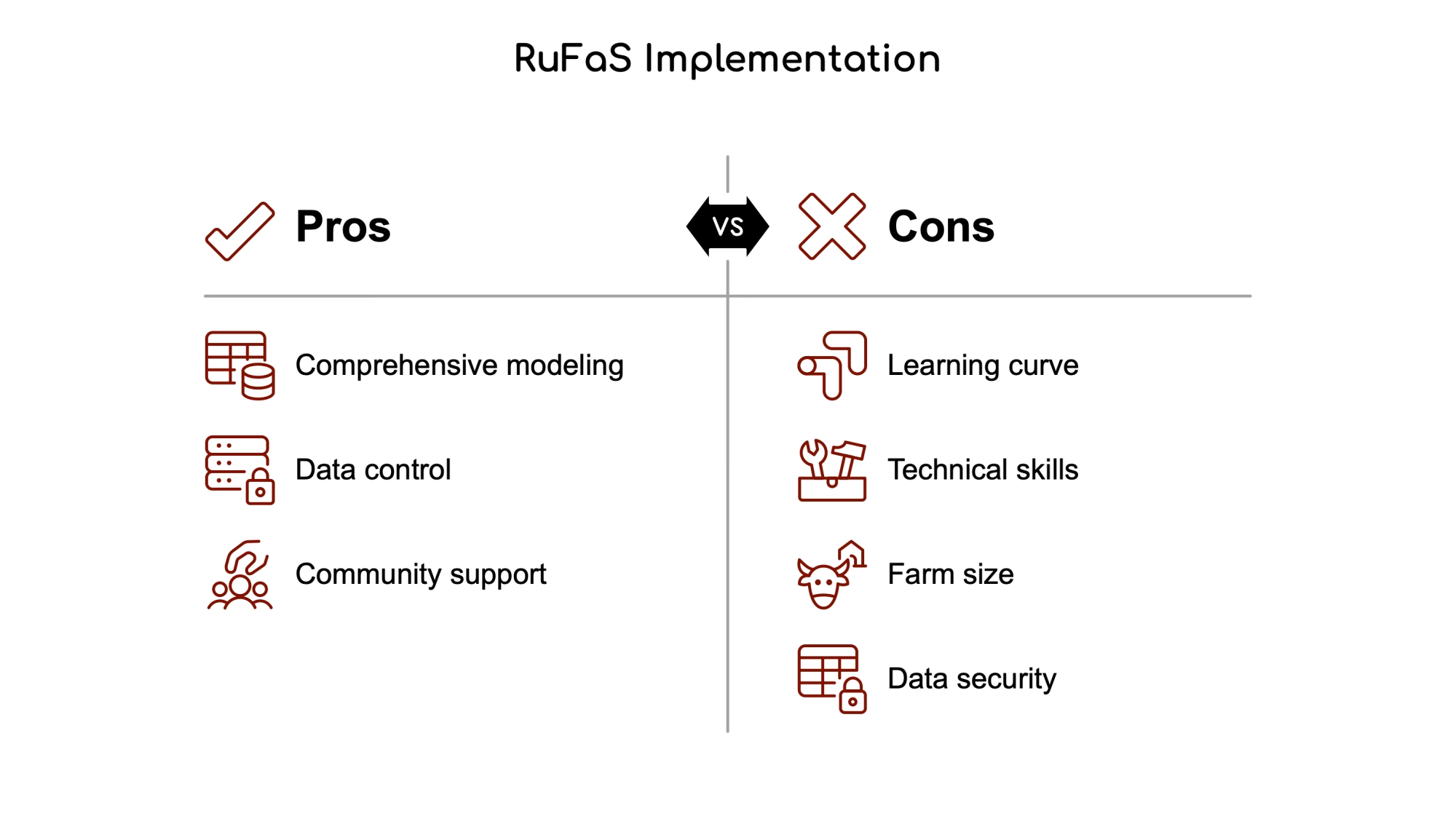
Let’s be honest about what you’re getting into. While RuFaS represents a revolutionary advancement, successful adoption requires understanding both its capabilities and limitations.
Learning Curve Considerations
RuFaS isn’t plug-and-play like your current software. The model’s sophistication requires:
- Time investment: Plan 2-3 weeks for initial familiarity
- Data preparation: Comprehensive farm information gathering
- Staff training: Key personnel need technical understanding
- Patience: Complex simulations take time to set up correctly
Technical Requirements
Unlike cloud-based subscription software, RuFaS requires:
- Local computing power: Standard farm computers handle it fine
- Data management skills: CSV files and database management
- Technical support: Community-based rather than phone support
Farm Size Considerations
RuFaS delivers maximum value for operations with:
- 300+ milking cows: Complexity justifies modeling sophistication
- Multiple enterprises: Crop, livestock, and manure management integration
- Environmental reporting needs: FARM program participation or carbon credit programs
- Management diversity: Multiple scenarios to evaluate
Smaller operations might find basic modules sufficient initially, with full implementation as operations grow.
Data Security and Privacy
Unlike proprietary software that owns your data, RuFaS keeps information on your systems. However, this means:
- You’re responsible for data backup and security
- There are no cloud vulnerabilities but also no automatic cloud backup
- Complete control over who accesses your information
Industry Disruption: The Resistance is Real (And Predictable)

Watch for predictable counterattacks from established software companies:
“Support Concerns”: They’ll claim free software can’t provide adequate support, ignoring that RuFaS comes with comprehensive documentation, active user communities, and collaborative development. How does that customer support work when your software crashes during breeding season?
“Reliability Questions”: Arguments about open-source stability from an industry that regularly releases buggy updates, discontinues products without warning, and holds your data hostage when you stop paying.
“Complexity Warnings”: They’ll suggest RuFaS is too complicated for farmers. You manage breeding programs with multiple AI studs, embryo transfer protocols, and crossbreeding systems, but apparently, you can’t understand transparent software algorithms?
The real disruption isn’t just economic—it’s philosophical. RuFaS shifts from “farmer as customer” to “farmer as collaborator.”
Getting Started: Your Path to Software Independence

Phase 1: Education and Exploration (Weeks 1-2)
- Download RuFaS documentation from Cornell’s project page
- Review module descriptions and input requirements
- Critical question: Can you afford to keep using inferior tools?
Phase 2: Pilot Testing (Weeks 3-6)
- Run parallel analyses with current software
- Compare results and examine assumptions
- Eye-opening reality: Your expensive software has probably been giving questionable results for years
Phase 3: Scenario Development (Weeks 7-12)
- Begin specific decision support scenarios
- Test management changes digitally before physical implementation
- Start with straightforward questions with clear economic implications
Phase 4: Integration Planning (Months 4-6)
- Develop strategies for regular management process integration
- Train staff and modify data collection procedures
- This isn’t just changing software—it’s improving decision-making
Phase 5: Community Engagement (Ongoing)
- Join the growing RuFaS user community
- Share experiences and contribute feedback
- Help improve the model for everyone
Technical barriers are minimal. If you can operate current farm management software or sync heat detection systems with breeding calendars, you can learn RuFaS.
The Future is Open: Where This Revolution Leads

The RuFaS revolution previews agriculture’s technological future. The question isn’t whether this transformation will happen—it’s whether you’ll lead it or follow it.
Expect to see:
Enhanced Integration: Real-time farm modeling based on sensor data rather than estimates—continuous monitoring of feed intake, activity levels, and milk production feeding comprehensive optimization models.
Global Adaptation: Open-source nature enables international customization for different climates and production systems.
Specialized Modules: Future developments in precision livestock farming, renewable energy integration, and ecosystem service quantification.
Policy Integration: Governments increasingly need sophisticated environmental modeling. RuFaS’s transparency and scientific rigor position it for official assessments and regulatory frameworks.
Do you want to use software regulators trust or software that hides its calculations?
The Choice is Yours: Evolution or Revolution

Every technological revolution reaches a tipping point where early adopters gain decisive competitive advantages. We’re approaching that moment in agricultural software.
You can continue paying thousands annually for black-box software that treats you like a customer to be managed rather than a partner to be empowered. You can keep writing checks to software companies that innovate at the pace of genetic progress in 1950—slow, secretive, and focused more on protecting their position than advancing the industry.
Or you can join the revolution.
RuFaS represents more than just free software—it’s a fundamentally different relationship between farmers and technology. Instead of being passive consumers, you become active participants in creating tools that actually serve your needs.
The agricultural software industry built its business model on information asymmetry and artificial scarcity. They convinced farmers that sophisticated modeling required expensive, proprietary solutions only experts could understand.
RuFaS shatters both assumptions.
Your current software subscriptions are probably up for renewal soon. Before you write those checks again, ask yourself: Why am I paying premium prices for inferior, inflexible tools when something better is available for free?
The revolution has already begun. The only question is which side of history you’ll choose.
Your Move: It’s Time to Act
The future of farm modeling is here. It’s open. It’s free. It’s RuFaS.
But here’s the hard truth: knowing about this revolution doesn’t help you if you don’t act. Every month you delay is another month of paying for inferior tools while competitors gain advantages.
So, here’s your call to action: Before you renew another software, subscription and accept another “proprietary algorithm” excuse, write another check to companies that treat you like a profit center—take one afternoon to explore RuFaS.
Visit the Cornell University RuFaS project page. Download the documentation. Run a comparison with your current software. Join the growing community of farmers and researchers building the future of agricultural modeling together.
Because here’s what I’ve learned in decades of covering this industry: The farmers who succeed aren’t the ones who wait for perfect solutions—they’re the ones who recognize game-changing opportunities and act while their competitors are still debating.
The revolution needs participants, not just observers. The question is: will you be one of them?
Stop paying for inferior software. Stop accepting black-box calculations. Stop letting software companies treat you like you can’t handle the truth.
The future is open source. The future is transparent. The future is now.
What are you waiting for?
Ready to explore RuFaS for your operation? Visit the Cornell University RuFaS project page or connect with the growing community of farmers and researchers who are building the future of agricultural modeling together. Because the revolution isn’t just about better software—it’s about better decisions, better outcomes, and a better future for dairy farming.
Key Takeaways
- Massive Cost Savings: Dairy operations spending $9,500-$26,000 annually on inferior proprietary software can access superior modeling technology for free, potentially saving $100,000-$260,000 over a decade.
- Superior Technology: RuFaS simulates individual animals using Monte Carlo methods rather than herd averages, provides complete algorithmic transparency, and integrates four interconnected modules for whole-farm optimization—capabilities that exceed expensive commercial alternatives.
- National Industry Validation: The model powers the FARM Environmental Stewardship Program Version 3, demonstrating that the national dairy industry chose free, open-source technology over expensive proprietary solutions for environmental assessments.
- Transparency Revolution: Unlike black-box commercial software that hides calculations, RuFaS provides complete open-source access to every equation and assumption, enabling farmers to verify, customize, and improve the model for their specific conditions.
- Competitive First-Mover Advantage: Early adopters gain access to research-grade modeling capabilities while competitors pay premium prices for inferior tools, positioning them for better decision-making and improved farm performance as the industry transitions to transparent, collaborative technology platforms.
Executive Summary
Cornell University’s Ruminant Farm Systems (RuFaS) model represents a seismic shift in agricultural software, offering free sophisticated dairy farm modeling while proprietary alternatives cost $9,500-$26,000 annually. Unlike black-box commercial software, RuFaS provides complete transparency with open-source code, simulates individual animals rather than herd averages, and integrates four interconnected modules tracking everything from feed storage to soil nutrients. The model has already achieved national validation through its integration with the FARM Environmental Stewardship Program, powering environmental assessments for thousands of U.S. dairy operations. This revolution challenges the $2 billion agricultural software industry’s business model built on information asymmetry and artificial scarcity. Early adopting farmers gain access to superior decision-support tools while potentially saving hundreds of thousands in software costs over a decade. The shift from proprietary to open-source represents more than cost savings—it’s a fundamental change from farmers as customers to farmers as collaborators in agricultural technology development.
Learn more:
- Simplify Your Dairy Farm Data Analysis: Turn Insights into Action
- Discover the Future of Dairy Farming: Key Technologies Revolutionizing the Industry
- 5 Technologies That Will Make or Break Your Dairy Farm in 2025
 Join the Revolution!
 Join the Revolution!
Join over 30,000 successful dairy professionals who rely on Bullvine Weekly for their competitive edge. Delivered directly to your inbox each week, our exclusive industry insights help you make smarter decisions while saving precious hours every week. Never miss critical updates on milk production trends, breakthrough technologies, and profit-boosting strategies that top producers are already implementing. Subscribe now to transform your dairy operation’s efficiency and profitability—your future success is just one click away.




