Archive for dairy export market

The Export Revolution That’s Starving America’s Butter Supply

Global buyers are draining U.S. butter supplies while you sleep. The $1.26/lb export advantage is rewriting domestic dairy rules forever.

EXECUTIVE SUMMARY: For the first time in 15 months, U.S. butter inventories have dropped below prior-year levels, falling 6.8% to 337.4 million pounds despite record milkfat production and abundant cream supplies. This dramatic shift stems from unprecedented export demand, with American butter trading at a $1.26 per pound advantage over European competitors—the largest gap in years. The April seasonal inventory build was the smallest in a decade, absorbed entirely by global buyers who are overlooking traditional quality specifications to secure American supply. Industry analysts project sustained pricing around $2.60 per pound as the tighter stocks-to-use ratio persists through Q2. Meanwhile, domestic import dependence is creating additional vulnerability as trade policies threaten to make imported alternatives less attractive. This isn’t a temporary market disruption—it’s a fundamental restructuring of butter markets from domestic commodity to global export opportunity. Producers who adapt their strategies to this new reality will capture the biggest long-term advantages, while those clinging to old domestic market assumptions risk missing the most profitable opportunity in decades.

KEY TAKEAWAYS

  • Export demand is the new market driver: Global buyers are absorbing U.S. butter faster than domestic storage can accumulate it, creating structural tightness that supports $2.60/lb pricing
  • Component strategy needs immediate revision: With butterfat premiums potentially increasing from $2.50 to $3.00 per point, a 1,000-cow herd could generate an additional $182,500 annually in component value
  • Supply security commands premium pricing: Buyers facing uncertainty are willing to pay premiums for guaranteed availability, making long-term contracts more attractive than spot market exposure
  • Regional advantages are emerging: Operations near export facilities or in areas with limited processing capacity may access premium pricing opportunities not reflected in national averages
  • Traditional seasonal patterns are obsolete: The smallest April inventory build in a decade signals that global demand no longer follows American agricultural calendars, requiring new marketing approaches

butter exports, dairy export market, butter prices 2025, global butter trade, American butter advantage

The world just discovered America’s butter secret, which will cost you $2.60 per pound. While you’ve been focused on mailbox prices, a quiet revolution in global dairy trade has fundamentally rewritten the rules of your domestic market—and the producers who adapt fastest will capture the biggest rewards in decades.

The April 2025 USDA Cold Storage numbers didn’t just surprise the market; they shattered every assumption about how butter inventories behave. For the first time in 15 months, U.S. butter stocks fell below prior-year levels, dropping 6.8% to 337.4 million pounds despite record milkfat production and abundant cream supplies. But here’s what the headlines missed: this isn’t a supply problem—it’s a demand revolution reshaping American dairy’s entire landscape.

Like managing a high-producing herd requires understanding individual cow performance, succeeding in today’s butter market demands recognizing that global forces now drive what happens in your local creamery. The days of thinking domestically about dairy fat allocation are over.

The $1.26 Advantage That Changed Everything

Let’s start with a number that should make every American dairy producer sit up and take notice: $1.26 per pound. According to current CME spot pricing data, U.S. butter holds the price advantage over European products, even after adjusting for fat content differences.

Think about that for a moment. In a global commodity market where pennies matter, American butter trades at more than a dollar premium to the world’s traditional butter powerhouse. This isn’t some temporary market hiccup—it’s the largest competitive gap we’ve seen in years, and it’s fundamentally altering global butter trade flows.

But here’s the question that should keep you up at night: Are you still pricing your components like it’s 2019?

Why This Advantage Exists—And Why It’s Sustainable

European dairy markets have been hammered by a perfect storm of challenges that would make your worst feed crisis look manageable: energy costs that make American producers look like they’re operating on subsidized power, regulatory constraints that limit production flexibility with the efficiency of a one-stall parlor, and input costs that would make your feed bills look modest. Meanwhile, American efficiency gains, favorable exchange rates, and our integrated supply chain have created a competitive moat that’s proving remarkably durable.

According to the latest Hoard’s Dairyman analysis, “Butter prices on the world market are still north of $3.20, which should keep exports positive in 2025”. But here’s where it gets interesting for your operation: this advantage isn’t just attracting opportunistic buyers looking for a deal. International purchasers are literally overlooking specification differences and potential trade policy ramifications to get their hands on American butter. When did you last see global markets abandon their traditional quality preferences for price? That’s not arbitrage—that’s structural demand shift.

The Seasonal Build That Wasn’t

Every April, butter stocks traditionally increase as spring flush production outpaces immediate demand. It’s dairy market physics—more milk, higher fat tests, more cream heading into storage. Except this April, that physics got rewritten entirely.

The seasonal inventory build between March and April was just 14.2 million pounds—the smallest increase in a decade. According to the USDA NASS report released May 23, 2025, butter stocks increased from 323.2 million pounds in March to 337.4 million pounds in April—a mere 4% monthly gain despite fat tests climbing to 4.36% (up 0.09% from last year).

What This Means for Your Component Strategy

This wasn’t a production constraint. There was plenty of milk/cream available in April. The minimal seasonal build happened because demand—driven primarily by export orders—was vacuuming up product faster than domestic storage could accumulate it.

For producers, this represents a fundamental shift in market dynamics. What are the traditional seasonal price patterns around which you built your component optimization? They’re being disrupted by global demand that doesn’t follow American agricultural calendars. Smart operators are already adjusting their butterfat marketing strategies and herd nutrition programs to capitalize on this new reality.

Think of it like this: if you’ve been managing your breeding program based on historical patterns, but suddenly your cows are cycling differently due to climate changes, you adapt. The same principle applies here—market seasonality is evolving, and your marketing strategy needs to grow with it.

Export Demand: The New Market Maker

Here’s where the story gets really interesting for forward-thinking producers. Export demand isn’t just contributing to tight supplies—it’s becoming the primary driver of domestic butterfat pricing.

Current spot butter prices hit $2.42 per pound as of the April 30 report, marking the first time since February that prices crossed the $2.40 threshold. However, industry analysts are projecting average prices of around $2.60 per pound as the tighter stock-to-use ratio works through the market. That’s not a price spike—that’s a fundamental repricing based on new demand patterns.

The Global Buyers Who Are Changing Your Market

International purchasers aren’t just buying American butter but actively seeking it out despite logistical challenges and specification differences. This represents a sea change in the global dairy trade. The latest CME market report from April 28, 2025, reveals that while “China’s punitive tariffs (up to 150% on whey)” are hampering some dairy exports, butter demand remains robust as “U.S. exporters pivot to Mexico and Southeast Asia amid trade headwinds.”

What’s driving this demand? European production constraints that make their drought years look manageable, Asian market growth that’s creating unprecedented demand for dairy fat, and the growing recognition that American dairy efficiency translates into superior value propositions for international food manufacturers. These aren’t short-term buyers looking to fill temporary gaps—they’re strategic purchasers building long-term supply relationships.

It’s like having buyers from three states over consistently bidding for your cull cows because your management program produces higher-quality animals. Once word gets out about superior value, demand becomes structural, not seasonal.

Regional Dynamics: Where Geography Meets Opportunity

The USDA’s upcoming changes to Cold Storage reporting will eliminate state-specific publications starting May 30, 2025, but the April data reveals critical regional patterns that smart producers can exploit.

Regional Butter Distribution Analysis

According to the USDA regional data, public warehouse butter stocks show significant geographic concentration, with the largest holdings in traditional dairy regions. However, proximity to export facilities creates distinct advantages that don’t show up in national averages.

For example, operations near major ports in California, New York, or the Great Lakes region may have opportunities to develop direct relationships with export buyers, potentially capturing premium pricing that coastal producers already enjoy. Similarly, regions with limited processing capacity might see stronger farmgate prices as buyers compete for limited supplies.

Building Regional Competitive Intelligence

With consolidated reporting coming, producers who invest in developing their own regional market intelligence will have advantages over competitors relying solely on national data. This might involve tracking local processor inventories, monitoring regional price trends, or developing relationships with buyers who can provide market insights.

It’s like having your own weather station instead of relying on the county average—the data that’s most relevant to your operation is often the most local data.

Risk Management: The Reality Check You Need

While the current market offers exceptional opportunities, it also introduces new risks that producers must understand and manage effectively.

Price Volatility and Timeline Expectations

Export demand creates price premiums but also increases volatility as global factors influence domestic markets. Analysis suggests that Q2 stocks-to-use ratios justify $2.60 average pricing but warns that “spot butter and futures were both quite firm heading into this report.”

Here’s your timeline reality check: The current tight inventory situation isn’t likely to resolve quickly. With the smallest seasonal build in a decade occurring during abundant cream availability, the structural demand shift appears sustainable through at least the remainder of 2025.

Supply Chain Disruption Risks

Global demand creates dependencies on international trade flows, shipping capacity, and foreign exchange markets that traditionally haven’t affected domestic dairy producers. The recent CME report highlights how “China tariffs cripple whey” exports, showing how quickly trade policies can disrupt established patterns.

Consider developing alternative marketing channels that can absorb your production if export markets suddenly become less accessible. It’s like having backup plans for feed supplies—you hope you never need them, but they’re essential for operational resilience.

Financial Modeling for Your Operation

Let’s translate market dynamics into numbers that matter for your bottom line. If current butterfat premiums increase from $2.50 to $3.00 per point above 3.5% fat due to export demand, a 1,000-cow herd averaging 4.2% fat suddenly generates an additional $182,500 annually in component value.

Here’s the calculation:

  • 1,000 cows × 23,000 lbs average production = 23 million lbs milk annually
  • 4.2% fat = 0.966 million lbs butterfat
  • 0.7 percentage points above 3.5% base
  • 0.7 × $0.50 premium increase × 966,000 lbs = $182,500 additional revenue

That’s not theoretical—that’s the kind of margin improvement this market shift can create.

Technology Integration: Your Digital Advantage

Modern dairy operations have access to data and technology tools that can provide significant advantages in navigating this new market environment.

Real-Time Market Intelligence

Consider precision feeding technology that can adjust rations based on real-time component pricing signals. When butterfat premiums spike, your system automatically optimizes for fat production. When protein values strengthen, you shift the nutritional focus. This kind of dynamic response capability is becoming a competitive necessity, not a luxury.

Component Optimization Tools

Modern genomic selection allows you to breed specifically for fat content, fat composition, and seasonal persistency—traits that become incredibly valuable when export markets reward consistent, high-quality butterfat production. It’s like having GPS guidance for your breeding program instead of navigating by landmarks.

The Bottom Line

The export revolution reshaping America’s butter market isn’t a temporary phenomenon—it’s a fundamental shift that creates both unprecedented opportunities and new challenges for dairy producers. The $1.26 per pound advantage American butter enjoys over European competitors, combined with structural changes in global demand patterns, has created market conditions that favor producers who understand and adapt to this new reality.

Based on verified USDA data from April 30, 2025, Cold Storage report, butter inventories at 337.4 million pounds represent the tightest supplies in 15 months. The minimal seasonal build of just 14.2 million pounds—the smallest in a decade—occurred despite abundant cream supplies, signaling unprecedented demand absorption.

Your Action Plan:

  1. Evaluate Your Component Strategy: Assess whether your fat-to-protein optimization maximizes returns under market conditions. Consider nutrition programs that can shift component focus based on market signals.
  2. Explore Export-Focused Relationships: Investigate opportunities with processors with established export channels, particularly in Mexico and Southeast Asia, where trade barriers remain manageable.
  3. Implement Dynamic Pricing Contracts: The current environment favors producers who can offer supply security. Long-term contracts with butterfat premiums may now offer superior risk-adjusted returns compared to spot market exposure.
  4. Build Regional Intelligence Networks: With USDA eliminating state-specific reporting after May 30, 2025, develop relationships that provide local market insights your competitors won’t have.
  5. Optimize for Export Quality Standards: Ensure your operation meets international quality requirements that enable access to premium export markets.

The producers who recognize this export revolution as a permanent market shift—not a temporary price spike—and adapt their strategies accordingly will capture the biggest long-term advantages. Those who continue operating under old assumptions about domestic markets will miss the most profitable opportunity the dairy industry has seen in decades.

The world has discovered what American dairy producers have known all along: we produce the most efficient, highest-quality butter on the planet. It’s time to leverage that advantage strategically and build operations that can thrive in an increasingly global marketplace.

Here’s your critical question: Are you still managing your operation like butter is a domestic commodity, or are you positioning yourself to capture your share of this global opportunity? The market has already given you the answer—the question is whether you’re listening.

Learn more:

Join the Revolution!

Join over 30,000 successful dairy professionals who rely on Bullvine Weekly for their competitive edge. Delivered directly to your inbox each week, our exclusive industry insights help you make smarter decisions while saving precious hours every week. Never miss critical updates on milk production trends, breakthrough technologies, and profit-boosting strategies that top producers are already implementing. Subscribe now to transform your dairy operation’s efficiency and profitability—your future success is just one click away.

NewsSubscribe
First
Last
Consent

TARIFF TIGHTROPE: Dairy Farmers Face Tough Choices as Trump’s Trade War Hammers Export Markets

China’s 125% tariffs slam US dairy exports as production peaks. Markets reel, farmers face profit squeeze & tough trade choices.

EXECUTIVE SUMMARY: Escalating trade tensions have thrown the US dairy sector into turmoil, with China’s retaliatory 125% tariffs effectively closing a critical $584M export market. The crisis hits as domestic milk production surges seasonally and $8B in new processing capacity comes online, flooding markets already rattled by plunging futures. USDA forecasts slashed milk prices across categories, while Mexico/Canada trade under USMCA grows fragile. Farmers face squeezed profits, volatile markets, and hard decisions about herd management and risk strategies. Three scenarios loom: prolonged trade war, negotiated truce, or industry pivot to new markets—each demanding urgent adaptation.

KEY TAKEAWAYS:

  • China’s 125% tariffs have shut down a $584M export channel overnight, crippling whey/lactose sales.
  • Domestic milk production surged 1% in February, colliding with shrinking export access to create oversupply risks.
  • Futures initially crashed below $17/cwt, with USDA cutting 2025 price forecasts for all dairy categories.
  • Profit margins evaporate as feed costs stay high and milk prices drop, forcing herd/risk strategy reviews.
  • Survival hinges on export diversification, hedging, and pressuring policymakers for trade resolution.
US dairy tariffs, China dairy trade war, dairy export market, milk price volatility, dairy farmer profitability

US dairy farmers who overwhelmingly supported Trump are now caught in a painful trade policy paradox. The administration’s escalating tariff battles with China, Mexico, and Canada have clouded what started as a promising year, threatening critical export channels just as milk production surges toward seasonal peaks. With China slapping retaliatory tariffs on US dairy products and futures markets signaling trouble ahead, producers face difficult choices between political loyalty and economic self-interest as the trade war intensifies.

Let’s face it – the return of Republican trade policy is creating one whopping headache for the dairy industry. After three years of relatively stable trade relations under Biden, Trump’s administration has wasted no time implementing its “America First” approach, and dairy farmers are feeling the squeeze where it hurts most – in their milk checks.

Does supporting Republican policies on taxes, regulations, and immigration mean you must swallow the bitter pill of trade disruption, too? That’s the trillion-dollar question facing dairy producers across America’s heartland this spring as seasonal production peaks collide with shrinking export opportunities.

Dairy Farmers Caught Between Politics and Profits

Here’s the uncomfortable truth: the same administration that 75% of dairy-heavy counties voted for is now implementing policies that the market views as harmful to the industry. CME Class III milk futures have sunk below per hundredweight for May and June contracts, reflecting serious concern about how restricted export access will impact domestic prices.

“Immigration reform has been very contentious,” notes Joe Glauber, former USDA chief economist, highlighting another area where Republican policies create tension for dairy operators who depend heavily on immigrant labor. “Immigrants supply at least half of fired labor for the dairy industry… Most of these workers may be undocumented, which could cause a real issue”.

Unlike seasonal crops, dairy farms need workers year-round, making them especially vulnerable to aggressive deportation policies. Can you support tighter borders while recognizing your operation might collapse without immigrant workers? It’s another contradiction many Republican dairy farmers are struggling to reconcile.

The China Conundrum: When Tough Talk Hits Your Bottom Line

Remember when getting tough on China seemed like a good idea at the campaign rallies? The reality has proven far more complicated for dairy producers dependent on export markets.

China has issued retaliatory tariffs on various US dairy products in response to Trump’s actions, effectively pricing American products out of this crucial market. For perspective, China represents a $584 million export destination that took 385,485 metric tons of US dairy products last year – a market now effectively closed by punitive tariffs.

Are you willing to sacrifice your farm’s profitability for a tougher stance against China? That’s the question many Republican dairy farmers are quietly asking themselves as retaliatory tariffs slam shut doors to markets, they’ve spent decades developing.

USMCA: A Republican Achievement Now Under Threat

One of the Trump administration’s legitimate agricultural accomplishments was negotiating the USMCA agreement, which maintained critical access to Mexico and Canada, collectively accounting for over 40% of all US dairy exports worth .6 billion annually.

But here’s the kicker – the current administration’s aggressive approach to tariffs now threatens to undermine this very achievement. Mexico remains America’s largest dairy customer at .47 billion annually, while Canada purchased a record .14 billion in US dairy products last year. Both relationships now hang in a precarious balance.

Looking to the future, dairy product sales to Mexico have great room for more growth as more Mexican consumers enter the middle class and seek higher-quality proteins and fats. Will this potential be sacrificed in the name of broader trade battles?

Republican Dairy Voices in Congress: Where Are They?

The dairy industry has historically had allies on both sides of the political aisle. Congressman David Valadao, a Republican dairy farmer from California’s Central Valley, won election in 2012 in a district where registered voters were 47% Democrat and only 33% Republican.

When Valadao decided to run the first time, he said it came down to, ‘You want to make a difference. You want to get involved. You want to do what’s good for your community.

With active dairy farmers like Valadao in Congress, you’d think the industry’s interests would be protected in Republican policy circles. So why aren’t Republican dairy representatives speaking louder against policies that harm their constituents’ livelihoods? The political calculus has grown increasingly complex.

Practical Strategies for Dairy Farmers

So, what’s a dairy farmer to do when facing this political-economic dilemma? Here are some practical approaches being adopted by forward-thinking producers:

  1. Separate politics from business decisions – Many are implementing hedging strategies even when they support the administration’s broader goals
  2. Engage with industry groups – Organizations like the International Dairy Foods Association are advocating for dairy-specific exemptions from tariff battles
  3. Diversify markets – Smart operators are reducing dependence on China by developing relationships with processors selling domestically or to more stable export destinations
  4. Control what you can control – Focus on reducing production costs and increasing efficiency regardless of political sympathies
  5. Communicate with elected officials – Even strong Republican supporters are making clear to their representatives that dairy needs protection from trade disputes

The Bottom Line: Principles Meet Pragmatism

The reality for America’s dairy sector is uncomfortable but unavoidable: the tariff policies being implemented by the administration most farmers supported are creating significant economic headwinds for their businesses.

Being a successful dairy farmer in 2025 means navigating this contradiction with clear-eyed pragmatism. You can support Republican principles on taxes, regulations, and social issues while still advocating for trade policies that protect your markets. The two positions aren’t mutually exclusive.

Let’s remember what brought most farmers to the Republican party in the first place – the promise of economic policies that support business growth and profitability. When specific policies counter those goals, real conservatives understand that speaking up isn’t disloyalty – it’s consistent with the principles of economic freedom and market access that define true Republican values.

The tariff tightrope won’t be easy to walk. But America’s dairy farmers have always been practical problem-solvers first and political partisans second. That pragmatic approach will be essential as you navigate the challenging trade environment.

Learn more:

Join the Revolution!

Join over 30,000 successful dairy professionals who rely on Bullvine Daily for their competitive edge. Delivered directly to your inbox each week, our exclusive industry insights help you make smarter decisions while saving precious hours every week. Never miss critical updates on milk production trends, breakthrough technologies, and profit-boosting strategies that top producers are already implementing. Subscribe now to transform your dairy operation’s efficiency and profitability—your future success is just one click away.

NewsSubscribe
First
Last
Consent

Ukraine’s Dairy Resilience: Adapting to War and Market Shifts

Discover how Ukraine’s dairy sector faces challenges and finds opportunities amid conflict. How can farmers respond to declining output and changing consumer needs?

Despite the ongoing conflict, Ukraine’s dairy sector has shown remarkable resilience, navigating unprecedented challenges and underscoring its vital role in its economic fabric. The industry’s ability to adapt and survive in the face of Russian aggression, relentless infrastructure attacks, and electricity shortages is a testament to its strength. This resilience offers hope for the future of Ukraine’s dairy industry. 

The Dichotomy of Resilience: Household Plots vs. Industrial Farm Fortitude in Ukraine’s Dairy Sector

The current landscape of Ukraine’s dairy sector characterizes a stark divide between household plots and industrial farms. Household plots, which account for about 60% of Ukraine’s total milk production, continue to grapple with inefficiencies primarily due to basic sanitary and veterinary practices. Despite their substantial contribution to overall production, these plots offer minimal input to industrial processing—approximately 8-9% of fluid milk. 

In contrast, industrial farms are on an upward trajectory. Recent data indicates a modest increase in fluid milk production from these farms despite a decreased overall cow inventory. This growth is fueled by improved productivity and operational scales, responding to the challenges posed by reduced domestic demand and logistical constraints stemming from ongoing geopolitical tensions. 

Statistics tell a compelling story. As of 2023, the number of cows in milk stood at roughly 1,400,000. This number is projected to fall to 1,150,000 by 2025, reflecting the broader structural adjustments within the industry. Milk production peaked at 7,452 thousand metric tons in 2023, an anomaly attributed to statistical adjustments, before declining slightly as industrial farm efficiency gains struggled to offset losses from household plots fully. 

These trends highlight the inefficiencies of the household dairy sector and the resilience and growth potential of industrial farms. The transition towards increased industrialization seems pivotal for the sector’s future, especially amid challenges such as electricity outages and labor mobilization that further strain production capacities.

Amidst the Shadows of Conflict: Navigating the New Terrain of Ukraine’s Dairy Industry

The Russian invasion, which began in 2022, has cast a long shadow over Ukraine’s dairy sector, drastically altering its landscape. The war’s direct implications are seen in the extensive damage inflicted on infrastructure. Dairies that once thrived on well-established supply and distribution networks now grapple with disruptions. Roads crucial for transporting milk to processing plants have been compromised, and production facilities in eastern regions face existential threats. 

One of the most acute challenges has been the frequent electricity outages, which have disrupted the regularity of production cycles. Dairy farms, heavily reliant on electricity for milking and milk chilling operations, have been forced to resort to power generators. These have increased operational costs and put smaller operations under immense financial strain, as they cannot absorb the shock of surging energy expenses. 

The conflict’s direct consequence has been workforce mobilization, which has led to labor shortages that further exacerbate production woes. Many workers have been conscripted into the military or displaced due to the conflict, significantly reducing the available labor force for dairy farming. Due to increased wage demands, farms struggle to maintain operations, often operating below capacity or at higher operational costs. 

Many dairy operations have migrated to central and western Ukraine in response to these adversities. These regions offer relative safety, but this relocation comes with a price. Farms must establish new operational bases and rebuild customer connections and supply chains while facing elevated logistics and setup costs. Additionally, this geographic shift has inadvertently increased competition amongst farms in these “safer” zones, increasing production costs and squeezing profit margins. 

These challenges have prompted an industry-wide recalibration, with efficiency taking precedence over expansion. The focus has shifted towards maximizing output per cow, investing in higher-yielding dairy technologies, and embracing sustainable practices. Despite the seemingly insurmountable challenges, the Ukrainian dairy industry is demonstrating unique resilience and seeking pathways to sustain its vital contribution to national food security. This growth potential should inspire and motivate stakeholders in the industry.

The Ukrainian Dairy Diagonal: Navigating Soft Cheese Ascendancy and Plant-Based Surges

The Ukrainian dairy market is at an intriguing crossroads, shaped by evolving consumer preferences and challenging economic realities. Notably, a discernible shift is occurring from complex to soft cheese. This transition is not just a fleeting trend but a reflection of changing consumer palates that now lean towards the versatility and cost-effectiveness of fresh, soft cheeses. These cheeses are increasingly favored in modern recipes, incorporating them into a broader range of cuisines beyond traditional Ukrainian dishes. 

The rise of plant-based milk substitutes is also influencing the market for dairy products. A growing segment of the population—about 5% of consumers—now regularly purchases these alternatives, with an additional 16% trying them at least monthly. This shift is driven by health trends, lifestyle choices, and their affordability in the face of economic instability. 

Economic factors loom large over Ukraine’s dairy consumption patterns. The decline in disposable income, compounded by ongoing population outflows due to conflict, exerts significant pressure on the market. Fluid milk sales, while traditionally stable, are not immune to these pressures and have seen only slight declines amid these challenging circumstances. The government’s potential tax increases further weigh on the horizon, threatening to constrain household budgets even more tightly. 

Moreover, demographic shifts resulting from population outflows, primarily affecting women and children—critical consumers of dairy products—are further influencing market dynamics. This demographic change affects consumption levels and alters the types of dairy products in demand, influencing individuals to seek budget-friendly and accessible alternatives.

Navigating the Narrow Path: Overcoming Raw Milk Challenges and Seizing EU Opportunities for Ukrainian Dairy Exports

Ukraine’s dairy export market faces significant hurdles, primarily driven by a shrinking raw milk supply. This shortage limits the volume available for international trade, thereby constraining growth opportunities. The scarcity of raw milk directly impacts the production capacities for export-oriented goods like cheese, butter, and non-fat dry milk (NFDM), keeping exports tepid. Despite these adversities, there are pathways to potential growth. 

The European Union (EU) represents a beacon of opportunity for future expansion. Ukrainian processors eye the EU market not only due to geographic proximity but also because of existing infrastructural pathways that can facilitate easier access. However, to tap into this potential, Ukrainian dairy products must meet stringent EU standards, requiring product quality and compliance investments. The role of international traders has been pivotal, bridging gaps between local producers and global markets. These traders often blend Ukrainian products with those from other regions, enhancing standards and sometimes re-exporting products under different labels. 

The competitive landscape is evolving, driven by both internal and external pressures. Domestically, Ukrainian producers must diversify beyond traditional product lines to cater to changing consumer preferences locally and abroad. The ascendancy of plant-based dairy alternatives represents a significant shift in consumer behavior that could redirect market demands. To maintain a competitive edge, Ukrainian dairy must innovate, developing niche products that cater to emerging market segments and respond to global dietary trends. 

In summary, while raw milk shortages present considerable challenges, strategic alignment with EU standards, leveraging international trade networks, and embracing product diversification could unlock new avenues for Ukraine’s dairy sector. This would mark the blueprint for sustainable export growth in a challenging global landscape.

Strategic Evolution in the Face of Societal and Economic Turmoil: Crafting a Resilient Future for Ukraine’s Dairy Sector

The future of Ukraine’s dairy industry stands at a crossroads, shaped by complex societal, economic, and geopolitical challenges. Looking ahead, stakeholders must recognize these hurdles as opportunities for strategic evolution. Although the immediate landscape may seem bleak, long-term prospects can be significantly enhanced through concerted efforts and innovative strategies. 

Given the persistent threat of infrastructural disruptions, particularly power outages, investing in renewable energy solutions like solar installations and more efficient energy storage systems could safeguard production continuity. We are strengthening infrastructure buffers against external shocks and positioning the industry toward sustainable growth. 

Efficiency improvements are paramount, especially on household farms. Encouraging these farms to adopt better sanitary and veterinary practices could enhance their productivity and product quality, thus integrating them more effectively into broader supply chains. Government incentives, perhaps in subsidies or technical support, could accelerate this transition, fostering a more resilient agricultural base. 

Diversifying target markets outside traditional FSU countries is essential for exporting. Ukraine has untapped potential by tapping into emerging markets in Asia and Africa, where dairy demand is burgeoning. Establishing trade relations with EU ports as logistical hubs can facilitate smoother export operations and lower transportation costs. 

Moreover, the industry might benefit from aligning more closely with global dairy trends, such as the growing popularity of plant-based alternatives. By locally leading innovations in this sector, Ukrainian producers could capture new consumer bases concerned with health and environmental impacts, thus securing an influential market position. 

Ultimately, each strategic move should be assessed for its long-term viability, ensuring that temporary gains stay within sustainable growth prospects. By embedding flexibility and foresight into their strategies, Ukraine’s dairy sector can overcome current adversities and lay the groundwork for a robust, future-ready industry.

Ukraine dairy sector, thriving despite conflict, commercial farms, home farms, growth, international collaboration, Michigan State University Extension, manufacturing cheese, infrastructural devastation, Association of Milk Producers, AMP, dairy practices, output levels, destruction of infrastructure, decreased herd populations, inventive techniques, milk, commercial goods, cheese, statistics, commercial milk output, efficiency, surviving herds, resilience, resourcefulness, global dairy markets, potential, consistent supply, dairy products, worldwide, Ukrainian dairy products, global supply networks, international crises, pandemics, geopolitical conflicts, improve dairy farming methods, worldwide partners, Michigan State University, new standards, dairy production, manufacturing procedures, higher-quality dairy products, Ukrainian exports, competitive, dairy-producing countries, raise standards, guidelines, competitive environment, consumers worldwide, future, institutions, education, technical improvements, economic initiatives, Ukrainian dairy producers.

Ukraine’s Dairy Odyssey: Navigating Past Legacies and Future Frontiers

Ukraine’s dairy industry, a cornerstone of its agricultural economy, has undergone significant transformations over the decades. This evolution closely mirrors the country’s turbulent geopolitical landscape, introducing challenges and opportunities with each shift. 

During the Soviet era, Ukraine was a critical milk supplier within the USSR, benefiting from centralized agricultural policies supporting large-scale dairy production. However, the dissolution of the Soviet Union in 1991 marked the onset of a challenging transition to a market-based economy. Removing subsidies and decentralizing farms led to immediate declines in production, as many smaller farms struggled to compete in the new economic climate. 

The dawn of the 21st century saw a gradual recovery driven by domestic reforms and foreign investments. This period was marked by the modernization of dairy facilities and a partial shift towards industrial farming, which began to improve overall productivity. Nevertheless, despite being less efficient, household plots continued to dominate the sector, reflecting the country’s mixed agricultural practices

Geopolitical tensions, particularly the annexation of Crimea in 2014 and the ongoing conflict with Russia have further shaped the industry. These events disrupted traditional export routes and markets, forcing Ukrainian producers to seek new partnerships and alliances, notably within the European Union. This necessity paved the way for compliance with EU standards, positioning some Ukrainian dairies to explore high-value markets. 

As Ukraine navigates its socio-political challenges, the dairy industry stands at a crossroads. The evolution of industrial farms amidst ongoing conflict suggests a potential path toward increased efficiency and expanded exports. Yet, with persistent threats such as power outages and workforce mobilization, the sector must remain adaptable. Fusing traditional practices with modern strategies offers a promising outlook, provided the industry can withstand the geopolitical tremors that still linger.

Global Support: A Beacon of Hope for Ukraine’s Dairy Resurgence

International aid and support have proven critical lifelines for Ukraine’s dairy industry, especially during hostilities. Several organizations and countries have rallied to bolster this sector, recognizing its importance in sustaining the national economy and ensuring food security

One notable example is the European Union’s commitment to providing financial aid and technical assistance to Ukrainian agricultural producers. This support includes helping dairy farmers access modern equipment and technology, enhancing productivity and efficiency amidst adversity. Additionally, the EU has facilitated export routes via their ports, mitigating some supply chain disruptions caused by regional instabilities. 

The United States Agency for International Development (USAID) has also played a pivotal role. It has launched programs to improve the resilience of Ukraine’s agricultural sector, including grants focused on dairy infrastructure and logistics improvements. These initiatives are designed to support local economies by protecting jobs linked to the dairy industry and paving the way for long-term growth and stability. 

Moreover, global organizations like the Food and Agriculture Organization (FAO) have been active in providing emergency assistance and resilience-building strategies. Their focus includes distributing essential supplies and offering expertise to optimize production practices, which can help offset the challenges presented by ongoing infrastructure damage. 

These combined efforts highlight the international community’s acknowledgment of Ukraine’s agricultural potential and strategic importance in the region. The support has been a source of immediate relief and a foundation for building a more sustainable and competitive dairy sector in the future.

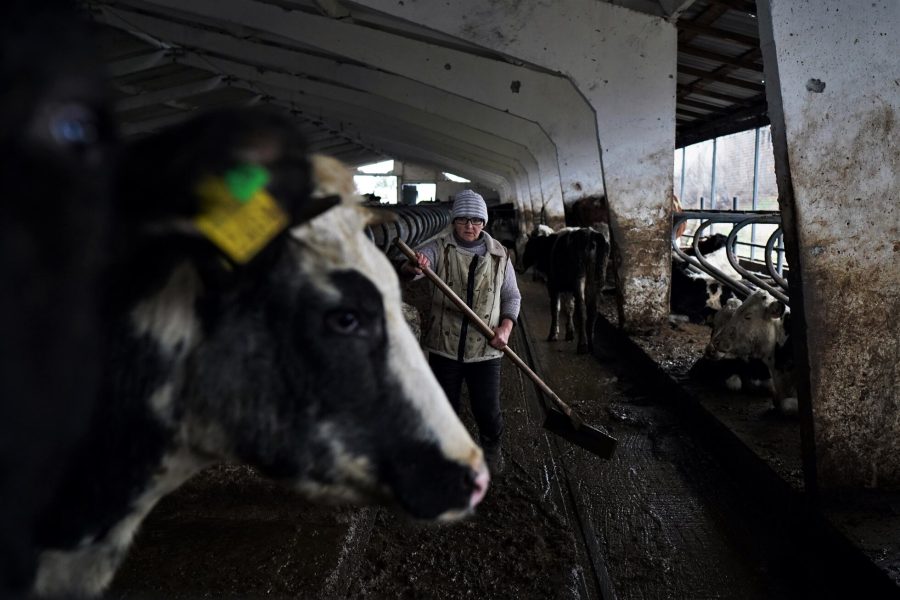
An employee works with some of the cows that survived the bombing at the Agrosvit farm, where 2,000 of the 3,000 animals died.

Reshaping Resilience: Ukraine’s Dairy Industry’s Path from Deconstruction to Renewal

The ongoing conflict has critically unraveled the intricate weave of Ukraine’s dairy industry, altering its fabric in profound and potentially enduring ways. In the long term, the war’s immediate effects—such as the decimation of infrastructure, the loss of workforce due to mobilization, and the disruption of supply chains—could lead to prolonged stagnation if not carefully managed. The reduction in dairy cow inventory and dwindling fluid milk production affects current market dynamics and sets back the industry’s ability to compete globally. 

However, scenarios for recovery and growth remain plausible once hostilities cease. A pivotal factor is refugees’ and displaced persons’ potential return and reintegration, which significantly bolsters human capital and domestic consumption. Modernizing infrastructure, particularly in resilient central and western Ukraine regions, could position the industrial sector better to absorb technological advancements, thereby enhancing productivity and efficiency. 

A strategic development plan that includes robust infrastructure investment and incentives for technological integration will be paramount for sustainable future growth. Collaboration with international partners for rebuilding efforts offers a lifeline, opening pathways to access advanced agricultural technologies. Establishing cooperative frameworks and knowledge exchange programs with EU dairy sectors could encourage Ukraine to rejuvenate its dairy industry to meet international standards. 

Government policy must support this transformation through subsidies and grants to revitalize household and industrial dairy farms. Additionally, fostering export partnerships will be crucial for market expansion, leveraging Ukraine’s geographical advantages and existing trade agreements. By focusing on sustainability, innovation, and international collaboration, Ukraine’s dairy industry can transform adversity into an opportunity for profound regeneration.

Global Lessons in Dairy: Navigating Turbulence for Survival and Growth

In a global context, the challenges faced by Ukraine’s dairy sector are not unique. Countries like Syria and Yemen, grappling with geopolitical instability, showcase similar patterns of disruption in agricultural industries. In Syria, the ongoing conflict has destroyed infrastructure, including that critical for dairy processing, resulting in a significant decrease in dairy productivity and quality [FAO Report on Syria Dairy]. This has forced a reliance on imports, causing a sharp increase in dairy prices, which impacts food security. In Yemen, consistent conflict has severely disrupted the supply chains necessary for dairy production, leading to a reliance on local, less efficient production methods [World Bank on Yemen Agriculture]. 

Both contexts offer critical lessons on resilience and adaptation. Addressing infrastructure challenges through international aid and rebuilding efforts can enhance recovery and sustainability in conflict-affected regions. Additionally, these situations emphasize the importance of diversifying milk production to ensure resilience against unforeseen disruptions. Efforts to support smallholder farmers and integrate them with industrial supply chains can bolster global food security and industry stability.

The Bottom Line

Ukraine’s dairy industry showcases remarkable resilience and perseverance in adversity. Industrial farms continue to find ways to increase productivity despite the ongoing challenges, while consumer preferences for soft cheese and plant-based alternatives are gradually shifting. Although the sector faces significant obstacles, including raw milk supply shortages and the looming threat of Russian aggression, opportunities for growth and expansion still exist, mainly through exports to the EU. 

As these producers navigate the complex tapestry of economic and social upheavals, the grit of the Ukrainian dairy industry remains a beacon of hope and potential. However, this is not a time for complacency. It’s crucial to ponder: How can the global community strengthen Ukraine’s agricultural backbone, ensuring its sustainability and growth in these testing times? 

Key Takeaways:

  • Ukraine’s fluid milk production is forecasted to decrease slightly in 2025 despite rising efficiency and industrialization in dairy farming.
  • The household sector remains a significant but inefficient contributor, primarily serving the low-price, low-quality market segment.
  • Russia’s ongoing aggression poses substantial risks to Ukraine’s dairy industry, with infrastructure attacks impacting production capabilities.
  • Domestic consumption of dairy products will continue to decline due to the economic downturn and population outflows.
  • Cheese production will shift towards soft varieties, with EU imports intensifying competition in the higher market segments.
  • Butter and NFDM production face contraction due to a tight milk supply, but exports may continue through EU trading channels.
  • Despite challenges, the Ukrainian dairy sector aims to maintain resilience and explore growth opportunities, especially post-2025, when recovery is anticipated.

Summary:

At a crossroads of geopolitical turmoil and economic instability, Ukraine’s dairy industry anticipates a slight drop in fluid milk production in 2025 due to the conflict with Russia, impacting resources and industrial efficiency. While industrial farms enhance efficiency, this is counterbalanced by household plots grappling with inefficiency, as they account for 60% of production but utilize rudimentary methods. The sector faces reduced incomes, population outflows, and shifting consumer preferences toward soft cheese and plant-based alternatives. Amid these challenges, producers aim to pivot toward EU export channels for growth prospects. Although industrial farms are adapting, the number of milking cows is poised to decrease to 1,150,000 by 2025, illustrating sector resilience amidst adversity.

Learn more:

Join the Revolution!

Bullvine Daily is your essential e-zine for staying ahead in the dairy industry. With over 30,000 subscribers, we bring you the week’s top news, helping you manage tasks efficiently. Stay informed about milk production, tech adoption, and more, so you can concentrate on your dairy operations. 

NewsSubscribe
First
Last
Consent
Send this to a friend