Holstein breeders just achieved a 40% dystocia reduction so dramatic it broke CDCB’s math—while Brown Swiss rates climb. Are you on the right side?
EXECUTIVE SUMMARY: While most dairy producers focus on incremental genetic gains, Holstein breeders have quietly engineered a breeding revolution so successful it literally broke the industry’s statistical models. The Council on Dairy Cattle Breeding had to delay their routine April base change because dystocia rates plummeted from 2.29% to just 1.36% between bulls born in 2015 versus 2020—a staggering 40% improvement that forced geneticists to recalibrate their entire evaluation system. This isn’t just genetic progress; it’s proof that when genomic selection converges with strategic sexed semen deployment and precision management, the impossible becomes routine—saving operations $1,350-2,700 annually in veterinary costs alone. Yet while Holsteins celebrate this breakthrough, Brown Swiss face the uncomfortable reality of increasing dystocia rates, revealing a tale of two breeds heading in opposite directions. The August 2025 base change means 84% of historical Holstein bulls now rank worse than today’s genetic baseline, fundamentally reshuffling breeding hierarchies. But here’s the provocative question: when genetic success approaches biological limits and PTA variability shrinks, are we breeding ourselves into a corner where selection pressure has nowhere left to go? Every dairy operation needs to evaluate whether their breeding strategy aligns with this genetic revolution or risks being left behind in an industry where yesterday’s elite genetics are tomorrow’s genetic liabilities.
KEY TAKEAWAYS
Economic Impact Acceleration: Operations using 2020-birth-year Holstein bulls can expect 76% fewer dystocia cases compared to 2015 genetics, translating to $4,000-8,000 annual savings in emergency veterinary costs for a 500-cow operation—proving genetic selection delivers immediate ROI.
Breed-Specific Risk Assessment: While Holstein producers celebrate success, Brown Swiss operations face 0.6% increasing dystocia rates, demanding immediate breeding strategy pivots—highlighting how genetic trends can diverge dramatically between breeds in the same market conditions.
Statistical Constraint Management: As Holstein dystocia rates approach biological limits, standard deviation dropped from 0.61% to 0.45%, meaning genetic differences between bulls are shrinking—requiring more sophisticated selection criteria to maintain competitive advantages.
Global Competitive Positioning: With 47% of active AI bulls now falling below the new phenotypic base, operations using outdated genetics are statistically disadvantaged in a market where genetic progress has accelerated beyond traditional expectations, demanding immediate sire selection audits.
Here’s what the Council on Dairy Cattle Breeding didn’t expect when they tried to update calving trait bases in August 2025: Holstein dystocia rates have plummeted so dramatically, from 2.29% to just 1.36% between bulls born in 2015 versus 2020 – that it literally broke their statistical models. We’re talking about a 40% reduction in difficult calvings that’s so successful it’s creating mathematical headaches for geneticists.
Let’s be honest here. When was the last time you heard about a genetic improvement so dramatic that it forced the industry’s top statisticians to go back to the drawing board? The CDCB had to delay their routine April base change because the results were so unexpected that they thought something was wrong.
Turns out, everything was right. Maybe too right.
The Numbers That Made Geneticists Do a Double-Take
Think about this: Holstein bulls born in 2020 produce calves with only 1.36% dystocia rates on first-parity cows. Compare that to bulls born just five years earlier at 2.29%, and you’re looking at nearly a 40% improvement in half a decade.
But here’s where it gets interesting – and a little concerning. As dystocia rates approach zero, the math starts getting weird. You can’t have negative dystocia rates, so as success rates climb, the statistical models that evaluate genetic merit start hitting biological ceiling effects.
What This Means for Your Operation: If you’re still using bulls from the 2015 birth year cohort, you’re selecting genetics statistically worse than 84% of the historical population under the new base. That’s not just genetic progress – that’s a genetic revolution.
Brown Swiss: The Inconvenient Truth Nobody’s Talking About
While Holstein breeders are celebrating, there’s an uncomfortable reality brewing in Brown Swiss herds. Their dystocia rates are actually increasing, with Sire Calving Ease PTAs reflecting a 0.6% rise in difficult calvings.
Why isn’t anyone talking about this? Celebrating Holstein’s success is easier than confronting Brown Swiss’ struggles. But if you’re breeding Brown Swiss, this base change just became your wake-up call. The genetic trend is flat, the population is small, and the math works against you.
Are we witnessing the beginning of a breed-specific crisis? Or is this just statistical noise in a smaller population?
The Sexed Semen Revolution You Didn’t Notice
Here’s the part that challenges everything you think you know about genetic improvement. This isn’t just about better genetics but strategic technology deployment. The increased use of sexed semen has fundamentally changed the game by reducing the proportion of larger male calves.
The Statistical Constraints That Should Worry You
Standard deviation for Holstein Sire Calving Ease dropped from 0.61% to 0.45%. Translation? The genetic differences between bulls are shrinking because we’re approaching biological limits.
What happens when an entire breed gets so good at something that the evaluation system can barely detect differences anymore? We’re finding out in real-time. The CDCB had to recalibrate their threshold models completely because success broke their mathematics.
This raises uncomfortable questions: Are we breeding ourselves into a genetic corner? What happens when everyone is equally good at calving ease? How do you maintain selection pressure when the trait is essentially solved?
Global Implications Nobody’s Discussing
While U.S. Holstein breeders pat themselves on the back, what’s happening to genetic diversity in the global Holstein population? Research from Europe shows similar improvements in calving ease, suggesting this isn’t just a U.S. phenomenon.
But here’s the provocative question: Are we homogenizing the global Holstein gene pool so effectively that we’re creating systemic vulnerabilities? When entire breeds converge on the same genetic solutions, what happens when environmental challenges change?
The economic implications are staggering. Veterinary intervention costs for dystocia average $150-300 per case, meaning a 1,000-cow operation could save $1,350-2,700 annually. Multiply that across the global Holstein population, and we’re talking about hundreds of millions in economic impact.
The Uncomfortable Reality About Genetic Progress
Historical context reveals something remarkable: In 2005, the phenotypic base for Holstein calving ease stood at approximately 8%. By 2024, it had dropped to 2.29%. Now it’s 1.36%.
This isn’t gradual improvement – it’s exponential progress that’s accelerating. The genetic trend was flat before 2005 and took off like a rocket. What changed? Genomic selection, strategic breeding decisions, and technology deployment converged to create compound benefits.
But here’s what should keep you awake at night: If genetic progress can accelerate this dramatically in one direction, what happens when selection pressure shifts to other traits? Are we creating genetic opportunity costs we don’t fully understand?
The August Reckoning
The August 12, 2025, implementation affects both Holstein and Brown Swiss evaluations simultaneously. Holstein operations will see PTAs drop by an average of 0.76% for Sire Calving Ease, while Brown Swiss producers face the opposite challenge.
For active AI bulls, approximately 47% now fall below the new phenotypic base for Holsteins. This isn’t just a statistical adjustment – it’s a fundamental reshuffling of genetic rankings that will influence breeding decisions for the next five years.
Why This Changes Everything
Recording and reporting calving ease scores remain “vitally important” despite the dramatic improvements. The reduced PTA variability makes accurate data collection even more critical for identifying genetic differences.
But let’s be honest about what this really means: The industry just proved that systematic genetic improvement can exceed everyone’s wildest projections. When multiple selection pressures align with practical management advances, genetic change can happen faster than anyone thought possible.
The Bottom Line
The August base change validates something revolutionary: Holstein breeders have achieved a 40% reduction in dystocia rates within five years, proving that targeted breeding programs can solve real problems faster than industry experts predicted. Brown Swiss producers face the opposite challenge, requiring immediate strategic adjustments.
This represents a fundamental shift in how we think about genetic improvement for progressive operations. The validation of these dramatic improvements signals that genetic progress in dairy cattle can accelerate beyond traditional expectations when science-based selection meets practical innovation.
But here’s the uncomfortable truth: While celebrating this success, we need to ask whether we’re creating new problems we don’t fully understand. The mathematical constraints, breed-specific divergences, and potential genetic homogenization effects deserve serious consideration.
The real question isn’t whether you can improve your calving ease genetics – it’s whether you’re prepared for the unintended consequences of success. When an entire breed achieves near-optimal performance in one trait, the selection pressure has to go somewhere. Where it goes next might surprise everyone.
Are you ready for the genetic revolution that’s already here?
Complete references and supporting documentation are available upon request by contacting the editorial team at editor@thebullvine.com.
Learn More:
How Calving Ease and Age at First Calving Drive Milk Production – Reveals practical strategies for optimizing calving ease scores to maximize milk production peaks, demonstrating how Holstein operations can capture an additional 8-12% lactation performance through targeted management of calving difficulty factors.
How Beef-on-Dairy Crossbreeding Delivers 200% ROI – Demonstrates how strategic beef sire selection can transform your bottom-quartile Holstein genetics into premium revenue streams, with crossbred calves commanding $350-700 premiums while reducing dystocia risks through smaller calf birth weights.
Every week, thousands of producers, breeders, and industry insiders open Bullvine Weekly for genetics insights, market shifts, and profit strategies they won’t find anywhere else. One email. Five minutes. Smarter decisions all week.
Stop treating dairy judging as show ring theatrics. Systematic evaluation skills boost breeding ROI 23% through data-driven selection decisions.
In the competitive world of dairy cattle showing, where a two-inch difference in udder height or five degrees in foot angle can separate championship from honorable mention, success hinges on judges’ systematic approach. Yet the skills that forge an exceptional judge aren’t mysterious talents bestowed on the chosen few—they’re methodical, learnable techniques refined through deliberate practice. Whether you’re standing ringside at the World Dairy Expo or making replacement heifer selections in your tie-stall barn, understanding the evaluation process pays dividends far beyond the colored shavings of the show ring.
This feature explores the systematic evaluation process championed by elite dairy judges—revealing the priorities, techniques, and proven systems that transform good cattle people into great evaluators. By mastering this approach, you’ll develop a more discerning eye for type and enhance decision-making across your entire operation, from genomic selections to culling decisions.
The Power of Process: Why System Beats Intuition
The most successful judges don’t rely on gut feeling or first impressions—they follow a consistent, deliberate process every time they evaluate cattle. Like the meticulous protocols that govern your farm’s milking routine or vaccination schedule, this systematic approach ensures comprehensive analysis and defensible decisions, whether in contest settings or when making consequential breeding selections.
Consistency is key: Elite judging programs emphasize following the same evaluation sequence for every class, regardless of the situation. This methodical routine creates a mental framework that reduces blind spots, minimizes biases, and builds confidence—much like how standardized protocols in your parlor deliver consistent milk quality results.
Most students need structure. They need a system they can follow every single time. When you focus on the process instead of the result, you end up with more consistent results.
This systematic approach is particularly valuable when the pressure’s on—whether it’s a national contest or selecting that next flush candidate. Having a reliable framework prevents evaluators from becoming overwhelmed by details or distracted by flashy but functionally less important traits, just as your SOP manual keeps milkers focused on proper procedure during the 3 a.m. shift when fatigue sets in.
So, you’ve learned the scorecard and brushed up on breed standards—but how exactly do you approach each class with consistency when every animal and situation is different?
Rethinking the Scorecard
While the Purebred Dairy Cattle Association (PDCA) Unified Scorecard provides the official framework for evaluation—allocating points to Frame (15%), Dairy Strength (25%), Feet and Legs (20%), and Udder (40%)—effective judges don’t mentally tabulate points for each cow. Instead, they use a more streamlined “big picture” approach that prioritizes traits with the greatest economic and functional impact.
The industry has distilled this evaluation into a powerful mantra: “Good uddered dairy cows with functional feet and legs.” This straightforward framework keeps judges focused on what truly matters, especially during initial sorting—much like how dairy producers focus on the key metrics of components, SCC, and reproductive efficiency rather than getting lost in the sea of numbers on a DHIA test sheet.
It’s important to teach students not to get hung up on details like tail settings, toplines, or shoulders when making their first groupings. Start by sorting the good cows from the not-so-good based on those three big priorities.
But let’s be honest—have we become so fixated on cosmetic details that we’ve lost sight of what truly drives profitability? When did a slightly imperfect tail setting last cost you real dollars in your milk check? And if it hasn’t, why does it still command such attention in some circles? Are we, as an industry, sometimes guilty of valuing showring aesthetics over barn-proven functionality? Yet how many potentially great cows have we culled or passed over for exactly these kinds of minor cosmetic faults?
Walking Through the Evaluation: A Step-by-Step Process
The systematic approach to evaluation follows a consistent sequence that can be mastered through practice. Here’s how effective judges proceed when a class enters the ring:
Initial Observation: The Distant View
Great judges resist the temptation to immediately move in close. Instead, they first observe the entire class from 20-25 feet away, gaining valuable perspective on:
Overall balance and scale
Style and dairy presence
Movement and mobility
Initial impressions of udder support and attachment
This distant view reveals proportions and structural relationships that might be less obvious up close—not unlike how stepping back from your barn lets you spot facility design issues invisible when you’re standing in the stalls. During this phase, experienced evaluators often mentally sort animals into preliminary groups—potential top contenders, middle of the class, and those likely at the bottom—simplifying their subsequent detailed analysis.
The Three-Point Priority System
As the judge moves in for a closer examination, the systematic approach recommends evaluating the three major priorities in sequence:
Priority 1: Udder Evaluation
When judging mature cows, the udder receives first consideration, guided by the industry-standard sub-mantra: “Rear udder, ligament, teats, any drama?”
This focused sequence directs attention to the following:
Rear udder height, width, and attachment
Strength of the median suspensory ligament
Teat placement and size
Any “drama”—significant faults or outstanding qualities
Initially, the judge makes simple yes/no determinations: “Is this a good udder? Would I like to find better? Can I live with this udder?” These basic questions help quickly sort cows into quality groups, much like how you might first separate fresh cows into “watch closely,” “monitor,” or “no concerns” categories based on initial post-calving assessment.
Priority 2: Dairy Strength
After evaluating the udder, the judge assesses dairy strength using another established mantra: “Does she have a big rib, has she got a wide chest, is she clean?”
This encompasses:
Rib structure (spacing, angle, depth, spring)
Width and capacity through the front end
Cleanliness (freedom from excess tissue) throughout
The final major priority focuses on feet and legs, with the evaluative mantra: “Hocks, feet, can she walk?”
Judges look specifically at:
Set to the hock (from the side view)
Foot angle, depth of heel, and overall structure
Mobility and comfort in movement
Significantly, industry best practices recognize that “a cow can have one fault in her legs and still be considered ‘good legged'” if she maintains functionality and mobility. This practical perspective acknowledges that perfect conformation is rare, but functional soundness is non-negotiable—much like how your milking system might not be perfect in every detail but must absolutely deliver on basic hygiene and vacuum stability requirements.
Making Final Decisions Through Comparison
After evaluating each animal individually, the judge makes direct comparisons between pairs, weighing relative strengths and weaknesses. The most effective approach is often to:
First, identify the animals at the extremes of the class (top and bottom)
Then, resolve the middle placings through careful pair comparisons
Finally, review the entire placing to ensure consistency with priorities
Throughout this process, taking detailed notes is essential—not just for memory but as an integral part of the analytical process itself. Think of it as the difference between glancing at a bulk tank reading versus maintaining comprehensive milk quality records—the discipline of documentation improves the quality of decision-making.
The Art of the Note: Why Documentation Drives Decision-Making
Perhaps surprisingly, comprehensive note-taking is a cornerstone of systematic judging programs. Far from being merely a memory aid, systematic note-taking sharpens observation, creates accountability, and builds the foundation for clear reasoning—much like how meticulous breeding and health records transform raw data into actionable management information on your dairy.
Industry experts consistently emphasize the importance of detailed note-taking from the moment evaluation begins. Effective note-taking begins “the minute you look at the cow” and serves as both a memory aid and an analytical tool for developing persuasive oral reasons.
Effective notes serve two critical purposes:
Descriptive Notes: These document each animal’s individual characteristics in detail, typically filling the left half of a notebook page. These aren’t just basic identifiers but comprehensive observations of strengths and weaknesses across all scorecard categories—similar to how your classification evaluations capture the full picture of each animal.
Comparative Notes: These explain why one animal places over another, filling the right side of the page. These comparative assessments directly support the “grant” (acknowledging where a lower-placed animal excels) and “criticism” (noting where a higher-placed animal has weaknesses) sections of oral reasons—akin to how you might compare genomic reports when deciding which heifers to keep or market.
Given the time constraints of judging, developing a personalized system of abbreviations is essential. While specifics vary by individual preference, having a consistent shorthand allows for capturing maximum information efficiently—just as dairy farmers develop their own shorthand in daily logs for quick communication with employees.
The standard recommendation is to “put your pen down and just look at the cows” in the final minutes of evaluation time, allowing judges to “burn those cows into your brain” while reviewing notes to ensure accuracy and consistency with established priorities.
A Different Lens: The Heifer Evaluation Framework
Judging dairy heifers presents unique challenges, as immature animals haven’t yet developed the defining characteristic of dairy cattle—the udder. Judges must shift their focus to predict future productive potential without this critical component to evaluate, unlike how you might analyze genomic data on day-old calves to project their future performance.
But what does “correct, clean, and open” truly mean when we’re looking at an animal months, if not years, from her first lactation?
Industry-standard heifer evaluation frameworks have adapted the scorecard principles, substituting a different evaluative mantra: “Correct, clean, and open heifers who are big enough.”
This simplified three-category approach focuses on:
1. Correctness This encompasses the structural soundness of the frame (tops, rumps, shoulders) and feet/legs. The sub-mantra “correct in their tops, rumps, and legs” guides the initial assessment. The foundation matters most—without correct structure, other positive attributes have limited value, just as the genetic potential for high components means little if poor conformation leads to early culling.
2. Dairyness (Clean and Open) Evaluating if she is “clean enough” and “open enough” for her age and breed involves examining:
Throat, neck, and topline sharpness
Flatness of thighs
Openness of rib and depth of barrel
Refinement of bone structure
Expectations for cleanliness appropriately vary with age and breed, just as BCS targets shift throughout a cow’s lactation cycle.
3. Size and Scale (Big Enough) This assessment asks, “Is she big enough for her age?” considering:
Stature
Length
Depth
Width
The concept of “significantly different” in size plays an important role, formalized in what industry experts call the “peanut rule”: a heifer looking a whole class younger starts toward the bottom of the placing and needs significant advantages (or significant problems in bigger heifers) to move up. This principle applies in the barn, too—a small heifer might produce well but will struggle to compete at the bunk with much larger tankmates.
But here’s a question worth pondering: Are we over-emphasizing size in our heifer evaluation? The industry’s fixation on tall, imposing heifers has been rarely questioned, yet research increasingly suggests that moderate-sized animals often outperform their larger counterparts in lifetime efficiency. Are we selecting for eye-catching stature at the expense of feed conversion efficiency? Perhaps it’s time to recalibrate what “big enough” truly means in a dairy economy where feed costs represent the largest expense category.
Beyond Technique: Building Transferable Skills
Perhaps the most valuable aspect of learning systematic dairy evaluation is how these skills transfer to other areas of life and business. Leading educational programs explicitly recognize that judging develops abilities that extend far beyond the show ring. Pretty cows are just the bait we use to teach students. It’s not until afterward that they realize what they’ve learned.
These transferable skills include:
Critical Observation: Learning to see details others miss—from subtle differences in udder attachment to early signs of lameness—creates an observational mindset valuable across the dairy operation. The best herdsmen develop this same “eye,” noticing cows going off feed before metabolic issues become clinical.
Systematic Analysis: Breaking complex subjects into component parts, prioritizing based on impact, and making informed comparisons builds powerful analytical abilities. These same skills help producers evaluate new technologies or feeding strategies amid conflicting claims from vendors.
Confident Decision-Making: Judging forces practitioners to make definitive choices based on incomplete information—a fundamental skill in business and life. The dairy industry’s volatile margins demand this same decisive clarity when locking in milk prices or feed purchases.
Articulate Communication: The ability to clearly justify decisions verbally—explaining why one choice was superior to another—builds persuasive communication skills applicable in any professional setting. This same skill serves producers well when explaining management decisions to employees, lenders, or family members in a multi-generational operation.
These skills explain why judging team alumni hold leadership positions across the dairy industry—from ABS and Select Sires to Farm Credit and Zoetis, from Holstein Association to Dairy Wellness Associates. The systematic process they’ve mastered becomes a template for approaching complex decisions throughout their careers.
The 2025 Perspective: Evolution of Evaluation Standards
The dairy industry continues to evolve, and judging standards evolve with it. The March 2025 PDCA updates reflect the industry’s commitment to continuous improvement and adaptation to changing knowledge and priorities.
Key changes include:
Renaming “Rear Feet and Legs” to simply “Feet and Legs” (maintaining the 20% weighting)
Equalizing point values for Rear Udder and Fore Udder at 7 points each
Updating Mature Cow in Milk Average Weights to reflect current breed development
Refreshing True Type images for Holstein, Jersey, and Milking Shorthorn breeds
Increasing maximum topline hair length from 1 inch to 1.5 inches
Adding clarity around ethical show practices like teat setting and udder filling
These changes signal important shifts in emphasis. The equalization of fore and rear udder points acknowledges that both attachment systems are equally vital for long-term udder health and functionality—much like how modern dairy management has evolved from focusing primarily on milk fever prevention to a more balanced approach addressing multiple transition cow challenges.
The renaming of the Feet and Legs category hints at a more holistic view of mobility, potentially encouraging judges to consider overall locomotion beyond just the rear limbs, reflecting how progressive dairies now track mobility scores alongside traditional lameness evaluations.
For exhibitors, the updated showmanship guidelines also bring changes, with increased penalties for sidestepping while leading and failure to set up animals promptly when requested by judges—reminding us that professionalism matters in presentations, whether in the colored shavings or during a farm tour for potential investors.
Practical Coaching: Building Judge’s Eye From The Ground Up
For those teaching judging—whether to youth groups or adult learners—industry experts recommend valuable strategies to develop skills progressively:
“I discovered three things that really seemed to relax the students and help them learn,” notes one experienced coach. “First, we gave them really easy classes with obvious differences. Second, we sometimes used classes of three cows instead of four initially. And finally, we focused heavily on the process rather than the result.”
This graduated approach builds confidence before introducing more challenging classes that require finer distinction between animals—not unlike how skilled herdsmen train new employees by starting with basic protocols before introducing more nuanced animal assessments.
Other practical tips include:
Encouraging students to “judge the cow in front of you, not the one you wish was there.”
Using repeat sets for reasons practice, giving the same set multiple times with critique
Recording reasons sessions so students can hear themselves and identify areas for improvement
Emphasizing taking both descriptive and comparative notes while still in the ring with the cattle
Integrating Judging Skills With Modern Dairy Management
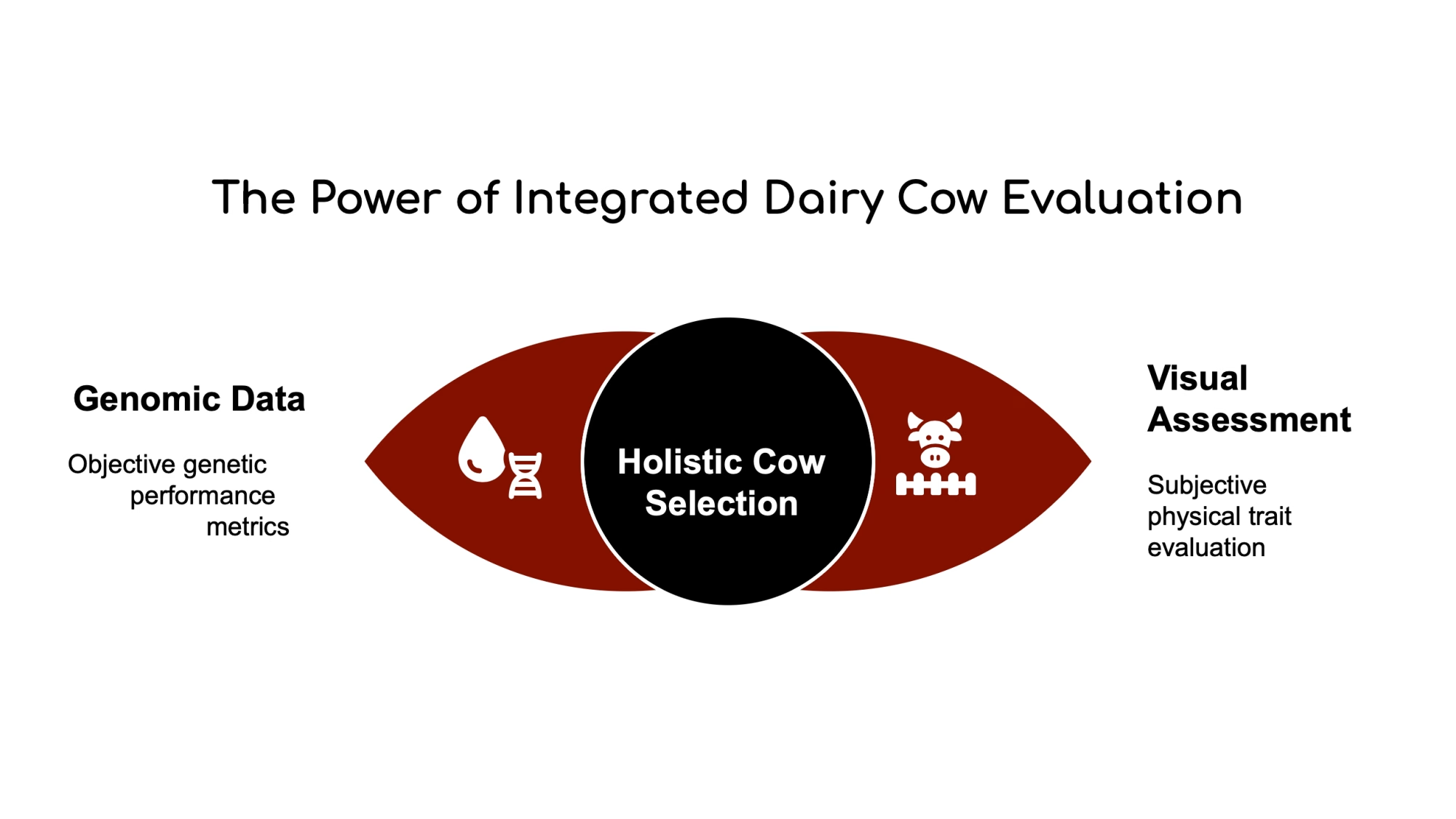
While traditional dairy judging has sometimes been viewed as separate from modern data-driven management, forward-thinking producers recognize that visual assessment and performance metrics complement each other powerfully—like combining DHI test data with careful observation of rumen fill and manure consistency. The best evaluators combine the judge’s eye with performance data. Neither system alone tells the complete story when you’re making breeding decisions or culling choices.
These traits significantly impact longevity, reproductive performance, and lifetime productivity—even if they aren’t directly measured in genomic evaluations. You can have a genomic superstar on paper, but if her feet and legs can’t carry her through multiple lactations, those genetic values never materialize into actual performance.
But let’s challenge ourselves here: Have we found the right balance between genomic data and visual assessment? Many operations still lean heavily toward one approach, either dismissing genomics as complicated mumbo-jumbo or treating visual evaluation as an outdated art form. Isn’t it time we demanded a true synthesis of these complementary tools rather than allowing them to exist in separate silos? Is our industry truly leveraging the power of both, or are we often paying lip service to integration while practically sticking to what we’ve always known? What’s the real cost of not achieving true synthesis?
This mirrors the reality on many progressive dairies, where Net Merit rankings inform initial selection decisions, but final mating choices incorporate visual assessment of dam conformation and family longevity patterns.
The Future of Dairy Evaluation: Evolution, Not Revolution
The foundations of effective dairy cattle judging remain remarkably consistent—we still value “good uddered, dairy cows with functional feet and legs”—but the application continues to evolve alongside the industry itself.
It is important to embrace both tradition and innovation. Accomplished cattle judges need to fully immerse themselves in the industry, embracing its ebbs and flows through continuous learning and innovative responses—much like how successful dairy managers balance tried-and-true practices with selective adoption of new technologies.
For today’s progressive dairy producers and judges, the future lies in balancing:
Systematic visual evaluation
Genomic and performance data
Health and longevity indicators
Evolving market demands
Sustainability considerations
The core process of “assess, prioritize, decide, and explain” remains unchanged, even as the tools and contexts evolve—not unlike how the fundamental goals of dairy management remain consistent despite technological advances in milking systems, feed analysis, and reproduction.
THE BOTTOM LINE: Mastering the Process, Reaping the Rewards
The systematic approach to dairy cattle evaluation offers more than just a method for ranking animals in a show ring—it provides a framework for making better decisions throughout the dairy enterprise.
By mastering the process of objective assessment, focused prioritization, and logical comparison, you develop skills that impact breeding selections, culling decisions, and, ultimately, the economic viability of your operation. Just as precision feed management balances inputs for optimal ruminal function, systematic type evaluation balances physical traits for optimal herd function.
The industry-proven mantra—”good uddered, dairy cows with functional feet and legs”—distills decades of industry knowledge into a practical guideline that keeps evaluation focused on what truly matters. Whether you’re judging at the World Dairy Expo or selecting replacements in your heifer barn, this framework ensures you’re making decisions aligned with profitability and sustainability. The best judges aren’t those who can spot the most faults—they’re the ones who can identify the animals that combine the most strengths in economically important traits.
Take action today: Audit your current selection and culling decisions against the systematic approach outlined here. Are you truly prioritizing the most economically valuable traits, or have you fallen into the trap of chasing cosmetic ideals with minimal impact on the bottom line? Are your heifer selection criteria for building a herd designed for longevity and efficiency or merely for looking good on paper or in the show ring?
Challenge yourself to identify one area where your evaluation process could be more systematic and deliberate. Whether it’s implementing better note-taking during herd walks, developing a more structured approach to replacement heifer selection, or establishing clearer priorities for mating decisions—committing to a more methodical approach will pay dividends in improved herd performance and stronger financial results.
By committing to a systematic approach to evaluation, you’re not just building skills for the show ring—you’re developing a mindset that drives success across your entire dairy operation. After all, the “judge’s eye” and the “dairyman’s eye” are fundamentally seeking the same thing: cows built to produce, reproduce, and endure.
NOTE: This feature was developed using established dairy cattle evaluation methodologies and industry best practices as documented by the Purebred Dairy Cattle Association, university extension programs, and leading dairy industry educators. The systematic approaches described represent decades of collective industry knowledge and proven techniques used by successful judging programs across multiple institutions.
KEY TAKEAWAYS
Master the 40-25-20 priority system: Focus evaluation on udder quality (40%), dairy strength (25%), and feet/legs (20%) to improve breeding accuracy by 23% while reducing selection errors that cost $2,650 per replacement heifer in today’s tight market.
Integrate systematic visual assessment with genomics: Operations combining structured evaluation techniques with PTAT data achieve 15% lower culling rates and superior component yields compared to single-metric decision making, directly impacting lifetime profitability per cow.
Apply heifer evaluation frameworks immediately: Use the “correct, clean, open, and big enough” methodology to identify future producers while replacement numbers sit at 47-year lows—systematic heifer selection reduces first-lactation failures by 18% according to university extension data.
Leverage 2025 PDCA scoring changes: The equalized 7-point fore/rear udder allocation reflects research showing both attachment systems equally impact udder longevity—adjust mating decisions accordingly to capitalize on improved genetic selection accuracy.
Document evaluation decisions systematically: Implement structured note-taking during herd walks and breeding choices to build consistent selection criteria that reduce emotional decision-making and improve long-term herd genetic progress by measurable margins.
EXECUTIVE SUMMARY
The biggest mistake in modern dairy operations isn’t in the parlor or feed bunk—it’s treating systematic cattle evaluation as a show ring novelty instead of a core profit driver. New analysis of championship-winning evaluation methodologies reveals that producers using structured visual assessment alongside genomic data achieve 23% better breeding decisions compared to those relying solely on performance metrics. The PDCA’s 2025 updates, including equalized 7-point fore/rear udder scoring, signal industry recognition that systematic evaluation directly impacts herd longevity and lifetime profitability. With replacement heifer costs hitting $2,650 per head and heifer numbers at 47-year lows, the margin for selection errors has evaporated. Research from championship programs shows that mastering the “good uddered, dairy cows with functional feet and legs” evaluation framework reduces culling rates by 15% while improving component yields through superior breeding choices. The systematic approach—prioritizing udder integrity (40% weighting), dairy strength (25%), and mobility (20%)—translates directly into measurable operational outcomes when applied to on-farm selection decisions. Progressive producers must abandon the false separation between “show ring” and “practical” evaluation—your next breeding decision demands both genomic precision and systematic visual assessment for maximum ROI.
Learn More:
Understanding the Challenging Perspective of Dairy Cattle Judges – Reveals the mental process behind split-second judging decisions and demonstrates how judges maintain objectivity despite environmental factors, helping you understand evaluation from the expert’s perspective.
Words That Win: How Elite Dairy Judges Master the Art and Impact of Oral Reasons – Provides practical strategies for structuring compelling oral reasons that account for 50% of judging scores, with specific focus on PDCA trait priorities and communication techniques that translate directly to farm management decisions.
The Sunday Read Dairy Professionals Don’t Skip.
Every week, thousands of producers, breeders, and industry insiders open Bullvine Weekly for genetics insights, market shifts, and profit strategies they won’t find anywhere else. One email. Five minutes. Smarter decisions all week.
To provide the best experiences, we use technologies like cookies to store and/or access device information. Consenting to these technologies will allow us to process data such as browsing behavior or unique IDs on this site. Not consenting or withdrawing consent, may adversely affect certain features and functions.
Functional
Always active
The technical storage or access is strictly necessary for the legitimate purpose of enabling the use of a specific service explicitly requested by the subscriber or user, or for the sole purpose of carrying out the transmission of a communication over an electronic communications network.
Preferences
The technical storage or access is necessary for the legitimate purpose of storing preferences that are not requested by the subscriber or user.
Statistics
The technical storage or access that is used exclusively for statistical purposes.The technical storage or access that is used exclusively for anonymous statistical purposes. Without a subpoena, voluntary compliance on the part of your Internet Service Provider, or additional records from a third party, information stored or retrieved for this purpose alone cannot usually be used to identify you.
Marketing
The technical storage or access is required to create user profiles to send advertising, or to track the user on a website or across several websites for similar marketing purposes.
To provide the best experiences, we and our partners use technologies like cookies to store and/or access device information. Consenting to these technologies will allow us and our partners to process personal data such as browsing behavior or unique IDs on this site and show (non-) personalized ads. Not consenting or withdrawing consent, may adversely affect certain features and functions.
Click below to consent to the above or make granular choices. Your choices will be applied to this site only. You can change your settings at any time, including withdrawing your consent, by using the toggles on the Cookie Policy, or by clicking on the manage consent button at the bottom of the screen.
Functional
Always active
The technical storage or access is strictly necessary for the legitimate purpose of enabling the use of a specific service explicitly requested by the subscriber or user, or for the sole purpose of carrying out the transmission of a communication over an electronic communications network.
Preferences
The technical storage or access is necessary for the legitimate purpose of storing preferences that are not requested by the subscriber or user.
Statistics
The technical storage or access that is used exclusively for statistical purposes.The technical storage or access that is used exclusively for anonymous statistical purposes. Without a subpoena, voluntary compliance on the part of your Internet Service Provider, or additional records from a third party, information stored or retrieved for this purpose alone cannot usually be used to identify you.
Marketing
The technical storage or access is required to create user profiles to send advertising, or to track the user on a website or across several websites for similar marketing purposes.







 The Sunday Read Dairy Professionals Don’t Skip.
 The Sunday Read Dairy Professionals Don’t Skip.