






How a Pennsylvania neighbor’s favor sparked the most influential Holstein breeding story of our time
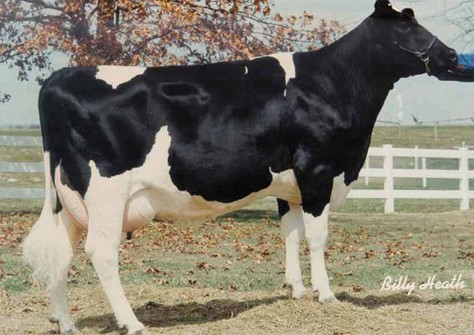
Picture this: It’s 5 AM on a crisp Pennsylvania morning, and Fred Rice is trudging down the gravel road toward his neighbor’s barn. Jay Knepper’s laid up after surgery, and Fred’s just being neighborly—helping with the morning milking at Terracelane Farm while Jay recovers. The familiar rhythm of the vacuum pumps fills the air, mixed with the sweet smell of fresh silage and that distinctive sound of cows settling into their routine.
But something catches Fred’s eye. Actually, five somethings.
“One bunch of cows, about five of them, seemed to milk way better than the others,” Fred would tell people later. Now, any producer worth their salt notices these things, but Fred really noticed. While the rest of the herd was doing their usual 50-60 pounds, this group was absolutely crushing it—we’re talking numbers that made you stop and look twice.
Fred, being Fred, had to know why. It turns out they were all related. Every single one of them.
What’s happening across the industry today with genomics and genetic selection… well, Fred Rice was watching it unfold in real time in his neighbor’s barn, decades before we had the tools to understand what we were looking at. He was witnessing the power of a great cow family, and he had the wisdom to act on it.
When Opportunity Knocks Down the Road
Later that year, when Knepper decided to thin his herd—you know how it goes, sometimes you need to raise cash or make room for the next generation—Fred and his brother Dale saw their chance. They didn’t go crazy. They bought just one heifer from that exceptional group.
Her name was Terracelane Ideal Star, and on paper, she looked decent enough. Sired by Harrisburg Gay Ideal with some solid Atlantic Breeders’ Cooperative genetics behind her. But here’s where it gets interesting… Star wasn’t much to look at as a fresh heifer. Scored 76 points as a two-year-old—respectable, but nothing that would make you remortgage the farm.
The thing is, though, Fred understood something that a lot of us miss in this business. Genetic excellence doesn’t always announce itself with fireworks and fanfare. Sometimes it whispers for years before it starts shouting. Star climbed to VG-88 by the time she was eight, stacking up 207,000 pounds of milk over her lifetime. But more importantly, she was building something deeper in her daughters and granddaughters.
Most producers would have looked at those early 76 points and moved on to the next shiny bloodline. Fred Rice saw potential where others saw ordinary. That’s what separates the dynasty builders from the trend chasers.
Three Generations Building Something Special
Here’s what strikes me about the Rice family story—it wasn’t about overnight success or lucky breaks. Fred Rice wasn’t even born into the dairy industry. Town kid who caught the farming bug hard enough to make it his life’s work. After years of renting and working other people’s operations, he and Dorothy scraped together enough to buy their own 85 acres in Chambersburg back in 1962.
By 1981, if you’d walked through Ricecrest, you’d have seen the vision coming together. The hum of a double-six herringbone parlor, 150 cows averaging 17,900 pounds—solid numbers for that era. They were grouping cows by production and feeding TMR to their top producers. Basic stuff now, but cutting-edge thinking back then.
What really made the difference was when the next generation came home. Fred E. Rice partnered with his father in 1976, after spending time with the USDA. Dale Rice joined them in 1980, fresh out of Penn State with a degree in Animal Science. You had three generations around the same kitchen table every morning—practical experience, government perspective, and formal education all working together.
I can picture those breakfast conversations… Dale brings the latest research from Penn State, Fred E. shares what he learned in Washington, and the old man listens, then says, “That’s fine, boys, but let’s see what the cows tell us.”
Their approach wasn’t flashy. They weren’t trying to impress visitors or win county fair banners. They were building cows that could pay the bills month after month, lactation after lactation. The Holstein Association noticed—by 1996, they’d earned the Progressive Breeder Registry Award for eight consecutive years, eventually extending to 21 years of recognition. That’s not luck. That’s a system that works through both good and bad markets, through feed price spikes and labor shortages.
The Cow That Defined an Era
When Ricecrest Southwind Kaye hit the ground on December 10, 1990, she came with serious credentials. Southwind Bell Of Bar-Lee on top—a son of the legendary Carlin-M Ivanhoe Bell—with proven Ricecrest maternal strength building underneath. Her dam was Ricecrest Ned Boy Noreen, an Excellent-91 cow, and you could trace the production potential back through generations of Gold Medal Dams and Dams of Merit.
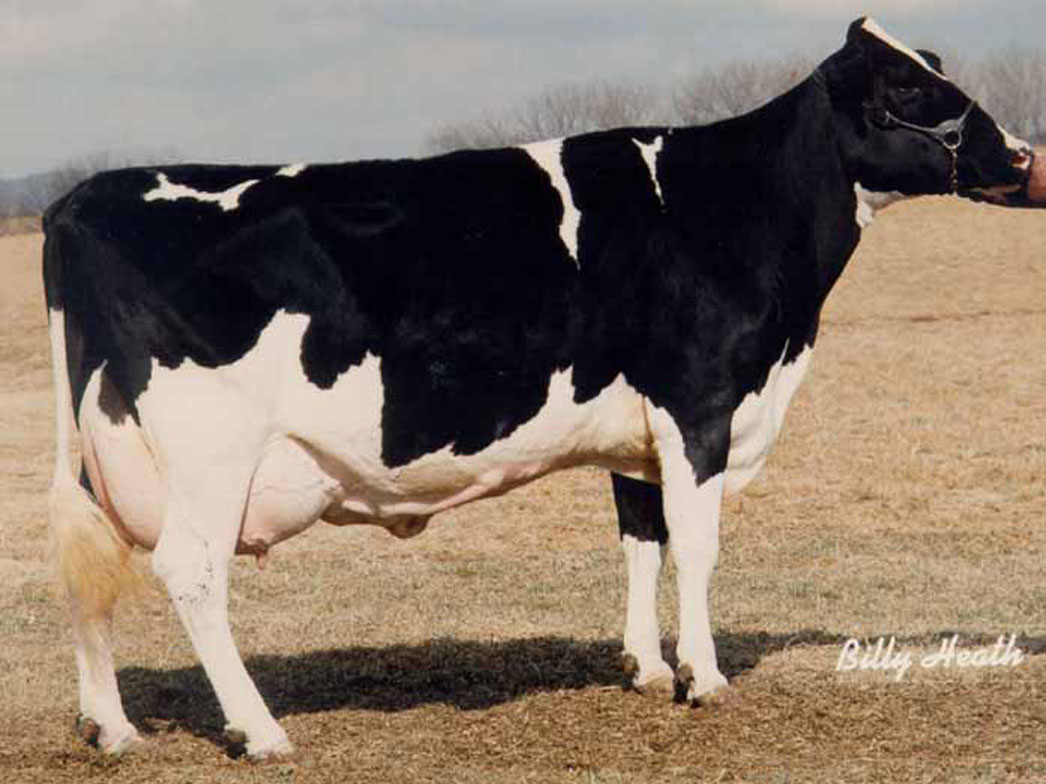
Kaye’s own numbers were the kind that make you sit up and take notice: 39,450 pounds of milk with 4.1% fat (1,633 pounds) and 3.4% protein (1,333 pounds) in her peak lactation. Her Very Good-87 classification, including a Very Good Mammary System score, told you this was a cow built for the long haul. Not show ring pretty, but the kind of structural correctness that lets a cow produce at high levels throughout a profitable life.
But what really set her apart… well, you couldn’t measure it in the milk house. It was her ability to consistently pass on her genetics to her offspring, regardless of which bull was used on her. The Holstein Association’s Gold Medal Dam and Dam of Merit designations confirmed what breeders around the world would soon discover.
Remarkably, Kaye’s genetics in this era aligned perfectly with what the market wanted. The Total Performance Index was becoming the driving force behind breeding decisions, and TPI in those days heavily rewarded production traits. Protein premiums were becoming serious money—we’re talking $2-3 per hundredweight differences on your milk check. Kaye’s genetics were exactly what producers needed to boost their bottom line.
The Impossible Becomes Reality
What happened next… honestly, I don’t think we’ll ever see anything like it again. Kaye produced three sons—three different sons by three different sires—who each claimed the #1 spot on the TPI rankings. Think about that for a minute. In an industry where thousands of bulls compete for genetic supremacy, and AI companies spend millions trying to find the next breakthrough sire, one cow has produced three different #1 bulls.
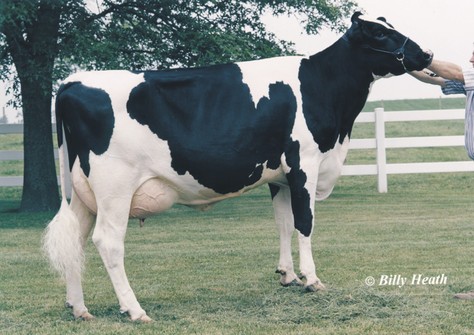
- Ricecrest Lantz (by Norrielake Cleitus Luke) was the first to capture the industry’s attention. Picture the buzz when he hit #1 TPI in September 1999. Phone calls flooding into Ricecrest, AI companies scrambling to secure breeding rights, and suddenly everyone wanted to know more about this Pennsylvania cow family.
- Ricecrest Marshall (by Lutz-Meadows E Mandel) followed his half-brother to the top, proving this wasn’t a one-time genetic accident.
- Ricecrest Brett (by Maizefield Bellwood) completed the trilogy, bumping Marshall out of first place in August 2000.
The protein transmission on these bulls was absolutely off the charts. Industry publications called Kaye “the greatest protein transmitter the breed has ever seen”. When you’re dealing with protein premiums that can make or break your operation, those genetics represent liquid gold flowing through breeding programs worldwide.
But what’s fascinating — the critics’ response. The elite sale consigners walked right past Ricecrest cattle. “Just good milk bulls, that’s all,” some of them said (though they wouldn’t go on record). Their type scores were modest—the kind of functional cattle that might not win the county fair but would definitely keep the operation profitable.
Pennsylvania Genetics Go Global
The thing about great genetics is they don’t stay put. When Ricecrest Bwood Brianne (Brett’s full sister) was sold as a calf to Bauer Bros. in Wisconsin, she began attracting bull contracts worth significant sums. We’re talking multiple contracts, including several to Japan.
And here’s where it gets really interesting… Brianne became the maternal granddam of Sandy-Valley Bolton, who would dominate the 2000s as one of the most popular bulls in breed history. Bolton was a breed-defining bull who ranked with Shottle and Goldwyn in popular favor as the twenty-first century began.
From what I’m seeing on farms today—whether it’s Wisconsin’s rolling hills, California’s Central Valley, or up in Vermont—genetics tracing back to this Pennsylvania program are still everywhere. Walk into any modern dairy barn, and you’ll find these bloodlines woven through countless pedigrees. That genetic thread connects directly back to Fred Rice’s decision to buy one heifer from his neighbor’s dispersal sale.
That’s the power of a great cow family. It ripples out through generations, often showing up in places you’d never expect.
The Double-Edged Sword
Here’s where this story gets complicated, and it’s something we’re still grappling with today. The same selection pressure that created Kaye’s incredible success also contributed to some serious challenges we’re facing across the industry.
Recent research indicates that over 99% of Holstein Y-chromosomes can be traced back to just two bulls from the 1960s: Pawnee Farm Arlinda Chief and Round Oak Rag Apple Elevation. That’s a level of genetic uniformity that would concern wildlife biologists if they saw it in wild populations. The same market forces that rewarded Kaye’s exceptional genetics were simultaneously driving the breed toward greater uniformity.
The industry is now seeing the trade-offs from that intense selection. The very traits that made bulls like Lantz, Marshall, and Brett so valuable came with consequences that are still playing out in herds today. But here’s the thing—you can’t blame the Rice family for this. They were responding to market signals, which were based on the economic formulas that indicated what would be profitable.
The Rice family didn’t create the system; they simply became the best in the world at succeeding within it. The TPI formula rewarded production, and they delivered it in spades.
The Ricecrest Legacy: Lessons for a Modern Herd
So what can we learn from all this? Well, for starters, the genomic tools we have today would have amazed Fred Rice, but I suspect he would have used them the same way he used his own eyes and instincts—to build cow families that could thrive in real-world conditions.
The challenge for today’s producers is balancing the economic pressure to maximize short-term production gains with the long-term health of our herds. Feed costs are squeezing margins like never before. Labor challenges are prompting us to reconsider our approach to cow flow and facility design. Consumer demands around sustainability and animal welfare are changing how we market our products.
In this environment, the Rice family’s approach offers some timeless lessons:
Focus on functional type over show ring beauty. In today’s market, with labor costs what they are, cows that can maintain themselves and produce efficiently are worth their weight in gold.
Great genetics often come from unexpected places—not always from the most expensive bulls or the flashiest sale catalogs. How often do we overlook opportunities in our own neighborhoods while chasing expensive genetics from across the country?
Play the long game. Multi-generational thinking in an industry that often operates on quarterly profit margins. Great cow families don’t just happen. They’re built through consistent selection over multiple generations, and that takes patience in a business that often rewards quick fixes.
Here’s what I’m seeing on farms that are succeeding in today’s environment… they’re taking the Rice family’s approach and applying it to modern challenges. They’re using genomics to identify animals with the right balance of production, health, and longevity. They’re paying attention to traits like feed efficiency and environmental impact that will matter in tomorrow’s market.
The challenge is learning to balance the tools we have today with the wisdom of the past. We can now predict genetic merit from a hair sample, targeting specific traits with precision that would have amazed Fred Rice. But we still need that farmer’s eye for recognizing excellence and the patience to develop it over generations.
Critically, we’re starting to see the industry respond to these challenges. Modern breeding indices are putting more emphasis on health and fertility traits. There’s growing interest in crossbreeding and outcrossing to broaden the genetic base. The genomic revolution that started in the 2000s is now being used to address some of the problems created by the intense selection of the 1990s.
The Neighbor’s Enduring Legacy
The Holstein breed is fundamentally different today because Fred Rice chose to help a neighbor and had the wisdom to recognize excellence when he saw it. That simple act of walking down a gravel road to help with morning milking triggered a chain of events that shaped global genetics for decades.
What strikes me most about this story is how it started. Not with a million-dollar investment or a breeding contract worth a small fortune. It started with a farmer helping his neighbor and having the eye to recognize genetic potential in a group of cows that were doing their job exceptionally well.
The legacy of Ricecrest Southwind Kaye isn’t just about the records she set or the sons she produced. It’s about the fundamental truth that transformative genetics often comes from the most unexpected places… and that sometimes the best investment you can make is helping your neighbor when he needs it most.
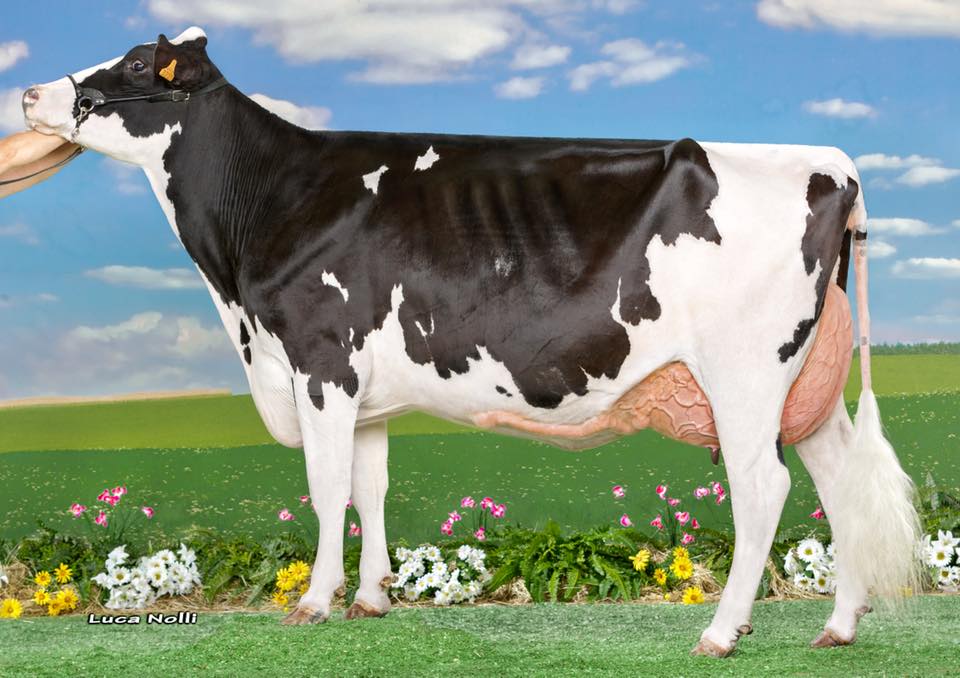
As we navigate whatever challenges lie ahead—whether it’s climate change, new regulations, or shifting consumer demands—that lesson is worth remembering. The future of our industry might not come from the latest genomic breakthrough or the most expensive bull. It might come from a producer who’s observant enough to recognize excellence, patient enough to develop it, and generous enough to share it with the world.
In our industry, the community has always been our strength. The Rice family’s story demonstrates that great things happen when neighbors help one another, when experience meets innovation, and when patience meets opportunity. The Holstein breed is better today because Fred Rice chose to be a good neighbor.
That’s a lesson worth carrying forward, especially in an industry that has always been built on the foundation of people helping one another. The next genetic revolution might be just down the road, waiting for someone with the wisdom to recognize it and the dedication to develop it.
KEY TAKEAWAYS
- Unprecedented Genetic Impact: Ricecrest Southwind Kaye achieved what no other Holstein cow has accomplished—producing three different #1 TPI sons (Lantz, Marshall, and Brett), demonstrating unmatched genetic transmitting ability
- Strategic Breeding Philosophy: The Rice family’s approach combined practical observation with progressive genetics, focusing on functional traits and production over show ring appeal, proving that sustainable success comes from patience and systematic selection
- Genetic Diversity Warning: While Kaye’s genetics drove remarkable production gains, the story highlights the industry’s challenge with genetic bottlenecking—over 99% of Holstein genetics now trace to just two bulls from the 1960s
- Modern Breeding Balance: Today’s producers must balance production gains with health, fertility, and longevity traits to ensure sustainable genetic progress in an era of genomic selection
- Community-Driven Innovation: The story demonstrates that revolutionary genetics often emerge from neighborly relationships and local observations rather than expensive investments, emphasizing the continued value of farmer-to-farmer knowledge sharing
EXECUTIVE SUMMARY:
Ricecrest Southwind Kaye stands as the most influential Holstein brood cow in modern history, achieving the unprecedented feat of producing three sons who each reached the #1 spot on the Total Performance Index (TPI) rankings. Born from a multi-generational breeding program at Ricecrest Farms in Pennsylvania, Kaye embodied the perfect alignment of genetics with the 1990s market demands, which heavily prioritized milk, fat, and protein production. Her legacy reshaped global Holstein genetics during an era of intense selection pressure, with her sons’ genetics disseminated worldwide through artificial insemination programs. However, Kaye’s story also serves as a cautionary tale about the double-edged nature of genetic progress—while her family achieved remarkable commercial success, the widespread use of their Holstein cattle contributed to the dramatic narrowing of Holstein genetic diversity that concerns breeders today. The Rice family’s patient, observation-based breeding philosophy exemplifies the balance needed between short-term genetic gains and long-term breed sustainability. Their story reminds the industry that transformative genetics often emerge from unexpected places through neighborly kindness, careful observation, and multi-generational vision rather than expensive purchases at elite sales.
Learn More
- The Ultimate Guide to Sire Selection: Beyond the Numbers – This guide provides a modern framework for applying the “farmer’s eye” wisdom from the Ricecrest story. It reveals practical strategies for balancing high-impact genomic data with the critical visual assessments needed to build a resilient, functional herd.
- Dairy Genetics: Are You Breeding for the Market or for Your Barn? – This strategic analysis dissects the economic drivers behind breeding decisions. It demonstrates how to align your genetic program with current market signals—like component pricing and sustainability demands—to maximize profitability, much like Ricecrest capitalized on the protein market.
- The Next Genetic Frontier: Breeding for Feed Efficiency and Climate Resilience – Looking beyond production, this article explores the innovative traits defining future success. It outlines how to leverage new genetic indexes for feed efficiency and heat tolerance, offering a forward-thinking approach to building a herd that thrives in tomorrow’s environment.
 Join the Revolution!
 Join the Revolution!
Join over 30,000 successful dairy professionals who rely on Bullvine Weekly for their competitive edge. Delivered directly to your inbox each week, our exclusive industry insights help you make smarter decisions while saving precious hours every week. Never miss critical updates on milk production trends, breakthrough technologies, and profit-boosting strategies that top producers are already implementing. Subscribe now to transform your dairy operation’s efficiency and profitability—your future success is just one click away.




