






Butterfat crashed 30% while production dropped—your co-op’s using taxpayer money to manipulate markets against you
EXECUTIVE SUMMARY: Here’s what we discovered: While butterfat prices have crashed 30% since July, production actually declined through the same period—yet processors claim “oversupply” while shipping record export volumes overseas using farmer-funded subsidies. Major cooperatives like Darigold cut member payments by substantial amounts to cover billion-dollar facility cost overruns, then used those same facilities to increase export capacity while claiming domestic markets are flooded. Industry reports show Cooperatives Working Together moved massive milk equivalent volumes through export assistance programs funded by producer assessments, essentially forcing farmers to pay for the “oversupply” problems used to justify their shrinking checks. Court documents reveal that major cooperatives control up to 85% of regional processing capacity, enabling coordinated manipulation that would land independent farmers in federal prison for price-fixing. With government export subsidies flowing to processors and emergency assistance concentrated among industrial operations, this isn’t market forces—it’s systematic wealth extraction using farmer equity and taxpayer dollars. The consolidation trends indicate that independent farming will be eliminated entirely within five years unless producers start documenting everything, demand transparency, and build alternatives outside this rigged system.
KEY TAKEAWAYS:
- Your cooperative’s “investments” are costing you real money: Operations reporting payment cuts of $4+ per hundredweight to cover facility overruns—that’s $175,200 annually for a 2,000-cow operation, while processors build export infrastructure with farmer equity
- Document payment patterns and facility timing: Track correlations between new plant openings and “market crises”—when billion-dollar facilities open in June and oversupply claims appear in July, that’s coordination evidence worth preserving
- Explore direct marketing and farmer-controlled alternatives: Family operations investing $120,000 in on-farm processing report 28% net revenue increases while creating farm jobs—every gallon that bypasses cooperative manipulation stays in farmer pockets
- Support legal challenges to cooperative abuse: Multi-million dollar settlements prove cooperative rhetoric can’t hide systematic market manipulation—every successful challenge weakens the framework enabling this systematic farmer exploitation
- Build independent networks before you need them: Connect with other producers, comparing payment experiences and processing alternatives—cooperative systems survive by keeping farmers isolated and uninformed about manipulation strategies

Look, I’ve been around long enough to smell BS from three counties away. But this whole butter market mess? I didn’t see this one coming either.
Butterfat’s been in free fall since July—Chicago Mercantile futures getting absolutely hammered week after week—and I keep hearing the same tired line from processors about “market forces” and “oversupply issues.” You know, the usual corporate speak.
I was talking with Jake, who runs about 800 head up the road… he’s been saying something’s fishy for months. I kept thinking he was just pissed about his milk check shrinking every month, you know? The guy’s always complaining about something.
Turns out he was right. Dead right.
Your co-op’s screwing you. And they’re using programs most of us don’t even know exist to do it. I spent the better part of six months digging into this mess—talking to producers from Wisconsin down to Texas, going through government reports until my eyes bled, piecing together what’s really happening—and honestly?
What I found will make you madder than finding your prize heifer stuck in a ditch during breeding season.
When Math Stops Making Any Damn Sense
So I’m sitting here last month going through USDA dairy production reports—you know, exciting Saturday night stuff—and something just doesn’t add up. You know that feeling when the numbers look wrong and you keep double-checking because maybe you missed something obvious?
Well, I didn’t miss anything.
The production data shows butter manufacturing bouncing around through the summer—nothing crazy dramatic, just normal seasonal variations. Now, I may not have attended business school like these co-op executives, but I learned about supply and demand by showing steers at the county fair when I was fifteen.
When production stays relatively stable, prices shouldn’t crater like a rookie trying to back a cattle trailer.
But they did crater. Hard.
Chicago Mercantile Class IV futures got absolutely pounded through August and September, while production wasn’t showing any major spikes that would justify it. That’s like telling me steady cow numbers should mean dirt-cheap milk. Makes no damn sense to anyone who’s actually farmed a day in their life.
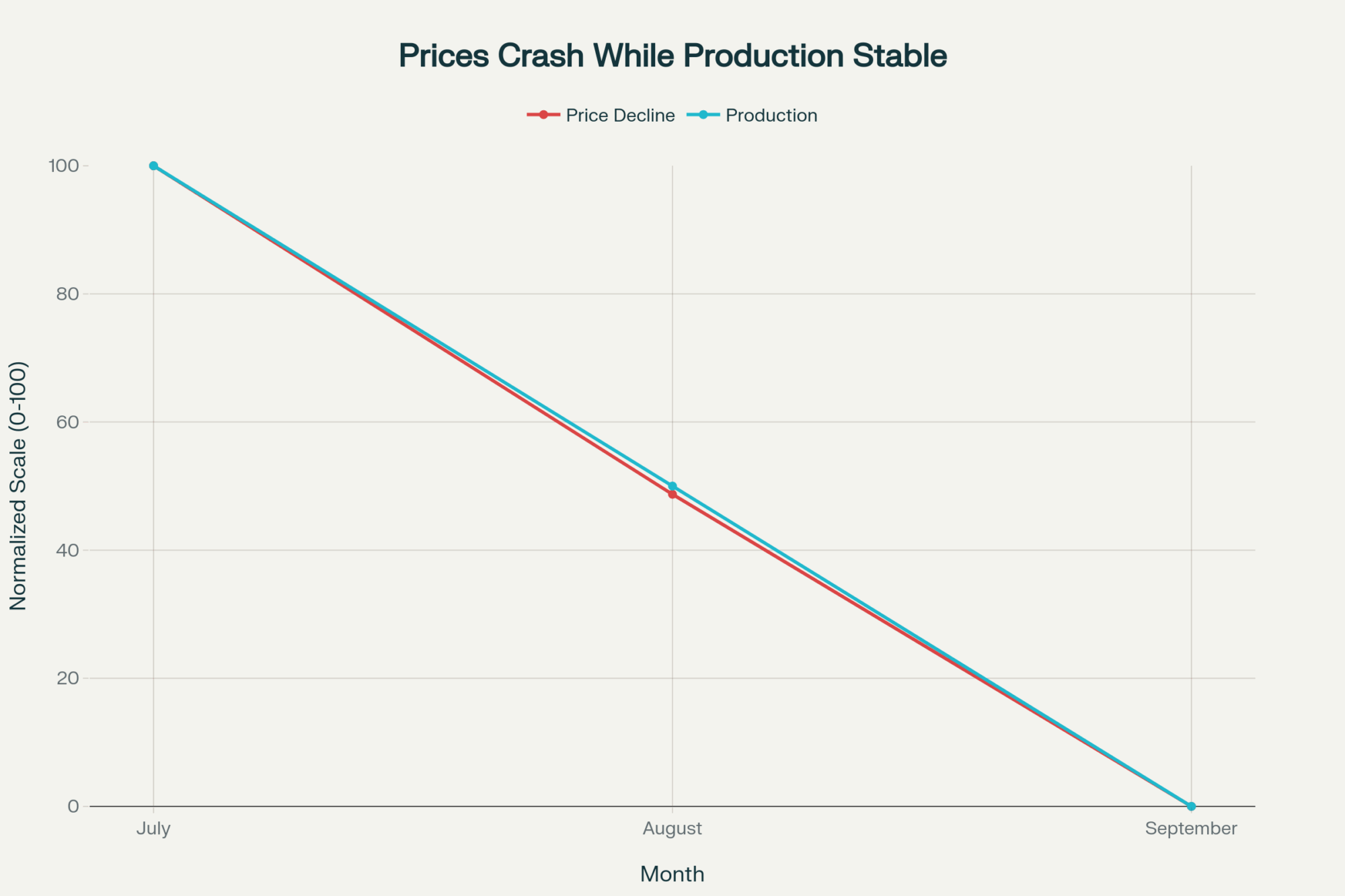
So what’s that tell me? Somebody’s playing games with the market. And I’m not talking about weather or corn prices or any of that normal stuff we deal with every damn day.
I mean coordinated manipulation by the same folks who send you those glossy cooperative newsletters talking about “challenging market conditions”—while they’re shipping product overseas faster than a green kid can spill milk in the parlor.
Actually, and this really started getting my wheels turning… you dig into export data patterns from Foreign Agricultural Service reports, and dairy product shipments are showing strong year-over-year growth. Real strong. But somehow we’ve got “domestic oversupply”?
That’s like cleaning out your entire silage pit and then complaining to your wife that you don’t have room to store anything.
The Darigold Disaster: When Your Own People Screw You
I was talking to some producers up in Washington last spring—good folks, been farming longer than I have—about that new Darigold plant in Pasco. You know the one, right? A major expansion project that was supposed to be a great thing for members?
Industry publications reported that the whole thing turned into a financial disaster. Significant cost overruns, major delays, and the works. But that’s not even the worst part, honestly.
The worst part is how they covered those extra costs.
Reports started coming out about Darigold implementing what they called “member payment adjustments” to help finance the facility completion. Member payment adjustments. Jesus. That’s co-op speak for “we’re cutting your milk checks and there’s not a damn thing you can do about it.”
And not small cuts either. We’re talking substantial reductions that hit producers right in the gut, right when feed costs are climbing and margins are already tighter than bark on a tree.
One operation I know up there—won’t mention names because these folks have enough problems already—told me it’s costing them serious money annually. Tens of thousands. That’s real money for family operations already running on razor-thin margins.
| Farm Size (Cows) | Annual Milk Production (lbs) | $4/cwt Payment Cut | Annual Income Loss | 3-Year Impact |
|---|---|---|---|---|
| 500 | 10,950,000 | $4,380 | $43,800 | $131,400 |
| 1,000 | 21,900,000 | $8,760 | $87,600 | $262,800 |
| 2,000 | 43,800,000 | $17,520 | $175,200 | $525,600 |
| 3,000 | 65,700,000 | $26,280 | $262,800 | $788,400 |
| 5,000 | 109,500,000 | $43,800 | $438,000 | $1,314,000 |
But here’s what really pisses me off… while they’re cutting member payments to cover their construction screwups, they built that whole facility with direct export access in mind. Rail connections, port proximity, and the entire setup are designed to move product overseas as efficiently as possible.
So they’re using farmer money to build infrastructure that helps them ship milk overseas while telling those same farmers that domestic markets are oversupplied.
You literally can’t make this stuff up. Actually, I guess you can if you’re running a cooperative and wearing a suit instead of coveralls.
The Money Trail They Hope You Never Find
Okay, so this is where it gets really interesting… and by interesting, I mean absolutely infuriating in ways that would make a preacher cuss.
You ever hear of Cooperatives Working Together? Most producers I talk to haven’t got a clue. It’s this export assistance program that’s supposed to help us compete globally against subsidized competition. Sounds pretty good on paper, doesn’t it?
Industry reports indicate that CWT has facilitated the movement of massive volumes of milk equivalent through export assistance programs in recent years. We’re talking about production equivalent to tens of thousands of cows getting subsidized to go overseas while processors keep telling us there’s too much milk floating around domestically.
And here’s the real kicker—we help fund the damn thing. Assessments come right out of our milk payments, month after month after month. So we’re literally paying them to create the very “oversupply” problems they keep blaming for our shrinking checks.
Can you believe that? We’re funding our own screwing.
Uncle Sam’s Making It Even Worse
Then you’ve got USDA throwing serious taxpayer money at export promotion through their Foreign Agricultural Service programs. Secretary Rollins announced big initiatives earlier this year to boost ag exports as part of addressing trade imbalances with other countries.
Look, I’m all for selling American dairy products overseas—God knows we produce some of the best in the world. But when you subsidize exports to create artificial overseas demand while domestic processing stays artificially constrained?
That’s not helping the trade deficit. That’s manipulating domestic prices to benefit processors while screwing producers.
And don’t even get me started on the disaster payments…
Actually, you know what? Let me get started on that, too. Analysis of Emergency Livestock Assistance Program distributions shows serious money flowing to large operations for bird flu losses. Major dairies are pulling in substantial payments while family operations struggle to get basic support when disaster hits.
Now I’m not saying big operations don’t deserve help when bird flu wipes out chunks of their herds. We all know it’s a real problem that can devastate any operation. But when the same large players consistently seem to navigate disaster payment bureaucracy successfully while smaller producers get tied up in red tape for months?
That starts looking less like emergency assistance and more like systematic support for industrial agriculture at the expense of family farms.
When Your Co-Op Becomes Your Worst Enemy
I remember when cooperatives actually worked for farmers instead of against them. My dad always said—and I’m starting to think the old man was dead right—that the only difference between a co-op and a corporation is the co-op tells prettier lies while they’re picking your pocket.
Take Dairy Farmers of America. Their management team gets hired by boards that are supposedly there to represent farmers, but they mostly just validate whatever professional management recommends. Industry publications regularly quote executives talking about “managing the business efficiently” rather than serving member interests.
Not serving farmers. Managing the business efficiently. There’s a world of difference between those two approaches, and if you can’t see it, you haven’t been paying attention.
Researchers have looked at what happened with failed dairy cooperatives in other countries, and it reads like a damn playbook for what’s happening right here. They consistently found that professional management often didn’t provide adequate disclosure to farmer boards, and producers couldn’t effectively challenge CEO practices because they lacked access to the information needed to make informed decisions.
Sound familiar yet? Farmers sometimes end up voting to sell their own cooperatives for fractions of their actual value because nobody bothered keeping them properly informed about what was really going on behind closed doors.
The Voting Changes Nobody Talks About
And here’s something that really gets my blood boiling. Cooperatives have been quietly shifting away from traditional “one member, one vote” structures toward production-based voting systems. USDA research shows more states allowing these arrangements every year, and most farmers don’t even realize it’s happening.
So your 500-cow family operation that’s been in your family for three generations gets exactly one vote in cooperative decisions. Your neighbor down the road with 200 cows gets one vote too. But that 5,000-cow industrial operation that moved in five years ago? They get multiple votes based on their production volume.
Now guess who’s really making the decisions about export policies, processing priorities, and payment structures?
Makes me madder than trying to load cattle in a thunderstorm with a hangover.
Market Control That Would Embarrass Standard Oil
Court filings in dairy industry litigation suggest major cooperatives control massive processing capacity in key regions across the country. When you control that much critical infrastructure, you’re not responding to market conditions anymore—you’re creating the damn market conditions.
And that’s exactly what happened with this whole butter price disaster. Industry publications reported farmers having to dump milk because processing plants claimed they were at capacity limits, while those same processing networks somehow managed to handle expanded throughput in other product categories that served their profit margins better.
It’s not about real capacity constraints. It’s about strategic capacity allocation.
After major acquisitions in recent years, processing control became increasingly concentrated in fewer hands. Companies can route milk wherever it serves their financial interests best, rather than member interests. Want to justify cutting member payments? Route more volume to export channels, then claim domestic markets are oversupplied. Need to show growth numbers for your board presentation? Process more domestically and talk about meeting strong consumer demand.
The Information War You Don’t Even Know You’re Losing
Think about this for a minute… processing control gives these companies advance knowledge of absolutely everything that matters. Regional milk flows, seasonal production patterns, demand fluctuations, inventory levels, and export timing. They see what’s coming weeks or months before any of us individual producers have a clue.
This intelligence advantage enables them to time export sales strategically, maximizing their benefits. They know exactly when to increase overseas volumes to create the artificial domestic supply conditions they can then use to justify cutting our payments while maintaining or expanding their processing margins.
The whole butter price collapse this year demonstrates exactly how this works. Export patterns got ramped up significantly early in 2025, and then—what a surprise!—we had “serious oversupply problems” by midsummer that required emergency member payment adjustments to address.
We never got to see the export timing data that would’ve exposed the whole coordinated scheme. That information stays locked up in corporate boardrooms where farmers aren’t invited.
Why Walking Away Isn’t Really an Option
So why don’t we just tell these cooperatives to go to hell and find alternatives if they’re not serving our interests?
Well, research on cooperative membership structures shows delivery rights and equity requirements often represent massive investments per farm—sometimes hundreds of thousands of dollars that took decades to build up. You decide to leave? You potentially forfeit substantial portions of that investment, depending on the specific cooperative’s withdrawal policies.
I know producers who’ve seriously researched leaving their cooperatives. The total costs—between lost equity, various penalties, and transition expenses to establish new marketing relationships—can be absolutely devastating for family operations. We’re talking about financial hits that could force operations that have been in families for generations into bankruptcy.
Additionally, major acquisitions over the past decade have eliminated many independent processing alternatives that previously existed. In some regions, court documents suggest producers have very limited viable processing alternatives outside of cooperative control.
That’s not a competitive market providing farmers with genuine choices. That’s a systematic constraint of farmer marketing options designed to maintain cooperative control regardless of member satisfaction.
And Federal Milk Marketing Orders don’t provide the relief you might expect either. You often can’t access pooling benefits and pricing protections without cooperative membership, so the government system that’s supposedly there to protect farmer interests actually channels producers into the very cooperatives that may not be serving those interests effectively.
The Capital Requirements Reality Check
Want to start genuinely farmer-owned processing as an alternative? Research on cooperative development shows you need substantial upfront capital commitments—we’re talking millions upon millions of dollars minimum just to get started. Individual farmers obviously can’t generate that kind of investment capital without pooling resources with other producers.
But here’s the catch… pooling financial resources typically means surrendering individual control to professional management structures that start looking exactly like the cooperative systems you were trying to escape in the first place.
Perfect Catch-22 designed to keep you trapped. You need a cooperative-level scale to compete effectively in modern markets, but achieving that scale almost inevitably means accepting cooperative-style management structures that prioritize business efficiency over individual member interests.
When Farmers Actually Control Things (Revolutionary Concept)
But here’s what gives me real hope for the future… it honestly doesn’t have to be this way.
Some cooperatives still demonstrate that genuine farmer control is not only possible but profitable. Operations that were started by small groups of committed farmers and managed to grow substantially while maintaining meaningful member governance show that it can work if you structure it right from the beginning.
Their members typically receive actual premiums—real money, not just promises and fancy presentations—plus meaningful equity distributions that reflect the cooperative’s financial performance. While some cooperatives pay commodity rates and capture processing margins for corporate expansion purposes, farmer-controlled operations focus on returning maximum value directly to the people who actually produce the milk.
What a revolutionary concept, right? Actually serving the people who own the damn operation.
Going Direct (And Scaring the Hell Out of Corporate Management)
I know family operations that made significant investments in on-farm processing equipment over the past few years. Nothing fancy or complicated, just enough capacity to handle substantial portions of their milk production directly rather than shipping everything to cooperative plants.
Their net revenues improved dramatically—we’re talking 20-30% increases in some cases. They created good-paying jobs right on the farm for local people. And every single gallon that bypasses problematic cooperative systems stays exactly where it belongs—in farmer pockets rather than corporate profit centers.
There are also examples from other countries—small groups of committed farmers who pooled resources to establish their own processing facilities. Modest scale operations, just large enough to handle milk from a limited number of participating farms, rather than trying to compete with industrial-scale processing.
These operations often pay substantially above regional commodity prices and return operational profits directly to farmer-investors rather than building corporate empires. Years later, they’re typically employing local people and proving conclusively that farmer-controlled alternatives can compete effectively when appropriately structured.
Small scale. Local ownership. Farmer control. Everything the mega-cooperatives claim can’t possibly compete in modern markets.
Legal Challenges That Are Actually Making Progress
You want to understand how problematic some current cooperative practices really are? Major cooperatives recently paid substantial multi-million dollar settlements regarding allegedly anticompetitive pricing practices. Court documents detail coordination schemes that supposedly suppressed producer payments through systematic information sharing and coordinated decision-making processes.
That’s textbook anticompetitive behavior that would land regular farmers in federal prison if we tried anything similar. If a group of independent producers tried coordinating milk pricing like these cooperatives apparently did, we’d be facing criminal conspiracy charges faster than you could say “price fixing.”
But cooperatives get special antitrust protections under the Capper-Volstead Act, so they typically face civil penalties and financial settlements rather than criminal prosecution when they get caught engaging in questionable practices.
Still, every successful legal challenge weakens the framework that enables these problematic practices to continue. Recent litigation has exposed how some cooperatives evolved from modest regional farmer organizations into what industry critics now describe as highly concentrated market controllers that prioritize corporate growth over member welfare.
At least somebody’s finally fighting back through the legal system, even if it’s taking way too long to see meaningful results.
Where All This Leads (Spoiler Alert: It’s Not Pretty)
Look, if current consolidation trends continue unchecked, we’re looking at the systematic elimination of independent family farming as we know it. International examples from countries with similar agricultural policies reveal massive losses in dairy operations, even when governments implement supposedly protective policies. We have significantly fewer protections than most of those countries.
Think about that reality for a minute. Just sit with it.
Census data shows we’ve already lost thousands of family dairy operations in recent years, and industry projections suggest continued rapid consolidation is virtually inevitable under current market structures. We’re headed toward a handful of massive processing entities controlling most dairy production capacity, with “farmers” potentially becoming contract laborers who provide facilities and labor, while others control the actual operations and capture the vast majority of profits generated.
My kids sometimes talk about potentially farming someday when they’re older. Current industry trends suggest they’ll be looking at completely different opportunities than what my generation experienced—if meaningful independent farming opportunities even exist at all.
That keeps me up at night more than I’d like to admit.
What You Actually Do About This Mess
First thing—start documenting everything you can get your hands on. When major facility openings coincide suspiciously with “market crisis” claims, that’s worth noting and tracking over time. When export volumes increase significantly while domestic prices decline dramatically, that demonstrates coordination possibilities that deserve investigation.
Save every milk statement you receive. Keep all those cooperative communications and newsletters they send. Track patterns and correlations between their “strategic investments” and changes in your payment structures over time.
Ask pointed questions and demand real transparency from your cooperative leadership. When processing efficiencies improve through technology investments, why don’t member payments increase proportionally? Where exactly do those efficiency gains actually go if not back to the people who own the operation?
Support Alternatives That Actually Work
Look into proven alternatives that demonstrate different approaches can succeed. Some cooperatives still show that genuine farmer control produces better member outcomes. Direct marketing demonstrates that independence can be profitable when done intelligently. Small-scale processing operations prove that sustainable alternatives exist if you’re willing to work for them.
Support legal challenges to problematic industry practices when opportunities arise. Every successful challenge helps weaken the systematic structures that enable this manipulation to continue unchecked.
Build Independent Networks Before You Need Them
Start having honest conversations with other producers in your area about what’s really happening to all of us. Highly concentrated cooperative systems benefit enormously from keeping individual farmers isolated and uninformed—they absolutely don’t want us comparing experiences about payment trends, policy changes, and strategic decisions that affect our operations.
Actively explore direct marketing opportunities that might work in your specific region and situation. Connect with processors who might be willing to deal more fairly with independent producers. Build relationships and explore alternatives outside problematic cooperative systems before you actually need them urgently.
Because once you need them urgently, you’ve probably already lost most of your negotiating leverage.
Bottom Line: Time to Stop Accepting This BS
You know what really gets under my skin about this whole situation? The same cooperatives that spend board meetings discussing “challenging market conditions” and “difficult economic pressures” just invested billions of dollars in new processing infrastructure and corporate expansion projects.
If markets are really as constrained and difficult as they keep telling us, where exactly did they find all that investment capital?
Right. Member money. Member equity contributions. The Member economic future is mortgaged for corporate growth that may not benefit members at all.
This isn’t a natural result of market forces creating unavoidable price pressures. This is the coordinated use of government programs, member financial resources, and market manipulation to engineer artificial conditions that justify reducing member payments while maintaining or expanding corporate processing margins and executive compensation.
Time to stop passively accepting systems that are specifically designed to concentrate benefits at the corporate level while distributing costs and risks to the farmers who actually do the work. Because if these consolidation trends continue for another five years, there won’t be enough independent producers left to influence anything meaningful in this industry.
And frankly, some powerful people are clearly counting on exactly that outcome.
My dad always used to say, ‘Never trust anybody who wears an expensive suit to look at cows.’ Wish I’d listened to the old man more carefully when I had the chance.
Complete references and supporting documentation are available upon request by contacting the editorial team at editor@thebullvine.com.
Learn More:
- Precision Feeding Strategies Every Dairy Farmer Needs to Know – This tactical guide reveals how to implement targeted feeding programs to reduce waste and improve herd health. Learn how to optimize ingredient order, calibrate mixers, and use data from milk components and body condition scores to boost profitability by minimizing feed costs.
- Why the Global Dairy Market is Making Waves in 2025 (and What That Means for You) – Go beyond domestic market dynamics to understand structural shifts in the global dairy trade. This article identifies premium export opportunities and offers strategies for hedging against market volatility, providing a crucial macro-level perspective that complements the local market focus of the main piece.
- Embracing the Future: The Latest Innovations in Dairy Technology and their Impact on the Industry – Discover how emerging technologies like manure management systems and wearable tech for cows are creating new revenue streams and boosting efficiency. This piece showcases innovative solutions that enable farmers to gain independence and reduce reliance on traditional systems.
 The Sunday Read Dairy Professionals Don’t Skip.
 The Sunday Read Dairy Professionals Don’t Skip.
Every week, thousands of producers, breeders, and industry insiders open Bullvine Weekly for genetics insights, market shifts, and profit strategies they won’t find anywhere else. One email. Five minutes. Smarter decisions all week.




