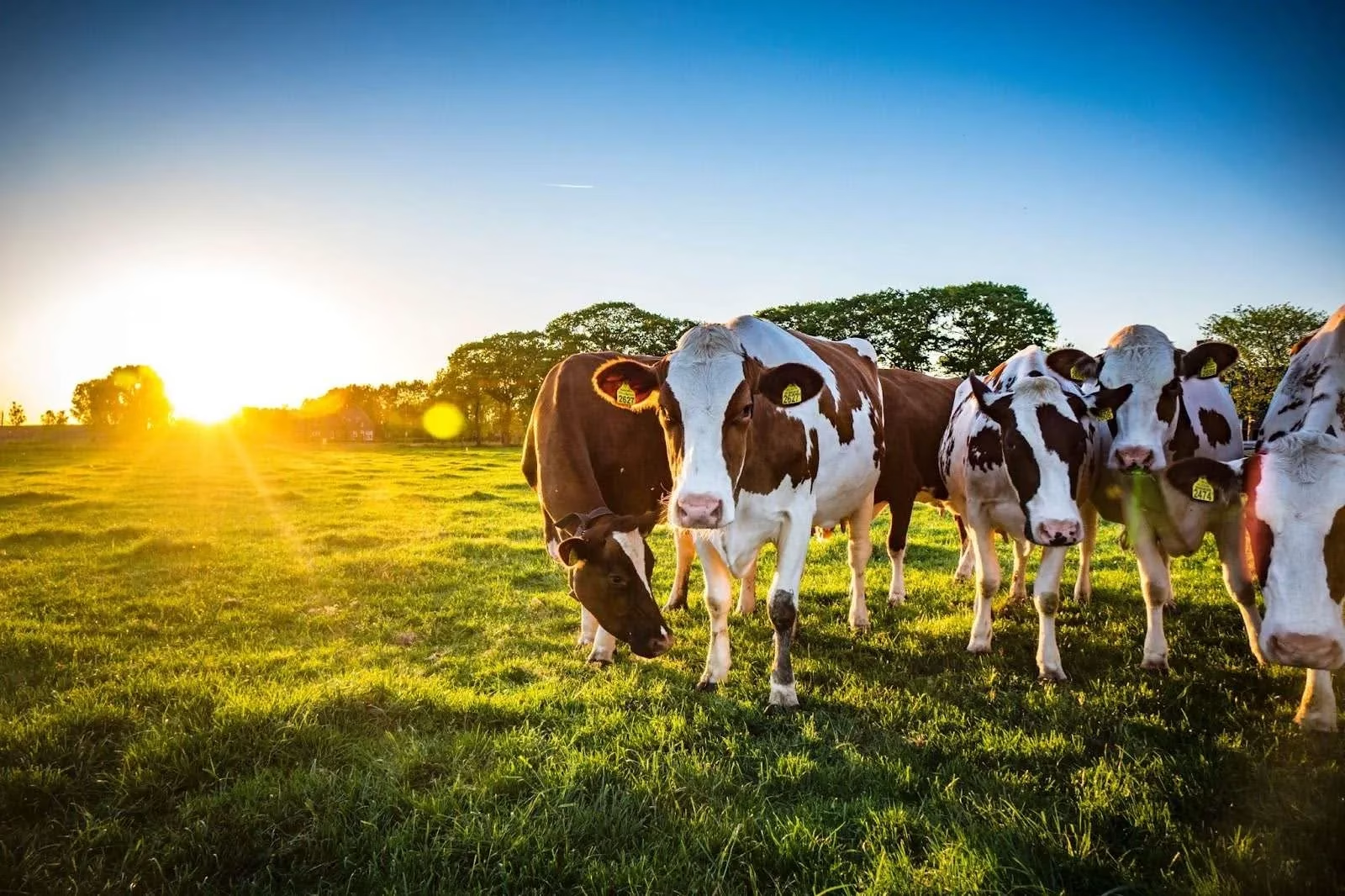
Australia’s genetic game-changer lets farmers breed heat-proof cows-cutting milk losses by 40%. The future of dairy is coded in DNA.
EXECUTIVE SUMMARY: Australia’s Heat Tolerance ABV, a world-first genetic index, empowers dairy farmers to breed cows resistant to climate-driven heat stress. Developed through genomic analysis, this tool identifies cattle with superior heat resilience, quantified by a score above 100. Early adopters like farmer Trevor Parrish report 20% of their herds now genetically outperform in heat, safeguarding milk yields and animal welfare. Validated in the U.S. and endorsed by Dairy Australia, the ABV merges cutting-edge science with practical farming, offering a permanent solution to a $1.5B global industry crisis. This innovation signals a shift from reactive cooling systems to proactive genetic resilience-transforming how the sector adapts to climate chaos.
KEY TAKEAWAYS:
- Genetic Insurance: The Heat Tolerance ABV uses DNA analysis to breed cows that lose 5% less milk per heat wave, turning genetics into a climate shield.
- 20% Herd Upgrade: Early adopters achieved measurable gains within years, proving rapid ROI for a trait once deemed too complex to target.
- Welfare + Profit: Cows suffer less, farmers earn more-dual wins critical for maintaining social license amid climate scrutiny.
- Global Blueprint: Validated in U.S. systems, this Australian innovation offers a template for heat-stressed dairies worldwide.
- Breeding Revolution: Challenges the “bigger-is-better” mentality, favoring compact, efficient cows built for tomorrow’s climate extremes.

While you’ve been throwing money at fans, sprinklers, and shade structures to combat heat stress, Australian researchers have quietly revolutionized dairy resilience with the world’s first genetic index for heat tolerance. The Heat Tolerance Australian Breeding Value (ABV) is already delivering 20% improvement in affected herds – and challenging everything we thought we knew about climate adaptation in dairy cattle.
THE BRUTAL TRUTH ABOUT HEAT STRESS YOU’RE IGNORING
Let’s get real about what’s happening in your dairy operation. When temperatures climb, production plummets – we’re talking about a staggering 25-40% drop in milk yield, according to Dairy Australia. That’s not just discomfort for your cows; it’s thousands of dollars evaporating from your milk check with every heat wave.
And here’s what’s worse – the climate chaos isn’t going away. As veteran New South Wales dairy farmer Trevor Parrish puts it: “This year has been more humid, but December was exceptionally dry… the year before was exceptionally wet. So, each year is never the same.”
This unpredictability makes your carefully planned environmental modifications increasingly obsolete. You invest in extensive cooling systems optimized for dry heat, then face a season of humid heat where those systems barely make a dent. You’re fighting yesterday’s battle with yesterday’s tools.
But what if I told you the most potent solution isn’t hanging from your barn ceiling or spraying from your holding pen? What if the answer is hiding in your cows’ DNA?
WHY YOUR CURRENT HEAT STRESS STRATEGY IS FAILING
For decades, the dairy industry’s approach to heat stress has been embarrassingly one-dimensional: modify the environment, not the cow. You’ve been taught to install bigger fans, build more shade structures, adjust milking times, and run sprinkler systems.
Parrish followed this conventional wisdom: “We have a larger dairy shed, so there’s more shade, and we try to milk the cows earlier in the morning and later in the afternoon.”
But let’s be brutally honest – these strategies are fundamentally limited because:
- They’re reactive instead of preventative
- They require massive capital investment and ongoing energy costs
- They become less effective as climate extremes intensify
Even worse, cow behavior often sabotages these environmental modifications. As Parrish observed: “In the summertime, when it’s too hot, [the cows] all stand together, which makes it worse because their body heat multiplies.”
The industry has failed to ask the most obvious question: What if our cows simply had greater genetic resistance to heat stress in the first place?
THE GENETIC REVOLUTION THE INDUSTRY DIDN’T SEE COMING
In 2017, Australia delivered a game-changing answer: the Heat Tolerance Australian Breeding Value (ABV). Developed by Melbourne-based scientist Dr. Thuy Nguyen, this world-first genetic tool identifies animals with superior ability to maintain production during heat events.
“Farmers have already done a lot to help cows cool during hot days,” Dr. Nguyen acknowledges. “But adding genetics on top of all that is significant because it’s better for the animals and improves the bottom line for the farmers when they go through the warmer season, which we know is becoming more apparent due to climate change.”
The implementation is brilliantly straightforward. A simple genetic sample – just a tuft of hair – is sent to DataGene, an independent, industry-owned organization. The results come as a numeric score with a baseline of 100. Any above 100 indicates above-average heat tolerance; below 100 means below-average tolerance.
This number becomes your secret weapon for systematically breeding heat tolerance into your herd’s genetic code.
REAL RESULTS FROM REAL FARMERS
Trevor Parrish didn’t hesitate to become one of the first New South Wales farmers to adopt the Heat Tolerance ABV. His decision wasn’t about quick fixes but building long-term resilience: “To me, it made a lot of sense to look into it and try and use bulls that were more heat tolerant so it would help the next generation moving forward.”
Parrish’s experience reflects both the promise and reality of genetic selection. “One bull I’ve used did a big drop, which was unfortunate. But I had a couple of others that went way up,” he notes.
The overall impact has been substantial. Parrish now estimates about 20% of his herd is genetically better equipped to handle hot weather. For a producer whose cows yield up to 50 liters of commercial-grade milk daily, this represents significant protection against heat-related losses.
His verdict? “I would encourage other farmers to use [the ABV]. It’s not getting any cooler.”
Think about that for a minute: 20% of his herd now has enhanced heat tolerance through breeding alone. How much would you have to spend on infrastructure to achieve that kind of improvement?
WHY THE WORLD IS WATCHING AUSTRALIA’S INNOVATION
Australia’s Heat Tolerance ABV isn’t just creating buzz down under – it’s garnering international attention. Stephanie Bullen, Dairy Australia’s national animal health and welfare lead, calls it a “world first” and notes growing international interest.
But here’s what’s truly compelling – this isn’t just theoretical science. “The US tested our ABV and found that it works in their conditions, so it’s great to see it make waves globally,” Dr. Nguyen reports. This American validation proves that genetic markers are robust across different production systems and climates.
While other dairy nations are still debating the merits of genetic selection for environmental resilience, Australia has already built and validated a working system. How long will it take your genetic companies to catch up?
RETHINKING “IDEAL” DAIRY COW TYPE: THE BRUTAL TRUTH
The Heat Tolerance ABV challenges long-held assumptions about what makes the “ideal” dairy cow. We’ve selected almost exclusively for production for decades, creating large-framed animals that excel in controlled environments but falter when conditions aren’t perfect.
We’ve been breeding Formula 1 race cars when many farmers need all-terrain vehicles.
Progressive farmers are now reconsidering cow type. As Parrish observes: “Into the future, they will want more of a compact cow, a cow that can handle just about everything. A smaller cow with good feet can walk more and convert feed into milk. An efficient cow. Heat tolerance is part of that efficiency.”
This represents a profound shift from the specialized, environment-dependent cow toward a more adaptable, resilient animal that performs across varied conditions. It’s not about maximizing production in perfect circumstances but optimizing performance in real-world environments.
Table: Traditional vs. Climate-Resilient Breeding Approaches
| Aspect | Traditional Approach | Climate-Resilient Approach |
| Primary Focus | Maximum production volume | Balanced production and resilience |
| Environmental Assumption | Controlled, optimal conditions | Variable, challenging conditions |
| Infrastructure Requirements | High (extensive cooling systems) | Moderate (complementary to genetics) |
| Adaptability to Weather Extremes | Low | High |
| Production Stability | Variable (drops significantly during stress) | More consistent across conditions |
| Long-term Viability | Decreasing as climate variability increases | Increasing as genetics provide inherent resilience |
THE WELFARE DIMENSION YOUR CHECKBOOK WILL APPRECIATE
An often-overlooked benefit of the Heat Tolerance ABV is its positive impact on animal welfare. Stephanie Bullen emphasizes this dual advantage: “I think it’s important to put the cow at the center of this conversation; those cows are going to be uncomfortable in that hot weather… So, it’s about maintaining the cow’s welfare as much as the productivity effects.”
Heat-stressed cows aren’t just producing less milk; they’re suffering physiologically. By breeding animals with enhanced capacity to regulate their body temperature, we address both economic and ethical imperatives – improving animal comfort while protecting production.
In an era of heightened consumer concern about animal welfare, doesn’t adopting breeding strategies that simultaneously improve profitability and animal comfort make sense?
THE BOTTOM LINE: YOUR GENETIC INSURANCE POLICY
Climate unpredictability isn’t going away. Each year brings different challenges – excessive humidity one season, extreme heat the next, and unprecedented wet periods afterward. No single environmental system can optimally address all these variables.
Genetics offers something different – an internal resilience that works across varied conditions. Think of the Heat Tolerance ABV as climate insurance built into your herd’s DNA.
The industry’s conventional approach to fighting climate challenges through ever more elaborate environmental modifications is reaching its financial and practical limit. The Heat Tolerance ABV provides a clear path forward – a science-backed approach to developing a productive and resilient herd against our climate reality.
The farmers embracing this approach will thrive when the next heat wave hits. The rest will be scrambling to install bigger fans while watching their milk tanks shrink along with their profit margins.
As Trevor Parrish said, “It’s not getting any cooler.”
The question isn’t whether climate challenges will intensify- it’s whether your herd will be genetically equipped to handle them.
Are you breeding cows for yesterday’s climate or tomorrow’s reality? Will you continue throwing money at symptomatic treatments while ignoring the genetic solution staring you in the face?
It’s time to stop treating the symptoms and start breeding for the cure.
Learn more:
- Modern Dairy Cows Suffer More Heat Stress: How Genetics, Barn Design, and Nutrition Can Help
Discover how genetic selection, advanced barn design, and targeted nutrition strategies can work together to combat rising heat stress in today’s high-producing dairy cows. - Understanding the “Slick Gene”: A Game-Changer for Dairy Farmers
Explore the science behind the “slick gene” and how this trait boosts heat tolerance, milk output, and fertility-offering a powerful tool for herds in hot climates. - Optimal Strategies for Enhancing Thermotolerance in Dairy Cattle
Dive into the latest research on genetic markers, immune response, and practical breeding programs designed to future-proof dairy herds against extreme heat.
 Join the Revolution!
 Join the Revolution!
Join over 30,000 successful dairy professionals who rely on Bullvine Weekly for their competitive edge. Delivered directly to your inbox each week, our exclusive industry insights help you make smarter decisions while saving precious hours every week. Never miss critical updates on milk production trends, breakthrough technologies, and profit-boosting strategies that top producers are already implementing. Subscribe now to transform your dairy operation’s efficiency and profitability—your future success is just one click away.