



Archive for Canadian supply management

Can This $1.1 Billion Trade Fight Finally Crack Open Canada’s Dairy Fortress?

Only 21% of our Canadian quota gets used—that’s $900M sitting on the table!

EXECUTIVE SUMMARY: Here’s what caught my attention—despite all the trade drama and those brutal 241% tariffs, American dairy still managed to ship $1.1 billion worth of product to Canada in 2024. But here’s the kicker… we’re only using about 21% of our allocated quota space, which means there’s nearly $900 million in untapped opportunity just sitting there. The research shows that with Bill C-202 now locked in and the 2026 USMCA review coming up, this trade fight is going to define the next decade of North American dairy economics. Canadian retail milk prices are hovering around CAD $1.07 per liter while we’re dealing with tighter margins down here. Smart producers who start building export relationships now—especially in the Midwest with those logistics advantages—are going to be first through the gate when those barriers start cracking. This isn’t just politics anymore, it’s real money with real potential.

KEY TAKEAWAYS:

  • Track quota utilization like milk prices – Only 21% filled means massive room for growth if allocation systems get fixed, potentially opening $900M+ in new market access for prepared exporters.
  • Build export co-op relationships now – Partner with processing facilities near the border and establish connections with Canadian buyers before barriers drop, especially if you’re running operations in Wisconsin, Minnesota, or New York.
  • Monitor protein markets for profit signals – Canadian dumping is hammering global protein prices by 8-12%, so watch for market corrections that could boost your ingredient revenue streams.
  • Position for 2026 USMCA review opportunities – Start documenting your export readiness and production capacity now, because when trade negotiations heat up, the prepared operations will capture the biggest opportunities.
  • Focus on specialty and premium products – Canadian retail prices show there’s appetite for premium dairy, so consider organic certification or specialty cheese production that commands higher margins in protected markets.
Look, I’ve been watching this dance between us and Canada for years, and this feels different. The political pressure is real, the economics make sense, and the timing with that USMCA review coming up… it’s all lining up.

The producers who move first on this are going to be the ones laughing all the way to the bank when those trade barriers finally start coming down. What do you think? Are you ready to step up when those market doors crack open?

You know what’s got the whole industry talking? It’s not just another trade spat—we’re looking at a genuine crack in the $1.1 billion Canadian dairy market that’s been locked up tighter than a first-calf heifer. The political winds are shifting, and for the first time in decades, that northern fortress might actually have some weak spots showing.

U.S. Dairy Quota Utilization in Canada (2024)

What’s Really Happening Up There?

The thing about Donald Trump’s renewed focus on Canadian dairy—and I’ve been watching this dance for years—is that it’s hitting different this time. His team’s threatening to match Canada’s brutal 241% tariff on over-quota imports, which sounds like political posturing until you realize we still managed to ship $1.1 billion worth of dairy north in 2024. That’s real money flowing despite the barriers.

But here’s where it gets interesting… Canada just passed Bill C-202 back in June, and this thing is welded shut. They’ve literally made it illegal for future trade negotiators to lower dairy tariffs or increase quotas. Think about that for a minute—they took negotiation off the table entirely.

What strikes me about this whole situation is how it mirrors what we saw with Japan’s beef quotas years back. Same playbook: use legislation to remove any wiggle room for future deals.

The Numbers That’ll Make You Think Twice

Now here’s the part that should grab every producer’s attention—we’re only filling about 21% of our allocated Canadian quota. Not the 42% you hear tossed around, but less than a quarter. That means nearly 80% of our negotiated access is just sitting there unused.

I was talking to a producer from Vermont the other day (you know how those Northeast operations are dealing with labor shortages and feed costs), and he put it this way: “We’re staring at Canadian retail milk prices around CAD $1.07 per liter while we’re trying to make sense of margins that barely pencil out.” That premium is serious money.
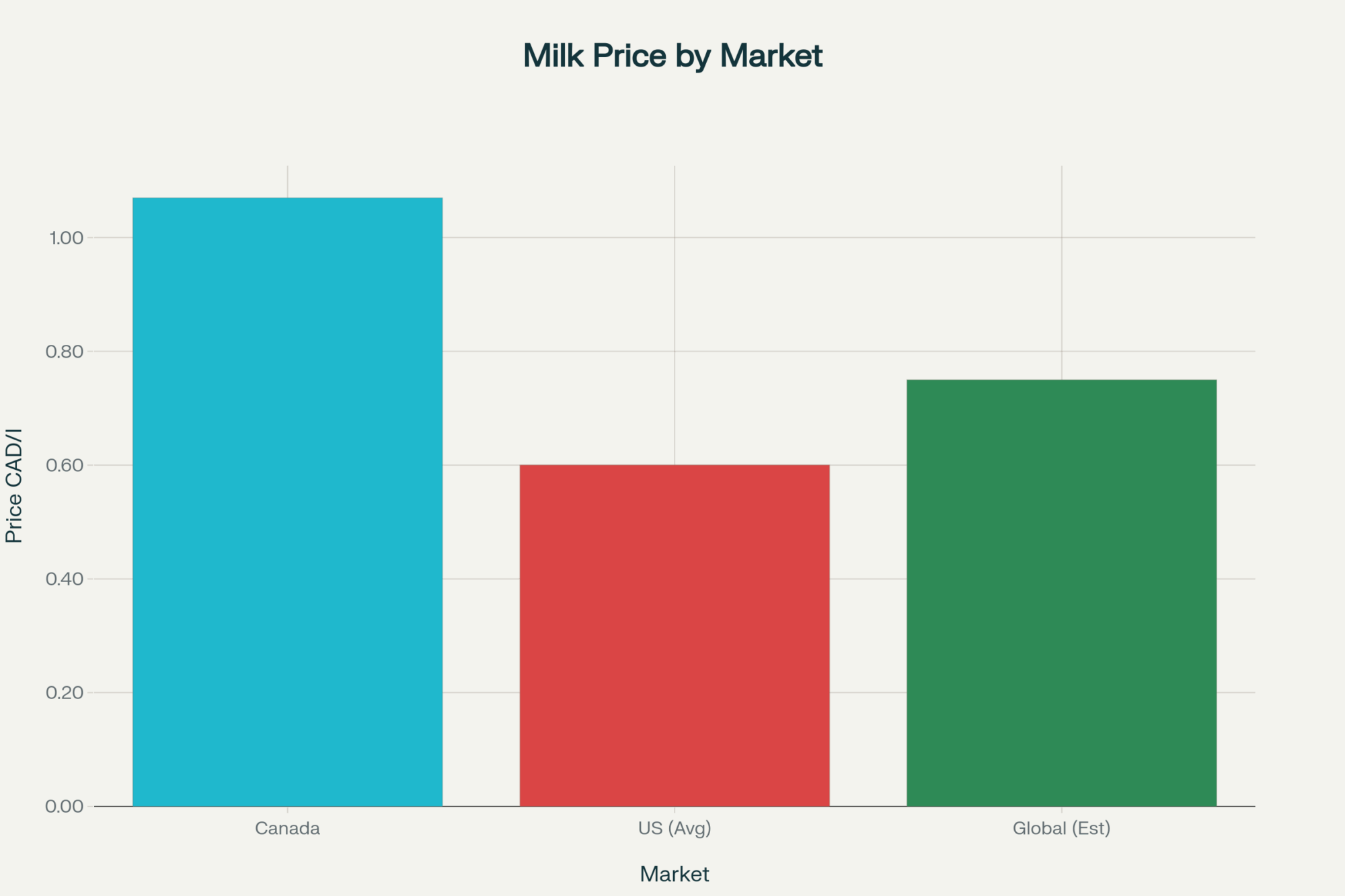
Retail Milk Price Comparison (CAD per liter)

Those tariffs work like a cliff edge, too. Inside quota? You’re golden with zero or low tariffs. Cross that line and boom—241% or higher depending on the product. It’s designed to be a hard stop, and honestly, it works perfectly.

Voices from the Trenches

Shawna Morris from the National Milk Producers Federation doesn’t mince words about this mess. She’s been pointing out for months that Canada’s quota allocation system heavily favors domestic processors who have zero incentive to bring in competing American product.

This isn’t happening in a vacuum either. When the latest round of tariffs kicked in, Canada fired back with retaliatory measures on $30 billion worth of U.S. goods, dairy included. Classic trade war escalation.

The Global Ripple Effect You Might Miss

Here’s something that caught my attention recently, and it’s bigger than just U.S.-Canada trade dynamics. Canada’s been dumping surplus dairy proteins—think skim milk powder—onto global markets at prices that are hammering worldwide protein markets by an estimated 8-12%.

If you’re a producer selling into ingredient markets, that hits your bottom line whether you’re exporting to Canada or not. It’s one of those interconnected things that doesn’t make headlines but shows up in your milk check.

This pattern is becoming more common… protected domestic markets subsidizing export dumping. We’ve seen it with EU dairy, we’ve seen it with New Zealand when they need to clear inventory. The difference here is scale and timing.

Looking at the Bigger Picture

Despite all the trade friction, the numbers tell an interesting story. Since USMCA took effect, U.S. dairy exports to Canada have grown by approximately 34%. That’s not the “quadrupled” figure you sometimes hear, but it’s solid growth in a heavily regulated market.

Those quotas are still managed with an iron fist by Canada’s supply management system—the Canadian Milk Supply Management Committee and Dairy Commission calling every shot. They’ve got this down to a science.

What This Means for Your Operation

Look, if you’re running a dairy operation and thinking about opportunities, here’s what I’d be watching closely:

Keep your ear to the ground on any shifts in U.S.-Canada trade policy, especially as the 2026 USMCA review approaches. That’s when the real horse-trading happens.

Pay attention to quota allocations. If we start seeing more import licenses going to retailers and food service companies instead of processors, that changes the entire game.

Watch protein markets like a hawk. Whether you’re selling domestically or internationally, those Canadian export practices are affecting your ingredient values.

And here’s the thing most producers miss—those 241% tariffs only kick in if you exceed quota limits. Since we’re not even filling a quarter of our allocated quotas, there’s actually room to grow within the existing framework if the allocation system gets straightened out.

Regional Realities Matter

This isn’t uniform across U.S. dairy regions either. Upper Midwest producers with established logistics networks might be better positioned if barriers fall. West Coast operations could find angles in specialty cheese markets. Northeast producers—especially in New York and Vermont—have proximity advantages for premium fluid milk markets.

I’ve been talking to producers from different regions, and the perspectives vary quite a bit. A guy running 800 head in Wisconsin sees this as potentially huge for his cooperative’s powder exports. Meanwhile, a family operation in Pennsylvania is more interested in what it might mean for their organic fluid milk premiums.

Bottom Line

Here’s my take after watching this industry for more years than I care to count: this feels like a rare opportunity for American dairy to crack into a premium market that’s been artificially protected for decades. But it won’t be easy, and it definitely won’t happen overnight.

The Canadian dairy fortress is real, and those political winds up north can shift faster than a July thunderstorm. Success will come to producers who stay informed, build the right relationships, and are ready to move when opportunities open up.

What’s got me optimistic is the combination of sustained political pressure, upcoming trade reviews, and the simple economics of the situation. When you’ve got American producers sitting on unused quota while Canadian consumers pay premium prices for milk, something’s eventually got to give.

The question isn’t whether change is coming to North American dairy trade—it’s whether your operation will be positioned to benefit when it does. This trade battle is going to define the next decade of North American dairy economics.

Your move: Start building relationships with export-focused cooperatives now. Monitor quota utilization reports. Keep tabs on processing capacity in border regions. Because when those barriers start coming down—and they will—the producers who moved first will capture the biggest opportunities.

What do you think? Are you ready to step up when those market barriers start cracking, or are you planning to wait and see how things shake out?

Complete references and supporting documentation are available upon request by contacting the editorial team at editor@thebullvine.com.

Learn More:

Join the Revolution!

Join over 30,000 successful dairy professionals who rely on Bullvine Weekly for their competitive edge. Delivered directly to your inbox each week, our exclusive industry insights help you make smarter decisions while saving precious hours every week. Never miss critical updates on milk production trends, breakthrough technologies, and profit-boosting strategies that top producers are already implementing. Subscribe now to transform your dairy operation’s efficiency and profitability—your future success is just one click away.


NewsSubscribe
First
Last
Consent

Trump’s Dairy Tariff War: How U.S. Farmers Could Benefit from Canada’s Trade Barriers

Trump’s bold move to impose reciprocal tariffs on Canadian dairy could reshape the global trade. What does this mean for U.S., Canadian, and global farmers?

Executive Summary

President Donald Trump has announced plans to impose reciprocal tariffs on Canadian dairy products, targeting Canada’s protectionist supply management system, which imposes steep over-quota tariffs of up to 241% on U.S. imports. This bold strategy aims to level the playing field for American farmers while pressuring Canada to reform its restrictive trade practices. U.S. dairy farmers, who export 18% of their milk production globally, could benefit from reduced competition and improved market access, though retaliatory measures from Canada may create short-term disruptions. Canadian farmers face potential price pressures as their insulated domestic market is challenged, while global producers in Europe and Oceania may seize opportunities in disrupted markets. This move builds on Trump’s first-term USMCA reforms but escalates efforts to address unresolved trade imbalances. The outcome of this tariff war could redefine North American dairy markets and have ripple effects worldwide.

Key Takeaways

  • Reciprocal Tariffs: Trump’s plan targets Canada’s 241% over-quota tariffs on U.S. dairy imports, aiming to create a fairer trade balance.
  • U.S. Dairy Impact: American farmers could see reduced competition domestically and better access to Canadian markets but face short-term volatility.
  • Canadian Farmers at Risk: Canada’s supply management system may face reform, exposing farmers to increased competition and price pressures.
  • Global Opportunities: European and Oceania producers could gain market share if U.S.-Canada tensions disrupt traditional trade flows.
  • Strategic Escalation: Building on USMCA reforms, Trump’s aggressive stance signals a shift from diplomacy to direct economic leverage in trade disputes.
Trump dairy tariffs, Canadian supply management, USMCA dairy provisions, dairy trade dispute, U.S. dairy exports

President Donald Trump has announced plans to implement reciprocal tariffs on Canadian dairy products, potentially as soon as today (March 7, 2025), in a decisive move to address longstanding imbalances in North American dairy trade. Speaking from the Oval Office on Friday, Trump emphasized his determination to confront what he characterized as Canada’s unfair tariff system that has disadvantaged American dairy producers for decades. For most U.S. dairy farmers, this aggressive stance represents the decisive action they’ve been seeking to level the competitive playing field.

“Ripping Us Off for Years” – Trump Takes Aim at Canadian Dairy Barriers

President Trump didn’t mince words during his Oval Office address, directly challenging Canada’s complex dairy tariff structure that has effectively limited American access to their market. “Canada has been ripping us off for years on tariffs for lumber and dairy products,” Trump stated, signaling his immediate intent to implement reciprocal measures.

This announcement’s timing is particularly significant, as it comes just days after his Joint Session address, in which he emphasized his “America First” trade philosophy.

While many mainstream media outlets have oversimplified Canada’s dairy tariff system, the reality is more nuanced and even more problematic for American producers. Canada operates a quota-based system where initial imports face relatively low tariffs, but punitive tariffs kick in once these quotas are exceeded. The official Canadian tariff schedule reveals the true magnitude of these barriers:

Dairy ProductWithin Access CommitmentOver Access Commitment
Milk7.5%241% but not less than $34.50/hl
Cream6.5%295.5% but not less than $4.29/kg
Condensed Milk2.84¢/kg259% but not less than 78.9¢/kg

Trump’s approach is characteristically direct: “They’ll be met with the same tariff unless they drop it. That’s what reciprocal means. And we may do it as early as today, or we’ll wait until Monday or Tuesday.”

This declaration clearly shows that the administration is prepared to use America’s economic leverage to secure better terms for dairy farmers, who have long felt disadvantaged by international trade agreements that failed to deliver promised benefits.

Beyond the Tariffs: Canada’s Supply Management System Explained

To truly appreciate why Trump’s move resonates so strongly with American dairy farmers, it’s essential to understand Canada’s supply management system. This protectionist framework controls dairy production and imports to maintain high domestic prices.

This system operates through three key mechanisms:

First, Canada strictly limits domestic milk production through quotas assigned to individual farmers. Second, it establishes minimum pricing for dairy products that ensures Canadian producers receive above-market returns. Third, and most problematically for U.S. producers, it implements those steep tariffs on imports that exceed carefully limited Tariff Rate Quotas (TRQs).

Under the USMCA agreement negotiated during Trump’s first term, Canada agreed to eliminate tariffs on dairy imports up to a set volume covering approximately 3.6% of the Canadian market. However, implementation has been contentious, with Canada allocating 85-100% of these quotas to processors rather than distributors and providing no TRQ access to retailers.

According to official USMCA documentation, Canada maintains TRQs on 14 different categories of dairy products. Four of these TRQs (Milk, Cream, Butter and Cream Powder, and Industrial Cheeses) include end-use restrictions requiring specific percentages to be used for processing into ingredients for further food processing, not retail sales. These technical restrictions further limit the practical market access for American dairy exporters.

“The supply management system isn’t just about tariffs –a comprehensive protectionist framework designed to keep American dairy products out of Canadian refrigerators,” explains dairy economist Thomas Reynolds. “Trump’s approach targets the most visible aspect of this system, but signals a willingness to challenge the framework that disadvantages American producers.”

American Dairy Exports: Growing Despite the Barriers

Trump’s confrontational stance on Canadian dairy tariffs comes against the backdrop of record performance for American dairy exports. According to USDA data, U.S. dairy exports reached an impressive $8.22 billion in 2024, marking the second-highest value ever recorded. This success demonstrates the growing global competitiveness of American dairy products despite persistent trade barriers.

U.S. Dairy Export Metrics (2024)Value/Volume
Total Export Value$8.22 billion
Total Export Volume2.65 Million Metric Tons
3-Year Average$8.59 billion
Growth Rate (2015-2024)4.6% compound annual growth

Canada has become an increasingly important market for American dairy, with exports to our northern neighbor reaching a record $1.14 billion in 2024. Along with Mexico ($2.47 billion), Canada now represents more than 40% of all U.S. dairy exports. These figures underscore both the opportunity and the challenge. While American dairy has made inroads into the Canadian market, the restrictive tariff system continues to limit the full potential of this trading relationship.

The dairy export achievements of 2024 included several notable milestones. For the first time, U.S. cheese exports exceeded 500,000 metric tons in a single year, with a remarkable 17% improvement year-over-year. This cheese export success stands in contrast to the challenges that milk powder exports (NFDM/SMP) faced, which declined by 8% in 2024. These mixed results highlight the complex market dynamics that American dairy farmers navigate and explain why many view Trump’s decisive action on trade barriers as essential to their future prosperity.

How Canada Limits U.S. Dairy Access: The USMCA Implementation Challenge

Under USMCA, Canada committed to providing Tariff Rate Quotas for various dairy products, but the implementation details reveal why American producers remain frustrated despite these commitments. Canada’s TRQ allocation system is designed to minimize disruption to their domestic market while technically meeting USMCA obligations.

TRQ Administration FeatureCanadian ImplementationImpact on U.S. Exporters
Allocation Distribution85-100% of quota to processorsProcessors have little incentive to import competing products
End-Use RestrictionsRequirements for processing use on multiple TRQsRestricts product marketing flexibility
Retail AccessNo TRQ access provided to retailersLimits direct consumer market access
Eligible ApplicantsNarrow definition excludes many potential importersReduces competition for quota allocation

A 2021 dispute settlement panel confirmed U.S. complaints about Canada’s TRQ allocation measures. The panel found, “The current Canadian system, which sets aside significant TRQ volumes only for processors, does not pass muster under the Treaty.” However, in a subsequent panel decision in late 2023, two of three panelists found that Canada’s revised measures did not breach USMCA commitments, while one panelist agreed with the U.S. regarding Canada’s narrow definition of eligible applicants.

Both sides claimed victory in these disputes. Canadian Trade Minister Mary Ng stated, “The panel expressly recognizes the legitimacy of Canada’s supply management system.” At the same time, then-USTR Katherine Tai declared it “a historic win” that would “help eliminate unjustified trade restrictions on American dairy products.”

This contradictory interpretation illustrates why many dairy farmers have grown frustrated with traditional diplomatic approaches to addressing trade barriers. Trump’s reciprocal tariff approach represents a significant escalation beyond these diplomatic efforts, reflecting frustration with Canada’s continued resistance to meaningful market opening despite USMCA commitments.

What Tariff Wars Mean for Your Milk Check

Implementing reciprocal tariffs on Canadian dairy would create significant market dynamics that American dairy farmers should consider carefully. Industry experts offer varying assessments of the potential impacts:

Michael Dykes, President and CEO of the International Dairy Foods Association (IDFA), has expressed optimism about America’s dairy export potential, noting that “consumers around the world continue to demand more U.S. dairy because we provide an assortment of delicious, nutritious and affordable dairy products.” While not directly addressing Trump’s tariff proposal, Dykes has emphasized that “with new trade agreements that remove obstacles and increase market access, we wouldn’t just break records – we would redefine the global dairy landscape for decades to come.”

For dairy farmers already navigating complex market dynamics, the prospect of more balanced trade relations offers hope for improved stability and profitability. While there may be short-term adjustments as markets respond to new tariff structures, many in the industry believe the long-term benefits of addressing unfair trade practices outweigh temporary disruptions.

Global Impact: How Trump’s Tariff Strategy Affects Dairy Farmers Worldwide

Trump’s reciprocal tariff approach could fundamentally reshape dairy trade dynamics across North America and beyond. Looking beyond individual farm operations, the tariff strategy has distinct implications for producers in different regions of the global dairy marketplace.

US Dairy Farmers

For American dairy producers, Trump’s confrontational stance represents potential short-term market disruption and long-term strategic advantage. The US dairy industry, which supports 3.2 million jobs and contributes nearly $800 billion to the economy, has invested over $8 billion in new processing capacity that depends on continued export growth.

The immediate benefit for US farmers could be reduced competitive pressure from Canadian imports in specific product categories, potentially strengthening domestic prices. Trump’s focus on achieving fair trade could finally address the frustrating imbalance that has hindered American access to Canadian markets while Canadian products faced fewer barriers entering the United States.

With approximately 18% of US milk production currently exported, any policy that increases domestic market protection while simultaneously working to secure better international market access represents a significant opportunity. The challenge will be managing any retaliatory actions from trading partners during what Trump has acknowledged will be an “adjustment period.” US producers should prepare for potential short-term price volatility while positioning for improved market conditions once trade negotiations conclude.

Canadian Dairy Farmers

Canadian dairy producers face the most direct impact from Trump’s tariff strategy. Canada’s supply management system has protected domestic producers through quotas and steep over-quota tariffs (241% for milk, not the sometimes claimed 270%) for decades. This system has effectively insulated Canadian dairy farmers from international competition while ensuring stable, often higher-than-market prices.

Trump’s reciprocal tariff approach directly challenges this protected status quo. Canadian dairy farmers may soon confront market conditions they’ve long avoided through their government’s protectionist policies. If negotiations result in meaningful reform of Canada’s supply management system, Canadian producers could face increased competition and potential price pressures as market forces play a more significant role in determining dairy values.

The Canadian government’s swift retaliatory measures, including announced tariffs on $30 billion worth of American products and threats of an additional $125 billion in tariffs, demonstrate its concern about disruption to its carefully managed dairy sector. These defensive actions reflect the significant stakes for Canadian dairy producers, who have benefited from decades of protection from international competition.

Global Dairy Producers

Beyond North America, dairy farmers worldwide watch this trade confrontation for opportunities and warning signs. European and Oceania dairy exporters, particularly those from Ireland, France, the Netherlands, New Zealand, and Australia, may find new opportunities to gain market share if US-Canada trade tensions persist.

Chinese markets, which have imported between $500-800 million worth of US dairy products annually in recent years, could become battlegrounds for international competition if US products face barriers in traditional markets. European producers, already significant players in the global dairy trade, are well-positioned to fill any gaps created by disrupted North American trade flows.

The situation creates a complex calculus for dairy farmers outside North America. While potential market openings may emerge in the short term, the long-term restructuring of global dairy trade patterns could create new competitive pressures. As Trump’s tariff strategy progresses, global producers must carefully monitor the direct US-Canada negotiations and the secondary effects on international market access, pricing dynamics, and regulatory frameworks.

From NAFTA to USMCA to Tariff Wars: The Evolution of Dairy Trade Policy

Trump’s current position on Canadian dairy tariffs builds upon his first-term accomplishments in renegotiating the North American trade relationship. The United States-Mexico-Canada Agreement (USMCA), implemented in July 2020, made incremental improvements in dairy market access compared to NAFTA, securing the elimination of Canada’s Class 7 milk pricing program and establishing those limited TRQs for American dairy products.

Yet implementation challenges have prevented American producers from realizing the full benefits promised. The dispute settlement process has yielded mixed results, with panel decisions that both sides have interpreted differently. This diplomatic approach has made incremental progress but has failed to reform Canada’s supply management system fundamentally.

Trump’s more confrontational strategy represents a calculated escalation to force more meaningful reform. By directly targeting Canada’s tariff imbalances with reciprocal measures, the administration signals that American patience with gradual diplomatic progress has run out.

A Watershed Moment for American Dairy

President Trump’s announcement of reciprocal tariffs on Canadian dairy products represents a potentially watershed moment for American dairy farmers who have long struggled against Canada’s protectionist policies.

By directly challenging the tariff imbalance, the administration is signaling its determination to secure meaningful market access rather than accepting incremental diplomatic victories that leave the core barriers in place.

For US dairy farmers, this decisive action aligns with their preference for government policies that directly prioritize American interests and confront unfair trade practices.

As these developments unfold in the coming days and weeks, The Bullvine will continue providing the detailed analysis and expert perspective that dairy producers need to navigate these complex trade dynamics. What’s clear is that Trump’s bold stance on Canadian dairy tariffs has fundamentally changed the conversation about North American dairy trade, potentially opening the door to more substantial reforms than previous approaches achieved.

Learn more

Join the Revolution!

Join over 30,000 successful dairy professionals who rely on Bullvine Daily for their competitive edge. Delivered directly to your inbox each week, our exclusive industry insights help you make smarter decisions while saving precious hours every week. Never miss critical updates on milk production trends, breakthrough technologies, and profit-boosting strategies that top producers are already implementing. Subscribe now to transform your dairy operation’s efficiency and profitability—your future success is just one click away.

NewsSubscribe
First
Last
Consent

The Controversial Canadian System That Could Save American Dairy

America’s dairy farmers are caught in a crisis, drowning in excess milk, while their Canadian counterparts thrive under a “socialist” supply management system. As prices fluctuate wildly and small farms vanish, is it time for the U.S. to rethink its free-market obsession? Discover the shocking truths behind this dairy dilemma!

America’s dairy farmers are drowning in a sea of milk, while their Canadian counterparts are sitting pretty with stable incomes. It’s time to acknowledge that our unwavering commitment to free-market principles is leading to the downfall of our dairy lands, where capitalism reigns supreme.  

Canada’s Golden Udder: A System That Works (Mostly) 

Canada’s dairy system is built on three pillars that would make any red-blooded American capitalist squirm: production quotas, fixed milk prices, and sky-high tariffs on foreign dairy. This system contradicts what is typically seen in economics. Well, hold onto your cowboy hats: 

  • Stable Prices: Canadian dairy farmers aren’t on a financial roller coaster. They can plan for the future—imagine that! By 2024, the industry had made $11.5 billion, with a five-year consistent growth rate of 2.8% annually.
  • Job Security: This “socialist” system supports over 70,000 jobs. Not too shabby for a bunch of “commies,” eh?
  • The Price of Stability: Here’s where it gets sticky. Canadian families might fork over an extra $339 to $554 annually for dairy. Consider this: Would you be willing to pay extra for milk to help save your neighbor’s farm?

As one Ontario dairy farmer says, “Supply management isn’t perfect, but it keeps us out of bankruptcy. I’ll take stable prices over free-market roulette any day.”

America’s Free-Market Fiasco: A Cow-Tastrophe 

Meanwhile, in the land of the free, we’re drowning in milk and red ink: 

  • Overproduction Nightmare: We’re producing excess milk with no clear plan for utilization. Wisconsin alone outproduces all of Canada. Talk about udder madness!
  • Farm Failures: Small farms are disappearing rapidly. Between November and December 2024, 9,000 cows were culled as farmers gave up. So much for the American dream, huh?
  • Price Whiplash: Milk prices swing more wildly than a cow’s tail in fly season. U.S. milk production dipped 0.5% in December 2024 due to rock-bottom prices and sky-high costs.
  • Uncle Sam’s Allowance: Here’s a hidden fact: We’re investing billions in subsidies into a flawed system. In 2020 alone, dairy farmers got a $2 billion bailout. Isn’t that just socialism with extra steps?

“Dairy farmers are stretched thin going into 2024,” said Washington dairy producer Jason Vander Kooy. “Milk prices have not stayed in line with the rising costs of dairy farming. The cost of producing milk is a steady incline, while the price we get paid for milk is a roller coaster”.

AspectUnited StatesCanada
Regulatory ApproachFree-market principlesSupply management system
Price StabilityVolatile pricesStable prices
Production ControlNo national quota systemStrict quota system
Government SupportSubsidies (e.g., $2 billion in 2020)Indirect support through tariffs
Farm NumbersDeclining (84% decrease since 1992)More stable
Export FocusHigh (key for surplus management)Limited (focused on domestic market)
Consumer PricesGenerally lowerHigher (extra $339-$554 annually per family)
Market VolatilityHighLow

David vs. Goliath: Small Farms in the Crosshairs 

Let’s talk about the elephant in the barn: How would a Canadian-style system shake up our dairy landscape? 

  • Small Farms: Quotas could be a lifeline, offering predictable income without the constant threat of being outmatched by mega-dairies.
  • Mega-dairies: They’d likely fight tooth and nail against production limits. But here’s a thought: Maybe it’s time they diversified instead of getting more significant.
  • Regional Ripples: States like California, with their dairy empires, might resist. But family farms in Wisconsin and Vermont deserve a real fighting chance.

The Real Cost of ‘Cheap’ Milk 

Sure, Canadians pay more at the checkout. But let’s crunch some numbers. U.S. taxpayers shell out roughly $22.2 billion annually in dairy subsidies. That’s about $173 per household—and you’re still paying for milk at the store! So, who’s getting milked here? 

“Americans pay twice for their dairy: once as taxpayers, and again as consumers,” noted a report from Dairy Farmers of Canada.

The Great Cheese Surprise of 2024 

When you thought things couldn’t get curdled, the September 2024 U.S. dairy product production report dropped a bombshell. Cheese production fell 18 million pounds short of forecasts, while butter overshot expectations by 4 million pounds. It’s as if our cows chose to produce butter instead of cheese! 

This dairy rollercoaster isn’t just giving farmers whiplash—it’s making the whole industry queasy. With cheese stockstightening and butter piling up, we’re looking at a market more unpredictable than a cow with mad cow disease. 

The Interest Rate Squeeze 

As if volatile milk prices weren’t enough, dairy farmers are now getting squeezed by rising interest rates. In 2024, rates climbed to levels unseen in 16 years. It’s comparable to attempting to milk a cow on a wildly bucking horse—nearly impossible and likely to result in failure (or worse). 

These sky-high rates force farmers to rethink everything from expansion plans to equipment upgrades. It’s no longer just about keeping the lights on; it’s about surviving in an industry that seems determined to put them out to pasture. 

The Export Conundrum 

Here’s a wild idea: Maybe the solution to our dairy woes lies beyond our borders. Due to low local demand, the industry is eagerly exploring foreign markets, akin to a cat eyeing a bowl of cream. 

Stephen Cain from the National Milk Producers Federation puts it bluntly: “The export market is going to be key for us moving some of this product overseas.” But here’s the rub—we’re not alone. The EU and New Zealand are in the game, turning the global dairy market into a high-stakes poker match. 

The Organic Option: A Cash Cow or Just Bull? 

Amid this dairy crisis, some farmers are rapidly transitioning to organic practices, almost at the speed of saying “grass-fed.” The USDA is sweetening the pot with $58 million in assistance for organic dairy operations. This is similar to applying a Band-Aid to a broken leg—it may seem helpful, but it doesn’t address the root issue. 

Choosing the organic path has its challenges beyond picturesque landscapes and content cows. With higher production costs and a niche market, it’s a gamble not every farmer can afford. 

Quick Stats

The Bottom Line 

The U.S. dairy industry stands at a critical crossroads. We must take decisive action now to ensure a sustainable and prosperous future. Here are key recommendations for farmers and policymakers: 

  1. Implement regional production quotas to curb overproduction and stabilize prices.
  2. Expand and enhance programs like Dairy Margin Coverage (DMC) to provide better financial security for farmers.
  3. Empower local cooperatives to manage supply, fostering a more grassroots approach to industry regulation.
  4. Invest in innovation and diversification strategies to help farmers adapt to changing market conditions.
  5. Develop a comprehensive export strategy to capitalize on global market opportunities.
  6. Reform federal milk pricing formulas to reflect current manufacturing costs and market realities better.
  7. Establish a voluntary program for dairy farmers looking to exit the industry, ensuring a dignified transition.

Taking these steps can transform our dairy industry from a crisis into an opportunity. The time for half-measures and band-aid solutions has passed. We must act boldly to preserve an industry and a way of life that has defined rural America for generations. 

The choice is clear: adapt, thrive, or cling to outdated systems and watch our dairy heritage wither. Let’s choose innovation, sustainability, and prosperity. The future of American dairy depends on our actions today. 

Key Takeaways:

  • Canada’s supply management stabilizes dairy prices and supports farmers, unlike the volatile U.S. market.
  • U.S. dairy farmers face overproduction, unpredictable pricing, and heavy reliance on subsidies.
  • There’s growing interest in the U.S. for adopting aspects of Canada’s dairy model amid ongoing criticisms.
  • Some industry players oppose the Canadian system due to concerns over market access, corporate interests, and consumer costs.
  • Implementing supply management in the U.S. would require significant adjustments, which would have varying impacts on farms of different sizes.

Summary:

American dairy farmers are dealing with an unpredictable market, where prices can swing wildly, and farms are closing down even with government help. Meanwhile, in Canada, quotas, fixed prices, and import taxes give stability, supporting many jobs and providing steady prices for farmers. Critics say Canada’s system is not competitive and makes families pay more for dairy. In the U.S., despite government support, too much milk and farm failures are significant issues. A Canadian-style system might help by giving small farms quotas for a steady income. For a better future, U.S. dairy can consider regional quotas, improve Dairy Margin Coverage, support local cooperatives, invest in new ideas, export more, change pricing rules, and help farmers who want to leave. It’s essential to act now for a sustainable future. 

Learn more:

Join the Revolution!

Bullvine Daily is your essential e-zine for staying ahead in the dairy industry. With over 30,000 subscribers, we bring you the week’s top news, helping you manage tasks efficiently. Stay informed about milk production, tech adoption, and more, so you can concentrate on your dairy operations. 

NewsSubscribe
First
Last
Consent

Send this to a friend



