





California lost 62% of its dairy farms in 25 years. Regulatory costs exploded 1,366%. Here’s why your operation could be next.

We’ve been crunching the numbers on California’s dairy crisis, and here’s what the industry doesn’t want to admit: this isn’t about drought, water scarcity, or even environmental compliance. It’s about the systematic elimination of family farms through regulatory warfare – and it’s coming to your state next. are seeing fees pile up year after year, forcing tough questions about whether family farms can keep punching through. GSA fee structures vary wildly across Central Valley subbasins, with assessments ranging from hundreds to thousands of dollars per acre-foot depending on sustainability plan requirements.
This isn’t just about water shortages anymore – it’s about an entire way of life under siege by a regulatory wave that few outside these valleys fully grasp.
What’s happening here in California is heading to your state next, and most producers aren’t even close to ready.
The Ground Under Our Feet Is Literally Collapsing
Talk to any well driller from Bakersfield to Modesto. They’ll tell you what everyone’s seeing on their operations. Nature Communications just published research showing the valley has sunk 14 cubic kilometers from 2006 to 2022 – that’s equal to all the land subsidence that happened in the previous 24 years combined.
Concrete pads are cracking clean through. Well casings show stress fractures. This isn’t some distant environmental study – this is infrastructure failing under our boots.
The Bureau of Reclamation started producers at 35% water allocation this year, and bumped producers to 55% by May. Sounds generous until you realize those numbers flip every month based on delta fish counts, court rulings, and political winds nobody can predict.
What you budget in January gets thrown out the window by October.
David Lemstra Saw This Coming Years Ago
David Lemstra ran cattle here for over 40 years before he’d finally had enough. Packed up 4,000 head and moved the whole operation to South Dakota. Now he ships to Agropur and sleeps better at night.
“Death by a 1,000 cuts,” he described it. “Wasn’t any single thing that broke us. Was everything piling up until you couldn’t breathe anymore.”
Smart man got out before the worst hit. More producers should have listened.
The Numbers That’ll Make Your Stomach Turn
Cal Poly just released a study that should scare the hell out of every producer in America. Regulatory compliance costs exploded from $109 per acre in 2006 to $1,600 per acre by 2024. That’s not a typo – sixteen hundred dollars per acre, representing a 1,366% increase.
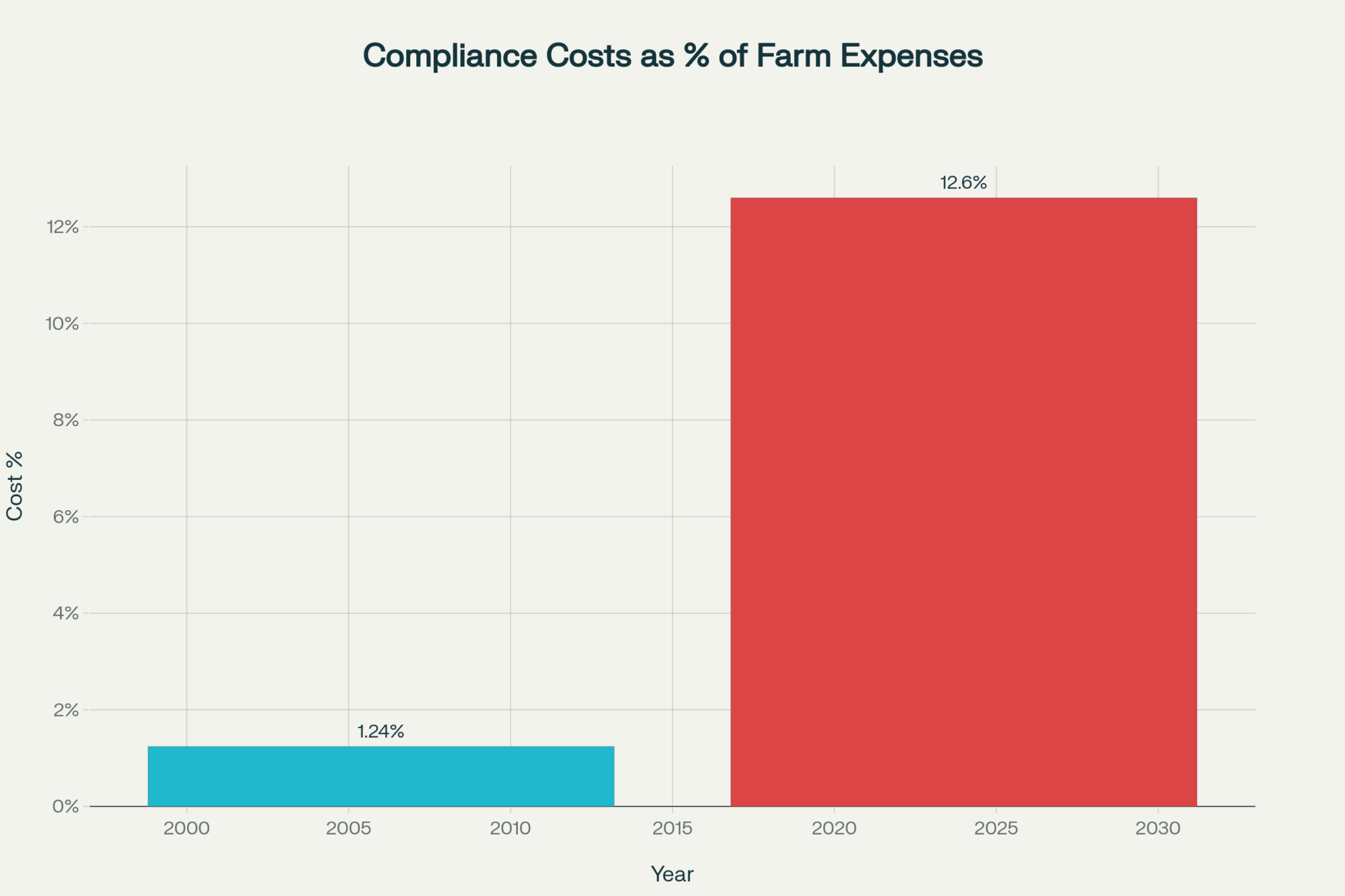
Think about that. By 2024, compliance was eating 12.6% of total production costs. One dollar out of every eight goes to paperwork, permits, and bureaucrats – not cows, not feed, not equipment.
Meanwhile, California dairies have cut water use per gallon of milk by nearly 90% since the 1960s. They’ve built digesters, installed precision irrigation, and managed manure like scientists. California dairies are now achieving a collective annual reduction of 5 million metric tons of methane emissions.
But efficiency won’t save you when the regulatory machine needs constant feeding.
Every Water Cut Hits Feed Supply
Here’s what folks outside the Valley don’t understand – every water restriction ripples through the entire feed chain. When Kern County almond growers get their allocations slashed, it affects feed availability across the board. When Imperial Valley cotton operations get squeezed, the ripple effects hit every feed supplier.
Feed supply costs fluctuate based on water allocation impacts throughout the Central Valley agricultural system. Nutritionists scramble to find alternatives, but there’s only so much you can substitute before milk production tanks.
Why Environmental ‘Success’ is Actually Destroying the Environment
Here’s the dirty secret nobody in Sacramento wants to admit: California’s “environmental success story” is making the environment worse.
Those methane digesters everyone’s celebrating? They’re creating a massive ammonia pollution problem that’s poisoning nearby communities. Research shows that after digesters process manure, they emit ammonia that travels for miles, contaminating water and soil while creating dangerous particulate matter that threatens human health.
But it gets worse. The EPA has documented that California’s regulatory approach is driving “policy leakage” – production shifts to states with dirtier energy grids and lower environmental standards. So while California politicians claim victory over methane reductions, they’re actually increasing global emissions by forcing production to places like Texas and Idaho, where environmental controls are weaker.
The environmental community stays silent because admitting this would destroy their fundraising narrative. Meanwhile, real communities suffer from increased ammonia exposure while global emissions actually rise.
This isn’t environmental protection – it’s environmental theater that makes politicians look good while making the actual problem worse.
Even Co-ops Are Throwing in the Towel
California Dairies Inc. sent letters to members warning that they can’t absorb regulatory cost increases anymore. When co-ops – the organizations that have stood by producers through everything – start passing compliance costs back to milk checks, you know the industry is drowning.
Land O’Lakes, Hilmar Cheese, Saputo – they’re all singing the same tune. Fewer buyers, tighter margins, and more regulatory overhead are eating into everyone’s bottom line.
How Industry ‘Leaders’ Are Selling Out Family Farms
The most infuriating part? The industry organizations that should be fighting for family farms are actively helping destroy them.
California Farm Bureau has gone completely silent on the regulatory explosion. When was the last time you heard them challenge the fundamental premise of California’s approach? They’ve traded advocacy for access, preferring quiet meetings with regulators over public fights that might upset their political relationships.
Western United Dairymen talks a good game about supporting all producers, but look at their board composition – it’s dominated by mega-dairies that benefit from regulatory consolidation. When push comes to shove, they support “compromise” solutions that sound reasonable but systematically favor large operations over family farms.
Major processors are actively complicit in this destruction. California Dairies Inc., Land O’Lakes, and Saputo could use their market power to resist regulatory overreach. Instead, they’re quietly passing compliance costs back to producers while positioning themselves as environmental leaders.
The most disgusting part? Many of these same organizations profit from the consultancies and compliance services that struggling farms need to navigate the regulatory maze they helped create.
Here’s what real leadership would look like: Publicly challenging the environmental effectiveness of current regulations. Filing lawsuits against discriminatory fee structures. Organizing producer boycotts of processors that won’t fight regulatory overreach. Demanding cost-benefit analyses of every new regulation.
Instead, we get press releases about “working collaboratively with regulators” while family farms disappear at record rates.
These aren’t industry leaders – they’re undertakers helping bury the family farm system while pretending to care about the funeral.
Disappearing Faster Than Anyone Wants to Admit
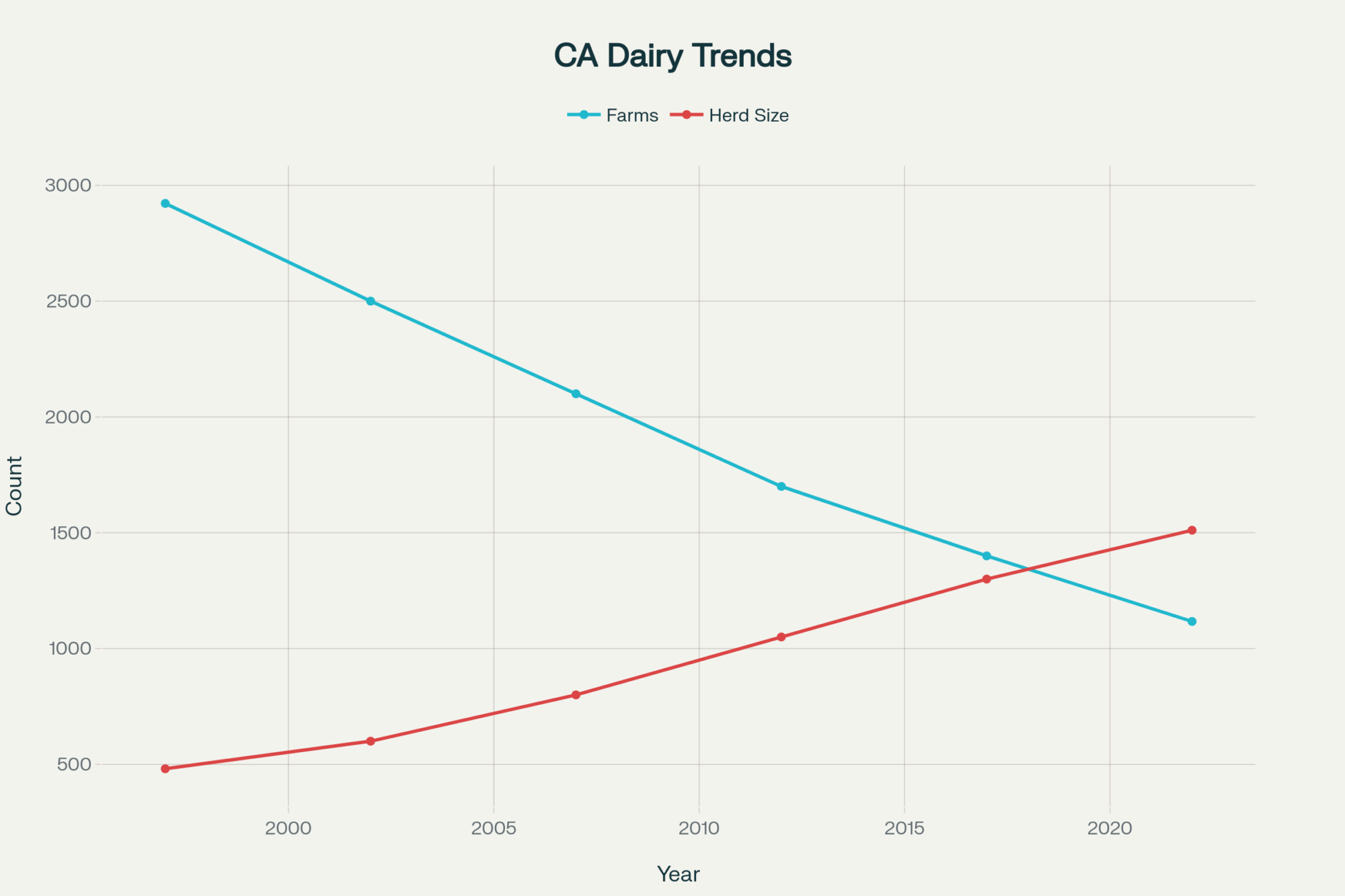
The USDA numbers don’t lie, even if politicians do. California went from 2,922 dairy operations in 1997 to just 1,117 by 2022 – losing 62% of farms in 25 years. Average herd size jumped from 481 to 1,511 head, meaning survivors absorbed what casualties couldn’t handle.
California now has 1.7 million dairy cows on just over 1,100 operations. The state still leads the nation in milk production, but with fewer and fewer family operations every year.
Merced County’s lost dozens of operations. Kern County’s hemorrhaging family farms every quarter. These aren’t just statistics – these are neighbors who built their whole lives around this business.
While producers have always battled volatile markets and labor shortages, this unprecedented regulatory burden is a man-made crisis with no end in sight. The operations disappearing aren’t bad farmers. They’re producers who focused on raising good cows instead of playing Sacramento politics.
The Political Reality Nobody Talks About
Operations surviving this regulatory slaughter aren’t necessarily the best at farming. They’re the best at politics.
They’ve got relationships in Sacramento. They position themselves as “partners” in regulatory development. They build compliance departments that become competitive moats against family operations that can’t afford regulatory lawyers.
Meanwhile, producers who put everything into genetics, nutrition, and animal care discover that raising excellent cows doesn’t protect you from terrible policy.
The Dirty Truth About Who Really Benefits from Regulation
Want to know who’s getting rich off California’s regulatory nightmare? It’s not the environment, and it’s definitely not family farms.
The Compliance Industrial Complex is booming. Environmental consulting firms are billing millions to help large dairies navigate the regulatory maze. Legal firms specializing in agricultural compliance have tripled their staff since 2020. Software companies selling regulatory tracking systems are reporting record profits.
Large agribusiness loves this system because it eliminates their competition. When Hilmar Cheese and Land O’Lakes face the same $1.2 million compliance bill as a 500-cow family farm, guess which one survives? The big players can spread regulatory costs across massive operations while small farms get crushed by fixed compliance expenses.
Regulatory agencies have built empires on this complexity. The California Air Resources Board has added 847 new positions since 2019, most focused on agricultural oversight. These aren’t temporary jobs – they’re permanent bureaucratic positions with pension benefits that depend on maintaining regulatory complexity.
Environmental groups raise record donations by promoting the crisis they’re helping create. The more farms that fail, the more they can claim environmental victory and ask for bigger donations to “protect” the environment.
Meanwhile, the politicians who created this mess get campaign contributions from all sides: environmental groups grateful for the regulations, consulting firms profiting from the complexity, and large agribusiness companies that want to eliminate competition.
The only losers? Family farmers who actually produce the food and the rural communities that depend on them.
Your State Is Next – Don’t Kid Yourself
If you think this is just California’s problem, you’re living in a fantasy. Federal climate policies explicitly reference California as the national model. Walmart, Costco, and every major processor are demanding California-style environmental standards from suppliers nationwide.
Washington State’s copying our framework. Oregon’s following suit. New York’s drafting identical legislation.
Think you’re safe milking cows in Wisconsin or Pennsylvania? Once corporate supply chain requirements lock in, you’ll face California compliance costs whether you’re in Modesto or Milwaukee.
The regulatory export machine is already running.
What You Can Do Before It’s Too Late
Time’s running short, but you’re not powerless yet. Start fighting now:
- Join Your State Farm Bureau Today – They’re the only ones fighting regulatory export legislation in Congress. Most producers never even know when comment periods open. Don’t be one of them.
- Build Political Relationships Before You Need Them – Get to know your county supervisors, state reps, and congressional delegation. When regulations hit your district, you want them knowing your name.
- Document Every Improvement – Track your efficiency gains, environmental investments, and compliance costs. You’ll need this ammunition when the regulatory army arrives.
- Form Coalitions with Other Livestock Producers – Beef, pork, and poultry operations face the same threat. There’s strength in numbers, but only if you organize before the fight comes to you.
- Plan for Regulatory Costs Like Feed Price Volatility – This isn’t temporary. Budget for compliance like any other permanent operational expense.
- Make Sure Your Co-op’s Ready – Demand they help members navigate regulatory complexity instead of just passing costs through to your milk check.
The Clock’s Already Ticking Nationwide
Based on current consolidation rates, California’s transformation will be complete by 2028. Once that happens, the political coalition becomes unbeatable. Environmental groups, large agribusinesses, regulatory agencies, and consulting firms all profit from maintaining complexity regardless of actual outcomes.
For producers in other states, you’ve got maybe three years before similar frameworks become politically irreversible in your region.
This Is About Control, Not Environment
Don’t let anyone fool you – we’re watching agriculture’s transformation from market-based production to regulatory-dependent compliance management. The documented trends clearly indicate that this poses a threat to food security and producer independence.
Environmental regulations that worsen environmental outcomes while destroying family farms aren’t about saving the planet. They’re about centralizing control over American food production.
The Bottom Line: Fight Now While You Still Can
California’s regulatory warfare isn’t about environmental protection – it’s about eliminating competition for players big enough to afford the compliance game. While industry leaders stay silent, family farms are getting systematically destroyed. The question isn’t whether this is coming to your state – it’s whether you’ll wake up before you become another statistic.
Don’t wait for the regulatory army to reach your state. The Bullvine doesn’t just report the news – we give you the tools to fight back. Subscribe now for the analysis that industry leaders don’t want you to see.
KEY TAKEAWAYS
- Track every regulatory dollar – Compliance costs jumped from 1.3% to 12.6% of expenses in 18 years; most producers don’t even know what they’re spending (Cal Poly Agricultural Business, 2024)
- Water allocations change monthly – Bureau of Reclamation updates based on fish counts and court rulings; attend your GSA meetings and stay informed, or get blindsided (Bureau of Reclamation, 2025)
- Methane programs pay off – California dairies achieved 5 million metric tons of annual reductions and are on track for climate neutrality by 2027; early adopters get the incentives (UC Davis CLEAR Center, 2025)
- Scale or partner up – With 62% fewer farms but 80% of the milk production, the math’s brutal; consolidation isn’t slowing down, so position yourself strategically (USDA Census of Agriculture, 2022)
- This is spreading fast – Federal policies explicitly reference California as the model; major processors are already demanding these standards nationwide, so prepare now or pay later
EXECUTIVE SUMMARY:
We’ve been digging into California’s dairy meltdown, and here’s what we found: regulatory costs have exploded 1,366% since 2006, now eating up over 12% of total production expenses. Despite cutting water use by 90% and achieving massive methane reductions, family dairies are still getting crushed – 62% gone since 1997, while average herd sizes tripled to 1,511 head. Water allocations swing from 35% to 55% based on politics, not hydrology, and those GSA fees keep climbing every year. The kicker? This isn’t staying in California – Washington, Oregon, and New York are copying the same regulatory playbook. Here’s our advice: stop thinking this won’t reach your state, start planning for compliance costs like you plan for feed volatility, and get politically engaged before it’s too late.
Complete references and supporting documentation are available upon request by contacting the editorial team at editor@thebullvine.com.
Learn More:
- Dairy Profits: Unpacking the 7% Rule for Financial Success – While the main article details external financial threats, this piece provides an immediate, tactical defense. It reveals a powerful financial management rule to optimize cash flow, control debt, and build the economic resilience needed to survive regulatory assaults.
- The Dairy Industry’s Future: Navigating the Top 5 Trends of 2025 – This article offers a crucial strategic lens on the market forces driving consolidation. It moves beyond politics to analyze key consumer, processing, and global trends, helping you position your operation to thrive in the exact market the main article warns about.
- Robotic Milking Systems: Are They the Future for Your Dairy? – To combat the scale and cost pressures described, this article explores a game-changing technological solution. It analyzes the ROI of automation, demonstrating how innovation can directly counter labor shortages and high overhead, creating a competitive moat for your farm.
 The Sunday Read Dairy Professionals Don’t Skip.
 The Sunday Read Dairy Professionals Don’t Skip.
Every week, thousands of producers, breeders, and industry insiders open Bullvine Weekly for genetics insights, market shifts, and profit strategies they won’t find anywhere else. One email. Five minutes. Smarter decisions all week.




