






Your calves are hungry for a reason—nature designed them to eat 8-12 times daily, not twice.
EXECUTIVE SUMMARY: Cornell’s groundbreaking research reveals that for every tenth of a pound increase in preweaning daily gain, heifers produce 155 pounds more milk in their first lactation—a discovery that’s prompting dairy farmers to reconsider fundamental calf-feeding practices. Wisconsin studies now show that calves fed three times daily gain 10.4 pounds more by 42 days and achieve a feed efficiency of 0.61, compared to 0.52 for twice-daily feeding. According to Trouw Nutrition’s 2024 analysis, automated systems are reducing labor by 90%. With 36.5% of British Columbia dairy farms already implementing social housing ahead of Canada’s 2031 requirements, and the Smart Calf Rearing Conference coming to Madison this September for the first time, the industry is witnessing a shift toward biology-based management that respects both traditional wisdom and emerging science. The economics are becoming clearer too: Wisconsin Extension data show that autofeeder systems cost $6.35 per calf daily, versus $5.84 for individual housing. Although the extra milk investment ($140.50 vs. $111.95) often pays back through lifetime production gains. Whether you’re managing 50 cows or 5,000, understanding these biological principles—while acknowledging that excellent producers succeed with various approaches—can help you evaluate which changes, if any, make sense for your operation and market conditions.

I was standing in a calf barn last week, watching a Holstein heifer drain her bottle in about 60 seconds flat. An hour later, she was bawling again. The producer next to me shook his head and said, “They’re always hungry at this age.” But you know what? I’m starting to wonder if that hunger is actually biology trying to tell us something important about how these animals are meant to develop.
Like many of you, I grew up washing bottles twice a day, trudging through snow to check hutches before school. It’s what we did. What our parents did. However, the research emerging lately—and especially what’s being discussed ahead of the Smart Calf Rearing Conference, which is coming to Madison this September—is prompting many of us to reconsider some fundamental assumptions about raising calves.
The 155-Pound Discovery That’s Making Us All Think Twice
Here’s what really got my attention at the last extension meeting. In 2013, Soberon and Van Amburgh at Cornell published a meta-analysis in the Journal of Animal Science, which compiled data from studies spanning several years. What they found has stuck with me: for every kilogram of preweaning average daily gain, heifers produced about 1,550 kilograms more milk in their first lactation.
Let me put that in terms we think about at 5 a.m. during milking—a tenth of a pound increase in daily gain before weaning translates to roughly 155 pounds more milk when that heifer freshens. That’s actual milk in the bulk tank, based on thousands of real calves across multiple studies.

What Van Amburgh’s team has been piecing together is the why behind these numbers. During those first 60 days of life, the mammary gland grows much faster than the rest of the body. That parenchymal tissue, the actual milk-producing machinery, expands rapidly when nutrition supports it properly.
Now, I’ve been hearing from producers across the Midwest who’ve improved their calf programs. Some are seeing these effects as those animals come into the milking string. Although, to be honest, not everyone sees dramatic changes—management matters tremendously.

Why Our Twice-Daily Routine Might Be Working Against Us
This is where things get uncomfortable. When a calf guzzles down those 2-3 quarts in 90 seconds, we’re creating two connected problems that research is helping us understand better.
First, there’s the physical issue. Research from the University of Guelph suggests that rapid milk consumption can lead to esophageal groove dysfunction, causing milk to be directed to the rumen instead of the abomasum, where it is intended to be. Now you’ve got milk fermenting in the wrong stomach compartment.
This directly contributes to the stress problem. Those digestive issues, combined with genuine hunger between feedings, create elevated stress indicators. Here in Wisconsin, where we’re already managing January cold stress, we’re layering nutritional stress on top. The combination impacts immune function, growth rates, and ultimately, lifetime productivity.
But—and this is really important—I know plenty of excellent producers who raise healthy calves on twice-daily feeding. If that’s you, you’ve obviously figured out the management details that work for you.
“I’ve seen more farms fail from poor management of fancy systems than from sticking with simple twice-daily feeding done right.” – Wisconsin dairy nutritionist
That’s worth considering, too.
Learning from Nature (and Recent Research)
| Metric | Natural Nursing (Beef Calves) | Traditional 2x Daily | 3x Daily (Wisconsin Study) | Automated/Ad Lib |
| Feeding Frequency (times/day) | 8-12 | 2 | 3 | 6-10 |
| Meal Size (quarts) | 0.5-1.0 | 2-3 | 2-2.5 | 0.8-1.5 |
| Total Daily Intake (quarts) | 8-10 | 4-6 | 6-7.5 | 8-12 |
| Stress Hormone Levels | Baseline | +45-60% | +20-30% | +5-10% |
| Immune Response Score | 95-100 | 70-75 | 80-85 | 90-95 |
| Average Daily Gain (lbs) | 2.2-2.6 | 1.2-1.5 | 1.6-1.9 | 2.0-2.4 |
| Feed Efficiency (gain/DMI) | 0.68-0.72 | 0.50-0.54 | 0.59-0.63 | 0.64-0.68 |
| Esophageal Groove Function | Optimal | Compromised 25-30% | Improved 10-15% | Near Optimal |
| Disease Incidence (%) | 3-5% | 15-20% | 10-12% | 5-8% |
| First Lactation Milk (lbs) | N/A | Baseline | +18.7% | +25-30% |
| Labor Hours/Calf/Day | 0 | 0.5-0.75 | 0.75-1.0 | 0.08-0.15 |
| Feed Cost/Day | N/A | $5.84 | $6.10 | $6.35 |
Research confirms that beef calves nurse 4-9 times in the first few days, often 8-12 times daily in the first week. Small meals, frequent intake, no stress peaks.
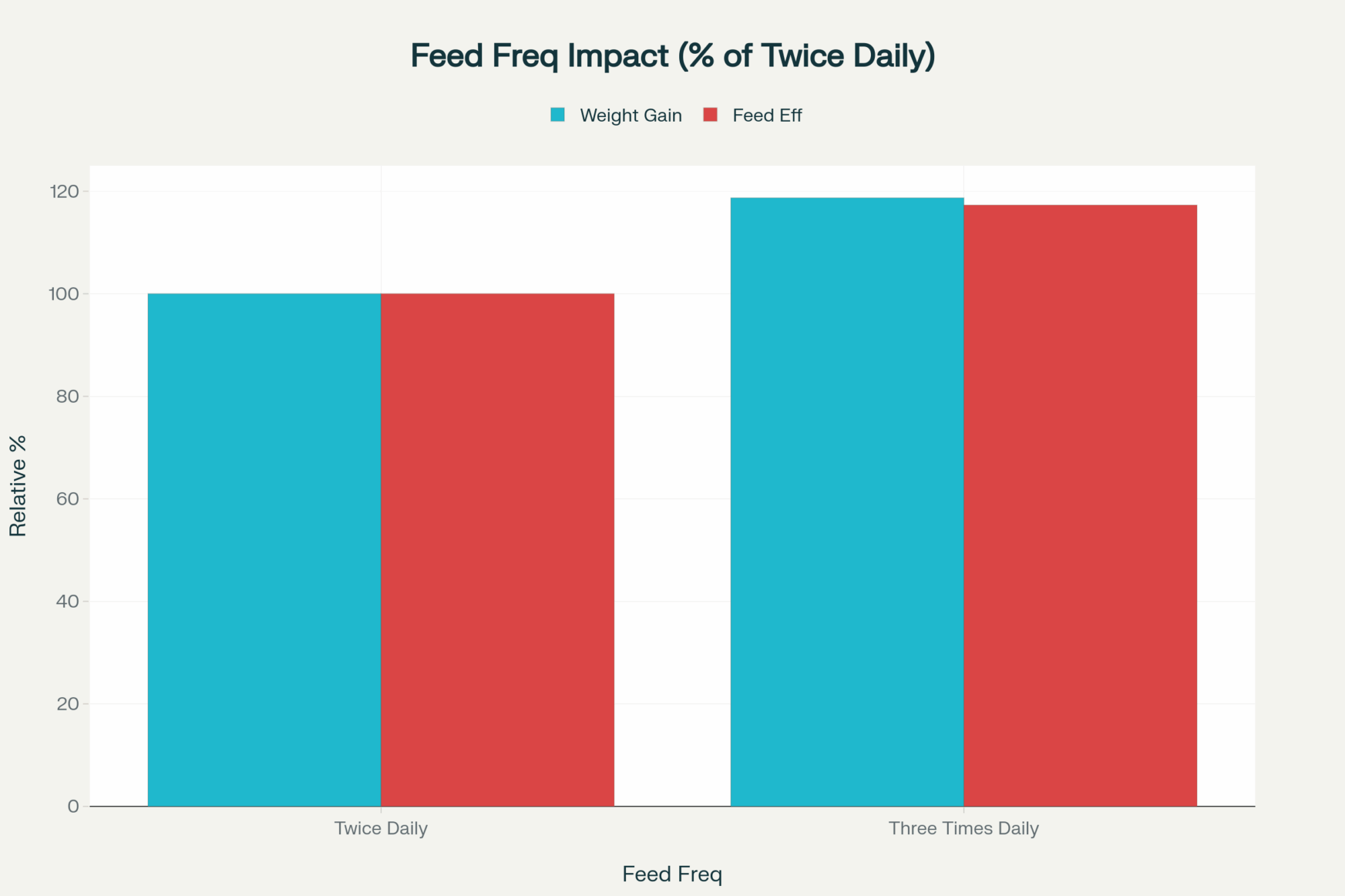
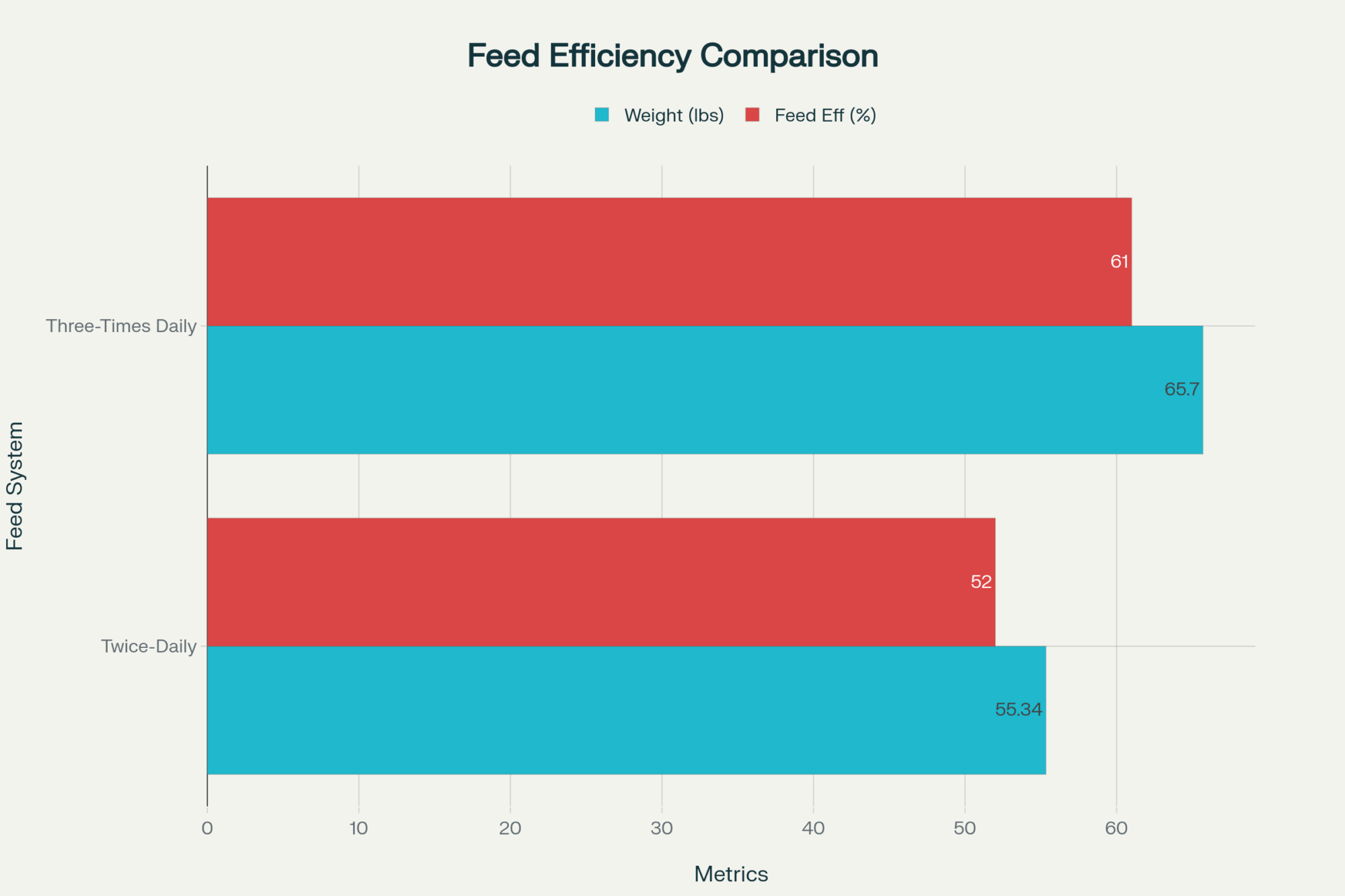
A recent University of Wisconsin study, presented by Donald Sockett, suggests that three-times-daily feeding could become the standard. Calves fed three times gained 65.7 pounds from birth to 42 days, compared to 55.34 pounds for twice-fed calves. Feed efficiency improved too—0.61 gain per dry matter intake versus 0.52.
I’m hearing from more producers experimenting. Some add that noon feeding is allowed when labor permits. Others try acidified milk systems. Förster-Technik and Urban Calf Tech systems typically cost $2,000-$ 4,000 for basic setups, although results vary by operation.

When Technology Actually Makes Biological Sense
Automated calf feeders enable calves to eat multiple times daily, providing valuable management data. Jorgensen and colleagues at the University of Minnesota tracked management on 26 farms using these systems, publishing their findings in the 2017 Journal of Dairy Science.
What’s particularly interesting from the 2024 research is that Trouw Nutrition found that automated systems can reduce labor by approximately 90% compared to manual feeding. Many producers tell me they’re catching pneumonia or scours 2-3 days earlier.
The investment? A 2018 Wisconsin Extension study found that autofeeder systems cost about $6.35 per calf per day, compared to $5.84 for individual housing—but that included $140.50 in liquid feed costs for autofeeder calves, compared to $111.95 for individually housed calves. The extra milk has driven up costs, but many view it as an investment in the future.
The Social Housing Debate Gets Real Data
Research from Emily Miller-Cushon at Florida shows social housing affects learning and stress response in ways that persist. The Canadian industry now requires pair or group housing by 2031.
What’s interesting is new data from British Columbia. A 2025 survey by Elizabeth Russell at UBC found 36.5% of farms already using social housing, with another 11.1% combining approaches. These are regular commercial operations, figuring it out.
I’m still hearing mixed reports. One producer who tried group housing told me, “The disease pressure in our area made it unworkable. Maybe with different facilities, but not for us now.”
Making Economic Sense When Numbers Keep Changing
Let’s be real about costs. The British Columbia survey found 52.4% of farms monitor calf growth, but only 31.7% have target growth rates. We’re measuring more, but not always sure what to do with it.
Questions to Consider:
- What’s your current mortality rate and treatment cost?
- How many hours daily on calf care?
- Can small changes be made before major investments?
- What disease pressures are specific to your region?
- Are you tracking growth against targets?
Where This Leaves You
I don’t have all the answers. Nobody does, really. But our understanding of calf biology is evolving faster than it has in decades.
If you’re successfully raising healthy calves with traditional methods, you’re not doing anything wrong. Your experience matters more than any research paper. However, if you’re experiencing issues—such as high mortality, poor growth, or rough weaning transitions—these insights may point toward potential solutions.
The calves are telling us what they need. Our job is figuring out how to listen while keeping the lights on.
What’s one small change you’ve made to your calf program that’s had a big impact? Maybe it was adding a third feeding, switching to teat feeders, or simply increasing milk allowance. Share what worked (or didn’t) at The Bullvine—your experience could be exactly what another producer needs to hear.
KEY TAKEAWAYS:
- 155-pound milk increase per lactation for every 0.1 lb improvement in preweaning daily gain (Cornell meta-analysis, 2013)—that’s roughly $31 extra revenue per heifer at current milk prices, achieved through better early nutrition management tailored to your system
- Three-times-daily feeding shows measurable benefits: 65.7 lbs weight at 42 days versus 55.3 lbs for twice-daily (Wisconsin research), with 17% better feed efficiency—consider adding that noon feeding if labor allows, or explore acidified milk systems ($2,000-4,000 investment) that let calves self-feed
- Automated feeders reduce labor by 90% while catching illness 2-3 days earlier through intake monitoring (Trouw Nutrition, 2024), though investment ranges from $15,000-30,000—evaluate whether labor savings and health benefits justify costs for your herd size
- Social housing becoming industry standard: Canadian requirement by 2031, with 36.5% of BC farms already implementing—start small with pair housing in existing hutches to test disease management before major facility changes
- Biology-based weaning using BHB testing (95% accuracy per Guelph research) identifies individual readiness from 7-10 weeks versus calendar weaning—particularly valuable for high-genetic-merit heifers where maximizing lifetime production justifies extra management attention
Complete references and supporting documentation are available upon request by contacting the editorial team at editor@thebullvine.com.
Learn More:
- Revolutionizing Calf Rearing: 5 Game-Changing Nutrition Strategies That Deliver $4.20 ROI for Every Dollar Invested – This practical guide provides actionable, step-by-step nutrition strategies for implementing changes on your farm, including how to measure your return on investment, making it a perfect companion for producers looking to move from theory to practice.
- Beef-on-Dairy in 2025: Turning Calf Premiums into Real Profit (Without Blowing Up Your Herd) – This article provides a strategic perspective on the economics of calf-raising, offering a detailed analysis of market trends and the financial benefits of beef-on-dairy premiums, which directly impacts the profitability of your calf program beyond just milk production.
- Calf Rearing Excellence: Finding the Perfect Feeding Plan for Your Farm – This piece delves into innovative calf-raising technologies and management systems, showcasing how advanced tools like automated feeders and specific micronutrient plans can enhance growth rates and efficiency, offering insights into modernizing your operation for maximum results.
 Join the Revolution!
 Join the Revolution!
Join over 30,000 successful dairy professionals who rely on Bullvine Weekly for their competitive edge. Delivered directly to your inbox each week, our exclusive industry insights help you make smarter decisions while saving precious hours every week. Never miss critical updates on milk production trends, breakthrough technologies, and profit-boosting strategies that top producers are already implementing. Subscribe now to transform your dairy operation’s efficiency and profitability—your future success is just one click away.




