







Trade barriers are dropping rapidly—and those who act now stand to gain significantly in the long run.
EXECUTIVE SUMMARY: I understand — with milk prices hovering around $17.30 and feed costs rising, thinking beyond your local market may seem like a luxury. However, what caught my attention is that Asia’s dairy market isn’t only growing, but also expanding rapidly, from $333 billion in 2024 to a projected $616 billion by 2033. We’re talking about consumers who’ll pay 50% premiums for quality products, especially in places like China, where the infant formula market alone saw a 4.2% increase in premium share from 32.8% to 37% in just one year. Sure, the entry costs aren’t pocket change — you’re looking at $ 300,000+ for compliance and cold chain setup, with a minimum of 2,000 cows required to make the math work. But those trade deals with Indonesia, Japan, and Korea? They’re opening doors that’ve been locked for decades. This isn’t about quick fixes — it’s about positioning your operation for the next decade while others are still figuring out domestic margins.
KEY TAKEAWAYS
- Market premiums of $2.50-$4.00 per cwt are realistic within 3 years — focus on lactose-free products, high-protein whey, and specialty lines that Asian consumers actually want and will pay for
- Minimum scale matters: 2,000 cows to absorb the $300K+ entry costs — but trade deals with Japan (80% tariff cuts) and Korea (16,000 tons tariff-free) make the investment worthwhile for serious players
- Digital traceability isn’t optional anymore — 78% of Asian dairy companies have it — start building your systems now because it’s your ticket to premium pricing and market access
- Currency swings can eat 8-12% of your margins overnight — hedge smart, keep domestic operations strong, and don’t bet the farm on export revenues until they’re proven
- Timeline reality check: 12 months for compliance, 2-3 years to profitability — start your regulatory paperwork today because the window for first-mover advantage won’t stay open forever
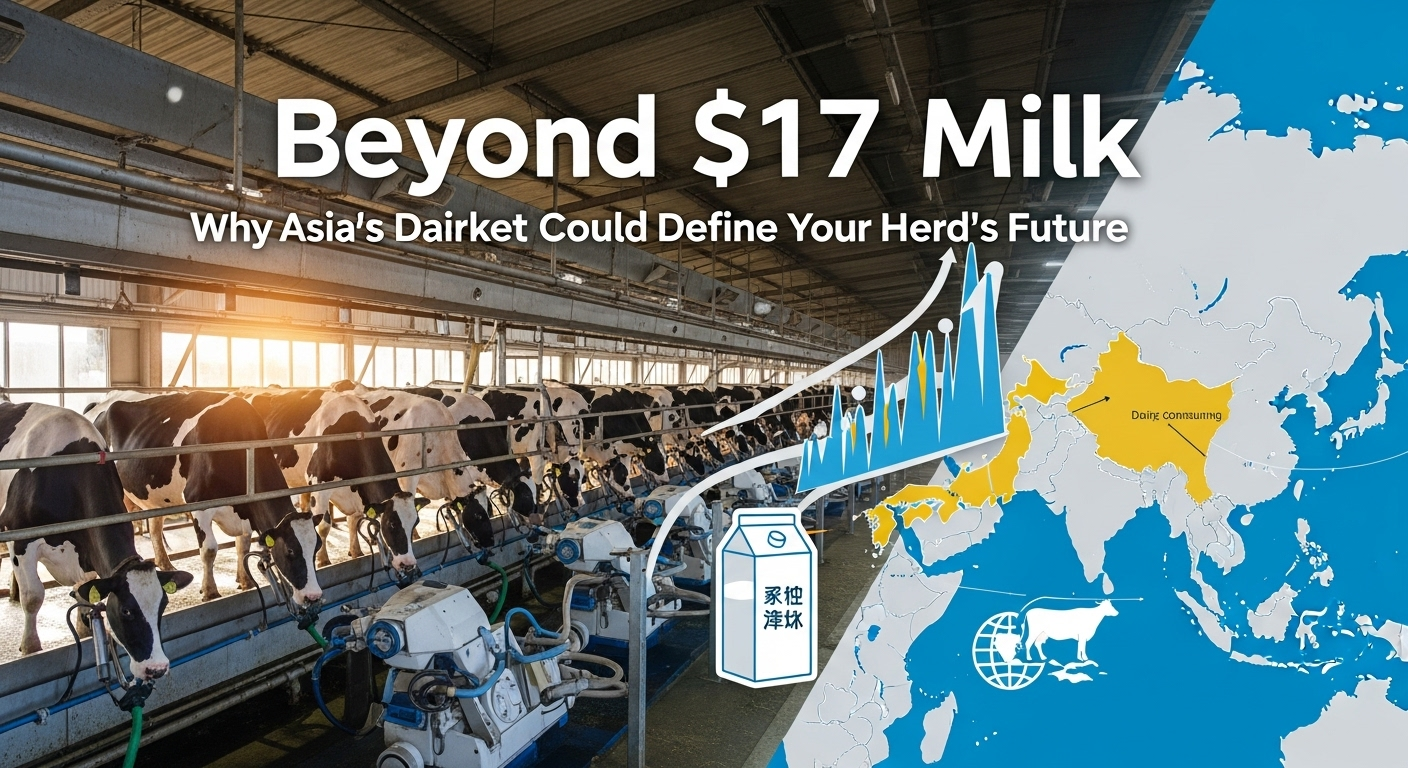
Let’s talk about dairy margins. With Class III futures still around $17.32/cwt in July 2025 and feed pushing costs higher, many producers are knee-deep in short-term survival mode. Meanwhile, currency volatility and regulatory curveballs have shifted from being surprises to being central features of the export landscape.
However, what’s fascinating is that while we’re focused on domestic pressures, Asia’s dairy market is opening doors that could reshape your operation’s future. The U.S.-Indonesia deal, which eliminates tariffs on 99% of dairy exports, was signed this year, instantly changing marketplace dynamics. China’s recent approval of whey permeate imports signals another long-awaited shift.
From Bulk Buys to Premium Brands: How Asian Consumer Tastes Are Evolving
Asia’s dairy market was valued at $333.00 billion in 2024, with forecasts indicating a rise to $616.45 billion by 2033. That kind of growth demands serious consideration of how your operation fits into the picture.
China’s appetite for dairy fats is increasing rapidly. Chinese butter imports are forecast to increase from 152,000 to 173,000 metric tons by 2028. But it’s not just about volume—buyers want tailored, high-value products, not bulk commodities.
Premium positioning is paying off. China’s premium infant formula segment expanded from a 32.8% to a 37% market share in 2024, with consumers paying 50% premiums for products backed by science and health claims. That premium trend is spilling into other dairy categories.
Southeast Asia offers the most explosive potential. Per capita dairy consumption sits at less than 20kg annually compared to 300kg in developed markets, according to industry data. Thailand alone achieved 11.5% export growth to $582.62 million in 2024, reflecting rapid market expansion.
A recent study by the U.S. Dairy Export Council reveals that reduced trade costs are directly correlated with increased nutrient availability—for every 1% reduction in dairy import prices, per capita nutrient availability increases by more than 6% in markets such as Mexico. Expect similar market gravity as tariffs drop across developing Asian markets.
The High Cost of Entry: Budgeting for Regulation, Logistics, and a Long Game
Success demands both thick skin and rigorous due diligence. Even market leaders stumble—Fonterra’s high-profile joint venture in India was wound down in 2022 due to complex market realities.
Infrastructure and regulatory compliance carry eye-opening costs. Industry experts estimate that the annual cost for facility registration and certification processes ranges from $50,000 to $200,000. Cold chain logistics investments typically range from $500,000 in mature markets, such as Japan, to $2 million in markets where infrastructure requires development, like Vietnam.
Legal compliance and quality certifications add another $25,000 to $75,000, while partnership due diligence can cost up to $500,000. You’re looking at six-figure commitments before shipping your first gallon.
Technology standards are non-negotiable. Asian dairy companies’ annual technology investments have created 78% digital traceability implementation across the region. U.S. producers must match this standard or risk being left behind.
Currency fluctuations have already eroded export margins this year due to the strength of the USD against Asian currencies. Competitors fiercely defend their market share, meaning new entrants face considerable pricing and relationship pressures.
Australia’s exports to Southeast Asia grew to over 290,000 tonnes, valued at A$1.2 billion in 2024—setting a high bar for newcomers.
Unlocking the Market: How New Trade Deals Are Creating a Competitive Edge
Japan’s bilateral trade agreement offers preferential treatment for 80% of U.S. dairy exports, with cheese tariffs as high as 40% set to disappear over a 15-year period. The Korea-U.S. FTA provides tariff-free access for approximately 16,000 metric tons of cheese, milk powders, and whey products.
China’s dairy imports strengthened in April 2025, marking five consecutive months of year-on-year growth, with sweet whey powder imports up 30% year-to-date. The U.S. maintained its position as the primary supplier, accounting for 43% of China’s total imports of sweet whey powder.
The regulatory momentum is building, but timing matters.
Your Go-To-Market Timeline: From Paperwork to Profitability
You’ll generally need a 2,000-cow equivalent operation to handle export compliance and logistics costs effectively. China’s projected increases in dairy imports, particularly whole milk powder, create specific opportunities where the U.S. already holds established market positions.
Industry data indicate that successful operators typically achieve premiums of $2.50-$4.00 per hundredweight over domestic pricing within 24-36 months—but this requires sustained marketing investment averaging $150,000-$300,000 annually for brand development and regulatory maintenance.
Real talk: export ventures are fraught with risk. Currency swings bite margins, competitors push back hard, and partnerships can fracture unexpectedly. The best strategy? Maintain strong domestic operations while young export markets mature.
Compliance and market development typically require a minimum of 12 months, with brand and distribution establishment demanding another 1-3 years. Expect full profitability in 3-5 years, though some operators achieve positive cash flow by years 2-3.
Focus on market-relevant products: lactose-free items aligned with regional preferences, high-protein whey concentrates where U.S. technology excels, premium products that leverage the North American quality reputation, and strategic joint ventures rather than commodity exports.
The takeaway is clear: engage now or risk being locked out of the market.
Bottom Line: Your Herd’s Strategic Decision Point
Producers positioning themselves for leadership in Asia’s dairy markets by 2030 are investing today—in both infrastructure and partnerships. This isn’t about chasing spot commodity prices when U.S. demand softens; it’s about building durable market share where growth is real.
With domestic milk prices steady near $17.32/cwt amid rising feed costs, diversifying through Asia plays both an offensive and defensive role in margin management. The barriers to market access are falling, but the window to act is closing quickly.
Action Plan for the Ready:
Phase 0 (Right Now): Evaluate your finances rigorously with the help of your advisors. Can your operation withstand a 2-3 year wait for returns? If not, scaling export efforts may need to wait.
Phase 1 (Next 6 Months): Launch comprehensive regulatory registrations and certifications—FDA facility registration, HACCP compliance, and relevant export documentation.
Phase 2 (6-18 Months): Attend trade shows, meet distribution partners in target countries, and immerse yourself in evolving consumer trends.
Phase 3 (Years 2-3): Implement traceability and quality control systems aligned to Asian import standards. Test your brand with trusted local partners.
Those ready to move early will build lasting market power. Those waiting may miss the opportunity entirely.
This strategy isn’t a quick fix for a volatile U.S. market; it’s a long-haul, capital-intensive investment in your herd’s future. The regulatory doors are now opening, but they require both vision and courage to walk through.
So, what’s your move?
Complete references and supporting documentation are available upon request by contacting the editorial team at editor@thebullvine.com.
Learn More:
- Breeding for a Balanced Herd: The Unsung Value of Components – This article provides practical genetic strategies for increasing milk fat and protein. It reveals how to breed for the high-value components that are essential for creating the premium export products Asian markets are demanding, directly impacting your potential margins.
- The Dairy Industry’s Crossroads: Navigating the Top 5 Economic Headwinds of 2025 – While the main article focuses on the “pull” of Asian markets, this piece details the “push” from domestic pressures. It offers a strategic analysis of market volatility, helping you frame an export strategy as a crucial long-term risk management tool.
- Beyond the Bulk Tank: How AI and Genomics Are Creating the Next Generation of Profitable Dairies – To compete globally, you need a technological edge. This piece explores how to implement AI and genomics to improve herd health, efficiency, and traceability—the exact qualities required to meet the high standards of premium international buyers.
 The Sunday Read Dairy Professionals Don’t Skip.
 The Sunday Read Dairy Professionals Don’t Skip.
Every week, thousands of producers, breeders, and industry insiders open Bullvine Weekly for genetics insights, market shifts, and profit strategies they won’t find anywhere else. One email. Five minutes. Smarter decisions all week.




