

Archive for agricultural interest rates

$3,010 Heifers, 30% Labor Jumps: The Mid-Size Dairy Survival Crisis

$3,010 heifers. 30% labor jump. A 650-cow Wisconsin dairyman told me: ‘The math that worked five years ago just doesn’t add up anymore.’ He’s right—and here’s the survival playbook for mid-size operations.

EXECUTIVE SUMMARY: The math that worked for mid-size dairies in 2019 doesn’t work anymore—and this isn’t a cyclical downturn waiting to correct itself. Replacement heifers hit $3,010 per head (up 75% since 2023), labor reached $19.52/hour (up 30% since 2020), and rate increases added $840,000 to the lifetime cost of typical barn financing. Operations milking 300-800 cows are stuck in the ‘mushy middle’: too large for family labor, too small for scale economics that make 1,000+ cow herds consistently profitable. Export tailwinds are fading—Mexico’s $4.1 billion domestic dairy investment and China’s 12% import drop signal permanent shifts. Three paths forward remain viable: scaling past 2,000 cows with strong balance sheets, premium positioning through organic or specialty programs, or partnership models sharing infrastructure costs. Operations missing three or more key benchmarks—cost under $17/cwt, labor efficiency of 50-60 cows/FTE, debt-to-asset under 40%—need strategic reassessment now, not later. The producers still hoping 2026 looks like 2019, risk becoming the cautionary tales others reference.
mid-size dairy survival

I had coffee with a producer friend in central Wisconsin a few weeks back. Runs about 650 cows, third generation, solid genetics, consistently good production numbers. He expanded his freestall barn in 2019—good timing, good financing, everything done right by the book.

But something he said stuck with me: “The math that worked five years ago just doesn’t add anymore. And I keep wondering if I’m missing something or if the whole game changed.”

He’s not missing anything. The game really did change.
As we look toward 2026, it’s becoming clear that we’re not simply weathering another cyclical downturn—the kind where you tighten the belt, wait for better prices, and emerge stronger on the back end. Several fundamental pillars of the traditional dairy business model have shifted, and understanding those shifts is essential for making sound decisions over the next few years.

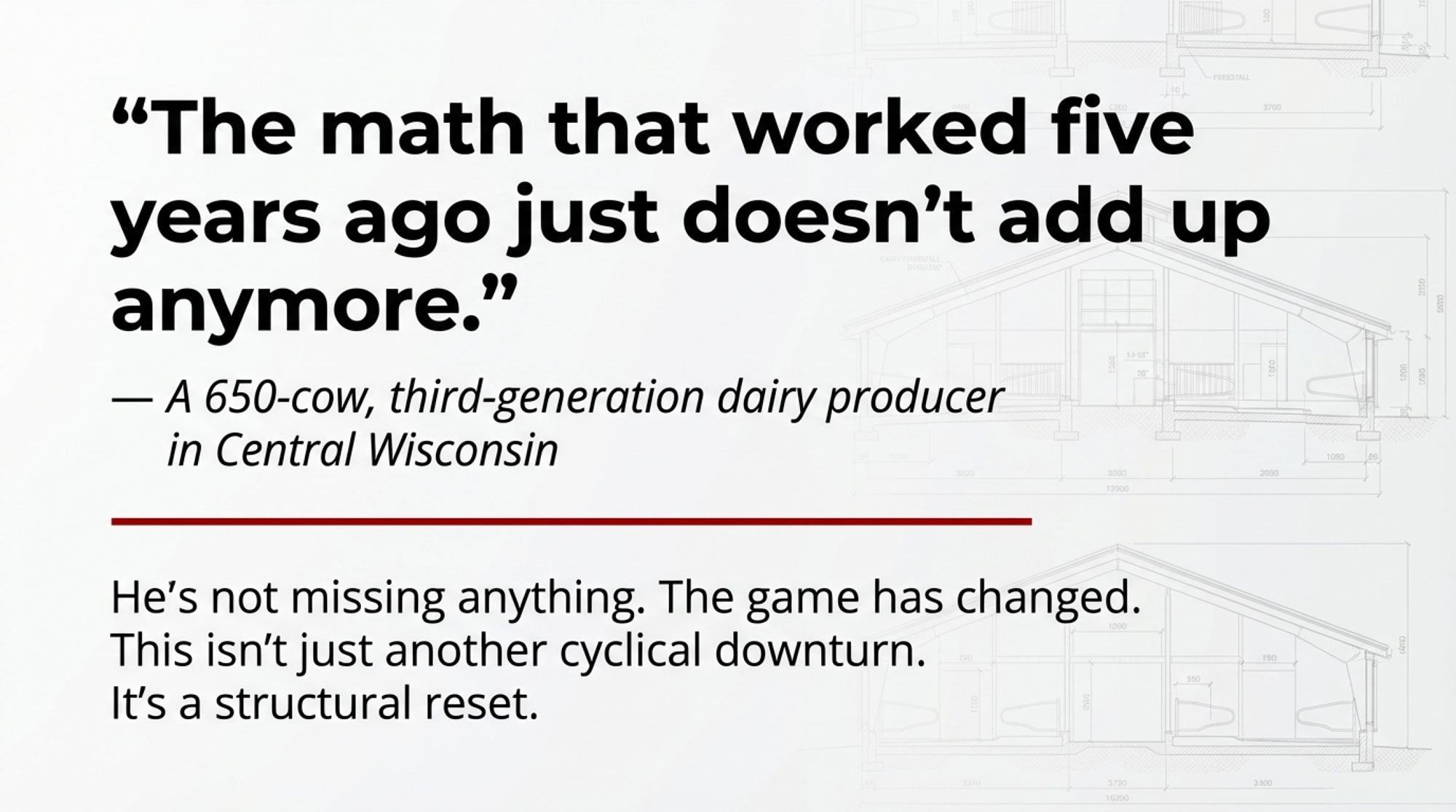
“The math that worked five years ago just doesn’t add up anymore.” — Central Wisconsin dairy producer, 650-cow operation

Why Different Farms Are Having Such Different Experiences

Purdue University’s Ag Economy Barometer from August 2025 found that crop farms showed financial stress rates around 6.5%—nearly triple the rate reported by livestock operations. Sentiment surveys consistently show livestock farmers running more optimistic than their crop and dairy neighbors, sometimes in the very same counties.

Why the gap? Much of it traces back to how capital gets deployed.

Here’s the reality of dairy economics: a substantial majority of assets are tied up in specialized infrastructure—milking parlors, freestall barns, manure handling systems. These are illiquid, depreciating assets. Research from the Wisconsin Center for Dairy Profitability has shown this pattern repeatedly: as capital investment per cow climbs, return on assets tends to compress.

A cattle feeding operation under margin pressure can reduce placements, turn cattle more quickly, and adjust in real time. A dairy operation doesn’t have that flexibility. Once you’ve built infrastructure for 500 cows, you’re milking roughly 500 cows every single day, regardless of where prices sit.

What’s Really Happening with Costs

Good news first: feed costs have moderated meaningfully. USDA’s Agricultural Prices Report showed dairy feed costs at $9.38 per hundredweight this past August—the lowest monthly reading since late 2020. That’s genuine relief after several difficult years.
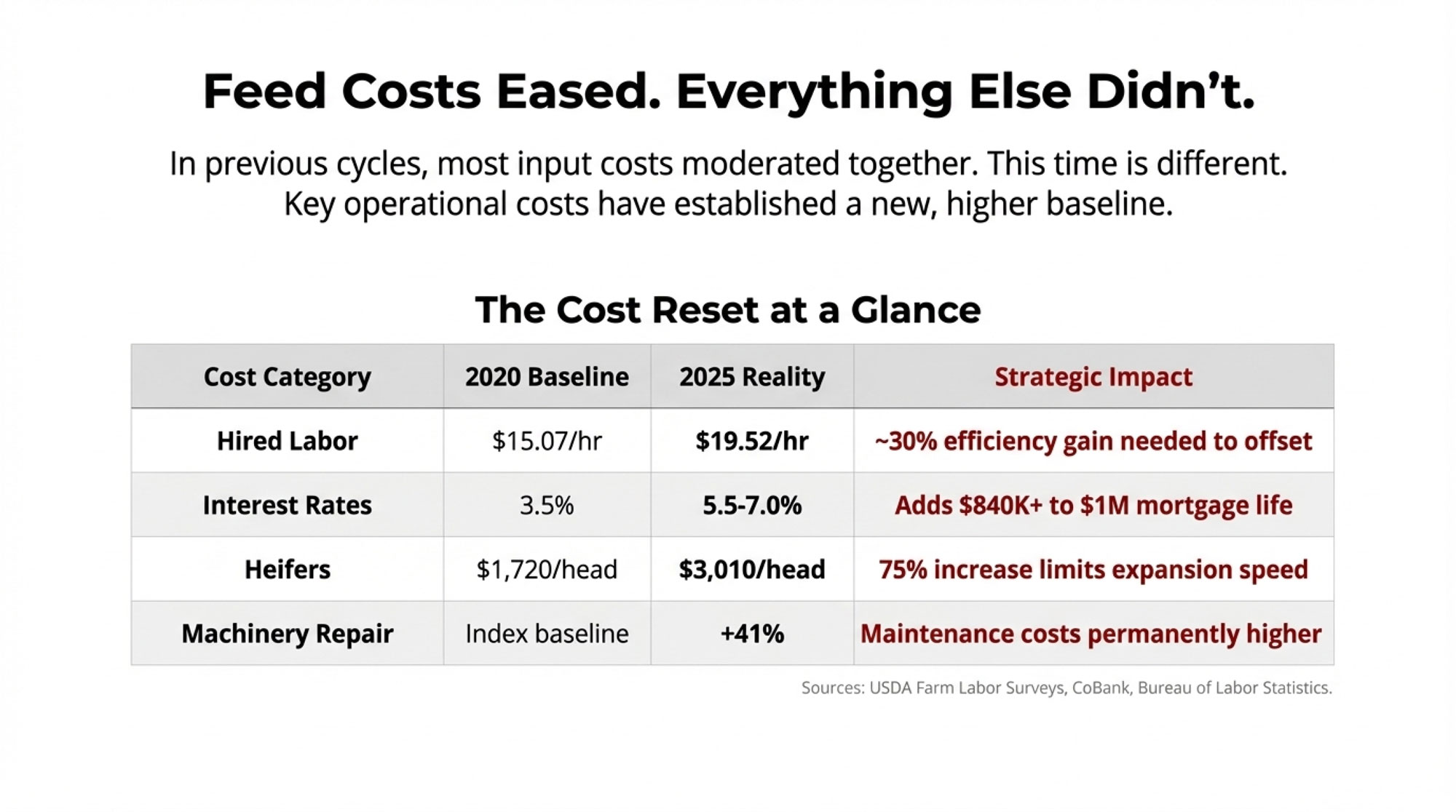
But here’s what concerns me. In previous downturns, nearly all input costs eventually moderated together. This cycle looks different. Feed came down, but most other major cost categories have reset to what appear to be permanently higher levels.
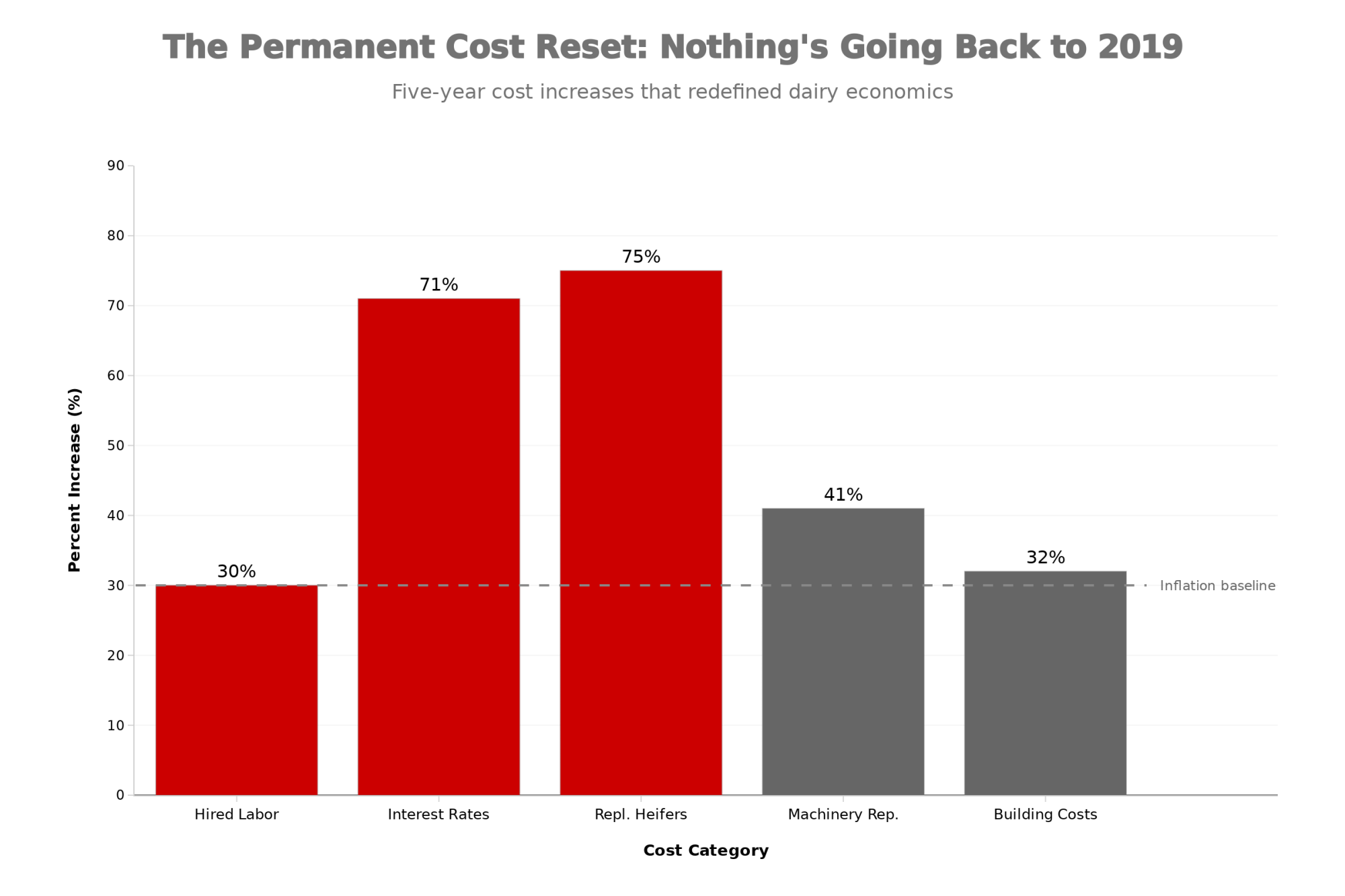
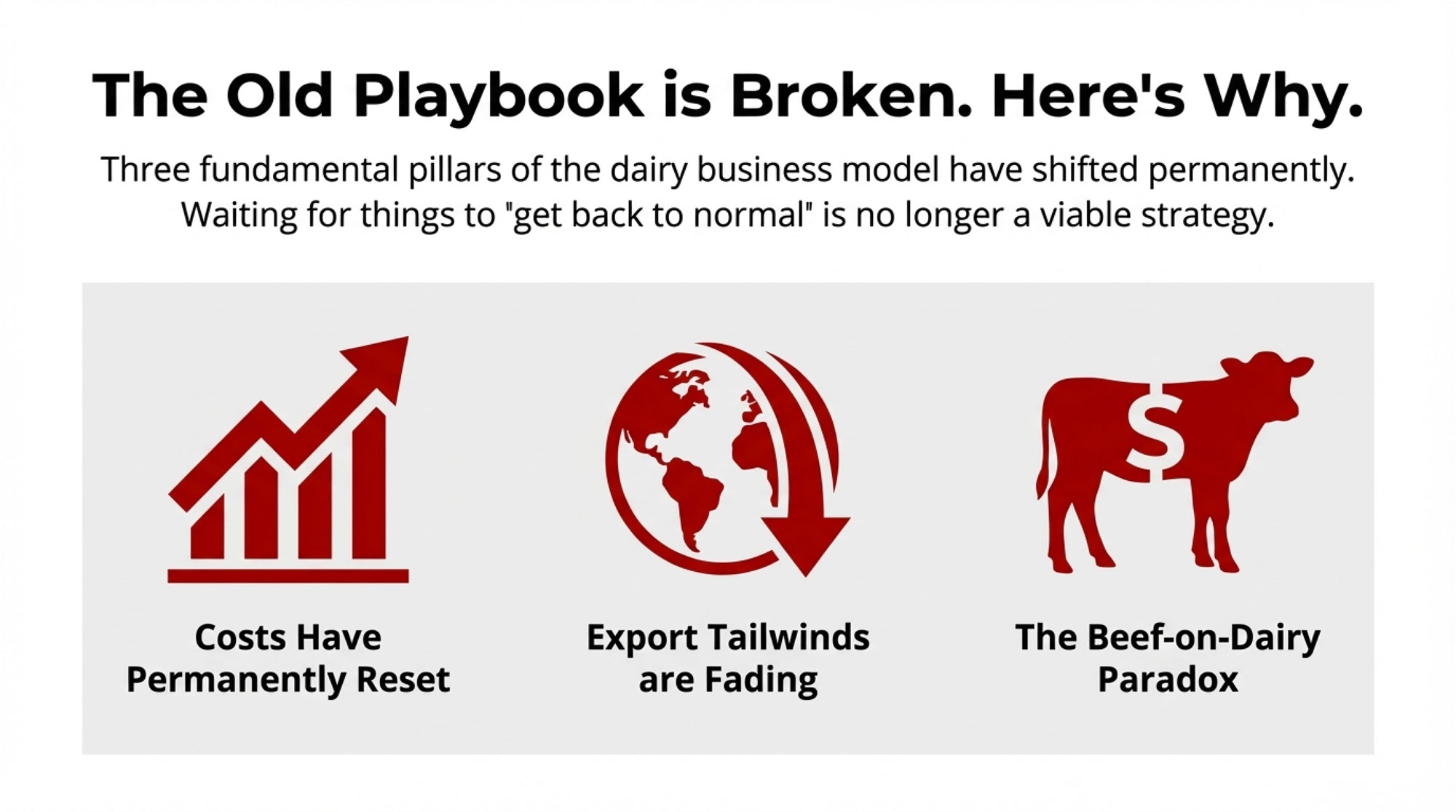
While feed costs moderated, every other major input permanently reset higher—heifers up 75%, interest rates up 71%, labor up 30%—this isn’t cyclical, and waiting for 2019 margins is a losing strategy

The Cost Reset at a Glance

Cost Category2020 Baseline2025 RealityStrategic Impact
Hired Labor$15.07/hr (USDA April 2020)$19.52/hr (USDA May 2025)Requires ~30% efficiency gain to offset
Interest Rates3.5% (historic lows)5.5-7.0% (commercial)Adds $840K to $1M mortgage over loan life
Replacement Heifers$1,720/head (April 2023)$3,010/head (July 2025)75% increase limits expansion speed
Machinery RepairIndex baseline 2020+41% (BLS 2025)Maintenance costs are permanently higher
Building Costs2021 baseline+25-40% (materials + codes)New construction ROI fundamentally changed

Sources: USDA Farm Labor Surveys (2020, 2025), USDA FSA rate schedules, CoBank Knowledge Exchange, Bureau of Labor Statistics

My Wisconsin friend’s 2019 expansion? Those interest rates look very different now. He locked in around 4%. Anyone evaluating the same project today faces rates pushing 6-7% on commercial loans.

These figures represent national averages. California operations typically face higher labor and regulatory costs. For Canadian operations, supply management creates a different dynamic entirely—quota values shift the strategic calculus in ways that don’t directly translate from U.S. benchmarks.

Labor illustrates this most clearly. The American Farm Bureau Federation’s analysis shows farm labor costs reaching record territory in 2025—USDA’s Economic Research Service projects labor expenses at $53.7 billion nationally. The May 2025 USDA Farm Labor Survey showed that operators paid $19.52 per hour on average, up 30% from $15.07 in April 2020.
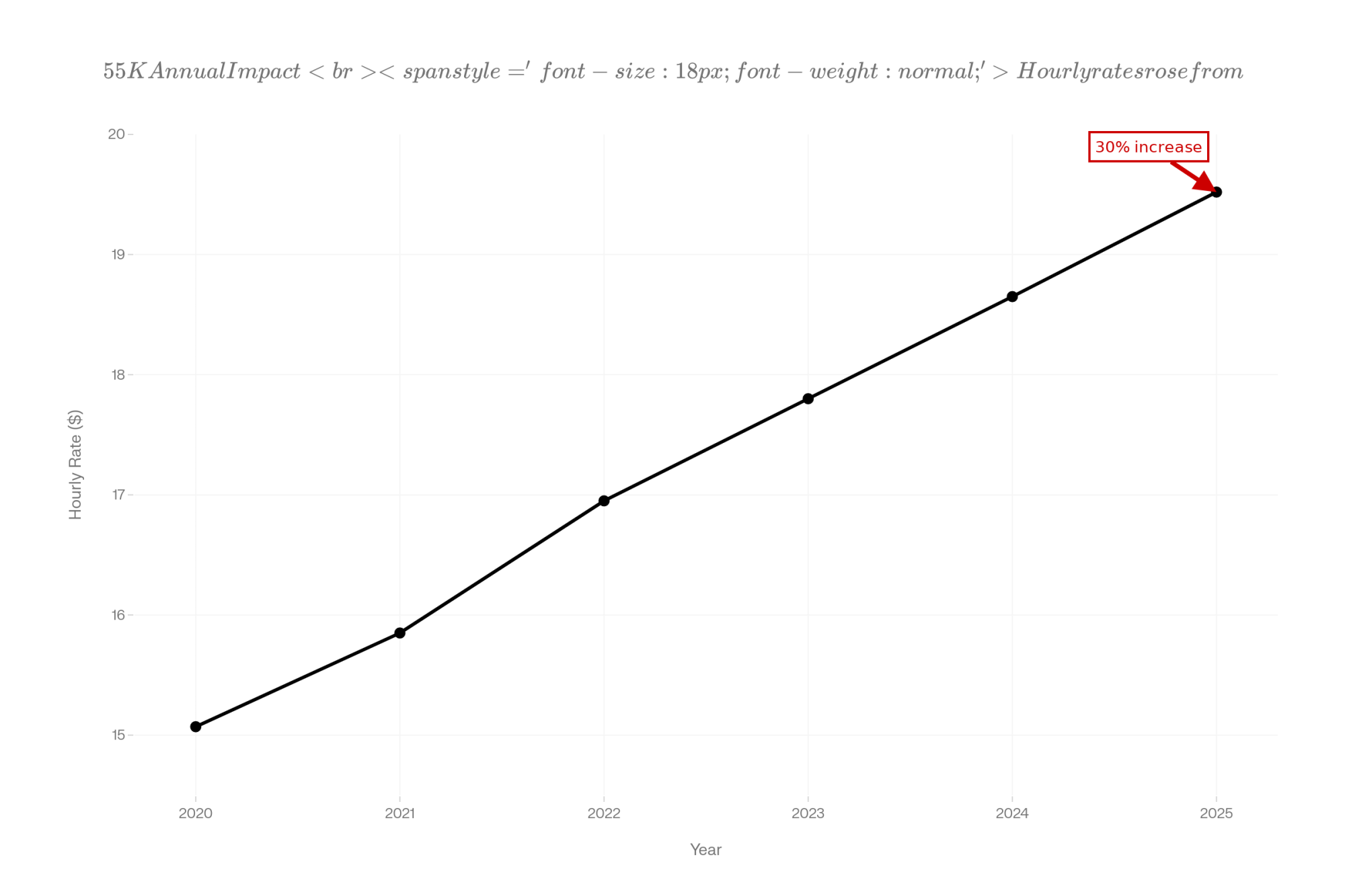
Labor costs jumped 30% since 2020, adding $55,600 annually to a typical 500-cow operation—this isn’t reverting, and competing industries keep bidding wages higher

Anyone who’s tried hiring lately knows the challenge firsthand. Competing industries keep bidding up wages, and the workforce available today simply expects more than it did five years ago. That’s not a criticism—it’s market reality.

Interest rates fundamentally changed expansion economics. Analysis from the Daily Dairy Report illustrates the math starkly: on a 30-year mortgage of $1 million, moving from around 3.5% to over 7% increases monthly payments by more than $2,300. Over the loan’s life, that’s nearly $840,000 in additional interest expense.

Equipment and construction costs reset higher as well. Bureau of Labor Statistics data shows farm machinery repair costs spiked 41% since 2020 alone. Ontario operations are navigating new agricultural building codes in 2025 that are estimated to add 15-35% to construction costs.

The Export Landscape: Meaningful Shifts Underway

Export dynamics deserve attention because they’ve underpinned expansion assumptions for the past 15 years.
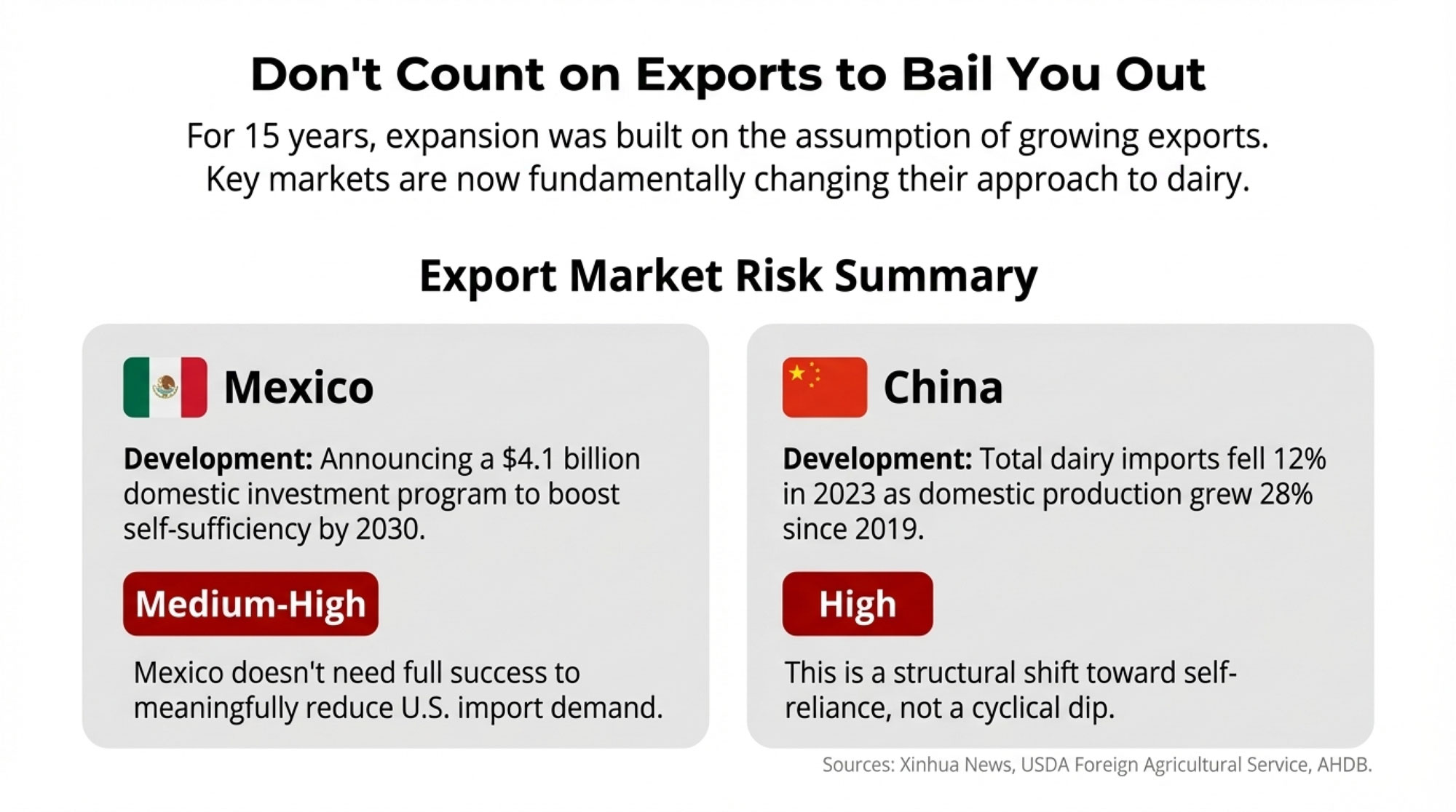
Mexico launched a significant self-sufficiency initiative. In April 2025, Xinhua News reported that the Mexican government announced a $4.1 billion investment program running through 2030 to increase domestic milk production. The Secretaría de Agricultura y Desarrollo Rural outlined specific projects—new pasteurization and milk drying facilities across multiple states.

Will Mexico achieve these ambitious targets? Honestly, that’s genuinely uncertain. Water scarcity and enormous productivity gaps between regions present challenges. But here’s the insight worth considering: Mexico doesn’t need full success to affect U.S. export volumes. Even partial achievement would meaningfully reduce demand.

China’s import patterns have shifted structurally. Customs data shows total Chinese dairy imports fell 12% to 2.6 million tonnes in 2023. Meanwhile, domestic production reached 41 million tonnes annually—up 28% from 2019according to the USDA Foreign Agricultural Service and AHDB analysis.

Export Market Risk Summary

Export Market2025 DevelopmentRisk Level for U.S. Dairy
Mexico$4.1B domestic investment through 2030Medium-High: Even partial success reduces demand
ChinaImports -12%; domestic production +28% since 2019High: Structural shift, not cyclical
DomesticFluid milk declining; yogurt/cottage cheese growingModerate: Growth can’t absorb 2.5-3% production increases

Beef-on-Dairy: Understanding the Complete Picture

Beef-on-dairy has delivered meaningful revenue for many operations. Day-old beef-cross calves command substantially higher prices than a few years ago, with some operations reporting six-figure annual revenue additions.

But a broader dynamic is developing.
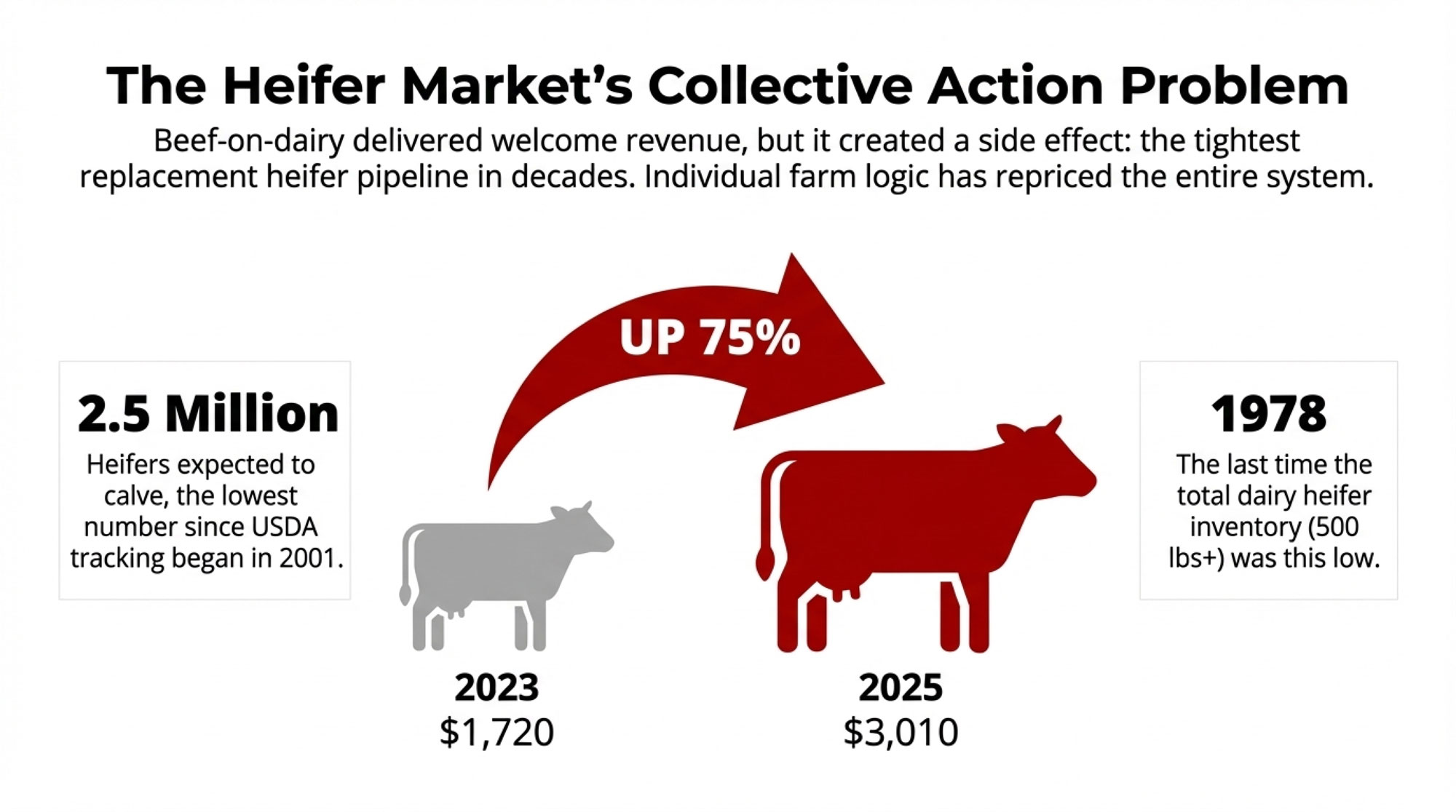
As more operations breed to beef semen, the replacement heifer pipeline has tightened considerably. HighGround Dairy analysis shows heifers expected to calve totaled just 2.5 million head as of January 2025—the lowest since USDA began tracking in 2001. Total dairy heifers weighing 500 pounds or more reached only 3.914 million head, the smallest inventory since 1978, according to USDA data.

CoBank’s Knowledge Exchange division projects 357,490 fewer dairy heifers in 2025 compared to 2024, with an additional 438,844-head decline expected in 2026.
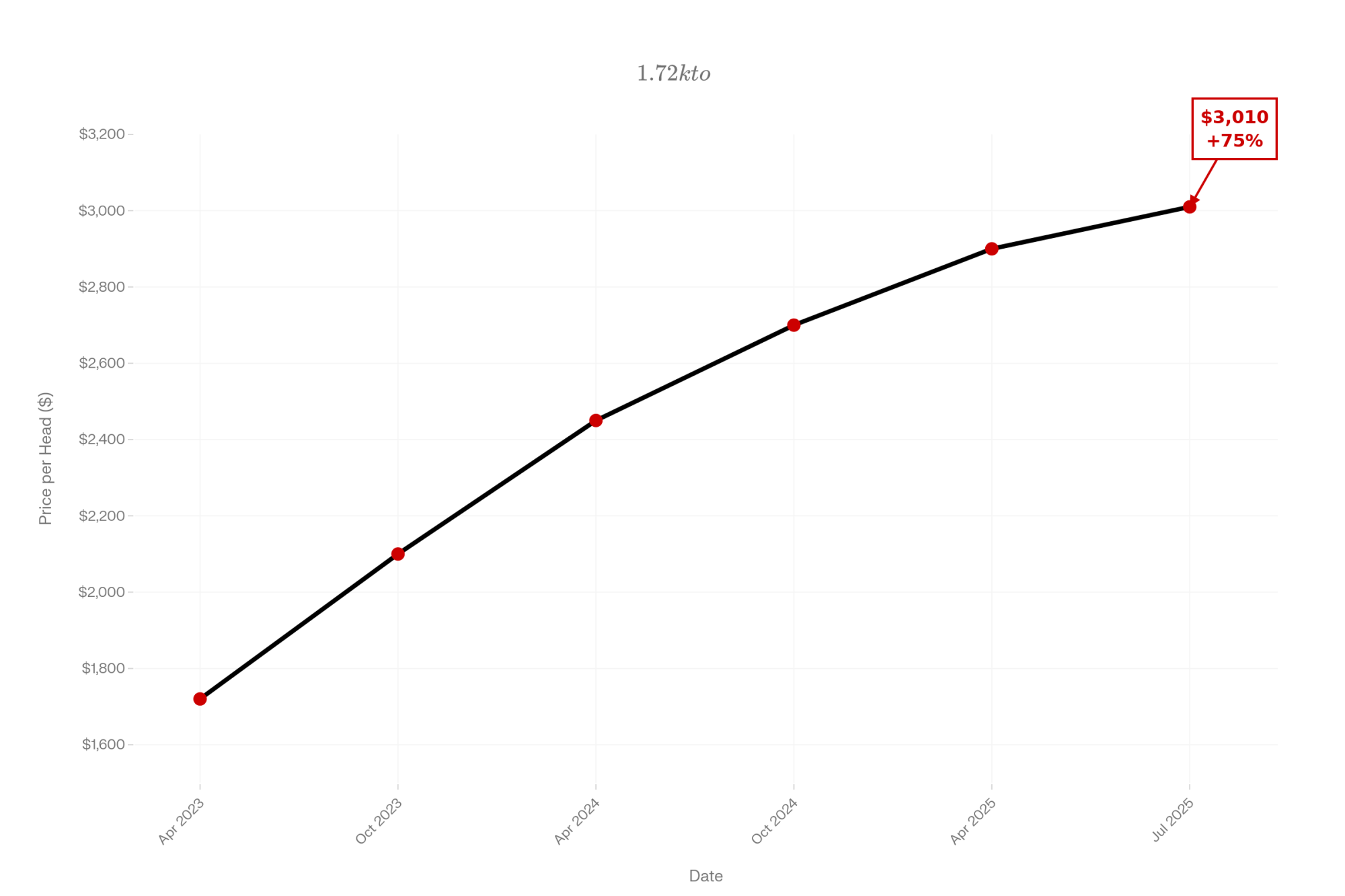
The 75% heifer price surge from $1,720 to $3,010 fundamentally changed expansion economics—this isn’t a cyclical spike, it’s a structural reset that makes traditional growth strategies obsolete for mid-size operations

The market response has been dramatic. USDA Agricultural Prices data tracked by CoBank shows replacement heifer prices moved from $1,720 per head in April 2023 to $3,010 by July 2025—a 75% increase in just over two years. Top dairy heifers at California and Minnesota auctions reached $4,000 per head by mid-2025.

This is a classic collective action situation. Each farm’s individual decision makes sense. But collectively, these decisions created a replacement shortage that’s repricing the entire system.

The “Mushy Middle” Reality Check

The Zisk profitability platform now monitors operations milking over 4.9 million cows—more than half the U.S. herd. Their data confirm that farms with 1,000 or more cows consistently outperform smaller operations in per-cow profitability.
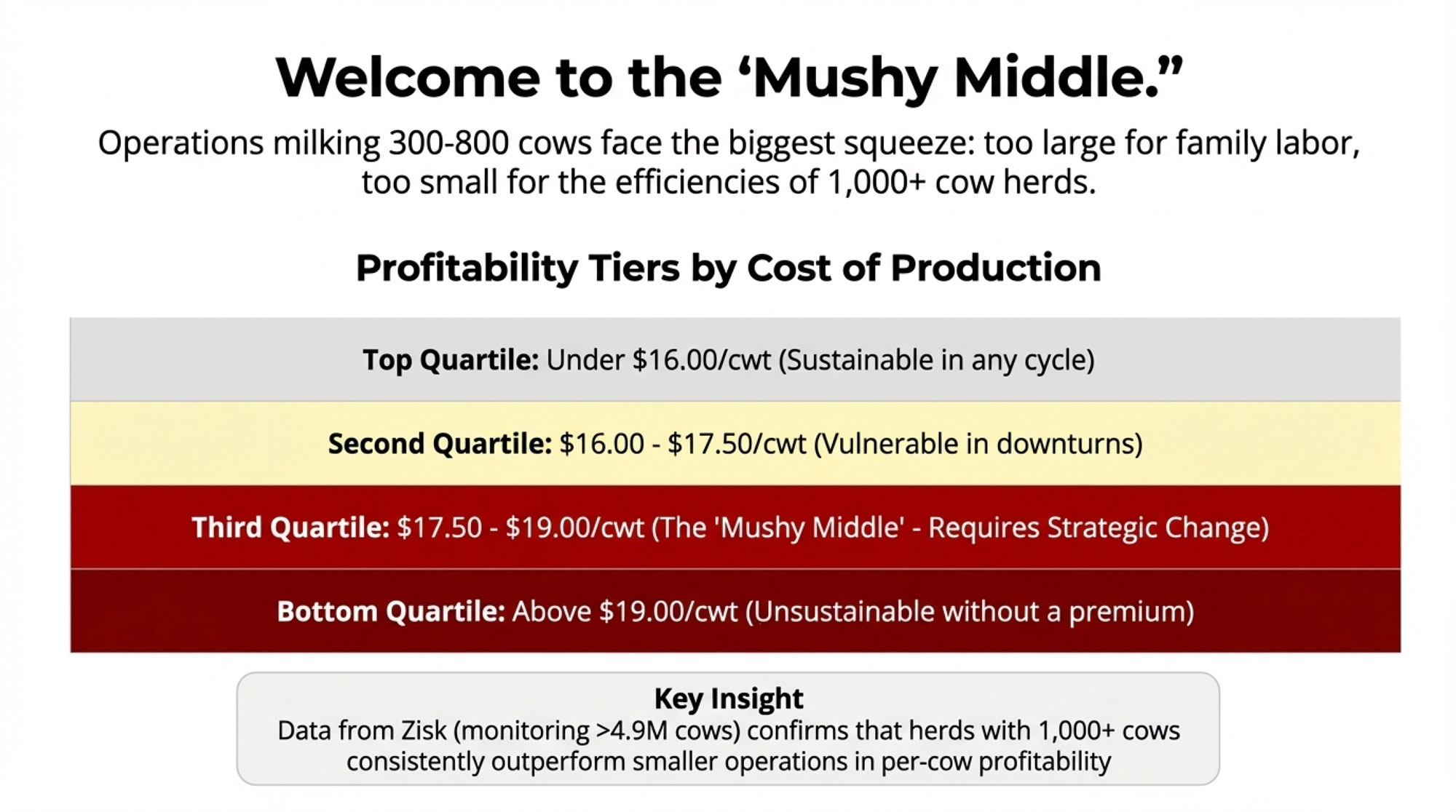
So what does this mean for my Wisconsin friend with 650 cows? That operation is squarely in the danger zone by these metrics.
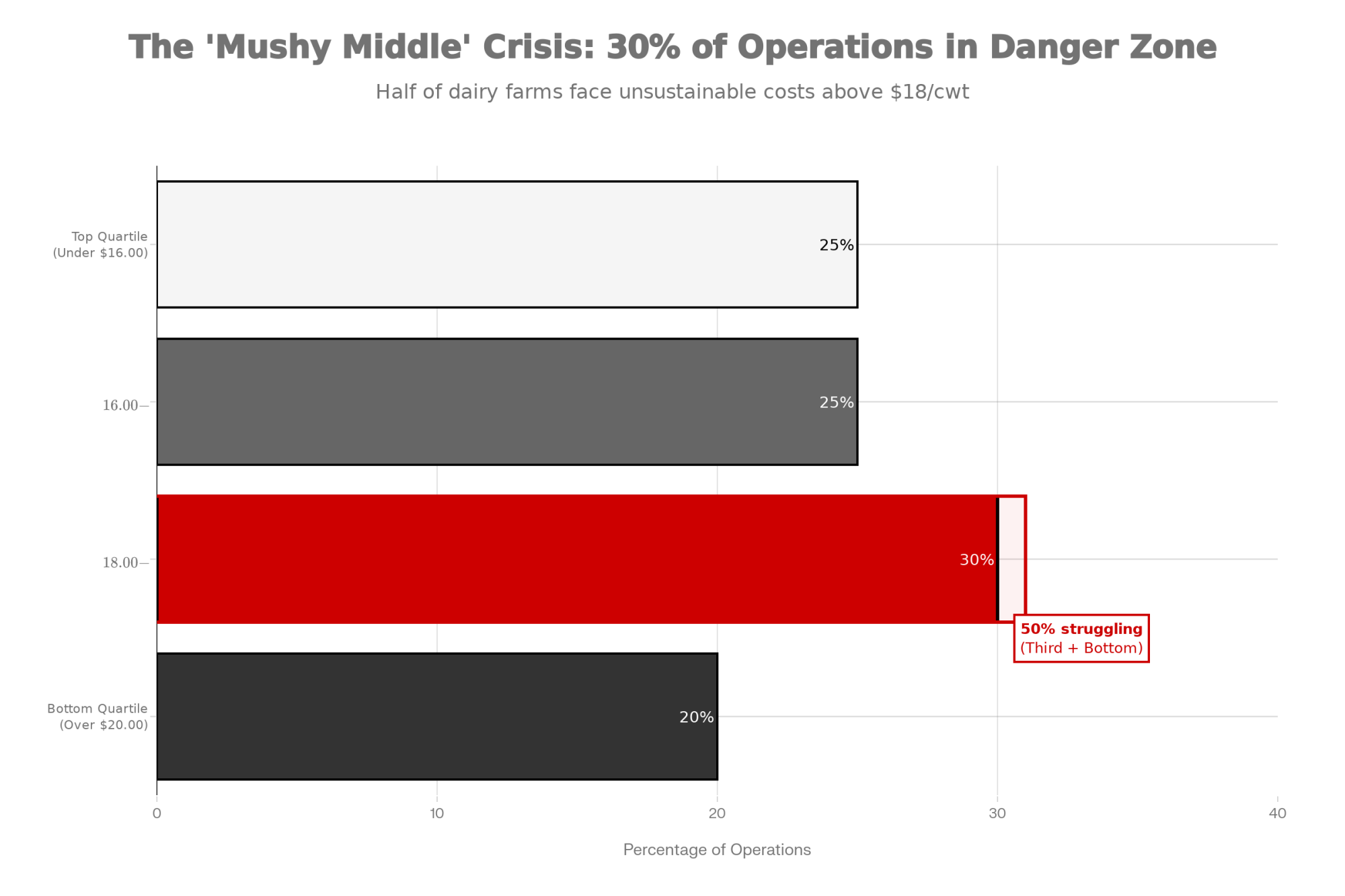
Half of all mid-size dairy operations fall into vulnerable or crisis zones with costs above $17.50/cwt—the ‘mushy middle’ at $17.50-19.00 faces the worst math: too large for family labor, too small for scale economics

The danger zone for mid-size operations involves several compounding factors:

  • Cost per hundredweight between $17.00-19.00—too high to compete on commodity margins, but without premium positioning
  • Debt-to-asset ratios above 45-50%—limited financial cushion
  • Herd size between 300-800 cows—too large for family labor alone, too small for full scale efficiencies
  • Single processor relationship—limited negotiating leverage
Performance TierCost per CwtCharacteristics
Top QuartileUnder $16.00Sustainable regardless of price cycles
Second Quartile$16.00-17.50Profitable in good years, vulnerable in downturns
Third Quartile$17.50-19.00The “mushy middle”—requires strategic change
Bottom QuartileAbove $19.00Unsustainable without premium pricing

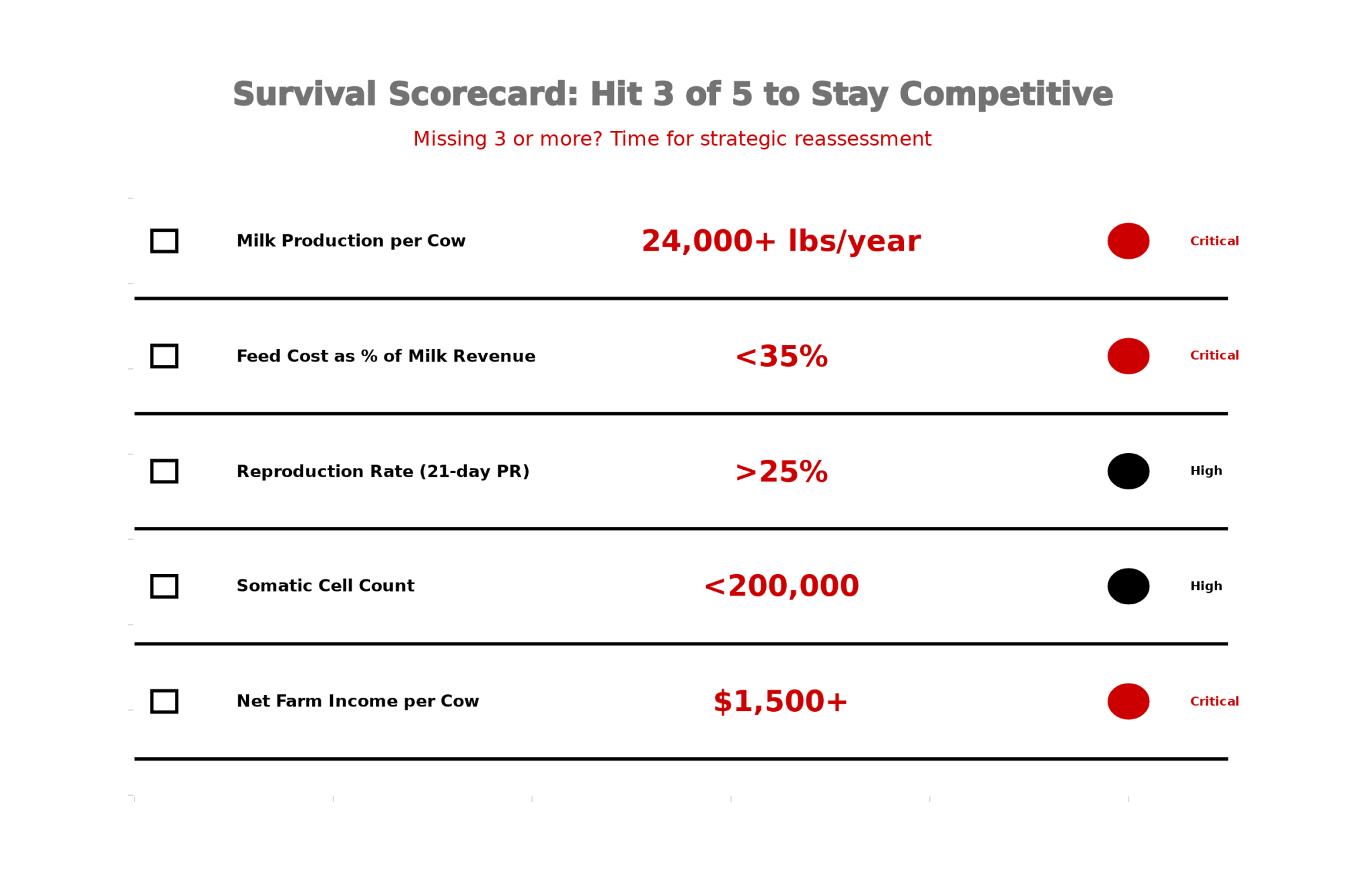
For that 650-cow operation to stay competitive, the math suggests needing to hit at least three of these five benchmarks:

  1. Total cost of production under $17.00/cwt
  2. Labor efficiency in the 50-60 cows per FTE range
  3. Debt-to-asset ratio under 40% before expansion
  4. Milk price premium of at least $0.50-1.00/cwt
  5. Feed cost under $9.50/cwt
The new competitive threshold: mid-size operations need to hit at least three of these five benchmarks—miss three or more, and you’re not waiting out a cycle, you’re sliding toward the cautionary tale category

Miss three or more? That’s the signal that strategic repositioning deserves serious analysis.

Technology favors scale as well. Genomic testing pays outsized dividends for larger operations—making breeding decisions on $50 tests rather than waiting years for daughter proofs accelerates genetic progress while the per-test cost spreads efficiently across larger herds.

I don’t want to overstate this. Many mid-size operations remain profitable. The data simply suggests the “sweet spot” has narrowed.

Strategic Pathways: What’s Actually Working
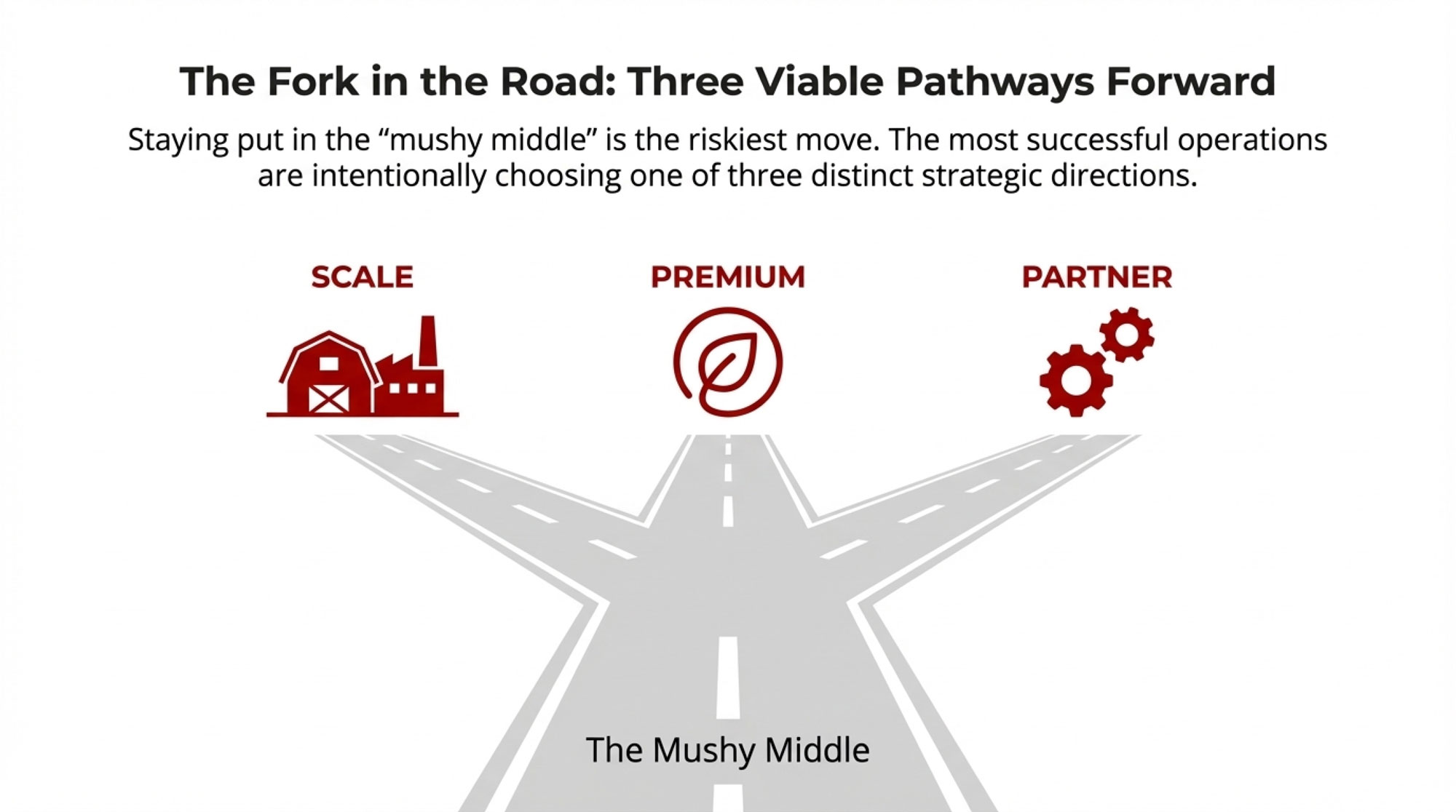
The Scale Pathway

Operations growing to 2,000+ cows achieve meaningful cost advantages when they have the right foundation: debt-to-asset ratios well under 40% before expansion, substantial liquid reserves, land and nutrient management already permitted, and management depth beyond the founding family.

The Premium Positioning Pathway

Smaller operations are capturing substantial margins through differentiation. Organic programs through cooperatives like Organic Valley pay meaningful premiums. The most successful premium operations layer multiple strategies—specialty genetics, A2A2 certification, organic practices, and on-farm processing.

The Partnership Pathway

I’ve spoken with Upper Midwest producers running separate family operations who share feed mixing systems, manure handling, and collective purchasing. Individually, none could justify certain equipment investments. Split three ways, the economics work. Partnership success hinges on governance—formal LLCs with clear operating agreements, not handshake arrangements.

Looking Forward

When I asked my Wisconsin friend what he’s planning, he said he’s finally running the numbers on all three pathways. That kind of strategic clarity is available to anyone willing to ask difficult questions.

The producers I encounter who seem most comfortable with their choices—whether expanding aggressively, transitioning to premium markets, or planning thoughtful exits—share something in common: they’ve done the analysis and made intentional decisions rather than defaulting to continuation.

The producers still hoping 2026 will look like 2019 may be the ones writing the case studies that future articles reference as cautionary tales.

Key Takeaways

  • Cost structures have reset permanently higher in labor (+30% since 2020), interest rates, equipment, and construction—feed relief alone won’t restore historical margins
  • Export dynamics are evolving as Mexico invests $4.1 billion in domestic capacity, and China’s imports fell 12%
  • The “mushy middle” faces the toughest math—operations with costs between $17-19/cwt need strategic repositioning, not just better prices
  • Replacement heifer prices hit $3,010/head—up 75% since 2023, fundamentally changing expansion and beef-on-dairy calculations
  • Five benchmarks define competitive mid-size operations: cost under $17/cwt, labor efficiency near 50-60 cows/FTE, debt-to-asset under 40%, milk premium capture, and feed cost advantages
  • Multiple strategic pathways remain viable—scale, premium positioning, and partnerships each show success stories
  • Proactive strategic decisions outperform reactive ones—the optimal time for analysis precedes circumstances that narrow available options

Complete references and supporting documentation are available upon request by contacting the editorial team at editor@thebullvine.com.

Learn More

Join the Revolution!

Join over 30,000 successful dairy professionals who rely on Bullvine Weekly for their competitive edge. Delivered directly to your inbox each week, our exclusive industry insights help you make smarter decisions while saving precious hours every week. Never miss critical updates on milk production trends, breakthrough technologies, and profit-boosting strategies that top producers are already implementing. Subscribe now to transform your dairy operation’s efficiency and profitability—your future success is just one click away.
NewsSubscribe
First
Last
Consent

Profitable but Drowning: The Interest Rate Crisis Reshaping Mid-Size Dairy

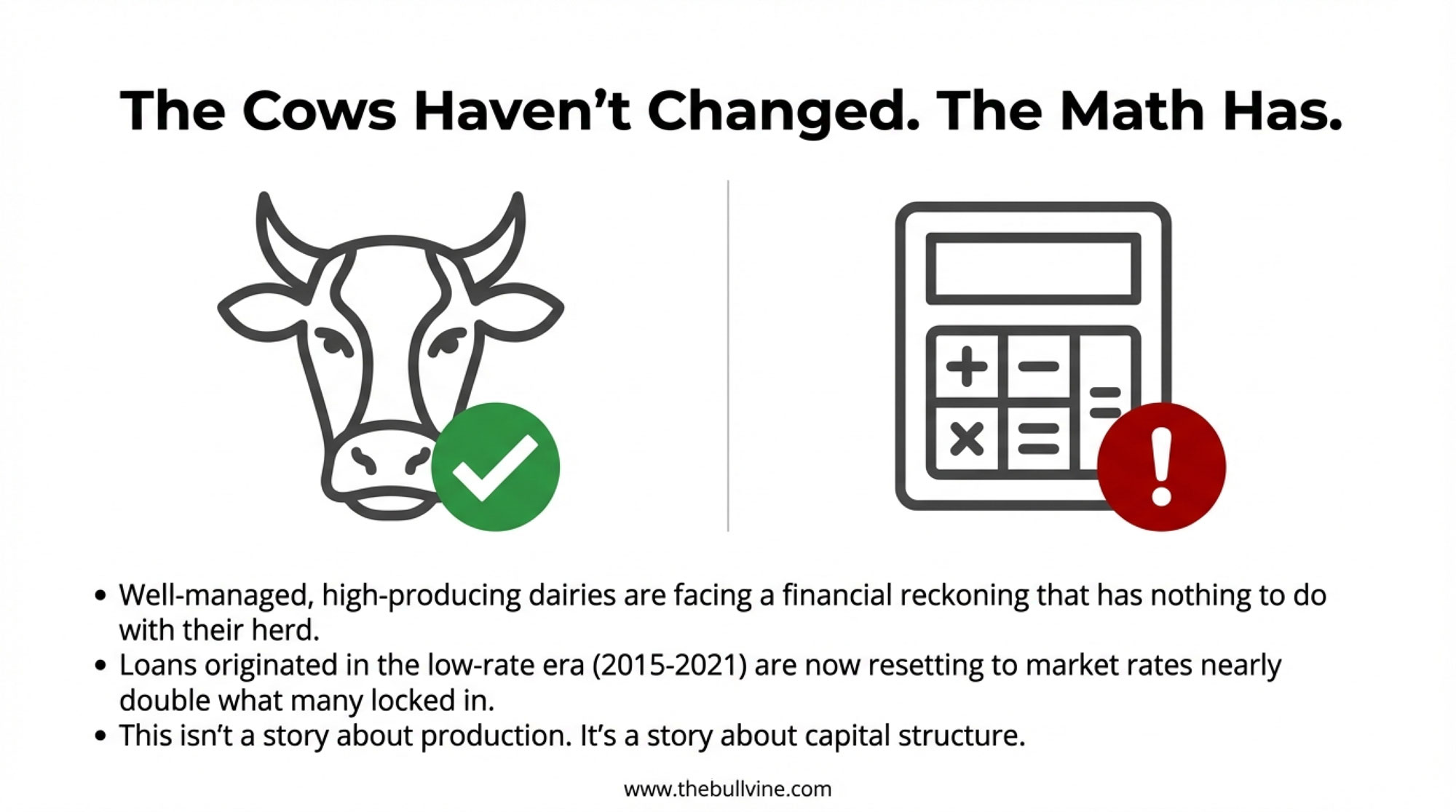
The cows haven’t changed. The math has. Why good dairies are suddenly fighting to survive.

Executive Summary: Well-managed mid-size dairies are facing a reckoning that has nothing to do with their cows. As loans from the low-rate era (2015-2021) reset to current markets—the Chicago Fed shows operating rates now at 7.73%, nearly double what many locked in—debt service is jumping 25-30% overnight. For a 400-cow dairy with typical leverage, that translates to $120,000 in added annual costs before a single operational change. Here’s what catches producers off guard: even farms current on every payment can trigger technical default when covenant ratios slip due to rate-driven debt increases, not management problems. More than 1,400 U.S. dairies closed in 2024, per USDA—Wisconsin alone lost 400. The path forward requires calculating your true breakeven at new rates, engaging lenders proactively with specific proposals, and recognizing that planned transitions preserve far more family wealth than forced exits ever do.

I’ve been having a lot of conversations lately that start the same way. A producer messages me after seeing their repricing notice, and the story sounds remarkably similar each time.

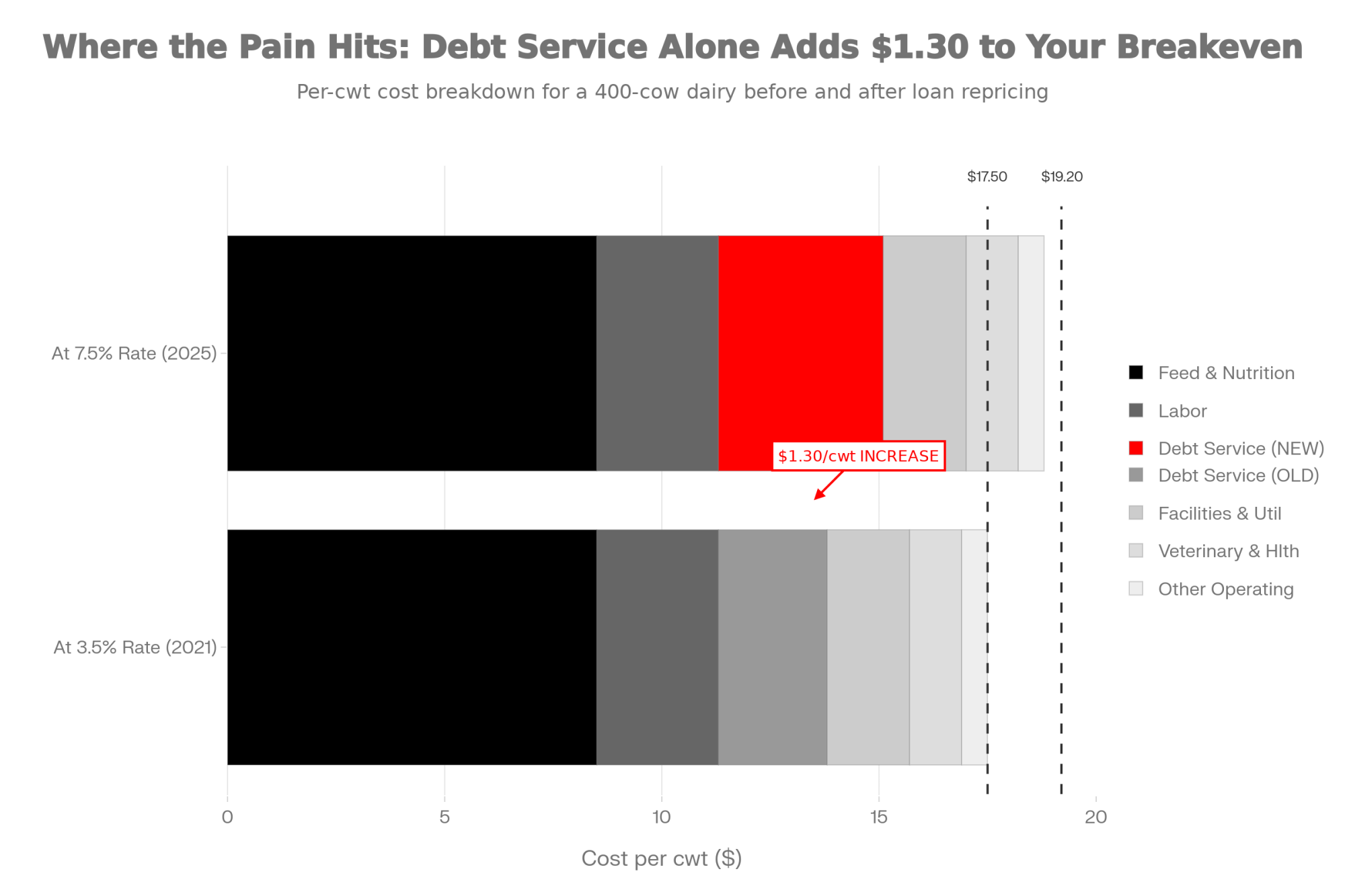
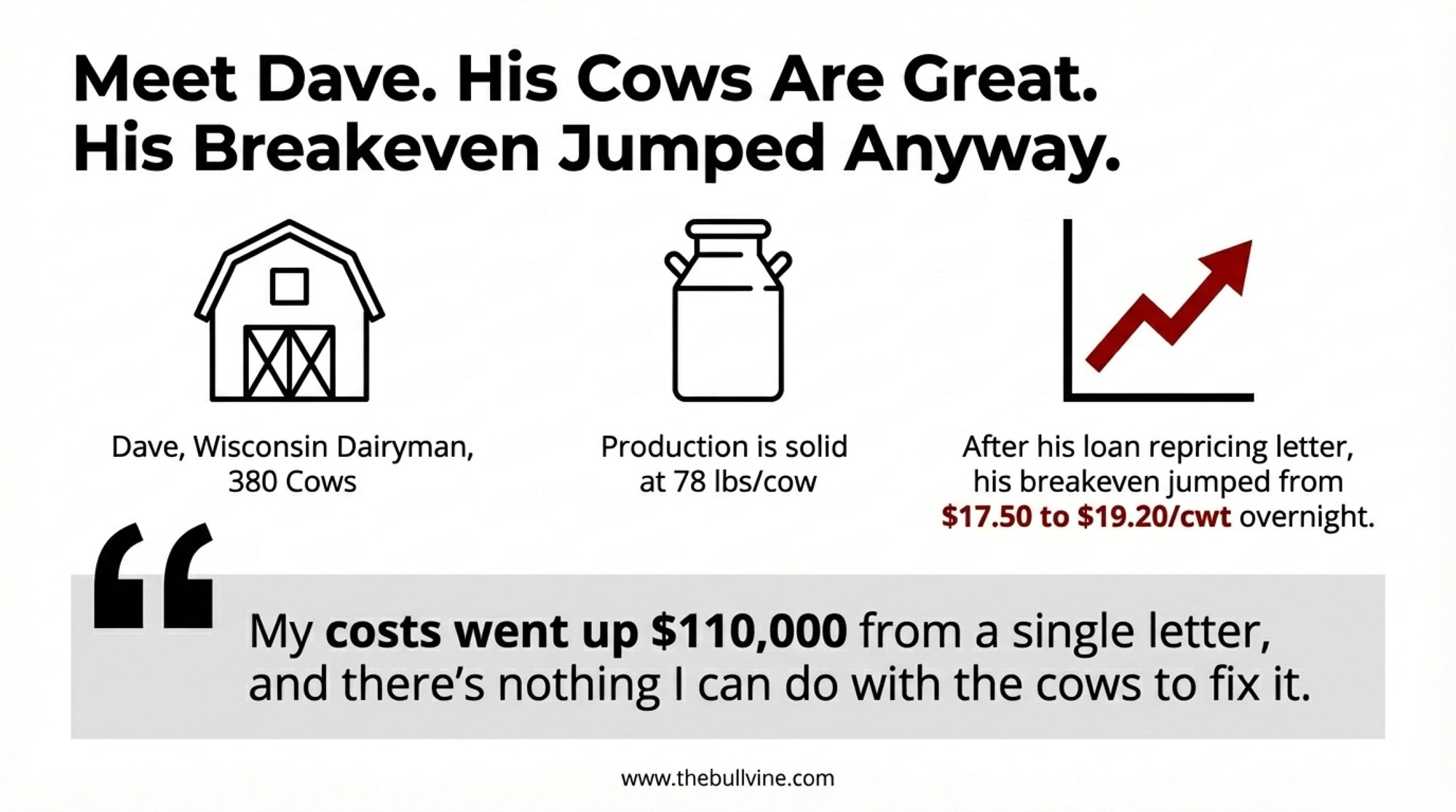
Take Dave, a Wisconsin dairyman I spoke with. When he ran his numbers after getting the repricing letter on his real estate loan, he discovered his breakeven had jumped from $17.50 to $19.20 per hundredweight. Nothing about his 380-cow operation had changed. The cows were still averaging 78 pounds. His nutrition program was dialed in. His fresh cow protocols were solid, and his transition period management hadn’t slipped. But the math had fundamentally shifted.

“I’ve been through bad milk prices before,” Dave told me. “I know how to tighten things up when we’re looking at $14 milk. But this feels different. My costs went up $110,000 from a single letter, and there’s nothing I can do with the cows to fix it.”

What struck me about that conversation—and the dozens like it I’ve had since—is how it captures something important about this moment. The challenge facing many mid-size operations isn’t about milk prices, feed costs, or management. It’s about debt structures that made perfect sense in one interest rate environment but don’t pencil out in another.

Understanding how this works can help you think through your own situation more clearly, whether you’re facing repricing directly or trying to plan around it.

How Dairy Loan Repricing Works

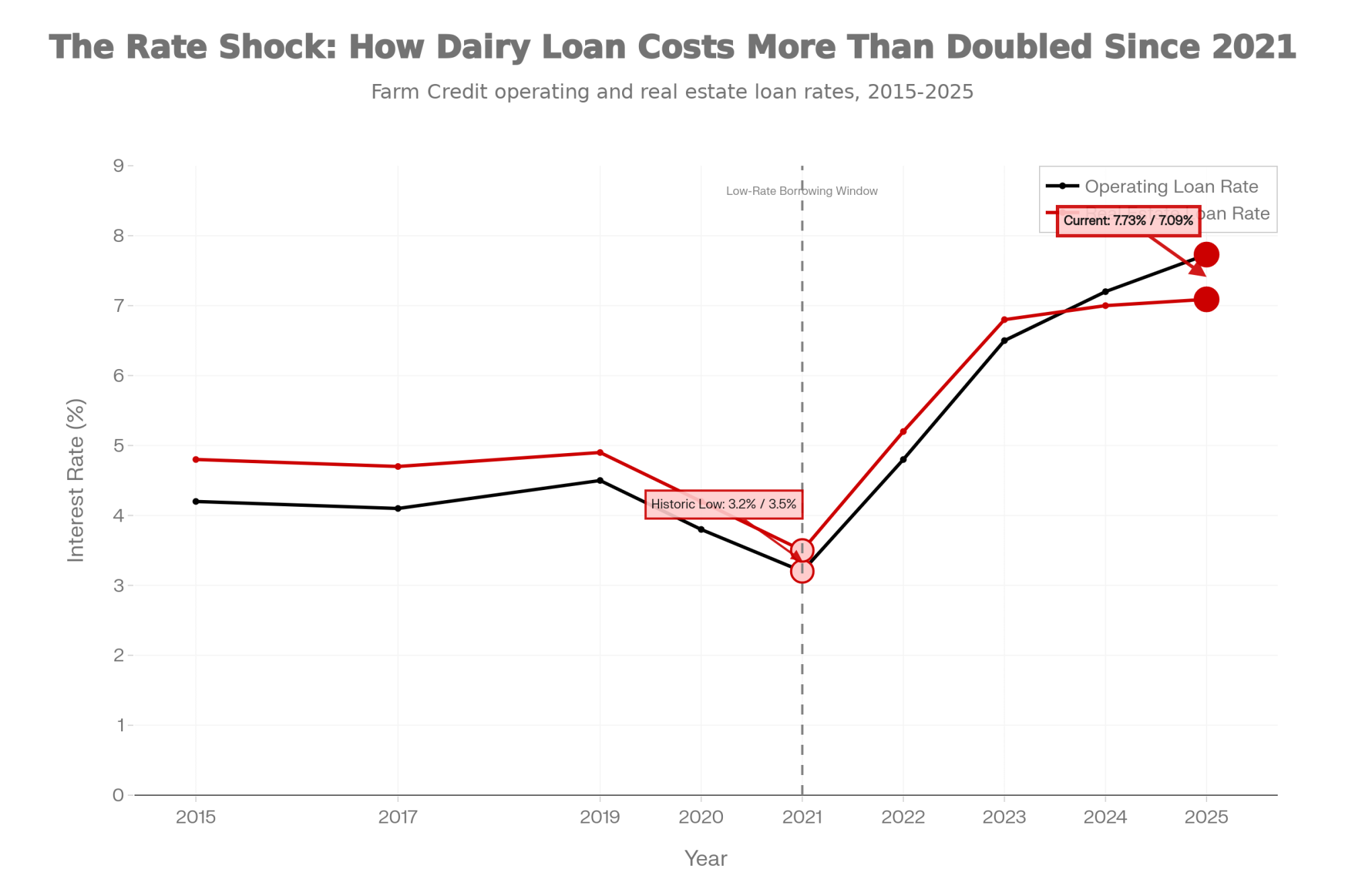
Here’s the backstory. During that stretch from roughly 2015 to 2021, agricultural lenders originated an enormous volume of dairy farm debt at rates between 3% and 4.5%. These loans financed the expansions, land purchases, parlor upgrades, and equipment investments that allowed mid-size operations to modernize and grow. It was, by most measures, a reasonable time to borrow.

Most of these loans were structured with 5-to-7-year terms before repricing—standard practice for agricultural real estate and equipment financing. What that means, practically speaking, is that a significant wave of debt is now resetting to current market rates. Federal Reserve Bank surveys throughout 2025 have documented this transition, with the Minneapolis Fed noting weakening credit conditions and declining farm incomes across the Ninth District.

The rate environment has changed substantially. The Chicago Fed’s agricultural credit survey from early 2025 shows operating loans averaging 7.73% and real estate loans at 7.09%. That’s roughly double what many producers locked in five or six years ago.

To put some numbers to this, consider a fairly typical 400-cow dairy carrying $4.5 million in total debt—the kind of balance sheet you’d see on a farm that expanded or did major capital improvements during that low-rate window:

The Repricing Impact: A Side-by-Side Comparison

Debt CategoryOriginal Rates (2020-2021)Repriced Rates (2025)Annual Increase
Real Estate Debt (15-year)3.5% → $232,000/yr7.5% → $300,000/yr+$68,000
Equipment Debt (7-year)4.0% → $197,000/yr7.0% → $217,000/yr+$20,000
Operating Line3.0% → $18,000/yr8.0% → $48,000/yr+$30,000
TOTAL ANNUAL DEBT SERVICE$446,000$566,000+$120,000 (+27%)

Based on a representative 400-cow dairy with $4.5 million total debt. Actual figures vary by operation.

That $120,000 difference translates to roughly $1.30 per hundredweight across a year’s production. For operations already running on tight margins, that kind of shift can consume the entire profit cushion that existed under the previous rate structure.

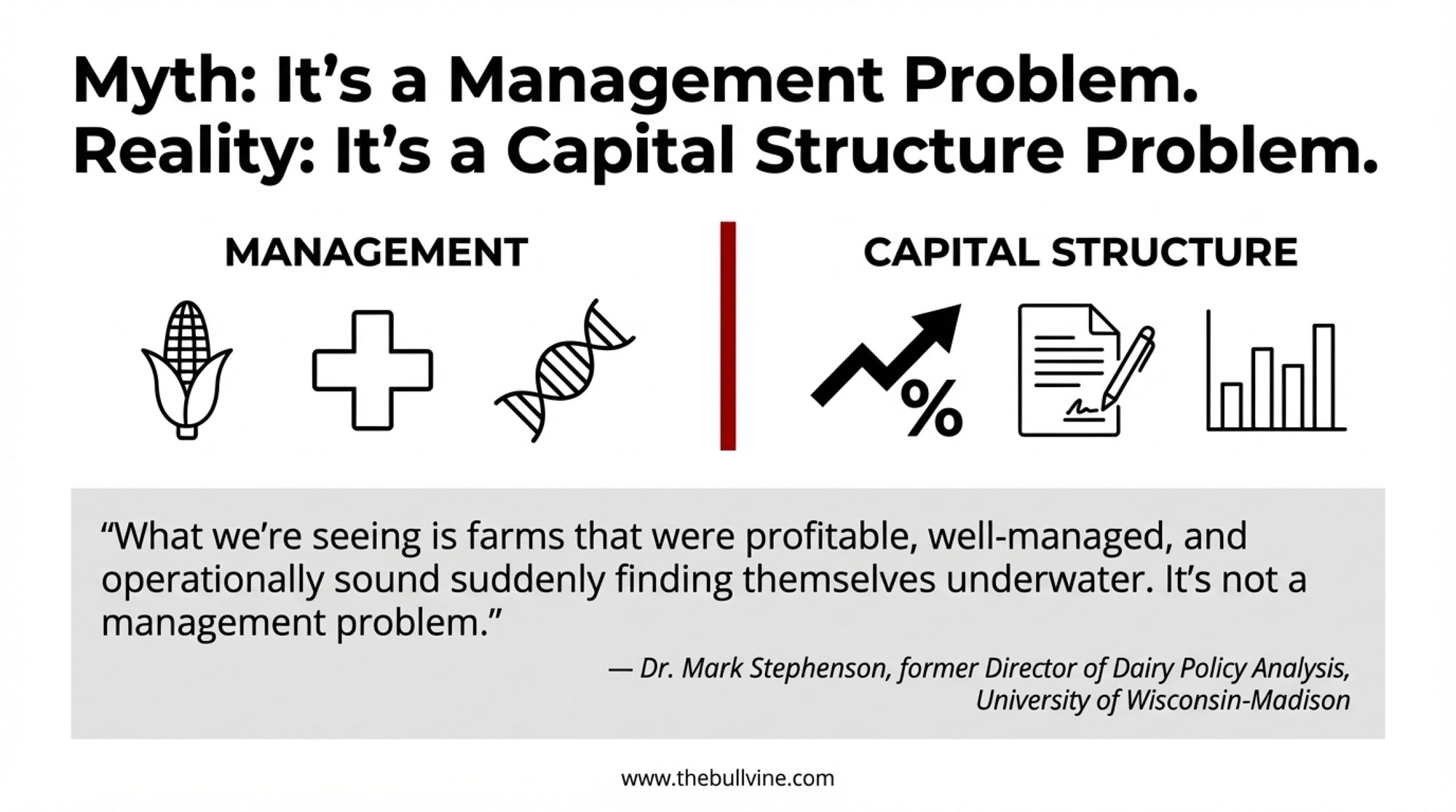
Dr. Mark Stephenson, the former Director of Dairy Policy Analysis at the University of Wisconsin-Madison, frames it this way: “What we’re seeing is farms that were profitable, well-managed, and operationally sound suddenly finding themselves underwater. It’s not a management problem. It’s a capital structure problem that originated in decisions made by both borrowers and lenders five to seven years ago.”

That framing matters. This isn’t about who’s a good farmer. It’s about financial structures adapting to changing conditions.

Which Dairy Farms Face the Greatest Repricing Risk

Operations under the greatest pressure tend to share certain characteristics. They’re typically in the 200 to 600 cow range—large enough to carry significant debt, but not quite large enough to achieve the per-unit cost advantages that help buffer larger operations against margin compression. They’re generally carrying debt-to-asset ratios between 65% and 70%, which means they’re leveraged enough that repricing creates covenant pressure, but weren’t in distress before rates moved. And most originated their loans between 2017 and 2021, during that window of historically low rates.

Geographically, the pressure seems most concentrated in traditional dairy regions. I’m hearing the most concern in Wisconsin, Michigan, Minnesota, New York, Pennsylvania, and parts of California and Idaho. The dynamics play out somewhat differently in Western dry-lot operations, where scale economics and distinct cost structures create distinct patterns. And in Canadian quota provinces, the supply management system provides some insulation, though producers there face their own version of capital intensity challenges.

The broader context here is important. The 2022 Census of Agriculture documented that approximately 65% of the nation’s dairy herd now lives on operations with 1,000 or more cows—up from just 17% back in 1997. That trajectory has been building for decades, but the current rate environment appears to be accelerating it.

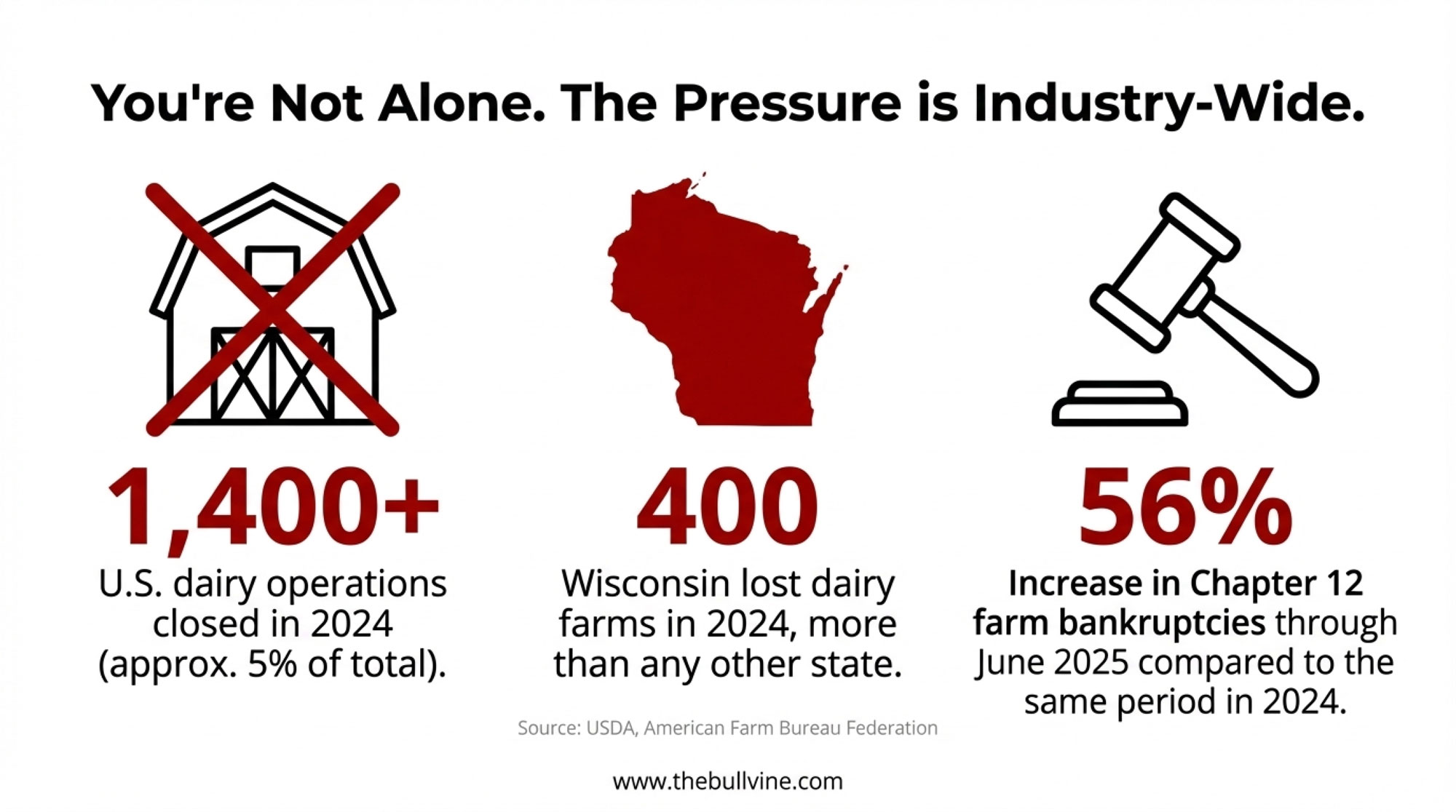
USDA’s February 2025 milk production report showed that more than 1,400 U.S. dairy operations closed in 2024—about 5% of the national total. Wisconsin lost approximately 400 dairy farms that year, more than any other state, followed by Minnesota with 165 closures. Those aren’t just statistics. Each one represents a family working through some very difficult decisions.

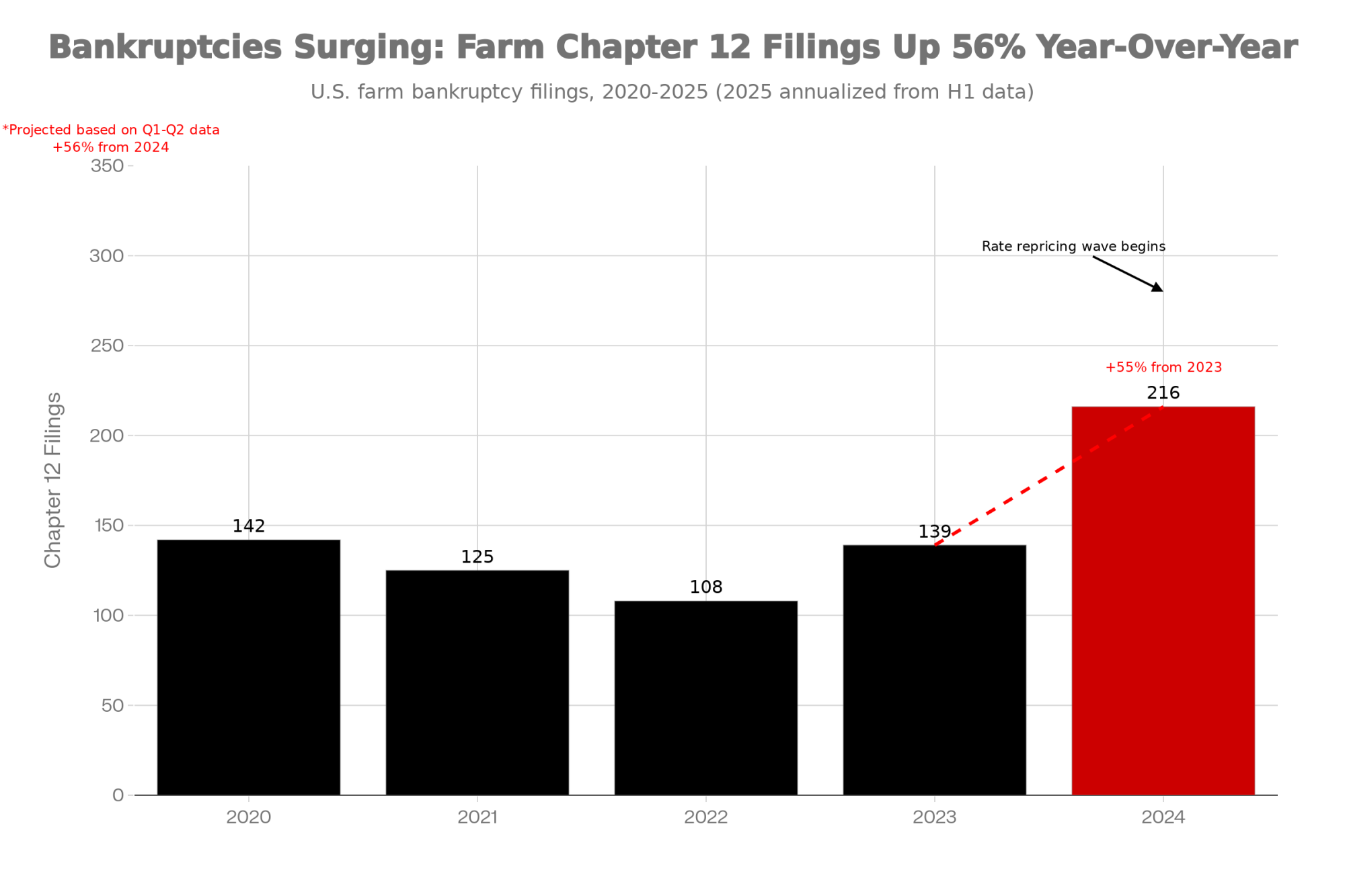
The stress extends beyond dairy. The American Farm Bureau Federation reported that Chapter 12 farm bankruptcies—the filing type designed specifically for family operations—were up 56% through June 2025 compared to the same period in 2024. For all of 2024, there were 216 Chapter 12 filings nationally, up 55% from 2023. The Kansas City Fed noted in their mid-2025 agricultural finance report that farm loan delinquency rates have increased for the second consecutive year, though they remain low by historical standards.

These indicators don’t necessarily predict a crisis, but they do suggest the farm economy is under meaningful pressure that warrants attention.

The Loan Covenant Trap Many Producers Miss

This is an area where I think many producers could benefit from a clearer understanding, because it often becomes relevant before anyone expects it.

Most agricultural loans include financial covenants—requirements that borrowers maintain certain ratios to remain in good standing. The common ones include:

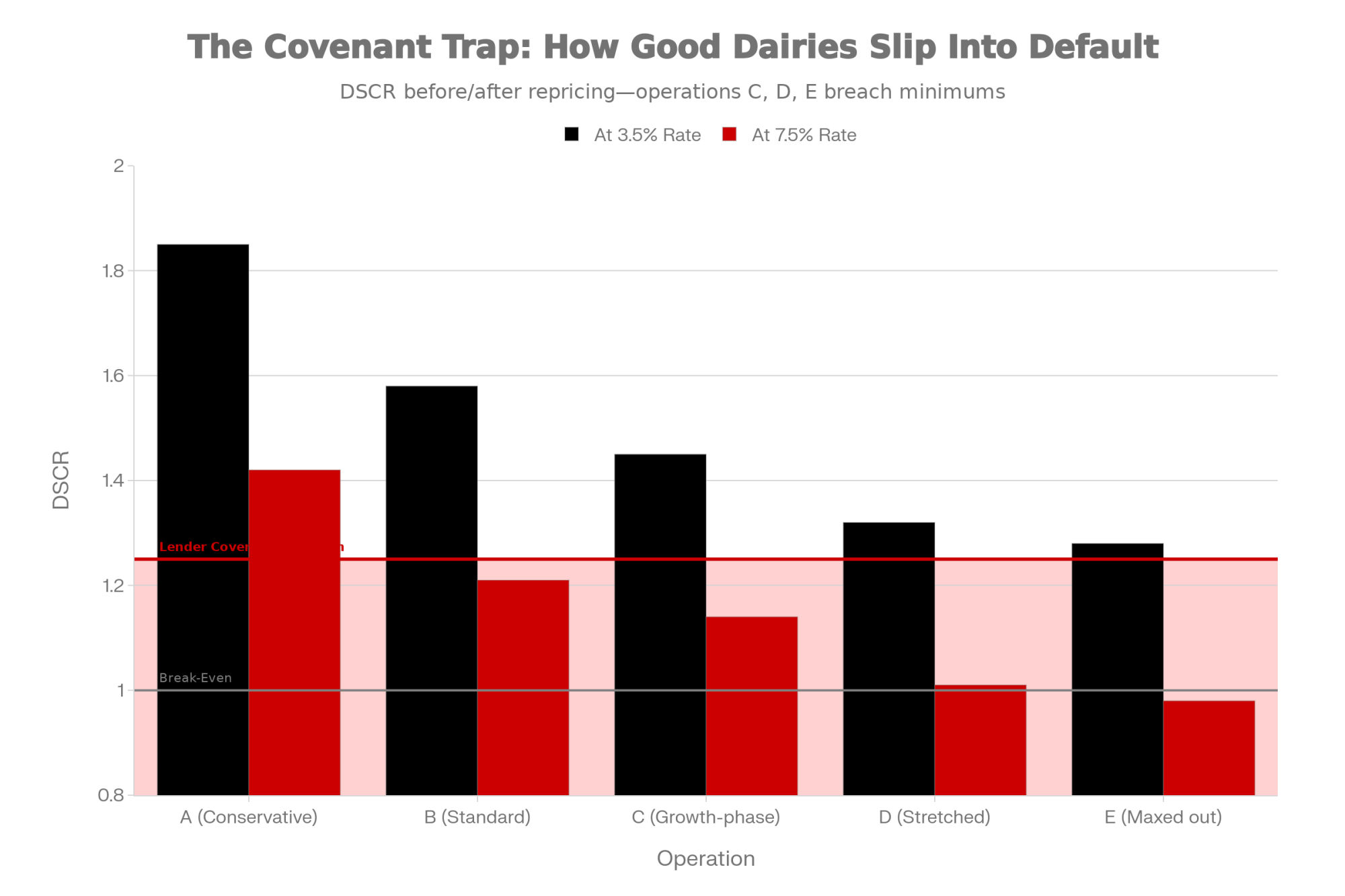
  • Debt Service Coverage Ratio: Typically 1.25x minimum, meaning net farm income needs to exceed debt payments by at least 25%
  • Current Ratio: Often 1.5x minimum, measuring working capital adequacy
  • Debt-to-Asset Ratio: Usually capped at around 60%

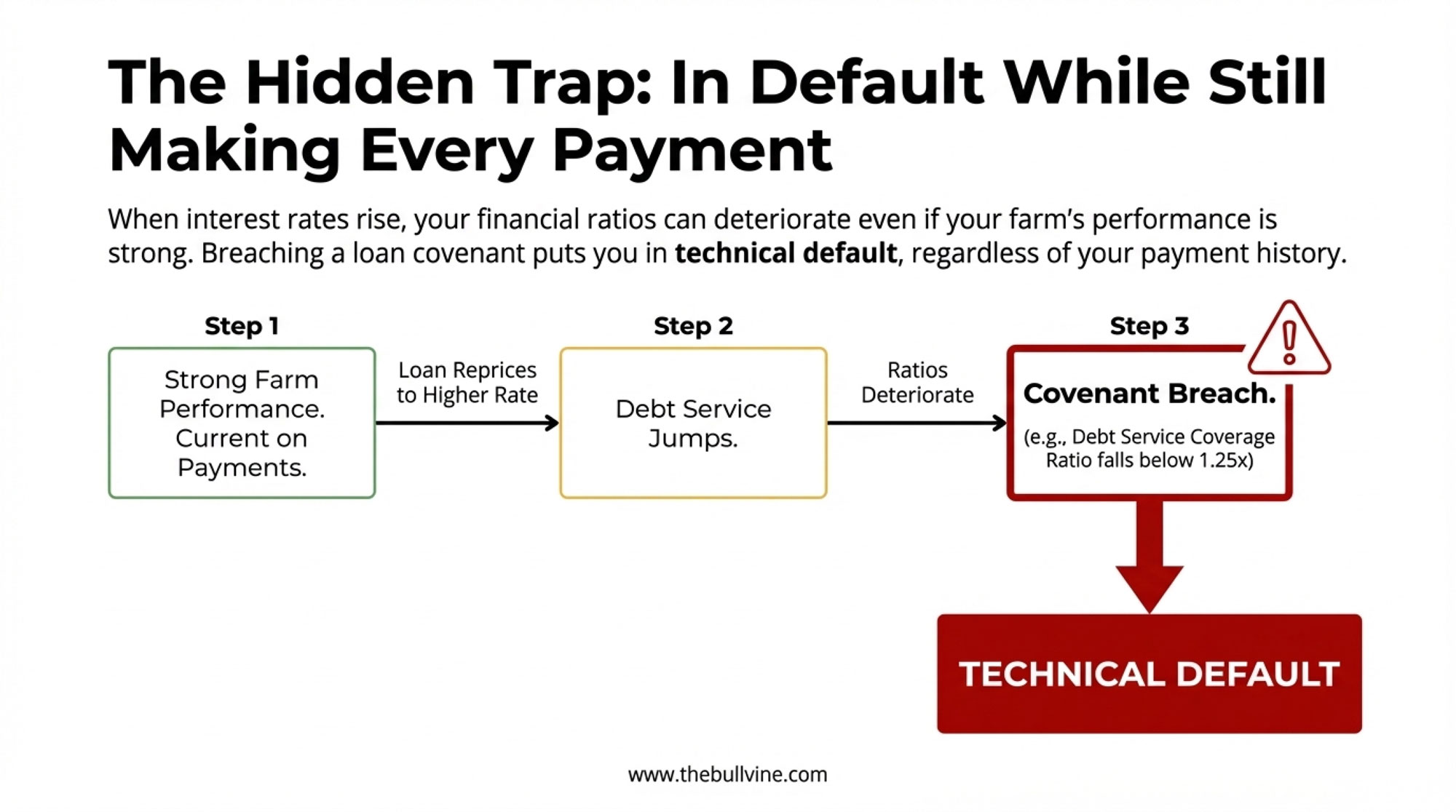
Here’s what’s worth understanding: when interest rates rise and debt service increases, these ratios can deteriorate even when operational performance remains strong. A dairy that comfortably met a 1.45x debt service coverage ratio at old rates might find itself at 1.14x after repricing—technically in covenant breach, even though production, costs, and management quality haven’t changed.

The wrinkle that surprises many producers is that once a covenant is breached, the loan is technically in default regardless of whether payments are current. This can trigger a sequence of lender responses.

I’ve spoken with agricultural lending professionals at several Farm Credit associations across the Midwest about how this plays out. As one loan officer with more than two decades of experience described it: “The farm could be making every payment on time, the cows could be performing beautifully, and they’re still in technical default. Those are hard conversations to have with producers who are doing everything right operationally.”

The typical progression involves enhanced reporting requirements first—monthly financials instead of quarterly. Then restrictions on capital expenditures and owner draws. If covenant compliance doesn’t improve, there may be requests for equity contributions or principal reduction. In more serious cases, loan acceleration becomes possible.

None of this is inevitable, and many lenders work constructively with borrowers to find solutions. But understanding the framework helps in planning how to approach these conversations.

Strategic Options and What They Can Realistically Achieve

I want to be straightforward here. There’s no simple fix for a structural repricing challenge. But some approaches can help, and understanding both their potential and their limitations is valuable.

Comparing Your Options

StrategyPotential Annual SavingsKey Limitation
Amortization Extension (15→25 yr)$80,000–$100,000Doesn’t reduce principal; extends total interest paid
Strategic Herd Reduction (15-25%)$60,000–$80,000Revenue declines proportionally with a smaller herd
Operational Efficiency Gains$55,000–$74,000Rarely sufficient alone for $120K repricing gap
FSA Refinancing (4.625%–5.75%)Varies by exposure$600K ownership / $400K operating caps
Private Ag LendersCovenant flexibilityRates are often comparable or higher than repricing levels

Savings estimates based on a representative 400-cow operation. Individual results vary significantly.

Engaging Your Lender Early

This consistently emerges as the most effective intervention. Producers who engage their lenders before repricing notices arrive—rather than after covenant issues develop—generally report more constructive conversations and better outcomes.

The difference between proactive and reactive discussions is substantial. When a producer approaches their lender with a thought-out plan before being flagged in the system, there’s typically more flexibility to work with. Once an account is classified as a problem asset, institutional constraints tend to narrow the options. That’s not a criticism of lenders—it’s just how credit administration typically works.

Approaches that seem to help include extending amortization from 15 years to 20-25 years (which can reduce annual payments by $80,000 to $100,000), requesting covenant modifications that reflect rate-driven rather than operational changes, and presenting cash flow projections based on realistic milk prices in that $18 to $19 per hundredweight range rather than more optimistic scenarios.

One thing I’d suggest: come to that meeting with a specific proposal rather than a list of possibilities. Demonstrate that you’ve carefully worked through the numbers. And focus on the financial analysis rather than the emotional weight of the situation—lenders work from models, and you’ll communicate more effectively if you engage on those terms.

Considering Herd Adjustments

Some operations are finding that a deliberate reduction in herd size—typically 15% to 25%—can restore financial stability when combined with proportional debt reduction.

The arithmetic: selling 80 cows from a 400-cow operation might generate $600,000 to $800,000 in proceeds, depending on cow values and quota where applicable. Applied directly to debt reduction, this can decrease annual debt service by $60,000 to $80,000—a meaningful offset against repricing impact.

The trade-off is real, though. Revenue declines with a smaller herd. This approach works better as a bridge to stability than as a permanent solution. A 320-cow operation carrying $3.8 million in debt at current rates still faces challenging economics. You’re creating breathing room, not resolving the underlying situation.

Operational Improvements

Focused attention on cost reduction absolutely has value, but it’s important to be realistic about what’s achievable:

  • Nutrition optimization: Working with a skilled nutritionist to refine rations typically yields savings of $0.30 to $0.50 per cwt. On a 92,000 cwt annual production, that’s $27,600 to $46,000—meaningful, but not transformative against a $120,000 repricing impact.
  • Labor efficiency: Workflow improvements without major capital investment might capture $0.15 to $0.25 per cwt.
  • Component and quality premiums: Optimizing butterfat and protein capture can add $0.20 to $0.30 per cwt if there’s room for improvement. Many operations have already pushed hard on this.

Combined realistic potential runs $0.60 to $0.80 per cwt—roughly $55,000 to $74,000 annually. That’s valuable and worth pursuing regardless of the rate environment. But it’s typically not sufficient on its own to offset a $1.30 per cwt repricing impact.

Alternative Financing Sources

Some producers are exploring options beyond traditional bank and Farm Credit financing:

USDA Farm Service Agency loans currently offer competitive rates—4.625% for direct operating loans and 5.750% for direct farm ownership loans as of December 2025. The constraint is dollar limits: FSA caps direct farm ownership loans at $600,000 and direct operating loans at $400,000. For a farm needing to refinance $2.7 million in real estate debt, these programs can help with a portion, but won’t address the full exposure.

Private agricultural lenders like AgAmerica and Rabo AgriFinance may offer more flexibility on covenant structures. Rates tend to be comparable to or somewhat higher than traditional sources, so this is more about terms than cost savings.

Realistic combined capital access from these alternative sources typically runs $300,000 to $600,000—helpful for bridging gaps, but generally not sufficient to resolve a seven-figure repricing exposure.

A Framework for Making These Decisions

What I’ve found most valuable in conversations with producers facing these decisions is an honest, numbers-first assessment. The emotional weight of these situations is real—often we’re talking about multi-generational operations and family identity. But the financial analysis needs to proceed on its own terms.

This is where working with good advisors makes a difference. Farm transition specialists, agricultural attorneys, and CPAs who understand dairy operations can help families see the full picture and evaluate options they might not have considered.

Some questions worth working through carefully:

  • What’s your true breakeven at new rates? This means debt service, operating costs, family living, and a realistic allowance for capital replacement. Calculate it precisely rather than estimating.
  • How does that breakeven compare to realistic price expectations? If you’re pushing above $19 per hundredweight, there’s very little margin for the unexpected.
  • Do you have access to meaningful outside capital? This could be family resources, off-farm assets, or other sources—but it needs to be real and accessible, not theoretical.
  • What signals is your lender sending? There’s often a gap between what we hope they mean and what they actually communicate. Try to hear the latter clearly.
  • What does the next generation want? If successors aren’t committed to the operation, the calculus changes significantly.

For operations where the breakeven is pushing toward $20 per cwt, debt-to-asset exceeds 70%, and there’s no access to outside capital, the outlook is genuinely difficult regardless of how well the cows are managed. In those situations, a planned transition—executed while meaningful equity remains—typically preserves substantially more family wealth than a forced exit 18 to 24 months later. Farm transition specialists consistently find that strategic exits preserve considerably more equity than distressed sales—often amounting to several hundred thousand dollars for families with significant remaining assets.

That kind of decision isn’t giving up. It’s sound financial management applied to a difficult situation.

The Other Side of This Story

It’s worth acknowledging that this environment doesn’t affect everyone the same way. Producers who maintained conservative balance sheets through the low-rate years—those who resisted the temptation to expand aggressively or who paid down debt rather than refinancing—find themselves in a very different position today.

For well-capitalized operations with strong working capital and minimal leverage, the current environment may actually present opportunities. Land that wouldn’t have come to market is becoming available. Equipment can be acquired at more favorable prices. Some producers are finding strategic growth opportunities they couldn’t access two years ago.

That’s not meant to minimize what leveraged operations are facing. But it’s a reminder that market stress always creates a range of outcomes. Where you land depends heavily on decisions made years ago—and on the decisions you make now.

What This Means for the Industry

Beyond individual farm decisions, the repricing wave is accelerating structural changes that have been building for some time.

The consolidation trend toward larger operations will likely continue. We’ve already seen the share of cows on 1,000-plus operations climb from 17% in 1997 to 65% in 2022, according to the Census of Agriculture. The mid-size family dairy is becoming an increasingly uncommon business model, particularly in regions without quota systems or other structural supports.

From the processor perspective, the picture is mixed. One Midwest cooperative executive described it this way: consolidation creates certain efficiencies in milk collection and quality consistency. “But we’re also watching our supplier base shrink faster than anyone planned for. When you lose 400 farms in a region over a few years, that’s infrastructure—roads, services, veterinary capacity—that doesn’t rebuild easily.”

Industry organizations are responding. The National Milk Producers Federation has advocated for expanded FSA lending authority, and the PACE Act was reintroduced in Congress in March 2025. If enacted, it would increase the caps on direct farm ownership loans from $600,000 to $1.5 million and on direct operating loans from $400,000 to $800,000. Whether any of this moves quickly enough to help farms facing near-term repricing remains uncertain.

There’s a broader consideration worth noting. As mid-size operations exit, the industry loses independent decision-makers who have historically contributed resilience through diversity of approach. Dr. Marin Bozic, an agricultural economist who spent a decade studying dairy markets at the University of Minnesota, has described this as “trading resilience for efficiency.” That trade-off works well under normal conditions. It becomes a vulnerability when circumstances deviate from what the models anticipated.

Practical Next Steps

For producers facing repricing in the next 12 months:

  • Know your numbers precisely. Calculate your exact breakeven cost at new rates—not an estimate, an actual calculation. That number anchors everything else.
  • Engage your lender before they engage you. Come with a specific proposal and realistic projections. The conversation is different when you initiate it.
  • Build your advisory team now. Connect with a farm transition specialist, an agricultural CPA, and potentially an ag attorney, even if you’re planning to continue. Understanding your options strengthens your position.

For those considering expansion or major capital investment:

  • Model everything at current rates. The 3% environment from 2019 isn’t returning in any relevant timeframe. Plan accordingly.
  • Stress-test at challenging milk prices. See how your projections hold at $17 to $18 per cwt, not just at more optimistic levels.
  • Understand that comfortable leverage at 4% becomes uncomfortable at 7-8%. The production side of your operation doesn’t change, but the financial dynamics shift considerably.

The Bottom Line

What’s unfolding now isn’t primarily about who’s skilled at producing milk. Many capable operations are exiting not because they can’t compete on the production floor, but because debt structures that worked in one rate environment don’t pencil out in another.

We’re going to see more good dairy families work through difficult transitions over the next couple of years. Not because they couldn’t manage cows or run tight operations, but because the financial landscape shifted in ways that were partly foreseeable and partly not.

But here’s something worth remembering: dairy has always adapted. The industry that emerges from this period will look different, yes. Some of the changes will feel like losses. But there will also be opportunities—for those who navigate successfully, for new models that emerge, for the next generation that finds ways to make the economics work.

The families who approach this period with clear financial thinking, good advice, and honest assessment of their situations will be best positioned—whether that means restructuring successfully, transitioning on their own terms, or finding paths forward that none of us have fully anticipated yet.

Understanding the dynamics at play is the first step. What you do with that understanding is up to you.

Key Takeaways

  • The cows haven’t changed—the math has: Loans repricing from 3.5% to 7.5% add ~$120,000 annually to a typical mid-size operation, or $1.30/cwt onto breakeven
  • You can be current and still default: Covenant breaches trigger technical default even when payments are on time—it’s the ratios, not missed payments, that trip the wire
  • Efficiency alone won’t close this gap: Operational improvements typically yield $0.60-$0.80/cwt; helpful, but not sufficient against a $1.30/cwt repricing hit
  • Talk to your lender before they talk to you: Proactive conversations with specific restructuring proposals consistently produce better outcomes than reactive ones
  • Planned exits beat forced ones: Strategic transitions preserve significantly more family equity than fighting until liquidation becomes the only option

Complete references and supporting documentation are available upon request by contacting the editorial team at editor@thebullvine.com.

Learn More:

Join the Revolution!

Join over 30,000 successful dairy professionals who rely on Bullvine Weekly for their competitive edge. Delivered directly to your inbox each week, our exclusive industry insights help you make smarter decisions while saving precious hours every week. Never miss critical updates on milk production trends, breakthrough technologies, and profit-boosting strategies that top producers are already implementing. Subscribe now to transform your dairy operation’s efficiency and profitability—your future success is just one click away.
NewsSubscribe
First
Last
Consent
Send this to a friend