





They told him he was wasting his time. A dairy farmer painting hay bales? That’s not how you change federal policy. Washington doesn’t listen to guys on tractors. Nelson Troutman painted anyway. Six years later, Congress voted unanimously—every single member—to put whole milk back in America’s schools.

Executive Summary: Whole milk just won—unanimously. On December 14, 2025, the U.S. House passed the Whole Milk for Healthy Kids Act without a single opposing vote, torching 13 years of misguided policy and sending a landmark bill to President Trump’s desk for signature. Schools nationwide can finally serve whole and 2% milk again—a shift that could pour 45-66 million pounds of butterfat back into fluid markets each year—and dairy farmers owe this victory to Nelson Troutman’s painted hay bales, the relentless 97 Milk movement, and New York champions Duane Spaulding, Anne Diefendorf, and Jay Hoyt, who refused to stop fighting until Congress had no choice but to listen.
This isn’t just policy—it’s redemption. And it happened because dairy farmers rolled up their sleeves and made it happen themselves.

The Grassroots Movement That Changed Everything
Picture this: 2019, central Pennsylvania. Dairy farmer Nelson Troutman looks out at his field, frustrated by years of watching federal regulations restrict whole milk from schools based on outdated science. Instead of grumbling about it over coffee at the local diner, he grabbed a paintbrush and wrote “97% Fat-Free Milk” on his hay bales.
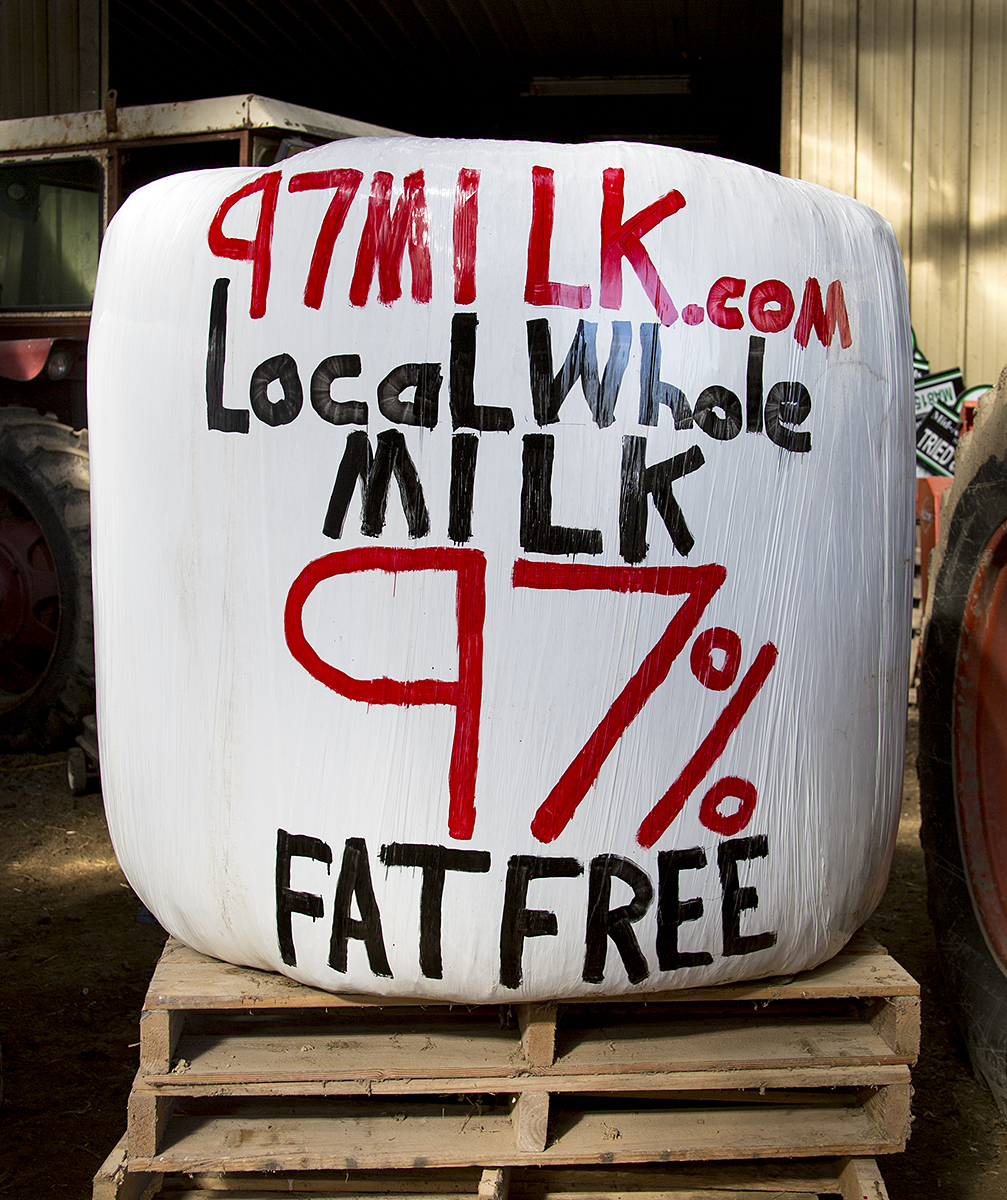
That simple act sparked something nobody expected. People driving past those bales started asking questions—wait, whole milk is 97% fat-free? They realized they’d been misled for years. Whole milk isn’t the dietary villain it was made out to be. The 97 Milk movement was born, creating a grassroots nonprofit dedicated to educating consumers and bringing choice back to school cafeterias (97Milk.com).
What’s interesting here is how a visual message on rural roadsides cut through all the noise that expensive lobbying campaigns couldn’t penetrate. I’ve noticed that the most effective agricultural advocacy often starts exactly like this—not in Washington conference rooms, but in fields and barns where farmers get fed up enough to do something unconventional.
“All the volunteers everywhere helped move this forward,” said Bernie Morrissey, Chairman of the Grassroots Pennsylvania Dairy Advisory Committee and 97 Milk. “We got attention on the school milk issue that most people didn’t even know about. We stuck with it, and our train kept getting longer as more jumped on board”.
The New York Trio Who Carried the Torch
In New York, three dairy farmers became the face of this movement in the Northeast: Duane Spaulding, Anne Diefendorf, and Jay Hoyt—the team behind “3 Farmers Who Care.” These folks didn’t just advocate from a distance; they lived and breathed this campaign, often at significant personal cost during some tough years for Northeast dairy.
“It all began six years ago when a Pennsylvania dairy farmer painted ‘97% fat-free milk’ on a hay bale,” Spaulding explained in a video documentary about the movement. That grassroots effort “works to educate consumers, support dairy farmers, and bring whole milk back to schools, while connecting farmers, families, and communities along the way” (YouTube/Facebook, 97 Milk Documentary, October 2025).
Jay Hoyt, who grew up in Vermont and moved to New York, put it plainly when asked why he kept pushing: “I guess I love farmers. I guess that’s why I stayed with it.” Their dedication—spending their own money and time away from their farms during critical seasons like first cutting and fall harvest—helped carry this movement across the finish line.
What farmers are finding is that this kind of peer-to-peer advocacy resonates in ways that polished industry campaigns sometimes don’t. When Spaulding or Diefendorf showed up at a school board meeting, they weren’t lobbyists in suits—they were neighbors who milk cows. That authenticity mattered.
What This Bill Actually Does
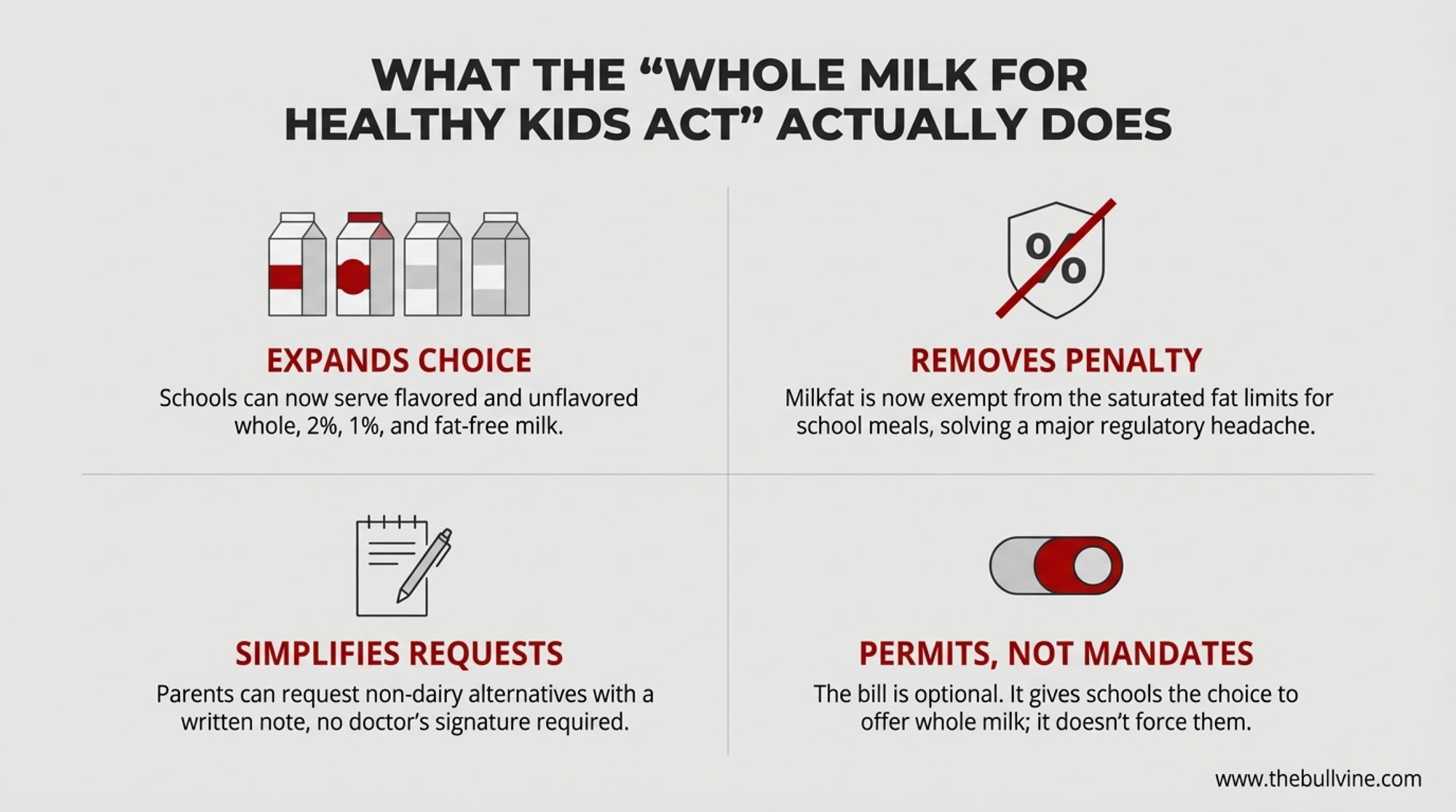
Let’s cut through the noise and look at what the Whole Milk for Healthy Kids Act actually changes. The legislation, formally H.R. 649 in the House and S. 222 in the Senate, does several critical things (Congress.gov, H.R. 649):
Expands Milk Options: Schools can now serve flavored and unflavored whole, reduced-fat (2%), low-fat (1%), and fat-free milk—giving kids the same choices they have at home. This development suggests a major shift in how federal nutrition policy treats dairy fat.
Removes the Saturated Fat Penalty: Here’s the technical piece that matters for school food service directors—milkfat is now exempted from saturated fat calculations for school meals. Previously, offering whole milk would push meals over saturated fat limits, creating a regulatory headache that discouraged participation (House Report 119-142).
Simplifies Parent Requests: Parents can now provide written requests for non-dairy alternatives instead of requiring a doctor’s note—common sense that should have been policy years ago.
Optional, Not Mandatory: And this is worth emphasizing for anyone worried about forced changes—schools aren’t required to do anything differently. They can choose what works for their students, their budgets, and their communities. The bill permits, not mandates.
The Science That Washington Finally Acknowledged
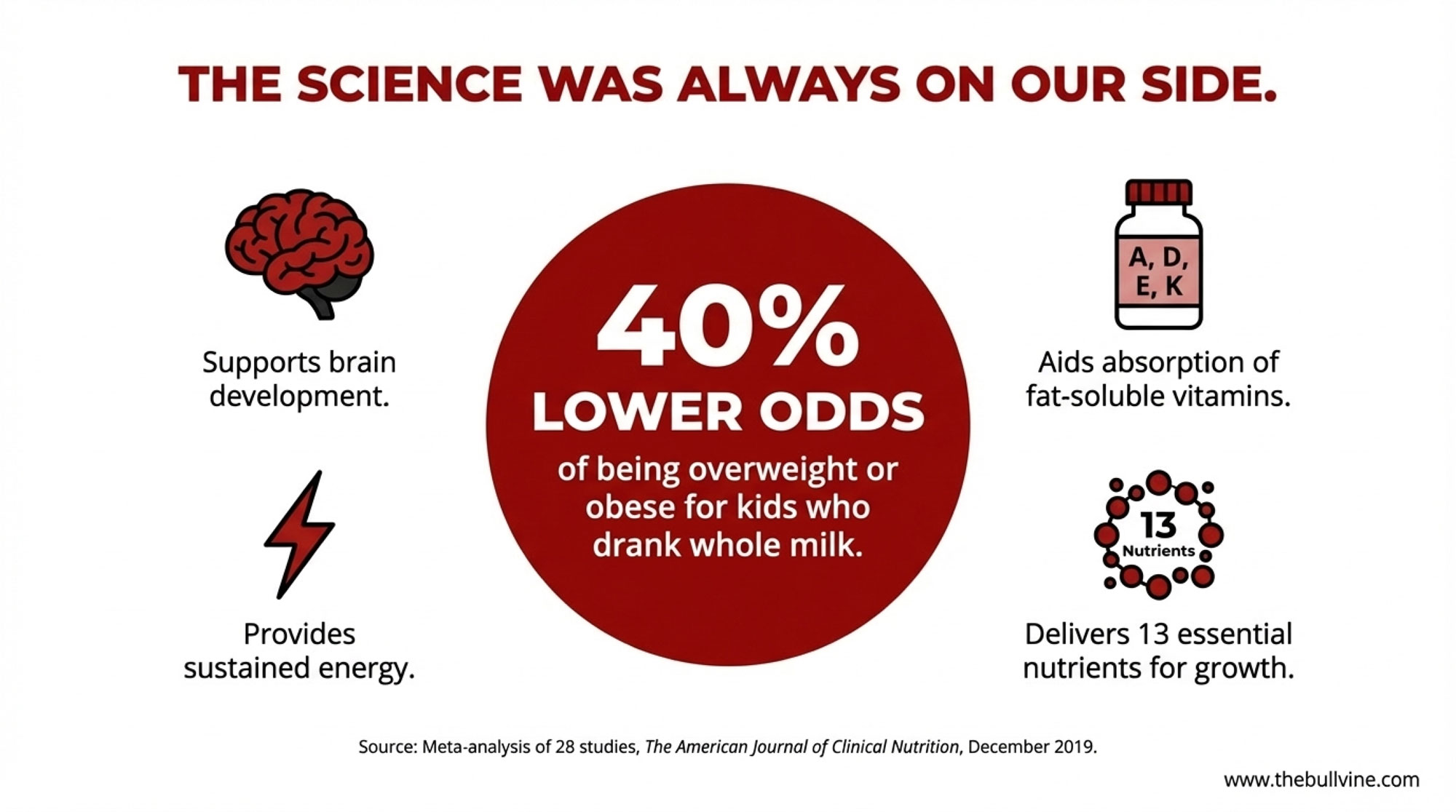
Here’s what makes this victory so satisfying for anyone who’s followed the research: the science has been on whole milk’s side for years, but federal nutrition policy stubbornly ignored it.
| Health/Nutrition Metric | Whole Milk | 2% Reduced-Fat | 1% Low-Fat | Key Finding |
| Obesity Risk (vs. baseline) | −40% lower risk | Baseline/Higher | Baseline/Higher | Meta-analysis of 28 studies, 21,000 children (Vanderhout et al., AJCN 2019) |
| Essential Nutrients per 8oz | 13 essential | 13 essential | 13 essential | Same micronutrients; fat-soluble vitamin absorption REQUIRES dietary fat |
| Fat-Soluble Vitamin Absorption | Optimal (A, D, E, K) | Reduced uptake | Minimal uptake | Dietary fat critical for calcium & vitamin D utilization in growing bodies |
| Childhood Dairy Compliance | Higher participation | Lower than whole | Lowest participation | 68–94% of U.S. children miss dairy targets; whole milk drives consumption |
| School Cafeteria Waste | Lower waste rate | Moderate waste | Moderate-High waste | 2012 ban increased waste & reduced participation; kids didn’t switch—they quit |
A comprehensive meta-analysis published in The American Journal of Clinical Nutrition examined 28 studies involving nearly 21,000 children and found that kids who drank whole milk had 40% lower odds of being overweight or obesecompared to those who drank reduced-fat milk (Vanderhout et al., American Journal of Clinical Nutrition, December 2019). That finding flies directly in the face of the 2012 regulations that banned whole milk from schools, supposedly to combat childhood obesity.
Looking at this from a nutritional standpoint, it makes sense. Whole milk provides 13 essential nutrients—calcium, vitamin D, potassium, protein, and more—critical for developing bodies and brains. The fats in whole milk support vitamin absorption (vitamins A, D, E, and K are fat-soluble), brain development, and provide sustained energy that keeps kids focused through afternoon classes (National Milk Producers Federation).

The consumption data tells an equally compelling story. Between 68% and 94% of school-age children fail to meet recommended dairy intake levels, depending on age group and region. When you ban the milk kids actually want to drink, they don’t switch to skim—they just don’t drink milk at all. I’ve seen this pattern repeatedly in school nutrition data.
School milk consumption dropped 37.4% overall when flavored and full-fat options were removed in 2012, with kids selecting fewer cartons and wasting more of what they did take.
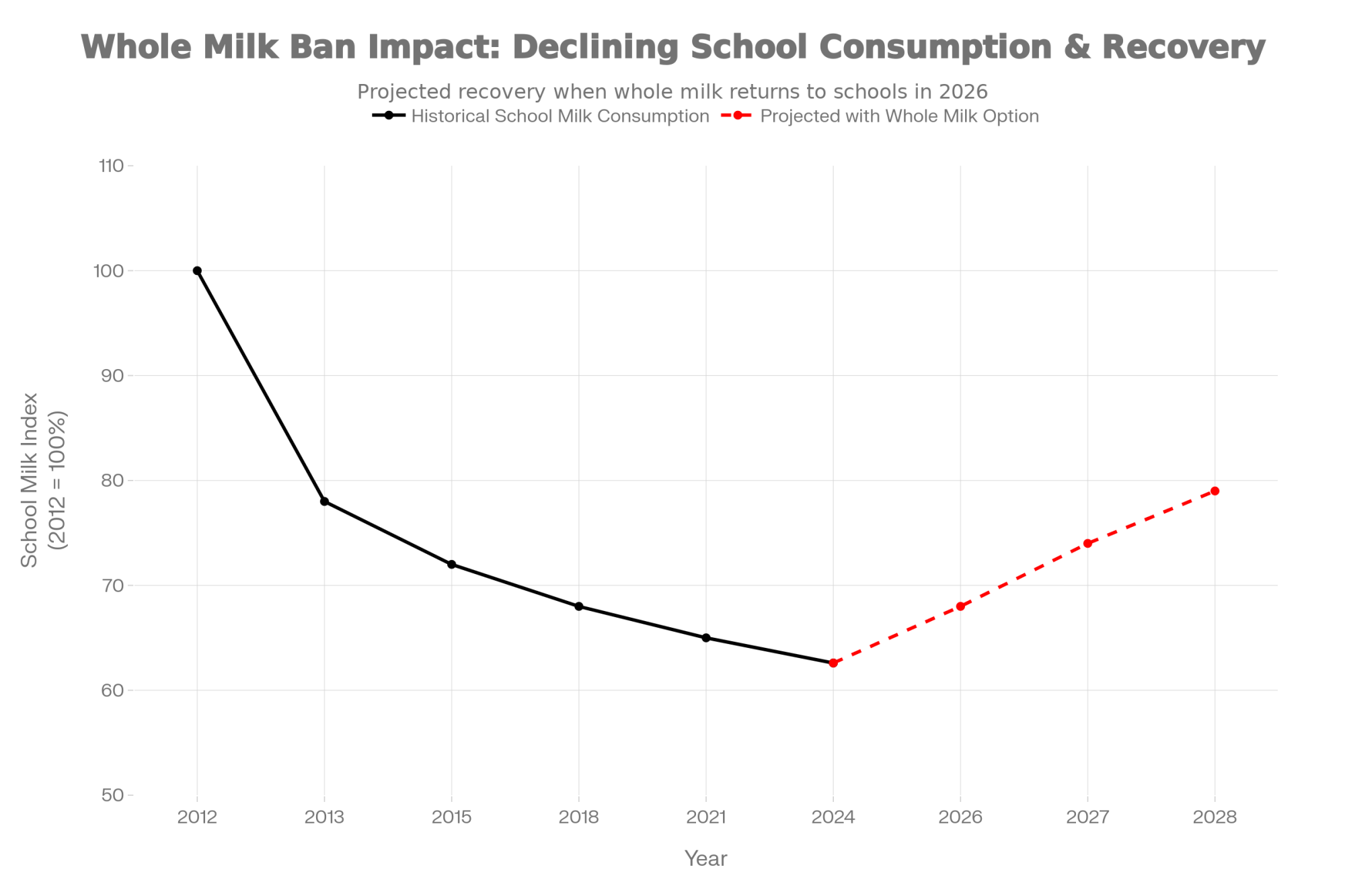
“Since whole and 2% milk were banned from school meals menus more than a decade ago, meal participation has declined while food waste has climbed, meaning children are consuming fewer essential nutrients,” said Michael Dykes, D.V.M., president and CEO of the International Dairy Foods Association.
The Political Breakthrough
This bill had something genuinely rare in today’s Washington: bipartisan support that wasn’t just rhetorical. The Senate passed it unanimously by consent on November 20, 2025 (Senate Agriculture Committee Press Release, November 2025). The House followed suit on December 14 with a voice vote that recorded zero opposition (Bloomberg Government, December 14, 2025).
When’s the last time you saw Congress agree unanimously on anything related to nutrition policy? That alone tells you something significant shifted in how lawmakers view dairy fat.
House Agriculture Committee Chairman Glenn “GT” Thompson (R-PA), who championed this legislation from day one, didn’t mince words after the vote: “I have worked for a decade to restore whole milk to our school cafeterias, which have been limiting healthy choices for students, but that changes today” (House Education and Workforce Committee Press Release, December 14, 2025).
The bill enjoyed backing from the Trump Administration, with USDA Secretary Brooke Rollins and HHS Secretary Robert Kennedy Jr. both publicly supporting whole milk in schools. Kennedy’s focus on making school meals healthier and questioning outdated nutritional guidelines aligned perfectly with this effort.
What This Means for Dairy Operations
Now let’s talk about what dairy farmers actually care about—the market implications. School milk represents about 7-8% of total U.S. fluid milk demand. That’s not the majority of anyone’s milk check, but it’s far from trivial—and more importantly, it’s one of the few fluid milk channels where consumption can actually grow rather than continue its decades-long decline.
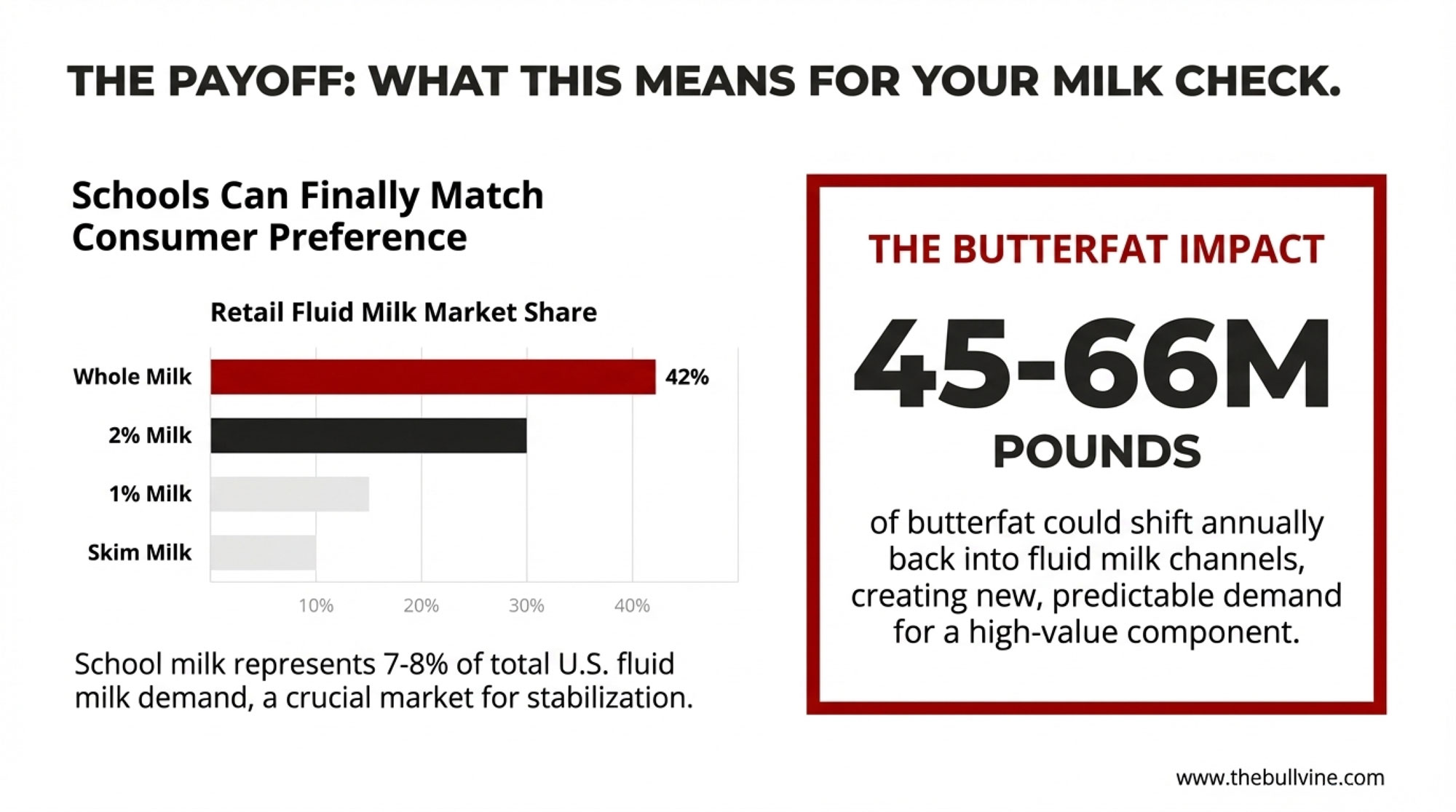
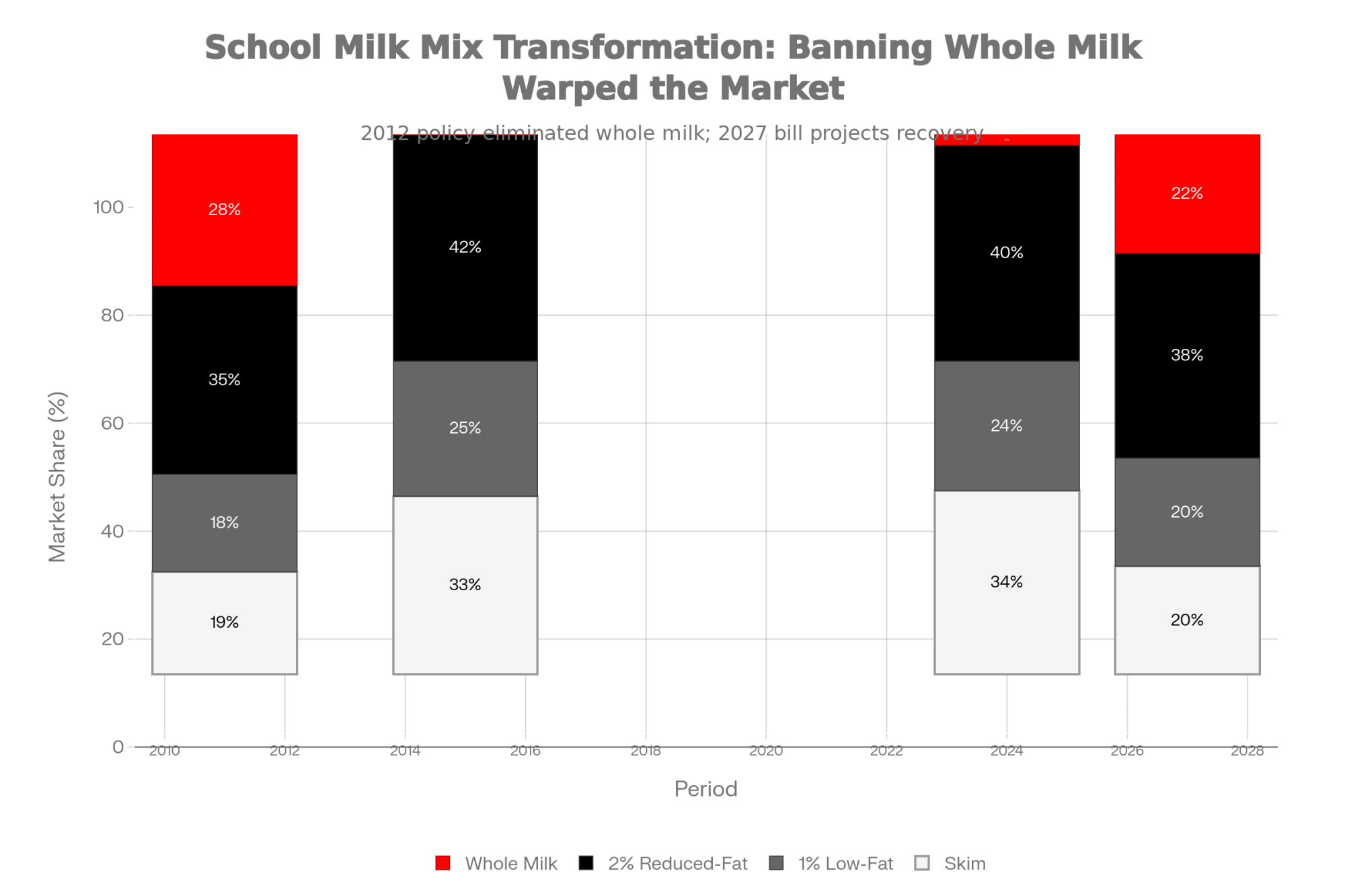
The butterfat implications are where this gets interesting for producers focused on components. From 2013 to 2024, whole milk sales grew 16% at retail while skim and reduced-fat options continued their slide. Whole milk now represents 42% of retail fluid milk sales—the highest share since 2001 (The Bullvine, November 2025).
| Year | Whole Milk % of Sales | 2% Reduced-Fat % | Skim % | Policy Context |
|---|---|---|---|---|
| 2001 | 42% | 35% | 23% | Baseline benchmark—pre-policy era |
| 2012 | 35% | 40% | 25% | School milk ban imposed despite retail demand |
| 2015 | 37% | 38% | 25% | Retail whole milk climbing; schools enforcing lower-fat mandate |
| 2024 | 42% | 35% | 23% | Whole milk back to 2001 levels despite 13-year school restriction |
| 2025+ | 42%+ | 34%– | 22%– | Schools can FINALLY follow consumer preference (no longer fighting market) |
Giving schools the option to serve what consumers actually want could shift 45 to 66 million pounds of butterfatannually into fluid milk channels, depending on adoption rates (American Farm Bureau Federation Market Intel, November 2025). For context, that’s meaningful additional demand for butterfat at a time when component values significantly impact milk checks across the country.
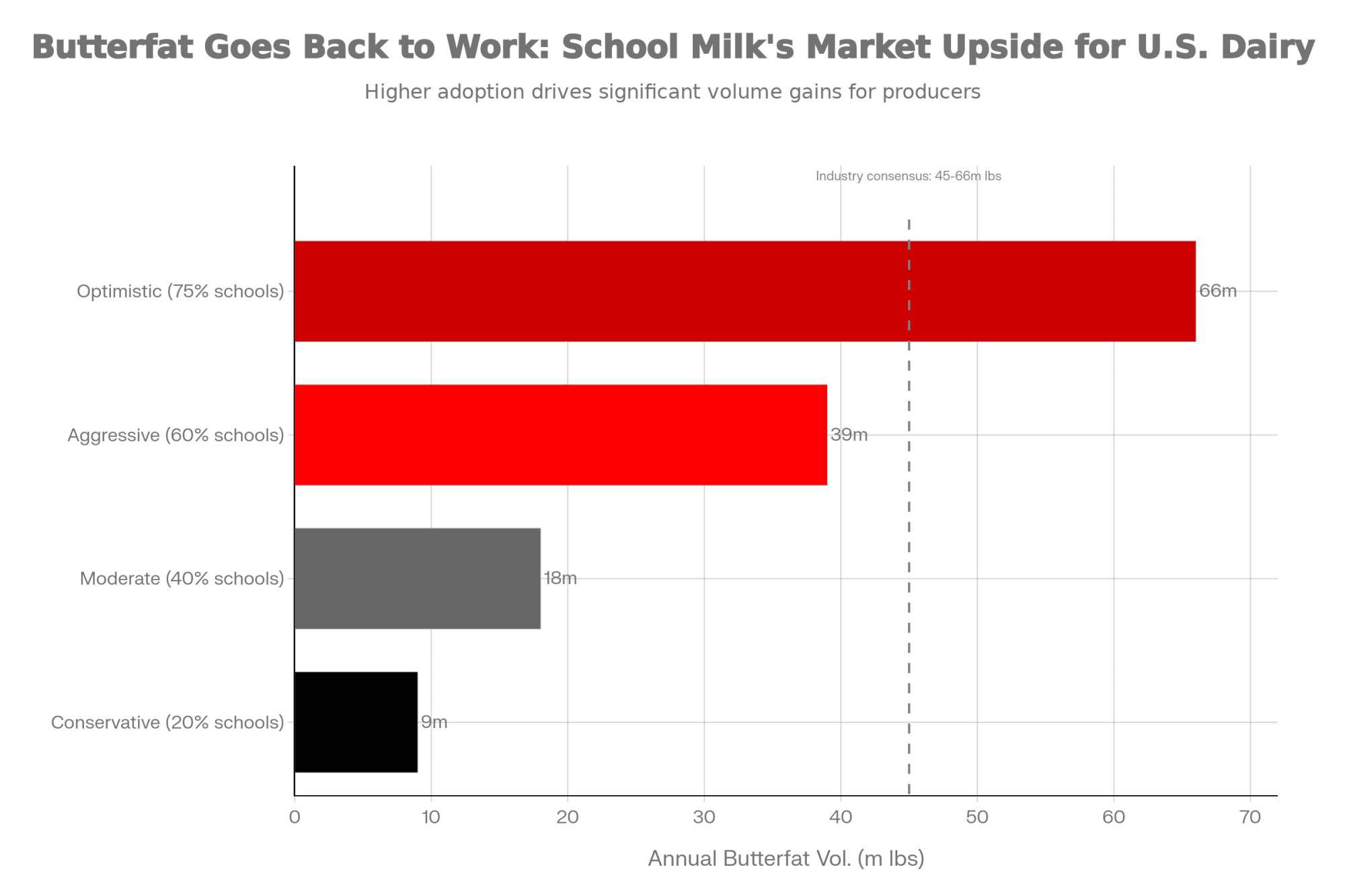
“Even modest gains in school milk sales strengthen fluid milk markets, boost butterfat utilization, and improve returns to farmers,” explained Daniel Munch, economist at the American Farm Bureau Federation (Farm Bureau, November 2025).
For operations that have been breeding and managing for butterfat performance—and that’s most progressive dairies at this point—this creates incremental demand pull in exactly the direction the market has been heading anyway. It won’t transform anyone’s operation overnight, but predictable demand in a category that’s been hemorrhaging volume for decades? That’s worth something.
| Operation Type | Butterfat Focus | Typical Herd Size | Primary Margin Driver | Whole Milk Market Fit |
|---|---|---|---|---|
| High-Component Specialists | Yes—core breeding goal | 50–150 cows | Component premiums | EXCELLENT—aligned to trend |
| Grazing-Focused Dairies | Often elevated naturally | 30–80 cows | Grass-based/brand premium | VERY GOOD—premium fluids |
| Regional Cooperatives | Member-variable | 100–5,000+ cows | Volume + component leverage | MODERATE—depends on co-op |
| Commodity/Volume Players | Not primary focus | 500+ cows | Scale + milk volume | LIMITED—needs commodity volume |
| Artisanal/Direct-to-Consumer | Very high (premium products) | 20–60 cows | Brand + direct sales | NICHE—select opportunities |
The Road Ahead
President Trump is expected to sign the bill quickly, making it law (Bloomberg Government, December 2025). But here’s the reality check: implementation won’t happen overnight. USDA will need to write the rules, states will need to adjust their school nutrition programs, and individual districts will need to update their procurement contracts and meal planning.
Some schools will jump at the chance to serve whole milk—particularly in dairy-heavy regions like Wisconsin, New York, and Pennsylvania, where this has been a community issue for years. Others will move more cautiously, constrained by existing contracts, food service infrastructure, or entrenched habits. The bill doesn’t force change; it permits it. That distinction matters for how quickly you’ll see this show up in school cafeterias near you.
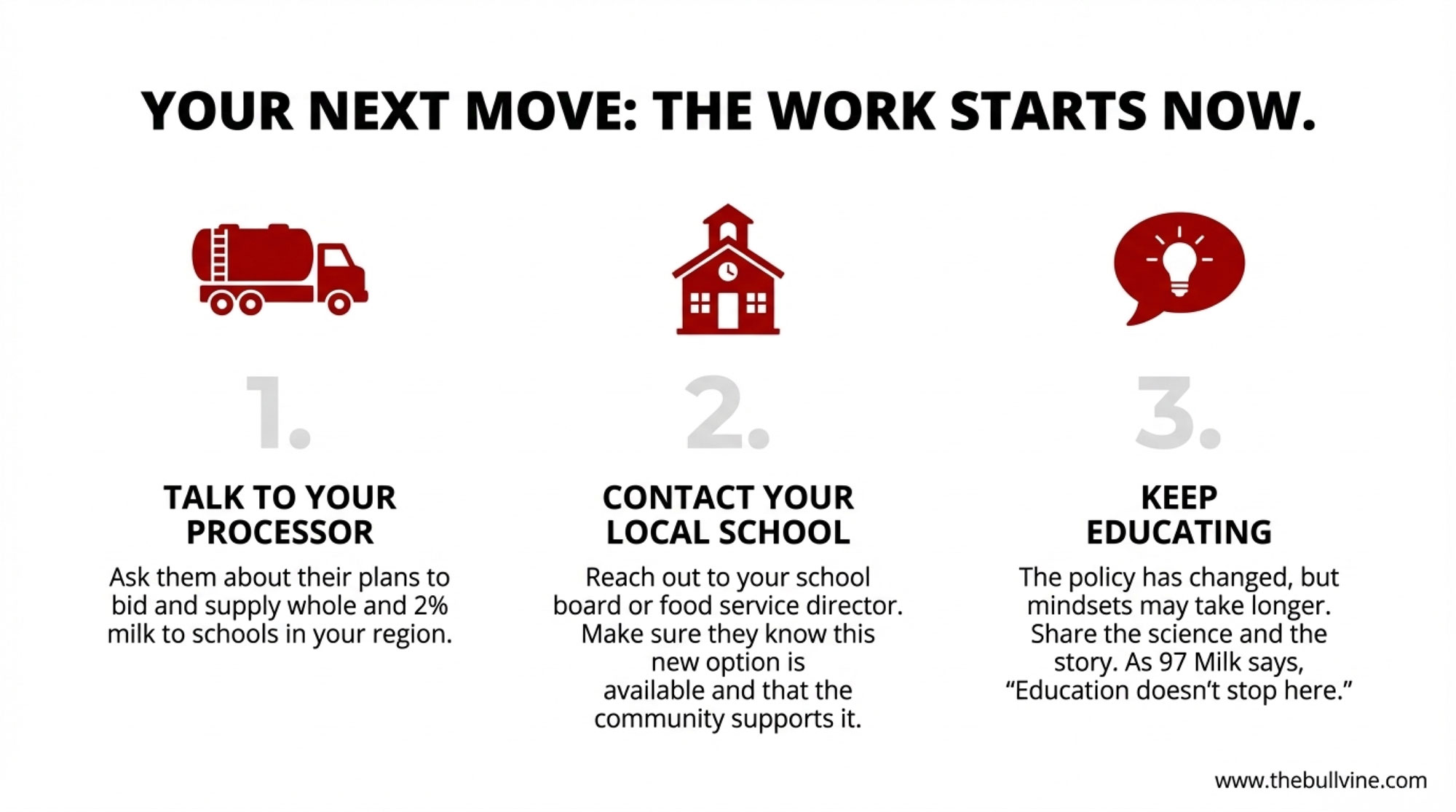
Processors serving the school milk market will need to adjust their bids and product offerings. Schools will need to request whole milk options specifically—it won’t just appear automatically. And the grassroots volunteers who made this happen? They’re already looking at what comes next.
“Education doesn’t stop here. We have to keep it going with more volunteers,” said GN Hursh, Chairman of 97 Milk.
Jackie Behr, a livestock nutritionist who helped design the 97 Milk educational platform, surveyed parents years ago and found “widespread questions and misconceptions about milk and dairy farming.” That education mission continues, because changing policy is one thing—changing minds takes longer.
A Win Worth Recognizing
Nelson Troutman could have complained about regulations over coffee. Instead, he painted hay bales. Duane Spaulding, Anne Diefendorf, and Jay Hoyt could have stayed focused solely on their own operations during some brutal years for Northeast dairy. Instead, they built a movement.
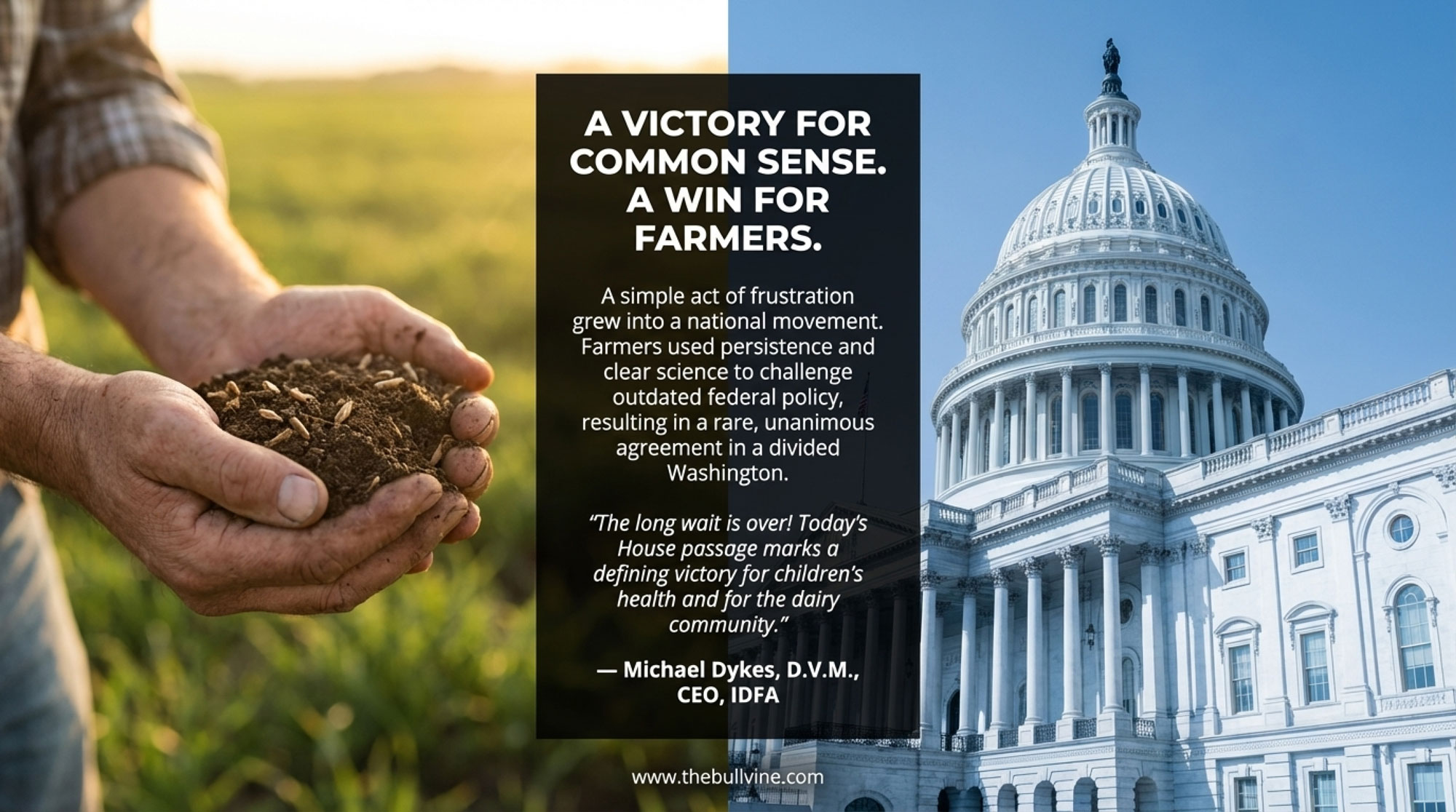
“The long wait is over! Whole milk is coming back to schools!” Dykes declared after the House vote. “Today’s House passage marks a defining victory for children’s health and for the dairy community that has fought for more than a decade to restore whole and 2% milk for our nation’s students” (International Dairy Foods Association Press Release, December 2025).
Rep. Tim Walberg (R-MI), Chairman of the House Education and the Workforce Committee, summed it up well: “Good nutrition is the foundation of a child’s life, including his or her ability to learn and grow” (House Education and Workforce Committee, December 2025).
For once, common sense, good science, and farmer advocacy aligned to produce real change. Kids will get better nutrition. Parents will have more choices. Dairy farmers will see stronger demand in a channel that desperately needed it.
That’s the kind of dairy industry story we need more of.
Key Takeaways
- Unanimous. Not a single vote against. The House passed the Whole Milk for Healthy Kids Act on December 14, 2025, with zero opposition. The Senate did the same in November. When’s the last time Washington agreed on anything? They agreed on whole milk.
- Whole and 2% are back in schools. First time since 2012. Flavored milk stays. Milkfat no longer counts against saturated fat limits. Thirteen years of questionable nutrition policy just got overturned.
- The market impact is real. 45-66 million pounds of butterfat could shift into fluid channels annually. School milk is 7-8% of U.S. fluid demand. Whole milk already drives 42% of retail sales—now schools can finally follow the consumer.
- Farmers won this. Not lobbyists. Nelson Troutman painted hay bales in Pennsylvania. Duane Spaulding, Anne Diefendorf, and Jay Hoyt refused to quit in New York. The 97 Milk movement turned grassroots persistence into federal law.
- Your next move. Trump signs within days. USDA writes implementation rules. Talk to your processor about school milk opportunities. Contact your local school district. Make sure they know the options are coming—and that you’re ready to supply them.
Learn More:
- Whole Milk Returns to Schools After $4.3B Loss – But Only Mega-Dairies Can Capture the Win – Reveals the critical “Seven-Month Sprint” timeline for school contract RFPs and explains why smaller operations must coordinate with cooperatives immediately to access this reopened market.
- Weekly Global Dairy Market Recap Dec 15th, 2025: The “Wall of Milk” vs. The Heifer Shortage – Analyzes the immediate economic impact of the new legislation against a backdrop of rising production and heifer shortages, offering essential margin management strategies for 2026.
- How Dairy Farmers Are Finally Breaking Free From the 365-Day Grind – and Finding More Time and Profit – Demonstrates how integrating automation can solve the labor constraints limiting your ability to expand, potentially cutting costs by over $150,000 while improving lifestyle.
 Join the Revolution!
 Join the Revolution!
Join over 30,000 successful dairy professionals who rely on Bullvine Weekly for their competitive edge. Delivered directly to your inbox each week, our exclusive industry insights help you make smarter decisions while saving precious hours every week. Never miss critical updates on milk production trends, breakthrough technologies, and profit-boosting strategies that top producers are already implementing. Subscribe now to transform your dairy operation’s efficiency and profitability—your future success is just one click away.




