23% of quarters still had open teat canals after six dry weeks. Your 30‑kg dry‑off cows are the ones keeping that number ugly.
Executive Summary: Your 30‑kg dry‑off cows are quietly wrecking colostrum six weeks before calving by keeping udders leaking when they should be sealed and rebuilding. Research on high‑yield Holsteins shows cows drying off above ~21 kg have more open teat canals, more new IMI, and, when they leak pre‑calving, lower Brix colostrum. Other studies tie short or rushed dry periods and heat‑stressed dry cows to reduced colostrum yield, weaker bioactive profiles, and daughters that give 2.2–6.5 kg/day less milk across three lactations. For a 200‑cow herd with 40% of cows drying off above 25 kg, UF’s barn math says fixing dry‑cow cooling alone is worth about $1,800/year before you count daughter milk. This piece reframes colostrum failure as a structural clash between high‑yield genetics, abrupt dry‑off, and mammary physiology — not something you can fix with another replacer or a better Brix gun. You’ll see clear thresholds for dry‑off yield, dry‑period length, and heat‑stress, plus barn‑tested options like tiered dry‑off and minimum‑effective cooling. If you’re already hitting 22–25% Brix but still buying too many scour treatments, this is the six‑week window you need to audit next.
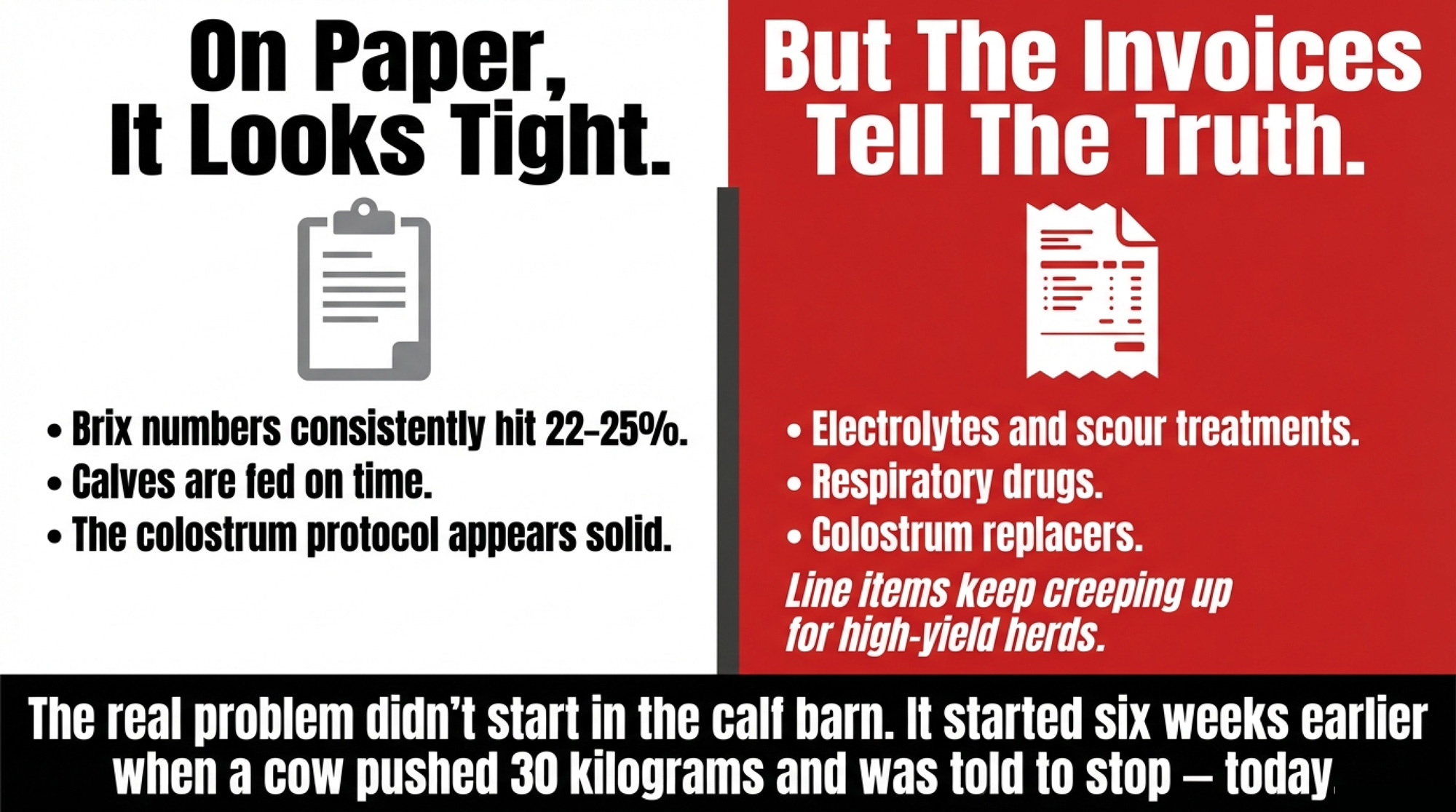
The invoice in the calf barn doesn’t lie. Electrolytes, scour treatments, respiratory drugs, colostrum replacer — those line items keep creeping up for a lot of high‑yield herds. On paper, the colostrum program looks tight. Brix numbers are solid. Calves get fed on time. But the real problem often started six weeks earlier, in the dry pen, when a cow walked out of the parlor still pushing 30‑plus kilograms and was told to stop — today.
If you’re breeding for 45‑kg peaks and drying off cows like it’s 1985, colostrogenesis is where that conflict shows up first.
What’s Really Happening in Those Six Weeks?
The mammary gland doesn’t sit idle between dry‑off and calving. It runs through three different jobs, and colostrum depends on each one finishing on time.
First is active involution, roughly the first two to three weeks after dry‑off. Milk stasis and intramammary pressure shut secretion down, old cells are cleared out, and the teat canal closes as a keratin plug forms. It’s the most vulnerable stretch for new intramammary infections (IMI), and the risk rises as milk yield at dry‑off goes up.
Next is steady‑state involution. This is the stretch a lot of herds treat as “dead time.” The cow isn’t milking, but the gland isn’t off. Tissue is regenerating, and the udder’s defenses against mastitis are at their highest.
Finally, about 15–20 days before calving, colostrogenesis kicks in. The mammary gland switches back into production mode — not for milk yet, but for colostrum. IgG starts moving from blood into secretions, and the gland begins synthesizing fat, protein, and a stack of bioactive compounds that shape the calf’s gut and immune system. In one Holstein study that followed cows through the dry period, IgG started building in pre‑partum secretions several weeks before calving in many cows, and those that accumulated IgG earlier and more gradually ended up with higher IgG at first milking.
So that six‑week window you’ve been treating as a holding pattern is actually colostrum’s entire production run.
How 30‑kg Dry‑Off Cows Blow Up the Timeline
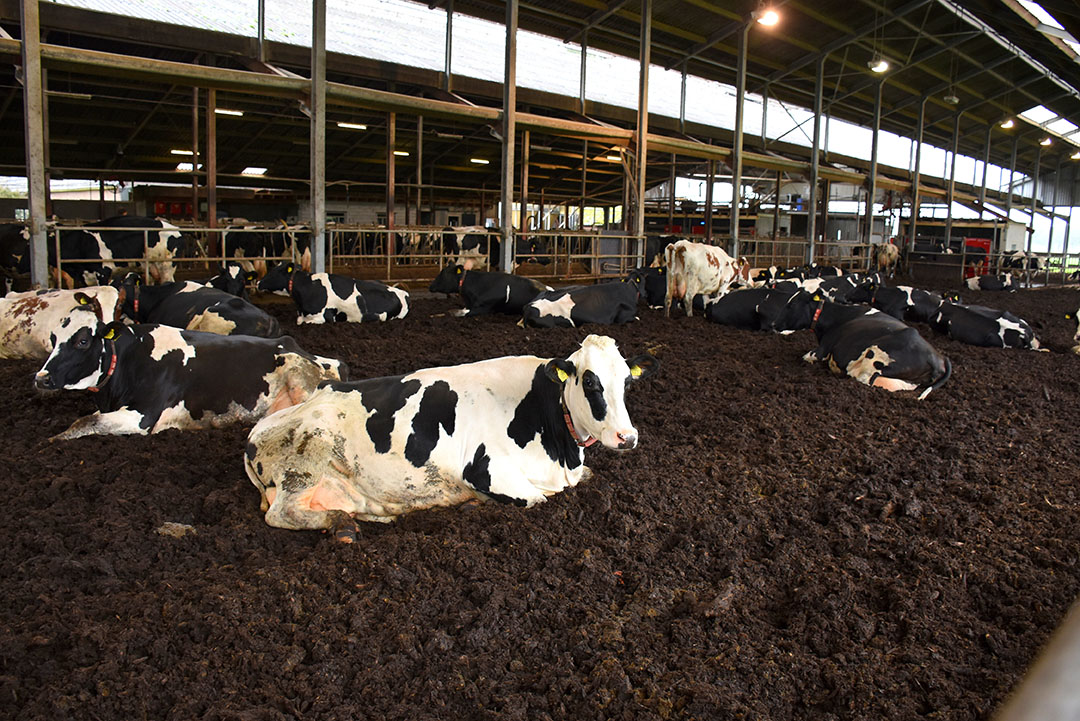
Walk through a dry pen three weeks after dry‑off. Some cows look exactly how you want — udders soft, teats sealed, nothing leaking. Then there are the others: three weeks dry, udders still tight, milk beads at the teat ends or streaks down the back legs.
Those are the cows the dry‑off research keeps circling back to.
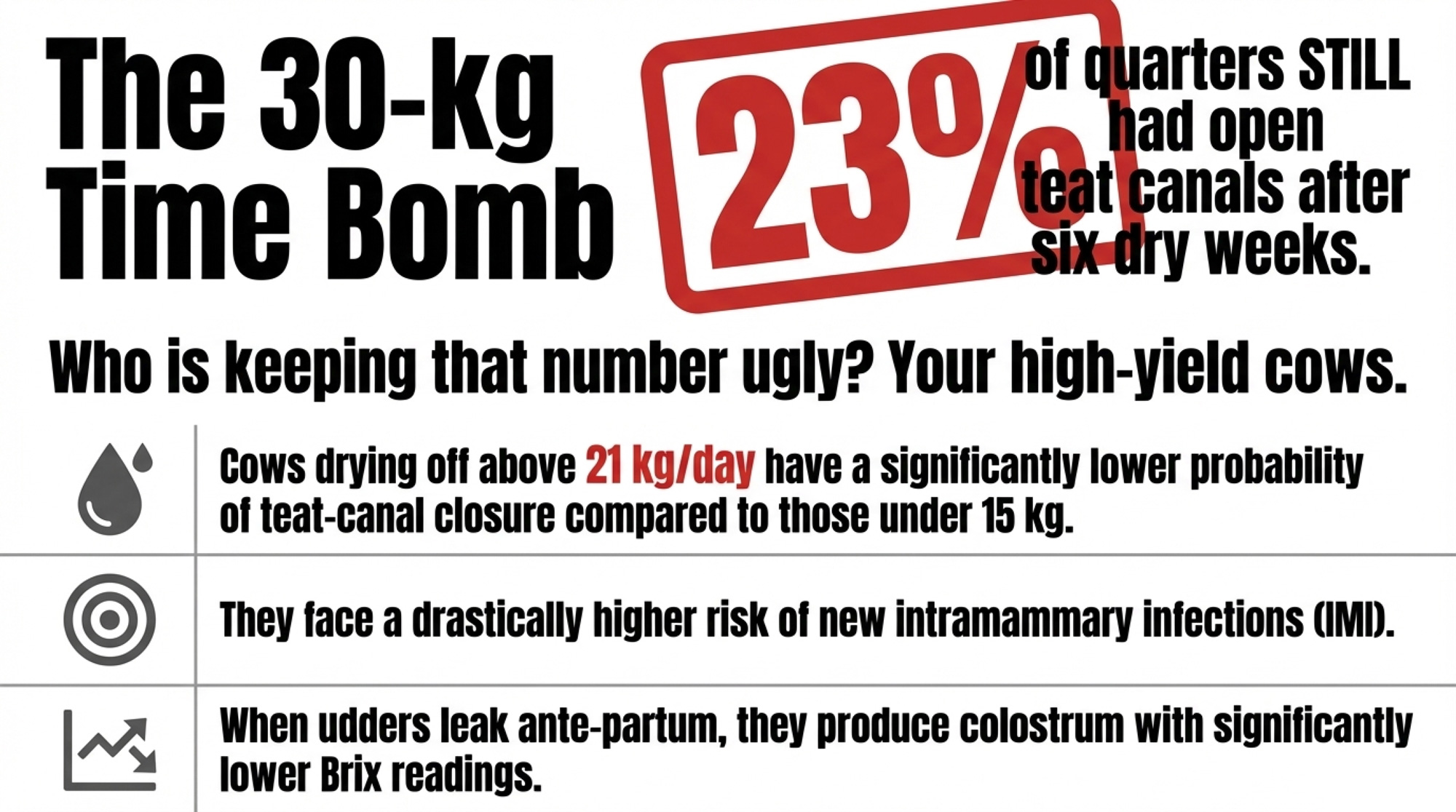
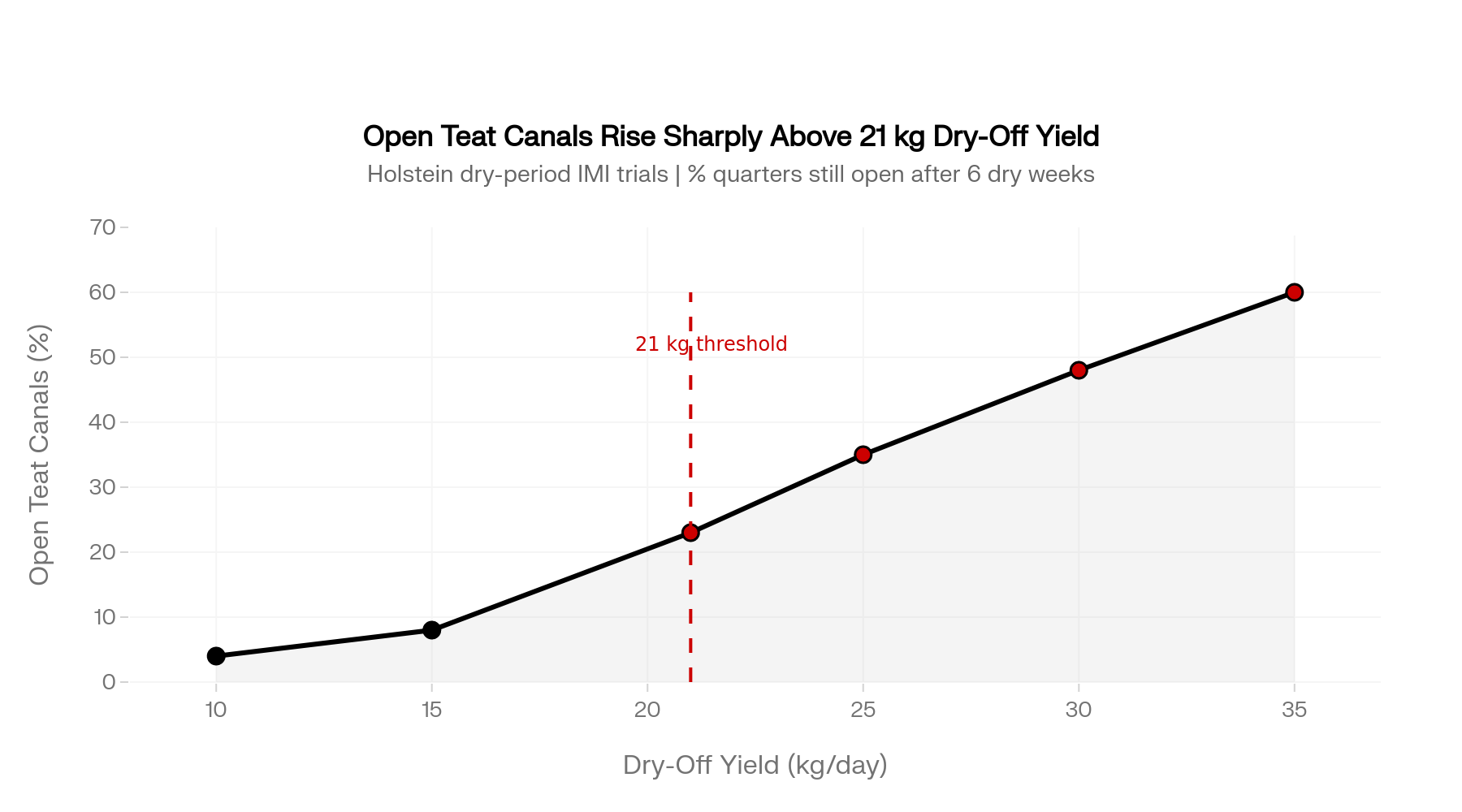
A landmark Holstein trial on drying‑off found that higher milk yield at dry‑off significantly increased the odds of new IMI during the dry period and delayed teat‑canal closure. After about six dry weeks, around 23% of quarters still had open teat canals, and cows with higher yields at dry‑off were more likely to be in that group. Cows producing more than 21 kg/day at dry‑off had a lower probability of teat‑canal closure and a higher risk of new IMI than cows drying off under 15 kg.
A 2024 study looking at milk leakage and udder pressure reported the same pattern: cows that leaked milk after dry‑off, and cows with higher udder pressure, were more likely to develop new IMI. The leaking cows were also the ones that had higher yields at dry‑off.
On the colostrum side, a multi‑herd study found that cows with ante‑partum leakage produced colostrum with significantly lower Brix readings than cows that stayed dry, and that dry‑period length, calving season, and herd size all influenced Brix values. Leakage wasn’t just a management annoyance — it showed up in colostrum quality data.
Now think about your own herd software. It’ll happily print “dry‑off today” beside a cow still giving 30 kg. That report doesn’t show you that you’ve just set that cow up for a rough involution, a leaky udder, and a higher chance of compromised colostrum.
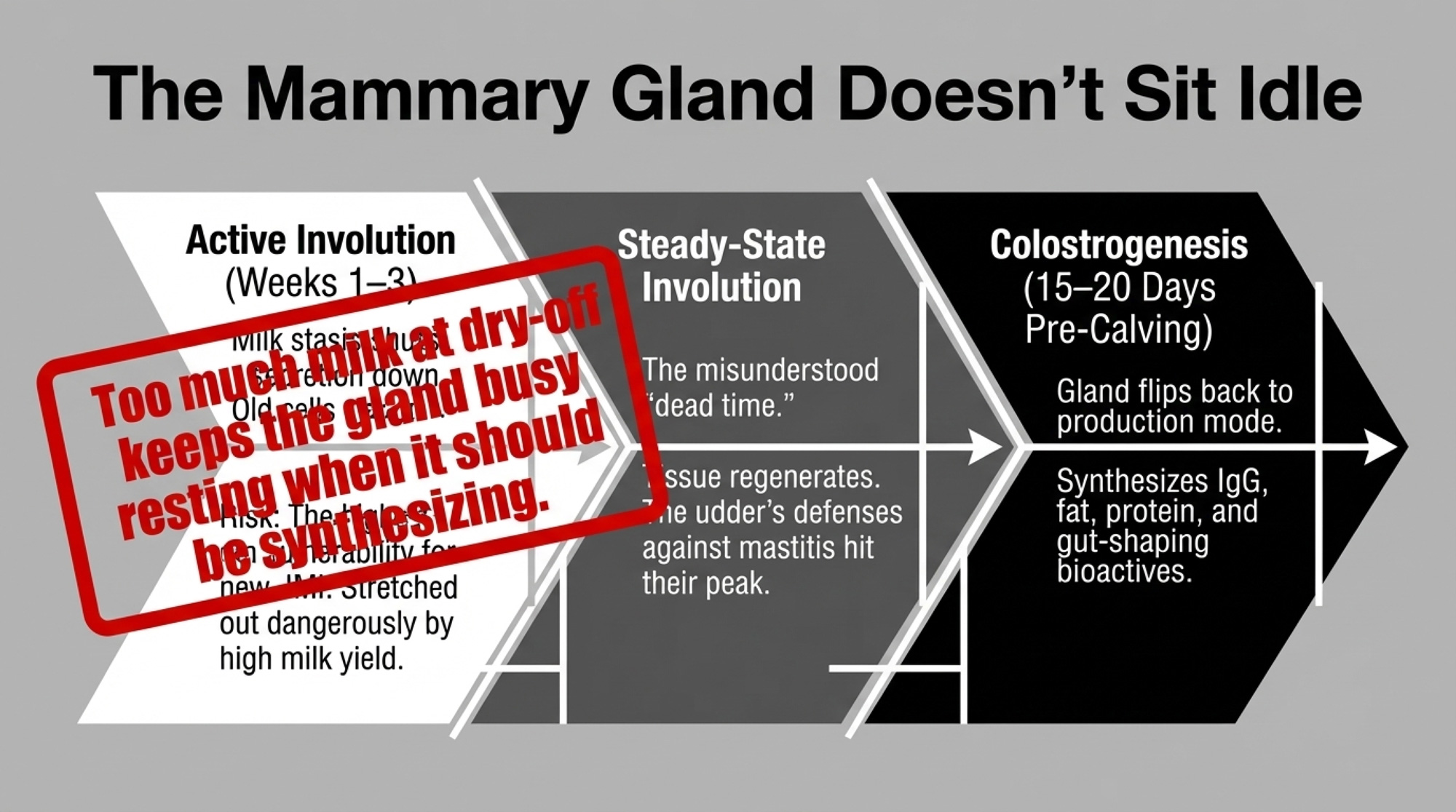
The biology is simple and ugly: too much milk at dry‑off stretches active involution, keeps mammary tissue “busy” when it should be resting, leaves teat canals open longer, and makes it harder for that gland to flip into a clean colostrum‑synthesis state at the right time.
What Your Brix Gun Can’t See
Brix refractometers have cleaned up a lot of colostrum programs. If you pull a sample at first milking and see 22–25% Brix, you can be reasonably confident you’re somewhere around 50 g/L IgG, often enough to hit the classic 10 g/L serum IgG target if you feed enough volume within two hours.
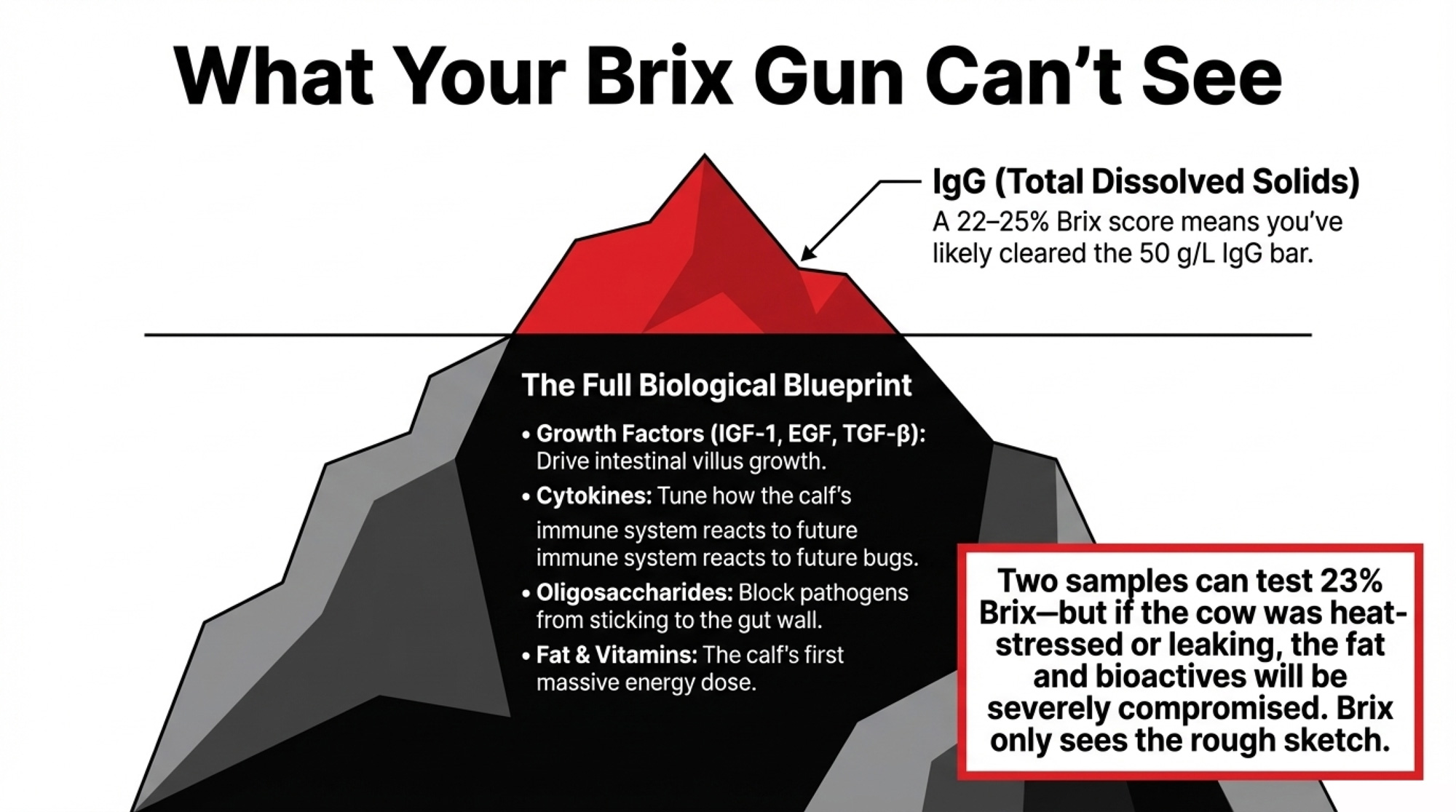
But Brix doesn’t tell you the whole story.
Brix is a total dissolved solids number. It was always meant to be an IgG proxy. It says almost nothing about the other pieces colostrum is supposed to deliver:
- Growth factors like IGF‑I, EGF, and TGF‑β drive intestinal villus growth and enzyme activity in the small intestine.
- Cytokines and immune modulators that tune how the calf’s immune system reacts to future bugs.
- Oligosaccharides that feed beneficial bacteria and help keep pathogens from sticking to the gut wall.
- Fat and fat‑soluble vitamins — the calf’s first big energy dose and a key support for early immune function.
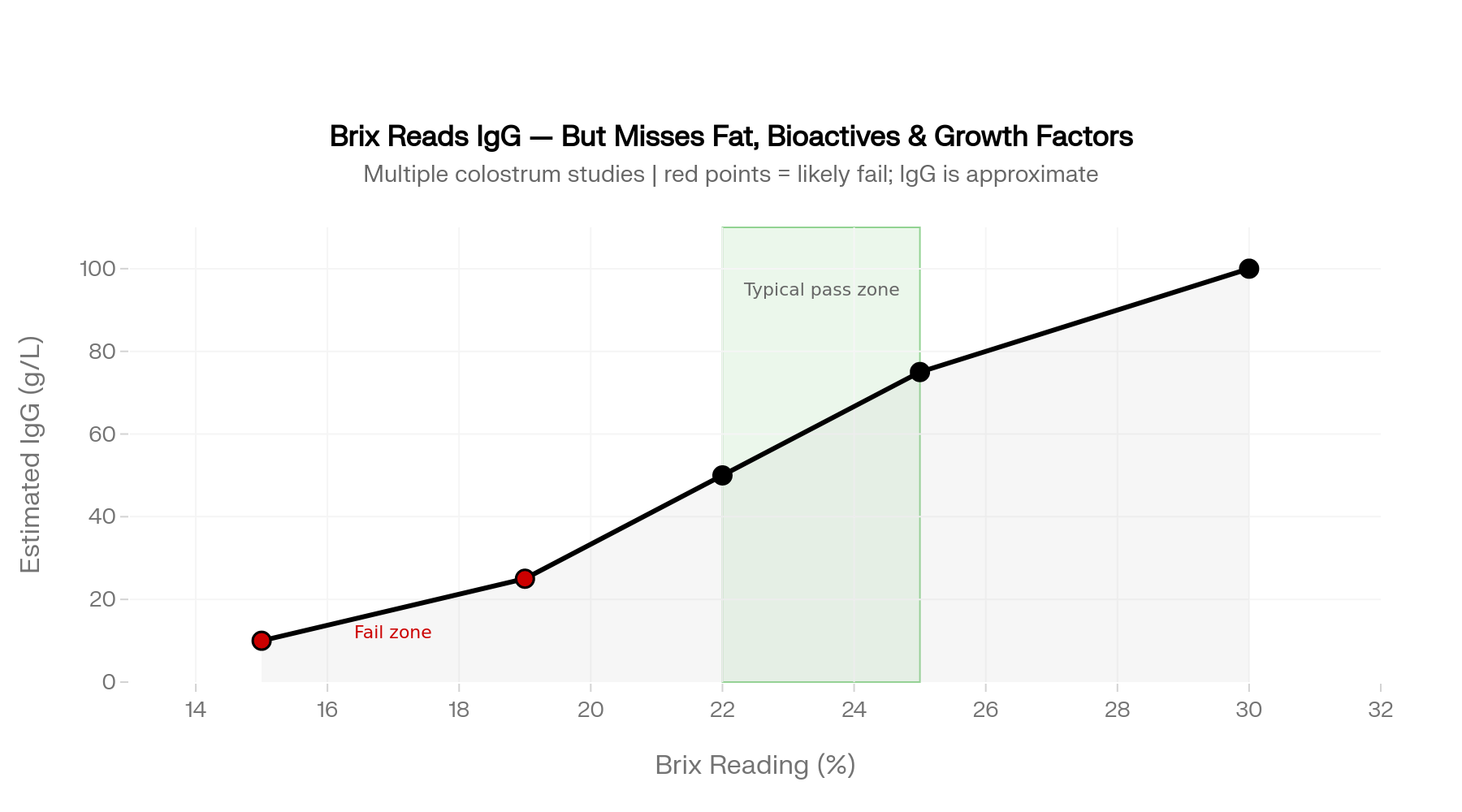
Several studies report strong correlation between Brix and colostrum IgG, with Brix readings of 19, 22, 25, and 30%as rough stand‑ins for 25, 50, 75, and 100 g/L IgG. That’s useful. But two samples can land at 23% Brix, carry similar IgG, and still be different animals when it comes to fat and bioactive profiles, depending on how the cow’s dry period went.
So yes, your colostrum can test 23% Brix and still be thinner on fat or certain bioactives if the cow spent the far‑off period leaking, heat‑stressed, or rushed through involution. Brix tells you you’ve probably cleared the IgG bar. It doesn’t tell you if the calf got the full biological blueprint or just the rough sketch.
Until there’s a practical field test for those bioactives, the upstream story is your best proxy: dry‑off yield, dry‑period length, far‑off pen stocking, heat‑stress exposure, and leakage.
Are Your Dry Periods Short‑Changing Colostrum and Longevity?
The same genetic pressure that pushed Holsteins into 45‑kg peaks also pushed dry‑off yields into the 25–30 kg band unless you actively manage the tail of lactation.
Colostrum traits themselves have real genetic variation. Recent work in Holsteins reported heritabilities around 0.21–0.23 for colostrum IgG and total Ig concentration, roughly double the heritability of colostrum yield (about 0.10). Genetic correlations between colostrum yield and IgG are low to moderate and can even be negative, and the links between colostrum traits and standard milk‑yield indexes aren’t strong. So breeding for higher milk doesn’t automatically protect colostrum; you’re dealing with different traits that need their own attention.
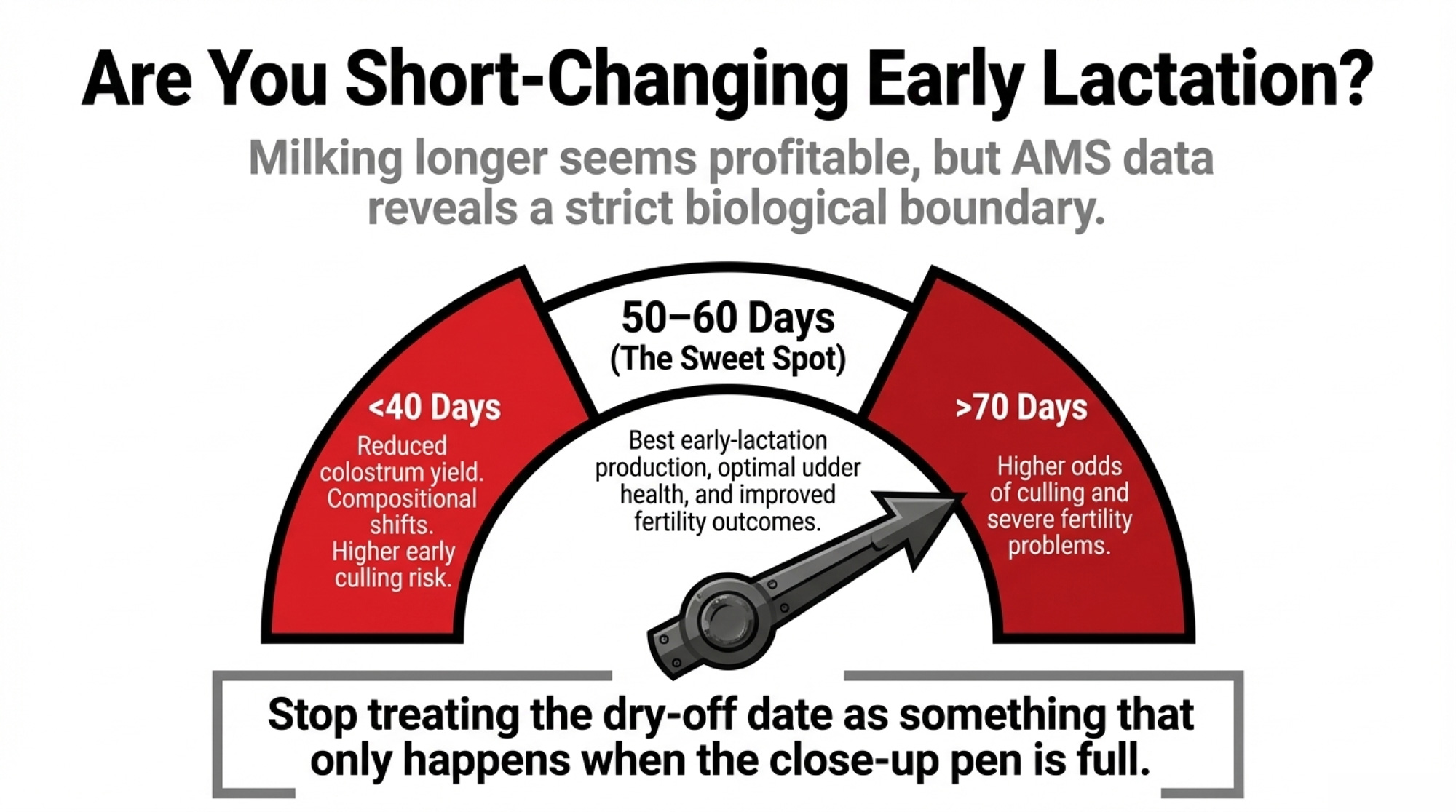
On the management side, a study in automatic‑milking herds found that dry‑period lengths under 40 days and over 70 days were linked with higher odds of culling in the first 60 days of lactation, compared to cows dried off in the 50–60 day band. Cows with very short or very long dry periods also had more fertility problems, while dry periods in the 40–70 day range delivered the best combination of early‑lactation production and udder‑health outcomes.
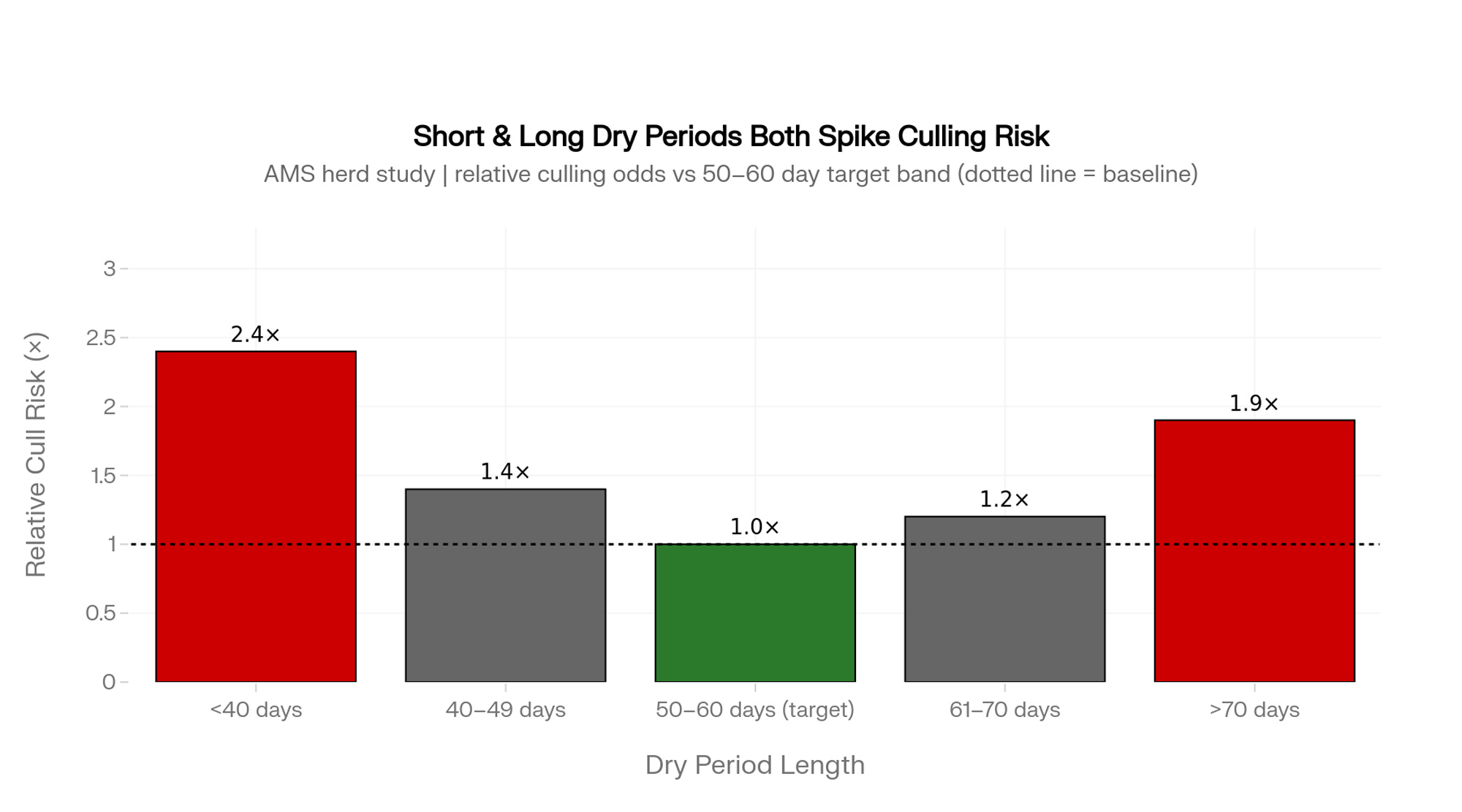
Shorter dry periods can improve postpartum energy status and, in some models, cash flow or emission numbers. But they also give the gland less time to involute and complete colostrogenesis fully. Several trials have reported reduced colostrum yields and compositional shifts in cows with short dry periods.
That’s the trade‑off in front of a lot of high‑yield herds right now: shaving the dry period to keep milk in the tank, versus protecting colostrum and early‑lactation stability. There isn’t a one‑size answer. The key is to stop treating the dry‑off date as something that happens when the close‑up pen is full.
The Economics You Don’t See on the Milk Cheque
Dry‑off and dry‑cow cooling tend to get framed as “soft” decisions. The UF/IFAS group has done the barn math on why they’re not.
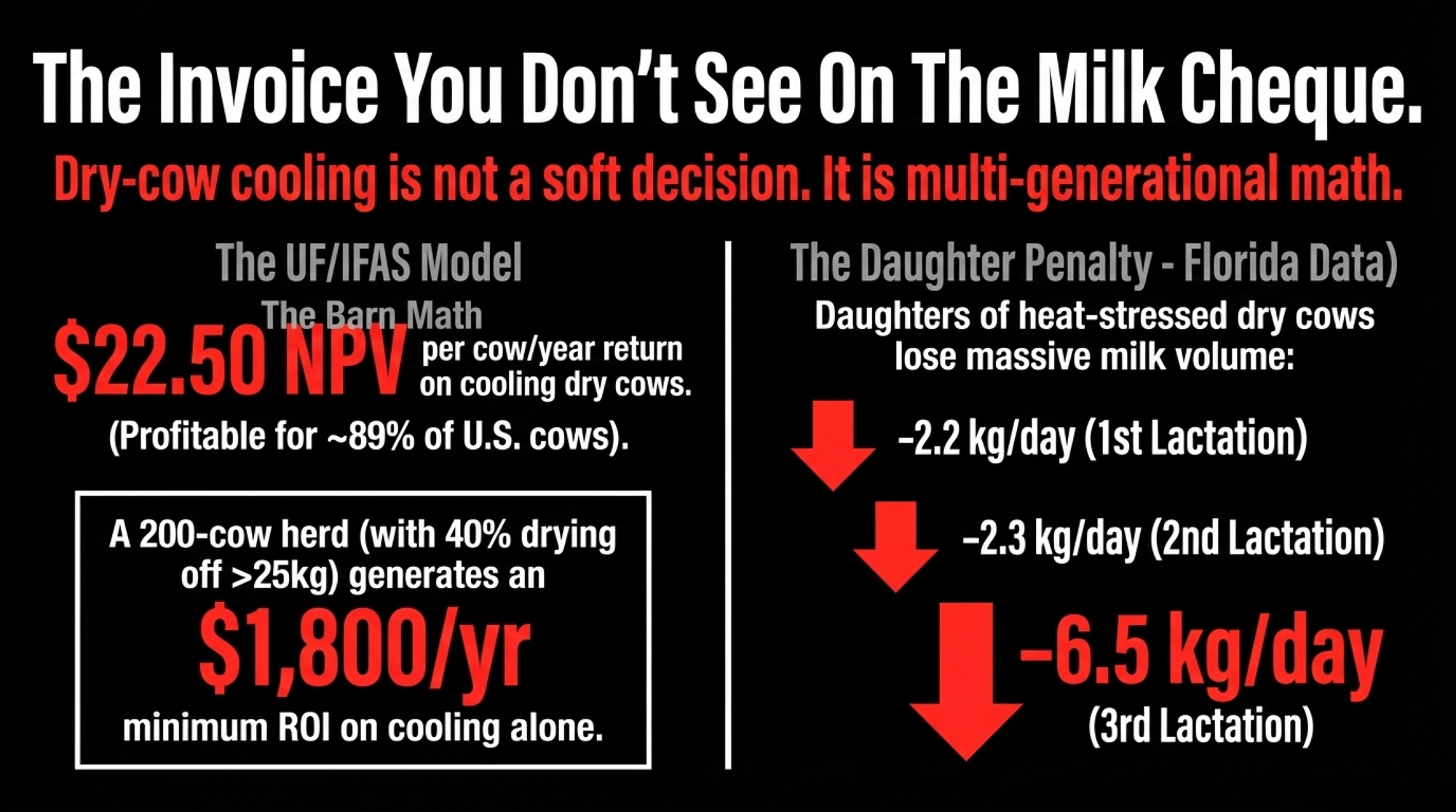
In a modeled scenario with 96 annual heat‑stress days and standard U.S. milk price and construction costs, the Economic Feasibility of Cooling Dry Cows analysis showed that cooling dry cows in a new barn returned a net present value of about $22.50 per cow per year, with a benefit–cost ratio of 1.45 and a payback period around 5.67 years. Under those conditions, the authors concluded it’d be profitable to cool dry cows for roughly 89% of U.S. cows.
A related paper on cooling dry cows suggested that failing to cool them could knock next‑lactation yields down by about 5 kg/day in some situations. Meanwhile, a pooled Florida dataset showed that daughters of heat‑stressed dry cows produced 2.2 kg/day less milk in first lactation, 2.3 kg/day less in second, and 6.5 kg/day less in third than daughters of cooled cows, and those daughters also had shorter productive lives.
Now pull that into your own barn.
Take a 200‑cow herd where 40% of cows dry off above 25 kg. That’s 80 higher‑risk dry‑off cows a year. Multiply that by $22.50 per cow per year from the UF dry‑cow cooling model, and you’re looking at roughly $1,800 per year tied just to improved dry‑cow performance and cooling, before you even count the milk those daughters don’t leave on the table in second and third lactation.
| Cost/Benefit Category | Status Quo (No Cooling, High Dry-Off Yield) | Progressive Protocol (Cooled, Tiered Dry-Off) |
|---|---|---|
| Dry-cow cooling NPV/cow/year | $0 | $22.50 (UF/IFAS model) |
| Est. annual gain, 200-cow herd (40% at risk) | $0 | ~$1,800 |
| Daughter milk loss, 1st lactation | −2.2 kg/day | ~0 kg/day |
| Daughter milk loss, 2nd lactation | −2.3 kg/day | ~0 kg/day |
| Daughter milk loss, 3rd lactation | −6.5 kg/day | ~0 kg/day |
| New IMI risk during dry period | Higher (open canals >21 kg yield) | Lower (<15 kg target at last milking) |
| Colostrum Brix | May pass IgG test; fat/bioactives depleted | Higher probability of full bioactive profile |
| Dry-cow cooling payback period | N/A | ~5.67 years (new barn); faster for retrofits |
| Benefit–cost ratio (UF model) | 1.0 | 1.45 |
That’s not a made‑up “you could be losing…” headline. Those are the UF numbers. You can plug in your herd size and local cost/price structure and get your own version of the same math.
3 Ways to Stop Treating the Dry Period Like a Parking Lot
You’re not going to rebuild your dry‑off system in one shot. You don’t have to. But if the 30‑kg trap feels uncomfortably familiar, here are three places progressive herds are actually moving the needle.
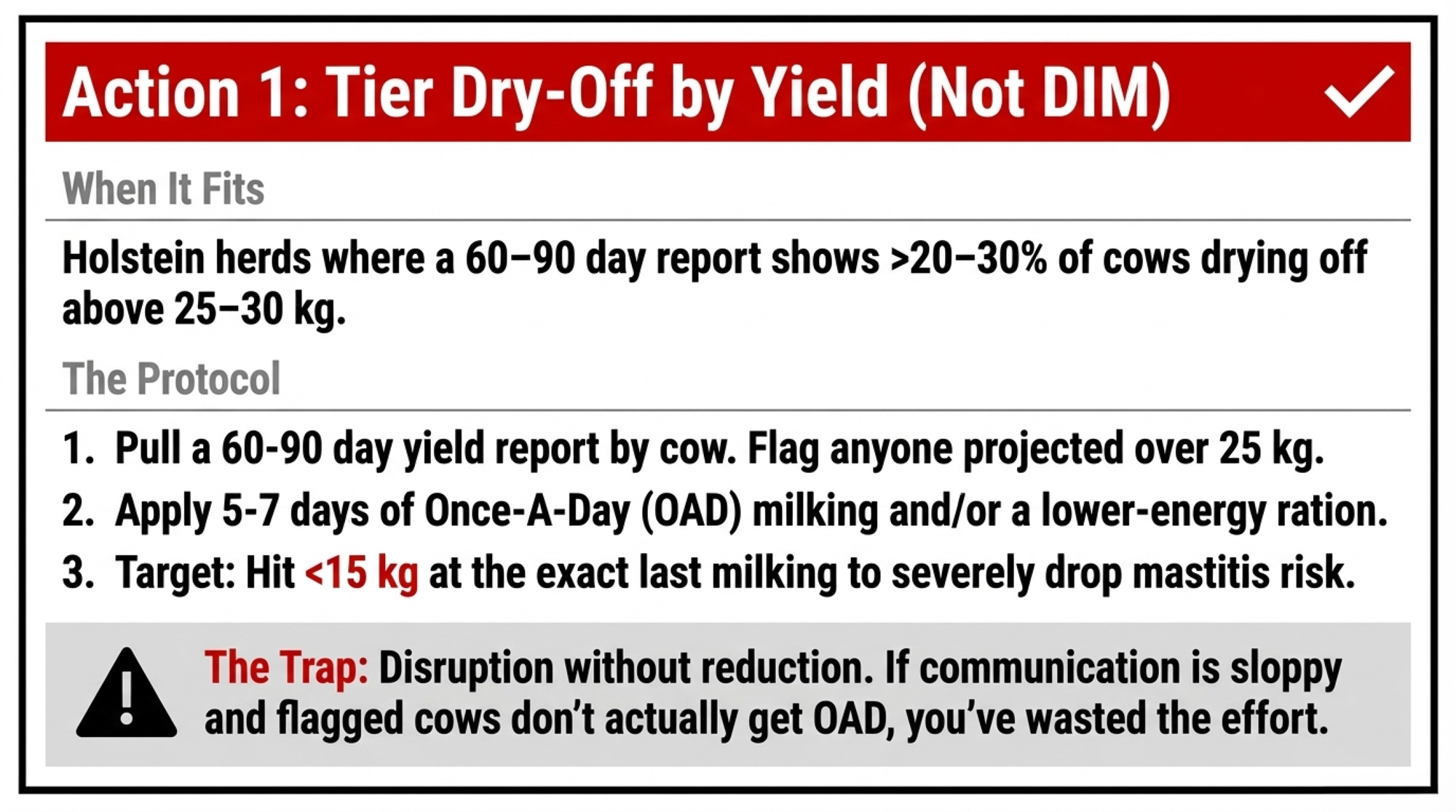
1. Tier Dry‑Off by Yield Instead of DIM
When it fits: Holstein herds where a quick 60–90 day report shows more than 20–30% of cows drying off above 25–30 kg.
How it works:
- Pull a 60–90 day dry‑off yield report by cow.
- Any cow projected to be over 25–30 kg at 10–14 days before dry‑off gets flagged for 5–7 days of once‑a‑day milking and, where possible, a lower‑energy ration or separate group.
- Aim for <15 kg at the last milking before dry‑off treatment and moving to the far‑off pen, in line with data showing mastitis risk climbs as dry‑off yield rises above about 10–15 kg.
What it costs: Some complexity in the parlor and pens, especially if staffing is tight or grouping options are limited.
Where it can backfire: If communication is sloppy and flagged cows don’t actually get OAD or ration changes, you’ve added disruption without real yield reduction.
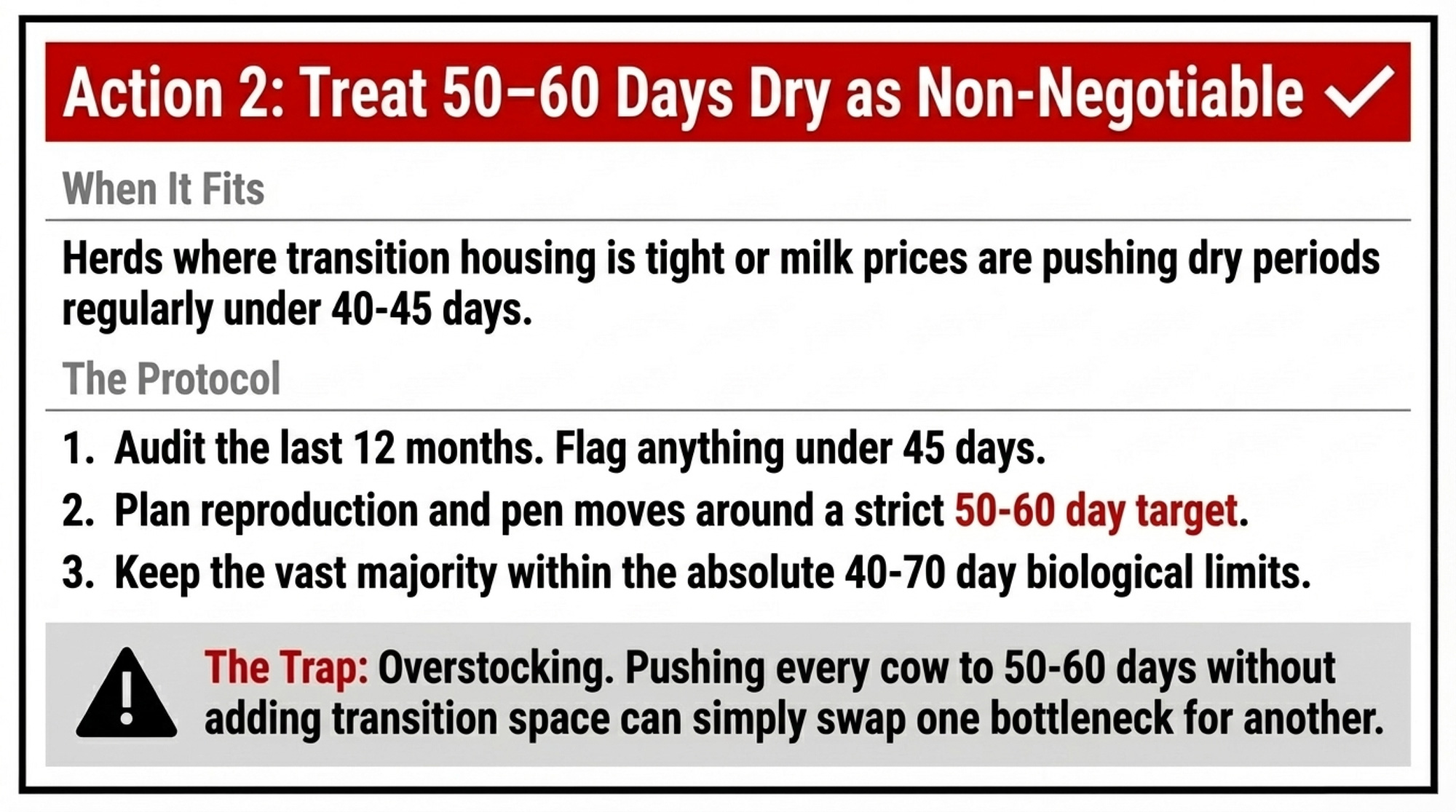
2. Treat 50–60 Days Dry as a Non‑Negotiable Band
When it fits: Herds where dry periods regularly slide under 40–45 days because transition housing is tight or the milk price is pushing you to keep cows milking.
How to check it:
- Audit the last 12 months of dry periods and flag everything under 40–45 days.
- Push to keep most cows in the 50–60 day band that AMS data linked with lower early‑culling odds and better fertility.
- Keep the vast majority of cows within 40–70 days dry, where early‑lactation production and udder‑health outcomes were best.
What it costs: Discipline in repro and pen planning so cows actually make it to target dry‑off dates. In some cases, short‑term milk sales may feel like they’re taking a hit.
Where it can backfire: In herds already overstocked in transition, pushing every cow to 50–60 days without adding space or changing traffic can swap one bottleneck for another.
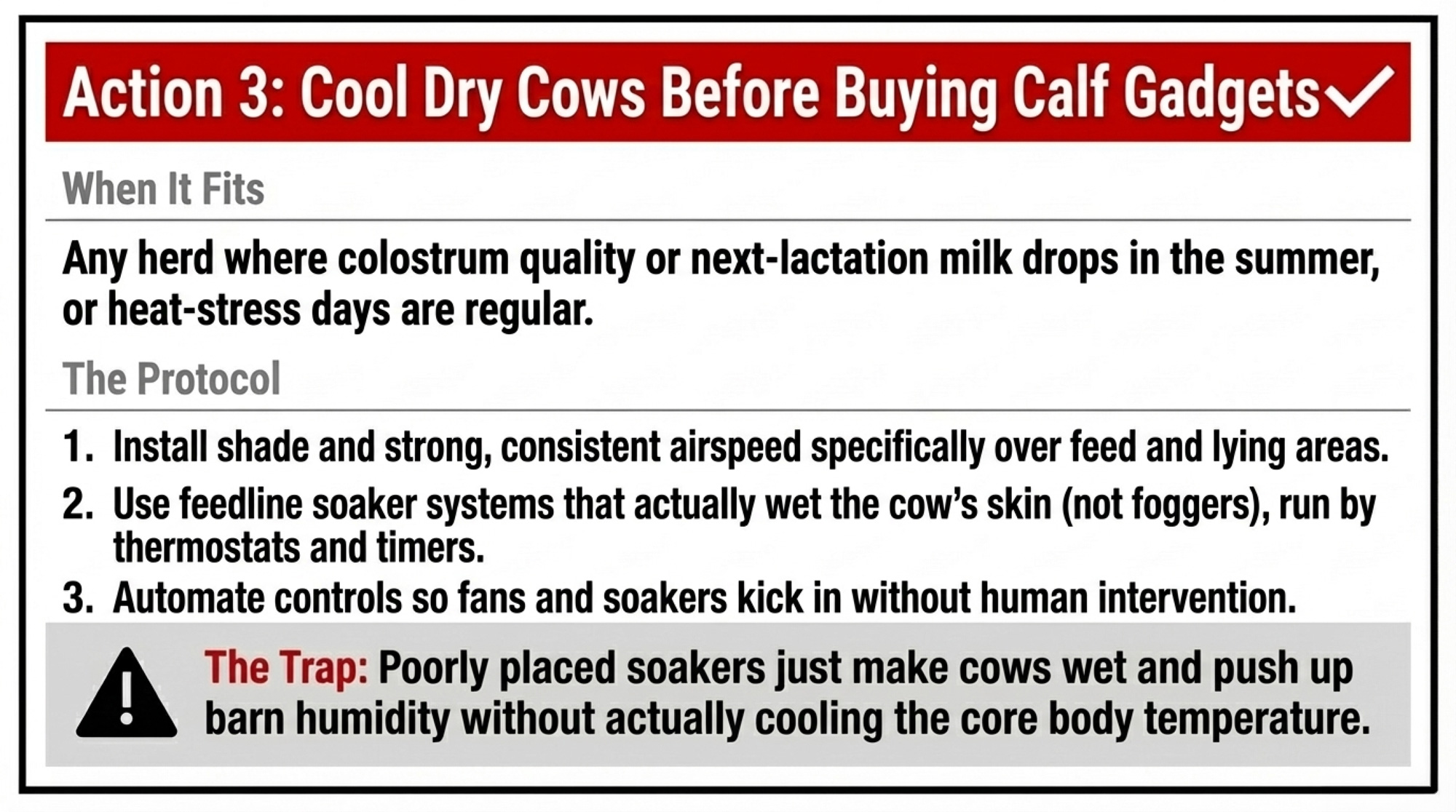
3. Cool Dry Cows Before You Buy Another Gadget for the Calf Barn
When it fits: Any herd where colostrum quality and next‑lactation milk clearly drop in summer, or where heat‑stress days are a regular feature.
What a minimum‑effective cooling setup looks like:
- Shade and strong, consistent airspeed over feed and lying areas, not just down the alleys.
- A feedline soaker system that actually wets the cow’s skin (not fog), on a thermostat and timer.
- Automated controls so fans and soakers kick in when the barn is hot, without someone remembering to flip switches.
UF’s model says cooling dry cows can pay for itself in about five to six years for a new barn and faster for retrofits or hotter regions. Florida data say those decisions ripple through multiple lactations in daughters and granddaughters: 2.2 kg/day less in first lactation, 2.3 kg/day less in second, and 6.5 kg/day less in third for daughters of heat‑stressed dry cows compared with daughters of cooled cows.
Where it can backfire: If soakers are poorly placed or controls are wrong, you can make cows wet without truly cooling them and even push humidity up.
Old Rules vs Progressive Targets at Dry‑Off
| Factor | The Old Standard | Progressive Target | What Goes Wrong Without the Shift |
|---|---|---|---|
| Dry-off yield | “Whatever she’s giving” | <15 kg at last milking | Open teat canals, more new IMI, lower-Brix colostrum |
| Dry period length | “~45 days, give or take” | 50–60 days (core band) | Higher culling odds in first 60 DIM; fertility problems |
| Dry period floor | No hard minimum | ≥40 days absolute minimum | Incomplete involution; colostrum yield and composition compromised |
| Heat stress management | “She’s not milking anyway” | Feedline soakers + high-speed fans | −2.2 to −6.5 kg/day in daughters across three lactations |
| Colostrum quality goal | 22% Brix / high volume | IgG + fat + full bioactive profile | Calves clear IgG bar but lack growth factors, cytokines, oligosaccharides |
| Dry-off method | Abrupt / calendar-driven | Tiered by yield (OAD + ration change) | High-yield cows don’t hit <15 kg target; all downstream risks follow |
| Heritability of colostrum traits | Ignored / assumed milk-linked | Selected independently (h² ~0.21–0.23 for IgG) | Milk-yield breeding doesn’t protect colostrum; different traits need different attention |
| Far-off pen investment | Low priority | Cooling and stocking rate budget items | Every heat-stress dollar NOT spent there costs 3+ lactations of daughter milk |
Your exact numbers will vary. The shift is what matters: stop treating the dry pen like a parking lot, and start treating it like the six‑week factory run for colostrum and the next lactation.
What This Means for Your Operation
- If more than a third of your cows are drying off above 25–30 kg, treat abrupt dry‑off as a colostrum‑risk protocol, not just “how we do it here.” Pull a 60–90 day report and count how many cows hit that band.
- If your dry periods are regularly under 40–45 days, recognize that you’re selling short your colostrum program and early‑lactation stability to keep milk in the tank this month. The AMS data say 50–60 days dry is where culling risk and fertility look better.
- If you’re spending serious money on colostrum replacer and calf treatments but haven’t invested in cooling the far‑off pen, you’re fighting a problem the dry cows are still creating. UF/IFAS and Florida data show dry‑cow cooling pays in next‑lactation milk and in the daughters’ three lactations deep.
- If your Brix gun says you’re “good enough” but calves still feel fragile, read your colostrum in the context of dry‑off yield, dry‑period length, leakage, and heat stress before blaming the colostrum bucket. Brix can’t see fat or bioactives.
- Within 30 days, pull your last 3 months of dry‑offs, sort by yield at last milking, and draw a line at 25–30 kg. If the list above that line is longer than you’d like, that’s your first project list.

Key Takeaways
- If your dry‑off report shows more than ~30% of cows leaving the parlor above 25–30 kg, start tiering your dry‑off protocol around yield, with OAD and ration changes to get those cows under 15 kg before you stop milking.
- If your typical dry period keeps slipping under 40–45 days, treat 50–60 days dry as a non‑negotiable target band instead of a nice‑to‑have, and plan reproduction and pen moves around that.
- If you haven’t cooled the far‑off pen yet, do the math on UF/IFAS’s $22.50/cow/year NPV and the 2.2–6.5 kg/day milk losses in daughters of heat‑stressed dry cows — then ask whether another calf‑barn gadget really solves the root problem.
- If your Brix numbers look fine but calf performance doesn’t, start treating the dry period as the real colostrum program and use leakage, dry‑off yield, and dry‑period length as early‑warning signs.
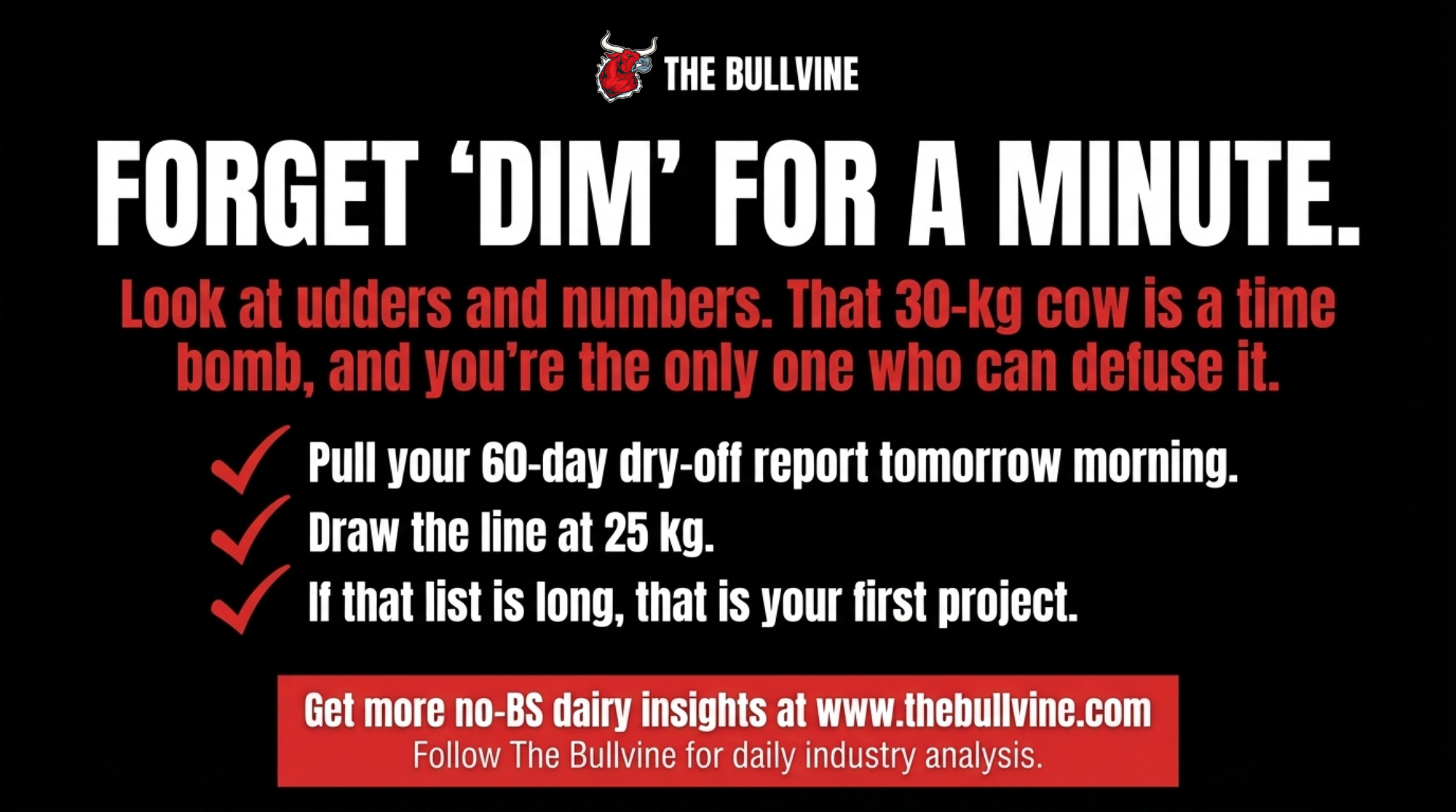
The next time you walk the dry pen, forget DIM for a minute and look at udders and numbers instead. How many cows are three weeks dry and still look like they could walk back into the parlor? That’s your 30‑kg time bomb — and you’re the only one who can defuse it.
Complete references and supporting documentation are available upon request by contacting the editorial team at editor@thebullvine.com.
Learn More
- The 11‑Day Vaccine Shift: From Dry‑Off Tax to 1,500‑lb Sensor Edge – Capture an extra 1,500 lbs of milk per mature cow by shifting your vaccine schedule off dry-off day. This research arms you with the specific 11-day window needed to stop taxing your cows’ immune systems.
- The 15:1 ROI Protocol: How Anti-Inflammatory Treatment is Cutting Transition Disease in Half – Protect your herd’s long-term equity with a battle-tested protocol that stabilizes transition performance and cuts disease in half. This strategy ensures your best genetics reach their peak production potential for multiple, profitable lactations.
- Cornell Study Proves Less Is More: Why Modern Colostrum Needs Just 2.5 Liters, not 4 – Exposes why feeding 2.5 liters of high-potency colostrum delivers 24% better absorption efficiency than old 4-liter rules. You’ll save $20 in immediate costs while ensuring your modern genetics get the elite start they deserve.
 The Sunday Read Dairy Professionals Don’t Skip.
 The Sunday Read Dairy Professionals Don’t Skip.
Every week, thousands of producers, breeders, and industry insiders open Bullvine Weekly for genetics insights, market shifts, and profit strategies they won’t find anywhere else. One email. Five minutes. Smarter decisions all week.