Three dairy families fought utilities for decades over unexplained herd losses. The testing blind spot and insurance trap they exposed threatens every operation milking on concrete.
Executive Summary: Three Upper Midwest dairies have already won more than $18 million in stray‑voltage verdicts, and the barn‑math says a hidden 4 lb/cow/day loss on a 500‑cow herd can quietly burn about $185,000/year off your milk check. The article walks through what happened to the Vagts (Iowa), Normans (Minnesota), and Haldersons (Wisconsin) when DC current from utility and pipeline systems ran through concrete barns while standard AC‑only tests kept saying “you’re fine.” It shows how insurance language like “death by electrocution” and “necessary suspension of operations” often pays for dead cows and wiring, but not years of lost milk if you keep milking through the problem. You’ll see exactly when to suspect voltage — cows avoiding one wet metal spot, 2–4 lb/cow/day unexplained loss, and no clear biological cause — and why a low‑thousands‑of‑dollars AC+DC test is basically eight days’ worth of the milk you’re probably already losing. There’s a clear 30‑day plan: schedule an independent DC‑capable test if you see those red flags, email your agent a 4–7 lb/cow/day scenario and ask what actually pays, and start logging production, behavior, and utility work like a future plaintiff. If you’re milking a few hundred cows or more on concrete, especially on older rural lines, this is the kind of “invisible loss” story you read once and then immediately go check your own numbers.
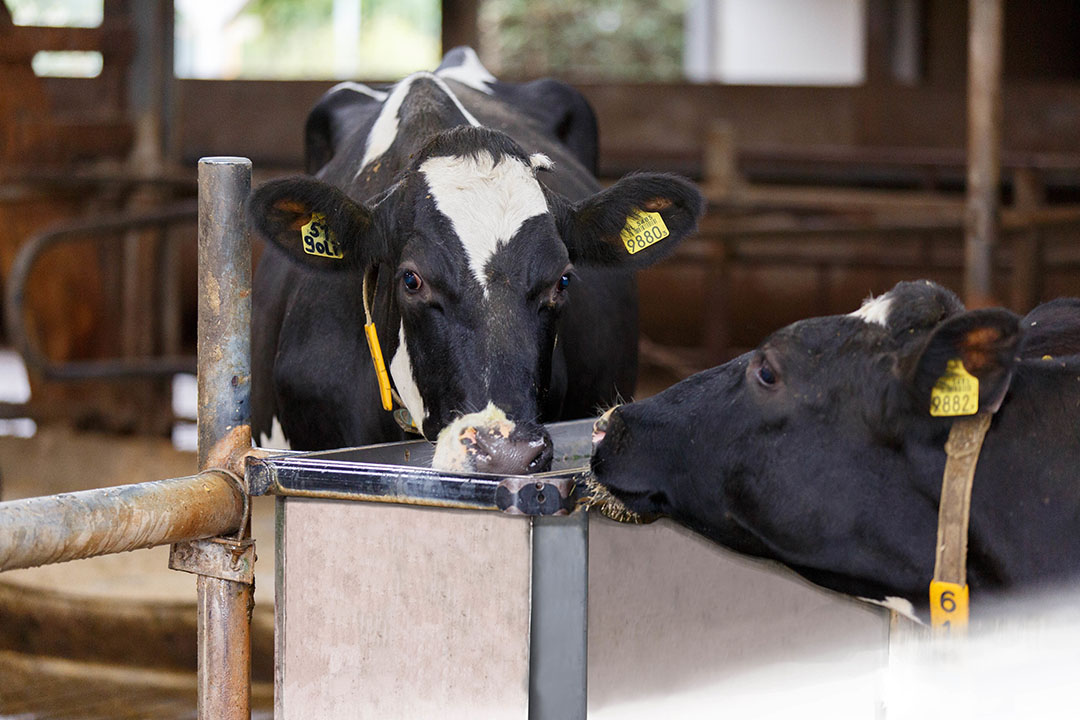
Editor’s note: These cases are centered in the Upper Midwest United States, but the technical blind spots in stray‑voltage testing and the “Catch‑22” in farm insurance language are risks any modern dairy on concrete can face, regardless of region.
Lawrence Neubauer walked onto the Vagts dairy near West Union, Iowa, in September 2020 and quickly found DC stray voltage at cow‑contact points. He spent three more days documenting it. By then, Mark, Joan, and Andrew Vagts had already burned through about seven years of vet calls, nutrition consults, and equipment checks trying to explain why cows that looked “fine” on paper were sick, nervous, and underperforming.
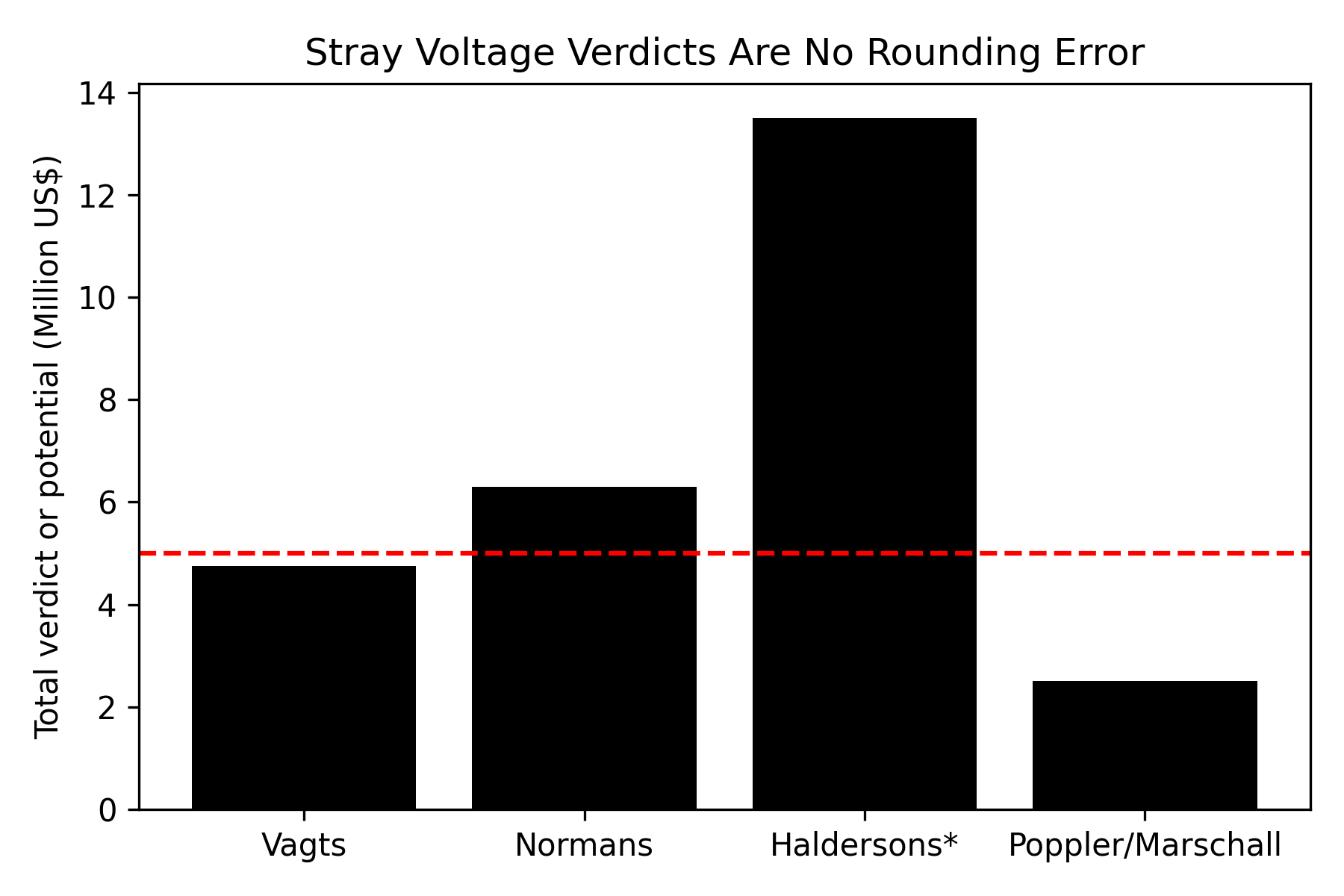
Their troubles started after 2013, when a nearby Northern Natural Gas pipeline’s cathodic protection system began leaking current into their ground. A Fayette County jury later awarded the Vagts $4.75 million — $3 million in economic damages, $1.25 million for personal inconvenience and distress, and $500,000 for loss of use and enjoyment of their property. The Iowa Supreme Court upheld every dollar on June 21, 2024.
That’s one family. Across Iowa, Minnesota, and Wisconsin, stray‑voltage verdicts now total well over $18 million, even if you use conservative numbers. The real total is closer to $20–30 million once you add interest, fees, and multiple trials. Farm legal expert Roger McEowen, a professor at Washburn University School of Law whose March 2026 analysis was published through Kansas State’s AgManager, put it bluntly: if this happened on your farm tomorrow, your insurance probably wouldn’t cover the part that hurts the most.
What’s Changing — and Why These Verdicts Matter Now
Stray voltage used to be a weird problem from the 1980s that only showed up in old extension bulletins. Four recent cases have turned it into a very current, very expensive risk.
In Minnesota, Randy and Peggy Norman ran a dairy near Pine River and did a lot of things right. Minnesota Lawyer reports that in 1994, they were 27 percent above the state average in milk production, and by 2012, they were 20 percent below. Over those years, their cows’ health would wax and wane without a good diagnosis that would fix the issue, their attorney Jeremy Stevens told the paper. “The cow would be culled or die.” After repeated accusations that they were mismanaging the herd, the Normans’ lender issued an ultimatum in 2012: sell the cows and quit milking. They did.
A Cass County jury trial in October 2014 produced the largest stray‑voltage jury award in Minnesota history: $4,861,478 in economic loss and $1.5 million in nuisance damages. With interest and fees, the total climbed to roughly $6.3 million. The Minnesota Court of Appeals affirmed it, and trial‑law publications later highlighted the case as a landmark.
Near Galesville, Wisconsin, Paul and Lyn Halderson operate a nearly 1,000‑cow dairy. Their lawsuit alleged that Northern States Power (an Xcel Energy subsidiary) had found “excessive voltage” in one of their barns starting in 1996 and never told them. Over the next 15 years, the Haldersons watched cows struggle with health and production while enduring accusations that they were substandard farmers. In 2011, they hired their own consultant, who traced the high electricity levels to the utility’s distribution system. Court records show the family claimed $5.8 million in lost profits between 2004 and 2011. A Trempealeau County jury found Xcel’s conduct “willful, wanton or reckless” and awarded just under $4.5 million — an amount that, under Wisconsin statute, can be tripled to $13.5 million when a utility violates certain safety laws. Appeals and post‑trial motions will determine the final number.
In Wright County, Minnesota, a jury initially awarded Harlan and Jennifer Poppler and Roy Marschall more than $750,000 in a stray‑voltage case against Wright‑Hennepin Cooperative Electric Association. After the Minnesota Court of Appeals ordered a new trial on damages, a second Wright County jury in 2015 returned a verdict of nearly $2.5 million. Minnesota’s appellate courts later upheld that award.
Taken together, these cases show a pattern where farm families spent years battling unexplained herd problems and litigating with utilities before juries and judges ultimately ruled in their favor. The cases didn’t just move money; they pulled back the curtain on how testing protocols, infrastructure, and insurance language actually behave when current starts leaking through concrete.
And in every single case, the big money didn’t come from insurance.
How This Actually Shows Up in Your Barn
The Vagts didn’t sit on their hands. They did what you’d probably do.
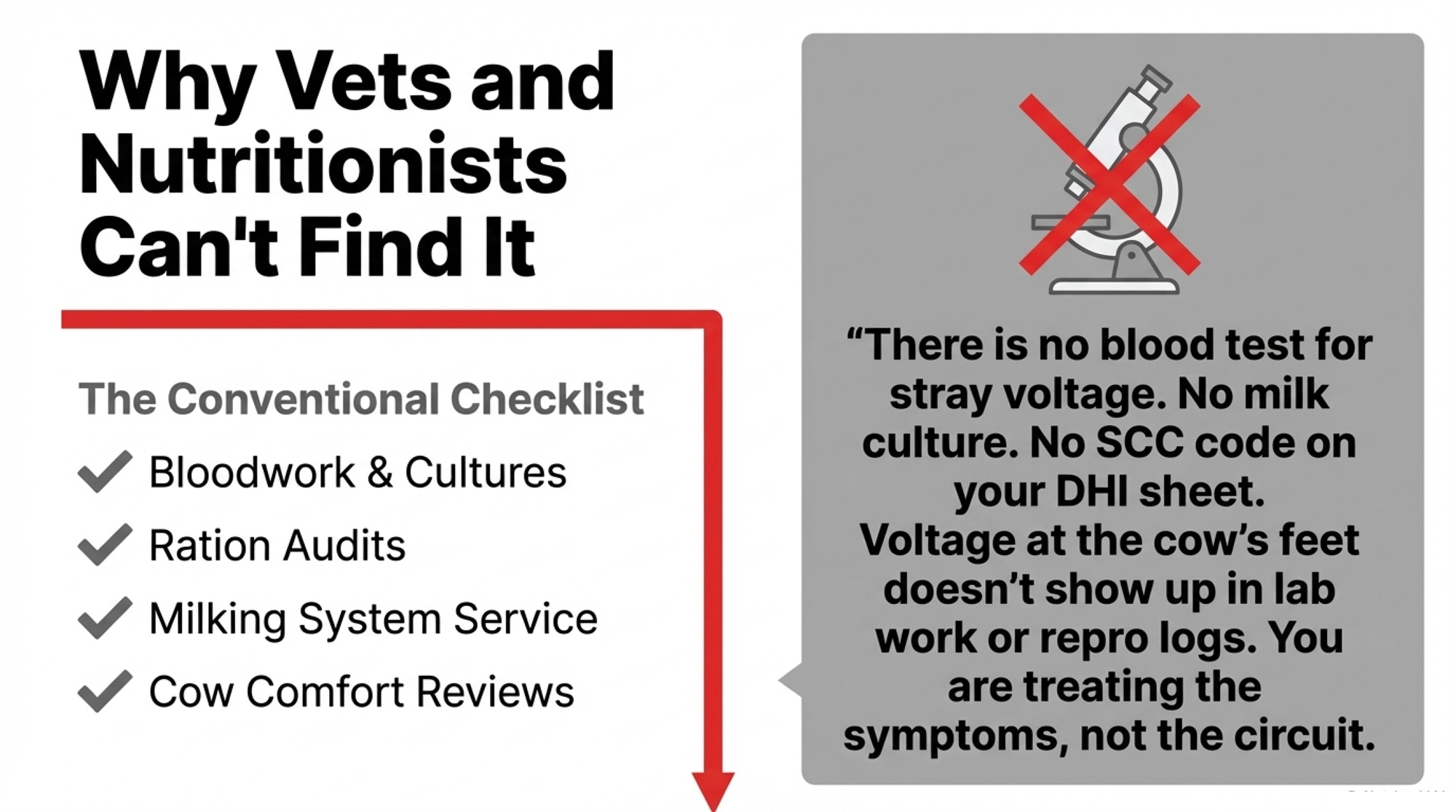
They called the vet. They adjusted rations with their nutritionist. They had the milking system serviced. They checked ventilation, bedding, and cow flow. For years, every professional who walked through that barn worked through the same checklist you and your advisors would use: bloodwork, cultures, necropsies, ration audits, cow comfort reviews. Nobody found a single “smoking gun.”
Here’s the hard truth buried in Wisconsin’s own stray‑voltage program documents: ” Stray voltage “is an electrical issue and can only be identified through standardized electrical testing protocols. There’s no blood test for it. No milk culture. No special SCC code on your DHI sheet.
Your vet can see the effects — chronic mastitis, odd behavior, production that doesn’t match the ration — but her toolkit is built to rule out disease, metabolic issues, and management mistakes. Voltage at the cow’s feet doesn’t show up in her lab work. It’s not in your nutritionist’s software. It’s not in your repro logs.
So how much did all that troubleshooting cost the Vagts before Neubauer showed up with the right meter?
You don’t have a published survey that nails down that figure. But on a 400–500 cow herd chasing an unresolved “mystery problem,” it doesn’t take long for extra vet calls, nutrition visits, milking‑equipment service, and outside consultants to add up to a noticeable line item. Over several years, that easily climbs into the five‑figure range — money that, in hindsight, would have covered a comprehensive independent electrical test many times over.
Then layer on what the Vagts eventually proved in court: about $3 million in lost production.
The Three Blind Spots That Let Stray Voltage Hide
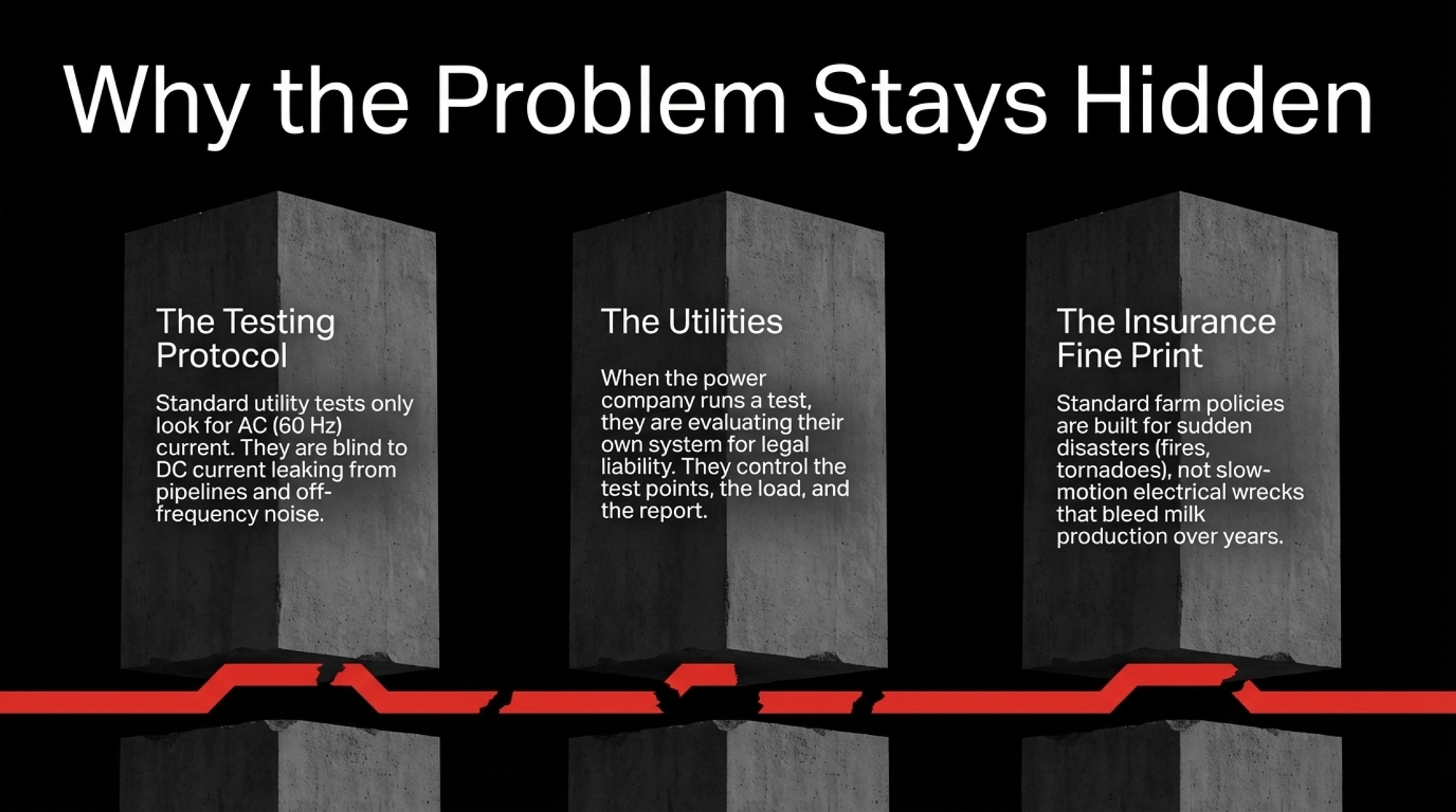
Stray voltage becomes expensive because three systems you rely on — testing, utilities, and insurance — are built with blind spots.
Blind Spot 1: The Testing Protocol
Wisconsin’s PSC Phase II protocol — the standard many utilities use and point to — explicitly measures only AC, 60 Hz, RMS, steady‑state animal‑contact voltages at cow contact points. That’s the right test if your problem is classic 60‑cycle current leaking off the utility neutral. It’s almost useless if the source is DC stray voltage from a pipeline rectifier, like on the Vagts farm, or if the current rides in on frequencies outside the 60 Hz band.
When utilities test under that protocol, they’re essentially using a thermometer that only reads one scale. If the problem is DC, the meter can sit close to zero, even while cows are still getting enough current through their legs to change behavior and milk.
Pro tip: A standard utility stray‑voltage test is tuned for AC at 60 Hz. If your problem is DC from something like a pipeline cathodic protection system, that DC current can slip right past that setup — which is exactly what happened before Neubauer showed up with a DC‑capable meter on the Vagts farm.
Blind Spot 2: Who Runs the Test
When your power company tests your farm, they’re evaluating their own system for potential legal exposure. They pick the test points, the timing, and the load conditions. They write the report. In states like Wisconsin, they follow PSC rules that set thresholds and protocols, which is better than nothing. But it’s still the entity whose system is being evaluated.
The Halderson case shows how that can go wrong. According to court documents and farm‑media coverage, Northern States Power measured excessive voltage in one of the Halderson barns starting in 1996 and recorded it internally. The Haldersons say nobody told them. They kept milking. They spent years battling health problems and production shortfalls. It wasn’t until 2011 — fifteen years later — that they paid for their own independent testing and finally had numbers they could use in court.
Blind Spot 3: The Insurance Fine Print
Standard farm packages were built for sudden events: fires, storms, and building collapses. Stray voltage is a slow‑motion wreck that doesn’t fit neatly into that box. The Mengel Dairy Farms case is the clearest lesson here.
Hastings Mutual insured Mengel, and its own investigation confirmed stray voltage as a cause of damage. The company paid for dead cows and electrical work. Then it denied coverage for years of reduced milk production, arguing two key policy clauses never kicked in:
- Livestock coverage: “death of livestock by electrocution.”
- Business income coverage: loss of income due to the necessary suspension of your operations caused by a covered cause of loss
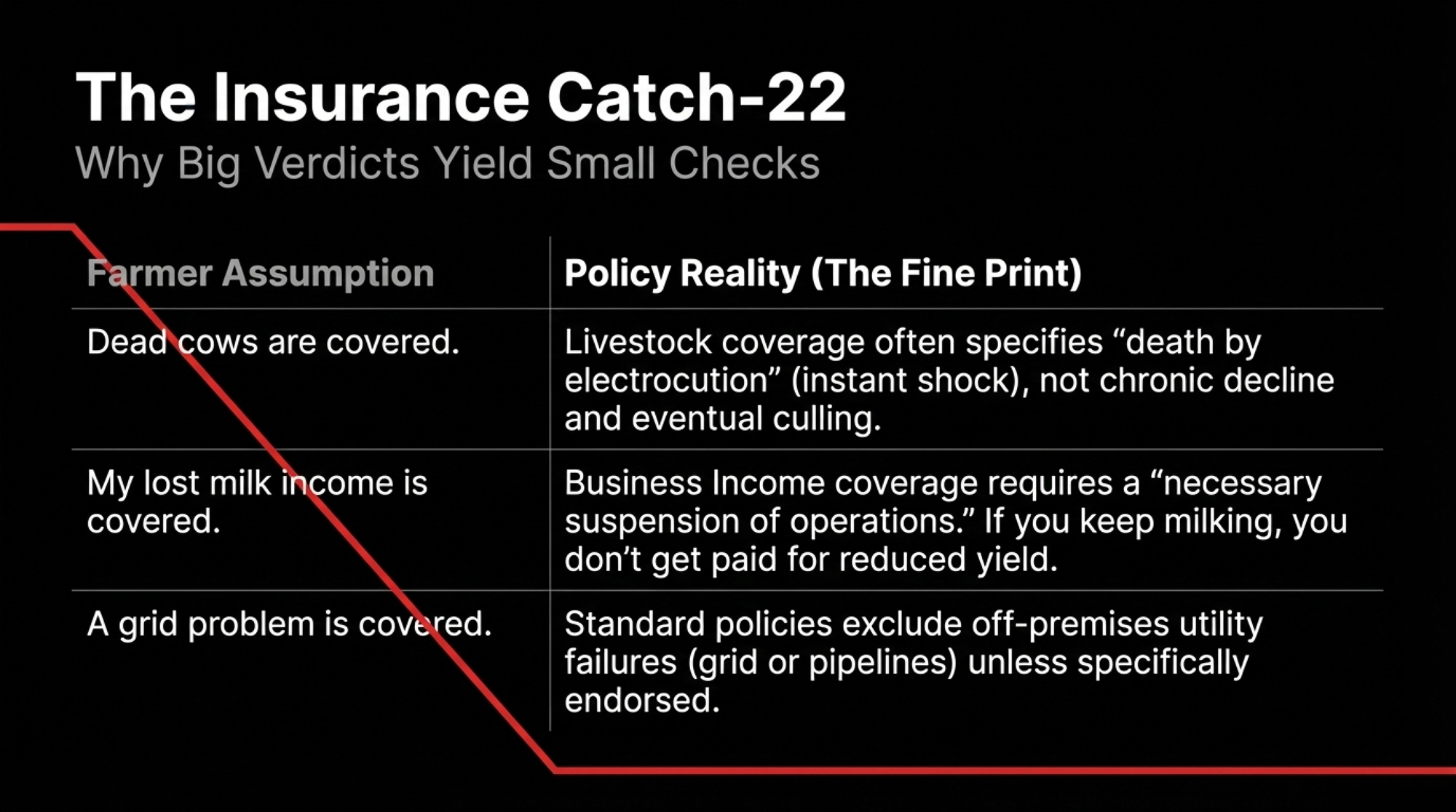
Mengel cut back cow numbers but kept milking. The cows didn’t die instantly from a visible shock. That, Hastings said, meant no business‑income coverage. A federal district court agreed, and the Sixth Circuit Court of Appeals affirmed in July 2021. As McEowen put it in his March 2026 article, it’s “a Catch‑22 for many farmers: if you keep working to save your business, you may disqualify yourself from insurance payouts for lost income.”
What Does Undetected Stray Voltage Actually Cost Per Cow Per Year?
Let’s do the barn math in plain numbers you can plug into your own herd.
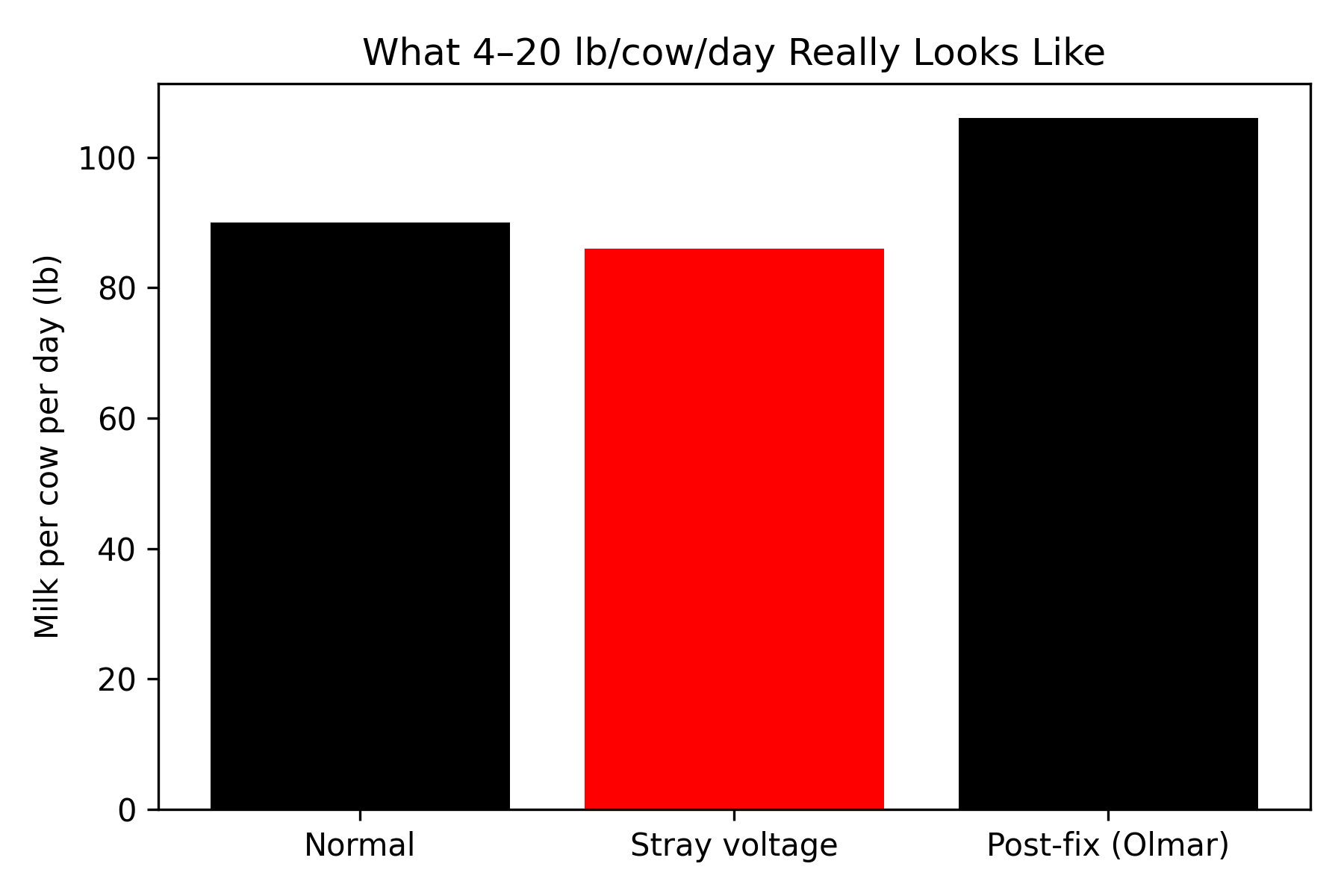
Take a 500‑cow operation. Suppose stray voltage quietly knocks 4 lb/cow/day off production — conservative compared to what families like the Vagts and Haldersons documented in court, and close to but below the nearly 20 lb/cow/dayproduction gain Jill Nelson at Olmar Farms in Sleepy Eye, Minnesota, saw after installing an isolated transformer and investing almost $100,000 to separate her farm from utility infrastructure.
Use a mid‑range milk price of $18.00/cwt — you can swap in your own number.
Barn Math at a Glance (500 cows)
| Impact Category | Estimated Loss (Per 500 Cows) | Per Cow/Year |
| Milk revenue (4 lb loss @ $18/cwt) | $131,400 | $262.80 |
| Extra culling (5 more culls per 100 cows) | $45,000 | $90.00 |
| Mastitis treatment (1 extra case per 10 cows) | $8,750 | $17.50 |
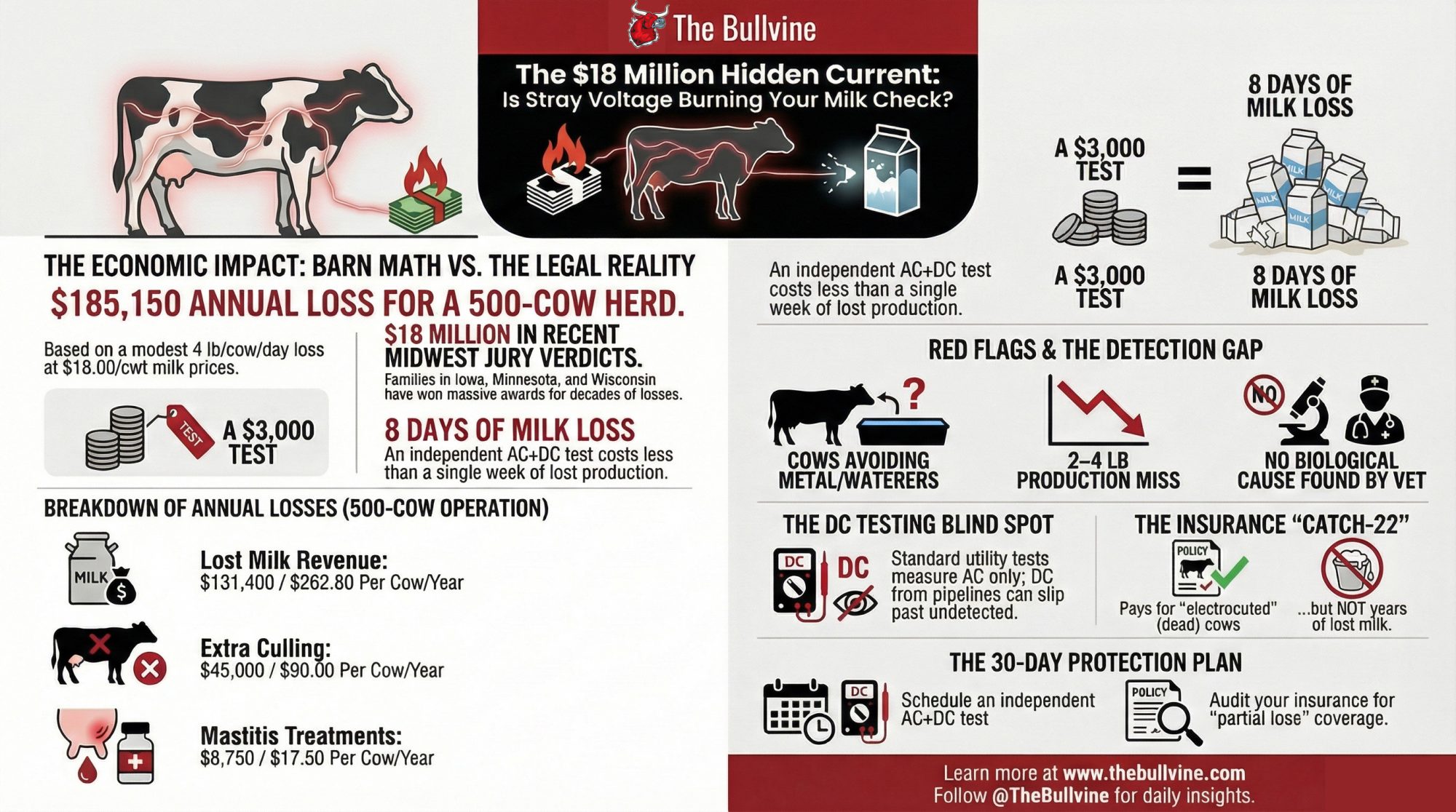
| TOTAL ANNUAL LOSS | $185,150 | $370.30 |
How it pencils out:
- Daily lost milk: 500 cows × 4 lb = 2,000 lb = 20 cwt
- Daily lost revenue: 20 cwt × $18.00 = $360
- Annual: $360 × 365 = $131,400
- Extra culls: 25 cows × $1,800 = $45,000
- Extra mastitis: 50 cases × $175 = $8,750
Rounded, that’s about $370 per cow per year on a 500‑cow herd.
And that’s using a modest 4 lb/cow/day loss. Nelson’s experience — nearly 20 lb/cow/day more milk after an isolated transformer and major electrical upgrade — shows how quickly these numbers get ugly when you’re on the wrong side of the current for years.
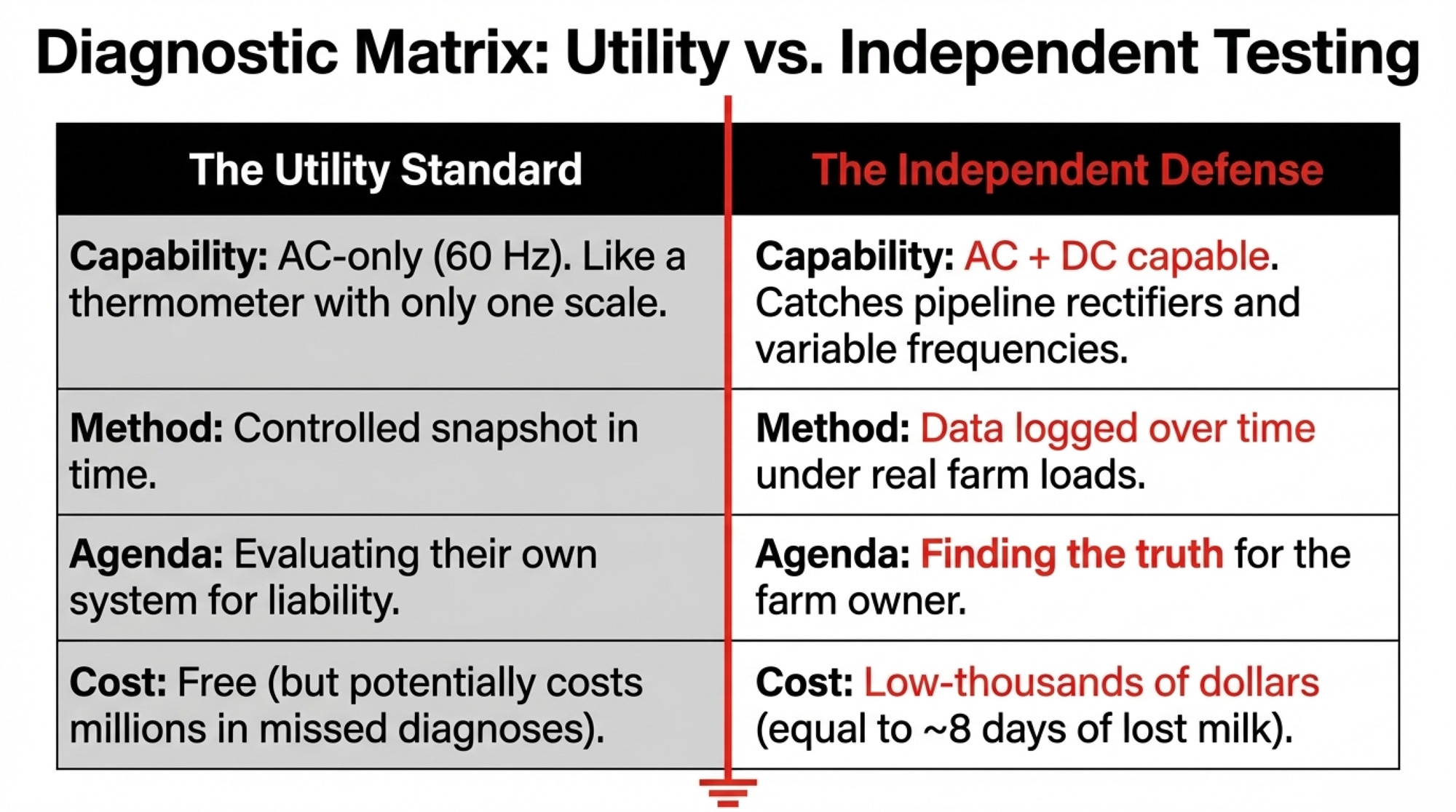
A comprehensive independent electrical assessment that measures both AC and DC at cow‑contact points often lands in the low‑thousands of dollars for a mid‑size dairy — for many 400–700 cow herds, that means writing a check in the low‑thousands range once you factor in travel and time on farm. At $360/day in milk‑only losses, a $3,000 test is equal to about eight days of the production loss it’s designed to catch. Even if your numbers are half that, the math doesn’t take long to pencil out.
Does Your Farm Insurance Actually Cover Stray Voltage Damage?
Short version: your farm policy likely covers a sliver of the damage — dead cows and maybe some electrical repairs — but not years of lost milk.
McEowen’s stray‑voltage insurance piece walks through the Mengel case in detail. The key lessons match what shows up over and over in real farm policies and public farm‑insurance endorsements:
- Electrocution means “instant death,” not chronic decline.
The livestock section in many policies uses language like “death of livestock by electrocution.” In Mengel, the court interpreted “electrocution” broadly enough to cover cows that didn’t die instantly — good news for direct animal‑loss claims. But that clause only applied to dead animals, not reduced milk flow. - Business income often requires “necessary suspension of operations.”
The business‑income section typically says something like “we will pay for the actual loss of business income you sustain due to the necessary suspension of your operations caused by a covered cause of loss.” Mengel reduced cow numbers but kept milking. Because the farm didn’t fully shut down, the court held that the business‑income coverage never kicked in. Hastings Mutual didn’t have to pay for the years of reduced production. - Off‑premises utility language can leave a gap.
Many standard farm policies include wording that limits coverage for problems with utility service before power reaches your meter. If the source of your stray voltage is a grid problem or a pipeline cathodic protection system, that language may mean your insurer has no obligation to cover the loss under the current wording.
That’s why you see big verdicts but small insurance checks. The utilities and pipeline companies are paying because juries found them liable. The insurers, in cases like Mengel, have covered direct physical losses, while courts have held that policy wording doesn’t extend to long‑term production loss.
How Do You Close That Gap Before a Problem Hits?
You’re not going to find a clean “Stray Voltage Rider” in your agent’s menu. But you can use the tools that do exist to close most of the hole.
Ask for business‑income coverage that doesn’t require a full shutdown.
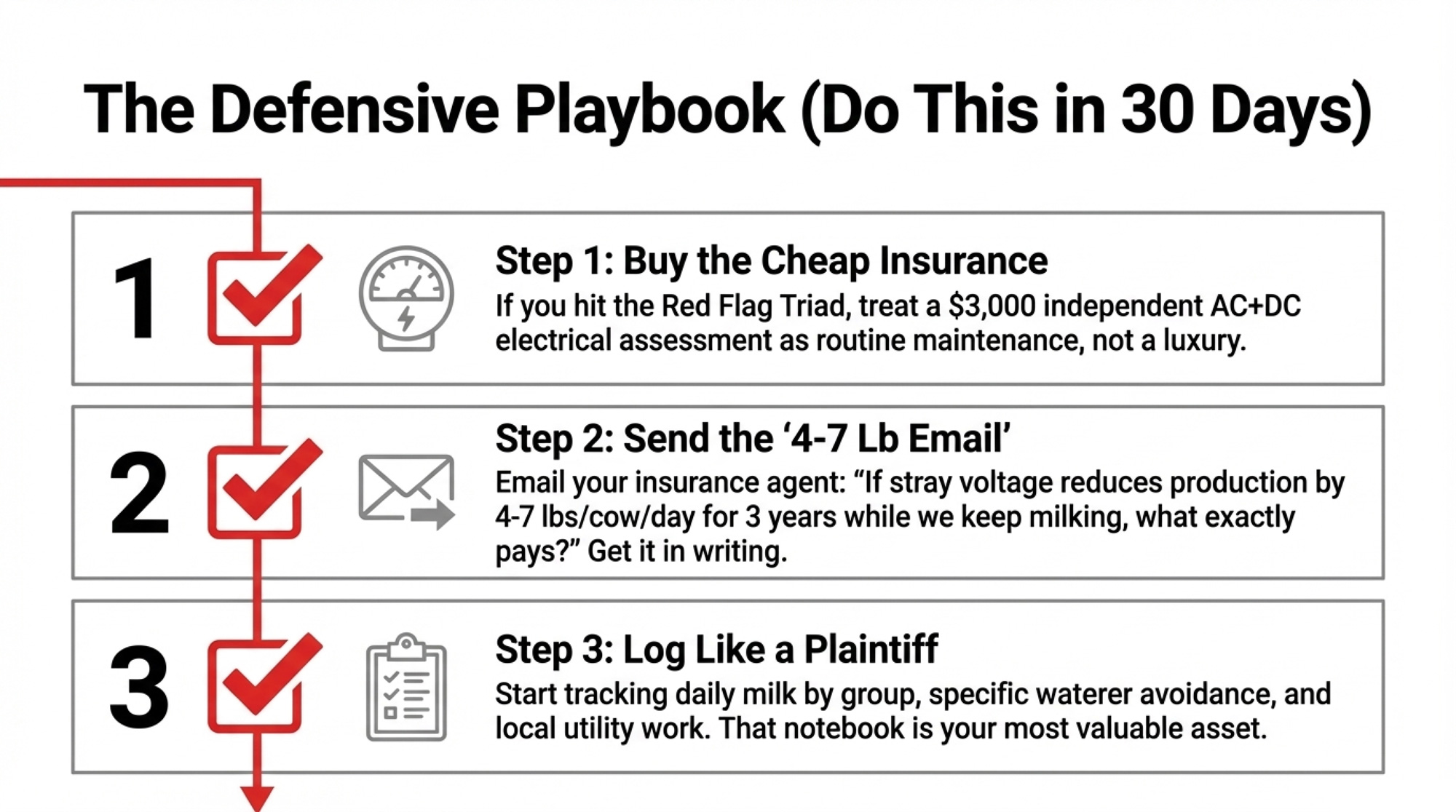
Sit down with your agent and walk through this specific scenario: “If stray voltage or another electrical issue reduces our production by 4–7 lb/cow/day for three years while we keep milking, what does this policy actually pay?” Ask about:
- A farm business‑income or “loss of farm income” endorsement that covers partial production loss, not just total shutdown.
- Whether “necessary suspension” can include a partial interruption or whether you truly have to stop milking to trigger coverage.
Don’t accept a hand‑wave answer. Ask them to put their explanation in an email.
Add utility service interruption coverage that reaches past your meter.
Standard property coverage often excludes damage caused by off‑premises utility failures. You want:
- A utility service interruption endorsement that covers losses if a problem on the grid or pipeline causes damage at your farm.
- Wording that explicitly includes overhead lines, distribution equipment, and, where possible, third‑party systems like pipelines if they’re feeding current into your ground.
On many mid‑size Upper Midwest dairies carrying full farm property, liability, auto, and umbrella, total annual premiums often end up in a five‑figure range. Endorsements like business‑income and utility‑service interruption usually add only a small percentage on top of that, not a second premium. In real terms, you’re talking about something in the ballpark of one smaller load of milk a year to close a six‑figure coverage gap.
And again, get it in writing. A clean email that says “here’s exactly how your policy would respond if stray voltage quietly took 4 lb/cow/day off your production for three years” is gold if you ever have to argue with a claims adjuster.
When Is It Time to Pay for a Stray Voltage Test?
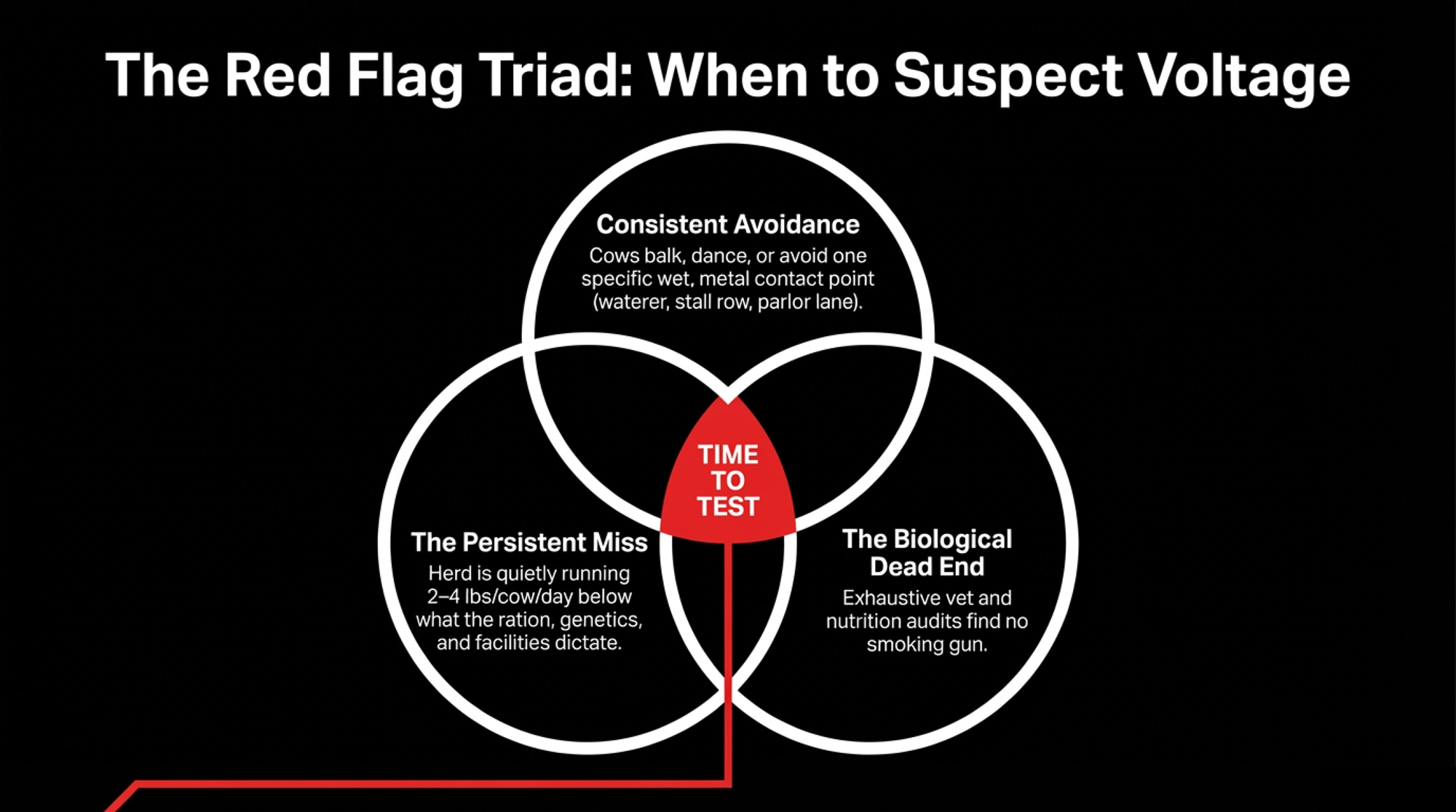
You don’t wait until your vet says, “I have no more ideas,” and your milk check has been light for three years. You pick up the phone when three things show up together.
- Cows consistently avoid one specific wet, metal contact point.
They balk, dance, or drink less at one waterer, stall row, or parlor lane — but use others without hesitation. Shadows, footing, and boss cows can cause some avoidance. But when it’s pinned to one specific piece of wet metal over time, you should get suspicious. - You’ve got a subtle but persistent production miss.
One group or the whole herd is running 2–4 lb/cow/day under what your ration, genetics, and facilities should deliver, and minor tweaks never quite close the gap. You’ve got a sense your numbers “should be better than this,” even if you can’t prove it on paper. - Your vet and nutritionist can’t find a clear biological or management cause.
You’ve worked through the checklist — fresh cow protocols, mastitis patterns, rumen health, feed quality, ventilation, milking routine — and you keep hearing some version of: “Honestly, this herd should be milking better than this. I don’t see a smoking gun.”
| Signal | Typical dairy explanation | Stray‑voltage interpretation |
| Cow behavior | Avoiding one trough is “cow politics” | High‑risk: one wet metal point consistently avoided |
| Production numbers | 2–4 lb/cow/day miss blamed on genetics | High‑risk: ration and housing say you should be higher |
| Vet & nutrition work | “Nothing obvious, herd should milk better” | High‑risk: biology ruled out, electrical not tested yet |
| Recommended action | Tweak feed or stall setup again | High‑risk: book independent AC+DC test within 30 days |
When those three line up, that’s your signal. You treat a low‑thousands‑of‑dollars independent AC+DC electrical assessment as cheap insurance, not a luxury.
What the “Cow Model” Actually Means
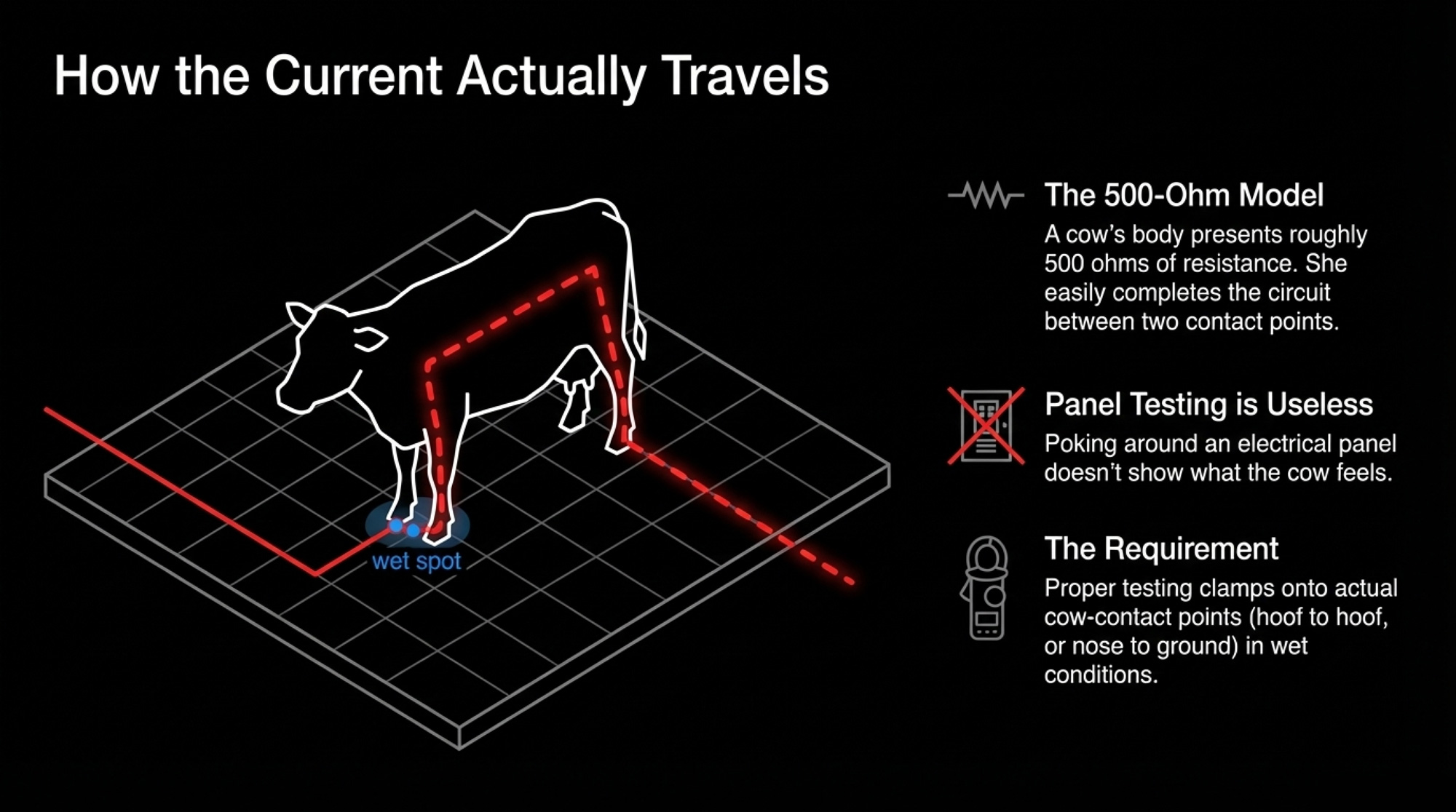
When consultants or PSC documents talk about a “500‑ohm cow model,” they’re just describing how easily a cow completes a circuit through her body — from a front foot in one wet spot to a back foot or nose touching another. The meter stands in for the cow, using about 500 ohms of resistance (roughly what a cow’s body presents), and measures how much voltage really exists from hoof to hoof or nose to ground. That’s why proper testing clamps onto actual cow‑contact points in wet conditions instead of just poking around in the panel.
And you start with someone who doesn’t have skin in the utility game. In Wisconsin, you can absolutely call your power provider and request a PSC‑compliant test, and you should. But remember: their protocol measures only AC, 60 Hz, RMS, steady‑state voltage. If your problem is DC from a pipeline or mixed‑frequency noise from aging infrastructure, that test literally can’t see it.
An independent dairy‑focused electrical consultant will:
- Measure both AC and DC at cow‑contact points with a realistic “cow model” (usually around 500 ohms).
- Log data over time, not just take snapshots.
- Look at your farm wiring and the grid as a system, not in isolation.
- Put findings in a written report of your own.
A simple, quick screen you can do yourself today: set a basic digital multimeter to low‑range AC volts, and check between the water in a suspect trough and a good ground reference. If you consistently see a few tenths of a volt or more — especially if it jumps when motors kick on — you’ve got enough reason to book a proper test. It’s not definitive, but it’s a useful filter between “cow politics” and “electrical problem.”
Why Do These Cases Keep Coming From Wisconsin, Minnesota, and Iowa?
It’s not that stray voltage only happens in the Upper Midwest. It’s that the conditions for big, provable cases cluster there. And those conditions are showing up in more regions every year.
First, the grid. Some Minnesota farm and energy advocates have described parts of the state’s rural electrical infrastructure as “crumbling.” Long rural feeders, multiple splices, and heavy livestock loads on circuits that were never designed for today’s 500–2,000 cow herds push a lot of current through a lot of grounded metal. Add in big barns built with concrete and steel — great for cow comfort, great for stray‑voltage pathways — and you’ve got more opportunities for dangerous “cow contact voltage” per mile of line than in smaller, pasture‑heavy regions.
Second, Wisconsin’s stray‑voltage program changed the game. Since the late 1980s, the PSC and DATCP have run a structured program with:
- Standardized Phase I and Phase II testing protocols.
- A defined “level of concern” threshold at about 2 milliamps (roughly 1 volt at a 500‑ohm cow model) at cow contact.
- A hard rule that utilities must keep their own contribution under 1 milliamp.
That framework created a paper trail. When a utility knows it measured above those thresholds and didn’t fix it, a jury has something concrete to latch onto. That’s exactly what happened with NSP and the Haldersons.
Third, once a few big verdicts land, the flywheel spins. Law firms and consultants build expertise. Producers talk. Neighbors recognize similar patterns of herd problems when they hear the story. The infrastructure for proving stray‑voltage cases — technical, legal, and cultural — exists in Wisconsin, Minnesota, and Iowa in a way it doesn’t yet in many other dairy regions.
That doesn’t mean other states are safe. It likely means they have under‑measured, under‑documented problems, which is exactly why this kind of piece belongs in your reading stack even if you live a thousand miles from the Upper Midwest.
Options and Trade-Offs for Farmers
You’ve got a few realistic paths here. None involves crossing your fingers and hoping.
Path 1: Treat a comprehensive electrical test as routine maintenance (30‑day action).
In the next month, schedule a full AC+DC stray‑voltage assessment if:
- Your cows avoid specific wet metal areas,
- Your herd is quietly a few pounds under where it should be, and
- Your advisors can’t find a good reason.
Think of it like a major parlor service or a feed audit. On a 500‑cow Upper Midwest dairy, a low‑thousands‑of‑dollars test is a line item. The risk of not knowing — $185,150 per year in quiet damage, plus the legal mess if you end up in a dispute — is not.
Path 2: Audit your insurance with stray voltage in mind.
Within the next 30 days, pull your farm policy and send your agent a simple email:
“If stray voltage or another electrical issue reduces our production by 4–7 lb/cow/day for three years while we keep milking, what parts of this policy actually pay, and what doesn’t?”
Ask them to walk through:
- The definition of “electrocution” in livestock coverage.
- Whether business‑income coverage requires “necessary suspension of operations.”
- Whether off‑premises utility issues (grid or pipeline) are excluded.
- Whether you can add business‑income and utility‑service endorsements that respond to partial production loss.
Get the answers in writing. Then decide whether that small percentage bump in premium is worth closing a six‑figure coverage gap.
Path 3: Start documenting like a future plaintiff, even if you never plan to be one.
If you’re not ready to spend on a test or endorsements this month, at least start a simple log:
- Daily or weekly milk by group.
- SCC trends.
- Culling reasons and dates.
- Behavior notes at waterers, stalls, and parlor lanes.
- Dates and descriptions of any electrical, utility, or pipeline work near your farm.
If you ever do end up in a fight — with a utility or an insurer — that notebook will be the single most important asset you own that isn’t a cow.
Path 4: Use your utility’s free test — but don’t stop there.
If you’re in Wisconsin, you can and should request a PSC‑standard stray‑voltage investigation. It’s a no‑cost way to establish a baseline. Just understand what it can’t see: DC, non‑60 Hz problems, and anything outside the narrow test setup. Treat it as a starting point, not a verdict.
Key Takeaways
- If your herd is consistently 2–4 lb/cow/day below where your ration, genetics, and facilities say it should be — and your vet and nutritionist can’t find a clear biological cause — you should treat a low‑thousands‑of‑dollars electrical test as a reasonable next step, not a last resort.
- If cows are avoiding one specific wet metal area (a waterer, stall row, or parlor lane) and not others, and minor changes don’t fix it, that’s your cue to suspect voltage before you accept “cow behavior” as the explanation.
- If your business‑income coverage requires “necessary suspension of operations,” assume it won’t pay for years of reduced milk unless you literally shut down — and talk to your agent about endorsements that cover partial production loss.
- If your policy limits coverage for utility problems before power reaches your meter, assume damage caused by the grid or a pipeline could fall in that gap until an agent puts in writing that it’s covered.
- If you’re milking 400–1,000 cows on concrete on older rural lines in the Upper Midwest, your risk profile looks uncomfortably close to the Vagts, Normans, Haldersons, and Popplers — and a low‑thousands‑of‑dollars test is about eight days’ worth of the loss it’s designed to catch.
The Normans spent more than twenty years fighting unexplained herd problems before a jury finally vindicated them. The Vagts dug through seven years of vet bills and underperformance before someone ran the right test. The Haldersons milked through at least fifteen years of documented voltage problems while their utility sat on a 1996 measurement that never made it back to the barn.
Cases like these are why families who’ve been through similar battles often say they wish they’d pushed for answers sooner.
Your vet can’t see voltage on a lab report. Your nutritionist can’t taste it in a TMR. Your utility will generally follow the testing protocol it has in place, which focuses on a narrow slice of possible electrical problems. And your insurer — if the Mengel case is any indication — can pay for dead cows and wiring fixes while denying years of reduced‑production claims because the policy language never contemplated a slow, stray‑voltage wreck.
So the real question isn’t whether stray voltage could be happening somewhere in your county. It’s whether you’re willing to spend one bad week’s worth of milk money this year to find out if it’s happening on your concrete.
We’re building a full insurance audit checklist, a 5‑question script you can use with your agent, and an independent testing directory for Upper Midwest dairies — with copy‑and‑paste email templates — in an upcoming Bullvine Weekly. That’s where we’ll get into the deeper contract language and dollar‑by‑dollar model that didn’t fit here.
If you had to pick one to do this month — schedule a DC‑capable stray‑voltage test or send that 4–7 lb/cow/day email to your agent — which one would you actually do first?
Complete references and supporting documentation are available upon request by contacting the editorial team at editor@thebullvine.com.
Learn More
- Is Stray Voltage Stealing 20 Pounds Per Cow from Your Dairy? – Stop letting standard utility tests lie to you. This breakdown reveals the technical “Testing Gap” and delivers the ROI math on isolated transformers so you can reclaim up to 20 pounds of daily production.
- Decide or Decline: 2025 and the Future of Mid-Size Dairies – Secure your operation’s future with this 2025 strategic playbook. It exposes why mid-size herds must pivot to precision management and 30% debt-to-asset ratios to maintain a competitive edge against the industry’s massive scale-up.
- Holstein’s Automated Classification Cameras: Why They’ll Work for 500-Cow Dairies but Maybe Not Yours – Glimpse the 2027-2028 horizon where depth-sensing cameras replace manual classifiers. This analysis explains how automated linear scoring will provide real-time genetic data, turning every parlor exit into a precise, high-value decision point for your herd.
 The Sunday Read Dairy Professionals Don’t Skip.
 The Sunday Read Dairy Professionals Don’t Skip.
Every week, thousands of producers, breeders, and industry insiders open Bullvine Weekly for genetics insights, market shifts, and profit strategies they won’t find anywhere else. One email. Five minutes. Smarter decisions all week.