





Forget adding more cows. New Zealand proves efficiency beats volume—$1.32/kgMS margins while others struggle.
EXECUTIVE SUMMARY: Look, I’ve been watching what’s happening down in New Zealand, and it’s got me thinking we’re approaching this whole cost crisis backwards. Here’s what’s wild: while feed costs have hammered everyone with a 19% jump since 2019, the Kiwi farmers who’ve embraced automation are actually widening their margins. We’re talking about robotic milking systems that used to take 4 years to pay back—now they’re doing it in 18-24 months. That’s real money, real fast. These operations are seeing 40% labor efficiency gains while their neighbors are still scrambling to find workers.And here’s the kicker: Fonterra’s paying $10.00/kgMS against an $8.68 breakeven. Do the math—that’s $1.32 per kilo of profit margin in an environment where most of us are sweating every penny. Global trends are backing this up too… automation isn’t optional anymore, it’s survival.You need to seriously look at what technology can do for your bottom line before your competition leaves you behind.
KEY TAKEAWAYS
- Slash labor costs by 40% with targeted automation – Start with automated cup removers and drafting gates in your existing parlor. The payback’s now under 2 years, not the 4-5 we used to see. Perfect timing with 2025’s tight labor market.
- Cut feed expenses despite 19% cost inflation – Pasture-based systems keep feed at 30% of costs vs. 55% for confinement operations. Focus on grazing management and feed efficiency testing. Every percentage point matters when margins are this tight.
- Capture export premiums through strategic positioning – New Zealand’s 10% export bump to China shows what happens when you’re positioned right. Start looking at value-added opportunities and component optimization. The global market’s rewarding efficiency over volume.
- Lock in technology ROI before costs rise further – Robotic milking units at $200K per 50-70 cows sound steep, but with current labor costs and milk prices, the math works. Get your financing lined up now—these payback periods won’t last forever.
- Build climate resilience into your operation – El Niño’s hitting hard in New Zealand, but diversified pasture systems (Italian ryegrass, plantain, chicory) are keeping farms profitable. Start testing alternative forages before you need them.
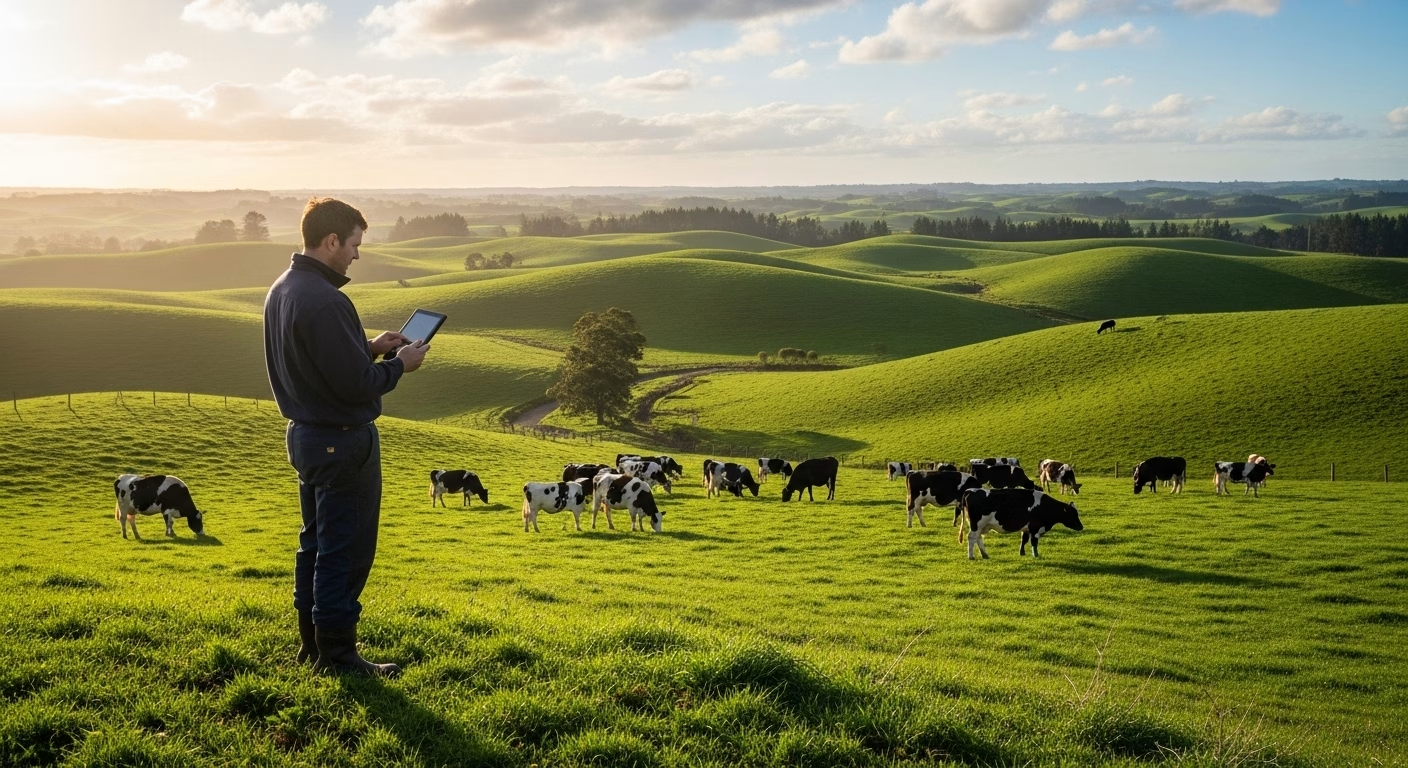
New Zealand’s dairy sector is navigating what is arguably its toughest cost environment in decades, yet it continues to teach the rest of the global dairy sector lessons that we can’t afford to ignore.
The Feed Cost Reality That’s Hitting Everyone
The developments regarding feed costs have been genuinely staggering. According to recent work from RaboResearch, feed expenses have jumped nearly 19% from 2019 to 2024 across major dairy regions. That’s the headline-grabbing figure, but here’s what strikes me about this: New Zealand, despite absorbing some of the sharpest cost hikes, remains a low-cost outlier.
Emma Higgins from RaboResearch put it perfectly when she noted that “the proportion of feed costs as a percentage of overall costs is generally lower for extensive and quasi pasture-based feeding systems like New Zealand.” What this means in practice? Pasture-based systems still account for approximately 30% of total expenses, compared to 55% in more intensive systems elsewhere.
Labor’s been the real kicker, though. While Australia’s seen wages jump over 50% since 2021, according to RaboResearch data, New Zealand’s been dealing with its own version of this challenge. The workforce shortage has become a dominant topic of conversation at recent dairy conferences.
What’s particularly noteworthy is how the industry’s been responding. Dr. Tim Mackle from DairyNZ has been pretty vocal about this: “in such a tight labor market, the contribution international staff make to keep farms running is critical.” The numbers tell the story—current estimates from DairyNZ suggest the industry is still facing a shortage of 4,000 to 6,000 workers, though recent immigration measures have started to alleviate that stress.
The Numbers Game: When $10 Meets Reality
Here’s where it gets interesting from a financial perspective. Fonterra has locked in the 2025/26 milk price at $10.00/kgMS within an $8 to $11 range—this isn’t speculation anymore, it’s business reality. Meanwhile, DairyNZ pegs the breakeven at $8.68/kgMS, a figure that’s become the focal point for hard-nosed decision making in paddocks from Northland to Canterbury.
Mark Storey from DairyNZ explained the pressure this way: “These [cost increases] are being driven by higher tax obligations, due to higher returns, and increases in general farm working expenses—particularly in feed, fertilizer, and energy costs.”
Currency movements complicate things further. The weakness of the NZD against the USD—thanks to ongoing global shifts—helps local farmers pocket more per kilogram, but increases the cost of imported equipment and fertilizers. From what I’ve gathered, talking to producers, they seem cautiously optimistic that it balances out… for now.
Key financial snapshot for 2025/26:
- Fonterra milk price: $10.00/kgMS (range $8-11)
- DairyNZ breakeven: $8.68/kgMS
- Operating margin: $1.32/kgMS at midpoint
- Feed costs: ~30% of total production expenses
The Technology Revolution That’s Actually Paying Off
Technology is where the future is heading in a big way, and the numbers don’t lie. Robotic milking’s payback times have seen a significant reduction, collapsing to roughly 18-24 months—half of what they used to be—which is no small feat when considering the mounting labor pressures, according to The Bullvine’s industry analysis.
What’s fascinating is that recent industry analysis shows that farms using automated milking technology are achieving labor efficiency gains of over 40%. But it’s not just about the robots themselves.
Consider the story from Alvin Reid—a 500-cow outfit on South Island’s Pleasant Point—who’s seen less mastitis and more milk per cow since installing six DeLaval robots back in 2013. He summed it up perfectly: “It’s not just about the tech—it’s about learning to think differently about managing cows and people.”
What’s interesting is how this mindset shift is spreading. Take James Patterson’s Canterbury operation—he invested around $500,000 in two Lely Astronaut robots three years ago. “Spreading that cost over 10 years and looking at the results we’ve achieved, we’re more than comfortable with the reduced debt,” he told me during a recent farm visit.
The reality check? Each robotic unit costs upwards of $200,000 USD for 50-70 cows, plus investments in infrastructure and maintenance. However, with wage inflation spiking, doing nothing comes at a cost as well.
Dr. Nicolas Lyons from the Milking Edge project puts it bluntly: “The reality is you can see every cow every day, but you will see her through the data… There are roughly 120 measurements captured when a cow walks into a robotic dairy.”
The China Factor: When Trade Policy Actually Delivers
A significant event occurred in January 2024 that’s worth understanding. China’s removal of all safeguard duties on New Zealand dairy imports unlocked major market access, and the results speak for themselves.
According to RaboResearch data, New Zealand’s dairy exports to China surged approximately 10% year-over-year in early 2025, contributing to an overall 5% export increase, supported by a relatively weak NZD and solid commodity prices.
Trade Minister Todd McClay called it “good news for our dairy sector,” noting that “the removal of these tariffs is expected to deliver additional savings of over US$350 million annually.”
But here’s the thing—trade dynamics can shift quickly. The current strength stems from persistent global supply constraints, with what analysts refer to as the “Big 7” export regions projected to grow by only 0.8% in 2025.
Recent export performance highlights:
- China exports: +10% volume growth
- Overall exports: +5% year-over-year
- Tariff savings: US$350 million annually
- Market access: Duty-free since January 2024
Weather, Risk, and the Persistence Problem
It’s not all sunshine, though. Recent spells of El Niño have been drying out Northland and Bay of Plenty pastures, creating what some farmers describe as their worst drought conditions in 50 years.
What’s particularly concerning is the longer-term trend. DairyBase data shows declining pasture harvest—about a tonne per hectare per decade in Northland and half a tonne in Waikato over the past twenty years. As one Northland dairy farmer told researchers: “We are constantly managing to minimize the effects of wet and dry—it’s very taxing to live on the edge of disaster.”
This persistence problem is forcing system changes that go beyond just weather management. Take Mike Thompson’s Waikato operation—he’s investing in diverse pasture species, adjusting grazing rotations, and implementing more flexible feeding strategies. “We can’t just rely on ryegrass and clover anymore,” he explained. “Italian ryegrass, plantain, chicory—it’s all part of building resilience.”
The Global Ripple Effect Nobody’s Talking About
What’s particularly compelling is that despite these challenges, New Zealand dairy operations are maintaining margins that many global operators can only envy. This isn’t just luck—it’s structural resilience and savvy strategic thinking.
The compressed automation payback periods we’re seeing in New Zealand are making producers in other regions reconsider their own technology adoption timelines. Current trends suggest that cost pressures and labor shortages are increasingly front-of-mind for dairy executives globally, driving unprecedented investment into technology and innovation.
What’s happening in New Zealand with robotics, labor efficiency, and cost management is becoming a playbook that producers worldwide are studying closely. The technology investments that seemed expensive or risky a few years ago? They’re becoming survival tools.
Sarah Mitchell from AgResearch put it this way: “What we’re seeing is a fundamental shift in how farms operate. The old model of throwing more labor at problems isn’t sustainable anymore.”
Financial Risk Factors Worth Watching
Let’s be honest about the financial complexity here. Interest rates remain a wildcard—the current environment supports investment, but rates can shift quickly. Currency hedging has become more critical than ever, especially for operations with significant imported input costs.
I’ve talked to several farm financial advisors who recommend:
- Currency hedging for 60-80% of expected foreign exchange exposure
- Interest rate fixing for 50-70% of debt at current levels
- Feed cost budgeting with 15-20% contingency allowances
- Technology investment timing aligned with cash flow cycles
The smart money is also closely watching global trade policy. What happened with China’s tariff removal could happen elsewhere, or reverse just as quickly.
The Playbook for Progressive Producers
So what’s a producer to do? First, lean hard into your natural advantages without resting on laurels. Quality feed management, labor efficiency gains, and leveraging genetic improvements remain crucial for success.
The growing role of advanced technology—from robotic milking units to AI-powered feeding—has shifted from an optional add-on to a must-have. Current market conditions support accelerated payback periods for automation investments, making the financial case stronger than ever.
Watch those trade channels and exchange rates too. As demonstrated by New Zealand’s experience with China’s tariff removal, geopolitical shifts can make or break your bottom line overnight.
Currency management remains crucial, given the global nature of dairy commodity pricing, and adaptive management capabilities are essential for navigating climate variability and fluctuations in input costs.
The Real Lesson Here
New Zealand’s story here is more than a local tale—it’s a bellwether. Their balance of rising input costs, labor crunches, and technology adoption forms a playbook the global dairy sector would do well to study.
What’s particularly noteworthy is how they’re managing to maintain profitability while investing in long-term sustainability. The combination of strategic technology adoption, trade policy advantages, and operational efficiency is creating a model that other regions are trying to replicate.
At the end of the day, how these lush green pastures adapt will tell us a lot about where global dairy is heading. The cost pressures, labor constraints, and technology solutions being tested in New Zealand today will likely define competitive advantages in dairy markets worldwide.
Ultimately, what works on New Zealand’s challenging terrain might just be the blueprint for profitable dairy farming everywhere.
Please note: All currency amounts are in New Zealand Dollars (NZD) unless stated otherwise.
Complete references and supporting documentation are available upon request by contacting the editorial team at editor@thebullvine.com.
Learn More:
- Harnessing Precision Technology in Dairy: “Fitbits” for Cows, Evolving Consumer Trends and Essential Grants for Dairy Producers – Reveals practical strategies for implementing wearable health monitors and automated milking systems, with verified ROI data showing 5-20% milk yield increases and specific cost-reduction pathways you can deploy immediately.
- Global Dairy Market Trends 2025: European Decline, US Expansion Reshaping Industry Landscape – Demonstrates how to capitalize on global production shifts and regulatory changes, providing strategic positioning insights that help you identify emerging market opportunities while competitors struggle with traditional approaches.
- The Digital Dairy Revolution: How IoT and Analytics Are Transforming Farms in 2025 – Shows breakthrough IoT applications delivering 15-20% productivity gains and 30% health cost reductions, complete with implementation roadmaps and real farm case studies proving technology ROI in today’s challenging market.
 The Sunday Read Dairy Professionals Don’t Skip.
 The Sunday Read Dairy Professionals Don’t Skip.
Every week, thousands of producers, breeders, and industry insiders open Bullvine Weekly for genetics insights, market shifts, and profit strategies they won’t find anywhere else. One email. Five minutes. Smarter decisions all week.




