Archive for News – Page 26

Acorn poison warning after toxin kills dairy cattle in Victoria

A south-west Victorian dairy farmer is warning other farmers to be wary of oak trees in their paddocks after losing several yearlings to acorn poisoning.

Carlie Barry from Woolvie Jerseys near Camperdown lost 10 yearlings and had to nurse other animals back to good health after the poisoning.

Acorns contain a toxin called tannic acid, which can cause damage to the liver, kidneys and intestines.

Ms Barry, who farms with her husband Owen, said they had been unfamiliar with the risk of acorn poisoning.

“We’re on a new property so we haven’t really had a lot of experience with oak trees before,” she said.

“The yearlings had access to a paddock with oak trees, but they weren’t locked in there. They were able to go in and out, but they must have acquired a taste for the acorns.”

Ms Barry said they went away for a few days, and when they returned home, they found their yearlings in dire straits.

“Out of the 70 yearlings, all of them were affected but there was about a third basically on death’s door,” she said.

“We got the vet out straight away and the sickest ones we were treating and one died in the vet’s arms while we were trying to treat it.

“That one went in for an autopsy and you could see that there was liver and kidney damage and there was about 30 litres of fluid in the intestines.”

No antidote available

Wendy Parish from the Hampden Veterinary Clinic in Cobden said it was the first time she had encountered acorn poisoning.

“It’s not common, I’ve never seen it before,” Ms Parish said.

“The animals were dull, depressed, not eating and I was able to collect some blood and urine samples. I was seeing very high kidney enzymes, meaning the kidneys were going into renal failure, as well as liver toxicity.

“On the animal that had died, I did a post-mortem and found there were acorns within the rumen.

“Acorns have a tannin in them which becomes an acid within the rumen and then that acid attacks the kidneys, the intestines and the liver.”

Yearling cattle stand behind an electric wire fence in a paddock.
Carlie and Owen Barry moved their yearlings away from the oak trees after they realised what had happened.(Supplied: Carlie Barry)
 

Ms Parish said animals including horses, sheep and goats were also susceptible.

“Unfortunately there’s no antidote available, all we can do is provide supportive care, keep the fluids up, and provide a protein-rich diet,” she said.

“There’s no known quantity that will cause sickness, and that’s what makes it difficult.”

A warning to others

Ms Barry said she was speaking out so others could avoid what she had been through.

“I’ve called some of my neighbours, they were sort of aware of it but not really aware of how serious it was,” she said.

“It’s pretty heartbreaking but farming has its ups and downs and I just hope that if I can save someone else’s cows by sharing and raising awareness, it’s not a completely negative experience.”

Source: ABC

Top Dairy Industry News Stories from April 9th to 15th 2022

Top Stories:

Farmer on TikTok reveals why some dairy cows actually eat Skittles: ‘Cows love consistency’

Why do cows eat Skittles? That’s the question behind a mind-blowing new TikTok video.

The fascinating explanation comes from a dairy farmer named Dan, who posts as @iowadairyfarmer on the app. His clip, which has over 3 million views, is a response to another user, who seemed surprised by the revelation that, in fact, many dairy cows do eat Skittles.

What is inflation and what causes it?

The story first went viral in 2017, when CNN reported that police had found thousands of Skittles scattered across a road in Wisconsin. The shocking part, of course, is that the Skittles were meant for cows, not people.

That led to a series of sensational news headlines and, years later, TikToks like the one Dan responds to in his video. But as the farmer explains, it’s not as strange as it sounds.

“That’s old news,” Dan says at the start of his clip. “Farmers have been doing stuff like this for a long time.”

Dan goes on to say that while he doesn’t feed his own cows Skittles, he believes farmers have a responsibility to be honest about what they’re feeding their animals. So, he dives into a full explanation.

According to Dan, a cow’s diet is made up of a totally mixed ration (TMR). Farmers make TMR by mixing several types of grains and nutrients together in a machine so that every bite is the same for every cow.

“Cows love consistency,” Dan says.

Skittles, meanwhile, can be added to that mixture as an energy source. Cows need some amount of sugar in their diets, meaning the Skittles could replace another, more costly ingredient.

Dan goes on to say that he’d gladly feed his cows Skittles — if it made sense. Generally, he says, the farmers who feed Skittles, Snickers or other candies to their cows do so because they’re near a plant where the snack is manufactured. That way they can acquire defective candy at a low cost.

Watch this Brooklyn bedroom go from drab to fabulous in one day:

“Just because it’s cheap, does that mean it’s low quality? No,” Dan says. “Maybe the Skittles didn’t have the ‘S’ put on them properly. … Maybe the colors were off just a little bit.”

Not only are candies like this cheap, Dan says, but they’re also sustainable. Farmers with access to defective Skittles are able to “upcycle” a resource that would otherwise be thrown away.

“I was really shocked to see how many people were bothered by the fact that a farmer would dare feed Skittles [to their cows],” he concludes.

TikTokers poured into the comments with praise for Dan’s transparency. Many were also fascinated by the inside look at the life of a dairy farmer.

That general interest reflects a larger trend on TikTok, in which users with uncommon jobs have been sharing their lives online. In recent weeks, TikTokers have also shown what it’s like to work on a container ship, what it’s like to stock shelves overnight at Walmart and what it’s like to work full-time as a luxury hotel pianist.

Recreate Tinashe’s striking In The Know cover makeup look with these products:

The post Farmer on TikTok reveals why some dairy cows eat Skittles appeared first on In The Know.

Feds to reimburse New Mexico dairy farmers for chemical contamination from Air Force base

Dairy farmers in New Mexico can seek reimbursement from the federal government for cows contaminated by chemicals that have leached into the groundwater around an Air Force base in the eastern part of that state.

A recent rule change by the U.S. Department of Agriculture has created a pathway for farmers to receive payments through the Dairy Indemnity Payment Program.

Previously, farmers were able to get payments for lost milk production but could not get paid for their cows.

New Mexico Senator Ben Ray Luján said in a statement that farmers and ranchers are critical contributors to the state’s economy and many producers have faced bankruptcy due because programs that were designed to provide a safety net were not working.

At one dairy, state officials estimate 5,200 cows were impacted by contamination and about 2,000 of the animals have died.

New Mexico sued the Air Force in 2019 for contamination at two bases. The state argued the federal government had a responsibility to clean up plumes of toxic chemicals left behind by past military firefighting activities.

The synthetic chemicals are used in products ranging from cookware to carpets and have been increasingly showing up in drinking water systems, wells and food.

They have been associated with health problems including cancer and reduced birth weight. They often are referred to as “forever chemicals” because they do not easily degrade and can remain in the body for years.

Last year, the EPA announced a new strategy to regulate them.

Source: Associated Press

2022 Holstein USA Distinguished Junior Member Semifinalists Selected

Twelve semifinalists have been named for Holstein Association USA’s 2022 Distinguished Junior Member (DJM) awards. The Distinguished Junior Member award is the highest honor given to members of the National Junior Holstein Association, ages 17 to 21, in recognition of a commitment to the Holstein breed and involvement in a variety of agriculture related activities.

The 2022 Distinguished Junior Member Semifinalists are:

  • Jill Allen, Jefferson, Maryland
  • Ryan Allen, Jefferson, Maryland
  • Elise Bleck, Glenbeulah, Wisconsin
  • Regan Demmer, Peosta, Iowa
  • Payton Erbsen, Lanark, Illinois
  • Jasenko Gavranovic, New Ulm, Minnesota
  • Matthew Gunst, Hartford, Wisconsin
  • Hannah Hockerman, Westfield, Wisconsin
  • Hannah Houseknecht, Columbia Cross Roads, Pennsylvania
  • Brian McCullough, Juda, Wisconsin
  • Jonathan McGee, Clearfield, Pennsylvania
  • Blake Wright, Verona, Missouri 

The twelve young adults were selected as semifinalists based on their firsthand working knowledge of the dairy industry and participation in Holstein, dairy, and other activities. The application process includes a resume, story of Junior Holstein work, essay questions, video elements, and more. Established in 1922, the DJM contest is the longest running Holstein youth program.

The DJM semifinalists will be interviewed at the National Holstein Convention being held June 27 to July 1, 2022, in Sioux Falls, South Dakota. Six DJM finalists will be announced during the Junior Awards Banquet on Friday, July 1.

For more information or to register for the 2022 National Holstein Convention visit www.2022nationalholsteinconvention.com. To learn more about the Distinguished Junior Members or Junior Holstein Association visit  www.holsteinusa.com/juniors or contact Kelli Dunklee at 800.952.5200 ext. 4124 or by email.

###

Holstein Association USA, Inc., provides programs, products and services to dairy producers to enhance genetics and improve profitability — including animal identification and ear tags, genomic testing, mating programs, dairy records processing, classification, communication, consulting services, and Holstein semen.

The Association, headquartered in Brattleboro, VT., represents approximately 25,000 members throughout the United States. To learn more about Registered Holsteins® and the other exciting programs offered by the Holstein Association, visit www.holsteinusa.com, and follow us on Instagram, Facebook, and Twitter.

New Mexico dairies urged to seek aid due to water contamination

Dairy farmers can seek reimbursement from the federal government for cows contaminated by chemicals that have leached into the groundwater around an Air Force base in Eastern New Mexico.

U.S. Sen. Ben Ray Luján on Friday commended a recent rule change by the U.S. Department of Agriculture that created a pathway for farmers to

receive payments through the Dairy Indemnity Payment Program.

Previously, farmers were able to get payments for lost milk production but could not get paid for their cows.

Luján said in a statement that New Mexico farmers and ranchers are critical contributors to the state’s economy and that many producers have been brought to the verge of bankruptcy due to inaction and because programs that were designed to provide a safety were not working.

“Beyond the moral imperative of the federal government providing just compensation, this announcement is part of a broader effort to support the dairy industry and rural communities,” he said.

At one dairy near Cannon, Luján’s office said an estimated 5,200 cows were impacted and about 2,000 of the animals have died.

New Mexico sued the Air Force in 2019 over PFAS contamination at Cannon and at Holloman Air Force Base in Southern New Mexico.

The state argued that the federal government had a responsibility to clean up plumes of toxic chemicals left behind by past military firefighting activities.

The synthetic chemicals known as per- and polyfluoroalkyl substances also are used in products ranging from cookware to carpets and have been increasingly showing up in drinking water systems, wells and food. They have been associated with health problems including cancer and reduced birth weight.

They often are referred to as “forever chemicals” because they do not easily degrade and can remain in the body for years.

In New Mexico, the Air Force began installing monitoring wells in March to determine the extent of “forever chemicals” in and around Cannon, which is located near the community of Clovis. The locations for the wells were determined following an extensive effort that involved the collection of soil and groundwater samples.

Air Force officials said the data collected from the wells will help determine potential future full-scale response efforts.

Source: Associated Press

World food prices soar to record high amid Russia-Ukraine conflict

World food commodity prices made a significant leap in March to reach their highest levels, as the conflict between Russia and Ukraine continues to push up energy costs and cause supply chain slowdowns.

The monthly food prices index, released Friday by the United Nations Food and Agriculture Organization (FAO), rose 12.6 percent to reach 159.3 points in March, compared to a baseline of 100 points for the average in 2014-2016 (adjusted for inflation.)

This is by far the highest total in the history of the index, which was launched in its current form in 1990.

All of the five sub-categories in the index rose, with prices for grains and cereals — the largest component in the index — climbing a stunning 17.1 percent. The FAO said the main factor behind this rise is that Russia and Ukraine are both major producers of wheat and coarse grains, and prices for these have soared due to the conflict. Concerns over crop conditions in the United States were also a factor, FAO said. Rice prices, meanwhile, were mostly unchanged compared to February.

Meanwhile, prices for vegetable oils climbed 23.2 percent due to rising transportation costs and reduced exports, again due to the Russia-Ukraine conflict.

The other sub-indexes were all higher, but rose less dramatically. Dairy prices were 2.6 percent higher, meat prices climbed 4.8 percent, and sugar prices by 6.7 percent. The conflict and related issues were also factors behind these price rises, said the FAO.

The FAO’s Food Price Index is based on worldwide prices for 23 food commodity categories, covering prices for 73 different products compared to a baseline year.

Source: china.org.cn

Complexity & Dairy MAX demonstrate importance of nutrition for gamers

Forging valuable partnerships to grow trust with consumers to drive sales has always been a priority for Dairy MAX. In early 2021, Dairy MAX was named the Official Nutrition Partner of Complexity Gaming, one of North America’s most elite and longest-standing esports organizations. This partnership is centered around connecting with Generation Z to grow trust in dairy and drive sales among a young age group.

Connecting with youth who play esports is a way to engage students who may not participate in traditional school sports, giving Dairy MAX a unique platform and opportunity to reach a new audience. Growing up, Gen Z has always known a world with the internet, so it is no surprise that 90% of the Gen Z audience games. Gen Z, comprised of those born from 1997 to 2012, makes up more than 20% of the population and according to Forbes has a direct and indirect spending power near $143 billion.

“Partnering with Complexity Gaming provides Dairy MAX with an extremely unique and valuable opportunity to meet young consumers in a non-traditional way. Through our partnership with Complexity and their athletes, who are influencers to their followers, we are able to elevate proper nutrition including dairy as a key factor in player performance,” said Marty McKinzie, vice president industry image and relations.

Most recently, Dairy MAX and Complexity Gaming hosted a nutrition challenge focused on evaluating nutrition’s impact on athletes’ gameplay, energy levels, and overall mood. Through the challenge, which was shared on Complexity’s and participating athlete’s social media channels, participants completed a series of skill tests consuming their usual breakfast, which ranged from a bottle of water to a breakfast sandwich. The same athletes completed the same challenges the next day, but first enjoyed a healthy-balanced dairy focused meal recommended by a Dairy MAX dietitian.

The athletes that participated in the challenge each have large social media followings on Instagram, Twitter and Twitch, an online gaming streaming platform. These Complexity athletes influence their followers’ actions both on and off gaming platforms. On day two of the challenge, Complexity athlete Electra enjoyed a nutrient-packed meal of yogurt parfait with berries and a cappuccino with milk. When asked how she felt following day two, Electra shared, “I played a lot better…I am almost positive I scored higher in every single category.”

The followers who viewed this challenge have been inspired to add dairy to their diets to see if it improves game performance. Christina, one of the followers that viewed the nutrition challenge video said “Love this [challenge]! Trying my test later today.”

Complexity’s impressive roster of athletes and streamers gives Dairy MAX access to influencers in the esports space to reach Gen Z and share the importance of proper nutrition inclusive of dairy, building healthy habits, and promoting overall well-being.

To learn more about Dairy MAX and their partnership with Complexity Gaming visit www.DairyMAX.org.

–Dairy MAX

Dairy priorities emphasized in congressional letter on Indo-Pacific

The National Milk Producers Federation (NMPF) and the U.S. Dairy Export Council (USDEC) today praised a bipartisan letter from 87 members of the U.S. House of Representatives who called on U.S. Trade Representative Katherine Tai and Agriculture Secretary Tom Vilsack, “to make agriculture a priority in the Indo-Pacific Economic Framework” (IPEF).

The letter was led by Representatives Jimmy Panetta (D-CA) and Jodey Arrington (R-TX), together with Jim Costa (D-CA), Dusty Johnson (R-SD), Ron Kind (D-WI) and Randy Feenstra (R-IA). The members of Congress called on the administration to use IPEF to address barriers to U.S. agricultural exports, create mutually agreed-upon regulatory reforms that would benefit U.S. dairy and others in American agriculture, “include efforts to reduce tariffs on U.S. agricultural exports” and more.

“These members of Congress have their fingers on the pulse of the agricultural economy, which in turn supports so much of rural America,” said Krysta Harden, president and CEO of USDEC. “Dairy farmers and manufacturers need a framework that lives up to the recommendations laid out in this letter, ensuring America’s dairy industry – from farmers to workers to manufacturers – are able to compete fairly and efficiently in fast-growing markets across Asia and the Pacific.”

“America’s dairy farmers and their cooperatives are strongly reliant on exports, which is why it’s essential that the Biden administration focus on tackling global barriers that stand in the way of our high-quality products,” said Jim Mulhern, president and CEO of NMPF. “Consumers around the world are hungry for dairy and our industry is eager to better meet that demand, unburdened by trade barriers and tariffs. But for that to happen, we need effective economic engagement with key trading partners, just as these members of Congress envision.”

The Congressional Research Service reported in February that the U.S. has held exploratory talks on IPEF with Japan, Malaysia, Singapore, and South Korea, although no determination has been made on the framework’s participants. Southeast Asia is one of the largest export destinations for U.S. dairy exports and sales to that region grew by 11% last year despite headwinds caused by supply chain issues and tariff disadvantages in key markets. South Korea and Japan round out the top ten markets for U.S. dairy products and saw growth rates of 15% and 17% respectively in 2021, making clear that these markets are priorities for U.S. dairy.

The full letter and list of signatories can be found here.

Top Dairy Industry News Stories from April 2nd to 8th 2022

Top Stories:

Thieves Steal Over $22,000 in Cheese Wheels from a Dutch Dairy Farm

Authorities say it looks like a “well-organized crime.”

A Dutch dairy farmer walked into his shed to milk his cows one morning last week, and was shocked to see that thieves had broken in overnight and helped themselves to over 60 cheeses. The oversized cheese wheels weighed 10 kilograms (22 pounds) each, so the farming couple from the town of Fijnaart say that they must’ve been hurriedly hauled away in a wheelbarrow. But they’re less concerned about the “how” than they are about the “why” they were targeted — especially since they’re now down ​​€21,000 ($22,920) worth of inventory. 

“They must have been watching us for a while. Our gate is always closed except on the day when the milkman comes by. They must have known that,” one of the cheese farmers, identified only as Gerda, told Netherlands public broadcaster Omroep Brabant. “They also passed by our house. I can kick myself for not noticing anything. You just don’t feel safe and that is a very bad feeling. It will really take a while before I regain trust in people.”

Gerda said that the farm now has a significantly smaller selection of cheeses in stock. The thieves only left the most mature cheeses — probably because they were on higher shelves than the younger ones. “I was completely stunned because who would do such a thing?” she sighed. “You work really hard for it and then everything is destroyed in one night.” 

Theo Dekker, the chairman of dairy farmers’ organization Bond van Boerderij-Zuiverlbereiders doesn’t think that the theft was the work of amateurs. “This is not just about cheese thieves. This is well-organized crime,” he told Omroep Brabant. “We are a bit afraid of this. They don’t shy away from entering a cheese farm with brute force. In no time they fill their bus and leave.”

Dekker also suggested that the cheeses would not be re-sold in the Netherlands, due to the registration code that all Dutch cheeses are required to have. “The number is pressed into the rind and cannot be removed without damaging the cheese,” he said. “As a result, the thieves cannot sell the entire cheese in the Netherlands. But yes, if you cut off a piece, you can no longer see where the cheese comes from.” (Last year, these registration numbers allowed the Bond van Boerderij-Zuiverlbereiders to identify some cheeses being sold online as the ones that had been stolen from another dairy farm.) 

Due to this theft, and others that have taken place throughout the country, Dekker is encouraging dairy farmers to beef up their security, and to look out for anyone who seems to be eyeing their property. “It is of course never pleasant to have burglars in your yard,” he said. “We know all too well how much craft is involved in the cheeses.”

Source: foodandwine.com

I love you, I hate you, give me more | How dairy can help us cope with PMS

We are always talking about how important dairy products are for bone, muscle and cognitive development and maintenance at all stages of life, but we rarely stop to think about how the richness of their nutrients can help us in specific situations such as premenstrual discomfort.

Although only 40% of women meet the criteria for the clinical diagnosis of Pre Menstrual Syndrome, all of us, to a greater or lesser extent, suffer from some symptom that affects us throughout our reproductive life. The management of these physical and emotional symptoms can be supported by the good results of the contribution of dairy products, from a chocolate milk, an ice cream, a spoonful of milk caramel or a portion of flan that comforts us when our spirits are irremediably collapsing, to what we cannot feel as directly as the adjustment in a hormonal imbalance.

More than 150 symptoms have been documented, but the most popular are anxiety, cramps, depression, breast pain and tenderness, general malaise, irritability, concentration problems, cravings and an emotional uneasiness that is the subject of an endless number of jokes, which… unfortunately have tragicomic support: a clinical study of premenstrual tension conducted in a prison population showed that 62% of violent crimes were committed by inmates in the premenstrual week. These can be days of rage, even if we don’t get to the crime girls, we know.

All this physical and emotional disorder has its origin in the hormonal imbalance that occurs in the luteal phase and until menstruation begins, except in perimenopausal women, who keep the symptoms later. Yes, girls. That’s how complicated we can be. And gentlemen, instead of knowing what sign we are, it may be more useful to know what stage of the cycle we are in (conquest tips).

With dairy consumption we can help balance low concentrations of calcium, magnesium, vitamin D and B6 and hormonal imbalance related to estrogen, progesterone and/or aldosterone and alterations in the synthesis of neurotransmitters, such as serotonin, since milk has tryptophan, an amino acid that promotes the release of serotonin in the body, improving mood and reducing irritability and moodiness.

Anxiety, sadness and those irrepressible cravings for sweets are also justified by the decrease in serotonin levels. It is again recommended for this purpose to consume foods that increase it, such as those rich in tryptophan, a natural component of milk, and as we said, an essential amino acid precursor of serotonin.

Vitamin B6 reduces pain and so does lowering the level of estrogen. By increasing the intake of calcium and vitamin D from dairy products we can achieve this result as it would directly affect estrogen levels during the period.

The clinical study published by the American Journal of Obstetrics & Gynecology revealed that by treating the female inmates I told you about at the beginning, with a therapy consisting of vitamin B complex supply and supplemental feeding of milk and cheese in the premenstrual period, a significant improvement was reported.

The results showed increased work productivity, improved behavior and attitude, fewer requests for painkillers and sedatives, and a marked increase in overall morale.

You looked at the almanac and figured out what stage of the cycle you’re in. It’s time for your glass of milk. I’ve had mine and I feel much better.

It’s good to consume dairy products, even on those days.

U.S. dairy farmers need real solutions to dairy pricing woes, not status quo

In the game of Monopoly there is only one winner. If current dairy “market forces” prevail, we are steadily moving in that direction.

Losing one to two dairy herds per day, as we have in recent years, is not progress. It is a sign that our antiquated dairy policy and ongoing price volatility need to be addressed.

In late March, dairy farmers from local chapters of the Wisconsin Farmers Union and Wisconsin Farm Bureau Federation teamed up to host a series of Dairy Revitalization meetings in western Wisconsin.

The success of the events indicates interest and the potential for bringing about the kind of change we hope for in the future.

I use quotation marks around the phrase “market forces” because the fiscal and public policy of past decades has been intended to continue a trajectory pre-determined for us.

It is time that we reevaluate these assumptions of “progress” and evaluate the effects of past policies.

We almost had a more farmer-friendly dairy policy in the 2014 Farm Bill, but it was taken out in the 11th hour due to powerful lobbying forces at play. The outcome is that we have spent around $1.2 billion more on government-funded dairy subsidy programs than what would have happened had we adopted growth management in 2014.

We have lost countless dairy herds that still might be in business today, if we would have had a mechanism in place to better balance milk supply with demand.

We have witnessed the erosion of farms from the landscape throughout the Midwest.

Thousands of farms have been forced out of dairy production in recent years because of these bad policies and broken markets.

Opportunity seems to be reserved only for a handful of farmers, and thus exposes how policy creates a history of American agriculture where the big get bigger and the small get out.

It is imperative that we diligently monitor our deliberations leading up to the next Farm Bill in 2023. Those in power want to continue the trends of the past.

They want to conserve power with those who have power. It will be easier for politicians to support subsidy programs over meaningful reform, because there is little accountability for those subsidies.

Projections will be created upon false hopes to justify more of the same types of policies.

If we look at these policy options as opportunities to learn from our past, we might create a better future.

A new set of data needs to be considered in these discussions. The lessons learned from a concentrated food system during the distress of the COVID-19 pandemic teach us that a diversified agriculture is a more resilient agriculture.

This lesson has been learned by countries experiencing the turmoil of war or the losses caused by catastrophic natural disasters.

Depending upon a very consolidated supply chain is not as durable as a distributed, diverse production system. We need farms of all sizes that will be able to supply our basic needs in a very uncertain future.

I believe that if you find yourself in a hole, the first thing needed to be done is to quit digging.

The hole that the US dairy industry is in is a trend toward fewer and larger farms, which concentrates our food security into the hands of a few.

We can create a better, more diverse future with the plan presented at the Dairy Revitalization meetings.

We can restore a more vibrant rural economy based upon more diverse farms.

We can start breaking the addiction to government subsidies to prop up only the farms and agribusinesses that are “too big to fail.”

If you weren’t able to attend the meetings, I encourage you to visit www.DairyTogether.com to learn about this plan that could increase farm net income, decrease our reliance on subsidies, stabilize the markets, and create a future for the next generation of U.S. dairy farmers.

Rick Adamski is president of the Wisconsin Farmers Union. He and his family run Full Circle Farm near Seymour.

Top U.S. Dairy Co-Op Hit With Antitrust Lawsuit Over Farmer Pay

Dairy Farmers of America Inc., the leading U.S. dairy cooperative, faces federal antitrust litigation in New Mexico over its alleged scheme with another top agricultural co-op to drive down compensation for small farmers producing Grade A milk throughout the Southwest.

The lawsuit, filed Monday, accuses DFA of conspiring with Select Milk Producers Inc. “to stabilize and depress” pay for their farmer-members by sharing illegal price data through various joint ventures, skimming excess profits from milk “pooled” from several sources, and “unlawfully coordinating pricing.”

“DFA and Select Milk are exploiting their members for cheap milk to supply the cooperatives’ commercial divisions,” which focus on profitable consumer products like cheese and yogurt, while “failing to pass on the increased commercial revenues to their farmers,” the suit says.

The effect “has been devastating to many dairy farmers,” forcing them “to borrow from generations of equity build up on their land,” according to the complaint filed in the U.S. District Court for the District of New Mexico. “Many Southwestern dairy farmers have been forced to declare bankruptcy.”

DFA didn’t immediately respond to a request for comment Monday. Select Milk couldn’t be reached. A joint venture of theirs that’s named as a defendant, Greater Southwest Agency, also couldn’t be reached.

The proposed class action on behalf of dairy farmers adds a new dimension to an ongoing wave of cartel litigation involving agriculture, livestock, and protein that has already taken aim at the chicken, beef, pork, turkey, tuna, salmon, and eggs industries.

Like the milk case, most of those suits allege unlawful price coordination through exchanges of sensitive commercial information. The poultry and tuna sectors have been hardest hit so far, with several executives facing or serving prison time over the price-fixing allegations.

The new suit against DFA and Select Milk echoes multidistrict litigation over an alleged industrywide scheme to drive down pay for chicken farmers. Top poultry producers have begun settling those claims for tens of millions of dollars.

DFA has faced antitrust woes in the past, including a challenge to its rescue buyout of the top U.S. milk processor, the bankrupt Dean Foods Co., which the co-op resolved with a confidential settlement in February 2021. DFA and Dean previously paid $350 million in 2014 to settle price-fixing claims.

Cause of Action: Section 1 of the Sherman Act.

Relief: Treble damages, an injunction, costs, fees, and interest.

Potential Class Size: Dairy farmers who produced Grade A milk since 2015 in the southwestern U.S., as defined by DFA.

Attorneys: The farmers are represented by Peifer, Hanson, Mullins & Baker PA; Lockridge Grindal Nauen PLLP; and Hagens Berman Sobol Shapiro LLP.

The case is Othart Dairy Farms LLC v. Dairy Farmers of Am. Inc., D.N.M., No. 22-cv-251, complaint filed 4/4/22.

Source: news.bloomberglaw.com

Minnesota Farmer Sentence to Prison for Loan Fraud

A Slayton, Minn., man has been sentenced to 12 months in prison, three years of supervised release, and ordered to pay restitution for converting collateral that secured loans from the U.S. Department of Agriculture

U.S. Attorney Andrew Luger says 54-year-old Mark Alan Engelkes pledged 15,641 bushels of soybeans as collateral in order to obtain loan proceeds of nearly $80,000.

During the application process for the loan, Engelkes agreed to not move or dispose of the collateral until the loan was paid in full. However, in 2016, officials learned that Engelkes removed the pledged grain without prior approval and sold it.

Engelkes pleaded guilty to one count of conversion of USDA Commodity Credit Corp. crops. He was also ordered to pay more than $435,000 in restitution.

USDEC’s Harden Testifies on Farm Bill Trade Title at House Agriculture Subcommittee Hearing

Krysta Harden, President and CEO of the U.S. Dairy Export Council (USDEC), today called on Congress and the administration to support a number of specific policy proposals that will help grow U.S. dairy exports. She testified before the House Agriculture Subcommittee on Livestock and Foreign Agriculture in a hearing entitled, “A 2022 Review of the Farm Bill: International Trade and Food Assistance Programs.”

“Since USDEC was founded 27 years ago, dairy exports have grown ten-fold, reaching a record $7.75 billion last year. Today, exports account for 17% of U.S. milk production,” said Harden. “Those impressive export results are a result of our members’ hard work, coupled with U.S. programs and policies that support exports such as those in the farm bill’s trade title.”

Harden then laid out a comprehensive trade roadmap to support U.S. dairy exports, focused on both farm bill provisions and essential trade policies that can complement the farm bill. Through its trade policy partnership with the National Milk Producers Federation, USDEC will continue its work to inform the development of the next farm bill and complementary U.S. government programs.

Within the scope of the farm bill, Harden:

  • Called on Congress to double funding for the Market Access Program (MAP) and the Foreign Market Development (FMD) programs. These programs promote American-produced products in highly competitive global markets and also help fight the European Union’s efforts to use geographical indications to create non-tariff barriers in foreign markets.
  • Recommended that Congress seek opportunities to increase the use of U.S. dairy ingredients across U.S. food aid programs. As part of this, she called on Congress to scale up purchases of U.S. ready-to-use therapeutic food (RUTF). Powdered milk is a primary ingredient in RUTF, which treats the deadliest form of childhood malnutrition.
  • Suggested adding two new provisions to next year’s farm bill. The first would include language to more effectively combat the EU’s abuse of geographical indications by using various tools to proactively defend common names. The second recommend provision would provide specific timeframes for the Administration to put forward crucial nominees overseeing agricultural trade.

Outside the scope of the farm bill, Harden asked Congress and the administration to:

  • Actively pursue comprehensive trade agreements that benefit agriculture. 
  • Maximize use of other trade tools, including Trade and Investment Framework Agreements. 
  • Strongly enforce existing trade agreements including, but not exclusively in, the U.S.-Mexico-Canada Agreement (USMCA).

California Beef Council, Camarena Tequila, and Real California Milk Partner

Three Key Retail Categories Connect for Cinco de Mayo Promotion

In a partnership that combines three key retail categories—meat, dairy and spirits—the California Beef Council (CBC) is again partnering with the California Milk Advisory Board (CMAB) and E. & J. Gallo’s Camarena Tequila for a co-branded Cinco de Mayo promotion. Dubbed “Tacos, Tequila y Más,” the two-month campaign runs April 1 through May 31 and provides consumers with product offers and savings, recipes, videos and other taco and margarita-inspired content on a single hub at TacoTimeCalifornia.com.

“The TacoTimeCalifornia.com site goes beyond consumer savings to celebrate what we love about tacos. Beef and California Hispanic-style cheese and crema make for a perfect taco. Pair with Camarena—the most awarded tequila—for the ultimate taco night at home,” said Christie Van Egmond, the CBC’s Director of Retail & Foodservice Marketing. “For this year’s campaign, the CBC is focusing on steak tacos with a new featured recipe video, and we’re offering consumers a $3 rebate on a $10 or more beef purchase through Checkout 51.” Camarena Tequila and Real California Milk are offering savings through in-store coupons.

Research from NielsenIQ reveals that the average shopping basket with beef is more than twice that of the typical ring ($115.40 vs. $56.00, respectively), and beef in the basket drives more total store sales than baskets with chicken, pork, or meat alternatives. Heavy beef-buyers, defined as the top 33% of beef purchasers, are more likely to purchase and enjoy alcohol with their meat. In addition, research from IRI shows the average basket ring for natural cheese is $95.76 compared to a much lower $42.90 on average basket without cheese.

“Whether shoppers see the mouth-watering campaign point-of-sale in-store, or they’re shopping online, we’re encouraging them to add these three powerhouse products—beef, cheeses and spirits—to their cart so they can create their own Tacos, Tequila y Más experience at home,” Van Egmond said.

Shoppers can take advantage of the following opportunities through TacoTimeCalifornia.com:

  • Consumer Mobile App Offers and In-Store IRCs: CBC will offer cash-back on beef through the Checkout 51 mobile app. Real California Milk will have in-store IRCs for Hispanic-style cheese and crema, and Camarena Tequila will have in-store bottle-necker savings. Links to offers will be on the campaign landing page, and quantity and pricing terms apply.
  • Recipe Inspiration: The campaign landing page features 14 clickable recipe images of tacos and margaritas, including a new steak taco recipe and video created by popular food blogger Whitney Bond.
  • Product Knowledge: Visitors to TacoTimeCalifornia.com can access product, cooking and lifestyle videos directly on the platform.

To “taco bout” more, visit TacoTimeCalifornia.com or contact Christie Van Egmond.

SOURCES: IRI Data 2021; NielsenIQ, Homescan Panel, Understanding the Buyers of Fresh Meat, June 2021

About the California Beef Council

The California Beef Council (CBC) was established in 1954 to serve as the promotion, research, and education arm of the California beef industry, and is mandated by the California Food and Agricultural Code. The CBC’s mission is to position the California beef industry for sustained beef demand growth through promotion, research and education. For more information, visit www.calbeef.org.

About the Beef Checkoff

The Beef Checkoff Program was established as part of the 1985 Farm Bill. The checkoff assesses $1 per head on the sale of live domestic and imported cattle, in addition to a comparable assessment on imported beef and beef products. States may retain up to 50 cents on the dollar and forward the other 50 cents per head to the Cattlemen’s Beef Promotion and Research Board, which administers the national checkoff program, subject to USDA approval.

About Real California Milk/California Milk Advisory Board

The California Milk Advisory Board (CMAB), an instrumentality of the California Department of Food and Agriculture, is funded by the state’s dairy farm families who lead the nation in sustainable dairy farming practices. With a vision to nourish the world with the wholesome goodness of Real California Milk, the CMAB’s programs focus on increasing demand for California’s sustainable dairy products in the state, across the U.S. and around the world through advertising, public relations, research, and retail and foodservice promotional programs. For more information and to connect with the CMAB, visit RealCaliforniaMilk.comFacebookYouTubeTwitterInstagram and Pinterest.

April 6th Registration Deadline for National Holstein Convention in Saskatoon

Attention National Holstein Convention show exhibitors! The committee would like to remind you that anyone bringing animals to Saskatoon, SK needs to have their animals registered this week by APRIL 6TH.

The committee also asks that you let them know how many people are in your crew as well to ensure you get your tickets to the ‘Tailgate Party’ Friday night which is taking place at the barns.

Questions and comments can be directed to Nadine Crosbie and/or Michael & Jessica Lovich.

Visit AssitExpo to get your registrations in!

Visit the National Holstein Convention Facebook page. 

Minecraft adds a dairy farm

The stereotype of a gamer is that he or she exists on Mountain Dew and Cheetos. Reality, though, is different, and the dairy industry is taking advantage of the “new” generation of gamers who pay attention to nutrition as a way to maximize their performance. Serena Schaffner, Senior Vice President of Communications at Dairy Management, Inc., the checkoff program serving the marketing needs of America’s 31,000 dairy farmers, talks with Steve Alexander about how the organization has teamed with Minecraft to develop a dairy farm within the game, and how gaming celebrities like Mr. Beast and Captain Sparklez are telling dairy’s story much the way athletes tout products like Gatorade.

Source: wgnradio.com

In the U.S., Manure is ‘Hot Commodity’ Amid Commercial Fertilizer Shortage

For nearly two decades, Abe Sandquist has used every marketing tool he can think of to sell the back end of a cow. Poop, after all, needs to go somewhere. The Midwestern entrepreneur has worked hard to woo farmers on its benefits for their crops.

Now, facing a global shortage of commercial fertilizers made worse by Russia’s invasion of Ukraine, more U.S. growers are knocking on his door. Sandquist says they’re clamoring to get their hands on something Old MacDonald would swear by: old-fashioned animal manure.

“I wish we had more to sell,” said Sandquist, founder of Natural Fertilizer Services Inc, a nutrient management firm based in the U.S. state of Iowa. “But there’s not enough to meet the demand.”

Some livestock and dairy farmers, including those who previously paid to have their animals’ waste removed, have found a fertile side business selling it to grain growers. Equipment firms that make manure spreading equipment known as “honeywagons” are also benefiting.

Not only are more U.S. farmers hunting manure supplies for this spring planting season, some cattle feeders that sell waste are sold out through the end of the year, according to industry consultant Allen Kampschnieder.

“Manure is absolutely a hot commodity,” said Kampschnieder, who works for Nebraska-based Nutrient Advisors. “We’ve got waiting lists.”

Sky-high prices for industrial fertilizer are projected to reduce American farmers’ corn and wheat plantings this spring, according to U.S. government data. That further threatens global food supplies as domestic wheat inventories are the lowest in 14 years, and the Russia-Ukraine war is disrupting grain shipments from those key suppliers.

While manure can replace some of the nutrient shortfall, it’s no panacea, agriculture specialists say. There’s not enough supply to swap out all the commercial fertilizer used in the United States. Transporting it is expensive. And prices for animal waste, too, are rising on strong demand.

It’s also highly regulated by state and federal authorities, in part due to concerns about impacts on water systems.

Manure can cause serious problems if it contaminates nearby streams, lakes and groundwater, said Chris Jones, a research engineer and water quality expert at the University of Iowa.

Livestock farmers say it’s a heavy lift to meet all the government rules and track how manure is applied.

RACE FOR WASTE

Regardless of the drawbacks, demand is booming.

In Wisconsin, three dairy farmers told Reuters they turned down requests to buy their manure sent via text and Twitter messages.

North Carolina-based Phinite, which makes manure-drying systems, says it’s fielding solicitations from growers as far away as Minnesota, Illinois, Iowa and Indiana.

Smithfield Foods, the world’s largest pork producer, has noticed the shift at the U.S. hog farms that supply its slaughterhouses.

“We’re definitely seeing farmers move toward manure with the increase in fertilizer prices,” said Jim Monroe, a spokesperson for the company, which is owned by Hong Kong-listed WH Group Ltd .

Industrial fertilizers such as nitrogen require a lot of energy to produce. Prices started to surge last year amid rising demand and lower supply as record natural gas and coal prices triggered output cuts by fertilizer manufacturers. Extreme weather and COVID-19 outbreaks also roiled global supply chains.

War in Ukraine has made the situation worse by reducing fertilizer exports from Russia and its ally Belarus due to Western sanctions and shipping snags. That threatens to shrink harvests around the world at a time of record food inflation. Combined, Russia and Belarus accounted for more than 40% of global exports of potash last year, one of three critical nutrients used to boost crop yields, according to Dutch lender Rabobank.

As of March, commercial fertilizer prices reached a record high, with nitrogen fertilizer jumping four-fold since 2020 and phosphate and potash up three-fold, said London-based consultancy CRU Group.

One person left bereft is Dale Cramer, who grows corn, soybeans and wheat on about 6,000 acres in Cambridge, Nebraska. Searching for alternatives, he has sniffed around feedlots for manure since last August with no luck.

“A lot of people have put their names in for the same thing,” Cramer said.

HONEYWAGON SCRAMBLE

With demand for manure surging, prices have followed, delivering an unexpected windfall to livestock producers and cattle feedlots.

Prices for good-quality solid manure in Nebraska alone have reached $11 to $14 per ton, up from a typical price of $5 to $8 per ton, consultant Kampschnieder said. A dry winter helped drive up prices by leaving manure with less water in it, making it more concentrated, and thus more valuable, he said.

Iowa farmer Pat Reisinger is relieved he has dung from the pigs and dairy cows he raises to fertilize the corn, soybeans and hay he grows to feed those animals. He sold a little manure to one neighbor and is getting phone calls from others in need.

“If I sold any more, I’d have to turn around and buy commercial fertilizer, which makes no sense,” Reisinger said.

The boom has also has lifted machinery companies that make spreading equipment for solid manure as well as so-called honeywagons: wheeled tanks hitched to trucks and tractors for transporting and applying liquefied waste.

In Canada, Husky Farm Equipment Ltd is sold out of honeywagons. The company built its first contraption back in 1960 as a way to make collecting and spreading manure more efficient, according to President Walter Grose. Today Grose sells directly to farmers and machinery dealerships, and he can’t keep up.

“We have people looking for equipment right away and we’re sold out for six months,” said Grose who sells honeywagons in several sizes. Bigger tanks come with a $70,000 average price tag.

CNH Industrial, the American-Italian farm and construction equipment giant, said it has seen strong demand for its New Holland brand box spreaders – essentially, a steel box that attaches to a tractor to haul and spread solid manure.

Kansas equipment dealership KanEquip Inc is sold out of New Holland spreaders, even though prices have jumped 10% from the normal list price of $30,000, said regional manager Bryndon Meinhardt. He said the dealership has ordered 10 more to meet demand.

NO POOP FOR YOU

Even in states where large livestock herds generate massive quantities of manure, there’s not enough to replace commercial fertilizer completely. Iowa, the top U.S. producer of pork and corn, already applies all of its manure on land covering about 25% of its corn acres each year, said Dan Andersen, an associate professor at Iowa State University who specializes in manure management.

On average, Iowa uses about 14 billion gallons of manure annually, said Andersen, known as @DrManure on Twitter. He expects Iowa growers may suck out an extra billion gallons this year from storage in tanks on farms to substitute pricey commercial fertilizer.

Part of the current supply problem is rooted in the evolution of the U.S. farm economy. As America’s livestock sector has consolidated, there are geographical hubs where animals are raised for eggs, milk or meat, and where the most manure is produced. As a result, some places have too little, while others have too much and have wrestled with ways to dispose of it.

Last October, Pennsylvania dairyman Brett Reinford thought he might be tight on manure storage space over the winter. So he made an offer to local farmers: You come and haul it away, you can have it for free. He got no takers.

Fast forward six months and Reinford is now sitting on liquid gold. “We’re keeping it all and I wish we had more,” he said.

Manure could become even more precious later this year, as U.S. livestock herds and poultry flocks shrink.

The number of hogs in the United States has dropped to its lowest level in about five years, as producers grapple with swine diseases and rising costs for feed and other inputs. Bird flu, meanwhile, has wiped out more than 22 million chickens and turkeys on commercial U.S. farms since February.

But even hard-hit poultry farmers could have something to use: Their dead birds can be composted and applied as fertilizer, according to the Iowa Department of Agriculture and Land Stewardship.

Source: Reuters

Dairy Farmers File Class Action against Southwest Dairy Cooperatives Alleging Violations of Sherman Act

On Monday, a group of dairy farmers filed a class action lawsuit in the District of New Mexico against Dairy Farmers of America, Inc. (DFA), Select Milk Producers, Inc. (Select Milk) and Greater Southwest Agency, Inc. (GSA) alleging violations of the Sherman Antitrust Act. 

According to the complaint, the named plaintiffs, Othart Dairy Farms, LLC, Pareo Farm, Inc., Pareo Farm II, Inc., Desertland Dairy, LLC, Del Oro Dairy, LLC, Bright Star Dairy, LLC and Sunset Dairy, LLC, marketed their raw Grade A milk through the dairy cooperative defendants.

The complaint also states that DFA is a Kansas not-for-profit organization and Select Milk is a New Mexico not-for-profit marketing cooperative association and both are organized as member-owned, non-profit dairy cooperatives, obligated to operate for the benefit of their  farmer-members. The complaint purports that together DFA and Select Milk control at least 75% of the Southwest dairy market. 

Additionally, the complaint states that defendant GSA is a Texas corporation that was formed by the three dairy cooperatives that supply nearly 100% of all milk marketed in the Southwest through cooperatives, DFA, Select Milk and Lone Star Milk Producers, to market dairy products in the southwest. The complaint also states that GSA shares its mailing address with DFA’s Southwest Area office.

Further, the complaint states that through the dairy cooperative process the dairy farmer members are obligated to deliver all of their milk to the cooperative to market on their behalf and in return the cooperative must process and market the milk to obtain the best price for the product. 

The complaint purports that the vast majority of the milk marketed in the southwest, approximately 85-90%, is marketed through a cooperative. Further, the complaint notes that cooperatives like DFA and Select Milk financially benefit from reducing raw milk prices paid  to farmers while maintaining the supply of as much raw milk volume as possible. 

In fact, the plaintiffs argue that the defendants have conspired in violation of the Sherman Act to depress the price dairy farmers receive in exchange for their raw milk that is delivered to the defendants. Specifically, the plaintiffs allege that DFA and Select Milk conspired and colluded through GSA to fix and depress the prices paid to Southwestern dairy farmers for the raw Grade A milk they produced beginning in at least 2015. 

The plaintiffs argue that as a result of the defendants’ unlawful conduct, the plaintiffs were artificially underpaid for the raw Grade A milk they produced. Accordingly, the plaintiffs brought the present case alleging violations of Section 1 of the Sherman Antitrust Act and seeking class certification, declaratory and injunctive relief, damages, pre- and post-judgment interest, attorney’s fees and costs. The plaintiffs are represented by Peifer, Hanson, Mullins & Baker, P.A., Lockridge Grindal Nauen P.L.L.P. and Hagens Berman Sobol Shapiro LLP.

Fire, explosions destroy Centre County dairy farm workshop

Multiple crews responded to the scene of a workshop fire overnight that saw equipment catch fire and explode and the roof collapse.

The fire was called out around 1 a.m. Wednesday morning on Rattlesnake Pike (Route 504) in Union Township. The property owner discovered the fire and made the call to 911.

When the first crews arrived, the roof of the building had already collapsed, according to Milesburg Fire Chief Corey Bowmaster.


The building was a workshop for a local dairy farm and had various tools, tractors, welding equipment, propane, etc.. inside resulting in numerous explosions as crews worked.

No injuries were reported and the Pennsylvania State Police Fire Marshal is investigating.


Multiple tankers from Centre, Blair and Clinton counties helped shuttle water to the area from the Unionville ball fields.

Source: WTAJ

Winners Announced for 2022 Holstein UK Master Breeder Awards

Holstein UK is delighted to announce the winners of the 2022 Master Breeder Awards. This prestigious award recognizes herds that have excelled in classification, production and longevity. Points are awarded to each female bred by the herd, which was recorded as having produced a lactation within the last two years. The top ten herds, based on highest average points scored per animal, are then selected as winners.

The Master Breeder Winners 2022:

  • Bannwater – A J Magowan & Son, County Down
  • Berryholme – H Wright & Son, Cumbria
  • Castellhyfryd – S P & S R Davies, Carmarthenshire
  • Gwili – M A & M R Williams, Dyfed
  • Lisnacloon – William S Hunter, County Tyrone
  • Matfield – Lewis McMurray & Sons, County Down
  • Mythebridge – F K Robinson & Son, Gloucestershire
  • Newry – S J, J R & C Stevenson, County Down
  • Sanbay – D F Bailey, Devon
  • Trasnafarm – H & A Maguire, County Fermanagh

Meurig James, Head of Breed Development for Holstein UK, commented “The Master Breeder Award is the pinnacle of success for all of the Holstein UK members who achieve this fantastic accolade. The award recognises herds that breed and develop outstanding cattle with renowned production, conformation, health and longevity. I would like to congratulate the 2022 Master Breeders and make a special mention to the Newry herd which is the first UK herd to win the award three times. I look forward to seeing the winners receive their awards at events around the UK later this year. Balmoral Show will be a particular highlight with five out of the ten award winners residing in Northern Ireland.”


Provided by Holstein UK

New BouMatic composite shells offer less weight, less stress for cows

A comfortable cow means more milk, and BouMatic’s new lightweight composite shells provide dairy operations with the most stress-free process possible in a modern dairy.

BouMatic, the Madison, Wisc.-based world leader in technology for dairy parlors, unveiled its LWX00 Shell today. The nylon-composite shells are both lighter and stronger than traditional stainless steel.

“Our dealers and producers asked us for a composite shell option, and we’re delivering,” said Tony Spaeth, Director of Sales at BouMatic. “Our engineers have designed a lightweight, durable shell that improves comfort for both the cow and operator with the same performance as our traditional stainless steel models.”

The new LWX00 weighs in at only 2.8 ounces compared to 6.5 ounces for stainless steel. When used in the full BouMatic system, claw weight is reduced by a full 2 pounds.

Other benefits of the LWX00 include

  • No twisting – With no restrictions or moving parts, the unit is cleaned easily and will take less chemicals to clean because it does not need to be filled and dumped.
  • Universal – This shell will work on any BouMatic Magnum or Turbo liner.
  • Finish – The right amount of texture is in the finish so that the shell is easy to handle.
  • Cold-weather comfort for both cow and dairy staff. Nylon shells retain heat better than their stainless steel counterparts.

“The LWX00 improves udder health and flow rates,” Spaeth said. “Less weight means fewer slips, which can lower the chance of mastitis. It also allows the vacuum to do its work more easily for improved milk-ability.”

To introduce the product to customers, the company has created a BouMatic Liner Agreement Program, which offers free shells with a 24-month liner agreement.

For more information, contact your local BouMatic dealer.

Please see this short (8 min.) press webinar for additional comments and information.


California town downwind of dairy fights proposed expansion. ‘Can’t stand the smell’

Dairy cows feed at Hillcrest Dairy in Merced County, Calif., on Thursday, March 17, 2022. Andrew Kuhn akuhn@mercedsun-star.com Read more at: https://www.fresnobee.com/news/local/article259472654.html#storylink=cpy

On a warm day in late March, longtime dairy farmer Eddie Hoekstra looked out at his farmland in eastern Merced County, pointing to an empty field where he hopes to build a corral for a new herd of cows. The new structure, which could hold up to 800 black and white Holstein cows, is part of a larger plan to expand the farm’s operations, he said.

“We have the infrastructure here, we have the team, so expanding, it just makes sense,” Hoekstra, 53, said, his eyes fixed on a row of cows as they grazed on a massive pile of feed. “If it doesn’t happen, we’ll look at other things. But I think we would be able to handle a 20% increase pretty easily.”

Hoekstra manages about 8,000 cows on his 2,290-acre farm, Hillcrest Dairy, located on a rural stretch of land just east of Merced. To the north, his farm overlooks the rugged foothills of the Sierra Nevada. But just two miles south lies the small, rural community of Planada, population 4,000, where some residents say the farm’s expansion would further degrade quality of life for a community already troubled by odor issues and poor air quality.

They fear the expansion could worsen the lingering stench caused by cow manure and increase the chances of finding elevated levels of nitrates in their groundwater supply.

“It gets not just in your nose, it gets into your lungs, and you just sit there, and it is foul,” longtime Planada resident Jerry Salcido said of the odors from the dairy.

But others say Hoekstra’s decades-long ties to the area and financial contributions to Planada make him a valuable member of the community. And while Hoekstra is seeking to install technology on his farm that could capture methane emissions and reduce the manure odor, environmental advocates say the technology itself could have a long-lasting adverse effect on nearby communities.

Vehicles drive past a sign identifying Hillcrest Dairy as a Hilmar Cheese Company supplier on Thursday, March 17, 2022. Andrew Kuhn akuhn@mercedsun-star.com

It’s an entrenched issue that showcases the tensions between industrial agriculture and the rural communities nearby.

California’s dairy industry is the nation’s largest, accounting for nearly 20% of the country’s dairy production and generating more than $7.47 billion a year in 2020 alone, according to the California Department of Food and Agriculture. Merced County is the second-largest dairy-producing county in the state, with milk being the county’s top agricultural commodity. The county’s dairy industry produced $1.05 billion in profits in 2020, representing 33.6% of the county’s agricultural production.

In the community of Planada, in comparison, about 28% of residents live below the poverty line. The median household income in the 98% Hispanic community is about $46,800.

John Pedrozo, a former chairman of the Merced County Board of Supervisors who represented the district that includes Planada, is familiar with the friction between the dairy and some residents.

“There are times when the smell is going to be stronger and so a lot of people would say that it gets so bad,” Pedrozo said. “But the positive news is that Mr. Hoekstra has gone above and beyond and spent a lot of money to try to keep the neighbors at bay and continue to operate a state-of-the-art facility.”

Proposed expansion would make Merced County dairy more ‘efficient’

Hoekstra grew up on a dairy farm in Riverside County before venturing out to the Central Valley, where he opened Hillcrest Dairy in 2002.

The proposed expansion would allow him to increase his dairy operations by 1,700 cows and young stock, bringing his total herd to 9,750. The project includes constructing 195,678 square feet of new support buildings, which will be used to shelter the cattle, within the existing acreage of the farm. Both the existing dairy and the proposed expansion would be on approximately 200 acres of the 2,290-acre farm.

Hoekstra, who comes from a long line of dairy farmers, takes pride in continuing the family tradition that has spanned generations. Despite the challenges, he hopes growing his dairy operations will better prepare his three sons, two of whom have agricultural degrees, to carry on the business.

“Eventually I’d like to step away and this (expansion) allows the dairy to be more efficient,” he said.

Dairy cows are milked at Hillcrest Dairy in Merced County, Calif., on Thursday, March 17, 2022. Andrew Kuhn akuhn@mercedsun-star.com

Hoekstra said the expansion is motivated in part by the many challenges he’s weathered over the past few years due to the pandemic and drought. Many of his employees got sick with COVID-19 early on in the pandemic. The price of essential items such as feed also dramatically increased at a time when the market rate price for milk plummeted.

The drought led many local producers to stop growing some water-intensive crops like alfalfa and corn silage, which Hoekstra uses to feed his herd. This means he now pays a higher price if he buys them from an out-of-state producer.

“We have to weigh those costs of what we’re getting for our milk price with the cost that we have to pay for in feed,” he said. “So we’re actually very vulnerable.”

The market price of milk has increased substantially, but feed costs also continue to rise — which means profit margins still remain slim, Hoekstra said. Expanding would allow the farm to produce more milk and offset some of the rising costs, he added. He compared it to planting more crops in a field or squeezing more tables into a restaurant.

“Our goal is to be more efficient, and I think with more animals, then we can be more efficient,” he said. “I wouldn’t even have attempted to submit an expansion application if I knew that we couldn’t handle it.”

Planada residents concerned about pollution from cows

David and Rita Rodriguez live about two miles away from Hoeksta’s dairy. They’ve lived in their Planada home, located across the street from the local middle school, for about 25 years. While the dairy odor isn’t an around-the-clock problem, they say, it’s still a nuisance that affects their quality of life.

As he sat in a chair in his grassy backyard on a late March afternoon, David Rodriguez recalled the first time, about a decade ago, that he got a whiff of the dairy.

“I was out here in the back,” David Rodriguez, 66, said. “I could smell it and, excuse my Spanish, but it was cow manure.”

Recently, the couple recalled hosting a movie night in their backyard. Nearly 30 people — family, friends and neighbors — were sitting on chairs and blankets on the lawn, snacking on finger foods and popcorn while watching “Pete’s Dragon” and other movies. Then, the smell wafted in.

“Nobody wants to sit and enjoy a hot dog while there’s this smell in the air that is just putrid,” Rita Rodriguez, 67, said.

Salcido, 62, was born in a farm labor camp in Planada and has lived in the rural community for most of his life. Heinherited his parent’s home and now rents it to tenants. He said the odor has led several renters to leave after just a few months.

“Some of them have mentioned that they can’t stand the smell,” he said.

Salcido said the odor also causes him anxiety. Sometimes, he will be visiting with friends or family from out of town when the odor rolls in like a wave. He ushers everyone inside the house, he said, but he’s still left feeling embarrassed, angry and powerless to fix the problem.

“It’s awful,” he added.

Over the years many of Planada’s residents have grown disappointed, David Rodriguez said, because nothing has changed — and they fear the situation is going to get worse if the dairy expands. Along with concerns about the odor becoming more severe or frequent, he is also concerned that more cows could increase the likelihood of nitrate pollution in the town’s drinking water.

“The more cows they have, the more it can become a dangerous issue,” he said.

Nitrate-contaminated water is a widespread problem that affects residents throughout the state that could lead to serious health issues. Agricultural fertilizers and animal waste on farmland are “by far the largest regional sources of nitrate in groundwater,” according to a UC Davis report commissioned by the California Water Resources Control Board.

The Central Valley is more susceptible to nitrate contamination because groundwater serves as the primary source of drinking water for nearly 90% of residents. The Valley counties of Fresno, Madera, Merced, Kern, Kings, San Joaquin, Stanislaus, and Tulare, have some of the highest rates of water contamination per person in the state, according to a separate report from the Community Water Center, an nonprofit organization that advocates for safe drinking water in vulnerable communities.

In response to concerns about water pollution, Hoekstra said cow manure is heavily regulated. The manure, soil and nearby wells are also regularly tested to measure nitrate levels.

Madeline Harris is a regional policy manager with Leadership Counsel for Justice and Accountability, an advocacy organization based in the Central Valley. She said the dairy poses other significant public health and environmental concerns. The dairy’s water consumption poses a problem for the region’s depleting groundwater reserves, she said, and its operations emit methane.

“These are huge problems,” she said. “We’re really seeing this pattern of factory farm dairies becoming larger and larger, but we’re not seeing meaningful community engagement in Merced County with all these proposed dairy expansions.”

Merced County dairy farmer contributes to community

But some residents say occasional agricultural odors are expected in rural areas, and that Hoekstra mitigates the problem by playing an active role in the community and regularly donating to school and charity functions.

Alicia Rodriguez, 56, no relation to David and Rita Rodriguez, has lived in Planada for 37 years and has known Hoekstra for several years. She said he regularly makes an effort to provide farm jobs to locals and also donate funds to the local church and schools.

“A lot of people don’t realize that (Hoekstra) has done a lot for this community,” she said. “He gives to any program there is for kids and is constantly giving money to Planada. He gives back to the community and I think that’s very, very important.”

She said she is not bothered by the dairy farm and sees no problem with the expansion. She said the odor is just “part of what it means” to live in a rural area.

“When you live in the country, you take what comes with it,” she said. “I have no concerns or issues with the dairy farms because I live in a farming community.”

Ildefonso Nava was born in Planada and now lives on the outskirts of town. He is the principal at Cesar E. Chavez Middle School and said Hoekstra has “always been supportive” of Planada and its residents. Recently, Hoekstra donated labor and equipment to help the school construct the new soccer and track field, he said.

“It’s not just about him making money and keeping the money, he does contribute back into the community,” he said. “I cannot remember one single instance where he has not supported our ventures or endeavors when we have asked for it.”

Rita Rodriguez said she recognizes that Hoekstra contributes positively to the community, by providing turkeys during Thanksgiving and holiday baskets at Christmastime. But she said that shouldn’t justify them tolerating the odor and “having to live this way.”

“Planada isn’t for sale,” she said. “We don’t want to give them that edge, that he can buy us off with Christmas baskets and toys for kids.”

Farmer hopes digester will reduce manure odor

Hoekstra acknowledged that some residents are upset about the smell of the odor. To mitigate the smell, he uses a solids separator. Separating solids from the liquid manure makes the mixture easier to process and handle, and helps reduce the intensity of the odor.

He said he tries to be a helpful resource to the community and is “sensitive” to their concerns.

“I don’t want to make anybody’s life miserable, I live in this area too,” he said. “I don’t want to be a nuisance to our community. I want to be an asset.”

He said he’s been looking into investing in new sustainable technologies to help with manure management and odor control, including an anaerobic digester.

Dairy cows at Hillcrest Dairy in Merced County, Calif., on Thursday, March 17, 2022. Andrew Kuhn akuhn@mercedsun-star.com

Currently, most dairy farmers manage manure by storing it in lagoons. Farmers use the lagoons to remove fecal matter and urine from the cows’ living area to ensure it is sanitary for the animals. A digester works by trapping the methane formed in the lagoon with a large covering. Once trapped, the gas can be converted into a form of biofuel that can be pumped into natural gas pipelines or used for vehicle fuel.

Manure digester systems can provide other benefits, too. They can reduce odors from livestock manure. Digesters have also been shown to “help protect local water resources by reducing nutrient run-off and destroying pathogens,” according to the U.S. Environmental Protection Agency,

The state is offering a financial incentive to farmers who want to implement the technology and for many, it’s an increasingly appealing option.

Hoekstra said he is “very serious” about investing in the digester. Hoekstra has a signed letter of intent with a digester company and is currently waiting on additional details on the design and cost. He’s hopeful that the technology will decrease the odor.

“The technology is really, really exciting,” he said. “You’re helping the environment and you’re greatly reducing your carbon footprint.”

Still, some advocates say digesters may do more harm than good for a community and the environment.

Harris, of the Leadership Counsel for Justice and Accountability, said dairy digesters “don’t actually address” the community’s concerns and still pose a threat to the environment.

She said covering a manure lagoon does not reduce the amount of groundwater that the dairy would have to use to sustain its operations or address water contamination concerns. She also said the biofuel produced by a digester “further ingrains our reliance on fossil fuels because dairy biomethane burns the same as natural gas.”

County officials are in the midst of drafting an environmental impact report for the proposed expansion.

Planada resident David Rodriguez, meanwhile, isn’t sure if the digesters will address the community’s concerns about odor. But if the project is eventually approved, he said the community won’t be left with many options.

“Suffer,” he said. “That’s what we’ll do — suffer.”

Source: fresnobee.com

Escondido home to the county’s last dairy farm

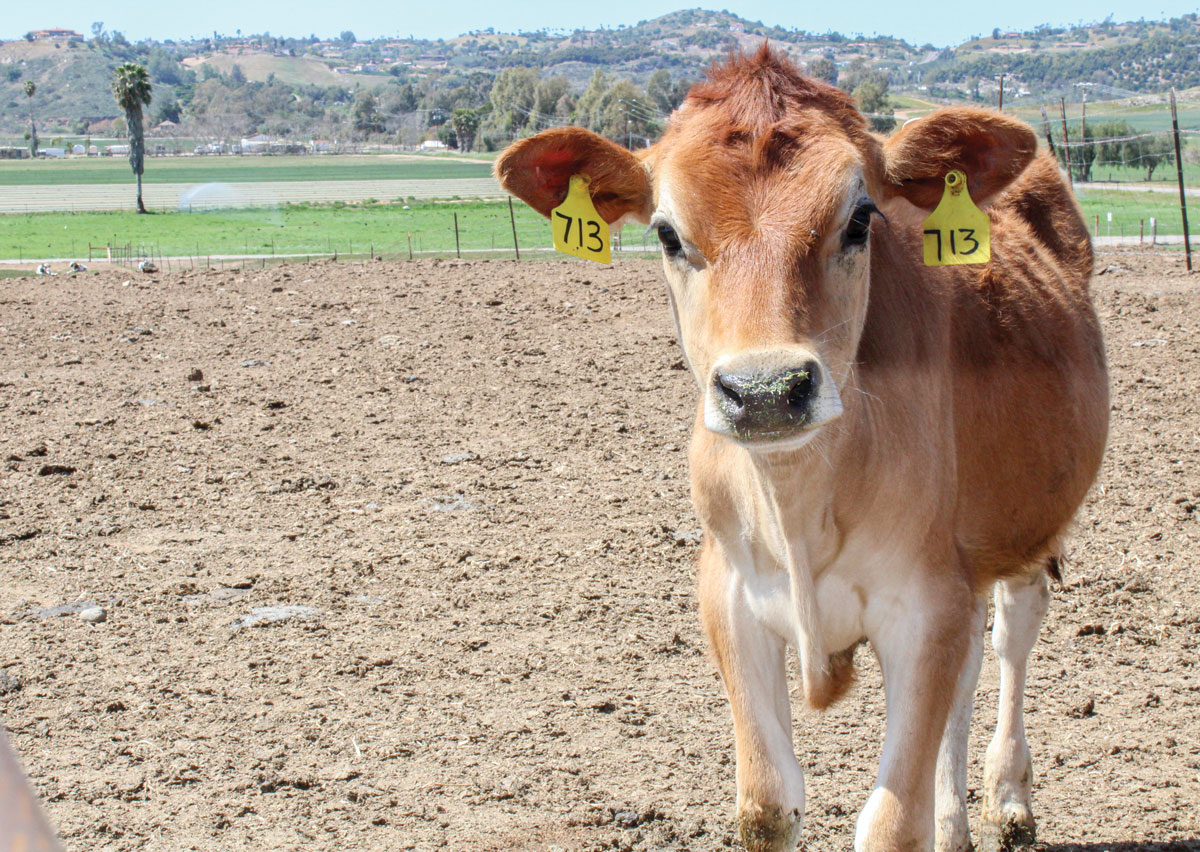
The last dairy farm in San Diego County nourishes its underground livestock just as much as its happy cows and heifers above.

Where there were once more than 100 dairy operations in San Diego County, two remain on record, according to the California Department of Food and Agriculture.

However, The Coast News confirmed that T D Dairy in Ramona is in the process of selling its herd — leaving the hundreds of cows at Frank Konyn Dairy as the last of their kind in the area.

T D will continue to survive, though in other ways, showcasing an ability to pivot and adapt that is naturally grown in the farmers of San Diego County.

In 1962, Holland-born Frank Konyn Sr. established a dairy in the San Pasqual Valley of Escondido on 250 acres leased in an agricultural preserve through the city of San Diego.

Now, decades later, the Frank Konyn Dairy is the last family-owned, self-sustaining dairy farm in the county. It is one branch, along with Konyn Dairy Farms, San Pasqual Valley Soils (SPVS), under the Frank Konyn Dairy Inc house.

Since 1962, the farm plus dairy operation now consists of 300 acres of irrigated and dry-farmed forage. Recently it leased an additional 290 acres for cut eucalyptus production, which brings its total acreage to about 700 acres. (This is in sharp contrast to the average farm size of 4 acres in San Diego County, nearly 350 for the state and 440 nationwide.)

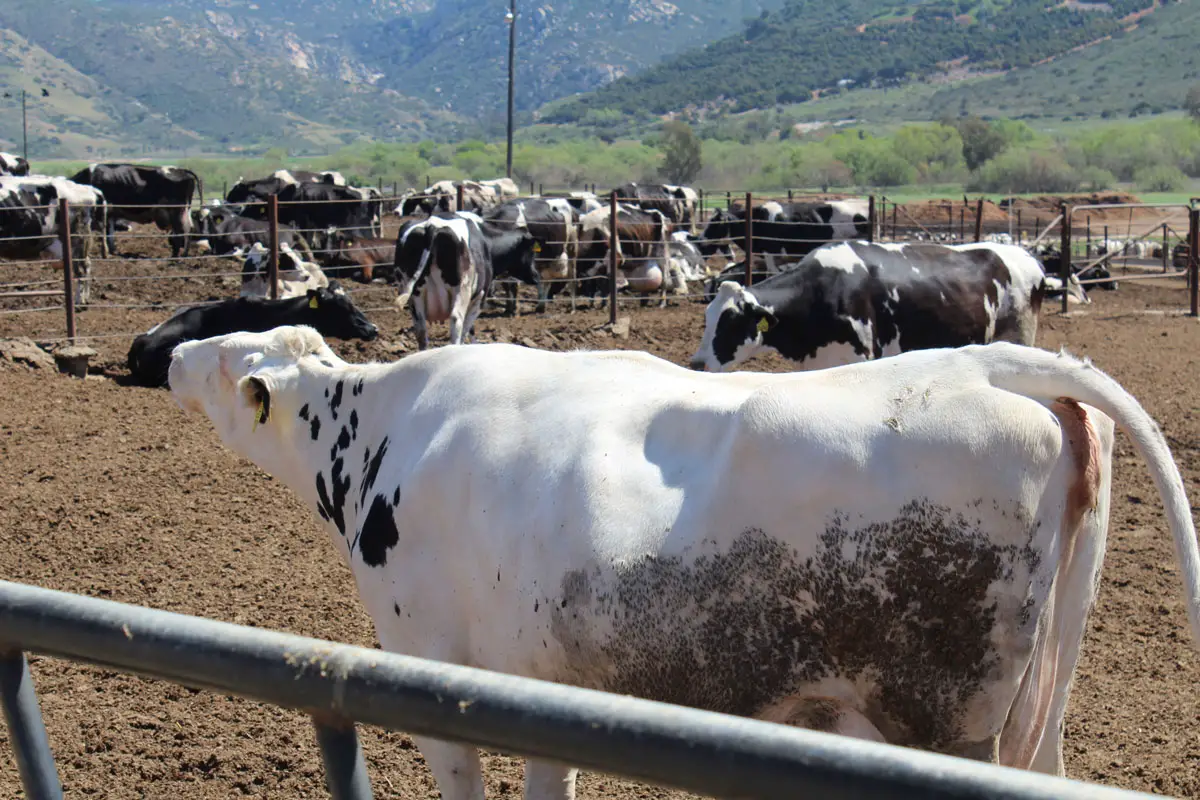
Konyn Dairy Farms home to hundreds of cows in a self-sustaining system that uses its land to help feed the herd, and uses herd waste to supplement revenue to stay afloat.
Konyn Dairy Farms is home to hundreds of cows in a self-sustaining system that uses its land to help feed the herd and uses herd waste to supplement revenue to stay afloat. Photo by Jacqueline Covey

“[We] continue to survive through innovation, diversity and a stubborn commitment to the principles of sustainability and hard work,” said Craig Kolodge, SPVS manager of business development and sustainability.

The Frank Konyn Dairy is approaching business and stewardship a little differently.

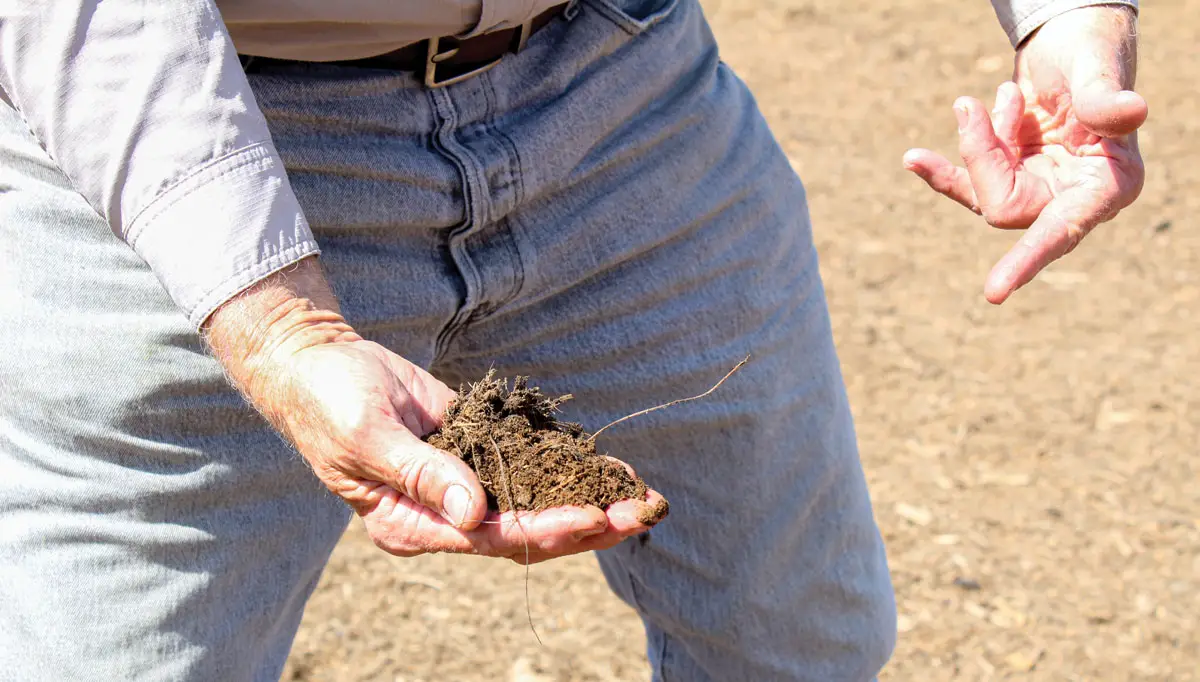
Typical soil in the area contains less than 1 percent organic matter. Organic matter is a major indicator of soil health.

This small percentage of microbial livestock is putting in work to loosen up the soil and retain what little water and nutrients it can in San Diego County. The Frank Konyn Dairy group practices regenerative agriculture, which builds soil health.

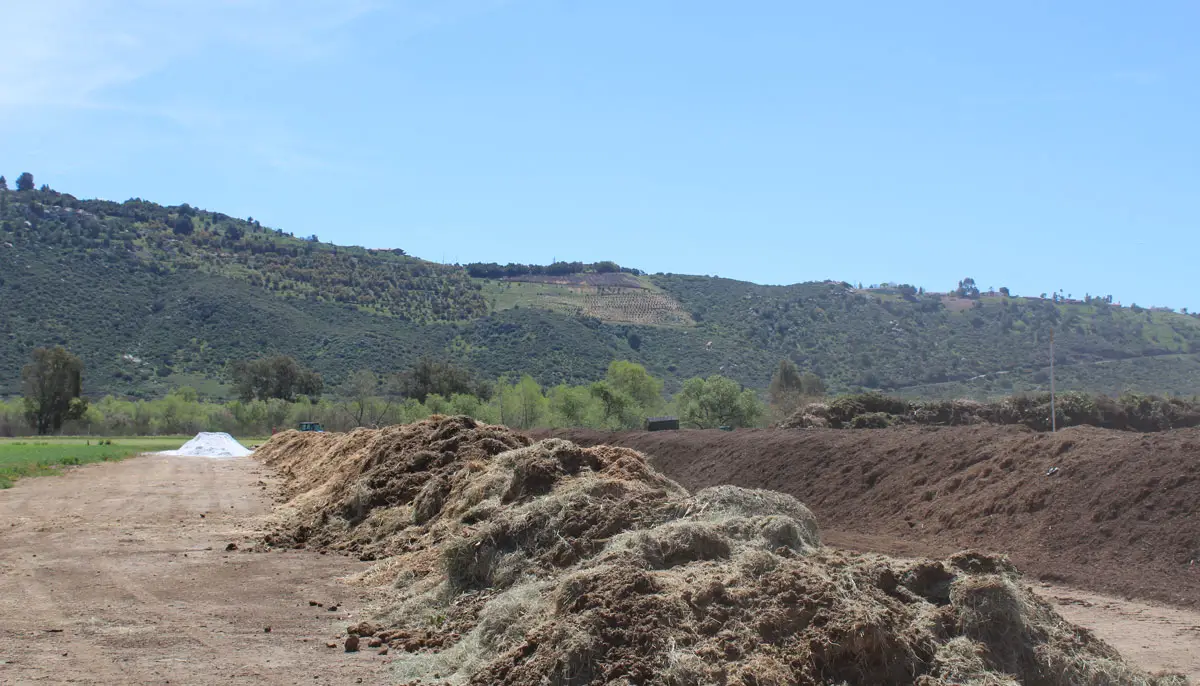
More than 15 years ago, a pile of manure sparked a unique composting business that would become an integral part of the survival of the Konyn Dairy, which is now owned and managed by Frank Konyn Jr.  By 2007, SPVS became a state-permitted composting facility, converting cow manure and recycled landscape trimmings into soil amendments for organic farming and landscapers in the county.

But the dairy doesn’t just supply this unique compost. In order to feed its massive herd, Foraging Manager Ernie Klemm and his team apply compost — some in part stemming from zoo waste — to the forage acreage at Konyn Dairy Farms.

Cow manure helped create a unique composting business, San Pasqual Valley Soils, that has become an integral part of the survival of Konyn Dairy.
Cow manure helped create a unique composting business, San Pasqual Valley Soils, that has become an integral part of the survival of Konyn Dairy. Photos by Jacqueline Covey

Frank Konyn Dairy now leases about 700 acres, 300 of which are dedicated forage land to help sustain the cow’s diet.  Driving through its land, which is nearby several other farms, one may notice Klemm’s fields don’t buckle in the way his neighbors do.

Locally, when it rains, some may see rain puddle and run-off fields, gardens or lawns. When soil is compacted, water has nowhere to go but out. However, when soil is healthy, water can infiltrate the soil and soak into the ground.

A one-percent increase in organic matter has the ability to increase water storage potential by more than 20,000 gallons, according to the Natural Resource Defense Council.

For six years, Klemm has land-applied locally produced compost from SPVS to increase and sustain organic matter between 4 and 6 percent on both irrigated and dry-farmed fields of Konyn Dairy Farms.

This has resulted in a “tremendous increase in water holding capacity of the amended soils” Klemm said, “although not nearly enough to offset the reduced rainfall in the area.”

“Alfalfa takes 19 to 32 inches of water to grow a harvestable crop,” Klemm explained.

The jump in water retention on Konyn Dairy Farms’ compost-amended fields allows alfalfa to be cut up to 10 times per year. Typically, without compost-amended fields, farmers can average between four to six cuttings per year. Even despite reduced rain events this year, Klemm said the dry-farmed crops are maintaining steady production. 

Konyn Dairy Farms maintains about 300 acres of forage land that helps feed the cows at the dairy. It takes about 150 pounds of feed to feed one cow.
Konyn Dairy Farms maintains about 300 acres of forage land that helps feed the cows at the dairy. It takes about 150 pounds of feed to feed one cow. Photo by Jacqueline Covey

At Konyn Dairy, forage crops are responsible for approximately 15 percent of the nearly 150 pounds of feed in the cows’ diet.  (A small — but growing — percentage of feedstock to support the dairy’s young developing cows comes from recycled grains from more than a dozen local breweries, as well as discarded bakery goods and fruit pulp from local juice businesses.)

“Feed to support the dairy is the largest cost for sustaining this livestock operation in San Diego County,” Kolodge said. “The amount and cost of food needed to support quality milk production is an ongoing challenge to all dairies, especially ones located outside large, rural agricultural communities.”

“[Konyn Dairy] functions on a sustainability model that depends on diversification and attention to not only the health of the dairy cows but also the health of the local land,” Kolodge added.

Like the Konyns and many others in North County, Klemm comes from a long line of farmers.

Even though Klemm joined Konyn Dairy Farms less than a decade ago,

Konyn Sr. predicted Klemm would one day join his operation when he was only a teenager.

In the 1930s, his grandfather immigrated from Zurich, Switzerland, to Imperial County and set up a dairy farm, which he would later move to Mission Valley in San Diego County.

Then, under the name Sweet Haven Dairy, the family was forced to relocate through the process of eminent domain in 1974, eventually landing in Fresno. Today, Klemm’s cousins still operate a successful milking farm with approximately 2,000 cows.

Urban sprawl has taken bites out of the county’s agricultural land for decades and is expected to continue.  While San Diego may be the eighth-largest city in the United States, its agricultural preserve remains a unique and vibrant part of the future of farming locally.

“The long-term goal of the dairy … the soils and farming operations is to continue to be a valuable resource for sustaining the values associated with the survival of local farms,” Kolodge said. 

Support from the urban communities within which the farm co-exists is an essential piece to that, he said, adding that the dairy would eventually like to start making products on site for those in the community.

“We can only accomplish that with strong support from the city and local citizens committed to the survival of local agriculture,” Kolodge said

Source: thecoastnews.com

Syngenta expects Ukraine harvest to fall by a third

The company doesn’t expect total failure

Swiss agrochemicals group Syngenta expects crops output in Ukraine to slump substantially this year, it said on Thursday, as it announced fourth-quarter results.

“We hope to be able to save around two-thirds of what would normally be possible,” a spokesperson said on Thursday, referring to the Ukrainian crops harvest. “We definitely don’t expect a total failure.”

The Chinese-owned group, which aims to raise around $10 billion from an initial public offering, sells both crop protection products and seeds, reported Reuters.

It said it was now selling these at the price of cost in Ukraine to ensure as high a harvest as possible.

“We are on the brink of a global food crisis,” CEO Erik Fyrwald said in a post LinkedIn, referring to the destruction of infrastructure, disruptions of transport and land and water contamination which he said were making it impossible for farmers to work.

Outside of conflict, the current growing season was also being affected by unprecedented floods, droughts and high levels of pest infestation, he said.

Ukraine is a major global agriculture producer and exporter, and Russia’s invasion of the country is expected to sharply reduce the 2022 harvest, with Agriculture Minister Roman Leshchenko telling Reuters its spring crop sowing area may more than halve this year.

Syngenta employs around 730 people in Ukraine and about 800 in Russia. It said it has no plans to withdraw from Russia. Crop production is not subject to various sanctions imposed on Moscow.

On a revenue basis, it said Ukraine and Russia each accounted for less than 2% of group sales.

Across the group, it said fourth quarter sales increased by 17% to $7.2 billion as it benefitted from farmers investing in seeds and sprays to boost production.

It said it had increased revenue generated from its training centres in China, where it added 167 new sites in 2021 to take its total to 492.

The sites train farmers in the latest agricultural techniques as well as supply equipment, seeds and pesticides.

Syngenta said it had continued to manage its supply chain in the face of procurement and other problems.

Earnings before interest, tax, depreciation and amortisation (EBITDA) rose 4% to $1.1 billion during the fourth quarter.

Syngenta, which competes with Germany’s Bayer and US agrochemicals company Corteva, was bought by state-owned ChemChina for $43 billion in 2017, and is currently looking into a flotation.

Source: Reuters

Larry Tande Obituary

Larry was a well-known Holstein breeder, long-time Extension agent and director, and past President of both the Minnesota Holstein Association and Holstein Association USA. In addition, he had a long career as a dairy cattle judge. He judged at most of the county fairs in Minnesota, countless state fairs, and twice at World Dairy Expo where he judged both the International Milking Shorthorn and International Brown Swiss shows.  He also officiated at several foreign dairy shows and other US National Shows.

Larry Tande of rural Medford, MN always referred to life as a journey. Now, at 83 years of age and 15 challenging years of multiple myeloma, his journey on earth has ended. Larry passed away Saturday morning, March 26, 2022, at his home.

Visitation will be Friday, April 8 2022, at the Medford Funeral Home from 4:00 pm to 7:00 pm. Funeral service will be 10:30 am Saturday, April 9, 2022 at First English Lutheran Church in Faribault, MN, with the visitation continuing one hour prior to funeral service at the church.

Condolences and memories for the family can be left here.

Dairy MAX Announces Executive Leadership Additions

Nonprofit regional dairy council Dairy MAX, which represents more than 900 dairy farmers in eight states, is pleased to announce that Marty McKinzie has been promoted to Chief Growth Officer of the organization, responsible for business development, industry image and relations, sustainability and organizational development. Dairy MAX has additionally hired Kay Johnson Smith as Chief Operating Officer, leading key areas of the business including consumer marketing, corporate communications, issues management, health and wellness and school marketing. McKinzie and Johnson Smith will report to Chief Executive Officer Mike Konkle, who has served in his role since 2007 and will continue to lead the growing organization.

McKinzie joined Dairy MAX in 2008 as Director of industry image and relations and currently is the Vice President of industry image and relations. He and his team are the conduit connecting Dairy MAX with the dairy farmers it serves, helping them build trust with communities through connections with farm tours, sharing checkoff program successes with youth inside and outside of schools and building relationships with business partners and health professionals. McKenzie has played a critical role in development of industry relationships, fostering growth and understanding through communication and annual one-on-one farm visits.

Johnson Smith joins Dairy MAX from the Animal AgricultureAlliance, based in Arlington, Virginia, where she served originally as Executive Director, then President and Chief Executive Officer for nearly 28 years. In that role, she was tasked with managing the organization’s operations, providing strategic guidance to the agriculture and food industry regarding farm animal issues and engaging stakeholders about the importance of modern animal agriculture.

“Dairy councils are an asset to farmers every day, supporting them in their efforts to provide and market dairy products to Americans,” said Mike Konkle, CEO of Dairy MAX. “The way we see it, dairy farmers have both tough and incredible jobs––and it is our responsibility to meet their expectations and serve them well. The addition of these two roles will help us to be positioned for continued success in the coming years. We look forward to Marty and Kay’s contributions.”

Dairy MAX is part of a nationwide effort to promote dairy, develop new dairy foods, provide educational information and increase consumption. It does so with a team of experts in dairy farming, business, education and health and wellness, working with organizations such as the National Dairy Council (NDC) and Milk Processor EducationProgram (MilkPEP). The organization is a longtime supporter of the Animal Ag Alliance, a nonprofit working to safeguard the future of animal agriculture, and looks forward to continued engagement with the organization into the future.

Hannah Thompson-Weeman named President and CEO of Animal Agriculture Alliance

The Animal Agriculture Alliance board of directors has announced that Hannah Thompson-Weeman, currently serving as the Alliance’s vice president, strategic engagement, has been named the organization’s new president and CEO. Thompson-Weeman will assume the role on May 1 prior to the departure of longtime president and CEO Kay Johnson Smith later that month to join the staff of Alliance member organization Dairy MAX, one of the leading regional dairy councils in America representing more than 900 dairy farmers and serving communities in eight states.

Description automatically generatedThompson-Weeman joined the Alliance in 2014 as director of communications and since that time has been promoted to vice president of communications before assuming her current role leading strategic engagement. She has led the Alliance’s issues management, crisis communications, animal rights extremist monitoring and influencer engagement work, as well as played an integral role in connecting with supporters and developing Alliance programs such as the Stakeholders Summit, Animal Ag Allies and College Aggies Online. Thompson-Weeman’s expertise and passion in these areas has made her a sought-after columnist for various publications and speaker for national and even international events, helping to build the Alliance brand. She holds a B.S. in agricultural communication with a minor in agricultural business and an M.S. in agricultural and extension education, both from The Ohio State University.

“Hannah’s history with the Alliance and energy for taking its mission to new heights make her the ideal choice for both a seamless transition and a bright future for the organization,” said Christina Lood, senior director, sustainability and innovation communications, Zoetis, and current Alliance chairperson. “The board of directors offers Kay the deepest gratitude for her nearly 28 years of commitment to the Alliance. The organization would not be what it is today if it weren’t for her pouring limitless time and energy into growing the Alliance’s resources, team and programs. We wish her all the best in her new role and look forward to continuing to engage with her both personally and professionally.”

Johnson Smith is departing the Alliance to join longtime Alliance member Dairy MAX as chief operating officer. A nonprofit organization headquartered in Texas and with operations in Colorado, southwest Kansas, Louisiana, Montana, New Mexico, western Oklahoma, and Wyoming, Dairy MAX is part of a nationwide effort to promote dairy, develop new dairy foods, provide educational information and increase consumption.

“While it is certainly bittersweet to leave the Alliance after so many years, I am looking forward to remaining in the animal agriculture community and continuing to be the Alliance’s strongest advocate, now as part of a member organization,” said Johnson Smith. “The Alliance will be in exceptional hands with Hannah leading a strong team with deep roots at the organization. It has truly been an honor to have served the Alliance, our members and the broader animal agriculture community for all these years, and I’m thrilled to be able to continue to do so in a new role going forward.”

Thompson-Weeman will begin her new duties just prior to the Alliance’s 2022 Stakeholders Summit, set for May 11-12 in Kansas City. Both Johnson Smith and Thompson-Weeman’s time at the Alliance and new roles will be celebrated during the Chairperson’s Reception at the event. For more information on the Summit, themed “Come Together for Animal Ag: Be Informed, Be Ready, Be Here,” and how to register, visit bit.ly/AAA22Summit.

About the Alliance:

The Animal Agriculture Alliance safeguards the future of animal agriculture and its value to society by bridging the communication gap between the farm and food communities. We connect key food industry stakeholders to arm them with responses to emerging issues. We engage food chain influencers and promote consumer choice by helping them better understand modern animal agriculture. We protect by exposing those who threaten our nation’s food security with damaging misinformation.

Find the Alliance on Facebook, Twitter, Instagram, and TikTok.

Cattlemen Care Blood Drive Set for May

To kick off the May is Beef Month celebration, the PA Beef Council (PBC) is teaming up with the American Red Cross to host the Cattlemen Care Blood Drive on May 10, 2022 in the Cameron Street Lobby of the PA Farm Show Complex. Donation times are available from 10:00 AM – 3:00 PM.

Currently, the American Red Cross is facing a national blood shortage, the worst in over a decade. This causes delays in care and can impact vital medical treatment for those in most critical need around the country. Currently Red Cross supplies approximately 40% of the nation’s blood supply.

“Teaming up with the American Red Cross to support a blood drive is a unique way for the agriculture community in PA to show our support. As cattlemen and women, we care for the land and livestock every day. Hosting a Blood Drive is one way for us to show our compassion for our community as well”, said Nichole Hockenberry, Executive Director of the PBC. “As we celebrate Beef Month, we want to not only celebrate the protein and great taste that beef has to beef offer, but also the people who produce it and the communities we are a part of”.

The event is open to the public and walk-in donors are welcome. An online sign-up portal is available and will expedite the registration process making the day flow more smoothly for donors. Donors who register by May 1 will receive a complimentary burger to refuel after their donation!

To register for the blood drive visit, the Red Cross website.

To learn more about the PA Beef Council visit www.pabeef.org.

Media Contact: Courtney Gray, cgray@pabeef.org or 814-623-2698

‘Everybody’s worried’: Farmers look to lock down fertilizer amid CP Rail shutdown concerns

Workers demonstrate in Calgary during the Canadian Pacific Railway work stoppage that started Sunday.
Workers demonstrate in Calgary during the Canadian Pacific Railway work stoppage that started Sunday.Photo by Gavin John/Bloomberg
Farmers are calling the Co-Op store in Neepawa, Man., maybe a dozen of them a day, asking if the shutdown on the Canadian Pacific Railway will make it harder to get fertilizer this spring.

“Everybody’s worried,” said Robert Melnyk, who manages the division that caters to farmers at the Neepawa-Gladstone Co-Op.

When farmers call, all he can tell them is that he hopes the terminals — the large warehouses that offload fertilizer from trains and store it — will have enough to go around. But if the labour dispute between CP and its union continues to halt all traffic on the second-largest rail network in the country, supply could start to get tight.

“If that happens, then we’re going to be allocating and limiting how many tons the growers can pick up each day,” he said.

The fertilizer concerns are part of a growing list of potential ripple effects from the CP shutdown, which stretched into a second consecutive day on March 21 as negotiators with CP and Teamsters Canada continued talks with federal mediators in Calgary. Both sides have argued publicly about who started the crisis, with the union calling the situation a lockout, while CP insists Teamsters went on strike first.

Advocates for Canada’s agriculture, energy, mining, and automotive sectors are all warning that a stoppage along CP’s lines will have impacts across the pandemic-battered North American supply chain. On farms, the situation threatens to stem the flow of crucial inputs like fertilizer and pesticides to some regions, which could reduce crop yields at a time when global grain supplies are already challenged by the Russian invasion of Ukraine.

It’s terrible timing

“It’s terrible timing,” said Matt Conacher, the senior fertilizer manager at Federated Cooperatives Ltd. (FCL), a wholesaler that buys product for local co-ops that serve farmers across Western Canada. “We rely quite heavily on CP.”

FCL orders fertilizer from domestic and international manufacturers, which is then transported by truck or rail across the Prairies. FCL operates three high-volume fertilizer terminals, two of which are supplied by CP trains. Conacher said FCL could supplement some of the lost rail traffic by using more trucks, but truck capacity is tightened due to labour shortages and heightened demand, and rates are up “astronomically.”

The federal government has so far resisted mounting calls to end the shutdown with back-to-work legislation, arguing that “the best deals are reached” at the bargaining table.

“When we talk about back-to-work legislation, what you’re talking about is depriving the leverage of workers. And you’ve got to do that after a great deal of thought,” Labour Minister Seamus O’Regan’s office said in an interview.

O’Regan said for a government to intervene, negotiations would have to be stalled. “That is not the case here. Negotiations are progressing. They are moving,” he said. “You’ve got to let that play out. … Let me just say, given what I know, I choose to be optimistic.”

Teamsters Canada Rail Conference, which represents roughly 3,000 engineers, conducts, train and yard workers, didn’t respond to calls on Monday, but the union’s Twitter account posted a cartoon showing a businessman perched on a mountain of money, accusing a worker of being greedy for requesting a raise to their pension cap. The two sides are reportedly at odds over pensions, wages and rules around work schedules.

CP’s net income was $2.9 billion in 2021, up from $2.4 billion the previous year, according to the company’s most recent earnings update. Annual revenues increased by four per cent to $8 billion.

The railway said it pays TCRC locomotive engineers an average annual salary of $135,442, and that the average pay of its conductors, yard workers and train workers is $107,872.

CP is also in the final stages of its plan to build the first rail network linking the U.S., Mexico and Canada. In December, CP’s US$31-billion acquisition of the Kansas City Southern (KCS) rail line closed into a voting trust. The company is now awaiting a decision later this year from the U.S. Surface Transportation Board on whether it can take control of the KCS network.

Negotiators didn’t reach an agreement before a 12:01 a.m. lockout deadline on Sunday, which CP initiated last week. Teamsters put out a release about 15 minutes before the deadline, blaming CP for locking out the union and putting the Canadian supply chain at risk.

“Canadian Pacific management must be taken to task for this situation,” spokesperson Dave Fulton said in the release.

But CP accused TCRC of “withdrawing services” — which essentially means workers stopped working — before the midnight deadline. After that, CP shut down its operations, CP spokesperson Salem Woodrow said.

“CP did not lock out its employees,” she said, adding that “CP made an offer and was sitting at the table waiting for a response” when TCRC issued its news release about a lockout.

Around Neepawa, Man., farmers don’t always have the space to store a whole spring’s worth of fertilizer. So Melnyk, at the Co-Op store, expects many to start coming to pick up their orders in April and May as needed, sometimes making daily trips. He estimated that about 50-60 per cent of the fertilizer his clients need for the season has already bee shipped to farms. But to be able to fill those orders, he needs the terminals to keep sending product.

“It definitely has us concerned,” he said.

Source: financialpost.com


Resolution Calls for Overtime Threshold to Remain at 60 Hours for NY Farms

The Grow NY Farms Coalition has announced that the New York State Association of Counties (NYSAC) is in support of maintaining the current overtime threshold at 60 hours for family farms across the Empire State.

During their 2022 Legislative Conference in Albany, which took place March 14-16, NYSAC passed a resolution affirming the group’s support of the current 60-hour overtime threshold.


NYS Association of Counties President and Tioga County Chair Martha Sauerbrey said, “New York’s counties are proud to stand with the family farmers and farmworkers who produce the food that fills our grocery store shelves, our school cafeterias and local foodbanks in opposing this change to the overtime threshold. We need to be doing everything we can to support our local farmers as they confront challenges from increasingly erratic weather and rising costs of feed and fuel, not adding additional burdens that threaten their ability to feed our communities and power local economies.”

NYS County Executives Association President and Dutchess County Executive Marc Molinaro said, “New York’s counties have sent a clear message that we cannot let our farmers and farmworkers lose income, hours, or the ability to continue providing local milk and food to our communities. These multi-generational family-run businesses are essential, and can’t stand by and allow them to go out of business, while their employees leave to work more hours in competing states. Nourish NY, food pantries, local grocery stores, school districts – all of our programs and food hubs depend on our local supply chain. Any reduction in the overtime threshold will only put family farms and New York’s food security at risk.”

NY Farm Bureau Vice President, and Partner at A. Ooms & Sons Dairy Farm in Columbia County, Eric Ooms said, “New York State’s county leaders have made their voices heard, and we hope that Governor Kathy Hochul is listening. We’re grateful for NYSAC’s support and partnership as we continue to advocate for the viability of New York’s farms and protection of the state’s local food supply. We cannot ignore the more than 70% of participants who asked to maintain the threshold during Farm Laborers Wage Board hearings. University researchers, industry experts, local and state officials, in addition to farmers and farmworkers, have asked to keep the threshold at 60. If we want to protect these family businesses for the next generation of farmers and farmworkers, the threshold must remain at 60 hours.”

Northeast Dairy Producers Association Chair, and Partner at Ideal Dairy Farms in Washington County, John Dickinson said, “Now is not the time to increase costs for an industry that cannot pass these increases on to consumers. Family farms are having to decide between filling the tractor’s diesel tank at more than $5 a gallon to start planting in the fields, or purchasing feed for their herd which has also skyrocketed over the past year. Any reduction in the overtime threshold is a lose-lose – for our employees, the Nourish NY program, the diversity of the state’s agriculture industry, and the viability of the future of farming in the Empire State. We’re asking Governor Hochul to stay at 60.”

New York State Vegetable Growers Association President, and Partner at Reeves Farm in Onondaga County, Brian Reeves said, “Our employees want to work. They understand the need to plant and harvest when Mother Nature allows, and they have a passion for caring for the land, each other, and the fresh produce that results from all our preparation, efforts, and teamwork. Unfortunately, farms are already feeling the unintended consequences of the 60-hour threshold, as employees choose to work for our competitors in order to get the hours they’re looking for. At the same time, our margins are increasingly razor-thin and we’re unable to donate as much food as we used to. If we have any chance at retaining our skilled workforce and continuing to provide to our neighbors and families across the state, Governor Hochul must keep the overtime threshold at 60.”

Source: Grow NY Farms

2022 National Guernsey Convention Hosted by The Ohio Guernsey Breeders Association

The Ohio Guernsey Breeders Association is to host the 2022 National Guernsey Convention in Wooster, Ohio with event headquarters at the Best Western Hotel, Tuesday, June 21 – Friday, June 24.

Tuesday, June 21 is optional pre convention tours at the Pro Football Hall of Fame and McKinley Library, Museum and Science Center in Canton, OH. Convention commences Tuesday evening at the Best Western with a welcome dinner and youth pizza party.

Wednesday, June 22 youth contest and adult committee meetings and seminars will be held, and Adult Awards dinner in the evening at the Best Western.

Thursday, June 23 join us for farm tours at Edward Keim, Pine Grove and Springhill, lunch at Der Dutchman in Walnut Creek, Oh. With a youth banquet and youth auction in the evening, at the Wayne County Fairgrounds.

Friday, June 24 attend the Annual Meeting of the American Guernsey Association and 2022 National Convention sale, at the Wayne County Fairgrounds.

To book a hotel room call 330-264-7750. Convention ticket prices will be announced after April 10, 2022, with a reservation deadline of May 16, 2022.

For up to date information follow the 2022 National Guernsey Convention on Facebook and instagram (2022nat.guernseyconvention)

Orego-Stim Lowers AMR Risk from Waste Milk

Waste milk occurs on farms where antibiotic treatment has been administered to cows. It cannot be sold for human consumption but as it contains valuable nutrients, it remains a popular source of nutrition for pre-weaned calves. It’s estimated that over half of the calves in the U.S. are fed waste milk that otherwise would be poured down the drain. Although nutrient-rich and inexpensive, there is risk of antibiotic residues in waste milk.

When calves are fed waste milk containing antibiotic residues, bacteria within the gastrointestinal tract can develop antimicrobial resistance. Research conducted at the University of Reading in England was undertaken to determine the effect of supplementing waste milk fed to dairy calves with Anpario’s Orego-Stim Liquid (a source of 100% natural oregano essential oil), on the population of antimicrobial resistant bacteria in their feces.

Calves were offered either waste milk supplemented with Orego-Stim Liquid for ten days (5ml per 2.5L milk twice daily) or a control diet of the same waste milk source without the addition of Orego-Stim Liquid. After ten days all calves were fed the same ration of unsupplemented waste milk and concentrates until weaning.

In the feces of control calves, 44.1% of the E. coli present were resistant to the 4th generation cephalosporin antibiotic cefquinome. In calves fed waste milk supplemented with Orego-Stim Liquid, only 12.6% of E. coli were resistant. In addition, calves fed the supplement shed Cryptosporidium in significantly lower amounts.

Orego-Stim was awarded a UK patent following the work, with the composition of the additive being effective in reducing antimicrobial resistance*. Waste milk is a valuable resource and this trial work shows that it may be possible to support calf gut health and enable the continued use of this vital calf feed.

Source: Dairy Calf & Heifer Association

USDA Publishes Origin of Livestock Final Rule for Organic Dairy

Today, the U.S. Department of Agriculture published the highly anticipated Origin of Livestock (OOL) final rule for organic dairy. This change to the USDA organic regulations will promote a fairer and more competitive market for all organic dairy producers, by making sure that certified USDA organic dairy products are produced to the same consistent standard.

“This action demonstrates the USDA’s strong commitment to America’s organic dairy farmers,” Agriculture Secretary Tom Vilsack said. “The Origin of Livestock final rule provides clear and uniform standards about how and when livestock may be transitioned to organic dairy production, and how transitioned animals are managed within the organic dairy system. Now, all organic dairy livestock producers will have the confidence and certainty they are operating in a fair and competitive market.”

“Consumers of dairy that carry the USDA Certified Organic Seal can trust that those products meet their expectations for how organic dairy products are produced,” said Under Secretary for Marketing and Regulatory Programs Jenny Lester Moffitt. “At the same time, the rule announced today also ensures new organic producers have a fair way to enter the market.”

USDA’s National Organic Program (NOP) will oversee the new rule, which in general:

  • Allows a dairy livestock operation transitioning to organic, or starting a new organic farm, to transition non-organic animals one time.
  • Prohibits organic dairies from sourcing any transitioned animals. Once a dairy is certified organic, animals must be managed as organic from the last third of gestation. Variances may be requested by small businesses for specific scenarios.

More information about the Origin of Livestock rule is available at: www.ams.usda.gov/rules-regulations/national-organic-program-origin-livestock

Hellebrand Lasting Legacy Award Application Deadline is June 15, 2022

Applications for the 2nd Annual Hellenbrand Lasting Legacy Award (HLLA) are being accepted now through June 15, 2022!

To honor Mike Hellenbrand and continue the legacy of Mike and his wife, Linda, the annual Hellenbrand Lasting Legacy Award (HLLA) was established to provide an aspiring and deserving dairy youth 50% ownership in a September, December or March heifer calf, born from a recent World Dairy Expo breed champion lineage.   Highlights of the program include developing the heifer with the guidance of a designated mentor, and showcasing her at local, state and national shows.   

Last year’s winner, Alison Gartman from Sheboygan,WI, received a Guernsey heifer calf from the 2017 WDE Guernsey Grand Champion, Springhill Mentor Jazzy-ET.   Breeder Springhill Farms in Ohio provided the calf.  Alison plans to showcase her heifer beginning in May.   

The 2022 award will be an Ayrshire heifer calf from the 2021 WDE Ayrshire Grand Champion, Marilie Gentleman Karmina.  The breeders, Budjon Farms and Peter Vail, will provide the calf to the HLLA award winner next spring for the 2023 show season. The breed of the calf awarded in subsequent years is expected to rotate amongst all the dairy breeds. 

Applications are now being accepted.  The deadline is June 15, 2022.  The HLLA recipient will be named in September, 2022.  

Go to www.mikehellenbrandlastinglegacy.com for nomination, application and award details.
Follow us on Facebook:  Mike Hellenbrand Lasting Legacy Award  

Judge Rules for Neighbors in Case Against Panton Dairy Farm

A large Panton dairy farm must make changes to stop turbid runoff and foul odors from contaminating a downslope neighbor, a state judge ruled Monday.

The decision by Superior Court Judge Mary Miles Teachout, following a civil trial held in December and January, does not specify how the three Vorsteveld brothers, who operate one of the 38 largest dairy farms in Vermont, must halt the pollutants. As Seven Days previously reported, the case also touched on broader issues in the dairy industry and how Vermont regulates farms.

Neighboring landowners Vicki and Dennis Hopper sued Vorsteveld Farm in 2020, alleging that runoff was interfering with life at their lakefront home and the operations of their daughter’s grass-fed livestock farm, known as Aerie Point.

The problems began when the Vorstevelds installed a tile drainage system in 2017 as part of a farm expansion project, Teachout concluded in a 32-page decision. The drainage system turned periodic streambeds into constant flows of brown water and “black sludge” that had high levels of E. coli and phosphorus. One of the Hopper’s grazing fields was eventually covered with water, preventing their livestock from using it. Aerial photos displayed at trial showed the dairy farm runoff flowing into Lake Champlain.

The pollution amounts to a nuisance and trespass of the Hoppers’ land, Teachout ruled.

Vorsteveld Farm “shifted to the Aerie Point owners the consequential costs of its changed agricultural practices, thereby damaging Aerie Point land through erosion and contamination and flooding,” she wrote. “It essentially discharged its waste onto Aerie Point land and let the consequences fall on Aerie Point as owner in a manner not done prior to 2017.”

 From left: Gerard, Rudy and Hans Vorsteveld - FILE: CALEB KENNA

  • File: Caleb Kenna
  • From left: Gerard, Rudy and Hans Vorsteveld

At trial, the Vorstevelds contended that the increased discharges were a symptom of climate change. Teachout was unpersuaded. While climate change may exacerbate the situation, she wrote, the Hoppers had proven by a preponderance of the evidence that the environmental changes were primarily caused by changes in the Vorstevelds’ farming practices.

The Hoppers had asked the court to impose a remedial plan suggested by their expert witnesses that involved changes to the Vorstevelds’ crop patterns, installation of vegetative buffers and more. Teachout said the court does not have the authority to impose specific fixes, only to require the Vorstevelds to stop the nuisance and trespass.

“The Farm should meet the obligation of every business or property owner to dispose of its own waste products responsibly rather than discharge them onto their neighbor’s land,” she wrote. “To prevent future trespasses and damage from nuisance, it is not necessary for Vorsteveld Farm to change its farming practices; it is only necessary that it manage its own waste.”

The Vorstevelds have previously faced state and local enforcement action over their land management practices, including a $21,750 fine by the Agency of Natural Resources in 2020 for improperly dredging and filling wetlands. The state environmental agency has received more than two dozen complaints about the farm over the last five years, but it did not intervene in the runoff issue, saying drainage disputes between adjoining property owners don’t fall within its jurisdiction, Seven Days previously reported. The Agency of Agriculture, Food and Markets didn’t get involved, either.

“The Agency of Agriculture utterly failed to address the environmental problems here,” the Hoppers’ attorney, Rob Woolmington, said in an interview following the decision. “It required the court to do the job the agency should have done.”

The Vorstevelds’ attorney did not immediately respond to a request for comment.

Source: sevendaysvt.com

Mabel Bush couple named Share Farmer of the Year at Dairy Industry Awards

2022 Southland-Otago Dairy Industry award winners, from left, Aidan Roe, Hamish Day, Emma Day, and Laura Murdoch.

Emma and Hamish Day were named 2022 Share Farmer of the Year at the Southland-Otago Dairy Industry Awards in Invercargill on Saturday night.

The Days, who contract milk 700 cows for Peter and Maria Clinton on their 220ha property at Mabel Bush just out of Invercargill, picked up the honour at the event held at Bill Richardson’s Transport World.

They claimed $13,176 in prizes plus four merit awards on Saturday night.

The couple, both 36, left Wellington in 2011 to enter the dairy industry. Hamish was a builder and Emma worked at AMP Financial Services before making the move.

“Hamish was a city boy all his life but had a taste of farming through my family who are dairy farmers and he really enjoyed the diversity,” Emma said.

The couple would like to see stronger promotion of the dairy industry in schools.

“Coming from an urban school in Wellington, Hamish never knew of the dairy industry as a career choice and was only offered information about trades.”

“It’s such an amazing career path as it provides so much diversity, it’s not just cows and grass.”

Although there have been some tough times.

“We faced financial pressure in 2014/15 and 2015/16 seasons with the low pay-out when we were LOSM [lower order sharemilkers], however, we came out of it in good financial shape after watching our budgets.”

“We try to use everything as a lesson, and it’s never a negative. It’s the only way to grow when you’re uncomfortable.”

Their future goals include another contract milking position with the ultimate goal of farm ownership.

The other big winners on Saturday night were Laura Murdoch who was named the 2022 Southland/Otago Dairy Manager of the Year, and Aidan Roe the 2022 Southland/Otago Dairy Trainee of the Year.

Murdoch, is 2IC for Chris Reilly on his 83ha, 230-cow Mokotua property, and was delighted to be named winner of the 2022 Southland/Otago Dairy Manager of the Year on Saturday night.

The former accountant aims to be a leader in the industry and inspire others with her journey.

“I’d love to showcase the joys and highlights of dairy farming, it’s a very rewarding industry to be a part of.”

“I’d love to help remove some of the wrongly-assumed stigma that’s often associated with dairying.”

Aidan Roe, Dairy Trainee of the Year, believed it was awesome to be a young person in the dairy industry.

He is farm assistant on Peter Sanford’s 200ha Winton property, milking 560 cows.

Roe has a Bachelor of Agricultural Science from Lincoln University and felt the pandemic had shown the world how important the food and fibre sectors are.

“I will be part of the generation of farmers that will have to make some pretty big changes to the industry to suit consumers’ demands,” he said.

Source: stuff.co.nz

Researchers use cameras to study the social interactions between cows

Data from sensors, showing the position of the cows, in combination with a video stream taken by cameras installed in the barn, are used to study the behavior of dairy cattle.

In a pilot study, at one of Swedish University of Agricultural Sciences´s research barns, Keni Ren and her colleagues show that a combination of sensors and cameras gives a really good picture of what is going on among the cows in the barn.

“Data from cameras add a whole new dimension to social behavioral studies,” says Keni Ren who recently defended her doctoral thesis at Umeå University.

The method of using cameras as a complement to real-time locating sensors was investigating with a focus on the social interactions between cows gathering around the feeding table, for example when younger individuals are introduced to an existing herd.

“When examining the competition and interactions between cows of different social rank, various sorts of information, like who, where, and what happened need to be taken into the measurement,” says Ren who is now a research assistant at the Department of Animal Breeding and Genetics.

All the cows want a place at the feeding table. They can be pushed away by other cows, or voluntarily leave room for someone else. This can be captured by the sensors installed in the barn and then analyzed by computers.

Through machine learning it is possible to analyze a large amount of videos and this gives many clues about the social interactions in the context of the time-series information.

The study was conducted on a smaller scale, with positioning data and visual data from only ten cows. But it shows that the technology works and it can be scaled up for monitoring a larger herd. In practice, it could be used as a tool for early detection of situations of stress among the cows.

The large amount of data that is generated is especially interesting for researchers who want to know more about behavior. The limitations are partly the design of the barn, and partly how many cameras you can set up. Another technical limitation is the battery capacity of the sensors, which currently lasts about two months.

“This study is quite technical but it shows that the method works. It is fun to apply technological development on this type of behavioral study, which can give us valuable information about the dairy cows,” says Ren.

This pilot study was conducted by researchers at Umeå University together with researchers at the Swedish University of Agricultural Sciences.

Source: thedairysite.com

Send this to a friend