Archive for News – Page 134

What to Take Away from Canada’s Vast Agriculture Survey

Canada’s agricultural industry received its five-yearly health check this month, with the publication of the 2016 Census of Canadian Agriculture – an incredibly detailed and comprehensive insight into the country’s farming sector. Angela Lovell pulls out the key stats and trends.

There are fewer agricultural operations in Canada today than there were five years ago, and although many are still family owned, they are larger and are growing more crops.

The newly released 2016 Census of Canadian Agriculture recorded 193,492 agricultural operations, down almost six per cent from 2011. Meanwhile, average farm size has increased to 820 acres from 779 acres, and cropland area has increased by almost seven per cent to a record 93.4 million acres, which accounts for almost 59 per cent of total farm area.

The good news for Canadian agriculture is that even though the overall number of farm operators in Canada continues to decline, there are more young people entering the industry than at any time during the past 45 years. The number of young farmers (that is, operators recorded in the census who were under the age of 35) had increased by three per cent from 2011 – the first time this age category has grown since 1991 – and they now make up just over nine per cent of all farm operators. The province of Manitoba has the largest proportion of farm operators under 35 years of age and the second youngest population of farm operators in Canada (after Quebec).

More women farmers

There are now two female agricultural operators for every five male operators in Canada, and they account for almost 29 per cent of all farm operators (up from just over 27 per cent in 2011). British Columbia in the west of the country is leading the trend, with the highest proportion of female farm operators (37.5 per cent) in Canada.

The proportion of Canadian farms operated solely by women grew by almost two per cent, and young women seem to be entering the industry at a faster pace than young men. The number of agricultural operations run solely by women under the age of 35 has grown by 113 per cent to 1,045 in the past five years. Operations solely run by male operators in the same age category, meanwhile, only increased by 24 per cent.

Although the trend for young farmers entering agriculture is encouraging, the average age of farmers has climbed to 55, and farmers aged 55 to 59 still make up the majority of operators across Canada.

More land rented

Farmland prices in Canada have been rising at a dramatic pace since 2011, spiking at an average increase of 19 and 22 per cent in 2012 and 2103 respectively. The average cost per acre across Canada is $2,696, an increase of almost 39 per cent from the previous census, but land prices are highly variable in different regions of the country and remain particularly strong in western Canada. The increase in land costs can be a barrier to establishing or expanding farm operations.

Given the high cost of purchasing farmland, it’s not surprising that more young farmers are renting land instead. Just over half of farmers aged 35 and under rented land in 2016, compared with 35 per cent of all agricultural operations. In all, more than 40 million acres are now under some form of rental agreement.

Farmers are working fewer hours

Canadian farmers are increasingly embracing technological innovation as a way to grow their farms without increasing labour requirements and costs. In 2010, more than 40 per cent of farm operators worked more than 40 hours per week – but that figure had dropped to 37.5 per cent by 2015, although the proportion varied by operation type and age group, with dairy operators and those under the age of 35 being most likely to work 40 or more hours a week.

The number of farmers taking on additional, off-farm employment also declined over the census period from almost 47 per cent of operators.

Optimising land use

Innovations in plant genetics, fertiliser and seeding technology, and changes in the type of crops grown, have contributed to an increase in the acres of cropland under constant cultivation. The adoption of no-till seeding technology – which allows farmers to retain crop stubble to trap snow, help conserve moisture and improve soil structure – has been a significant factor in reducing land in summer fallow by more than 57 per cent. The total area of land seeded using no-till technology increased by almost 17 per cent to 48.2 million acres between 2011 and 2016.

Diverse farm operations

Oilseed and grain farms account for almost 33 per cent of all Canadian agricultural operations and continue to constitute the highest proportion of farms in Canada, with most concentrated in Ontario and the Prairie provinces of Alberta, Saskatchewan and Manitoba. Although beef ranching and feedlot operations declined by 3.7 per cent over the past five years, they still account for the second highest proportion (24 per cent) of all operations.

Although canola and spring wheat dominate crops in western Canada and soybeans, corn and winter wheat are staples in the east, soybean has made significant inroads in western Canada over the past five years, as earlier maturing varieties have been developed to suit short, Prairie growing seasons. Manitoba soybean acres have doubled in the past five years, and the province now accounts for one-third of all soybean acreage in the country.

Corporate farms on the rise

As farm size and complexity have increased over the years, more farms are incorporating because of the management, taxation and legal advantages that incorporation offers to the farm business. Forty-five years ago, 97 per cent of Canadian farms were sole proprietorships or partnerships, but by 2016 only three-quarters had this organisational structure. The remaining 25 per cent of farms are now incorporated, and most are still family owned.

As the average age of farmers in Canada continues to rise, succession planning is an issue that many family farms are dealing with – and for the first time, the Census of Agriculture includes information about this. Surprisingly, only 8.4 per cent of all agricultural operations have a written succession plan. Capital-intensive, supply-managed operations such as dairy, milk, poultry and egg farms were most likely to have a formal succession plan in place.

You can view the 2016 Census of Canadian Agriculture by clicking here.


Source: The Cattle Site

Cow creations catch eyes

A cement-cow lawn ornament was once iconic in the front yards of Wisconsin dairy farms, frequently accompanied by a farm sign. When farmers retired and moved in town, they frequently took their cement cows with them to restore them to their rightful spots on front lawns.

FAST Corporation of Sparta has taken cow statues – and three-dimensional likenesses of everything else for that matter – to an entirely new level. Exhibiting at the 2017 Professional Dairy Producers of Wisconsin’s business conference in Madison, Wisconsin, FAST’s herd of life-size and over-sized cows drew lots of attention — as its colorful true-to-life animals and whimsical critters do wherever they happen to be.

FAST stands for “Fiberglass Animals, Shapes and Trademarks.” The Monroe County, Wisconsin, company makes fiberglass statues, roadside attractions, themed water slides and larger-than-life creations of all kinds, including apples, pumpkins, a 30-foot eyeball, pheasants, flamingoes, spiders and jack rabbits wearing saddles. If somebody somewhere can name it, they’ll make it.

“They’re all individually painted,” said Darren Schauf, FAST’s general manager and vice-president.

Schauf grew up working on a farm in the family that his cousin runs now; he wanted to be a farmer. But he has worked for FAST 10 years now, one of about 20 employees.

FAST Corporation had its beginning in the late 1960s or early 1970s and for many years was a work in progress. In 1978, then operating as Creative Display, the business completed its revered 145-foot-long musky at the Freshwater Fishing Hall of Fame in Hayward, Wisconsin.

In 1983, Jerome Vettrus incorporated the company under its present name and moved it in the direction of producing themed water slides. Vettrus sold it to his buddy James Schauf – Darren Schauf’s father – in 2000. Whether it’s as outrageous as a 15-foot golf ball perched on a tee or a 14-foot-tall pineapple, or as somberly patriotic as a trio of almost-7-foot Vietnam solders in combat gear, FAST’s creations are eye-catching and typically colossal. The largest creation FAST has built is a pair of eagles with 300-foot wingspans that perch on tribal buildings at Red Lake, Minnesota.

Cows are a mainstay, Schauf said.

“It’s the dairy state,” he said. “Holstein cows were a natural.”

FAST’s dairy herd includes cows that are 3, 10 and 14 feet tall. The firm makes a life-size cow, a reclining cow that’s a bench and a dairy calf. A life-size cow weighs 125 pounds and generally takes six weeks from order to delivery on the farm. A cow can be custom-painted at a farmer’s request, to reflect a family’s favorite herd member.

“We can make any breed,” Schauf said. “We use paint to distinguish breed. I know there are some structural differences in the Brown Swiss.”

FAST produced all of the Amazing Grazing Cows displayed at businesses and on the streets of Thorp, Wisconsin. There are at least two dozen. The city provides visitors with a checklist and map so they can see them all.

Schauf said FAST is partnering with a New Hampshire firm for “The Incredible Milking Cow.” FAST produces the shell. Marquis Enterprises turns that into an interactive cow that teaches the art of hands-on milking by adding electrical components, a self-contained pump that delivers constant fluid to the udder, and mooing sound effects. The Incredible Milking Cow, which comes in two sizes, also talks, providing educational facts about her real-life herdmates.

“You plug it in and basically forget about it,” Schauf said of the educational bovine.

In Wisconsin, Incredible Milking Cows are at the Children’s Museum in Eau Claire, Pagel’s Ponderosa Dairy in Kewaunee, Holland’s Family Cheese in Thorp and Green Meadows Farm in East Troy to mention just a few.

FAST has also beef bulls and steers, from Hereford to Brahma, and Black Angus to Scotch Highland. The company’s colorful catalog includes pages of other farm animals including pigs, a sheep, a goat, horses, a 7-foot rooster, dogs and more.

There are pages of water slides and other pool features, school mascots, national brands and trademarks like an 8-foot A&W Bear and a 9-foot bottle of Tabasco. There are characters such as a Native American and trapper in a birch-bark canoe, an 11-foot lumberjack with a blue ox, a 6-foot Frankenstein head, a 30-foot Abe Lincoln, and pages of giant fish, food, birds and wild animals.

Schauf said his company has also made giant ice cream cones, big wedges of cheese, huge milk jugs and a 20-foot-long relief of dairy products.

Like running a farm, making roadside creations means doing something different every day, Schauf said.

“They put joy on people’s faces,” he said. “It’s not your typical product. I enjoy seeing how happy people are when they see our products.”


Source: Ag Update

Dairy Industry Sees Value In Indy 500 Tradition

The leader of the Dairy Business Association says milk’s place in the Indianapolis 500 auto race is a tradition that’s important to the industry.

President Mike North says it’s always nice when you see an event like the Indianapolis 500 that’s closely followed by a very broad demographic to be promoting dairy. “That promotion is always well received by the dairy industry and certainly one that we hope can continue to spell out the health benefits and nutritional value of not just fluid milk, but all dairy products.”

The winner of the race not only gets the trophy, but also a big, cold bottle of milk. It’s a winner’s circle event that first happened 84 years ago, but became an annual tradition in 1956. The American Dairy Association of Indiana arranges the winner’s milk delivery each year, and they promote dairy products through the Fastest Rookie program.

Source: Brownfield

Dairy farmer kicked out of Lush store, contends viral post

A Grand Rapids area mom’s Facebook rant about how her son was treated at a Lush store in Woodland Mall has gone viral.

Leslie Van Houten Parrish, of Caledonia, said her teen son was shopping for a gift for his girlfriend when an employee allegedly asked him to leave the high-end beauty retailer known for its “100 percent vegetarian” products.

The 17-year-old, who was wearing clothes that indicated he worked on a dairy farm, was told the beauty retailer “didn’t support farmers and stood against cruelty to animals and refused to sell to him,” according to Van Houten Parrish’s May 19 post, which had more than 6,900 shares by the morning of Monday, May 22.

An email to Lush’s spokesperson requesting a comment wasn’t immediately returned Monday morning. 

Van Houten Parrish said her son explained how his family’s farm goes “above and beyond to care and nurture our animals.”

When the Lush employee refused to relent, Van Houten Parrish says her son said “I farm you eat!” before leaving.

The angry mom says she will never shop at Lush again, and unleashed her fury on what she sees as the ignorance about the connection between farms and food:

“So for all you LUSH employees I hope you don’t drink milk, soy or almond milk, eat ice cream, cheese, yogurt, eggs, cereal, bread, pasta, steak, chicken or pork, eat your vegetables or put your creamer in your coffee at Starbucks. EVERYTHING here is provided by a farmer. They work hard to provide for you AND your customers which keep you in business.

***And maybe you don’t realize that the ingredients YOU USE (soy yogurt and soy milk) in your products are available because of FARMERS!!!*** I supported your business because you didn’t test on animals. We treat our animals with love and respect. But I refuse to support you when you can’t support those help make your business profitable.  This world needs farmers more than it needs bath bombs. #Ifarmyoueat

Van Houten Parrish followed up with a comment in the post on May 20 after talking to the store’s manager, who says he is looking into the incident.

“At first he thought it was a miscommunication. But after telling him it clearly wasn’t when the clerk made a statement to him ‘how would you like to be chained up most of your life?’ He was caught a little off guard. This was not what was told to him by the employees working that night. I am continuing to work with them to educate their staff,” she wrote.

Lush, a UK-based beauty company with a passionate following for its handmade skincare and cosmetics, opened its lone West Michigan location at Woodland in 2014. The company also has three stores in metro Detroit and one location in Ann Arbor.

The retailer’s products are described as 100 percent vegetarian, 82 percent vegan, 60 percent preservative-free, and 38 percent free of wasteful packaging. None of the products or its ingredients involve animal testing. These ethics are at the heart of the brand, the company says.

Woodland confirms Von Maur is coming to mall in 2019

Woodland confirms Von Maur is coming to mall in 2019

The high-end retailer to replace Sears in Grand Rapids as part of a makeover that will bring in new retailers.

Upscale Lush Fresh Handmade Cosmetics to open in Woodland Mall

Upscale Lush Fresh Handmade Cosmetics to open in Woodland Mall

The upscale bath and body retailer will open next to Chico in the nearly 1,000 square-foot location formerly occupied by The Body Shop.

Source: mLive

New Zealand dairy farm sales rise 20 per cent from a year ago

Dairy farm sales around the country have shot up by 20 per cent as confidence enters the industry, says real estate agent Peter Barnett.

The co-owner of Feilding-based NZR said last year’s tally of dairy farms sold was low after being hit by a low milk payout, but this had improved and in many regions, dairy farm sale numbers were similar to those in the high payout season of 2014.

The big dairying regions led the way, with more dairy farms sold in Waikato, then Taranaki and Northland and Southland, than last year. Barnett said smaller regions such as Hawke’s Bay, Wairarapa, Manawatu and Whanganui had seen lower numbers of transactions, but this was expected to change next season.

NZR Real Estate owner, Peter Barnett  says dairy farm sales have increased.NZR Real Estate owner, Peter Barnett says dairy farm sales have increased.

“Both buyers and sellers gain confidence by seeing other sales occurring, which helps them make decisions to sell or buy and the market gains momentum. With not enough transactions happening for people to develop confidence around benchmarks and it makes it harder to make a decision if you are a buyer or a seller. More transactions makes people more confident.”

He said there was no price differential with the payout and it was the same no matter where a person farmed, so it was just a matter of time for sales activity to flow from bigger regions to smaller regions. 

“Therefore next year I believe we’ll see a lot more dairy farms sold in our local region.

Barnett said sheep and beef farms were in super short supply.

“It is the area that is the most unsupplied relative to demand.  There hasn’t been much on the market at all.  There is demand, but sheep and beef farms for sale are at historic lows and have been for the past two years.”

He said he didn’t know the reason for the shortage but it was a cycle and would change.  Good sheep and beef farms had sold for more than they would have four years ago.

Barnett said the Manawatu market for lifestyle blocks was also tight on supply.

“It is linked to the house market and has more correlation to that than the farm market.  The house market is strong and so the lifestyle market demand has flowed on from that.”

He said there had been quite a bit of bare-land subdivision near towns and cities, as farmers earmarked some land for lifestyle blocks and kept the rest to reduce their  debt levels or pursue other opportunities.

Source: Stuff

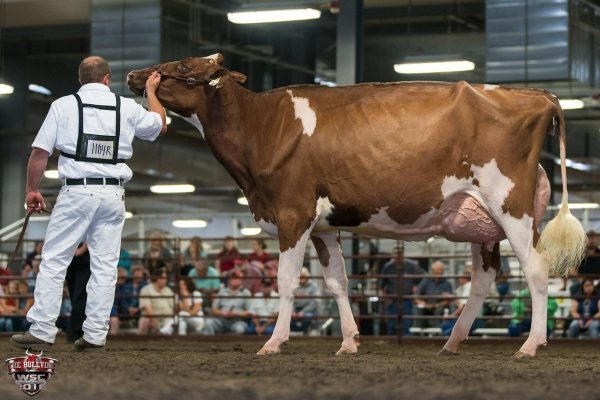
Wisconsin Cow Wins 2016 Holstein Association USA Star of the Breed

Miss Hot Mama-Red

Miss Hot Mama-Red-ET has earned the honor of Holstein Association USA’s 2016 Star of the Breed. This recognition is given annually to a Holstein that exemplifies outstanding production combined with exceptional type.

Hot Mama-Red-ET was bred by Nathan Thomas, Michael Heath and Will Iager and is owned by Smith-Crest Holsteins, Watertown, Wis.; Majestic View Genetics LLC, Sun Prairie, Wis.; Rhonda Shore, Sun Prairie, Wis.; Randy Connery, Sun Prairie, Wis. and Crailoo Dairy Farm LLC, Brownsville, Wis.

Hot Mama-Red-ET is sired by Mr Apples Armani-ET, out of Starmark AD Hotstuff-Red-ET, Excellent-94, EEEEE. She made an outstanding milk record in her first lactation, calving in at 1-11, producing 33,520 pounds of milk, with 5.8 percent fat (1,940 pounds) and 3.5 percent protein (1,162 pounds) on a 274-day record. Hot Mama-Red-ET is classified Excellent-92, EEEEE. In 2016, Hot Mama-Red-ET placed fourth in the Senior Three-Year-Old class at the Eastern Fall National Holstein Show.

“Hot Mama is one of the easiest cows I have worked with. No matter where she goes, she does well,” says Matt Smith, Smith-Crest Holsteins. “She travels easily, and adapts well to new environments. She blends great dairy strength with her flashy type; she truly has the will to milk.”

To be eligible for the Star of the Breed award, a cow must place in the top five of her class at a National Holstein Show in the award year, be in a herd enrolled in the TriStarSM  program, and have an official classification score. Once the eligible cows are determined, the following calculation is used to decide the award recipient: Combined ME Fat and Protein + Age Adjusted Classification Score x (Breed Average ME Combined Fat & Protein/Breed Average Age Adjusted Classification Score).

For more information about the Star of the Breed Award, visit www.holsteinusa.com/awards/animals.html.

Connecting Consumers to the Farm Through Racing

The Fastest Rookie award and the Indianapolis 500 are two opportunities to tell the story of Indiana’s dairy farmers.

Deb Osza with the American Dairy Association of Indiana says they’re proud to take part in both – and it’s a great way to start a conversation with consumers. “Because the winner of the Indianapolis 500 drinks milk,” she says. “We’ve been able to use that wonderful, serendipitous winning trophy to connect agriculture with racing.”

This year’s second fastest rookie, Ed Jones of Dubai, says there is no greater prize in sports than the drink of milk in victory circle. “The glass of milk is so prestigious and such a big part of the history at the Indianapolis 500,” he says. “To be able to accomplish that is a dream come true.”

Jones will start in the 11th position on race day – the same position as last year’s Fastest Rookie Alexander Rossi, who was also last year’s winner of the Indianapolis 500.

On race day, two Hoosier dairy farmers greet the champion in Victory Circle to present that prized bottle of milk. Former Milk Man and chairman of the American Dairy Association of Indiana Alan Wright says dairy farmers are honored to continue the race day tradition. “As a dairy farmer that’s the greatest thing we can do,” he says. “It’s a great advertisement and great promotion. Racecar drivers work hard every day – just like we do as dairy farmers and we’re proud to be associated with them.”

This year’s Fastest Rookie was Fernando Alonso of Spain – with a four-lap average speed of 231.3 mph.

Source: Brownfield

Young couple defies dairy startup odds via organic route

Who says young people can’t start farming today? Certainly not Ryan Murray and fiancee Annie Grant. They’re doing it the smart way — with smart help.

In 2013, 20-year-old Murray began with 150 acres of rolling rented hay and pastureland and facilities near Truxton in central New York’s Cortland County. Since then, his 30-cow, certified organic milking herd has grown to 60 cows, plus a herd of new calves.

Participating in New York’s Organic Dairy Farm Business Summary put Murray and Grant on the road to owning their own farm. The couple will marry this year and is looking for land to buy.

“When I heard Fay Benson describe the organic edition of the Dairy Farm Business Summary, that sounded like a good thing for my seasonal, lower-cost, lower-production business model,” says Murray. (Benson is Cornell Cooperative Extension’s small-dairy educator.) “As a sole operator without employees, I was keeping good basic records, but didn’t have a lot of time for analysis.”


ORGANIC GUIDANCE: Murray utilizes the help of Fay Benson, who also has a small dairy.

The Dairy Farm Business Summary uses data from farms of similar size and practices to create benchmarks that individual operators measure their farm’s performance against. “The organic edition factors in specific values for intensive grazing, organic feed costs for purchased feed, cost savings based on pasture value and other organic-specific practices,” explains Benson.

Efficiency discovery time!
Murray transferred his numbers on cows, milk production, costs and receipts from Excel into the ODFBS program. “I immediately began to see opportunities to cut costs and increase production,” he reflects. “It reaffirmed where to put my limited resources, both time and money, first to get the best return on investment.”

The analysis shows the relationships among diverse factors influencing how well a farm meets its goals. Success is analyzed across balance and cash flow, debt-to-asset ratio, per-cow milking, per-acre cropping plus labor-efficiency data.

Then, Benson connected Murray with Certified Crop Advisor Tom Kilcer to evaluate his cropping plan. “Adjustments to my cropping practices resulted in more feed from the same acres, which is critical since my acreage is currently limited,” explains the young farmer. “Increasing crop yields supported increasing cow numbers.”

Those 60 new calves are part of his plan, influenced in part by the ODFBS analysis. “With the goal of buying land, I’ve focused on managed internal growth to build equity in my cows. From the start, working the summary highlighted the significance of economy of scale,” he adds.

Continual progress helped Murray become a completely seasonal operation in 2015. Comparing his numbers to Larry Tranel’s Iowa State data for 2015 for the top 15% of profit groups for totally grass-fed operations helped show where he was doing well, and areas that need attention. The Iowa State data broke out higher- and lower-profit subsets for four geographic areas: eastern Iowa, southwest Wisconsin/northwest Illinois, Ohio and Pennsylvania/New York.

Startup financial grants available
New York Farm Viability Institute has funded organic dairy production projects for more than a decade. In 2006, the Institute provided startup funding for the NY Organic Dairy Initiative in response to consumer demand for organic milk.

“The Organic Dairy Farm Business Summary project supports development of topic-specific profit teams focused on benchmarking to benefit individual farm participants and add to the larger dataset benefiting dairying industrywide,” notes NYFVI Executive Director David Grusenmeyer.

The Institute offers financial grants to encourage producers to participate in the ODFBS. It also supports topic-specific profit teams for transitioning to organic milk production, and for using the Dairy Profit Monitor, reducing cow lameness, plus enhancing cow comfort and health for any dairy operation.

Source: American Agriculturist

“Kickin’ It with the Cows” Run Will Support Children’s Hospital

The inaugural “Kickin’ It with the Cows” Run/Walk will come to downtown De Pere on the morning of Saturday, July 8.

The event — an extension of the Dairy Cares of Wisconsin fundraising campaign on behalf of Children’s Hospital of Wisconsin — will feature a 10k run as well as 5k run/walk. Runners and walkers will enjoy a scenic course through the city of De Pere and along the Fox River, with real dairy cows cheering on participants as they cross the finish-line. Proceeds will benefit the youth patients and their families confronting health crises through the medical care provided by the Milwaukee-based health system.

Individuals interested in participating — as well as sponsors who want to support the event — can contact Chairman Mike Kuehl by email or by phone at (920) 737-8773. To register please visit Active.com and search “Kickin’ It with the Cows”. The early bird fee is $25 with a group rate of 3 or more for $20 and children 12 and under $15. In addition to the hope and support your registration provides to Children, you will receive a Dri-Fit shirt and access to cheese, milk, ice cream, and beer (please bring your ID) upon completion of the race.

Since its inception in 2011, the Dairy Cares of Wisconsin annual garden party has raised more than $630,000 on behalf of the hospital.

“We wanted to find a fun, fresh and new way to reach out to more families,” Kuehl said. “A lot of our Dairy Cares supporters are enthusiastic runners, and we thought a fun run would be the perfect way to promote fitness while benefitting the critical health and caregiving work of Children’s Hospital.”

As the event’s name suggests, “Kickin’ It with the Cows” will feature a distinctly different flavor than many other run-, jog- and walk-events. “I can’t think of another event that welcomes its runners to the finish line with cows,” Kuehl said. “But Wisconsin — rightfully — is America’s Dairyland and we intend to celebrate that fact. This will be a new experience for both participants and sponsors.”

Children’s Hospital of Wisconsin provides statewide care through 40 different locations. These various sites provide a range of specialized services, from dealing with childhood terminal illness and cancer to psychological disorders. Experts in premature birth, the neonatal intensive care unit is ranked top in the nation.

The seventh annual Dairy Cares Garden Party is scheduled for Saturday, July 22nd. To learn more, please visit www.dairycaresofwisconsin.com.


Elanco seeks injunction to stop Arla Foods’ rbST advertising

Eli Lilly Elanco US Inc. (Elanco) initiated a legal action May 19 in the U.S. District Court for the Eastern District of Wisconsin against international dairy conglomerate Arla Foods demanding that Arla immediately cease its false advertising campaign and unfair business practices against recombinant bovine somatotropin (rbST), a proven and safe dairy technology approved by the Food & Drug Administration in 1993. Elanco sells and markets the supplement rbST under the brand name Posilac.

According to Elanco, Arla’s “Live Unprocessed” campaign, which launched across the U.S. in late April, is built on a child’s interpretation of what rbST is and brings that perception to life as an animated, six-eyed monster with “razor-sharp horns” and electrified fur.

In its complaint, Elanco states that it believes the campaign deceives consumers with false notions about the safety of rbST. “For more than 20 years, rbST has been used to help cows increase milk production without changing the safety and quality of the dairy products we consume. As one of the most researched animal products ever to be approved by the FDA, rbST and dairy products made with milk from rbST-treated cows have been deemed safe by scientific authorities and regulators in more than 50 countries across the globe, including the World Health Organization,” the company noted.

“We believe these ads intentionally frighten and mislead consumers in an attempt to gain a competitive advantage,” Eric Graves, president of Elanco North America, added. “In fact, the FDA has concluded rbST poses no human health risk and requires companies to disclose that there is no significant difference between milk produced from rbST-treated and non-rbST-treated cows if they include the ‘rbST-free’ claim on their packaging. This Arla campaign blatantly disregards the proven safety of rbST as well as the real consequences of removing this type of innovation from our U.S. dairy industry.”

Elanco said removing rbST from the dairy industry’s toolbox would have a direct impact on the sustainability and economic viability of dairy farms.

“Research shows that rbST helps cows produce more milk — about a gallon more per cow per day — which means farmers can produce the same amount of milk with six cows instead of seven,” the company explained, adding that the use of rbST also reduces the carbon footprint of a gallon of milk by 9%.

The collective impact of this increased productivity each year in the U.S. alone saves 95.6 billion gal. of water, reduces the amount of land needed for dairy farms by 1,023 square miles and eliminates 2.9 million metric tons of greenhouse gasses, Elanco noted.

“Products like rbST greatly improve farmers’ impact on the environment without changing the composition, quality or nutrition of the milk their cows produce,” said Mike Hutjens, University of Illinois professor emeritus in animal science. “We should not ignore science and technology that have been proven safe and effective for the sake of marketing claims that confuse consumers.”

Graves concluded, “This is a campaign against science and innovation. We will fight to protect this important technology for future generations of dairy farmers.”


Source: Feedstuffs

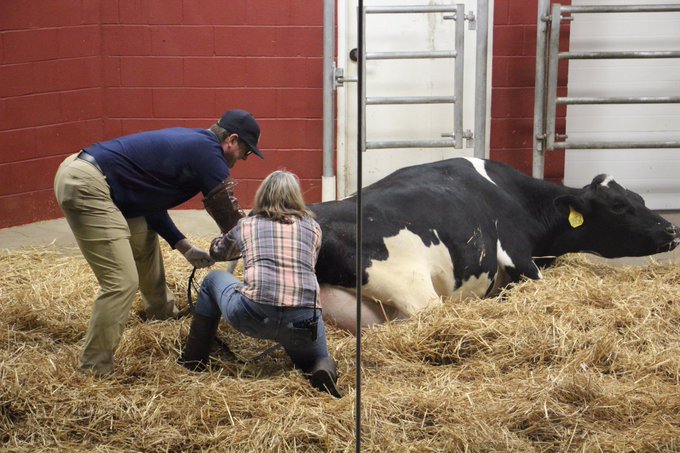
Football Coach Jim Harbaugh just helped deliver a baby calf on a dairy farm

Remember those milk commercials Jim Harbaugh starred in last fall?

Well, he recently visited a farm in Indiana that produces the ulta-filtered milk Fairlife he endorses.

And in typical Harbaugh fashion, he got hands on.

The Michigan football coach tweeted a pair of photos Monday morning from Fair Oaks Farms, including one that apparently shows Harbaugh – donning a U-M baseball hat, blue sweatshirt and trademark khaki pants – helping deliver a baby calf.

No, seriously. See below.

View image on Twitter

No word yet on a name, but don’t be surprised if it’s Michigan or Harbaugh-related.

Harbaugh and his staff are nearing the end of the latest NCAA recruiting evaluation period, which ends on May 31. Then comes a string of scheduled satellite camps in June and July.

Illinois farmers seek help to protect immigrant workers under Trump

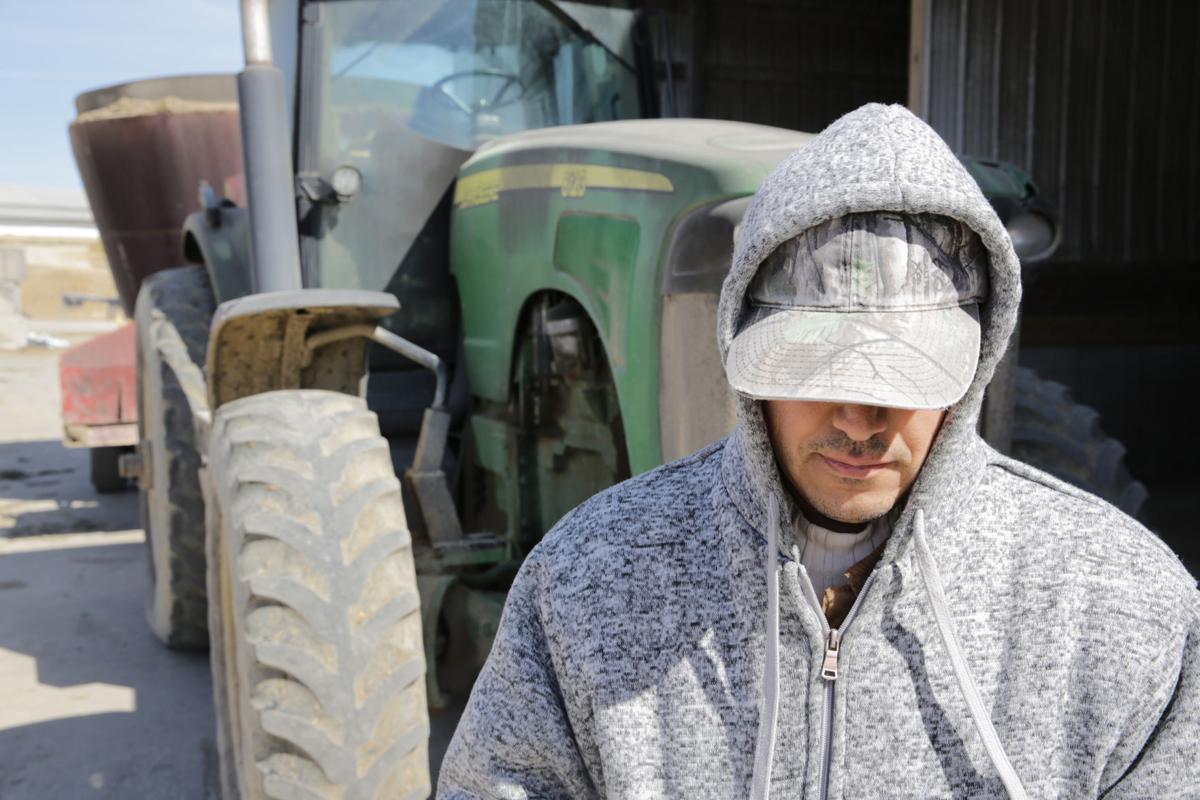
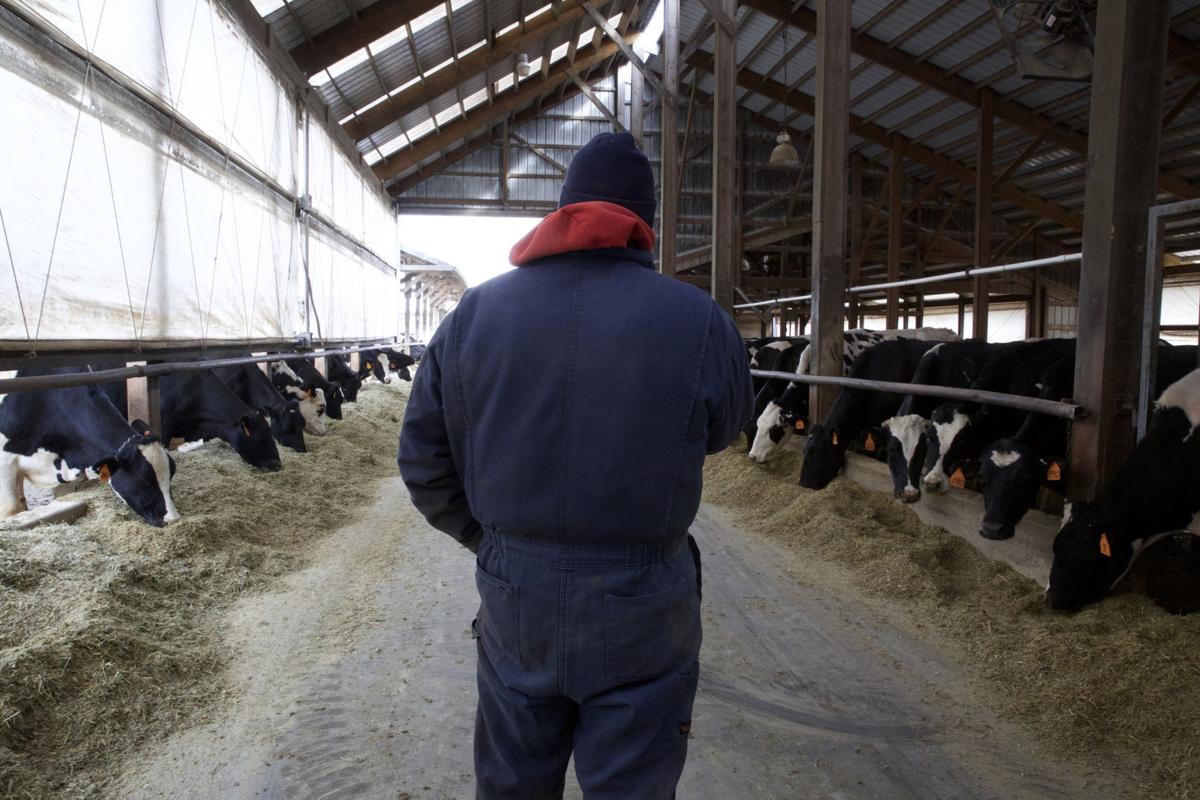
At a dairy farm in northwest Illinois, Esteban works the land the way his father taught him in his native Michoacan, Mexico. Every day before the sun rises, Esteban, who prefers not to give his last name because of his immigration status, feeds about 1,200 cows, regardless of rain, snow or hail. He has been working on the same farm for almost 17 years, he said.

“I feel like they are like family and real friends because they all treat us, the workers, like friends,” Esteban said, referring to his boss and his family. “They truly care for us and watch out for us,” he added in Spanish.

His job earns Esteban “enough” to feed his five children and support his parents in Mexico, he said.

But since President Donald Trump’s election, Esteban has been nervous at work. He and 17 immigrant co-workers, all Mexicans, he said, fear Immigration and Customs Enforcement (ICE) raids, which could lead to the deportation of immigrants in the U.S. illegally.

“We can leave our homes and may not come back to see our children again if we get deported or if the police arrest us,” Esteban said.

Although there have been no reports of raids in the area, farm owners share their employees’ concern.

Esteban’s boss, David, who also prefers to keep his identity confidential, said he fears losing “an extraordinarily good employee” who helped to grow his milking operation to about twice the size it was 20 years ago.

For that reason, David’s farm manager helped reorganize evening shifts on Feb. 22 so Esteban and his co-workers could attend an immigration “Know Your Rights” workshop — the first of its kind in a rural county where Trump beat Hillary Clinton by over 15 percentage points.

“They feel that they wouldn’t have the life they have without us, and we certainly cannot survive without them, so that’s part of what I call a family,” David said about his immigrant workforce.

The 25 or so Latino families that gathered at the rundown St. Mary Parish Center in Freeport, Illinois, learned how to differentiate between local, state and federal law enforcement and immigration officials.

Their children helped to read information printed in English, and listened gravely as a representative from the League of United Latin American Citizens, a Latino civil rights organization, explained what to do if an ICE agent knocks on their door.

Many attendees said they were sent by their employers, who, like David, depend on immigrant labor, documented or undocumented, to produce cheese, milk and poultry in the region.

“Immigrant labor in all the larger dairy operations is an absolute must. There is no way we would be able to survive in business without immigrant labor,” David said. “I’m hoping the administration is smart enough to know there are several facets of the economy of this country that will not survive.”

The Hispanic community in the area is small but growing, according to the Rev. Diego Ospina, the priest of the parish, whose church is the only one in the area that offers Mass in Spanish.

According to Father Ospina, families’ fear and uncertainty have become evident over the past few months, with some choosing to remain inside their homes in case there are raids in the area, he said. “People here really have no information about what’s going on or on how to protect themselves,” he added.

The priest said Latino community organizations have no presence in the area, and he could not identify any safe spaces providing assistance for those living in the country illegally besides his church.

Julieta Galicia, a mother of three who has lived in Freeport for almost 19 years, organized the workshop and called on her fellow immigrant families to attend.

“We tend to think that it (immigration enforcement) is not going to happen to us. That was the case for me eight years ago,” Galicia told the crowd.

Now protected under President Barack Obama’s Deferred Action for Childhood Arrivals program, Galicia was pulled over in 2008 after swerving to avoid an animal on the road. The officer reported her to immigration enforcement officials, she said, and she was put in deportation proceedings.

Galicia fought the order in court for years, just recently achieving its cancellation, she explained.

“In this area, there is no public transportation, so everyone has to drive to work and to take our children to school, so we are all at risk,” Galicia said. “With this new president, we all are criminals, like he has stated before.”

Galicia said she has never felt much racism in the area. On the contrary, the owners of the farms “are willing to make a change,” for their employees, she said.

David has contemplated trying to find housing close to his operation, so employees don’t have to drive as far to get to work. He said he has also written letters to people in power to bring attention to immigrants’ essential role in the dairy industry, and the difficulties that current immigration policy cause him.

“The immigrant labor needs to hear us be proactive to know that they do have our support, and that has been a question for many of my employees,” David said. He voted for Trump, whom he considered the fiscal candidate and best choice for his business, but said he “absolutely” supports an immigration reform that would make it easier for his industry to contract properly authorized workers.

David has made frequent efforts to attract American citizens to his farm, where wages start at $11 an hour, but he has struggled to find “dependable, skilled laborers,” he said.

“I think the biggest misconception in the political field is that the immigrant labor force is taking away jobs from U.S. citizens,” he said. “The fact is the American citizen does not want to do the jobs that the immigrant labor is doing.”

Dairy cows are milked three times a day, 365 days a year. There are no days off, the work is physical and smelly, and the hours are long.

Even if wages were doubled, to $20-$25 an hour, Alan, another area farmer with a smaller operation milking about 400 cows a day, doesn’t think U.S.-born laborers could support the industry.

“I think you would have the same problem with reliability and I don’t think they would work as hard,” Alan said

Dairy workers are not entitled to overtime or paid vacation, due to farmworker exemptions in the Fair Labor Standards Act, and neither farm visited for this story offers health insurance.

However, both Alan and David have taken measures to ensure the safety and financial stability of their workers.

In Alan’s case, that means offering bonuses and contributing to a pension plan. He estimates his most senior workers cost him $22-$23 an hour, after matching tax contributions to Social Security.

“Their wages do need to come along,” Alan said of his workers. “But the margins in dairy, you’re always afraid that you’re gonna margin yourself right out of the business.”

At the national level, people living in the country illegally contribute billions of dollars to federal programs like Social Security, with little hope of reaping the benefits, barring a change in immigration status.

Data from the Office of the Chief Actuary of the Social Security Administration showed people living in the country illegally contributed about $13 billion to Social Security in 2010 via payroll taxes.

“It’s just stolen money for the government,” Alan said.

According to the Pew Research Center, 26 percent of the farming workforce nationwide consists of people living in the country illegally, and Illinois farmers and dairy economists agree that about two-thirds of Illinois milk is produced by immigrant labor.

However, ascertaining what proportion of Illinois dairy workers are living here illegally is impossible, because employees must present documents proving U.S. work authorization to get hired. In the case of at least 1.8 million immigrants in the country illegally, those documents are fraudulent, the SSA reported in 2013.

Employment-related fraud is another consequence of a broken labor and immigration system, said Chuck Roth, director of litigation at the National Immigrant Justice Center, who has represented people living in the country illegally in Social Security fraud cases.

“The law doesn’t permit the employer to find people in the right way,” Roth said. Nor does it permit people to immigrate to the U.S. for low-education, low-wage employment.

“There’s no line for you to get into if you want to come and work as a dishwasher,” Roth said. “The idea that people should just wait in line somewhere, it’s spurious, there’s no line to get into.”

Temporary visa programs, like H-2A, which contracts laborers from Mexico for seasonal agricultural work, are unsuited to dairy because of the constancy of the business, David said.

“We operate 24 hours a day, seven days a week. If labor needs to go back to their home country to renew visas, that’s fine, but we have to have a method that we can very rapidly fill that need, and that method’s not in place today,” David said.

His business does sales in the millions of dollars per year, David said, but its narrow profit margin, a product of market forces and what he called the U.S.’s “cheap food policy,” won’t let him pay the higher wages some believe would attract more American workers.

David’s starting wage of $11 an hour is roughly the average for Illinois farms, according to Mike Hutjens, professor emeritus of animal sciences at the University of Illinois, who has tracked Illinois’ dairy industry for 32 years.

“Dairy is a price taker,” David explained, subject to the milk prices set by a market becoming increasingly globalized, as about 15 percent of U.S. milk products are now sold internationally.

In 2015-16, increased production in the U.S. and Europe, and decreased exports to China and Russia, drove milk prices down. In Illinois, farmers lost an average of $410 per cow in 2015, according to reports produced by University of Illinois agricultural economists and the Illinois Farm Business Farm Management Association. It was the second year in the last decade that farmers lost money on milk sales, Hutjens said.

But workers should not bear the brunt of our demand for cheap milk, said Carly Fox, a farmworker rights organizer and advocate with the Worker Justice Center of New York.

“They’re paying the price with their bodies, they’re paying the price with substandard housing,” Fox said. “There’s so many ways we can remedy this, just not on the backs of the workers.”

For Fox, that means transferring some of the “enormous profits” made by the multinational corporations that purchase, process and distribute farmers’ milk back to workers. It could also mean asking customers to pay a little more at the grocery store.

Research suggests the costs to the consumer would not be prohibitive.

Maintaining supply and demand constant, a 40 percent increase in farmworker earnings across farming sectors would raise U.S. household spending about $16 a year at most, the Economic Policy Institute reported.

Comparing that statistic with the possible food costs passed to the U.S. consumer were Trump to pursue the removal of farmworkers living in the country illegally suggests deportations would lead to much higher costs at the grocery store.

Removing half the estimated 76,968 U.S. immigrant dairy workers would cause a 24.2 billion pound decline in milk production, increasing retail milk prices by nearly one-third, reducing U.S. economic output by $16 billion nationwide, and causing losses of up to 65,620 jobs in supporting sectors, according to a study produced by researchers at Texas A& M University and funded by the National Milk Producers Federation.

At the store, a gallon of milk averages about $1.58-$2.50 in the Midwest, and around $2.68 nationally as of the week of March 31, according to the USDA’s Dairy Market News Branch.

People who may have conservative politics on immigration still depend on immigrants who are willing to work for the wages that farmers can afford to pay, to sustain low prices, said James Wolfinger, a DePaul University history professor specializing in issues of race, politics, and labor.

“They want the wall built, but at the same time they want people who can get across the wall to come work at the ranch,” Wolfinger said.

Meanwhile, fear of attention from immigration enforcement prevents farm workers living in the country illegally from organizing for better wages and a fuller range of benefits, Fox said, and false perceptions that those workers do not have the right to report unfair or unsafe labor conditions abound.

“There are workers who feel that, because of their status, they could get targeted … if they make any kind of a fuss,” Fox said. “It takes an incredible amount of rights education and building trust.”

In her region, Fox said that fear has been exacerbated by the recent ICE arrests of several prominent farmworker rights activists living in the country illegally, including Enrique “Kike” Balcazar, 24, Zully Palacios, 23, and José Coyote Pérez, none of whom had criminal records, according to local media reports, and Fox said she thinks all three arrests were targeted.

Salvador, a Mexican-born father of three U.S citizen children who prefers not to give his last name because of his immigration status, defies his fear daily by driving 35 minutes each way to his job at Alan’s farm, five days a week.

“We need to work to feed our families. I have no other option,” he said.

Although Salvador owns a small house in Freeport and supports his family with his wages, he said his American Dream is yet to be accomplished.

“I will keep working as long as God permits, and as long as my boss keeps giving me work,” he said.


SourceThe Southern Illinoisan

Finalists Named for 64th Princess Kay of the Milky Way

The 12 young women who will compete for the title of Minnesota’s 64th Princess Kay of the Milky Way have been named, paving the way for each of them to have their likenesses carved in blocks of butter during the 2017 Minnesota State Fair.

The announcement came after a weekend leadership workshop held at the College of St. Benedict in St. Joseph, in which more than 50 dairy princesses representing counties across the state participated.

The finalists include:

  • Emily Annexstad, 19, St. Peter, daughter of Rolf and Jean Annexstad, and representing Nicollet County;
  • Anna Broll, 19, Chaska, daughter of Dan and Kathie Broll, and representing Carver County;
  • Shelby Campbell, 19, Maple Lake, daughter of LeRoy Campbell and Donna Decker, and representing Wright County;
  • Gina Holdvogt, 19, Freeport, daughter of Alvin and Bernie Holdvogt, and representing Stearns County;
  • Abby Hopp, 19, Chatfield, daughter of Doug and Heather Hopp, and representing Fillmore County;
  • Madelin Lindahl, 20, Lindstrom, daughter of Kevin and Tara Lindahl, and representing Chisago County;
  • Quinci Scherber, 23, Rogers, daughter of John and Staci Scherber, and representing Hennepin County;
  • Rebecca Schubert, 18, Rice, daughter of Natalie and Jerome Schubert, and representing Benton County;
  • Margaret Socha, 18, Rogers, daughter of Michael and Donna Socha, and representing Wright County;
  • Samantha Traxler, 18, Cleveland, daughter of Brian and Patty Pettis, and Brian and Heather Traxler, and representing Le Sueur County;
  • Ashley Warren, 19, Watkins, daughter of John and Carol Warren, and representing Meeker County; and
  • Jessaca Zuidema, 19, Blomkest, daughter of Jan and Jolene Zuidema, and representing Kandiyohi County.

The finalists were selected based on their passion for dairy and their communication skills. Princess Kay and county dairy princesses make appearances to help explain dairy farm families’ commitment to taking care of their animals and resources while providing wholesome, nutritious and affordable dairy products. Midwest Dairy Association manages the program.


Source: MidWest Dairy

Three B.C. dairy workers who pleaded guilty to animal cruelty get jail time

British Columbia’s provincial court says three dairy farm workers from the Fraser Valley have been sentenced to jail for causing distress to an animal after an undercover video showed several employees abusing milk cows.

The Chilliwack provincial court registry confirmed Jamie Visser and Chris Vandyke were given 60 days each in jail, while Travis Keefer must spend seven days in jail after they pleaded guilty to animal cruelty charges.

Visser and Vandyke are also prohibited from having animals in their custody for three years and must serve six months’ probation.

The dairy farm company and its owner were fined $75,000 each after pleading guilty last year to causing an animal to continue to be in distress.

The owners of the company apologized for what took place in the spring of 2014.

The hidden-camera video played in court showed a cow being lifted by a chain around its neck using a tractor and other employees repeatedly beating and kicking cows, while others nearby cheered and laughed.

Charges in the case were laid after an investigation by the British Columbia Society for the Prevention of Cruelty to Animals.

Marcie Moriarity of the SPCA says she believes it’s the first time in Canada where a company has been held responsible for the acts of cruelty by its employees on a farm.

“We rarely see convictions involving farm animal cases in the context of animal cruelty. This is absolutely precedent setting.”

She said the convictions show the courts, investigating agencies and the farming industry take such allegations seriously.

“We worked hand-in-hand when this first occurred with the B.C. dairy industry, milk marketing board and the Ministry of Agriculture to see those lasting changes in legislation.

“That was a huge feat for all those parties to come together with the goal of preventing animal cruelty.”

The farm, Chilliwack Cattle Sales Ltd., is one of the largest farms of its kind in Canada with 2,800 cows.

Moriarity says the role of the animal rights group Mercy For Animals in recording the undercover video was essential in the case.

She says she would like to see video used on farms to audit their activities.

“Accountability is absolutely necessary and I think that is a message that came out of this case.”

Source: CTV News

Large Dairy Farm Developers Turn to Wisconsin Supreme Court

The owners of a proposed large-scale dairy farm in Wood County have asked the Wisconsin Supreme Court to overturn a ruling that blocked the project.

Golden Sands Dairy maintains it has rights to use most of its 6,400 acres for growing crops and manure spreading because the land was zoned unrestricted when the dairy filed for building permits in 2012 and the applications referenced the land.

The Town of Saratoga argues the dairy can’t use the land that way because it was re-zoned for preservation four months after the applications were filed.

A state appeals court blocked the project last month.

The developers, the Wysocki Family of Companies, asked the Wisconsin Supreme Court this week to review the decision, saying the appeals court failed to properly apply the relevant laws.


Source: U.S News

Academies of Science finds GMOs not harmful to human health

Genetically engineered crops are safe for humans and animals to eat and have not caused increases in cancer, obesity, gastrointestinal illnesses, kidney disease, autism or allergies, an exhaustive report from the National Academies of Science released Tuesday found.

Work on the 388-page report began two years ago and was conducted by a committee of more than 50 scientists, researchers and agricultural and industry experts convened by the National Academies of Sciences, Engineering, and Medicine. It reviewed more than 900 studies and data covering the 20 years since genetically modified crops were first introduced.

Overall, genetically engineered (GE) crops saved farmers in the United States money but didn’t appear to increase crop yields. They have lowered pest populations in some areas, especially in the Midwest but increased the number of herbicide-resistant weeds in others. There’s also no evidence that GE crops have affected the population of monarch butterflies, the report said.

The review was thorough and systemic, assessing many of the issues that have been raised about genetically engineered crops over the years, said Gregory Jaffe, director of biotechnology at the non-profit watchdog group the Center for Science in the Public Interest in Washington D.C. The group was not involved in the report’s creation.

The genetic material of GE plants is artificially manipulated to give them characteristics they would not otherwise have. The two most common are pest resistance and the ability to withstand certain herbicides. That allows farmers to spray fields with herbicide, killing weeds while not harming the crops. Drought tolerant traits are newer and also becoming popular.

The report, “Genetically Engineered Crops: Experiences and Prospects,” was meant to be an objective overview of current research into the safety and environmental and social effects of these increasingly popular crops and the foods made from them.

Safe for humans

To gauge whether foods made from genetically modified crops were safe for human consumption, the committee compared disease reports from the United States and Canada, where such crops have been consumed since the mid-1990s, and those in the United Kingdom and western Europe, where they are not widely eaten.

No long-term pattern of increase in specific health problems after the introduction of GE foods in the 1990s in the United States and Canada was found.

There was no correlation between obesity or Type II diabetes and the consumption of GE foods. Celiac disease, which makes humans intolerant of gluten, increased in both populations. Patterns in the increase in autism spectrum disorder in children were similar in both the United Kingdom and the United States, the committee reported.

Overall the report concluded that there were no differences in terms of a higher risk to human health between foods made from GE crops and those made from conventionally-bred crops.

Critics: too much industry influence

Groups opposed to genetically engineered crops criticized the report for arriving at watered-down scientific conclusions due to agricultural industry influence.

Food & Water Watch, a government accountability group in Washington D.C., said the committee’s ties to the biotech industry and other corporations create conflicts of interest and raise questions about the independence of its work.

“Critics have long been marginalized,” said Wenonah Hauter, the group’s executive director.

Economic and ecological effects

Overall, the report found that GE crops save farmers money in terms of time spent tilling and losses to weeds and insects, but can have both positive and negative effects on pests, farming practices and agricultural infrastructure.

Pest-resistant crops have resulted in lower pest populations overall in some areas of the midwest, especially European corn borer, the report found.

However the use of herbicides on GE crops in some areas has resulted in the evolution of herbicide-resistant weeds.

Despite claims by some proponents of GE crops, their adoption didn’t appear to increase yields overall among U.S. farmers, the report found.

The report specifically addressed a commonly cited link between GE crops and falling populations of monarch butterflies.

As of March 2016, there was no evidence that the suppression of milkweed (the only food of the insect in its caterpillar state) by the use of herbicides caused declines in the monarch population, the committee found. In fact, the monarch population has seen a moderate increase in the past two years. Still, the report called for continued monitoring of the situation.

Mostly cotton, soy and corn

There are only 12 genetically modified (GM) crops grown commercially grown worldwide according to the report. The vast majority of GM acreage is concentrated in cotton, soybeans, corn, sugar beets and canola.

In the United States, the list of commercially grown GM crops includes cotton, soy beans, corn, sugar beets, canola, alfalfa and papaya, in addition to small amounts of zucchini and yellow summer squash, apples and potatoes.

However four of them are extremely popular with farmers. In 2015, 99% of sugar beets, 94% of soybeans, 94% of cotton and 92% of feed corn grown in the United States were genetically engineered to either be herbicide or pest resistant, or in some cases both, according to the International Service for the Acquisition of Agri-Biotech Applications.

Globally, 12% of all cropland is planted with genetically engineered plants, according to the report.

However there has been significant pushback against these crops, particularly in Europe.

GMO-free a selling point

A significant portion of American consumers are concerned about the safety or other effects of foods made with genetically modified crops, often called GMOs for genetically modified organisms.. A survey released last year by the NPD Group, a market research firm, found that 57% of Americans were concerned that genetically modified foods posed a health hazard.

The food industry has taken notice. In 2015, Progressive Grocer, a trade publication, reported that total U.S. sales of food and beverage products labeled “non-GMO” reached $10 billion during 2014.

Labeling foods as GMO-free has become a popular marketing and differentiation method for companies. The Non-GMO Project, a labeling program, has almost 35,000 verified products, according to its website.

Packaged Facts estimates that the global food and beverage market was worth more than $5 trillion in 2014 and that non-GMO products accounted for $550 billion of that. It projects that the global market for non-GMO foods and beverages will reach to $1 trillion by 2019.

The National Academies report will likely not sway these consumers, said Phil Lempert, a Los Angeles-based food industry analyst.

“It’s an emotional issue, it’s not a science issue,” he said.


Source: USA Today

Tri-Koebel Farm Hosting “Painting With The Cows”

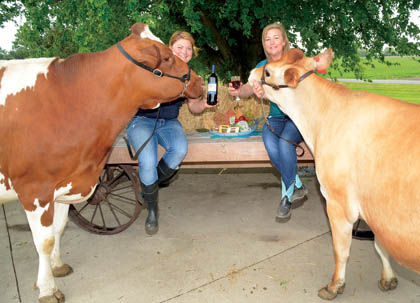
Paparazzi and Gatsby are ready to pose for their pictures under an iconic oak tree at the Tri-Koebel Dairy Farm.

The dairy cow duo will be part of a Saturday, May 27, “Painting With Cows At The Oak Tree” event that will feature selections from Berrien County’s Old Europe Cheese, wine by Dablon Vineyards of Baroda, local produce, honey products, farm tour and more.

Hosting the 3 to 7 p.m. wine & canvas-style event will be mother and daughter Jennie Koebel and Tera Koebel Baker (key members of the four-generation group currently running the farm) along with local artist Jacqueline Suzanne Rowlison.

Baker said Painting with Cows grew out of a desire to “tell our farm story.”

Not only is the Koebel family farm blessed with “awesome cows,” Baker said it is located in “one of the most diverse agriculture production counties in the world.”

“I thought it would be really neat to showcase the animals that are making the product, the cheese that’s done right here in the county (Tri-Kobel Farm milk is used by Old Europe), and then make it fun,” she said.

The bovine models will be placed in a pasture under a 100-plus-year-old oak tree (weather permitting) directly across the road from the farmstead at 16318 Avery Road, Three Oaks.

“Once painting is complete, we will take a hay ride tour through the farm to see the total life cycle of a cow, feed baby calves and watch mama cows be milked in the parlor,” Baker said.

She said those painting Paparazzi and Gatsby will “get to know the cow, get to know her story and paint a picture of her and get to take that home as a keepsake.”

Paparazzi, a Red and White Holstein, was born and raised at the family farm, with Tera showing her at the World Dairy Expo in 2011 where Jennie said she was nominated Junior All American.

Gatsby is a Jersey, and there are plenty of stories to tell about her as well.

Baker is a 2009 River Valley High School graduate and active member of the Young Dairy Leaders Institute, a national Holstein program.


“I’m the fourth generation working here at the farm and mom is in the third-generation,” she said.

Tera’s sister, Greta, also helps out at the farm.

In addition to dairy products, the Tri-Koebel Farm grows corn, soybeans and hay. Jennie Koebel said about 85 cows at the farm are milked with the total population at over 200 head.

“Over they years we’ve done a number of tours for school children, Boy Scouts, we hosted the Blossomtime queens a couple years ago, we’ve done legislator tours here,” Koebel said.

Painting With Cows At The Oak Tree tickets ($79 each) must be purchased in advance (participation is limited to 40 people) at https://theoaktree.ticketleap.com.

Source: Harbor Country News

Top Dairy Industry News Stories from May 13th to May 19th 2017

Feature Reports

Top News Stories

Why Are Americans Drinking Less Cow’s Milk? Its Appeal Has Curdled

Americans are drinking a lot less milk than they used to. According to the U. S. Department of Agriculture, the average person drinks 18 gallons a year. Back in the 1970s it was more like 30 gallons a year. We once hoisted a glass with dinner, soaked our breakfast cereal or dipped into the occasional milkshake. This habitual milk drinking was no accident.

It started in the 1800s, when Americans moved from farms to cities. “First, you had to have the rise of milk trains that would bring milk from the countryside. That milk was refrigerated with ice,” says Melanie DuPuis, a professor at Pace University and author of Nature’s Perfect Food: How Milk Became America’s Drink.

Before that, she says, milk was not a reliable source of nutrition for city dwellers. Nor was it all that safe. In the 1850s there was a major scandal in New York after thousands of babies died from drinking swill milk — the stuff that came from sickly cows, animals fed from the waste of city grain-alcohol distilleries.

This led to reformers calling for safe milk. At the same time, rural and upstate dairy farmers wanted customers. A political bargain was born. “We are going to make this deal, where we’re going to feed those children and enable them to get enough nutrition through this thing that the nutritionists were calling a protective food,” says DuPuis. “That will enable your farmers and your farm regions to have a vibrant economy.”

Milk get its healthy halo
DuPuis says early-20th century nutritionists mounted studies to better understand the health benefits of milk. For instance, they’d feed dairy products or vegetable oil to rats or dogs, and then they’d measure the results.

“These rats that had dairy products would be sleek and healthy-looking and larger, and the other animals would look scrawny and unhealthy,” adds DuPuis. Groups that represented milk interests embraced the research and infused their advertisements with glowing claims about milk’s health benefits.

By the mid-20th century, Americans were told to drink two to three glasses of milk a day. And for generations, we did. Dairy companies like Borden boomed. Dairy industry marketing? That was the stuff of legend.

But by the time the famous ’90s-era “Got Milk” advertising campaign hit the airwaves and pages of magazines, liquid milk sales were already on the decline.

Marion Nestle, a professor of nutrition, food studies and public health at New York University and author of Food Politics, points to the 1970s as a time when new research raised questions about milk’s effectiveness in preventing osteoporosis.

“Milk is the perfect food – for calves,” Nestle says. “There is no question about that. But for humans, it may not be. And it may not be necessary, and there is plenty of evidence that it isn’t necessary.”

The key word there is necessary. Nestle says if you want to drink cow’s milk, go ahead — it’s still a healthy and nutritious option. The problem for the dairy industry is that it’s no longer the only beverage option with a health halo. Juice makers offer calcium and Vitamin D-fortified drinks. Dairy-free diets are widespread. The lactose intolerant no longer believe they need milk to have a complete diet.

Meanwhile, the political debate over how dairy cows were raised also became a factor. The genetically modified growth hormone that was fed to cows to increase dairy production became a major consumer turnoff, says Nestle. “That’s why it’s not being used that much anymore.”

Nestle says the animal rights movement that led many people to become vegetarians or vegans also contributed to the long-term decline in cow’s milk consumption.

More choices for kids — and moms
But the biggest hit to milk drinking in the U.S. may have come from teens and the youngest dairy consumers, kids ages 2 to 8.

That’s what keeps Julia Kadison up at night. Kadison is the chief executive officer at MilkPep – The Milk Processor Education Program. “What’s going on with that decline in the young kids really has a lot to do with their gatekeeper moms, “she explains. Kadison says her group believes moms are still the key decision makers when it comes to what kids are drinking. With moms choosing alternative milks – soy, almond, coconut and the like — kids are embracing those options as well.

“Now there’s so much choice in the marketplace,” Kadison says. “You have all kinds of different waters and sports beverages and energy drinks, so there’s just a lot of choice out there. It’s a culture of choice.”

Kadison points to the fact that sales for dairy in other forms are still doing well – a fact she attributes to simple innovations like changes in packaging.

“When you go to the yogurt aisle, you will see, probably, depending on the store, half or 40 percent of that is dedicated to kid’s products,” Kadison explains. “There are all kinds of flavors, there are all kinds of packages, and I am sorry to say but in the milk category that has not been the case. It’s like carton or jug, basically. ”

What’s more, plant-based milks have been steadily gaining ground. According to Nielsen’s, almond milk, for instance, has seen sales grow 250 percent over the past five years.

Milk drinking has always been in part about habit and marketing, and milk alternatives capitalize on both.

Even using the word “milk” has become a source of controversy. “What would you call it? Almond slurry?” asks Nestle. “They are deliberately marketing them as a substitute for cow’s milk, and it’s very successful: More and more people are using those products.” As a result, lawmakers from dairy states earlier this year called on the Food and Drug Administration to better enforce rules on what is labeled “milk.”

Despite the decades-long decline, the dairy industry thinks it can boost milk consumption. The industry still managed to ring up more than $14 billion in North American sales in 2013. Alternative milks sell a fraction of that. There are also some positive trends for the industry — foodies embracing organic whole milk again; athletes taking to chocolate milk as a recovery drink.

But Marion Nestle still has her doubts. “The dairy industry has a lot of public relations that it is going to need to do to convince the public that it is producing a product that is healthy, good for animals, good for people and good for the planet.”

  Source: NPR

Seven-month-old baby dies after his parents fed him a gluten-free diet which included quinoa milk

A malnourished seven-month-old baby has died weighing just 9lbs after his parents fed him a gluten-free diet which included quinoa milk.  

They mother and father ran a natural food store in their home town of Beveren, near Antwerp, and their son’s diet, described by doctors as unsuitable, led to him being less than half the expected weight for a boy his age.

An autopsy showed his stomach was totally empty and despite the baby gasping for air in the days leading to his death, the parents never thought to seek medical attention. A prayer card was found in his nappy. 

The parents now face jail sentences, with Belgian prosecutors alleging they contributed to the death of the boy from dehydration and undernourishment.

Hospital Virga Jesse Ziekenhuis in the city of Hasselt, where the parents took their baby to see a doctor. Shocked by the health of the child, the expert told them to take him immediately to seek specialist, emergency treatment.

The baby was taken to Hasselt in Belgium where doctors pronounced him dead upon arrival,

Parents tried a variety of milks with the baby, including a formula made from quinoa (pictured)

Local media in Belgium reported that the parents gave their child a gluten-free diet, which public prosecutor’s said contributed to the death of the baby.

The seven-month-old boy named Lucas was taken to Hospital Virga Jesse Ziekenhuis in the city of Hasselt on June 6, 2014 after 34-year-old father Peter S and 30-year-old mother Sandrina V went to visit a homeopathic doctor who urged them to seek immediate hospital care.

Lucas’ nappy contained a prayer card and the boy only weighed 9.47lbs (4.3 kg) and suffered from dehydration and malnutrition.

Doctors at the hospital in Hasselt could said the boy was dead on arrival and yesterday the trial against the parents started.

 We never went with Lucas to a doctor because we never noticed anything unusual
The dead baby’s father Peter S 

Public prosecutors – chasing an 18 month sentence for each parent – are saying they are to blame for the death of Lucas after they gave their baby the wrong food and compiled their own diet.

The parents, who run a natural food store in their hometown, fed their child on a special milk diet.

Even though Lucas lost a lot of weight and family friends said the boy looked dismal and was gasping for air, they never sought medical attention.

The public prosecutor said: ‘The parents determined their own diagnosis that their child was gluten intolerant and had a lactose allergy. 

‘Not a single doctor had a dossier about Lucas and child protection services did not know about them.’

The prosecutors are blaming the parents for driving to a homeopathic doctor on the other side of the country when the baby was starving instead of going to the nearest hospital.

In court, the parents defended themselves and the boy’s father Peter S said: ‘We never went with Lucas to a doctor because we never noticed anything unusual.’

Mother Sandrina V said in tears: ‘Sometimes he gained a little weight, sometimes he lost a little. We never wished for the death of our son.’

According to their lawyer Karine Van Meirvenne the parents thought Lucas had an eating problem.

Elisabeth De Greef from the University Hospital of Brussels said the baby’s diet was unsuitable.

Van Meirvenne said: ‘Lucas had an eating disorder. He got cramps when he was fed with a bottle and his parents tried out alternatives.

‘Oat milk, rice milk, buckwheat milk, semolina milk, quinoa milk. All products which they also sell in their store.’

Yet according the public prosecutor ‘this equals intentionally denying food’ to the boy.

According to child doctor Elisabeth De Greef from the University Hospital of Brussels, feeding quinoa milk and other such foods to infants is an absolute no-go.

She said: ‘These kinds of milk, which you can buy in a supermarket, do not contain the necessary proteins, minerals and vitamins. 

‘They are not adjusted to infants and thus unsuitable.’

The trial is continuing, with the presiding judge set to deliver his ruling on June 14. 

Source: The Daily Mail

Crystal Siemers-Peterman named Wisconsin’s 70th Alice in Dairyland

Wisconsin has a new agricultural ambassador. Following an exhaustive selection process that began in January, Crystal Siemers-Peterman was chosen as the state’s 70th Alice in Dairyland.

Ben Brancel, Department of Agriculture, Trade and Consumer Protection (DATCP) secretary, made the announcement May 13, in the Lambeau Field Atrium.

“Many months of work and dedication culminate this evening as we announce the selection of the 70th Alice,” said Brancel. “DATCP is proud of the Alice program and is pleased to again have such a highly qualified group of professional candidates.who have worked so hard during this selection process.”

Farmgirl

The new Alice in Dairyland grew up on her family’s registered Holstein dairy farm near Cleveland, Wis. She was active in Manitowoc County and Wisconsin Junior Holstein associations. She represented Wisconsin at national dairy judging and dairy quiz bowl competitions.

“I look forward to traveling throughout this great state of Wisconsin promoting our $88.3 billion diversified agriculture industry,” said Siemers-Peterman after receiving congratulations from her predecessor, Ann O’Leary.

“I’m a firm believer that consumers are smart, but looking for reassurance in making the right food purchases for their families,” she continued. “And as the 70th Alice in Dairyland, I will provide Wisconsin, national and global residents the confidence to buy Wisconsin products, and share the message that makes Wisconsin agriculture so incredibly great.”

Attending the State Fair as a youth, and seeing Alice in Dairyland in action first piqued her interest in the position. When the announcement seeking applicants for the 70th Alice was made in January, she decided to apply.

“I knew that I wanted to make a difference, and I felt ready to take on this role of supporting and promoting Wisconsin agriculture,” said Siemers-Peterman.

Later this month, she will graduate from the University of Minnesota-Twin Cities with a major in agricultural and food business management and a minor in marketing. Previously, she interned with Sassy Cow Creamery, FLM+ Advertising Agency and Land O’Lakes Inc.

Selection process

A three-member selection panel comprising Sandy Chalmers, DATCP Assistant Deputy Secretary; Vicki Janisch, Producer Communications and Programs specialist at Wisconsin Milk Marketing Board; and Corey Geiger, managing editor, Hoard’s Dairyman, chose Seimers-Peterman, from six finalists based on individual interviews, writing samples, radio and TV interviews, public speaking and professionalism.

Siemers-Peterman also offered words of encouragement to the other five Alice finalists: Abrielle Backhaus, Kewaskum; Jenna Crayton, Oak Creek; Alexis Dunnum, Westby; Kaitlyn Riley, Gays Mills; and Kelly Wilfert, Two Rivers.

“I have had the pleasure making friends with these five exceptional young women,” said she said. “Your passion for Wisconsin agriculture will take you far in your future endeavors, and I wish you nothing but the best.”

In her presentation featuring a Wisconsin agricultural product during the finale program, Siemers-Peterman focused on the state’s position as the nation’s top cranberry producer. She noted that Wisconsin cranberries have long been a part of Thanksgiving dinners and continue to be a holiday staple.

“Our great state of Wisconsin produces 57 percent of the nation’s crop,” she affirmed, noting that cranberries are produced by 250 farmers on 21,000 acres across 20 Wisconsin counties.

“Many cranberry farms are operated by fifth and sixth generations of the same family, who have a long-term commitment to the land, their local communities and Wisconsin, providing a $23 billion annual impact to our state’s economy,” she added.

She also noted that Wisconsin is the leading exporter in both prepared and preserved cranberries, which are available around the world including China, India and Mexico.

“Cranberries are packed with vitamins and are low in calories,” said Siemers-Peterman. “I’m glad that Wisconsin cranberries aren’t just for Thanksgiving, and can be enjoyed all year long.”

Duties as Alice

Siemers-Peterman will officially begin her duties as a communication professional with DATCP on June 5, helping to educate people throughout the state, and beyond, about the importance of agriculture in Wisconsin.

“I feel the past couple of months (since the announcement of the finalists) have really helped me to prepare for the position, and I’m looking forward to seeing what the next year brings,” she said. “I expect to have many great conversations as I share the story of Wisconsin agriculture with people of all ages.”

During her 12 months as Alice in Dairyland, Siemers-Peterman will travel approximately 40,000 miles speaking at numerous events and giving media interviews. In partnership with the Wisconsin Milk Marketing Board, she will also help students in more than 100 classrooms learn about Wisconsin agriculture.

Between now and June 5, Siemers-Peterman also will learn more about Wisconsin’s diverse and extensive agriculture from the DATCP staff and through meetings with various producer groups.

“I’ll be reaching out to knowledgeable people from across the state who can help me deliver positive messages about our state’s agriculture, so that I can get off to a great start,” she stressed.

Siemers-Peterman plans to use her personal experiences and education, as well as her sense of humor and outgoing personality to deliver a consistent and upbeat message.

“I want to have fun with agriculture, and want people to have positive feelings about Wisconsin agriculture,” she said.

“We need to reach out to consumers and businesses, and thank them for using real Wisconsin cheese, or just have a conversation around the dinner table about why we’re serving Wisconsin peas.

“Keeping positive messages in front of people in our state, and across the nation will help keep Wisconsin agriculture great and growing,” she stressed.

Source: Wisconsin Farmer

‘The industry has lost dairy producers at an alarming rate’ – Government approach to bovine TB branded ‘disappointing’

Numbers of cattle being slaughtered due to TB in Wales have continued to rise, leading farming groups to slam the Welsh Government’s ‘disappointing’ progress towards eradicating the disease.

While the statistics showed a fall in TB herd incidence since 2012, the number of cattle slaughtered in the 12 months leading to January 2017 was 22 per cent higher than in the previous 12 months.

It came despite the five-year £3.7 million badger vaccination programme in North Pembrokeshire, south-west Wales, which concluded ‘consistent trends in indicators of bovine TB incidence have not yet been seen’.

Farmers’ Union of Wales (FUW) senior policy officer Dr Hazel Wright said the issue required a more holistic approach which tackled the wildlife reservoir.

Alarming

“The industry is well aware that the results after four years of badger vaccination in the Intensive Action Area (IAA) showed levels of bovine TV which are no different to other comparable areas where badger vaccination did not take place,” she said.

“The number of cattle herds registered in Wales has declined by 43 per cent since 1996 and the industry has lost dairy producers at an alarming rate.”

The Welsh Government’s TB dashboard recorded 71 new cases in Pembrokeshire in the last three months of 2016 despite fairly static levels of bovine TB in varying counties.

While some areas had experienced minor improvement, nearly 30 per cent of the TB incidents closed in 2014 resulted in a recurrence in the subsequent two years.

“The restrictions on a farm business can be incredibly destructive. It is extremely distressing for our members to have worked hard to gain TB-free status, only to lose it again,” Dr Wright added.

“The restrictions on a farm business can be incredibly destructive and it is extremely distressing for our members to have worked hard to gain TB-free status, only to lose it again in the subsequent years.”

A Welsh Government spokesman said while the rise in slaughterings was concerning, it did not reflect a worsening situation.

He said this was due to the use of more sensitive testing methods and more ‘severe interpretation’ of the skin test, which was identifying infection sooner and reducing disease spread.

He added: “As a result the number of cattle slaughtered is expected to fall over time.”


Source: FG Insight

How lightning affects dairy farms

Last week, 32 cows were killed by lightning in Missouri…which may make you wonder how lightning can take out that many cows at once.

Any person, object or animal can be directly struck by lightning, but another way farm animals are more commonly struck is through ground current. Once the lightning strikes an object like a tree or the ground directly, electric current travels in and along the ground (sometimes up to 100 feet) and can electrocute anything along its path.

If animals like cows are all huddled together – especially in mud or shallow water – they all are more likely to get struck because water is a good conductor of electricity.

Farm animals are also more likely to die from a lightning strike because they have larger body spans. The greater the distance between the entrance of the lightning (in this case – the hooves closest to the strike) to the exit (the hooves farthest from the strike) – the deadlier.

Austin Waldroup has worked on a dairy farm since he was 14-years-old. He’s currently the owner and dairy farmer at Waldroup Dairy Farm in LaGrange, Georgia.

None of his cows have ever been hit by lightning, but he says they are often are at risk of being struck because they hide under trees to get out of the wind and rain when storms move through.

“It’s more common than people think cause when it gets stormy, they all kind of huddle up together under the tree or any shelter they can,” says Waldroup.

He says insurance covers any cows struck and killed by lightning, but the cost of feed and the economic loss from the milk production would put him out of business if enough cows were hit. For him, that would be about 50 of the 100 of his best dairy cows.

“If my cows get struck by lightning…it depends on how many. 90% of the time it’s going to be 50 of your best cows struck by lightning when something happens to them. So 50 of my best cows get struck, I would probably have to get out of the dairy business cause I can’t make it the way milk prices are and feeding prices. I mean, I’m paying 300 dollars a tub on feed…I’m paying $5000 a week on feed. And feeding the cows doesn’t pay the bills,” he adds.

The best way to prevent cows from being struck by lightning is to move them into a safe shelter before a storm comes in. If this isn’t an option, it’s just a risk farmers have to take.


Source: WRBL

American Jersey Cattle Association offers 14 scholarships

With the addition of two new scholarships, the American Jersey Cattle Association will present 14 educational awards totaling $27,600 for the 2017-18 academic year.

The new scholarships are the Morris B. Ewing ABS Genetic Performance Scholarship, made possible by a national fundraising effort, and The Lineweaver Scholarship, established by Dr. Joseph A. and Beverly Lineweaver of Blacksburg, Va.

“Educational opportunities after high school are a stepping stone for young Jersey owners who aspire to be successful business owners and influencers in the dairy industry,” said Neal Smith, Executive Secretary and Chief Executive Officer.

“Thanks to the foresight of key leaders and the generosity of many, this year the AJCA will provide a record amount of financial support for undergraduate and graduate studies and career development experiences.”

Ewing Scholarship

This past March, the campaign started in mid-2014 to establish a scholarship in honor of Morris B. Ewing was completed with a generous contribution from ABS Global / Genus PLC. The Morris B. Ewing ABS Genetic Performance Scholarship will be awarded annually to a junior or senior undergraduate student seeking a career in genetics, dairy production, large animal veterinary medicine or milk marketing. Its intent is to honor the dedicated efforts of the long-time sire analyst to improving the productivity and profitability of Jersey cows and Jersey genetics. The 2017 award will be for $1,750 and include a copy of Ewing’s autobiography, A Time With Jerseys.

The Lineweaver Scholarship

The generous contribution from Dr. Joe Lineweaver, recipient of the AJCA-NAJ Award for Meritorious Service in 2010, and his wife Beverly established The Lineweaver Scholarship for students who have completed at least one year at an accredited four-year college/university in a dairy science, animal sciences, or dairy products department. Selection will be based on financial need, leadership skills, and academic performance. The scholarship may be automatically renewed twice or until completion of the recipient’s undergraduate degree (whichever comes first) provided eligibility requirements are met, continuing financial need exists, and academic performance is maintained. The amount to be awarded for 2017 is $1,750. Eligibility and renewal details are provided in the application form.

Other Scholarships Offered for 2017

The Russell–Malnati Scholarship for Advanced Studies in the amount of $5,000 will be awarded. Applicants must be graduate students in dairy science, animal science (dairy emphasis), large animal veterinary practice, dairy production or manufacturing, or dairy product marketing.

Three scholarships of $2,000 each will be presented. Students who will begin a program of study at an accredited college or university in the fall of 2017 may apply for the William A. Russell Memorial Scholarship. Students who have completed at least one year of study toward their degree are eligible for the V. L. Peterson Scholarship. Also, the Jack C. Nisbet Memorial Scholarship will be awarded to an eligible nominee for the National Jersey Youth Achievement Contest.

A Cedarcrest Farms Scholarship of $1,750 will be awarded to an undergraduate or graduate student enrolled in a program to earn a degree in large animal veterinary practice, dairy production, dairy manufacturing, or dairy product marketing, and who demonstrates through completed coursework and goal statement, significant progress toward this intended degree and a clear intention for a career in agriculture.

Three scholarships of $1,500 each will be presented. The Paul Jackson Memorial Scholarship is for continuing college students in any degree program area. The AJCA Directors’ Scholarship will be awarded based on academic performance, activities and accomplishments with Jersey cattle and commitment to continued involvement in the Jersey dairy business. Lastly, the Bob Toole Jersey Youth Award can be used for educational expenses or a well-defined practical experience related to breeding, developing and showing Registered Jerseys.

The Reuben R. Cowles Jersey Youth Award will be presented to an eligible resident of Georgia, Florida, North Carolina, South Carolina, Tennessee and Virginia. Applicants must be at least high school graduates, but not older than 36 years of age as of January 1, 2016. The value of this award varies from year to year and is to be used for educational expenses or to travel to the All American Jersey Show and Sale, the AJCA-NAJ Annual Meetings or other Jersey educational activities.

Also to be awarded in 2017 is the Anne E. Perchard Challenge Award. The recipient will be selected from among applicants for the national achievement contest and/or scholarship program to recognize abilities and leadership potential and, in turn, challenging the recipient to achieve his/her potential through continuing Jersey activities.

Applications due July 1

Eligible applicants are Junior or Lifetime members of the association with a minimum grade point average of 2.5 (on a 4.0 scale). Copies of the applicant’s high school and college transcripts are required, along with two letters of recommendation. Visit the “Scholarships and Internships” page on the USJersey website for applications.

Applications must be postmarked or received by email not later than Saturday, July 1.

Recipients, including the winners of the 2017 Fred Stout Experience Awards, will be recognized on Saturday, November 4 at the annual Junior Banquet held during The All American Jersey Shows and Sales in Louisville, Ky.

The American Jersey Cattle Association has made strategic investments in Jersey youth since 1958 when it created the National Heifer Sale to provide annual funding for educational programs and awards. Scholarships are paid from permanent endowments administered by the American Jersey Cattle Association. Contributions are recognized by the Internal Revenue Service as 501(c)(3) tax deductible charitable gifts and may be made at any time during the year.


The labels said ‘organic.’ But these massive imports of corn and soybeans weren’t.

A shipment of 36 million pounds of soybeans sailed late last year from Ukraine to Turkey to California. Along the way, it underwent a remarkable transformation.

The cargo began as ordinary soybeans, according to documents obtained by The Washington Post. Like ordinary soybeans, they were fumigated with a pesticide. They were priced like ordinary soybeans, too.

But by the time the 600-foot cargo ship carrying them to Stockton, Calif., arrived in December, the soybeans had been labeled “organic,” according to receipts, invoices and other shipping records. That switch — the addition of the “USDA Organic” designation — boosted their value by approximately $4 million, creating a windfall for at least one company in the supply chain.

After being contacted by The Post, the broker for the soybeans, Annapolis-based Global Natural, emailed a statement saying it may have been “provided with false certification documents” regarding some grain shipments from Eastern Europe. About 21 million pounds of the soybeans have already been distributed to customers.

The multimillion-dollar metamorphosis of the soybeans, as well as two other similar grain shipments in the past year examined by The Post, demonstrate weaknesses in the way that the United States ensures that what is sold as “USDA Organic” is really organic.

The three shipments, each involving millions of pounds of “organic” corn or soybeans, were large enough to constitute a meaningful proportion of the U.S. supply of those commodities. All three were presented as organic, despite evidence to the contrary. And all three hailed from Turkey, now one of the largest exporters of organic products to the United States, according to Foreign Agricultural Service statistics.

Agriculture Department officials said that they are investigating fraudulent organic grain shipments. But the agency declined to identify any of the firms or shipments involved.

“We are continuing the investigation based on the evidence received,” it said in a statement.

The imported corn and soybean shipments examined by The Post were largely destined to become animal feed and enter the supply chain for some of the largest organic food industries. Organic eggs, organic milk, organic chicken and organic beef are supposed to come from animals that consume organic feed, an added expense for farmers that contributes to the higher consumer prices on those items.

While most food sold as “USDA Organic” is grown in the United States, at least half of some organic commodities — corn, soybeans and coffee — come from overseas, from as many as 100 countries.

USDA officials say that their system for guarding against fraud is robust.

Under USDA rules, a company importing an organic product must verify that it has come from a supplier that has a “USDA Organic” certificate. It must keep receipts and invoices. But it need not trace the product back to the farm. Some importers, aware of the possibility of fraud, request extra documentation. But others do not.

Regardless of where organics come from, critics say, the system suffers from multiple weaknesses in enforcement: Farmers hire their own inspection companies; most inspections are announced days or weeks in advance and lack the element of surprise; and testing for pesticides is the exception rather than the rule.

These vulnerabilities are magnified with imported products, which often involve more middlemen, each of whom could profit by relabeling conventional goods as “organic.” The temptation could be substantial, too: Products with a “USDA Organic” label routinely sell for twice the price of their conventional counterparts.

In recent years, even as the amount of organic corn and soybeans imported to the United States has more than tripled, the USDA has not issued any major sanctions for the import of fraudulent grain, U.S. farmers said.

“The U.S. market is the easiest for potentially fraudulent organic products to penetrate because the chances of getting caught here are not very high,” said John Bobbe, executive director of the Organic Farmers’ Agency for Relationship Marketing, or OFARM, a farmer cooperative. In Europe and Canada, he said, import rules for organics are much stricter.

Moreover, even when the USDA has responded to complaints of questionable imports, action has come too late to prevent the products from reaching consumers.

Four months after the soybeans arrived in California and after The Post began making calls about the shipment, county officials acting on behalf of the USDA showed up at the warehouse where the soybeans were being stored. The officials took samples to test for exposure to pesticides.

By that time, about 21 million pounds of the 36 million-pound shipment had already reached farms and mills. The customers who have purchased the soybeans said they were unaware there may have been a problem until a Post reporter called.

Gauging the extent of fraud in imported organics is difficult because there is little incentive for organic companies to advertise their suspicions about suppliers.

To test USDA claims that organic imports are rigorously monitored, The Post examined pesticide residue testing conducted on organic products in China.

China is the leading source of organic tea and ginger in the United States, and its food exports have drawn repeated scrutiny.

“In China, farmers have trouble following their own laws,” said Chenglin Liu, a professor at St. Mary’s University School of Law in San Antonio. “ So how can Americans expect Chinese farmers will follow U.S. organic rules?”

As in the United States, farmers in China seeking the “USDA Organic” label hire an inspection agency to certify that they meet the organic rules.

Using public-records laws, The Post obtained the results of pesticide residue tests conducted on farms with USDA organic certification in China. Although pesticide tests are not mandatory, inspection agencies are required to take samples from 5 percent of their clients, and The Post requested the results from the three most active inspection agencies overseeing Chinese farms.

The pesticide results showed very high levels of pesticide residue on some “organic” Chinese products. They also showed that the pesticide residue tests are applied unevenly.

One of the largest inspection agencies, a German company known as Ceres, appears to do rigorous testing.

Ceres conducts most of its tests on plant leaves, rather than on fruits, a method that can be more likely to detect pesticide use.

Their results from China, as a Ceres official said, were “quite shocking.”

Of 232 samples that Ceres tested from the Chinese organic farms, 37 percent showed more than traces of pesticide residue.

“This is the reality we are battling with in China,” said Albrecht Benzing of Ceres.

Some of the problem arises from pesticides from neighboring farms drifting over, experts said, and some is contamination from China’s polluted soil and water.

For example, in Shandong province, the Laiwu Manhing Vegetables Fruits Corp. harvests ginger that has been grown organically. But the water available for washing the ginger is so polluted that it leaves pesticide residue.

“After the ginger is washed, the water leaves behind pesticide residues too high to be considered organic” in the United States, said Li Hongtao, a sales manager at the company. He said the ginger is sold as organic in some countries but not the United States or Europe.

The pesticide residue results that were obtained by The Post also indicate that enforcement of “USDA Organic” rules for pesticides are uneven and possibly arbitrary, with results depending on the inspection agency.

While Ceres found remarkably high levels of pesticide residue, others reported extremely low levels.

For example, Ecocert, a French inspection agency, reported pesticide residue on about 1 percent of 360 samples from China in 2015 — a level of cleanliness remarkable for any country, let alone China and its well-documented pollution.

This wide range of pesticide use detected by organic inspectors in China — nearly 40 percent at one company and 1 percent in another — suggests a variety of methods and standards at work. Ecocert said their results may be low because they chose samples from a large number of farms. Different firms may also use different thresholds for what constitutes a positive result. The next year, Ecocert said, its testing criteria changed slightly, and the percentage of samples with pesticide levels rose to 8 percent.

Critics say the disparity in results shows that certifying agencies can make any farm look organic.

“The certifying agencies can choose who and when they test,” said Mischa Popoff, a former USDA organic inspector turned critic. “That’s why the results they can get are completely arbitrary.”

Each of the questionable organic shipments of corn and soybeans examined by The Post passed through Turkey, a country whose organic exports have provoked criticism from international authorities.

In 2013, for example, a report by the Research Institute of Organic Agriculture found that half of European importers and Turkish handlers had detected pesticide residue on organic products from Turkey.

The United States has seen large spikes in the amount of organic corn and soybeans entering from Turkey, according to USDA statistics. Between 2014 and 2016, the amount of organic corn arriving from Turkey rose from 15,000 metric tons to more than 399,000 metric tons; the amount of organic soybeans coming from Turkey rose from 14,000 metric tons to 165,000. (The three shipments examined by The Post represent roughly 7 percent of annual organic corn imports and 4 percent of organic soybean imports.)

Such sudden jumps in organic food production draw scrutiny because the organic transition process is slow — it can take three years for conventional land to be converted into organic farmland.

“Where did all this big production come from? Where are these organic farmers?” Miles McEvoy, chief of the USDA’s organic program, said to a group of U.S. organic farmers earlier this year.

The rise of imports has helped drop prices by more than 25 percent, hurting U.S. organic farmers, many of them small operations.

“My neighbor, small farm, lost $30,000 last year on 100 acres of organic corn,” said OFARM’s Bobbe. “In fact, there’s so much coming in, we’re finding buyers who won’t take any corn.”

To piece together the three questionable shipments, The Post was given records of the transactions by an industry expert who requested anonymity because they may conflict with the mandates of his employer. The documents included company invoices, shipping records and health certificates accompanying the shipments. Warehouse operators, importers, exporters and Ukrainian officials verified key documents and added details.

●The first of the shipments arrived at the port of Wilmington in Delaware a year ago. It consisted of 46 million pounds of “organic” corn.

The Romanian company that provided the corn is not a certified organic company, and receipts show that the corn was initially purchased at the conventional price, not the organic one.

The shipper is listed as Hakan Organics, a Dubai-based company with operations in Turkey.

Hakan Organics is listed as an organic handler in good standing with the USDA.

The first intended customer for the corn, Perdue Agribusiness, asked for additional paperwork and then refused to accept the shipment, because “we could not confirm all the proper documentation” that Perdue requires, a company spokesman said.

The Post could not determine who ended up purchasing the “organic” corn.

Since then, Perdue has not received any shipments from Hakan Organics, a Perdue spokesman said.

Hakan Organics continued to ship agricultural products to the United States.

Hakan Bahceci, the chief executive of Hakan, indicated by email that he would answer questions but then did not respond further.

●The second shipment, the soybeans from Ukraine and Turkey, arrived aboard the Four Diamond at the port of Stockton in December 2016.

A set of health certificates that accompanied the soybeans allowed The Post to trace the soybeans from California back to Turkey and to their origin in Ukraine.

The health certificates and associated receipts indicate that they were not really organic. For one thing, the soybeans were fumigated with tablets of aluminum phosphide, a pesticide prohibited under organic regulations; some of the soybeans originated from ADM Ukraine, a company that does not produce or trade organic soybeans and did not sell or label them as such, a company spokeswoman said; and finally, the soybeans were originally priced at the level of conventional soybeans.

Invoices and other documents for those soybeans showed that they were originally priced at about $360 per ton. By the time they reached the United States, the price reached almost $600 per ton.

Global Natural, the Annapolis-based firm that was marketing the soybeans in the United States, said it has stopped selling “all potentially affected product.” Company officials declined to answer further questions.

The importer of the soybeans is Agropex International.

Ashley Anderson, who is listed as the president of Agropex International, insisted that the soybeans that arrived in Stockton are legitimately organic.

●The third shipment involved 46 million pounds of “organic” corn that sailed from Romania to Turkey and then to Baltimore, arriving in March.

The Romanian producers of the corn, a company called Belor, is not a certified organic company and sold the corn at conventional prices, according to receipts. But by the time the corn from Romania reached the United States, it was labeled organic. Its price had risen 72 percent. As with the cargo aboard the Four Diamond, the value of the shipment increased by millions.

Dennis Minnaard of DFI Organics said his company had been set to buy some of the corn but rejected the shipment because the broker did not “take away our doubts” about its authenticity.

Yet that “organic” corn continued to be marketed to other customers, according to industry officials who spoke on the condition of anonymity because of the private nature of the deals.

With “the complex supply chain of organic grain,” McEvoy, the USDA official, told concerned farmers at the Midwest Organic and Sustainable Education Service conference earlier this year, “there are challenges.”

Source: The Washington Post

Female triplet calves born in Allenton, farmers call it “extreme

It’s going to be a big Mother’s Day weekend for a farm in Washington County where one cow – just on Thursday – gave birth to all-female triplet calves.

Farmers say that’s an extremely rare event. CBS 58’s Jacob Kittilstad went out to Allenton to check on the newborns.

The people at Hillcrest Farms say they expected this particular pregnant dairy cow to have a multiple-birth, but when three heifer calves were born – and all survived – it was something that they had never seen before.

“Every calf born here, they get their own individual pen,” Shannon Dwyer, a fifth generation farmer said as she walk where the young cows bed down.

“She’s a little bit shaky, standing on her legs there for one of the first times,” Dwyer said, as one of the three calves started to move.

She’s told the odds that the odds of the birth are about 1 in 400,000.

“Yesterday afternoon about 5 o’clock the first baby arrives. And then, shortly after that, the next two arrived. I was very surprised to see the next two,” Dwyer said with a laugh.

“My mom, when she was a little girl, watched Petticoat Junction. And the names of the three girls on there were Billy Jo, Betty Jo, and Bobby Jo. So that’s what she decided to name these calves,” Dwyer said.

The meridian heifer calves weigh about 65 pounds each and were already pretty spunky at just 18-hours-old.

Dwyer says – as a farmer – it never gets old seeing the animals give birth.

“Seeing it three-fold was just, I don’t know…my heart was bursting,” Dwyer said.

And she also finds it somewhat inspiring. It’s hard not to notice that Dwyer-herself is about 7-months-pregnant.

“No, I’m just having one baby girl,” Dwyer said, laughing.

“I don’t want to say it was easy for her but she just knew what to do and it was just such a beautiful thing to happen that it makes me – not less scared – it makes me appreciate birth and life in a new way, and gives me a new perspective on it,” Dwyer said.

“And it really makes me anticipate becoming a mother myself,” Dwyer said.

The cow that gave birth to the triplets – “Belle” – is also doing very well. Farmers giving her some extended, well-deserved rest.

Source: CBS

New DeLaval Calf Feeder Puts the Future of Your Farm at Your Fingertips

DeLaval recently launched a new calf feeder – DeLaval calf feeder CF1000S. This latest model features remote connectivity which allows calf raisers to access information about their calves’ feeding habits and plans from a smart device, such as a phone or tablet. Automatic calf feeding has been praised in research from leading universities for its “intensive” calf feeding capabilities, helping increase calves’ daily rations and intake frequency.*

“The benefits of automated calf feeding – increased milk yields, lower mortality rates, and lower replacement costs – have been widely studied and accepted within the industry,” says Gavin Strang, DeLaval Market Development and Sales Support Manager for Capital Equipment. “However, feeding calves robotically also includes advantages for the producer, like the conversion of higher value labor, and now with CalfApp, the ability to monitor calf data and service the machines remotely.”

The Dairy Calf and Heifer Association recommends calves double their birth weight in the first 60 days to ensure lifetime health and productive milk yields. DeLaval calf feeder CF1000S helps producers achieve this target growth rate by taking the guesswork out of feeding. DeLaval’s exclusive calf feeder software accommodates each calf’s unique feeding pattern by allowing her to carry over the remaining ration from the previous day.

DeLaval understands that success in automated calf feeding is a team effort, which is why the company requires its dealers to be certified before they install the machines. Furthermore, these dealers are supported by a large network of DeLaval veterinarians, nutritionists and calf health experts to help farms achieve maximum results.


A dirty, cruel, murdering dairy farmer turns over a new leaf

Dear Safe, Farmwatch and the Sunday programme.

OK. You guys are right. After much soul-searching I’ve decided that you are right. I am a dirty, cruel, murdering dairy farmer.

I’m going to change my ways, stop milking my cows, stop sending cull cows and bobby calves to the works, stop ripping the baby calves off their mothers.

All the animals will be kept until the end of their natural life. Heck I’ll even convert to veganism. It will be paradise!

I might need your help and advice on how to make these changes, since you seem to know what’s best for us all.

I’ve got three full-time staff and two part-timers and they rely on our business to provide for their families. I’ll have to lay them off, but I’m sure they will understand.

Tomorrow I’ll open all the gates on the farm and let the cows FREE to fend for themselves as nature intended. The calves and heifers will be reunited with their mummies and they’ll be so happy! Everything will be in harmony.

We’ve got 440 cows, 13 bulls, 90 heifers and 98 calves. The calves are four months old and are starting to become sexually active. I guess the bulls will have their way with them and the calves will have their first calf in nine months time.

We would normally keep the bulls away from them for another year, but we don’t want to restrict their natural tendencies do we, Safe?

They will be way too young and some will die giving birth because their calf will be too big, but, hey, that’s what nature intended I guess?

Next spring we will have 530 cows because nothing has been culled, and we’ll leave all the calves on the cows. So we’ll have 530 cows, 90 heifers, and 500 calves at a guess. Plus 13 worn out bulls!

We won’t bring the calves in to a warm dry shed and make sure they’ve all been fed – that would be too cruel.

We won’t milk the cows and relieve them when they have too much milk, that would be too cruel.

There will be a lot of mastitis and milk fever and calving problems, but I guess that’s the vegan way? We shouldn’t interfere.

Of course, without any grazing management or bought-in feed (no money for that) there will be no grass to feed all these animals, but then again the cows know best – like you say they are very intelligent. They will work it out.

Or maybe with all your donation money you could help out and buy some feed? We may need a hand to pay the interest to the bank as well, I’m sure you understand.

Another year would go by and we’d be up to 600 cows 250 heifers and 250 yearling bulls. With all the freedom to breed there would be 850 calves born that year I’m guessing.

I couldn’t bear to sell anything, in case the buyer eventually sold them to the nasty freezing works.

 Everything has to live out its natural life. It’s the vegan way and it must be right.

After another say 10 years we’re up to 5000 cows, 4000 bulls, 2000 heifers and 2000 yearling bulls.

The district council are a bit upset at all the pollution going into the river but they will understand because the animals’ rights are far more important. 

I’m finding it a bit tough growing my vegetables to eat because all the bulls fighting have destroyed all the fences. 

I’m starting to think there must be a better way!

Maybe if we get our herd at a manageable number, cull the older cows and send the surplus calves off each year, maybe that would work!

Perhaps we could milk the cows and sell the milk to make some money, and use that money to feed and care for the cows we have! We could even employ some people to help out!

Oh, hang on, that’s what we’re doing now…..

Marc Gascoigne is a Cambridge dairy farmer

New study deems dairy “excellent” source of protein for children

Researchers at the University of Illinois are using pigs as a model to study the best way of evaluating protein quality in foods eaten by children, a method that was proposed by the Food and Agriculture Organization (FAO) of the United Nations in 2011.
“Plant proteins are the primary sources of amino acids in many parts of the world, whereas animal proteins are the primary sources in other parts of the world. However, the composition and digestibility of these types of proteins differ,” says Dr. Hans H. Stein, professor of animal sciences at U of I and principal investigator of this research.

Researchers in Stein’s lab conducted a study to calculate protein scores for eight sources of protein, derived from both plants and animals.

Protein scores compare the amount of digestible amino acids in a food with a “reference protein,” a theoretical protein which contains fully digestible amino acids in the proportions required for human nutrition at a particular stage of life.

The score which has been used for more than 20 years is the protein digestibility-corrected amino acid score, or PDCAAS. PDCAAS is calculated using the total tract digestibility of crude protein. However, this method has certain shortcomings.

“The total tract digestibility fails to take into account nitrogen excretion in the hindgut,” Stein says. “The PDCAAS also assumes that all amino acids in a foodstuff have the same digestibility as crude protein, but in reality, amino acid digestibilities differ.”

These flaws led to the development of a new measure, called the digestible indispensable amino acid score (DIAAS). The DIAAS is calculated using ileal digestibility values, because all absorption of amino acids takes place in the small intestine. It also uses values calculated individually for each amino acid.

Stein and his team determined standardized ileal digestibility of crude protein and amino acids in eight sources of animal and plant protein: whey protein isolate, whey protein concentrate, milk protein concentrate, skimmed milk powder, pea protein concentrate, soy protein isolate, soy flour, and whole-grain wheat. They derived DIAAS scores from those ileal digestibility values. They also calculated PDCAAS-like scores by applying the total tract digestibility of crude protein in the ingredients to all amino acids.

All dairy proteins tested in the study met Food and Agriculture Organization (FAO) standards as ”excellent/high”-quality sources of protein for people six months of age or older, with DIAAS values of 100 or greater. Soy protein isolate and soy flour qualified as ”good” sources of protein, with a score between 75 and 100. With scores below 75, pea protein concentrate and wheat did not qualify to make recommendations regarding protein quality.

“Compared with DIAAS, PDCAAS calculations tended to underestimate the protein value of high quality protein sources, and overestimate the value of lower quality sources,” says Stein. “Thus, to better meet protein requirements of humans, especially for people consuming diets that are low or marginal in digestible amino acids, DIAAS values should be used to estimate protein quality of foods.”

Stein acknowledged certain limitations in the study. “The protein sources used in this experiment were fed raw, and foods processed as they typically are for human consumption might well have different protein values.” However, he says, it represents a step forward in determining protein quality.

Funding for the research was provided by National Dairy Council, the non-profit organization founded by America’s dairy farmers and funded by the national dairy checkoff program. The organization had no input into the experimental design or analysis.

“The results of this pilot study indicate that dairy proteins may be an even higher quality source of protein compared to vegetable-based protein sources than previously thought,” said Dr. Greg Miller, chief science officer at NDC. “While using DIAAS is a newer concept and more research will be needed, one thing rings true — milk proteins are high quality and milk as a beverage has protein plus eight other essential nutrients, which is especially important when it comes to kids, because they need quality nutrition to help support their growth and development.”

The paper, “Values for digestible indispensable amino acid scores (DIAAS) for some dairy and plant proteins may better describe protein quality than values calculated using the concept for protein digestibility-corrected amino acid scores (PDCAAS)” was published in the February 2017 issue of the British Journal of Nutrition. The co-authors were John Mathai and Yanhong Liu of the University of Illinois.

Source: ACES

Undercover Video Captures Abuse at Pennsylvania Dairy

Compassion Over Killing (COK), a national animal protection organization, released a shocking new investigation* of Mason Dixon Farms. The video reveals alleged abuse of dairy cows on a 2,600 cow dairy farm, one of the largest on the East Coast and is well known for being one of the first farms to adopt robotic technology on a major scale in the U.S.

Filmed by a COK investigator working inside the dairy facility in Gettysburg, Penn., the video reveals employees handling cows by kicking, punching and prodding them. At one point a cow is allegedly shocked 100 times with a handheld taser.

Mason Dixon Farms is a supplier to Dairy Farmers of America (DFA), the nation’s largest milk marketing cooperative. According to DFA, Mason Dixon has fired one employee in response to the acts of animal cruelty documented in this footage.

DFA would rather see animal abuse reported immediately to the proper authorities than used in an undercover video to be spread online. (Read more: DFA Urges Activist Groups to Report Not Record) In a news release from DFA they state, “Unfortunately, we question the agenda of organizations like Compassion Over Killing. Rather than work with us, they continue to use deceptive practices to go undercover recording footage over a period of months that is then used to create highly edited videos that distort what truly happens on America’s dairy farms.”

DFA Urges Activist Groups to Report Not Record

Mason Dixon Farms, a Dairy Farmers of America member farm in Pennsylvania, has recently become the target of an animal abuse campaign waged publically by activist group Compassion Over Killing (COK). DFA, the dairy industry and our individual farm owners do not tolerate abuse of any kind.

Immediately upon learning about this allegation, we initiated a third-party audit to investigate the claim. No evidence of abuse or mistreatment was found in this audit. Unfortunately, the actions captured on video by a member of COK who was undercover on this dairy, were concerning. An employee was terminated by the farm owner, and we worked with authorities in filing charges against him.

This individual’s actions were not representative of the ninth-generation family farm’s practices or practices on dairies in general. Despite that, today, long after the undercover activist left the farm and weeks after the initial allegation, COK began sharing a highly edited version of this video. In addition, Dairy Farmers of America executives received a letter from COK requesting an open dialogue.

As an organization and industry that has invested considerable resources in animal welfare, we welcome the opportunity for dialogue with any organization that has the best interests of our animals at heart.

Unfortunately, we question the agenda of organizations like Compassion Over Killing. Rather than work with us, they continue to use deceptive practices to go undercover recording footage over a period of months that is then used to create highly edited videos that distort what truly happens on America’s dairy farms.

Anyone who truly cares about animals would not go undercover and observe, incite or fail to immediately report incidents of abuse. We encourage anyone who suspects animal abuse on our dairies to report, not record that abuse.


Source: DFA

Is giraffe milk the new superfood?

Cow’s milk has been seen as a vital source of nutrients for over 7,000 years.

However, people have recently begun getting curious about other types of animal milk.

To be precise, giraffe milk. Google searches for ‘Can you milk a giraffe?’ are on the rise – and it turns out this is not the first time people have wondered this.

In 1962, a group of researchers milked a giraffe while it was under anaesthesia for an operation, to find out what was in its milk.

The report revealed that giraffe milk has a high fat content – 12.5%, to be precise. That compares with 3.5% in full fat cow’s milk (semi-skimmed has 1.5% – 1.8%, skimmed milk has less than 0.3% fat content).

In addition, giraffe milk contains similar amounts of riboflavin, thiamine and vitamin B6 to cow’s milk, but it has higher levels of vitamins B12 and A.

In other words, in many ways, giraffe milk could be better for us than the traditional cow’s milk we pour on our cereal – though the fat content could be off-putting to some.

After all, giraffe milk has four times more fat than full-fat cow’s milk, and more than 12 times more fat than skimmed milk.

Does this mean it’s bad for us, though? Maybe not.

A study published by Tufts University in 2016, which followed 3,333 people over two decades, noted that those who had the most dairy fat in their diet had a 46% lower risk of diabetes, compared with people who consumed the least.

More vitamins, four times the amount of dairy fat that reduces risk of diabetes… hold on – is giraffe milk the new superfood?

If so, where can we buy it?

Sadly, currently nowhere, because to date, there is no one brave enough to try to make a business out of selling giraffe milk.

So why is it that humans tend to milk mainly cows?

It is not because we cannot drink the milk of other mammals. While other mammals’ milk may taste less pleasant to our palate – sea lion milk has a 40% fat content and no lactose, dolphin milk is said to be ‘oily and fishy’, for instance – we should be able to safely consume the milk of pretty much all mammals. It is the limitations around production that limit our consumption.

In the UK, there is a market for goat’s milk and a small market for buffalo milk.

Elsewhere, along with goat’s milk, other milk has a market – camel milk in the Middle East, yak milk in central Asia (China, India, Mongolia, Nepal and Tibet) and buffalo milk in South Asia and Italy, for instance.

It comes down to a number of elements – mainly, cost, efficiency and practicalities of production.

Cows are docile animals that are relatively easily kept, herded and milked. Other animals, like goats and sheep, may produce enough milk to make milking worthwhile, but keeping them requires more space and herding and milking is more of a challenge.

Camels can be milked, but it is a tricky task. As this WSJ video explains, camels do not like being milked. They are cantankerous animals who don’t like their udders to be touched.

When camels are milked, it tends to be by hand – though in Kenya and UAE, there are some larger-scale camel milk farms and camel milk made by Desert Farms in the mid-west US by Amish communities can be bought online.

In general though, it requires much more effort to hook camels up to mass milking machines like cows are, making mass production impractical.

When it comes to a giraffe, it would be almost impossible to get one to stand still long enough to be milked – let alone enough to set up a profitable business. The giraffes that have been milked have been milked under controlled conditions by scientists.

The idea that giraffe milk should become as common as cow’s milk or goat’s milk in our supermarkets is unlikely.


Source: Metro

Ontario Dairy Youth Trust Fund Received Funding for Scholarship Program

The Ontario Dairy Youth Trust Fund is a registered charity that has invested over $800,000 in funding to various youth programs over its 23-year history. At its core, the Trust Fund is an organization created with gifts from generous individuals, industry partners and companies who are committed to the dairy industry.

The Trust Fund is honoured to receive a generous contribution from Edward Y. Morwick to fully fund the Scholarship program. These scholarships are available to students who have successfully completed at least one year of a university/college program and are enrolled in subsequent year(s). Each summer, the Trust Fund awards eight scholarships of $1,000 each to support students who have submitted an impressive application based on their community involvement, post-secondary achievements and agricultural pursuits, along with success in the 4-H program. Deadline for submission is June 15, 2017.

Edward Y. Morwick was born on a dairy farm in Jerseyville, Ontario. He bought his first Holstein calf when he was just eight years old and has owned Holsteins ever since. He was also a 4-H member for several years, an experience he found most rewarding. Originally enrolled at the University of Guelph with plans to become a journalist, he changed career paths after two years to become a lawyer and was called to the Bar of Ontario in 1975. He practised law for 30 years serving many prominent Holstein breeders as some of his clients. Later on, he turned to property development and established Central Ontario Capital Corporation, a real estate, mortgage investment and venture capital firm.

Edward Y. “Ted” Morwick is a passionate supporter of the dairy industry and has written “The Chosen Breed”, the history of Holstein Cattle in Canada”, and “The Holstein History” about the breed’s development in the U.S. He also has a new book coming out this summer, which covers a variety of agricultural topics. Ted lives on the farm where he was born, still owns cattle and still works a 50-hour week.

The Ontario Dairy Youth Trust Fund is extremely pleased to receive such generous support to help develop our leaders of tomorrow.

For more information visit Ontario Holstein


“CDN Global” Now Available!

Canadian Dairy Network (CDN) recently launched a new web site aimed at providing the international community improved access to Canadian genetic and genomic evaluations. With this initial introduction CDN Global offers interested users the ability to query the CDN database in either Spanish or German with results displayed differently for computers, tablets and mobile devices.

Accessing this new web site is easy by either going directly to global.cdn.ca or by selecting the preferred language from the home page of CDN’s full web site at www.cdn.ca. The usual tool for language selection on the CDN web site can also be used to get redirected to CDN Global once either of the international languages are selected. The focus of CDN Global is to allow users that are more comfortable with Spanish or German to access the Animal Query and Group Query tools that have been very popular globally.

Once a specific animal is identified and selected, users have access to its Genetic Evaluation Summary and Genomic Evaluation Details pages as well as details associated with their evaluations for production, conformation and functional traits. The Pedigree Tree and list of progeny in the CDN database are also available in the language of choice. For most Canadians, and other users more comfortable with English or French, the full CDN web site will remain the preferred option as it includes valuable extension articles, various reports, lists and data files, as well as access to data management services and popular tools including the Inbreeding Calculator.

In recent years, the longstanding and freely accessible web site of CDN has steadily grown in terms of usage and popularity. In 2016, the CDN web site had over 1 million different visits throughout the year and over 50 million hits! In terms of people using the web site during the year, the average number of unique users per month in 2016 was just shy of 28,000 with peak months surpassing 32,000. There is no question that CDN has one of the world’s most popular web sites for accessing genetic information for dairy breeds!

Canadian Dairy Network (CDN) is the national genetic evaluation centre for dairy cattle and provides services to Canadian dairy producers and member organizations including breed associations, DHI agencies, A.I. organizations and Dairy Farmers of Canada.


For more information, please contact:          
Brian Van Doormaal,General Manager, Canadian Dairy Network
 

Judges Announced: 2017 All American Jersey Shows

The judges have been selected for The 65th All American Jersey Shows, sponsored by the American Jersey Cattle Association of Reynoldsburg, Ohio.

The largest exhibition of Registered Jersey™ cattle in the world, the three shows of The All American will be held November 4, 5 and 6, 2017 in conjunction with the North American International Livestock Exposition in Louisville, Ky.Dean Dohle, Halfway, Mo., will judge The All American Jersey Show on Monday, November 6. This will be his second appearance as a judge for an All American show, having placed the National Jersey Jug Futurity in 2012. Dohle judged the Jersey shows at the Ohio and Kentucky state fairs and the New York Spring Carousel in 2016, as well as the national Brown Swiss Show of Mexico in 2015. His consultant will be Paul Trapp, Taylor, Wis.

Keith Topp, Botkins, Ohio, will place the 64th National Jersey Jug Futurity on November 5. Highlights of his long career as a dairy cattle judge include the state fairs in Wisconsin, Indiana, Minnesota, and New York, plus Eastern State Exposition and the Ft. Worth Stock Show. Topp will also be judge for the 2017 International Brown Swiss Show at World Dairy Expo. His consultant will be Joe Nash, Lyndonville, N.Y.

The National Jersey Jug Futurity is the oldest and richest class for dairy cattle in the world. A total of 293 cows are currently eligible for the 2017 show, which is expected to offer $9,000 in premiums.

Judge for The All American Junior Jersey Show on Saturday, November 4 will be Kevin Lutz, Lincolnton, N.C. He has judged all of the shows that make up the All American schedule: the open show twice, in 2012 and 2003; the National Jersey Jug Futurity in 1999; and the junior show in 1998. Lutz judged the 2011 Royal Melbourne (Australia) Show, as well as many state fairs across the United States over the years. Brady Core, Salvisa, Ky., will be the consultant.

The first and second place winners in each class of these shows will become the 2017 All American and Reserve All American honorees of the American Jersey Cattle Association.


Australian dairy farmer fined over animal cruelty

A Kyabram dairy farmer was fined $35,000 in the Shepparton Magistrates’ Court last week after pleading guilty to animal cruelty charges.

He was also banned from keeping livestock for five years.

The farmer, 65, pleaded guilty to seven aggravated cruelty charges and four cruelty charges for failing to provide the animals with feed and veterinary treatment.

The court heard veterinary officers found the herd of 116 cattle in emaciated condition and a number of animals had to be euthanased.

Veterinary officer Sarah Hall said the pasture available was insufficient to meet the needs of the herd which included pregnant cows and calves.

Agriculture Victoria chief veterinary officer Charles Milne said while the farmer may have had some personal issues he agreed with the Magistrate Stella Stuthridge that “people who keep animals must keep them in good condition irrespective of their circumstances”.

Dr Milne said he could not comment whether the man was having financial difficulties.

He described the $35,000 fine as “significant.”

“I think it was to act as a deterrent and in recent years we have been seeing an increase in the magnitude of the fine,” he said.

Dr Milne said the five-year ban was also significant given the man’s age.

Magistrate Stuthridge said during sentencing there was no doubt the cows were in pain and distress and she could not fathom how a dairy farmer of 50 years could so wholly abrogate his responsibility to the animals.

She said the accused deserved a custodial sentence, but imposed a fine and ban instead.

The Kyabram farmer was the second dairy farmer in less than a month to be convicted of animal cruelty charges.

Last month a 76-year-old farmer from Tragowel, in northern Victoria, was fined $50,000 and convicted for aggravated cruelty and cruelty charges in the Kerang Magistrates’ Court.

Dr Milne said if farmers were facing difficulties with managing stock there were “all sorts of avenues for help”.

“Call Agriculture Victoria to discuss the problem, talk to the Victorian Farmers Federation or think about selling because at the end of the day that might be the best solution.”

Source: Weekly Times

Domino’s stands its ground against animal rights ‘extremists’

Animal rights groups have been successful in pressuring many of the top food companies and restaurant chains to adopt stricter animal welfare policies, such as cage-free eggs and gestation stall-free pork. One notable exception is Domino’s Pizza, based in Ann Arbor, Michigan, which has stood its ground in the face of extreme pressure from animal activists.

Read more: Brownfield Ag News

‘America Last’: A dangerous reaction to Trump’s trade bullying

Over-the-top protectionist rhetoric wins few friends among governments or consumers.

At first it was easy to discount U.S. President Donald Trump’s outrageous comments on trade. They came in the same breath as vows to build a wall along the entire U.S.-Mexico border and remarks about dating his own daughter.

But now with the planned imposition of duties of up to 24 per cent on Canadian lumber, Trump has demonstrated to the world that he is not merely raving.

There are growing signs that the world is taking Trump’s protectionism seriously.

Blame Canada

Canada’s government has responded diplomatically, politely disagreeing with the discredited old saw that Canada is dumping softwood on U.S. markets. But British Columbia, whose huge forest industry would be devastated by such a duty, has shot back, demanding a ban on U.S. thermal coal shipments through the province.

Heaping blame on foreign governments may play well among core Trump supporters. But Trump’s outspoken comments are beginning to alienate some of the country’s closest trade partners in a way that will only hurt the U.S. economy and damage the lives of the people who voted for him.

As in the past, companies that produce lumber in the U.S. will experience a windfall once the duty is imposed. But it is U.S. consumers who will pay the bill, says Queen’s University trade expert Warren Mabee.

Pushing up prices

“It’s going to push up prices for lumber. It’s going to push up prices for houses. It going to make things more expensive for the average American,” says Mabee. He says studies have shown the duty could increase the price of a new U.S. home by thousands of dollars.

As for dairy, Mabee says that from Trump’s tweets you would never guess Canada is a net importer of dairy products from the U.S.

But of course Canada isn’t alone in taking offence from the U.S. president’s protectionist tack on trade.

Back when the new president took office, one of his first official acts was to sign an order pulling the U.S. out of the Trans-Pacific Partnership, calling the move “great news for American workers.”

Everyone assumed that was the end of the deal, but Japan’s minister of finance Taro Aso has just announced his country will restart negotiations, leaving the U.S. out in the cold.

‘Minus the U.S.’

“We will start talks on an 11-member TPP, minus the U.S.,” said Aso in New York last week.

Japan isn’t the only one looking to start a club without inviting the U.S. China is already threatening to fill the role of Pacific trade leader with RCEP, the Regional Comprehensive Economic Partnership, a free-trade deal with 16 Asian countries.

According to a report yesterday from the Bloomberg business news service titled “America’s $1.2 Billion Mexico Milk Trade Is Now at Risk,” the world’s biggest buyer of U.S. milk is looking for new sources, working on a deal with giant milk producer New Zealand and increasing imports from Europe.

“Mexico is looking to make sure they have market alternatives because of the rhetoric from the U.S. on renegotiating NAFTA,” a U.S. agriculture and trade expert told Bloomberg.

Seeking markets outside the U.S.

Here in Canada trade hostility from the U.S. has led to a push to find new markets for lumber and other Canadian products. Canada’s CETA agreement with Europe is one success, as Canada expands trade links with the world’s second largest trade bloc. A similar deal between Europe and the U.S. seems far away.

Canadian international trade analyst Patrick Leblond says off-the-cuff comments by Trump have an effect, not just on government negotiators but consumers. For example, Trump’s grouping energy with milk and timber as areas where Canada is trying to “take advantage” added new enemies.

“It has negative consequences,” says Leblond, senior fellow with the Centre for International Governance and Innovation and a professor at the University of Ottawa. “It puts a damper on how people see the U.S. and how they see U.S. products.”

He says the impact has already become apparent in the U.S. tourism industry as international travellers look for alternatives to Trump’s United States, where minorities feel unwelcome and border guards demand cellphone passwords.

‘America Last’

As Trump talks about “America First,” consumers might be increasingly tempted to pursue a strategy of “America Last.”

Patricia Cormack, an expert in a subject called consumer nationalism and co-author of the book Desiring Canada, says consumers have enormous power.

“The idea of boycotting Trump precedes these trade discussions at a more personal level, as all of us are consumers,” says Cormack. “We don’t need California wine. We’ve got tons of choices.”

Of course in a globalized world market, products that seem to be from one country, such as California wine, may have inputs from many other countries, including the country doing such boycotting.

Trump’s inflammatory and misinformed comments might be useful in softening up the other side in a real estate deal. But if they inspire old friends to develop plans for retaliation against the United States, they could be setting the stage for a trade war that will benefit no one.


Source: CBC

Award-winning dairy calls it quits

Brian Medeiros sat in the office of his Hanford dairy Tuesday and let out a long sigh.
On the desk was a pile of paperwork that had to be sorted through, the visual evidence of what it takes to wrap up the Medeiros and Son dairy after 27 years in the business.

Looking out the window, he could see the barns and corrals looking neat and clean in the midday sun.

It was eerily quiet. The bulk of the nearly 5,000 milk cows and heifers that had called the dairy home were auctioned off Saturday.

The dairy itself, along with 1,200 acres to support it, had already been sold.

Driving out to the barns, Medeiros got out of his mud-spattered pickup, walked into the corrals and softly whistled to herd some of the few remaining cows from one pen to another.

They responded to his voice, hustling through a section of slippery ground they had been reluctant to cross.

“It’s still kind of a bittersweet moment,” said the 29-year-old Cal Poly graduate, who took over the reins from his parents. “I don’t know if the feeling has subsided yet.”

Medeiros and his parents had hoped the milking operation near the intersection of 14th and Kent avenues would survive for generations to come, but he said a variety of factors motivated them to call it a day and move on.

One issue they faced was the increasingly complex groundwater regulations dairies have been hit with in recent years.

Regulators are concerned about nitrates from manure getting into groundwater, so they’ve increased the reporting requirements for manure application on fields and required dairy farmers to demonstrate that they aren’t applying more than the feed crops can absorb.

Then there is the roller-coaster ride of California milk prices and feed costs, which have fluctuated wildly in recent years.

The up-and-down swings have driven many Kings County dairies out of business and forced others to consolidate and get leaner.

If those had been the only two factors raising his production costs, Medeiros might have stayed in the game.

He was already one of the most efficient operations in the area, having more than once been recognized as the highest-producing dairy in Kings County by the Dairy Herd Improvement Association.

In addition to that honor, Medeiros received the Young Farmers and Ranchers Award from the California Farm Bureau Federation in 2014.

Medeiros has prided himself on paying his workers a living wage, recycling water and running a clean, tidy operation.

He installed a large solar panel array in 2015 to save on the power bill.

But another big factor has come into play that’s been harder to manage: increasing labor costs and labor shortages.

Medeiros said that recently adopted overtime rules in the state increased labor costs by 15 percent for the dairy’s 27 workers.

It’s well-known that dairies face a greater labor challenge than other types of farming.

Cows get milked around the clock. Unlike seasonally harvested field crops, there has to be a shift of workers on the job at all times.

“A dairy is the most difficult thing you can do,” said fellow Hanford dairyman Dino Giacomazzi.

Medeiros said that last summer, a labor shortage made it hard to fully staff his dairy with effective workers.

Get news headlines sent daily to your inbox

The challenging work on a dairy is largely done by immigrants, many of whom speak Spanish.

Like many owners, Medeiros has had to become nearly bilingual in Spanish in order to manage the operation.

He called the labor problem “probably the straw that broke the camel’s back.”

“We had all these different factors we were dealing with,” he said.

Seeing Medeiros and Son bow out has other local dairy operators wondering who else might be tempted to call it quits.

“I’ve always admired and respected the way [Medeiros and his parents] have treated their operation,” Giacomazzi said. “It’s just unfortunate that under a certain climate, people who do this as well as they do feel like they can’t continue doing it. That’s the sad part.”

Giacomazzi said that the dairies that have survived up to now – dairies like his and Medeiros’ – have already become super-efficient, which leaves little room for further belt-tightening to offset the increasing cost of complying with multiplying regulations.

“[Medeiros and his parents] cared as much as anybody about their cows,” he said. “They invested in their dairy.”

Medeiros said he plans to keep farming on 800 acres the family has retained in Kings. 

He’s considering planting tree crops, maybe getting into tomatoes or onions.

He’ll harvest a wheat crop this year that’ll eventually end up in somebody’s cereal and bread.

Medeiros said he’s still optimistic about the future of California’s agricultural industry despite the challenges.

“I think farming will remain a top economic activity,” he said. “We have a lot of people here who need to eat.”

Source: Hanford Sentinel

Farmer devastated to discover lightning strike killed 32 of his dairy cows

In Missouri, it’s not uncommon to hear an occasional roar of thunder and flash of lightning, especially this time of year. The area has recently been hit with some severe storms and flooding.

So when Springfield farmer Jared Blackwelder and his wife, Misty, heard some crashes Saturday morning after feeding the dairy cows, they didn’t think anything of it.

But as Blackwelder headed back to the pasture to fetch the cows for their evening milking, he walked upon a devastating sight: his 32 dairy cows piled on top of each other, lifeless on the mulch. 

They had been struck by lightning.

“He went out to bring the cows in and that’s when he found them,” Stan Coday, president of the Wright County Missouri Farm Bureau, told CBS News. “It’s a common occurrence. It does happen. The thing that made this the worst was just the sheer number of cows that were affected.”

A local veterinarian who performed the inspection, confirming lightning killed the cows, told Coday that until now, six was the most he’d ever seen. 

The cows were most likely grouping up under the trees to protect themselves from the storm.

“You’re at the mercy of mother nature,” Coday said, adding that he himself lost a cow to lightning several years ago. 

Even though farmers understand the risk, Coday said such a loss is very painful. 

“It’s not like they are pets. But the ones I’m milking, I’ve raised every one of them,” Blackwelder told the Springfield News-Leader. “Dairy cattle are a little different because you mess with them twice a day. It knocks you hard.”

It’s also a devastating loss financially.

Blackwelder told the News-Leader he has insurance, but he’s not sure if it will cover his total loss. He estimates each certified organic cow was worth $2,000-$2,500, a total loss of more than $60,000.

“Most producers don’t carry insurance,” Coday said. “If you lose a cow you’ve lost everything.”

Responding to questions from local residents, Coday, who raises beef cows, wants to clarify that meat from Blackwelder’s cows could not be salvaged.

“Those animals are damaged and of course they had been there for a few hours when he found them,” he said. “In processing an animal, there’s a process that needs to be gone through. They wouldn’t have been fit for human consumption.”

With Missouri’s warmer climate, Coday added most farmers don’t have a separate building to house their cows.

“This was nothing that he had any control over,” Coday said.

Source: CBS News

Send this to a friend