Archive for Dairy Industry – Page 37

Danone Plans to Sell China Dairy Stake to Appease Shareholders

Danone is preparing to sell its stake in a Chinese dairy company to fund stock buybacks as the French company tries to boost shareholder returns amid pressure from disgruntled investors.

Danone said Sunday it plans to sell its stake in China Mengniu Dairy Co., which has a market value of more than $2 billion, later this year. Most of the proceeds would be used to fund share repurchases. Danone shares rose as much as 2.6%.

The announcement comes hours before Danone’s board reportedly meets to discuss its response to calls from investors such as Artisan Partners Asset Management Inc. for management changes. Danone Chairman and Chief Executive Officer Emmanuel Faber is facing demands for him to give up one or both of his positions at the company, which he has led since 2014.

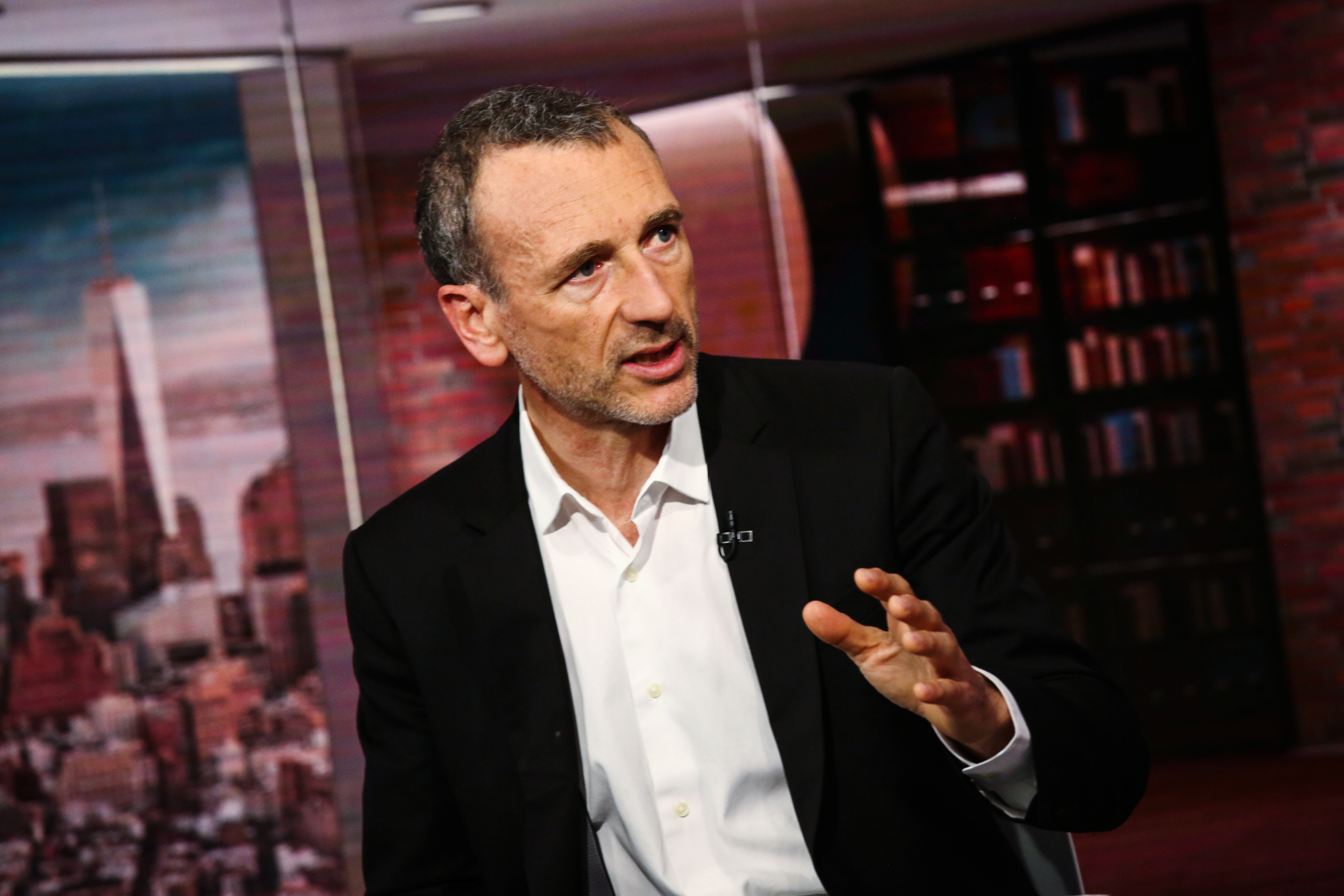
Danone SA Chief Executive Officer Emmanuel Faber Interview

Emmanuel Faber

Photographer: Christopher Goodney/Bloomberg

China Mengniu climbed 1.5% early Monday amid a broader market rally in Hong Kong. Shares of the company, which makes milk, ice cream and cheese, have gained 54% over the past 12 months.

Faber said last month that Danone will divest assets that don’t contribute to profitable growth. The CEO is under scrutiny after Danone shares lost a quarter of their value last year. Bluebell Capital Partners has also called on the company to replace him.

Danone first took a stake in Mengniu in 2013. Its 9.8% holding is currently held indirectly in a venture with COFCO Corp., Mengniu’s biggest shareholder, and first Danone will convert the investment into a direct holding.

The conversion process is subject to regulatory approval and the divestiture could take place in one or several transactions, depending on market conditions, the French company said. The book value of the holding is 850 million euros ($1.03 billion).

Mengniu said in a bloomberg.com

Dairy shines in Covid world

Consumers are flocking back to dairy products as Covid shines the light on health and wellness, says Tom Bailey, the new senior vice president for Southern Pastures.

Bailey, who took up his new role in Auckland after working as a senior dairy analyst for RaboResearch in the US, told Rural News that dairy demand has come roaring back as people seek natural nutrition and go back to basics – simple, uncomplicated, familiar and trusted food.

“Covid has emphasised health and wellness from many angles and demand for milk is back,” he says.

“There are specific examples of this on a national scale; the US has bought massive amounts of dairy as part of its food support programs,” he says.

“Chinese demand has also been very strong. The government has emphasised the health benefits of milk, and we are hearing that fluid milk demand is pumping.”i

As a result, the Chinese dairy processors do not have excess milk, which they normally would, because fluid milk demand has been so strong.

This has helped bolster NZ exports as our exports meet growing demand and also backfill where domestic Chinese manufacturers are missing.

Bailey also says NZ ingredients remain at a substantial premium relative to the global markets, due to many factors – grass-fed is better, many brands require Fonterra specifications for label requirements, and NZ has a great working relationship with key importing markets, such as China.

Southern Pastures owns and operates 20 farms in Waikato and Canterbury and also owns boutique milk company Lewis Road Creamery. The company milks cows under a stringent independently certified 10 Star certified values program, which stipulates grass-fed, free-range, climate-change mitigation, human welfare, animal welfare, GMO-free, palm products free, growth hormones free, antibiotic stewardship, and environmental sustainability requirements. 

Premium milk produced under the Southern Pastures 10 Star program is currently used in Lewis Road Creamery’s grass-fed butter sold in Whole Foods and other stores across the US.

Bailey believes value-add dairy products of the type produced by Southern Pastures and Lewis Road are poised for significant global growth.

“We’ve seen a back-to-basics trend for some time now, with consumers seeking out high quality, nutritious dairy options over more expensive and less healthful alternative plant-based products,” he says.

“People are showing a clear preference for more natural, less adulterated foods with shorter ingredient lists.”

He said premium markets will increasingly pay more for dairy that has an authentic and traceable story.

“When you add attributes such as sustainability or more favourable omega 3:6 milk fat ratios you can extend your market lead, and that’s where Southern Pastures really stands out.”

Lost Opportunity

New Zealand milk volume is surprisingly declining in a highly profitable environment. 

Tom Bailey believes this is due to legislative uncertainty around environmental regulations and central bank policies creating reluctance to invest in dairy. 

“This is affecting banks’ willingness to lend as well as farmer ability to expand. This is a lost opportunity for the economy,” he says.

While NZ supply set for further possible declines, Bailey believes NZ premium are well positioned to be maintained relative to other global dairy export markets.

“Furthermore, consumers continue to show a lot of love for grass-fed products,” he told Rural News.

“Because grazing is amazing and NZ dairies are the most productive with the smallest environmental footprint in the world, NZ products should sell well.

“There is no doubt that premium consumers want our products – our Lewis Road brand has had fantastic traction in the US, and we are set to launch on Amazon, making us the first NZ butter brand store on Amazon.”

Source: ruralnewsgroup.co.nz

There are some warning signs for the dairy industry, specifically production and demand

The dairy markets have appeared to stabilize after the uncertainty of 2020, but a market advisor says that there are some warning signs ahead. 

Those warnings are on the production side. 

Bryan Doherty of Total Farm Marketing says that production capability has been revolutionized, but when you get high prices, you get natural expansion when you have good foodstuffs. 

Crops are good in dairy producing regions, but the industry’s wet rag is that producers are good at what they do. He says that one hedge against future uncertainty is potential demand.

According to Doherty, “Don’t underestimate the demand market worldwide, especially as we come out of COVID, but still, it looks like the market has, a couple of times now, been way at the forefront of that, and we get the rug pulled out from under us, and yet, those rallies kept the production cycle active and alive, and the last several production reports have indicated that.”

He also says that there will be some government support from this.

Source: rfdtv.com

Buttergate: Why are Canadians complaining about hard butter?

Stock photo of butter being spread on bread

Something is amiss with Canadian butter, according to local foodies, who have been arguing for weeks that their blocks are harder to spread than usual.

These so-called “buttergate” anecdotes have been spreading online, with many Canadians complaining that their butter does not soften at room temperature.

Food experts have churned up palm fat in cow feed as a likely culprit.

The dairy industry insists the claims are unfounded, but has created a working group to seek answers.

Buttergate began with a question posed on Twitter by Canadian cookbook author Julie Van Rosendaal: “Have you noticed it’s no longer soft at room temperature?”

Hundreds of home cooks responded with similar butter woes.

Ms Van Rosendaal suggested in a Globe and Mail column last week that a higher demand for butter in the pandemic led to changes in livestock feed, as farmers sought to increase production.

Demand certainly has been on the rise during the pandemic.

The country’s dairy sector – a major presence in all 10 provinces – determines its production quotas based upon demand forecasts. With more Canadians staying home, demand for butter rose by over 12% in 2020, according to Dairy Farmers of Canada.

Adding palm oil-based energy supplements to cow feed is a decades-old practice said to increase the milk output of cows and increase the milk’s fat content.

Since the summer, hundreds of farmers around the country have stepped up their use of palm oil substances in an attempt to boost supply.

Canada’s Dairy Processors Association told Real Agriculture there have been no changes to butter production itself nor national ingredient regulations.

Little research has been done on the true impact of palm oil in dairy, but agricultural experts say butter made from cows fed with palm oil has a higher melting point and, therefore, may be harder to spread at room temperature.

“A Buttergate is not what the industry needs, or what Canadians deserve,” wrote Sylvain Charlebois, senior director at Dalhousie University’s Agri-Food Analytics Lab, in a widely published opinion piece this week that argues most of the country’s butter has definitely gotten harder.

Mr Charlebois noted that palm fat is a legal ingredient in dairy cow feed, but research shows palm oil can increase heart disease risk in people.

Its production also harms the environment, he said, making it an “ethically questionable” practice for the dairy industry, which is heavily subsidised by Canadian taxpayers.

“Let us hope the dairy industry can clean itself up before its moral contract with Canadians is permanently damaged,” he concluded.

Responding to the complaints, the Dairy Farmers of Canada lobbying group released a statement on Friday arguing palm products “help provide energy to cows and no undesirable effects have been identified arising from its use in cows’ feed rations”.

They also noted that farmers in other countries, including the UK and United States, also use palm product supplements.

The group said it would nevertheless assemble an expert committee – composed of various dairy stakeholders, including consumers – to address the concerns.

Source: bbc.com

U.S. Lost 4,400 Farms During Past Year

The total number of farms in Iowa in 2020 was 85,000, down 300 farms from 2019, according to the USDA, National Agricultural Statistics Service – Farms and Land in Farms 2020 Summary report. Farms in the $10,000-$99,999 sales class decreased by 200, while farms in the $250,000-$499,999 sales class decreased by 100.

The number of farms in the United States for 2020 is estimated at 2,019,000, down 4,400 farms from 2019. The number of farms in all sales classes declined. In 2020, 51.1% of all farms had less than $10,000 in sales and 81.5% of all farms had less than $100,000 in sales. In 2020, 7.4 % of all farms had sales of $500,000 or more.

Total land in farms, at 896,600,000 acres, decreased 800,000 acres from 2019. The biggest change for 2020 is that producers in Sales Class $10,000 – $99,999 operated 550,000 fewer acres than in 2019. In 2020, 30.1 percent of all farmland was operated by farms with less than $100,000 in sales, while 40.8 percent of all farmland was operated by farms with sales of $500,000 or more.

The average farm size for 2020 is 444 acres, unchanged from the previous year. Average farm size increased in the $250,000 – $499,999, $500,000-$999,999, and $1,000,000 or more sales classes and remained unchanged in all others.

Read full report here


Weathering the Storms: Rabobank dairy forecast

The Australian dairy industry finished 2020 in a reasonably strong position despite the challenges confronted. The year started with some dairying regions battling bushfires. The supply chain then needed to navigate a global pandemic. In the wash-up, the industry weathered the storms well and has a strong foundation heading into a new year.

The industry is on track to see consecutive seasons of dairy farm profitability. Seasonal conditions in 2020/21 have been favourable for most Australian dairy farmers, with the outlook remaining positive with a La Niña underway in the tropical Pacific. The Bureau of Meteorology forecasts January to March 2021 rainfall to likely be above average across most of Australia.

Purchased feed prices are lower than a year ago, and with a sizeable winter crop harvest underway, it is likely to support cheaper feed bills through the rest of the season.

Australia’s long-awaited grain production recovery is here. After three successive years of below-average production – nearly 30 per cent below in the case of 2019/20 – Rabobank estimates Australia is on track to produce 47.4 million tonnes of winter grains, oilseeds, and pulses this year. This means local grain prices will be down notably year-on-year, but with supportive global pricing and some local withholding we expect wheat prices to remain near to five-year averages in 2020/21.

Importantly, farmgate milk prices are supportive of farmer margin. Across the southern export regions, farmgate milk prices were at record levels in 2019/20. While current milk prices in the 2020/21 season are lower, they are still elevated and above break-even for most farmers.

At the end of 2019/20, Australian milk production was less than nine billion litres. The industry had lost around one billion litres of supply (10 per cent) through the previous four seasons due to the impact of drought and market disruptions. A recovery is underway but there are some limiting factors for a quick recovery to Australian milk production, such as the national herd. Cull cow prices remain elevated. The rate of culling has slowed in recent months, but is coming off an extended period of increased cull rates through the drought period.

Improving confidence

All these factors are feeding through into improved confidence. Rabobank’s December Rural Confidence Survey showed a strong lift in confidence levels among Australian dairy farmers and in investment intentions. The signs of a stabilisation, then recovery, in milk production is evident. In the first four months of the 2020/21 season, milk production has expanded by 1.6 per cent.

There has been growth in all key dairy production regions on the east so far. The season has passed its peak (October) and Rabobank has trimmed the full-year growth forecast slightly, but is still expecting milk production growth by two per cent for the full-year, reaching 8.95 billion litres.

The latest data showed some important shifts in the use of milksolids. In 2019/20 Australian manufacturing favoured cheese production, which lifted by 2.3 per cent to 371,000 tonnes. In contrast, output of milk powders dropped, with skim milk powder (SMP) falling 20 per cent to 141,000 tonnes and whole milk powder (WMP) dropping eight per cent to 43,800 tonnes. Close attention remains on the production shifts in the new season given the increase in milksolids, and weakness in end-user demand for cheese and butter due to market shifts during the global pandemic. The export data provides some context. In the first quarter of the new season, total Australian dairy exports are up 12 per cent on a volume basis. In the same period, SMP exports are 50 per cent higher year-on-year and liquid milk exports are also up 12 per cent.

Light at the end of the tunnel?

As a challenging 2020 ends, more optimistic projections set the tone for 2021. Rabobank expects the global economy to contract by 3.8 per cent in 2020 and recover by 4.5 per cent in 2021. China is the only major economy expected to grow in 2020. There is positive news on the arrival of effective COVID-19 vaccines, although availability and distribution will vary globally.

Several factors in 2021 aid positive consumer sentiment in key dairy markets, including effective vaccines, less political uncertainty after the US election, a weaker US dollar that aids commodity prices, and projections for economic growth in most regions after the 2020 recession.

Supply growth is slowing across primary export regions. Milk production gains across the global Big-7 dairy exporters surprised in 2020, with growth at its highest level since 2017 (4.5 billion litres). However, Rabobank is projecting a more moderate growth rate in 2021, albeit positive across all regions, totalling 2.7 billion litres.

The duration of the second COVID-19 wave and the arrival of vaccines are key to stabilising Q1 2021 demand in foodservice. While there is optimism regarding vaccines and gradual control of the pandemic, there are increasing restrictions on foodservice outlets as COVID-19 cases are on the rise overseas. Retail sales should strengthen further as more meals are consumed at home. Nevertheless, a full recovery in dairy demand is contingent on reaching pre-COVID-19 sales.

Risks lingering

The impact of less government interventions could be significant in 2021. A key reason for strong demand and healthy trade during the COVID-19 pandemic has been government actions in many countries during 2020. It is likely that fiscal constraints will prompt governments to scale back dairy purchases and cash payments to consumers in 2021. This could limit demand growth and impact global prices in 2021 if the economic recovery does not materialise.

Industry consolidation

Locally in Australia, 2020 saw another major shift in consolidation of the processing sector following details of Bega Cheese acquiring the Lion Dairy and Drinks business, making Bega Cheese a much bigger player in Australian dairy. The acquisition will see Bega Cheese lifts its annual milk intake by 75 per cent to 1.7 billion litres, meaning it will rival that of Saputo Dairy Australia and Fonterra Australia.

Source: foodanddrinkbusiness.com.au

Texas dairy producers affected by winter storms, milk supply impacted

Recent severe winter weather is causing distribution and supply issues for the Texas dairy industry, possibly impacting the amount of milk available for purchase at local grocery stores.

“Trying to keep equipment running in low temperatures is hard. Trying to get transportation in and out to pick up the milk we produce is a big challenge,” said Darren Turley, executive director of Texas Association of Dairy. “We’re just having some plants shut down, and icy road conditions…so we may see some spots where inventory is a little restricted. With this long of time without production being delivered and things like that, the consumer will kind of catch up to the supply.”

Plants have shut down due to a shortage of natural gas causes by winter weather.

Many dairy farms are unable to heat up and pasteurize their milk, as they have been asked to shut down so area residents have electricity.

“We’ve now seen plants have a situation…where they cannot get their natural gas so they can’t run their equipment, which is primarily their pasteurizers, because you have to heat milk up to pasteurize it,” explained Turley. “Without that, they’re not able to process milk and some have been curtailed in their areas to not have any power to ensure the residents in the area still have heat. We are having some plant shutdowns. We’re having to move milk greater distances. ”

Unable to process milk themselves or get it to a processing plant due to hazardous road conditions, the milk is going to waste.

“There is a limiting factor. The cows have to be milked. We can’t tell them we have a problem with distribution and we’ll wait until tomorrow,” said Steve Martin, owner and nutritionist of Dairy Nutrition and Management Consulting. “So maybe the least flexible thing is that if that cow is used to being milked twice a day, we have to do that no matter what, and figure out the rest of the logistical problems later.”

The winter weather also results in lost milk production.

Texas dairymen say the health of the cow is always first priority.

So when temperatures get below freezing, the focus shifts away from milk production and towards caring for the animal.

Farmers must pay for extra feed, special wind blocks and bedding to keep cows warm.

Increasing their feed and fiber intake allows the cow to increase its internal body temperature, but this causes the cow’s metabolism to focus on keeping warm and breaking down food rather than producing milk.

“There’s also the cost of lost milk production,” explained Martin. “These cows and these dairy are really fined tuned biological machines that are producing very efficient milk. When we get weather like this, all of that kind of goes to the side a little bit and we focus on keeping the cows healthy and happy. We do lose some sellable marketing milk production just because the cows are using their metabolism to keep warm instead of make milk.”

However, dairy industry experts say due to a large and complex chain of connected dairy farms, they should be able to keep liquid milk on the shelves

“The distance between the cow and grocery store is very short, not as flexible, and that’s what we’ll make sure is filled first,” explained Martin. “The other things, whether its butter, or cheese, or whole milk power, those things can adjust to make sure we have milk for people to buy at the store.”

All of these factors have an economic impact on dairy farmers.

“There are costs for increased feed intake. They have to buy the straw and the cornstalks, they have to pay for the diesel to run the machines, they have to pay for labor,” explained Martin. “A lot of these dairies turn into 24 hour shifts almost, maybe they bring cots in so the employees may sleep because the roads may be bad. This is all done to keep the cows comfortable and healthy.”

With 80% of the state’s milk coming from Panhandle dairies, this economic loss may trickle into other parts of our economy.

Source: newschannel10.com

Canadian dairy compensation payments arrive

About half of Canada’s dairy farmers have received their second trade compensation payments from the federal government, said agriculture minister Marie-Claude Bibeau last week.

Speaking to the Dairy Farmers of Canada annual meeting, she said 5,054 farmers had received $267.1 million so far from the second year of the Dairy Direct Payments Program.

There are 10,095 dairy farms eligible for payments after losing market share through the Comprehensive and Progressive Agreement for Trans-Pacific Partnership and the Comprehensive Economic and Trade Agreement with Europe.

Producers must register with the Canadian Dairy Commission for the compensation before March 31 to receive money this year.

The four-year, $1.75-billion program announced in 2019 saw $345 million available in the first year and $468 million this year. The 2021-22 allocation is $469 million, followed by $468 million in the final year.

According to the government a farm with 80 dairy cows will get about $38,000 next year and the year after. There is no maximum per farm.

Payments are calculated based on the quota allocated to each province for the 12 months ending Oct. 31. The payments are taxable.

Compensation for market share loss for about 4,800 producers in the other supply-managed sectors of chicken, eggs, turkey and broiler hatching eggs is still under negotiation.

That program would see about $691 million distributed over 10 years and more details are expected this spring.

Meanwhile, Ottawa has promised fair compensation to all sectors for losses due to the Canada-United States-Mexico Agreement but has not offered a cost estimate.

A legislative costing note issued by the Parliamentary Budget Officer Feb. 10 said total cost for that compensation if paid in the 2021-22 fiscal year would be about $786 million.

“Underlying our analysis is the assumption that projected increases in demand are larger than the changed quotas for any year going forward,” the note said. “Thus, the compensation is for lost expansion opportunities, in particular, lost additional net income or profits.”

The analysis uses unchanged raw milk prices to calculate net income loss for producers, adjusted for reduced expenditures. Processors’ compensation is calculated as income lost by the owners.

“We also assumed that, under new CUSMA export restrictions, processors will export lower volumes of infant formula, skim milk powder and protein concentrates at domestic animal feed prices, which are lower than the export price of these commodities,” the note said.

The compensation is the net present value of foregone income over 25 years, the authors said, and assumes income tax paid at 15 percent.

The total cost estimate is $925 million less recovery of $139 million.

The payments would be $588 million to dairy farmers, $305 million to processors, $30 million to poultry and egg producers, and $2 million to poultry processors.

Source: producer.com

Dairy compensation payments arrive for Canadian Dairy Farmers

About half of Canada’s dairy farmers have received their second trade compensation payments from the federal government, said agriculture minister Marie-Claude Bibeau last week.

Speaking to the Dairy Farmers of Canada annual meeting, she said 5,054 farmers had received $267.1 million so far from the second year of the Dairy Direct Payments Program.

There are 10,095 dairy farms eligible for payments after losing market share through the Comprehensive and Progressive Agreement for Trans-Pacific Partnership and the Comprehensive Economic and Trade Agreement with Europe.

Producers must register with the Canadian Dairy Commission for the compensation before March 31 to receive money this year.

The four-year, $1.75-billion program announced in 2019 saw $345 million available in the first year and $468 million this year. The 2021-22 allocation is $469 million, followed by $468 million in the final year.

According to the government a farm with 80 dairy cows will get about $38,000 next year and the year after. There is no maximum per farm.

Payments are calculated based on the quota allocated to each province for the 12 months ending Oct. 31. The payments are taxable.

Compensation for market share loss for about 4,800 producers in the other supply-managed sectors of chicken, eggs, turkey and broiler hatching eggs is still under negotiation.

That program would see about $691 million distributed over 10 years and more details are expected this spring.

Meanwhile, Ottawa has promised fair compensation to all sectors for losses due to the Canada-United States-Mexico Agreement but has not offered a cost estimate.

A legislative costing note issued by the Parliamentary Budget Officer Feb. 10 said total cost for that compensation if paid in the 2021-22 fiscal year would be about $786 million.

“Underlying our analysis is the assumption that projected increases in demand are larger than the changed quotas for any year going forward,” the note said. “Thus, the compensation is for lost expansion opportunities, in particular, lost additional net income or profits.”

The analysis uses unchanged raw milk prices to calculate net income loss for producers, adjusted for reduced expenditures. Processors’ compensation is calculated as income lost by the owners.

“We also assumed that, under new CUSMA export restrictions, processors will export lower volumes of infant formula, skim milk powder and protein concentrates at domestic animal feed prices, which are lower than the export price of these commodities,” the note said.

The compensation is the net present value of foregone income over 25 years, the authors said, and assumes income tax paid at 15 percent.

The total cost estimate is $925 million less recovery of $139 million.

The payments would be $588 million to dairy farmers, $305 million to processors, $30 million to poultry and egg producers, and $2 million to poultry processors.

Source: producer.com

UK dairy trade with the US

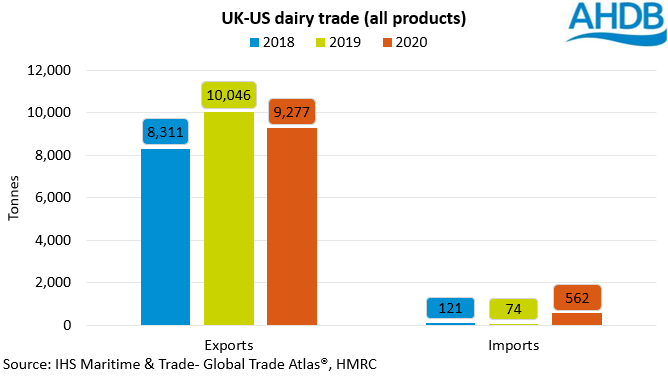
The US is the second most important export market for dairy products from the UK outside of the EU, both in terms of volume and value.

The UK is currently a net exporter of dairy products to the US according to HMRC data. In 2020, 9,300 tonnes of dairy products were exported to the US from the UK, valued at £52 million. Exports were predominantly of cheese (81%), while butter accounted for 13%. The remainder was made up of other dairy products such as whey. Cheese also contributed the most to the value of exports in 2020 (85%) with Cheddar being the predominate variety.

Import volumes of dairy products entering the UK from the US were up year-on-year, although remain small at 562 tonnes. This was primarily made up of whey products (94%).


The volume of exports in 2020 did drop back on year earlier levels which may be, in part, due to tariffs being imposed on dairy products as a result of the Airbus dispute back in 2019.

The relatively weak US dollar, which has been losing value against both the euro and sterling over the past year, may also have reduced import demand as UK exports would be comparatively more expensive.

However, with the majority of UK cheese exports being value-added products, and directed towards consumer markets, demand is likely to be less sensitive to price, helping to mitigate the impact of tariffs or exchange rate fluctuations.

Source: ahdb.org.uk

American Dairy Coalition congratulates Senate Appropriations Subcommittee on Agriculture Chair Selectee Baldwin

The American Dairy Coalition wishes to congratulate the newly selected Chair of the Senate Appropriations Subcommittee on Agriculture, Rural Development, Food and Drug Administration, and Related Agencies, Senator Tammy Baldwin (D-WI).
 
Baldwin has repeatedly proven herself to be a friend and advocate of dairy producers. When serving on the Agriculture Appropriations Subcommittee, she sponsored and authored the Defending Against Imitations and Replacements of Yogurt, milk, and cheese to Promote Regular Intake of Dairy Everyday Act – or DAIRY PRIDE Act. This bill was a bipartisan effort calling for the Food and Drug Administration to enforce the law requiring imitation dairy products to be labeled properly.
 
“Dairy farmers in Wisconsin work tirelessly every day to ensure that their milk meets high standards for nutritional value and quality,” Baldwin stated. “Imitation products have gotten away with using dairy’s good name for their own benefit, which is against the law and must be enforced. Mislabeling of plant-based products as ‘milk’ hurts our dairy farmers. That’s why I’ve authored the DAIRY PRIDE Act to take a stand for Wisconsin farmers and the quality products they make.”
 
Baldwin has also proven herself an advocate for dairy producers by supporting keynote improvements to the 2018 Farm Bill’s and Bipartisan Budget Act’s financial dairy safety net. Notably, she also sponsored the FARMERS FIRST Act to reestablish the Department of Agriculture’s Farm and Ranch Stress Assistance Network.
 
“With her track record, the American Dairy Coalition sees the selection of Tammy Baldwin as very positive for dairy farmers from across the U.S. We look forward to working within her new role and seeing the contributions she makes toward supporting the future of dairy,” said Laurie Fischer, CEO for the American Dairy Coalition.

USDA Issues WASDE Report – More Milk, Lower Prices

The World Agricultural Supply and Demand Estimates were released on February 9.

The 2020 milk production, trade, and stock estimates are adjusted to reflect December data. For 2021, the milk production forecast is raised from last month, primarily on higher dairy cow numbers. The 2021 fat basis import forecast is raised on higher expected imports of cheese and butterfat products, while exports are raised on higher shipments of butterfat. On a skim-solids basis, the import forecast is unchanged while the export forecast is raised, reflecting expectations of strong international demand.

Annual product price forecasts for cheese and butter are lowered from the previous month on current prices, increased production, and larger stocks. Nonfat dry milk (NDM) and whey price forecasts are raised from last month on firm demand.

The Class III price is reduced on the lower cheese price forecast and the Class IV price is also reduced, reflecting a lower butter price forecast. The 2021 all milk price forecast is reduced to $17.15 per cwt.

The entire report is available here.

Latest round of compensation already delivered to more than 50% of Canadian dairy farmers

Today, the Minister of Agriculture and Agri-Food, the Honourable Marie-Claude Bibeau, announced that 5,054 Canadian dairy farmers have already received their payments, totalling $267.1 million, under the second year of the Dairy Direct Payments Program. This represents roughly 51 % of the more than 10,000 dairy farmers across the country. Minister Bibeau made the announcement as part of a keynote speech to the Dairy Farmers of Canada at their Annual General Meeting.

With these direct payments the Government of Canada is delivering on its commitment to provide full and fair compensation to supply-managed sectors for market access concessions made under the Canada-European Union Comprehensive Economic and Trade Agreement (CETA) and the Comprehensive and Progressive Agreement for Trans-Pacific Partnership (CPTPP).

Dairy farmers will receive $1.75 billion in direct payments over the course of four years, with $345 million made available in year one (2019-20) and $468 millioncurrently available under year two of the program. Another $469 million will be available in 2021-22, and $468 million in 2022-23. The owner of a farm with 80 dairy cows will be awarded compensation in the form of a direct payment of approximately $38,000 for each of these remaining years. 

These amounts also build on the $250 million CETA on-farm investment program, and provide certainty on the schedule and form of remaining payments in the $2 billion total compensation package for dairy farmers.

The Government of Canada remains committed to engaging the sector on full and fair compensation for the Canada-United States-Mexico Agreement (CUSMA), and to providing compensation to processors of supply-managed products.

Canada’s supply managed farmers are the backbone of rural communities across the country, and help ensure a strong Canadian economy and agriculture sector. Throughout the COVID-19 pandemic, these farmers have consistently demonstrated their outstanding commitment to providing high-quality products to the Canadians who rely on them.

Quote

“Our Government is moving full steam ahead to ensure that supply-managed sectors receive full and fair compensation that gives them the predictability and support necessary for their success for generations to come. More than 50% of producers have already received their second payment. The Government continues to work tirelessly to ensure that dairy, poultry and egg producers remain resilient and prosperous.”
–       The Honourable Marie-Claude Bibeau, Minister of Agriculture and Agri-Food

Quick Facts

  • Letters were mailed to all Canadian dairy producers in January to provide them with directions on how to register for this second payment. Producers must register through the Canadian Dairy Commission prior to March 31, 2021 to receive a payment under this program year.
  • There are 10,095 dairy farms in Canada, supporting close to 19,000 direct jobs on farms. The demand for Canadian dairy remains strong, and has led to a 9% increase in raw milk production between 2016 and 2019.
  • There are over 4,750 chicken, egg, broiler hatching egg, and turkey farmers across Canada. These farmers generated over $4.9 billion in farm cash receipts in 2019, totalling 7.4 percent of all farm cash receipts in Canada. According to industry, Canada’s poultry and egg sector supports more than 140,000 direct and indirect jobs.
  • Details of federal compensation programs for chicken, egg, turkey and broiler hatching egg producers, totaling $691 million over ten years, are being discussed in consultation with industry representatives. These consultations are progressing well, further program details  expected to be available this spring.

Additional Links 

Follow us on Twitter: @AAFC_Canada
Like us on Facebook: CanadianAgriculture

SOURCE Agriculture and Agri-Food Canada

For further information: Jean-Sébastien Comeau, Press Secretary, Office of the Minister of Agriculture and Agri-Food, jean-sebastien.comeau@canada.ca, 343-549-2326; Media Relations, Agriculture and Agri-Food Canada, Ottawa, Ontario, 613-773-7972, 1-866-345-7972, aafc.mediarelations-relationsmedias.aac@canada.ca

US dairy exports volume sets all-time high mark in 2020

Despite significant disruptions in trade throughout 2020, the United States exported nearly 2.4 million metric tons of dairy goods last year–a record-setting mark, according to data released today by USDA’s Foreign Agricultural Service (FAS).

Michael Dykes, D.V.M., President and CEO of the International Dairy Foods Association (IDFA) issued the following statement:

“Last year was yet another banner year for U.S. dairy exports, a testament to the resilience, innovation, and growth of the U.S. dairy industry. While logistical issues challenged the industry in 2020 and some continue today, U.S. dairy exports maintained an accelerated pace throughout the year. Export volumes were boosted by 10 percent over 2019, setting an all-time record for export volumes in one year and pushing export values to more than $6 billion for the first time since 2014.

“A look at the United States’ top markets shows positive trends with trading partners new and old. Export volumes and value are up over 2019 levels in 9 of our top 10 markets. Some Asian markets—China, Philippines, Indonesia, and Malaysia—saw increases between 40-50% in value over 2019, with correlating increases in volume to those markets. In fact, the few countries in the top 20 export markets that did decline by volume all have known tariff and non-tariff barriers in place, on which IDFA has been advocating with our U.S. government colleagues.

“Two decades ago, U.S. dairy was almost completely a domestic market. But the past 20 years have been transformational. During that time, U.S. dairy exports increased 5X, and the United States became the world’s third-largest dairy product exporter. Now, we export approximately 15% of U.S. milk production.

“With more than 95 percent of potential customers living outside the United States, expanding access to international markets is essential for the future America’s dairy industry. We cannot achieve this growth alone—we need the Administration’s support and the support of our elected officials to continue growth in U.S. dairy exports.”

Additional Background on USDA’s Export Data Release:

USDA released US agricultural export data for December 2020, completing the full picture for exports in 2020. In total, dairy exports were $6,452,903,000, up 9% from 2019. Here are the top five markets and products:

Top 5 markets (value):

Mexico: $1,415,827,000 – down 8% from 2019
Canada: $675,993,000 – up 1% from 2019
China: $539,059,000 – up 45% from 2019
Philippines: $409,855,000 – up 50% from 2019
S. Korea: $370,481,000 – up 12% from 2019

Top 5 products (value):

Milk powder, <1.5% fat (0402.10): $2,011,058,000 – up 22% from 2019
Fresh cheeses (0406.10), cheese all kinds (0406.20), and cheeses mixed (0406.90): $1,304,763,000 total – down 2% and up 21% and 5% from 2019, respectively
Milk albumin, including concentrates of whey proteins (3502.20): $355,917,000 – up 6% from 2019
Lactose (1702.11): $317,326,000 – up 10% from 2019
Infant formula (1901.10): $292,813,000 – down 6% from 2019

Source: idfa.org

Dairy Industry Ireland accused of deliberate undermining of milk price

Acting chair of the IFA’s dairy committee Stephen Arthur has condemned Dairy Industry Ireland’s (DII) proposals to change base milk price quotations.

Processors will now express their milk price on the basis of 4.2% butterfat and 3.4% protein which is the European standard and close to the average milk constituents in Ireland, DII announced on Tuesday.

The current 3.6%/3.3% pricing model to allow comparison between years will be also retained, with processors expected to quote the two prices starting with January 2021 price announcements.

DII said the change would allow for a better comparison between Irish milk prices and those quoted across the continent.

‘All for optics’

Last week, the IFA wrote to all milk processors outlining opposition to the change and requested that the letters be read out at all milk processor board of management meetings.

“The representative structure of milk processors is being undermined by management. Farmers have been side-lined. There was no consultation with elected representatives,” Arthur said.

“This is a change sought solely by management, not by suppliers, and must be reversed. Processors want to look like they are paying more for milk when nothing has changed, we are still getting the same price for our milk as we did 25 years ago.”

The IFA has called for milk price to be stated on a euro per kilogram of solids basis.

“The real threat from this change is that it will erode the gains farmers have made within the farm gate. Over time, we will end up supplying milk with higher milk solids, but for a lower price,” Arthur concluded.

Source: farmersjournal.ie

Growth seen in Kansas dairy industry despite fewer farms

Kansas is well known for beef production, but the state’s dairy industry has grown significantly over the past 20 years and Kansas State University’s Mike Brouk expects that trend to continue.

 Brouk, an animal science professor and K-State Research and Extension dairy specialist, said there are twice as many dairy cows in Kansas now as there were in 1998, and the state has been adding 3,000 to 4,000 per year.

The trend started years ago when some large dairies relocated from other states because of Kansas’ readily-available feed, land and generally favorable climate, according to a USDA report.

“We’re milking more cows, but we’re also getting more milk per cow,” said Brouk.

Milk production per cow is up about 50% from where it was in 1998, reaching an average of 23,429 pounds per cow per year in 2019 from 16,037 pounds in 1998. Brouk largely credits Kansas producers and their management practices for the increases.

He works with some producers who have started using robots or are considering switching to robotic milking but noted that startup costs are an obstacle to the adoption of the technology. The equipment investment for robotic milking is about $2,500 per cow compared with $250 per cow using conventional equipment.

Currently, five farms in Kansas are milking robotically.

Kansas’ overall milk production is about three times what it was in 1998 because of the increase in cow numbers and more milk production per cow. That puts the state at No. 16 nationally in total milk production and No. 14 in production per cow.

One of the downsides in the industry is consolidation. Brouk said there has been a 2.57 fold decrease in the number of dairy farms in the state, but added that many of the remaining farms are growing. Some have locations in other states.

“We produce more milk in Kansas than what we can consume as a population,” he added.

Americans typically consume about 600 pounds of milk or milk products each year. Since Kansas currently produces about twice that much or 1.13 million pounds, about half goes to other states – often southeast states where production per capita is less or is exported to other countries.

Brouk said dairy consumption has increased over the past 20 years, but “how we consume dairy products has changed drastically during that time. We’ve had a decrease in fluid milk sales of about 42% but an increase in cheese sales of about 170%. It’s not all about fluid milk anymore.”

As in other agriculture sectors, dairy exports to other countries have become increasingly important and have continued to increase even this year during the coronavirus pandemic. Mexico is the largest buyer of US dairy products, but southeast Asia and Canada are also key markets.

Brouk said total dairy product consumption is up about 20% from where it was in 1975.

“We have a very healthy market, healthy demand for our products and that’s a good thing for our industry,” he said.

He noted, however, that even with robust milk production and demand, dairy farmers’ margins are tight because of feed costs. A measure called the milk-feed price ratio indicates that dairy producers’ profit margins are growing tighter.

“That means any uptick in feed prices without a corresponding move up in milk prices will make margins even tighter,” Brouk said.

Source: K-State

How USDEC Delivered in 2020

In 2020, the U.S. dairy industry exported more than 2 million tons of milk solids for the first time ever. That milestone means more U.S. milk is being shipped across our borders than ever before, in part due to the work of the U.S. Dairy Export Council (USDEC).
 
The checkoff-funded USDEC works with processors, trading companies and others to enhance global demand and market access for U.S. dairy products and ingredients on behalf of U.S. dairy farmers.

Read the recently released 2020 USDEC Progress Report for a cross section of the USDEC work from the past year that attests to an increasingly diversified scope, product offerings and approach to reaching end-users and consumers. Your checkoff funding directly supports many of these activities.


Dairy Industry Ireland accused of deliberate undermining of milk price

Acting chair of the IFA’s dairy committee Stephen Arthur has condemned Dairy Industry Ireland’s (DII) proposals to change base milk price quotations.

Processors will now express their milk price on the basis of 4.2% butterfat and 3.4% protein which is the European standard and close to the average milk constituents in Ireland, DII announced on Tuesday.

The current 3.6%/3.3% pricing model to allow comparison between years will be also retained, with processors expected to quote the two prices starting with January 2021 price announcements.

DII said the change would allow for a better comparison between Irish milk prices and those quoted across the continent.

‘All for optics’

Last week, the IFA wrote to all milk processors outlining opposition to the change and requested that the letters be read out at all milk processor board of management meetings.

“The representative structure of milk processors is being undermined by management. Farmers have been side-lined. There was no consultation with elected representatives,” Arthur said.

“This is a change sought solely by management, not by suppliers, and must be reversed. Processors want to look like they are paying more for milk when nothing has changed, we are still getting the same price for our milk as we did 25 years ago.”

The IFA has called for milk price to be stated on a euro per kilogram of solids basis.

“The real threat from this change is that it will erode the gains farmers have made within the farm gate. Over time, we will end up supplying milk with higher milk solids, but for a lower price,” Arthur concluded.

Source: farmersjournal.ie

Kansas dairy farmers brace for dangerous cold weather, keeping animals safe

The incoming wind chills are bad enough for humans but for animals out on the farm, the cold can easily become a life-or-death situation.

Complicating matters, this is the time of year that calves are born to cows.

Farmers at Be Whole Again Farm in Excelsior Springs considered their options on Thursday night before a wind chill warning took effect at midnight.

Wind chill temperatures are expected to dip below -10 degrees going into the weekend.

Their cows group together inside of their barn which has a big open hole on one side. Normally this set-up is a good thing because it allows for ventilation so cows don’t develop lung issues.

But because of the expected wind chill, farmer Rachel Moser planned to make a temporary wall – covering the hole with tarps recycled from old billboards.

“I heard someone say that their cow went down on some ice and he watched it fall and it broke a rib. The rib punctured its lung and it was dead in five minutes,” Moser said.

“I mean, I definitely am losing sleep right now. Like I will come out and check on animals. We had a cow calf this morning,” Moser said.

Calves are born wet and slimy which is dangerous with our region’s cold temperatures. Mosers said they use towels and  a blow dryer to help the mother cow who would typically lick them clean.

“Compared to a beef animal, beef animals have way more fat on them. Just way more muscle in general,” Moser said.

“Is there anything that they do that indicates to you that you really need to be keeping your eye on them?” FOX4 asked.

“Yeah, there’s certain visual cues in terms of like everything is freezing and they’re breathing and there’s like icicles on their face. Then you know it’s really cold. Their ears will go droopy,” Moser said.

“They can just slip and break a hip, break a rib, break a leg, and then their hooves don’t do very well. It’s just painful. I’ve actually been keeping a momma cow in with my babies at night just to act as a heater,” Moser said.

Source: fox4kc.com

New Dairy Export Assurance program allows more market opportunities for Australian farmers

Dairy Australia is partnering with The Department of Agriculture, Drought and Emergency Management to deliver the Dairy Export Assurance Program’s project deliverables, with a multidisciplinary team working collaboratively across the Department and Dairy Australia.

Minister for Agriculture, Drought and Emergency Management David Littleproud said the program would help build a stronger, export-ready sector.

“This program will identify the regulatory hurdles for domestic dairy manufacturers to become exporters, and reduce regulatory intervention through improved data collection,” Minister Littleproud said.

“Helping our small to medium exporters to better understand the regulatory compliance step-change required to become export ready will ultimately support our Ag2030 agenda for a $100 billion agriculture industry by 2030.

“The program will work with industry to align food safety in regulatory and commercial assurance programs.

“Stronger demand for our products will maintain upwards pressure on farm gate milk prices, build greater confidence in the industry and create a more encouraging environment for capital investment at both the farm and processing steps in the dairy supply chain.

“The projects will work with industry to develop awareness training and increase capability for producers, exporters and state regulators to better understand the key differences in food safety and regulatory standards required to meet export and importing country requirements.

“These initiatives also aim to reduce the audit burden by reviewing requirements and seeking recognition across audit compliance systems. This supports existing work undertaken by state regulators to achieve greater levels of compliance and data supporting regulatory intervention.

Dairy Australia Managing Director, David Nation, said: 
“Exports are a vital part of the Australian dairy industry and account for around a third of annual production. In an increasingly competitive global market it is essential that Australian companies are able to access key export destinations. 

This initiative will support dairy companies to expand their operations into export markets by improving their knowledge of, and compliance with, a more streamlined export regulatory process.

“Dairy Australia is pleased to have been invited to work in this unique collaboration model with the Department of Agriculture, Water and the Environment to deliver these benefits to Australia’s dairy industry.”

U.S. Dairy Exports Volume Sets All-Time High Mark in 2020

Despite significant disruptions in trade throughout 2020, the United States exported nearly 2.4 million metric tons of dairy goods last year — a record-setting mark, according to data released last week by the Department of Agriculture’s (USDA)Foreign Agricultural Service (FAS). Michael Dykes, president and CEO of the International Dairy Foods Association (IDFA), issued the following statement:
 
“Last year was yet another banner year for U.S. dairy exports, a testament to the resilience, innovation and growth of the U.S. dairy industry. While logistical issues challenged the industry in 2020 and some continue today, U.S. dairy exports maintained an accelerated pace throughout the year. Export volumes were boosted by 10% over 2019, setting an all-time record for export volumes in one year and pushing export values to more than $6 billion for the first time since 2014.
 
“A look at the United States’ top markets shows positive trends with trading partners new and old. Export volumes and value are up over 2019 levels in 9 of our top 10 markets. Some Asian markets — China, Philippines, Indonesia and Malaysia — saw increases between 40-50% in value over 2019, with correlating increases in volume to those markets. In fact, the few countries in the top 20 export markets that did decline by volume all have known tariff and non-tariff barriers in place, on which IDFA has been advocating with our U.S. government colleagues.
 
“Two decades ago, U.S. dairy was almost completely a domestic market. But the past 20 years have been transformational. During that time, U.S. dairy exports increased five times, and the United States became the world’s third-largest dairy product exporter. Now, we export approximately 15% of U.S. milk production.
 
“With more than 95% of potential customers living outside the United States, expanding access to international markets is essential for the future of America’s dairy industry. We cannot achieve this growth alone — we need the Administration’s support and the support of our elected officials to continue growth in U.S. dairy exports.”
 
Additional Background on USDA’s Export Data Release
 
USDA last week released U.S. agricultural export data for December 2020, completing the full picture for exports in 2020. In total, dairy exports were $6,452,903,000, up 9% from 2019. Here are the top five markets and products:
 
Top 5 markets (value):
  • Mexico: $1,415,827,000 – down 8% from 2019
  • Canada: $675,993,000 – up 1% from 2019
  • China: $539,059,000 – up 45% from 2019
  • Philippines: $409,855,000 – up 50% from 2019
  • S. Korea: $370,481,000 – up 12% from 2019
 
Top 5 products (value): 
  • Milk powder, <1.5% fat (0402.10): $2,011,058,000 – up 22% from 2019
  • Fresh cheeses (0406.10), cheese all kinds (0406.20), and cheeses mixed (0406.90): $1,304,763,000 total – down 2% and up 21% and 5% from 2019, respectively
  • Milk albumin, including concentrates of whey proteins (3502.20): $355,917,000 – up 6% from 2019
  • Lactose (1702.11): $317,326,000 – up 10% from 2019
  • Infant formula (1901.10): $292,813,000 – down 6% from 2019

Source: Quality Assurance Magazine 

India #1 Dairy Production Country in the World

India has taken over US and is now the Number one Nation in the world in the field of Animal husbandry and dairy farming and Production, according to Dr. Ashok Dalwai, CEO National Rainfed Area Authority, Union Ministry of Agriculture and Farmers’ Welfare.

Speaking at An Interactive Session on Doubling of Farmers’ Income at the Karnataka State Rural Development and Panchayat Raj University, Gadag on Saturday, Dr. Dalwai said that the United States of America was the number one Country in the World so far in Animal Husbandry, Dairy Farming and Production, But India has not only overtook America, but now producing twice the Amount of Dairy products comparing to what the USA was producing.

Calling upon the Farmers to follow the Advise of Mahatma Gandhiji to adopt themselves into Farming and keeping their villages as the Centre of their Agricultural activities to achieve National prosperity, Dr. Dalwai said that the Agriculture is the only means through which the eradication of poverty is possible in the Country. According to him, Cultivating, Processing and Marketing the crops meeting the demands of the International Market would definitely help in the direction of doubling the Farmers’ income. Plus the Center’s Schemes under the Aatma Nirbhar Yojana will also help the Farmers to a great extent in doubling their income, he added.

Dr. Dalwai said that the Farmers must adopt themselves to the advanced Technology and Mechanized method of farming to boost their Farm production which will enable them to strengthen and achieve financial Stability. Referring to the allocation of Rupees One Lakh Crores grant by the Center in the recent Budget for the Agricultural Sector, he suggested that the funds should be utilized to help and assist farmers to grow high quality crops, to building facilities to process Agri products in accordance with the Market requirements, building Modern Godowns for storing, provide suitable Marketing and Transportation facilities etc., to ensure increased income to the Farmers.

Dr. Dalwai also advised the Farmers to make sure that they have taken necessary insurance for their crops against damages and losses due to natural disasters Etc., He also advised them to enter into advance agreements with Trading companies to sell their products in order to protect themselves against any future losses.

Source: uniindia.com

Milk-Production Increase Outstripping Supply Gains, NMPF’s Vitaliano Says

ilk production is increasing faster than demand is recovering, making 2021 a challenging year for dairy farmers, said Peter Vitaliano, NMPF’s chief economist, in an NMPF podcast released today.

“On balance, things are improving a little bit” in dairy demand, “but they’re still falling short of the milk production rate of increase,” Vitaliano said. Still, bright spots remain for the medium- and longer-term dairy outlook. Demand for U.S. dairy exports is at record levels, and demand for dairy away from home should increase as the COVID-19 pandemic fades, he said.

The full podcast is here. You can also find this and other NMPF podcasts on Apple PodcastsSpotifySoundCloud and iHeart Radio.

The way we breed cows is setting them up for extinction

There are more than 9 million dairy cows in the United States, and the vast majority of them are Holsteins, large bovines with distinctive black-and-white (sometimes red-and-white) markings. The amount of milk they produce is astonishing. So is their lineage. When researchers at the Pennsylvania State University looked closely at the male lines a few years ago, they discovered more than 99% of them can be traced back to one of two bulls, both born in the 1960s. That means among all the male Holsteins in the country, there are just two Y chromosomes.

“What we’ve done is really narrowed down the genetic pool,” says Chad Dechow, one of the researchers.

The females haven’t fared much better. In fact, Dechow—an associate professor of dairy cattle genetics—and others say there is so much genetic similarity among them, the effective population size is less than 50. If Holsteins were wild animals, that would put them in the category of critically endangered species. “It’s pretty much one big inbred family,” says Leslie B. Hansen, a Holstein expert and professor at the University of Minnesota.

Any elementary science student knows that genetic homogeneity isn’t good in the long term. It increases the risk of inherited disorders while also reducing the ability of a population to evolve in the face of a changing environment. Dairy farmers struggling to pay bills today aren’t necessarily focusing on the evolutionary prospects of their animals, but Dechow and his colleagues were concerned enough that they wanted to look more closely at what traits had been lost.

For answers, the researchers have begun breeding a small batch of new cows, cultivated in part from the preserved semen of long deceased bulls, to measure a host of characteristics—height, weight, milk production, overall health, fertility, and udder health, among other traits—and compare those to the modern Holsteins we’ve created. The hope is that they might one day be able to inject some sorely needed genetic diversity back into this cornerstone of livestock agriculture, and possibly reawaken traits that have been lost to relentless inbreeding.

“If we limit long term genetic diversity of the breed,” Dechow says, “we limit how much genetic change can be made over time.”

In other words, we could reach a point where we’re stuck where we’re at. There will be no more improvement in milk production. Fertility won’t improve. And if a new disease comes along, huge swaths of the cow population could be susceptible, since so many of them have the same genes.

Holsteins today are responsible for the vast majority of milk we drink and much of our cheese and ice cream. For at least the past century, these animals have been prized for their voluminous output. Over the last 70 years or so, humans have introduced a variety of methods to ramp up production even further. In 1950, for example, a single dairy cow produced about 5,300 pounds of milk a year. Today, the average Holstein is producing more than 23,000. In 2017, a prize-winning cow named Selz-Pralle Aftershock 3918 cranked out 78,170 pounds of milk—more than 200 pounds every single day.

“These cows are real athletes,” says Hansen.

This benefits consumers by keeping food prices low. It benefits farmers because they save on costs when fewer cows produce the same amount of milk. It also benefits the environment because a cow’s digestive system produces considerable amounts of methane and waste. (Although high-producing Holsteins consume more energy and generate more waste per cow, researchers estimate that the efficiency gains result in significantly reduced environmental impacts overall.)

Part of this success story has to do with changing the way Holsteins are raised and managed. But the biggest change has been in the way cows are bred. Long ago, farmers would bring in bulls from other farms to get their cows pregnant—a way of ensuring genetic diversity, or “stirring the pot,” as Hansen says. In the 1940s, they began to use artificial insemination. This way, a single dose of bull semen could be used to impregnate a whole lot of heifers. Soon, technology allowed the semen to be frozen, which meant a bull could father calves for decades, even long after he was dead. Meanwhile, the dairy world was keeping very detailed records, so the bull studs who sell the semen could tell which bull went on to produce the best offspring—and by the best offspring, they meant the daughters who produced the most milk.

By this point, a highly sought-after bull would sire thousands of daughters. Carlin-M Ivanhoe Bell, a bull born in 1974, had more than 80,000 offspring. Most bulls have fewer, though their progeny still number in the thousands. By the 1980s, it was clear inbreeding was increasing significantly.

In the early days of artificial insemination, bulls would have to prove their merit in real life. That is, they’d sire 100 daughters, then when those daughters calved and began producing milk, their output was measured. The better the output, the more marketable the bull. This “progeny testing” was a valuable process, but it took several years to determine if a bull was any good.

In 2009, new technology came along: big data and genomic selection. Today, a bull’s marketability is determined by a computer. A complex algorithm analyzes the bull’s genetic makeup, taking into account the health of his offspring, their milk production, the fat and protein in the milk, and other traits, to come up with figures that rank him against other bulls. The key figure is called lifetime net merit. It represents the average amount of money a farmer can expect to earn over the offspring’s life by choosing this bull over another one.

While this allowed farmers to more efficiently evaluate animals across many key traits, the process also led to even higher rates of inbreeding. The “inbreeding coefficient” for Holsteins is currently around 8%, meaning an average calf gets identical copies of 8% of its genes from its mother and its father. That number is in comparison to a baseline of 1960—and it continues to increase by .3 or .4 every year.

“Inbreeding is accumulating faster than it ever has,” Dechow says.

But is 8% too much? Dairy experts continue to debate this. Some argue that Holsteins are doing their job, producing a lot of milk, and that they’re a relatively healthy bunch. Hansen, however, notes that if you breed a bull to his daughter, the inbreeding coefficient is 25%; in that light, 8 seems like a lot. He and others say while inbreeding may not seem like a problem now, the consequences could be significant.

Fertility rates are affected by inbreeding, and already, Holstein fertility has dropped significantly. Pregnancy rates in the 1960s were 35 to 40 percent, but by 2000 had dropped to 24 percent. Also, when close relatives are bred, it’s more likely for cows get two copies of unwanted recessive genes, where serious health problems could be lurking.

“Something needs to change,” Hansen says.

For Dechow, the concern is the rate of increase and what that means for the future of the breed. “Imagine you’ve got a cow who has 100 really good genes and 10 really horrible genes. You eliminate that cow from your breeding program because she’s got 10 horrible genes,” he says, and “you’ve lost her 100 good ones, as well. You’re losing long-term genetic potential.”

Dechow grew up on a dairy farm, so long before he knew the ins-and-outs of the cow’s genome, he could see some of what was happening.

Holsteins look very different than they did 50 years ago. For one thing, they’ve been bred to have longer and wider udders, rather than deep ones. A deep udder can touch the ground, making it much more prone to infection or other problems, so that’s a change for the better. But other changes could be problematic. For example, modern Holsteins are bred to be tall and thin, to the point of boniness. That thinness is a byproduct of milk production, because “they’re directing the energy they consume towards milk,” Dechow says.

But it’s also something of an aesthetic choice. The ideal Holstein cow—at least in the view of people who judge these things—is “feminine and refined.” That means thin and angular. The problem is, a tall, thin cow isn’t necessarily the healthiest cow and shorter and rounder cattle are more likely to get pregnant.

A few years ago, Dechow and others started to wonder, just how significant was the inbreeding and loss of diversity? In the early 1950s, there were about 1,800 bulls represented in the population. They knew there were fewer today, but they had no idea how few. Dechow and his colleagues Wansheng Liu and Xiang-Peng Yue analyzed the paternal pedigree information of nearly 63,000 Holstein bulls born since the 1950s in North America.

“We were a little bit surprised when we traced the lineages and it went back to two bulls,” he says. They’re named Round Oak Rag Apple Elevation and Pawnee Farm Arlinda Chief. Each one is related to about half the bulls alive today. Essentially, Elevation and Chief outcompeted every other bull on the market. Even Select Sires, a company that is in the business of selling bull semen, was surprised by the findings. Charles Sattler, a company vice president, sees the news as a bit of a reality check, but not a cause for alarm. “Probably the biggest concern is, are there any really valuable genes we may have lost along the way that we could make use of today?” he wonders.

Not too long ago, there was another Y chromosome represented, that of Penstate Ivanhoe Star, born in the 1960s. His decline demonstrates one problem with all this inbreeding. In the 1990s, dairy farmers around the world started noticing calves being born with such serious vertebrae problems, they didn’t survive outside the womb. Around the same time, calves were being stillborn with a condition called bovine leukocyte adhesion deficiency. It turns out Star, and his prolific son, Carlin-M Ivanhoe Bell, had problematic recessive genes that didn’t come to light until a few generations of inbreeding.

After this discovery, farmers stopped breeding cows to Star’s descendants and that problem was resolved. But could other problems be lurking within the chromosomes of our remaining Holsteins? What had been lost with all this inbreeding? These questions troubled Dechow enough that he began searching out some of those old genes.

That required digging into the archives of the National Animal Germplasm Program in Fort Collins, Colorado. It’s like a seed bank, except it collects ovarian tissue, blood, and semen from domesticated animals, and it holds about 7,000 cocktail-straw-sized semen samples from Holstein bulls.

Dechow’s team found two that weren’t related to Chief or Elevation, so they took those samples, got eggs from top-notch females, and created embryos to implant into surrogate Penn State heifers. The idea was to combine the half-century-old Y genetics with DNA from females who are among the finest examples of modern-day milk production. Over the course of 2017, the animals wound up giving birth to 15 calves, seven of them male. The oldest of these animals are about two and two now have calves of their own.

Every parameter in the development of these cattle will be measured, and their DNA is being analyzed and compared to the general population. It turns out that not a lot is known about the Y chromosome, so this is an opportunity to use this newly-introduced variation to understand it better. Semen samples were also taken from the bulls and sent to the germplasm bank in Colorado. Dechow can already see a difference on the ground in the way these cattle look. They’re a bit shorter than most Holsteins, and also heavier. They’re also a little less docile than average.

Select Sires has collected semen samples from the bulls and run them through its grading program to so-so results; they came out in the middle of the pack. They’ve offered some of these samples for sale to dairy farmers, but sales so far have been minimal. Dairy farmers today are already struggling financially, and it’s not easy to convince them there’s a benefit to getting DNA from average bulls.

Dechow is still hopeful that there will be more to gain from this research once the cattle mature.

“My pie-in-the-sky dream,” Dechow says, “is that we’ll able to show these old genetics still have something to offer.”

This article was originally published on Undark. Read the original article.

Making India a major milk exporting nation

India’s journey from a milk deficit country to one of surplus has been momentous. Initiated in 1970, Operation Flood was arguably the world’s most ambitious dairy development programme that transformed India into one of the largest milk producers. India’s milk production rate in the past few decades has, in many ways, been symbolic of the upward trajectory of the country’s economy and influence. The per capita availability of milk in 2018-19 was 394 grams per day as against the world average of 302 grams. Between 2016 and 2019, the annual milk production in the country registered a compound annual growth rate of 6.4%. Today with an annual production of 187.75 million tonnes (as per 2018-19 data) India accounts for about 22% of the world’s milk production. However, India is yet to join the ranks of major milk exporting nations, as much of what we produce is directed towards meeting domestic demands. So, to unpack the issues facing our dairy sector, it is pertinent to dive deep and list out the factors that have been hampering the productivity levels of our cows.

The dairy sector assumes a great deal of significance on account of multiple reasons–for one, it has to do with the socio-cultural affinity towards cows and dairy products in large parts of the country, and as an industry, it employs more than 70 million farmers. However, the crying need of the hour is for us to identify ways in which we can enhance the return on investment for our farmers. Recent data indicates that indigenous cows produce 3.01kgs of milk per cow per day, while the yield of exotic crossbred cows is 7.95kgs. This implies that, overall, the average productivity output of indigenous cattle (both non-descript and high yielding indigenous breeds) is only 1,099kg per animal per year, while for cross-bred cattle average productivity is 3,073kg per animal per year. So, the magic word is ‘crossbreeding’.

Crossbreeding has taken off in a big way because of the advancements in reproductive technologies like In vitro fertilization (IVF), embryo transfer process, and artificial insemination. Out of these processes, IVF and artificial insemination have proven to be the most popular and effective methods. The NAIP (Nationwide Artificial Insemination Programme) Phase-I was launched by Prime Minister Narendra Modi in Mathura on 11 September 2019. Every animal in the programme was assigned a 12-digit unique identification number under the Pashu Aadhar scheme to ensure accuracy in tracking–the animal is monitored continuously from the period of artificial insemination till the birth of the calf.

Building upon the first phase of the programme, NAIP Phase-II was initiated on 1 August 2020 with an allocation of ₹1,090 crore in 604 districts covering 50,000 animals per district and is on track to be completed by the 31 May 2021. Under the programme, 9.06 crore artificial inseminations will be performed and is expected to lead to the birth of 1.5 crore high yielding female calves. Consequently, 18 million tonnes of additional milk will be produced as average productivity will be enhanced from 1,861kg per animal per year to 3,000kg per animal per year.

Until now, artificial insemination (AI) technology has been the most used method in India, but its success hinges upon accuracy in heat detection and timely insemination. And this is where In Vitro Fertilization (IVF) technology will prove to be more effective. IVF has become a helpful tool in crossbreeding as under this technology semen from different bulls can be used to fertilize each oocyte from a collection that in turn enables greater genetic diversity from a single cow. Projects for the establishment of 30 IVF labs have already been sanctioned and 15 labs have been made functional thus far.

In the past six years, the animal husbandry and dairying sector has received a great deal of impetus under Prime Minister Modi’s vision of ‘Make in India’ and towards becoming an ‘Atmanirbhar (self-reliant) Bharat’. In keeping with our ethos of ‘Jai Kisan, Jai Vigyan’ the marriage of rural farming with the latest innovations in technology will usher in unprecedented transformation in our dairy industry.

Source: livemint.com

A new deal for Scottish milk – supply chain to be brought under a statutory code of practice

Scottish dairy farmers have been given hope for a fairer future, with the news that their sector is to be brought under a statutory code of conduct reining in the power of milk buyers.

For decades, milk producers have been calling for a rebalancing of risk and reward in their supply chain – a lobbying effort that led to last year’s 12-week national consultation seeking views on how dairy contracts and relationships could be improved, which generated a huge grassroots response calling for change.

As a direct result of that consultation, the UK Government and Devolved Administrations this week announced that they will now collaborate to develop a new statutory Code of Conduct for the sector, with both producers and processors at the table.

Last year, NFU Scotland’s milk committee chairman Gary Mitchell was instrumental in encouraging producers to respond to the consultation. This week he hailed the results as a ‘great milestone’ for both the dairy sector, and the rest of productive Scottish farming.

“First of all, I want to say a big thank you to all the Scottish dairy farmers who took the time to fill this in,” said Mr Mitchell.

“It’ll be at least 10 years we’ve spent getting to this point,” he noted, recalling that the sting in the tail of the previous voluntary code had been the promise that, if it didn’t work, a legislated code would be the next step.

“I am just delighted that this didn’t end up stuck in a cupboard somewhere – Brexit and Covid could have seen it kicked into the long grass – but the Government and devolved administrations have seen this through. I’d certainly credit George Eustice for his support here.

“All we want is a long term sustainable future for dairying,” he stressed. “I want Scottish dairy farmers to be able to produce milk in confidence and work with their processors without fear. The code has to help the whole sector. We all know processors are being squeezed as well.

“We are looking at a whole new world, with environmental requirements to the fore, so we need to go forward in stability and fairness, with the confidence to invest.”

Mr Mitchell added: “This is a great milestone, and not just for dairy farming. I’d like to see other sectors starting to look at how they sell their produce. If we can see that milk contracts can be agreed, not just pushed on us, why can’t other sectors follow suit?”

Defra Farming Minister, Victoria Prentis said: “This new Code of Conduct will crack down on unfair practices within the supply chain, supporting the dairy sector and ensuring that our dairy farmers remain competitive as they look to the future.”

Scottish Rural Economy Secretary Fergus Ewing said: “The dairy mandatory code of conduct consultation demonstrated that Scottish respondents were the strongest supporters of putting transparency into contracts to protect our farmers. We will now work to put together a new Code of Conduct which will increase transparency within the supply chain moving forward.”

Source: thescottishfarmer.co.uk

Dairy Farmers of Wisconsin Reflects on Super Bowl Cheese Milestones

Super Bowl Sunday is a celebration for many, be it the love for the game, love for intimate gatherings, or love for food. As many fans celebrated at home, the food spread is equally as important as the game. Overall in 2020, cheese sales jumped 13 percent as Americans bought more cheese last year than any other year, leading Dairy Farmers of Wisconsin to believe that cheese would be a star player this year.

Suzanne Fanning, Chief Marketing Officer, Wisconsin Cheese, and Senior Vice President, Dairy Farmers of WisconsinSuzanne Fanning, Chief Marketing Officer, Wisconsin Cheese, and Senior Vice President, Dairy Farmers of Wisconsin“Cheese has always been a game day staple, but this year, we are seeing record-breaking cheese sales and a huge increase in game day recipe searches,” said Suzanne Fanning, Chief Marketing Officer for Wisconsin Cheese and Senior Vice President at Dairy Farmers of Wisconsin. “The desire for recipes with cheese—the ultimate comfort food—coupled with the continued craze for charcuterie boards, ensures that cheese will be the real winner of the Big Game.”

According to the release, Dairy Farmers of Wisconsin projected that over 20 million pounds of cheese would be consumed by fans while watching the NFL’s signature event. In comparison, that would be 1.7 million wheels of cheese—enough to fill the entire playing field of Raymond James Stadium in Tampa Bay, Florida, with a football field-sized cheese board, and all other NFL stadiums nationwide, without any room in the lineup for charcuterie, crackers, or other snacks.

Overall in 2020, cheese sales jumped 13 percent as Americans bought more cheese last year than any other year, leading Dairy Farmers of Wisconsin to believe that cheese would be a star player this year

America’s appetite for cheese continues to grow, and Wisconsin specialty cheese sales are currently outpacing the entire category, noted the release.

Kirk Scott, Senior Vice President of Dairy Company Communications, Dairy Farmers of Wisconsin
Kirk Scott, Senior Vice President of Dairy Company Communications, Dairy Farmers of Wisconsin“Many of our state’s cheesemakers have added extra shifts and secured extra space to accommodate all the orders—not to mention adapt their businesses to accommodate the sudden jump in online cheese orders from consumers across the country,” commented Kirk Scott, Senior Vice President of Dairy Company Communications at Dairy Farmers of Wisconsin.

Recent Google trends data revealed the most popular big game snacks by state, and 28 states (or 56 percent) named a dish that included cheese—from tacos to dips and cheeseballs to charcuterie boards. As demand continues to rise, there seems to be more growth for the industry to come.

Ken McNulty, Owner, Wisconsin Cheese Mart
Ken McNulty, Owner, Wisconsin Cheese Mart“We are planning to triple our fulfillment capacity in the coming months,” said Ken McNulty, Owner of Wisconsin Cheese Mart. “We saw a huge increase in our online sales thanks to shifting customer demand and the Dairy Farmers of Wisconsin’s continuing marketing efforts.”

Wisconsin cheesemakers have the same sense of pride and passion for what they do that is comparable to some of the world’s best athletes, taking home more cheese awards than any other state or country year after year, stated the release.

Recent Google trends data revealed the most popular big game snacks by state, and 28 states (or 56 percent) named a dish that included cheese—from tacos to dips and cheeseballs to charcuterie boards

All Wisconsin cheesemakers bear a license to make cheese—a requirement that is unique only to Wisconsin. The elite few also go through over 10 years of rigorous hands-on training to become Wisconsin Master Cheesemakers, a title only given to just over 90 cheesemakers in the 27 years since the esteemed program began.

No matter the occasion, it looks like cheese will be an A-list player this year.

Source: delimarketnews.com

New Zealand farming family bottles and delivers 5,000 litres of milk a week

The Hill family bottle and deliver 5000 litres of milk a week. Source: rnz.co.nz

Then, the Hill family produced 30 litres of drinking milk a week and delivered it to local customers. Now they bottle and deliver 5000 litres – in one-litre bottles – from the west coast to the east coast.

Their website has a rolling tally of the number of plastic milk bottles they’ve saved from re-cycling or landfill – over 150,000 and counting.

Jess Hill says customers are loving the glass bottles and the fact they’re supporting a local enterprise.

“That is a big part of the appeal,” she says.

The business is full-on with all family members starting at 5am, stopping for breakfast at noon.

David Hill says the only days they don’t bottle milk are Christmas Day and New Year’s Day.

They plan to soon stop supplying Fonterra altogether which they feel is a bold move for “just dairy farmers” but it feels right.

They have a new purpose-built factory beside their cowshed and the bottling plant will move out of its current home in a shipping container. The expansion means they could also look at cheese making.

They only have 150 cows but there are nine people on their payroll, a far cry from days when David and Bronwyn were milking 270 cows together.

The five distinctive black and white milk trucks are a familiar sight on the Raglan streets and around Waikato, and even as far as Bay of Plenty.

Source: tvnz.co.nz

Dairy company makes offer on Nestle factory

The prospective purchaser of the Tongala Nestlé factory wants to install a spray dryer to manufacture infant formula powder on the site.

Tongala’s citizens were startled to get good news and bad news in the same week for the town, when they were told a large number of jobs had been lost at the Tongala HW Greenham factory and then news that a buyer had been found for the ill-fated Nestlé property.

NSW company Manning Valley Fresh is negotiating for the purchase of the dairy factory.

Company founder and owner Steven Elvidge said he was conducting due diligence checks and hoped to have a deal reached soon.

But the timing, he said, would depend on how negotiations went with the multinational owner.

Nestlé announced in 2019 it was intending to close the factory within 18 months, and the following year decided to extend its life to early 2021.

The site has largely produced tinned milk products, but in recent years Nestlé has added new product ranges.

This has included producing Maggi culinary products since 2010, Nestlé Health Science medical nutrition products from 2012 and Milo Ready to Drink since 2017.

Manning Valley Fresh produces butter, cheese and cream products on contract.

Mr Elvidge said he had been looking to establish his own factory and the Tongala site was promising because of its location in a dairying area and its proximity to the border would allow him to bring down milk from NSW.

He said if successful in the purchase, he would invest in the site and would be looking to secure former employees to run the plant.

Source: Shepparton News

Wisconsin Dairy Groups Send Mixed Signals To White House On Trade Dispute With Canada

Wisconsin dairy groups are split on how the new Biden administration should handle a trade dispute with Canada over exports.

The Wisconsin Farmers Union signed on to a letter from farm and food advocacy organizations calling on the Biden administration to drop a challenge against Canada started by the previous administration.

In December, then-U.S. Trade Representative Robert Lighthizer challenged how Canada was implementing policies under the new U.S.-Mexico-Canada Agreement, a trade deal that the Trump administration touted as providing farmers with fairer access to the Canadian dairy market. 

Lighthizer claimed Canada was undermining American producers’ ability to export by reserving a portion of dairy tariff-rate quotas for Canadian processors.Tariff-rate quotas (TRQs) allow a certain amount of product to be imported at a lower tax rate under Canada’s federal dairy supply management system and were seen as a way for U.S. producers to increase exports to the country.

Darin Von Ruden, president of the Wisconsin Farmers Union, said he thinks the fight with Canada is misguided.

“The actions that the Trump administration wanted to see would have actually cost the Canadian union workers their jobs,” Von Ruden said. “So we just felt, in consultation with the dairy farmers from Canada too, that this is just an unwarranted action, really. It’s another hit or attack on the Canadian dairy supply management program.”

Von Ruden said only the largest dairy processors stand to gain anything from the dispute while smaller producers continue to feel the squeeze of outdated domestic milk pricing policies.

And he said a growing number of farmers would like to see the U.S. adopt policies similar to Canada’s, which are aimed at protecting farmers from an overproduction of milk.

“At some point in time, we’ve got to start listening to the producers and what the producers want rather than big agriculture and big dairy because it just isn’t working for this country to continue to try to undercut other markets to get in there,” Von Ruden said. 

But other Wisconsin dairy groups feel the policy fight with Canada is needed to protect the market access that was won with renegotiating the trade agreement between the three countries in North America.

Edge Dairy Farmer Cooperative also sent a letter to the Biden administration this week, encouraging officials to continue talks with Canada on the trade dispute.

John Holevoet, director of government affairs, said all sizes of farms sell to large milk processors, so ensuring they have fair market access is not just about the largest players.

“The issue, at least with the Canadians, is that our small part of USMCA, particularly as it relates to access to the Canadian dairy market, is just one thing that we got out of that agreement,” Holevoet said. “We all negotiated in good faith. We all got both benefits and also made concessions to reach that agreement. So it’s not at all unreasonable for us to make sure that everyone is following that agreement in good faith now and following through on their obligations. That’s just good negotiation tactics.”

Holevoet said the current debate among U.S. producers is in some ways a proxy fight over the future of domestic dairy policy. He believes those conversations with the Biden administration are on the horizon, especially as ag groups look to the next federal farm bill.

Source: wpr.org

Surplus milk threatens prices

While most dairy farmers feel last year’s milk prices experienced more ups and downs than a roller coaster, overall it wasn’t as bad as many feared it would be.


Up and down year

There were some rough times at the start of the pandemic in March and April, with some farmers being asked to dump milk and others culling up to 20% of their cows. That was followed by cheese on the Chicago Mercantile Exchange dropping to $1 a pound in late April. Class III milk prices plummeted to $12.30 per cwt in May. Prices quickly rebounded, and by mid-July, cheese set a record high on the CME, selling for $3 per pound.

During the annual University of Wisconsin-Madison Ag Outlook Forum on Jan. 26, Mark Stephenson, who is in charge of dairy policy at UW-Madison, said there were a number of good things that happened in 2020.

Pandemic milk prices ended up higher than most expected. The Class III milk price averaged $18.16 in 2020. On top of that, dairy farmers received Coronavirus Food Assistance Program payments, which added $2.45 per cwt to what they were paid for their milk in 2020. According to Stephenson, this gave them the best income since 2014.

But he cautioned that milk supplies since last fall have been building. U.S. dairy farmers are currently producing a surplus of milk in excess of 3%.

“When we get about 2% growth in milk, we have to rely on exports,” he explained.

Dairy exports have been strong during the past year, Stephenson said. But there are some areas of concern.

“Our exports to Mexico, who is our No. 1 dairy customer, have softened because their peso has dropped in value, which makes U.S. dairy products look expensive,” he said. “Fortunately, we are exporting a lot of dairy products to Asia.”

Stephenson cautioned that dairy farmers may soon be asked to cut milk production. “This spring, we may see some of our dairy co-ops pulling the trigger on reducing milk supplies.”

Stephenson is not advocating dumping milk, but he did suggest dairy farmers may want to cull a few cows that are problem breeders, have high somatic cell counts, or struggle with mastitis or other health issues. He also said with skyrocketing feed prices, farmers may want to consult their nutritionist to create a less dense ration and cut back on protein, both to save money on purchased feed and trim milk production.

Before making any cuts to milk production, be sure to talk to your dairy plant field representative.

Stephenson also recommended that dairy farmers manage some risk by locking in coverage through the Dairy Margin Coverage program at the $9.50 level.

“It is a very cost-effective coverage option, and data has proven to provide a number of payments at this level,” he said.

Buckle up. While 2021 could turn out to be a good year for dairy farmers, we are not out of the woods yet with the pandemic. Skyrocketing feed prices and surplus milk could also make for a bumpy ride.

Source: farmprogress.com

Dairy Products In India: Where Does India Stand?

Dairy plays a crucial role in India’s food choices and local cuisines. From sweets, ghee, butter to pure milk and curd, it is consumed across the spectrum. India has emerged from a dairy deficient country to the leading milk producer in the world today, with estimated production of milk in 2018-19 at 187 million tonnes.

The National Sample Survey Office’s (NSSO) 70th round survey shows that 23 per cent of agricultural households with exceedingly small pockets of land, less than 0.01 hectare have reported livestock as their principal source of income. Dairy industry has thus emerged as one of the key alternatives available to the Indian farmer. It is inclusive in nature, and available for farmers across the financial spectrum.

As per Department of Animal Husbandry and Dairy, India ranks first among the world’s milk producing nations since 1998 and has the largest bovine (cow, buffalo, etc) population in the world. Milk production in India during the period 1950-51 was 17 million tonnes, which has gone up to 176.4 million tonnes in 2017-18, and 187 million tonnes in 2019-20. This phenomenal success is attributed to the head start given by programmes such as ‘Operation Flood’ during 1970–1996, which focused on dairy development activities.

FAO (Food and Agriculture Organisation) has reported and increase of 1.46% in the world milk Production from 800.2 million tonnes in 2016 to 811.9 million tonnes in 2017. The per capita availability of milk in India was 130 gram per day during 1950-51, which has increased to 374 gram per day in 2017-18. These encouraging statistics represent sustained growth in the availability of milk and milk products for our growing population.

Owing to the success and potential of the dairy sector so far, the government has initiated various dairy development schemes, namely, National Programme for Dairy Development(NPDD), National Dairy Plan (Phase-I),Dairy Entrepreneurship Development Scheme(DEDS), Dairy Processing and Infrastructure Development Fund (DIDF). The budget of 2020-21 has advanced existing provisions to facilitate doubling of India’s annual milk processing capacity from 53.5 million tonnes (mt) to 108 mt by 2025. Other provisions include Kisan Rail through Public Private Partnership (PPP) arrangements. There shall be refrigerated freight trains as well. The government is also looking to eliminate “Foot and Mouth” disease, brucellosis bacteria in cattle and also “peste des petits ruminants” (PPR) in sheep and goats by 2025. There is also an increase in the coverage of artificial insemination from the present 30% to 70%.

Despite these initiatives, India’s dairy farm is facing numerous challenges:

· The cattle has one of the lowest productivities in the world. As per Department of Animal Husbandry and Dairy, continuous focus on cross breeding has led to decline in the number of indigenous breeds which had better adaptability. The disease-resistance and feed efficiency ratio are on the decline. Crossbreeding has had limited success.

· There is a massive shortage of organized dairy farms, with a need for investment to make dairy industry at par with global standards. Improving productivity of farm animals is thus one of the major challenges.

· Globalization has created avenues for increased participation in international trade. However, along with-its stringent food safety and quality control standards have become stringent. A lot of food products have been banned from India. The dairy sector will also come under significant adjustment pressure to the emerging market and quality forces.

· As per Department of Animal Husbandry and Dairying, of the total milk production in India, 48 % milk is consumed at the producer level or sold to non-producers mainly in the rural area. The balance 52 % of the surplus is available for sale to consumers in urban areas. Out of this 52%, it is estimated that about 40 % of the milk sold is handled by the organized sector like cooperatives and private dairies, and the remaining 60 % by the unorganized sector. Lack of access to markets including lack of infrastructure for milk collection, transportation, and processing may act as a disincentive to farmers. Given the existing situation, they will not have any reason to adopt improved technologies or invest in quality inputs.

We have other issues as well over and above the ones listed. Some of them include lack of scientific livestock feeding practice, unavailable or expensive livestock healthcare, inadequate milk marketing facilities, and uncertain price of milk for producers, milk losses due to lack of cold chain facilities.

In this light, NITI Aayog in its document ‘Strategy for New India @ 75’ has come up with some suggestions for the government to heed. First of these suggestions is breeding of indigenous cattle with exotic breeds, mainly to address the issue of inbreeding. This will promote gene coverage and diversification, along with reduced diseases and greater resilience to climate change. Promote and develop “Bull Mother Farms”, that is, employing multiple ovulation and embryo transfer technologies. This will significantly enhance milk productivity through the supply of cattle with enhanced milk potential to farmers. Other suggestions include “Village Level Procurement Systems”, that is, installing bulk milk chillers, and facilities for high value conversion of milk are needed to promote dairy in states. The private sector should also be incentivized to create a value chain for dairy products at the village level. One can also take a cue from the Amul cooperative model under Dr. Verghese Kurian, which is relevant from 1946 till today.

The government is on the right track, but a lot needs to done. It is the need of the hour that we seek out expert advice and take note of suggestions like the NITI Ayog document.

Source: Bussiness World


Cheap milk, lots of it and step-ups scarce: 2021 Australian dairy outlook

Australian milk production is expected to increase by four per cent next year, reaching a number the industry hasn’t met in three years — nine billion litres.

This increase will be driven by favourable farm conditions such as abundant feed stocks, summer rainfall and a lowering water price.

Tasmanian farmers will be the most productive, with Tassie farms on track to eclipse their record 2019-20 year with 850 million litres in 2020-21.

All this has been outlined in the Rural Bank’s Australian Agriculture Outlook 2021 report.

In addition to the good year Australia’s dairy farmers are expected to have, production in New Zealand, the European Union and the United States is also on the increase.

The report says the increasing milk supply will provide a higher exportable surplus, which is likely to lead to growth in export value of four to five per cent.

Demand for milk powder is expected to peak in early 2021 before tapering off as China looks to stockpile.

Japan’s demand for cheese remains sluggish as their own local milk pool increases and foodservice demand remains low.

Rural Bank’s Josie Zilm said the growing milk supply would likely create downward pressure on global dairy prices.

“However, this will be partially offset by importers prioritising food security,” Ms Zilm said.

“Domestic demand is expected to shift from supermarkets back to foodservices … increasing demand for premium products such as soft cheese and butter.”

The report says Victoria will see the biggest swing back to hospitality goods after the state’s intense lockdowns.

When it comes to milk price step-ups, a farmer’s only hope is for their processor to do exceptionally well selling products and pass the windfall down the line.

Source: riverineherald.com.au

Lights out: Brexit shuts off market for English cheese truckles

An English company that has long been selling its wax-coated mini barrels of cheese directly to European consumers says it can no longer do so because of Brexit, pushing it to consider new investment in France.

Last year The Cheshire Cheese company sold £180,000 ($247,000) worth of artisan truckles — the traditional name for cheese shaped like a barrel — to European Union customers, but Managing Director Simon Spurrell says that is no longer possible.

“That’s completely gone. At the moment we’ve had to just switch that light out,” said Spurrell, surrounded by milking cows at the company’s creamery near Matlock, northern England.

London and Brussels agreed a last-minute trade deal last December which averted border tariffs, but many companies, particularly smaller ones, have warned that the deal has thrown up new obstacles to trade that are killing business.

Spurrell can no longer sell cheese gift boxes worth around £25 to the EU through his online shop because each consignment needs to be accompanied by a health certificate signed off by a vet that costs £180 per consignment, regardless of size.

The company has therefore put on hold plans for a £1 million new distribution centre in Macclesfield, northern England, and is instead considering setting up its own hub in France, where it can still ship on a wholesale basis.

Prime Minister Boris Johnson argued that Britain would be free to trade globally once it had cast off the shackles of the EU and has said the bureaucratic snags are teething problems.

But for many companies that built up markets in the world’s biggest trading bloc during Britain’s 47-year membership, the new relationship is hitting sales and putting pressure on jobs and investment.

Smaller firms are bearing the brunt of the fallout, from specialist beef producers to shoe makers and fishing crews.

At The Cheshire Cheese Company, which sells a type of crumbly cheese first recorded over 400 years ago, recent investments in multi-lingual websites helped European online sales jump last year and they had been forecasting a 40 percent rise this year.

Spurrell thinks that the lack of an exemption from costly certificates for direct consumer sales was an oversight as negotiators rushed to seal the deal. He’s in touch with the government about the difficulties he’s facing but time is running out.

($1 = 0.7291 pounds)

Source: Reuters

Arla looks to create ‘happy cow measure’ for dairy herds

Arla has installed sensors and track movements on-farm to further the dairy industry’s understanding of cows’ mental wellbeing and positive welfare indicators.

The dairy co-operative’s ‘happy cow’ project aims to provide a new insight into the behaviour of cows with market leading accuracy and reliability.

It is being driven with the knowledge that wellbeing is determined by how cows are managed within an environment, rather than which type of production system the farm operates.

The cumulative data is the wider dairy sector create a ‘happy cow measure’, which, for the first time, looks to automate the measurement of mental wellbeing for cows.

The project is being spearheaded at the Arla UK 360 Innovation Farm based near Aylesbury, where the herd are using Nedap sensor tech capable of tracking activity, behaviour and location.

Sustainability experts at FAI Farms are now analysing data to identify key behavioural traits that signal changes positive welfare.

With UK farmers already using technology to monitor heat detection and early signs of illness, the potential to identify further uses for this technology is seen as a big leap.

The project is working to show that the data already being captured on farm in wearable technology can be further interrogated to monitor cow behaviour and mental wellbeing, something that until now, has always been a ‘feeling’ rather than a tangible measure to monitor.

Arla’s Director of Member Relations, Alice Swift said: “This study is going to be a very helpful barometer and blueprint as we continually look to improve.

“The study will allow us to map and measure positive behaviour among cows and therefore promote better welfare as the learnings are shared with the wider farmer network.”

FAI Farms began reviewing reports and analyses on what key behaviours can be measured, this was then tested by an animal behavioural scientist observing the cows at farm to verify and define key positive behavioural indicators which are demonstrated by individual cow and herd interactions.

These key positive behaviour indicators included social grooming, synchronicity and brush use, which ordinarily would not be monitored and never before automatically measured.

While this set the benchmark for monitoring, the study also set out to see how these principles could be automated, to eventually pave the way for a scaled-up system.

Annie Rayner, Research Coordinator from FAIFarms added that displaying positive behaviours brings ‘enjoyment and pleasure’ to an animal, thus improving its quality of life.

“This project will not only further our understanding of positive welfare indicators for dairy cows but will also make a start at automating these measures.

“We hope that by creating a measure of positive welfare, we will help guide and encourage farmers to provide these positive experiences for their cows.”

Technology partners in the study, Nedap together with Alta Genetics, installed a network of receivers in the shed, which in conjunction with sensor tech worn by the cows, primarily for heat detection and health monitoring, can also track location and movement of the cows.

The project is now looking to interrogate the data captured by this sensor technology to measure the key positive behaviour indicators.

DairyLight

DairyLight is a ground-breaking lighting system developed specifically for dairy cows and scientifically proven.

Source: farminguk.com

New agreement reached by gov’t with Israel’s dairy farmers

The agreement, for a period of three years with an option to be extended for an additional two years, serves to regulate the Israeli milk market.

Minister of Finance Israel Katz and Minister of Agriculture Alon Shuster signed a new agreement last week with Israel’s dairy farmers.

The agreement, for a period of three years with an option to be extended for an additional two years, serves to regulate the Israeli milk market, and has a direct effect on the price of dairy and cheese products. The agreement sets the price paid to producers for every liter of milk, as well as the cheese import quota.

Milk producers were represented by Lior Simha, CEO of the Milk Producers’ Association, and Itzik Schneider, CEO of the Milk Council. Strategic consultant Eli Kamir led the process.

Source: jpost.com

Fonterra spills 170,000 litres of milk into sea, blames valve fault

Fonterra is blaming an open valve for a spill of 170,000 litres of skim milk into the Tasman Sea from its Whareroa plant in Taranaki.

The leak left globules of fat dispersed along the foreshore of Ohawe and Waihi beaches, near Hāwera.

In a similar mishap in 2008, the dairy giant spilt 110,000 litres of skim milk into the ocean from the same plant.

In a statement, Fonterra’s general manager for lower North Island operations, Tony MacLean, said the November fault caused milk to overwhelm the plants wastewater system.

“A valve on a pipe that we transfer milk through opened, releasing milk into the waste water drain instead of it reaching its intended location of another milk silo.

“As soon as we became aware of the leak, we stopped the transfer of the milk. However our current waste water system could not cope with the unexpected large volume so the milk overflowed into our ocean outfall.”

The Taranaki Regional Council and iwi were notified immediately.

Maclean said skim milk was soluble in water and an inspection of the outfall shortly after the spill showed no milk in the sea. However, Fonterra staff were sent to remove visible fat deposits from the Ohawe and Waihi beaches.

SUPPLIED/RNZ

Scum on the beach in Taranaki from skim milk discharged in September 2008.

The Rangitapu Trust incorporates the Ohawe Beach Camp and Ohawe Boat Club.

Its chairman Nigel Nuku noticed the spill, but wasn’t too concerned.

“We’ve had it now and again, but it wasn’t that bad. It wasn’t to the point where I had to jump up and down do anything about it.”

Nuku said the spill did have a visible impact on the beach.

“Oh it’s just the stuff that curdles up when it hits the water, but that’s about all. It wasn’t a heck of a lot. It’s like foam, you know, but it’s noticeable.”

Nuku said in general he was happy with the Whareroa plant’s environmental performance.

But Emily Bailey – an iwi appointee on the regional council’s consents and regulatory committee – was less than impressed.

“It’s pretty disappointing, like there’s quite a lot of incidents that have happened in the past few months from farming, but when you’ve got a big professional company like this opening valves and letting milk flow out into the sea and overload their systems, I would expect better from them.”

Bailey said the leak was symptomatic of wider issues.

“There’s just a lot of pressure on our rivers and our kai moana in the sea around there. You know, kaumatua from around there say they haven’t been able to collect kai moana like they used to out on that coast.

“So companies really need to think long-term. We need our fisheries and we need our clean water. It’s just not good enough.”

Christel Yardley/Stuff

Fonterra’s general manager for lower North Island operations, Tony MacLean, said the November fault caused milk to overwhelm the plants wastewater system.

In a statement, the council’s director of resource management, Fred McLay, downplayed the severity of the spill.

“In a nutshell, only minor environmental effects were found as a result of this incident. And the circumstances of the spill are still under investigation. There were no water-quality issues to notify to the public.”

McLay did not seem concerned there had been a similar spillage at Whareroa in 2008.

“All consent-holders are held to account when conditions are breached, and the council will take whatever action is required to ensure consent-holders understand the need for full compliance.

“This particular incident was self-notified by the company, whose compliance performance has improved significantly since 2008.”

Fonterra was fined $750 for the 2008 incident.

Meanwhile, Fonterra’s Maclean said the company was taking steps to improve its performance.

“It’s disappointing that this incident occurred, but we’re investing $28 million in a new waste water treatment plant which will be operational by August this year. This will significantly reduce the risk of this happening again.

“In addition to this we have made changes to our automation system around the transfer of milk.”

Whareroa, which employs about 1000 people processes up to 12 million litres of milk per day and collects milk from around 1500 farms Taranaki farms.

The regional council will discuss the milk spill at its consents and regulatory meeting next week before consider whether Fonterra should be fined.

Source: RNZ.co.nz

India’s milk production grew by 5.7% to reach 198.4 Mill MT in 2019-20

India’s milk production is growing by 35.61% during the last six years to 198.4 million tonnes in 2019-20, says the Economic Survey.

“Milk production in the country has increased from 146.3 million tonnes in 2014-15 to 198.4 million tonnes in 2019-20,” the survey said. Compared to 2018-19, it has increased by 5.70 percent according to the government data.

It also added that as per a study on the demand for milk conducted by the National Dairy Development Board (NDDB), the estimated demand for 2030 at an all India level is 266.5 million metric tonnes for milk and milk products.

The rural sector has an estimated share of 57 per cent in the total consumption. The per capita consumption in the urban areas (592 ml) remains higher than the rural areas (404 ml) even in the 2030 projections.

Several measures have been initiated by the government to increase the productivity of livestock, which has resulted in increasing the milk production significantly, it said. India continues to be the largest producer of milk in the world.

The annual growth rate of milk production was 6.27 per cent during 2014-15, thereafter, there was a steady increase. In 2019-20, milk production increased by 5.68 per cent as compared to the previous year.

The per capita availability of milk was 407 grams per day in 2019-20.

Uttar Pradesh, Rajasthan, Madhya Pradesh, Gujarat, Andhra Pradesh and Punjab continued to be the major milk producing states.

Source : The Economic Times Jan 29,2021 by Madhvi Sally

Cropp: January 2021 Dairy Situation and Outlook

Milk production continues to run well above a year ago. December milk production was 3.1% higher than a year ago marking the second straight month above 3%. Milk cow numbers have been increasing since July with another 12,000 in December bringing the total increase to 100,000. December cow numbers were 1.1% higher than a year ago. Of the 24 selected states just 8 had fewer milk cows than a year ago. Milk per cow continues well above the normal trend being up 2.0%.

Each of the five top dairy states that produce over half of the milk production had relatively strong increases in December. The increases were: California 3.2%, Wisconsin 2.6%, Idaho 1.2%, Texas 7.5% and New York 2.2%.  South Dakota led all states with an increase of 11.9% followed by Indiana 9.8%, Colorado 6.3%, Kansas 5.1%, Michigan 4.9%, Illinois and Minnesota 4.7%, Iowa 4.3% and New Mexico 3.7%. Of the 24 selected sates just 6 had lower production with Florida leading with 5.0% followed by Vermont with 3.1%.

With this relatively high milk production dairy stocks are building. Butter and cheese stocks both built from November 30th to December 31st. Compared to a year ago December 31st stocks of butter were 44.4% higher, American cheese stocks 6.8% higher, and total cheese stocks 5.7% higher.

Relatively high milk production and higher dairy stocks are putting downward pressure on the price of cheese and butter. In early January 40-pound cheddar cheese blocks were $1.6175 per pound and barrels $1.4825 per pound. Then it was announced that a 5th round of the Farms to Families Food Box Program would run from January through April of 2021. The cheese market responded with blocks reaching $1.9625 per pound by January 11th and barrels $1.6525 by January 7th. But realizing cheese purchases under the program probably can not hold prices at these levels prices fell with today blocks at $1.61 and barrels at $1.3925. Butter showed similar price moves starting in January at $1.29 per pound reaching $1.4550 by January 20th and has fallen to $1.36. Nonfat dry milk has shown strength starting January at $1.1475 per pound and reaching $1.2150 before falling to now at $1.1625 per pound. Dry whey continued to strengthen in January starting at $$0.4650 per pound to now at $$0.54 per pound. With some strengthening in dairy product prices the Class III price will be near $16.15 in January compared to $15.72 in December and the Class IV price near $13.80 compared to $13.36 in December.

The outlook for milk prices remains uncertain. With the growth in milk production improved domestic sales of milk and dairy products and favorable dairy exports will be needed to maintain and to increase milk prices. Until COVID-19 comes more under control dairy product sales will be dampened. Hopefully with the vaccine things will be different and sales will improve by the second half of the year with restaurants more fully opened and schools returned to in person learning. After a 14 month of year-over-year volume growth November exports were down slightly, 0.2%. Compared to a year ago, dry whey exports were 27% higher due to continued strong sales to China, but nonfat dry milk/skim milk powder exports were 8% lower, cheese 16% lower and butterfat 3% lower. Looking ahead exports going into next year could remain positive for milk prices especially for nonfat dry milk/skim milk powder, whey products and butterfat as prices remain competitive with world prices. Milk production for 2021 by the five largest dairy exporters (EU-28, New Zealand, U.S., Argentina and Australia is forecasted to be up about 1%. COVID-19 continues to restrict domestic demand in each of these exporters so most of increased milk production will be available for export. Also, it will take time for the world economies to recover from the recession caused by COVID-19.

Government purchases of dairy products will provide support to milk prices. There is $400 million under the Dairy Donation Program to pay for milk to be processed into dairy products and donated to nonprofit entities. There will be purchases of fluid milk, butter and cheese under Section 32 of the Act of August 24,1935. And from January through April there will be purchases under the Farms to Families Food Box Program. It is not certain that the new administration will continue this program beyond April.

So, with the current amount of milk being produced we could see the Class III price in the $16’s first half of the year and the $17’s the second half if COVID-19 is more under control and things turn more to normal. The Class IV price could be in the $14’s and $15’s first half of the year and the $16’s the second half. But none of this certain and a lot could change this forecast. USDA in their last forecast was not quite this optimistic. USDA forecasted Class III to average $16.90 compared to $18.25 last year and Class IV to average $14.10 compared to $13.48 last year.

Source: fyi.extension.wisc.edu

Indiana Unveils Strategy to Attract Dairy Business

The Indiana State Department of Agriculture has unveiled an updated Indiana Dairy Strategy, which focuses on dairy business expansion, development and attraction to the Hoosier State.

ISDA first issued a dairy strategy in 2015.

The ag department says the Indiana Dairy Strategy 2.0 was developed to better understand the state’s current dairy industry environment and its strengths.

“This updated dairy strategy highlights our strengths as an agriculture-focused state along with our unprecedented business climate,” said Lieutenant Governor Gov. Suzanne Crouch. “We want to encourage processors and dairy businesses to think of Indiana when realizing expansion or adding an additional location is on the horizon.”

According to data from the U.S. Department of Agriculture, Indiana is ranked No. 15 in terms of milk production.

Last year, the state’s approximately 800 dairy farms produced 371 million pounds of milk, up 9.8% from 2019. In comparison, California dairies produced 3.3 billion pounds and Wisconsin produced 2.5 billion pounds in 2020.

The ISDA says Indiana produces a net surplus of 3.5 million pounds of milk each day, so it needs to find markets for the extra milk. The strategy includes attracting dairy processing facilities to the state.

“How can we bring in more processing,” said Doug Leman, executive director for Indiana Dairy Producers, a trade association for dairy farmers.

Leman says the updated strategy builds on the 2015 version by showing dairy-related companies that Indiana is “open for business.”

“We were ready…with the desire, the economics, the incentives, having the infrastructure,” said Leman. “So, there’s just opportunities here and to look at ways to bring in more products that we can even hopefully put on the export market.”

The strategy points out Indiana has been successful in attracting dairy-related business, including the opening of a new Walmart milk bottling plant in Fort Wayne in 2018. Last year, Dreyer’s announced an expansion of its ice cream production line in Allen County.

“Indiana consistently ranks among the top states for regulatory environment as well as tax climate,” said Victoria Herring, ISDA’s business development director. “Between Indiana’s hardworking and innovative dairy producers, business-friendly climate and first-class infrastructure…Indiana is positioned to be the preferred spot for sustainable milk production.”

Source: insideindianabusiness.com

Send this to a friend