
Archive for Dairy Industry – Page 35

Bangladesh dairy farmers in dire straits as cattle feed prices shoot up

  • They blamed the price hike on feed producing companies and importers creating an artificial crisis
  • However, price hike of raw materials for dairy feed in local and international markets is also blamed
  • Disruption in import of raw materials due to lockdown is another cause 

Entrepreneurs in the dairy sector are in dire straits, thanks to a sudden increase in cattle feed prices while the price of milk is falling, due to the lockdown to curb the surge in Covid-19 infections.

The prices of almost all dairy feed products in the market have shot up by Tk 100-200 per sack in the last two weeks, the dairy owners said. 

They blamed the price hike of dairy feed on feed producing companies and importers creating an artificial crisis, despite having adequate stock in factories and warehouses.

However, dairy feed prices have also shot up as the price of raw materials for dairy feed has increased in local and international markets, coupled with disruption in import of raw materials due to the lockdown, businessmen said.

At present, good quality wheat husk is being sold for Tk1350 per sack (35 kg), which sold for Tk1,150 just two weeks ago. As such, the price of the product has shot up by Tk200 in two weeks, according to market visits.  

Two weeks ago, medium quality wheat husk sold for Tk1,030. Increased by Tk100 per sack, currently it is being sold for Tk1130. Two weeks ago, wheat husk sold at Tk1,100 per sack (50 kg), which is now being sold for Tk1,200.

At present, a 30kg sack of lentil husk is sold for Tk820, which was Tk720 at the end of March. Earlier, a 40kg sack of Moong dal husk was sold for Tk1,100. With an increase of Tk80 per bag, it is now Tk1,180.

Soybean husk was available at Tk2,300 per sack (50 kg) but now it was Tk2,380 at the end of March. As such, its price has shot up Tk80 in two weeks. Crushed maize is sold at Tk1,050 per sack (48 kg), up by Tk100. Pea husk is sold at Tk600 per sack(18 kg). The price of Chira husk (40 kg) has shot up by Tk50 and now sells for Tk750, and dry straw (per kg) sold for Tk6, but has now increased another Tk2.

Among these products, crushed corn sold for Tk1000, Pea husk for Tk500, chira powder for Tk700 and dry straw for Tk6 in late March.

Abu Yusuf, owner of Messrs Eva Dairy Farm in Ghasiar  Para, Chattogram, said that with the price of dairy feed and medicine rising day by day, it has become difficult to run the farm.

At present, the cost of milk production is around Tk63 per liter with dairy feed, medicine and labour wages. But at the wholesale level, per kg milk has to be sold at Tk54-57. Even at these prices, buyers are not available during the lockdown.

Dairy entrepreneurs said, alongside dairy feed, the prices of essential medicines for cattle has also shot up at an unusual rate.

DCP powder (bone powder) is being sold at Tk350 per packet (5 kg), which was sold for Tk300 two weeks ago.  Per kg mineral powder sold for Tk280 two weeks ago. Mineral powder is now Tk320 per kg, up by Tk40 per kg. Liquid calcium is sold for Tk1,100 per packet (5 kg), up from Tk950-1,000 two weeks ago. Similarly, the price of each calcium injection has also increased by Tk40. Two weeks ago, each calcium injection sold for Tk480, which is now Tk520, they said. 

Mohammad Omar Babu, general secretary of the Chattogram Dairy Farm Association, said farmers are in dire straits due to rising prices of dairy feed. Many entrepreneurs have already closed their farms due to increasing dairy feed prices year after year. Debt ridden, many of them are being forced to sell their cows. 

About the price hike, Harunur Rashid, proprietor of Haji Joynal Abedin Store, dairy-poultry feed wholesaler in the Chaktai area, said manufacturers do not supply the required quantity of dairy feed in the market. Demand consequently exceeds supply of imported products in the market. 

Belal Hossain, Territory Executive of ACI Feed, said the import of raw materials for poultry and dairy feed is being hampered by Covid-19 lockdowns in various countries. Not only ACI, but almost every feed manufacturer has increased prices, he added.

Chinese owners of Australia biggest dairy scrambling to sell parts of business after investigation launched

The Chinese owner of Australia’s biggest and oldest dairy farming business is scrambling to sell off parts of the business after an investigation was launched into the conditions of farms.

The Van Dairy Group, which owns 23 farms in Tasmania, has been negotiating the sale of up to 10 of its 23 farms to a Melbourne-based investment manager, the Sydney Morning Herald reported.

This comes after the Environmental Protection Agency launched an investigation following the revelation of shocking conditions on the farms, including claims of animal welfare abuse and overstocking of cattle that is causing effluent systems to fail and damaging nearby waterways.

A series of confidential documents, photographs and accounts from employees and locals showed the conditions deteriorated after the 2016 takeover by China’s Moon Lake.

But the bigger scandal is why it took so long for authorities to step up and do their job.

The shocking state of some of the farms, including the overcrowding of animals and serious effluent problems, didn’t happen overnight. This was five years in the making. It has left the local community up in arms and the problems continue.

An employee, who asked not to be named, described the past week as farcical. “The TDIA [Tasmanian Dairy Industry Authority] has been running around some farms and the only way to describe it is a shit show.”

He said he was disgusted that it took authorities so long to take action.

“Why did it take so long to get off their arses and come down? There’s still a lot to do to get this mess up. It’s about a band-aid solution at the moment,” he said. (ANI)

Source: news.webindia123.com

Growing opportunities for Nebraska dairy

They’re not raising poultry but dairy farmers do face a chicken and egg question. What comes first — more dairy farms or more dairy plants?

It’s an issue for dairy producers like Mike Guenther. Milk from his farm has to be hauled about an hour and a half daily to be processed.

“Our milk has to cross state borders to find a home,” he said.

The state would like to grow the dairy industry, believing Nebraska has everything it takes to be successful

“We’ve got food source, abundant water, friendly climate for ag businesses in our state,” Gov. Pete Ricketts told us at the recent dairy convention.

But one thing Gov. Ricketts said is lacking is the processing capacity and that’s where that chicken or egg question comes for these dairy farmers.

“What comes first processing plant or dairies so we really benefit from having processing plant here. Milk is a perishable product, needs to be transported every day so the further you are from a plan that’s hours and miles, weather can be adverse to get a product to its home,” Guenther said.

AFAN, the Alliance for the Future of Agriculture in Nebraska is trying to attract dairy plants to the Cornhusker State.

Executive Director Steve Martin said, “It’s one of those processes that takes time, not an overnight thing. We’re building relationships and get processers convinced to come here.”

A 2014 legislative report points out dairy farming is labor intensive and requires more manpower than cattle feeding. Because of that it generates more local economic activity.

AFAN would like to encourage dairy farmers to relocate from states where zoning may be an issue to Nebraska where most counties are designated livestock friendly.

“With our regulatory standpoint from state and local level we’ve got things figured out,” Martin said.

The ingredients may be there but the state likely needs to grow both the herd and the processing.

Martin said, “I think if we get the interest of some processers we could really grow the dairy herd of Nebraska.”

The problem is especially acute in central Nebraska where a Ravenna cheese plant closed seven years ago leaving dairy farmers no choice but to haul milk several hours away.

Source: nebraska.tv

Serge Riendeau reappointed to Canadian Dairy Commission

Minister Marie-Claude Bibeau announced the reappointment of Serge Riendeau as CEO of the Canadian Dairy Commission for another one-year term.

Riendeu’s term will be effective from 14 May 2021. He was first appointed as CEO of the CDC in 2018. During his tenure, he has made significant contributions to the sector, including supporting the negotiations for the new Canada-United States-Mexico Agreement and chairing the Canadian Milk Supply Management Committee.

Commenting on his reappointment, Minister Marie-Claude Bibeau said:

“The Canadian Dairy Commission plays an important role in keeping the dairy sector competitive, productive and innovative. Under Mr. Riendeau’s watch, the CDC has a solid track record of delivering major programs, including the Direct Dairy Payment Program and added dairy surplus purchases during the pandemic. Having dedicated his entire working life to the industry, I am confident that Mr. Riendeau will continue to be a tremendous asset to the Commission and a strong leader for our hard working dairy producers.”

Prior to his appointment, he operated a dairy farm for over 40 years and served 26 years on the Board of Directors at Agropur, Canada’s largest dairy processor, including 15 years as president. Mr Riendeau is also an active supporter of charities for children facing bullying and violence.

With Mr Riendeau’s term ending in May 2022, the Government of Canada is launching appointment processes for a new full-time CEO and a part-time chairperson at the CDC. Please visit the Governor in Council appointments webpage to learn more and to apply to these opportunities.

Background information

  • The Canadian Dairy Commission (CDC) is a Crown corporation, established in 1966, with the mandate of coordinating federal and provincial dairy policies.
  • The CDC Board of Directors is appointed by the Governor in Council upon the recommendation of the Minister of Agriculture and Agri-Food.
  • Our country is stronger and more effective when decision makers reflect Canada’s diversity. In 2016, the Government of Canada implemented an open, transparent and merit-based process for selecting Governor in Council appointees. Appointees play a fundamental role in Canada’s democracy by serving on commissions, boards, Crown corporations, agencies and tribunals across the country.

Read Serge Riendeau’s full biography here

Increased production in EU dairy outlook

The European Commission believes EU-27 milk production could grow by 1% in 2021, according to the latest EU short-term outlook. This will be driven by an estimated 2% growth in milk yields, which is expected to outweigh the continuing decline in the EU dairy herd (-1% in 2021).

This is a slight increase (+0.2%) from the Commission’s previous estimate, but it is lower than the growth seen in 2020 (+1.7%). It comes despite EU heifer numbers at the start of 2021 being the lowest in 10 years, with milk yields lifting 2.8% in 2020. For 2021, milk yields are expected to continue this trend, assuming favourable spring weather conditions and good grass growth, which should outweigh concerns of rising feed costs.

During the second half of 2021, foodservice demand is expected to recover as lockdown restrictions are eased. As a result, butter consumption in the EU is expected to lift by 1% in the year. EU butter prices have lifted in recent months, although prices remain competitive on the world market. As such, the Commission anticipates 4% year-on-year lift in EU butter exports for 2021, as the global demand for butter continues to grow.

Similarly, the re-opening of foodservice is expected to support a 1% increase in EU cheese consumption, while cheese exports are anticipated to grow by 4% in 2021. The main driver for this is increased shipments to Japan, and the US, following the temporary lifting of additional tariffs on EU products.

Following an increase in cheese production, whey production is expected to increase by 2%, with exports expected to rise 5%, driven by increased demand from China.

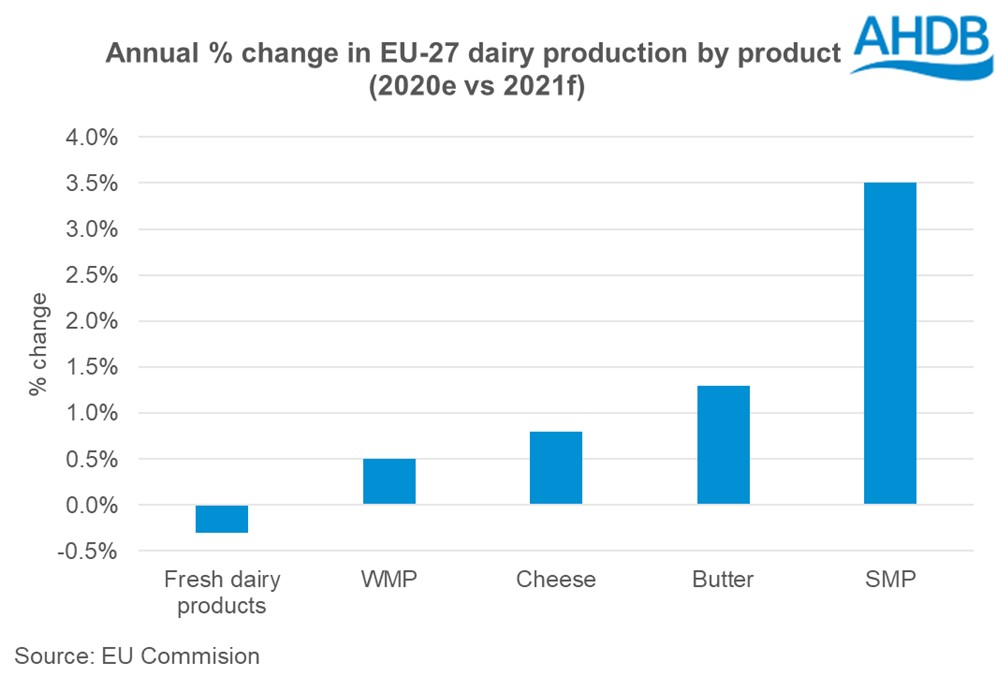
EU SMP production is also expected to increase, up 3.5% year-on-year in 2021, following increased demand from South-East Asia. As such, EU exports of SMP are expected to grow 6% in 2021, further supporting the higher prices seen.

For WMP, EU production is expected to remain stable (+0.5%) on 2020 levels, to keep up with domestic and higher export demand seen last year.

Overall, the consumption of butter and cheese are expected to particularly benefit from the recovery of foodservice, with the retail sales of these products expected to remain above pre-COVID-19 levels. Meanwhile, the consumption of fresh dairy products is expected to fall in 2021 year-on-year, as more people continue to work from home, limiting the use of fresh dairy in cafes and cafeterias. However, consumption of fresh dairy products is expected to remain above 2019 levels.

Source: ahdb.org.uk

Soaring milk prices keep New Zealand farmer confidence high

Farmer confidence is soaring. Put it down to the recent spike in prices for New Zealand dairy products.

According to the latest Rabobank Rural Confidence Survey, farmer sentiment is now sitting at its highest level since early 2018.

The second successive lift in farmer sentiment – coming on a rise in the last quarter of 2020 – pushes overall net confidence back into positive territory – with more of the country’s farmers now optimistic than pessimistic about prospects for the wider agri economy.

This snaps a run of ten consectuive surveys with net negative results.

The latest survey – completed earlier this month – found net farmer confidence rose sharply to +10%, up from -23% recorded in early December last year.i

The number of farmers expecting conditions in the agricultural economy to improve in the coming 12 months had risen to 29% (up from 16% last quarter) while there were fewer farmers expecting conditions to worse (19% from 39% previously). The number of farmers expecting the performance of the agricultural economy to stay the same rose slightly from 49% (from 44% previously).

Rabobank New Zealand chief executive Todd Charteris says farmers across all sector groups were now more buoyant about the outlook for the agri economy, with both dairy farmers and sheep and beef farmers significantly more optimistic than last quarter.

“Rising commodity prices were the key factor cited by farmers now holding an optimistic view of the year ahead with this no surpise given the strong upward movement in dairy commodity prices we’ve seen since our last survey,” he says.

Over the course of the year, dairy commodity prices have shot up over 20% on Global Dairy Trade platform.

The survey kicked off just after the bumper 15% average price rise in early March. The survey was also conducted after Fonterra lifted the midpoint for its pay-out forecast for the current season to $7.60/kgMS – the second rise in as many months.

While the improved dairy outlook is the chief contributor to improved expectations for the broader agri economy, encouraging news for sheep and beef farmers have also helped.

Among the one in five farmers now expecting the agricultural economy to worsen, the survey found government policies were still the major concern – with this cited by two-third of those with a negative outlook. In line with the results for the broader agri economy, the survey found pastoral farmers were significantly more confident about the prospects for their own farm performance over the next 12 months.

“Well over a third of dairy farmers are now expecting their own farm business performance to improve, while the number of dairy farmers expecting performance to worsen fell to just about eight per cent,” notes Charteris.

Source: ruralnewsgroup.co.nz

US dairy producers look to reverse the harm caused by Federal Milk Pricing Formula

Dairy producers say that the Federal Milk Pricing Formula has caused them financial harm and they are calling for collaboration with industry groups to fix it.

The Producer Price Differential began before the pandemic as a deduction on their checks. However, COVID-19 exasperated the issue caused by the 2018 Farm Bill. Typically these changes go through a process involving hearings, but this change was made through legislation.

“So, farmers are asking, A, right now, that they fix this through legislation, but then also open up a new Federal Milk Marketing hearing in an expedited fashion so that we can work together with both processors and dairy farmers and come up with some solutions to alleviate or reduce substantially the PPD,” American Dairy Coalition’s Laurie Fischer states. 

The Coalition says that before the Farm Bill changed the formula to be based on an average, the milk prices were based on a “higher of” formula.

Source: rfdtv.com

Dairy prices under pressure due to increased U.S. milk production

Dairy prices continue to be under pressure because of increased milk production around the country. The latest USDA Dairy Products Report shows production of butter, cheese and nonfat dry milk in February was the highest ever for the month. But helping ease some of that price pressure has been increasing demand from the food service industry as more restaurants have been reopening with increased seating capacity. Butter production in February was over 185 million pounds while cheese makers produced over a billion pounds in February.

USDA numbers show China is aggressively buying U.S. soybeans. In March they bought 7.77 million metric tons from us—a new monthly record. For the first half of the current marketing year, the Chinese have bought almost 47 million metric tons of U.S. soybeans. Grain traders expect their purchases for the year will top 100 million metric tons since the second half of the year is their biggest buying window.

USDA officials also say they will soon put in place the Dairy Donation Program called for in the 2021 Consolidated Appropriations Act. The program is designed to reimburse coops and other organizations for their production costs when they process and donate surplus milk supplies and production to feeding programs around the country. The program does include some minimum requirements for dairies to get involved.

June might be Dairy Month, but May is being celebrated as American Cheese month. Major events are being planned for the month all over the state with the culmination of activities to include a celebration of Wisconsin’s 180th anniversary of cheese making. Dairy Farmers of Wisconsin, formerly known as the Wisconsin milk marketing Board, is leading the festivities across the state designed to get consumers involved in the history and importance of cheese making to the state. Cheese making first came to Wisconsin in 1831 with a farmstead cheese factory in Koshkonong near Fort Atkinson. In 1841, Anne Pickett started the state’s first cottage industry cheese factory using milk from her neighbor’s cows. In 1858, John Smith obtained the state’s first cheese vat and made cheese at his home in Sheboygan County. But most of Wisconsin’s early cheese makers were women.

Source: weau.com

Australian live cattle exports will lift with NZ banning live trade, industry analyst

The Australian livestock export industry has distanced itself from the New Zealand trade, which has been banned from exporting livestock by sea. 

Key points:

  • New Zealand will ban the export of livestock by sea after a two year transition, citing animal welfare concerns
  • Australian exporters of dairy heifers are “in the box seat” to pick up lucrative trade from NZ 
  • No plans to ban exports from Australia, says Agriculture Minister

The Australian Government says it has no plans to ban livestock exports and New Zealand’s move is expected to help Australian farmers win lucrative trade deals with China, which had been spending big on dairy breeding heifers.

Chief executive of the Australian Livestock Exporters’ Council Mark Harvey-Sutton said the Council was sympathetic to its Kiwi colleagues and disappointed by the ban.

“We have full confidence in the standards the Australian industry upholds and expect the impacts of the New Zealand decision to have limited bearing on the strength of the Australian industry and its continuing growth,” he said.

New Zealand’s Agriculture Minister Damien O’Connor announced the decision this morning, to phase out live exports of animals by sea.

The decision followed an inquiry into the sinking of a ship carrying 43 crew and thousands of New Zealand cattle off the coast of Japan last year.

According to the Federated Farmers of New Zealand, the live export trade was worth $200 million to Kiwi farmers last year, with 110,000 animals exported live. 

The lobby group said it saw no reason for the ban.

“We’re a little bit surprised really that it’s come out now, and that they’ve decided to go down this route,” NZFF spokesman Wayne Langford told the ABC.

Australian dairy exporters ‘in the box seat’ 

New Zealand had already stopped the export of livestock for slaughter in 2008, but the export of breeding cattle had been increasing, with strong demand from China. 

Dairy industry analyst Emma Higgins said the decision to ban exports from New Zealand left Australian dairy producers “in the box seat” to take up the trade of dairy heifers into Asia.

“The good news for Australian exporters and dairy producers is that there’s an opportunity there for Australian farmers to fill the gap that New Zealand will leave,” Ms Higgins said. 

In a statement, Federal Agriculture Minister David Littleproud said “this is a matter for the New Zealand Government and Australia has no plans to suspend or ban live animal exports”.

“The Federal Government is confident in our standards, regulations and laws to ensure high standards of animal welfare for livestock exports,” the statement read. 

The Royal Society for the Prevention of Cruelty to Animals used the NZ announcement to renew calls for an end to the Australian live export trade.

“New Zealand has made the right decision, and with it, is cementing its international reputation as a world leader in high quality, ethical agricultural products while Australia is left behind yet again,” RSPCA spokesman Jed Goodfellow said.

Dr Goodfellow said Australia exported more than 170,000 breeding cattle last year, primarily to China and Pakistan.

“And there are no laws to protect them once they are there,” he said.

The Opposition’s agriculture spokeswoman Julie Collins was approached for comment.

Source: abc.net.au

Compensation registration closes for Canadian Dairy Producers

Registrations have closed for the second round of dairy compensation payments from the federal government.

Agriculture minister Marie-Claude Bibeau said April 8 that 9,682 farmers had registered for this year’s program. Payments totalling $459.4 million will be made this month as part of the $1.75 billion effort to compensate farmers for lost markets due to international trade agreements.

The compensation based on milk quota is being paid over four years.

There are 10,095 dairy farms in Canada that could have shared the $468 million available this year.

A spokesperson for Bibeau said the number of farmers who didn’t apply, 413, is similar to last year.

“The Canadian Dairy Commission and provincial boards have reached out to non-registered producers on multiple occasions and some producers chose not to register for a variety of reasons,” the spokesperson said.

Compensation for the Canada-United States-Mexico trade deal has not yet been determined.

Source: producer.com

Wisconsin Dairy Farmer Overwhelmed With Calf Reaction


What can 10 little Wisconsin dairy calves do?  Plenty when it comes to capturing the attention of classroom students and teachers around the United States!

The “Adopt a Cow” program created and administered through the Center for Dairy Excellence and Dairy Farmers of Wisconsin adjusted things a bit to introduce K-8 students to 10 Wisconsin dairy calves.  The students got to monitor daily activities of the calves and the farm families caring for them, and became a part of classroom instruction about where food comes from, what farmers really are, and more.

Three of the calves featured came from Synergy Dairy Farm in Pulaski.  Sharlamagne – a red and white Holstein calf; Seroogy – a Jersey calf, and Dorito, a black and white Holstein.

Heather Jauquet and her son, Evan, found the engagement with the classrooms interesting and fun – and the supportive comments and physical mail they received was a little overwhelming!

Synergy Dairy Farm will wrap up their Adopt a Calf story with a special one hour, interactive virtual farm tour, on Wednesday, April 27th.

This one program has reached more than 1 million students in all 50 states.

Source: omny.fm

The science of turning milk into cheese

IMAGE
Credit: University of Córdoba

The global production of sheep’s milk is one the rise, in the vast majority of cases used to produce cheese. However, a relatively large amount of milk is needed to produce it, so science is looking for ways to increase its yield; that is, to obtain more cheese using less milk.

Immersed in this task, a team from the Department of Animal Production at the University of Cordoba, led by Professor Ana Garzón, has collaborated with the University of Leon in the search for genetic parameters affecting the cheese production of milk from Churra sheep, one of the oldest and most rustic breeds on the Iberian Peninsula.

After analysing traits related to rennet and milk properties (pH, milk yield, fat and protein content) in a sample of more than 1,000 sheep, the research team found a low to moderate heritability of these traits, suggesting that their improvement can be achieved through genetic selection. In addition, the need to consider milk pH at the beginning of the coagulation process as a characteristic to be taken into accountas a selection index for the improvement of Churra quality was confirmed, as it will augment the ‘cheesemaking capacity’ of the milk from this breed.

The team,formed by Ana Garzón andthe researchers Antonio Figueroa and Javier Caballero-Villalobos, comprise the Dairy Laboratory, where the milk samples of this work were analysed, measuring their pH; the physical-chemical parameters of the milk, such as its proteins, fats, and lactose; and technological parameters, such as coagulation time and curd hardening speed; with the aim of providing information for the selection of values to be included in the genetic selection scheme of the Churra breed in order to obtain ewes that give milk with a higher yield in terms of cheese production.

The UCO Dairy Laboratory | The science that cares for milk

This service, part of the UCO’s Department of Animal Production, has been working since 2003 on the study of the composition, quality and technological parameters of ruminant milk with the aim of transferring knowledge to the livestock sector to improve milk quality, productivity and yields.

The Dairy Laboratory specialises in the study of the Manchega breed, which is the most important class of sheep in terms of product quality and economic weight in the sector. In this regard, the search for a faster, cheaper and more efficient method to measure the quality of milk according to its composition is one of their main lines of research, as they are trying to determine whether chromaticity can provide information sufficient for the livestock sector to evaluate milk quickly and cheaply.

They are also striving to solve the problem of water retention in curd, which reduces the milk’syield, thus requiring a lot of milk to obtain cheese. In their latest work, they develop mathematical models to achieve more efficient milk for cheese production. Finally, they analyse the correlation between the health of the sheep’s udder and these coagulation parameters of the milk slated for cheese production.

In short, this work directly transfers the science carried out in the Laboratory to the livestock sector, which benefits from improvements in the quality and efficiency of its dairy farms.

Source: eurekalert.org

Australian farmers can contract new season milk at trading event

Dairy farmers will have the opportunity to contract some of their next season’s milk at a Milk Exchange trading event later this month.

Dairy farmers will have the opportunity to contract some of their next season’s milk at a Milk Exchange trading event later this month.

The Milk Exchange is an eCommerce trading platform of milk and dairy products for the Australian industry.

The trading event on April 21 will be the first for new season 2021-22 farm milk.

Milk suppliers need to register their interest to offer milk at the event by email by April 14.

Milk Exchange general manager – commercial development Richard Lange said key features of the trading event included milk suppliers being able to set a reserve price for their Offer to Sell milk and designating a validity period for the offer.

Milk trading could be anonymous and suppliers could also offer split contracts on the exchange.

At the conclusion of the event, milk suppliers could choose to accept or reject bids .

Mr Lange said the trading event would provide milk suppliers with greater choice and control in how set their milk contract for next season.

“We are expecting major milk buyers to participate as it affords the opportunity to lock away some critical volume early and avoid some of the mad scramble for milk that occurs in June each year – this offers a better way to buy and sell milk,” he said.

Farm milk will be contracted with a standard form agreement, which complies to the Australian Competition and Consumer Commission’s Mandatory Dairy Code of Conduct, including a 14-day cooling off period.

Buyers and sellers can trade anonymously with a simple click to contract process that avoids complicated and protracted negotiations.

Mr Lange said the exchange currently had commitments for a milk pool of more than 100 million litres of new season milk throughout Victoria, SA, NSW and Queensland.

“We will be receiving and assessing volumes within these regions and other regions over the next two weeks,” he said.

“The trading event, through bidding activity, will provide price transparency for the current conditions in the commodity and consumer markets.”

The event will be held between 9am and 2pm on April 21.

Suppliers can register at https://www.milkexchange.com.au/getting-started/ or phone 1300 645 539 for more information.

Minnesota dairy farmer packs up and leaves with 245 cows: ‘We’re not able to grow anymore’

With a big portion of his herd packed into livestock trailers, Parker Byington said goodbye to Winona County Thursday, looking forward to what he hopes are more welcoming pastures in Colorado.

Byington, who until recently milked 660 head of cattle at his farm south of Lewiston on Interstate 90 and Wabasha County Road 14, loaded 245 cows onto eight trailers and hauled the animals to their new home out west.

“We are moving west to further our career in dairy there,” Byington said. “With the current regulations (in Winona County), we’re not able to grow anymore.”

Specifically, Byington said the animal unit cap in Winona County limited his ability to grow his business. While he did get a permit to expand his dairy to 998 animal units, the regulatory costs of going up to the county’s 1,500 animal unit limit would not make an expansion to that size worth the investment.

In Colorado, he said, his farm will be classified as a family farm and he will only need to meet the federal CAFO — concentrated animal feeding operation — guidelines instead of additional state and county regulations.

In Minnesota, the Minnesota Pollution Control Agency is one of the permitting authorities for any feedlot of 1,000 or more animal units. For Byington and other animal agriculture farmers in Winona County, that means once the MPCA is involved, feedlots can only go up another 500 animal units from that point.

Mitch Thompson, who bought Byington’s farm, expressed mixed feelings Thursday.

Dairy farmer Parker Byington, formerly of Lewiston, seen Thursday, April 8, 2021, at the farm he'd just sold, is moving his operation and a large number of his cattle to Colorado to continue his business. Byington, who moved to Winona County five years ago, said the county's animal unit cap played a significant factor in his leaving. (Brian Todd/btodd@postbulletin.com)
Dairy farmer Parker Byington, formerly of Lewiston, seen Thursday, April 8, 2021, at the farm he’d just sold, is moving his operation and a large number of his cattle to Colorado to continue his business. Byington, who moved to Winona County five years ago, said the county’s animal unit cap played a significant factor in his leaving. (Brian Todd/btodd@postbulletin.com)

“It’s bittersweet,” said Thompson, who owns a separate dairy farm less than a mile away and will operate both farms. “This allows me to expand my business, but I hate to see a good neighbor go.”

Winona County Commissioner Steve Jacob, who said the county’s animal unit cap needs to be reviewed and possibly changed, said the loss of business will hurt the county.

“It breaks my heart to see this happen,” Jacob said. “I so wish I could get my other three commissioners that represent the city of Winona to revisit this issue.”

The Post Bulletin reached out to those commissioners — Marie Kovecsi, Greg Olson and Chris Meyer — but two did not respond to messages and Kovecsi said she has been advised by the county attorney not to discuss the animal unit cap due to the ongoing case of Daley Farm vs. Winona County.

Dairy cows get loaded onto a trailer headed to Colorado Thursday, April 8, 2021, south of Lewiston. Parker Byington is moving his dairy operation and a large number of his cattle out of Winona County, saying the county's animal unit cap played a significant factor in his leaving after moving to the farm south of Lewiston five years ago. (Brian Todd/btodd@postbulletin.com)
Dairy cows get loaded onto a trailer headed to Colorado Thursday, April 8, 2021, south of Lewiston. Parker Byington is moving his dairy operation and a large number of his cattle out of Winona County, saying the county’s animal unit cap played a significant factor in his leaving after moving to the farm south of Lewiston five years ago. (Brian Todd/btodd@postbulletin.com)

Jacob said that while he’s glad Thompson is taking over the dairy, the net loss of 245 cows will negatively impact the local economy.

According to the most recent Comprehensive Review of Iowa’s Dairy Industry, each dairy cow is worth about $25,000 in economic activity, meaning those 245 cows represent a loss of roughly $6.1 million to the county’s economy.

“This hurts all the taxpayers,” Jacob said. “Those economic drivers of our local economy are leaving us, literally, today. The rest of us need to pay more taxes to make up for the revenue stream.”

Steve Jacob
Steve Jacob

Jacob cited the Byington’s farm as a well-run, environmentally sustainable operation, adding that larger dairies have the financial capital needed to implement the kinds of environmental safeguards the county needs.

“They’re the answer to protecting the environment,” Jacob said. “The solution is to do things right in our community, and these are the kinds of people we should be supporting.”

A dairy cows peeks out from inside a livestock trailer Thursday, April 8, 2021, south of Lewiston. The animal, along with 244 others, is headed to Colorado. Parker Byington is moving his dairy operation and a large number of his cattle out of Winona County, saying the county's animal unit cap played a significant factor in his leaving after moving to the farm south of Lewiston five years ago. (Brian Todd/btodd@postbulletin.com)
A dairy cows peeks out from inside a livestock trailer Thursday, April 8, 2021, south of Lewiston. The animal, along with 244 others, is headed to Colorado. Parker Byington is moving his dairy operation and a large number of his cattle out of Winona County, saying the county’s animal unit cap played a significant factor in his leaving after moving to the farm south of Lewiston five years ago. (Brian Todd/btodd@postbulletin.com)
Dairy cows get loaded onto a trailer headed to Colorado Thursday, April 8, 2021, south of Lewiston. Parker Byington is moving his dairy operation and a large number of his cattle out of Winona County, saying the county's animal unit cap played a significant factor in his leaving after moving to the farm south of Lewiston five years ago. (Brian Todd/btodd@postbulletin.com)
Dairy cows get loaded onto a trailer headed to Colorado Thursday, April 8, 2021, south of Lewiston. Parker Byington is moving his dairy operation and a large number of his cattle out of Winona County, saying the county’s animal unit cap played a significant factor in his leaving after moving to the farm south of Lewiston five years ago. (Brian Todd/btodd@postbulletin.com)
Source: Post Bulletin 

Another Wisconsin dairy farm sells cows, but welcomes new farming opportunities

The Reisinger family in the dairy barn before the cows left. From left to right: son Brian, father Jim, mother Jean and daughter Malia. Image courtesy of Brian Reisinger.

A month ago, the Reisingers of Spring Green said farewell to 60 dairy cows after more than a century of milking on the homesteaded property in the Driftless Area.  

Jim Reisinger, choking up, reflected on the morning of March 12. He recalled the milkman had tears in his eyes leaving the Reisinger driveway with the last load of milk. He had been to the farm every morning for 25 years picking up the family’s milk. But while the milkman no longer takes the winding Schweppe Road every morning, the family continues to be a part of the dairy supply chain. 

“There is life after milking cows, and you can still farm without milking cows. Now it’s time for transitioning to make our life as good as it can be,” Jean Reisinger told WisBusiness.com at the farm. 

Jim and Jean are approaching their 70s, and the labor-intensive work of milking cows is getting tough. Jim added that contracting COVID-19 was a sign that it was time to slow down. A northern Wisconsin farm bought the cows, and the Reisinger family was pleased with the sale.

“They’re all together. That’s what I wanted,” Jim said. 

With their adult children Brian and Malia, and soon-to-be four grandchildren, the Sauk County farm continues to operate over 100 years after it was homesteaded by Jim’s grandfather in 1912.

The Reisingers tend to about 280 acres of hay, corn and soybeans. They will continue cash cropping. And while one would expect the farm to be silent without cows, the Reisingers keep about 80-head of cattle on-farm, raising steers and custom heifers as Reisinger Hilltop Heifers.

Father Jim and daughter Malia with their custom heifers. Malia is a mother of three and pregnant with her fourth child. She is also a part-time hairdresser. Image courtesy of Brian Reisinger.
While cows no longer occupy the barn, there’s plenty of room for calves. These calves will grow up to be heifers and bred to become dairy cows for milking. Image courtesy of Brian Reisinger.

And last but not least, Jim keeps bees. His apiary produces Jim’s Hilltop Honey. 

Jean and Jim praised their son and daughter’s work organizing a new business model for the farm’s transition that allows the family to be profitable without milking. And Brian praised his parents for operating a small dairy farm debt-free for over 45 years that allowed him and his sister to develop a strategic plan for the family business. 

“Not everybody gets that chance,” said Brian, who is also the president and COO of Platform Communications. “Too many small farms are just going by the wayside.”

Small is the correct adjective for a 60-cow dairy farm these days. Jean explained that when the couple took over the dairy farm in 1976, they had 32 cows. That was a big operation then, she said. 

“Now 60 cows is a very small farm,” she continued. “Our goal was always to keep it as a family farm. Now farms have become more like a corporation. Everything has become numbers, and it’s a different world now. Farms have become more like factories than they have small families, and we wanted it to be a family farm, and that is what we continued. Everything we did was so the two of us could operate as a family and not have a lot of staff.”

Jean currently serves on the lobby organization FarmFirst Dairy Cooperative board. She’s also served on Dairy Farmers of Wisconsin, the Farm Bureau Federation, and other farm boards and consumer cooperatives related to farming.

Citing USDA data, the Milwaukee Journal Sentinel reports the number of cows in Wisconsin has remained steady over the past 20 years. However, more and more of those cows are part of larger operations. The number of cows on small operations — one to 99 cows — has steadily decreased every five years since the late 90s.

“At our stage in life, we just kind of want to diversify and do what we can handle,” Jean said. “We want to be able to do what we can do and not necessarily turn our farm into a big corporation.”

More than just the size of the farm has changed since she and Jim started farming. Technology has become an essential part of a farm from total mixed ration mixers — making sure each cow gets the right nutrients — to robotic milkers. The Reisingers thought about getting a robotic milker, but Jim said it would have put the farm in debt. The price of technology requires a farm to have more cows to make more money.

And if a farm has more cows, it’s likely to need more machinery. Jean said she remembers being the first farm in the area with an air-conditioned cab on the tractor. Now that John Deere tractor looks antique next to the machinery on the market today. 

“If you found enough family members to become involved, a small farm would work,” Jean said when asked if there’s a place for small farms in today’s dairy economy. “But it’s a lot of hard physical work and not everybody wants to do that. With the price of land and machinery, it’s hard to do that.”

She noted that on Schweppe Road, everyone used to be milking cows. After the Reisingers sold their cows, just one dairy farm remains. 

Dairy farms had gone through multiple recessions over the years and all manner of weather. Jean said the worst summer on the farm was in 1975 when not one kernel of corn came out of the ground due to a drought. Other years brought ample rain. And dairy farmers had gone through years with great milk prices and years, such as the last five, when farmers’ finances were strapped.

Even though the Reisingers aren’t producing milk, they still remain a part of the supply chain by selling crops for feed and heifers to be bred as milk cows. And the family does their part to buy Wisconsin products, especially cheese. Their milk had gone to Cedar Grove Cheese, a small-scale cheese factory in Plain, just north of Spring Green, founded by Bob Wills. Its sister company is Clock Shadow Creamery in Milwaukee.

“The farmers in the state of Wisconsin that I know do a tremendously good job on the milk they produce,” Jean said. “I really want us to continue to have good quality products — milk, cheese and all those things. I want the consumers to understand that having the real thing is really wonderful.”

She added that she wants to see people respect farmers and the job they do — starting with learning and understanding the farming industry. 

“There’s no nobler thing to do than to farm the land that God gives you. We’re very fortunate to be able to stay here,” Jean said of her “slice of heaven” tucked away in the Driftless Area’s rolling hills. “Things are changing in farming more than ever and you have to go with the change.”

Source: wisbusiness.com

Neospora infects 25% of UK dairy farmer’s herd

A tenant farmer in Surrey says his dairy herd has been devastated by neospora after an increase in dog walkers using the land in the last 18 months.

Mark Frost has recorded an alarming rise in infection and said he has found the disease in a quarter of the 100 British Friesians he keeps in Norbury Park, near Leatherhead and Dorking.

Mark Frost in field with cattle

Mark Frost © Surrey County Council

This has led to 11 miscarriages in the past eight months and estimated losses of about £8,000 a year, Mr Frost said.

The farmer runs the cows on about 24ha that is open to the public, and an influx of dog walkers using the footpaths has led to more litter across the fields.

Beer cans and bottles, food wrappers, disposable barbecues and surgical masks have been discarded in the fields and hedgerows as well.

Litter in field

© Surrey County Council

Mr Frost said his livelihood is under threat and most of his time is spent clearing up the mess best he can.

“The infection had always been around 5% of the herd, but there has been a huge jump in the last year and a half,” he told Farmers Weekly.

“You have got people coming from everywhere now – London, Croydon, Haywards Heath – it is not necessarily local.

“You get professional dog walkers who turn up because there is a car park opposite. Some of them will have 10 dogs.

“We do have signs up, but people aren’t very helpful. It is only about 10% of the people but it is enough to cause us a huge problem.”

The 6ha field opposite the car park is currently shut for silage-making, but Mr Frost said he was having to still walk through and pick out dog mess to stop it going in to the clamp.

The land is rented from Surrey County Council and Mr Frost farms with his 78-year-old father, who has been on the land for 42 years.

Surrey County Council has produced a video for dog walkers, in which Mr Frost explains the devastating impact the dog fouling and littering is having.

Neospora – which leads to abortions, still births and infertility in cattle – is caused by livestock grazing pasture contaminated with dog faeces containing eggs from the parasite neospora caninum.

Source: fwi.co.uk

U.S. dairy exports surge despite shipping woes

Despite having one fewer day in February 2021 compared to last year and U.S. suppliers still facing shipping delays, U.S. dairy exports surged in February.   

Total dairy export value climbed 7% year-over-year to reach $565.5 million and volume in milk solids equivalent (MSE) jumped 15%. February’s growth was driven primarily by resurgence in nonfat dry milk/skim milk powder (NFDM/SMP) to Mexico and Southeast Asia and whey products to China.

Chart1A (3)


More information, data and charts on specific products and markets can be found here.

Below are our three main stories for the month:

NFDM/SMP exports an uplifting surprise

February’s NFDM/SMP export data surprised us. Frequent reports of shipping frustrations delaying exports have been the story for months. Logistics delays drove the declines we saw in U.S. NFDM/SMP exports in November, December and January. And the preliminary data suggested that was going to be the case in February.

USDA’s Dairy Product Report showed growing inventories of NFDM – reaching 156,766 MT in February. That figure was up 18,419 MT from January despite less NFDM/SMP produced. This suggests reduced commercial disappearance. And yet, NFDM/SMP exports grew substantially. Total NFDM/SMP exports grew 31% (+17,120 MT) over February 2020 with volumes gaining to both Southeast Asia (+38%, +8,421 MT) and Mexico (+30%, +5,936 MT).

Chart2A (3)


From this, we can infer a few things:

First, domestic disappearance of NFDM was very weak in the first part of the year. Taken at face value, if production was down and exports were up but inventories still grew, then the culprit must have been reduced domestic disappearance.

Second, we can assume that the February exports were predominantly SMP produced in Q4 of last year that was able to make it onto a boat for export. The growing inventory figure from USDA only tracks NFDM, so to make the math work, the exported product must have been predominantly SMP.

Third, and perhaps most importantly, the surge in exports – particularly to Southeast Asia – suggests that international demand is better than the global trade figures implied over the past several months. Global NFDM/SMP trade declined five months in a row from September 2020 to January 2021, even as prices have steadily climbed. However, combine February’s robust exports, anecdotal reports that the product that is in inventory is sold, and the gain in Tuesday’s GDT, and the picture you get is of strong international demand for SMP, but shipping delays limiting the ability to fully meet that demand.

Looking ahead, this suggests that if U.S. exporters can secure booking with a carrier, there will be opportunities to grow exports.

Cheese volume highest in seven months

The U.S. exported 30,176 MT of cheese in February. It was the first time monthly volume exceeded 30,000 MT since last August – and it was done in a month with only 28 days. Adjusting for Leap Day, February 2021 U.S. cheese exports grew 1.1% over February 2020.

While cheese exports for the first two months still lag January-February 2019 and 2020, there were some optimistic signs in the February numbers.

Looking at individual market performance (NOT adjusted for Leap Day), U.S. suppliers saw broad-based geographical gains in February, led by a 70% increase in sales (+1,062 MT) to the Middle East/North Africa (primarily Saudi Arabia and the United Arab Emirates). Exports were also strong to Japan (+263 MT), China (+201 MT), Oceania (+192 MT), Central America (+189 MT) and South Korea (+188 MT). (U.S. cheese exports to Japan and South Korea in the first two months were up 20% over the same period in 2020.)

That diversified success in February helped mitigate an 11% decline in cheese exports (-1,019 MT) to our No. 1 market, Mexico. It was the United States’ sixth consecutive year-over-year monthly decrease in cheese sales to Mexico, but at 8,591 MT, February was the largest volume since August 2020.

More competitive U.S. cheese pricing since December and progress in keeping COVID-19 in check in key markets in East Asia and the Middle East (and subsequent improved foodservice traffic in those markets) are creating a more optimistic outlook for U.S. cheese. But U.S. shipping issues and continued COVID-19 uncertainty remain strong headwinds to a full cheese rebound.

Continued strong whey exports

U.S. whey exports rose 29% (+11,500 MT) in February, continuing the march of strong global whey demand, and it comes as no surprise that China led the way. U.S. whey exports to China in February more than doubled, up 159% (+16,270 MT) compared to February 2020. Year-to-date total U.S. whey exports grew 22% (+17,700 MT) with year-to-date exports to China up 120% (+27,400 MT).

Along with the U.S., the EU is the other major provider of whey products to China; however, the EU product mix is weighted toward more high-value whey products where the U.S. is a primary provider of whey products used in feed in China. China’s continuing efforts to rebuild its swine herd has increased demand for whey in feed and as such has led to increased U.S. whey exports and rising U.S. market share.

Chart3 (2)-Apr-07-2021-06-45-11-58-PM


Additionally, domestic milk prices in China are exceptionally high. Domestic demand for dairy products has risen at an increased rate with the growing popularity of dairy products and as the government backs the idea that milk consumption helps boost immunity – a persuasive message during a global pandemic. From this, raw milk prices in China reached levels above 2013 levels, which has made importing dairy products, like whey, more economically feasible as the country tries to meet demand.

Overall, both increased domestic demand for dairy products raising domestic milk prices and ongoing efforts to rebuild the swine herd has led China to dramatically increase whey imports. The U.S. continues to be a key beneficiary of this demand despite the supply chain constraints in moving product off the West Coast.

Chart4 (2)-Apr-07-2021-06-45-45-68-PM


Source: USDEC

Why the dairy industry will struggle to meet the EU’s organic targets

The EU Farm to Fork (F2F) strategy is part of the Green Deal and provides a high-level ambition for the EU food ecosystem.

While many goals in the F2F strategy impact the dairy sector, the target to have at least 25% of all farmland under organic farming in 2030 particularly catches the eye. Although the dairy sector is an important user of agricultural land, only 4% of the current dairy herd is organic.

Major dairy companies have yet to embrace the organic target, encompassing a large shift of supply and demand. Proposed policy measures in the F2F tend to focus on developing supply, implying it’s mainly up to dairy companies and retailers to stimulate demand for organic products. This only works if consumers are willing to pay a premium or if the EU compensates dairy farmers for their additional efforts.

An increase in organic dairy farming puts pressure on milk volumes and leads to a higher cost price. This could leave dairy processing plants underutilised. Companies that rely on exports and dairy commodities will especially face difficulties translating additional costs into higher product prices.

1 Support from EU countries and the (dairy) sector

From the beginning, the F2F strategy has received mixed support from farmers, industry organisations and agricultural ministers due to concerns over farm income, competitiveness and food security. The organic target receives mixed support within the dairy sector because it could offset earlier progress on lowering CO2 emissions and land use.

2 Implementing a coherent set of policy measures

Changing food systems requires the integral support of several departments such as agriculture, health and the environment and an interlinked set of measures at the national and European level. However, the discussion on the reform of the Common Agricultural Policy budget shows the difficulties of redirecting EU funds from conventional farming practices towards those which are more linked to sustainability. 

3 Overcoming transition costs and risks for farmers

While the number of organic dairy farmers is growing, transition-related costs and risks are a major hurdle for more farmers to follow suit. If society expects farmers to change tack, the bill for their extra efforts must be paid by someone in the end.

4 Creating consumer awareness and willingness to pay a premium

It will take continued effort from companies and policymakers to ensure consumers value sustainability-related efforts made in agriculture. Currently, only one in five EU consumers is willing to spend more on sustainable food, according to a survey by BEUC – the European consumer organisation. On top of that, limited demand for organic dairy in the export and commodity markets is a bottleneck because that’s where many dairy companies are earning a large share of their revenue.

Spotlight on organic farming in the farm to fork strategy and the dairy sector

Many of the targets in the F2F and related policy proposals impact the dairy sector. But the one that probably has the biggest economic impact is the target to use at least 25% of total farmland for organic farming by 2030. It’s also a complex target to reach because it involves commitment from every stakeholder in the value chain. While it’s the first time such a quantitative target has been set, the interest in organic is not new.

For example, the first EU action plan on organic dates back to 2004 and the EU organic sector in general. The organic dairy sector, in particular, has been growing over the past two decades.

25% organic farmland, an ambition but no hard target

It is worth noting that the 25% organic target is set for all EU farmland, and it seems highly unlikely that there will be a specific target for dairy farming. Still, the dairy sector is an important agricultural land user for grazing livestock and the production of feed crops. Given that around 4% of all the dairy cows in the EU were organic in 2019, it’s clear that the sector will have to think about how it can contribute.

EU officials like vice-president Frans Timmermans and Agricultural commissioner Janusz Wojciechowski have indicated that the 25% is an EU average and that every country is supposed to go the extra mile regardless of their current share. What’s also clear from the outset is that if agricultural heavyweights such as Germany, France and Spain remain far from the intended target, it will be quite impossible to reach.

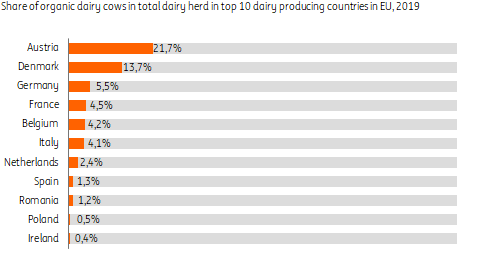
The organic dairy herd is relatively small in most EU countries

Organic dairy farming is still quite small

There are big differences between EU countries as far as organic production in the dairy sector’s concerned. Austria is the frontrunner as almost a quarter (22%) of the dairy herd is organic. In major dairy-producing countries like Germany, France and the Netherlands, the share lies between 2.5% to 5.5%.

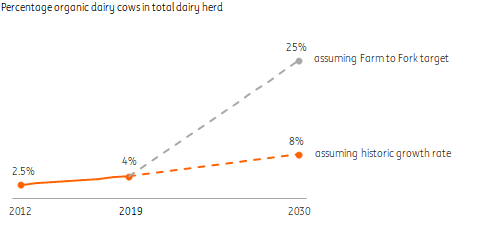
Although the organic share in the EU dairy herd has been growing from 2012 to 2019 (Compound Annual Growth Rate: 6.7%), a simple continuation of that growth rate wouldn’t be sufficient. In that case, the share would end up around 8% in 2030, nowhere near the Farm to Fork ambition.

Historic growth patterns won’t be sufficient to reach F2F goal

Reaching the target involves every part of the value chain

To support the growth of the organic market, every stage from farm to fork is important.

The share of organic farmland will only increase when there are farmers who want to produce, dairy companies that are able to process the milk and create added value, retailers and caterers who see opportunities to market these products and consumers who are willing to pay a bit extra.

While the F2F strategy proposes measures that can influence everyone involved here, they tend to lean more heavily on influencing the supply side and less on demand related measures. This can prove difficult as a balanced development of both supply and demand is needed. 

More organic milk means more value but less volume for dairy farmers

EU projections show a slight decrease in the dairy herd this decade. With that in mind, assuming a 25% share for organic in the dairy herd means the number of organic dairy cows would have to multiply by almost six to around four million in 2030. We estimate more than 100,000 dairy farmers would have to convert from conventional to organic farming in such a scenario. There is definitely interest among dairy farmers to make this step, but the transition period of at least two years and uncertainty about future organic milk prices also pose additional risks for farmers.

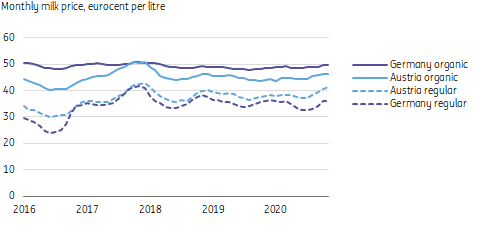
Once converted, the financial perspective can become more attractive because organic milk trades at a premium. In Germany, this premium was on average 15 cents per litre in the last five years and in Austria eight cents per litre. Whether this premium is enough to compensate for lower milk production on organic farms (on average more than 20% lower) and a higher cost price per litre differs from farm to farm.

There is a steady premium for organic milk in Germany and Austria

Dairy companies need to have balanced supply and demand growth

The EU Green Deal and F2F have far-reaching implications for dairy companies. While the reduction of CO2 emissions has become an explicit target in the sustainability strategy of major dairy companies, increasing organic production is often not yet, at least,  part of this strategy. Still, dairy companies play a decisive role in the development of the market. Dairy companies actively coordinate the supply of regular, organic and other added value milk (such as genetically modified or GMO-free), and some have been making a foray into plant-based drinks.

Simultaneously, they can stimulate demand either individually or in coordination with retailers and food service clients. The challenge lies in making sure the supply of organic milk is in line with demand. Higher cost prices can be successfully passed on to customers to ensure a profitable business model for themselves and associated farmers.

While total dairy supply in the EU is expected to grow towards 2030, an acceleration of organic farming could hamper this trend. And that, in turn, could put pressure on the capacity utilisation at dairy processing plants.  

Major food retailers are taking extra steps

Retailers acknowledge the need for greening their supply chains but are also wary of losing price-sensitive customers to competitors. General sales of organic products in the EU reached 41.4 billion EUR in 2019, and conventional supermarkets have introduced more branded and private label organic products across all categories.

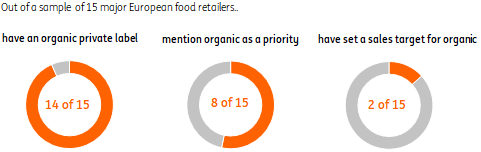
An assessment of fifteen major EU retailers shows that more than half of them have earmarked organic as an important element within their sustainability strategy. However, our analysis also finds that hard targets on sales of organic products are uncommon. Given the prominent position of retailers towards European consumers, it would boost the F2F goals when retailers finally incorporate these targets into their sustainability strategy. However, it remains uncertain whether this will happen without more directive policies.   

Organic products are mainstream, specific sales targets for organic products are not

The Farm to Fork strategy in a nutshell

In May 2020, the EU Commission presented the Farm to Fork Strategy for a fair, healthy and environmentally-friendly food ecosystem. The Commission charts an ambitious course in which longer-term sustainability gains are favoured over short-term productivity gains in the strategy. The strategy includes promoting organic farming and reducing nutrient loss, use of antimicrobials and pesticides in agriculture towards 2030, plus a set of broader policy actions.

While the ‘what’ is clear, the ‘how’ is still a topic of fierce debate in Brussels. Due to concerns about farmers’ income, competitiveness and food security, it’s not clear how much support the Commission will get from the European Parliament and the member states to effectively carry out the F2F strategy.

Source: think.ing.com

Global Dairy Commodity Update April 2021

The complexity of moving parts affecting the global dairy market outlook has rarely been greater.

The world is on a path to a COVID endgame but the timelines for reducing infections to effective “immunity” are varied.
The US and UK are well into rapid inoculation programs that will ensure a steady reopening of the food service trade in coming months. Europe has lost control of infections and a slow vaccine rollout has forced extended but uneven restrictions on movement. Meanwhile major logistics delays have slowed trade from major US and EU ports.

Weather is also varied as the La Nina effect weaken after delivering a cool wet summer to create great seasonal conditions in southern Australia. Cold weather in the EU will ensure a slow start to spring cold, while drought creeps further across the west of the US. Volatile late-season conditions across NZ have brought a late-season lift in milk output, but that can quickly change.

Strong Oceania prices – driven up by China’s dominance of the Global Dairy Trade buying of WMP and butter – will meet some pushback. Demand elsewhere for WMP and fats remains patchy and price-sensitive while SMP is more affordable with the spread of values on offer.

Strong commodity fundamentals are supported however by a firm EU-27 market with slow milk growth bringing tight butter and SMP supplies.

The late season improvements in NZ and Australia won’t alter the global market balance in the short-term but may present opportunities while northern hemisphere logistics remain knotted.

Milk supplies in the US will gradually slow as farm margins weaken. Meanwhile the reopening of eating-out venues will lift cheese demand and tighten butterfat supplies as cream use picks up. US cheddar prices should improve as heavy stocks ease. Volatility in the US is assured on the way out of COVID just as we saw on the way into crisis.

Source: Dustin Boughton

U.S. Dairy Industry United in Opposition to Canadian TRQ Administration

NMPF, the U.S. Dairy Export Council (USDEC), and International Dairy Foods Association (IDFA) submitted comments on March 5 to Global Affairs Canada on the administration of Canada’s dairy tariff rate quotas (TRQs).

The comments presented a clear, unified signal to Canadian authorities of the need for dramatic reforms in their current administration and allocation of TRQs. “Canada is failing to meet its trade obligations by manipulating import license procedures and minimizing the ability of U.S. dairy farmers to have full access to the benefits of USMCA. That needs to stop, and we look forward to working with the Biden Administration to ensure it does,” said NMPF President and CEO Jim Mulhern.

Canada is taking several actions in its administration of TRQs that undermine its USMCA obligations. Not providing fair or equitable procedures in administering the TRQs and reserving large shares of the quota for processors and so-called “further processors” are examples of how America’s dairy farmers and processors are losing out on the hard-fought USMCA benefits for U.S. dairy.

The comments to Global Affairs Canada, which provide recommendations on how Canada can reform its TRQ administration procedures to ensure full utilization of dairy quotas, follow joint NMPF, USDEC and IDFA comments to the Canadian agency in February 2020 and reflect NMPF’s ongoing attention to the issue. Last August, NMPF played a critical role in bicameral, bipartisan letters sent from Congress to the U.S. Trade Representative (USTR) and the U.S. Department of Agriculture urging them to ensure compliance of the dairy TRQs. USTR initiated the ongoing dispute settlement case as a result of these efforts.

The US dairy industry is making progress with China, but still room for improvement

U.S. Trade Rep, Katherine Tai just released her first National Trade Estimate report. Dairy groups are urging her to help lift barriers that restrict their product. The industry notes it has been making progress with China.

U.S. Dairy Export Council’s President and CEO Krysta Harden says that the answer might be in the milk. 

According to Harden, “It really has been about our ingredients; that’s where we are advancing and accelerating in a number of key areas here… certainly talking about product nutrition and education, the innovation, the ideas of what consumers want, and how we can meet them in the marketplace, and I mentioned sustainability about producing our products in a lasting way, making sure it’s also good for the planet.”

Though the trade war took a toll on the dairy industry, exports to China are recovering.

“China is a very, very key market for U.S. dairy; number three… but the tariffs took a toll,” she states. “There is absolutely no doubt, so we should look at the numbers and the recovery; you can see that we are making progress and things are coming back.”

The Dairy Export Council has even formed partnerships to find out what Chinese consumers want.

“Their demand for health and well-being products– that’s a growing area. We know that we can help meet that,” she adds. “I’ve been working with the Chinese Insitute of Food Science and Technology, working on different prototypes, and different products that might meet that growing demand.”

They have also established a partnership with a Chinese university to continue building on those relationships.

Source: rfdtv.com

Australian dairy processors optimistic about season ahead

Major Australian dairy processors are looking forward to the coming season with optimism, having come out the COVID-19 pandemic in a good position, an Australian Dairy Conference webinar on March 23 heard.

The webinar, which attracted participants from around the world, featured Bega Cheese executive chairman Barry Irvin, Fonterra Australia managing director René Dedoncker, Norco chief executive officer Michael Hampson and Australian Dairy Products Federation president Grant Crothers.

Rabobank senior dairy analyst Michael Harvey, who hosted the panel session, said the strong start to commodity dairy markets in 2021 meant some prices were at their highest levels since 2014.

But he warned forecasting milk prices for the season ahead this far out was always fraught with difficulty, particularly when things appeared to be changing rapidly in a large market like China.

Mr Irvin said while it was pleasing to see the price rally at present, he was always a little cautious.

“Obviously the commodity volatility that we’ve seen is pretty extreme,” he said.

“I think sometimes people forget just the sheer size of the drop back in March last year; it was in that 30 per cent area.”

Mr Irvin said last year’s opening prices had insulated Australian suppliers from the worst of those drops in the commodity market and had some associated risk for processors.

“So it’s been pleasing to see the path back and, quite frankly, I think I would say on the basis of my knowledge, I was a bit relieved to see it recovering as fast as it did,” he said.

“I thought that we would have a long road to recovery.”

Mr Irvin said it was too early to comment on opening prices for this year, given uncertainty about exactly how much product was going into storage and what was happening in the northern hemisphere.

“I feel optimistic but I also always temper my enthusiasm until we get a little closer to the moment where we’ve got to announce and make some sort of long-term assessments around what we think next year might look like.”

Mr Dedoncker said he was optimistic about the season ahead, particularly as the Australian dairy industry had proved its diversity and reliability during the COVID-19 pandemic.

“More than ever, it is our time to create stability and to be able to leverage that diversity that we’ve got in this country,” he said.

On the domestic scene, Fonterra had a solid retail business and its food service business was rebounding.

“Our exports are consistent and again I think that’s built on the fact that we have been good supply partners through a really challenging 12 months to all of those countries in south-east Asia, and particularly China,” he said.

“So those fundamentals are actually in good shape.”

Mr Dedoncker said the market rally was demand driven.

“I’m a bit careful around trying to see too far ahead but I think demand is going to stay fairly stable,” he said.

“Maybe not quite at the peaks that it has been at but I think it’s going to be consistent ”

Mr Crothers said the industry was in a sweet spot at the moment, with milk prices in the top 90 percentile, improved seasonal conditions and dairy farmers being able to retire debt and buy land.

But he also warned that the Australian dairy industry was a minnow in a very big food market and that currency also moved values around.

He said Australian processors had protected dairy farmers from the extreme volatility of COVID-19 and from the extreme volatility of the Global Dairy Trade auction.

“We are in a very competitive space, we’ve got imports coming at us every day of the week,” he said.

“It is a very tough market.”

Mr Crothers said it was also important for farmers to understand that the Global Dairy Trade price index was “an index, not the index”.

The milk price was complicated.

The ADPF had launched its Milk Value Portal in November to better explain the value of raw milk in Australia.

It tracked the commodity milk value in Australia on a spot basis and on a year-to-date basis.

“So there’s a lot of information,” Mr Crothers said.

COVID-19 recovery

The webinar heard that the Australian dairy industry had managed the impact of the COVID-19 pandemic well and had come out the other side in a good position.

Mr Hampson said the initial pandemic and lockdown was devastating for Norco, particularly as the company was primarily a supplier of fresh milk products.

“Our pubs and clubs business was down 95pc, our cafes and bakery business was down between 50 and 60pc initially, and this part of the business represents about a third of the economic activity of the Norco dairy business.

“So there was a significant change of consumer demand.”

The retail arm of the business picked up – although that represented a different value equation.

“I think everyone knows that the bigger the customer, the smaller price, the smaller the customer the bigger the price,” he said.

“So when you’re moving from 6000 small customers into two or three large customers, there’s quite a significant different value equation.”

Norco turned to other ways to sell milk – with its cafes starting to retail milk and more product being sold through independent supermarkets.

The lockdowns also occurred at its traditionally lowest period of milk intake, which reduced pressure.

Mr Hampson said the big positive from COVID was that it had changed the marketplace.

“I think there is still that underlying desire from consumers to support Australian dairy and that’s a very positive sign for the future,” he said.

Mr Hampson said in the domestic market it was clear the Australian consumer valued Australian products.

“That is the big thing for reaching the sustainable price in dairy, certainly in northern NSW and in Queensland,” he said.

“That’s an incredibly large positive for us to hold onto.

“We’ve restructured pricing in the market over the last two years.

“It took a terrible drought to get there, but we’ve been able to hold it this year and let’s see how we move forward into the future.”

Mr Dedoncker said Fonterra had discovered the value of having options and different markets into which to sell its dairy products.

“In these times you need optionality,” he said.

“Options on where to put milk solids and then you need a business system behind it that can do it quickly, so you need agility and speed.”

Mr Irvin said the dairy supply chain in Australia had proved amazingly resilient during the pandemic.

It had worked together and quickly adapted to new processes on farm for picking up milk, while the logistics in both the domestic and export markets had coped really well.

So any disruptions to markets were fairly short lived.

“I think what that reflected is partly the industry culture where everybody works together when they are in a difficult period,” Mr Irvin said.

Mr Dedoncker said the pandemic had also reinforced Australian consumers’ connection with quality food.

People had rediscovered their love of food and their love of cooking.

“When we eat at home, we we do eat more protein and we certainly eat more dairy, there’s no doubt about it,” he said.

“And I think that’s here to stay.

“When we eat at home, I think we’ve all lifted our standards and therefore I think the retail offtake, while it won’t stay at the peak that we all enjoyed, it will be inflated.”

Mr Irvin said people had turned back to brands during the pandemic.

“I think there’s a genuine trend,” he said.

“People are going back to brands that they know, brands that they trust, brands that they have understood … sometimes generational brands,” he said.

“I think people wanted to go in a time of insecurity to things that they are familiar with, things that they feel secure with and that obviously helped well-established businesses.”

Source: farmonline.com.au

Are cows emotionally intelligent?

Most people that work closely with cows already know that cows are much more than what they can provide for us… which is why in the dairy industry, cow comfort is a big deal. We understand that the physical and mental health of a cow creates a better life for both the herd… and the people that work with them.

A Day in the Life of a Cow

I often see the question, what is a day like in the life of a cow? I believe this is important to understand—especially when you manage a herd.

Typically, life revolves around milking, eating, drinking, socializing, lying down, sleeping and chewing their cud. The physical health of the cow is keyed into eating, cud chewing and drinking. Their mental health is keyed into sleeping and socializing.

Much like us, cows enjoy a routine that is consistent. Like all animals, they have an internal clock that is keyed off of day length and sun angle—it is regulated all the way down to the cellular levels.

The pivot point is lying time. Given a choice they choose to have at least 10 hours of lying time versus eating. There is an order to it… after lying, then comes eating, followed by social contact.

We often look at a 24 hours’ time budget… and this is what it looks like for a cow in a three-time-a-day milking herd:

  • Time spent milking 3.5 to 4 hours
  • Time eating 4 to 5 hours
  • Time socializing and drinking 2.5 hours
  • Time lying down 12 hours

If you do the math, that’s 22 to 23.5 hours a day… so you can see, there is not a lot of time for management activities!

The Importance of Lying Down

It is interesting to note that the lying time is not spent all at once. Depending on the softness of the bed they are lying on, they average 1.2 hours of a lying at a time. In a given day, they do that an average of 12.9 times.

So… about every hour they get up.

The other interesting fact is that they only really sleep in REM slumber for about 45 minutes. The rest of their sleep is much like dozing—occurring while they are standing or lying.

During this time, we need to recognize cud chewing. It can occur while standing or lying and its duration is about 8 hours a day.

The important thing is that we prefer it occurs while lying down. Lying improves milk flow to the udder which increases milk production.

Next Steps

In the next article, I’ll write about the intelligence of cows and especially their complex relationships within a herd.

With this series,  I hope you go away with the thought , “How does this information affect how I manage my herd?”

Do you have any thoughts so far? Leave a comment below!

Source: Amelicor

Robbie Watson: Dairying in Peru… and Ecuador

What’s it like to dairy in Peru or Ecuador?  This is a question Robbie Watson is uniquely qualified to answer. 

Today, he owns a dairy in Peru—and another in Ecuador.  And although Peru and Ecuador are neighboring countries in South America, dairying looks quite different in the two countries.

Watson studied animal husbandry in Lima, writing his thesis on dairy cattle.  Then, he added to his education by completing a Masters in Business Administration.  Using those skills, he worked for many years with a beauty company that took him all over the globe, averaging about 200 flights annually.  Every time he’s has the chance, he squeezes in a visit or two to local dairies. Add in another thirty trips to Madison for the World Dairy Expo and ten times to the Tulare Farm Show in California, and Watson can truly claim a fascinating international dairy perspective.

Watson started his first dairy, La Querencia, in Peru in 1987.  In 1989, he imported twenty-eight heifers from Ohio, “the seed stock,” as he calls them.  The farm is located 25 miles to Lima, Peru’s capital, which also accounts for 65-70% of the economy, and is home to 12-13 million of Peru’s 34 million habitants.  “People-wise, about one third of the country lives in Lima,” Watson notes. 

Peru is the nineteenth largest country in the world, he explains, with four completely different regions:  the Sierra/Mountains, Jungle, Coast and Islands.  Dairy cattle are mostly in the mountains and the high jungle, about 2,000 feet above sea level.  The coast of Peru is “a big desert,” as Watson puts it, and the country is cut by 52 rivers.  While farm land used to surround Lima, the city has taken over. 

“We have to haul feed for the cows.  It’s a trip of at least 60-95 miles for corn silage, or 370 miles for alfalfa.  And they are not easy miles, either–with a lot of traffic, too,” he says.  “It’s very expensive, and the cost of the feed increases because of the hauling.”

The location also gives them a competitive advantage.  “We are close to the market, and we can get a premium for the quality of milk we produce.”   For other farmers—who pay less for their feed—the problem is distribution of their product.  “It can take two to three days to get to the main cities, and you can’t get the milk out in fluid form.  They have to produce cheese.”

His dairy in Lima is not necessarily typical, he notes, mainly because he has constructed freestalls and uses stanchions.  “There are probably only three dairies with freestalls in all of Peru,” he says.  “We started over 25 years ago, and saw big improvements in production.  We have sprinklers in the parlor, and fans at the feed bunks.  It looks very much like a California-style barn, with sand and open corrals, no concrete because it doesn’t rain here. We have the best of two worlds:  forestalls with sand, and open corrals with no concrete.” 

He notes that they have tried to be “at the forefront of technology”.  They use a Delaval double twelve, milking three times each day. They are proud of their production, too, which is an average of 71 pounds of milk per cow per day.  Or, as Watson puts it as many around the world would: “It’s 12,000 liters (26,000 pounds) of milk produced per day, with 372 cows milking.” 

The climate in Lima is considered “mild”, but with high humidity, normally 90-95%.  The temperatures in the winter run 58-64 F, and in the summertime, 72-82, occasionally 86 F.  It can cause problems with pregnancy rates in the summer, which he’s happy if they can keep around 50%. “It’s the combination of the humidity and the heat,” he says. “It’s not as high as California or Arizona, but it’s not a dry heat.  That’s a big problem for the cows.” 

Their summer average is 66 pounds/cow/day, and winter is 81 pounds/cow/day.  They are higher than other farms in the country which is more towards 57 pounds/cow/day.  And, he is quick to point out that there are also different styles of dairying entirely.  “There are small family farms, with maybe eight to twelve cows, which are not dedicated to producing milk.  They get more like 26 pounds/cow/day.  They are feeding calves directly, usually using a dual-purpose breed, like a crossbred Holstein with Brown Swiss, Mount Billiard, Normandy or Fleckvieh.

“In the jungles of Peru, they use Jerseys because of the heat.  And water buffalo and Jir, a Brazilian breed, or a combination of Jir and Holstein, the Jirolando, a breed that started in Colombia and Brazil.  The Jirolando can achieve 66 pounds/cow/day, with really no body condition, and that’s becoming more coming in Peru’s hotter areas.”  

Watson feels they have learned to manage the heat of summer over time, now only losing about 8% due to heat stress.  “Before this, we had 40% production loss,” Watson says.  “Cow comfort is huge.” 

Watson notes that dairying in Peru looks a lot like the USA.  “Peru is very open to free trade, and protective of agriculture.  We import commodities, but pay higher prices.  Energy is very similar to the USA.  We can get almost 100% of the products that the USA has, just at a higher cost.  But the milk price is higher, too.” 

Source: GlobalCow

Australian dairy price history is about to be made: Rabobank

Another report has come out of the gates swinging for Australian dairy.

Rabobank’s annual dairy seasonal outlook has boldly predicted good things for the industry while talking up profits.

In the outlook, titled In Pursuit of History, the agribusiness banking body said dairy was now “staring down history” as expectations for a highly profitable 2019-20 season continue to ramp up.

These expectations are largely contained to the southern export region.

The report predicts Victorian farmer margins will exceed industry targets in 2019-20 and again in 2020-21.

There is even talk of the 2021-22 season being “on track” for similarly strong results.

Rabobank senior dairy analyst Michael Harvey said if these expectations were realised, it would be the first time since benchmarking began 15 years ago that three consecutive seasons have exceeded industry targets.

“The elevated outlook for the milk price is key to profitability,” Mr Harvey said, confirming the fate of the industry remains in the processors’ hands.

Mr Harvey said the return to profitability was “remarkable” after an extended period of low margins.

Rabobank is expecting a 2021-22 milk price of $6.65/kg MS in the southern export region.

“Price signals ahead of the 2021-22 season remain favourable, with the upside and downside risks to the global outlook more balanced then they were this time last year,” Mr Harvey said.

“That said, while the pandemic-related uncertainty has subsided, it has certainly not disappeared.”

Mr Harvey said global freight and logistical challenges, which were complicating the outlook and market dynamics, were set to recede by mid-2021.

Source: dairynewsaustralia.com.au

New Zealand farmer confidence surges on the back of high dairy prices

Farmer confidence has surged to its highest level in years on the back of a recent spike in dairy prices.

Net farmer confidence rose to +10 percent in the latest Rabobank Rural Confidence Survey, up from -23 percent in the previous survey last December. 

The number of farmers expecting conditions in the agricultural economy to improve over the coming 12 months was also up, rising from 16 percent last quarter to 29 percent.

Meanwhile there were fewer farmers expecting economic conditions to worsen, at 19 percent compared to 39 percent previously.

Todd Charteris, chief executive of Rabobank New Zealand, said positivity among farmers was the highest it’s been since early 2018.

“Rising commodity prices were the key factor cited by farmers now holding an optimistic view of the year ahead with this no surprise given the strong upward movement in dairy commodity prices we’ve seen since our last survey.”

The survey was also conducted after Fonterra raised its midpoint forecast payout to $7.60 per kilogram of milk solids in March.

Charteris said while dairy prices were primarily responsible for the lift in confidence, there was also positive news for the sheep and beef sector.

“Commodity prices for red meat products haven’t fared as well as dairy prices. But demand from our key markets has held up much better than expected in the first quarter of the year, with Chinese demand in particular leading the charge as our major market continues its post-COVID-19 recovery.”

The survey also showed an increase in pastoral farmers who were significantly more confident about the prospects for their own farm performance in the coming year.

“Well over a third of dairy farmers are now expecting their own farm business performance to improve while the number of dairy farmers expecting performance to worsen fell to just eight percent,” Charteris said.

Not everyone in the agriculture sector was positive though.

Ongoing labour shortages plaguing the horticulture industry had led to more growers expecting their business’ performance to worsen than those expecting it to improve.

Source: newshub.co.nz

Australian report recommends minimum milk price, amended dairy code

A report into the de-regulation of the dairy industry is calling for a suite of changes to the industry, including considering amending the Dairy Code of Conduct, establishing a minimum farm gate price for milk in each region and investigating price discrepancies in milk supply contracts.

Released in late March by the Senate Standing Committees on Rural and Regional Affairs and Transport, the report examined the profitability of the industry since it was deregulated in 2000.

The report made 14 recommendations including Dairy Australia increase its research, development and extension activities into tropical and subtropical dairy regions, require processors to pay a levy to fund Dairy Australia and that the Federal Government make the Food and Grocery Code of Conduct a mandatory code.

The report called on the government to investigate price discrepancies between exclusive and non-exclusive milk supply contracts, processors circumventing collective bargaining groups, and the fairness of pricing for multi-year contracts.

The committee also recommended the ACCC be tasked with investigating a mandatory minimum farm gate price for milk in each dairy region and the government consult with industry stakeholders to investigate a retail sales levy that would increase returns to farmers.

The report has been welcomed by Dairy Connect, who said dairy value-chain initiatives must underpin the future of the industry.

Dairy Connect Farmers Group president Graham Forbes said the report featured “substantive” recommendations.

“Future generations of dairy farmers will depend upon the actions taken in the coming months and years; as well as to ensure the future security of food/dairy production within Australia,” Mr Forbes said.

Dairy Connect chief executive Shaughn Morgan said that the Senate committee indicated it was sympathetic to the proposal for a royal commission into the dairy industry.

“However, the committee did not believe that a royal commission should be held at this time given recent ACCC inquiries into a mandatory industry code and perishable foods,” Mr Morgan said.

“While Dairy Connect is disappointed at this and we do not agree with this view, we will continue to advocate for an outcome that ensures that the appropriate recommendations put forward by the majority of the Senate committee are implemented.

“The recommendations, and the suggested amendments by the government Senators, have been put forward to provide a platform to continue to grow the national dairy industry.

“Dairy Connect hopes that the majority of the recommendations will attract bipartisan support within Federal Parliament after considered discussion and debate.

“After 10 major reports into the dairy industry since 2010, the national dairy industry remains at a crossroads and we must ensure that the dairy value-chain works cohesively to act in the best interests of the entire Australian dairy industry.”

Source: dairynewsaustralia.com.au

USDA and Dairy Farmers work together to mitigate risk in 2021

In an unprecedented year, USDA staff and dairy producers across the country worked together to protect dairy operations for the 2021 production year under USDA’s risk management program options – the Dairy Margin Coverage (DMC), Dairy Revenue Protection (DRP), and Livestock Gross Margin for Dairy Cattle (LGM) programs. Recent enrollment data for these programs indicate that dairy operations are proactively managing their risk.

“In a year rife with challenges, our staff worked diligently to improve customer service and seamlessly deliver programs to assist agricultural producers,” said Bill Northey, USDA’s Under Secretary for Farm Production and Conservation. “Through patience and perseverance on both sides of the virtual counter, as well as added resources made available to producers and staff for operating in a pandemic, producers were able to timely participate in these programs.”

Dairy Margin Coverage

Administered by USDA’s Farm Service Agency, DMC offers protection to dairy producers when the difference between the all-milk price and the average feed price (the margin) falls below a certain dollar amount selected by the producer.

Nearly three-quarters of all U.S. dairy operations with established production history are enrolled in DMC for the 2021 program year. Compared with 2020 enrollment of 13,532 operations, participation for 2021 increased to cover nearly 18,500 operations nationwide – meaning an additional 4,900 dairy operations recognized the value of DMC to their bottom line.

This enrollment success is a testament to the value of DMC to dairy operations. DMC is a cashflow-friendly program that offers enrolled operations the option to select a $4.00 catastrophic level of coverage with no premium fee or elect to buy up coverage. The premium on buy-up coverage is based on margin triggers between $4.50 and $9.50 on 5 to 95% of established production history. For coverage at the maximum margin trigger of $9.50, producers pay $0.15 per hundredweight of established milk production history.

To date, DMC has paid out more than $500 million in program benefits to dairy operations enrolled in calendar years 2019 and 2020. Margin payments triggered seven months in 2019 and four months, to date, for the 2020 DMC program year.

Additional Protection for Dairy

Approximately 3,000 operations purchased additional protection under DRP, which covers 30% of the milk supply and has provided more than $400 million in payments to covered operations since 2019. DRP, now in its second year, has grown from 2,500 policies in 2019. Additionally, 200 producers purchased coverage through LGM. Both LGM and DRP are managed by USDA’s Risk Management Agency.

While DRP insures against unexpected declines in the quarterly revenue from milk sales, LGM provides protection against the loss of gross margin (market value of milk minus feed costs) on the milk produced from dairy cows.

More Information

Enrollment for 2022 coverage for DMC will take place in the fall of 2021. For more information about DMC and to use the online program decision tool, visit the farmers.gov DMC webpage, or contact your local USDA Service Center. To locate your local office, visit farmers.gov/service-center-locator.

All Federal crop insurance policies are available from Approved Insurance Providers (AIP). To learn more about DRP and LGM and other crop and livestock insurance products, contact your local AIP. A list of AIPs is available at all USDA service centers and on the RMA website at the Agent Locator Page.

All USDA Service Centers are open for business, including those that restrict in-person visits or require appointments. All Service Center visitors wishing to conduct business with FSA, Natural Resources Conservation Service, or any other Service Center agency should call ahead and schedule an appointment. Service Centers that are open for appointments will pre-screen visitors based on health concerns or recent travel, and visitors must adhere to social distancing guidelines. Visitors are also required to wear a face covering during their appointment. Our program delivery staff will continue to work with our producers by phone, email, and using online tools. More information on working with our Service Centers can be found at farmers.gov/coronavirus

Source: osceolasun.com

Russia decreased dairy imports by 10%

In January 2021, Russian imports of dairy products appeared to be 10% lower compared to their level in 2020 for the same period and practically corresponded to the volume of imports in 2019.

577 thousand tons of dairy products worth USD 202.6 million (-25%) were imported. Such data is provided in the report by the National dairy Producers Union of Russia (Soyuzmoloko).

A decline in supply was observed for all product categories, except for cheese. By the results of January 2021, the main external suppliers of dairy products to Russia are the Republic of Belarus (75 %), New Zealand (8 %), Argentina (5 %), Uruguay (4 %), and Kyrgyzstan (2 %). Whereas the Republic of Belarus’ volume increased by 14 %, all other countries decreased their supplies of dairy products to Russia by 44 %. 

Belarus occupies a leading position in external supplies of most types of dairy products despite the steady volume of dairy imports from non-CIS countries. The Republic of Belarus supplies 86% of fluid milk and cream, 88% of skimmed milk powder (SMP), 94% of whole milk powder (WMP), 95% of fermented milk products, 89% of whey powder, 52% of butter, 91% of cheese, almost 100% of quark, 60% of ice cream. Cheese products are an exception here with Belarus supplying only 14% of the category’s Russian import.

The main dairy products imported by Russia in January 2021 remained cheeses (≈46% of imports in value terms), butter (22%), milk and cream, powdered and condensed (10%), including SMP (5%) and WMP (2%), fluid milk and cream (8%), fermented milk products (8%) and cheese products (5%).  At the same time, in comparison with 2020, the share of cheese in the import structure has grown.

National Dairy Producers Union of Russia (Soyuzmoloko) – is a nonprofit organization based in 2008 in Moscow, Russia. SOYUZMOLOKO unites milk producers and dairy processors as well as numerous service companies to represent their interests thus providing the dairy industry in Russia with economically favorable conditions. The industry association advocates policies to executive and legislative authorities at both state and local levels, foreign agencies, other business organizations, the news media, and the public. The Union currently represents over 200 milk producers, dairy processors, and service companies, which account for over 60% of milk and dairy products of Russia.

Source: SOYUZMOLOKO (National Dairy Producers Union, Russia)

U.S. Dairy Making Inroads Back Into China After the Trade War

The U.S. Heartland China Association recently hosted a roundtable discussion on the trading relationship between the U.S. and China. Agriculture and trade officials from both countries talked about ways to go about improving the relationship between the nations. Krysta Harden, President and CEO of the U.S Dairy Export Council, says America’s dairy farmers have a lot to offer to Chinese consumers.

“It really has been about our ingredients; that’s where we are advancing and accelerating in many key areas here. And hopefully, you’ll be able to dig a little deeper on some of these areas, but certainly talking about product nutrition and education, the innovation, the ideas of what consumers want, and how we can meet them in the marketplace. And I mentioned sustainability, about producing our products in a lasting way, making sure it’s also good for the planet. Those are key elements that really do drive our relationship and our exports to China.”

The recent trade war between the two countries took a toll on American dairy, but the good news is that dairy exports to China are bouncing back. “China is a very, very key market for U.S. dairy; number three. It’s a market that has been growing, a market that is important to us, and one that we would like to see improve over time. But the tariffs took a toll. There is absolutely no doubt, so we should look at the numbers and the recovery; you can see that we are making progress and things are coming back. But it was a very, very tough, difficult process for U.S. dairies through the tariffs.”

The Dairy Export Council is making inroads into China by forming partnerships to find out what Chinese consumers want in dairy. “The one thing we have done is try to join forces and build partnerships in-country to have programs that will help us spur product development, looking at what the Chinese consumers want. And their demand for health and well-being products is a growing area, and we know that we can help meet that. We’re working with the Chinese Institute of Food Science and Technology on different products and prototypes that might meet that growing demand. So, we were excited about working together to build these partnerships to find answers for your consumers.”

Dairy has also established a partnership with a prominent university in China to continue building on established relationships in the country. “We’ve had a great partnership with Yuhan University that we started by signing a Memorandum of Understanding in 2018, and it has been a great relationship. It continues to grow, and we continue to have a great relationship with the students working on different products, developing great ideas there, and we’re really excited about these relationships and what they might be in the future.”

Again, Krysta Harden is CEO and President of the U.S. Dairy Export Council.

Source: American Ag Network


‘Got Milk?’: Dairy is a major economic factor in Texas economy

‘Got Milk?’ It is a popular campaign slogan that families across the nation and in Texas are asking on a regular basis as need for the drink increases.

According to the Texas Association of Dairymen, 351 Texas Grade A Dairies, with an estimated 586,395 cows, produced more than 14.8 billion pounds of milk equating to more than 1.7 billion gallons, in 2020, up 7% from 2019.

The total economic impact of the Texas dairy industry in 2018 was estimated at almost $4.3 billion. Milk is ranked fourth in Texas agriculture commodities for its economic impact.

These are just a few of the facts that Copperas Cove High School students learned as the Copperas Cove FFA kicked off the celebration of National FFA Week with a presentation from Southwest Dairy Farms.

CCHS Agriculture and CTE classes rotated through the information workshop learning about dairy farms, healthy living, dairy cattle breeds, nutritional requirements and care of dairy cattle. Students witnessed a firsthand demonstration on the equipment used, milking procedures, and the process of milking dairy cows.

A Holstein cow, Katy Bell, was used for the milking demonstrations.

Some students were exposed to cattle in person for the first time.

“It was very entertaining,” Saymon Taylor said. “We got to learn about different types of cows and their many uses.”

According to the Texas Association of Dairymen, the average Texas dairy herd has 1,487 cows, and each cow produces an average of 2,861 gallons of milk per year, or about 7.84 gallons per day.

Both Texas milk production and milk output per cow rank fifth nationally. The total economic impact of the Texas dairy industry in 2018 was estimated at almost $4.3 billion. Dairy milk and cows brought in more than $2.4 billion in total cash receipts in 2019, with a $1.8 billion total contribution to Texas’ gross domestic product.

Milk is ranked fourth in Texas agriculture commodities for its economic impact. Milk produced in Texas in 2018 had an estimated value of almost $2 billion, which is 7.86 percent of the total value of all Texas agriculture commodity production.

Texas dairy exports totaled $321 million in 2019.

“The classes had an enjoyable time and learned some new things,” said FFA adviser, Danielle Sherwood. “The mobile dairy was a great start to the celebration of National FFA Week.”

Source: kdhnews.com

Australian dairy farmgate pricing influenced by three new factors

The dairy industry code of conduct, new contract arrangements for the majority of farmers and the COVID-19 pandemic have fundamentally altered the way dairy farmgate prices are set in Australia, according to Dairy Australia’s March 2021 Situation and Outlook report.

The report said this season had set a different pattern from the norm.

“Australian dollar denominated returns for dairy products have largely improved over the course of the current season, whilst competitiveness of imports has correspondingly declined,” it said.

This type of improving market would normally see southern milk producers receive step-up payments – based on the established practice where opening prices in southern regions form a conservative starting point in a given season.

“In contrast, what has been observed this season fits a different pattern, with aggressive opening prices to secure supply and a risk-averse approach to subsequent changes,” the report said.

“This is a pattern we can expect to see more in future years while excess milk processing capacity remains a factor.”

The report put this down to the Mandatory Dairy Industry Code of Conduct, introduced before the start of the 2020-21 milk season.

“The code is widely regarded as having concentrated the competitive period for milk supply to the start of the season, between minimum prices being disclosed and supply agreements being signed,” it said.

“As a result, opening prices were aggressive in the context of a depressed mid-2020 market, exceeding the more conservative expectations and forcing prompt changes for processors opening behind the pack.

“However, since that time there have been few changes in what looks like a rising market, leading to confused signals.”

Related reading:

The head of one of Australia’s largest processors, Fonterra managing director René Dedoncker agrees that the relationship between suppliers and processors has changed.

“If you look back through history, you will see typically processors open at 90 something per cent of where it might finish,” he said.

“Often we are in the 94 to 95 per cent of where we think it might finish and then we progressively step up through the year.

RENE DEDONCKER: "It is a competitive milk pool and processors are opening closer to where they think they might finish and we are seeing that right now."

RENE DEDONCKER: “It is a competitive milk pool and processors are opening closer to where they think they might finish and we are seeing that right now.”

“That’s been turned upside down.

“It is a competitive milk pool and processors are opening closer to where they think they might finish and we are seeing that right now.”

Mr Dedoncker said as a result of the mandatory code, Fonterra now had a contract with every single farmer from whom it directly collected milk.

Previously most suppliers to most processors in southern milk regions were uncontracted.

“You could ring your processor and give them a few days notice of an intention to change processor and you could move … at very short notice,” he said.

“Now you are unable to do that.

“You are actually contracted to a processor for the period of the milk supply year and then you get the opportunity at the end of that contract to reassess.”

The benefit of the new arrangement was that farmers were now able to plan around a minimum price for the season, while processors had certainty of supply, he said.

But Australian Dairy Products Federation president Grant Crothers said it was difficult to see that the mandatory code had caused a fundamental change in most farmer/factory relationships.

“We do not see that the code has heightened competition nor significantly influenced prices announced on June 1, 2020,” he said.

GRANT CROTHERS: "The supply of raw milk has been a very competitive space for some years now and the 2020/21 season saw this continue with high opening base prices announced on June 1, 2020."

GRANT CROTHERS: “The supply of raw milk has been a very competitive space for some years now and the 2020/21 season saw this continue with high opening base prices announced on June 1, 2020.”

“The supply of raw milk has been a very competitive space for some years now and the 2020/21 season saw this continue with high opening base prices announced on June 1, 2020.

“In prior years, processors who opened ‘behind the pack’ applied steps up and the market saw this happen in 2020, perhaps quicker than in the past, providing cash-flow benefits for some farmers.

“Experienced observers know well, it is the closing farmgate milk price that matters much more than the opening.”

Mr Crothers also challenged the proposition in the Situation and Outlook report that the market had been rising since June.

The report said anybody looking at a monthly dairy commodity price chart could be forgiven for largely overlooking the havoc that COVID-19 wreaked upon the world in 2020.

“The first few months did see volatility and lower product values as the initial shock of COVID-19 hit the market, but from the middle of the year onwards, prices gradually trended upward,” the report said.

But Mr Crothers said indicators clearly showed that the international market for dairy products significantly depreciated until February 2021.

“The NZX weekly spot value illustrates the deterioration in the Australian dollar Commodity Milk Value (CMV) from March ’20 to January ’21,” he said.

“Only in February ’21 did the CMV exceed the June 1 level of A$5.75/kg MS – at the same time as milk production volumes commence their decline into autumn and winter.”

Mr Dedoncker said Fonterra was only able to step up its price in March.

“We review our price every two months,” he said.

“In January, we were not in a position to make any moves.

“Since then we’ve seen a stabilisation in foreign exchange but importantly we’ve seen a steep rise in commodities.”

Mr Crothers said the code introduced uniform transparency and new disciplines for the buyers and sellers of raw milk.

“While there is significant risk that it will lead to more conservative opening prices only time will tell – that did not seem to happen in 2020,” he said.

“The size and timing of step ups will overbearingly be driven by market conditions and the ability of processors to extract value from milk in the various and diverse markets in which they operate.”

Source: farmonline.com.au

Dairy farmers hit by flood disaster in eastern Australia

Another climatic disaster has hit eastern Australia, this time in the form of heavy rains that have caused dramatic flooding affecting 3 states.

Dairy farmers in the regions have lost thousands of cattle, many of which have been swept away by the currents and their carcasses washed up on beaches and town areas. A weather system affecting 3 states, all the way from southeast Queensland down to the New South Wales border with Victoria, thrashed the regions with up to 900mm of rain. Meteorologists have described this as a 1 in 100 up to a 1 in 200 year event.

Disaster

Farmers in eastern Australia are only recovering from severe drought which hit them hard last year. This latest disaster will put a huge pressure on them financially and mentally. As well as the cattle lost, farmers have also lost their fodder supplies and for those that managed to move cattle to higher ground, they have little left to feed them with.

NSW dairy farmer Douglas Johnston had just finished milking for the day when the floodwaters rose so fast that he and his family became trapped in the dairy. The third-generation farmer had only managed to come out of the debt his business encountered during the drought. Now he doesn’t know how if he can survive another disaster.

He said: “We were devastated during the drought; we were probably down to our last couple of months. We couldn’t have survived much longer.

“We’ve only just gotten ourselves out of debt from the drought, and now the flood has hammered us. I don’t know how we can carry on.”

After losing a lot of cattle in these floods, Douglas doesn’t know how he can feed the ones that survived. An online page has been set up to help raise cash for Douglas to help him out.

I just had absolutely no hope being able to rescue them before the flood came in. It just came so fast and furious. I’ve had to remove all my cows from the property to higher ground, and now I’m going to have to make the big decision to cull very heavily.”

At Jones Island, north of Taree in NSW, Rachel and Sam Nicholson have also been forced to shift cattle to higher ground while watching their farm and milking parlour fill up with water. “It’s devastating watching your hard work float past you,” said Rachel. “We put them on our highest ground, but at the end of the day it was not high enough, they are still walking in water up to their bellies.

“We’ve been on this farm for 5 years and have not experienced a flood, we didn’t expect this, it came up so quickly. The whole farm is under water, we are an island,” she added. Mrs Nicholson said they had lost their winter feed supply for the cattle and were still counting how many cattle they had lost.

Another farmer, Peter Bowie from Mondrook, has lost 180 cows and a house on the mid north coast. He said: “The cattle are worth as much as $360,000 (US$ 272,000) in the current market, so losing the house in the floodwater was pretty secondary.

Cows have ended up all over the place around Taree, on the street, in the primary school, people’s backyards, and we know some of those cows are ours.”

Kempsey Shire councillor Sue McGinn has been a dairy farmer for almost 3 decades and said this was the worst flood she has experienced. Mrs McGinn said the land strip they were on was getting narrower as the water rose but was very thankful they had not lost any cattle. She was also very glad they had enough fodder to feed her cattle and was very sorry for those other farmers who did not.

Source: dairyglobal.net

One third of British dairy farmers consider leaving the industry

A survey of dairy farmers conducted by the Royal Association of British Dairy Farmers (RABDF) in December and January, found 63% of farmers struggled to recruit in the last five years.

This is up from 51% in 2016 and 40% in 2014 when the RABDF last surveyed farmers using repeated polls about labour.

It is something that is of increasing concern with almost all respondents (80%) saying staff recruitment was something that worried them and almost a third (32.5%) saying they would consider leaving the industry due to a lack of dairy labour.

Employers say unsocial working hours and not enough people interested in dairy farming are two of the main reasons for people not wanting to work on dairy farms, with 28% reporting staff leaving due to unsociable working hours.

This is despite 77% of employers saying they had made changes on their farm to make the workplace more attractive. Changes included creating dedicated staff facilities; offering more time off and not working weekends; attractive house packages and pensions, for example.

The difficulty in recruiting from the domestic workforce has seen the reliance on foreign labour remain with almost half of respondents (42.1%) employing foreign workers in the last five years. The reliance on foreign labour is concerning with access to any new foreign workers being restricted following Brexit.

RABDF Managing Director Matt Knight said: “Despite repeated calls to the Government to try and get dairy workers included on the Migration Advisory Committee’s Shortage Occupation List or included as a skilled worker, we have not had any luck in doing so. We need access to these skilled workers, especially in the short-term until longer-term solutions to the dairy labour issue are found.”

Encouragingly, half of the labour employed on dairy farms (54%) were aged between 16-34, with 75% of employees aged under 49 -well below the national average age in agriculture of 651. Apprentices make up a valuable part of the workforce with over half (57.5%) of survey respondents employing one and 86.5% saying they would consider taking on an apprentice.

Mr Knight adds: “These initiatives take time, which is why we’ve written to the MAC highlighting these results and requesting they reconsider including dairy workers on Shortage Occupation List or as a skilled worker.”

Source: farminglife.com

New USDA initiative gives pandemic relief to previously overlooked farmers

The USDA announced the creation of the Pandemic Assistance for Producers, a new initiative to offer financial assistance to farmers and ranchers affected by pandemic-related disruptions.

This endeavor will direct about $6 billion towards new outreach and support programs, with a particular focus on parts of the food system that were overlooked in previous rounds of assistance. This includes small and socially disadvantaged producers, specialty crop and organic producers, producers of renewable fuel, and local and regional food processing facilities. Pre-existing pandemic programs like the Coronavirus Food Assistance Program (CFAP), which will be umbrellaed under the initiative, will receive additional funding, as will several other permanent UDSA programs. 

Throughout the pandemic, National Farmers Union (NFU) has urged USDA to ensure that aid is distributed “fairly and equitably” and that “payments are commensurate with demonstrated need.” In a statement, NFU President Rob Larew thanked the agency for reevaluating its methods and taking steps to serve farmers who were initially excluded.

“Federal assistance has been absolutely fundamental to the agriculture industry’s survival during the pandemic. Unfortunately, as National Farmers Union has pointed out, some farmers – particularly those who are socially disadvantaged, run smaller operations, grow specialty crops, or sell into local and value-added markets – have been largely unable to access the help they need due to inadequate outreach and structural flaws. Because those producers already tend to lack financial security, we were concerned that the lack of support could lead to a wave of farm closures.

“We appreciate USDA’s recognition of these issues and efforts to rectify them with the Pandemic Assistance for Producers initiative. This sensible approach will help reach farmers who have previously been excluded from relief programs and keep them in business. As the agency implements this plan, we stand ready to provide further input on how to distribute resources in an effective and equitable manner.”

An in-depth explanation of the new initiative can be found here

New York milk production, prices down

Milk production and prices in New York were both down in February compared with the previous year.

The latest Northeast Region report prepared for the U.S. Department of Agriculture shows that the state’s milk production in February totaled 1.20 billion pounds, down 1.8 percent from February 2020. The average milk price received by New York farmers in January 2021 was $17.10 per hundredweight, down $1.20 from December 2020 and down $2.70 from January a year ago.

New York’s 626,000 milking cows remained steady from the previous year.

Milk production in neighboring Pennsylvania and Vermont was also down.

Pennsylvania production during February 2021 totaled 798 million pounds, down 4.2 percent from February 2020, with the price per hundredweight was down $2.90 from January a year ago. Production in Vermont in February totaled 199 million pounds, down 7.0 percent from February 2020. The average milk price received by Vermont farmers in January 2021 was down $1.20 from December 2020 and down $2.50 from January a year ago.

Source: auburnpub.com

Though No Longer Dumping Milk, Pandemic Still Affecting Dairy Farms

Stephanie Finn loves her life on the farm.

She’s the farm’s herdsman, helping raise their cows at Finndale Farms in Holland Patent.

Finndale Farms’ cows are milked three times a day, and it’s a schedule that can’t be interrupted.

“It’s basically like relieving pressure, and if you have inconsistent milking schedules or improper procedures, they’re prone to get Mastitis, which is basically an infection in the udder, and it’s really painful, and something we hope to avoid at all costs,” Finn said.

Last year, the farm was one of many forced to dump milk because with schools and restaurants closing, among other factors, the demand just wasn’t there.

Finn said they couldn’t sell their raw milk because a license is needed to do so, and even then, it’s difficult due to regulations and liability concerns.

“It was disheartening because we knew there were people who needed it,” said Finn.

Finn said the cost was absorbed by their co-op. Now things are a little better as they are not dumping milk, but there are other issues.

“Anytime that you order supplies, it takes twice as long to get here,” Finn said. “Things that you wouldn’t even expect, like our milkers wear gloves in the parlor, and gloves are such a high demand during the pandemic, we can’t actually find gloves.”

Finndale Farms was founded in 1964 in Oneida County. It’s still owned and operated by the Finn family.

Source: spectrumlocalnews.com

Rabobank sees positive times ahead for dairy

In its quarterly report, Rabobank noted by mid-year, there should be a return to familiar consumer patterns, adding this will not be immediate, and certainly not smooth, but on balance, it should be positive for dairy markets.

Rabobank forecasts a 1.1% increase in milk production across the Big-7 dairy-producing regions in 2021. This is a decrease compared to the 1.6% YOY increase in 2020 and represents a modest tightening of supply, which should help support markets as demand settles into post-vaccine balance.

“China’s near-term import demand is elevated, but is expected to slow in the second half of the year. High domestic milk prices are driving interest in expanding domestic milk production, which could reduce import needs in the future,”​ said Ben Laine, analyst – dairy, at Rabobank.

The high milk prices favored imported whole milk powder (WMP) early in the year, but that demand could see a pause following a recent spike in Oceania prices. Milk prices in China have likely reached a peak and will begin to soften from here.

Demand will be in the driver’s seat in 2021.

“Throughout the pandemic, global milk supply has been much less impacted than demand. Disruptions arose as consumers made significant shifts in their consumption patterns, which spilled through supply chains. Most of those shifts were abrupt and severe as we entered the crisis, but coming out should be much more gradual,”​ Laine said.

Most economies will grow in 2021 compared to 2020. Rabobank is forecasting a 4.5% YOY increase in global GDP for 2021, compared to a 3.8% contraction in 2020. The impact of widespread vaccination should be felt by mid-year, which will be positive for economic activity. There will still be a long tail to some aspects of the recovery.

Rabobank said arenas and convention centers might not be full this year, but restrictions on restaurants are likely to be lifted, and holiday gatherings are less likely to be discouraged. This will positively impact dairy demand, particularly in markets like the US, where a greater volume of dairy is consumed through foodservice channels than through food prepared at home.

Source: dairyreporter.com

Vision for Vermont agriculture skips over 600 dairy farms

Agriculture has long been the bedrock of Vermont, combining food production and employment with rural economies and preservation of the state’s ecosystems and landscapes. 

Over the years, legislatures and governors have periodically commissioned reports to formulate plans to strengthen Vermont’s agriculture. The most recent of these appeared last month. It’s titled the “Vermont Agriculture and Food System Strategic Plan.”

The plan document, the product of “1,500 dedicated and passionate food system professionals and Vermont residents,” is informative and beautifully presented in full color. It urges that stabilizing and revitalizing Vermont’s agricultural industry requires “bold and decisive action.” The report recites some obvious challenges, such as “development pressure on farmland, generational transfer of farm assets, [and] changing consumer preferences and markets.”

But in its Vision Statement for 2030, the report wanders off into what might be called “Ceres in Wonderland.” That’s a collection of correct and happy outcomes, an exercise noticeably infused with political correctness. 

The 15 goals declare what must be made to happen — not only obvious things like “Demand for Vermont food will increase” but surprising things like “Food system organizations and stakeholders will prioritize racial equity” and “”At least 75% of Vermont residents will report that composting or managing food scraps is easy.”

Then come 34 “priority strategies” — one wonders what concern failed to be recognized as a priority. And here a curious feature appears.

Every one of the priorities begins not with a subject, but with a verb. The most popular verbs are fund, provide, establish, improve, rebuild, support, increase and expand. There’s never a hint about just who or what is supposed to deliver on these priorities.

A common theme runs through almost all of the 34 priorities. They require — wait for it — Funding! Investment! Allocating Resources! The report calls for a modest $9.7 million of one-time funding the first year, and $23.3 million a year for each of the 10 years to follow, to be distributed by 33 new state government employees overseeing achievement of the Visions.

Another obligatory inclusion is the fear of climate change, about which the report offers no support other than one unattributed chart purporting to show “projected” change in precipitation events between now and 2050.

One would think that friends of agriculture would welcome the increased crop productivity caused by carbon dioxide enrichment of the atmosphere, and the longer growing seasons predicted by the climate change authorities. But that would be wrongthink. Instead, the report advocates that somebody (who?) should make payments to farmers for carbon sequestration, which their fields, forests and crops have been doing for the past 200 years.

In sum, the report is a comprehensive and indeed elegant promotion for a Vision that appears to reward every “stakeholder” participating in its preparation. Its 164 supplementary pages contain much useful background information and a number of worthwhile ideas. 

But analyzing the verbs, one discovers that almost all of the many priorities require money to appear from somewhere, and it gives the strong impression that no acceptable agricultural system can exist without the all-embracing government planning, taxing, funding, directing and providing for its every component.

A more useful plan for Vermont agriculture would analyze and come to grips with the challenges faced by its most important component — the 600 dairy farms that produce 2.6 billion pounds of milk each year. The report does recognize the potential of forage-based milk production (“grass farming”) , but it doesn’t compare it to industrial-style free stall, capital-intensive, high-input-cost traditional production. 

How can Vermont dairies cope with changing consumer preferences and non-dairy milk biotechnology? 

What business model will allow which dairy farms to prosper when federal price supports sink below current levels — and what becomes of the others? 

What farming model will sharply curtail agriculture’s share of the phosphorus fouling our lakes and rivers? What model will protect the incalculable value of the soil, the responsible and humane management of livestock, and the well-being of migrant laborers? 

Which cost-effective technologies will successful dairy farms need to employ?

The report offers little or no practical discussion of these complicated questions, probably because most of the stakeholders understand little of the complex milk pricing system and the rapidly changing technology needed to keep farms competitive.

Instead, the report participants are transfixed by their glorious Vision of all the good things that could be made to happen by an all-knowing government directed by wise and right-thinking people — making use of millions of dollars raised from unidentified parties who shop at the farmers market and competently manage their food scraps.

Source: vtdigger.org

National Agriculture Day 2021

BY THE PRESIDENT OF THE UNITED STATES OF AMERICA

A PROCLAMATION

On National Agriculture Day, we recognize the unique and irreplaceable value that farmers, ranchers, foresters, farmworkers, and other agricultural stewards have contributed to our Nation’s past and present. America’s agriculture sector safeguards our Nation’s lands through sustainable management; ensures the health and safety of animals, plants, and people; provides a safe and abundant food supply; and facilitates opportunities for prosperity and economic development in rural America.
 
Over the last year, workers and other leaders across the agriculture sector have stepped up to ensure a stable food supply in the face of incredible challenges prompted by the COVID-19 pandemic. Farmworkers, who have always been vital to our food system, continued to grow, harvest, and package food, often at great personal risk. Local farmers helped to meet their communities’ needs by selling food directly to consumers. Small meat processors increased their capacity as demand for their services skyrocketed. Restaurants found creative ways to bring food to members of their communities. Grocers and grocery workers also navigated new models, such as curbside pickup and online sales.
 
These collective efforts helped get food to the millions of adults and children in America experiencing nutrition insecurity. Programs such as the Supplemental Nutrition Assistance Program; the Special Supplemental Nutrition Program for Women, Infants, and Children; school meals; and others focused on eliminating nutrition insecurity play an integral role in making sure that every family has enough food on the table.
 
As we overcome the pandemic and build back better, we will advance an agriculture sector that works for everyone. When I took office, I made a commitment alongside Vice President Kamala Harris to put racial equity at the forefront of our Administration’s priorities. For generations, Black, Indigenous, and other farmers of color have contributed to sustaining this Nation. They fed their communities, gave the country new food products, and nourished communities with rich food traditions. Yet for generations they have faced the harmful effects of systemic racism. On this National Agriculture Day, I remain determined to address racial inequity and create an equitable space for all to participate in the great American enterprise of agriculture.
 
I also made a commitment to tackle the climate crisis. Farmers, ranchers, and foresters play a critical role in combating climate change. From sequestering carbon in the soil to producing renewable energy on farms, we will continue to innovate and create new revenue streams for farmers and ranchers while building a resilient agriculture sector.
 
NOW, THEREFORE, I, JOSEPH R. BIDEN JR., President of the United States of America, by virtue of the authority vested in me by the Constitution and the laws of the United States, do hereby proclaim March 23, 2021, as National Agriculture Day. I call upon all Americans to join me in recognizing and reaffirming our commitment to and appreciation for our country’s farmers, ranchers, foresters, farmworkers, and those who work in the agriculture sector across the Nation.
 
IN WITNESS WHEREOF, I have hereunto set my hand this twenty-second day of March, in the year of our Lord two thousand twenty-one, and of the Independence of the United States of America the two hundred and forty-fifth.
 
JOSEPH R. BIDEN JR.
Send this to a friend