Dairy farmers in Maharashtra started protesting over the low prices of milk on Thursday morning. The protest, organised by the All India Kisan Sabha-the farmer’s outfit of the Communist party. The protest saw farmers emptying their milk cartoons on the road at various places in Aurangabad and Ahmednagar.
Since the start of the lockdown in Maharashtra, milk procurement prices have collapsed at the farm gate levels. Farmer who were paid a comfortable Rs 30-31/liter for their milk with 3.5 percent fat and 8.5 percent SNF(Solid-Not-Fat); since then are receiving around Rs 17-20/liter. Dairies on their part have blamed the demand destruction for them having to slash procurement prices.
In their letter to the chief minister and the minister for dairy development;the Kisan Sabha has pointed out how the milk pouch prices have not corrected for the consumer; despite a dip in procurement price. The Sabha has asked for a complete audit of the milk unions to find out if their claim of demand destruction is true during the lockdown. They have also asked for strict legislation against such drastic price dips.
The farmers have demanded a revenue sharing formula between the farmers and the dairies which shall safeguard them from price shocks. Also, they have asked for single milk marking brand in Maharashtra on the lines of the Gujarat Cooperative Milk Marketing Federation or Amul. Asking for a stop on the sales of toned milk, they have asked for strict implementation of laws against milk adulteration.
Governor Pete Ricketts was on hand for the presentation of a new dairy economic study.
Industry experts examined the impact of the growing industry in the state.
Nebraska is coming off two difficult years. The pandemic had put added pressure on supply chains and historic flooding in 2019 presented other challenges for producers.
Now many are optimistic about the future.
“This cause is definitely worth fighting for,” said Kris Bousquet, who is the executive director of the Nebraska State Dairy Association.
The main message from the Nebraska Farm Bureau is that they want to grow the dairy sector and breed as much competition as possible- keeping jobs in the state.
The data shows promise with thousands of jobs being added in a sector that’s economic impact has reached nearly 1.7 billion dollars.
Local dairy farmers from the American Dairy Association North East region are asking consumers to “round up” their change at local retail checkouts during National Dairy Month. All funds will support Fill a Glass with Hope® and the Great American Milk Drive™ to help local food banks provide milk to families in need.
“Dairy farmers work every day to help feed the world, and National Dairy Month is a great way to recognize their hard work and dedication to their local communities,” said ADA North East CEO Rick Naczi. “Their support of these hunger relief campaigns with our partners is just one more example of their commitment to providing a safe, wholesome product to for their neighbors in need.”
Fill a Glass of Hope was initiated in 2015 by Pennsylvania dairy farmers in partnership ADA North East, PA Dairymen’s Association and Feeding Pennsylvania. More than 21 million servings of milk have been distributed in Pennsylvania to-date. ADA North East expanded the program into New York in last year, and New York dairy princesses raised $7,270 to contribute to the campaign.
During June, dairy farmer Matt Hoff from Coldsprings Farm, New Windsor, Md., will be featured in a video in 23 Shoppers Food & Pharmacy stores to promote the campaign.
ADA North East president and dairy farmer Audrey Donahoe from Atrass Farm, Clayville, N.Y., will participate in a live Q&A session on Facebook later this month with Price Chopper, who is running the campaign in 133 stores.
In 202 Weis Markets stores, consumers will hear a public service announcement encouraging shoppers to “round up,” from dairy farmer Amanda Condo of Paul R. Dotterer and Sons Dairy, Mill Hall, Pa.
The Great American Milk Drive is a Milk Processor Education Program (MilkPEP) campaign that ADA North East supports locally in Safeway retail stores.
Last year, the partnership with Safeway stores in the District of Columbia, Maryland, Virginia and Delaware raised $381,926 to get 96,000 gallons of milk to local families.
The Great American Milk Drive campaign will be held in 113 Safeway stores, and dairy farmer Shelby Green of Coldsprings Farm, New Windsor, Md., will join a National Football League player next week to celebrate the event at the Safeway store in Washington D.C.
For more information about ADA North East’s hunger relief programs, visit AmericanDairy.com, or call 315.472.9143.
Milk may not be the most urgent issue for school administrators these days, but the issue came up in a New York state Senate hearing earlier this year.
During a Feb. 24 hearing of the New York Senate Agriculture Committee, agricultural law attorney and dairy producer Lorraine Lewandrowski called for a greater investment in dairy farms and rural communities.
Lewandrowski prefaced her testimony by describing several issues that dairy farmers are struggling with. Including New York state’s strict laws on milk pricing.
Lewandrowski said dairy farmers face strict production limits, reducing their bargaining power. “Our food model is based on faraway sources while we throw our rural communities away,” she said.
One of the points Lewandrowksi made in her testimony is that public school students in the state should be able to consume whole milk.
“Make it legal for a New York state student to have a glass of fresh whole milk,” Lewandrowski said. “A beautiful food from a beautiful land.”
Is whole milk really prohibited in New York public schools? Basically, yes.
Where the ban on whole milk came from
In 2006, New York City school districts underwent a far-reaching rebranding of their student lunch programs, focusing on improving the meals’ nutritional values. As a result, whole milk was removed and ultimately banned by the city’s education board.
The options left on the menu were 1% milk, skim, and skim chocolate milk.
Then, in 2010, the Healthy, Hunger-Free Kids Act was passed by Congress. The law altered school lunch programs nationally by banning whole milk, 2% white milk, 2% flavored milk, and 1% flavored milk. This left students’ milk options to flavored skim, white skim, or white 1%.
During the 2017-18 school year the regulations were loosened and Congress allowed schools to offer 1% flavored milk with proof of operational hardship. By 2018-19, schools were allowed to offer the 1% flavored milk without citing an operational concern, according to the USDA. But whole milk remains unavailable.
New York state Sen. George Borrello, a member of the Agriculture Committee, told PolitiFact that he “wholeheartedly” supports efforts to return whole milk to schools. He said that doing so would provide children in New York with another option at lunch while also aiding the state’s dairy industry.
Dairy farmers want to be able to sell whole milk in addition to the other types because they contend that it’s more nutritional and cuts down on waste by students who don’t like the taste of lower-fat milk.
Food Waste Warrior, a project of the World Wildlife Fund, found that as much as 45 million gallons of milk were wasted in 2019 in school lunchrooms, a value of $138 million. The study predicted that total food waste in schools could cost as much as $9.7 million per day or $1.7 billion per school year.
“We are losing an entire generation of students who don’t know about appreciating a good glass of flavorful milk,” said Lewandrowksi “How could this be good? If food is given to students, wouldn’t choosing foods that children prefer be better?”
Our ruling
Lewandrowski said it’s not currently “legal for a New York State student to have a glass of fresh whole milk.”
New York City banned providing whole milk in schools in 2006, and the federal government banned whole milk nationally — and therefore in all of New York state — in 2010.
Texas dairy producers are experiencing better prices and improving market conditions as the economy continues to emerge from the pandemic, but processing limitations are holding them back, according to a Texas A&M AgriLife Extension Service expert.
Prices have rebounded compared to a year ago, said Jennifer Spencer, PhD, AgriLife Extension dairy specialist, Stephenville, and demand continues to be high for milk and milk products from cheese to ice cream.
Spencer said Texas has surpassed New York to become the nation’s fourth-leading milk producer with 1.32 billion pounds. But a lack of processing plant capacity has limited dairy expansion.
“It’s good and bad news,” she said. “Prices are good, but processors are overloaded with milk and a tiered program has been implemented giving producers an allotment of milk production before receiving a discount, so they’ve in turn had to pull back on production for now.”
Spencer said producers would like to be maximizing on the excellent crop production fueled by rains this spring but will have to wait.
Ongoing expansion of the state’s processing capacity with a new cheese processing facility in Amarillo will help to reduce the duration of the allotment program, she said. Spencer suspects the state will quickly move into third place ahead of Idaho for US dairy production once processing volume allows Texas dairy producers to operate at maximum capacity and/or expand.
Texas dairy outlook good after ugly year
The good news is the Texas dairy industry overall emerged from more than a year of adversity, Spencer said. Unfortunately, some dairy operations didn’t. She said there were approximately 400 registered dairies in the state in 2019. There are now 351.
Texas dairy producers faced challenging times as COVID-19 disrupted the market destinations for milk, cheese and butter due to school and restaurant closures. Uniform milk prices fell after March and April and dropped from $19 per hundredweight to around $14 per hundredweight. For the year 2020, the average price was $15 per hundredweight.
Dairies also dumped around 14 million gallons and incurred losses of around $8 million in February as Winter Storm Uri brought the logistical chain from raw milk pick up to processing and product delivery to a virtual standstill.
Prices slowly recovered as the pandemic wore on but have yet to reach pre-pandemic levels – around $19 per hundredweight, Spencer said. Milk prices were around $17 per hundredweight and could be poised to climb during the summer.
“There are a lot of creative milk products, which helps demand, but there is also that summer demand for ice cream,” she said. “That and the drop in milk production by cows during the summer, and we could see prices climb a bit more.”
Increased export demand adds another element to price forecasts being good for producers, Spencer said, adding the future for Texas dairy production appears much brighter than in 2020.
“There have been positive developments lately,” she said. “Once the additional processing is available, it’s possible that Texas could move into third place, but the two top producers – California and Wisconsin – are way ahead. But, over the next decade with all the growth in the Panhandle, who knows?”
Frank Konyn figures there are about 150 breweries within a reasonable drive from his dairy farm in the County of San Diego, Calif.
He frequents 19 of them but it has nothing to do with grabbing a cold one after a long day of milking cows. Instead, he makes weekly stops to pick up something the brewers no longer want: spent grains that remain from creating some of the area’s trendiest microbrews.
On an average week, Konyn collects about 225 tons of the grain that serves as protein-rich feed for his nearly 900 milking cows. He has plenty left over for a nearby dairy farmer’s herd.
Konyn began hauling the unwanted byproduct in 2009 with a pickup truck. Today, he owns five semi-trucks and 40 “roll-off” containers that are 18 feet long and are left at each brewery to be filled.
“The brewers know their waste stream is being upcycled and not contributing to filling up landfills,” Konyn said. “We’ve taken care of their headaches and created a win-win situation. It makes them proud and gives them a story they can tell.”
The more than 31,000 dairy farm families in the U.S. also have a story to tell, and the timing couldn’t be better to share it. Climate change is top of mind for consumers and is especially high on the radar of younger generations. A YPulse Sustainability Report of Gen Z and Millennial audiences (13- to 39-year-olds) finds two in five young people worry about climate change every week.
They expect industries to do the right thing for the planet. The good news is dairy farmers have been caring for the environment long before the term sustainable hit the mainstream. Though there’s still work that needs to be done, farmers haven’t always talked about the progress they have already made.
Frank Mitloehner of University of California, Davis, works with dairy farmers to maximize on-farm efficiencies.
But Frank Mitloehner, Ph.D., a professor and air quality specialist at University of California, Davis who has worked closely with dairy farmers across the country, will happily do so on their behalf.
“We have seen changes in the U.S. dairy industry that are astounding,” Mitloehner said. “They are the envy of the world, but for whatever reason they are painfully quiet about it.”
Citing Environmental Protection Agency (EPA) data that helps put to rest the idea dairy and other aspects of animal agriculture are major greenhouse gas (GHG) emitters, Mitloehner said there are three sectors that produce nearly 80% of all GHG emissions in the U.S.: transportation, power production and industries.
According to Mitloehner, The EPA found all species of livestock, including the feed sector, produce only 4% of all greenhouse gases.
“But there are people out there who will claim there is nothing worse and more environmentally detrimental than the livestock sector,” he said. “That clearly is not supported by fact, it’s not supported by science.”
Cows: The Original Recyclers
Juan Tricarico, Ph.D., vice president of sustainability research at Dairy Management Inc., an organization that grows sales and trust on behalf of U.S. dairy farmers and importers, says the nation’s 9 million lactating dairy cows play a starring role in dairy’s environmental success.
Tricarico understands quite well what makes cows tick. He earned his doctorate degree in dairy cow nutrition, which has consumed his world for the last 25 years. That’s why he gets rather excited – borderline geeked out – when he speaks about a cow’s ability to take food humans can’t eat and convert it into something they can: milk.
Tricarico authored research that shows 80% of what dairy cows eat can’t be consumed by people. This includes byproducts such as those Konyn collects from microbreweries and others, such as almond hulls, cottonseeds, citrus pulp and peel, and corn grain remaining from the production of ethanol.
Tricarico describes the cow’s digestive system as “this amazing community of microbes that are an entire ecosystem inside the belly of the cow.” He says bacteria, archaea, fungi and protozoa work in a way that puts the cow in a class of its own when it comes to digesting abilities.
“The rumen ecosystem includes thousands of microbial species and is equivalent in its complexity to the tropical rain forest,” Tricarico says. “Dairy cows can eat fairly rough plant material, and they can eat a lot of it because they have a big rumen with the ability to digest it all.”
Understanding Methane
The cow, however, sometimes gets a bad rap. “Cow farts” are blamed as a primary cause of climate change, but Tricarico falls back on Biology 101 to offer clarity. When cows ingest feed, microbes ferment it in the rumen first.
“The microbial fermentation occurs closer to the mouth; therefore, the methane is primarily released from the mouth, not from the back end,” Tricarico says.
Mitloehner adds to Tricarico’s point with more methane facts. He said there are three main greenhouse gasses: carbon dioxide, methane and nitrous oxide that all differ in how they trap heat from solar radiation. But he said what isn’t talked about enough is that carbon dioxide has a lifespan of 1,000 years, while methane has a lifespan of 12 years.
“So that means any kind of carbon dioxide we put into the air through any of our activities is still there,” Mitloehner said. “Every day you drive your car, you are adding new CO2 to the atmosphere. That’s different from methane because while it’s also emitted, it’s also destroyed, and it’s destroyed at a very high rate through a process called oxidation.
“This is critical for animal agriculture because roughly the amount of methane being produced every year almost equals the amount of methane that is being destroyed every year globally and nationally.”
Cows are able to turn byproducts of human food production into milk, thanks to their unique digestive systems.
Measuring Dairy’s Environmental Impact
David Darr serves as senior vice president, chief strategy and sustainability officer at Dairy Farmers of America (DFA), the country’s largest cooperative with more than 13,000 dairy farmer members. Darr said a “lightbulb just kind of came on” following a life cycle assessment (LCA) the U.S. dairy industry conducted in 2008.
The LCA focused on fluid milk and showed the industry accounts for:
less than 2% of total GHG emissions in the U.S.;
5.1% of water use;
and 3.7% of U.S. farmland.
Meanwhile, on the farm, the environmental impact of producing a gallon of milk in 2017 shrunk significantly from 2007, requiring:
30% less water;
21% less land; and a
19% smaller carbon footprint.
Darr said the dairy LCA – the first in food agriculture at a national scale – allowed the dairy community to begin speaking about sustainability more quantitatively than qualitatively when talking about dairy sustainability.
“Historically, it was ‘We take care of cows because they take care of us’ and ‘We take care of the land so it’s around for the next generation’ but how do we measure that?” Darr said. “How do we validate that and communicate that? Normal farm practices [that have been done for years] evolved pretty quickly into ‘sustainability.’”
Yet even the smallest emissions can still have an impact on the climate. That’s why the U.S. dairy industry in 2020 announced its most pivotal and public commitment to the planet.
The Innovation Center for U.S. Dairy, an organization that works with leaders from across the dairy value chain to align on pre-competitive priorities, drive progress and advance a shared social responsibility platform, developed the 2050 Environmental Stewardship Goals. By 2050, U.S. dairy collectively commits to:
Become carbon neutral or better.
Optimize water use while maximizing recycling.
Improve water quality through enhanced manure and nutrient management.
The Innovation Center – along with five other national dairy organizations – followed with the announcement of the Net Zero Initiative (NZI) as a key pathway on farm toward achieving the industry’s collective goals. Its aim is to create a world where dairy is a solution for today’s nutrition and environmental challenges. NZI will enable dairy to provide accessible and affordable nutrition while sequestering carbon and improving soil health through improved land use systems; reducing GHG emissions through feed management, manure management and energy efficiency; and generating renewable energy that can cleanly power vehicles, homes and businesses.
NZI can be a fit for all U.S. dairy farms, and some of the world’s most recognized brands have taken notice. Nestlé and Starbucks recently announced they are providing financial and technical support and expertise in helping famers find their path toward net zero.
Karen Scanlon, executive vice president of environmental stewardship for Dairy Management Inc., runs point on NZI and is excited the initiative will provide further proof that dairy is produced responsibly.
“We fully believe that all farmers – regardless of size or geography –– are already doing something that contributes to progress and will help our industry reach our environmental stewardship goals,” Scanlon said. “Dairy farmers’ values, progress and long-standing commitments are the reason we can set aggressive goals and be leaders in sustainably nourishing people and the planet.”
NZI will document farmers’ efforts, such as producing renewable energy from wind and solar, as well as anaerobic digestion. It also will track other energy-saving measures, such as LED lighting installed in barns or switching to high-efficiency refrigeration used to instantly chill milk at the farm. Practices in the fields, such as minimal disturbance tillage, cover cropping and buffer strips, are also ways farmers reduce their GHG emissions.
Different practices work for different farmers, so they can tailor what works for their region and climate.
Adapting Game-Changing Technologies
Some practices are pretty high-tech. Varcor may top the list.
Varcor was created by Peter Janicki of Sedron Technologies and gained attention when the Bill and Melinda Gates Foundation used a similar technology to process human waste into safe, drinkable water for developing nations.
It so happened Janicki’s wife has roots in the dairy community and conversations started about how this technology could be applied to the industry. That’s when Donald and Cheri De Jong, who own Natural Prairie Dairy Farms in Texas and Indiana, and another farmer met with a team of Janicki’s engineers to explore the possibilities.
Varcor offers more than a clean water solution for dairy farmers. Using a process called vapor recompression and distillation, cow manure that has been mixed with water from cleaning dairy barns is piped into the Varcor system where it reaches a near boiling point. It then is dried and scraped. The finished product is an odorless, concentrated nitrogen, phosphorus and potassium (NPK) fertilizer.
While the water runs clean, it has yet to be approved as safe by the Food and Drug Administration for human or animal consumption, but it finds a second life nourishing crops that are grown to feed the De Jong’s cows. The system also produces another byproduct: aqueous ammonia, which is high in nitrogen and can be injected into the ground as additional crop fertilizer.
Varcor ultimately would eliminate the need for manure storage lagoons on some dairy farms while greatly decreasing methane emissions. It also would reduce or eliminate tractors, dump trucks and fuel used for handling manure.
Cheri De Jong said she figures Varcor can produce up to 20 tons of NPK solids daily from the farm’s 3,000 cows in Indiana.
“This is a game-changer,” she says. “We’ve gotten more calls and e-mails about dairy farmers’ interest in this. They see opportunities out there, whether it’s Varcor or other technologies. They are looking at things differently because sustainability is the key to our future in dairy farming.”
Community Collaboration Turns Waste Into Energy
Washington dairy farmer Jim Werkhoven understands sustainable practices can change the course of business for the better. His family operates two dairies in the Cascade Valley town of Monroe, about 30 miles northeast of Seattle. The farms are at the confluence of the Skykomish and Snoqualmie rivers in a setting fit for Instagram. Werkhoven’s goal is to preserve the pretty picture by avoiding a potential manure runoff caused by the family’s 2,000 cows.
Jim Werkhoven’s digester in Washington converts his community’s waste into enough electricity for about 300 homes.
The rivers are sacred to the nearby Tulalip Indian tribe, which has used them as a source of drinking water and salmon harvesting for generations. About 20 years ago, conversations began regarding enhanced water protection measures supported by the Tulalip that would have a dramatic impact on management practices at Werkhoven’s farms. His family and other valley farmers became worried.
But instead of letting matters become heated, the farmers met with tribe leaders, a salmon recovery group and local officials.
“They educated us on some of the problems they have with salmon recovery, and we educated them on modern agriculture practices,” Werkhoven said. “We decided we need to figure out a way to do something collectively. Our values are not that dissimilar that we can’t work together.”
The group identified about 300 acres of state property where a prison farm once operated. A legislative act then deeded the land to the tribe with a provision it remains in agriculture. This led to the construction of a methane digester in 2008. Cow manure now leaves Werkhoven’s dairies and is fed into the digester along with waste from the Tulalip community. And, to borrow Werkhoven’s description, “gunky” material makes its way there from local businesses.
He said there is a “cottage industry” of people who collect remnants from fish processing plants and slaughterhouses as well as used cooking oil from restaurants’ deep fryers arrive by the semi load.
“It’s real ugly stuff,” Werkhoven says. “This is the stuff sewer plants hate and landfills struggle with because it’s liquid. Twenty-five years ago, it was going down the drain.”
But the digester’s microorganisms work their magic and convert about 22,000 gallons of the assembled waste daily into methane, which powers a 450-kilowatt generator. This produces enough electricity for about 300 homes.
“The digester has been successful, but honestly the biggest success is a good working relationship with the tribe,” Werkhoven said. “Things sometimes seem like they need to start with a fight in agriculture. In our experience it showed you’re going to be more productive if you work together. The tribe has been a super partner and being partners is a whole lot better than being enemies.”
Across the country, a digester project in Florida also is primed to make an environmental impact. Chevron U.S.A and Brightmark have partnered on projects that will produce renewable natural gas (RNG) from biomethane captured at dairy farms through anaerobic digesters. The raw biogas is processed before being injected into local, state or interstate pipelines. Many businesses depend on natural gas for cooking, steam production, water heating, power generation and other uses.
Larson Dairy in Okeechobee, Fla., became a partner with the project last fall. It’s expected to annually convert 230,000 tons of manure from 9,900 cows into RNG.
The patriarch of the family’s dairy, Louis “Red” Larson, was involved with discussions of the project but passed away at 96 before seeing the work finalized.
His grandson, Jacob, said one of his grandfather’s favorite sayings was “do the right thing.” Those words were echoed by Jacob during a groundbreaking ceremony at the dairy last November.
“The Larson family feels this is the right thing,” Jacob said. “It’s the right thing for our future, it’s the right thing for sustainability.”
Elsewhere, Vanguard Renewables, one of the country’s leading food waste recyclers, has partnered with Dairy Farmers of America, Unilever and Starbucks to form the Farm Powered Strategic Alliance. Its goal is to reduce food waste from manufacturing and the supply chain and repurpose unavoidable waste that cannot be eliminated into renewable energy via farm-based anaerobic digesters.
“Dairy is really demonstrating the goodness we can do,” DFA’s Darr said. “Some of the country’s largest brands and companies are coming to dairy and asking us how we can collaborate with them. They’re doing it because of the reputation and track record that dairy is establishing around how we believe we can be part of environmental solutions and how we’re willing to have a dialogue to see how we can go beyond what we know and be part of unique, cutting-edge projects.”
Education plays a role
Farmers, such as Michigan’s Annie Link, have grasped the importance of dialogues, especially with consumers who are a couple of generations or more removed from the farm and food production. This gap inspired her family to create the Dairy Discovery program, using their farm as a destination for field trips, camps or for anyone else interested in learning about modern agriculture practices.
The conversations begin with a history lesson. SwissLane Dairy Farms was founded by Link’s great-grandfather, Swiss immigrant Fredrick Oesch, 105 years ago. He no doubt chose the location because a creek runs along the backside of the farm’s 90 acres where his cows could grab a drink of cold water and continue crossing into a field to graze.
The cows no longer wade into the creek, which today provides more sentimental purposes for Link. It’s a Mother’s Day tradition for her husband, Jerry, to take her trout fishing there.
“He knows all the best spots,” Link says. Whatever they catch, Jerry cooks. A couple of years ago it was her best catch ever: an 18-inch brown trout.
Annie Link of SwissLane Dairy in Michigan started an education program for anyone interested in modern agriculture practices.
Fishing aside, having a dairy that close to the water comes with added expectations from a magnified public lens that the farm does all it can to preserve the water’s integrity.
That motivated the family to further show its commitment to the environment. One goal was to become verified through the Michigan Agriculture Environmental Assurance Program, a state-based tool to prevent or minimize agricultural pollution risks.
During the review process, the farm was told one of its barns was too close to a steep hill, increasing the potential for runoff to enter the creek should a torrential downpour occur. So, in 2007 the family constructed a modern barn built further from the creek. This earned the dairy its verification, and it later received similar acknowledgement for its cropping efforts.
SwissLane also partnered with the Coldwater River Watershed Council to conduct tests on the health of the water and its fish. The results showed high water quality and healthy fish – and no concern the farm and its cows were impacting its integrity.
“Maybe it’s because the dairy is here that we have healthy fish and clean water,” Link said. “I always ask kids on our tour if they think the creek was cleaner now or in 1915. They always say 1915, but we have the facts that it is a renowned trout creek and it’s cleaner now.”
Back in San Diego, Frank Konyn farms under an even brighter spotlight. San Diego is the eighth-largest U.S. city with 1.4 million residents. He said there was a time when the county had more than 200 dairies. Now, he’s one of two remaining.
It may be why he’s always gone above and beyond to be a good neighbor. Around 2007, he began placing a pile of manure near the front of his dairy where people could take what they wanted for their home gardens. A donation box sat nearby for them to leave a few bucks if they chose.
“You’d check the box once a week and say, ‘Holy smokes, someone left a $10 bill in there!’” Konyn says.
From those humble beginnings, Konyn, 48, has built a composting business that requires much more than a donation box. He partners with large landscaping companies to take their green waste and trimmings. It’s mixed with his cow manure and results in 27 composting products available in the marketplace.
“Once again, it’s a story of material that would have ended up in a landfill now being diverted and composted with cow manure,” Konyn said.
It begs the question: Is Konyn a dairy farmer first and environmental entrepreneur second or vice versa?
“It’s a great question,” he says. “The dairy is like the mothership with all of these satellites around it, but the satellites wouldn’t exist without the mothership. I have a vision of what this place will look like when I’m 65, and right now I’m just assembling the pieces of the puzzle.
“Hopefully when I’m 65 someone will say, ‘He put together a hell of a show and it’s a viable enterprise and he’s doing the right thing for the environment. Let’s hope it continues for the benefit of the citizens of San Diego.’”
Dairy farms in the US are consolidating at a faster rate today than any other agricultural commodity. And it isn’t only happening on the farm itself. A recent BULLVINE article addressed consolidations in dairy sire lineups. “Many of the smaller A.I. units have been purchased by larger genetic players and the rate of change has accelerated considerably. (see Stud Wars May ’21 – Attack of the Clones). Obviously consolidation is not a new phenomenon in a single aspect of the dairy industry. But, in the interest of what is most desirable, let’s look at dairy farms from the perspective of size.
AMERICAN DAIRY SIZES AND PRODUCTION
There are many ways to gather actual statistics about the current size of dairy farms and how many cattle each herd sector is milking. These statistics have been reported by USDA 2019?
In 1987 the average US herd size was 80 milk cows.
In 2017 the midpoint in herd size had reached 1300 cows
Currently US herds of 1000 and more cows represent 58% of US dairy cows
US herds 1000+ cows produce 62% of total national production.
Between 2002 and 2019 more than half the licensed US dairy herds exited the industry.
Herds over 2000 milk cows have the highest on average net returns
In simplest terms, less than 6% of dairy farms are milking almost 60% of the total number of cows. At the top end of the scale, the average herd size is more than 3,000 cows. The total number of cattle is not getting smaller even as the total number of farms is dropping dramatically.
REDEFINING the ACCEPTABLE ROOTS of LARGE AND REDEFINING WHAT IS SMALL
What is large? What is small? Grandma’s small dairy farm worked sunrise to sunset providing for a specific group of people … the farm family. Today’s dairy farm with the goal of supporting a family also works 24/7 but now must provide money for food, clothing, school fees, sports fees not only for the immediate family but also to provide milk products for 100 people. No matter what they physical size of the dairy is cash flow must be found for feed, labor, housing and replacements. Even beyond size, location and infrastructure could also be a limiting factor. When deciding whether to sell or consolidate, real estate values could be a major determining factor. Are generations of investment going to be reduced to nothing through mortgage payments or will it be cashed in for retirement? What door closes first? Labor? Cash flow? Feed? Animal health?
GLOBAL PROJECTIONS ALSO COME IN MANY SIZES
Wherever you are reading this from, you can most likely point to trends which are defined by fewer dairy farms of larger sizes. Even in North America it is unrealistic to say that one situation applies in exactly the same way to the USA, Canada and Mexico. South America, Asia and Europe are going through the same reshaping process. The basic point is that dairy industry consolidation is global and complicated. Causes, effects, sizes and methods cannot be simplified into one easily explained phenomenon such as milk prices or national supply and demand.
FAMILY FARM OR FACTORY FARM?
We are aware of the discussions about differences between historically revered family farms and factory farms which are reviled by many. Are the two mutually exclusive?
We could dismiss those who uphold historical family farms because we recognize that their position is driven by handed down memories and not actual facts or experience. We all value our historical roots. What is becoming a hurdle is that there are new perspectives on the value of “large”. If everything large is put into one basket, we find large entertainment, large populations and large politics all jostling together and impacting our positive or negative experience of our life choices. Large farms gather from the negative
DOES SIZE ALONE INVALIDATE FAMILY FARMS?
Can we factually determine at what size a family farm becomes a factory farm? If large families require larger dairy operations, does the term family farm not apply? If the owners of a large dairy do not have multiple family generations sharing management is that dairy, regardless of size, a factory farm?
Modern dairy provides the opportunity to move beyond labels and stories. The challenge is to move toward well-considered value-added food production while avoiding misguided milk production massing.
WHAT DO FUTURE DAIRY FARMS LOOK LIKE? THE PROS & CONS OF CONSOLIDATION
When considering the pros and cons of dairy consolidation there is not a clear winner. The oft repeated conclusion is that successful large, consolidated farms will be more efficient in terms of producing milks solids. They will achieve this by carefully incorporating generations of dairy knowledge, by themselves or others, into active present-day decision making. Is dairy muscle memory an absolute requirement for dairy success?
You might ask, “Does every consolidated dairy farm have more than one generation of farming experience? Do any have five generations?” These are interesting questions, but the answers don’t, by themselves, impact the success or failure of consolidated dairy farms. Mutual respect, teamwork and diversity of generations and workers does make a difference. New players have the opportunity to access and enact successful processes. Most important is knowing on a dairy farm to dairy farm basis what the limiting factors are.
LABOR SHORTAGE HITS DAIRY REGARDLESS OF SIZE
When small farms give in or give up, what drives the final decision? In many cases, it comes down to people – specifically the people needed to do the work. Dairy isn’t alone in facing the devastating impact that happens when it is impossible to find accessible and effective labour. Choices between the family business and the future success of the next generation are difficult if not impossible to choose between. Demanding work schedules and physically demanding jobs mean that fewer people are choosing dairy work. Add to this that there is limited access to educational opportunities for farm workers. At a basic level, it may come down to individual preferences for living near larger urban communities with greater access to infrastructure such as Internet access, health services, entertainment, schools, and shopping.
However, jumping to farm consolidation does not automatically provide the solution to labor problems. Housing, health care, education and transportation problems continue to loom large. Additionally, are the problems of local and federal regulations regarding immigration and, as the pandemic has highlighted, no dairy farm can operate in isolation from the health and welfare of the local community.
SEEN AND UNFORESEEN CONSOLIDATION CHALLENGES
Problems of law, labor, land, water, and energy can be foreseen, negotiated, and planned for. However, unforeseen forces also can impact consolidation plans. Something as simple as the price of lumber, which has been rising exponentially, has an effect on implementing or maintaining consolidation effectiveness. Also largely unforeseen are the extreme disruptions from freezing, floods, drought and fires. The dairy industry has daily reliance on nature and environment in order to meet the demands of consumers and to improve sustainability of its production ecosystems. No matter what size your dairy operation is, you must be able to produce 24/7.
MIRED IN MILK, MONEY, AND POLITICS
And so, we realize that consolidation does not boil down to a simple “either” “or” decision. It is all to easy to get mired in milk, money and politics. When does the cash cow of dairying become the barn lane cash out? If only it was as easy as the slogan, “Buy American.” Unfortunately, dairying like thousands of other industries, does not exist in a vacuum. Until every single product, nutrient, health product or piece of equipment is produced in the US. there is need for three things: global partnerships; consumers and money.
Even imagining a perfect world where these inputs are being handled, the cash implications of dairy overproduction are very real right now and must also be addressed. Too much milk affects every producer. Even in countries with supply management, the political ramifications in trade discussions, consumer rights and agricultural negotiations changes money margins on the farm and can be used as a political pawn. For example, it is recognized that supply management protects producers. What isn’t often talked about is the way supply management may protect exit from the dairy industry, but also the way it inhibits entry. Politically decision makers also walk a fine line between determining dairy industry relevance based on too big, too small, or too independent. While focused on elections and re-elections an entire industry could evolve into shrinking relevance.
DIGITAL APPLICATIONS AND CONSOLIDATION – Grow or Go?
Regardless of the size of the dairy operation, effective production relies on veterinarians, nutritionists, and agronomists to name just three sources outside the on-farm team. Today we need developers of digital applications to integrate data points. Effective dairy management absolutely requires the ability to visualize the best way to improve decision making. Without new applications, dairies face years of in-fighting over the same problems. The opportunity provided by digital applications is that of creating outstanding dairy solutions to what have been oft-repeated problems. Will we fight for the status quo until the last puff of paper and pencil files spell “Closed”? At some point, the larger dairies begin to question why they must carry all the technology and research and development. Is there mutual benefit? Regardless of size is it possible to navigate change faster, while being more inclusive
EFFECTIVE INDUSTRY OR DREAM ENVIRONMENT WANTED BY CONSUMERS
Effective is possible in many sizes. But the key to effectiveness does not rely on size alone. An informed consumer has been shown to be able to make food choices outside of personal experience with the production process. Growth industries built on an intimate purchasing experience such as is found within focused sales locations selling predominantly one beverage – think coffee or smoothies – highlights that the product not the size of the company, can be embraced by the consumer. The question is, “Why do consumers feel they know how the dairy industry should be run. Their long past memories influence what they think it should look like. And driving all of these is the question of “What convinces people to make a beverage choice?”
COMMUNICATIONS & MEDIA – “Look who’s Talking”
We are well beyond the time or place where a simple answer can be summed up in a few words. But open conversations will get us to a new dairy future. And this brings us to dairy communications and the media. We need ag communicators to reach out and make real connections with the new generation of consumers. Continued viability means that the dairy industry needs robust support from consumers and, therefore, dairy must tell the dairy product story with provable facts and transparency. Consumers need information which is based on integrity and real industry skill and development. We cannot stay locked in dated dairy – whether it is our own dairy or wrapped up in consumer long-ago memories. Equally worrisome is the danger of simply changing everything to something new and different. Designer Dairy may be successful, but it must be built on healthy, competitive, and sustainable products.
BULLVINE BOTTOM LINE – Where does it end?
The dairy industry of the future will not succeed if decisions are solely based on size. The dairy industry of the future will not succeed, if decisions are based solely on sentimentality. In dairy consolidation, the whole is greater than the sum of its many dairy parts. A relevant dairy farm must be actively engaged with suppliers, professionals, local communities and consumers. It is time to decide if dairy industry totals are temporarily readjusting or being permanently left behind.
Holstein Association USA, Inc. is pleased to honor Mackenzie, Andy, Tyler, and his wife Kelly Reynolds of Reyncrest Farm with the 2021 Distinguished Young Holstein Breeder Award.
The Reynolds are the third generation on the farm in Corfu, New York, which is owned by their parents John and Shelley. Their 1,400-cow herd is milked three times a day and has a rolling herd average of 27,533 pounds of milk with 1,042 (3.8%) pounds of fat and 855 (3.1%) pounds of protein.
The Reynolds siblings all attended Cornell University prior to returning home to farm. They started with whatever position was open before transitioning to their current jobs. Tyler has a general farm and employee management role, Mackenzie is the herd manager, and Andy is responsible for calf feeding, heifer care, and crops. Kelly runs the farm’s social media pages and engages in community outreach. Tyler and Kelly have a tenth-month old daughter, Cannyn.
Reyncrest is also home to a show string, currently consisting of eight cows and 25 heifers. All four of the Reynolds, along with Andy’s fiancé Whitney Kugler, make decisions and care for the show herd. Over the years they have owned 35 All-American Nominations and won over 130 All-New York Awards. In 2019 they took home the Premier Breeder and Exhibitor of the heifer show at World Dairy Expo.
The Reynolds family has implemented many changes that have bettered their herd and improved their profitability. They have placed an emphasis on cow comfort and efficiency, especially when building new facilities and renovating existing ones.
They are also passionate about breeding, exhibiting, and marketing quality Registered Holsteins. They aim to blend both type and production into their herd and enjoy classifying several times a year. They have bred and developed 35 Excellent cows, including three 95-point cows. On their main dairy, they place an emphasis on milk, combined fat and protein, daughter pregnancy rate, and somatic cell count, while striving to breed functional type cows with good feet and legs.
Tyler, Kelly, Mackenzie, and Andy were all involved in Junior Holstein activities growing up and say working with Registered Holsteins keeps them excited about the dairy industry. Now they share their talents by serving on their local Holstein club board, hosting judging team practices, and serving as official judges at shows.
About the Award
The Distinguished Young Holstein Breeder award recognizes significant accomplishments of young Registered Holstein® breeders for their commitment to preserving the dairy industry and for achieving excellence in their daily lives. The Reynolds will be recognized during the 2021 National Holstein Convention on June 24th in Lancaster, Pennsylvania
The T.C. Jacoby Weekly Market Report Week Ending June 11, 2021
Summer is off to a sweltering start in much of the nation and there is still plenty of milk. Cheese plants are running full throttle, demand is strong and exports are booming.
Although summer is off to a sweltering start in much of the nation, there is still plenty of milk. In the Upper Midwest, excess tankers are selling at $5 to $6 under class, and cheese plants are running full throttle. Thankfully, demand is strong. Retailers continue to place big orders, and foodservice demand is generally steady. Exports are booming. The U.S. sent a record shattering 89.1 million pounds of cheese abroad in April, up 51% from a year ago. USDA’s Dairy Market News reports that lower prices today are attracting more orders, and Asian buyers are particularly happy to bargain shop.
Still, there is plenty of fresh cheese to be had. Processors unloaded 52 cars at the CME spot market this week. Blocks held steady near 13-month lows at $1.50 per pound. Barrels ascended again. They added 5.75ȼ from Friday to Friday and reached $1.6725. The futures were unimpressed. There is quite a gap between the CME spot Cheddar average and July cheese futures. Spot Cheddar will have to strengthen to forestall a selloff in nearby cheese and Class III futures.
CME spot whey powder bounced back this week, climbing 2.5ȼ to 62.75ȼ. Demand for high-protein whey products remains robust, which is keeping dry whey output in check despite formidable cheese production. U.S. whey protein concentrate exports are off to their strongest start on record, and shipments of whey protein isolates to foreign buyers jumped 13.3% from 2020 in January through April. But whey exports are starting to slow. Backups at the ports, a shortage of shipping containers, and stiffer competition from Europe are taking a toll. Closer to home, some buyers have balked at historically high prices. However, whey powder stocks remain tight.
The Class IV products moved higher. CME spot butter rallied 1.75ȼ to $1.7925. Cream is plentiful, particularly in the West. Foodservice orders continue to climb, but retail butter demand has softened. U.S. butter exports leapt more than three-fold in April to the highest monthly volume in nearly seven years. That helped the U.S. to flip to a net butter exporter in April, although, at 1.85 million pounds, the trade surplus remains relatively small.
CME spot nonfat dry milk (NDM) jumped 4ȼ this week to $1.30. As usual, the tail end of the spring flush has collided with the summer slowdown in school milk programs, and dryers are running hard. Domestic users have been buying opportunistically, stepping up purchases when the price ticks down, and then backing off again as values rise. U.S. NDM exports fell short of the record volumes set in March but were still 16% greater than those of April 2020. China remains hungry for foreign milk powder, and shipments to Mexico accelerated. Industry contacts suggest that NDM sales to Mexico are likely to remain strong.
Nearby Class IV futures moved a little higher this week, and the September contract jumped 27ȼ. The futures project that Class IV values will inch higher through the rest of the year. Prices range from $16.56 per cwt. in June to $17.70 in December. Class III futures fell back, helping to close some of the gap between the low spot cheese market and loftier futures. Most contracts lost just a few cents, but the July contract fell 33ȼ to $17.53. August through December futures are trading well north of $18.
In a normal year, $17 and $18 milk is more than enough to pay the bills. But amid higher feed costs, rising wages, and a trucker shortage, expenses are adding up quickly. Losses are accumulating, especially for those producers who suffered from last year’s depooling and this year’s spike in feed costs. In recent weeks there have been noticeably more heifers for sale, and more chatter about dairy producers ready to exit the business, either due to their own fatigue or at the behest of their banker. But there are also expansions underway, and dairy producers in regions with onerous supply management programs stand ready to fill any vacuums left by their peers who sell out. In some cases, the cows will simply move a few miles down the road, and the milk will keep flowing. In others, dairy producers who have been held back by base programs will be given the opportunity to step up milk yields incrementally as their neighbor makes room. We’re likely to hear of more sellouts in the near future, but the U.S. dairy herd is massive, and it will take many months of red ink to push milk production noticeably downward.
Like a fairgoer on a bungee trampoline, the old crop corn market shot breathlessly higher, dropped with stomach-churning speed, and then did it all over again. But, just like all carnival riders, corn futures ended up right back where they started, albeit a little sweaty and full of adrenaline. July corn closed today at $6.845 per bushel, up less than 2ȼ from last Friday. New crop futures strengthened. The December contract closed at $6.0975, up 18.25ȼ.
Exactly a year ago, USDA projected that we would end the 2020-21 crop year with an extra 3.3 billion bushels of corn, nearly a quarter of annual demand. That would have been the highest end-of-season stocks to use ratio in nearly three decades. But corn acreage was significantly lower than USDA had anticipated, and the derecho and other crop issues dragged on yields. Farmers grew 14.2 billion bushels of corn last year, well short of USDA’s June 2020 projection of nearly 16 billion bushels. Meanwhile, exports soared and total demand ballooned to a record-shattering 15 billion bushels. With the benefit of hindsight, USDA is now calling for end-of-season corn stocks at just 1.1 billion bushels and a stocks to use ratio of just 7.4%, a 25- year low. July corn futures are holding near $7 per bushel, and cash corn values are not expected to drop anytime soon.
Hopefully, we’ll grow a bumper crop this year, which will ease the shortage and weigh on corn prices in the fall. Later this month, USDA will revise its acreage forecasts, and the industry is counting on a significant increase in corn area. Yields are harder to predict. The crop is off to a great start in much of the Corn Belt and in the Southeast, but it’s dishearteningly dry in the Dakotas and the crop in the northern states is looking parched. Next week’s rains will be crucial.
Soybean futures plummeted. The July contract fell more than 75ȼ to $15.085. Concerns about a potential slowdown in soybean oil usage for biofuels weighed heavily on the soy complex. Soybean meal futures also moved lower. The July contract lost nearly $13 and settled at $383.30 per ton.
Molly Pelzer is the CEO of Midwest Dairy and has more than 35 years of experience working with the dairy checkoff. Midwest Dairy represents 5,800 dairy farm families across a 10-state region, working on their behalf to build dairy demand by inspiring consumer confidence in products and production practices. To learn more, visit MidwestDairy.com.
IFT: COVID-19 had a tremendous impact on all of agriculture. How did the dairy industry fare over the first few months of the pandemic?
PELZER: When the pandemic began, there were many unknowns. But as time passed, we saw a change in consumer buying behavior, which shifted the tides for dairy. After the initial dip in spring of 2020, retail dairy sales increased 17% — outperforming other category increases at retail. The dairy community came together to solve supply chain challenges and helped get dairy foods on grocery shelves and to those facing food insecurity.
IFT: Agriculture has seemingly recovered from the COVID impact. How would you assess the state of the dairy industry today?
PELZER: The dairy industry is strong, with steady sales throughout the past year. This is due to many things, including the significant shift to individuals and families cooking at home. In addition, dairy has a strong nutrition story and remains at the core of healthy eating. Dairy is good for the body and the brain, and an excellent source of immune-boosting nutrients — a powerful combination for good health. Dairy also has a positive sustainability story, which puts the industry in a strong position to take advantage of the opportunities for dairy in 2021 and beyond.
IFT: With more consumers cooking at home, how did that impact dairy sales and consumption?
PELZER: During the pandemic, people turned to dairy for comfort, enjoyment and nutritional value, especially as more meals were being prepared at home. Dairy was a huge player in at-home cooking, baking and snacking, and as a result, we saw increased demand, especially in categories like butter and cheese.
IFT: Has the dairy industry found new customers, and what sort of consumer are you primarily targeting with your promotion?
PELZER: At Midwest Dairy, we’re focusing on reaching millennial parents and Generation Z. Millennials (born 1981-1996) have recently overtaken the baby boomer generation as the largest consumer demographic, and Generation Z (born 1997-2010) isn’t far behind.
Recent research has shown a significant drop-off in dairy consumption in households once kids reach age 13, so we are working to ensure that dairy remains relevant and appealing to these groups, which helps build trust and drive dairy sales now and into the future.
IFT: What are a few promotional campaigns Midwest Dairy is currently running or participating in?
PELZER: New this year, we’re partnering with museums that typically attract parents and their children to share dairy’s sustainable nutrition story. Since people view museums as sources of credible, science-based information and exploration, these partnerships provide a unique opportunity for the dairy industry to engage with people who are in a mindset for discovery and learning.
A key component is developing interactive exhibits that bring dairy’s stories to life, share information about the dairy industry’s commitment to reach net zero by 2050, and highlighting the sustainable practices dairy farmers use every day.
We’re also thrilled to deepen our relationships with retailers. Consumers look to stores as resources about where their food comes from and have an expectation that the products they carry are produced in a sustainable way, so we are collaborating with retailers to design resources, programs and promotions that share dairy’s positive environmental story.
To celebrate National Dairy Month, retailers across our region will have in-store signage, along with videos online and at partner gas pumps, featuring local dairy farmers and messaging about how local, healthy and sustainable dairy products are.
In Iowa, we’re partnering with Kum & Go and Casey’s to build consumer trust and drive dairy demand with expanded activations. Throughout June, Kum & Go will donate $1 for every gallon of milk sold to benefit No Kid Hungry — showcasing the common value of nourishing local communities. Casey’s will offer the sale of dairy products on their app, which will be promoted via social media, web banners and on their website — connecting consumers with dairy both in-store and online.
IFT: How are dairy numbers?
PELZER: We’ve seen a decline in the number of Iowa dairy farms over the past few years, but the number of cows has stayed around 220,000. Iowa has an excellent opportunity to grow the dairy industry with plentiful natural resources and a good mix of processors to sell to. On-farm processing has seen rapid growth, providing a new market opportunity for dairy farmers.
IFT: As you look ahead five to 10 years, what changes do you anticipate when it comes to structural and consumer trends?
PELZER: Sustainability will continue to be a priority. Studies have shown 31% of Midwest consumers are uncertain about whether dairy products are environmentally friendly, highlighting why sustainability is an important topic for the entire dairy value chain.
Many consumers also look to their food for functional benefits, along with enjoyment. We anticipate this trend growing. Along with the 13 essential nutrients, dairy’s immune-boosting properties and ability to help reduce inflammation positions it well in this health-conscious world. These unique health benefits, along with consumers’ desire to embrace healthy and sustainable products will continue to increase market share this National Dairy Month and beyond.
A virtual meet the buyer event has helped UK dairy businesses continue to unlock potential export opportunities in Asia.
Five companies, supported by the Agriculture and Horticulture Development Board (AHDB), took part in the online FHA Match Dairy event to put them in direct contact with trade buyers and explore potential new business leads in Asia and the wider global market.
The event, organized by the company behind the Food & Hotel Asia (FHA Singapore) exhibition, included one-to-one virtual meetings with potential buyers from Asia and proved to be a success, helping deliver 175 connections and more than 750 message exchanges among UK dairy suppliers and potential buyers.
It also led to exporters being placed on an online platform accessible for buyers looking for specific products to help generate more targeted export opportunities in the region.
Lucy Randolph, AHDB Senior Export manager for Dairy, said: “We are committed to keeping our exporters in front of potential buyers and ensure the export momentum gained in the region isn’t lost in the fallout out of the COVID-19 pandemic.
“Online events are the perfect platform to do this. FHA Match Dairy highlighted this with a raft of positive feedback from our exporters who took part and will hopefully benefit from the business leads generated.
“International market development remains one of the cornerstones of AHDB’s work and I’m delighted that we’ve been able to continue offering our exporters tangible support during this challenging time.”
The U.S. dairy industry continues to play a strong role in the U.S., supporting 3.3 million total jobs and $41.6 billion in direct wages, according to the latest economic impact report from the International Dairy Foods Association.
IDFA’s 2021 Economic Impact Study, which measures the combined impact of the dairy products industry, showed the U.S. dairy industry’s economic impact totaled $752.93 billion.
The newly released figures indicate that the U.S. dairy industry now contributes:
3.5 percent of U.S. GDP
3.3 million total jobs
$41.6 billion in direct wages for workers in dairy industry
$67.1 billion in federal, state and local taxes (not including sales taxes paid by consumers)
For the first time, the total value of exports was included in the study, revealing the U.S. dairy industry is responsible for a total of $6.5 billion in exported goods and reinforces the importance of fair international trade agreements for the industry.
“Every dairy company knows that dairy products offer significant benefits that go beyond improving consumers’ health, and our latest economic impact study provides specific numbers that reinforce just how true that is,” said Michael Dykes, D.V.M., IDFA president and CEO. “Whether it’s milk, cheese, ice cream, yogurt and cultured products, or dairy-derived ingredients, American dairy companies contribute significantly to the U.S. economy and their impact continues to grow year after year. IDFA’s members remain dedicated to making safe, delicious products that nourish and sustain consumers while delivering for our economy.”
The report also demonstrates how dairy product categories contribute directly to the U.S. economy, including:
Cheese: Adds $55.4 billion in direct economic impact and supports 57,700 dairy industry jobs
Milk: Adds $49 billion in direct economic impact and supports 62,200 dairy industry jobs
Ice Cream: Adds $13.1 billion in direct economic impact and supports 28,800 dairy industry jobs
Yogurt & Cultured Products: Adds $6.8 billion in direct economic impact and supports 8,600 dairy industry jobs
Dairy Ingredients: Adds $17.7 billion in direct economic impact and supports 11,000 dairy industry jobs
The study’s findings are also available in an interactive economic impact tool on IDFA’s Dairy Delivers® webpage where users can click on an interactive map of the U.S. to learn how dairy impacts their community. Just select an area of the country that interests you—options include the full U.S., any of the 50 states, or any of the 435 Congressional districts. Once you click on the state and/or district that interests you, select View/Print to generate your own detailed fact sheet or economic impact report. To learn more, visit www.idfa.org/dairydelivers.
The dairy industry is facing an extremely challenging year on the back of spiralling production costs and variable milk prices unions have warned.
It follows new analysis from AHDB which highlights how the milk to feed price ratio for some producers is at a level which historically has led to reducing milk production.
NFU dairy board chair Michael Oakes said: “We have previously highlighted the ‘haves and have nots’ when it comes to dairy contracts. Even those on the best performing contracts will be struggling to keep up with the rising bills.
“For those on the least favourable contracts, we know it means that many may consider cutting production or leaving the industry. Milk prices may now be improving slightly, but those on certain contracts will have been suffering losses for a while now, which is unsustainable.”
NFU Cymru milk board chair Abi Reader said: “Compliance with a huge array of standards is constantly in milk producers’ minds, to meet consumer demands and trust in the UK’s amazing safe and trusted dairy products. Although those standards are very important to our industry, it comes at a cost and those producers with milk prices below average will be hardest hit.
“A current case in point here in Wales are the extra costs of meeting Water Regulations recently introduced by the Welsh Government and the steep rise in building material costs across industry post-Covid, not to mention feed and fertiliser input prices.”
NFU Scotland milk committee chair Gary Mitchell said: “I know a number of farmers in Scotland and further afield were receiving below the UK average farmgate milk price for April 2021. The AHDB data is clear; milk supply is likely to suffer if this trend of cost to income is not rectified.
“For too long dairy farmers in the UK have been asked to produce a quality product at an unsustainable price – one which inhibits on farm investment and a profitable return for the primary producer. The whole supply chain from cow to consumer must recognise the severity of this situation.”
While the United States and the European Union are working to close the trade gap between aviation and steel, the U.S. dairy sector has announced that Europe’s proposed review of health certificates required for imports is U.S. exports. It states that it is a great threat to the United States.
The United States ships about $ 100 million worth of dairy products to the EU each year, despite tariffs and restrictive licensing requirements, but according to the National Federation of Milk Producers and US industry groups like the United States. Sales to Europe are on the verge of worsening. Dairy Export Council.
Beginning in August, the EU plans to impose a number of new regulations on the import of dairy and complex foods, which, according to the US industry, impede trade. The European Commission has been working on a review of health certificates for dairy products, meat, eggs, seafood and complex foods for almost a year before the new regulations were announced at the end of last year. Complex foods are a wide variety of products such as pizzas, cheesecakes and biscuits.
Is New regulations Require farms to undergo frequent inspections for signs of foot-and-mouth disease or rinderpest. The EU is also demanding a new records management system that stores years of data on cattle health records and movements.
To Recent letter to Ag Secretary Tom Vilsack U.S. trade representative Katherine Tai, NMPF president and CEO Jim Mulhern, and USDEC president and CEO Christa Harden said the regulation was a “serious problem” in the rules of the World Organization for Animal Health and Codex. He said he was in violation.
Jim Mulhern, NMPF
“If we don’t meet these requirements, trade will stop in Europe,” said one US industry insider.
There is evidence that trade is already affected. U.S. exporters are rushing to ship to Europe on the books by the August 21 deadline, according to industry and U.S. government officials who are monitoring the situation.
After August 21, new certificates will be required and “it is unlikely that we will be able to meet the new certificate requirements,” said a senior government official. Products with old certificates must arrive in Europe by October 20th.
“If dairy products and composite certificates are implemented as proposed, this new law will go to the EU market as well as foreign food processors that ship the final products to the EU, which will eventually ship to the EU. We are deeply concerned that U.S. dairy exports may be blocked. USDEC and NMPF said in a letter: “U.S. in third countries and within the EU (on the way) via EU member states. The trade in dairy products to military bases is at risk as well as the export of composite products to the EU, even if they contain very little dairy products. “
According to one official, the European Commission is only working to tighten food safety and animal welfare regulations on imports, while the US dairy industry is doing so. I haven’t seen it.
Representatives say the United States deserves special consideration as it is in better condition than many European countries when it comes to food safety and the strength of the animal health system, especially animal diseases such as foot-and-mouth disease. I am.
Interested in more coverage and insights? Receive a free month Agripulse West
“Even if the EU rushes to introduce a’universal’approach to food import certification in all countries, the safety of US dairy products is not recognized. To Vilsack and Thailand.
As U.S. exporters rush to sell before the August deadline, Washington and Brussels government officials have come up with a solution to keep trade flowing, even if it’s just a postponement of new certification requirements. I’m about to put it out.Government officials say Agripulse.
Crysta Harden, USDEC
Due to ongoing delicate talks, European and US officials agreed to talk only about the background.
One government official said Washington is working hard to bend Brussels. “We are fully concerned that we are really pushing it.”
Mulhern and Harden say they are dissatisfied. In particular, Europe has more access to the American dairy market than Europe.
“If the EU is not truly ready to reform its agricultural trade tactics, the United States will have to make the difficult decision to fight fire,” they said in a letter to Vilsack and Thailand.
“Our industry is forced to scramble every few years when EU import document requirements are changed just for the EU to stick to dairy exports, while the EU is about 1.5 billion each year. I am deeply dissatisfied with the easy and reliable access to this market for dollar dairy products, more than a tenth of that level. This persistent EU disregard for the impact of changes in agricultural regulations on trading partners is It must end in order to have the hope of resetting trade relations in good faith. “
According to EU officials, the European Commission has been very flexible in responding to requests for consultation, but emphasized that the deadline still remains. Officials did not say whether the change was agreed.
“We are in talks and hope to find a solution,” an official said.
Dairy Farmers of Canada (DFC) launched a vibrant new marketing campaign that highlights the next generation of Canadian dairy farmers and their work towards our shared future. Dairy Farmers of Tomorrow features authentic and relatable young farmers shining a light on sustainable and responsible modern farming practices.
“We’re excited to feature young dairy farmers from across the country in this campaign, as they bring to life a progressive and forward-facing industry that builds upon Canada’s tradition of producing high-quality milk under some of the world’s most stringent standards,” says Pierre Lampron, president of Dairy Farmers of Canada. “We’re reminding consumers of Canadian dairy’s progress in lowering carbon emissions, our farmers’ commitment to animal care, and the fact that our milk is produced without the use of artificial growth hormones.”
The Dairy Farmers of Tomorrow creative platform demonstrates that Canada’s next generation of farmers is on a mission to keep innovating and keep improving, especially in the areas of animal care and sustainability. Working with third-party social media influencers, young Canadian dairy farmers showcase their use of innovative technologies while debunking myths about dairy farming practices.
“Behind Canadian dairy stands the Blue Cow logo, an iconic symbol recognized by nine out of 10 Canadians which represents the high standards that go into every drop of 100% Canadian milk,” says Pamela Nalewajek, DFC’s vice-president of marketing. “The Blue Cow is an emblem of truth and transparency that is backed by dedicated on-farm practices Canadian dairy farmers take to produce the highest quality milk while also committing to animal care and environmental sustainability.”
The six-week-long, bilingual campaign which kicked off June 10, with social and digital components (featuring online video, influencers, web and audio), will run through July 22 nationwide. The lead creative agency on this campaign was Angry Butterfly, with media buying by Initiative.
ABOUT DAIRY FARMERS OF CANADA Dairy Farmers of Canada (DFC) is the national policy, lobbying and promotional organization representing Canadian dairy producers. DFC strives to create stable conditions for the dairy sector in our country. It also seeks to maintain policies that promote the sustainability of Canadian dairy production and promote dairy products and their health benefits.
The battle for milk in Australia has just got tougher for processors like Fonterra.
Giant food retailer Coles is chasing more direct suppliers and ramping up the pressure on milk processors by announcing three-year minimum price contracts to secure the supply.
Australian media reports say Coles will pay farmers a full season price of about A$7.19/kgMS, which puts them ahead of most processors, including Fonterra.
Fonterra, which collects and processes milk in Victoria and Tasmania, recently came out with an opening price of A$6.55/kgMS.
In Australia, milk supply agreements for the new season must be signed before June 30.
A Fonterra spokesperson told Dairy News that while it couldn’t comment on what Coles is doing, in terms of its own milk supply, it has come out early with an opening price.
“Coming out early with an opening price for the new season means out team has been able to get a head start and are out talking to farmers and getting agreements signed ahead of the 30 June deadline.
“The response from our farmers on our price announcement has been really positive; they appreciate the early signal which helps them plan for the season ahead.”
Fonterra has been facing strong competition in Australia from other processors like Saputo. In its latest Global Dairy Update, Fonterra says its season-to-date collection to April 2021 is down 1.1% compared to last year.
Farmers seeking a better milk price have been dropping processors and signing directly with Coles.
Coles launched its direct-sourcing model in Victoria and New South Wales in 2019. The model was extended to South Australia and Western Australia in 2020.
Under the model, Coles offers a farmgate price to farmers, and pays dairy processors to process and bottle the milk. Under a processing agreement, Bega Dairy & Drinks will process and bottle milk sourced from Tasmanian farmers at their plant in Hobart to produce Coles Brand fresh white milk. It is now recruiting farmers to supply milk for Coles branded cheese.
Coles says it has over 60 Australian dairy farms supplying milk under direct contracting arrangements.
By sourcing directly for Coles Brand Cheese it expects to lift this number to around 100 Australian farms across the country supplying around 400 million litres of milk every year.
Dairy farmer Peter Delahunty from Alvie in Western Victoria said that his three-year supply contract with Coles, signed in July 2020, was a game-changer for his dairy farm.
“Having direct access to the Coles Dairy Team was important to my business as it gives true meaning to ‘working as a team’,” he says.
“The financial certainty of a three-year price and the day-to-day support of my farm has been the best I have experienced in my 46-year farming career.”
Charlotte Rhodes, Coles general manager for dairy, says the success of direct sourcing for Coles Brand milk and positive feedback from dairy farmers had prompted the expansion of the model to Coles Brand Australian cheese.
“Every time we have been to market looking to buy milk directly from farmers the response has been very positive, and we really value the relationships we have been able to build with our dairy farmer suppliers,” she said.
“Extending our direct-sourcing model is part of our commitment to investing in a sustainable future for the Australian dairy sector, and our farmers have told us that it has made a real difference for their businesses.”
Edge Dairy Farmer Cooperative, one of the largest dairy co-ops in the country, applauded an announcement today by U.S. Trade Representative Katherine Tai that the United States is moving forward in challenging Canada over its allocation of tariff-rate quotas for dairy products.
Tai said that per her official request, a dispute settlement panel will be established under the United States-Mexico-Canada Agreement (USMCA) against Canada regarding its dairy tariff-rate quotas, which allow that country to impose higher tariffs on imports over a certain quantity for milk, cheese, skim milk powders and other dairy products. The USTR says Canada is creating limits that prevent U.S. dairy producers from selling a wider variety of products into the country.
“International trade is key to economic growth and stability for our dairy farmers and processors. That’s why additional market access into Canada is an important part of USMCA,” Edge President Brody Stapel, a Wisconsin dairy farmer, said. “Edge and our farmers appreciate USTR’s commitment to holding Canada to the agreement and giving the U.S. dairy community greater export opportunities as intended.”
Edge has aggressively pushed for the USTR’s enforcement action after the issue first arose last summer. Most recently, the co-op worked with Congress to raise the issue during Tai’s confirmation hearings and was among a group of dairy organizations that sent this letter to the USTR earlier this month.
Under the previous administration, USTR took an initial enforcement step in December by seeking consultations, which did not resolve the issue. In the new action, USTR asked for the establishment of a dispute settlement panel, which is expected to issue a report later this year.
Click here to read USTR’s announcement and more background about the issue.
About Edge:
Edge Dairy Farmer Cooperative provides dairy farmers throughout the Midwest with a powerful voice — the voice of milk — in Congress, with customers and within their communities. Edge, based in Green Bay, Wis., is one of the top cooperatives in the country based on milk volume. More information: www.voiceofmilk.com.
Recently, People for the Ethical Treatment of Animals (PETA) bit off more than it could chew, when it pushed for Amul to switch to ‘vegan’ milk from dairy products. Amul’s Managing Director RS Sodhi minced no words while replying to PETA’s demand as he raised the question over the affordability of vegan milk and people’s willingness to consume synthetic food made from chemicals in laboratories. “… how many can afford expensive lab-manufactured factory food made out of chemicals and synthetic vitamins?,” asked Sodhi in his tweet. He also pointed out that the livelihood of 10 crore farmers was dependent on the dairy industry.
How the face-off started?
Amul posted an artwork on their official Twitter handle showing the Amul girl feeding Amul butter to Joaquin Phoenix, dressed as a joker. Phoenix had won the Oscar for Best Actor for his role in the film ‘Joker’ at the 92nd annual Academy Awards. PETA India called Amul’s cartoon as tone deaf artwork. “The joke’s on you,” read the tweet.
Phoenix is a Vegan. Strict Vegans are people who do not eat food derived from animals. The thought behind vegan diet is that it denies giving commodity status to foods of animal origin. Obviously, a vegan would decline to eat products like eggs, meat, milk and milk products, cheeses and even honey.
What is PETA?
PETA is a Virginia-based international non-government organisation founded in March 1980, as an American animal rights organisation. The India arm of PETA was founded in 2000. PETA’s slogan is “Animals are not ours to experiment on, eat, wear, use for entertainment, or abuse in any other way.” It focuses on four core issues – opposition to factory farming, fur farming, animal testing, and the use of animals in entertainment. It also campaigns for a vegan lifestyle and against eating meat, fishing, the killing of animals regarded as pests, the keeping of chained backyard dogs, cock fighting, dog fighting, beekeeping, and bullfighting.
Similar Cases in the Past
In 2017, a Swedish oat-milk brand, Oatly, approached and supported a dairy farmer to switch to plant-based farming. The farmer agreed and found to his surprise that his profits had substantially increased. Other dairy farmers also made a switch. Similar initiatives were taken by Kellog, Kashi and Miyoko’s Creamery in the United States to promote plant-based farming. And the noteworthy point is that they launched their non-dairy products in competition to milk products. Note that neither the farmers nor the companies switched over for their love of vegan but to increase profits. Consequently, many dairy companies filed lawsuits against such brands for allegedly confusing consumers by using the term “milk” to describe a non-dairy product.
Milk’s contribution to the GDP
Milk production in India is an important activity for a large number of small milk producer that seek to get financial security. Milk production in India during FY2020 amounted to about 198.8 million metric tons up from 187.7 million metric tons in fiscal year 2019, an increase of 5.91 percent over the previous year. The value of raw milk produced in India is estimated close to Rs 9 lakh crore annually. Milk alone contributed 4.2% of India’s GDP during 2020.
ASCI Dismissed PETA’s Plea
The development comes days after self regulating ad industry entity Advertising Standards Council of India (ASCI) dismissed a plea filed by PETA against Amul for stating that plant-based products can’t be called ‘milk’. Food regulating entity FSSAI’s draft regulation for dairy products already states that non-dairy products like soya and almond milk cannot use the ‘milk’ in their nomenclature.
Alternative Milk
The apex body of the cooperative dairy sector has contended that beverages or products derived from soya, almonds and so on cannot be sold as ‘milk’ or ‘milk products’ such as paneer, curd or yogurt. The National Cooperative Dairy Federation of India (NCDFI), in a plea before the Delhi High Court, raised the issue whether products derived particularly from plants can be termed as milk or milk products. Justice Rekha Pali of the Delhi Court last week issued notices to the Centre, Delhi government, food safety regulator FSSAI, and various companies, including Hershey, which sells such products – such as soy milk – seeking their stand on the plea.
China has come to crave milk. Demand that had been steadily growing has spiked further after doctors touted its health benefits amid the coronavirus pandemic and dairy firms across the country have embarked on a farm-building frenzy.
BEIJING, June 3 (Reuters) – China has come to crave milk. Demand that had been steadily growing has spiked further after doctors touted its health benefits amid the coronavirus pandemic and dairy firms across the country have embarked on a farm-building frenzy.
But quenching that thirst will be problematic, not least because finding the millions more cows needed for planned new and expanded farms will be challenging.
China is the world’s third-largest milk producer, but last year’s 34 million tonnes of output only met about 70% of domestic needs. Complicating matters are feed costs at multi-year highs, while land and water are also in short supply, making the country a costly place to produce milk.
Spurred on by near record highs for raw milk prices and government subsidies, just over 200 new Chinese dairy farm projects were announced last year, according to consultancy Beijing Orient Dairy.
Its analysis shows that 60% of the new projects have set their sights on 10,000-plus cows and in total the plans call for some 2.5 million cows – roughly half of China’s current milking herd – to be added in the coming years.
On the face of it, China’s dairy market, worth some $62 billion in annual sales, is ripe for development. The government has heavily promoted milk and its benefits – in part to support the rural dairy industry – boosting consumption. Even so annual per capita intake is only 6.8 litres compared to 50 litres for the United States, according to Euromonitor International.
“Average per capita consumption is still very low,” Gao Lina, the CEO of China Modern Dairy Holdings Ltd 1117.HKtold Reuters. “The potential is huge.”
She said Chinese people, especially children, have begun eating more cheese which will further inflate demand. A kilogram of cheese generally requires 10 kilograms of milk to make.
Milk in China is, however, still considered special enough to be a popular gift. Fresh milk costs about $2 a litre, roughly double UK and U.S. prices, while the more common 240 ml packs of room temperature UHT milk cost about 40 cents.
Demand for fresh chilled milk especially, which constitutes just a fifth of milk sales in China, has shown rapid growth, climbing 21% in the first 11 months of 2020 versus 10.9% for room-temperature milk, according to Nielsen data.
To satisfy that demand, big players will need to develop more raw milk sources closer to wealthier population centres, analysts say.
SEND IN THE COWS
Firms outlining grand plans include Modern Dairy, which wants to double its herd over the next five years to 500,000 by buying up smaller farming companies and building new farms.
Shanghai-based processor Bright Dairy and Food Co Ltd 600597.SS aims to build four more farms to add 31,000 cows to its 66,000-strong herd. China Youran Dairy is planning an IPO, seeking up to $800 million to expand its breeding herd and increase milk output.
According to Beijing Orient Dairy, new Chinese farms needing a total of 1.35 million cows are already under construction, but some of those will have to sit empty.
It estimates that over the next two years, China’s domestic herd will generate about 500,000 new heifers while imports could come in at around 400,000 if the pace of imports stays the same as last year when China imported almost 200,000 heifers, mostly from Australia and New Zealand.
Importing heifers is the fastest way to stock a new farm, shaving about a year off the time it would take to breed the stock at home. Imports are also preferred as the cattle are free from the many diseases circulating in China’s herd.
But clouding that outlook has been New Zealand’s decision in April to halt live cattle exports within two years due to concerns about the welfare of livestock on ships for long periods.
“We have been inundated with inquiries, especially as New Zealand stops the trade,” said an Australian cattle exporter who declined to be identified, adding that the surging demand from China is encouraging graziers to spend more on breeding.
Chile and Uruguay also export small volumes, but shipping times are twice as long and the breeds used produce less milk, making them less attractive options.
Brazil, the United States and European countries could become good sources of breeder cattle, said Dou Ming, chief economist at Beijing Orient Dairy.
“If we just added two more import countries, we’d be fine,” he said.
China and the United States pledged to start talks on imports of breeder cattle within a month of the Phase 1 trade deal signed in Jan. 2020 but it remains unclear if the discussions have begun.
The office of the U.S. Trade Representative, China’s Ministry of Commerce and General Administration of Customs did not respond to requests for comment.
Feed costs, however, present another impediment, analysts and industry sources say, as imported heifers take time before they become milkable cows.
Corn prices are at record levels, while hay/grass is also set to become more expensive as it competes for acres with corn, said Grant Beadles, China manager at Land O Lakes, which supplies feed and forage seed to the market.
(Reporting by Dominique Patton; Additional reporting by Beijing Newsroom, Colin Packham in Canberra, Tom Polansek in Chicago and Gavin Maguire in Singapore; Editing by Tony Munroe and Edwina Gibbs)
IMAGE: A new study published in JDS Communications found that households with children reported purchasing larger quantities and higher-fat dairy products compared to households without children. view more Credit: JDS Communications
Households with children reported purchasing larger quantities of and higher-fat fluid milk compared to households without children, according to research in JDS CommunicationsTM
Champaign, IL, January 15, 2021 – American dairy consumers are often influenced by a variety of factors that can affect their buying habits. These factors include taste, preference, government information, cultural background, social media, and the news. In an articleappearing in JDS Communications, researchers found that households that frequently bought food for children are interested in dairy as part of their diet and purchased larger quantities of fluid milk and more fluid milk with a higher fat content.
To assess the purchasing habits of households that purchase food for children versus those that do not, researchers from Purdue University and Oklahoma State University collected data through an online survey tool, Qualtrics. Respondents, required to be 18 years of age or older, were asked a variety of questions to collect demographic information and dairy product purchasing behavior from US residents. Kantar, an online panel database, was used to obtain participants through their opt-in panel database. “The sample was targeted to be representative of the US population in terms of sex, age, income, education, and geographical region of residence as defined by the US Census Bureau (2016),” said author Mario Ortez, PhD student at Purdue University in West Lafayette, IN, USA.
The survey received a total of 1,440 responses to be assessed. Per the results, 511 respondents indicated they frequently purchased food specifically for children, whereas 929 indicated they did not. Of the 1,440 respondents, 521 indicated that they had at least one child in the household, and 912 indicated they did not have children in their household. The study found that households that frequently purchased food for children generally purchased larger quantities of fluid milk, along with their chosen fluid milk having a higher fat content. Households with children also bought yogurt more frequently than other households.
Other findings from the survey indicated that cheese and milk are most often purchased for part of a meal, and yogurt is bought most frequently as a snack. The survey also found that households largely reported reviewing product attributes of price, expiration date, and nutritional information (in that order) on egg, milk, and meat labels.
“This study demonstrates the continued belief among American consumers that dairy products are an important part of a healthy diet fed to children. The popularity of whole milk, cheese, and yogurt within these households suggests that children enjoy the taste of dairy products and are happy to have them served during regular meals and at snack time,” said Matthew Lucy, PhD, Editor-in-Chief of JDS Communications, University of Missouri, Columbia, MO, USA. These findings can influence product marketing efforts and stakeholder decisions in the dairy industry.
“Future studies can build on this work by evaluating whether there is a spillover effect from purchasing specifically for children and the general dairy and protein product purchasing habits of those households,” said Dr. Courtney Bir, PhD, coauthor of the study and assistant professor, Oklahoma State University, Stillwater, OK, USA.
Policy makers and companies can use this information to help inform product labeling and better target necessary segments to increase product awareness and better the dairy industry as a whole.
A Southland dairy farm attracted $60,000 in fines for eight breaches of the Animal Welfare Act in 2017. (File photo)
Dairy industry animal welfare complaints are increasing though the number of recommended prosecutions isn’t.
Ministry for Primary Industries’ data on the number and nature of complaints in the commercial dairy industry over the last five years showed that of the 1304 complaints made from the beginning of 2017 to April this year, 420 resulted in investigators uncovering an animal welfare offence.
In 2017 there were 264 complaints, 258 in 2018, 332 in 2019 and last year there were 373.
DairyNZ senior manager Helen Thoday said the majority of its farmers followed excellent animal welfare practices because they cared for and valued their cows.
“We are concerned about any breach of animal welfare standards.”
She said the rising number of complaints might be due to raised awareness.
“As public expectations around animal care rise and the laws that protect animals strengthen, we expect the number of complaints might increase.”
Just over a third of complaints over the four years from 2017-2020 were animal health related and a quarter were to do with transportation of the cattle.
Late last week, Reuters writer Dominique Patton reported that, “China has come to crave milk. Demand that had been steadily growing has spiked further after doctors touted its health benefits amid the coronavirus pandemic and dairy firms across the country have embarked on a farm-building frenzy.
Gavin Maguire- Asia Commodities & Energy Editor-in-Charge for Reuters. Twitter Post – https://twitter.com/GavinJMaguire/status/1400643814759403526 (June 3, 2021).
“But quenching that thirst will be problematic, not least because finding the millions more cows needed for planned new and expanded farms will be challenging.
“China is the world’s third-largest milk producer, but last year’s 34 million tonnes of output only met about 70% of domestic needs. Complicating matters are feed costs at multi-year highs, while land and water are also in short supply, making the country a costly place to produce milk.”
Ms. Patton explained that, “Spurred on by near record highs for raw milk prices and government subsidies, just over 200new Chinese dairy farm projects were announced last year, according to consultancy Beijing Orient Dairy.
“Its analysis shows that 60% of the new projects have set their sights on 10,000-plus cows and in total the plans call for some 2.5 million cows – roughly half of China’s current milking herd – to be added in the coming years.”
The Reuters article noted that, “Feed costs, however, present another impediment, analysts and industry sources say, as imported heifers take time before they become milkable cows.”
“Tightening domestic supplies of feed grains and soaring demand from China’s pork producers has triggered record feed grain import purchases this year.”
The Reuters article indicated that, “‘I think they realize comparative advantage … Grow and produce what fits your climate, your natural resources, your soil, your water supply. They don’t have it the way we, Brazil, Australia do,’ MacLennan said at the National Grain and Feed Association annual convention on Friday.
“‘They need to depend on trade,’ he added.”
Meanwhile, Reuters News reported last week that, “China hailed on Thursday the resumption of ‘normal discussions’ with the United States on the trade and economic fronts, apparently keen to move beyond a trade war as it said both sides aimed to resolve issues pragmatically.
“China’s Vice Premier Liu He, who has led trade negotiations with the United States, has held two video calls with U.S. Trade Representative Katherine Tai and Treasury Secretary Janet Yellen in a week, marking the first formal engagement between the two sides on trade and economic issues under the Biden administration.”
The Reuters article pointed out that, “Chinese state media also focused on the positive tone of the economic talks following frosty exchanges between top Chinese and U.S. foreign policy officials at a meeting in Alaska in March.
“The exchanges over the past week were ‘sparking optimism over enhanced communication between the world’s two biggest economies,’ the Chinese state-run Global Times tabloid reported.”
And Bloomberg News reported on Wednesday that, “President Xi Jinping urged Chinese officials to create a ‘trustworthy, lovable and respectable’ image for the country, in a sign that Beijing may be looking to smooth its hard-edged diplomatic approach.
“Xi told senior Communist Party leaders Monday that the country must ‘make friends extensively, unite the majority and continuously expand its circle of friends with those who understand and are friendly to China,’ according to the official Xinhua News Agency. Beijing needed ‘a grip on tone’ in its communication with the world, and should ‘be open and confident, but also modest and humble.’”
“It remains to be seen whether the push would have any impact on China’s policies in disputes with countries such as the U.S., Australia or the European Union, all of which have seen ties deteriorate further in recent months,” the Bloomberg article said.
Technology has changed our everyday lives for the better. With the advent of technology, it has penetrated every business sector, and dairy is no exception. The global dairy products market share, valued at USD 481.08 billion in 2019, is expected to reach USD 586.11 billion by 2027 with a CAGR of 2.5%. Technology is playing a vital role in this year-on-year increase in the global dairy market.
Something as simple as small food and liquid-filling machines filling up standing milk pouch saves hours of manpower. It is also helping to increase daily production by freeing up workers to complete other works. Similarly, technology is revolutionizing the dairy industry in several ways. In this post, we will have a look at some ways in which technology is transforming the dairy sector.
1. Mass increase in the production lines
We have always seen that milking is a time-consuming manual process. However, this was true until a few years back when robotics and automation came into existence. The use of robotic machines to automate the milking process has increased dairy production several folds. On top of that, it is also helping with several other associated concerns. For instance, robotics allows laborers to cover other manual works and milk several cows simultaneously. Similarly, robotics also help ensure a hygienic milking process and reduce labor work, thereby reducing the overall cost.
By embedding the robotic machines with sensors, you can auto-enable detecting the cow and which of its teats is ready for milking. Simultaneously, you can also leverage the devices to inspect the milk quality and clean the cows’ teats after the milking process.
2. Keeping the milk fresh
Milk is highly perishable, and this makes delivering quality milk at a long distance a challenging task. Despite several efforts to increase milk’s shelf life without any preservatives, tons of milk go stale and become a waste. However, technology has made this possible. With the help of new technology, scientists have developed an alternative way of pasteurization that can extend milk’s shelf life from 13 to 40 days.
Besides preventing the milk from getting stale and being wasted, this technology also helps deliver quality milk worldwide. With the help of this pasteurization technology and supercooling, you can transport your milk and milk products from one corner of the world to another.
3. Automated livestock management
If you think that data is only helpful in the factories where you are packaging and preparing the final dairy products, you are wrong. When put to good use, data has its meaning and value at all places. This can also be seen on the farm while managing your livestock. Managing cows and other dairy animals can be a tedious task. Tracking individual cows manually is not possible, especially if the numbers are high. That’s where technology comes into the picture to ease the burden on dairy farmers.
A combination of some hardware and software applications can provide the farmers with real-time data to track the cows and improve the efficiency of livestock management. Smartwatches would be a simple, relatable example here. These smartwatches help us track our health vitals. Similar technology can help dairy farmers track and monitor the vitals, comfort, location, behavior, and productivity of cows.
Some prominent technologies helping with livestock management are:
RFID tags: RFID tags can help detect the location of individual cows.
Fitbit: With a Fitbit, you can track the vitals and other health-related data of cows.
Facial recognition technology: Based on Artificial Intelligence (AI), this technology enables you to identify each cow. It also helps in identifying which cow is inactive or behaving abnormally.
Internet of Things (IoT): IoT can gather real-time data about cows and transfer it to another system (thing) for analyzing and generating actionable insights.
4. Supply chain optimization
The dairy supply chain consists of multiple players and factors that impact the delivery of quality milk. For instance, temperature, weather, packaging, and storage contribute to the complex supply chain. Similarly, there are packers, delivery guys, and receivers who are all a part of the supply chain. In such a situation, tracking where something went wrong can be challenging.
IoT and blockchain technologies can help ease the burden on the dairy supply chain. IoT can use sensors to track the factors such as temperature, weather, and storage to prevent any problems. Blockchain, on the other hand, can help eliminate any fraud. It is an immutable distributed ledger technology. You can use it to track which player of the supply chain currently has the consignment.
The dairy sector is a large industry, and technology has indeed reshaped it to a great extent. It is evident that with advancements in technology, daily operations in the dairy industry will become more streamlined and standardized.
“For the season to date (June-April) milk production is up 2.5% with output on track for another record season.”
Farmers are benefiting from both a strong production season and a high milk price. “These factors don’t often coincide.”
Despite these indicators being extremely positive, the mood in the NZ dairy industry remains subdued as the focus is on paring back debt and setting farms up to reduce their environmental footprint, said the analysts. “The industry is going through a period of rapid change, and the associated uncertainty is bringing its own challenges,” stressed the ANZ Research team.
So, regardless of the strong returns, they said the dairy sector is expected to shrink as higher operating costs erode production, particularly on dairy farms with high nutrient output relative to the ability of the catchment to handle the nutrient loading.
In the areas with high nutrient loading, a reduction in stocking rates or change of land use will most likely be required, said the analysts.
“Measures that will need to be taken to reduce greenhouse gas emissions (GHG) also mean we may need to reduce stock numbers further, with the rate of change dependent on what other mitigation options can be implemented now or will become available in the future.”
There are also challenges at the processing level in New Zealand, according to that publication.
“Fonterra is trying to simplify and strengthen its capital structure to better prepare it for the future, whilst Synlait has hit a rocky patch due to its high reliance on The a2 Milk Company, which is experiencing challenges selling its infant formula due to disruption to its usual channels.”
Uptick in US milk production
Globally, the report sees supply expanding at about 1.5%.
“A bounce-back from last year’s drought means the Southern Hemisphere has been responsible for most of this growth – a trend that will not persist into next season. Meanwhile, growth in the Northern Hemisphere has been pretty subdued, but output in the US has picked up in recent months.”
In March, US milk production increased by 2.1% year-on-year (y/y), while in April output shot up 3.3% y/y, noted the publication. US milk is forecast to grow by 2.1% in 2021 but if the current rate of growth persists it will exceed that level, they said.
“One factor that could slow output is that grain is expensive at present, meaning US dairy farmers who haven’t hedged their feed costs will find their profit margins under pressure.”
Milk production in Europe is expected to expand at a modest rate of about 1% in 2021. “This year, to date, milk production in both Germany and France is well behind the same period last year.”
The UK farming unions are warning that the dairy industry is facing an extremely challenging year on the back of spiralling production costs and variable milk prices.
It follows new analysis from AHDB which highlights how the milk to feed price ratio for some producers is at a level which historically has led to reducing milk production.
NFU dairy board chair Michael Oakes said: “We have previously highlighted the ‘haves and have nots’ when it comes to dairy contracts. Even those on the best performing contracts will be struggling to keep up with the rising bills.
“For those on the least favourable contracts, we know it means that many may consider cutting production or leaving the industry. Milk prices may now be improving slightly, but those on certain contracts will have been suffering losses for a while now, which is unsustainable.”
NFU Scotland milk committee chair Gary Mitchell said: “I know a number of farmers in Scotland and further afield were receiving below the UK average farmgate milk price for April 2021. The AHDB data is clear; milk supply is likely to suffer if this trend of cost to income is not rectified.
“For too long dairy farmers in the UK have been asked to produce a quality product at an unsustainable price – one which inhibits on farm investment and a profitable return for the primary producer. The whole supply chain from cow to consumer must recognise the severity of this situation.”
NFU Cymru milk board chair Abi Reader said: “Compliance with a huge array of standards is constantly in milk producers’ minds, to meet consumer demands and trust in the UK’s amazing safe and trusted dairy products. Although those standards are very important to our industry, it comes at a cost and those producers with milk prices below average will be hardest hit.
“A current case in point here in Wales are the extra costs of meeting Water Regulations recently introduced by the Welsh Government and the steep rise in building material costs across industry post-Covid, not to mention feed and fertiliser input prices.”
UFU dairy chairman Mervyn Gordon said: “Here in Northern Ireland we are facing the challenge of constantly rising variable input costs which is seemingly relentless and impacting upon the profitability of many of our dairy farms.
“This expands beyond traditional dairy inputs to include many general and capital items needed to run a viable dairy enterprise.”
Texas state lawmakers have made changes to how raw milk can be bought and sold, but some farmers say the new law misses the mark.
Robert Ragels tends to more than 100 goats on his farm in New Braunfels, and he knows them each by name.
The retired veteran first found solace in tending to a couple goats. His hobby turned into a full-fledged dairy.
With 95 milking goats, Ragels makes cheese, but also has a clientele for milk in its rawest form. Tim Webber visits the New Braunfels farm for raw milk every two months.
“I consider it a superfood. I definitely feel the health benefits from it,” said Webber.
Raw milk isn’t pasteurized, so it is under stricter state regulation.
“It should be readily available for everybody to have access to with no difficulty,” said Webber.
Until now, Ragels could only sell his raw goat milk straight from his farm in face-to-face transactions.
But lawmakers voted to change the rules in what they considered to be an attempt to make raw milk more accessible to consumers.
The new law allows for the transportation of raw milk, which was previously banned. This may sound simple enough, but there’s a caveat — payment.
“They made it very difficult to do raw milk sales because everything has to be preordered and pre-paid for before it can leave the farm,” said Ragels.
That complicates the backend process for farmers, Ragels says.
There’s also another change regarding fewer quality assurance checks.
“So, now, I get tested by the state 60% less,” said Ragels.
Ragels says he trusts his product, but appreciated the stamp of approval by the state on these goats and their milk for the sake of his customers.
The United Nations Food Systems Summit, which is being convened this September by UN Secretary-General António Guterres, marks a clear point in time when decisions will be taken relating to the future production and consumption of food. With the world nowhere close to delivering on the Sustainable Development Goals (SDGs) by the target date of 2030, the Summit Secretariat has issued a call for game changing solutions to pick up the pace to delivery of the SDGs.
Work underway
The preparatory work for the Summit has been underway for some time. A large part of that work is being carried out under five different Action Tracks (ATs). Each Action Track is supported by a Chair and a Vice-Chair, a UN Anchoring Agency, and members of the Independent Scientific Group.
The ATs and the workstreams that sit within them are:
Action Track 1: Ensure access to safe and nutritious food for all
Workstreams: (1) Zero hunger, (2) Access to nutritious food, (3) Safe food
Action Track 2: Shift to sustainable consumption patterns
Action Track 5: Build resilience to vulnerabilities, shocks, and stress
Workstreams: (1) Economic resilience – Being equitable and inclusive, (2) Social resilience – Producing broad-based benefits for all people, (3) Environmental resilience -Generating positive and regenerative impacts on the natural environment.
In January 2021, public surveys were launched for each of the ATs, as a means of generating ideas for ‘game changing’ solutions to address the issues covered by each Action Track. The Leadership Teams for each of the Action Track have been meeting to share ideas and solutions and to shortlist the Game Changers.
Waking up to Our Game Changing Potential
The global dairy sector has been sharing information on the contribution of dairy to healthy and sustainable diets throughout the preparatory stage of the Summit and will continue to do so. In addition, many of IDF’s National Committees and other organizations have been engaged on a local and regional level to ensure that the value of diets that contain dairy foods as well as plant foods is recognized.
The IDF-FAO Dairy Declaration of Rotterdam signed in 2016 could already be described as a game changing solution as it committed the global dairy sector to continuous sustainable improvement while recognizing the considerable contribution dairy makes already to the SDGs. The Dairy Declaration of Rotterdam is unique in its ability to take an integrated approach to the sustainability of dairy systems and is particularly important in playing a role in delivering SDG 1, 2, 3 & 4.
But we can and will strive to do more. The global dairy sector, including IDF, is therefore asking the Summit Secretariat to facilitate game-changing recommendations that maximize the value of animal agriculture to economies, diets, and the environment while creating opportunities for women and youth. It’s important that the role of livestock, and in particular dairy, is not forgotten or underestimated in discussions on sustainable food systems.
Particularly highlighted for dairy in the Summit discussions is the sector’s potential to:
Reduce methane emissions – with a focus on science-based animal feed options (track 2 and 3).
Reduce the impact on environment – by increasing productivity per animal with the use of animal care, feeding and breeding (track 3)
Valorization of eco services provided through dairy production – transformation of non-edible grass, grains and plant waste into nutrient-dense food, energy production with methane bio digestion and manure, soil management and biodiversity support. (track 3).
As we look to the future of food systems, there is no doubt that dairy has a strong role to play in helping to address the issues which fall within the remits of Action Tracks 1, 2 and 4. Let’s take just one example, and look at school milk.
School milk programs have been operating around the world very successfully for decades , helping to improve the nutritional status of children – especially the most vulnerable, who rely on school feeding programs. School feeding programs help address broad ranging issues from hunger reduction to helping close the gender divide, from increasing educational potential and human productivity on top of improving nutritional status.
In fact, school feeding programs are supported by several stakeholders as a key game changing solution to scale-up within the Summit discussions, as a result of their positive impact in supporting the growth and development of school aged children. The continued inclusion of milk and other dairy products within these programs is important, not just for the sector, but the children who benefit from the foods we provide. We are making a strong, evidenced based case for dairy being part of a school feeding game changer.
There are numerous other game changing solutions for dairy, many of which are already being explored, all of which are center around people: from our farmers at the beginning of the value chain through to our processors adding value and our consumers need for safe, nutritious, sustainable and affordable foods.
From a farming perspective, many of the discussions taking place in preparation for the Summit focus on the need to help farmers make their operations more resilient in adapting to climate change and to addressing biodiversity loss. Farmers are the bedrock of rural life, not only producing food but providing employment for their local communities and looking after the land.
Understandably, there is a lot of discussion around small holder farmers and the dairy sector has been working to try and move the discussion from only smallholders to talking about the majority of farms being family owned, which is inclusive of small holders as well as farms of all sizes.
Another game changing solution submitted for consideration by the UN is the Dairy Nourishes Africa (DNA) initiative. Founded by the Global Dairy Platform (GDP), Dairy Nourishes Africa (DNA), is a 15-20-year, public-private partnership which leverages the collective strength of the global dairy sector and local stakeholders, to help make food systems more resilient, inclusive and environmentally sustainable. With dairy processors as the linchpin for transformation, DNA uses a market system approach to ensure food systems become more resilient, inclusive, and environmentally sustainable. This initiative aims to contribute to the achievement of several SDGs and will be particularly helpful in addressing SDG Goal 2: Zero Hunger. The pilot project for DNA is taking place in Tanzania with GDP, Land O’Lakes Venture37, and Bain & Company working in partnership.
A new initiative that certainly has the power to be a game changer for the dairy sector is under development. The initiative is called ‘Net Zero, Pathways to Low-Carbon Dairy’, and it is a globally collaborative, sector-wide effort to make positive progress on green gas emissions.
There is no one size fits all diet or one single way to limit our impacts on the environment and protect our planet. There are multiple choices and actions. Through the Food Systems Summit, our sector will have a valuable opportunity to increase understanding of the significant contribution it makes to food security.
Everybody wants better Food Systems, so let’s go build them together.
When wondering where milk comes from, we all know the most important information: chocolate milk comes from brown cows.
Ok, not exactly.
It’s a funny comment to make when you open a bottle of chocolate milk, but it’s not wrong. It’s not completely accurate, but it’s not wrong. The milk that is used in a delicious glass of chocolate milk does come from brown cows—and spotted cows, big cows, small cows, and many more—just add the chocolate later.
The point? There isn’t simply one cow breed producing the milk you drink. In the US, there are 6 popular dairy cow breeds, all producing the wonderful milk that people enjoy.
Holstein
Beginning with her voyage from the Netherlands to America in the mid-1800s, the Holstein has become a dairy cow icon in the US dairy industry. The Holstein is the most common dairy breed in the US, known for her black and white spots. This breed is so popular because Holsteins produce more milk than other dairy breeds.
Another popular Holstein breed has emerged in America with distinguishing red and white marking instead of the common black and white spots, known as the Red and White Holstein.
Jersey
Originally from the Isle of Jersey, part of the British Isles, the Jersey is distinct in the gray or brown coloring of the body compared with the darker coloring of the face and hips. Despite being the smallest of the popular dairy breeds, she works hard, producing more milk per pound of body weight than any other dairy breed. Jerseys are ideal for dairy farms in a warmer climate.
Ayrshire
There’s more to this breed than the brownish-red and white markings. The Ayrshire, which originated in Scotland in the county of Ayr before coming to America 200 years ago, is a popular breed throughout the world for its adaptability.
Brown Swiss
The Brown Swiss comes from Switzerland and is possibly the oldest modern breed. This Swiss cow is unassuming with her dark, solid coat, but she produces a large volume of milk. The Brown Swiss cow’s milk is a popular choice for cheesemaking, with many of the breed living in or around Wisconsin, perfect as the breed can easily adapt to hot or cold climates.
Guernsey
The Guernsey was used in the British Isles on the Isle of Guernsey. Her markings are a light brown or golden body with white legs and spots. Guernseys naturally produce milk with a golden tinge, making golden milk before it was cool.
Milking Shorthorns
Like several others on this list, the Milking Shorthorn originated in Great Britain and was the first of these listed breeds to come to America. She is one of the larger breeds and is speckled with white and a mix of red, black, or brown. The Shorthorn was originally used for beef production but is growing in popularity for her efficiency regardless of the environment.
All these dairy cows work together to produce the tasty and nutritious milk you drink every day.
We estimate organic milk production in GB to have been around 493 million litres in 2020/21. This is the first year of data that we’ve been able to collate, and will set the base for future comparisons.
Initial estimates for April 2021 put organic production at 45.3 million litres. That would be just 0.4m litres (-0.8%) lower than April last year.
It should be noted that these numbers are provisional. We have started to estimate GB organic milk production as part of our weekly survey of the largest milk buyers. The volumes are scaled up based on other available data, including the official Defra organic report. The aim over the coming weeks is to start publishing daily deliveries data for GB organic milk along the lines of the current overall daily deliveries information.
OPINION Annual observances reflect the circumstances that surround them. The year 2021 is a unique moment, with light at the end of the COVID-19 pandemic in the United States. There’s excitement for the future, mixed with apprehension and nervousness about what may lie ahead. World Milk Day – June 1 – provides a moment to celebrate, for all the difficulties, dairy’s many impressive achievements of the past year. It’s a time to consider how those accomplishments can be a springboard for whatever the next year brings.
Celebrate that the COVID-19 pandemic brought with it a renewed appreciation for nutrition that can be counted on. That was reflected in robust sales of milk and dairy products in grocery stores, that outpaced the overall gain in grocery spending. When times turned difficult, Americans turned to baking. And they turned to glasses of milk for children, cheese and yogurt for their deliciousness, and cream for the coffee brewed before another day of workplace Zoom. Dairy has been part of the resilience that’s seen people through.
Celebrate that U.S. dairy is increasingly nourishing consumers around the world. Hundreds of millions of people each day gain the nutrients critical to preventing and addressing malnutrition and promoting a healthy diet – including excellent-quality proteins, calcium, phosphorus, potassium, iodine, and vitamins B2 and B12. As of early this year the U.S. share of the global milk market has increased to 21 percent, from 19 percent a year earlier. That gain equals about 3.4 billion pounds of milk. Dairy’s global presence – and benefits – are only growing.
Celebrate that dairy is asserting itself not just as a global food choice, but as a global sustainability leader. It’s often easy in the day-to-day to forget dairy’s genuine progress in responding to long-term profound challenges such as climate change. But 2020’s launching of the Net Zero Initiative, along with the voluntary adoption of the U.S. Dairy Stewardship Commitment by companies representing three-quarters of the nation’s milk production, positions the industry well for generational leadership in one of the era’s most crucial concerns.
Celebrate that dairy is also meeting immediate challenges. Dairy farmers are recognized leaders in facing society’s most pressing need – to recover from the COVID-19 pandemic. By leading vaccination efforts in rural areas and small towns across the nation, dairy farmers and their cooperatives are playing a key role in the return to normal. They’re a leading light after more than a year of masks, lockdowns and traumas borne by millions.
Celebrate that, in times of intense political division, dairy works across party lines for widespread benefit. From playing a prominent role in the first agricultural-labor bill to be approved by the U.S. House of Representatives in more than a generation, to backing measures that will support rural communities. Dairy works to provide necessary farm-disaster assistance as well as crafts programs that serve historically underserved communities. Dairy is unfailingly an agent of bipartisan progress, which strengthens the nation and keeps it moving forward.
Another thing annual celebrations do is they reflect on the past but help keep people moving forward. There are many reasons, this World Milk Day, to be excited about what’s ahead. May your glass of milk help brace you for the journey. Raise it!
Hans Breitenmoser Jr.’s mother and father came to northern Wisconsin as Swiss immigrants, searching for the American Dream.
“My parents started here in 1968. I was born in 1969. They made their career of this farm,” Breitenmoser said Wednesday. “They started out with 20 cows.”
The Merrill-area farm grew, and so did the family’s passion for the land, the career, and each other.
“My father just passed away in February at age 82. He’s buried right over there,” Breitenmoser said, choking up as he pointed to the road. “He made a good career.”
Golden Dawn Farm now has 450 dairy cows, farming 1,300 acres. It’s doing well.
On Wednesday, the farm with decades of stories added one more, as Breitenmoser gave Gov. Tony Evers a tour.
He introduced his 12 employees. Workforce difficulties mean all but one them are from Mexico. He’s been hiring from Central America for at least 20 years.
“I don’t want to say it’s the only people that are available, but it’s pretty close to that,” Breitenmoser said.
Workforce challenges, coupled with wildly fluctuating milk prices and financial stresses on families, have led to decreasing numbers of dairy farms in Wisconsin.
In fact, dairy farms have completely disappeared from parts of the Dairy State. Oneida, Vilas, Forest, and Florence counties no longer have a single dairy farm left.
For the last few years, the state has lost an average of a farm a day.
“We are losing farms,” said Mark Stephenson, the Director of Dairy Policy Analysis at UW-Madison. “They tend to be the smaller farms that do go out of business. But we’re still producing more milk than we ever have before.”
Farm consolidation and more productive cows help explain that trend.
Now, Evers wants to send relief to Wisconsin farmers, proposing $43 million for farms and farm families in his two-year budget.
He said future dairy strength depends on expanding markets.
“We will create more markets for our dairy products. There’s a significant investment directly from the Department of Agriculture at the state level to reach out globally to make sure we have touched every place on this globe for our dairy products,” Evers said.
Stephenson thinks that could be a good move. After all, Wisconsin still leads the nation in cheese production.
“We don’t sell very much cheese into export. Occasionally we do. That’s growing in popularity in a number of other countries, including Asia,” Stephenson said.
On his Merrill-area farm, Hans Breitenmoser sees a different path forward.
Opening more markets wouldn’t be a bad thing, he said.
“But I’ve been doing this for so many years [that I know] we will never market our way out of low prices because we’re so darn good at producing more milk.”
Instead, he said, farmers collectively need a better way of controlling supply. Otherwise, they’ll continue cranking out more milk as prices level off or drop.
Breitenmoser knows other farmers that could no longer sustain their farms.
He’s doing okay now, but has faced hard times himself over the years.
What will happen to his own farm years into the future?
Breitenmoser looked at his 15-year-old daughter and admited he isn’t sure.
“It’s really, really hard for me to predict what it’s going to look like, because there have been so many changes from when I was her age to now that happened on our farm and in the ag industry and specifically in the dairy industry.”
Argentine milk producers demand clearer rules and shortages may soon become noticeable.
As tensions between the Government of President Alberto Fernández and rural producers seem to be focused on the 30-day ban on meat exports, the Argentine Rural Confederations (CRA) issued a statement this weekend headed “Does the milk producer not matter?”
CRA Vice President Gabriel De Raedemaeker explained that the cancellation of meat exports will not bring down the price within the domestic market as Fernández had intended, and he also warned of other conflicts such as the one with milk producers are yet to fully surface should the government stick to its current policies.
The CRA statement highlights that “The Argentine milk producer receives the lowest price in the world for his milk.” And he “produces 30% more than the milk necessary to make all the dairy products that are consumed on the Argentine table.”
And yet, despite all that oversupply, “the retail price of milk went up around 40 per cent in the past four months, way above what salaries did, not to mention the increasing number of people who have lost their sources of income, particularly those with little children who require milk,” an angry consumer in Buenos Aires told MercoPress at a supermarket.
The CRA document goes on: “The Argentine milk producer, to sell his product, lacks a transparent marketing system and arbitrable commercial rules. In addition, he has just learned that an agreement was signed to which, as an indispensable member of the chain, he was not even invited.”
Meanwhile, Javier Linari, a milk producer interviewed by CNN Radio, maintained that the Government should call for dialogue and pointed out that “adding the tax burden, with provincial and municipal taxes, 40% of what is collected” goes to the governments at the different levels. He also complained that this year “dairy products increased by 39% with an inflation of 46%.“ He added that ”with the Nation (Federal Government) and the Province of Buenos Aires we have little dialogue,“ Linari said.
After the Government announced a price agreement with dairy product manufacturers following a meeting where milk producers ”were not invited,“ Linari feared exports might also be closed soon. “You see twists and turns in a government that is divided. The fear is that the agreement will not be respected,” he replied. “Between 2015 and 2020 the dairy chain lost 900 million dollars due to non-investment. There is a chronic problem,” Linari went on.
The Chinese owners of Australia’s largest dairy operation have sold off a dozen farms after a tumultuous few years.
Key points:
Van Dairy offloads a dozen farms in North-West Tasmania
The business has been in the spotlight over environmental concerns
The Chinese owners say the sale fulfils the promise for Australian ownership
The $62.5 million deal will mean 5,000 cows and 2,200 hectares of prime dairy country in Tasmania’s far north-west is transferred to Melbourne-based asset manager Prime Value.
The sale marks a partial return to Australian ownership for the historic property, which was owned by a New Zealand council prior to its acquisition by Chinese businessman Xianfeng Lu in 2016.
Mr Lu said the sale of the 12 farms had “attracted many investors from all over the world”.
“This shows that farming in north-west Tasmania is very popular,” he said.
“It is becoming the dairy industry centre of Australia.”
Van Dairy has faced numerous problems in recent years, from a mass resignation of its board in 2018 to serious concerns about effluent management uncovered earlier this year.
Mr Lu said the sale “delivers on our promise for Australian companies to own 10 per cent of the land”.
‘Some of the best dairy land’
Prime Value branded itself as a “boutique investment manager” and established its “dairy trust” with the acquisition of a farm in south-west Victoria in late 2019.
It expanded to Tasmania when it bought a north-west farm in July 2020, and on Monday announced it had acquired 11 Van Dairy farms.
Dairy investment manager Kirsti Keightley said the Van Dairy properties represented a “fantastic opportunity” and said Prime Value was “definitely going to be investing” and “farming down there for years”.
“For us, it’s some of the best dairy land you can probably get — not only in Australia, but in the world,” she said.
Some of the farms acquired were found to have serious effluent management issues following an investigation by the Tasmanian Dairy Industry Authority (TDIA) earlier this year.
Ms Keightley said Prime Value had established a “management plan” with the TDIA, Environmental Protection Authority and Circular Head Council and “the majority of those issues have been rectified”.
“I’ve got a history of buying farms and doing them up. So you know it didn’t scare me. I just saw it as a huge opportunity,” she said.
“It’s really about making sure you understand the things put in place.”
‘Happy’ farms were sold
The sale of the farms to an Australian company was welcomed by Circular Head mayor Daryl Quilliam, who was “sure that people in the community will be quite happy about that”.
Cr Quilliam said Van Dairy was an “extremely significant” part of his district and the Tasmanian dairy industry.
“They are the biggest single owner of dairy cows in Australia,” he said.
Cr Quilliam was confident “90 per cent, if not more” of the employees from the sold farms would keep their jobs.
He also hoped the sale would provide the funds needed to ensure problems regarding effluent management were properly addressed.
“If there are any issues with lack of funding, for the sale of these farms, that should counteract that,” he said.
Locally owned agriculture investment fund Circular Head Farms had also tried to buy the Van Dairy properties but was outbid by Prime Value.
CHF chairman Paul Lambert said at least the farms were “back in Australian hands”.
“But they’ve got to spend some money out there,” he said.
“I’m sure they’ll go alright. The people that run it (Prime Value) are quite experienced in asset management and have a bit of experience in dairy.
India is the world’s largest producer and consumer of milk. Milk production in the country is expected to continue to report strong growth in the foreseeable future. Milk demand too is expected to rise to 266.5 million tonnes by 2030, according to a study by the National Dairy Development Board (NDDB).
Our per capita milk consumption is well below other major producers, and the cattle yield is also among the lowest. Enhancing yield is one of the key challenges in the Indian dairy sector. In my opinion, it is also a major responsibility so that dairy farmers or milk producers can receive better compensation for their efforts.
This is, however, easier said than done. There are an estimated 96 million dairy farmers in India and the daily production of 440 million liters of milk. Most of these farmers have 3-5 cattle and many of them even fewer. Enhancing milk yields requires improved cattle feed, better cattle health, milk extraction equipment, veterinary facilities, and a host of other factors. Considering the sheer numbers of farmers and bovine cattle, increasing milk yields is a daunting task, to say the least, but the country is on the right track. Efforts are being made to enhance cattle productivity, and the results should start becoming visible in the near future.
Along with improved yields, the major challenge for the Indian dairy farmers is the lack of adequate milk cooling infrastructure. A delay in chilling leads to an estimated three percent or around 5 million tonnes of milk getting spoiled, causing heavy losses to the farmers. Even otherwise, the delay causes a rapid increase in bacterial load, affecting milk’s quality and reducing its potential shelf life.
The currently available solutions are inadequate to achieve the desired quality standards. The absence of a continuous and reliable power supply during chilling is also an issue in many villages. A majority of milk collection centers also do not have cooling infrastructures such as chilling centers, cold chains, or bulk milk coolers.
While these are huge challenges, the other way of looking at them is that they also present a huge opportunity for the dairy sector. Solutions to instantly chill milk at the source are available, and efforts must be made for their higher adoption.
According to projections in the government’s National Action Plan, there is a requirement of 8,80,000 rapid milk chillers in India, and this translates into a $3 billion opportunity.
There is a lot of focus on strengthening the milk cooling infrastructure during the collection and distribution stages by the government and the cooperative or private sector. Still, similar efforts are needed at the farmer’s doorstep to reduce milk wastage if not completely prevent it.
The value added to milk products in India is also significantly lower than other major producers, and this is also a challenge and an opportunity. According to the government’s estimates, there is a potential to add more than 115 million tonnes of additional processing in the value-added dairy products segment in the next five years. This, too, has the potential to attract thousands of crores of rupees in investment and must be tapped.
Talking about digitalization, it is already playing a vital role in the dairy sector and is expected to become a critical aspect in the near future. From farm management, which includes using technology to monitor cattle health and productivity, to milk procurement, comprising automatic milk collection systems and bulk milk collection systems, digitalization is everywhere.
Digitalization also has applications in milk testing for evaluating the quality, screening adulteration, and ushered in greater transparency and traceability throughout the dairy supply chain. The opportunities for digitalization are immense, and even more so because of the greater adoption of emerging technologies such as Artificial Intelligence (AI), Internet of Things (IoT), and Cloud.
As a leading dairy technology company, working at the ground level for nearly three decades, the resilience of Indian dairy farmers still amazes us. If India can transform itself from a milk deficient country into the world’s largest milk producer in a matter of a few decades despite all the challenges, we can imagine where our dairy sector can be in the next 10 years if we empower our dairy farmers with the necessary tools and infrastructure, and extend them the support they need. In such a scenario, the sky is the limit for the Indian dairy sector.
Source: indianretailer.com
A collapse in the number of dairy farmers in states such as Minnesota is destroying livelihoods and hollowing out rural life
A Minnesota dairy farm closed after the business was swamped with debt. Between 2012 and 2017, the midwestern state lost 1,100 dairy farms. Photograph: Getty Images
In late January last year, dairy farmers filled a pub in the tiny town of Greenwald, Minnesota (population 238). Organisers from the Land Stewardship Project – a sustainable agriculture nonprofit – expected 50 people to attend, but 130 showed up from all corners of the state.
Dr Richard Levins, professor emeritus of applied economics at the University of Minnesota, addressed the event, which served as part elegy for the thousands of small family-owned dairies lost in recent years and part rallying cry for those remaining, despite the odds.
Across the US, dairy farmers have struggled beneath the weight of an industry-wide economic crisis. The cause is the massive overproduction of milk by large dairy operations, which has saturated the market, driving prices down well below the cost of production.
Proponents of mega-dairies cite efficiency and economies of scale, arguing that the model is simply the next logical step in dairying. But opponents, including Levins, say such operations do incalculable damage to the environment and rural communities, and capture bigger slices of a finite milk and cheese market – to the detriment of smaller dairies barely hanging on.
Fifth-generation farmer Bob Krocak stands in the milking parlour of his former dairy, shut down in 2018 due to high operating costs (unrelated to Riverview), Montgomery, Minnesota, March 2019.Photograph: Getty Images
“Unfortunately, the ‘there’s room for everybody’ argument doesn’t work so well in dairy. It’s a matter of simple mathematics,” Levins told the meeting. Bringing in a 5,000-cow dairy doesn’t increase the demand for milk, he said – it simply replaces 50- to 100-cow dairies. “We’re playing musical chairs.”
Rise of a mega-dairy
Dairy conglomerate Riverview LLP is by far the largest mega-dairy operation in the state. At the company’s flagship dairy in Morris, Minnesota, 10,000 cows wait expectantly for the feed truck. In the “nursery”, a still-wet calf, its umbilical cord dangling, struggles against a worker who tilts back the small head and inserts a tube of colostrum all the way to its stomach.
At one day old, calves are strapped into vests, machine-lifted into a truck and transported 10 miles away to the company’s calf facility. A few days later, they are trucked more than 1,000 miles, either to New Mexico (if bound for the beef market) or Arizona (if destined for dairy) – a move that Riverview says is for the warmer weather.
Riverview’s origins lie with the Fehr family, who began a crop and beef farm in 1939. In 1995, seeing an opportunity in dairy, they established their first 800-cow dairy and incorporated as Riverview LLP, a status allowing for multiple owner-investors. One of those investors was the Wulf family, who attended the same church and owned a beef cattle operation. In 2012, Riverview officially merged with Wulf Cattle.
Some of a herd of 9,000 cows are milked at a mega-dairy in Pickett, Wisconsin, December 2019. Despite a 55% nationwide decrease in US dairy farms between 2002 and 2019, cow numbers have held steady. Photograph: Morry Gash/AP
Today, Riverview operates three linked but separate segments – dairy, beef and crop – with at least 25 facilities across five states: Minnesota, South Dakota, Nebraska, New Mexico and Arizona. In Minnesota, the Morris dairy alone produces enough milk every day to fill six 32.5-ton (29.5-tonne) tanker trucks.
“We’re really bullish with the market,” says Natasha Mortenson, who works in community outreach and education for Riverview.
Modern US agriculture is hugely influenced by the vision of Earl Butz, secretary of agriculture under Presidents Nixon and Ford, who championed corporate farming, encouraging farmers to plant “fencerow to fencerow” and “get big or get out”.
Donald Trump’s secretary of agriculture, Sonny Perdue, echoed these sentiments at the 2019 World Dairy Expo in Madison, Wisconsin – a state that lost 10% (more than 800) of its dairy farms that year. “The big get bigger and small go out,” he said. “It’s very difficult on economies of scale with the capital needs and all the environmental regulations, and everything else today, to survive milking 40, 50, 60 or even 100 cows.”
Despite a 55% nationwide decrease in dairy farms between 2002 and 2019, cow numbers have held steady and fluid milk volume has increased – a fact that illustrates a trend toward fewer farms operating on much larger scales.
A farmer feeds cows on a small farm in Hugo, Minnesota, September 2019. Photograph: Getty Images
Between 2012 and 2017, Minnesota lost 1,100 dairy farms. In contrast, those years marked enormous growth for Riverview as it built three new Minnesota mega-dairies, a feedlot in South Dakota and expanded its calf and dairy operations to New Mexico and Arizona.
A similar strategy to capture the market was seen in the hog and poultry industries: buy out the smaller farmers at rock-bottom prices, lock in contracts with processors (or acquire your own processing facility), and then seal the doors so no one can get back in when the market rebounds.
Mortenson says Riverview only builds dairies where invited by the community, and, in Minnesota, when cheese processors have an ongoing need for more milk. “We sit at kitchen tables at every single neighbour’s house,” she says. “Does that mean that every single neighbour loves us? No, it does not mean that. But that’s life.”
Unanswered questions
One of those potential neighbours, a crop farmer in Dumont, Minnesota, says a Riverview official visited him in April 2019 and shared a plan to build a 24,000-cow dairy a mile away. The official offered to buy the farmer’s corn for feed, and to sell manure to him as fertiliser. The offer was declined. “I said, I’m not very interested in that because you’re not paying enough for the product, and you’re charging too much for the manure.”
The farmer – who asked to remain anonymous – was also horrified by the idea of so many cows so close to his home. He worried about odour and air quality, wear and tear on the roads, manure leaching into streams and rivers, and the demand on the groundwater supply. “I’m telling you, it’s scary they’re going to come in here and suck that much water from the ground,” he says.
The 24,000-cow dairy has not been built but, according to state records, the company has applied for a permit to build a 10,500-cow dairy approximately 130 miles north in Waukon Township. Additionally, an application for another 10,500-cow dairy, in Grace Township, is under review.
“They never seem to stop,” the farmer says.
The farmer’s concerns echo those of community members in Chokio, Minnesota, who organised a campaign in 2014 against Riverview’s proposed $55m (£39m) Baker dairy, which would have housed 9,000 cows if built.
In August 2014, the Baker dairy proposal came in front of the Minnesota Pollution Control Agency citizens’ board, which, since 1967, had been responsible for reviewing the environmental impacts of industry proposals and determining whether more thorough regulatory impact studies should be required.
Louriston Dairy, operated by Riverview LLP (pictured in July 2018), is home to 9,500 cows. Proponents of mega-dairies cite efficiency and economies of scale. Photograph: ZUMA Press Inc/Alamy
Jim Riddle, who served on the citizens’ board for two years, says there were a number of unanswered questions over the Baker dairy proposal.
“The owners of the facility did not have access to sufficient land to spread even half of the manure that would be generated,” wrote Riddle. “They did not have data on how their proposed massive water drawdown would impact existing crop and livestock farms in the area. They did not have an agricultural mitigation plan in place for their proposed 12-mile pipeline to carry water from a well that had been permitted seven years earlier for an unbuilt ethanol plant, to the Cafo [confined animal feeding operation].”
The only way to resolve those questions was by compiling a full environmental impact statement (EIS), said Riddle – and the board voted unanimously to require one. After the board ordered the statement, Riverview retracted its proposal, and Baker dairy was never built. But there were enormous consequences for the citizens’ board.
As reported in the Star Tribune, Riverview’s Brad Fehr “said the ruling prompted him to spend two weeks airing his concerns with groups like the Minnesota Milk Producers Association, Minnesota AgriGrowth Council, Minnesota Farm Bureau and the State Cattlemen’s Association”. In turn, Riddle says, corporate agricultural interests – led by the AgriGrowth Council, which presented Riverview LLP with a distinguished service award in 2012 – acted swiftly, putting pressure on state legislators to eliminate the citizens’ board.
The citizens’ board was abolishedin June 2015. “So that told me that Riverview has tremendous political influence over both parties,” says Riddle.
Wulf says that while the denial of the Baker permit was the catalyst for the scrapping of the board, Riverview was “not involved in that pressure or in that process”.
‘We need family. We need community’
Jim Van Der Pol, 73, grew up on the family farm in Kerkhoven, Minnesota, and returned in the 1970s with his wife, LeeAnn. They raised their children there and began their own small farm business, which sells grass-fed beef and pork to restaurants and customers throughout the state.
The Van Der Pols used to be surrounded by working family farms, but that has changed. “I sometimes think the right way to say it is that there are ghosts in the land,” says Jim. “It’s a lot lonelier than it was.”
Children play on a cart filled with corn on their family-run farm in Montgomery, Minnesota, April 2019.Photograph: Getty Images
Yet there are five Riverview operations within 10 miles of the Van Der Pols’ house and another within 15 miles. Approximately two miles away is Riverview’s Louriston dairy, home to nearly 10,000 cows, which the Star Tribune reports“drink enough water to drain an Olympic-sized swimming pool in just over two days, and produce enough manure to fill one every three days”.
Communities change when mega-dairies flourish, says Levins, “[decreasing] the economic activity on Main Street. And of course, it decreases the number of people that go to church, go to school, go to the hospital, that sort of thing. So the consolidation in the dairy leads to consolidation in all of those services as well.”
Over supper, the Van Der Pols discuss the tangible and intangible costs of Riverview moving in: the loss of community, unknown environmental ramifications, even a noticeable change to the night sky due to the 24/7 lights from the facilities.
“In the wintertime here, especially when it’s still or quiet, [the stars] are so bright at night … I mean, it just goes on for ever,” says Jim. “But now Riverview is starting to interfere with that, because that place is lit up like a Christmas tree.”
The sun sets on an old farm truck at Krocak farm in Montgomery, July 2019. Photograph: Getty Images
Back at the pub in Greenwald, dairy farmer James Kanne addressed the room. “I’m a survivor,” he said – the last of the dairies from his childhood still in business, but only with help. Recently, his daughter and son-in-law came back to the farm.
“And that is what we need. We need family. We need community.”
Heads nodded across the packed room.
The story of the mega-dairy is not about “little dairies becoming a little bit bigger”, says Levins. “It’s about enormous operations coming in and putting everyone else out of business by the fact that there’s only so much business to go around. People say, ‘we can have both’. Well, if there’s only a certain amount of dairy demand, in a way, you can’t.”
Genetics will play a key role in helping farmers achieve a premium for their milk as part of Fonterra’s new Co-operative Difference Payment.
CRV managing director James Smallwood says it makes sense that farmers who have invested in tools and solutions, such as genetics, to produce sustainable, high value milk from healthy and productive herds – are rewarded.
From June 1, Fonterra is introducing a payment of up to 10c/kgMS if the farm meets the co-op’s on-farm sustainability and value targets.
Smallwood says the payment programme aligns extremely well with what farmers can expect from breeding with CRV sires.
“For many years, CRV has provided farmers with a choice of sires that perform not only in terms of production, but also from a broader health and sustainability perspective. Our investment in research and development is ongoing, with at least 20 per cent of our revenue each year dedicated to finding innovative genetic solutions for New Zealand farmers.”
CRV has led the way in identifying teams of bulls that can help reduce cows’ milk urea nitrogen (MUN), increase facial eczema tolerance, breed hornless calves, and breed cows suited to once-a-day milking.
“Incorporating these types of traits over time into a breeding programme will help farmers future-proof their herd and their business,” says James.
CRV is convinced that targeted breeding still has huge potential to improve the feed efficiency performance of cows.
In 2020, CRV Netherlands began collecting the feed intake data of more than 1600 cows. This data has been used to develop a Feed Efficiency index.
“By using of some of these Dutch genetics in our New Zealand portfolio and in our breeding programmes, our goal is to reduce the cost of milk production and increase the sustainability of dairy farming,” says Smallwood.
“Our connection to the wider CRV business and the R&D work being carried out in the Netherlands creates an opportunity to further strengthen our ability in this innovative trait space.
“Breeding is not a quick fix. While it plays a crucial role in producing quality and sustainably made consumer dairy products, farmers understand a breeding programme takes time. You don’t get the results in year one, which is why CRV focuses on longer-term gains.
“Targets, such as reducing cow numbers by 15% while maintaining production, are achievable with small incremental gains. The benefit of genetics is that the gains are locked in the genes. The benefits will be passed on, which means they will be there for generations to come.”
Cheddar from a Devonshire cheesemaker will be heading to Japan this month thanks to the knowledge and expertise of AHDB’s Export team.
Mary Quicke, who is the 14th generation of the Quicke family on Home Farm, will see her world-famous cheddar sold in retail after securing a deal with Weldairy.
However, an issue with the Export Health Certification threatened to disrupt the first shipments, leaving the family fearful of falling at the first hurdle. As a result, Mary utilised the skills of AHDB to resolve the situation – with exports now due to depart for Japan within the next few days.
Mary has been running the cheese business since 1987 and has been growing her exports for the last 40 years – with her products now sold in the US, Australia, Canada and Europe.
Having secured numerous contracts over the last few years to ship her cheese to Japan through third parties, Mary won her first deal directly with an importer earlier this year.
Mary said: “Japan has been a key target market for our cheese for a number of years, so securing a deal direct from an importer was a massive step forward for us as a business. However, when we encountered a problem with the Export Health Certification, we were concerned it would jeopardise this new relationship.
“As an AHDB levy payer, I knew that the help I needed could be found within the excellent AHDB Export team. They spoke to the relevant individuals within Defra and resolved the situation within days to allow the cheese into Japan.”
This new deal will build on Mary’s impressive export figures, which saw her ship 41 tonnes of cheese overseas last year – worth around £400,000 to the family business.
Cheese exports from the UK to Japan have been growing over the last few years, up from 228 tonnes in 2018, to 411 tonnes last year – valued at £2.2 million.
Mary added: “Japan is a hugely important market for our cheese exports as it’s a wealthy economy, with an understanding in their culture of excellence in food and the value of artisan production.”
AHDB International Market Development Director Dr Phil Hadley said the knowledge and skillset of the export team was fundamental for UK exporters – with teams in place in markets across the globe to help facilitate trade.
He added: “While many are aware of most of the activity undertaken by the Export team, including supporting export health certification, there is so much carried out behind the scenes, which ensures that our levy payers are in a strong position to sell their products around the world.
“We are delighted that Mary has been able to get her cheese into the Japanese market and we hope that this first direct deal with an importer will prove fruitful for her business and provide more opportunities in the future.”
The United States is ramping up its dispute with Canada over the sale of American dairy products north of the border — the first significant new trade squabble between the two countries of the post-NAFTA era.
U.S. Trade Representative Katherine Tai formally requested a dispute settlement panel Tuesday to examine allegations from American producers that Canada is denying them fair access to the Canadian market.
The request marks a significant escalation of American complaints about the way Canada is allocating access to its supply-managed dairy market under NAFTA’s successor, the U.S.-Mexico-Canada Agreement.
“A top priority for the Biden-Harris administration is fully enforcing the USMCA and ensuring that it benefits American workers,” Tai said in a statement.
“Launching the first panel request under the agreement will ensure our dairy industry and its workers can seize new opportunities under the USMCA to market and sell U.S. products to Canadian consumers.”
At the heart of the dispute is how Canada has distributed its tariff-rate quotas — the quantities of certain dairy products like milks, cheeses, powders, yogurt and even ice cream — that can be imported at lower duty levels.
U.S. trade officials and dairy industry advocates say a large share of those quotas have been allocated to processors rather than producers, effectively denying U.S. farmers their fair share of the supply-managed Canadian market.
That is expressly forbidden under the text of the agreement, USTR officials told a background briefing Tuesday.
“What Canada is doing is essentially dividing up the (quotas) … into different pools and saying, ‘Well, here’s a pool that only processors can access,'” said one official, who cannot be identified under the terms of the briefing.
“We read the agreement — and we think it’s pretty plain on its face — that that’s not permitted. Canada disagrees, and so we’re going to argue that out before a panel.”
The two sides held consultations on the issue late last year as an initial first step, “but did not resolve the dispute,” the USTR said in a news release Tuesday.
Canadian officials have been insisting for months that the allocations are perfectly in keeping with Canada’s commitments under the trade agreement, which took effect last July.
International Trade Minister Mary Ng said Canada is “disappointed” in the USTR’s decision, and that the quota allocations are well within the bounds of the agreement, known north of the border as CUSMA or the “new NAFTA.”
“Under CUSMA, Canada agreed to provide some additional market access to the United States for dairy while successfully defending our supply management system and dairy industry,” Ng said in a statement.
“We are confident that our policies are in full compliance with our CUSMA TRQ obligations, and we will vigorously defend our position during the dispute settlement process.”
The request for a panel puts dairy squarely alongside the ongoing softwood lumber dispute as two of the most prominent trade-related sore spots in the Canada-U. S. relationship.
It suggests the U.S. is serious about making sure the USMCA lives up to the promise that everyone reaps the benefits, said Dan Ujczo, a trade lawyer and Canada-U. S. specialist at Thompson Hine in Columbus, Ohio.
“There’s a concerted effort — not only by the U.S., but all three countries — to not make the mistake of the original NAFTA, which is just make a deal, and then let it sit there and become the punching bag over the next 30 years,” Ujczo said.
“The idea is that this is a living, breathing agreement. And that was reflected even last week at the Free Trade Commission meetings, that we’re going to make this work for North America. And this is a piece of that puzzle.”
Advocates for dairy farmers in both countries were quick to react to the USTR’s decision, albeit with very different perspectives.
Pierre Lampron, president of the Dairy Farmers of Canada, described the quota allocations as “consistent” with the terms of the agreement and predicted vindication.
“We believe the Canadian government has a solid case to present before the panel and ultimately our right to administer TRQs will be recognized,” Lampron said.
The U.S.-based National Milk Producers Federation had a different take.
“Canada has failed to take the necessary action to comply with its obligations under USMCA by inappropriately restricting access to its market,” president and CEO Jim Mulhern said in a statement.
“This needs to stop and we are thankful that USTR intends to make that happen.”
Even healthy relationships have disagreements, Prime Minister Justin Trudeau said earlier Tuesday.
“We will always defend supply management and our dairy producers, amongst others. We will always stand up for our forestry workers in the industry across the country,” Trudeau said.
“We will continue — as we did successfully in the previous administration — to stand up to defend Canadian interests and values wherever necessary.”
As for who might be in the right, Ujczo was characteristically diplomatic.
“If this was easy,” he said, “We wouldn’t be going into a dispute resolution panel.”
The United States has requested to use the dispute settlement panel on Canadian dairy quotas under the USMCA trade deal, escalating a simmering trade tension.
Reuters reports that the Biden administration is intensifying an ongoing trade dispute with Canada over dairy import quotas, requesting that the first dispute settlement panel under the U.S.-Mexico-Canada Agreement be formed to review the matter.
The US Trade Representative’s office said its complaint alleges that Canada was improperly allocating USMCA tariff-rate import quotas on 14 dairy products, diverting a portion of them to Canadian processors and unfairly limiting export opportunities for US dairy farmers and processors.
USTR first requested consultations with Canada on the matter in December, when former President Donald Trump’s administration was still in office. USTR officials said that Canada had been “responsive” in discussing the US concerns but that the dispute was not resolved.
The USMCA, which took effect in July 2020, replacing the North American Free Trade Agreement, granted some additional limited access for US dairy farmers and processors to Canada’s largely closed domestic dairy market, via tariff-rate quotas on 14 products from milk powder to ice cream and cheese.
USTR claims that Canada is illegally reserving a portion of those quotas for Canadian processors.
“Canada is disappointed that the United States has requested a dispute settlement panel,” Canadian Trade Minister Mary Ng said in a statement,” adding the country is confident its policies “are in full compliance” with its tariff-rate quota obligations.
A dispute panel will take about 30 days to form under the USMCA’s dispute settlement system, and is due to file an initial report within about 120 days, with a final report 30 days after that – about late November.
USTR officials said that a ruling in the United States’ favor would lead to further consultations with Canada to resolve the matter but could ultimately lead to punitive tariffs imposed on imports from Canada.
“A top priority for the Biden-Harris Administration is fully enforcing the USMCA and ensuring that it benefits American workers,” US Trade Representative Katherine Tai said in a statement.
“Launching the first panel request under the agreement will ensure our dairy industry and its workers can seize new opportunities under the USMCA to market and sell U.S. products to Canadian consumers.”
Production has stalled in Australia’s fourth-largest rural industry despite millions of dollars being spent to try to restore profitability, sustainability, and unity.
Key points:
The Australian Dairy Plan took two years and more than $2 million to develop
It was a major strategic planning initiative, charting a course forward for the industry
Farmers are divided over whether the plan, and subsequent work, has been worthwhile
It took almost two years to complete and cost an estimated $2.1 million.
The plan delivered five commitments designed to benefit the industry, however, farmers remain divided about whether it was all worth the time and money.
One key recommendation was the formation of a new national organisation incorporating policy, advocacy, marketing and research and development.
Dubbed ‘NewCo B’, this proposal was the result of an investigation carried out by the chairs of key industry bodies:
Australian Dairy Farmers, the peak national dairy advocacy group
Australian Dairy Products Federation, representing processors
Dairy Australia, the national services body; and
the Gardiner Foundation, a not-for-profit research, development, and extension organisation.
The group was chaired by former Victorian premier John Brumby.
Farmers argued the national body would have allowed the industry to speak with one united voice to government and consumers.
But Dairy Australia chair James Mann recently described it as “ambitious” when announcing that it could not be achieved.
Critics, however, say it was always destined to fail.
Was it a waste of money?
Farmer Power chief executive Garry Kerr described the dairy plan as “a joke”.
“The dairy plan was about a whole-of-industry body,” Mr Kerr said.
“We knew that wouldn’t work.
Bega Valley dairy farmer Phil Ryan said the process represented a lost opportunity.
“We could have been here a couple of years ago really, and that is disappointing,” Mr Ryan said.
“A lot of hard work did happen behind the scenes, but unfortunately it hasn’t had a material outcome for us.
NSW Farmers dairy committee chairman Colin Thompson said delivering the remaining commitments was a work in progress.
“Farmers are certainly disappointed. We envisaged something different. In the end, it wasn’t possible,” he said.
Question of funding advocacy
As a result, member-based dairy farmer advocacy groups like the United Dairyfarmers Of Victoria (UDV) must save money and rely more heavily on their membership base to fund their work.
“The primary issue is how we make the structure work with what we’ve currently got. But more importantly, how do we go about funding it,” Mr Mumford said.
Phil Ryan said there may be a way to achieve a united voice without crossing into agri-politics.
“There’s a lot of work that can be done in the advocacy space in policy development that isn’t agri-political, and we need to find ways of funding and resourcing that better,” Mr Ryan said.
Why did industry reform fail?
Dairy Australia chair James Mann said it had become apparent “restrictions prevented the use of [farmer levy funds] for agri-political activity”.
“[The] all-in-one industry model is unable to address the priority of a stronger and more unified industry voice as it cannot accommodate the requirement for independent representation,” Mr Mann said.
Federal Agriculture Minister David Littleproud said government should not interfere in dairy advocacy.
“Because then you have a strong industry group that will be able to be loud and clear about its challenges that it wants government to face up to.”
Money well spent
Kaarinjeet Singh-Mahil, who has a dairy farm at Crossley in south-west Victoria, said the Australian Dairy Plan provided much-needed goals for the industry.
Ms Singh-Mahil said while industry reform was needed, the real benefit to farmers would come from efforts to secure a stronger workforce.
“[Industry reform] is not going to put money in our pockets,” she said.
“Apart from what happened in 2016, the one issue that has come closest to us saying ‘why are we doing this? Why don’t we stop?’ has been staffing.
“The fact it’s so hard to attract people to our industry to work within it has been an enormous challenge to us and I know to a lot of other farmers.”
The road ahead
Good seasonal conditions have made operating slightly easier for Australian dairy farmers.
However, some continue to leave the industry, and milk production has stagnated.
UDV president Paul Mumford said he and his peers had been tasked with investigating ways to shore up resources for advocacy work.
“That’s the challenge we’ve got and that’s going to be very difficult to achieve,” he said.
More immediately, he echoed comments from Mr Thompson that cooperation between advocacy groups, processors, and farmers would be critical.
To provide the best experiences, we use technologies like cookies to store and/or access device information. Consenting to these technologies will allow us to process data such as browsing behavior or unique IDs on this site. Not consenting or withdrawing consent, may adversely affect certain features and functions.
Functional
Always active
The technical storage or access is strictly necessary for the legitimate purpose of enabling the use of a specific service explicitly requested by the subscriber or user, or for the sole purpose of carrying out the transmission of a communication over an electronic communications network.
Preferences
The technical storage or access is necessary for the legitimate purpose of storing preferences that are not requested by the subscriber or user.
Statistics
The technical storage or access that is used exclusively for statistical purposes.The technical storage or access that is used exclusively for anonymous statistical purposes. Without a subpoena, voluntary compliance on the part of your Internet Service Provider, or additional records from a third party, information stored or retrieved for this purpose alone cannot usually be used to identify you.
Marketing
The technical storage or access is required to create user profiles to send advertising, or to track the user on a website or across several websites for similar marketing purposes.
To provide the best experiences, we and our partners use technologies like cookies to store and/or access device information. Consenting to these technologies will allow us and our partners to process personal data such as browsing behavior or unique IDs on this site and show (non-) personalized ads. Not consenting or withdrawing consent, may adversely affect certain features and functions.
Click below to consent to the above or make granular choices. Your choices will be applied to this site only. You can change your settings at any time, including withdrawing your consent, by using the toggles on the Cookie Policy, or by clicking on the manage consent button at the bottom of the screen.
Functional
Always active
The technical storage or access is strictly necessary for the legitimate purpose of enabling the use of a specific service explicitly requested by the subscriber or user, or for the sole purpose of carrying out the transmission of a communication over an electronic communications network.
Preferences
The technical storage or access is necessary for the legitimate purpose of storing preferences that are not requested by the subscriber or user.
Statistics
The technical storage or access that is used exclusively for statistical purposes.The technical storage or access that is used exclusively for anonymous statistical purposes. Without a subpoena, voluntary compliance on the part of your Internet Service Provider, or additional records from a third party, information stored or retrieved for this purpose alone cannot usually be used to identify you.
Marketing
The technical storage or access is required to create user profiles to send advertising, or to track the user on a website or across several websites for similar marketing purposes.



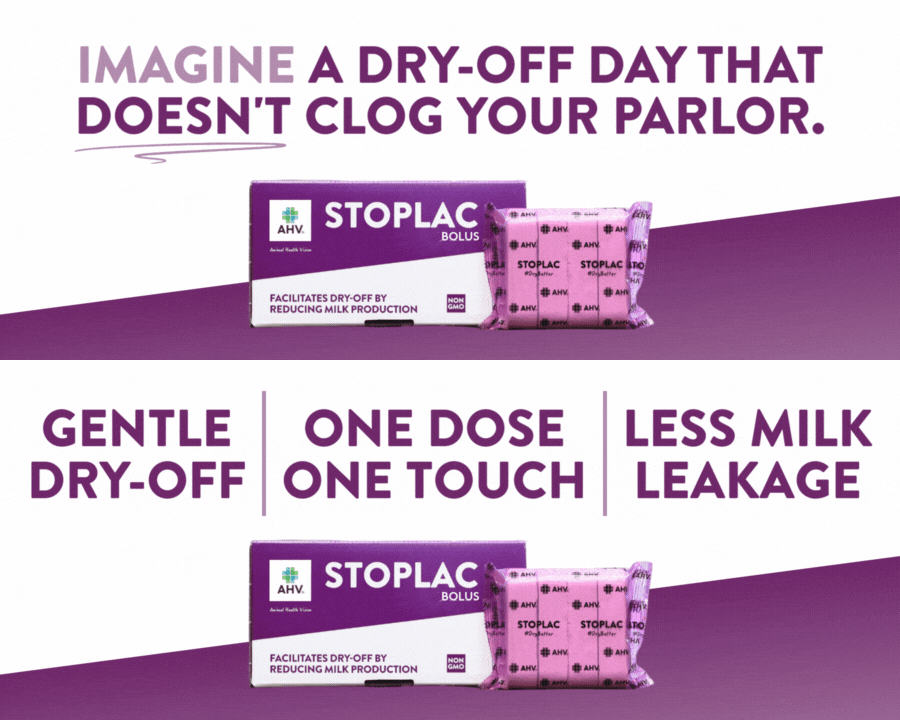







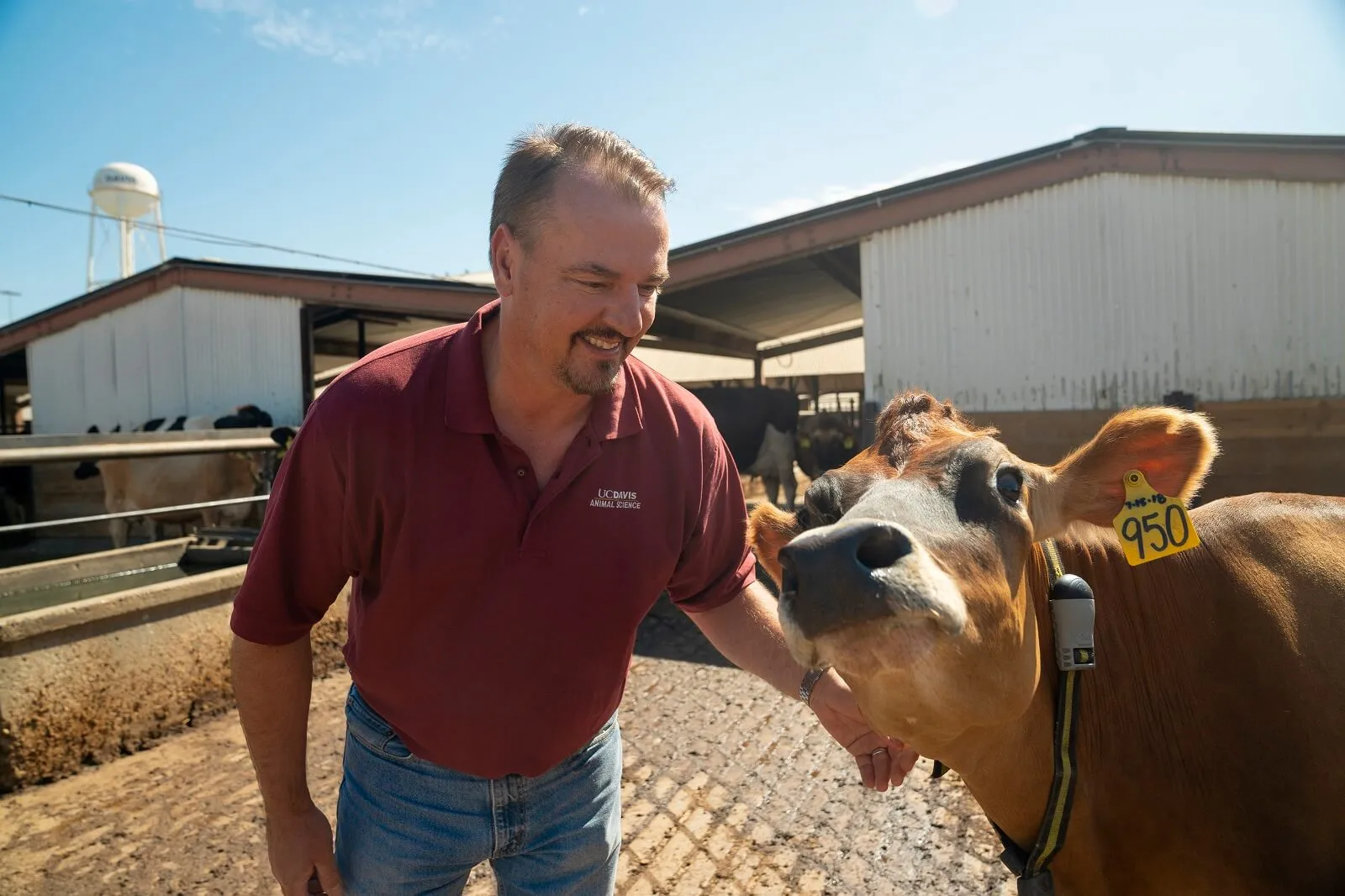
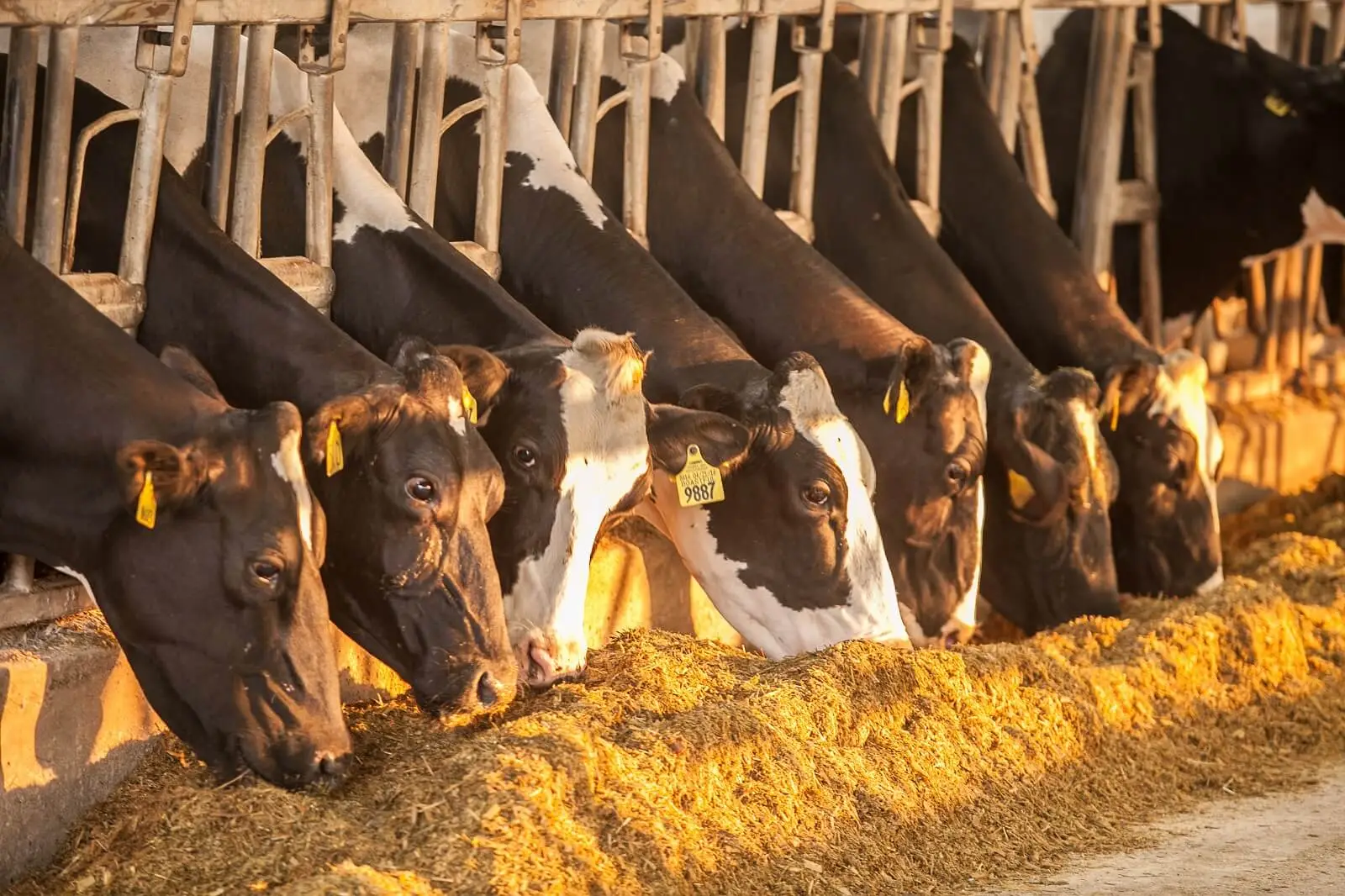
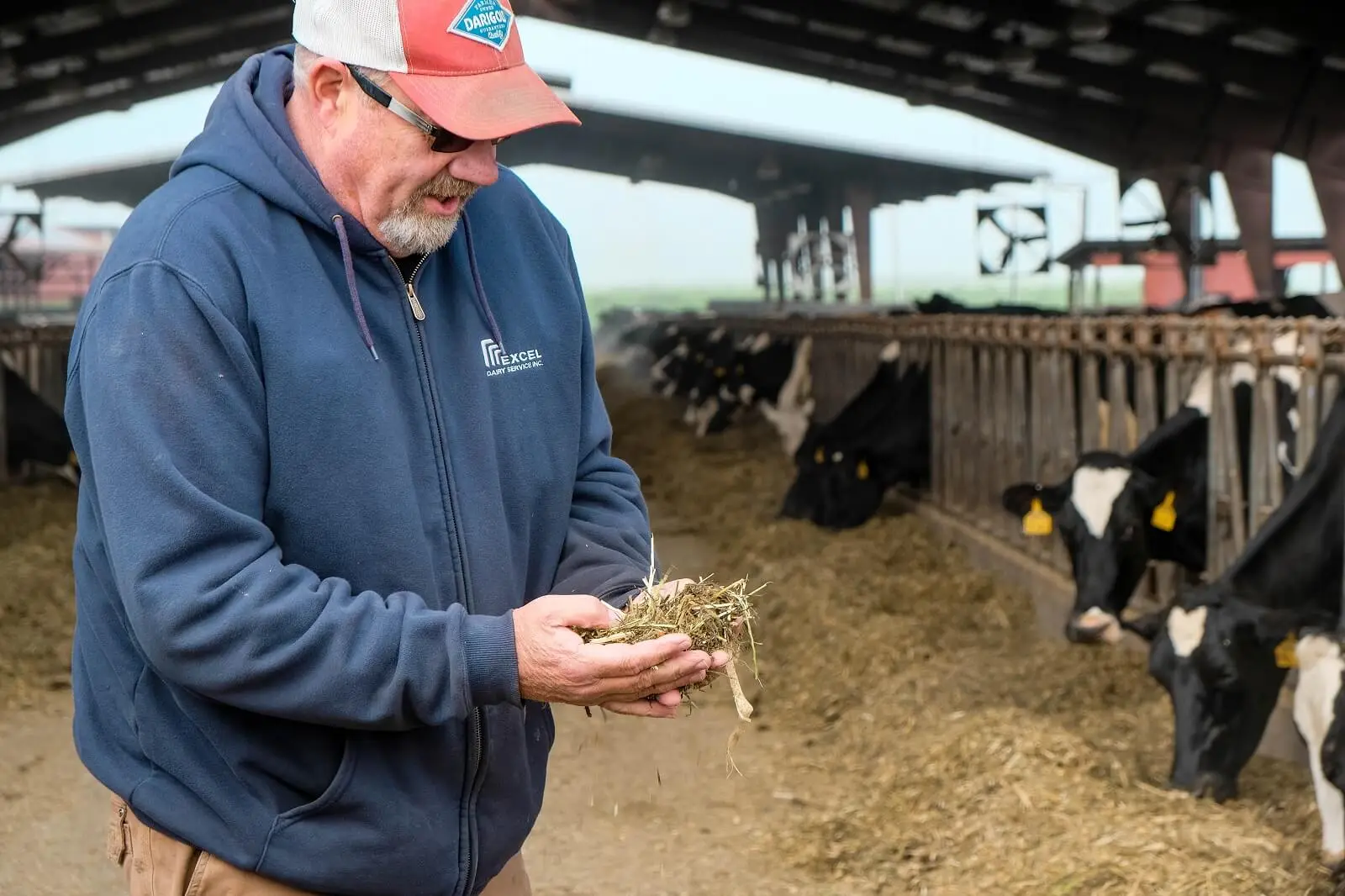
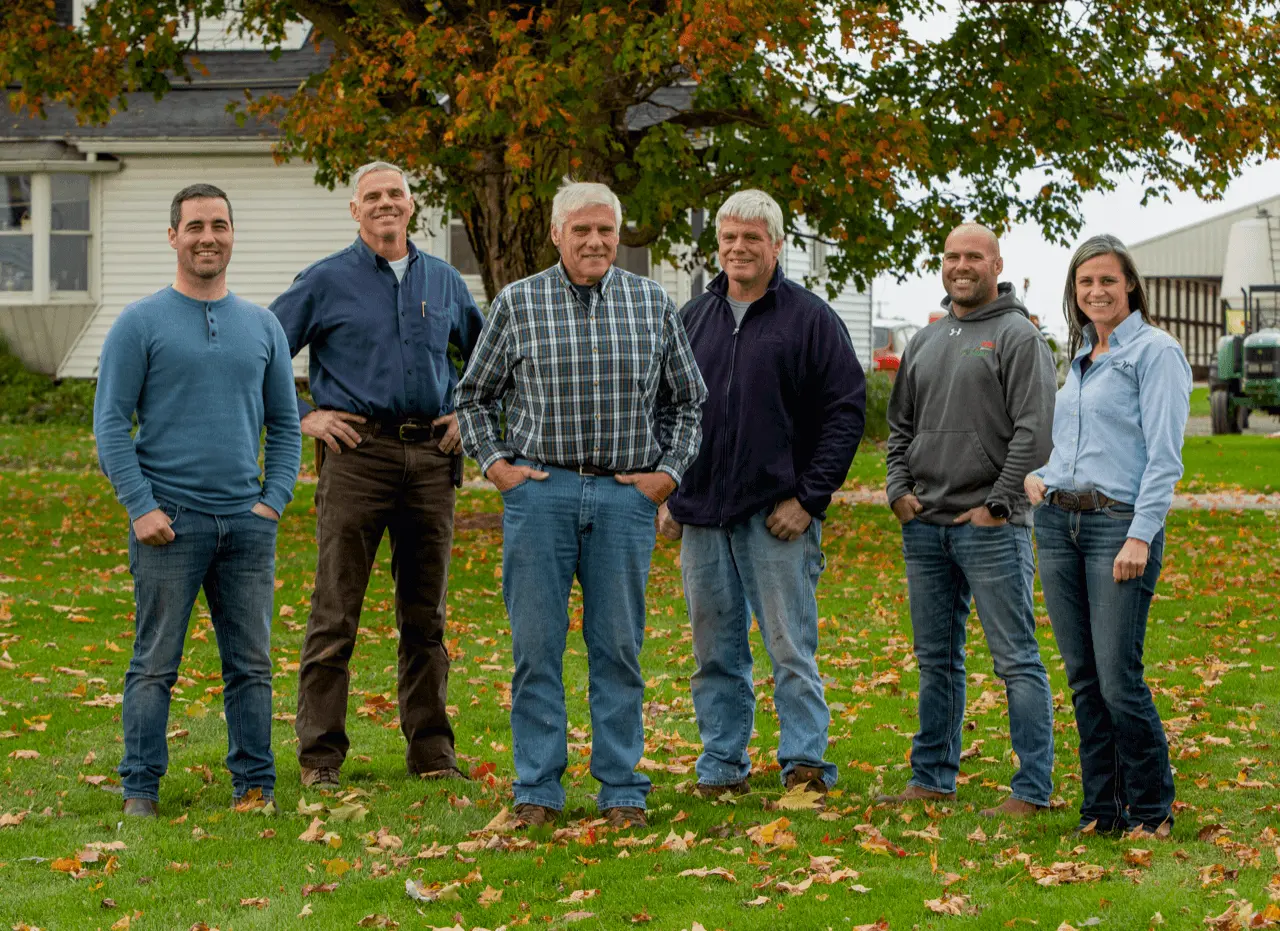

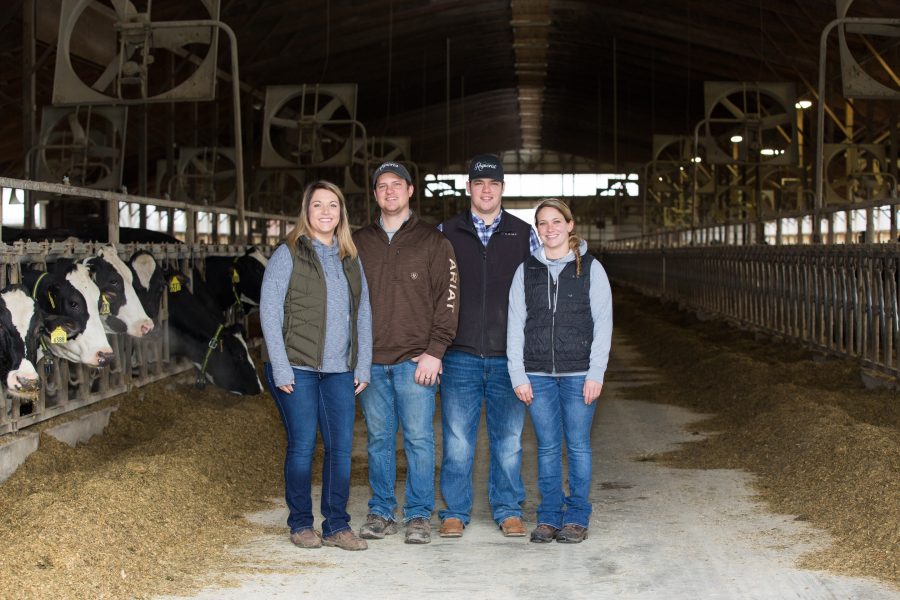

 Although summer is off to a sweltering start in much of the nation, there is still plenty of milk. In the Upper Midwest, excess tankers are selling at $5 to $6 under class, and cheese plants are running full throttle. Thankfully, demand is strong. Retailers continue to place big orders, and foodservice demand is generally steady. Exports are booming. The U.S. sent a record shattering 89.1 million pounds of cheese abroad in April, up 51% from a year ago. USDA’s Dairy Market News reports that lower prices today are attracting more orders, and Asian buyers are particularly happy to bargain shop.
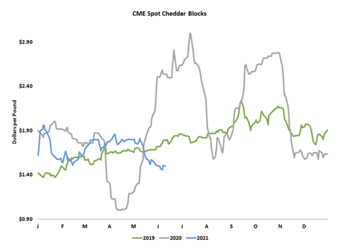 CME spot whey powder bounced back this week, climbing 2.5ȼ to 62.75ȼ. Demand for high-protein whey products remains robust, which is keeping dry whey output in check despite formidable cheese production. U.S. whey protein concentrate exports are off to their strongest start on record, and shipments of whey protein isolates to foreign buyers jumped 13.3% from 2020 in January through April. But whey exports are starting to slow. Backups at the ports, a shortage of shipping containers, and stiffer competition from Europe are taking a toll. Closer to home, some buyers have balked at historically high prices. However, whey powder stocks remain tight.
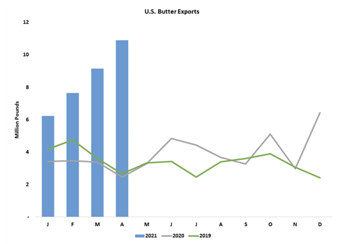 The Class IV products moved higher. CME spot butter rallied 1.75ȼ to $1.7925. Cream is plentiful, particularly in the West. Foodservice orders continue to climb, but retail butter demand has softened. U.S. butter exports leapt more than three-fold in April to the highest monthly volume in nearly seven years. That helped the U.S. to flip to a net butter exporter in April, although, at 1.85 million pounds, the trade surplus remains relatively small.
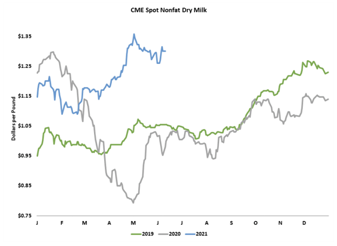 CME spot nonfat dry milk (NDM) jumped 4ȼ this week to $1.30. As usual, the tail end of the spring flush has collided with the summer slowdown in school milk programs, and dryers are running hard. Domestic users have been buying opportunistically, stepping up purchases when the price ticks down, and then backing off again as values rise. U.S. NDM exports fell short of the record volumes set in March but were still 16% greater than those of April 2020. China remains hungry for foreign milk powder, and shipments to Mexico accelerated. Industry contacts suggest that NDM sales to Mexico are likely to remain strong.
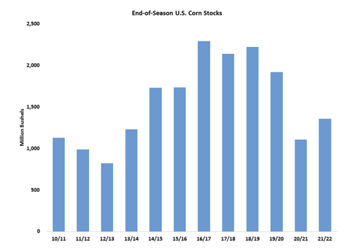 Exactly a year ago, USDA projected that we would end the 2020-21 crop year with an extra 3.3 billion bushels of corn, nearly a quarter of annual demand. That would have been the highest end-of-season stocks to use ratio in nearly three decades. But corn acreage was significantly lower than USDA had anticipated, and the derecho and other crop issues dragged on yields. Farmers grew 14.2 billion bushels of corn last year, well short of USDA’s June 2020 projection of nearly 16 billion bushels. Meanwhile, exports soared and total demand ballooned to a record-shattering 15 billion bushels. With the benefit of hindsight, USDA is now calling for end-of-season corn stocks at just 1.1 billion bushels and a stocks to use ratio of just 7.4%, a 25- year low. July corn futures are holding near $7 per bushel, and cash corn values are not expected to drop anytime soon.

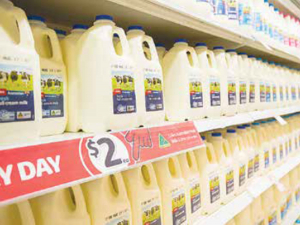 The battle for milk in Australia has just got tougher for processors like Fonterra.




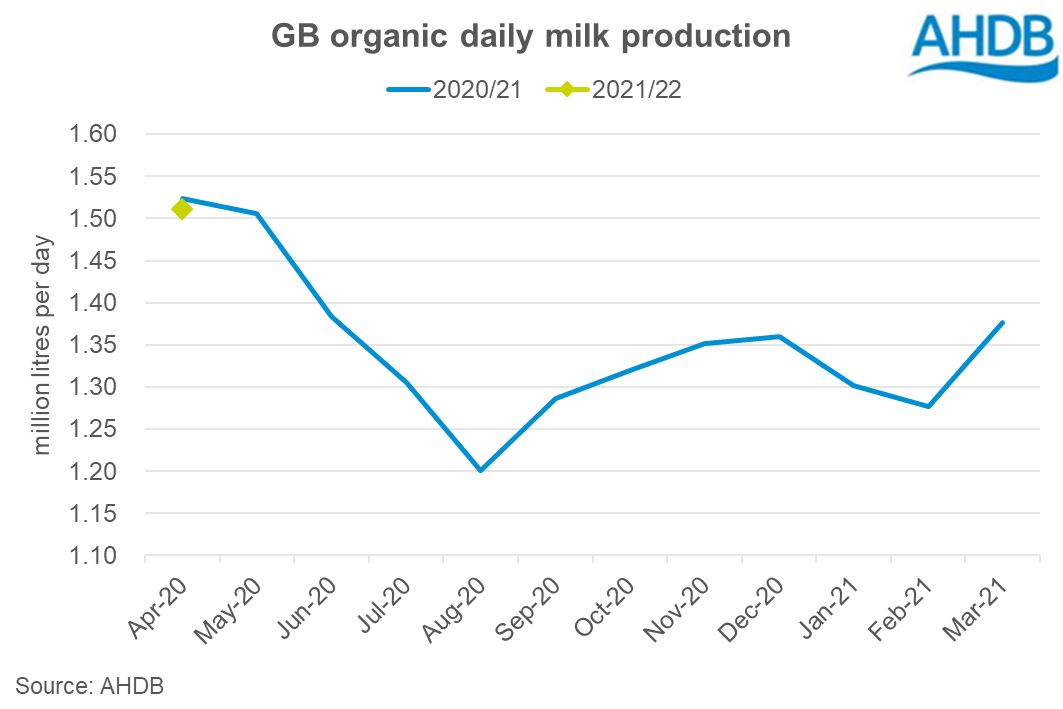
 OPINION Annual observances reflect the circumstances that surround them. The year 2021 is a unique moment, with light at the end of the COVID-19 pandemic in the United States. There’s excitement for the future, mixed with apprehension and nervousness about what may lie ahead. World Milk Day – June 1 – provides a moment to celebrate, for all the difficulties, dairy’s many impressive achievements of the past year. It’s a time to consider how those accomplishments can be a springboard for whatever the next year brings.
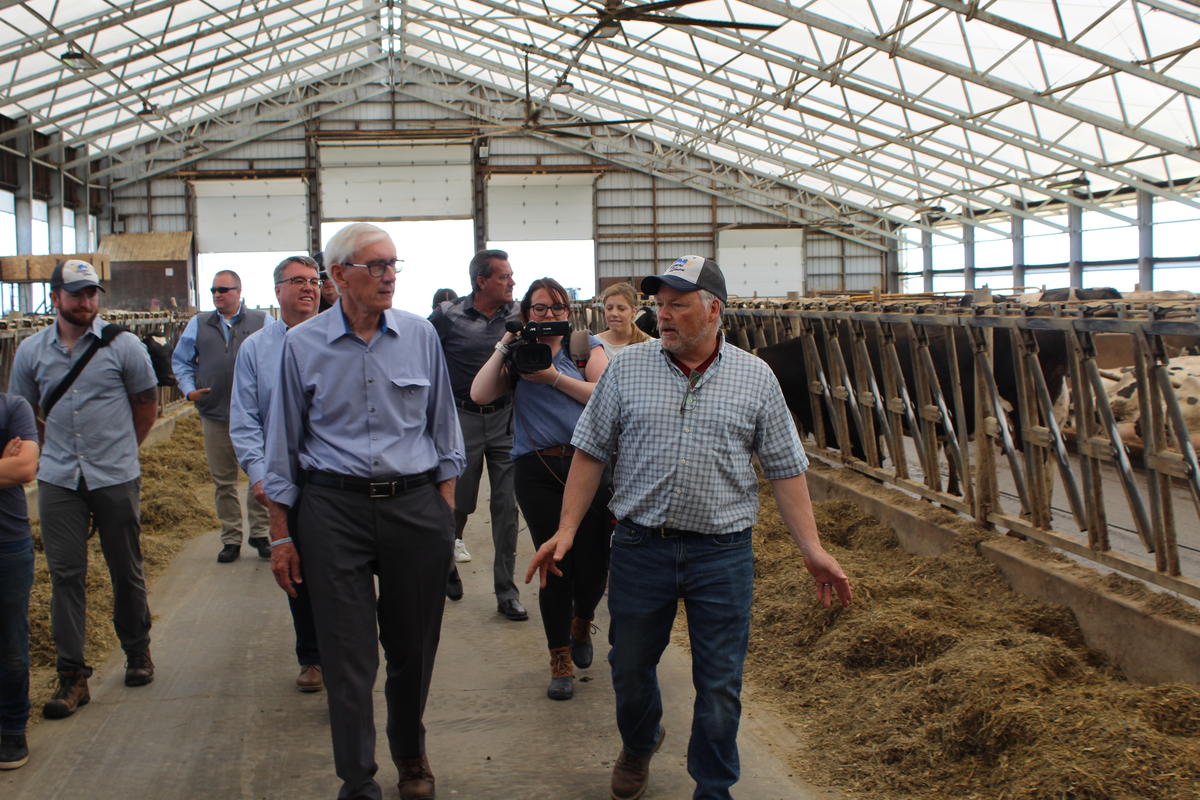 Hans Breitenmoser Jr.’s mother and father came to northern Wisconsin as Swiss immigrants, searching for the American Dream.