



Archive for robotic milking costs

Robotic Milking Pays 13% More – After 7 Years of Red Ink

Here’s the cash flow math the dealer didn’t show you — and the one number that predicts whether your robots will pay

A brand-new USDA Economic Research Service report — Precision Dairy Farming, Robotic Milking, and Profitability in the United States (ERR-356, January 22, 2026) — finds that robotic milking increases U.S. dairy net returns by 13 percent on average. The researchers drew on five waves of USDA Agricultural Resource Management Survey data spanning 2000 through 2021, and they controlled for the fact that stronger managers tend to adopt first. That 13% is an adjusted treatment effect. It’s the strongest national evidence yet that AMS profitability is real.
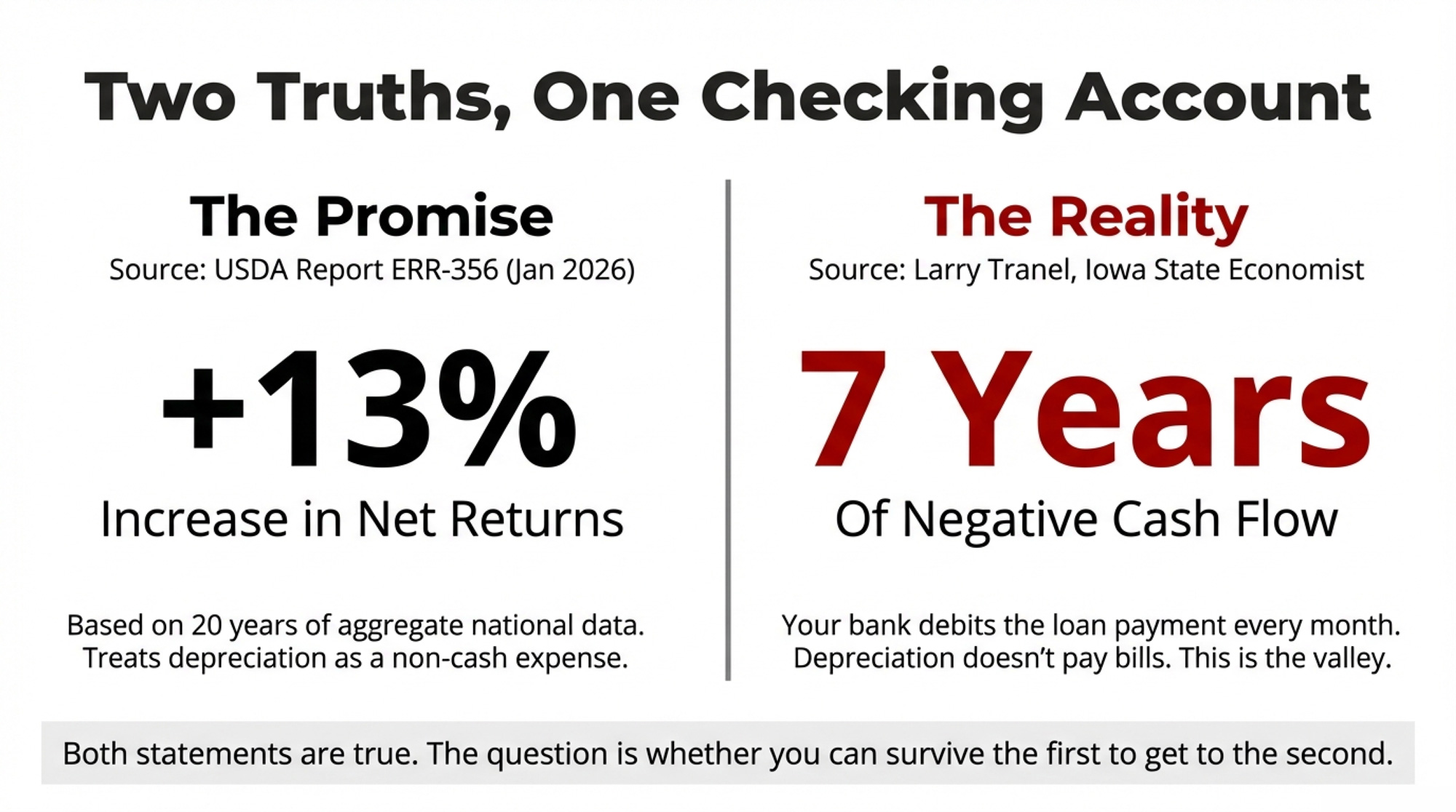
And yet. Iowa State dairy economist Larry Tranel — the guy who’s been running AMS economics since before most dealers had a demo unit — puts it this way: “Cash flow of a robot tends to be very negative in the first seven years, then pretty positive for rest of the life of the AMS, but that is dependent on many variables, especially repair costs across the whole life of the robot.”

Both things are true. The question is whether your operation can survive seven years on the wrong side of the ledger to reach the right one.
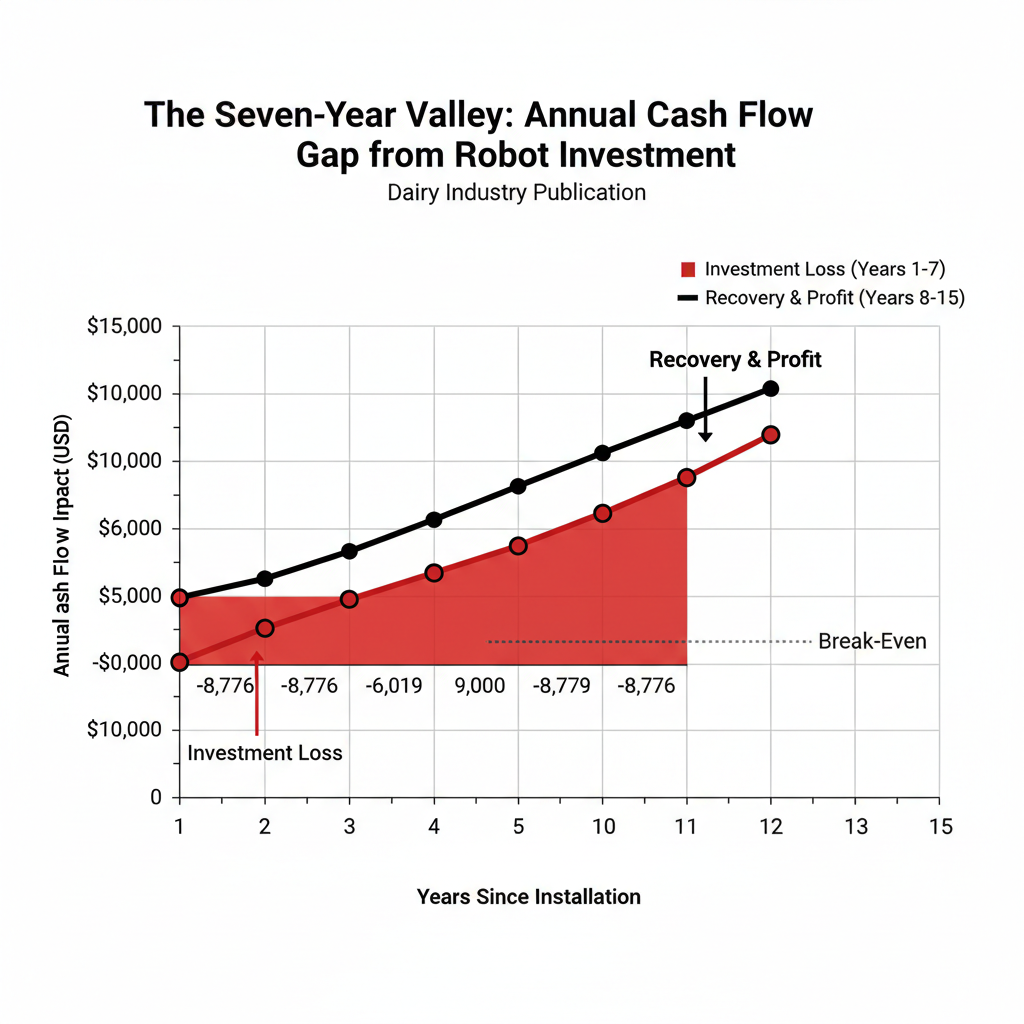
The $8,776 Gap Your Checking Account Feels Every Year

Here’s how the math works in Tranel’s partial budget model for a two-robot retrofit with a total investment of $400,000. Annual ownership costs — depreciation, interest, repairs, insurance — run roughly $62,000. Against that, the net financial benefit from labor savings, production gains, and reduced hired help comes to just $1,391 per year before you assign a single dollar to quality of life.
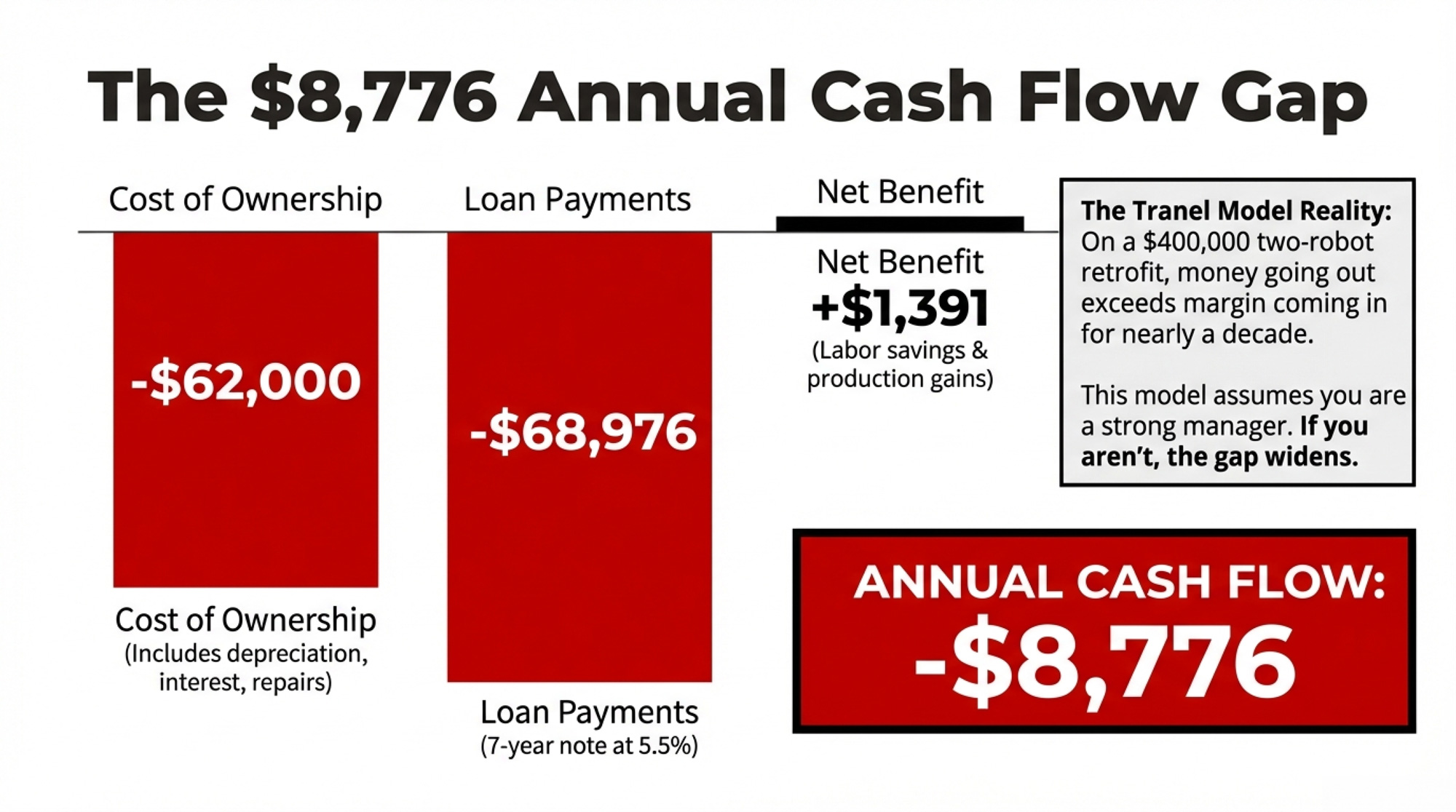
Now layer on the loan. A 7-year note at 5.5% means an annual payment of $68,976. The capital recovery cost for a 10-year useful life is $60,200. The gap: negative $8,776 per year in cash flow — and that’s before you account for any labor you didn’t actually eliminate.

Why does the USDA aggregate picture look so much rosier? Depreciation. In the national profitability calculation, it’s a non-cash expense spread over the equipment’s useful life. In your checking account, the loan payment is debited every month. For seven years, money going out exceeds the margin improvement coming in. That’s the valley.

Worth noting: the USDA report says only 6% of U.S. milk came from cows milked via box robots as of 2021. AMS remains the minority, meaning the profitability data reflects a population skewed toward early adopters who tend to be stronger managers to begin with.

The Production Gain That Isn’t What You Think

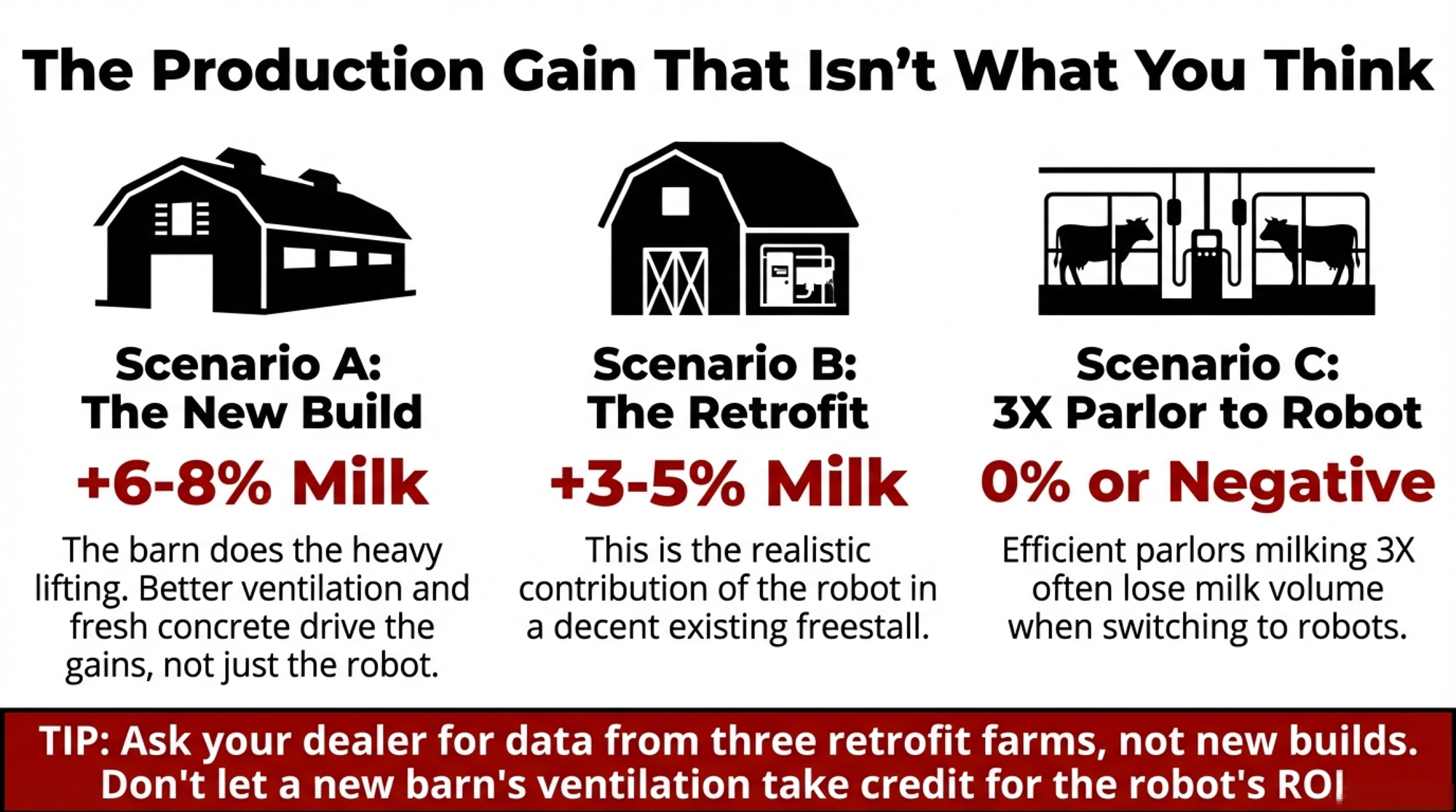
Tranel puts the typical production bump at 3 to 5 percent for herds switching from twice-daily milking. Some farms hit 10% or more. But here’s what gets glossed over at the open house: “Often, much of the increase reported on AMS is due to the new cow housing facility, not just the AMS, as new facilities often increase production 6 to 8 percent over old, worn-out facilities. This is an important point often overlooked.”

That 10% jump your neighbor reported? Maybe 3–5 points came from the robot. The rest came from the new barn. Better ventilation. Fresh concrete.

Already milking 3X in an efficient parlor? Tranel doesn’t sugarcoat it: “Producers currently milking 3X may experience a decrease in milk production.”
Where You’re StartingRealistic Gain
2X in older tie-stall or worn-out freestall6–8% (new barn + robot combined)
2X in decent existing freestall (retrofit)3–5% (robot contribution)
3X in an efficient parlor0% or potentially negative

Source: Tranel, Iowa State Extension (2018)

💡 The Bullvine Tip: Before you sign an AMS contract, ask the dealer for production data from three retrofit farms — not new-builds. If the big gains only show up where somebody also poured a new barn, the robot isn’t the hero. The ventilation and stall comfort are doing the heavy lifting. Purina Canada’s 2025 analysis of Canadian retrofit herds found a trending average of +3 liters/cow/day — about C$2.70/cow/day at a Canadian milk price of roughly 90 cents/liter. A useful reference point, but Canadian pricing doesn’t translate directly to U.S. operations.

At Tranel’s benchmark of 4,500 lb of milk per robot per day, AMS milking costs run about $2.13/cwt (range: $1.77–$3.00). A well-run swing-12 parlor? Roughly $1.08/cwt. That’s a dollar-plus gap you have to close with production gains, labor savings, and management value. Every month.

Cost ComponentAMS ($/cwt)Swing-12 Parlor ($/cwt)
Ownership (depreciation, interest, insurance)$1.05$0.38
Maintenance & Repairs$0.54$0.22
Labor (net after savings)$0.34$0.38
Throughput & Efficiency$0.20$0.10
Total Milking Cost$2.13$1.08
Gap You Must Close+$1.05/cwt

Where the Maintenance Money Goes

The 2019 joint survey by Extension educators at UW-Madison, the University of Minnesota, and Penn State — with more than 50 complete responses — tracked how costs change as robots age.

Early years: repairs and maintenance average around $5,000 per robot per year. As units get older, those costs climb to roughly $10,000, driven mainly by bigger repair bills while routine maintenance stays fairly steady.
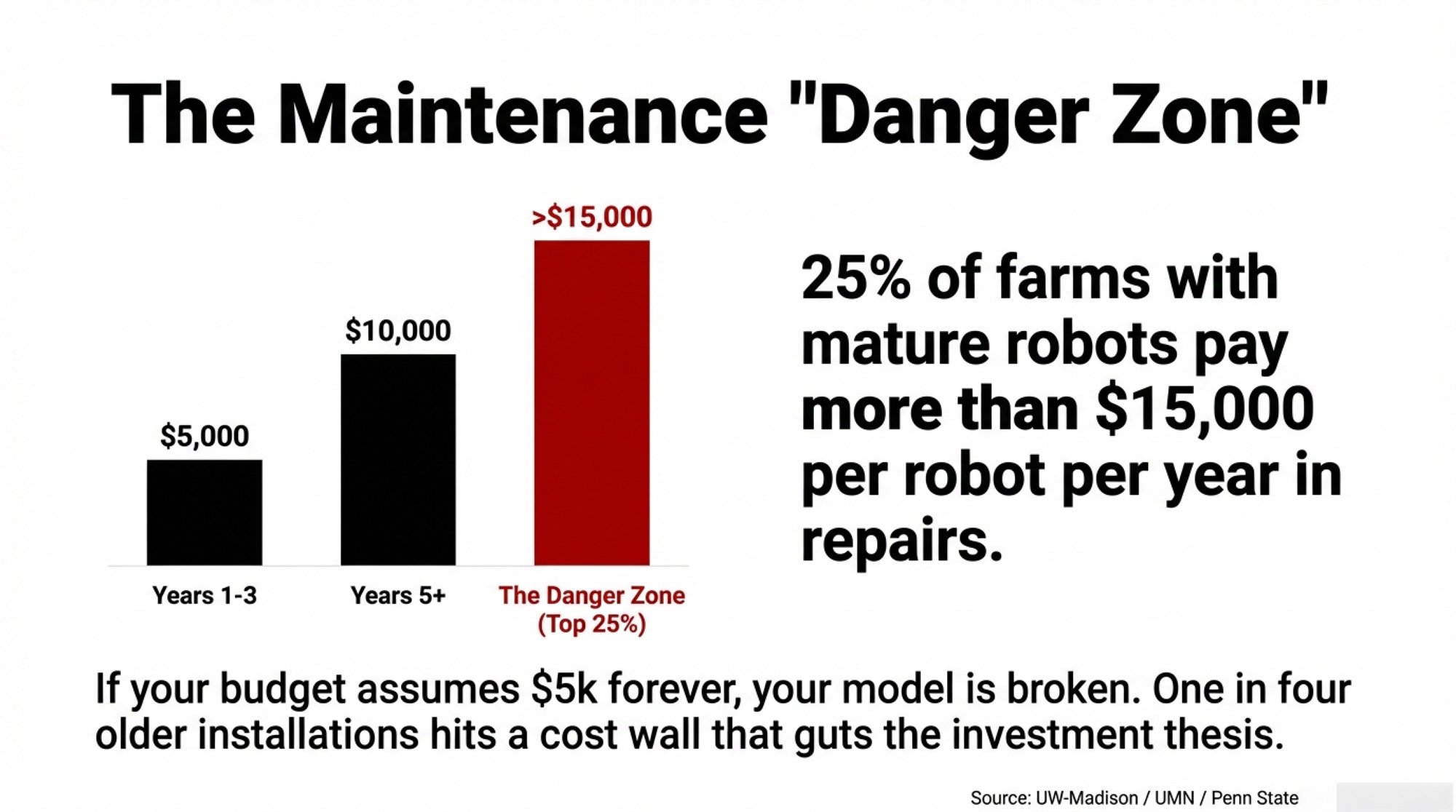
But averages mask the danger zone. Among farms running robots for 5 years or more, 25% reported maintenance costs exceeding $15,000 per robot per year. A few blew past $25,000. Those producers, in their written comments, “made it clear that adaptation to AMS didn’t go well for them and that they were transitioning back to conventional milking systems or exiting the dairy sector.”
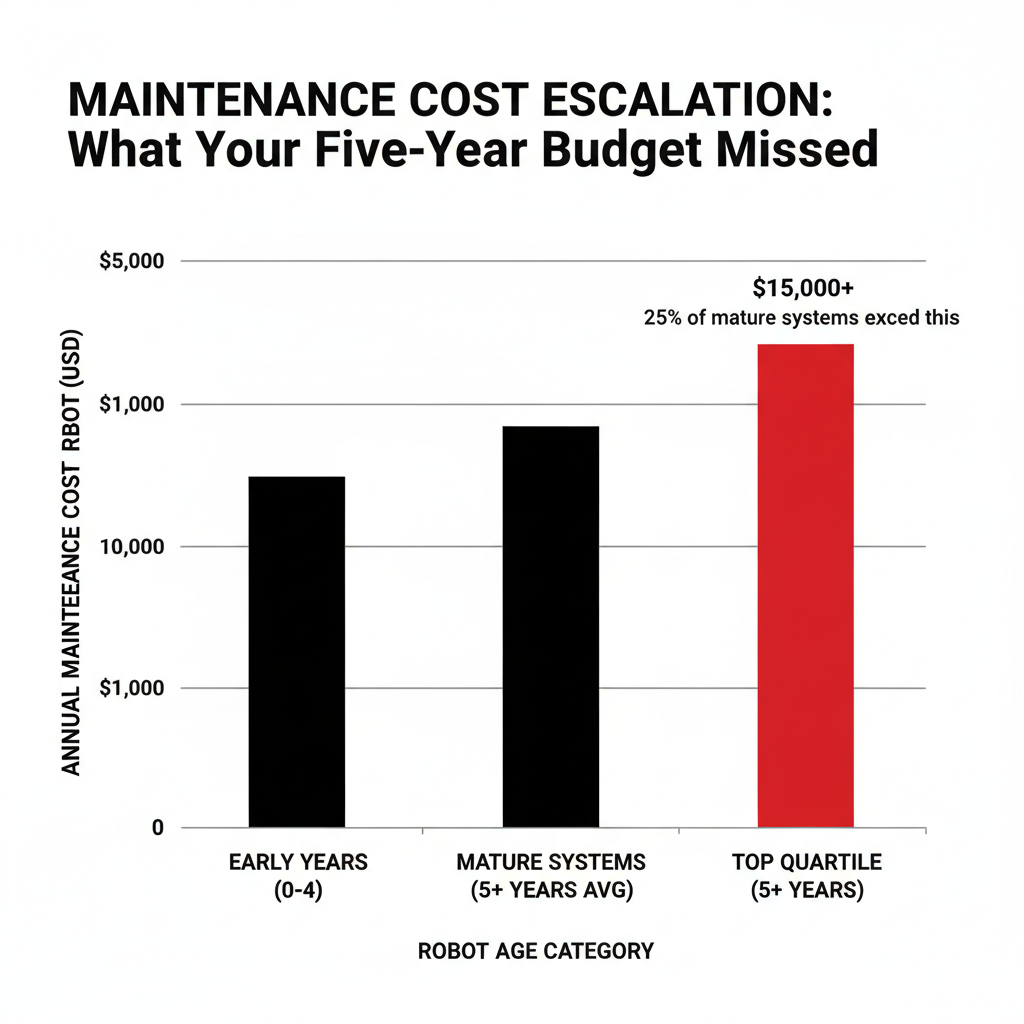
One in four older installations is hitting a cost wall that guts the investment thesis. That’s not a tail risk. That’s a quartile.

One bright spot from the same survey: 45% said dealer service had improved since they first adopted. When your robot goes down, how fast the technician arrives is the difference between a hiccup and days of lost production.

The Labor Savings Are Real. The Mental Load Is the Surprise.

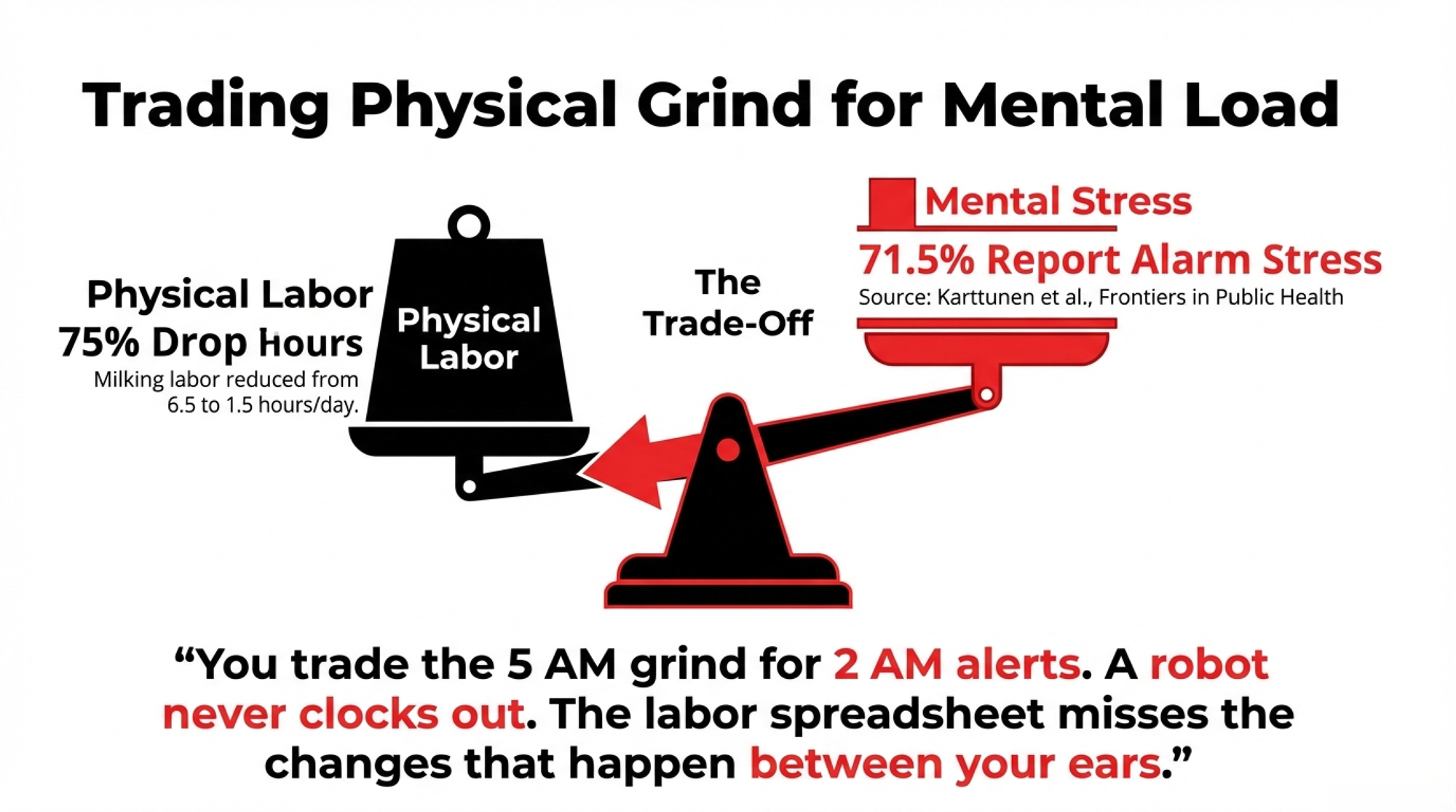
Tranel’s data show a 75% decrease in milking labor hours — from 6.5 hours/day to 1.5 on a typical two-robot farm. The UW–UMN–Penn State survey confirmed average savings of 38% per cow and 43% per hundredweight. At $15/hour, that works out to about $1.50/cwt in labor savings. Top-quartile farms saved $2.40/cwt or more.
But 8% of respondents reported no labor savings at all — mostly because maintenance demands ate the hours right back.

And the labor spreadsheet misses the changes that happen between your ears. A 2014 survey of 228 Finnish AMS farmers — published in 2016 by Karttunen, Rautiainen, and Lunner-Kolstrup in Frontiers in Public Health — found 71.5% reported mental stress from nightly AMS alarms and 51.7% experienced stress from the 24/7 standby. Overall, 93.4% mentioned at least one AMS-related issue causing mental strain.

That survey is now a dozen years old, and alarm management tech has improved. But the underlying reality hasn’t changed — a robot never clocks out. Christina Lunner Kolstrup of the Swedish University of Agricultural Sciences, a co-author on the Finnish study, put it plainly in a summary of her qualitative research reported by Dairy Global in 2021: “Previously, with conventional milking, the working day had a clear and natural ‘start’ and ‘end’, but with the AMS, there are no specific working hours. The informants claimed that they are working longer hours now than before. They are never really done after a working day, as there is always something more to be done in the dairy barn.”

One Wisconsin producer in the Extension survey nailed it: “AMS is not stress free. Physically, it is easier. Mentally stressful.” Another said: “Anyone considering robotics should understand that there is still plenty of daily work involved in milking, robots just give you more flexibility with your time.”

You trade the 5 AM and 5 PM grind for 2 AM alerts. If you run a family operation, that trade-off deserves a kitchen-table conversation before it deserves a dealer quote.

FactorThe Financial Gain (Quantified)The Mental Load Reality (Survey Data)
Milking Labor Hours75% reduction (6.5 hrs/day → 1.5 hrs/day)51.7% report stress from 24/7 standby requirement
Labor Cost Savings38–43% per cow; $1.50–$2.40/cwt71.5% report stress from nightly AMS alarms
Top-Quartile Labor Savings$2.40/cwt or higherWorkdays no longer have clear “start” or “end”
Zero Labor Savings8% of adopters (maintenance ate the hours back)93.4% report at least one AMS-related mental strain
Physical DemandSignificantly easier (no 5 AM/5 PM milking)“Mentally stressful… never really done after a working day”
Schedule FlexibilityMore control over daily timingTrade 5 AM/5 PM grind for 2 AM alerts; alarms wake you at night

The 15.8% Who Stopped

Dr. Nicolas Lyons, dairy technology leader at NSW Department of Primary Industries and a key researcher on Australia’s FutureDairy project, tracked the country’s entire AMS adoption history: “Of the 57 farms that commissioned robots since 2001, now there were only 48 operating. We had nine cease — some went back to a conventional dairy, and some left the industry entirely.”
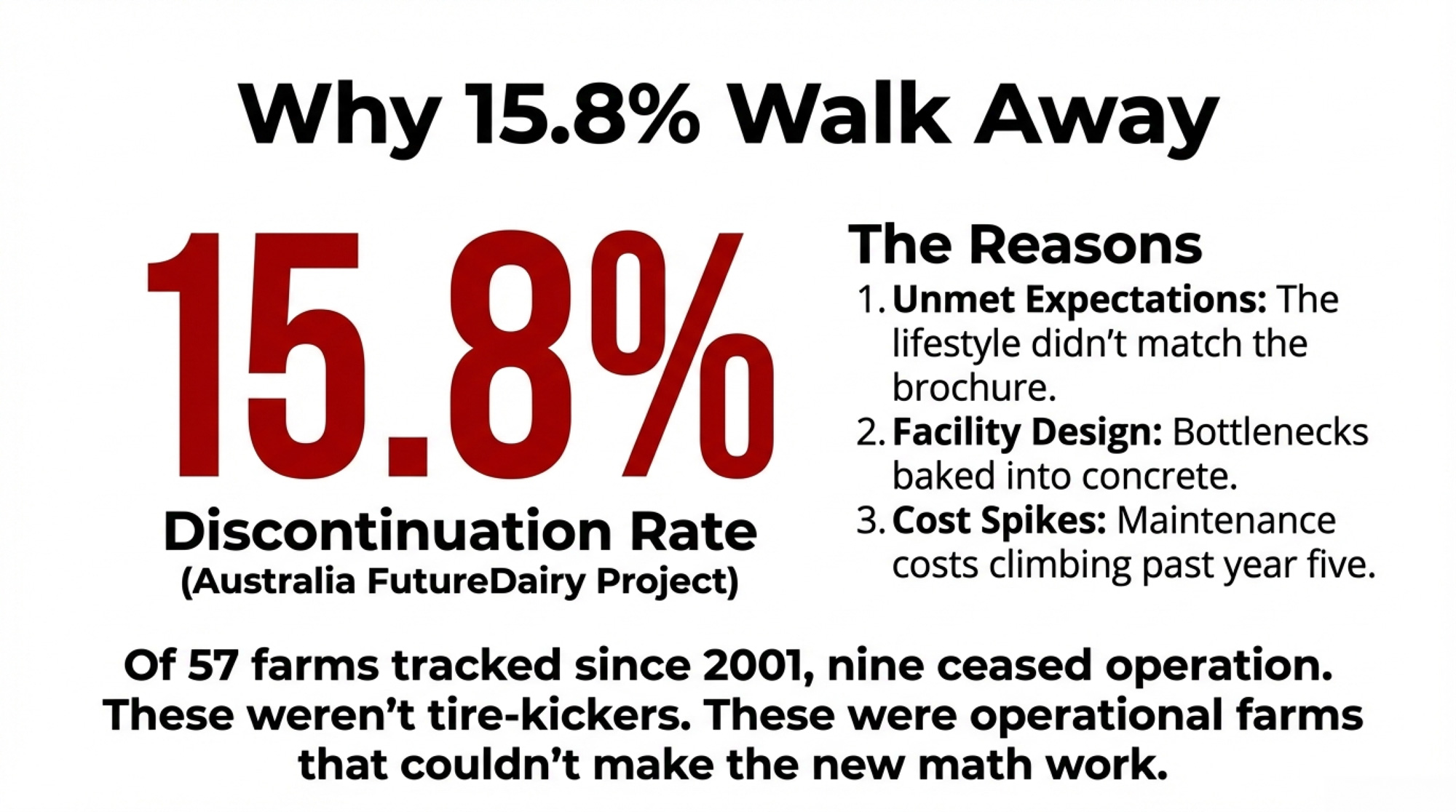
Nine of 57. A 15.8% discontinuation rate — not among tire-kickers, but among farms that installed robots, ran them, and walked away.
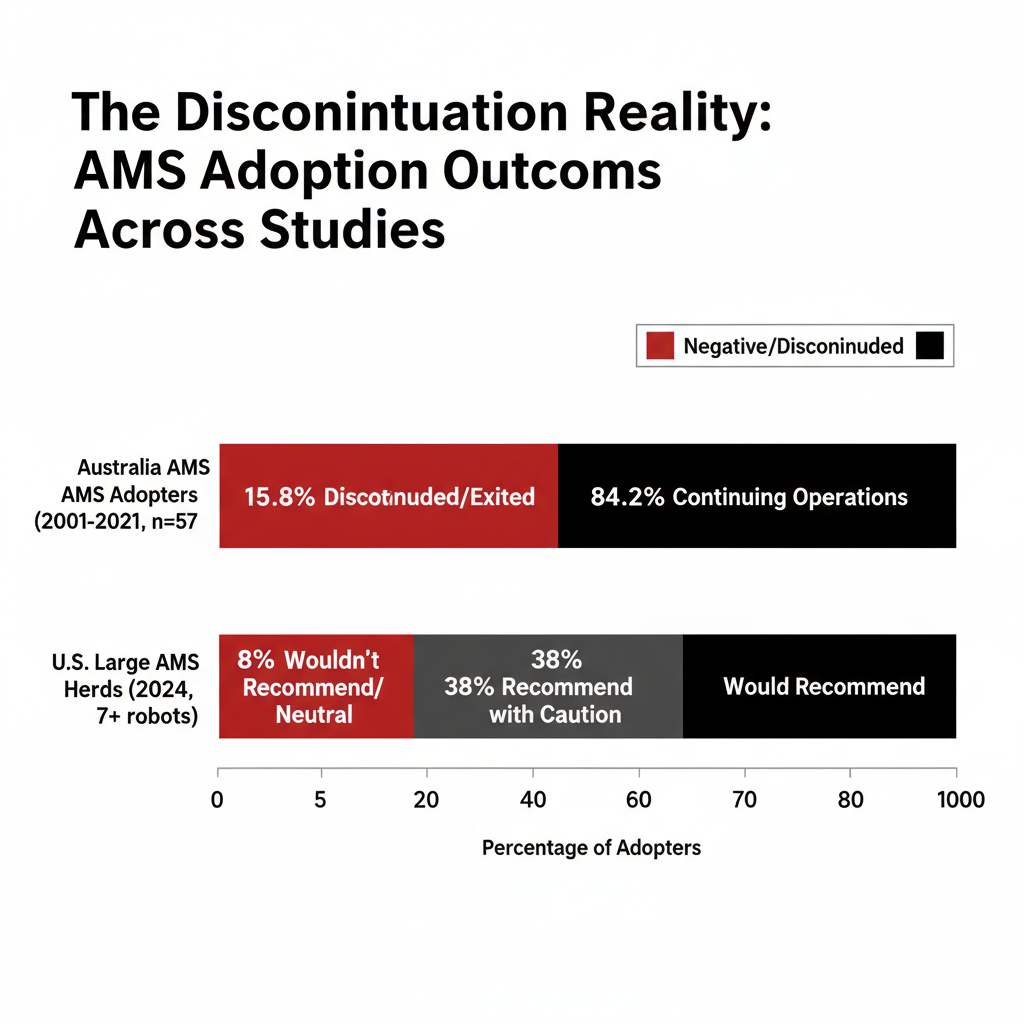
Lyons didn’t dodge the reasons: “It basically comes down to things like expectations weren’t met; some couldn’t make it work; some didn’t have a good relationship with the equipment provider; and some didn’t achieve what they had hoped.”

The pattern usually starts with facility design — cow traffic bottlenecks baked into concrete you can’t move. It compounds when maintenance costs climb past year five. And it breaks open when the promised lifestyle improvement collides with the grind of 24/7 systems management.

What the Satisfied Farms Actually Said

De Assis Lage and colleagues surveyed large U.S. AMS operations — farms running 7 or more milking boxes, median herd around 940 lactating cows — in a 2024 study published in MDPI Animals. The results: 54% would recommend AMS. Another 38% advised careful consideration before adopting. Just 8% were neutral or wouldn’t recommend.
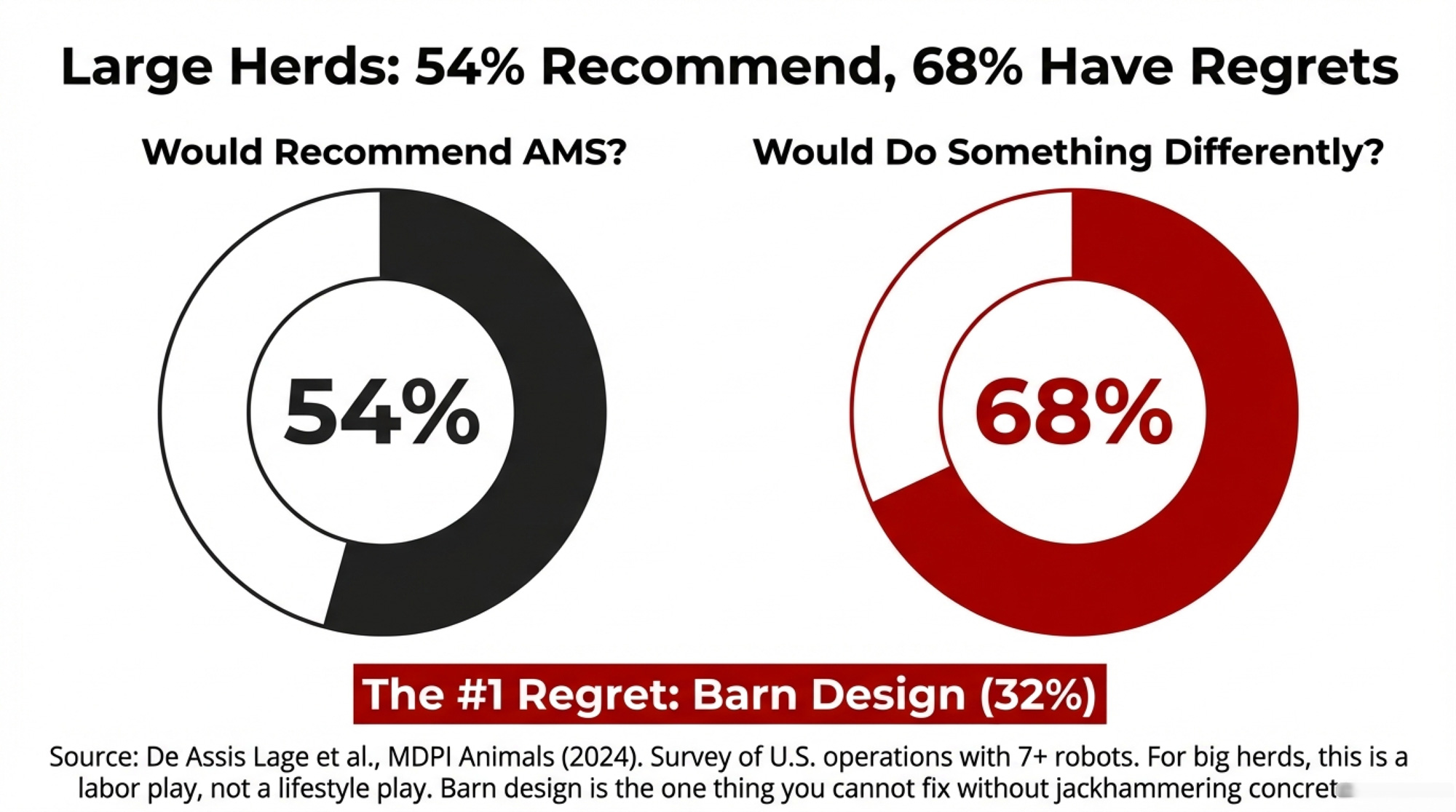
That 38% isn’t a rejection. It’s producers who know it works—and exactly what it costs to get there.

Production results: 58% reported increases, and 32% saw higher fat and protein content. Top adoption motivations for these large herds: labor costs (81%), cow welfare (78%), herd performance (74%). Quality of life came in fourth at 44%. For big U.S. operations, AMS is a labor and performance investment first. The lifestyle argument carries more weight on smaller Canadian and European farms, where it consistently ranks as the top driver.

The regret data matters most: 68% would do something differently. Barn design modifications topped the list (32%), followed by improvements to cow flow (16%). Two-thirds wished they’d planned their facility better — the one thing you absolutely cannot fix without jackhammering concrete.

What Your Lender Sees

Brad Guse, Senior Vice President of Agriculture at BMO Harris Bank, frames the question the way your banker will: “Given the significant capital outlay for robotic dairy equipment, how are you going to repay the debt?”

Tranel’s model answers that bluntly. On a $400,000 investment at 7 years and 5.5%, the payment is $68,976/year. Capital recovery is $60,200/year. The cash squeeze starts on day one.

Guse warns specifically against balloon payments — you’re deferring principal at exactly the point maintenance costs start climbing.

And Tranel raises a timeline question that rarely comes up at the dealer’s table: “If you will be farming for at least another 13 to 17 years, that increases the propensity to put in robotics, but if you are only planning on farming about seven years, then it might not make sense.” Looking at 20 more years? “You need to consider needing to make a second investment of money in 15 years when the equipment wears out.”

The One Number That Predicts Your Return

Tranel is clear: milk per AMS unit is “very highly correlated” to AMS profitability — more so than milk per cow. The 2019 survey data showed robot visits ranging from 2.4 to 3.1 per cow per day, and milk per visit ranging from 21.4 to 39 lb.
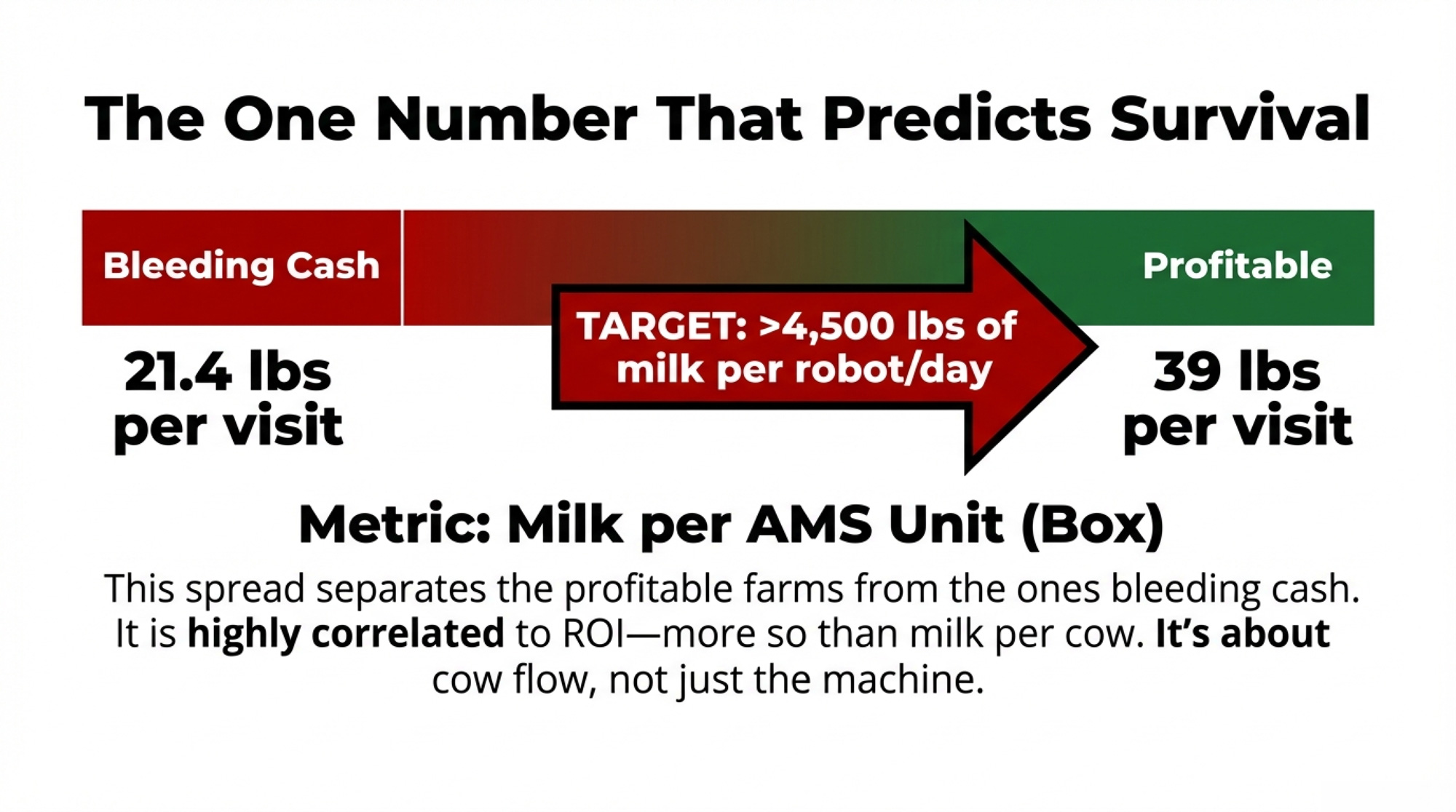
That spread — 21.4 to 39 lb per visit — separates the robots that pay from the ones that bleed you dry. And the gap isn’t about the machine. It’s cow flow, feed management, lameness protocols, stall comfort, and whether you run the data like a systems manager or treat the robot as a very expensive hired hand.

What This Means for Your Operation

  • Budget AMS milking at $2.00–$2.50/cwt against roughly $1.08/cwt for a good parlor. Your labor savings, production bump, and management-software value have to clear that gap. Monthly.
  • Plan for maintenance to roughly double by year five — and for the real possibility you land in the top quartile at $15,000+ per robot. If your cash flow model assumes $5,000/year in perpetuity, it’s wrong.
  • If you’re milking 3X in an efficient parlor, don’t model production gains from AMS. Tranel’s data says you may lose ground. Be honest about your starting point before you model the finish.
  • Run Tranel’s spreadsheet — search “Iowa State Extension dairy team milking systems” for the free download. [Verify URL is current before publication.] Stress-test your numbers at $17 milk, not just $22. If the math only works at high prices, you’re making a bet, not an investment.
  • Facility design is the regret you can’t undo. Visit retrofits, not just new-builds. Walk through at peak milking time. Ask every operator the same thing: “What would you do differently?”
  • Know your timeline. Less than 10 years to exit? The valley may outlast your career. Twenty years out? Budget for a full equipment replacement at year 15.
  • Have the family conversation about mental load before you have the dealer conversation about price. The Finnish data is clear: 71.5% of AMS farmers reported stress from nightly alarms. Alarm tech has improved since that 2014 survey, but the 24/7 nature of robot management hasn’t changed.

Key Takeaways

  • The January 2026 USDA report (ERR-356) confirms that AMS boosts net returns 13% on average. But Tranel’s cash flow model shows seven years of red ink before you reach the payoff. Both are true. The difference is what you measure.
  • Production gains of 3–5% are realistic for 2X herds. Much of any larger gain comes from new facilities—not from the robot itself. Ask for retrofit data before you sign.
  • AMS milking costs roughly double a good parlor — $2.13/cwt vs. $1.08/cwt in Tranel’s model.
  • 54% of large U.S. AMS farms recommend the technology, but 38% say do your homework first. And 68% wish they’d planned their barn differently.
  • Maintenance costs nearly double as robots age. One in four older installations tops $15,000/robot/year.
  • Of Australia’s 57 AMS adopters since 2001, nine stopped entirely — a 15.8% discontinuation rate driven by unmet expectations and poor dealer relationships.

The Bottom Line

The producers who recommend AMS without hesitation didn’t just buy different equipment. They became different managers — relentless about the gap between 21.4 and 39 lb per visit, obsessed with cow flow, and brutally honest about what the investment demands.

Where does your operation actually sit in that picture? Answer with a spreadsheet — not a brochure — before you pour the concrete.

Executive Summary: 

USDA’s 2026 ERR-356 report says robotic milking and precision tech boost U.S. dairy net returns by about 13% on average, but Iowa State economist Larry Tranel’s cash flow work shows that a typical two-robot install often spends roughly seven years in the red before that upside appears. In his model, a $400,000 system carries about $62,000 in annual ownership costs and nearly $69,000 in loan payments, with only around $1,400 in net financial benefit — leaving an estimated $8,776/year cash flow gap in the early years. Extension surveys echo that pressure, finding that maintenance and repair costs commonly rise from about $5,000 to $10,000 per robot as units age, and that roughly one-quarter of mature AMS herds pay more than $15,000 per robot per year. On the positive side, those same data sets show 3–5% milk increases in most 2X herds that adopt robots, 38–43% labor savings, and better components in many large U.S. dairies, especially when upgrades include new barns. Mental health research from Finland and Sweden then adds a human price tag, with more than 70% of AMS farmers reporting stress from nightly alarms and describing workdays that no longer have a clear start or finish. The full article combines these numbers into a clear playbook — from cost per cwt and milk per robot box to maintenance risk and farming timeline — so you can decide, with eyes open, whether robotic milking fits your herd and your life.

Complete references and supporting documentation are available upon request by contacting the editorial team at editor@thebullvine.com.

Learn More

Join the Revolution!

Join over 30,000 successful dairy professionals who rely on Bullvine Weekly for their competitive edge. Delivered directly to your inbox each week, our exclusive industry insights help you make smarter decisions while saving precious hours every week. Never miss critical updates on milk production trends, breakthrough technologies, and profit-boosting strategies that top producers are already implementing. Subscribe now to transform your dairy operation’s efficiency and profitability—your future success is just one click away.

NewsSubscribe
First
Last
Consent

The Robotic Milker Hangover: The Hard Truths About Automation Your Dealer Won’t Tell You

70% of large US dairies building robots choose new construction—here’s why retrofitting your barn might cost you $37,800 annually

So, I was sitting in a diner last week, listening to two producers argue about robots. One swore they were the future of dairy farming. The other called them overpriced milking machines for people who forgot how to manage cows.

Both were right, and both were wrong.

Here’s the thing about automated milking systems—they’re not what most people think they are. They’re not magic productivity boosters, and they’re definitely not the answer to every dairy operation’s problems.

But they’re also not just expensive toys for farmers with more money than sense.

What strikes me about this whole automation discussion is how polarized it’s become. You’ve got the early adopters who act like conventional parlors are ancient history, and you’ve got the traditionalists who think robots are going to destroy everything good about dairy farming.

The truth? It’s somewhere in the middle, and it’s a lot more interesting than either side wants to admit.

The labor crisis everyone’s talking about (and some solutions nobody mentions)

Let’s start with the elephant in the barn—labor. According to the latest USDA figures, we’re looking at agricultural wages hitting $18.12 per hour on average, with some regions seeing $20+ for skilled milkers.

That’s not sustainable math for most operations, especially when you factor in the 3.6% annual increase we’ve been seeing.

But here’s what’s fascinating about the labor discussion… it’s not just about wages. I was talking to a 450-cow Holstein operation in Vermont’s Champlain Valley last month, who told me something that stuck with me:

“I can find workers. I just can’t find workers who want to work weekends, holidays, and who don’t mind getting kicked by a fresh cow at 4 AM.”

That’s the real labor crisis. It’s not just about money—it’s about lifestyle expectations that don’t mesh with the realities of dairy farming.

Recent work from the Journal of Dairy Science shows that labor costs have jumped from 13% of total dairy expenses in 2011-2012 to over 16% by 2017, and that trend’s only accelerating.

Now, here’s where it gets interesting… conventional operations aren’t sitting still. Some of the most efficient dairies I’ve visited are running modern double-24 parlors with two people milking 400+ cows in under four hours. They’ve invested in automatic takeoffs, automatic cluster flushers, and management systems that make the milking process incredibly efficient.

The difference? These operations typically have solid family labor, or they’re located in areas where agricultural workers are still relatively available. A 320-cow registered Holstein producer in Lancaster County, Pennsylvania, told me he’s had the same two milkers for eight years. They live within five miles of the farm, their kids go to local schools, and they’re part of a community that still values agricultural work.

So, when does conventional still make sense? More often than the automation advocates want to admit.

If you’re running under 150 cows, have solid family labor, and you’re not planning major expansion, a well-designed parlor can serve you for decades. The key is being honest about your situation.

Robotic milking systems reduce labor costs by $210 per cow annually compared to traditional parlors

The real cost of automation (and why the numbers don’t tell the whole story)

Robotic milking systems achieve payback in 3.2 years with continued financial benefits thereafter

Let’s talk money, because that’s where a lot of these conversations get muddy. Current market data shows automated milking systems running $150,000-$275,000 per robot. For a typical 120-cow operation, you’re looking at $3,200-$3,800 per cow when you factor in facility modifications.

But here’s what those numbers don’t capture—the operational transformation. I visited a 180-cow Jersey operation in Wisconsin’s Driftless Region that switched to robots three years ago. Their labor costs dropped from $375 per cow annually to $165 per cow. That’s $37,800 in annual savings for their herd size.

The payback math works.

Except… and this is important… it works if you can manage the system properly. The same operation told me they spent $22,000 on service calls and extra maintenance in year two because they hadn’t developed proper protocols for daily system checks.

This is where the industry conversation gets really interesting. Research from the University of Wisconsin shows that top-performing AMS operations get 42% more throughput from the same robotic hardware compared to poor performers.

That’s not a technology difference—that’s a management difference.

The international perspective we’re missing

European countries lead global adoption of robotic milking systems, with Scandinavian countries approaching 90% adoption

One thing that surprises me about the North American automation discussion is how little we talk about what’s happening globally. Europe’s been using robots for two decades. In the Netherlands, over 70% of dairy farms use automated milking systems. The Scandinavian countries are approaching 90% adoption.

But here’s what’s interesting—their approach is completely different from ours. European operations typically run smaller herds with higher per-cow productivity. They’re not necessarily more profitable than our conventional operations, but they’ve optimized for different constraints.

I had a conversation with a Danish producer last year who runs 150 cows through three robots. His milk price is about 30% higher than ours, his land costs are astronomical, and his labor regulations make hiring almost impossible.

For him, automation isn’t about productivity—it’s about survival.

That’s a critical distinction. In North America, we’re often trying to use automation to scale up and improve efficiency. In Europe, they’re using it to maintain viability under completely different economic pressures.

The nutritional complexity nobody talks about

Here’s where things get really technical, and honestly, where a lot of operations struggle. The nutrition program for an automated milking system is fundamentally different from a conventional TMR program.

You’re not just feeding cows—you’re programming behavior.

Recent research from the Journal of Dairy Science shows that the balance between your partial mixed ration (PMR) and robot concentrate is critical. Get it wrong, and you’ll either have cows camping at the feed bunk or you’ll be force-feeding concentrate through the robot to get them to visit.

What’s particularly noteworthy is how this varies by traffic system. Free-flow operations typically need 6-8 pounds of robot concentrate per cow daily to maintain adequate visit frequency. Guided-flow systems can often get by with 4-6 pounds.

That difference might seem small, but at $400-450 per ton for quality robot pellets, it adds up fast.

The complexity doesn’t end there. The timing of feed delivery, the palatability of your PMR, and even the ambient temperature affects voluntary milking behavior. I know a 240-cow Brown Swiss operation in northern Wisconsin that has had to completely reformulate their rations seasonally because heat stress changes how cows respond to the robot incentive.

The data revolution that’s changing everything (and overwhelming everyone)

The thing about automated milking systems is that they turn every cow into a data point. Your typical robot captures 50+ individual measurements per cow per milking.

That’s incredible… and incredibly overwhelming.

I was visiting a 280-cow operation in New York’s North Country that had been running robots for two years. The producer showed me his management computer with pride—milk yields, component data, conductivity readings, activity monitors, and rumination data.

Then he admitted something that I hear more often than you’d think:

“I’m drowning in data, but I’m not sure I’m making better decisions.”

That’s the dirty secret of the data revolution. Having information isn’t the same as having insights. The most successful AMS operations I’ve visited have figured out how to filter the noise and focus on actionable intelligence.

Operations using AI-powered analysis tools show 15% better performance than those trying to manage data manually.

The technology exists to help process all this information, but it requires additional investment and a learning curve that some operations aren’t prepared for.

The failure stories we don’t hear enough about

Here’s what makes me uncomfortable about a lot of the automation discussion—we don’t talk enough about the failures. I’ve visited operations where the robots are running, but the results are disappointing.

Usually, it comes down to one of several issues that nobody wants to discuss openly.

Poor facility design is probably the biggest culprit. I know of a 200-cow operation in Michigan’s thumb region that retrofitted robots into an existing freestall barn. The layout created permanent bottlenecks that limited cow flow.

Three years later, they’re still dealing with the consequences. Their robot utilization is about 70% of what it should be, and their fetch cow percentage is nearly twice the industry average.

Management complexity catches others off guard. The technology requires a different skill set, and not everyone adapts well to data-driven management. I’ve seen operations where the robots function perfectly from a technical standpoint, but the management team never fully embraced the systematic approach needed for success.

This is why the retrofit versus new construction decision is so critical. Recent industry surveys show that 70% of large US dairy farms adopting AMS choose to build new.

That’s not because producers enjoy spending extra money—it’s because the compromises inherent in retrofitting often create permanent inefficiencies.

The regional variations that matter more than anyone admits

What’s happening in dairy automation looks completely different depending on where you’re sitting. In the Upper Midwest, where labor is particularly scarce and winters are harsh, the automation decision often comes down to operational survival.

You simply can’t count on finding reliable help when you need it most.

I was talking to a 165-cow producer in northern Minnesota who told me his decision was made for him when his longtime milker moved to town and refused to drive the 20 miles to the farm during winter storms.

“I either automated or I milked cows myself for the next 15 years.”

For him, the $400,000 investment in robots was cheaper than the alternative.

Compare that to California’s Central Valley, where labor is more available but regulatory pressure is intense. The operations I’ve visited there are looking at automation as a way to improve consistency and reduce regulatory compliance risks.

Their labor costs might be manageable, but their environmental reporting requirements favor the precision data that automated systems provide.

The financing landscape is also regional. In areas with strong agricultural banking relationships, producers are finding creative solutions. Some operations are partnering with technology companies on lease arrangements that convert automation from a capital expense to an operating expense.

The quality of life question nobody quantifies

One aspect of automation that’s hard to measure but impossible to ignore is the lifestyle impact. I’ve interviewed dozens of producers who’ve made the switch, and the quality of life improvement is consistently mentioned as a major benefit.

A 210-cow producer in Iowa told me:

“I haven’t missed a single one of my daughter’s basketball games since we installed the robots. Before, I was chained to that parlor twice a day, every day. Now I check my phone for alerts, but I’m not physically tied to the milking schedule.”

But here’s the flip side—the stress doesn’t disappear, it just changes. The same producer admitted that he wakes up at 2 AM sometimes, worrying about robot alarms. The 24/7 nature of the system means problems can develop at any time, and system downtime can be costly.

From industry observations, the producers who adapt best to automation are those who embrace the shift from physical labor to systems management. They become comfortable with troubleshooting technology and using data to make decisions.

The ones who struggle are often those who miss the hands-on interaction with cows that conventional milking provides.

The environmental angle that’s gaining momentum

What’s interesting about the automation discussion is how environmental considerations are starting to influence decisions. Recent research from the Journal of Dairy Science shows that automated systems can reduce water usage by 15-20% compared to conventional parlors.

That’s becoming important in water-stressed regions.

The precision feeding capabilities of robots also offer environmental benefits. Because you can adjust concentrate allocation individually, there’s less waste and more efficient protein utilization. Some operations are reporting 5-10% improvements in feed efficiency, which translates to lower nitrogen excretion and reduced environmental impact.

But here’s where it gets complicated—the environmental benefits depend heavily on management. A poorly managed automated system can actually be worse for the environment than a well-run conventional operation.

The key is in the details: proper PMR formulation, accurate robot calibration, and consistent maintenance protocols.

The technology evolution that’s accelerating

The automation landscape is changing faster than most people realize. The robots being installed today are dramatically different from the systems available just five years ago.

AI integration, improved sensor technology, and better data analytics are making newer systems more capable and user-friendly.

What’s particularly noteworthy is the emergence of farm management platforms that integrate multiple systems. Instead of managing separate software for robots, feed mixers, and activity monitors, newer operations are working with unified platforms that provide holistic farm management.

This trend suggests that we’re moving beyond simple milking automation toward comprehensive farm automation. The early adopters are already experimenting with automated feed pushers, robotic manure scrapers, and AI-powered health monitoring systems.

The generational divide that’s real

One pattern I’ve noticed in my farm visits is that automation adoption often reflects generational differences. Younger producers, who grew up with technology, tend to embrace the data-driven approach more readily.

They’re comfortable with smartphone apps, cloud-based management systems, and troubleshooting electronic issues.

Older producers sometimes struggle with the transition from visual observation to data analysis. I’ve seen operations where the father installed robots, but the son actually manages the system because he’s more comfortable with the technology interface.

This generational aspect is important for succession planning. If your operation is planning to transition to the next generation, automation can be a tool for keeping young people engaged in dairy farming.

The technology aspect appeals to people who might otherwise be drawn to careers outside agriculture.

The financial reality that nobody wants to discuss

Let’s be completely honest about the financial picture. The initial investment for automated milking is substantial, and the payback period isn’t always as rosy as the sales literature suggests.

Recent analysis shows payback periods ranging from 5-10 years, with significant variation based on management quality.

The operations that achieve faster payback typically have three things in common: high production per robot (55+ cows per unit), excellent robot utilization (85%+ of capacity), and strong management protocols that minimize service calls and downtime.

But here’s what the financial analysis often misses—the risk mitigation value. Your robot payment is fixed and predictable. Your labor costs are variable and rising.

Dairy labor costs have risen from 13% to nearly 18% of total farm expenses, driving automation adoption

From a risk management perspective, automation converts your largest variable cost into a fixed cost.

The question isn’t whether you can afford to invest in automation. It’s whether you can afford not to invest while your competitors gain advantages that compound over time.

The decision framework that actually works

After visiting hundreds of dairy operations and watching the automation discussion evolve, I’ve developed a simple framework for evaluating whether automation makes sense for a specific operation.

First, assess your labor situation honestly. If you have stable, skilled labor that’s likely to continue for the next 10-15 years, conventional systems might serve you well. If you’re struggling to find help or your current team is aging toward retirement, automation becomes more attractive.

Second, evaluate your management style. Are you comfortable with technology? Do you enjoy analyzing data and optimizing systems? Can you troubleshoot equipment issues, or do you prefer hands-on problem-solving? Your answers should influence your decision.

Third, consider your facility constraints. If you’re planning to build new anyway, automation deserves serious consideration. If you’re retrofitting, be realistic about the compromises you’ll have to make and whether they’ll create permanent inefficiencies.

Finally, think about your long-term goals. Are you planning to expand? Do you want to improve work-life balance? Are you trying to keep the next generation engaged in the operation?

Automation can be a tool for achieving these goals, but it’s not the only tool.

The conversation that’s just beginning

The automation revolution in dairy farming isn’t a destination—it’s a journey. The technology will continue evolving, the economics will continue changing, and the management approaches will continue improving.

What’s exciting about this moment in dairy farming is that we’re not just talking about replacing labor with machines. We’re talking about fundamentally reimagining how dairy operations function.

The data, the precision, the 24/7 optimization—these capabilities are creating possibilities that didn’t exist before.

But here’s what I want every producer to understand: automation isn’t about the robots. It’s about the system. It’s about creating an integrated approach to dairy farming that leverages technology to achieve goals that were impossible with conventional methods.

The producers who thrive in this environment won’t be those who buy the newest technology. They’ll be those who understand how to integrate that technology into a comprehensive management system that serves their specific goals and constraints.

That conversation—about systems, integration, and strategic thinking—is just beginning. And it’s going to determine the future of dairy farming for the next generation.

Key statistics driving dairy automation adoption in 2025

KEY TAKEAWAYS

  • Labor Risk Hedge Worth $37,800 Annually – For a 200-cow operation, switching from $375/cow labor costs to $165/cow AMS costs saves real money while eliminating your biggest operational risk. With ag wages hitting $18+ per hour, this isn’t just cost savings—it’s insurance against labor market volatility.
  • Data-Driven Management Beats Gut Instinct – AMS captures 50+ data points per cow per milking versus 5-10 manual observations in parlors. Early mastitis detection through conductivity monitoring and activity-based heat detection dramatically improve your bottom line through proactive rather than reactive management.
  • Free-Flow Traffic Systems Deliver Premium Production – Research shows free-flow barns produce an extra 2 pounds of milk per cow daily compared to guided systems, but require stronger nutrition programs and accept higher fetch cow rates. Given 2025’s tight feed margins, this production boost often justifies the management trade-offs.
  • New Construction Beats Retrofit Economics – While retrofit projects seem cheaper upfront, 70% of large dairies choose new builds because retrofitting creates permanent bottlenecks. The “save now, pay later” mentality with narrow alleys and poor robot placement costs you efficiency for decades.
  • Management Skills Matter More Than Hardware – Top AMS managers extract 42% more throughput from identical robots through superior protocols and data interpretation. Invest in training your team for data-driven management—the technology is only as good as the people running it.

EXECUTIVE SUMMARY

Look, I’ve been watching this automation wave for years, and here’s what most producers don’t get about robotic milking systems. The biggest mistake isn’t buying robots—it’s treating them like expensive parlor replacements instead of complete system overhauls. We’re talking serious money here: labor savings of $175-250 per cow annually, with milk yield bumps of 2-12% when you get it right. But here’s the kicker… Canadian data shows robot farms dropped their labor costs from 8.44% of revenue down to just 4.39%—that’s real profit flowing straight to your bottom line. The Europeans figured this out decades ago (70% adoption in the Netherlands), and now progressive US operations are following suit with payback periods averaging just 5.2 years. The key? Stop thinking equipment upgrade and start thinking complete operational transformation. You should seriously consider whether your current setup is costing you more than you realize.

Complete references and supporting documentation are available upon request by contacting the editorial team at editor@thebullvine.com.

Learn More:

Join the Revolution!

Join over 30,000 successful dairy professionals who rely on Bullvine Weekly for their competitive edge. Delivered directly to your inbox each week, our exclusive industry insights help you make smarter decisions while saving precious hours every week. Never miss critical updates on milk production trends, breakthrough technologies, and profit-boosting strategies that top producers are already implementing. Subscribe now to transform your dairy operation’s efficiency and profitability—your future success is just one click away.

NewsSubscribe
First
Last
Consent
Send this to a friend





