






Your cows’ breath contains metabolic secrets worth thousands in prevented disease costs-yet you’re still chasing them with needles. Time to exhale?
EXECUTIVE SUMMARY: Exhalomics-the analysis of volatile compounds in cow breath-represents a revolutionary non-invasive alternative to traditional invasive monitoring methods in dairy farming. Research led by Dr. Mutian Niu has demonstrated strong correlations between exhaled volatile compounds and actual rumen measurements, potentially enabling early detection of ketosis, SARA, and other metabolic conditions without the stress and complications of blood draws or rumen sampling. While still advancing from laboratory to commercial application (with farm-ready systems likely 3-5 years away), this technology promises to transform transition cow management by shifting from reactive treatment to predictive prevention-potentially saving hundreds of dollars per cow through earlier intervention. Forward-thinking producers should begin considering how this emerging technology could integrate with their current monitoring systems to improve animal welfare, operational efficiency, and ultimately, profitability.
KEY TAKEAWAYS
- Beyond Blood and Needles: Exhalomics analyzes hundreds of volatile compounds in cow breath to monitor both rumen fermentation and systemic metabolism non-invasively, showing strong correlations with direct sampling methods.
- Economic Impact: Early detection of subclinical ketosis (48-72 hours before conventional methods) and prediction of SARA could dramatically reduce transition cow diseases, with potential savings of $289 per prevented ketosis case and $1.12 per cow daily for SARA prevention.
- Integration Potential: Future applications will likely integrate with existing dairy systems-parlors, robotic milkers, and feeding stations-providing continuous monitoring rather than periodic snapshots of health status.
- Timeline to Adoption: While laboratory research shows promising results, farm-ready commercial systems are estimated to be 3-5 years away, with opportunities for progressive producers to participate in upcoming field trials.
- Action Steps Now: Forward-thinking producers should calculate current transition disease costs, discuss emerging monitoring technologies with advisors, and prepare digital infrastructure to integrate with future sensor technologies.
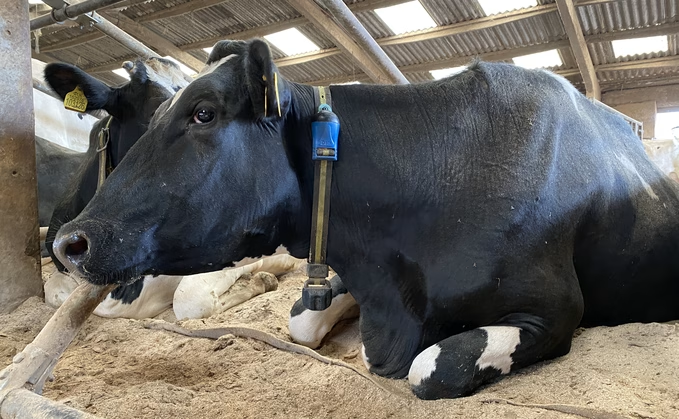
The dairy industry relies on invasive testing while breakthrough technology waits in the wings. Exhalomics-analyzing volatile compounds in cow breath offers a non-invasive window into rumen fermentation and metabolic health that could revolutionize transition cow management, slash disease costs, and optimize feeding programs. Yet most producers remain unaware of this research while continuing invasive testing that stresses animals and delivers inferior data.
Is it 2025, or are we stuck in 1985 regarding monitoring cow health? If you’re still chasing fresh cows through headlocks for blood draws or hiring veterinarians to perform rumenocentesis, you’re missing an opportunity to embrace the future of dairy health monitoring. That future isn’t in blood, milk, or urine-it’s in something your cows are already giving you 24/7: their breath.
The analysis of volatile organic compounds in exhaled air is poised to revolutionize how we detect metabolic disorders, assess rumen function, and manage transition cows. This isn’t some academic pipe dream; it’s a practical technology already showing remarkable results in research settings. While you’re busy restraining cows for invasive sampling, forward-thinking producers are watching technological developments that will soon deliver better data without touching animals.
Let’s be honest: our industry’s attachment to invasive monitoring techniques isn’t just outdated- it’s limiting our ability to implement the precision health management that will define successful dairy operations in the coming decade.
The Current Reality of Your Monitoring Methods
The methods we currently rely on for monitoring cow health have significant drawbacks. Consider your current approach to rumen assessment:
- Rumen cannulation – Installing a permanent “porthole” that requires lifetime maintenance increases infection risk and costs thousands per animal, which is primarily used in research settings.
- Orogastric tubing – Forcing tubes down reluctant cows’ throats, contaminating samples with saliva, and getting results that don’t fully represent true rumen conditions.
- Rumenocentesis – Puncturing the rumen wall with needles, risking peritonitis, adhesions, and hemorrhage for a small amount of fluid to obtain a single pH reading that represents just one moment.
For metabolic disease detection, we’re not much better off. The average fresh cow in a well-managed North American herd gets blood samples drawn multiple times during her transition period. While these tests provide valuable diagnostic information, they’re labor-intensive, stressful for animals, and only capture snapshots of metabolic status rather than continuous monitoring.
Ask yourself: If someone proposed these monitoring methods today as innovations, would you consider them efficient, animal-friendly, or economically sound for whole-herd management? Or would you ask if there’s a better way to gather this critical information?
The Breath Revolution Your Nutritionist Might Not Be Discussing
While conventional testing methods continue to dominate, researchers like Dr. Mutian Niu at ETH Zurich have been developing a monitoring approach that could transform dairy management: exhalomics.
Every time your cow exhales or belches, she’s releasing hundreds of volatile compounds that reveal exactly what’s happening in her rumen and throughout her body. These breath markers include:
- Rumen fermentation products – VFAs like acetate and propionate that reveal fermentation efficiency
- Ketone bodies – Particularly acetone that signals mobilized body fat and potential ketosis
- Microbial metabolites – Compounds that indicate shifts in rumen microbial populations
Dr. Niu’s groundbreaking research has proven that these exhaled compounds strongly correlate with actual rumen measurements. Using sophisticated Secondary Electrospray Ionization-High Resolution Mass Spectrometry (SESI-HRMS), his team found “a strong positive correlation between the levels of ruminal and exhaled acetate for both diets (HS: r = 0.84; LS: r = 0.85), ruminal and exhaled propionate (r = 0.74), and ruminal and exhaled acetate: propionate ratio (r = 0.80).”
In plain English? Your cow’s breath reveals the same information about rumen VFA profiles as direct sampling, without surgical interventions or invasive procedures.
Even more impressive is the potential to predict rumen pH without invasive sampling. “We now actually develop prediction models, and we can predict the rumen pH relatively well,” says Dr. Niu. “We’re now collecting more data to provide better early prediction or a prediction of acidosis or SARA.”
While some nutritionists continue recommending traditional sampling methods because they’re proven and familiar, innovative researchers are already looking toward breath analysis as the next frontier in dairy health monitoring.
Why Isn’t This Technology More Widely Known?
The gap between cutting-edge research and on-farm implementation isn’t unusual in agriculture. Several factors are at play:
Technology Maturation Process
Advanced analytical techniques used in research, like SESI-HRMS, are laboratory-based instruments not designed for farm environments. Converting these sophisticated systems into robust, affordable on-farm sensors represents a significant engineering challenge still being addressed.
Research-to-Practice Timeline
As with other innovations like rumination monitoring collars (which took years to move from research to commercial application), exhalomics requires extensive validation across different farm environments, cow breeds, and production systems.
Industry Education Gap
Many industry professionals aren’t yet familiar with exhalomics research. Dr. Niu explains, “In the whole of Switzerland, we have six rumen cannulated cows, and in my research facility, we have four,” highlighting how different regulatory environments drive innovation in monitoring methods.
When will North American dairy producers gain access to these non-invasive monitoring options? The timeline depends partly on demand-increased awareness and interest from progressive producers could accelerate development.
How This Technology Will Transform Your Transition Program
Imagine what your transition program could look like with exhalomics:
Early Ketosis Detection
Your close-up and fresh cows walk through a breath-sampling portal during morning lockup. The system instantly flags #1847 as developing subclinical ketosis 48-72 hours before conventional testing would detect it.
Recent research shows that breath acetone levels correlate with rising ketone bodies, potentially offering earlier detection than traditional methods. A 2023 study confirmed that “rising ketone bodies can be detected in blood, urine, milk, and breath,” though the study noted that longitudinal sampling improved detection accuracy.
You administer a targeted propylene glycol drench only to cows that need it, saving $3-5 per cow daily in unnecessary treatment costs while preventing clinical cases that would cost you $289 per case in treatment and lost production.
Real-Time Rumen Health Monitoring
The same system monitors VFA profiles and predicts rumen pH, alerting you when your fresh cow TMR is causing suboptimal fermentation patterns days before you’d see milk fat depression or reduced intake.
Why does this matter? According to research by the Ontario Ministry of Agriculture, SARA costs the North American dairy industry between 0 million and billion annually, with costs per affected cow estimated at .12 per day. Early detection through non-invasive monitoring could dramatically reduce these losses.
Adjust your ration’s physically adequate fiber before SARA develops, avoiding substantial economic losses while maintaining peak production.
Think of exhalomics as shifting your transition program from a reactive “treat-the-sick-cow” approach to a predictive “prevent-the-disease” strategy that fundamentally changes how we manage dairy health.
Comparing Monitoring Methods: A Balanced Perspective
While exhalomics offers exciting possibilities, it’s essential to recognize the strengths of different monitoring approaches:
| Method | Strengths | Limitations | Best Use Case |
| Blood Testing | Gold standard for metabolic markers; established thresholds for diagnosis; immediate cow-side results for some tests | Invasive; labor-intensive; snapshot rather than continuous monitoring | Diagnostic confirmation; targeted testing of high-risk animals |
| Rumen Sampling | Direct measurement of actual rumen conditions; definitive for pH and VFA analysis | Highly invasive; impractical for routine monitoring; single timepoint measurement | Research settings: investigating specific digestive disorders |
| Milk Testing | Non-invasive; easily automated in modern systems; provides indicators of both health and nutritional status | Indirect measure of metabolic state; influenced by multiple factors; limited parameters | Routine screening; identifying potential issues for follow-up |
| Breath Analysis (Exhalomics) | Non-invasive; potential for continuous monitoring; captures both rumen and systemic markers | Currently, the research requires technology development for on-farm use, complex data interpretation | Future integration with precision health systems; continuous monitoring |
The future likely involves strategic combination of these methods: exhalomics for constant monitoring to flag potential issues, followed by targeted traditional testing to confirm diagnoses when necessary.
When Will This Technology Reach Your Parlor?
Let’s be realistic about the timeline. Exhalomics technology is still transitioning from research laboratories to commercial applications. Several developments are underway:
Practical Sensor Development
Researchers are working to develop more affordable, robust sensors suitable for farm environments. A 2025 study demonstrated the potential of electronic nose technology, reporting that “experimental results show the high sensitivity of the instrument in differentiating acetone solutions” with “classification using linear discriminant analysis (LDA) and quadratic discriminant analysis (QDA) achieved accuracy rates above 70% and 85%, respectively.”
Integration Opportunities
Dr. Niu envisions “on-site real-time end-to-end tools” becoming available for precision management in the coming years. The most likely early applications will target:
- Parlor integration – Breath sampling during milking for daily health screening
- Robotic milking systems – Sampling during box visits for continuous health monitoring
- Smart feeding systems – Integration with computerized feeders to link intake with metabolic status
What is the realistic timeline? While laboratory research is progressing rapidly, commercial farm-ready systems will likely take 3-5 years to reach early adopters, with broader implementation following as costs decrease and technology becomes more robust.
Practical Farmer Takeaways
What should forward-thinking dairy producers do today?
Stay Informed About Emerging Research
- Follow developments in exhalomics research through industry publications and conferences
- Understand how this technology might complement your existing health monitoring program
Evaluate Your Current Monitoring Approach
- Calculate the full costs of your transition cow program, including labor, treatments, and disease losses
- Identify gaps in your current monitoring system that non-invasive continuous monitoring could address
Consider Early Adoption Opportunities
- Explore possibilities to participate in field trials as commercial systems begin development
- Discuss emerging technologies with your veterinarian and nutritionist
Prepare Your Digital Infrastructure
- Ensure your herd management software can integrate with future sensor technologies
- Develop protocols for how you would use real-time health alerts within your management system
The Bottom Line: Choose Your Future
The dairy industry stands at a monitoring crossroads. One path continues with periodic, labor-intensive procedures that provide valuable but limited data. The other embraces continuous, non-invasive technologies that capture real-time metabolic information without disrupting the cow’s normal behavior.
Which path will you choose?
If you’re serious about transition cow success, rumen health, and operational efficiency, you should be:
- Talking to your advisors about exhalomics and asking how emerging technologies could complement your current practices
- Questioning the necessity and frequency of invasive procedures when non-invasive alternatives are developing
- Exploring opportunities to participate in field trials as this technology moves toward commercialization
- Calculating your current transition disease costs to understand the potential ROI of early adoption
The future of dairy health monitoring isn’t exclusively in blood, rumen fluid, or milk. It’s increasingly including something your cows give you freely, continuously, and without stress or pain.
Dr. Niu explains: “We’re using exhalomics to study the volatile compounds in cattle breath, which provides new insights into ruminant metabolism and health monitoring.”
Are you ready to stop poking and start listening to what your cows are already telling you with every breath? Your answer may determine whether your operation thrives or merely survives in tomorrow’s increasingly competitive dairy landscape.
Learn more:
- Mastering the Transition: A Holistic Approach to Dairy Cow Health and Productivity
Explores strategies for optimizing transition cow management, aligning with exhalomics’ potential to detect metabolic disorders like ketosis early in this critical phase. - Boosting Dairy Cattle Rumen Fermentation: The Role of Altering Rumen Microbiota
Discusses advancements in rumen health monitoring, directly tying into exhalomics’ ability to non-invasively track VFA profiles and fermentation efficiency. - Discover the Future of Dairy Farming: Key Technologies Revolutionizing the Industry
Highlights emerging tools like sensors and automation, contextualizing how breath analysis could integrate with precision dairy farming systems for real-time health insights.
 Join the Revolution!
 Join the Revolution!
Join over 30,000 successful dairy professionals who rely on Bullvine Weekly for their competitive edge. Delivered directly to your inbox each week, our exclusive industry insights help you make smarter decisions while saving precious hours every week. Never miss critical updates on milk production trends, breakthrough technologies, and profit-boosting strategies that top producers are already implementing. Subscribe now to transform your dairy operation’s efficiency and profitability—your future success is just one click away.




