






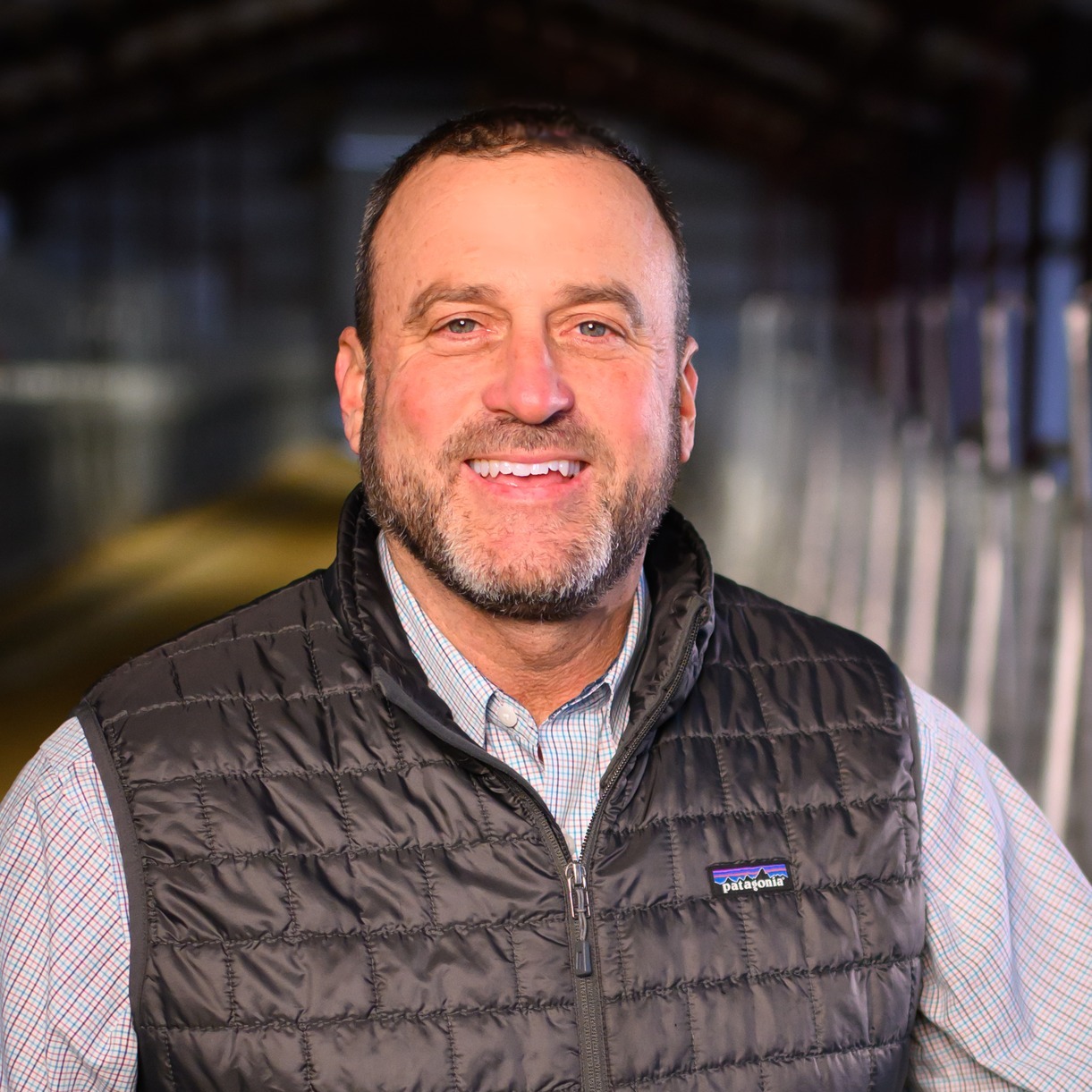
From a Florida parlor to a 65,000-head Kansas ranch, Nic Schoenberger is proof that in dairy, the mission is bigger than the herd.
Executive Summary: Nic Schoenberger didn’t grow up on a family dairy, but a Florida Holstein herd, a Dairy Science degree from the University of Florida, and years working on Wisconsin farms drew him into the heart of the dairy community. His leadership path deepened through the Holstein Foundation’s Young Dairy Leaders Institute, where a mission statement he wrote years ago now mirrors the way he serves farms and neighbors today. With his wife, Christine, and her brother, Mike, he helped Shuler Dairy grow from roughly 230 to 700 cows before the family exited milking in 2021 and continued cropping the land, keeping their connection to local agriculture. Today, Nic and Christine are partners in Kansas Dairy Development near Deerfield, Kansas, a calf ranch and heifer development operation raising about 65,000 head for around 70 client dairies in 14 states, with expansion toward 75,000 head, and they operate a Wisconsin calf depot that serves 23 clients and links family farms to that heifer program. Beyond the barn, Nic’s involvement with Farm Wisconsin Discovery Center and Miracle League of the Lakeshore reflects his commitment to opening doors between agriculture and the wider community and making sure every kid has a place to belong. In recognition of this blend of dairy leadership, community connection, and long-term impact, he has been named the 2026 Young Dairy Leaders Institute Distinguished Alumni Leader, to be honored during YDLI Class 14 Phase I in Dallas.
While many outlets are sharing the award headline, we wanted to look at what Nic Schoenberger’s story says about where dairy leadership, heifer management, and community are headed.
I can’t shake the picture of that folded piece of paper.
It had been riding along with Nic Schoenberger for years—tucked away after a Young Dairy Leaders Institute session, forgotten in the rush of chores, moves, and decisions. It was his personal mission statement, scribbled down when the Holstein Foundation’s YDLI program pushed a room full of dairy people to think past the next milk cheque and write out what they really hoped their lives in this business would be about.
When he finally pulled it back out, before anyone called about a plaque or a banquet, he saw it with fresh eyes. The work he was doing. The people around him. The places he’d said “yes” and the ones he’d had to leave behind. Somehow, it all lined up with what he’d written that day.
Not long after that, Holstein Foundation named him the 2026 Young Dairy Leaders Institute Distinguished Alumni Leader. It didn’t feel like the start of something. It felt like someone quietly saying, “We see what you’ve been building—with a whole lot of other people—all this time.”
This isn’t just Nic’s story. It’s a story about families, employees, vets, feed reps, volunteers, and neighbors whose fingerprints are on barns, depots, classrooms, and ballfields across a long stretch of dairy country.
When a Florida Farm Opened the Gate
The moment dairy really got under Nic’s skin didn’t happen on a farm with his name on the mailbox. It happened at McMullen Dairy Farm in Florida, where he got his first real taste of Holsteins and the rhythm of a working dairy.
You know the kind of place I’m talking about: the parlor humming awake before sunrise, the shuffle of cows finding their spots, the mix of steam and silage in the air. That’s where dairy stopped being an idea and started being a life he could picture for himself.
That pull carried him to the University of Florida to study Dairy Science. He didn’t just park in a classroom and take notes. He spent time around the university dairy, with professors and extension folks who cared about taking research back to real barns, and with classmates and staff who could talk mastitis, margins, and milk checks in the same conversation.
Then he headed north to Wisconsin. Those first years were the kind that don’t usually make headlines. He worked on other people’s farms, side by side with families and crews who were already deep into their own stories—helping manage fresh cows, walking pens, pitching in wherever he was needed.
He watched:
- Owners walking the line between herd health and loan payments.
- Vets and nutritionists who knew the cows and the people because they’d been coming up those lanes for years.
- Milkers, feeders, and herdsmen who could spot a cow off feed from across the pen and keep the whole thing from going sideways.
Those barns became classrooms of their own. They showed him what quiet strength looks like when it’s holding up not just a farm, but a community.
Dairy Leadership, YDLI, and a Wider Circle
Standing in a hotel meeting room with a name tag on your chest, being told to write a personal mission statement, isn’t exactly most farmers’ idea of a good time.
When Nic joined Class 4 of the Young Dairy Leaders Institute, he stepped into that space with a mix of curiosity and “what did I get myself into?” YDLI is a three‑phase dairy leadership and communication program run by Holstein Foundation as part of the Holstein Association USA family. It gathers young adults from across the dairy world—farmers, co‑op staff, breed association reps, industry folks—and asks them to do hard things: face mock media interviews, speak to consumers, and look honestly at their own leadership habits.
At one point, each participant is asked to write down a personal mission statement. Not for the farm. For themselves.
Nic did that. He put on paper what he hoped his life in dairy would be about—how he wanted to serve, lead, and stay connected—then he folded the paper and went back to the barns and meetings and long days like the rest of us.
Years later, before any award emails landed in his inbox, he picked that paper up again. Looking at his journey—from Florida to Wisconsin, from working for others to joining a family dairy, from local barns to multi‑state heifer work—he realized those words had quietly taken shape in real life. In his own words, that mission “has come true,” not in a glossy, straight line, but in a way that felt honest and earned.
The other thing YDLI gave him was people.
Classmates became sounding boards and friends. Alumni spread out across the U.S., Canada, and Puerto Rico stayed in touch. Some ended up running family dairies. Some moved into co‑ops and processors. Some took on roles in breed associations or youth programs linked to Holstein Association USA. They swapped ideas, compared scars, and reminded each other that good leadership in dairy isn’t about making noise—it’s about showing up for your herd and your community, day after day.
So when you hear “Distinguished Alumni Leader,” don’t picture a spotlight and a speech. Picture a long string of conversations, favors, late‑night calls, and decisions where those mission‑statement words kept nudging him toward work that mattered to people beyond his own lane.
A Family Dairy, a Growing Herd, and a Changing Role
If you’ve ever watched a family dairy climb and then have to change direction, you know those stories are complicated and heavy and hopeful all at the same time.
In 2004, Nic and his wife Christine stepped into Shuler Dairy in Wisconsin, the farm where she grew up. Her brother Mike was there too. Together with their families and a group of employees, they helped grow the herd from around 230 cows to roughly 700.
Growth like that doesn’t come from a line in a business plan. It comes from:
- Family members saying, “Yeah, I’ll take that on” when new responsibilities arise.
- Employees learning new routes, new routines, and how to keep more cows healthy without burning themselves out.
- Vets and nutritionists helping reshape transition and repro programs for a bigger herd.
- Neighbors living with more truck traffic, more lights on late, and more movement on the road—and often still waving when they pass.
For years, Shuler Dairy was one of those farms where the glow from the barns, early and late, told the community that cows were being milked and that someone’s whole life was wrapped up in that work.
Then came 2021.
Public reports say the Shuler family exited the dairy business that year and stepped away from milking. Anyone who’s been close to a decision like that knows it’s not something you take lightly. It changes daily schedules, family rhythms, and how the place feels when you pull into the yard.
But the land didn’t go quiet.
The family kept farming the fields around the former dairy. Corn, hay, and other crops still came off those acres. The feed trucks still rolled. The lane that used to bring cows to the parlor stayed part of the local agricultural heartbeat, even if it sounded different now.
People on that road saw a dairy herd disappear. But they also saw that the family and the land stayed part of the bigger farming picture.
Heifer Management on a Big Canvas: Kansas Dairy Development
If the Shuler chapter is about a home herd changing shape, the next part of Nic and Christine’s story zooms way out.
They’re also partners in Kansas Dairy Development—KDD—a calf ranch and heifer development operation near Deerfield, Kansas. It’s the kind of place you hear about at meetings when folks start talking about heifer management and specialization.
On any given day:
- Around 70 dairy customers from 14 different states have calves and heifers there.
- Roughly 65,000 head call KDD home while they grow, with expansion underway toward about 75,000 head on a 1,600‑acre footprint.
- Those animals come from a mix of family and larger herds in states like Kansas, New York, Michigan, Wisconsin, Ohio, South Dakota, Iowa, Florida, Georgia, and Minnesota.
Behind each load of calves rolling into that yard is a team back home:
- Families who’ve decided, after a lot of conversation, that trusting someone else with their replacements is the best way to use their own land and labor.
- Employees who can spend more of their time on milking cows, managing fresh animals, and keeping repro strong.
- Local vets and nutritionists who coordinate with KDD’s professionals so that the heifers come back ready to fit into the herd’s existing programs.
At KDD itself, it takes another community to make it all work. Calf‑barn crews are watching intakes and bedding. Heifer managers are tracking groups and growth. Veterinarians and nutritionists are fine‑tuning health and rations. Maintenance and office staff keep the place running and the records straight.
KDD’s CEO, Jason Shamburg, has put it simply: dairies are outstanding at making milk, and KDD is a “temporary home” for calves and heifers in a region where the dry climate, steady breezes, and soil types fit large‑scale youngstock housing. It’s one way to let milking herds focus on what they do best while a partner specializes in raising replacements.
Those relationships are built on ongoing conversations—sharing health information, growth data, and breeding status so that heifers head home as bred springers, ready to join the milking string. When those trucks roll out of Kansas, they’re carrying more than animals. They’re carrying the combined effort of people in two different communities who’ve decided to tackle this part of the job together.
A Wisconsin Depot, a Familiar Lane, and a New Job
Back in Wisconsin, not far from the old Shuler Dairy lane, another piece of the puzzle fits into place.
Nic and Christine own a calf depot there that picks up calves from 23 clients across the region. It’s the kind of operation that doesn’t make big headlines, but it matters a lot to the families who use it.
On a shipping day, you can picture it:
- Farm staff at each place making sure calves are tagged, fed, and ready when the trailer arrives.
- Drivers who know which lanes turn muddy, which corners need a little extra caution, and which dogs always chase the truck.
- Calves from different herds arriving at the depot, getting grouped and checked for the longer trip.
From that yard, loads head west toward Kansas. The same road that used to see the Shuler herd moving to and from the parlor now sees calves from dozens of family dairies moving toward their time at KDD.
The fields around the site still grow feed. The lane still matters. It’s just serving a different piece of the dairy chain now.
It’s a quiet example of how a farm that no longer milks cows can stay woven into the wider dairy community—acting as a bridge between local barns and a large heifer development center. And it’s not just about Nic and Christine. It’s about the drivers, the farm crews, and the local suppliers whose everyday work keeps that bridge open.
Why Some Farms Don’t Raise Every Heifer at Home
Ask a group of dairy producers over coffee how they handle heifers, and you’ll hear a whole spectrum.
Some will say, “Every heifer stays here. That’s just how we do it.” Others will say, “We finally admitted we couldn’t keep doing it all under one set of roofs, and we’re better for it.”
The reasons aren’t mysterious. They come up again and again:
- Land: Acres are precious. The ground that used to support cows, calves, and heifers now has to stretch farther. Some farms decide their best acres should go into feed and cows, not more buildings.
- Labor: Good people are hard to find and harder to keep. When your crew is already stretched between the parlor, calf pens, and fields, adding bigger heifer groups can push everyone past what’s sustainable.
- Facilities: Older barns weren’t built for today’s replacement numbers or animal‑care standards. Neighbors and zoning boards don’t always welcome new heifer barns, even when they’re well‑planned.
- Weather and disease pressure: In some regions, mud and humidity wear youngstock down. In others, deep cold and wind test calves and heifers, no matter how much you invest in shelter.
For some herds, the best answer is still to raise every heifer at home and do it well. For others, the math and the reality on the ground point toward partnering with a custom heifer grower—letting their home farm focus on milking cows and fresh‑cow health while someone else specializes in replacements.
Those decisions usually involve more than one kitchen‑table talk:
- Families sit down and ask, “What can we honestly carry?”
- Vets and nutritionists lay out what the current heifer program is delivering—and where it’s falling short.
- Lenders and advisors help map out the costs, risks, and potential payoffs of different paths.
- Neighbors and peers share stories about what worked for them and what they’d never do again.
Nic and Christine’s connection with KDD and the Wisconsin depot is one example of how those choices can look when they’re built on clear expectations and shared responsibility. It doesn’t set a “right way” for everyone. It just shows how farms in different regions lean on each other to keep their herds strong.
And even if a farm finds a heifer plan that fits, the bigger questions don’t disappear—questions about markets, succession, mental health, and how to hold onto good people when the work is heavy and the clock never really stops.
Opening Doors: How Farm Wisconsin Changes the Conversation
There’s another side to this story that doesn’t involve TMRs or breeding targets.
Near Manitowoc, Wisconsin, the Farm Wisconsin Discovery Center stands as a front door between dairy and the wider world. It’s an interactive agricultural education center with about 10,000 square feet of hands‑on exhibits, a birthing barn where visitors can see calves entering the world, and tours that take school groups and families out to a working dairy.
From the beginning, farmers, educators, and local supporters worked together to make sure what’s inside those walls looks like today’s agriculture—not a postcard from 50 years ago. Nic is one of the dairy people who’s contributed time and experience there, alongside many others who care deeply about how this story gets told.
You can imagine the scene: a busload of kids climbing off, some from town, some from cities far away. A few have scraped boots. Others are standing next to a calf for the first time. Parents and teachers carry questions—about how cows live, what they eat, and what happens when they’re sick.
Inside the center, exhibits explain soil and feed, and milk processing in ways kids can touch and see. In the birthing barn, people get a chance (if the timing works) to watch a calf be born. On the farm tours, someone from the dairy community walks them through barns and parlors, fielding questions that range from “how much does she eat?” to “do the cows like it here?”
In 2019, TIME for Kids named Farm Wisconsin one of the World’s 50 Coolest Places. That honour didn’t rest on one person; it fell to a whole network of board members, staff, volunteers, and farm families who believed that opening the doors like that would change how their neighbors saw them.
For the dairy community around Manitowoc, it’s one more way to build trust. When folks who’ve toured Farm Wisconsin drive past a freestall or a bunker, they’re more likely to see people and purpose—not just concrete and metal.
A Ballfield Where Everyone Belongs
A different kind of field draws people together a few miles away.
At the Miracle League of the Lakeshore in Manitowoc, kids with disabilities play baseball on an accessible field built so everyone can be part of the game. It’s the kind of place where the sound of cheers matters more than the numbers on the scoreboard.
Nic is one of many volunteers who help support that league, alongside parents, buddies, coaches, and community members from all sorts of backgrounds. On a game night, you’ll see players rolling or running up to the plate with a buddy at their side, families cheering for every swing, and volunteers from farms, local businesses, and the town all working together so each inning goes smoothly.
Those evenings don’t make milk checks bigger or repair labor shortages. But they do something else that matters a lot in a farm community. They remind people that their neighbors’ lives are bigger than their job titles. They remind dairy folks who are used to being “the farm family” in every conversation that they’re also just part of a town that wants every kid to have a chance to belong.
For farmers and farm employees who spend most days counting dollars and liters and hours of sleep, a night at that ballfield can feel like a reset. A reminder that they’re more than their production numbers—and that their community sees them as more than that, too.
What This Story Offers to Other Farms and Communities
Every farm town has its own history. Every family has its own pile of joys and scars. Not many will trace the exact path from a Florida dairy to a Wisconsin family farm to a Kansas heifer development center and back to a Miracle League field.
But there are threads here that can run through just about any community.
1. Take a little time to write down where you hope you’re headed.
You don’t need a conference badge to do what YDLI pushed Nic to do. One quiet night, after chores and supper, sit down at the table and write a few lines about what you hope your work, your family, and your place in the community will look like 10 or 20 years from now. It doesn’t have to be fancy. It just has to be honest. Years from now, you might look back and see how much those words shaped the choices you made.
2. Let someone you trust look over your heifer plan.
Whether every heifer stays on your farm or you’re already sending some out, it’s worth asking, “Is this still the best fit for us?” Bring your vet, your nutritionist, your lender, or a neighbor you respect into that conversation. Talk through land, labor, health, and cost. You might walk away feeling more confident about what you’re doing—or you might spot a change that gives your people and your cows a little more breathing room.
3. Pick one place beyond your own lane to plug in.
For Nic, that’s Farm Wisconsin and Miracle League. For you, it might be:
- Helping a 4‑H dairy club at the fair.
- Serving on a co‑op or processor committee.
- Saying “yes” when the school calls and asks if you’ll talk about cows to a classroom.
- Volunteering at a local fundraiser, church supper, or community event.
It doesn’t have to be huge. Showing up regularly, even in small ways, changes how your community sees agriculture—and how you feel seen by them.
4. Talk with your own crew about “why,” not just “what.”
In between talk about SCC, milk price, and planting dates, try asking, “What do you think we’re really trying to build here—for us and for this community?” The answers might be rough. They might surprise you. But hearing each other’s “why” can strengthen your team in ways no new piece of equipment ever will.
5. Notice who’s already building bridges—and see how you can help.
Every area has its “bridge builders”—people who connect farms, organize tours, support kids, or quietly keep an eye on neighbors who are struggling. It might be someone running a local farm safety day, a mental health night, a youth show, or a food drive. Ask yourself: who’s doing that kind of work where you live? And what simple thing could you do to make their load a little lighter?
Community & Legacy: What This Means for All of Us
When you step back and look at Nic and Christine’s story—the Florida dairy that gave him his first shot, the family operation in Wisconsin that grew and then changed, the heifer work at KDD and the Wisconsin depot, the Discovery Center doors, the Miracle League field—you don’t just see a list of jobs.
You see how one life in dairy can thread through many communities. And how many communities, in turn, can shape one life.
There are the barns that took a chance on a young guy from Florida. The employees, family, vets, and advisors who helped grow a herd and then walked through the hard choice to let the cows go. The client herds and crews that trust a calf ranch in Kansas with their youngstock. The volunteers and staff who open farm doors at Farm Wisconsin and open the gate at Miracle League so every kid can step onto the field.
Most dairy folks will recognize pieces of themselves in there somewhere:
- In the long push to grow, and the tough conversations when growth can’t go on forever.
- In the land that keeps producing long after a parlor goes quiet.
- In weighing what work belongs on your own place and what might be better done with a partner’s help.
- In the evenings spent in community halls, arenas, school gyms, and fairgrounds that never show up on a milk cheque but matter deeply to the life of your town.
Not every farm will work with a big heifer ranch, build a discovery center, or volunteer at a Miracle League field. But every farm has chances—big and small—to invest in people, accept help when it’s needed, and be part of keeping their roads, churches, arenas, and kitchens full of life.
In the end, that’s the heart of this Distinguished Alumni Leader’s story. Dairy isn’t just about animals and acres. It’s about how we keep showing up for each other—through changes, hard calls, and everyday work—to keep both our herds and our communities going, one truckload, one meeting, and one small act of help at a time.
Key Takeaways
- 2026 YDLI Distinguished Alumni Leader: Nic Schoenberger, who didn’t grow up on a family dairy, has been named Holstein Foundation’s top YDLI alumni honoree for his leadership across farms, heifer management, and community service.
- 65,000 head and growing: As partners in Kansas Dairy Development near Deerfield, Kansas, Nic and Christine help raise about 65,000 head for roughly 70 client dairies in 14 states, with plans to expand to 75,000 head.
- A bridge for family farms: Their Wisconsin calf depot serves 23 clients, connecting local dairies to KDD’s heifer program and showing how regional partnerships let farms focus on what they do best.
- Community beyond the barn: Nic’s involvement with Farm Wisconsin Discovery Center and Miracle League of the Lakeshore reflects a commitment to opening doors between agriculture and the wider public—and making sure every kid has a place to belong.
- The real takeaway: Dairy leadership grows through trust, relationships, and steady service—not overnight success, but years of showing up for your herd, your partners, and your community.
Editor’s note: This story draws on public coverage of Nic Schoenberger’s work with Shuler Dairy, Kansas Dairy Development, Farm Wisconsin Discovery Center, and Miracle League of the Lakeshore. We’ve connected those dots to explore what his journey means for dairy families and communities everywhere.
Continue the Story
- The Two-Track Future: Why Mid-Size Dairies Face an 18-Month Decision That Will Define Everything – Nic and Christine wrestled with the exact question posed here: stay the course or specialize. This article explores the high-stakes decisions mid-sized families are making as they transition from traditional milking to new, essential roles in the dairy supply chain.
- When Your Calves Outearn Your Cows: The 357,000-Heifer Shortage and the $200K Math Reshaping Dairy Survival – To understand why KDD is scaling toward 75,000 head, you have to understand the forces reshaping our markets. This piece breaks down the heifer shortage and the economic math that makes Nic’s specialized focus so critical for the industry’s survival.
- The Bullvine Dairy Curve: 15,000 U.S. Farms by 2035 and Under 10,000 by 2050 – Who’s Still Milking? – As we look toward the next chapter for our communities, this forecast proves the point that survival requires a new way of thinking. It explores how specialization and community-driven leadership will define the few farms that remain woven into our industry’s future.
 Join the Revolution!
 Join the Revolution!
Join over 30,000 successful dairy professionals who rely on Bullvine Weekly for their competitive edge. Delivered directly to your inbox each week, our exclusive industry insights help you make smarter decisions while saving precious hours every week. Never miss critical updates on milk production trends, breakthrough technologies, and profit-boosting strategies that top producers are already implementing. Subscribe now to transform your dairy operation’s efficiency and profitability—your future success is just one click away.




