Archive for next-generation farmers

The Quiet Revolution: Two Young Dairy People Who Refused to Choose Between Love and Survival

Rachel Craun and Jon Chapman didn’t inherit easy paths. They’re carving new ones—and in doing so, they’re teaching us what loyalty to an industry really looks like.
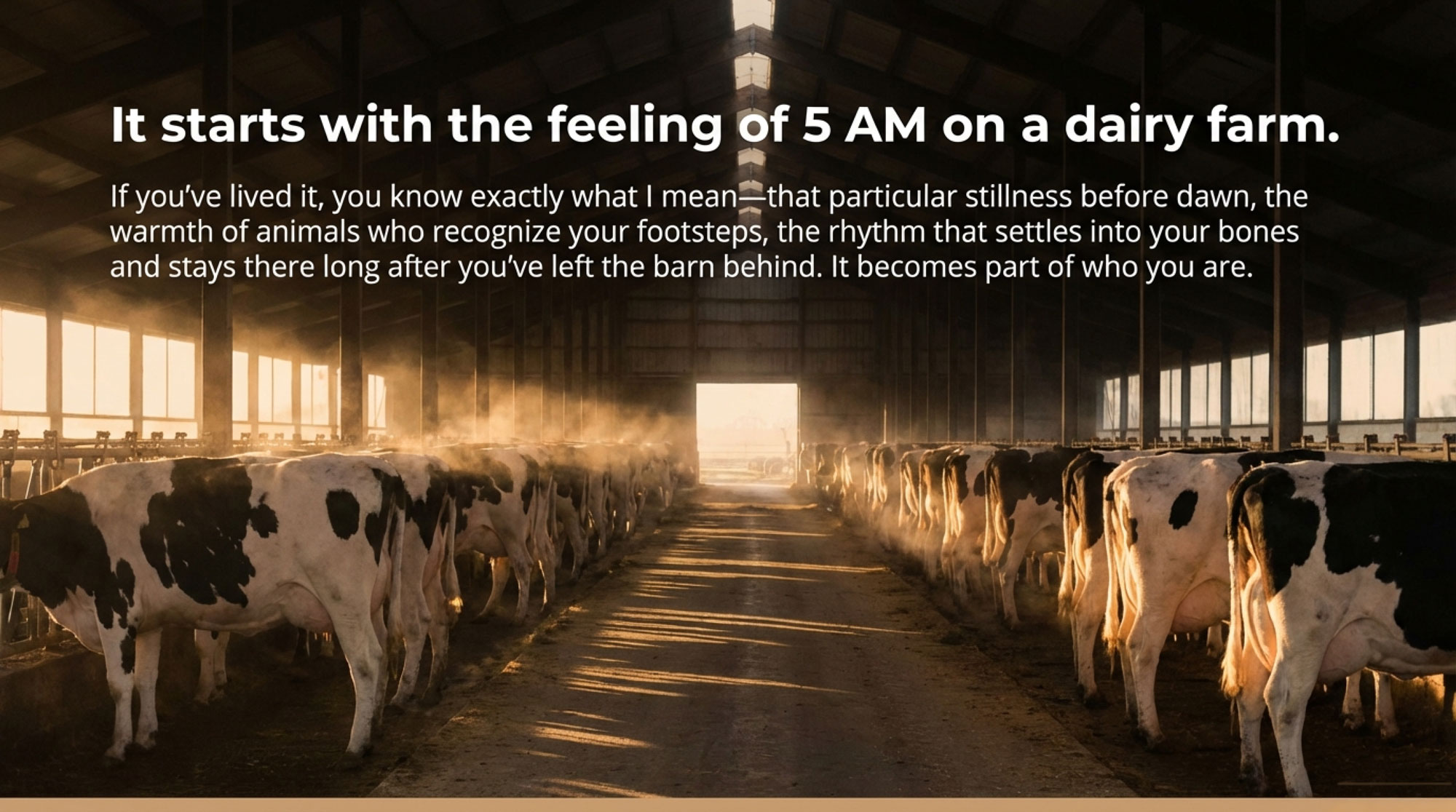
There’s something about 5 AM on a dairy farm that never leaves you.

If you’ve lived it, you know exactly what I mean—that particular stillness before dawn, the warmth of animals who recognize your footsteps, the rhythm that settles into your bones and stays there long after you’ve left the barn behind. It becomes part of who you are in ways you can’t quite explain to anyone who hasn’t experienced it.

Rachel Craun knows that rhythm intimately. She’s been living it since childhood on her family’s dairy operation in Mount Crawford, Virginia. Now she’s at Purdue University, active in the Dairy Club and finding real success on the Collegiate Dairy Judging team.

The Virginia mornings are behind her, at least geographically.

But over a dozen years of dairy farming rhythms? Those don’t care about geography. They travel with you wherever you go.
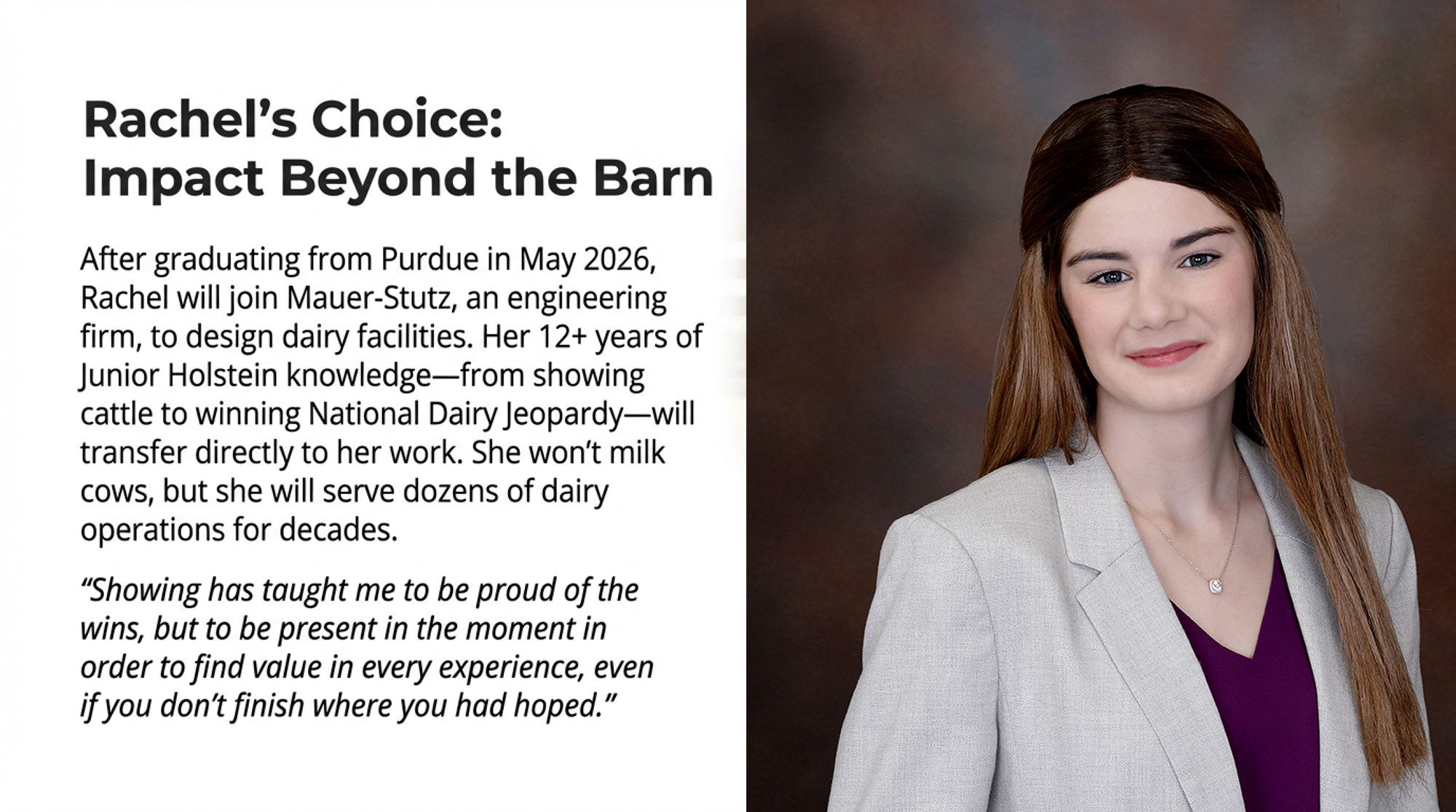
Rachel Craun, Mount Crawford, Virginia — First place National Dairy Jeopardy, first place National Virtual Interview, Distinguished Junior Member finalist, and future dairy facility engineer at Mauer-Stutz. Twelve years of Junior Holstein commitment led her here. Photo: Holstein Association USA

“Showing has taught me to be proud of the wins,” Rachel says, “but to be present in the moment in order to find value in every experience, even if you don’t finish where you had hoped.”

I’ve read that quote several times now, and what moves me most isn’t the words themselves—it’s how much living must be packed into them. Over a dozen years of Junior Holstein involvement. More than a decade of early mornings, weekend shows, long drives home after placings that didn’t go the way she’d hoped. The kind of quiet, persistent commitment that shapes who you become when nobody’s watching.
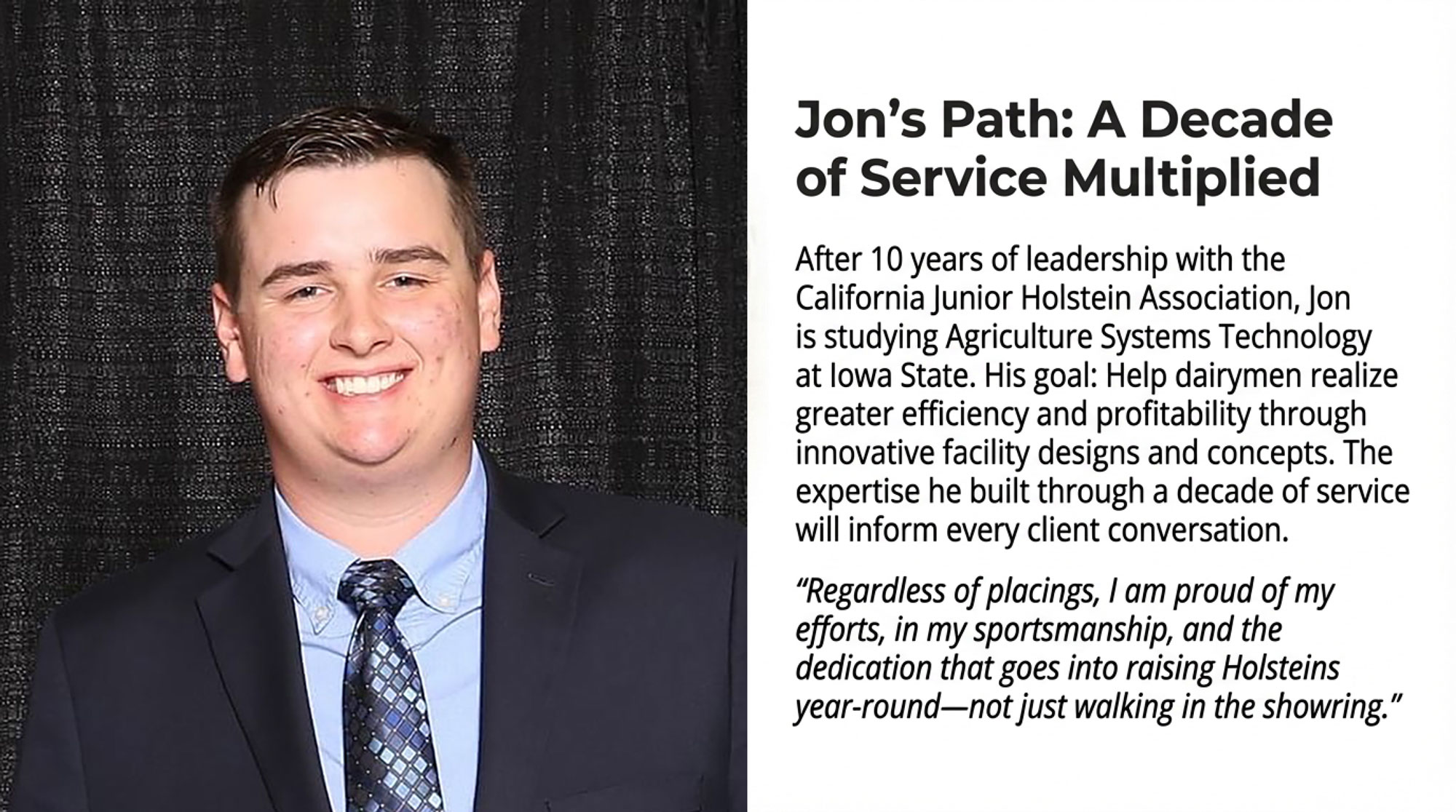
Jon Chapman, Keyes, California — Ten years as a California Junior Holstein officer, current Junior Advisory Committee Chairman, and two-time International Junior Holstein Show competitor. He’s studying Agriculture Systems Technology at Iowa State to serve the dairies he grew up loving. Photo: Holstein Association USA

Three thousand miles away in Keyes, California, Jon Chapman carries a similar weight in his heart. His family operates a Holstein dairy in the Central Valley, and Jon has been part of it since he could walk.

Ten years. Let that sink in for a moment. Ten years serving on the officer team for the California Junior Holstein Association. He’s currently serving as chairman of the Junior Advisory Committee, representing dairy youth across the entire West Coast. He’s competed at the International Junior Holstein Show at World Dairy Expo twice—because once, apparently, wasn’t enough to satisfy his love for this industry.

“Regardless of placings,” Jon says, “I am proud of my efforts, in my sportsmanship, and the dedication that goes into raising Holsteins year-round—not just walking in the showring.”

There it is again. That word: dedication. Not to winning. Not to trophies. To showing up.

This past year, Rachel and Jon received the Judi Collinsworth Memorial Scholarship—Rachel receiving the top $1,000 scholarship, Jon receiving the $500 scholarship. The amounts seem modest against the backdrop of modern education costs.

But what moved me most about researching their stories wasn’t the scholarship itself.

It was understanding what these two remarkable young people represent—and the uncomfortable questions their choices force us to ask about what it actually means to invest in dairy’s future.

The Woman Who Saw What Others Missed

Judi Collinsworth dedicated her career to Holstein Association USA in Brattleboro, Vermont. As Executive Director of Member and Industry Relations, she was responsible for telemarketing, member programs, and—this is the part that matters most—spending a great deal of her time improving and expanding the programs available to Holstein youth.

She passed away in late 2023.

What she left behind can’t be measured in program budgets or press releases. It’s something far more precious than that.

She built something harder to name. Call it permission. Call it space. Call it the radical, beautiful idea that you could love dairy with your whole heart and still have a life beyond the barn.

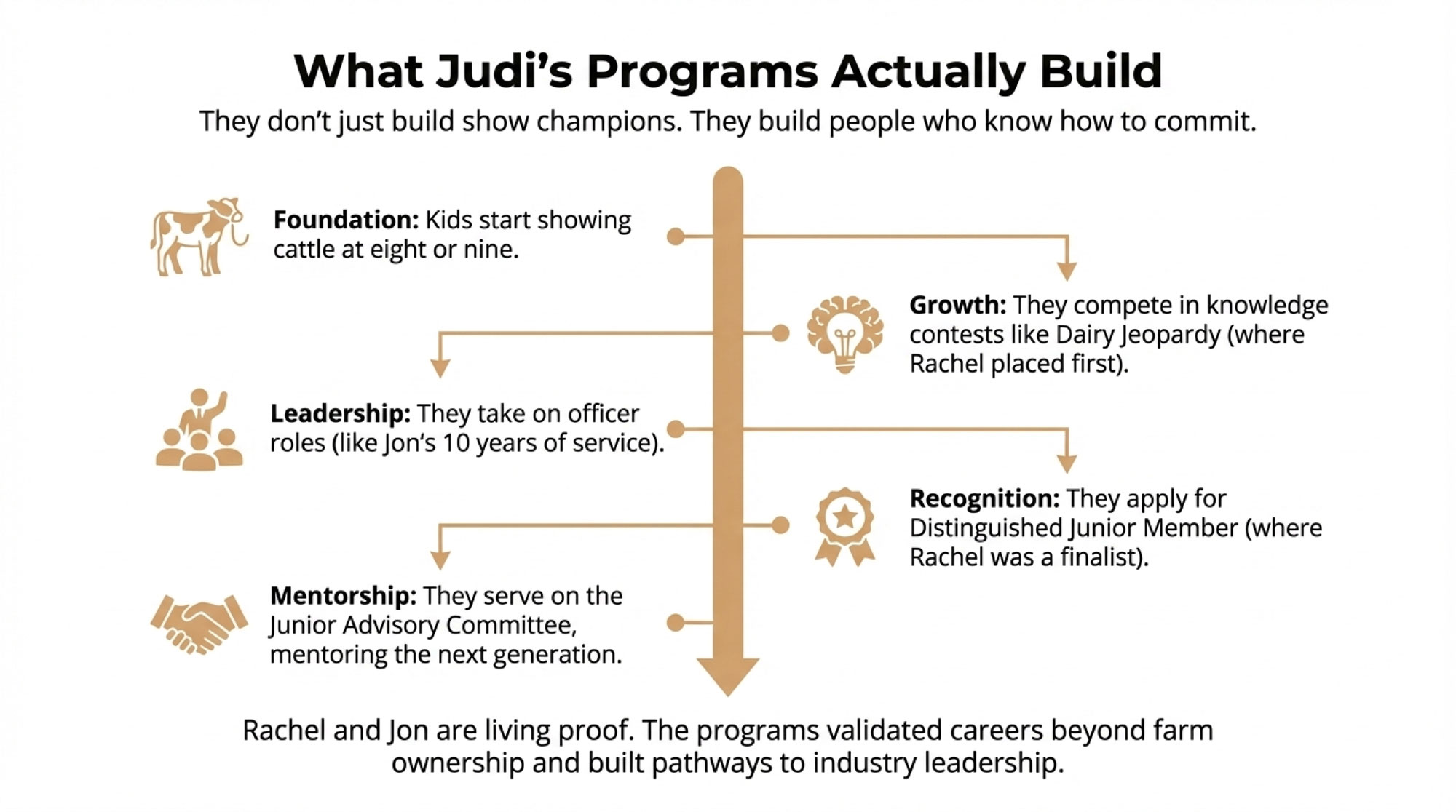
Think about what that means for a young person growing up on a farm. The programs Judi championed fostered an identity formation that unfolds over the years, layer by layer. Kids start showing cattle at eight or nine—nervous, uncertain, not yet knowing what they’re becoming part of. By their early teens, they’re taking on officer roles, competing in knowledge contests, and learning to win and lose with grace. By high school, they’re applying for Distinguished Junior Member, standing before judges who’ve read their entire dairy journey in a book they wrote themselves.

By their early twenties? They’re serving on the Junior Advisory Committee, mentoring the nervous kids who remind them of themselves at eight.

Rachel Craun walked every step of that path. And here’s where her story takes my breath away.

She placed first in the National Dairy Jeopardy contest. First. In a competition that requires you to care enough about this industry to fill your head with knowledge most people will never need. She placed first in the National Virtual Interview, too.

Then came Distinguished Junior Member. Rachel was named a finalist—one of only six young people in the entire country selected for that honor. Six. Out of everyone who applied, everyone who dreamed, everyone who worked for years toward that recognition.

She served in officer roles on the Virginia Holstein Association. She competed at the International Junior Holstein Show at World Dairy Expo in 2025—a goal she’d set for herself years ago and then actually achieved.

Jon Chapman walked the same path, just from the other side of the country. A full decade of officer service. Two-time International Junior Holstein Show competitor. Currently, the chairman of the Junior Advisory Committee.

These aren’t résumé lines. They’re evidence of something rare and beautiful: young people who kept showing up when nobody was watching. When it would have been easier to quit. When the world offered a thousand other things to care about.

Judi Collinsworth would have recognized them immediately.

Not because they won everything.

Because they never stopped coming back.
The Math Nobody Wants to Talk About

I need to be honest about something, because this is where the story gets complicated—and painful. It’s the part that keeps me up at night when I think about the future of this industry.

Rachel knows her family’s farm the way you only know a place you’ve grown up in. The sounds. The rhythms. The particular way a barn feels in early morning when the animals are stirring and the day hasn’t quite started yet. That bone-deep connection that becomes part of your soul.

But knowing a place and being able to buy it are entirely different things.
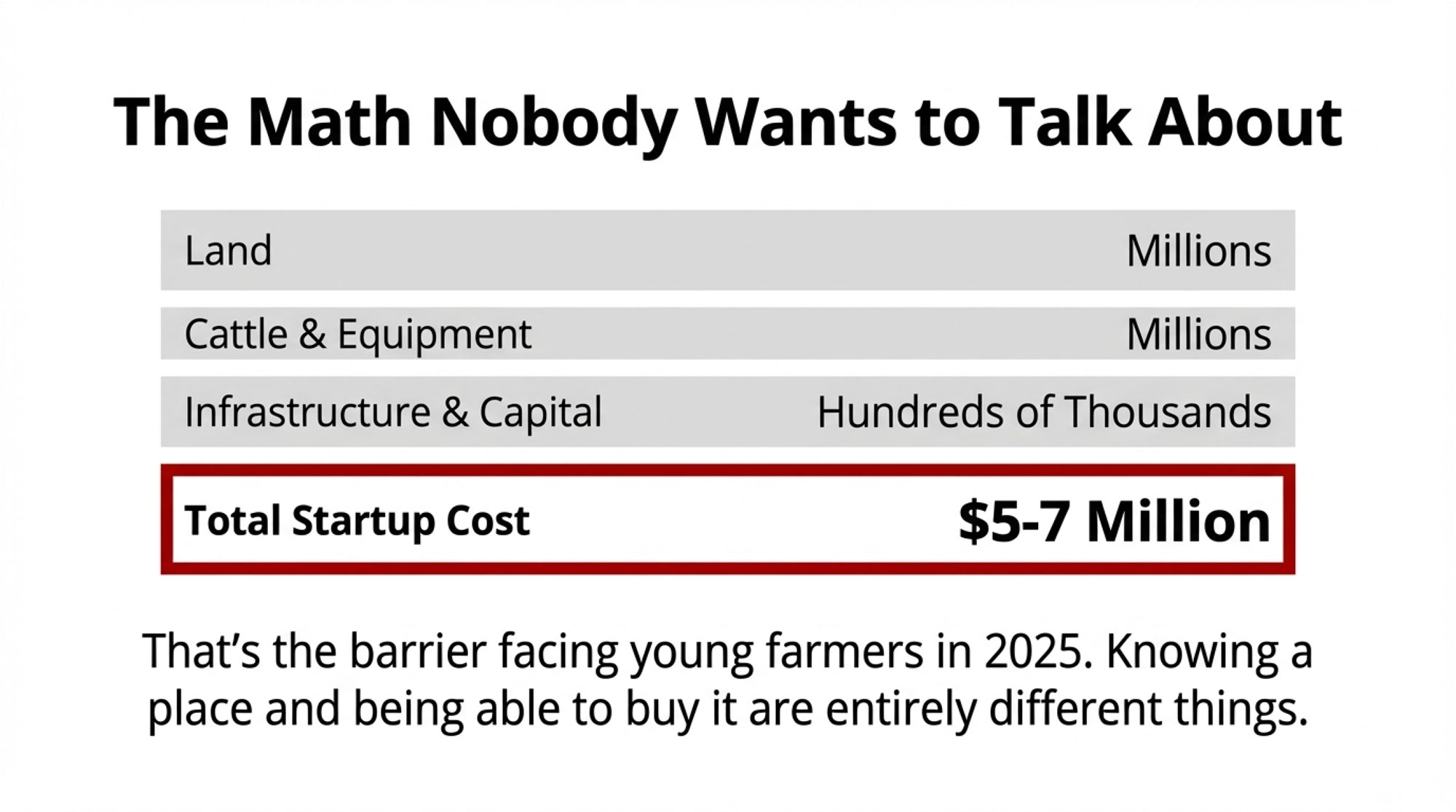
Let’s look at what it actually takes to acquire a dairy operation in 2025. Land alone, at current prices in productive dairy regions: millions of dollars. Add cattle, and you’re deeper in. Machinery. Buildings. Infrastructure. Operating capital for the first year, when everything feels uncertain.

By the time you’ve accounted for everything required actually run a dairy, you’re looking at capital requirements that can easily exceed $5-7 million for a viable operation. We’ve been tracking these numbers throughout 2025—in pieces like “What Lactalis’s 270-Farm Cut Really Means for Every Producer” and “The Four Numbers Every Dairy Producer Needs to Calculate This Week“—and they keep moving in the same direction.

After graduating in May 2026, Rachel plans to work full time for the agricultural division of Mauer-Stutz, an engineering firm based in Peoria, Illinois.

I don’t have to tell you what that math means.

You already know.

Jon faces the same impossible arithmetic in California, where land prices run even higher. His family’s operation represents capital accumulation across generations—the kind of investment that no 22-year-old can replicate, no matter how deep their commitment. No matter how many trophies they’ve earned. No matter how much they love this with everything they have.

So Jon is studying Agriculture Systems Technology at Iowa State University. He hopes to help dairymen realize greater efficiency and profitability through innovative facility designs and concepts.

Both of them love Holsteins.

Both of them are staying in the dairy industry.

Neither of them is becoming a dairy farmer.

Sit with that for a moment. Because I think it tells us something important—and heartbreaking—about where we are.

What a Decade of Saturdays Actually Looks Like

I want to stay with Jon’s story for a moment, because I think it illuminates something important about the quiet heroism of showing up.

Ten years serving on the officer team.

What does that actually mean? It means Saturday mornings when he could have slept in like his friends. Meetings in towns he’d never otherwise visit. Phone calls to coordinate volunteer coverage for the next show. Budget reviews that nobody will ever thank you for. The thousand small decisions that keep youth organizations functioning—decisions that matter enormously and earn almost no recognition.

California’s Central Valley isn’t far from the coast. While Jon was organizing junior Holstein events, plenty of his peers were spending summer weekends at the beach. Nobody would have blamed him for making a different choice.

But something kept him coming back. Year after year. Meeting after meeting. Something in his heart that wouldn’t let go.

“Regardless of placings, I am proud of my efforts, in my sportsmanship, and the dedication that goes into raising Holsteins year-round—not just walking in the showring.” — Jon Chapman, JAC Chairman

The return on a decade of service isn’t trophies. It’s something harder to measure, but infinitely more valuable.

It’s the nervous first-time exhibitor who discovers she can actually speak in front of a crowd. It’s the kid who almost quit but didn’t, because someone made him feel like he belonged. It’s the programs and pathways that help the next generation find their place—pathways Jon helped build with ten years of Saturdays.

Two Paths to Staying in Dairy

 Traditional PathNew Professional Path
Entry PointInherit family operationYouth programs, education, and industry service
Capital Required$5-7 million+Education investment
Daily WorkMilking, feeding, and managing the herdDesigning facilities, consulting, systems optimization
Industry ImpactOne operationDozens of operations over a career
ExamplePrevious generationsRachel Craun (Mauer-Stutz engineering) and Jon Chapman (Agriculture Systems Technology)

That’s what service multiplies.

That’s what showing up creates.

We wrote about this same truth earlier this year in “This Was Never About the Cattle: What the TD 4-H Classic Really Teaches at 5:47 AM.” The pattern holds: what youth programs actually build isn’t show champions. It’s people who know how to commit.

What a Generation Had (And What Changed)

To understand what’s different now, you need to understand what dairy farming used to offer—and what’s been lost.

There was a time—within living memory, within your grandparents’ memory—when inheriting a farm meant inheriting a community. When the neighbor who helped you fix the fence in April was the same neighbor whose hay you helped bring in come August. When everyone in a ten-mile radius knew whose cows were whose, and that knowledge itself was a kind of wealth you couldn’t put a price on.

That world made different choices possible.

A young farmer starting out didn’t need to finance everything alone, because they weren’t alone. They stepped into a web of relationships that had been forming since before they were born. When disaster struck—a barn fire, a failed crop, a death in the family—the community showed up. Not out of charity, but out of reciprocity. You helped because someday you’d need help too.

That mutual obligation functioned as a kind of informal insurance. It reduced capital needs. It created resilience that individual families couldn’t achieve alone.

That world is largely gone now.

Thousands of dairy farms have closed in recent years. The remaining operations grow larger, more capital-intensive, and more dependent on professional management and specialized expertise. The web of relationships that held earlier generations has thinned and frayed.

I understand why Rachel and Jon made different choices.

The infrastructure that held their grandparents’ generation simply isn’t there to hold them.

What Judi Actually Built

So what did Judi Collinsworth create, knowing the world was changing faster than anyone wanted to admit?

She made space.

Space for young people like Rachel and Jon to love dairy and still have lives. To serve the industry without being crushed by the economics that make farm ownership impossible for most. To be dairy people in whatever form that identity could survive.

The programs Judi championed didn’t promise anyone a farm. They promised something more durable: a sense of belonging that could survive career pivots, geographic moves, and economic impossibility. A home in this industry that wasn’t dependent on owning land.

Rachel can work in Peoria, designing facilities for dairy operations, and still be a dairy person. Her knowledge doesn’t disappear because she’s not milking cows. It transfers—to facility designs that actually work for farm families, because she understands how farm families actually live.

Jon can consult for California dairies and still bring 10 years of officer service to every client conversation. He knows what matters to producers because he grew up as one.

The scholarship named in Judi’s honor does exactly what she designed her programs to do. It recognizes sustained commitment. It validates alternative pathways. It signals that the industry values expertise even when that expertise doesn’t come with a barn attached.

The Investment Nobody Calculates
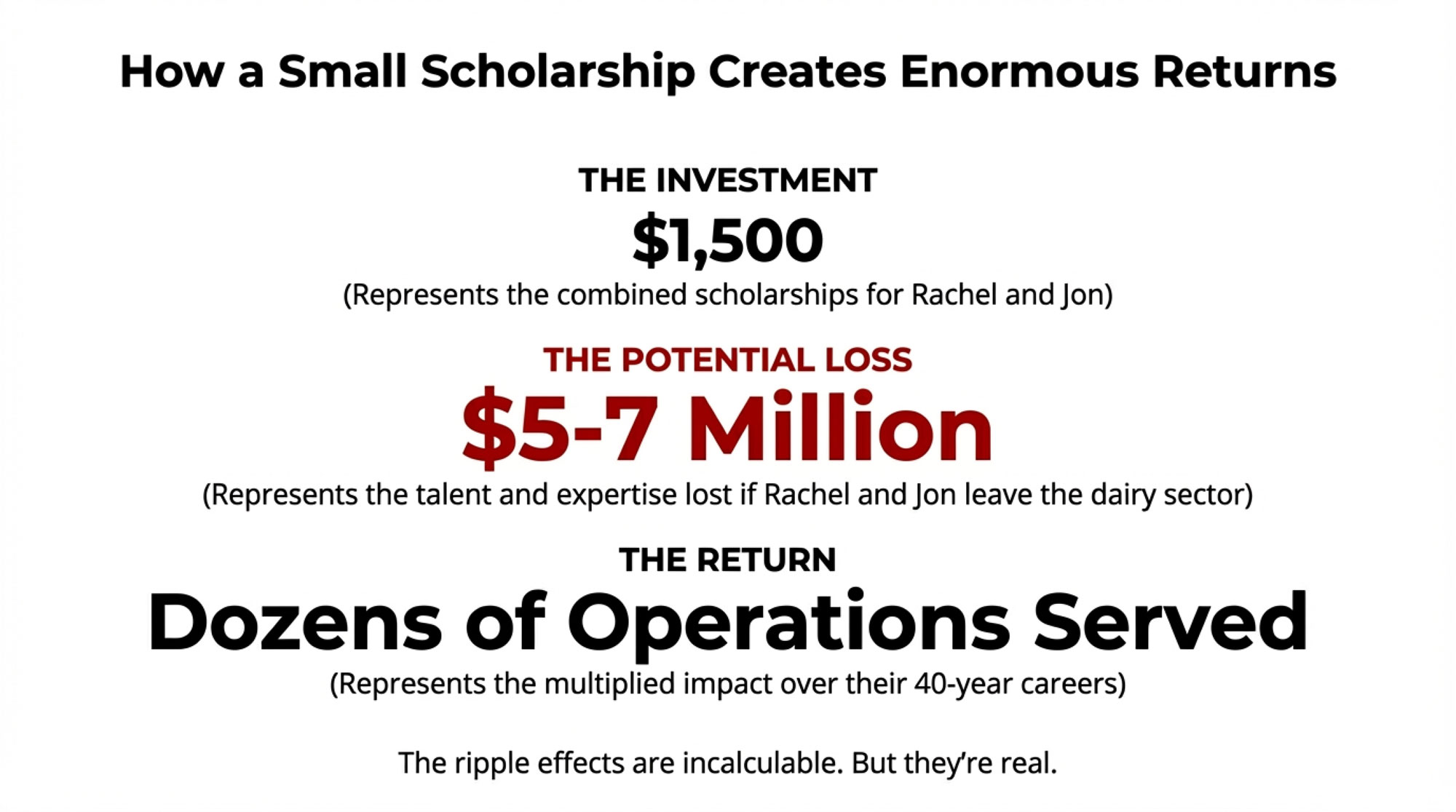
What does $1,500 in scholarships actually buy?

Not farm owners. Not solutions to the capital barrier. Not a reversal of the consolidation reshaping the industry.

But consider what that modest investment actually creates.

Rachel, without validation from her industry, might have taken her engineering skills somewhere else entirely. Designing facilities for companies that process soybeans, corn, anything but dairy. Her deep knowledge—earned through twelve years of showing cattle, competing, serving—flowing to sectors that had nothing to do with the cows she grew up loving.

Jon, without recognition for his decade of service, might have applied his systems expertise to Silicon Valley startups. Agricultural technology serving every sector, dairy is just one line item among many.

Instead, they’re staying.

Not as farmers. But as professionals who will serve dozens of operations over their careers. Engineers and consultants who bring genuine dairy knowledge to their work because they lived it before they studied it.

Rachel will spend her career designing agricultural facilities. Each one will work better because she knows what the rhythm of a dairy operation feels like from the inside.

Jon will help California dairies implement technologies that actually fit their operations—because he understands producer decision-making from a decade of serving producers.

The ripple effects are incalculable.

But they’re real.

What Stays With You

Ask what over a dozen years of showing cattle, competing in knowledge contests, and serving in leadership roles actually taught Rachel and Jon, and certain truths emerge:

Sustained commitment matters more than occasional brilliance. Anyone can show up once. Showing up for a decade—through middle school awkwardness, high school social pressure, college course loads—proves something about who you are.

Resilience isn’t about winning. It’s about finding value in every experience, especially the losses. The placings you hoped for and didn’t get. The classes where nothing went right. The years that tested whether you really loved this.

Service creates ripples you’ll never fully see. Ten years of officer meetings. Programming that helped young people discover confidence they didn’t know they had. That’s how commitment multiplies—in ways the person serving may never know about.

The Bottom Line

The dairy industry stands at a crossroads it didn’t choose and can’t avoid.

Farm ownership has become economically impossible for most young people, no matter how deep their commitment. The capital requirements have outpaced anything individual families can accumulate. The support structures that once made small operations viable have changed fundamentally.

We can rage against this reality.

Or we can adapt to it.

Rachel Craun and Jon Chapman represent adaptation. Not abandonment—never abandonment—but evolution. A new way of serving an industry they love, sustainable across a 40-year career, creating value for dozens of operations instead of struggling to save one.

The Judi Collinsworth Memorial Scholarship recognizes that evolution. It says to every Junior Holstein member watching: You can love this industry and still have a life. You can honor your heritage without destroying yourself. There are multiple pathways to being a dairy person.

An earlier generation had one path: inherit the farm, work the land, pass it to your children. That path created something beautiful, and its transformation deserves to be mourned.

But Rachel and Jon are creating something new. Professionals rooted in dairy knowledge, serving an industry in transition, carrying forward the values that matter even as the structures change.

Somewhere, Rachel is preparing for graduation—ready to join Mauer-Stutz and build the kind of expertise that will help dairy facilities work better for the families who use them.

And somewhere, Jon is thinking about the next generation of junior members. The nervous kids who’ll discover, as he did, that service matters more than trophies.

They’re not abandoning dairy.

They’re ensuring it has a future.

And watching them build it—two young people who found a way to love this industry without being destroyed by it—I think Judi Collinsworth would recognize exactly what she helped create.

Not the future anyone imagined.

But maybe the only one that was ever possible.

If you know a young person wrestling with how to stay in dairy when farming isn’t possible, share this with them. Sometimes knowing you’re not alone changes everything.

The National Holstein Foundation administers the Judi Collinsworth Memorial Scholarship. Learn about youth scholarship opportunities and how to support the next generation of dairy professionals at holsteinusa.com/future_dairy_leaders.

KEY TAKEAWAYS

  • $5-7 million says it all: That’s what a viable dairy startup costs now. Loving this industry and owning a farm are no longer the same thing—and pretending otherwise fails the next generation.
  • One farm or dozens of clients? Rachel Craun will design dairy facilities. Jon Chapman will optimize dairy systems. Over 40-year careers, they’ll serve more operations than any single farm ever could.
  • Youth programs build professionals, not just champions: Rachel’s 12+ years of Junior Holstein involvement and Jon’s decade as a California officer created expertise that transfers directly to careers serving this industry.
  • What Judi Collinsworth actually built: Programs that let young people love dairy without being crushed by its economics. Rachel and Jon are living proof.
  • If your kid loves dairy but can’t afford to farm: They haven’t failed. There’s a path forward. Share this with them.

EXECUTIVE SUMMARY: 

What happens when young people who’ve dedicated their lives to dairy can’t afford to farm? Rachel Craun and Jon Chapman just answered that question. Craun won National Dairy Jeopardy, won National Virtual Interview, became one of only six Distinguished Junior Member finalists nationally, and after graduating from Purdue in May 2026, she’ll design dairy facilities at Mauer-Stutz engineering, not milk cows. Chapman served 10 years on the California Junior Holstein officer team, now chairs the national Junior Advisory Committee, and is studying at Iowa State to help dairies he’ll never own run better. Both just received the Judi Collinsworth Memorial Scholarship, honoring the Holstein Association USA executive who built programs that let young people love dairy without being crushed by its economics. With farm startups demanding $5-7 million in capital, they represent a new path: professionals who’ll serve dozens of operations over a lifetime, rather than struggling to save one. They’re not leaving dairy—they’re the reason it will survive.

Learn More

Join the Revolution!

Join over 30,000 successful dairy professionals who rely on Bullvine Weekly for their competitive edge. Delivered directly to your inbox each week, our exclusive industry insights help you make smarter decisions while saving precious hours every week. Never miss critical updates on milk production trends, breakthrough technologies, and profit-boosting strategies that top producers are already implementing. Subscribe now to transform your dairy operation’s efficiency and profitability—your future success is just one click away.

NewsSubscribe
First
Last
Consent

When 5:30 AM Chores Matter More Than the NHL Draft: The Martin Family’s Extraordinary Lesson in Raising Kids Who Choose to Stay

Nashville took him 5th overall. He was in the barn. ‘The cows don’t care if you’re drafted,’ he said. What his family did differently should make every farm parent think twice.

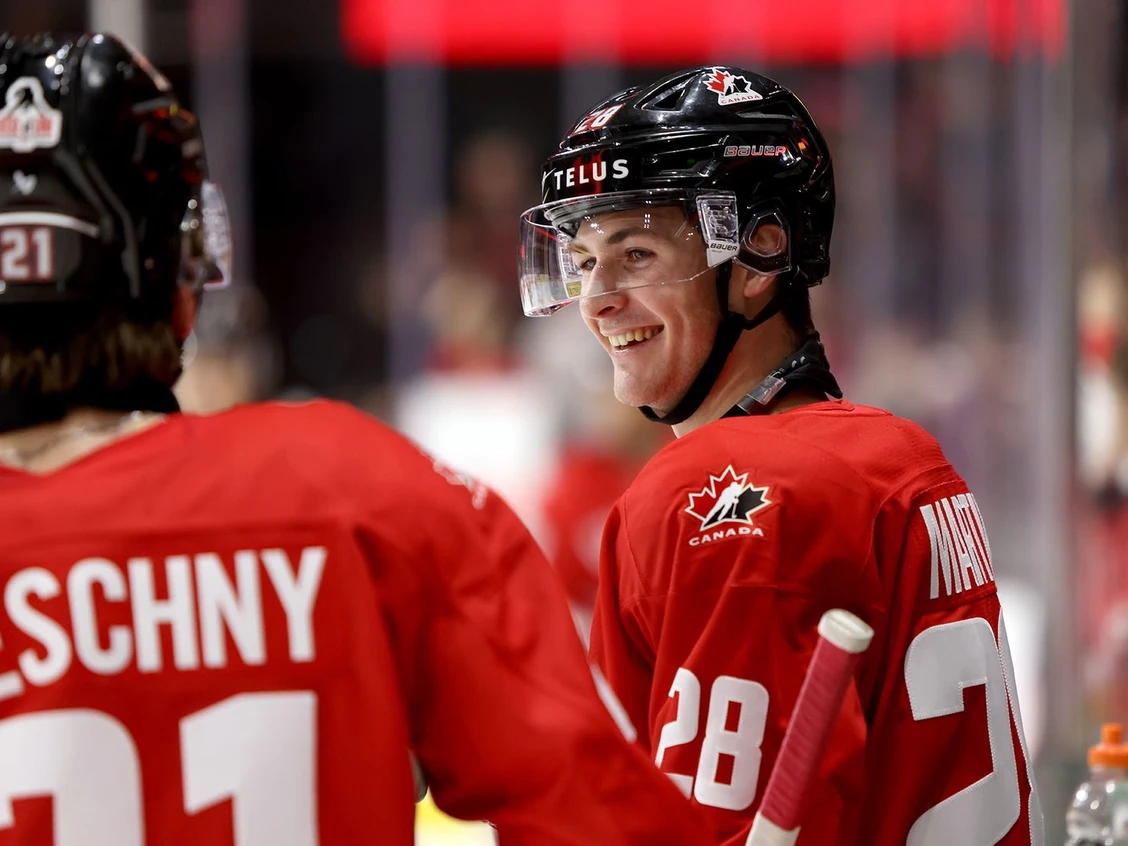
No 5:30 AM chores this morning—the cows are 1,500 kilometers away in Elmira. But the farm strength that built this smile? That traveled just fine. Brady Martin celebrates after scoring for Team Canada at the World Junior Championship in Minnesota.

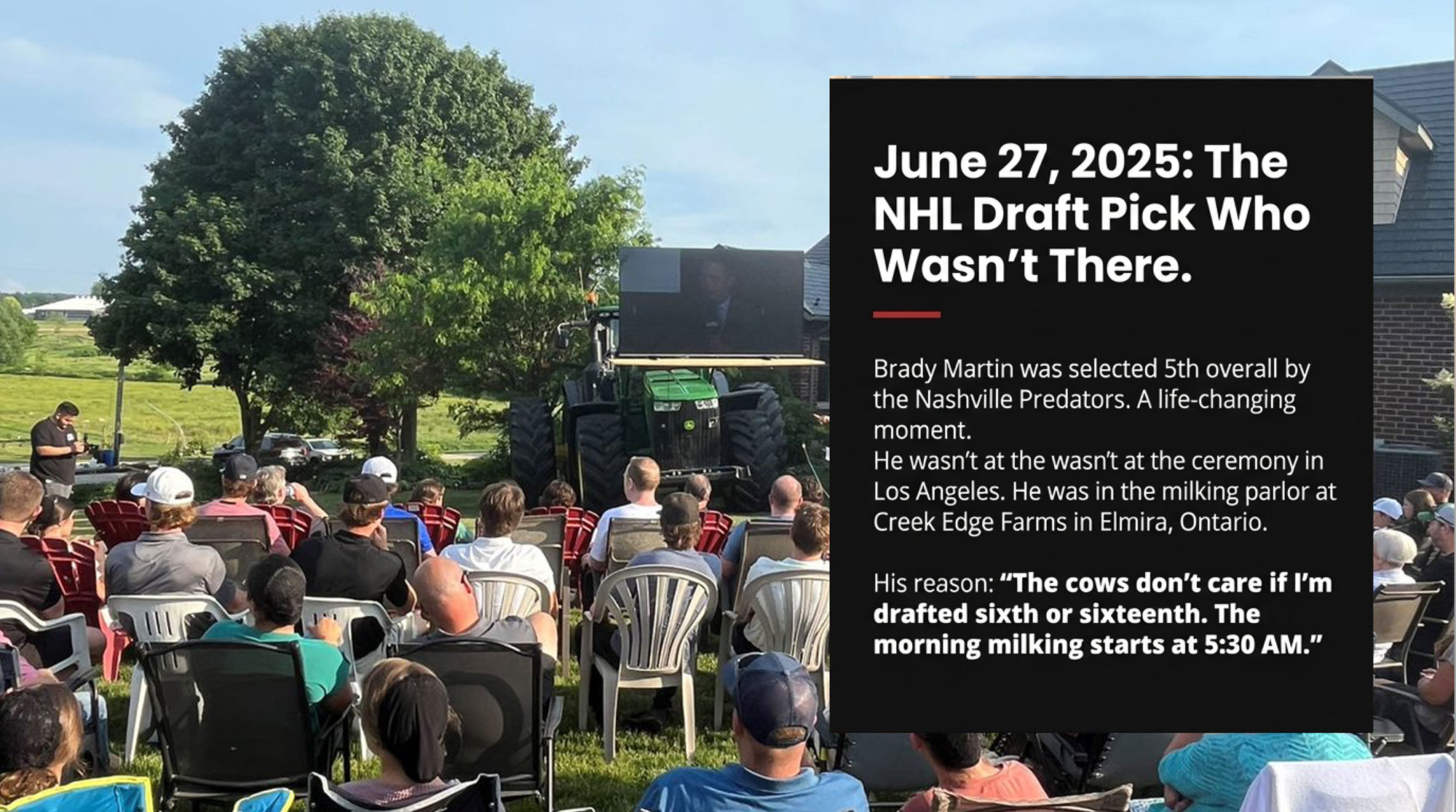
On the evening of June 27, 2025, the Nashville Predators selected Brady Martin fifth overall in the NHL Draft.

Brady wasn’t there.

He was in the barn at Creek Edge Farms, finishing the evening’s work alongside his brothers, just as he had every single day for as long as he could remember. The draft ceremony in Los Angeles—the red carpet, the cameras, the handshakes with NHL executives—had happened without him. He’d watched the broadcast from the milking parlor of his family’s 250-cow dairy operation near Elmira, Ontario, surrounded by the animals he’d cared for since childhood.

When reporters finally reached him and asked why he’d skipped what should have been the biggest night of his life, Brady’s answer was simple: “The cows don’t care if I’m drafted sixth or sixteenth. The morning milking starts at 5:30 AM.”

The family’s response to draft night captured everything about who they are. Being selected by an NHL franchise didn’t change a single thing about the next morning’s responsibilities. That was simply understood.

The following morning, Brady Martin—newly minted Nashville Predators prospect, eighteen-year-old with a three-year contract and more questions than answers about what comes next—was in the barn at 5:30 AM.

Because that’s what Martins do.

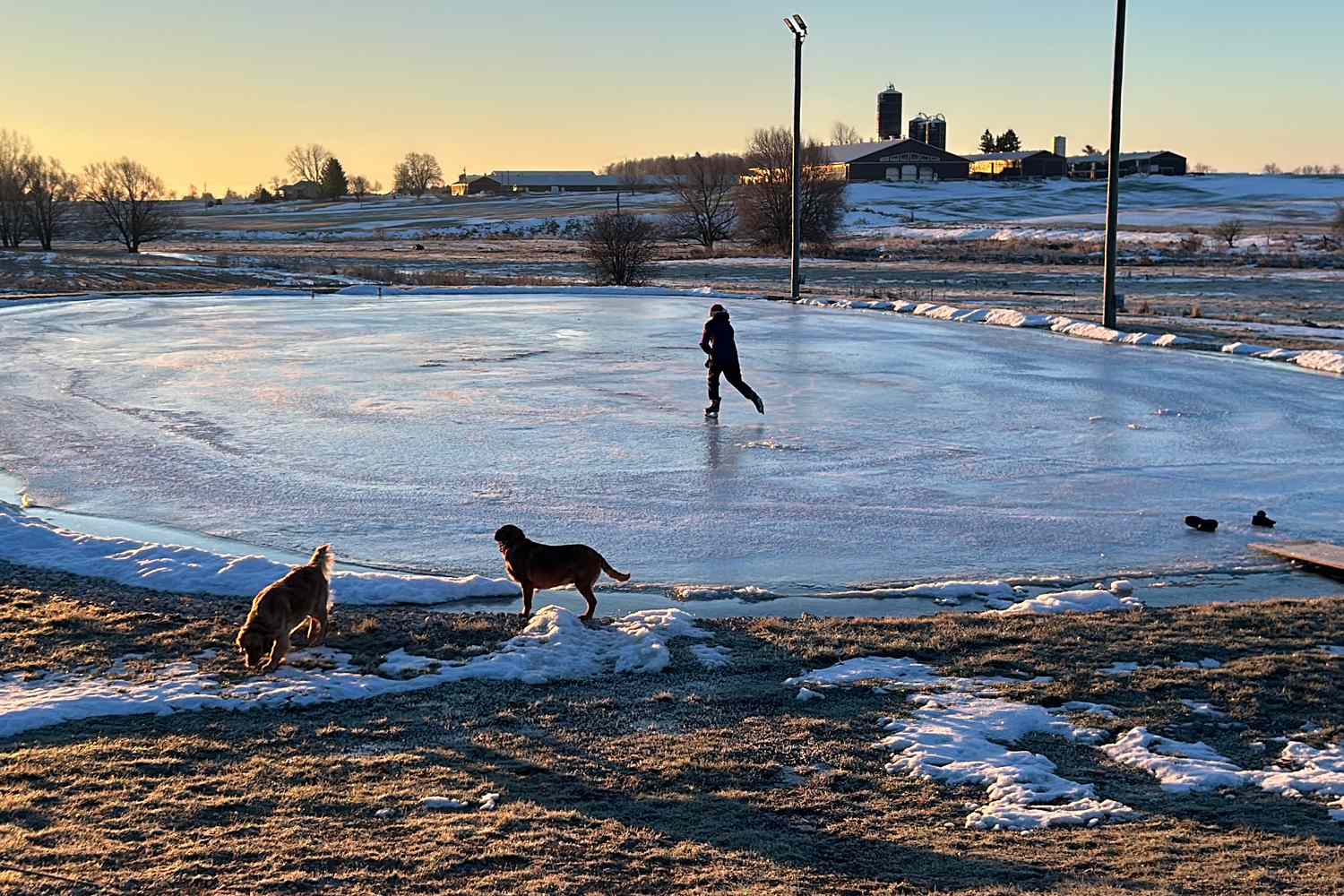
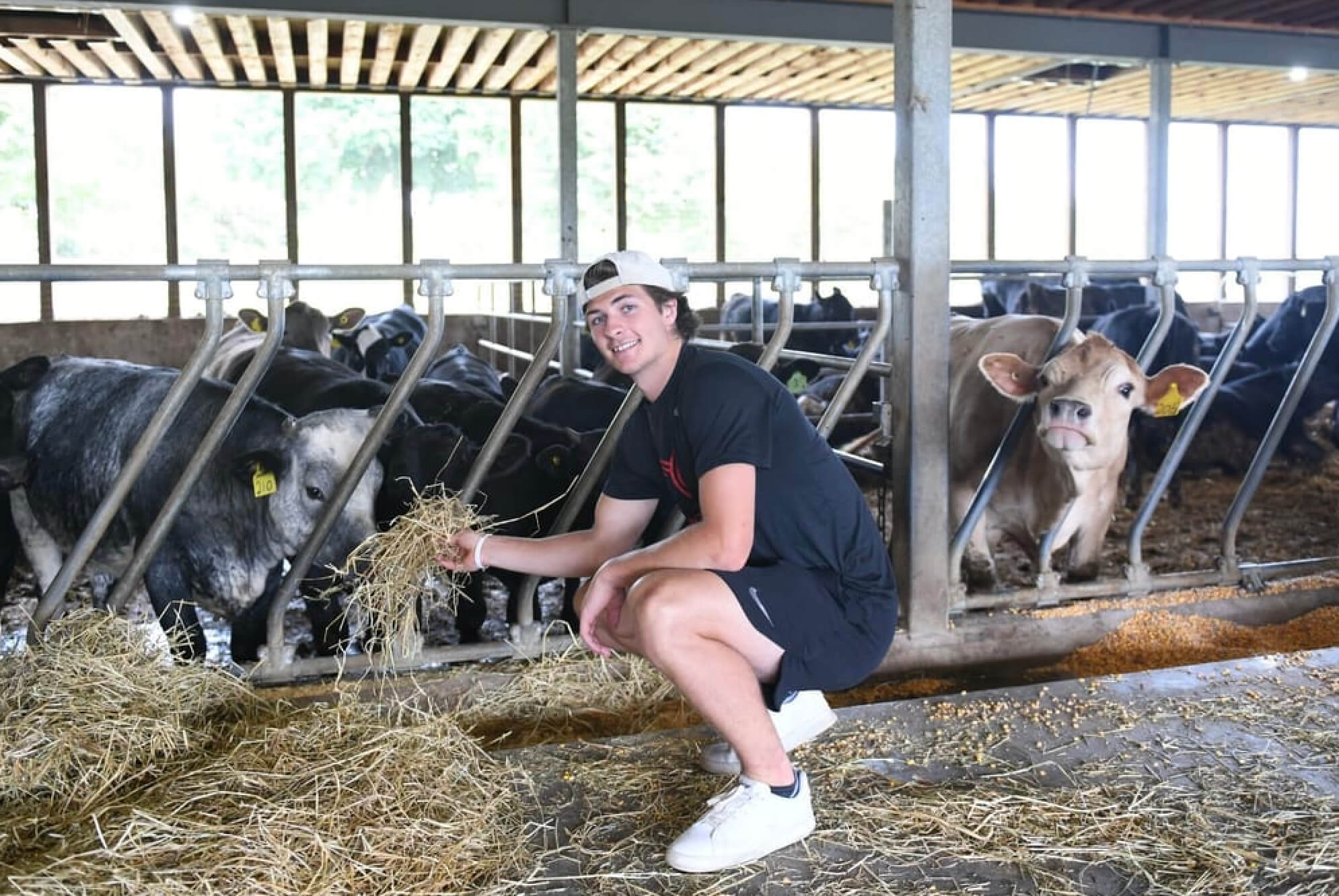
Before the NHL Draft, before Team Canada, before the scouts started calling it ‘farm strength’—there was this. A frozen pond, a pair of skates, the barn waiting for morning chores, and a kid who never learned to separate the two. Creek Edge Farms, where it all started.

The Moment Everything Almost Fell Apart

To understand what the Martins built, you have to understand what they almost lost.

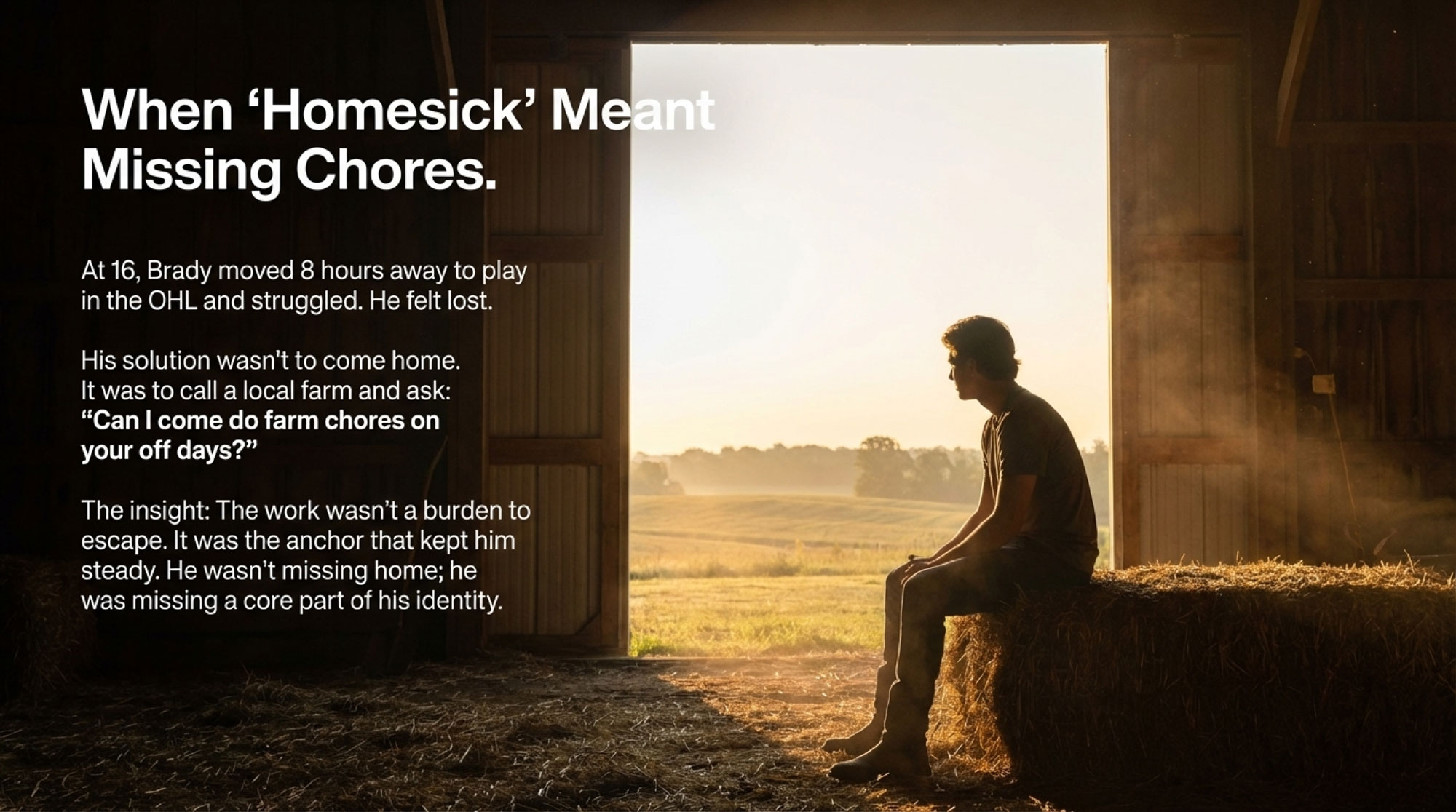
In 2023, sixteen-year-old Brady moved eight hours from home to Sault Ste. Marie to play for the OHL’s Greyhounds after being selected third overall in the Priority Selection. It was the opportunity he’d worked toward his entire young life. And within weeks, he was struggling.

“The first couple of months were tough,” Brady later admitted. He was lonely. He missed his family. He struggled to make friends in a new city where nobody knew him as anything other than “the new guy on the team.”

What happened next is the part of the story that still gets me.

Brady didn’t call home begging to quit. He didn’t push through with white-knuckled determination, pretending everything was fine. Instead, he called a family friend who lived near Sault Ste. Marie and asked a question that would have puzzled most teenagers: “Can I come do farm chores on your off days?”

Think about that for a moment. A sixteen-year-old, homesick and struggling, doesn’t ask to come home. He asks strangers if he can shovel their manure.

He wasn’t homesick in the conventional sense. He was experiencing something deeper—a disruption to his identity. The 5:30 AM chores weren’t just work he’d been assigned; they were part of who he was. Without them, he felt unmoored. Lost in a way that had nothing to do with geography.

The friend said yes. Brady started showing up on days off to feed cattle and do the unglamorous work that had structured his entire life. Within weeks, he’d stabilized. He started playing better. He made friends. He found his footing.

Sheryl Martin watched this unfold from 500 kilometers away and realized something she hadn’t fully understood before: the non-negotiable morning work she and her husband, Terry, had built into their children’s lives hadn’t been a burden Brady needed to escape. It was the anchor that kept him steady when everything else was uncertain.

The Mockery That Became Respect

Brady’s farm background didn’t always earn admiration. When he first entered the OHL, teammates weren’t sure what to make of the kid who talked about cows and couldn’t stay out late because he had to call home and check on the calving schedule.

“He took a little bit of a jabbing,” Sheryl recalls. “‘Oh, you’re a farmer—what does that even mean?'”

The ribbing escalated. During one game, a London Knights player named Landon Sim called Brady a “Mennonite” on the ice—an insult that earned him a five-game suspension. The mockery had crossed a line.

Most families would have advised Brady to downplay his background. Stop talking about the farm. Fit in. Don’t give them ammunition.

The Martins did the opposite.

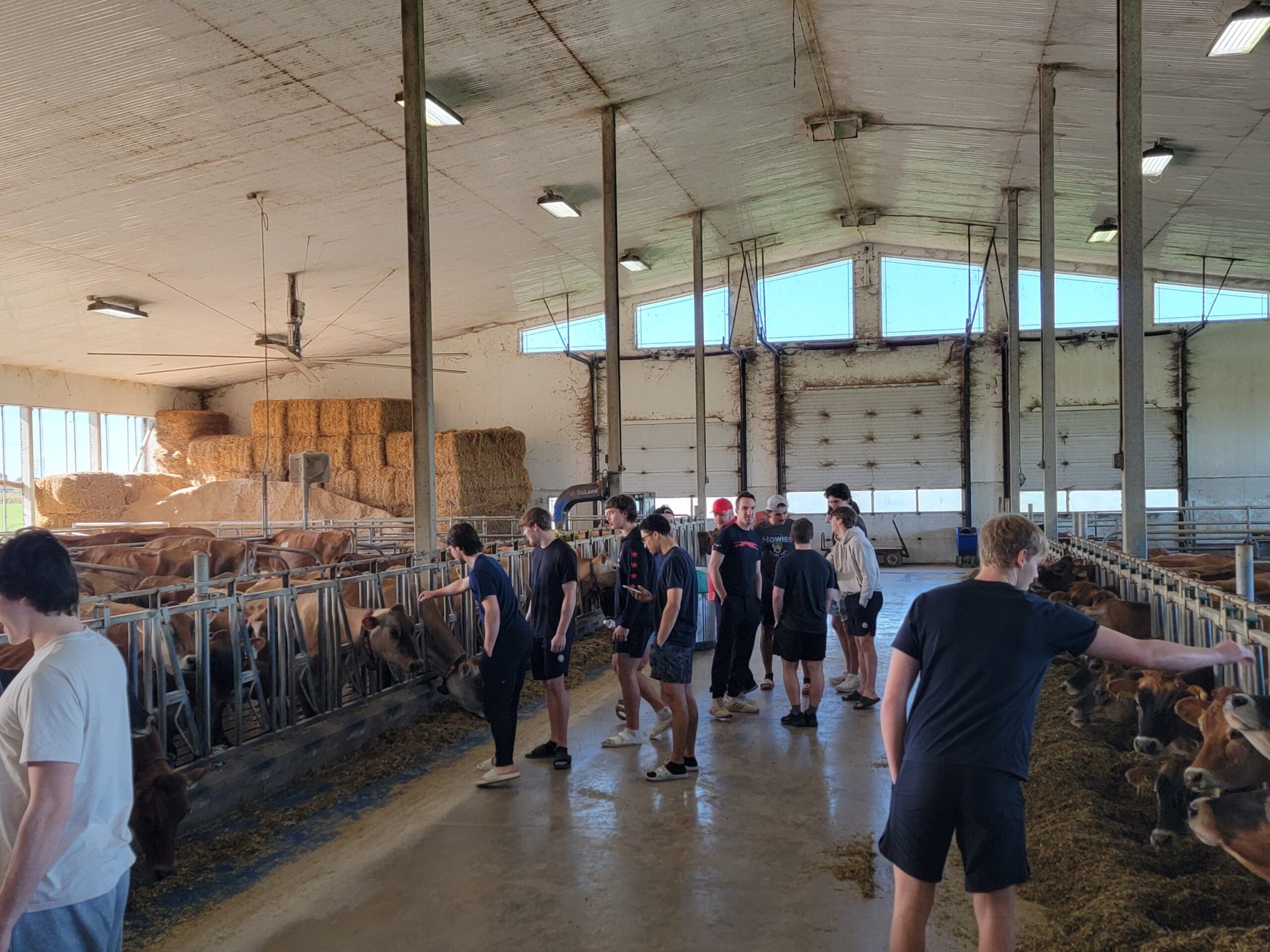
During the playoffs, Sheryl organized a team visit to Creek Edge Farms. She smoked 45 pounds of beef, invited Brady’s entire team, and let them experience a working dairy farm firsthand.

“Most of the boys had never, ever been on a farm before,” Sheryl says. “They had no idea the function of a farm.”

Most of the boys had never, ever been on a farm before.’ The Soo Greyhounds visit Creek Edge Farms—the day the jokes stopped. Forty-five pounds of smoked beef and one barn tour later, Brady wasn’t the weird farm kid anymore. He was family.

Players who’d spent months teasing Brady about his background stepped off the bus into the smell of fresh hay and manure, the sound of cattle moving in the barn, the scale of an operation they’d never imagined. They held chickens—some for the first time in their lives. They watched Brady’s family work with the quiet efficiency of people who’ve done this work for generations.

Coach John Dean observed the transformation in real-time: “You could see him taking charge of things, caring for the smaller details, and he naturally fell into his rhythm—picking stuff up off the ground and moving gates. He wasn’t doing it to impress anybody—it was simply ‘This is what I do.'”

The teammates who’d been mocking him for months stood “completely wide-eyed.” Not all of them became converts overnight—some habits die hard—but the tone had shifted. Brady wasn’t the weird farm kid anymore. He was the kid whose family fed them 45 pounds of smoked beef and let them hold chickens. The jokes stopped. Players who’d skipped the visit regretted it.

From ‘you’re a farmer—what does that even mean?’ to this. Brady Martin (#28) shares a laugh with Cole Reschny during Team Canada warmups in London, Ontario. Forty-five pounds of smoked beef and one farm visit later, the jokes stopped. 

In an industry often obsessed with being ‘misunderstood’ by the public, the Martins showed that the best way to be understood is to open the gate and feed people.

When the Parents Themselves Had Doubts

Here’s the part of the story that doesn’t make it into the highlight reels: even Sheryl and Terry questioned whether they were asking too much.

There were mornings—Sheryl admits—when getting teenagers out of bed at 5:30 AM required more persistence than any parent wants to muster. There were arguments. Slammed doors. Mornings when “I’m too tired” echoed down the hallway, and Sheryl had to decide whether this particular battle was worth fighting.

It always was. But that didn’t make it easy.

The system wasn’t magic. It was consistent, and consistency is exhausting.

As Brady’s hockey career accelerated, as scouts started calling, as the demands on his time intensified, the Martins wondered: Were they being fair? Could their son actually succeed at the highest levels of professional sports while maintaining his farm responsibilities? Were they holding him back from his potential?

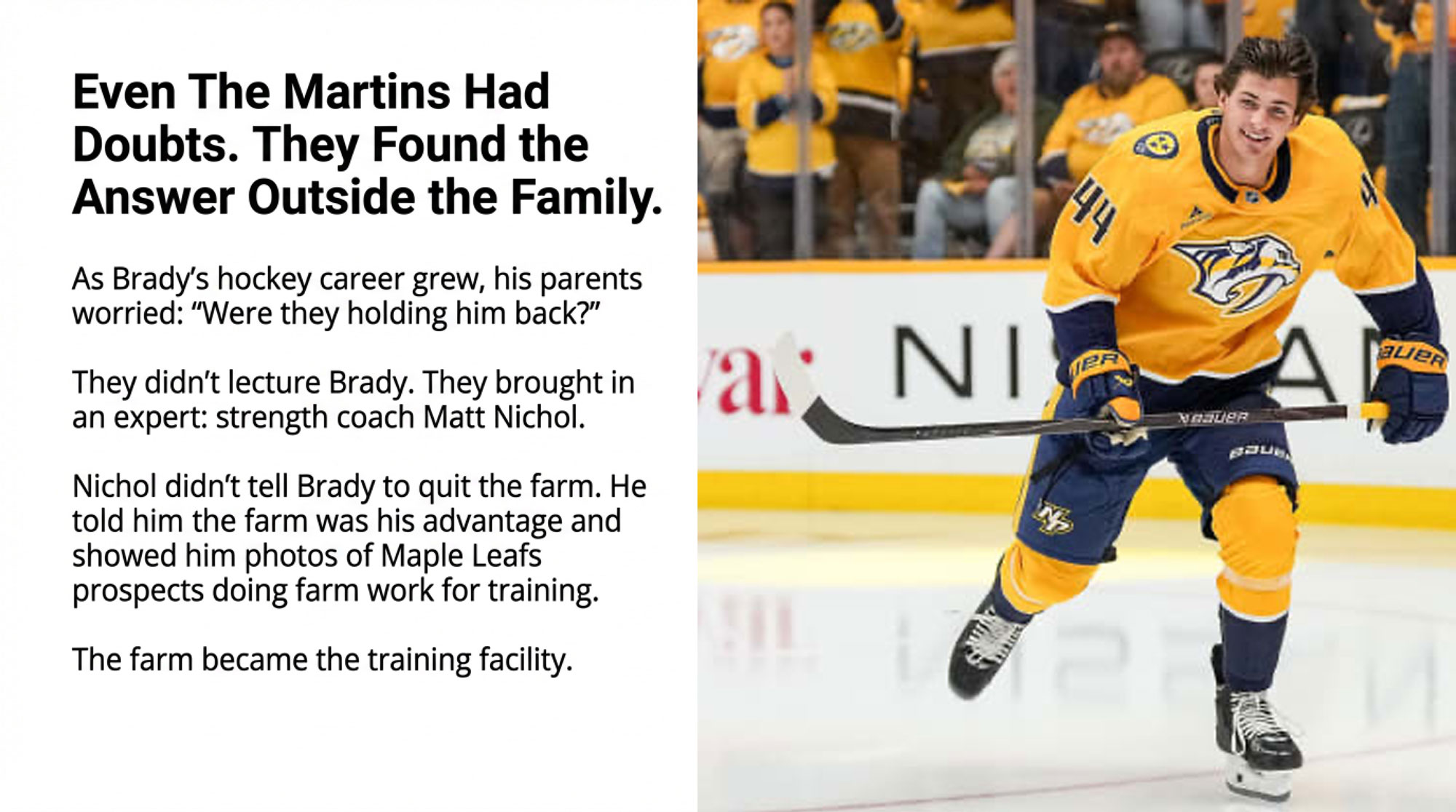
“They were worried,” Brady’s strength coach Matt Nichol later revealed. “‘Is he going to be able to still be at home and be on the farm and accomplish his goals?'”

When the doubt crept in, the Martins did something smart: they brought in an expert who could tell them the truth without bias.

Nichol’s assessment shocked them. The conventional wisdom—that Brady needed to leave the farm and train full-time at elite facilities—was wrong.

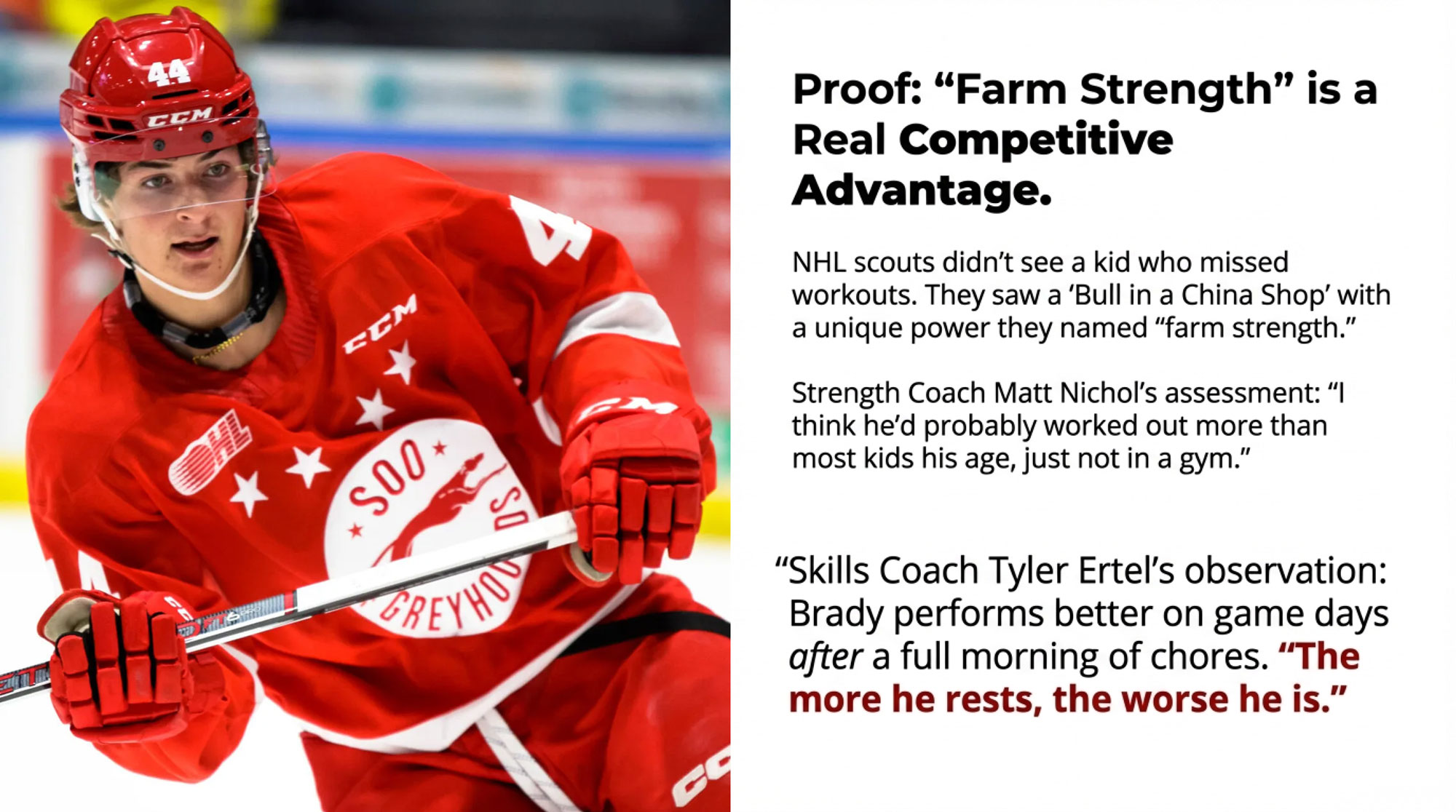
“The narrative on him was that he’d never worked out,” Nichol said. “I think he’d probably worked out more than most kids his age, just not in a gym.”

Instead of uprooting Brady from his agricultural life, Nichol designed programs that worked within it. He told the family about NHL legends who’d built their strength through manual labor. He showed Brady pictures of Maple Leafs prospects doing farm work as part of their training.

Then Sheryl Martin did what farm mothers do—she solved it herself. She pulled out the backhoe and built a training hill on the farm to the exact specifications Nichol recommended for professional development.

The farm didn’t adapt to accommodate hockey despite its limitations. The farm became the training facility that produced NHL-caliber results.

“Farm Strength”—The Competitive Advantage Nobody Saw Coming

By the time draft day arrived, NHL scouts had a name for what Brady brought to the ice: “farm strength.”

Not gym strength. Not a training facility strength. Farm strength—the natural power, resilience, and work capacity built through years of daily physical labor that no amount of programmed workouts can replicate.

“Pound for pound, when he hits guys, the way he’s hard on pucks—that’s something he has come by completely naturally with his work on the farm,” Coach Dean explained.

Scouts compared him to Sam Bennett and Nazem Kadri—physical, relentless competitors who change games through sheer willpower and toughness. They called him a “Bull in a China Shop.” And in a detail that still makes his coaches shake their heads: Brady performs better on game days when he’s done a full morning of farm work first.

“The more he rests, the worse he is,” his skills coach, Tyler Ertel, observed. Ertel has worked with Brady since he was nine years old and lives just nine minutes from Creek Edge Farms—close enough to witness the connection between barn work and ice performance firsthand.

In one tournament game on the way to the OHL Cup, Brady put in a complete morning of barn work, then drove to the city and scored a hat trick against the top-ranked team in the province.

This isn’t to say the path came without trade-offs. Brady missed hockey camps. He arrived at some tournaments with less rest than competitors who’d spent the previous day in recovery protocols. But somehow, for him, the equation worked differently. The farm work wasn’t draining him. It was fueling him.

his is what ‘farm strength’ looks like before the scouts give it a name. NHL first-rounder, $3M contract, Team Canada roster—and still happiest pushing up feed at Creek Edge Farms. ‘The more he rests, the worse he is,’ his coach says. Now you know why.

The Sibling Infrastructure Most People Miss

The most overlooked part of this story isn’t the draft pick. It’s the sibling infrastructure that made it possible.

Sheryl and Terry Martin raised four children—Joey, Brady, Jordan, and youngest Rylee—each with the same expectations, each finding their own balance between farm responsibility and individual pursuits. Joey, the eldest at nineteen, has taken on primary responsibility for the farm’s day-to-day operations during hockey season. Jordan, at sixteen, handles his own substantial workload while still in high school. Both covered for Brady during the stretches when his hockey schedule made full farm participation impossible.

The family operates on what amounts to an annual ledger rather than a daily one. Fairness isn’t measured by equal work on any given day—it’s measured by everyone contributing fully over the course of a year, with flexibility for individual circumstances. Brady goes hard in the summer when hockey pauses. His brothers shoulder more of the workload during the winter months.

The balance works out—though that’s not to say there’s never friction. When schedules collide or workloads feel uneven, the tension surfaces like it does in any family. But they work through it, usually over breakfast, always with the understanding that they’re building something together.

When the three brothers launched their beef cattle enterprise during COVID—”We were all stuck at home, so I went and bought some cows,” Brady recalls with characteristic understatement—they became business partners, not just siblings doing chores.

That beef enterprise has since “taken on a life of its own.” During the flurry of NHL interviews surrounding the draft, Brady was simultaneously auctioning cattle for the family operation. One reporter caught him juggling calls from hockey executives and livestock buyers in the same afternoon.

Joey and Jordan aren’t waiting for Brady’s hockey career to end. They’re building something alongside him. And that shared ownership changes everything about how they view the work.

The Uncomfortable Truth Most Farm Parents Won’t Hear

Here’s where I’m going to say something that might sting: most farm families are doing this backwards.

The Martins didn’t set out to create a replicable system. They were just trying to raise good kids who understood the value of hard work. Terry Martin gave Brady a single line that became his operating principle: “Hard work is the biggest thing, and if you’re working hard, good things will come.”

But what they discovered exposes a pattern that’s killing farm succession across North America.

The conventional approach to farm family scheduling treats external activities as fixed and farm work as flexible. Soccer practice is at 6 PM, so chores get squeezed in “when there’s time.” Tournament weekends mean someone else covers the barn. School, sports, friends—all non-negotiable. Farm work gets whatever scraps of time remain.

Every time you negotiate away the chores, you’re teaching your kids that the farm is the least important thing in their lives.

Let that sink in.

When you say, “skip the morning milking, you’ve got a big game,” you think you’re being supportive. You think you’re helping them succeed. What you’re actually doing is confirming what they already suspect: the farm is an obstacle to their real life, not the foundation of it.

The Martin family flipped this entirely.

Farm work is the fixed point around which everything else orbits.

When farm work is non-negotiable—when it happens at 5:30 AM regardless of what game was played last night—kids learn something different: this is who we are. This is the foundation. Everything else gets built on top of it.

Brady Martin didn’t become someone who “has to do chores.” He became someone who does chores. Identity, not obligation. That distinction made all the difference.

And before you tell me your operation is different, that your kid’s travel schedule is too demanding, that you can’t afford to be inflexible—ask yourself this: are you raising a kid who will come back to the farm, or are you raising a kid who can’t wait to leave it?

For Families Without 250 Cows

I need to be honest about something: the full Martin framework requires certain prerequisites—enough scale to absorb seasonal flexibility, strong management, and genuine profitability. Not every operation can implement the complete rotation system.

But here’s what any family can do, regardless of scale: recognize that external validators matter more than parental lectures.

Brady didn’t decide farm work was valuable because his parents told him so. He decided it was valuable because NHL scouts called it “farm strength,” because his strength coach said he’d already out-trained most athletes, and because his teammates visited Creek Edge Farms and left transformed.

The Martins didn’t convince their son. They connected him with people whose opinions he respected—and let them do the convincing.

If your teenager thinks farm work is competing with their goals, here’s the single highest-leverage action you can take: arrange one 15-minute phone call between your kid and someone in their field of interest who grew up on a farm.

Not mentorship. Not career counseling. Just one question: “When did you realize your farm background was actually an advantage in your career?”

Find that person through LinkedIn, through the FFA’s Forever Blue Network, or simply by texting your veterinarian: “Do you know anyone in engineering—or nursing, or business—who grew up on a farm?”

That 15-minute conversation can accomplish what years of parental lecturing cannot. Because kids can’t hear this message from us. We’re too biased. We need them to do chores, so of course, we say chores are valuable.

But when someone with no stake in your operation tells your kid, “Farm work is why I got hired,”—they believe it.

Will this work every time? No. Some teenagers are determined to see farm work as punishment, no matter what anyone says. But for the genuinely uncertain kids—who haven’t yet decided what the farm means to them—external validation can tip the scales.

The Legacy Being Built

In Nashville’s development camp after the draft, Brady Martin showed up as the only first-round pick who’d never attended a formal hockey training facility. The other prospects had spent years in elite programs with specialized coaches and state-of-the-art equipment.

Brady had spent those same years at Creek Edge Farms. On a tractor. Building fences. Chasing escaped cattle. Waking at 5:30 AM every morning because that’s when the cows needed milking.

And somehow, that unconventional path had produced exactly what professional hockey demands: a player with elite strength, unusual mental toughness, unshakeable work ethic, and the quiet confidence that comes from knowing you’ve already done harder things than anything a game can throw at you.

By October 2025, Brady had made Nashville’s Opening Night roster—one of the youngest players in the league. He played three NHL games before being sent back to the OHL for further development, a standard path for eighteen-year-olds with long careers ahead of them.

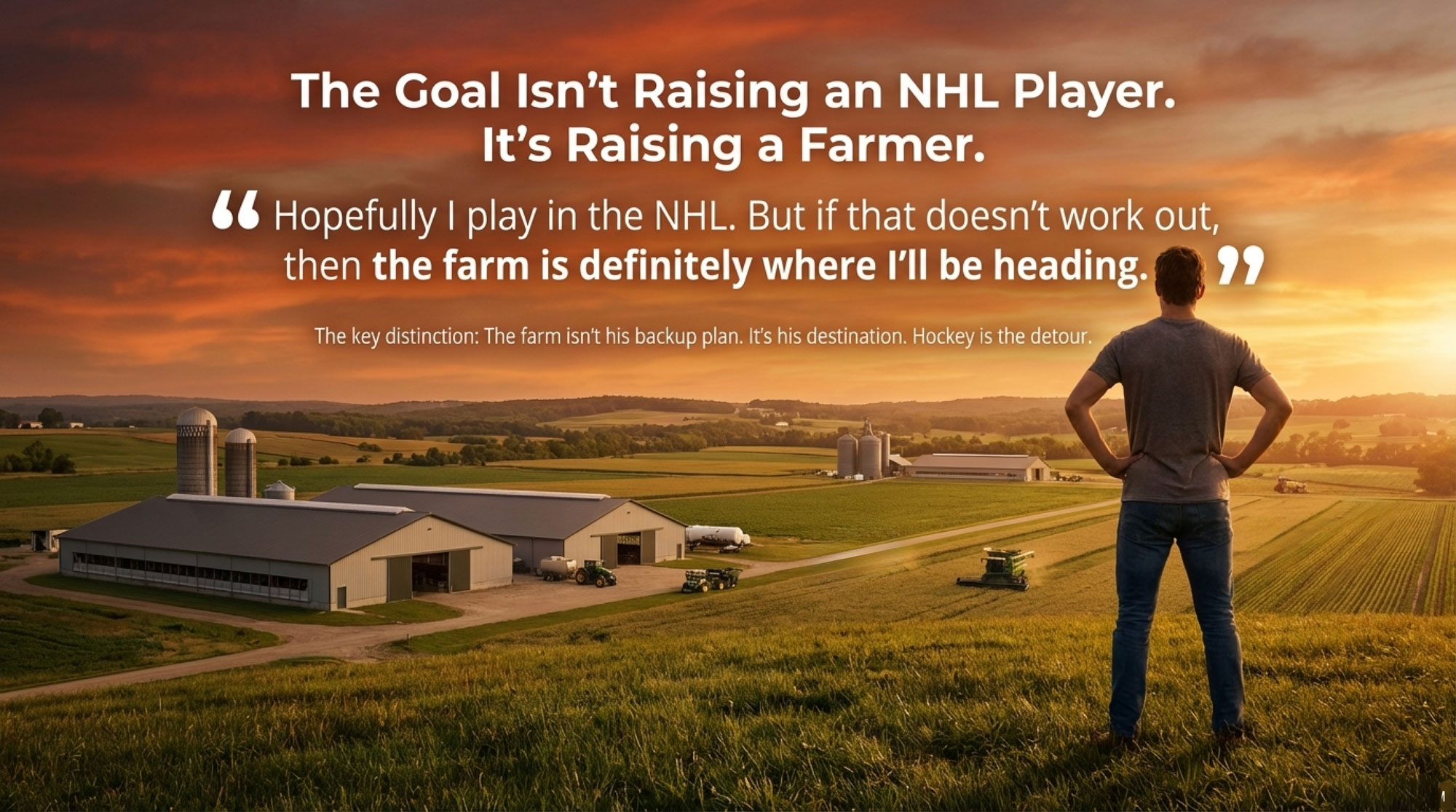
When reporters ask Brady about life after hockey, his answer never wavers: “Hopefully I play in the NHL. But if that doesn’t work out, then the farm is definitely where I’ll be heading.”

Notice what he’s saying. The farm isn’t his backup plan if hockey fails. It’s his destination. Hockey is the temporary—if spectacular—detour.

The Martin family didn’t set out to create an NHL player. They set out to raise children who understood the value of hard work, the dignity of agricultural responsibility, and the irreplaceable satisfaction of building something real with your hands.

That Brady also became a first-round draft pick is almost beside the point.

The real achievement is raising kids who—given every opportunity to leave, every excuse to prioritize themselves, every reason to see the farm as something to escape—chose to stay connected to the land and animals that shaped them.

The Bottom Line

On the morning after the biggest night of his life, Brady Martin was in the barn at 5:30 AM. Not because anyone made him. Because that’s who he is.

The cows don’t care if you’re drafted sixth or sixteenth. They need milking at 5:30 AM.

And in that simple, stubborn, beautiful fact lies everything you need to know about raising kids who achieve extraordinary things—and still choose to come home.

KEY TAKEAWAYS 

  • Make farm work the fixed point: The Martins built their schedule around 5:30 AM chores, not around hockey. Everything else orbits the barn. Reverse this, and you’re already teaching your kids to leave.
  • “Farm strength” is a real advantage: NHL scouts named it. Strength coaches confirmed it. Daily physical labor builds something no elite training facility can replicate—and Brady performs worse when he rests more.
  • Identity over obligation: Brady didn’t become someone who “has to do chores.” He became someone who does chores. That single distinction determines who comes back and who can’t wait to escape.
  • Stop negotiating away the chores: Every time you say “skip the milking, big game today,” you confirm what your kid already suspects—the farm is an obstacle to their real life, not the foundation of it.
  • Use external validators: Your teenager can’t receive this message from you. One 15-minute phone call with a professional who grew up on a farm accomplishes what years of your lectures never will.

EXECUTIVE SUMMARY: 

Brady Martin was drafted fifth overall by Nashville in 2025. He wasn’t at the ceremony—he was in the barn at 5:30 AM, same as every other day. Scouts called it “farm strength.” His family called it non-negotiable. The Martin system is brutally simple: farm work is the fixed point around which everything else orbits. Most families do the opposite—making chores the flexible thing that gets sacrificed for games and practices—then wonder why their kids can’t wait to leave. The Martins held the line through slammed doors, teenage arguments, and their own doubts. Result: four kids building a beef enterprise together, one of them in the NHL, all of them coming back. The lesson every farm parent needs to hear: your kids can’t receive this message from you. Find someone in their field who grew up on a farm and arrange one 15-minute call. External validation beats parental lectures every time.

Learn More

Join the Revolution!

Join over 30,000 successful dairy professionals who rely on Bullvine Weekly for their competitive edge. Delivered directly to your inbox each week, our exclusive industry insights help you make smarter decisions while saving precious hours every week. Never miss critical updates on milk production trends, breakthrough technologies, and profit-boosting strategies that top producers are already implementing. Subscribe now to transform your dairy operation’s efficiency and profitability—your future success is just one click away.

NewsSubscribe
First
Last
Consent
Send this to a friend