







His neighbors called it a gamble. World Dairy Expo just called him the 2025 Producer of the Year. What happened in the 13 years between? That’s the story nobody tells.
EXECUTIVE SUMMARY: When World Dairy Expo announced its 2025 award winners, the industry celebrated innovation that was finally recognized. But behind every honor lies a story the press releases don’t tell: the validation gap—those brutal years between building something new and anyone noticing it matters. The McCartys spent 13 years operating a processing plant that they had no experience running. Juan Moreno pioneered sexed semen technology when 88% of farmers wouldn’t touch it. Jim Mulhern showed up to policy meetings for 45 years before anyone called him Industry Person of the Year. This isn’t a story about awards. It’s about what happens in the silence of year six—and why the producers who survive that silence change the permission structure for everyone who comes after.
The cows still needed milking on the morning the award was announced. That’s the thing nobody tells you about recognition—it doesn’t change the work. It changes who believes the work was worth doing.
There’s an image from the McCarty story I can’t shake.
It was April 2012. Ken McCarty was standing in a building he had absolutely no idea how to operate.
The hum of refrigeration units filled the empty processing plant. Stainless steel gleamed under fluorescent lights—everything new, everything untested. The smell of industrial cleanser and fresh concrete hung in the air. Somewhere, a compressor cycled on—that mechanical heartbeat of a facility that represented everything his family had risked. And there stood Ken, in the middle of McCarty Family Farms in Rexford, Kansas, wondering if he’d just made the worst decision of his life.
The facility was designed to handle half a million pounds of milk daily. Thirty-one specialized employees had been recruited from outside the dairy world—people who knew processing but had never set foot on a working dairy. The whole thing was built through a partnership with Danone that seemed either visionary or completely insane, depending on who you asked.
What moves me most is Ken’s honesty about that moment. He didn’t pretend to have it figured out. He later admitted something that takes real courage to say out loud: “We had no experience running a milk processing plant before 2012. We depended heavily on the Danone teams to help us develop our skill set.”
I keep coming back to that sentence. Here’s a dairy farmer whose family has been milking cows for generations. And he’s standing in a facility that represents millions in investment, that his neighbors think is a gamble, that his banker barely understands—and he’s telling the world he had zero experience operating it.
That takes a kind of courage that doesn’t photograph well. There’s no triumphant moment to capture. Just a man in a humming building, hoping he hasn’t bet everything on a dream that won’t work.
That was Day One.
Day 4,745 would arrive on a March evening in 2025, when World Dairy Expo announced the McCarty Family as Dairy Producers of the Year—the industry’s highest recognition for farming excellence.
What happened in between those two days? That’s the story nobody tells about agricultural innovation. And honestly, it’s the part that matters most.

The McCarty Family: Generations of dairy farming excellence stands proudly in one of their innovative free-stall barns. From left to right, brothers Mike, Clay, Tom (father), Dave, and Ken McCarty have transformed a 15-cow Pennsylvania dairy into a sustainability-focused operation spanning multiple states, earning them World Dairy Expo’s prestigious 2025 Dairy Producer of the Year award.
The Valley Nobody Warns You About
Every innovation story we love to celebrate follows the same arc: Someone has a vision. They build something new. The industry recognizes their genius.
What gets edited out is the decade in between steps two and three.
Agricultural researchers have a clinical term for this brutal middle period: the “Valley of Death.” It’s where emerging tools and approaches remain stuck, unable to advance from proof of concept to widespread adoption. The funding gap hits. The adoption gap hits. And most pioneers? They don’t survive the crossing.
For the McCartys, the valley looked like years of learning to operate a processing plant while simultaneously managing dairy expansion. Technical problems for which no solutions had been documented. Equipment designed for average milk composition that couldn’t handle their herd’s exceptional genetics.
Here’s the part that still gets me: Their cows kept getting better. Through careful breeding, their herd was producing 4.5-4.6% butterfat—well above the industry average of 3.7-3.8%. Sounds like a triumph, right?
Except their processing plant separators weren’t designed for milk that rich. Ken explained it with characteristic plainness: “We have to run our plant slower.”
Think about what that actually means. Your breeding program succeeds beyond your wildest expectations—and it creates a whole new problem. Your genetics outpace your equipment. Most dairy farmers never face this challenge because, as Ken put it, their “connection to that separator ends at the back of a milk tanker.” The McCartys saw it all the way through—every improvement revealing new bottlenecks nobody else had ever needed to solve.
That’s what the validation gap actually looks like. Not a dramatic failure that makes for good storytelling. Just constant, grinding problem-solving with zero external validation that you’re even on the right path.
The Weight of the Unseen Years
In every innovator’s journey, there are moments of doubt that never make the official story.
The McCartys have spoken openly about the technical challenges of those valley years—equipment struggles, the complexity of managing what no one in their region had ever attempted before. The processing team they’d recruited? Ken shared something remarkable about them: “Most of those team members are still with us 13 years later.”
That kind of loyalty doesn’t happen by accident. It happens when people believe they’re building something worth staying for, even when the world hasn’t noticed yet. I think about those employees sometimes—the ones who showed up in 2012 to work for a dairy family with no processing experience, and decided to stay anyway. What did they see that others missed?
I think about what those years must have felt like. Not the dramatic crises, but the quieter weight. The mornings when you walk into that plant knowing you’re solving problems nobody else has faced—and the equipment manual on your desk is one you’re writing as you go.
“We enjoyed creating things,” Dave McCarty would later explain about why they left Pennsylvania for Kansas. “My dad and mom just allowed us to make it ours.”
What strikes me about that quote is what it doesn’t say. It doesn’t say they always believed it would work. It doesn’t say the doubt went away. Creating things means making something that didn’t exist before, which means you can’t know in advance whether it should exist. The McCartys built anyway. But I suspect there were mornings when “enjoying” wasn’t quite the right word. Mornings when it was just stubbornness. Just being too far in to turn back.
But they kept going. Not because they knew it would work—they couldn’t have known that. Because stopping felt worse than continuing.
Read more: The McCarty Magic: How a Family Farm Became the Dairy Industry’s Brightest Star
The Silence That Tests Everything
There’s a moment in every innovator’s journey—usually around year five or six—when the hardest question arrives.
It’s not “Is this working?” By year five, you have data. You know if the economics function.
The hard question is this: “Is this worth it when nobody else seems to care?”
Your neighbors are milking cows, shipping milk, and going home. Their operations look simpler. Less stressful. More manageable. They’re not dealing with food safety inspections, processing plant employees, or equipment that wasn’t designed for what you’re trying to do.
Meanwhile, you’re solving problems nobody else has. You’re operating at the edge of industry knowledge. And when you look around for validation—for someone to say “Yes, this matters, keep going”—the silence is deafening.
Juan Moreno knows this silence intimately.
When Moreno was pioneering gender-sorted semen technology, the industry wasn’t celebrating his vision. They were skeptical. In 2012, only about 12% of U.S. dairy operations used sexed semen. Nearly half of the dairy farmers surveyed had never even tried it. The technology worked, but most farmers weren’t buying it—literally.
Moreno’s response? He kept building anyway.
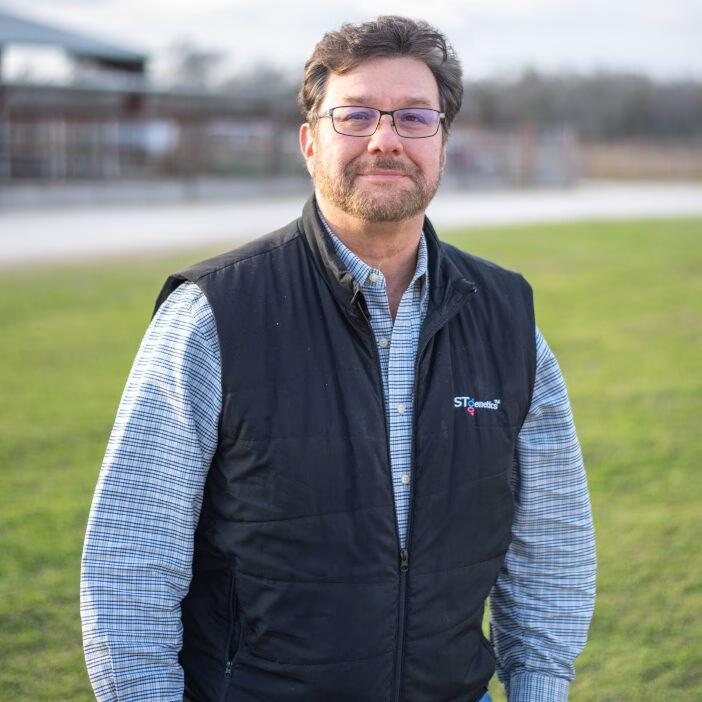
Juan Moreno, CEO of STgenetics, stands at the forefront of his company’s facilities where revolutionary genetic technologies are developed. Under his visionary leadership, Moreno has transformed the dairy breeding industry through innovations in sexed semen technology and genomic testing that have fundamentally changed how farmers approach herd genetics worldwide.
“It all started on my family’s cattle operation, where an early fondness for animal husbandry took root,” he explained after receiving the 2025 International Person of the Year award. “Those early experiences shaped my understanding of the daily practical challenges farmers face.”
He wasn’t building sexed semen technology to revolutionize the industry. He was solving a problem nobody else thought was worth solving yet—the frustration of unwanted bull calves, the slow pace of genetic progress, the coin-flip uncertainty of every breeding decision.
By 2024, adoption had reached 84% in Great Britain—the world’s highest rate. Moreno’s decades of work finally looked like genius. But in 2005? In 2010? In all those years, when most farmers considered the technology too expensive and unreliable?
He was just a man in a lab, wondering if anyone would ever see what he saw.
Read more: Bull in a China Shop: How Juan Moreno Turned the Dairy World Upside Down
The Invisible Giant
Not all validation gaps end with visible, dramatic operations like on-farm processing plants.
Some end with policy infrastructure that touches every dairy farmer in America—without most of them ever knowing the name of the person who built it.
Jim Mulhern spent 45 years doing work that most dairy farmers never saw. Congressional testimony. USDA comment periods. Coalition-building with farm organizations. Endless meetings with staffers whose names would never appear in industry publications.
I find myself wondering what sustains someone through that kind of invisible work. Forty-five years. Think about that. Forty-five years of showing up to meetings where your name never appears in the headline. Forty-five years of watching legislators change, programs rise and fall, knowing that the farmers who benefit from your work will never know you built the infrastructure that saved their milk check.
How do you keep going when the work is that invisible?
When Mulhern received the 2025 Industry Person of the Year award, his colleagues’ description revealed the answer: “His work has made lasting impacts on dairy and ag policy, and his colleagues routinely say his kindness, hard work, and collaborative nature are unmatched in policy circles.”
Kindness.
In 45 years of policy work—the meetings, the testimony, the endless negotiations—that’s what people remembered most. Not the wins. Not the programs. The way he treated people during the long, unglamorous middle.
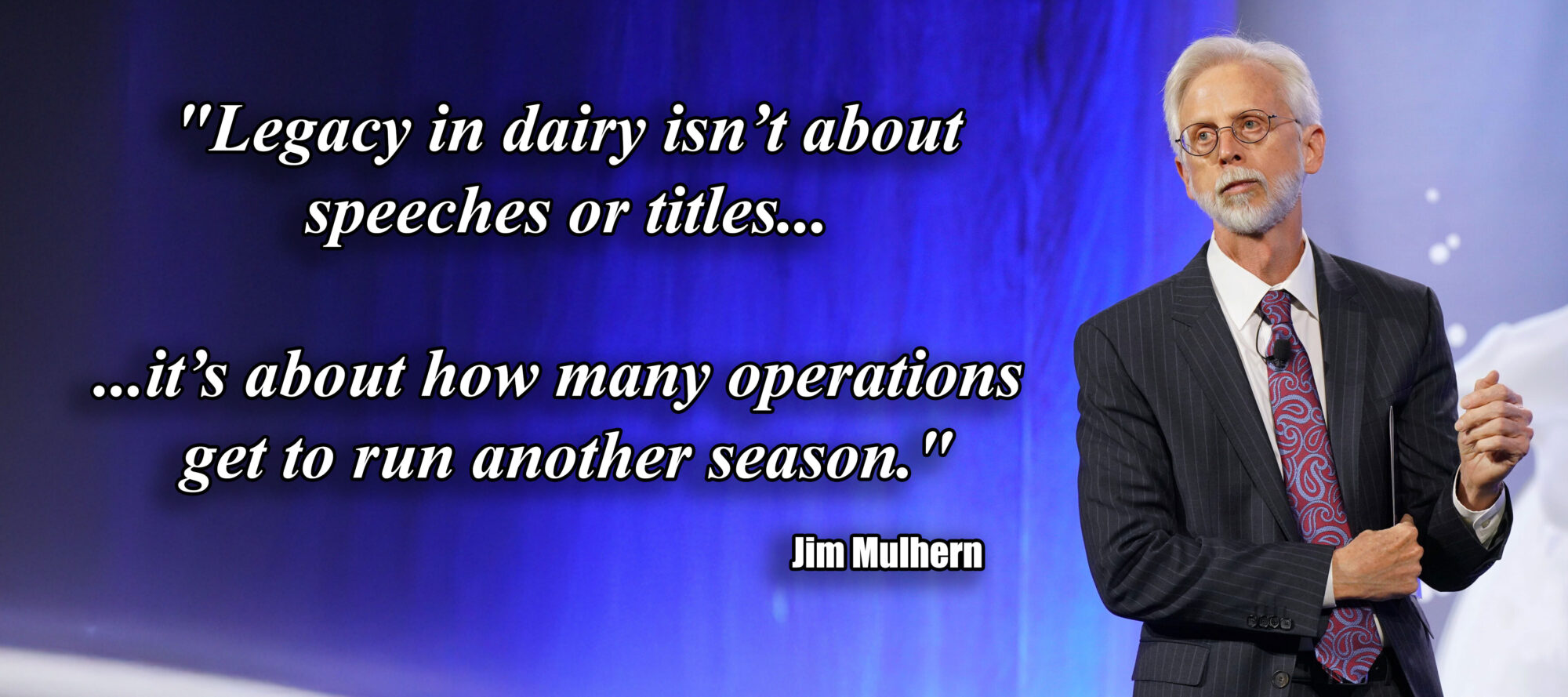
The Dairy Margin Coverage program—which distributed $1.27 billion to 17,059 operations in 2023 alone—exists in part because of Mulhern’s decades of policy architecture. Federal order reforms that affect every milk check in America bear his fingerprints.
But here’s what strikes me most: Mulhern didn’t separate survival from legacy.
He didn’t spend 20 years doing policy work and then 25 years building something meaningful. His survival strategy WAS building policy infrastructure that protected all dairy farmers—including himself. Every hour spent in committee meetings was simultaneously about keeping the industry viable and creating something that would outlast him.
Legacy isn’t what you build after you survive. Legacy is what you build while surviving.
Or it’s not built at all.
Read more: More Than Policy: For Jim Mulhern, Legacy is Measured One More Season at a Time
The Fear That Wears a Different Name
That kind of invisible courage—showing up for decades without recognition—requires the same thing the McCartys needed: the willingness to be vulnerable to failure without anyone watching.
But most producers I talk to face the opposite challenge. Their fear isn’t invisibility. It’s visibility.
You’ve probably said this yourself. In hundreds of conversations with mid-size dairy producers, I’ve heard the same refrain: “That’s for the big guys. I’m too small to matter to Land O’Lakes or Danone or any of these programs.”
I’ve come to believe something uncomfortable about that sentence. In most cases, it’s not a size problem at all. It’s a fear problem wearing a scale costume.
The McCartys had advantages, yes. Scale, Kansas State University support, and a Danone partnership. But Randy Kortus won Dairy Producer of the Year in 2023 with approximately 90 cows across three breeds—Holsteins, Jerseys, and Ayrshires. Ninety cows. That’s not mega-scale. That’s the kind of operation thousands of producers run while telling themselves they’re “too small to matter.”
The difference wasn’t Kortus’s cow count. It was his willingness to be seen. To share operational data with universities for benchmarking. To host farm tours and engage with industry visitors. To present at conferences about what worked and what didn’t. To document his practices in ways that helped other producers learn.
“Too small” protects us from vulnerability. It’s easier to say “Programs like that aren’t for farms my size” than to make the call, share the data, and risk rejection.
But here’s what I’ve learned: Land O’Lakes TruTerra accepts operations of ALL sizes. They paid $5.1 million to farmers in 2022 for carbon sequestration—distributed among thousands of participants, most of whom were mid-size operations.
USDA EQIP programs often score smaller operations HIGHER because they can demonstrate greater per-acre environmental impact.
Regional processors actively seek mid-size operations for premium programs because they want authentic “family farm” stories for their marketing.
The question isn’t whether you’re big enough to matter. The question is whether you’re brave enough to become visible.
And I get it—visibility is terrifying. When you’re visible, people see your failures as well as your successes. Your neighbors know when you’re struggling. Industry colleagues witness your challenges.
But here’s what I’ve noticed about every producer who eventually earned recognition: They were all terrified, too. They didn’t conquer the fear. They just got tired of letting it make decisions for them.
What Separated the Stayers from the Leavers
Looking at the producers who emerged from the valley faster, I started noticing patterns. Three habits kept showing up—and none of them were what I expected.
Most producers do the opposite of all three. They compete instead of connect. Hoard instead of share. Protect instead of expose.
They became connectors instead of competitors. When you consistently highlight other farmers doing innovative work—profiling their approaches, sharing their data, celebrating their successes—something shifts. You become indispensable without ever asking to be. Within a year, people start asking you, “Who should I talk to about X?” You’ve built influence without ever self-promoting, because the person who knows who’s doing innovative work IS the expert.
The 2024 Industry Persons of the Year, GPS Dairy Consulting, won not by promoting their own expertise but by consistently highlighting their clients’ achievements. “Inspiring change and growing leaders in the dairy industry is the hallmark of success for GPS Dairy Consulting.” They spent years making other people look good—and in the process became indispensable.
They built tools others could use. Not just case studies about their own success, but actual decision-making frameworks. Spreadsheets calculating carbon program ROI. Checklists assessing direct-marketing feasibility. Templates that other farmers could adapt to their own situations.
The McCartys built a 7,500-square-foot Learning Center featuring VR experiences that show how dairy foods are made. That’s not altruism—that’s infrastructure that makes their approach replicable. Every visitor becomes a potential advocate. Every tour validates the model for someone who might have otherwise dismissed it.
They answered the questions everyone was afraid to ask. Every producer community has uncomfortable questions for which nobody has real data. “Do carbon credits actually generate meaningful income?” “Can direct marketing work at 500-cow scale?” The producers willing to answer those questions—with real numbers, including what didn’t work—become the authorities. Not because they claimed expertise, but because they provided the transparency everyone else was withholding.
The common thread? All three approaches are about serving rather than promoting. You never say “Look at me.” You say, “Look at this problem I’m helping solve.”
Dairy culture has a long memory for people who show up to help. Recognition eventually finds them—often years after they’ve stopped expecting it.
What Actually Changes When Recognition Arrives
Here’s where something remarkable reveals itself.
When World Dairy Expo announced the McCartys as Dairy Producers of the Year, nothing changed about their operation. The cows still needed milking. The processing plant—now handling 2.2 million pounds daily, up from that original 500,000—still ran the same equipment. The economics were identical to what they’d been the day before.
But something profound shifted in the broader industry.
Within months, the media amplification cascade began. K-State Magazine, Brownfield Ag News, High Plains Journal, and Dairy Herd Management—publication after publication profiled the operation. A YouTube documentary that had been quietly accumulating views suddenly surged past 92,000.
But here’s what matters most: the institutional permission structure transformed.
Before recognition: “On-farm processing? That’s too risky for our lending portfolio.”
After recognition: “On-farm processing? The World Dairy Expo Producers of the Year operate one. Let’s look at the model.”
Before recognition: “Cost-plus pricing partnerships with major processors? That’s not how dairy works.”
After recognition: “Danone publicly documented their partnership model with the McCartys. Maybe we should explore similar arrangements.”
The award didn’t make the McCartys’ approach work. It gave everyone else permission to believe it could work for them.
And in an industry where 2,800 operations closed their barn doors in 2024—most of them mid-size dairies that ran out of options before they ran out of determination—that permission to believe matters more than any number can capture.
That’s the real legacy of surviving the validation gap. You don’t just prove your model works. You compress the timeline for everyone who comes after. The next producer exploring vertical integration won’t face thirteen years of isolation. Maybe five to seven years instead—because now there’s a proof of concept. A name to cite when their banker raises objections.
The Question That Matters
I should be honest about something: For every McCarty family that survives thirteen years in the valley, others did similar things and didn’t make it. Not because they lacked courage or vision, but because timing, circumstances, or just plain bad luck worked against them. This isn’t a story about guaranteed outcomes. It’s a story about what becomes possible when you stay long enough to find out.
If you’re a mid-size producer reading this, fighting to survive the next milk check while wondering whether any of this applies to you, here’s the question that determines everything:
“Is the survival work I’m doing today solving a problem worth documenting for others?”
If yes: Document it. Share it. Stay committed. Whether or not awards ever arrive, you’ll have built something meaningful.
If no: There’s honor in survival itself. Not every farm needs to be a case study. Some just need to keep milking cows and supporting families, and that’s enough. That’s always been enough.
But whatever you do, don’t fall into the trap of thinking you’ll survive first, then build a legacy later.
The McCartys didn’t wait until year thirteen to start documenting their model. They were sharing, teaching, and opening their operation to visitors throughout the valley—building that Learning Center, hosting tours, answering questions from producers who wondered if such a thing was even possible.
Moreno didn’t wait until 84% adoption to advocate for sexed semen technology. He was presenting, publishing, and partnering while skeptics still dominated the conversation.
Legacy is what you build while surviving. Or it’s not built at all.
What This Means for All of Us
As nominations open for the 2026 World Dairy Expo awards, thousands of producers will read the criteria and think: “That’s not for someone like me.”
Some of them are right. The survival challenges they face don’t translate into industry-wide impact, and that’s okay.
But some of them are wrong. They’re in year five of something meaningful. Year eight of building infrastructure that could help thousands. Year three of solving a problem publicly that others are desperate to understand.
To those producers: The validation gap is real. The silence of year six is brutal. The temptation to quit and return to simpler operations is constant.
But so is what waits on the other side.
I think about Ken McCarty standing in that processing plant in 2012. Stainless steel and fluorescent lights. The smell of concrete, possibility, and fear, all mixed together.
And I think about him standing in that same building in 2025, knowing exactly how every system works, having solved problems nobody else had documented, watching the industry finally catch up to what his family had been building for thirteen years.
The cows still needed milking that morning. They always do.
But something had changed. Not in the plant. Not in the economics. In everyone else’s permission to believe that what the McCartys built was possible for them, too.
The 2,800 farms that closed in 2024? They faced the same choices the McCartys faced in 2012. The same uncertainty. The same skeptical neighbors and confused bankers, and years of wondering if the risk was worth it.
The difference was refusing to stop—answering questions when nobody seemed to be listening, documenting when it felt pointless, staying visible when hiding felt safer.
The industry always catches up eventually. The only question is whether you’ll still be there when it does.
World Dairy Expo award nominations are open now. Visit worlddairyexpo.com for current deadlines and nomination forms. Whether you nominate your neighbor, or simply take inspiration from those who’ve walked this path before—the work you’re building today is the legacy that matters.
KEY TAKEAWAYS
- All three WDE 2025 winners survived the same invisible battle: The McCartys (Dairy Producer of the Year), Juan Moreno (International Person of the Year), and Jim Mulhern (Industry Person of the Year) endured 13-45 years of building before recognition arrived
- The validation gap kills more innovations than failure does: Those brutal middle years—when the work is real but nobody’s watching—is where most pioneers quit. The McCartys survived 4,745 days of it.
- “Too small” is fear wearing a scale costume: Randy Kortus won 2023 Producer of the Year with 90 cows. Land O’Lakes TruTerra paid $5.1M to mid-size farms in 2022. The barrier isn’t size—it’s visibility.
- Awards change permission, not profit: The McCartys’ honor didn’t improve their margins. It transformed “on-farm processing” from a banker red flag to a validated model.
- Legacy is built while surviving, not after: Document now. Share now. Answer the hard questions now. That’s what separated the 2025 winners from the 2,800 farms that closed last year.
 The Sunday Read Dairy Professionals Don’t Skip.
 The Sunday Read Dairy Professionals Don’t Skip.
Every week, thousands of producers, breeders, and industry insiders open Bullvine Weekly for genetics insights, market shifts, and profit strategies they won’t find anywhere else. One email. Five minutes. Smarter decisions all week.




