







Heifers aren’t small cows—that 36-hour timing difference is worth $3,900 annually on 200 head
EXECUTIVE SUMMARY: The convergence of $3,010 replacement heifers and 20-year inventory lows has transformed heifer reproduction from routine management to a critical profit center. University research confirms what progressive producers are discovering: heifers develop dominant follicles 24-36 hours faster than lactating cows, requiring fundamentally different breeding protocols. Dr. Albert De Vries from the University of Florida calculates that every 1% improvement in 21-day pregnancy rate delivers $25 per cow annually—but for heifers, where you’re not losing milk production during extended days open, the value comes from reduced feed costs and accelerated genetic progress. Operations adjusting their AI timing to 60-66 hours post-CIDR removal (instead of the traditional 72 hours for cows) are seeing conception rates climb from 40% to 50% or higher, resulting in $2,800-$ 3,900 in annual savings for a modest 200-heifer program. With CoBank projecting no inventory recovery until 2027 and NAAB reporting an 18% surge in sexed semen sales, the message is clear: farms that respect the unique biology of heifers—rather than treating them as small cows—are positioning themselves to thrive when others struggle to find replacements. The tools and knowledge exist today; the only question is how quickly each operation can adapt to capture these gains.

The dairy industry is experiencing a fundamental shift in heifer reproduction management. With replacement values exceeding $3,000 and inventories at historic lows, every breeding decision carries unprecedented economic weight.
And here’s what’s interesting—this transformation isn’t just about economics. It’s building on what we’ve learned about heifer biology over the past few years, combined with the harsh reality of today’s replacement market.
The Biological Divide: Why Heifers Aren’t Just Small Cows
At the heart of this shift is a simple biological truth: heifers channel energy toward growth, while mature cows direct metabolic resources toward milk production. This distinction drives every aspect of their reproductive physiology.
Dr. Paul Fricke from the University of Wisconsin’s Department of Dairy Science has been emphasizing this in his extension presentations for years. As Dr. Matt Lucy at the University of Missouri puts it: “A heifer’s energy is going toward growth, not milk production. That fundamentally changes how she responds to reproductive interventions.”
What I find compelling is how this metabolic difference shows up in measurable ways. Research confirms heifers develop dominant follicles 24 to 36 hours faster than lactating cows—and you know, those hours matter when you’re trying to hit that breeding window. Studies show heifer conception rates can reach 50% or higher under optimal management, but achieving “optimal” means respecting their unique biology.
University research reveals another piece of the puzzle. In mature cows, a single prostaglandin treatment typically achieves complete luteolysis of 90% or better. But in heifers? Data suggests it’s more like 65-70%. That incomplete regression… it’s been quietly undermining our success rates industry-wide, hasn’t it?
Dr. Joe Dalton from the University of Idaho, who serves on the Dairy Cattle Reproduction Council’s protocol committee, summarizes what many of us have been thinking: “We’re finally understanding that heifers need their own playbook, not just a scaled-down version of what works for cows.”
A Quick Look at the Key Differences

Looking at the research, here’s how these physiological differences break down:
| Aspect | Heifers | Mature Cows |
| Metabolic Priority | Energy toward skeletal/muscle growth | Energy toward milk synthesis |
| Follicular Development | Dominant follicle 24-36 hours earlier | Standard timing patterns |
| Prostaglandin Response | 65-70% complete luteolysis | 90%+ complete response |
| Heat Stress Impact | Better conception maintenance | Significant decline due to lactation heat |
| Optimal AI Timing (CIDR) | 60-66 hours post-removal | 72 hours post-removal |
| GnRH Dose Response | Often better with adjusted doses | Standard 150 mcg is typically used |
Economic Imperatives Driving Change
Extension economists from Penn State report heifer rearing costs ranging from $2,000 to $2,800 per head. Dr. Heather Weeks from Penn State Extension breaks it down this way: feed accounts for about 60% of costs, labor 10%, with housing, health, and breeding expenses making up the remainder.

But here’s where it gets really compelling. CoBank’s analysis indicates that dairy heifer inventories have reached a 20-year low, with projections suggesting another 800,000 head reduction over the next two years. Recovery? Not expected until 2027. And when replacement heifers hit $3,010 per head this past July… well, every pregnancy matters more than ever.

Dr. Albert De Vries from the University of Florida has done some interesting economic modeling on this: “Every 1% improvement in 21-day pregnancy rate is worth approximately $25 per cow per year. For heifers, where you’re not losing milk production during extended days open, the value comes from reduced rearing costs and faster genetic progress.”
“Every 1% improvement in 21-day pregnancy rate is worth approximately $25 per cow per year. For heifers, where you’re not losing milk production during extended days open, the value comes from reduced rearing costs and faster genetic progress.” – Dr. Albert De Vries, University of Florida
5 Quick Protocol Wins for Better Heifer Conception
Before diving into the detailed economics, here are immediate adjustments that can improve your heifer program:
- Timing is everything: Switch to 60-66 hour AI timing after CIDR removal (not 72 hours)
- Double-check PGF response: Consider two prostaglandin treatments 14 days apart for better luteolysis
- Watch your GnRH dose: Research suggests adjusting doses for heifers may improve response
- Pre-synch matters: Add a prostaglandin treatment 14 days before starting your breeding protocol
- Records reveal patterns: Track conception by service number, not just overall pregnancy rates
ROI Analysis: Making the Numbers Work
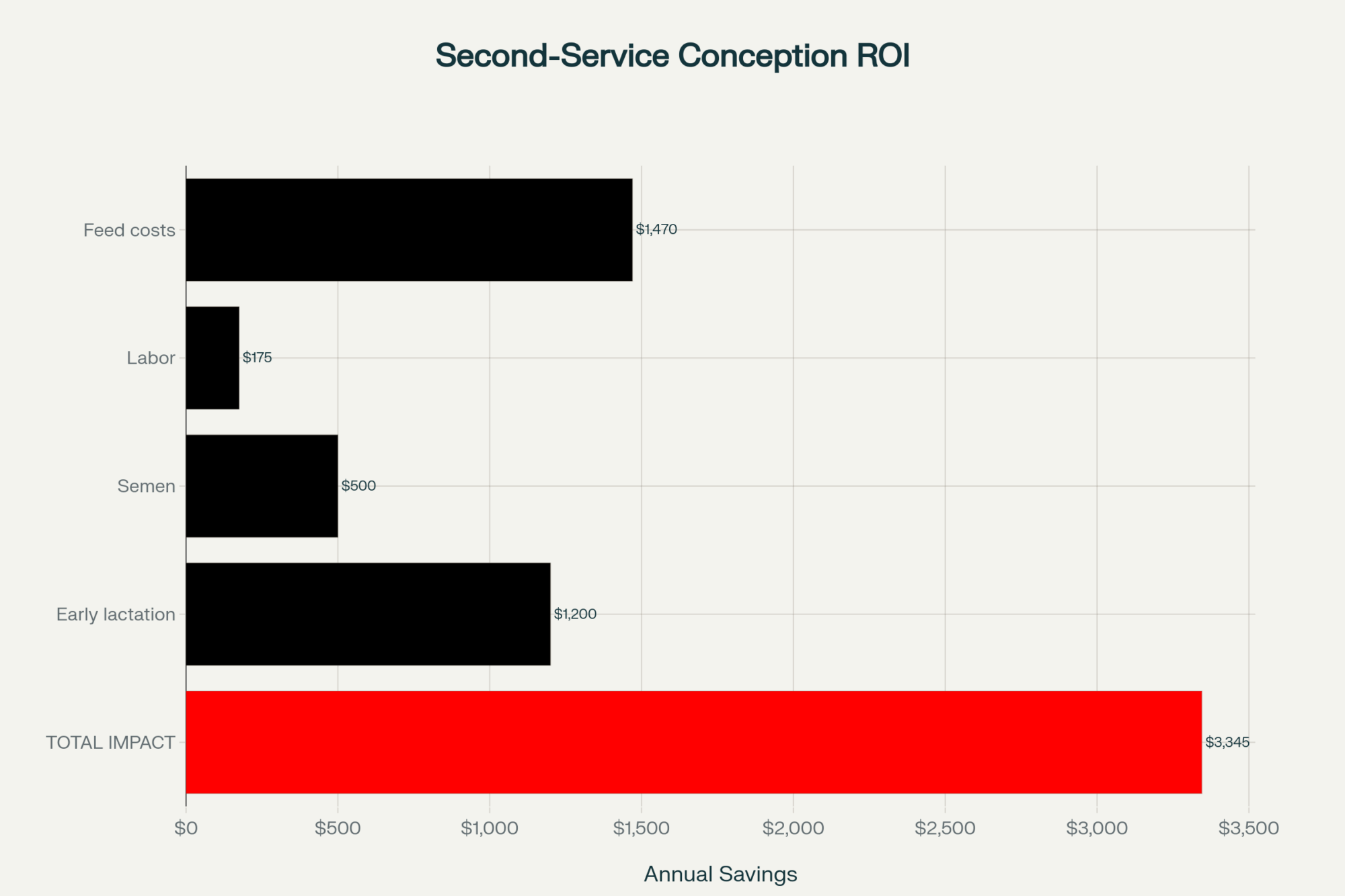
Let me walk through a realistic scenario based on current feed costs and industry averages. Say you’re running 200 heifers annually and improve second-service conception rates from 40% to 50%:
Estimated Direct Cost Savings:
- Feed costs avoided: 20 additional pregnancies × 21 days × $3-4/day = $1,260-1,680
- Labor reduction: 20 fewer cycles × handling time = $150-200
- Semen savings: 20 fewer straws × $20-30 = $400-600
Potential Revenue Gains:
- Earlier lactation (10-14 days): $1,000-1,400 lifetime value
Total Estimated Annual Impact: $2,800-3,900
These estimates are based on typical operations; your actual numbers may vary. But even conservative calculations show meaningful returns.
Global Insights Informing Local Solutions
What’s encouraging is how research from different systems worldwide is helping us better understand heifer reproduction. AgriHealth’s New Zealand studies show that properly synchronized heifers in seasonal systems conceive about 11 days earlier on average—and that translates to real milk in the tank regardless of your calving pattern.
Research at various institutions continues exploring CIDR protocol modifications. Studies suggest that optimizing timing for heifer-specific physiology can lead to meaningful improvements in pregnancy rates, though results vary by system and management.
Heat stress research reveals an interesting advantage for heifers—they generally maintain conception rates better than lactating cows during thermal stress, partly because they’re not dealing with the metabolic heat burden of milk production.
Looking beyond North America, European intensive systems have been exploring different approaches. Dutch operations, for instance, often achieve strong results with their highly standardized protocols, whereas Brazilian operations, which deal with tropical conditions, have adapted protocols for year-round heat stress management.
Regional Adaptations Across North America
Different regions are finding approaches that work for their specific conditions:
Many Upper Midwest operations report success through precise protocol timing, particularly that 60-66 hour AI window after CIDR removal. The cooler climate for much of the year certainly helps with conception rates as well.
Down in the Southeast, heat stress management becomes critical. Operations increasingly recognize that cooling systems for heifers—whether shade, fans, or sprinklers—have become essential for maintaining summer reproduction.
California operations, dealing with unique environmental regulations and housing systems, often find that intensive management of smaller heifer groups yields better results than large-pen standardized protocols.
And in the Northeast, where many operations are smaller and more labor-intensive, combining visual heat detection with simplified synchronization protocols often aligns better with management style.
Implementation Strategies by Scale
Here’s what generally works at different operation sizes:
Small Operations (50-200 heifers): These farms often have the advantage of closer animal observation. Even basic improvements in timing and protocol compliance can yield meaningful results. Dr. Carlos Risco, who spent over 25 years at the University of Florida before becoming dean of Oklahoma State’s veterinary college, often emphasized that regular veterinary involvement—even just monthly visits focused on the heifer program—typically pays for itself through improved reproductive outcomes.
Mid-Size Operations (200-800 heifers): This scale often offers the best return potential. You’re big enough that small percentage improvements multiply into real dollars, but not so large that implementation becomes unwieldy. A 5% conception improvement on 500 heifers? That’s 25 additional pregnancies at today’s values.
Large Operations (800+ heifers): At this scale, systematic approaches become essential. It’s not just about conception rates—it’s about creating predictable, repeatable processes that reduce labor while improving outcomes. Small inefficiencies compound quickly when you’re dealing with these numbers.
Custom Heifer Raisers: These operations face unique pressures in managing animals from multiple sources. Industry consultants often note that consistency across diverse genetics matters more than peak performance on specific bloodlines—a protocol that works reasonably well across all genetics is more effective than one that excels in some and fails in others.
Technology Integration: Finding What Works
Research suggests that activity monitoring systems can significantly improve heat detection rates compared to visual observation alone. But honestly? I’ve seen numerous operations achieve excellent results with chalk, tail paint, and good observation.
Dr. Jeffrey Stevenson from Kansas State University, who’s done extensive protocol research, often reminds producers that the best protocol is the one you can execute consistently—not necessarily the most sophisticated on paper.
What matters is having a system you’ll actually use. Some farms thrive with high-tech monitoring. Others do better with traditional methods executed well. There’s no shame in either approach.
Emerging technologies, like in-line milk progesterone testing and automated heat detection through image analysis, are showing promise in research settings. However, for most operations, the fundamentals still matter most: consistent protocol execution, accurate record-keeping, and attention to detail.
Industry Trends Reshaping Reproduction
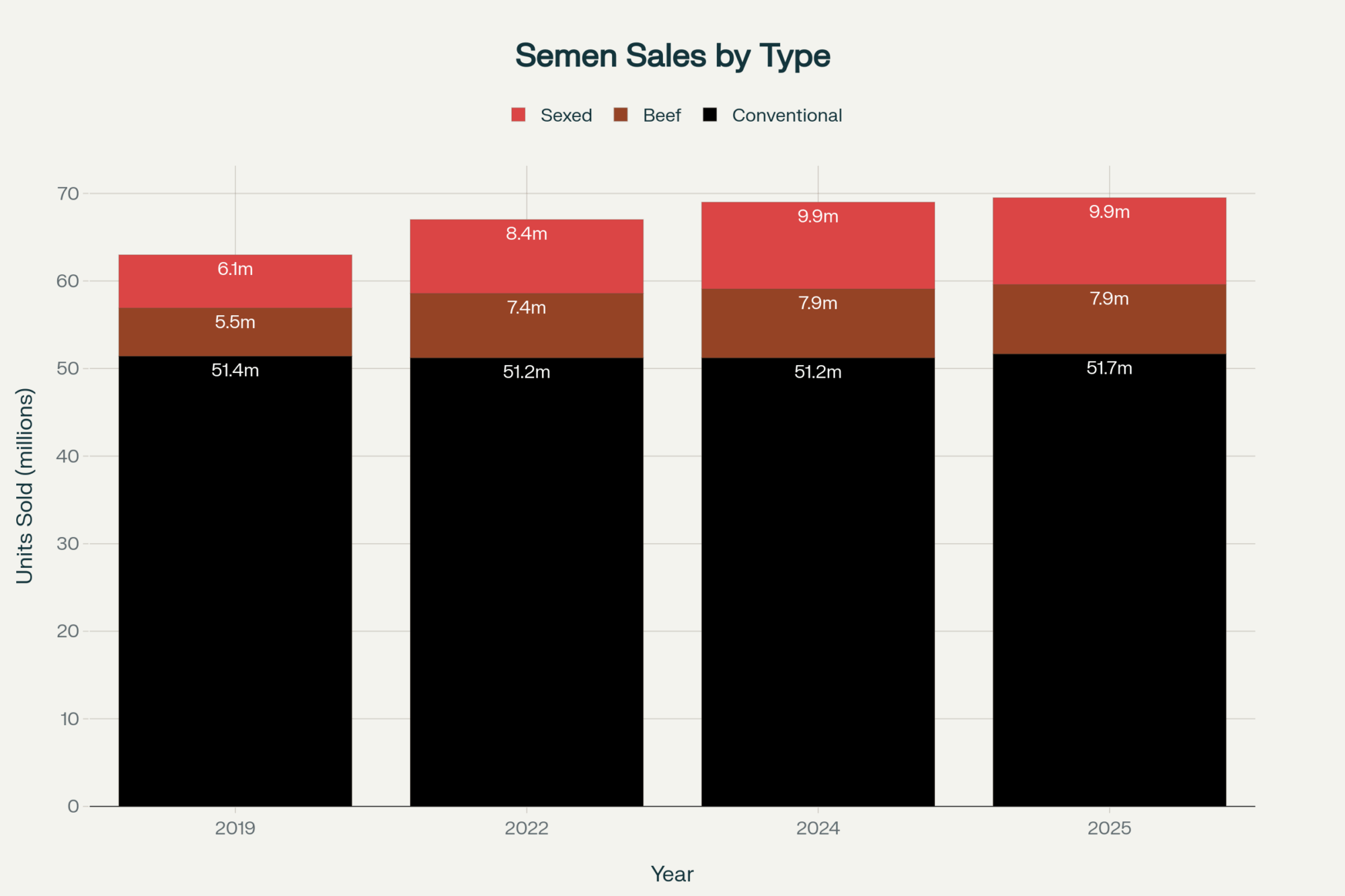
The latest NAAB report tells us where the industry’s heading:
- Gender-sorted semen sales: 9.9 million units (up nearly 18%)
- Additional sexed semen used: 1.5 million units year-over-year
- Beef semen in dairy herds: 7.9 million units (holding steady)
- Total bovine semen sales: 69 million units (up 4%)
And you know what’s driving this? Economics. Wisconsin market reports show that beef-cross calves consistently bring premiums of $200-$400 over Holstein bull calves. When beef-cross calves sell for over $1,000 and Holstein bulls bring $700-1,075, being strategic about which heifers produce replacements and which get beef semen changes the whole equation.
The genomic revolution is adding another layer to this. Operations using genomic testing to identify their best heifers for replacements can be more strategic with sexed semen use, maximizing genetic progress while managing inventory costs.
Critical Protocol Adjustments
Research from Wisconsin and other universities suggests specific heifer modifications that make a real difference:
- 7-day CIDR insertion protocols tend to work well
- Prostaglandin at CIDR removal (day 7)
- AI timing: 60-66 hours post-removal works better than the 72 hours typically used in cows
Dr. Richard Pursley from Michigan State, who developed the original Ovsynch protocol, has done extensive work on GnRH optimization. Research suggests that adjusting GnRH doses for heifers versus cows may improve results—it’s these small adjustments that can shift outcomes from mediocre to excellent.
Some operations are also finding success with modified pre-synchronization approaches. Adding a prostaglandin treatment 14 days before starting the breeding protocol can help ensure more heifers are at the right stage of their cycle when you begin.
Environmental Considerations and Sustainability
Here’s something that doesn’t get discussed enough: improved heifer reproduction also has environmental benefits. When heifers calve earlier and have longer productive lives, you’re reducing the carbon footprint per unit of milk produced. With sustainability becoming a bigger factor in milk pricing and consumer perception, this matters more than ever.
Operations achieving higher conception rates require fewer replacement animals overall, resulting in less feed, less manure, and less methane per gallon of milk sold. It’s a win for both the bottom line and environmental stewardship.
Looking Forward: What This Means for Tomorrow’s Dairy
Dr. Milo Wiltbank from Wisconsin, after decades studying bovine reproduction, observes that we’re entering an era where precision management—tailoring protocols to specific animal groups—will increasingly separate profitable operations from those just getting by.
With heifer inventories at 20-year lows and CoBank projecting no recovery until 2027, getting reproduction right isn’t optional anymore. The combination of biological understanding, economic pressure, and better breeding tools creates both challenges and opportunities.
What’s interesting is that success doesn’t require revolutionary technology or expensive interventions. It’s about understanding heifer biology, applying protocols consistently, and making strategic breeding decisions. The 18% jump in sexed semen usage tells us the industry’s already moving this direction.
Looking ahead, the integration of precision livestock farming tools—from automated weight monitoring to real-time health tracking—will likely make heifer management even more precise. But the fundamental principle remains: heifers aren’t small cows, and managing them as such leaves money on the table.
Operations that recognize heifers as metabolically distinct animals—not small cows—and adjust accordingly will capture significant advantages. Those sticking with one-size-fits-all approaches… well, the economics are getting tougher every year.
The fundamental lesson here is pretty straightforward: sometimes the most valuable improvements come from applying what we already know more precisely. Heifers have different needs than cows because they’re growing, not lactating. Respect those differences through tailored protocols, and reproduction shifts from a persistent challenge to a competitive advantage.
And maybe that’s what this whole shift is really about—not discovering something entirely new, but finally applying what the biology has been telling us all along. The operations that listen to that message and adapt their management accordingly? They’re the ones positioned to thrive in tomorrow’s dairy industry.
As we face tighter margins and higher replacement costs, the difference between average and excellent heifer reproduction might just be the difference between surviving and thriving. The tools are available, the science is clear, and the economics are compelling. The only question now is how quickly each operation can adapt to this new reality.
KEY TAKEAWAYS:
- Timing adjustment delivers 10% conception boost: Switch from 72-hour to 60-66 hour AI timing after CIDR removal—Wisconsin research shows this simple change alone can improve pregnancy rates by 5-10 percentage points, worth approximately $73.50 per heifer per avoided cycle
- Double your prostaglandin effectiveness: Heifers achieve only 65-70% complete luteolysis with single treatment versus 90%+ in cows—adding a second PGF shot 14 days before breeding protocol starts ensures more heifers respond properly
- Scale determines strategy, not technology: Small farms (50-200 head) profit most from improved observation and monthly vet checks; mid-size operations (200-800) see best ROI from protocol refinement; large operations (800+) need systematic approaches that reduce labor while improving outcomes
- Beef-cross premiums change the equation: With Wisconsin markets showing $200-400 premiums for beef-cross calves over Holstein bulls, using sexed semen on your best heifers and beef on the rest maximizes both genetic progress and cash flow—explaining why sexed semen sales jumped 18% in 2024
- Regional adaptations matter more than ever: Southeast operations must prioritize cooling systems for summer breeding; Upper Midwest farms can focus on protocol precision; California’s environmental regulations favor intensive small-group management—what works in one region might fail in another
Complete references and supporting documentation are available upon request by contacting the editorial team at editor@thebullvine.com.
Learn More:
- Replacement Economics: Why Raising Your Heifers Just Became Profitable Again – This article provides a comprehensive economic analysis of the current market, using specific USDA and Canadian data to show why the “buy vs. raise” equation has flipped. It delivers a deeper dive into the cost breakdown of home-raised heifers versus market prices, helping producers make a strategic financial decision.
- The Heifer Shortage: Crisis and Opportunity – This piece expands on the market forces driving the heifer shortage, including a look at why the beef-on-dairy trend, while profitable for cash flow, is creating a long-term supply problem for replacements. It offers strategic planning and risk management advice for navigating a future of high-priced heifers.
- 6 Game-Changing ID Technologies Every North American Dairy Farm Needs Now – This article explores how technology can support and enhance a heifer management strategy. It moves beyond basic reproduction to discuss how advanced ID systems, like smart boluses and camera-based monitoring, can provide the precise data needed to optimize a heifer program, offering a clear ROI on tech adoption.
 Join the Revolution!
 Join the Revolution!
Join over 30,000 successful dairy professionals who rely on Bullvine Weekly for their competitive edge. Delivered directly to your inbox each week, our exclusive industry insights help you make smarter decisions while saving precious hours every week. Never miss critical updates on milk production trends, breakthrough technologies, and profit-boosting strategies that top producers are already implementing. Subscribe now to transform your dairy operation’s efficiency and profitability—your future success is just one click away.




