







18 farms fell. Three families stayed. On Washington’s Enumclaw Plateau, the dairies that survived didn’t find better math—they found different kinds of courage.
There’s a moment in every dairy farmer’s life when a sentence changes everything.
For Troy Wallin, it came somewhere between the 4 AM milking and the sunrise he’d watched from that same Enumclaw barn since he was eight years old, standing on wooden blocks his father had built just so he could reach the cows.
“I stay in it because it’s my passion; it’s all I ever knew,” Troy told Dairy Star in January 2026. “My boys have been by my side, so it’s like, I don’t want to get out, but I can’t keep taking the hits.”
What moved me most about that quote wasn’t the defeat in it. It was the love. The way you can hear a father weighing his dreams against his sons’ futures. The way a man who’s been dairying since 1988 still calls it his passion in the same breath he admits it’s breaking him.
That’s the kind of honesty that takes courage—courage most people never understand.
Eighteen Empty Barns
Drive the Enumclaw Plateau today, and you’ll pass ghosts.
When Ryan and Haylee Mensonides started their dairy here in 2012, King County Field Notes reports there were 22 dairy farms scattered across this stretch of Washington. After just over a decade, 18 of them had ceased operations. Troy Wallin, talking to Dairy Star, counts six dairy farms still operating in his immediate area.
Six.
Each of those missing sixteen operations had a family behind it. Kids who grew up chasing barn cats between the stanchions. Couples who sat at kitchen tables running numbers that wouldn’t run right. Grandparents who watched generations of work slip away.
And here’s what strikes me every time I think about it: the families who stayed aren’t staying because the math got easier. They’re staying because they found something inside themselves—or inside each other—that the spreadsheets couldn’t measure.
What’s happening on this plateau isn’t unique to Washington. Progressive Dairy’s 2024 statistics show the United States now has roughly 26,000–27,000 licensed dairy herds, down about 5% from just a year ago. At current exit rates, that number could fall toward 20,000 by 2028. Every one of those vanishing numbers represents a family making the hardest decision of their lives.
This is the story of three who chose differently. Three families. Three completely different paths. And one plateau that taught them all the same brutal truth: survival in 2026 dairy isn’t about finding the right answer. It’s about having the courage to make a choice before circumstances make it for you.
Troy: The Night Before Everything Changed
Troy Wallin’s father, Bob, didn’t have money when he started dairying in 1962. What he had was determination and a willingness to do A.I. work all over the area, sometimes getting paid in heifer calves when neighbors couldn’t afford cash.
That’s how the Wallin dairy began. One calf at a time. One act of faith at a time.
Troy grew up in that faith. He told Dairy Star he remembers those wooden blocks his dad built so an eight-year-old could reach the udders. He remembers going full-time right after high school, running a trucking business on the side, building the operation cow by cow, the same way his father had.
By early 2026, the Wallins were running 320 conventional cows through a double-9 herringbone parlor. Troy was farming about 350 acres for his own feed and doing custom crop work on another 2,000 acres for neighbors who needed the help.
From the outside, it looked like success.
From the inside, Troy was drowning.
The processor deductions kept carving into his milk check. The new Federal Milk Marketing Order producer price differential was making conventional farming—as Troy described it to Dairy Star—”financially impossible” for his family. A 27-acre parcel they used to rent was being developed into 86 homes. And every season, he wrestled with the same unforgiving reality: eight to twelve inches of soil over clay, no permanent irrigation, and a market that didn’t care how hard he worked.
What I’ve learned talking to farmers facing these crossroads is that the decision rarely comes in a moment of clarity. It comes in a moment of exhaustion. It comes at the end of a day when you’ve done everything right, and the numbers still don’t work.
Troy didn’t give up. He pivoted.
The Courage to Become Something New
By mid-February 2026, Troy planned to sell his conventional herd. Not because he was leaving dairy—but because he was transforming it.
He’d signed with Organic Valley. He’d already been transitioning heifers on certified ground he’d rented specifically to manage the transition cost. His first organic heifers would calve around early April, and he was targeting about 200 organic cows instead of 320 conventional cows.
The economics, as he described them to Dairy Star, looked completely different. He expected his organic pay price to be roughly three times what he’d been getting for conventional milk. He anticipated cutting hauling costs by around $5,000 per month under the new contract.
But here’s what the numbers don’t capture: What does it feel like to sell a herd you’ve spent decades building? What conversations happened around that kitchen table? What did Troy’s boys say when they realized their father was betting everything on a new path—not abandoning the dream, but reinventing it?
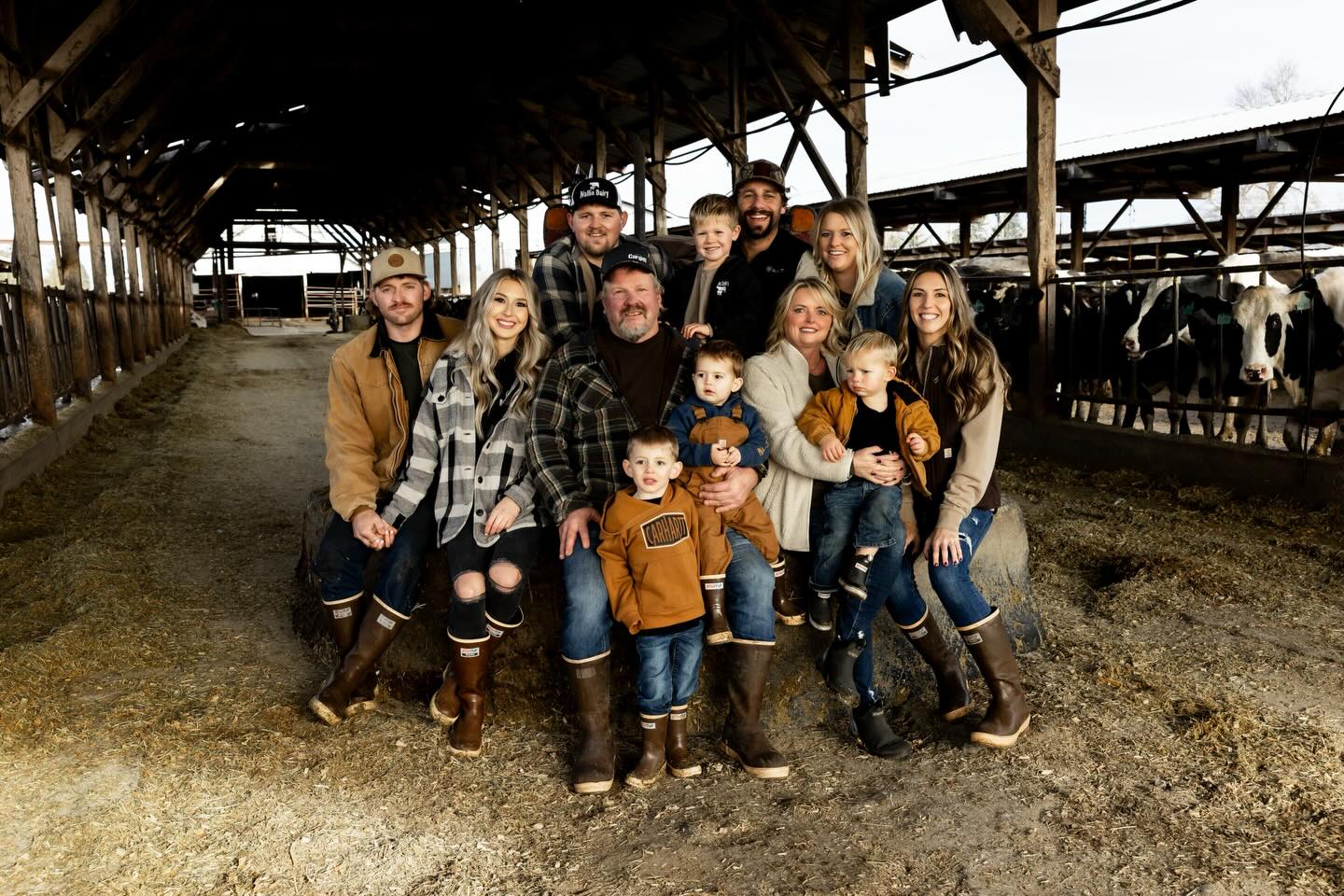
Those moments never make it into the articles. But every dairy family who’s faced a similar crossroads knows exactly what they feel like.
Troy’s choice wasn’t surrender. It was the hardest kind of hope—the kind that requires letting go of what you’ve been to become what you might still be.
Haylee: The Morning the Door Opened
Fifteen miles away, a different kind of courage was taking shape.
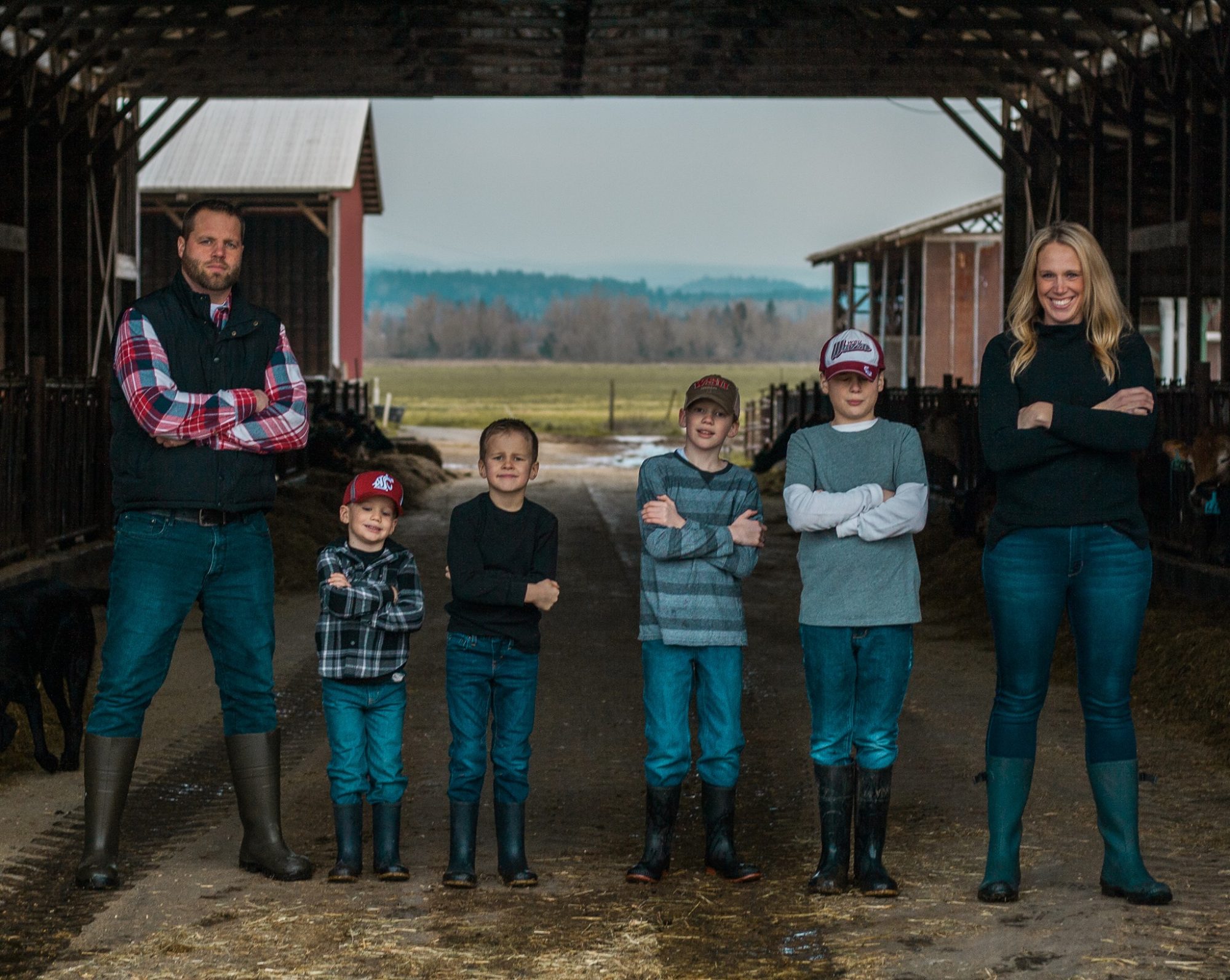
Ryan and Haylee Mensonides built their dairy from scratch in 2012—starting organic from day one, raising Jersey cows while raising four young boys. For years, they did what most dairy families do: shipped their milk off the farm and hoped the check would be enough.
But somewhere along the way, Haylee started dreaming bigger.
What if their milk could have a face? What if the community that drove past their farm every day could actually taste what they were building?
On October 19, 2024, according to KIRO7, they opened Mount Rainier Creamery & Market—a small storefront situated off Highway 410 in Buckley. Inside, you’ll find bottled milk and cream made fresh from their Enumclaw dairy, soft-serve ice cream using a dairy mix from Edaleen Dairy, handcrafted coffee from Dillanos Coffee Roasters, and products from local farmers and artisans. The Mensonides chose Jersey cows deliberately—the breed’s naturally higher butterfat and protein made their signature soft-serve possible. As KIRO7 noted, Jerseys produce creamier dairy products. That gives them a story to tell.
What I witnessed in Haylee’s words to King County Field Notes was something beautiful: “As we have gotten started, we have been amazed daily by our customers. We love our products, but to see others come visit and love them too is so exciting.”
You can hear the wonder in that. The nervous joy. The gratitude of someone who took a massive risk and watched it become something real.
She added that they hope to give back to the community in all the ways the community has supported them.
That’s not business strategy. That’s a family finding its purpose.
The Extraordinary Weight of Showing Up
Starting a creamery sounds romantic until you realize what it actually requires.
You’re not just a milk producer anymore. You’re a retailer. A marketer. A customer service operation. You’re the face people see when they walk through the door, which means every hard day, every sleepless night, every worry about whether you made the right choice—all of it has to stay behind a smile.
But the real story isn’t about the cows. It’s about a young couple with four boys who looked at an industry that’s pushed out 18 of their neighbors and said, “We’re not leaving. We’re building something new.”
That takes a kind of courage that doesn’t get celebrated enough.
Mike and Leann: The Ones Who Stay
Not every path requires dramatic reinvention.
Krainick Dairy has been an Enumclaw fixture since 1912—over a century of early mornings, uncertain markets, and the quiet persistence that keeps a farm alive. Mike and Leann Krainick are third-generation now, carrying the weight their grandparents first shouldered when Mount Rainier’s shadow fell on brand-new barns.
In 2020, King County recognized them with the John D. Spellman Legacy Business Award. The honor celebrated what the Krainicks had built: an operation deeply woven into the community’s fabric. As King County TV documented, their cows’ milk ships to local grocery stores. Their cow-manure fertilizer goes to gardeners across the region. Their herd eats leftover mash from local breweries.
What the awards don’t capture is what it feels like to drive past farms you remember as thriving operations, now silent. The Krainicks have watched this plateau empty out around them—and kept showing up anyway.
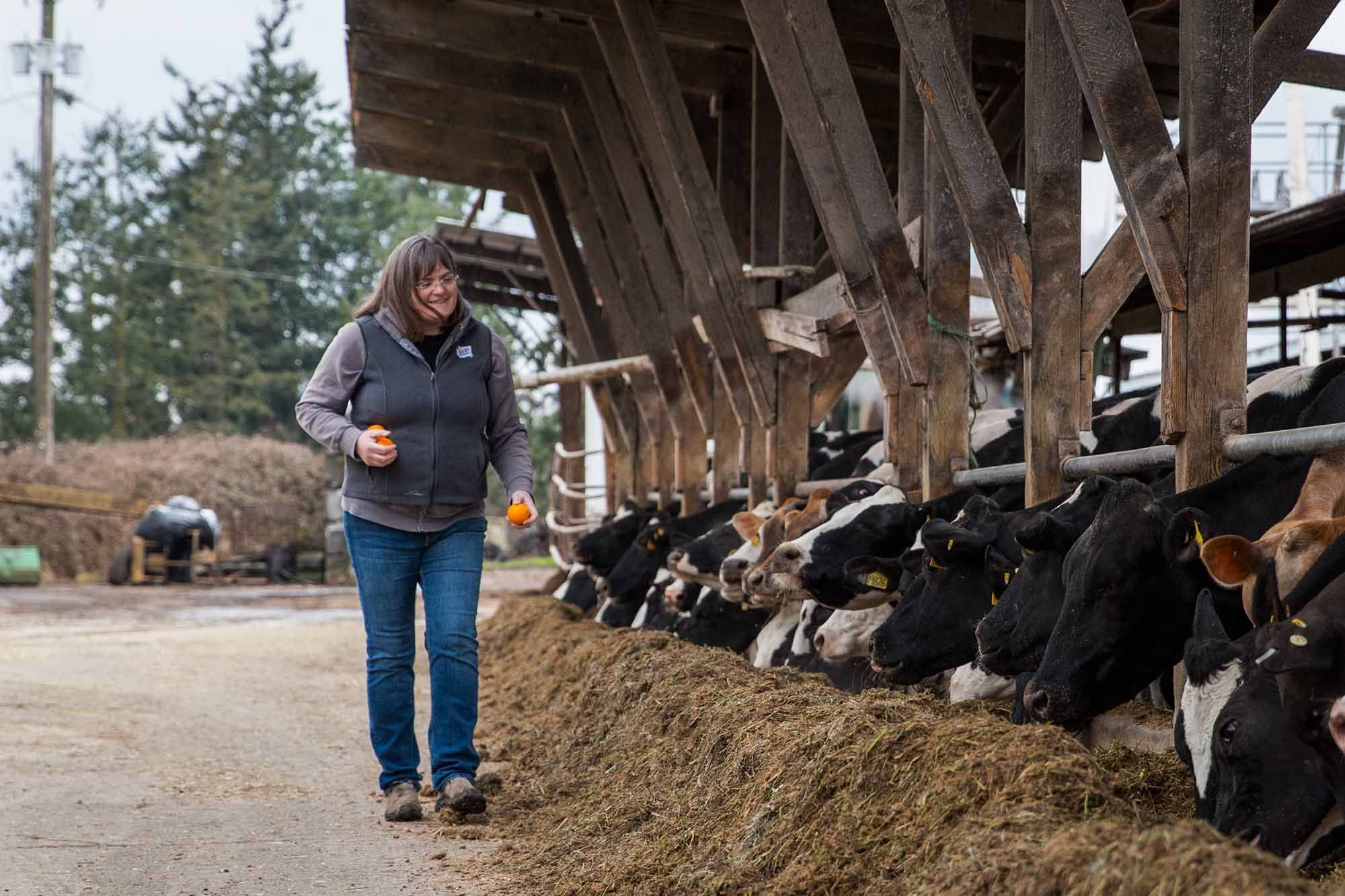
Photo: Krainick Dairy
It’s not flashy. It’s not disruptive. It’s something rarer: sustainable.
What I’ve noticed about operations like this is that their survival depends less on any single brilliant strategy than on something harder to quantify. Accumulated relationships. Diversified revenue streams. The willingness to modernize inch by inch rather than in one terrifying leap.
And most critically: a next generation that says yes.
Every time someone inherits a century-old farm, they’re accepting early mornings that never end, capital decisions that keep them awake, and the constant question of whether they’re honoring their grandparents while protecting their children.
The Krainicks keep saying yes. That’s its own kind of extraordinary.
The Grief Nobody Warns You About
Here’s what rarely gets spoken in articles like this: the grief.
When Troy Wallin watches that conventional herd load onto trailers—cows he’s known individually, cows his boys helped raise—there will be a moment that feels like failure, even though it isn’t. Even though it’s the bravest thing he could do.
When the Mensonides locked their creamery door that first night, hands still shaking from the rush of customers, there was probably a moment of terror alongside the joy. What if it doesn’t last?
And the Krainicks, watching sixteen neighboring farms go dark over a decade? That’s survivor’s guilt—the particular ache of making it when people you’ve known your whole life couldn’t. No business school teaches you how to process that.
The families who make it through this era aren’t the ones who don’t feel the weight. They’re the ones who feel it fully and keep moving anyway.
What These Three Families Taught Me
Standing back and looking at the Wallins, the Mensonides, and the Krainicks, I see something that matters far beyond the Enumclaw Plateau.
Each of them faced the same brutal reality: mid-size conventional dairy, as we’ve known it, is vanishing. The plateau these families farm is a preview of what’s coming everywhere.
But here’s what’s inspiring: they didn’t accept the ending the market wrote for them. They wrote their own.
Troy chose transformation—organic certification, a smaller herd, and a completely different milk check. The Mensonides chose connection—a storefront that turns their Jersey herd into a community gathering place. The Krainicks chose persistence—the patient, generation-spanning commitment to being so deeply rooted that storms can’t tear you out.
All three paths are legitimate. All three require different resources, different risk tolerances, and different family conversations that probably lasted longer than anyone expected.
None of them are easy. But all of them are possible.
| The Path | The Family | What They Faced | What They Built |
| Transformation | Wallin | Math that stopped working | A smaller organic herd with Organic Valley—triple the pay price |
| Connection | Mensonides | Milk without a face | Mount Rainier Creamery—where customers know the family |
| Persistence | Krainick | 112 years of uncertainty | Deep roots that outlast every storm |
For the Farmer Reading This at 2 AM
If you found this article because you’re lying awake wondering whether you can keep going, I see you.
Maybe your numbers look like Troy’s did. Maybe you’ve been quietly researching organic certification, direct-to-consumer, or exit strategies, feeling like even googling those things is some kind of betrayal.
It isn’t.
The first step is the hardest: sitting down with the numbers you’ve been avoiding and being honest about what they’re telling you. Not the story you tell the banker. The real one. The one that includes your own unpaid hours and the equipment you’ve been afraid to look at too closely.
The second step is finding someone who won’t just tell you what you want to hear. A spouse who’ll sit with the hard truth. A lender who’s seen other families through transitions. Or another producer who’s already walked through the fire and can tell you what it actually feels like on the other side.
The third step is mapping three possible paths—stay as-is, transform how you produce, or plan an exit on your terms—and asking yourself honestly: Which one would I regret not trying?
You don’t have to decide tonight. But you deserve to see your choices clearly. You deserve to make the call before circumstances make it for you.
And you deserve to know that whatever you decide, it doesn’t erase what you’ve built. It doesn’t diminish the mornings, the sacrifice, or the love you’ve poured into ground that doesn’t always love you back.
What the Mountain Keeps Watching
Mount Rainier catches the first light every morning, regardless of which barns below it are still full of cows.
It watched Bob Wallin build a parlor in 1962 and get paid in heifer calves because neighbors believed in him. It watched the Krainicks’ grandparents bet everything on this plateau a century ago. It watched Ryan and Haylee Mensonides pour their savings into a creamery and wait, hearts pounding, to see if anyone would come.
The mountain doesn’t care about milk prices, Federal Orders, or processor deductions. But the people who farm in its shadow—they care about each other. They remember the families who left. They celebrate the ones who found a way to stay.
What Troy Wallin is doing right now—selling the herd he built to become something new—that’s not giving up. That’s the purest form of hope there is.
What the Mensonides built in that little storefront off Highway 410—that’s not just a business. It’s a declaration that small farms can matter, that local food means something, that community is worth fighting for.
What the Krainicks represent after 112 years—that’s not just history. It’s proof that persistence, done right, can outlast everything the market throws at you.
The Bottom Line
Somewhere on the Enumclaw Plateau right now, a boy might be standing on wooden blocks to reach the cows. Maybe he’s a Wallin. Maybe he’s someone else entirely. Maybe he doesn’t know yet that he’s learning something no classroom could ever teach him.
The plateau lost most of its dairies. But the ones that remain?
Against all odds, they’re still here. Still milking. Still believing.
And they’re showing the rest of us what courage actually looks like.
Key Takeaways:
- 18 farms fell. Three families stayed. The Enumclaw Plateau proves survival isn’t about finding better math—it’s about choosing your path before the market chooses for you
- Organic can transform your milk check: Troy Wallin expects triple the pay price and $5,000/month in hauling savings after transitioning 200 cows to Organic Valley—but he made the move proactively, not desperately
- In direct-to-consumer, story matters as much as product: The Mensonides’ Mount Rainier Creamery turned their Jersey herd into a community gathering place where customers know the family behind the milk
- Legacy is earned daily, not inherited: Krainick Dairy’s 112 unbroken years prove that persistence—paired with deep community roots and diversified revenue—can outlast any market cycle
- The question that opens everything: Stop asking “Can we survive this?” Start asking “Should we keep doing it this way?” The second question leads to different answers.
Which path resonates with your operation? Share your thoughts in the comments or join the conversation on Facebook.
Executive Summary:
Troy Wallin stood on wooden blocks to reach the cows when he was eight. Forty years later, he told Dairy Star he “can’t keep taking the hits”—then chose transformation over surrender. On Washington’s Enumclaw Plateau, where 18 of 22 dairies have vanished since 2012, three families found survival paths the spreadsheets said didn’t exist. Troy is transitioning to organic with Organic Valley. The Mensonides opened Mount Rainier Creamery, turning their Jersey herd into a community gathering place. The Krainicks marked 112 years by refusing to be the generation that quits. Their stories reveal what courage actually costs in 2026 dairy—and offer a roadmap for every producer who’s lying awake wondering what comes next.
Note on Sources: This profile was compiled using investigative reporting from Dairy Star (January 2026), KIRO7 News, and King County Field Notes. The Bullvine honors the resilience of these families as documented across the regional agricultural press.
Continue the Story
- Trembling Hands, A Decade of Faith, 200 Fewer Cows: Three Paths to the Same Truth – This breeder’s journey echoes Troy Wallin’s, proving that choosing a smaller, more intentional herd size isn’t a retreat. It’s a brave pivot for families who’ve wrestled with the same question: how do we stay?
- The $16/CWT Reality: Why Mid-Size Dairies Can’t Out-Work Structural Economics – And What Actually Works – To understand the ghosts on the Enumclaw Plateau, you have to see the invisible economic walls shaped by the same forces that nearly broke Troy. This deep-dive reveals why passion alone can’t beat the math.
- The Quiet Revolution: Two Young Dairy People Who Refused to Choose Between Love and Survival – Like the boys watching from Troy’s parlor, a new generation is redefining the path forward. These young leaders prove the story carries forward, showing that survival often requires reinventing what it means to be a dairy farmer.
 Join the Revolution!
 Join the Revolution!
Join over 30,000 successful dairy professionals who rely on Bullvine Weekly for their competitive edge. Delivered directly to your inbox each week, our exclusive industry insights help you make smarter decisions while saving precious hours every week. Never miss critical updates on milk production trends, breakthrough technologies, and profit-boosting strategies that top producers are already implementing. Subscribe now to transform your dairy operation’s efficiency and profitability—your future success is just one click away.




