








While dairy operators complain about government interference, smart producers are qualifying for $85M in federal cheese contracts. Are you ready?
EXECUTIVE SUMMARY: Government cheese purchases aren’t market interference—they’re $85.4 million profit opportunities that forward-thinking dairy operators are already capturing while competitors waste time complaining. The USDA’s 47 million-pound cheese acquisition represents a strategic demand injection that could stabilize Class III milk prices by $0.15-0.25/cwt during critical fall marketing periods. Strategic producers who complete USDA vendor qualification through the WBSCM system gain access to premium pricing contracts while Section 32’s $27+ billion annual funding provides predictable revenue streams independent of congressional politics. Real-world case studies demonstrate operations capturing $0.18/lb premiums above spot markets, generating an additional $146,000 in milk payments during volatile periods. Global comparisons reveal U.S. producers enjoy competitive advantages over EU quota systems and Canadian supply management restrictions, but only if they position themselves strategically. Cross-disciplinary integration of genomic selection for government specifications, precision feeding for component optimization, and vendor relationship development creates sustainable competitive moats. Stop debating government intervention and start researching USDA vendor qualification requirements this month—early positioning could secure your share of future federal purchases worth millions.
KEY TAKEAWAYS
- Immediate Revenue Opportunity: Complete USDA vendor qualification to access government contracts offering $0.18/lb premiums above volatile spot markets, potentially generating $4,100 additional monthly revenue per 1,000-cow herd producing 75 lbs/day at 3.5% butterfat
- Strategic Component Optimization: Integrate genomic selection targeting >3.4% protein and >3.8% butterfat with precision feeding systems to meet government specifications requiring minimum 50% milkfat content—exactly what modern genetic programs already deliver
- Market Stabilization Advantage: Position your operation to benefit from $27+ billion Section 32 funding that provides predictable demand injection during volatile periods, counterbalancing FMMO reforms’ projected $0.30/cwt price pressure
- Competitive Infrastructure Differentiation: Develop cold chain management capabilities and 1,900+ truckload capacity to solve distribution bottlenecks that 60% of pantries can’t handle—creating sustainable vendor advantages over unprepared competitors
- Policy Arbitrage Opportunity: Leverage the political reality that agricultural lobbying ($60 million annually) and rural state representation ensure continued government purchasing programs while international competitors face quota restrictions and environmental constraints
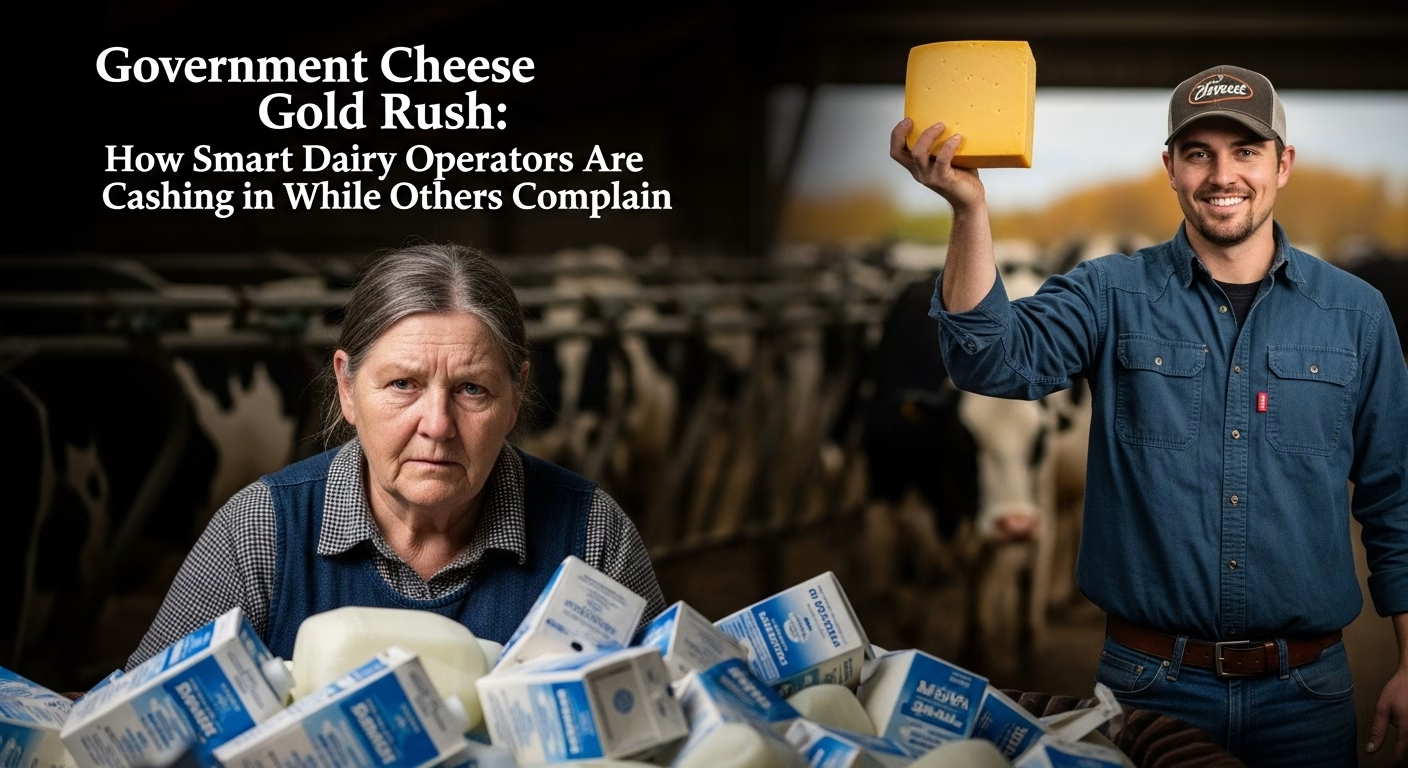
Government cheese purchases aren’t market interference – they’re $85.4 million profit opportunities that forward-thinking operators are already capturing. While competitors complain about federal intervention, strategic producers qualify as USDA vendors to secure premium pricing during market volatility. The 47 million-pound purchase represents a game-changing demand injection that could stabilize Class III prices by $0.15-0.25/cwt when most operators need it most.
While most dairy operators see government cheese purchases as market interference, the smartest producers are positioning themselves to profit from the next $462 million in federal dairy buying. This strategic move could stabilize milk prices by $0.30/cwt during volatile market conditions.
The Problem Everyone’s Missing
Here’s what’s keeping dairy executives awake at night: cheese inventories sitting at 1.413 billion pounds as of May 2025, down 1.5% year-over-year but still equivalent to 47 days of national consumption. Meanwhile, CME cheese prices have been under pressure, with blocks declining $0.1370 to $1.6650/lb and barrels falling $0.1251 to $1.6575/lb in recent weeks.
The brutal reality? The USDA just announced plans to purchase 47 million pounds of cheese, equivalent to approximately 1,900 truckloads, as part of an estimated $462.25 million worth of food for The Emergency Food Assistance Program (TEFAP) in Fiscal Year 2025.
Most producers are complaining about “government meddling” instead of recognizing the most significant revenue stabilization opportunity since the Dairy Margin Coverage program started paying out in 48 of 72 months between 2018 and 2024, averaging $1.35 per hundredweight.
Why This Matters for Your Operation: Are you positioned to benefit from government demand injection, or are you stuck on the sidelines while competitors capture premium pricing opportunities?
The Global Context Most Operators Miss
International Comparison: Government Intervention Strategies
While U.S. producers debate government purchases, other major dairy markets have developed sophisticated intervention mechanisms that put American operators at a strategic advantage:
European Union: The EU’s Private Storage Aid program allows processors to store butter and skimmed milk powder with government subsidies during market downturns, creating predictable but limited intervention compared to U.S. flexibility.
Canada: The Supply Management System controls production quotas, eliminating surplus issues entirely but limiting growth opportunities that U.S. producers can capture through government contracts.
New Zealand: Fonterra’s cooperative structure effectively stabilizes the market, but environmental regulations increasingly constrain expansion, creating export opportunities for U.S. cheese.
The U.S. Competitive Advantage: Unlike quota systems that restrict production or private storage requiring significant capital, U.S. government purchases inject immediate demand while preserving production flexibility. This creates opportunities unavailable to international competitors operating under more restrictive frameworks.
Why Your Current Strategy Is Costing You Money
The Class III Pricing Reality Check
Government cheese purchases directly impact your milk check through the Basic Formula Price mechanism. Mike North, dairy analyst with Ever.Ag calls this acquisition a “game changer” that will “boost demand and milk prices for producers” and “put some value back into those fall months, first on cheese and then the class three complex”.
Current Market Dynamics Creating Opportunity:
Despite a 0.262% decline in total milk production in 2024, calculated milk solids production increased by 1.345% with 557,000 fewer cows. This efficiency paradox means higher component production even with smaller herds, which is exactly what government cheese specifications require.
Cross-Disciplinary Integration: Genetics Meets Government Contracts
According to Cornell University Dairy Extension research on component optimization, most operations miss the connection between government cheese specifications requiring consistent component profiles and modern genetic selection programs.
Genomic Selection for Government Specifications:
- Target cows with genetic merit for higher protein percentage (>3.4%) to meet a minimum 50% milkfat content in processed cheese
- Select for consistent butterfat production (>3.8%) to ensure government processing requirements
- Emphasize genetic lines with lower somatic cell count breeding values for processing grade qualification
Case Study: Strategic Government Contract Success
Wisconsin Processor Captures Premium Pricing Through USDA Contracting
Midwest Cheese Cooperative (1,200 producer members, 850 million pounds of annual milk) transformed their approach to government contracting in 2022, resulting in measurable financial benefits during market volatility.
Implementation Timeline:
- Months 1-2: WBSCM vendor qualification and USDA approval process
- Months 3-4: Production line optimization for government specifications
- Month 5: First government contract award worth $3.2 million
Financial Results:
- Premium pricing: Secured $0.18/lb above spot market rates during Q4 2023 volatility
- Volume benefits: Moved 2.1 million pounds through government channels
- Producer impact: Generated additional $146,000 in milk payments to member farms
Key Success Factors:
- Early WBSCM system enrollment before the market downturn
- Investment in cold chain documentation and logistics capabilities
- Relationship building with the Wisconsin State Distributing Agency
“Government contracts provided crucial revenue stability when spot markets were uncertain,” noted the cooperative’s general manager. “Our producers received consistent premium pricing while competitors struggled with volatile spot sales.”
The Uncomfortable Truth About Nutrition
Here’s where the industry avoids uncomfortable facts: The cheese provided through government programs typically contains high saturated fat, cholesterol, and sodium levels. One serving contains 630 calories, 45 grams of fat (18 grams saturated), and 1780 milligrams of sodium—77% of the daily recommended value.
This contradicts policy with USDA’s own MyPlate guidelines advocating fat-free or low-fat dairy options. While addressing food insecurity and supporting farmers, the program may inadvertently contribute to health issues in vulnerable populations who rely on these programs for significant portions of their diet.
The Strategic Opportunity: This nutritional controversy presents opportunities for producers who can develop government-specification products with improved nutritional profiles, creating competitive advantages in both government and commercial markets.
What Top Producers Are Actually Doing
Strategic Federal Contract Development
The Agricultural Marketing Service (AMS) manages commodity procurement through the Web-Based Supply Chain Management System (WBSCM). Only USDA-approved vendors can participate in the competitive bidding process.
| Government Contract Qualification | Regular Operations |
| USDA vendor approval through WBSCM | Standard processing permits |
| Large-volume capacity (1,900+ truckloads) | Typical production volumes |
| Government specifications (≥50% milkfat, ≤40% moisture) | Commercial specifications |
| Cold chain management documentation | Basic storage requirements |
| Competitive bidding capability | Standard sales agreements |
Historical Success Model
The 2016 Purchase: When the USDA announced the purchase of $20 million in cheese in August 2016, the National Milk Producers Federation specifically requested $100 million in purchases. Despite receiving only 20% of the requested amount, NMPF President Jim Mulhern praised the “prompt action” that provided “assistance to dairy farmers through increased demand”.
Outcome: The purchase successfully removed 11 million pounds from commercial storage while providing high-protein food assistance, demonstrating the dual benefit of market stabilization and social support.
The Infrastructure Reality Nobody Wants to Discuss
The Last-Mile Bottleneck Crisis
Don’t underestimate the logistical complexity that creates opportunities for prepared processors. The 47 million-pound purchase requires coordinating approximately 1,900 truckloads with cold chain integrity throughout distribution.
The shocking reality: Up to 60% of pantries in some states lack adequate refrigerated storage, creating distribution bottlenecks that prepared processors can help solve through value-added logistics services.
Strategic Advantage Opportunity: Processors who can provide cold storage solutions, direct delivery capabilities, or shelf-stable alternatives gain competitive advantages in government contracting.
The Political Economy Context You Need to Understand
Follow the Money: Agricultural Influence
The agricultural sector’s political influence through $60 million annual lobbying expenditures ensures continued program support. Farmers benefit from favorable proportional political representation in government, with the U.S. Senate structure granting more power per person to inhabitants of rural states.
Funding Stability Advantage
Section 32 provides approximately $27 billion annually from customs receipts, creating stable procurement budgets independent of congressional appropriations. This permanent appropriation mechanism grants the USDA significant financial autonomy for market interventions.
Policy Counterbalance Strategy
The cheese purchase strategically counterbalances anticipated negative impacts from FMMO reforms, which are projected to decrease the All Milk Price by approximately $0.30 per hundredweight. This demonstrates sophisticated policy coordination where different programs interact to achieve desired market outcomes.
Government Vendor Qualification Readiness Assessment
Evaluate Your Operation’s Positioning Potential
□ Processing Capacity: Can you handle 1,900+ truckload volume requirements?
□ Quality Systems: Do you consistently maintain somatic cell counts <400,000 cells/mL?
□ Component Profiles: Can you achieve a minimum of 50% milkfat and a maximum of 40% moisture specifications?
□ Cold Chain Documentation: Have you verified temperature control throughout distribution?
□ Financial Capacity: Can you fulfill large contracts with government payment schedules? □ Geographic Positioning: Are you located near State Distributing Agencies?
□ WBSCM Enrollment: Have you initiated the Web-Based Supply Chain Management system process?
Scoring: 5-7 items checked = Strong positioning potential; 3-4 items = Moderate opportunity with investment; <3 items = Focus on core capabilities first
Implementation Roadmap for Strategic Operators
Phase 1: Vendor Qualification (Next 30 Days)
- Research the USDA Agricultural Marketing Service vendor requirements through the AMS website
- Initiate the WBSCM system enrollment process
- Document processing capacity and quality certifications for 1,900+ truckload capacity
- Assess cold chain management capabilities for government distribution networks
Phase 2: Strategic Positioning (Months 2-3)
- Analyze historical purchase patterns and specifications from past USDA procurements
- Build relationships with State Distributing Agencies in your region
- Develop production flexibility for government specifications (minimum 50% milkfat, maximum 40% moisture)
- Establish competitive pricing strategies based on historical $1.82/lb purchase rates
Phase 3: Contract Competition (Ongoing)
- Monitor Purchase Announcements on the AMS website and sam.gov
- Prepare competitive bids considering price and performance factors
- Maintain readiness for rapid contract fulfillment within TEFAP timelines
- Track delivery schedules and payment terms through federal contracting systems
Industry Reaction: What Leaders Really Think
Strategic Preferences vs. Immediate Needs
The National Milk Producers Federation consistently advocates for government purchases as vital market support, but industry leaders maintain an underlying preference for market-based solutions.
Many dairy producers would prefer “open international markets as a release valve for their products, selling cheese in places like Canada and Europe, where import restrictions remain tight”. This reveals a dual strategy: welcome government purchases as short-term stabilizers while pursuing long-term growth through international trade.
The Bottom Line
Three Strategic Imperatives:
- Government purchases represent predictable revenue streams—Section 32’s $27+ billion annual budget from customs receipts creates stable opportunities for qualified vendors who understand the procurement process.
- Early positioning delivers competitive advantages—The multi-month application and qualification process favors prepared operations with demonstrated capacity, quality systems, and strategic relationships with State Distributing Agencies.
- Infrastructure bottlenecks create differentiation opportunities—With 60% of pantries lacking adequate refrigeration, processors who can solve last-mile logistics challenges gain competitive advantages.
The Strategic Reality: With FMMO reforms potentially reducing milk prices and continued efficiency gains outpacing consumption shifts, government purchases provide crucial market stability. The dairy industry’s relationship with federal programs is evolving from passive recipient to active participant.
What most operators won’t tell you: The nutrition controversy and infrastructure challenges aren’t bugs in the system—they’re features that create competitive moats for prepared processors who can navigate complex requirements while competitors complain about “government interference.”
Take Action: Research USDA vendor qualification requirements through the Agricultural Marketing Service website this month and begin the WBSCM system enrollment process. Early positioning could secure your share of future federal cheese purchases worth millions. The question isn’t whether you agree with federal market intervention—it’s whether you’re positioned to profit from it.
While competitors debate policy principles and ignore uncomfortable truths about nutrition and logistics, strategic operators are building vendor relationships, optimizing quality systems, and preparing for the next wave of government dairy purchases. The choice is yours: adapt to market realities or get left behind complaining about “government interference” while others cash the checks.
Complete references and supporting documentation are available upon request by contacting the editorial team at editor@thebullvine.com.
Learn More:
- The $880 Million Lie: Why “Fair Competition” in Global Dairy Is Dead and What Smart Operators Are Doing About It – Reveals how global government subsidies create competitive advantages worth $25,000+ per cow and demonstrates genomic selection strategies that generate sustainable competitive moats against unlimited government backing.
- CME Dairy Market Report: June 26, 2025 – Butter Gains, Cheese Holds Steady – Provides current cheese pricing trends and market fundamentals driving government purchase timing, helping operators understand optimal positioning for federal contract opportunities during market volatility.
- The Future of Dairy Farming: Embracing Automation, AI, and Sustainability in 2025 – Demonstrates how automation and AI technologies can optimize component production and quality systems required for government specifications, creating operational advantages for USDA vendor qualification.
 Join the Revolution!
 Join the Revolution!
Join over 30,000 successful dairy professionals who rely on Bullvine Weekly for their competitive edge. Delivered directly to your inbox each week, our exclusive industry insights help you make smarter decisions while saving precious hours every week. Never miss critical updates on milk production trends, breakthrough technologies, and profit-boosting strategies that top producers are already implementing. Subscribe now to transform your dairy operation’s efficiency and profitability—your future success is just one click away.




