Archive for dairy trade tariffs

The Dairy Apocalypse of 2025: Why Your Milk Check Is Disappearing and Who’s Profiting from It

Milk prices crash 15% as trade wars erupt & new policies gut profits. Can dairy farmers survive 2025?

EXECUTIVE SUMMARY: US dairy faces a perfect storm in 2025: Plummeting milk prices (USDA slashes forecasts by $1.50/cwt), crippling tariffs locking exporters out of China/Mexico, and FMMO reforms reinstating $millions from producers to processors. HPAI outbreaks rage unchecked, while tight heifer supplies, and policy inertia expose farmers. Survival demands radical shifts-optimizing components over volume, aggressive risk management, and treating biosecurity as profit protection.

KEY TAKEAWAYS:

  • Milk checks nosedive: 2025 prices projected at $21.10/cwt (-15% from 2024), with Class IV hit hardest (-$2.55).
  • Trade wars backfired: 135% Chinese tariffs and Mexico/Canada retaliation threatened $1+/cwt price drops.
  • FMMO “modernization” = wealth transfer: Higher processors make allowances slash farm payouts, favoring fluid-heavy regions.
  • HPAI is the new normal: 1,000+ herds are infected, production losses are up to 15%, and no vaccine will be until 2026.
  • Adapt or collapse: Component-focused feeding, blended risk strategies, and biosecurity investments separate survivors from casualties.

dairy market outlook 2025, US milk prices, dairy trade tariffs, FMMO modernization, HPAI dairy cattle

The 2025 dairy industry faces a perfect storm that nobody wants to discuss. Milk prices are in free fall, with USDA slashing forecasts by $1.50/cwt in just 90 days. Meanwhile, bureaucrats are ramming through FMMO “reforms” that will drain millions from producers’ pockets through bloated make allowances, all while government-imposed trade wars lock us out of our most valuable export markets. And if that wasn’t enough, HPAI continues to ravage herds nationwide, with regulators pretending they’ve got it under control. The days of $23 milk and $4 corn are dead and buried.

The data doesn’t lie, folks. After riding high on record-breaking $16/cwt margins in late 2024, dairy producers are staring at a financial cliff in 2025. Let’s cut through the spin and get to the ugly truth about what’s happening to your milk check this year.

Your Disappearing Milk Price

Remember February, when USDA economists confidently projected a 2025 all-milk price of $22.60/cwt? That number has evaporated faster than dew on a summer morning in Texas. By March, it mysteriously dropped to $21.60. The latest May forecast? A pathetic $21.10/cwt.

That’s not a rounding error – it’s a $1.50/cwt heist in just 90 days. For a 500-cow dairy producing 25,000 pounds per cow annually, we’re talking about $187,500 in vanished income. When’s the last time an “adjustment” cost you nearly $200K?

Every month this year, USDA forecasters have slashed their milk price predictions while offering zero explanation for why they got it so wrong the month before. This isn’t meteorology, where predictions naturally become more accurate over time – it’s economics, and this pattern of consistent downward revisions reveals either incompetence or a deliberate attempt to mask how bad things are getting.

Look at what’s happening to your milk check:

Price Indicator2024 (Actual/Est.)2025 (Latest Forecast)Change
All-Milk Price$22.61/cwt$21.10/cwt-$1.51
Class III Price~$19.00/cwt$17.60/cwt-$1.40
Class IV Price$20.75/cwt$18.20/cwt-$2.55

The spotty good news? Feed costs remain relatively stable. But don’t celebrate yet – the projected declines in milk prices will still outpace any savings on your feed bill. It’s like finding a nickel in the parlor drain the same day your milk truck jackknifes on the highway.

The Trade War Nobody’s Talking About

While economists drone on about “shifting market fundamentals,” they’re tiptoeing around the elephant in the milking parlor: we’re in an unprecedented trade war systematically dismantling decades of market development.

In March, the administration unleashed a barrage of new tariffs – 25% on nearly all imports from Mexico and Canada and escalating rates on Chinese goods. Did anyone bother to ask dairy farmers if they wanted to sacrifice their export markets on the altar of immigration politics? The predictable result? Swift and severe retaliation targeting US dairy:

  • China slapped additional tariffs of 10-15% on US dairy products, pushing effective rates to an eye-watering 135%
  • Mexico announced its retaliatory measures against US goods
  • Canada immediately hit back with tariffs on approximately $21 billion of US products

The impact has been immediate and devastating. Nonfat dry milk/skim milk powder exports have collapsed 20% year-over-year, while lactose exports are down 14%. The critical dry whey market faces crippling tariffs of 84% to 150% in China.

Here’s what dairy economists won’t say publicly: this isn’t a typical trade dispute – it’s a full-scale market destruction that could take a decade to rebuild. When’s the last time you heard industry leaders acknowledge this reality instead of offering tepid statements about “hoping for resolution”?

The timing couldn’t be worse. New domestic cheese processing capacity is coming online just as international markets are slamming their doors in our faces. With no place for this additional production, the pressure on domestic prices will only intensify.

This is pure politics trumping economics. According to industry analysts, each posturing speech about “getting tough” on trade costs dairy farmers real money – about /cwt in Class III prices alone. That’s not theoretical – that’s your mortgage payment.

FMMO Reform: The Great Dairy Robbery

After years of debate and months of hearings, the Federal Milk Marketing Order modernization takes effect on June 1st. But before you celebrate this “achievement,” you might want to check which side of the dividing line you’re standing on – because this reform is nothing short of a massive wealth transfer.

The most crucial change is getting the least attention: substantially higher make allowances for processors. These allowances are increasing to $0.2519/lb for cheese, $0.2272/lb for butter, $0.2393/lb for NDM, and $0.2668/lb for dry whey.

Let’s call this what it is: a direct transfer of money from farmers to processors. Higher make allowances mathematically reduce the milk price paid to farmers. Period. Industry representatives frame this as “necessary adjustments reflecting higher processing costs,” but the reality is simpler: processors get guaranteed margin relief while farmers bear all the market risk.

When processors face higher costs, they get an automatic adjustment. When your diesel or labor costs skyrocket, where’s your automatic adjustment? The hypocrisy is stunning, yet industry organizations dominated by processor interests have convinced farmers to vote for their financial disadvantage.

And here’s where it gets interesting. The net impact will vary dramatically by region:

  • If you’re producing milk in the Southeast, Florida, or Appalachia Orders where fluid utilization is high, congratulations – you’ll likely see a net benefit from these changes.
  • But are you in the Upper Midwest, Pacific Northwest, California, or Arizona? You’re about to get fleeced. The higher make allowances will hit you hard, while your region’s manufacturing-heavy utilization will dilute the benefits of Class I changes.

This regional disparity raises a fundamental question: Should dairy policy create winners and losers based on geography rather than efficiency? Does penalizing regions that have invested billions in creating efficient manufacturing infrastructure make sense? The data suggests that the FMMO changes reward location over innovation, potentially distorting signals for long-term industry development.

HPAI: The Disease They Can’t Control

While policymakers debate prices and tariffs, dairy farmers face a more immediate threat: the relentless spread of Highly Pathogenic Avian Influenza (HPAI) in cattle. Despite more than a year of intervention efforts, this crisis is accelerating, not receding.

As of April 2025, HPAI had been confirmed in dairy cattle on over 1,009 premises across 18 states – a dramatic increase from the 16 states reported in late 2024. The states with the highest number of affected herds include California (with approximately 765 affected herds), Idaho (65), Colorado (64), Michigan (31), and Texas (27).

The most alarming finding? Scientists have identified multiple viral strains, confirming at least two spillover events from wild birds into dairy herds. This means the threat isn’t just from cattle movement – even operations with strict biosecurity remain vulnerable to environmental exposure from wild bird populations.

Why isn’t this front-page news? If a virus affecting food production had infected over 1,000 operations in any other industry, it would be deemed a national emergency. Yet HPAI has been normalized, with USDA officials repeating reassurances while case numbers climb.

The impact on affected farms is significant: reduced appetite, decreased milk production (estimated at 10-15% in clinical cases), and changes in milk consistency. While mortality rates remain relatively low, production losses can devastate farm economics.

California’s experience illustrates the scale of impact. In October 2024, the state’s milk production was down a dramatic 3.8% year-over-year, partly attributed to HPAI infections. As the virus spreads through 2025, similar production declines could emerge in other major dairy regions.

The USDA’s response, including the National Milk Testing Strategy and enhanced biosecurity recommendations, has failed to contain the spread. Let’s be honest about where we stand: regulators have shifted from containment to management after over a year. The virus is here to stay.

Breaking With Conventional Wisdom

Let’s challenge some sacred cows in the dairy industry:

1. The “Produce More” Mentality Is Dead

For decades, the standard advice during low-price periods has been to maximize production to spread fixed costs. This outdated thinking is financial suicide in today’s market. While the industry mantra has been “produce more to spread fixed costs,” the economic reality has fundamentally changed.

Instead of chasing volume, leading producers are pivoting to component optimization. With cheese prices showing relative strength compared to other products, farms focusing intensely on butterfat and protein percentages rather than raw volume are capturing premium returns despite lower overall prices.

“We’ve shifted from a volume mindset to a component value mindset,” explains one Wisconsin producer whose operation has maintained profitability despite the market downturn. “Our nutritionist now formulates rations to maximize component yield rather than total production. It’s completely changed our approach to feeding.”

Would you rather ship 80 pounds of 3.8% fat, 3.3% protein milk or 90 pounds of 3.5% fat, 3.0% protein milk? Do the math – the lower volume, higher component milk is worth significantly more in today’s market, with lower hauling costs.

2. Risk Management Isn’t Optional – It’s Essential

Too many producers still treat risk management as something only big dairies need to worry about. That mentality is financial suicide in today’s volatile market. The most successful operations have abandoned the all-or-nothing approach to risk management.

Instead of either fully contracting or staying completely exposed to the market, they’re employing blended strategies that combine:

  • Targeted contracts for specific periods based on margin opportunities
  • Strategic use of put options to establish price floors while maintaining upside
  • Maintaining a portion of production unhedged to capture potential market improvements

Think of risk management like your breeding program – you’d never breed your entire herd to a single bull with extreme traits. You select a group of sires with complementary strengths to manage genetic risk. Your marketing approach should follow the same diversified strategy.

What Smart Producers Are Doing Differently

Faced with falling milk prices, export disasters, policy upheaval, and disease threats, smart dairy farmers aren’t waiting for conditions to improve – they’re taking decisive action now:

1. Biosecurity as a Profit Center, not a Cost

Forward-thinking operations have reconceptualized biosecurity from a regulatory burden to a profit-protection strategy. These farms aren’t just implementing basic HPAI prevention measures; they’re treating disease prevention as a core business function with dedicated staff, regular training, and rigorous protocols.

“We’ve stopped thinking about biosecurity as something we do to satisfy regulators,” notes a California producer who has kept HPAI at bay despite being surrounded by affected operations. “Now we treat it like we treat cow comfort or nutrition – as a direct driver of profitability that deserves significant time and investment.”

Consider the return on investment: spending $15,000 on enhanced bird deterrents, boot wash stations, and dedicated equipment between pens might seem excessive until you calculate the $85,000 lost milk revenue from even a moderate HPAI outbreak in your herd. The prevention math suddenly looks compelling.

2. Feed Efficiency: The New Production Frontier

With milk prices falling faster than feed costs, the margin between the two is compressing rapidly. In response, innovative producers are doubling on feed efficiency programs that reduce production costs by $0.75-1.25/cwt.

These initiatives go far beyond basic ration balancing, incorporating:

  • Intensive forage quality programs that maximize digestibility
  • Precision feed management systems that reduce shrink and waste
  • Genomic selection specifically targeting feed conversion efficiency

“We can’t control milk prices, but we absolutely can control how efficiently our cows convert feed to milk,” explains a New York producer who has reduced feed costs by over $1/cwt in the past year. “That’s where our focus needs to be in this market.”

Every pound of feed lost to shrinkage, sorting, or spoilage is pure profit leakage. Are you treating your silage face management with the same precision you apply to your synchronization protocols? Both directly impact your bottom line.

The Bottom Line

The 2025 dairy landscape presents unprecedented challenges: systematically lower milk prices, destructive trade policies, confusing order reforms, and a persistent disease threat. The combined impact creates a perfect storm that will test even the most efficient operations.

Here’s what you need to understand:

  1. Official forecasts have consistently underestimated the severity of price declines – expect continued downward pressure through 2025 as export markets remain constrained and domestic production increases.
  2. The trade war is not a temporary disruption but a fundamental reshaping of market access that could take years to resolve – plan accordingly rather than hoping for a quick fix.
  3. FMMO changes taking effect mid-year will create significant regional disparities – understand exactly how they’ll impact your operation’s specific milk check calculation.
  4. HPAI remains uncontained and will continue to spread despite official intervention – investing in rigorous biosecurity isn’t optional but essential for financial survival.
  5. Component optimization, strategic risk management, biosecurity investment, and feed efficiency programs aren’t just marginal improvements but essential strategies for navigating this challenging environment.

Are you still operating with a 2023 mindset in a 2025 market? The rules have fundamentally changed. Those waiting for markets to “return to normal” will be waiting for a train never arriving. Instead of hoping for better days, take control of what you can influence: your components, your risk management, your biosecurity, and your feed efficiency.

The question isn’t whether conditions will improve – it’s whether you’ll still be in business when they do. The dairy industry has weathered difficult periods, but 2025 presents complex challenges. Success will require abandoning outdated assumptions, embracing uncomfortable realities, and implementing bold strategies that challenge conventional wisdom.

What are you changing today to ensure you’re still milking cows in 2026?

Learn more:

Join the Revolution!

Join over 30,000 successful dairy professionals who rely on Bullvine Weekly for their competitive edge. Delivered directly to your inbox each week, our exclusive industry insights help you make smarter decisions while saving precious hours every week. Never miss critical updates on milk production trends, breakthrough technologies, and profit-boosting strategies that top producers are already implementing. Subscribe now to transform your dairy operation’s efficiency and profitability—your future success is just one click away.

NewsSubscribe
First
Last
Consent

Dairy’s Perfect Storm: Market Mayhem Reshapes Farm Profitability in 2025

Dairy crisis 2025: Plummeting prices, trade wars & butterfat glut crush farmers—survival strategies to weather the storm inside.

Dairy market crisis 2025, milk price collapse, butterfat oversupply, dairy trade tariffs, dairy farm survival strategies

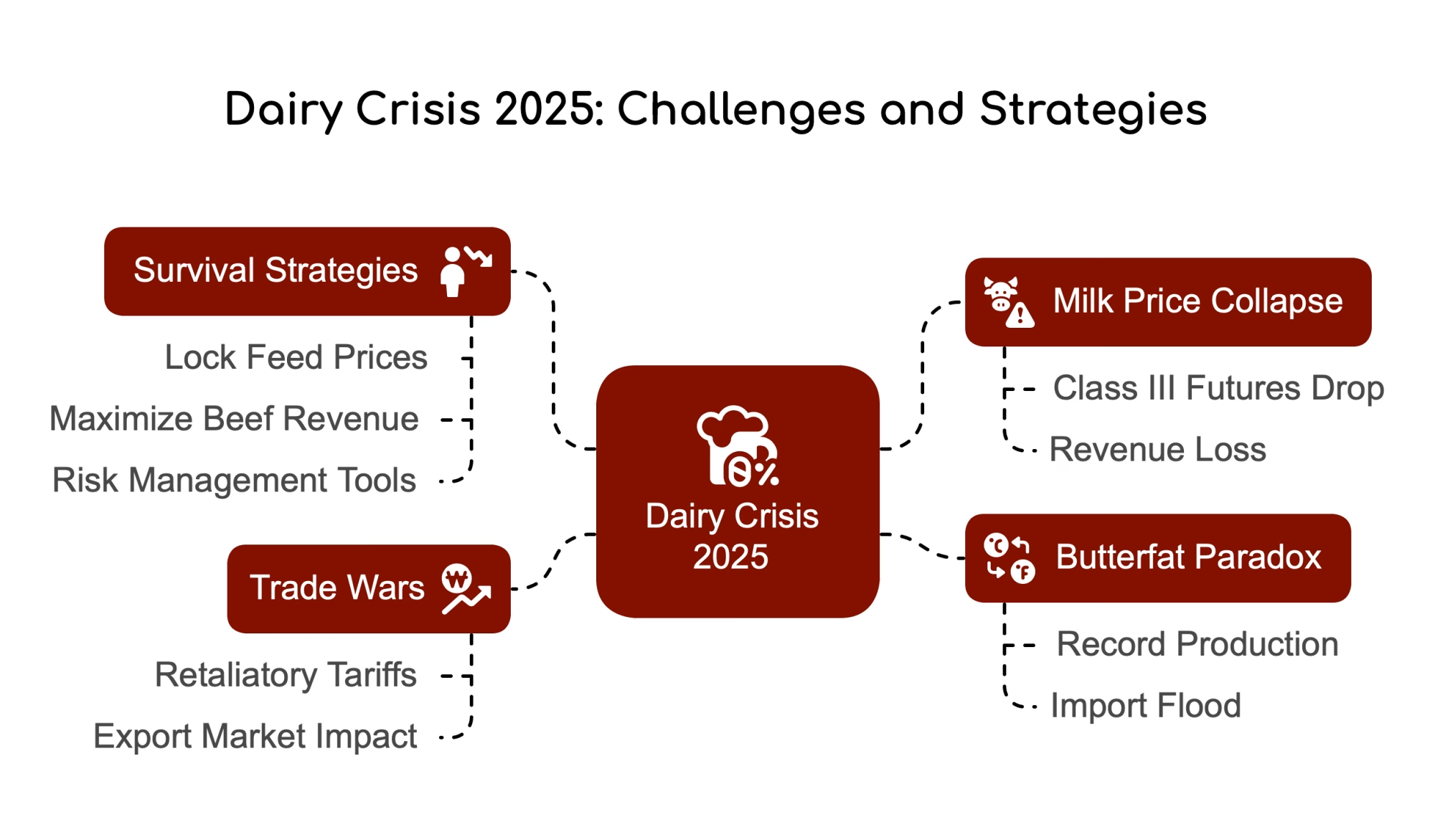
EXECUTIVE SUMMARY: U.S. dairy farmers face a triple threat in 2025: milk prices nosedived (Class III at $16.86/cwt, -15% since January), retaliatory tariffs slashed exports to key markets, and a butterfat glut from record-high components and surging imports. Feed cost relief offers limited respite, while beef-on-dairy breeding risks long-term herd shortages. Survival hinges on locking feed prices, maximizing beef revenue, and deploying risk management tools like DMC. Farmers must balance short-term cash flow with strategic herd planning to endure the downturn.

KEY TAKEAWAYS:

  • Milk price collapse: Futures dropped $2.50/cwt since January, erasing $25K/month for 1M-lb herds.
  • Butterfat paradox: 4.4% milk components + 172M lbs imported butter = price crash despite production success.
  • Feed relief: Corn ($4.20/bushel) and alfalfa ($210/ton) prices down 14% and 9%—lock savings now.
  • Beef-on-dairy gamble: 7.9M beef semen units sold in 2024 boost cash flow but risk 20-year lows in replacement heifers.
  • Risk management critical: Tools like DMC and Dairy-RP stabilize margins amid volatility.

The optimism of January has evaporated as plummeting milk prices, trade wars, and butterfat oversupply create unprecedented challenges for dairy producers. Yet, within this turbulence lie strategic opportunities for those who can adapt.

The Vanishing Promise of 2025

At the start of 2025, dairy farmers had every reason to feel optimistic. Domestic retail sales climbed $2 billion over the previous year to $78 billion, while restaurant sales surged from $93.7 billion in March 2024 to $97.6 billion by November 2024. Export markets were equally promising, with international cheese shipments growing by 17% to hit a record 1.13 billion pounds and overall dairy exports reaching .2 billion—second only to the .5 billion all-time high in 2022.

But that optimism didn’t last long. By February 2025, restaurant sales had dipped to $95.5 billion—a seven-month low—and escalating tariffs on U.S. dairy exports made international buyers hesitant. Meanwhile, U.S. dairy farmers continued producing record levels of components like butterfat and protein, further saturating the market and sending futures contracts into a tailspin.

“The current market downturn, following a period of relative optimism, may accelerate underlying industry trends,” notes Dr. Mark Stephenson, dairy economist at the University of Wisconsin-Madison. “Operations with weaker financial positions or higher production costs could face heightened pressure, potentially leading to further consolidation within the sector as more resilient farms find opportunities to expand.”

The Price Plunge: $2.50/cwt Vanishes Overnight

Milk prices have taken a nosedive in early 2025, erasing significant revenue for dairy farmers across the country and dropping by $2.57 per hundredweight (cwt), settling at an average between January and April of $16.86/cwt for April-to-June contracts. Class IV futures fell even further, losing $2.73/cwt during the same period.

Month/ContractClass III ($/cwt)Class IV ($/cwt)Key Event
Jan 2025 (Peak)$20.34$20.73Tariff talks begin
Feb 2025$20.18$19.90Restaurant sales dip
Mar 2025$18.62$18.21Retaliatory tariffs imposed
Apr-Jun 2025 Futures$16.86$17.77Record butter imports reported

Source: CME Group, USDA AMS

For farmers producing one million pounds of milk monthly, this price drop translates to roughly $25,000-$27,500 less revenue every month—a devastating hit to cash flow and profitability.

“A drop like this isn’t just numbers on paper—it’s a real gut punch when you’re trying to pay feed bills or make loan payments,” says John Newton, Chief Economist at the American Farm Bureau Federation.

Demand-Side Worries: Restaurants and Exports Falter

The food service sector—responsible for half of all dairy consumption—has shown troubling signs of weakening demand in recent months. Restaurant sales fell from $97 billion in December 2024 to $95.5 billion by February 2025, marking a noticeable decline as consumers tighten discretionary spending on dining out.

Export markets aren’t faring much better due to escalating trade tensions with key partners like Canada, Mexico, and China—countries that collectively account for half of U.S. dairy exports by volume and over 40% by value. Retaliatory tariffs imposed by these nations have made U.S.-produced dairy less competitive globally.

“This reliance on exports makes the U.S. dairy sector increasingly susceptible to geopolitical tensions and trade policy decisions,” explains Tom Vilsack, president and CEO of the U.S. Dairy Export Council.

The Butterfat Paradox: Record Production Meets Import Flood

U.S. dairy farmers have achieved remarkable success in boosting milk components over the years—average butterfat levels have climbed from 3.70% to 4.40% over two decades—but this triumph has created new challenges in today’s saturated market.

Metric2024 Value2023 ValueChange
U.S. Butterfat Production4.40% avg4.25% avg+0.15%
Butter Imports172M lbs118M lbs+46%
Butter Stocks (Dec)97M lbs90M lbs+7%
CME Butter Price (Apr ’25)$2.33/lb$2.89/lb-19%

Source: USDA Milk Production, USDA FAS

Despite record butterfat production domestically, processors are overwhelmed with cream supplies. At the same time, butter imports continue flooding into the U.S.—up 46% year-over-year from countries like Ireland and New Zealand.

“We’re drowning in cream while still importing butter—it makes zero sense,” says Mary Ledman, Global Dairy Strategist at Rabobank.

Beef-on-Dairy Strategy: Short-Term Gain vs Long-Term Risk

Many farmers have turned to beef-on-dairy breeding strategies to capitalize on strong beef markets while reducing reliance on low-value bull calves from traditional Holstein breeding programs.

Beef semen sales hit a record 7.9 million units in 2024—a clear sign that producers prioritize short-term cash flow over herd expansion.

“Beef prices are saving us right now—but replacement heifers are scarce as hen’s teeth,” warns Dr. Albert De Vries from the University of Florida.

While this strategy provides immediate financial relief through premium crossbred calves fetching up to $300 per head, it risks creating long-term shortages in replacement heifers for herd growth and sustainability.

The Bottom Line: Survival Strategies for Dairy Farmers

1. Lock In Feed Costs While Prices Are Low

Corn prices are down significantly at $4.20/bushel (-14% year-over-year), while alfalfa hay is averaging $210/ton (-9%). Securing feed contracts now can protect margins against future price volatility during summer droughts or other disruptions.

2. Milk Every Penny from Beef Markets

Strong beef prices provide a lifeline for cash flow through crossbred calves and cull cows—but balancing short-term gains with long-term herd needs is critical, given replacement heifer shortages.

3. Use Risk Management Tools

With milk prices tumbling—Class III futures averaging .86/cwt—programs like Dairy Margin Coverage (DMC) and Dairy Revenue Protection (Dairy-RP) are essential tools for stabilizing farm finances during volatile times.

“Risk management isn’t optional anymore—it’s survival,” says John Newton.

Learn more:

Join the Revolution!

Join over 30,000 successful dairy professionals who rely on Bullvine Daily for their competitive edge. Delivered directly to your inbox each week, our exclusive industry insights help you make smarter decisions while saving precious hours every week. Never miss critical updates on milk production trends, breakthrough technologies, and profit-boosting strategies that top producers are already implementing. Subscribe now to transform your dairy operation’s efficiency and profitability—your future success is just one click away.

NewsSubscribe
First
Last
Consent

U.S. Dairy Exports in February 2025: How Can Record Values Coexist with Plummeting Volumes?

Cheese exports boom 14% while NFDM crashes 28%: How U.S. dairy walks the tariff tightrope between record profits and market chaos.

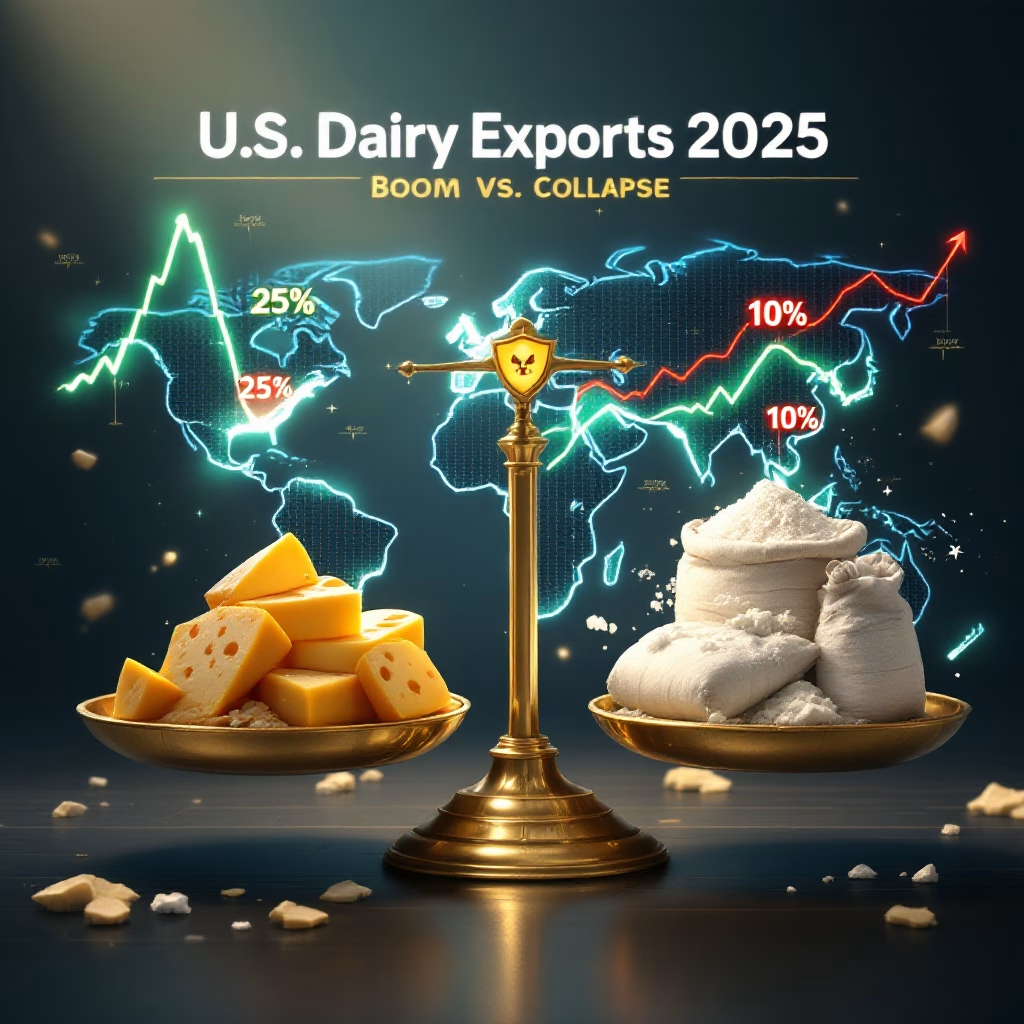
EXECUTIVE SUMMARY: February 2025 revealed a divided U.S. dairy export landscape: Cheese and butter shipments surged (14% and 126%, respectively) despite Canadian tariffs, while nonfat dry milk collapsed (-28%) amid global oversupply. Trade tensions with Canada and Mexico threaten $1.43B in exports as H5N1 protocols add logistical hurdles. Rabobank forecasts modest 0.8% global milk growth, intensifying competition. The article exposes how breed selection (Jerseys vs Holsteins), blockchain traceability, and premiumization strategies will determine winners in this high-stakes market reshaped by disease risks and protectionist policies.

KEY TAKEAWAYS

  • Value Over Volume: Cheese/butter exports now drive 63% of dairy export value growth
  • Trade War Fallout: Canada’s TRQ System Blocks $210M in Potential Annual U.S. Dairy Sales
  • Disease = Dollars: H5N1 testing delays cost exporters $18/lb in EU market penalties
  • Breed Calculus: Jerseys’ 5.86% ROI outpaces Holsteins in component-driven export markets
  • Tech Edge: Blockchain adoption boosts export margins 22% (DeGroot Dairy case study)
U.S. dairy exports 2025, cheese exports growth, NFDM market decline, dairy trade tariffs, H5N1 impact

The numbers tell a conflicting story: While U.S. dairy exports hit $723.5 million in February 2025 (an 8% annual increase), nonfat dry milk shipments cratered by 28%. Cheese and butterfat sales soar even as trade wars loom. What does this paradox mean for dairy farmers and global markets? Let’s dissect the chaos.

The Export Tightrope: Walking Record Values and Market Volatility

The U.S. dairy sector’s export performance in early 2025 resembles a high-stakes balancing act. Total export value surged to $1.43 billion in January-February (+14% year-over-year), yet volume declines in key categories reveal vulnerabilities.

The Mexico Factor: Stability Amidst Storm Clouds

Mexico retained its position as America’s top dairy buyer at $396.2 million (+10%) for January-February, but cracks emerged:

  • Cheese exports to Mexico fell 5% by volume despite global growth
  • Reliance on a single market now represents 27.7% of total U.S. dairy exports

“Any disruption in trade flow is troubling,” warns Jaime Castaneda of the National Milk Producers Federation. With 40% of exports flowing to Mexico and Canada, this concentration risk keeps analysts awake at night.

“President Trump isn’t going after the system of supply management as much as looking to dump surplus subsidized U.S. dairy products on the Canadian market,” counters Pierre Lampron, President of Dairy Farmers of Canada, highlighting the Canadian perspective on trade tensions.

Cheese & Butter: The Unlikely Heroes

Cheese Exports Break Barriers

MarketVolume (Million lbs)Change vs. 2024
South Korea25.6+40%
Japan19.2+10%
Australia13.0+37%
Canada8.4+19%

Source: USDA Foreign Agricultural Service, February 2025 Export Data

Cheese exports hit $223.7 million in February (+14% value), proving premium products can defy economic gravity. South Korea’s 40% volume surge reflects strategic market diversification.

“We had a record year in 2024 as a nation. We exported 1.1 billion pounds of cheese to other countries,” notes John Umhoefer, Wisconsin Cheese Makers Association Executive Director. “We like trade issues to get resolved as fast as possible. We like the free and fair trade to flow in both directions.”

Butter’s Shock Surge: 126% Volume Jump

Butter exports defied Canada’s 25% retaliatory tariffs, reaching 11.5 million pounds in February. “This isn’t your grandfather’s commodity market,” notes IDFA’s Becky Rasdall Vargas. “Innovative packaging and targeted marketing are unlocking new demand channels.”

The Powder Crisis: NFDM Exports Crash 28%

While cheese thrives, nonfat dry milk (NFDM) tells a different story:

February 2025 Powder Performance

  • NFDM: 106.9M lbs (-28%)
  • Whey Protein Concentrate: 21.3M lbs (-29%)
  • Lactose: 73.1M lbs (-7%)

Source: USDA FAS Export Data, February 2025

“Powders are the canary in the coal mine,” explains dairy economist Chuck Nicholson. “Trade disputes and global oversupply first hit them.” With China reducing imports (-4% to the Philippines), the U.S. faces a $210M quarterly powder shortfall.

H5N1 Testing Protocols: Impact on Export Compliance

The USDA’s National Milk Testing Strategy (NMTS), implemented in December 2024, has added a layer of complexity to exports. According to a USDA whistleblower report, delayed test results have impacted EU shipments, with some containers held at ports awaiting clearance.

“The D1.1 outbreaks in Nevada and Arizona were identified through silo testing before affected cattle developed clinical signs, providing evidence that the NMTS is working,” reports the American Veterinary Medical Association. This early detection system has prevented three potential outbreaks in February alone but has created logistical challenges for exporters facing tight shipping deadlines.

Trade Wars & Tariffs: The Double-Edged Sword

Canada’s TRQ System: Protectionism or Fair Play?

President Trump’s criticism of 250-390% Canadian dairy tariffs misses nuance. Under USMCA:

  • 85-100% of Canadian TRQs go to domestic processors
  • U.S. exports face 0% tariffs below quotas
  • 2024 saw $1.1B in duty-free U.S. dairy to Canada (+55% since 2020)

“By 2024, as a result of trade concessions, some 18% of our domestic milk production will be outsourced to dairy farmers in other countries at a time when Canadians are more aware than ever of the importance of ensuring our food security,” states Pierre Lampron of Dairy Farmers of Canada, highlighting concerns about the impact of trade agreements on Canadian producers.

“Our issue isn’t tariffs—it’s accessing the quotas,” clarifies Rasdall Vargas. Canadian processors dominate TRQ allocations, creating “invisible trade barriers.”

The Innovation Imperative: Data-Driven Dairy

DeGroot Dairy Case Study: Blockchain Implementation

Wisconsin’s DeGroot Dairy implemented blockchain traceability in 2024, resulting in a 22% increase in EU export margins. Their system tracks milk from individual cow groups through processing, providing verifiable documentation for export certification.

“Blockchain isn’t just buzzword technology—it’s solving real problems for our export program,” explains Sarah DeGroot, export manager. “When H5N1 testing requirements changed overnight, our digital documentation allowed us to adapt immediately while competitors were stuck with paperwork delays.”

5 Data Points Revolutionizing Exports:

  1. Real-time tariff impact modeling
  2. Blockchain traceability for premium markets
  3. Predictive analytics for H5N1 risk zones
  4. Dynamic pricing engines for cheese varieties
  5. Social media sentiment tracking in target markets

Bullvine’s 2024 investigation into farm data systems revealed top performers achieve 19% higher export margins through predictive logistics.

Global Market Context: Rabobank’s Outlook

Rabobank’s Q1 2025 Global Dairy Quarterly report titled “Modest growth amid trade shifts” provides a crucial context for U.S. export performance. The bank projects milk production in the Big Seven dairy-export regions to expand by 0.8% year-on-year for 2025.

“US supply expansion is expected in 2025, but it’s likely to be modest at sub-1%,” notes Michael Harvey, RaboResearch senior dairy analyst. This limited growth helps explain why export values remain strong despite volume challenges in some categories.

In contrast, Rabobank’s analysis of Northwestern Europe forecasts a potential 20% drop in milk production by 2035 unless the industry adapts. “To counterbalance the rising costs, companies should shift their focus on producing high-value dairy products,” recommends Richard Scheper, Rabobank dairy analyst, aligning with the U.S. shift toward value-added exports.

The Bottom Line: Navigating the New Dairy Geopolitics

Three make-or-break factors for 2025:

  1. Trade Agility: With 18% of U.S. milk production exported, rapid response to tariff changes is critical.
  2. Value-Add Focus: Cheese/butter growth proves premiumization beats commodity reliance.
  3. Disease Diplomacy: Transparent H5N1 management could become a market differentiator.

“This isn’t about surviving 2025—it’s about dominating 2030,” declares IDFA CEO Michael Dykes. As global dairy demand grows 2.3% annually, U.S. exporters must master this high-wire act.

Your Move: Will your operation chase volatile commodity markets or build value-added resilience? Share your strategy in the comments—the most innovative response wins a Bullvine analysis of your export potential.

Learn more:

Join the Revolution!

Join over 30,000 successful dairy professionals who rely on Bullvine Daily for their competitive edge. Delivered directly to your inbox each week, our exclusive industry insights help you make smarter decisions while saving precious hours every week. Never miss critical updates on milk production trends, breakthrough technologies, and profit-boosting strategies that top producers are already implementing. Subscribe now to transform your dairy operation’s efficiency and profitability—your future success is just one click away.

NewsSubscribe
First
Last
Consent

Weekly Global Dairy Market Recap February 3rd 2025: Tariffs Spark Market Upheaval

Trump’s 25% tariffs rocked the $1.2B North American dairy trade, creating market chaos as Asian buyers drive prices skyward while European markets crumble. With US heifer numbers at 47-year lows and feed costs volatile, dairy farmers face tough choices in a rapidly fragmenting global market. Here’s your survival guide.

 Summary:

Implementing a 25% tariff on North American dairy trade has significantly disrupted global markets, leading to regional price divergence, with European prices falling and Asian demand rising. This tariff has impacted $1.2 billion in US-Canada dairy trade, exacerbating supply constraints as US heifer numbers plummet to levels unseen since 1978. As farmers grapple with these pressures and volatile feed and input costs, the need for strategic adaptation has never been more pressing. Shifts in supply chains and market strategies will continue through Q2 as farmers navigate these unprecedented challenges worldwide.

Key Takeaways:

  • Global dairy markets experience significant shifts due to newly imposed 25% tariffs on North American dairy trade.
  • Regional price disparities widen, with European butter prices dropping and Asian Whole Milk Powder (WMP) prices rising.
  • US dairy production focuses on fat and protein content, slightly decreasing overall milk output.
  • Trade disruptions result in immediate market challenges, particularly for US exports to Canada and Canadian cheese surplus.
  • Feed and input costs show volatility driven by international weather conditions, affecting dairy farm operations.
  • Decreasing US dairy heifer numbers indicate potential future supply constraints.
  • Geopolitical developments necessitate strategic adjustments by dairy producers to navigate evolving market conditions.
dairy trade tariffs, North American dairy market, global dairy prices, US heifer numbers, dairy farmers survival strategies

Global dairy markets fracture as Trump’s 25% tariffs slam $1.2B trade.

Today’s implementation of 25% tariffs on North American dairy trade creates unprecedented market disruption, just as regional price gaps hit record levels. Here’s what dairy farmers need to know.

Market Splits Deepen 

Regional price differences hit record levels, creating both threats and opportunities:

RegionProductChangePrice
European UnionButter+0.5%€7,471
 SMP+0.4%€2,517
 WMP+0.9%€4,313
Asia-PacificWMP+2.5%$4,012
 SMP+0.2%$2,976
 AMF+0.2%$6,734
United StatesButter-9.75¢$2.4325/lb
 Cheddar+4.5¢$1.8775/lb
 Dry Whey-5.75¢$0.64/lb

While Asian buyers drove WMP up 2.5% to $4,012/tonne, European butter futures plunged 2.3% to €7,109/tonne last week. As inventories swell, US butter crashed to $2.43/lb, an 18-month low. These widening regional price differences create both threats and opportunities for strategic farmers. 

Production Landscape 

Global milk production shows dramatic regional shifts as farmers adapt to new market realities:

RegionVolume ChangeMilk solidsKey Driver
US-0.5% YoY+1.6%Component Focus
New Zealand+1.0% YoY+2.3%North Island Surge
Australia-1.1% YoY-1.1%Labor Costs
Italy+1.1% YoY+1.9%EU Subsidies

US milk output dropped 0.5% in December despite component levels jumping 1.6%, showing farmers focusing on fat and protein content over volume. New Zealand collections rose 1.0%, with the North Island showing a 1.9% increase, outperforming the South Island. Australian farmers struggled with a 1.1% decline, though season-to-date numbers remain positive at +0.8%. 

Trade War Reality 

The new 25% tariffs targeting $1.2B in the US-Canada dairy trade are creating immediate market disruption: 

  • US butter exports to Canada ($119M market) face severe pressure
  • 83,800 tonnes of Canadian cheese need new buyers
  • Government relief packages cover less than 20% of the projected losses incurred by the industry.
  • Market analysts expect supply chain reorganization through Q2

Feed & Input Costs 

Current market conditions signal potential margin pressure ahead:

Input TypeCurrent PriceChange
Corn (Mar25)$4.9025/bu
Soybean Meal$304.70/ton
DMC Feed Price$9.92/cwtUnchanged

Supply Constraints 

US dairy heifer numbers hitting their lowest point since 1978 suggest tight milk supplies are ahead. With today’s tariffs implemented, anticipate ongoing market volatility as supply chains adapt.

What This Means for Dairy Farmers

The current market conditions present both challenges and opportunities for dairy farmers worldwide:

North American Farmers 

  • U.S. producers face immediate pressure from the new 25% tariffs, particularly those exporting butter to Canada ($119M market).
  • Canadian farmers must manage 83,800 tonnes of cheese needing new markets, with relief packages covering less than 20% of expected losses.
  • Both U.S. and Canadian farmers should prepare for significant supply chain disruption through Q2 2025.

European Producers 

  • EU farmers see mixed signals, with butter prices up 0.5% to €7,471 but facing pressure from increased production.
  • British producers can expect 1.1% production growth in 2025, though margins may tighten in the year’s second half.
  • Component prices remain strong, with cheese premiums up 16.1% year-over-year.

Oceania Operations 

  • New Zealand farmers benefit from strong Asian demand, with WMP up 2.5% to $4,012/tonne.
  • Australian producers face a 1.1% production decline but maintain positive season-to-date numbers (+0.8%).

Strategic Considerations 

  • Record-low U.S. heifer numbers suggest tight supply ahead, potentially supporting prices.
  • Feed costs remain stable (corn at $4.90/bushel, soybean meal at $304.70/ton).
  • Component-focused production strategies show promise, with U.S. milk solids up 1.6% despite volume decline.

Action Items 

  1. Review export market exposure and consider diversification
  2. Monitor component levels as markets reward fat and protein content
  3. Evaluate feed contracts with South American weather concerns looming
  4. Consider heifer retention strategies given tight replacement markets

Flexibility in production and marketing strategies, while focusing on operational efficiency and component optimization, will be the key to survival.

What’s Next? 

With US heifer numbers at 47-year lows and new trade barriers taking effect, expect: 

  • Continued regional price divergence
  • Supply chain restructuring through Q2
  • Increased price volatility in North American markets
  • Growing Asian demand supporting Oceania prices

Learn more:

Join the Revolution!

Bullvine Daily is your essential e-zine for staying ahead in the dairy industry. With over 30,000 subscribers, we bring you the week’s top news, helping you manage tasks efficiently. Stay informed about milk production, tech adoption, and more, so you can concentrate on your dairy operations. 

NewsSubscribe
First
Last
Consent
Send this to a friend