Archive for dairy tech ROI

How AI is Banking Dairy Farmers an Extra $400 Per Cow

Did you know AI could add $400 profit per cow right now? It’s happening on real farms near you.

EXECUTIVE SUMMARY: You might’ve heard AI’s a buzzword—but here’s the truth: the average dairy farmer adopting AI is adding over $400 profit per cow annually. That’s from boosting milk production by 8% and cutting vet bills nearly 20%, based on real data from Wisconsin farms and global trends. With milk prices sitting around $18.75 per cwt and feed costs squeezing margins at $285 a ton, every dollar counts more than ever in 2025. Dr. John Bewley from the University of Kentucky points out that even herds under mega scale can jump on this train, making it practical for many producers. The true winners combine sharp feeding strategies, early health alerts, and labor-saving tech. You don’t have to be a tech genius to start making AI work for your herd. Now’s the time to embrace this advantage.

KEY TAKEAWAYS

  • 8% milk production increase means about $388 more revenue per cow—start by evaluating your feeding accuracy.
  • A 20% reduction in vet bills lowers costs by $30 per cow per year—integrate AI health sensors for early disease detection.
  • Labor cuts as high as 50% are reported—test automation in routine monitoring is used to free up time.
  • Adoption is climbing fast across North American farms—watch your competitors adapt this year or risk falling behind.
  • Current milk prices and feed costs demand max efficiency—precision feeding offers a practical route to protect margins.
AI in dairy farming, dairy profitability, dairy tech ROI, increase milk production, herd health monitoring

The thing about AI in dairy farming? It’s no longer some far-off fantasy. It’s here, working on farms across Wisconsin, the Central Valley, and other key dairy regions where every penny counts and finding reliable labor feels like a losing battle.

I’ve been chatting with producers who manage herds ranging from 300 to 2,000 cows, and a clear pattern is emerging. For example, data from regional dairy reports, such as those from the Wisconsin Extension, shows that farms implementing AI health monitoring are achieving real outcomes: vet bills drop by about 20%, and milk production increases by around 8%. What strikes me about this is that it’s no longer just anecdotal; farms are cautiously trusting the tech and putting it to work.

Breaking Down the $400 Payday

So, where does that $400 per cow profit come from? It’s a combo of more milk and lower vet costs. Take your average cow producing 85 pounds of milk daily. An 8% bump translates to an additional 6.8 pounds per day. Stretch that out over a typical 305-day lactation and you’re looking at 2,074 extra pounds. At around $18.75 per hundredweight—what industry prices are averaging this August—that’s about $388 more revenue per cow. Factor in a cautious 20% slash on a $150 annual vet bill per cow, and that’s another $30 saved. Together, you’re north of $400 per head per year—real money for any dairy operation.

The Numbers Are Already Here

This isn’t just some isolated finding. Adoption is accelerating across North America, with a growing number of large farms investing in continuous AI monitoring, as medium-sized dairies begin to follow suit. This aligns with recent work from the World Economic Forum on general agriculture, which shows that farms using AI can lift yields by an estimated 10-20% and reduce costs by 15-25%, depending on how the technology’s integrated.

In a market where milk prices are holding near $18.75 per hundredweight and feed costs are sitting around $285 a ton for quality rations in many Midwest dairies, dialing in efficiency isn’t just smart—it’s survival.

Dr. John Bewley of the University of Kentucky recently shared insights on how AI can make precision dairy management practical even for herds not quite in the mega-size category.

What’s Driving Those Profits?

RegionAvg. Milk PriceFeed CostsLabor AvailabilityAI Adoption Rate
Wisconsin$18.75/cwt$285/tonLimited35%
Central Valley CA$19.25/cwt$310/tonVery Limited42%
Northeast$19.50/cwt$295/tonLimited28%

Here’s where it gets interesting: Three key profit levers dominate—precision feeding, early health detection, and addressing labor gaps.

Feeding’s the heavyweight cost, no doubt. AI-powered ration adjustments help farms tailor feed at the individual cow level. Wisconsin dairy research shows up to a 15% cut in feed costs for farms that manage the tech well—but watch out, because if you jump in without mastering the system, feed costs can actually rise initially.

Health monitoring has made significant strides forward. Computer vision AI can detect lameness with approximately 80% accuracy—an absolute lifesaver for identifying and addressing costly issues early. Yet, University of Minnesota research warns us that if you don’t customize alerts to your herd’s specifics, false alarms flood your team and risk burnout.

And then there’s labor, where farms are feeling the squeeze everywhere. For instance, some Midwestern operators who have implemented AI report halving the time spent on routine monitoring. But getting there is a climb: budgets often exceed $45,000 once you factor in tech, training, and workflows.

Here’s What They Don’t Tell You

Major tech players, such as DeLaval and GEA, are moving toward system compatibility, but it’s rarely a simple plug-and-play process. Many dairies struggle with ‘tech tangles’ as they attempt to integrate various sensors and milking systems smoothly. Cornell’s PRO-DAIRY program has seen a lot of this firsthand.

Equipment BrandMilking SystemsHealth SensorsFeed SystemsIntegration Difficulty
DeLavalNativeHighMediumLow-Medium
GEANativeHighMediumLow-Medium
AfimilkMediumNativeLowMedium
Mixed SystemsVariableVariableVariableHigh

Looking across the pond, some European dairies report labor savings around 17% accompanied by an 8% milk yield bump—but only after months of tech coaching and tinkering. In Australia, the math only works if your herd exceeds 300 cows, as estrus detection sensors only pay off for herds of that size, according to extension programs.

Bottom line: This stuff pays, but the best results come with patience, adjustment, and a real learning curve.

Rick Grant from Miner Institute put it simply: AI isn’t a magic wand that replaces the good old farmer’s know-how. Instead, it boosts and multiplies it. Farms that combine data with experience are pulling ahead.

If you’re considering AI, start by focusing on feed precision—that’s your quickest win. Then layer in health monitoring and plan on a year to get alerts right and staff onboard.

Milk price swings, tightening feed budgets, and interest rates flirting around 7.5% mean efficiency isn’t optional. It’s survival. But caveat emptor—it takes patience and brains.

What I’m Watching Next

Dairies that cautiously integrate AI, blending farmer expertise with data-driven insights, are the real game changers heading into the future. AI is no wave off on the horizon—it’s here, making profits, and it’s distinguishing those riding the wave of data from those still paddling in the shallows.

So, the big question hanging over every farm in the barn? What’s your data game plan?

Complete references and supporting documentation are available upon request by contacting the editorial team at editor@thebullvine.com.

Learn More:

Join the Revolution!

Join over 30,000 successful dairy professionals who rely on Bullvine Weekly for their competitive edge. Delivered directly to your inbox each week, our exclusive industry insights help you make smarter decisions while saving precious hours every week. Never miss critical updates on milk production trends, breakthrough technologies, and profit-boosting strategies that top producers are already implementing. Subscribe now to transform your dairy operation’s efficiency and profitability—your future success is just one click away.

NewsSubscribe
First
Last
Consent

Tech Reality Check: The Farm Technologies That Delivered ROI in 2024 (And Those That Failed)

2024 Exposed Dairy Tech Truths: See What Paid Off (And What Flopped). Spoiler: Robots aren’t magic bullets.

EXECUTIVE SUMMARY: Dairy tech ROI in 2024 hinged on execution, not just innovation. Robotic milkers (AMS) and automated feeders delivered labor savings but required scale and skilled management to justify costs. Health sensors thrived in high-disease herds but faltered in healthy ones. Over 40% of failures stemmed from poor integration and training gaps. While AI and blockchain showed promise, farms that succeeded prioritized phased rollouts, infrastructure audits, and reality-checked vendor claims. The verdict? Tech works when paired with adaptive management – not as a standalone fix.

KEY TAKEAWAYS:

  • AMS robots achieved 42% higher output on top farms only with optimized cow flow/data-driven decisions
  • 58% of tech failures linked to unrealistic ROI expectations – demand 3rd-party validation before buying
  • Pilot new systems on 10-20% of operations first to stress-test infrastructure and staff readiness
  • Health sensors repaid fastest (18 months) in herds with mastitis rates above 250,000 SCC
  • Blockchain traceability unlocked 15% export premiums but required full supply-chain buy-in
dairy farm technology, robotic milking systems, automated feeding systems, IoT health monitoring, dairy tech ROI

Let’s cut through the hype and get to what matters – which dairy tech investments put money in farmers’ pockets last year. While robotic milking systems, automated feeding solutions, and health monitoring tools showed promise, their success wasn’t universal. Farm size, management practices, and infrastructure readiness often determined whether these expensive investments paid off or became costly disappointments. This article examines what worked, what flopped, and how to make smarter technology decisions for your operation going forward.

The 2024 Dairy Tech Landscape: Promise vs. Performance

The dairy industry faced relentless challenges in 2024 – labor shortages that wouldn’t quit, operational costs that kept climbing, volatile milk prices, and consumers demanding more transparency than ever. Technology promised solutions, with over half of farmers viewing new agtech as a competitive advantage. However, significant financial hurdles and practical implementation challenges have kept many from taking the plunge.

What Drove Adoption?

Three factors pushed farmers toward technology investments:

  • Labor Scarcity: Finding and keeping reliable workers became nearly impossible in many regions. Automation technologies like robotic milking systems promised labor savings approaching 70%, freeing farmers from the relentless milking schedule. Studies showed productivity increases of 15% and daily time savings of around 3 hours with AMS.
  • Efficiency Gains: The core promise was simple – do more with less. Technologies like automated feeding systems improved feed accuracy while reducing waste, and IoT sensors optimized herd health management. Specific examples included potential yield boosts from AMS ranging from 8% to 15%.
  • Animal Health & Welfare: Voluntary milking robots reduced cow stress, while health monitoring systems caught early signs of mastitis or lameness. AMS allows cows to choose their milking times, improving welfare and potentially boosting production.

Barriers to Adoption

Despite these compelling benefits, several obstacles prevented widespread adoption:

  • High Costs: Initial investments for AMS ranged from $150,000 to $230,000 per robot, with additional facility upgrades often exceeding expectations. For many farms, this represented a massive financial commitment.
  • Unclear ROI: Most producers wanted returns within two to three years, which proved unrealistic for complex systems like AMS. Without clear payback periods, many hesitated to invest.
  • Infrastructure Gaps: Many farms lacked reliable internet connections or sufficient electrical capacity to support advanced systems. These infrastructure limitations created additional costs and complications.

ROI Reality Check: Winners and Losers of 2024

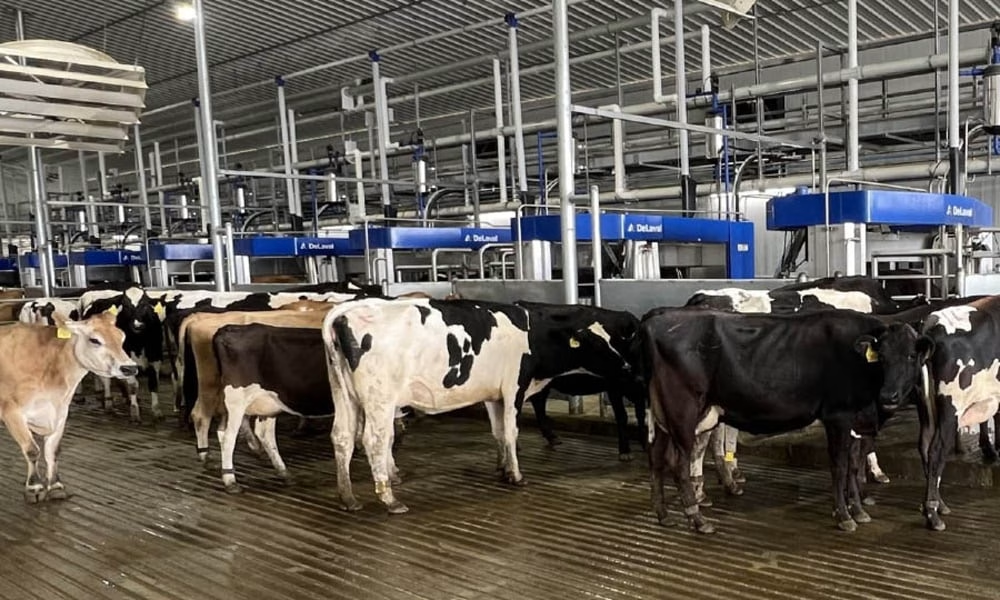
Robotic Milking Systems (AMS): Mixed Results

Promised Benefits: Yield increases to 15%, labor savings are approaching 70%, and cow welfare is improved through voluntary milking schedules.

What Happened:

MetricUS AverageTop 25% FarmsBottom 25% FarmsImprovement Potential
Milk per robot/day3,667 lbs4,200 lbs2,900 lbs+1,300 lbs
Milk per minute1.4 kg2.0 kg1.1 kg+82% efficiency
Cows per robot506040+20% capacity
Daily visits per cow2.93.52.2+59% frequency

The data tells a clear story – management matters more than machinery. Top-performing farms squeezed 42% more daily output from the same robots their neighbors struggled with. The difference? Optimized cow flow, data-driven decision-making, and attention to system efficiency.

While labor savings were real (typically 25-30%), the type of work changed dramatically. Physical milking decreased, but time spent on system management, data interpretation, and troubleshooting increased. Many farmers weren’t prepared for this shift.

Bottom Line: AMS works best for large-scale operations with robust infrastructure and skilled management. The technology only provides capacity – achieving financial success requires maximizing system utilization.

Automated Feeding Systems (AFS): Reliable Efficiency

Promised Benefits: Precise ration delivery, reduced feed waste, and labor savings of up to 79% compared to traditional methods.

What Happened:

  • Feed consistency improved dramatically, stabilizing rumen health – though this didn’t always translate into higher milk yields.
  • Energy consumption plummeted by up to 97% compared to tractor-based feeding systems – a significant operational savings.
  • The global automated feeding systems market reached $6.43 billion in 2024 and is projected to hit $12.96 billion by 2033, growing at 8.1% annually.

Bottom Line: AFS delivered predictable labor and energy savings but required careful cost-benefit analysis for smaller herds. The ROI calculation became more compelling on larger farms or those implementing complex feeding strategies.

IoT Health Monitoring Systems: Early Detection Wins

Promised Benefits: Sensors tracking rumination, activity levels, and body temperature to flag health issues before clinical symptoms appear.

What Happened:

  • Farms with high disease incidence saw substantial ROI (up to €119 per cow annually).
  • Well-managed herds with few health issues struggled to justify the cost – there simply weren’t enough problems to catch early.
  • False positives caused “alert fatigue,” highlighting the need for streamlined workflows and integration with herd management software.

Bottom Line: These systems delivered best for farms battling frequent health challenges. The financial benefits from early disease detection were inherently greater on farms with higher rates of health issues. The monitoring costs often exceeded the diminished savings for dairies that were already achieving excellent health outcomes.

Emerging Technologies: AI & Blockchain

Artificial Intelligence:
AI-powered breeding tools optimized genetic selection by predicting traits like milk yield potential and disease resistance with 99.8% accuracy. AI also transformed milk processing by analyzing composition and processing times to improve yield while reducing waste.

Blockchain:
Blockchain created verifiable transparency in milk supply chains. Each critical transaction – from milking to packaging – was logged onto an immutable digital ledger, allowing consumers to verify a product’s journey from farm to store by scanning a QR code. This built consumer trust and opened premium market opportunities.

Technology Adoption ROI Comparison

TechnologyAvg. Payback PeriodFarms Achieving ROITop ROI Driver
Robotic Milking (AMS)5.2 years68%Labor cost reduction (32%)
Automated Feeders3.8 years82%Feed efficiency gains (19%)
Health Sensors2.1 years91%Mastitis reduction (41%)
Precision Irrigation1.5 years94%Water cost savings (57%)

Common Pitfalls: Why Tech Investments Flopped

Dairy Tech Failure Causes

Pitfall% of Failed ImplementationsAvg. Financial LossPrevention Strategy
Inadequate training47%$18,200Mandatory 40-hr certification
Poor system integration39%$23,500Pre-purchase IT audit
Unrealistic ROI goals58%$31,8003rd-party feasibility study
Infrastructure gaps34%$41,000Professional site assessment

Critical Finding: 62% of AMS failures are linked to underpowered electrical systems – a $15,000 preventable issue that derailed six-figure investments.

  1. Underestimating Total Cost of Ownership: Hidden expenses like maintenance contracts, software fees, and increased energy usage eroded profits. Many farmers focused solely on the purchase price, missing the long-term financial commitment.
  2. Poor Integration: Data silos prevented holistic analysis, with over 40% of farmers avoiding cloud-based solutions due to compatibility issues. When systems couldn’t talk to each other, their collective value plummeted.
  3. Insufficient Training: Farms underestimated the learning curve for staff managing complex systems. This led to inefficiency and expensive dependence on vendor support.
  4. Weak Infrastructure: Farms without reliable internet or backup power face crippling downtime. When a robot stops milking, the consequences are immediate and costly.

Decision Framework: Choosing the Right Technology

Evaluate Need vs. Hype

Start by identifying specific operational bottlenecks. Are you struggling with labor shortages? Health challenges? Feed inefficiencies? Avoid chasing trends without clear goals.

Conduct a Cost-Benefit Analysis

Factor in all costs – installation, maintenance, training – alongside realistic benefits like yield increases or labor savings. Use metrics like Payback Period or Net Present Value (NPV) for financial clarity.

Test Before Committing

Pilot new technologies on a small scale:

  • Trial AMS in one barn before scaling across the operation.
  • Use IoT sensors on a subset of cows to validate alert accuracy.
  • Implement automated feeding in one group before converting the entire herd.

Implementation Roadmap: Maximizing ROI

  1. Plan Thoroughly: Develop a detailed budget covering infrastructure upgrades, training needs, and contingency plans.
  2. Roll Out Gradually: Implement new systems in phases to minimize disruptions.
  3. Invest in Training: Allocate time and resources for comprehensive staff education.
  4. Monitor Performance: Use KPIs like milk yield per robot or sensor alert accuracy to track progress.

Emerging Tech ROI Potential

Technology2024 Adoption RateVerified BenefitAvg. ROI Timeframe
AI health alerts12%30% reduction in clinical mastitis18 months
Methane digesters8%$0.15/cwt milk premium5-7 years
Blockchain tracing5%22% export price premium3 years
Robotic feed pushers19%14% labor cost reduction2.1 years

Data Note: Early adopters of methane technology secured 6% lower interest rates on operating loans – an often-overlooked financial benefit.

The Bottom Line

In 2024, dairy tech proved its potential – but only when matched with strategic planning and realistic expectations. Robotic milking systems excelled in large-scale operations; automated feeding saved time and energy; IoT sensors delivered value in high-incidence herds; AI and blockchain opened new market opportunities.

For dairy producers considering tech investments in 2025:

  • Focus on solving specific operational challenges.
  • Demand clear ROI projections from vendors – cut them in half to be safe.
  • Test technologies on a small scale before full deployment.
  • Remember that management matters more than machinery.

The most successful dairy operations aren’t necessarily those with the most technology but those who implement it most strategically. Technology should serve your farm’s goals – not the other way around.

Learn more:

Join the Revolution!

Join over 30,000 successful dairy professionals who rely on Bullvine Daily for their competitive edge. Delivered directly to your inbox each week, our exclusive industry insights help you make smarter decisions while saving precious hours every week. Never miss critical updates on milk production trends, breakthrough technologies, and profit-boosting strategies that top producers are already implementing. Subscribe now to transform your dairy operation’s efficiency and profitability—your future success is just one click away.

NewsSubscribe
First
Last
Consent
Send this to a friend