


Archive for dairy policy

Whole Milk Comeback: Senate Momentum Builds as Sen. Welch Predicts 60% Chance of Victory in 2025

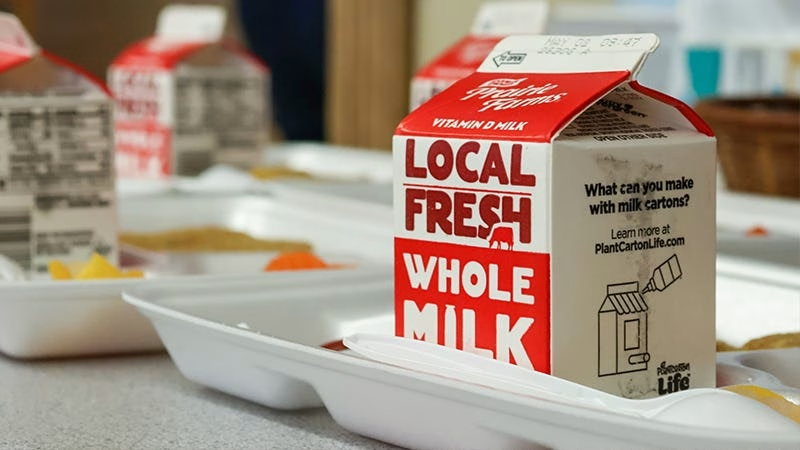
60% chance whole milk returns to schools! Bipartisan push could boost dairy demand & reverse kid nutrition declines.

EXECUTIVE SUMMARY: The Whole Milk for Healthy Kids Act has a 60% chance of passing in 2025, per Sen. Peter Welch (D-VT), reversing decade-old school restrictions and reintroducing whole/2% milk. With rare bipartisan House approval (330-99) and Senate momentum, this legislation addresses plummeting school milk consumption (45M gallons wasted annually) while aligning with modern nutritional science validating dairy fats. For producers, it promises expanded market access to 30M students, potential 15-20% sales growth, and long-term consumer cultivation. Strategic farm planning and advocacy are urged as the bill advances.

KEY TAKEAWAYS:

  • Legislative Momentum: 60% Senate passage chance with bipartisan backing, already House-approved (330-99).
  • Market Opportunity: 30M students/day could drive 15-20% school milk sales growth, stabilizing dairy demand.
  • Science Wins: Recent studies debunk fat fears, linking whole milk to better child nutrition and body composition.
  • Farmer Action: Plan for demand shifts, advocate to senators, and consider component-focused breeding strategies.
  • Waste Reduction: Restoring preferred options could slash 45M annual gallons of school milk waste.
Whole milk legislation, school milk options, dairy policy, bipartisan support, milk consumption

DAIRY PRODUCERS TAKE NOTE: The Whole Milk for Healthy Kids Act has a 60% chance of becoming law this year, according to Senator Peter Welch (D-VT). This potential game-changing legislation would reverse over a decade of restrictions limiting school milk options, creating significant new market opportunities for dairy farmers while addressing alarming declines in student milk consumption. With overwhelming bipartisan support already demonstrated in the House’s 330-99 vote last December, the Senate could deliver a major win for dairy farmers and America’s schoolchildren before year‘s end.

THE POLITICS ARE FINALLY ALIGNING

The political stars are aligning for dairy. Senator Peter Welch, ranking member of the Senate Agriculture Committee’s rural development subcommittee, recently declared on the Dairy Defined podcast that the Whole Milk for Healthy Kids Act has strong potential to pass this year.

“This is one of those things where, if we get it on the floor and get the cooperation of leadership, we get the votes,” he said confidently. “This is one of those areas of rare bipartisanship that we have right now.”

This legislation has already cleared significant hurdles, passing the House of Representatives in December 2023 with an overwhelming 330-99 bipartisan vote. The momentum continued into 2025, with the House Committee on Education and the Workforce approving the bill again in February by a decisive 24-10 margin.

For dairy producers who’ve watched school milk consumption plummet since whole milk was banned from cafeterias, this progress represents more than just another bill – it’s potentially the most significant market opportunity in over a decade.

THE SLAM-DUNK CASE FOR WHOLE MILK

The push to restore whole milk options aims to undo restrictions established under the 2012 guidelines that aligned school nutrition standards with dietary recommendations of that era. For more than a decade, schools have been limited to offering only fat-free (flavored or unflavored) and low-fat unflavored milk options – a policy that has backfired spectacularly.

The numbers tell the sad story – milk consumption among Gen Z is 20% lower than that of other generations. Even worse, an estimated 45 million gallons of milk are thrown out in schools yearly. That’s a shocking amount of nutrition and farmer income going down the drain.

School nutrition directors have been sounding the alarm for years. Krista Byler, district food service director for Union City Area School District in Pennsylvania, testified that “the amount of waste that we were throwing away each day was disheartening,” adding that her “dairy orders also greatly declined” following the implementation of fat restrictions.

This waste isn’t just hurting farmers’ bottom lines – it’s creating a nutrition crisis. Between 68% and 94% of school-age boys and girls are failing to meet recommended levels of dairy intake per federal guidelines. That’s a generation of kids missing out on essential nutrients during critical developmental years.

BIPARTISAN SUPPORT GROWS IN BOTH CHAMBERS

What makes this legislation particularly promising is its strong bipartisan backing. In the Senate, the bill is being championed by Senators Roger Marshall (R-KS), Peter Welch (D-VT), Dave McCormick (R-PA), and John Fetterman (D-PA). The House version was introduced by Representatives Glenn “GT” Thompson (R-PA) and Kim Schrier (D-WA).

At an April 2025 Senate Agriculture Committee hearing on the bill, Chairman John Boozman (R-AR) and Ranking Member Amy Klobuchar (D-MN) voiced their support. This cross-party cooperation has become increasingly rare in Washington, making the whole milk legislation stand out as an issue where lawmakers can still find common ground.

“NMPF commends Sens. Roger Marshall, R-KS, and Peter Welch, D-VT, for advocating for our nation’s students to have more access to nutrient-rich dairy by allowing schools to offer whole milk with school meals,” stated Gregg Doud, NMPF President & CEO. “We know that Americans are under-consuming dairy products, and as we heard today, students have said they want the milk they are familiar with and find satisfying. For many students, that’s whole milk.”

MARKET IMPACT: WHAT IT MEANS FOR YOUR OPERATION

The potential market implications for dairy producers are substantial. School meal programs serve over 30 million students daily across approximately 100,000 schools nationwide. That massive institutional market segment has been artificially restricted to lower-fat products despite clear evidence of reduced consumption and increased waste.

In 2019, school milk sales amounted to 10% of all fluid milk sales – a significant market channel that could grow substantially if whole milk options are restored. For dairy farmers struggling with market volatility and price pressures, this legislation represents a concrete opportunity to stabilize an important institutional sales channel.

Michael Dykes, president and CEO of the International Dairy Foods Association, emphasized the importance of the legislation: “Whole and 2% milk provide kids with 13 essential nutrients and high-quality protein critical for growth, development, healthy immune function, and overall wellness. It’s time for Congress to pass the Whole Milk for Healthy Kids Act and bring whole and 2% milk back to schools.”

WHY THIS MATTERS FOR YOUR FUTURE

For forward-thinking dairy producers, the implications extend far beyond just school milk sales:

Building Lifetime Consumers: Kids who develop positive experiences with milk in schools are more likely to become lifelong dairy consumers, creating sustainable demand for generations.

Aligning with Consumer Preferences: This legislation would bring institutional purchasing in line with what families already choose in grocery stores, where whole milk’s popularity has steadily increased.

Component Value: Higher-fat milk options could increase the value of milkfat components, potentially improving milk checks for producers focused on component production.

Reduced Waste: Better-accepted milk products mean less waste in school cafeterias and more actual consumption of the dairy products you work hard to produce.

THE BOTTOM LINE: TIME TO GEAR UP FOR ACTION

While Senator Welch’s 60% probability assessment offers encouraging odds, significant hurdles remain before the Whole Milk for Healthy Kids Act becomes law. The bill must still navigate the Senate’s complex legislative process and compete for floor time with other priorities.

Smart dairy producers should:

  1. Start planning now for potential increased demand, especially if you have connections to processors serving institutional markets
  2. Contact your senators to express support for the legislation, particularly if they serve on key committees
  3. Consider component strategies in your breeding program that could capitalize on increased milkfat demand
  4. Stay informed on the bill’s progress through industry publications and advocacy organizations

This legislation represents that rare alignment of nutritional science, consumer preferences, and bipartisan political support. If Senator Welch’s prediction proves accurate, the 2025-2026 school year could mark the triumphant return of whole milk to cafeterias nationwide, potentially reversing years of declining school milk consumption and creating valuable new opportunities for dairy producers across America.

Learn more:

Join the Revolution!

Join over 30,000 successful dairy professionals who rely on Bullvine Weekly for their competitive edge. Delivered directly to your inbox each week, our exclusive industry insights help you make smarter decisions while saving precious hours every week. Never miss critical updates on milk production trends, breakthrough technologies, and profit-boosting strategies that top producers are already implementing. Subscribe now to transform your dairy operation’s efficiency and profitability—your future success is just one click away.


NewsSubscribe
First
Last
Consent

The Death of Small US Dairy Farms: An Autopsy Report

Uncover the factors driving the decline of small US dairy farms, examine the resulting economic and environmental repercussions, and consider actionable policy strategies for their resurgence.

Consider an urgent problem in rural America, akin to a crime scene that demands immediate attention. The victims in this case are the small dairy farms, historically the backbone of their communities, now struggling against the dominance of larger businesses. As investigators, we meticulously examine the dramatic shifts in the U.S. dairy business over the past few decades. Let’s delve into the reasons, effects, and remedies for the urgent revival of small dairy farms.

The downturn not only affects farmers but also tears at the fabric of rural America, impacting the entire community. We’ll delve into the core reasons, analyze the economic and environmental consequences, and strongly advocate for legislative changes to ensure a more sustainable future for small dairy farms. We want to underscore the critical efforts needed to revitalize and maintain small dairy farms nationwide for the sake of these communities.

YearNumber of Small DairiesNumber of Large DairiesAverage Cows per Small DairyAverage Cows per Large Dairy
199771,0325,19850500
200751,0127,48070700
201727,41510,053100900
202224,08212,0221201,000

Economic and Environmental Strains: The Twin Burdens of Small Dairy Farms

Small dairy farmers confront complex economic challenges that are only getting worse. Since 1998, these farms have generated cumulative 10-year net returns of less than -$10/cwt, indicating ongoing financial duress. In 2023, volatile market circumstances exacerbated these issues, including a significant market drop and increased feed and fuel expenses. Small dairies are struggling to thrive, and many are leaving the business.

Meanwhile, the expansion of large-scale dairy farms has severe environmental repercussions. Mega-dairies, with herds ranging from 1,000 to 25,000 cows, currently provide more than 70% of US milk. Large farms benefit from economies of scale but contribute to climate change by increasing methane emissions. They also create significant air and water pollution, endangering the health of adjacent residents and poisoning local water sources.

The Relentless Decline of Family-Scale Farms: Economic Hardships in the US Dairy Industry

Small farms struggle financially with growing production costs that outpace milk prices. The typical American dairy farm has only been profitable twice in the previous two decades, leaving small-scale farmers in heavy debt.

Small farmers are experiencing increased production costs that surpass milk prices. Many small-scale farmers are in debt, barely making two profits in the past two decades. Sarah Lloyd, a Wisconsin dairy farmer, said, “The consolidation of the dairy industry has siphoned life out of rural America.” Small farms suffer financial collapse, resulting in mounting debts, bankruptcies, and farmer suicides. The socioeconomic fabric of rural communities deteriorates, emphasizing the necessity for a significant rethink of dairy policy.

As small farms falter, they risk financial devastation, rising debts, bankruptcies, and farmer suicides. The socioeconomic fabric of rural communities deteriorates, emphasizing the critical need for a complete revision of dairy policy to protect small-scale farmers against monopolistic corporations.

YearTotal Dairy FarmsMilk Production (Billion Pounds)Average Operating Margin (%)Dairy Exports (Billion USD)
200370,3751703%0.77
200862,5001892%3.0
201349,3312011.5%5.5
201837,4682181%5.6
202236,1042200.5%6.3

The Monopolistic Squeeze: How Dairy Cooperatives Are Reshaping the Industry

The growing concentration of the dairy business, with Dairy Farmers of America (DFA), Land O’Lakes, and California Dairies owning 83% of milk sales, has marginalized small-scale farms, driving them to the edge. Rising production costs and low milk prices put small dairy producers at a competitive disadvantage, undermining the sector’s variety and resilience. Family farms must choose whether to develop or abandon an enterprise passed down through generations.

Dairy cooperatives primarily cater to larger dairies, reinforcing the consolidation cycle and exacerbating challenges for smaller operations. These cooperatives can negotiate better prices and establish strong supply chains that benefit large-scale producers, but smaller farms lack the volume to leverage the same benefits. This discrepancy manifests in various ways: 

  • Bulk Pricing Models: Cooperatives offer pricing models favoring high-volume producers, making it hard for smaller farms to compete.
  • Priority Access: Larger dairies enjoy priority access to cooperative resources, leaving smaller farms with limited support.
  • Logistical Support: Infrastructure built by cooperatives caters to large producers, providing inadequate support for smaller farms.
  • Market Influence: Cooperatives’ market influence shapes industry policies to the advantage of larger operations, sidelining smaller competitors.

This emphasis on bigger dairies feeds a vicious cycle in which small farmers struggle to stay in business. Optimized resource arrangements for large-scale production hurt small farmers’ livelihoods and the fabric of rural communities that rely on them.

From Stability to Strain: How 2000s Policy Shifts Unraveled the US Dairy Industry

In the early 2000s, U.S. dairy policy experienced significant changes: 

  • End of Dairy Price Supports: These supports once provided a safety net for small farms. Their removal led to financial instability.
  • End of Grain Supply Management: Previously, policies kept feed prices stable. Their discontinuation increased feed costs, squeezing small farms’ profit margins.
  • Export-Focused Policies: Aimed to integrate U.S. dairy products into the global market, favoring large-scale, industrial farms.
  • Economies of Scale: Larger farms could produce milk cheaper, putting small farms at a competitive disadvantage.

These developments weakened family-owned dairies, compelling them to expand or leave the sector. The new laws hastened the demise of small farms, driving the US dairy sector toward large-scale, export-oriented production.

Strategic Policy Solutions: A Multifaceted Approach to Revitalize Small Dairy Farms

Experts support strategic initiatives to fight the demise of small dairy farmers. Implementing a federal supply management scheme may help to balance supply and demand while preventing export market flooding. Legislative efforts to block agricultural mergers and abolish industrial farms by 2040 are critical. Restoring supply management and revamping the rural safety net in the following agricultural Bill is vital. Setting mandatory objectives for reducing greenhouse gas and methane emissions will help to reduce environmental damage. Requiring dairy corporations to disclose emissions and meet science-based objectives would increase accountability while revitalizing local dairy farms and ensuring their economic and ecological viability.

In addition to legislation, education, and assistance activities are critical for helping small dairy producers adapt to changing market circumstances. Farmers might benefit from programs that teach them financial literacy and business management skills. Furthermore, giving grants and low-interest loans will provide crucial financial assistance, focusing on improving agricultural infrastructure, promoting sustainable practices, and innovating technologies to reduce efficiency and environmental effects.

Community support and consumer awareness are essential. Promoting locally produced dairy products and educating customers about the advantages of small farms may increase demand and provide a competitive advantage. Establishing farmer cooperatives may give greater market access, reduced expenses, and more substantial bargaining power versus more prominent corporations.

Promoting research and development in sustainable dairy farming is vital. This involves establishing feed techniques to minimize methane emissions, investigating alternative energy, and strengthening resistance to climate change. Public-private collaborations may spur innovation, allowing farmers to remain profitable while adjusting to environmental problems.

Mental health and well-being services for farmers and their families must not be disregarded. The stressors of farming may substantially influence personal health, so guaranteeing access to mental health services and establishing community support networks is essential.

To resuscitate and maintain small dairy farms, a multidimensional strategy that includes regulatory change, financial assistance, community participation, and sustainable practices is required. This comprehensive approach provides a roadmap to preserving a crucial agricultural environment component while encouraging a more resilient and responsible dairy business.

The Bottom Line

The decline of small dairy farms in the United States is being pushed by constant economic pressures and legislative choices that favor large-scale enterprises. These dynamics have significantly weakened the profitability of family-scale farms, necessitating major regulatory adjustments. Reforms should attempt to stabilize the market and provide a more fair and sustainable future for the dairy sector. This paper demonstrates that the demise of small US dairy farms is not a natural development but rather a significant result of purposeful decisions and institutional biases. Without immediate legislative reforms, mega-dairies will dominate US agriculture, threatening small farmers, the environment, and rural communities. Revitalizing small dairy farms would need a comprehensive strategy addressing the underlying reasons for their decline. This research emphasizes the critical need for focused initiatives to restore America’s dairy legacy.

Key Takeaways:

  • The US dairy industry has seen significant consolidation, with small dairy farms declining sharply while large-scale operations dominate the market.
  • Financial pressures, driven by prolonged negative net returns and rising input costs, have severely affected small dairy farms.
  • Changing consumer preferences, particularly among younger generations, have led to decreased dairy milk consumption and increased demand for plant-based alternatives.
  • The shift towards larger dairy operations has exacerbated environmental issues, including higher methane emissions and pollution, adversely affecting local communities.
  • Current federal policies, while providing some support, are often inadequate to address the unique challenges faced by small dairy farms.
  • Proposed policy solutions include implementing federal supply management, banning factory farms, enhancing the farm safety net, and setting binding emissions targets for the agriculture sector.
  • Comprehensive policy reforms are essential for creating a sustainable and equitable dairy industry, benefiting both small farmers and the environment.

Summary:

Small dairy farmers in the US face significant economic and environmental challenges, with a cumulative 10-year net return of less than -$10/cwt since 1998. In 2023, volatile market circumstances exacerbated these issues, leading to a significant market drop and increased feed and fuel expenses. Large-scale dairy farms, which provide over 70% of US milk, contribute to climate change by increasing methane emissions and creating significant air and water pollution. Small farms struggle financially with growing production costs that outpace milk prices, leaving them in heavy debt. The socioeconomic fabric of rural communities deteriorates, emphasizing the need for a complete revision of dairy policy to protect small-scale farmers against monopolistic corporations. Dairy cooperatives primarily cater to larger dairies, reinforcing the consolidation cycle and exacerbating challenges for smaller operations. Strategic policy solutions include implementing a federal supply management scheme, legislative efforts to block agricultural mergers and abolish industrial farms by 2040, restoring supply management and revamping the rural safety net, setting mandatory objectives for reducing greenhouse gas and methane emissions, requiring dairy corporations to disclose emissions and meet science-based objectives, education, and community support.

Learn more:

Send this to a friend



