






When times got tough, Jim Mulhern fought to keep dairy farmers afloat—his legacy is measured in seasons survived, not speeches made.

What’s interesting about Jim Mulhern’s legacy—really, what stands out if you hang around barn meetings or share coffees after a long Expo day—isn’t just the policies on paper or the speeches under the lights. It’s how many dairy producers, across regions and generations, end up telling the same sort of story: when margins went south, when feed costs jumped, when times felt especially lean—somewhere in the background, or sometimes the foreground, Jim or his policy work was part of the survival toolkit. Sometimes it’s an NMPF Zoom, sometimes it’s a barn newsletter that started somewhere in DC, but at the end of the day, it’s about service, not a resume.
Ask producers from different regions and you hear variations of the same story: when margins got tight and options felt limited, Jim’s approach—listening first, speaking plainly—made challenging situations feel more manageable. Jim never had miracles—but if you picked up the phone, he’d listen, cut through the DC fog, and, true to form, drop that middle-child line: ‘You get good at compromise or you don’t eat!’ It made disaster feel… survivable.”
That earthy, honest support is the current running through his 45 years. Policy? It matters—but in dairy, legacy is how many operations get to run another season. So, let’s skip the official bio-paper and start where it hits hardest: with those farm stories that turn ‘legacy’ into something you can actually hold.
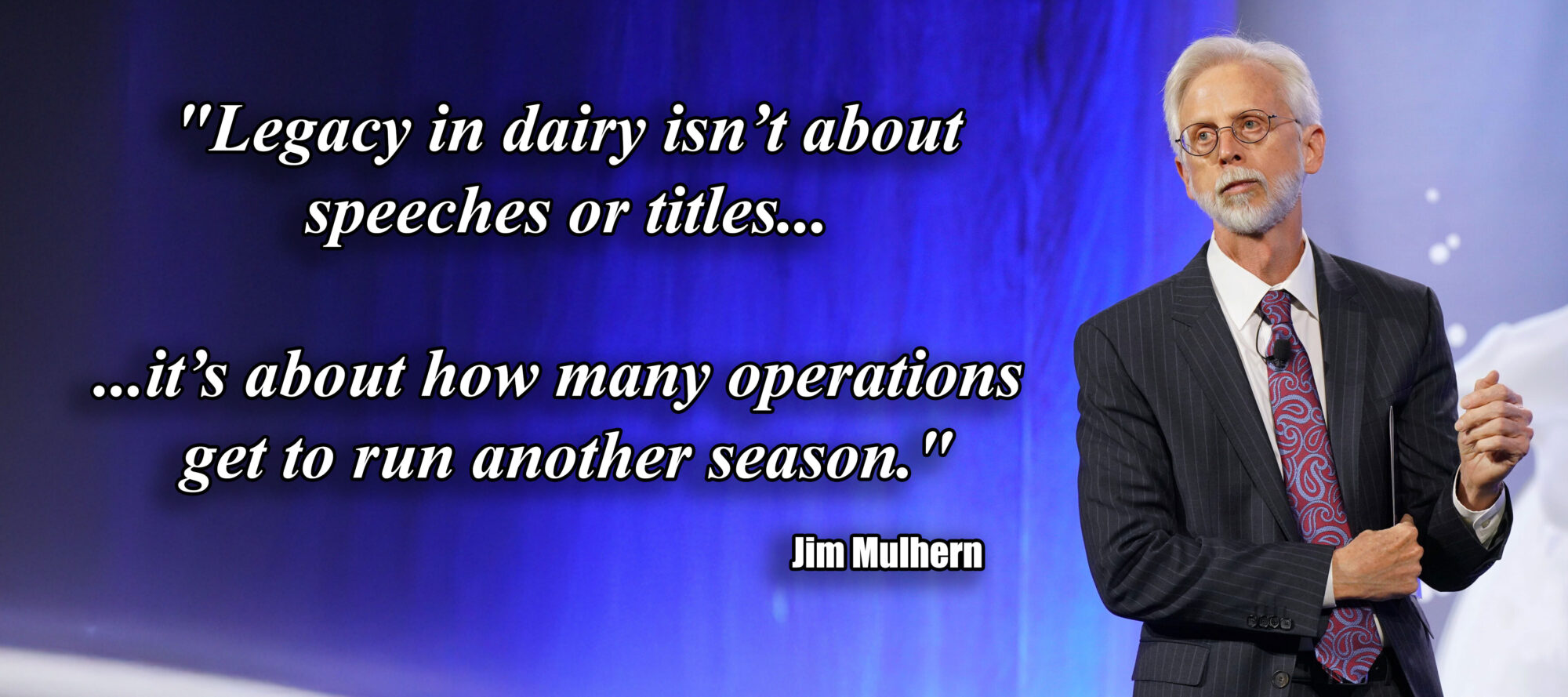
The Thing About Legacy in Dairy
It’s never been about reform tallies or titles. Ask anyone who’s watched drought suck the valley dry in Tulare, or a New Yorker calculating butterfat after a ration swap, or a Nevada dairyman wincing at the new heifer price sheet. Legacy’s about who keeps showing up—boots on, sleeves rolled—when everyone else is home.
Jim’s roots? Portage, Wisconsin—a big breakfast table, weekends on neighbors’ farms, one of those upbringings where you learned fast how problems got solved. Shuffled off to UW-Madison, he wasn’t in it for the hands-on milking; it was about using ag journalism to keep his hands in the land. That early DC internship with Bob Kastenmeier made it real: policy’s not a sideline, not if you steer it for the folks actually working the ground.
Compromise Isn’t a Dirty Word—It’s the Dairy Way
Here’s what the industry crowd knows: volume in a boardroom never means as much as listening on the ground. Jim, one of nine siblings, had the lessons of compromise engrained before he could drive. “The hardest part of co-op isn’t the milk check—it’s getting everyone on the same page.”
The road through FMMO reform? Nobody who was there would call it smooth. Those months would test anyone’s patience—herding Holsteins along a muddy path more than a couple of times. With all the regional priorities—Midwest cheese, Plains expansion, fluid markets in the West—compromise wasn’t an act, it was the job description. Jim pulled in trusted voices like Jim Sleper, and always circled back to what mattered: “Nobody walked away with everything, but everybody left knowing, ‘Yeah, my big worry was on the table.’” That’s why the results stuck when it mattered most.
Living Risk—Not Just Avoiding It
Let’s get down to it: bring up MILC, MPP, DMC (Dairy Margin Coverage program) at any coffee shop, and yeah, you’ll get some eye-rolls—until another dairy downturn reminds folks why it matters. Before the overhaul, many people figured their best shot was a prayer, insurance, and maybe a check if things got rough.
However, this is the new trend: with DMC, mid-sized to small operations have a real net. DMC’s pushed out over $2 billion when the pain hit hardest—money that kept for-sale signs out of the barn windows. You hear the same story everywhere—Michigan’s Thumb, a dry-lot outside Yuma, a late-night text from Idaho. When COVID hammered the sector, and the checks came, people said straight up, “That’s what kept cows fed and my kids in 4H.” That’s policy making a difference.
But managing risk wasn’t just about safety nets; it was also about fighting for a fair, predictable price in the first place—a battle that brought Jim straight to the messy heart of FMMO reform.
FMMO Reform—Messy, But Worth It
“Modernization” means one thing in Kansas, another in the Northwest—new barns going up in the plains, headaches with fluid class in the West. What’s striking, if you circle back with any co-op lead or new face from Montana to the Southeast, is that Jim didn’t duck the bumps. “Processors wanted unity for the Farm Bill, but the pandemic called the bluff—the formula needed rewriting. Still, we got folks back at the table and eventually hammered it out.” Grumbling’s still common (just call Vermont), but, as one co-op chair reminded me, “predictable beats chaos in my mailbox.”
Stewardship—Not Buzz, Just How You Farm
Sustainability’s trendy on the panel circuit, but “stewardship”—that’s been inside farming forever. Jim credits his convictions to watching families, his and others, do more with less, finding ways to turn waste into value, and always prepping for next year.
Ask the digester crew in Yakima. Or Florida operators who count every rainstorm and stretch a cover crop for two seasons. Policy eventually caught up: “We’ve cut emissions, improved yields, done more with less. Maybe, finally, that story is landing with customers and Congress.”
The Unfinished Battles: Immigration and Trade
You can measure most farm headaches by the grumble at Bullvine coffee hours, and nothing comes up more than labor and trade. Western herds, New York recalls, up into Quebec—if you don’t have crew, or if a new market wall goes up, everything halts. Jim’s honest about it: “Progress or not, it isn’t done until the guys in the parlor feel a difference.” Right now, Congress is stuck. And in ag, policy’s only as good as its impact before sunrise.
Labels, School Milk, and the Small Battles
Want to get Mulhern animated? Bring up almond “milk.” “Fake products using real dairy terms—FDA should’ve stepped in years ago.” And getting whole milk back in schools? If you’re not convinced, check in with a school nutrition lead in the Upper Midwest. “What we feed kids isn’t just a menu—it’s a message to the next generation.”
Passing the Torch—Not Just Polished Shoes on the Boardroom Floor
Ask Jim about wins, and he talks about his team, not tallies. “Building up smart, driven staff—beating paperwork by a mile,” he’ll say if you push. A real legacy isn’t a retirement countdown; it’s whether the next generation takes the lessons and actually runs with them.
Gregg Doud’s taking over, and from what Mulhern’s said publicly, the endorsement couldn’t be clearer: ‘Gregg is an established leader with a wealth of experience in ag policy. He knows the issues well, and he knows how to get things done.’ As more than one industry observer has noted, Jim’s legacy isn’t about grand gestures—it’s about leaving the field a little more level than he found it.
The Bottom Line—From the Parlor to the Boardroom
When you talk legacy around here, don’t glance at the plaque. Remember a neighbor scraping through a thin season thanks to a new rule, a check that cleared, or maybe just the right frank call at the right time. Sometimes it’s small, sometimes it makes the difference between getting the next shipment of feed or not.
You spot Jim Mulhern at Expo, maybe catching a sunrise before the barns get busy? You don’t need to make a speech. A nod—or a simple thank you—does the trick. The glue in this business has always been the unsung folks, steady at the wheel while the rest of us are milking before dawn.
Here at The Bullvine, that’s the vantage point we stand by: from the muddy middle, never giving up, proud of the next mile. Telling stories that help us all do it again, season after season.
Key Takeaways
- Jim Mulhern’s legacy is defined by practical, producer-first leadership—he prioritized compromise, collaboration, and real-world policy solutions that mattered at the farm level.
- His tenure saw major wins for dairy risk management (notably the DMC program), FMMO modernization, and timely COVID relief, helping stabilize milk checks and ensure producer survival through volatile markets.
- Mulhern’s approach was always rooted in listening, unity, and finding common ground, even amid fierce regional and industry divides.
- Ongoing challenges like labor, immigration, and global trade remain urgent—not “wrapped up” as he exits, but spotlighted as unfinished business for the next generation.
- Beyond the boardroom, Mulhern is remembered for championing dairy’s true values—stewardship, authenticity, and resilience—leaving U.S. dairy better prepared for whatever comes next.
Executive Summary
Jim Mulhern’s legacy as retiring NMPF President isn’t written in speeches or boardroom victories—it’s measured season by season, in the everyday resilience of dairy producers his work helped sustain. Drawing on Midwestern roots and a knack for compromise forged as the middle child in a large family, Mulhern led policy moves like FMMO modernization and the Dairy Margin Coverage program that directly impacted milk checks in tough years. He was known for human-scale leadership: listening, cutting through politics, and prioritizing practical solutions that reached the parlor as much as the Capitol. The article spotlights Mulhern’s industry role in navigating regional divides, rallying co-ops, and meeting challenge after challenge—from market risk to labor and trade demands—with humility and relentless advocacy. Through anecdotes, peer insight, and grounded storytelling, it connects his legacy to themes of stewardship, collaboration, and the quiet determination that defines the dairy industry’s backbone. Even as he steps aside for a new generation, Mulhern’s mark endures in the unity he fostered and the real-world relief he delivered when it counted most.. This is the story of a leader whose true victories remain etched in seasons survived, not just awards won.
Learn More:
- Bull in a China Shop: How Juan Moreno Turned the Dairy World Upside Down – This Colombian farm kid didn’t just enter dairy’s china shop—he deliberately smashed outdated breeding practices and rebuilt the entire industry.
- McCarty Family Farms Named 2023 Innovative Dairy Farmer of the Year – This profile showcases the innovative business strategies that drive a large-scale, award-winning operation. It provides a blueprint for leveraging stewardship and supply chain partnerships to build a resilient and sustainable dairy business for the next generation.
- Dairy Risk Management: Protecting Your Bottom Line in Volatile Times – While policy provides a safety net, this article offers practical strategies for protecting your margins on-farm. It details actionable steps for using market tools and internal benchmarks to build financial resilience against price volatility, complementing the high-level policy discussion.
 Join the Revolution!
 Join the Revolution!
Join over 30,000 successful dairy professionals who rely on Bullvine Weekly for their competitive edge. Delivered directly to your inbox each week, our exclusive industry insights help you make smarter decisions while saving precious hours every week. Never miss critical updates on milk production trends, breakthrough technologies, and profit-boosting strategies that top producers are already implementing. Subscribe now to transform your dairy operation’s efficiency and profitability—your future success is just one click away.




