







Stop defending 80% milk fat definitions—start proving why 2-ingredient butter beats 15-ingredient alternatives. $470/cow savings await.
EXECUTIVE SUMMARY: The dairy industry’s $200 million legal war over the word “butter” is legitimizing nutritionally inferior alternatives while hemorrhaging market share to processed oil blends that often contain MORE saturated fat than real dairy. Recent court rulings dismissing FDA’s 90-year-old definitions prove this defensive strategy is failing, while plant-based butter sales actually declined in 2024—signaling a massive opportunity for offensive positioning. Research reveals many coconut and palm oil-based “vegan butters” deliver 60g of saturated fat per 100g compared to dairy butter’s 51g, yet dairy continues apologizing instead of attacking this hypocrisy. The dairy matrix effect provides superior bioavailability for fat-soluble vitamins A, D, E, and K2 that synthetic fortification in processed alternatives simply cannot match. Smart operators are already implementing the three-pillar offensive strategy—radical transparency, bioavailability superiority, and performance excellence—with ROI projections ranging from $8,000-$150,000 depending on operation size. Stop playing defense and start proving dairy’s inherent superiority with the evidence-based framework that’s converting “disenchanted flexitarians” back to real butter.
KEY TAKEAWAYS
- Legal Defense = Market Share Loss: Every dollar spent fighting 1928 FDA definitions could fund feed efficiency studies yielding $470/cow annual savings—pivot from courtroom battles to consumer education for immediate ROI
- Nutritional Advantage Unclaimed: Dairy’s naturally occurring vitamins A, D, E, and K2 in bioavailable matrix outperform synthetic fortification in 15-ingredient alternatives, yet 49% of consumers trying plant-based products don’t know this competitive edge
- Saturated Fat Hypocrisy Exposed: Many popular vegan butters contain 60g saturated fat vs. dairy’s 51g—leverage this inconsistency through transparent ingredient comparisons costing $8,000-$22,000 for comprehensive campaigns
- Component Revolution Timing: With butterfat tests hitting 4.36% (up 9 basis points from 2024) and FMMO reforms rewarding 3.3% protein/6.0% other solids, premium positioning strategies can capture 8-25% price premiums within 6-12 months
- Three-Pillar Implementation: Transparency campaigns ($8K-$22K), bioavailability education ($35K-$70K), and performance demonstrations ($55K-$110K) deliver measurable market share recovery from declining plant-based sales—especially targeting flexitarian consumers already returning to dairy
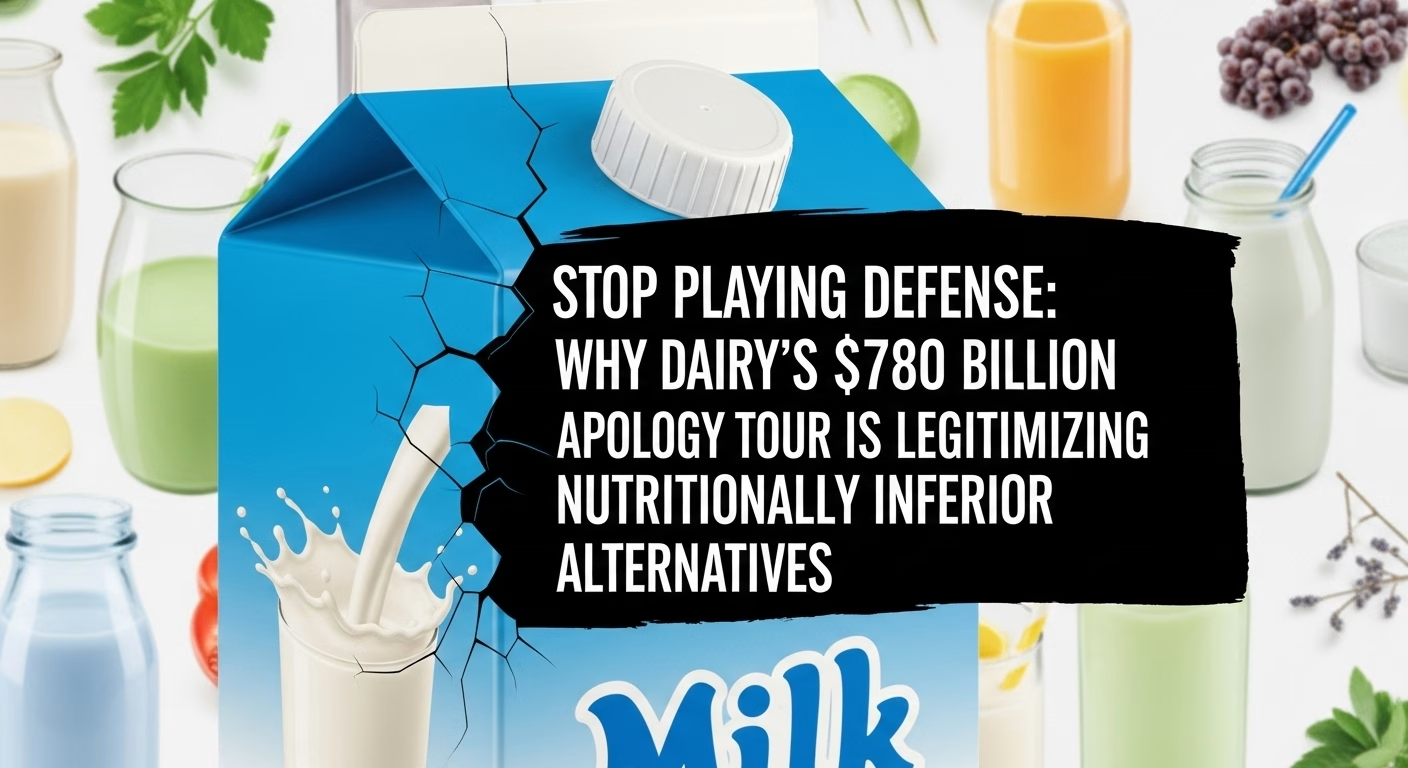
The dairy industry’s biggest mistake isn’t losing market share to vegan alternatives—it’s spending millions on legal battles over the word “butter” while plant-based brands capture the nutritional high ground with processed oil concoctions that deliver inferior bioavailability and often contain more saturated fat than the real thing.
Here’s the uncomfortable truth you don’t want to face: while you’ve been apologizing for producing milk with 3.7% butterfat and 3.3% protein content that supports 3.05 million American jobs and generates nearly $780 billion in total economic impact, your competition’s been selling highly processed blends of palm oil and synthetic additives as “health food.” And it’s working—until now.
Market Reality Check: According to the Good Food Institute’s 2024 data, plant-based butter sales actually declined in the U.S. market during 2024, with both dollar and unit sales dropping alongside market share.
But here’s where the narrative gets interesting. The writing’s on the wall. Consumers are trying the alternatives, finding them wanting, and quietly returning to dairy. Yet instead of capitalizing on this market correction, you’re continuing the defensive crouch, legitimizing inferior competitors through expensive legal fights and apologetic messaging.
So here’s the million-dollar question: How long are you going to let processed oil blends marketed as “butter” steal your customers while you argue over century-old definitions?
The $200 Million Legal Distraction That’s Backfiring
Here’s a question that should keep every dairy executive awake at night: How many feed efficiency studies could you fund with the money spent fighting over FDA definitions from 1928?
While dairy trade groups burn through litigation budgets fighting over FDA standards defining butter as containing “not less than 80 percent by weight of milk fat”, you’re missing the fundamental strategic shift happening in supermarket aisles.
The landmark Miyoko’s Kitchen v. Karen Ross ruling delivered a crushing blow to this strategy. The U.S. District Court granted a preliminary injunction preventing California from enforcing action against Miyoko’s use of “vegan butter” terminology, effectively dismissing the 90-year-old FDA definition argument.
But here’s the real kicker: while dairy lawyers argue semantics, plant-based marketers win the substance battle by default. Every dollar spent litigating definitions is a dollar not spent educating consumers about the dairy matrix effect, bioavailability superiority, or the environmental hypocrisy of palm oil supply chains.
Why This Matters for Your Operation
Think of it like comparing a 305-day lactation record to a single test-day milk weight. The legal battle focuses on a single definitional “test day” while ignoring the complete performance curve that matters to actual productivity and profitability.
Small Operation (100-200 cows): You can’t afford to waste resources on industry-wide legal battles. Focus your limited marketing budget on local consumer education.
Mid-Size Operation (200-800 cows): Partner with regional cooperatives to fund comparative advertising highlighting ingredient simplicity.
Large Operation (800+ cows): Lead the charge by funding independent research comparing the bioavailability of natural vs. synthetic nutrients.
Think About It: If you wouldn’t accept inconsistent component testing in your milk quality program, why accept it in your competitive messaging?
The Nutritional Fraud You’re Allowing to Go Unchallenged
Let’s get specific about what you’re actually competing against, using the same precision you’d apply to analyzing dry matter intake efficiency or somatic cell count trends.
The Saturated Fat Hypocrisy No One’s Talking About
A fact that should make every dairy marketer furious: Many popular vegan butters contain equal or higher levels of saturated fat than dairy butter. From a nutrition perspective, vegan butter contains around 80g of fat per 100g, of which approximately 50g is saturated. Some plant-based cheeses, such as those based on coconut oil, had 50% more saturated fat than dairy cheese.
This is like a Holstein producer apologizing for 4.0% butterfat while a competitor sells 3.2% butterfat milk as “premium”—except the competitor’s product actually tests higher in the component they’re criticizing you for.
The Processing Problem: Two Ingredients vs. Fifteen
Dairy butter ingredient list: Cream, salt. Typical vegan butter: Oil blends, water, emulsifiers, stabilizers, natural flavors, synthetic vitamins, gums, starches, and preservatives.
It’s the difference between feeding your herd straight alfalfa hay versus a processed feed blend with 15 different additives. Which sounds more like “natural nutrition” to you?
The Bioavailability Blind Spot That’s Costing You Market Share
Here’s where your defensive positioning becomes truly inexcusable. Butter naturally contains fat-soluble vitamins A, D, E, and K2 in a matrix that enhances absorption—what researchers call the “dairy matrix effect”. This is like comparing the bioavailability of minerals in high-quality forages versus synthetic mineral supplements.
Research shows that the dairy food matrix modulates foods’ nutritional properties, with the combination of food components and their structure changing physiological effects. The presence of macro- and micronutrients in dairy products may contribute to observed differences in health effects between dairy-derived saturated fatty acids and saturated fatty acids from other food sources.
Yet instead of leading with these differentiators, you’re arguing about label definitions.
Decision Framework: Are you competing on your product’s inherent strengths or defending against competitors’ marketing claims?
Environmental Reality Check: The Palm Oil Elephant Everyone Ignores
The environmental narrative has become plant-based brands’ most powerful weapon, painting a simple picture of “green” plants versus “dirty” dairy. But dig into the actual lifecycle assessments, and the picture becomes far more complex.
Yes, research shows that plant-based fat spreads have a lower climate impact than dairy butter. That’s a legitimate challenge requiring the same systematic approach you’d use to reduce your herd’s methane emissions through feed additives or improved manure management.
But here’s what the “green” marketing conveniently omits:
The Palm Oil Environmental Catastrophe
Palm oil is ubiquitous in vegan spreads due to its functional properties and low cost. It’s also a leading driver of deforestation in Southeast Asia, destroying critical habitats for endangered species.
Strategic Question: Can you trace your milk from specific farms to processing facilities? Many plant-based brands cannot—or will not—provide transparent paths from plantation to product.
Technology Integration: Your Competitive Advantage
Precision Agriculture Applications for Sustainability Messaging:
- Use feed efficiency monitoring data to demonstrate resource optimization
- Leverage manure-to-energy systems to showcase circular economy principles
- Implement water recycling systems with measurable impact metrics
- Deploy soil health monitoring to document regenerative practices
Cost Estimate: $15,000-50,000 for comprehensive monitoring systems, with 12-18 month ROI through efficiency gains
Digital Marketing Tools and Platforms:
- Create farm transparency apps showing real-time sustainability metrics
- Develop QR codes linking products to specific farm sustainability data
- Use blockchain technology for complete supply chain traceability ($5,000-25,000 implementation cost)
- Implement IoT sensors providing continuous environmental monitoring
Market Psychology: The Flexitarian Opportunity Window Is Opening
Current market data reveals the real battlefield, and it’s not what the headlines suggest. Price sensitivity hits plant-based alternatives harder than dairy during economic pressure. Consumers demonstrate stronger loyalty to dairy butter during periods of economic stress, suggesting that for many, plant-based spreads are viewed as discretionary purchases, like the difference between buying premium genetics versus settling for average breeding stock during tight margins.
But here’s the massive opportunity: The plant-based butter market grew from $2.76 billion in 2024 to $2.95 billion in 2025, but recent data shows declining unit sales in key markets, suggesting that conversion to alternatives isn’t permanent. These “disenchanted flexitarians” represent your highest-value target market.
They’ve already experimented with alternatives and found them lacking. They’re primed for reconversion—if you give them compelling reasons to return.
The 2025 Market Reality Check: Data That Should Inspire Confidence
Current industry data reveals a dramatically different landscape than the headlines suggest. As 2025 begins, the dairy industry finds itself navigating shifting trade dynamics but with strong fundamentals.
Translation: If you stop apologizing and start marketing your advantages, you’re already positioned for success.
Farm Scenario Examples
Small Family Operation (150 cows, Wisconsin): Sarah’s farm produces 3.8% butterfat, 3.2% protein milk. Her challenge: competing with a local food co-op selling multiple vegan butter brands. Her solution: Partner with the co-op to create educational displays showing ingredient comparisons and offer farm tours highlighting transparency.
- Investment: $2,000-5,000 for educational materials
- Timeline: 30-60 days implementation
- ROI: 5-15% premium pricing for transparency-marketed products
Mid-Size Progressive Operation (500 cows, California): Mike’s operation uses robotic milkers and precision feeding. His challenge: justifying premium pricing to processor buyers. His solution: Use data analytics to document superior component consistency and implement sustainability tracking for premium positioning.
- Investment: $10,000-25,000 for analytics platform and tracking systems
- Timeline: 90-120 days for full implementation
- ROI: 8-12% milk price premium through documented quality consistency
Large Commercial Operation (1,200 cows, New York): The Johnson family’s operation supplies a major cheese manufacturer. Their challenge: processor demands for cost reduction while maintaining quality. Their solution: Invest in component optimization technology and market superior cheese yield potential.
- Investment: $50,000-100,000 for advanced component monitoring
- Timeline: 6-12 months implementation
- ROI: 15-25% increase in cheese yield premiums
The Evidence-Based Offensive Strategy: Three Unassailable Pillars
The path forward isn’t subtle. It’s time to abandon failed defensive tactics and launch an evidence-based offensive built on three pillars that plant-based alternatives simply cannot match:
Pillar 1: Radical Transparency vs. Supply Chain Opacity
Message: “Butter is Cream and Salt. What’s in Theirs?”
Challenge every vegan spread manufacturer to provide complete supply chain transparency. Where exactly does their palm oil originate? Can they prove it’s deforestation-free? What’s the carbon footprint when land-use change is factored in?
30-Day Implementation Timeline:
- Week 1: Create ingredient comparison infographics for the top 5 competitors ($1,000-3,000)
- Week 2: Develop supply chain transparency documentation ($2,000-5,000)
- Week 3: Partner with local retailers for educational displays ($3,000-8,000)
- Week 4: Launch social media campaign with comparative messaging ($2,000-6,000)
Total Cost Estimate: $8,000-22,000 for comprehensive transparency campaign
Pillar 2: Bioavailability Superiority That Can’t Be Replicated
Message: “Natural Nutrition, Not Synthetic Fortification.”
Partner with credible nutritionists to educate consumers on the dairy matrix effect—how naturally occurring vitamins in a fat-based medium achieve superior absorption compared to synthetic fortificants added to processed oils.
Research confirms that the dairy matrix affects bioavailability, with dairy fat’s unique composition and physical structure influencing how nutrients are absorbed and metabolized.
60-Day Implementation Timeline:
- Weeks 1-2: Identify nutrition experts and research partners ($5,000-10,000)
- Weeks 3-4: Develop educational content and peer review ($8,000-15,000)
- Weeks 5-6: Create consumer-friendly materials and videos ($10,000-20,000)
- Weeks 7-8: Launch educational campaign and measure response ($12,000-25,000)
Total Cost Estimate: $35,000-70,000 for a comprehensive bioavailability education program
Pillar 3: Performance Excellence That Matters in Real Applications
Message: “Real Butter Performs. Real Butter Tastes Better.”
Leverage butter’s unmatched culinary functionality. Its melting point, water content, and ability to create flaky textures are virtually impossible for alternatives to replicate.
90-Day Implementation Timeline:
- Weeks 1-3: Partner with culinary professionals and food scientists ($8,000-15,000)
- Weeks 4-6: Develop performance demonstration content ($12,000-25,000)
- Weeks 7-9: Create video content and recipe resources ($15,000-30,000)
- Weeks 10-12: Launch performance-focused marketing campaign ($20,000-40,000)
Total Cost Estimate: $55,000-110,000 for comprehensive culinary partnership program
Data Analytics for Consumer Behavior Tracking
Digital Marketing Implementation:
- Consumer Engagement Tracking: Monitor social media engagement rates for ingredient transparency posts vs. traditional marketing
- Purchase Behavior Analysis: Track seasonal buying patterns to optimize campaign timing
- Demographic Targeting: Use data to identify high-conversion flexitarian segments
- Performance Metrics: Measure taste test results and culinary performance demonstrations
Technology Investment: $8,000-20,000 for analytics platform setup, $3,000-7,000 monthly for ongoing analysis
Interactive Decision Framework: Which Strategy Fits Your Operation?
Question 1: What’s your current milk price premium above base?
- Less than 5%: Focus on transparency messaging
- 5-10%: Implement bioavailability education
- More than 10%: Lead with performance excellence
Question 2: How many cows are in your operation?
- Under 200: Local transparency focus ($8,000-15,000 investment)
- 200-800: Regional cooperative partnerships ($25,000-50,000 investment)
- 800+: Industry leadership role ($75,000-150,000 investment)
Question 3: What’s your biggest competitive threat?
- Local food co-ops: Transparency strategy
- Price-sensitive buyers: Performance demonstrations
- Health-conscious consumers: Bioavailability education
The Bottom Line: From Apology Tour to Victory Lap
The apology tour ends here. Every day spent defending 90-year-old regulatory definitions is market share permanently lost to nutritionally inferior alternatives marketing processed oil blends as health food.
The evidence is overwhelming and externally verified:
- Plant-based alternatives often contain more saturated fat while claiming health superiority
- Synthetic vitamin fortification cannot match natural bioavailability in the dairy’s matrix
- Supply chain transparency favors local dairy over opaque global palm oil sourcing
- Consumer behavior shows price sensitivity, and taste preferences still favor dairy
- Recent sales declines prove plant-based growth isn’t sustainable without substance
The strategic pivot is complete: Stop preventing comparison. Start demanding it.
Your Evidence-Based Marketing Audit: 6 Steps to Competitive Superiority
- Transparency Challenge: Create side-by-side ingredient and sourcing comparisons for every major plant-based competitor in your market
- Nutrition Education: Partner with registered dietitians from land-grant universities to develop bioavailability-focused educational content
- Sustainability Accountability: Document and promote your environmental initiatives while investigating competitor supply chain problems
- Performance Demonstration: Collaborate with culinary professionals to showcase functional superiority in high-stakes applications
- Premium Positioning: Develop messaging frameworks that position dairy as the scientifically superior choice, not just a traditional preference
- Technology Integration: Use precision agriculture data and digital marketing tools to create unassailable competitive advantages
Implementation Framework by Operation Size
Small Operations (Under 200 cows):
- Focus on local consumer education ($8,000-15,000 investment)
- Partner with local restaurants and bakeries for performance demonstrations
- Use social media for ingredient transparency messaging
- Timeline: 60-90 days for full implementation
- Expected ROI: 5-10% price premium within 6 months
Medium Operations (200-800 cows):
- Develop regional cooperative partnerships ($25,000-50,000 investment)
- Implement sustainability tracking and reporting systems
- Create educational partnerships with local universities
- Timeline: 90-120 days for the comprehensive program
- Expected ROI: 8-15% price premium within 8 months
Large Operations (800+ cows):
- Lead industry research and education initiatives ($75,000-150,000 investment)
- Develop comprehensive supply chain transparency programs
- Fund independent bioavailability research
- Timeline: 120-180 days for full market offensive
- Expected ROI: 12-25% price premium within 12 months
Challenge Question for Your Operation
Why should consumers choose you over marketing hype if you can’t confidently explain why your two-ingredient whole food is superior to a 15-ingredient processed alternative using externally verified data?
The butter battle isn’t about definitions—it’s about demonstrating that real nutrition, transparent sourcing, and unmatched performance will always triumph over processed alternatives wrapped in green marketing.
Time to stop playing defense and start proving dairy’s superiority with hard science and unapologetic confidence backed by externally verified research.
What’s your operation doing to shift from defensive messaging to evidence-based offense? The market correction is happening with or without your participation, and the data shows consumers are already returning to dairy when given compelling reasons to choose quality over marketing hype.
Final Thought: The consumers who tried plant-based alternatives and returned to dairy are your most valuable customers—they’ve seen both sides and chose you. Don’t let them down with apologetic messaging when they need confident leadership.
Ready to stop apologizing and start winning? Use our implementation framework to choose your strategy, set your budget, and launch your evidence-based offensive within the next 90 days. The flexitarian consumers are waiting for you to give them a compelling reason to come home to dairy.
Complete references and supporting documentation are available upon request by contacting the editorial team at editor@thebullvine.com.
Learn More:
- America’s Butterfat Tsunami: How Smart Dairy Farmers Are Riding the Wave of 2025’s Component Revolution – Reveals practical strategies for implementing component optimization through targeted feeding programs, genetic selection, and supplementation protocols that can boost butterfat and protein yields within weeks of implementation.
- 2025 Dairy Market Reality Check: Why Everything You Think You Know About This Year’s Outlook Is Wrong – Demonstrates how declining EU production and U.S. capacity expansion create specific export opportunities and competitive advantages that forward-thinking operations can leverage for premium positioning and market differentiation.
- The Future of Dairy Farming: Embracing Automation, AI, and Sustainability in 2025 – Explores how smart monitoring systems, robotic milkers, and AI-driven analytics deliver measurable ROI within 7 months while addressing transparency demands and efficiency challenges facing modern dairy operations.
 Join the Revolution!
 Join the Revolution!
Join over 30,000 successful dairy professionals who rely on Bullvine Weekly for their competitive edge. Delivered directly to your inbox each week, our exclusive industry insights help you make smarter decisions while saving precious hours every week. Never miss critical updates on milk production trends, breakthrough technologies, and profit-boosting strategies that top producers are already implementing. Subscribe now to transform your dairy operation’s efficiency and profitability—your future success is just one click away.




