








Stop believing environmental compliance kills profits. Dutch crisis reveals nitrogen efficiency could boost dairy ROI by $300+ per cow annually.
EXECUTIVE SUMMARY: The U.S. dairy industry is sleepwalking toward an environmental crisis that could shut down operations overnight, but the solution isn’t just compliance—it’s profit optimization. While Dutch farmers face court-ordered nitrogen reductions and €10 million penalties, American operations operating at similar intensities ignore the warning signs and miss massive profitability opportunities. Current research shows dairy herds achieve only 30% nitrogen use efficiency, meaning 70% of protein investment becomes waste instead of milk production. Danish farms prove dramatic improvement is possible—they achieved 40% nitrogen reduction while doubling efficiency and maintaining 25,000+ pounds per cow annually. Precision feeding systems generate $0.32-$0.60 per cow daily while reducing nitrogen excretion by 20%, and genomic testing for nitrogen efficiency costs just $28 per head—yet most U.S. operations completely ignore these profit-boosting technologies. The contrarian reality? Operations mastering nitrogen efficiency first will dominate markets where environmental compliance becomes mandatory. Calculate your nitrogen use efficiency this month—your future profitability depends on it.
KEY TAKEAWAYS
- Precision Nutrition ROI Revolution: Research proves precision feeding could save the U.S. dairy industry $775 million annually in feed costs while reducing nitrogen emissions by 82,000 tonnes—generating $117,000-$219,000 additional income for 1,000-cow operations through optimized protein delivery across lactation curves.
- Breeding’s Billion-Dollar Blind Spot: Genomic selection ignores nitrogen use efficiency despite $28 testing costs and significant genetic variation between cows, missing 15-20% nitrogen reduction potential within one generation while the Feed Saved trait introduced in 2020 remains underutilized across the industry.
- Danish Success Blueprint: Comprehensive nitrogen management achieved 40% reduction since 1985 while doubling efficiency through precision nutrition (reducing crude protein from 18% to 15% mid-lactation), advanced manure separation (60-70% emission reduction), and integrated technology systems—proving environmental compliance enhances rather than threatens profitability.
- Proximity Risk Assessment Critical: Operations within 5 miles of sensitive ecosystems face regulatory scrutiny within 5-10 years based on European precedents, making proactive nitrogen efficiency improvements 60-80% less expensive than reactive crisis management when court orders force emergency compliance.
- Technology Investment Payback: Anaerobic digesters generate $400,000-$600,000 annual revenue for 2,000-cow operations through electricity production plus reduced disposal costs, while precision nutrition systems provide 18-24 month ROI through optimized feed conversion ratios and improved income over feed costs exceeding $2,000 per cow annually.
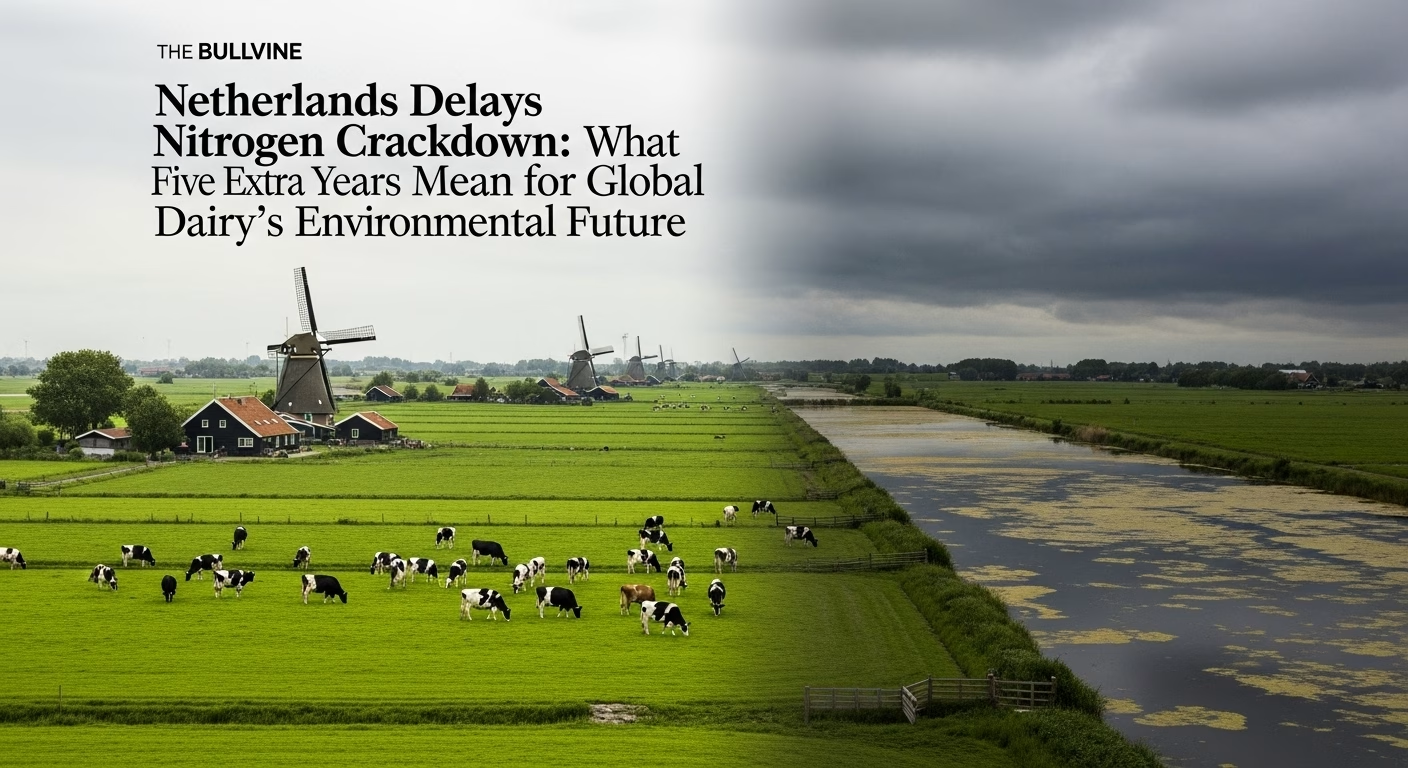
The Dutch government just bought its dairy farmers five more years to solve Europe’s worst nitrogen pollution crisis, defying court orders and risking EU sanctions in the process. This high-stakes gamble reveals the brutal reality facing intensive dairy operations worldwide: environmental regulations aren’t going away, and the political and economic forces are not protecting agriculture. For strategic planners in the global dairy industry, the Netherlands offers both a warning and a roadmap for navigating the collision between environmental law and agricultural economics.
Why Should Global Dairy Care About Dutch Dirt?
Here’s the uncomfortable truth: what happens in the Netherlands doesn’t stay in the Netherlands. This tiny country pumps out nitrogen emissions at four times the EU average, making it the poster child for intensive agriculture gone wrong. But before dismissing this as a European problem, consider that the same regulatory pressures, court challenges, and environmental standards are spreading globally across every major dairy region.
Are we witnessing the future of dairy regulation worldwide, or is the Netherlands an outlier case that won’t affect your operation? The Dutch situation isn’t unique—it’s just ahead of the curve. High-density livestock operations, proximity to sensitive ecosystems, and mounting legal pressure from environmental groups represent the future battleground for dairy farming worldwide. The nitrogen crisis that paralyzes Dutch agriculture could easily be tomorrow‘s reality in Wisconsin, California, or New Zealand.
Agriculture accounts for 61% of the Netherlands’ nitrogen compounds, with intensive livestock farming as the biggest single culprit. The numbers are staggering: over 95,000 tonnes of ammonia annually are pumped into the atmosphere from massive dairy herds, pig farms, and poultry operations. Even worse, 120 of the country’s 160 protected nature areas currently experience nitrogen deposition above critical thresholds.
What makes this crisis particularly brutal for dairy is geography. Dutch farms sit practically on top of 162 protected Natura 2000 conservation areas. This proximity means that even though agriculture might not be 100% responsible for nitrogen emissions, it’s causing 60% of deposits in the places that matter most to environmental lawyers and EU bureaucrats.
Think of it this way: if your operation sits within five miles of a sensitive watershed, national park, or protected habitat, you operate in the Dutch model. The question isn’t whether environmental pressure will reach your farm—it’s when and how severely it will hit.
What’s Really Behind the Five-Year Extension?
The Dutch government’s decision to push emission reduction deadlines from 2030 to 2035 isn’t just about giving farmers more time—it’s a calculated political gamble that reveals the raw power dynamics shaping agricultural policy globally. Agriculture Minister Femke Wiersma, representing the Farmer-Citizen Movement party that literally emerged from tractor protests, is betting that €2.2 billion in incentives can do what decades of regulation couldn’t.
But here’s where it gets interesting for strategic planners: this decision directly defies a January 2025 court order that mandated adherence to the 2030 deadline. The government is openly risking €10 million in fines and potential EU sanctions to protect its agricultural base. That’s not policy—that’s politics in its rawest form.
When did your government last defy a court order to protect dairy farmers? This level of political intervention reveals just how existential the nitrogen crisis has become for Dutch agriculture—and potentially for intensive dairy operations worldwide.
The financial package breaks down strategically: €750 million for livestock farmers who want to exit completely, €627 million for dairy producers looking to downsize, and €100 million for environmental restoration. These aren’t small numbers—they offer 120% of company value to the biggest polluters and 100% to smaller operations.
The regulatory shift could be even more significant than the money. Instead of measuring how much pollution settles in protected areas—the current system driving everyone crazy—they want to set emission limits directly at individual farms and dairy plants. There’s talk of raising the maximum emissions threshold from 0.005 mole of nitrogen per hectare per year to 1 mole per hectare per year—that’s a 200-fold increase.
Why Previous Buyout Schemes Failed Spectacularly
Here’s the harsh lesson for any region considering voluntary reduction programs: they don’t work when you need them most. The Dutch government has already burned through €3 billion in previous voluntary programs, offering farmers generous compensation to quit. The result? A pathetic 7% of the required nitrogen reduction.
The economics are brutally simple and mirror what happens in dairy herd culling decisions. The farmers most likely to take buyouts are those with negative net present values—older facilities, higher somatic cell counts, lower conception rates, and declining profitability. Meanwhile, the operations you need to address—the high-producing, efficient farms that happen to be near sensitive areas—have zero incentive to shut down when generating $2,000+ income over feed costs per cow annually.
This creates the same economic paradox dairy producers face with voluntary herd health programs: the cows that need the most intervention are often the least responsive to voluntary measures, while the high performers don’t need the program. Environmental economist Daan Boezeman captured this perfectly: “The farms that remain are the ones that make a profit and are in a better financial position because others have already stopped.”
It’s like trying to improve your herd’s genetic merit by offering voluntary buyouts to your cattle—the cows with the highest Total Performance Index (TPI) scores aren’t going anywhere, while you’re left with a management challenge that voluntary measures simply can’t solve.
A government committee figured out in 2022 that targeted closure of 500-600 major polluters would be far more effective than endless voluntary schemes—similar to how culling the bottom 10% of your herd based on lifetime net merit typically improves overall profitability more than incremental nutrition improvements across the entire herd.
The lesson for global dairy? Voluntary programs are a political theater that delays real solutions while burning through public money. If your region is heading toward similar environmental pressure, don’t count on governments buying their way out of the problem.
The Nitrogen Numbers: Production Reality vs. Environmental Math
Let’s break down the nitrogen efficiency crisis in terms dairy producers understand. Current research shows that dairy herds achieve only about 30% nitrogen use efficiency (Reducing nitrogen losses from dairy farms: Netherlands experience), meaning 70% of the nitrogen consumed becomes manure rather than milk protein. That’s like having a feed conversion efficiency of 0.3—completely unsustainable from both economic and environmental perspectives.
Here’s how the math works in practical terms: A 1,400-pound Holstein consuming 55 pounds of dry matter daily at 16% crude protein intake processes approximately 1.4 pounds of nitrogen per day. With 30% efficiency, only 0.42 pounds can be converted to milk protein, while 0.98 pounds can be converted to manure nitrogen. Multiply this by 1.6 million Dutch dairy cows, and you’re looking at over 570,000 pounds of excess nitrogen daily hitting the environment.
If your operation runs similar efficiency numbers, what will happen if environmental regulators suddenly started paying attention to your nitrogen balance? Most dairy producers have never calculated their operation’s nitrogen use efficiency—yet this metric is becoming the foundation for environmental compliance worldwide.
Compare this to Danish agriculture, which achieved 40% nitrogen reduction since 1985 while doubling nitrogen use efficiency through comprehensive management changes. Their approach included:
- Precision Nutrition Protocols: Matching crude protein levels to lactation stage and production level, reducing dietary protein from 18% to 15% during mid-lactation
- Manure Management Technology: Advanced separation systems reduce barn emissions by 60-70% while converting nitrogen to reusable fertilizer
- Seasonal Management: Compulsory winter cover crops and strict nitrogen budgets with associated fines
- Spatial Planning: Buffer zones and constructed wetlands near sensitive ecosystems
The Danish success story proves that substantial nitrogen reductions are possible without destroying dairy productivity—they maintained milk production per cow while dramatically improving environmental metrics. It’s like achieving 25,000 pounds per cow annually while reducing your carbon footprint by 40%.
Technology Pathways: What Actually Works for Dairy Operations
The technological solutions exist today to dramatically reduce nitrogen emissions without compromising milk production or profitability. Feed efficiency represents the most immediate opportunity for most operations. Research shows that precision feeding could lower nitrogen emissions by 82,000 tonnes annually in the US, with precision feeding reducing excess protein intake and cutting nitrogen excretion by 10-20%.
Precision Nutrition Implementation: Advanced feed management systems using near-infrared spectroscopy to optimize protein delivery throughout lactation curves. Early lactation cows (0-60 DIM) requiring 18-19% crude protein for peak production can transition to 15-16% during mid-lactation (60-200 DIM) without affecting milk yield. This targeted approach reduces nitrogen excretion by approximately 20% while maintaining butterfat and protein percentages.
But here’s what most producers miss: precision nutrition isn’t just about reducing environmental impact—it’s about maximizing income over feed costs. Research suggests feeding cows according to their protein and amino acid needs could save over US5 million annually in feed costs. When you optimize protein delivery to match actual requirements rather than using blanket formulations, you’re improving both profitability AND environmental compliance.
Manure Management Technology: Advanced separation systems like anaerobic digesters combined with nitrogen recovery can reduce barn emissions by up to 70% while generating renewable energy. The economics work for larger operations: a 2,000-cow dairy can expect $400,000-600,000 annual revenue from electricity generation plus reduced nitrogen disposal costs.
| Technology Solution | Nitrogen Reduction | Investment Cost (per cow) | Implementation Complexity | ROI Timeline |
| Precision Nutrition Systems | 15-25% | $150-300 | Low-Moderate | 18-24 months |
| Anaerobic Digesters | 40-60% | $2,500-4,000 | High | 7-10 years |
| Feed Additives (Methane Inhibitors) | 15-30% | $50-100 | Low | 6-12 months |
| Advanced Manure Separation | 60-70% | $800-1,500 | High | 3-5 years |
Activity Monitoring Integration: Modern precision agriculture systems can optimize nitrogen application timing and rates based on GPS mapping, soil sensors, and weather data. This reduces total nitrogen input by 20-30% while maintaining or improving forage quality—equivalent to reducing your feed bill by $200-300 per cow annually.
The conventional wisdom says environmental compliance costs money. But what if the opposite is true? The most successful Danish operations discovered that nitrogen efficiency improvements actually increased profitability while meeting environmental standards. It’s time to challenge the assumption that environmental regulations necessarily hurt your bottom line.
Why American Dairy is Sleepwalking Toward the Dutch Crisis
Here’s the controversial truth most US dairy producers refuse to acknowledge: America’s intensive dairy regions follow the same trajectory that created the Netherlands crisis, but without any regulatory pressure that could force corrective action before it’s too late.
Consider the numbers that should keep every Wisconsin and California dairy strategist awake at night. The Netherlands operates at nitrogen emissions per hectare four times the EU average (Assessment of Nitrogen Ceilings for Dutch Agricultural Soils), while US dairy regions like the Central Valley and Central Sands operate at similar or higher intensities without any systematic monitoring or regulation.
What makes American complacency even more dangerous is the proximity factor. Just like Dutch operations sitting next to Natura 2000 conservation areas, thousands of US dairy operations operate within five miles of sensitive ecosystems, national parks, and protected watersheds. The only difference? European environmental law has teeth, while US environmental regulation treats agriculture as a protected class.
However, what American dairy leaders consistently ignore is that the legal framework driving Dutch compliance is spreading globally through climate commitments and biodiversity agreements. The same court precedents being established in Europe will eventually reach US courtrooms, and when they do, American operations will face mandatory compliance timelines with zero preparation time.
The Feed Efficiency Breeding Scandal Nobody Discusses
What if the biggest failure in modern dairy genetics isn’t what we’re selecting for but what we’re completely ignoring? The current genomic selection emphasizes milk yield, butterfat percentage, and protein content. Still, despite mounting evidence that this characteristic shows significant genetic variation between individual cows, it completely overlooks nitrogen use efficiency as a heritable trait.
The US dairy industry has achieved impressive productivity gains through genomics—a 19.2% increase in milk production since 2008 with only 1% more cows. But that success story masks a critical failure: we haven’t optimized for environmental efficiency alongside production efficiency.
Genomic testing now costs as little as $28 per head—approximately 1% of the cost to raise a heifer. Yet most operations still don’t test for traits that could determine future regulatory compliance. The Feed Saved trait was introduced in December 2020 to enable dairy producers to breed more feed-efficient cows, but adoption rates remain pathetically low across the industry.
Why are we not already selecting for nitrogen efficiency? Because the dairy industry operates under the assumption that environmental concerns are separate from genetic improvement. The Netherlands crisis proves that assumption is dangerously outdated.
Research shows significant genetic variation in nitrogen use efficiency between individual cows (An integrated assessment of nitrogen source, transformation, and fate within an intensive dairy system), yet this trait rarely appears in breeding indexes. Imagine breeding decisions based on a “Nitrogen Merit Index” that combines production traits with environmental impact metrics. Early research suggests this approach could reduce nitrogen excretion per unit of milk by 15-20% within a single generation while maintaining production levels.
The Total Performance Index (TPI) formula was updated in April 2021 to include Feed Saved evaluations, yet most breeding decisions still prioritize short-term production gains over long-term environmental sustainability. This represents a fundamental strategic failure that will become increasingly expensive as environmental regulations tighten.
Why This Matters for Your Operation: Regional Risk Assessment
Proximity Risk Evaluation: Map your operation’s distance from sensitive ecosystems, protected wetlands, or conservation areas. Operations within 5 miles of such areas should expect regulatory scrutiny within the next 5-10 years. This isn’t speculation—it’s pattern recognition based on how environmental law enforcement evolves.
Take the Yakima Valley lawsuits in Washington State, where environmental groups successfully challenged dairy operations under the Resource Conservation and Recovery Act. The legal precedent established there affects every dairy operation in the United States—nitrogen is nitrogen, whether it comes from manure, anhydrous ammonia, or synthetic fertilizers.
Economic Impact Analysis: The Dutch construction sector alone lost €14 billion over five years due to nitrogen-related project suspensions. This translates to potential restrictions on farm expansions, new facility construction, and even routine infrastructure maintenance for dairy regions. A mid-sized dairy planning a $2 million parlor upgrade could find permits suspended indefinitely if nitrogen regulations tighten suddenly.
Consider this scenario: You’re operating a 1,200-cow dairy in Wisconsin’s Central Sands region, planning a $1.8 million expansion to 1,800 cows. Your operation sits 3 miles from a restored wetland area that’s part of a state conservation program. Current nitrogen loading in your watershed is approaching critical thresholds, and environmental groups are starting to file lawsuits similar to those in the Netherlands and Washington State.
Do you proceed with the expansion and risk regulatory shutdown, or do you invest that $1.8 million in nitrogen reduction technology that could future-proof your operation? This isn’t a hypothetical scenario—it’s the decision facing thousands of dairy producers in sensitive watersheds worldwide.
Regional Comparison Context:
- United States: Wisconsin and Pennsylvania dairy regions show similar nitrogen loading patterns to the Netherlands, particularly in areas with high cow density relative to cropland
- New Zealand: Canterbury Plains operations face increasing scrutiny over nitrate leaching into groundwater systems
- European Union: Germany and Belgium employ “more generous limit values” that experts believe may be incompatible with EU environmental directives
- India: Rapid dairy sector expansion in Punjab and Haryana creates similar nitrogen loading challenges
- China: Inner Mongolia dairy regions show concerning nitrogen accumulation patterns
Global Implications: The Nitrogen Revolution Coming
The economic model of intensive dairy farming faces a fundamental challenge. High-density operations near sensitive ecosystems experience existential pressure from environmental regulations backed by judicial enforcement. The traditional approach of externalizing environmental costs is no longer sustainable when courts can shut down entire sectors overnight.
Denmark’s comprehensive approach offers the clearest roadmap forward. Their 40% nitrogen reduction by 2010 while doubling efficiency proves dramatic improvements are possible without destroying agricultural productivity. The key was comprehensive, long-term integration of multiple technologies and management approaches rather than relying on single solutions.
For dairy strategic planners, the Danish model translates to specific operational changes:
- Nutrition Optimization: Reducing crude protein levels during mid-lactation from 17% to 15% while maintaining milk yield through improved amino acid balancing
- Manure Management: Installing anaerobic digesters on operations of over 1,000 cows with nutrient recovery systems
- Spatial Planning: Establishing buffer zones between barn areas and sensitive water systems
- Technology Integration: Precision application systems for manure and fertilizer based on soil testing and GPS mapping
But here’s what policymakers consistently underestimate: the speed at which environmental law is evolving. The Netherlands went from voluntary programs to court-ordered deadlines with financial penalties in less than five years. California’s dairy sector could achieve similar transformation timelines, proving rapid change is possible when regulatory pressure aligns with technological solutions.
Are you prepared for regulatory timelines that compress decades of gradual change into five-year mandatory compliance windows?
Real-World Economics: What Proactive Compliance Actually Costs
Success Story: Precision Feeding ROI Analysis
Research from the University of Idaho and Virginia Tech demonstrates that precision feeding systems can generate $0.32 to $0.60 gain per cow per day when feeding based on individual protein requirements. For a 1,000-cow operation, this translates to $117,000-219,000 annual additional income while simultaneously reducing nitrogen excretion by 10-20%.
The Feed Efficiency Economic Impact:
The Holstein Association’s Feed Efficiency Dollar index shows that every pound of Feed saved returns a net profit of eleven cents per cow per lactation. With feed costs representing over 65% of farm expenses, genetic selection for feed efficiency can improve a farm‘s bottom line while supporting environmental goals.
Failure Example: Reactive Compliance Costs
Contrast proactive implementation with reactive crisis management. The Netherlands’ €3 billion investment in voluntary buyout schemes achieved only 7% of the required nitrogen reduction—representing a cost of approximately €43 billion per percentage point of reduction achieved. Operations forced into emergency compliance face similar cost multiplication factors when technology adoption occurs under regulatory deadlines rather than strategic planning.
The difference? Strategic planning versus reactive crisis management generates 60-80% cost savings for equivalent environmental outcomes. Which scenario describes your operation’s current approach to environmental risk?
Implementation Timeline: What Strategic Planners Should Do Now
Phase 1 (Next 90 Days): Risk Assessment and Baseline Establishment
- Evaluate proximity to sensitive ecosystems and protected areas within a 10-mile radius
- Calculate current nitrogen use efficiency based on feed analysis and manure testing
- Assess potential regulatory exposure through environmental consultant evaluation
- Establish baseline measurements for future compliance documentation
Phase 2 (3-12 Months): Technology Evaluation and Pilot Implementation
- Test precision nutrition protocols during transition periods to measure nitrogen reduction potential
- Evaluate manure management technology options with ROI calculations
- Implement activity monitoring systems for nitrogen application optimization
- Develop relationships with environmental technology vendors and consultants
Phase 3 (1-3 Years): Comprehensive System Integration
- Install selected manure management technology based on pilot results
- Integrate precision nutrition throughout lactation management protocols
- Establish nitrogen monitoring and reporting systems for regulatory compliance
- Develop contingency plans for different regulatory scenarios
Phase 4 (3-5 Years): Optimization and Expansion
- Scale successful nitrogen reduction technologies across entire operation
- Share learnings with regional dairy organizations and industry groups
- Prepare for potential regulatory requirements through proactive compliance
- Evaluate additional environmental benefits (carbon credits, water quality improvements)
The conventional approach is to wait for finalizing regulations before taking action. But what if proactive implementation gives you competitive advantages in a nitrogen-constrained world? Early adopters of precision nutrition and manure management technologies often discover operational improvements that go far beyond environmental compliance.
The Bottom Line: Preparing for the Inevitable
The Dutch nitrogen crisis represents the future battleground for intensive dairy farming worldwide. Environmental regulations aren’t disappearing—they’re strengthening, backed by courts willing to impose real financial penalties and shut down entire sectors when necessary.
The five-year delay Dutch farmers just won isn’t a victory—it’s borrowed time. The government’s €2.2 billion bet on voluntary measures will likely fail like previous programs, leaving mandatory reductions as the ultimate solution. For strategic planners in the global dairy industry, waiting for perfect solutions or hoping for political salvation isn’t viable when courts and environmental law drive the timeline.
Technology offers the only sustainable path forward, but it requires proactive implementation. The Danish success story proves dramatic nitrogen reductions are possible without destroying agricultural productivity, but only through comprehensive, long-term strategies integrating multiple technologies and management approaches.
What specific steps will you take in the next 90 days to assess your operation’s nitrogen risk and begin implementing reduction technologies? The Dutch crisis shows that reactive approaches cost far more than proactive preparation—both financially and operationally.
Here’s your implementation challenge: Calculate your operation’s current nitrogen use efficiency using the 30% industry benchmark (Reducing nitrogen losses from dairy farms: Netherlands experience). If you’re operating at the industry average of 30%, you’re essentially giving away 70% of your protein investment while creating environmental liabilities that could shut down your operation overnight.
The questions you need to answer today:
- Where does your operation rank for proximity to sensitive ecosystems?
- What’s your current nitrogen use efficiency, and how does it compare to leading operations achieving 40%+ efficiency?
- Do you have relationships with environmental technology vendors before you need them?
- Have you calculated the ROI for proactive compliance versus reactive crisis management?
The nitrogen revolution is coming to dairy farming worldwide. The only question is whether you’ll be ready when it arrives at your operation or whether you’ll be caught scrambling like Dutch farmers facing court-ordered deadlines with insufficient time to adapt.
Start with nitrogen use efficiency calculations this month. Your future compliance—and profitability—depends on it.
The conventional wisdom says environmental regulations threaten dairy profitability. The contrarian reality? Operations that master nitrogen efficiency first will dominate markets where environmental compliance becomes mandatory. Which side of that equation will your operation be on?
Learn More:
- Strategies for Increasing Nitrogen Efficiency in Dairy Herds – Practical strategies for precise nutrient management, forage optimization, and feeding protocols that immediately improve nitrogen utilization while reducing environmental impact and feed costs.
- Research Shows How to Slash Nitrate Leaching by 28% While Boosting Milk Protein – Reveals genetic selection methods using MUNBV that reduce nitrogen pollution by 28% while increasing milk protein premiums, adding $45,000-$60,000 annually for 500-cow operations.
- 5 Technologies That Will Make or Break Your Dairy Farm in 2025 – Demonstrates how AI-driven precision feeding systems and smart monitoring technologies slash feed waste by 18% while positioning farms for environmental compliance success.
 Join the Revolution!
 Join the Revolution!
Join over 30,000 successful dairy professionals who rely on Bullvine Weekly for their competitive edge. Delivered directly to your inbox each week, our exclusive industry insights help you make smarter decisions while saving precious hours every week. Never miss critical updates on milk production trends, breakthrough technologies, and profit-boosting strategies that top producers are already implementing. Subscribe now to transform your dairy operation’s efficiency and profitability—your future success is just one click away.




