






From parlor to payment, dairy runs on data. What happens when that flow gets hacked?
Executive Summary: When ransomware sidelined Dairy Farmers of America’s payment systems in 2025, the cows didn’t miss a beat—but the milk checks did. That disruption exposed just how intertwined today’s dairy operations are with digital infrastructure. With most farms carrying less than two weeks of cash flow, even short delays ripple quickly through feed, payroll, and herd health. Now, the industry is pivoting—insurance carriers, processors, and co-ops are requiring proof of cybersecurity readiness much like milk quality testing. Encouragingly, shared-defense models pioneered by rural electric co-ops are showing how collaboration can make protection affordable. The bottom line? For modern dairy, safeguarding data has become as essential as managing fresh cow health, feed efficiency, and butterfat performance—and it’s a challenge the cooperative spirit is well-suited to solve.

You know, it wasn’t that long ago that when we talked about “security” on a dairy farm, we were thinking about padlocks, not passwords. But things have changed. When Dairy Farmers of America (DFA) confirmed a ransomware attack last summer that disrupted milk pickup and delayed producer payments, it delivered a wake‑up call to everyone in dairy.
What’s interesting is that this was never just the DFA’s problem. It was a reminder that every gallon of milk today depends on layers of technology—from dispatch and lab testing to payroll. The cows kept milking, of course. But the money stopped moving, and that’s when every producer felt it.

When Data Fails Before the Pump Does
The FBI and federal ag briefings have shown that ransomware groups, including one known as “Play,” have been targeting food and logistics operations more frequently in the last two years. Agriculture offers what hackers want: essential infrastructure and time‑sensitive data.

DFA handled the incident quickly and with transparency, but the bigger takeaway is that every co‑op, regardless of size, now sits on the same digital fault line. I’ve noticed that even smaller Midwest cooperatives rely on a handful of software links for billing, route management, and milk quality reporting. If those systems lock up, the trucks can roll all they want—nobody gets paid on time.
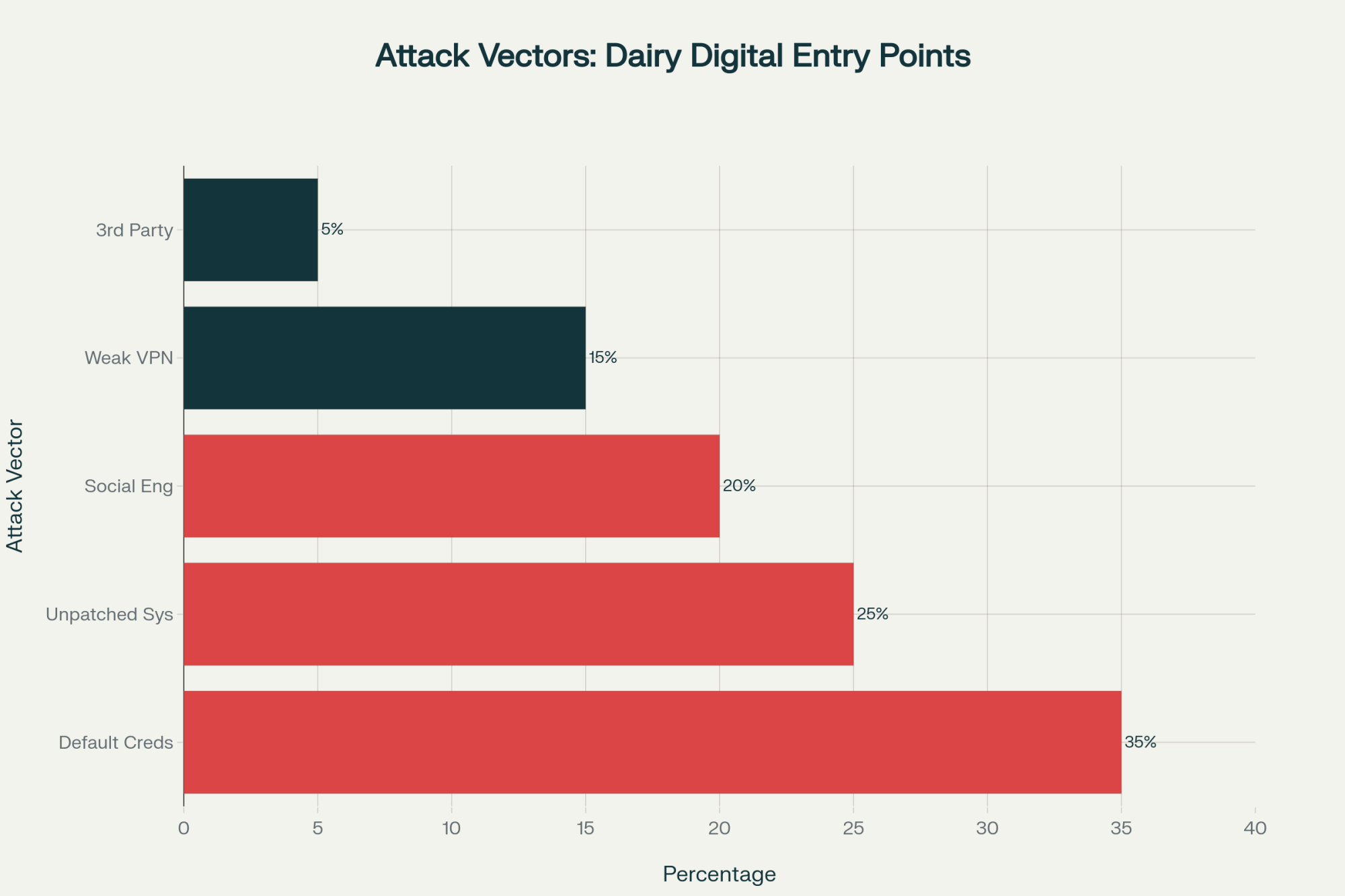
Margins, Minutes, and Modern Milk
What I’ve found in extension discussions lately is that this risk exposes an uncomfortable truth about dairy’s financial stamina. USDA Economic Research Service data shows U.S. dairy herds clocked in at over 23,000 pounds per cow in 2024, a record high. Yet Penn State Extension financial summaries reveal that nearly two‑thirds of farms have less than two weeks’ worth of operating capital in reserve.
Rows (alternating white/#F5F5F5, black text, RED numbers #CC0000 for critical figures):
| Metric | Industry Reality | Cyber Attack Impact |
|---|---|---|
| Operating Cash Reserve | < 2 weeks (66% of farms) | Depleted in 3-7 days |
| Milk Production/Cow/Year | 23,000+ lbs (2024) | Continues uninterrupted |
| Payment Delay Tolerance | 3-5 days max | DFA: 17 days actual |
| Feed Cost Impact | $5.50+/cow/day | Immediate pressure on suppliers |
| Production Drop Risk | 3-5% in 30 days | Long-term herd damage |
It’s a dangerous mix: more digital dependence, less financial cushion. In most operations, if one milk check misses the bank by 3 days, feed schedules or payroll feel the pinch immediately. And that ripple doesn’t stop in the office. A short‑term ration downgrade may look harmless, but research in the Journal of Dairy Science confirms a 3–5 percent milk decline within a month and lower butterfat performance across the herd.
As a New York nutritionist put it in a recent cooperative workshop, “Every gallon lost in production isn’t just lost feed—it’s deferred maintenance on the cow herself.”
Why Boards Overlook the Digital Barn Door
Now, to be fair, most cooperative boards are filled with the people who made dairy what it is—smart, experienced producers. But cybersecurity’s a whole new animal. Many directors can watch butterfat averages like a hawk but have never seen what a server backup log looks like.
That’s changing. A growing number of co‑ops are bringing in CISA agricultural advisors or extension IT specialists to run tabletop backup tests. These “practice crises” map how fast payment systems could reboot after a lockout. What’s encouraging here is that producers themselves are asking for those updates. The conversation has moved from “Why do we need this?” to “When’s our next recovery test?”
Shared Defense: The Power Co‑Op Lesson
Here’s something dairy can borrow from our electric cooperative neighbors. The National Rural Electric Cooperative Association (NRECA) created ICS‑REC, a shared cybersecurity system that enables small utilities to pool resources to monitor and respond to cyber threats.

According to NRECA’s 2024 report, co-ops using shared monitoring cut their outage time nearly in half and saved an average of 40 percent on technology costs compared to going it alone. That model is now being discussed in ag circles, with USDA rural development offices and state councils exploring pilot versions tailored to food and dairy infrastructure.
What’s encouraging is that this approach feels familiar to farmers. We’ve always pooled tankers, lab testing, and marketing. Pooling digital defense is just the next step.
Regional Realities: Same Storm, Different Forecasts
Cyber threats look a bit different depending on where your milk flows. In California, major processors managing high‑volume export trade are investing in dual‑site data centers because uptime equals product flow. In the Upper Midwest, co‑ops still running older accounting platforms grapple with software compatibility and delays in security‑patch updates. In the Northeast, where many co‑ops rely on third‑party vendors for payment processing, vulnerability often sits one contract away.
Different setups—but the same universal lesson. Every operation should know who’s guarding its data pipeline, not just the milk pipeline.
Compliance Is the New Competition
Here’s a shift few saw coming: insurers and buyers now view cyber preparedness as a supply‑chain expectation. Re‑insurance providers have begun demanding proof of frequent system tests before renewing cooperative policies.
Meanwhile, Dairy Market News (September 2025) reported that several national processors will soon require suppliers to meet NIST Cybersecurity Framework benchmarks—the same federal standards guiding manufacturing. This isn’t about red tape; it’s about risk mitigation. Ten years ago, it was traceability. Five years ago, sustainability. Today, it’s cybersecurity.
That trend tells us that staying digitally sound may soon be as important to your milk check as your somatic cell count.
Four Questions Every Member Should Ask
Looking at this trend, here are the questions producers are starting to bring up in their own co‑op meetings:
- How quickly can our payment systems recover if they’re shut down?
- When was our last confirmed backup test, and what were the results?
- Does our insurance actually protect producer payments or just IT equipment?
- What are we doing to verify the digital safety of outside vendors?
Those are the right conversations to be having. They don’t require tech fluency—just business fluency.
Farm‑Level Insurance: The Practical Kind
While the bigger fixes happen at the cooperative level, each farm can still boost resilience. Penn State Extension and the Food and Ag ISAC recommend keeping 30–45 days of cash or credit set aside for feed, payroll, and essentials; maintaining both cloud and physical copies of records; and outlining a 72‑hour business‑continuity plan.
During last summer’s brief DFA delay, farms that maintained these safeguards navigated the disruption calmly. One Wisconsin dairyman told me, “I treat data backups like fresh cow checks—you do it before things go wrong, not after.”
What’s particularly noteworthy is how these everyday steps—basic organization, paper copies, a short‑term cash plan—shielded real operations from chaos.
From Hardware to Heart of Cooperation
If there’s a silver lining in all of this, it’s that cybersecurity may actually reconnect dairy to its cooperative roots. Just as early milk pools allowed farmers to share equipment and market access, today’s co‑ops have a new reason to collaborate on shared digital defense.
NRECA’s ICS‑REC success shows what collective foresight can achieve: greater resilience at lower cost. And with CISA beginning to tailor agriculture‑sector protocols, we have both the data and the roadmap.

Cybersecurity might not feel as tangible as herd management or fresh cow care, but in 2025, it’s part of keeping the parlor humming. Protecting bridges between the barn, the bank, and the buyer ensures that milk—and money—keep moving.
Because at the end of the day, protecting your milk check is just another form of protecting your herd.
Key Takeaways :
- The 2025 DFA cyberattack revealed that dairy’s digital systems—dispatch, payments, and lab data—are now as critical as the milking parlor itself.
- With most farms carrying under two weeks of liquidity, a frozen payment system triggers losses far beyond delayed deposits.
- Shared‑defense models pioneered by rural electric co‑ops show that collaboration can make cybersecurity affordable and effective.
- Insurers and processors are treating cyber readiness like milk‑quality testing: it’s not optional, it’s expected.
- Strengthening your co‑op’s firewalls is today’s version of maintaining herd health—a shared responsibility that protects everyone’s milk check.
Complete references and supporting documentation are available upon request by contacting the editorial team at editor@thebullvine.com.
Learn More:
- Boost Your Dairy Farm’s Health: Vital Ratios for Financial Fitness and Growth – This article provides the tactical “how-to” for building the exact financial resilience your article calls for, detailing the key ratios like working capital that farms need to monitor to survive a milk check disruption.
- 2025 Dairy Market Reality Check: Why Everything You Think You Know About This Year’s Outlook is Wrong– This strategic analysis details the 2025 market volatility, labor costs, and pricing pressures that create the “razor-thin margins” you mentioned, reinforcing why a cyber-attack on payment systems is an existential, time-sensitive threat.
- AI and Precision Tech: What’s Actually Changing the Game for Dairy Farms in 2025? – While your piece highlights the risks of digital dependency, this article shows the rewards. It details the ROI of data-driven tech, demonstrating why farms must adopt these tools for profit, which perfectly frames your argument for securingthem.
 Join the Revolution!
 Join the Revolution!
Join over 30,000 successful dairy professionals who rely on Bullvine Weekly for their competitive edge. Delivered directly to your inbox each week, our exclusive industry insights help you make smarter decisions while saving precious hours every week. Never miss critical updates on milk production trends, breakthrough technologies, and profit-boosting strategies that top producers are already implementing. Subscribe now to transform your dairy operation’s efficiency and profitability—your future success is just one click away.




