







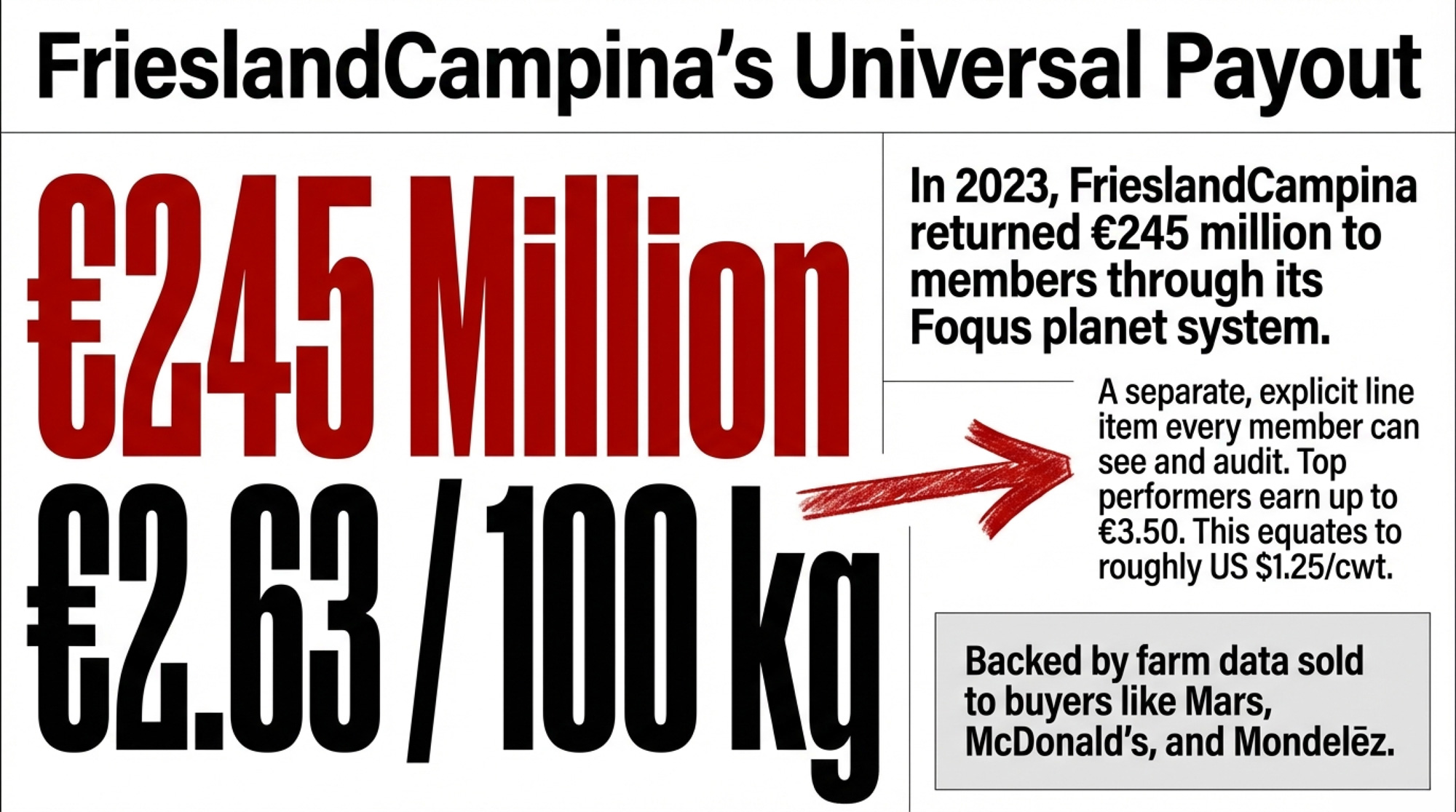
FrieslandCampina paid farmers €245 million in sustainability bonuses last year — €2.63/100 kg (US$1.25/cwt) as a separate line on every milk check. Your co‑op? Blank.
Executive Summary: FrieslandCampina handed back €245 million to its 2023 members in sustainability premiums — €2.63 per 100 kg (US$1.25/cwt) as a line item every farmer could see and bank on. North America’s Fair Trade (45¢/cwt), Truterra ($21M), Organic Valley ($20/ton), and Athian ($18M) deliver real cash — if you enroll, verify, and qualify. No blanket bonus hits every cwt from every farm. A 300‑cow herd under FC’s formula? €65,857 — roughly US$70k you could plug into stalls or payroll. Your data fuels these programs, yet you’re footing the platform bills while co‑ops quietly blend the upside into base pay. Nebraska Gov. Jim Pillen and Sen. Mike Jacobson want LB525 to flip that: farm data is yours, not vendor fodder. Do this now: Calc your “FrieslandCampina gap” (kg shipped ÷ 100 × €2.63), then email your co‑op rep demanding their sustainability revenue details — pool total, per‑cwt payout, exact line item.
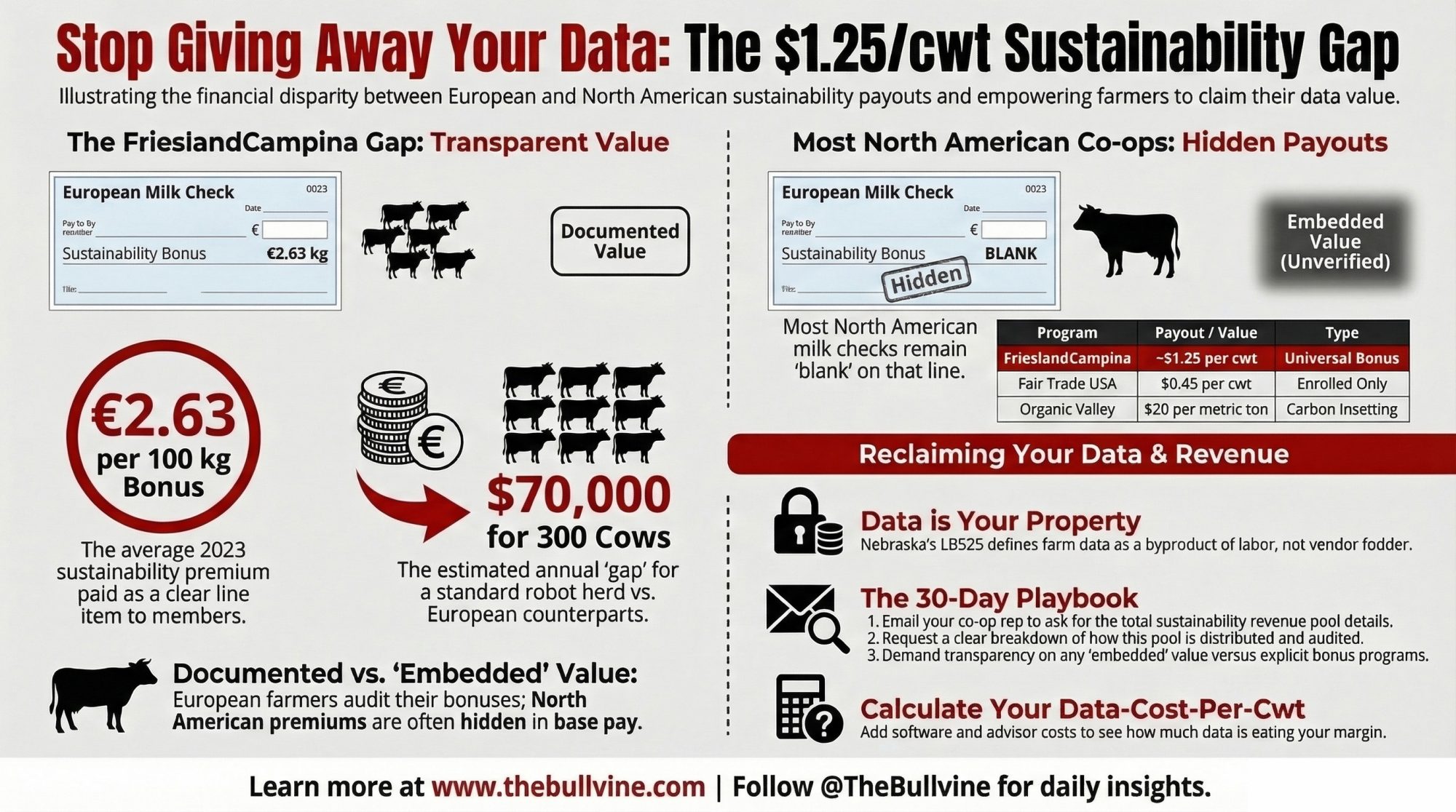
FrieslandCampina reported paying more than €245 million in sustainability premiums to member farms in 2023 — averaging €2.63 per 100 kg of milk, with top performers eligible for up to €3.50 per 100 kg. That’s roughly US$1.25–1.30 per cwt, based on published 2023–24 exchange rates, where €245 million converted to approximately US$263 million, and it appears as a separate sustainability line item that every member can see and audit.
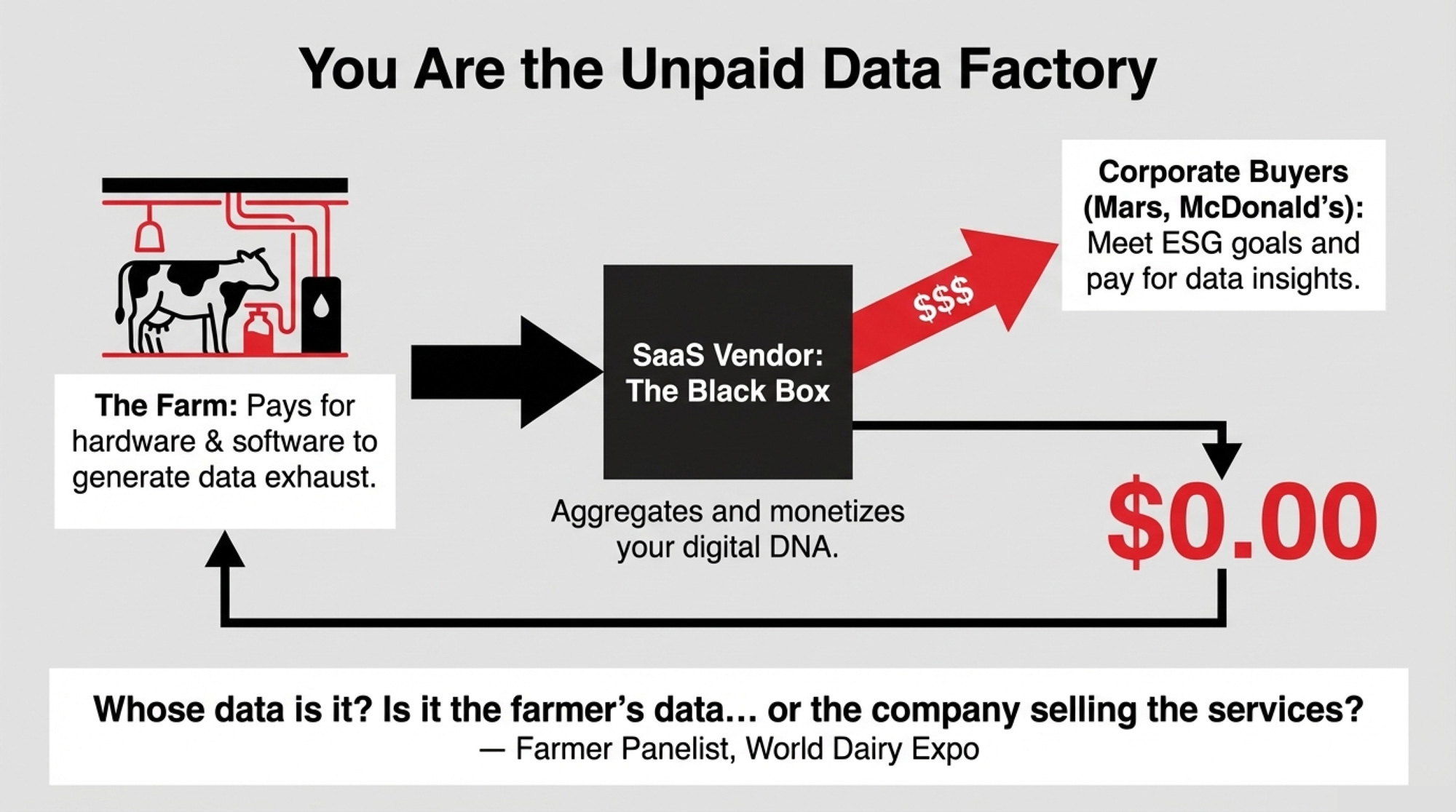
At World Dairy Expo 2025, during a Knowledge Nook seminar on connected data platforms, one of the farmer panelists cut through the tech talk with a blunt question: “Whose data is it? Is it the farmer’s data — the farmer that’s paying for it — or is it the company that’s selling the services?”
That’s the heart of it. If a European co‑op can put a sustainability number on every check with a formula its members can audit, why are so many North American milk checks still blank on that line?
How FrieslandCampina’s Sustainability Premium Formula Actually Works
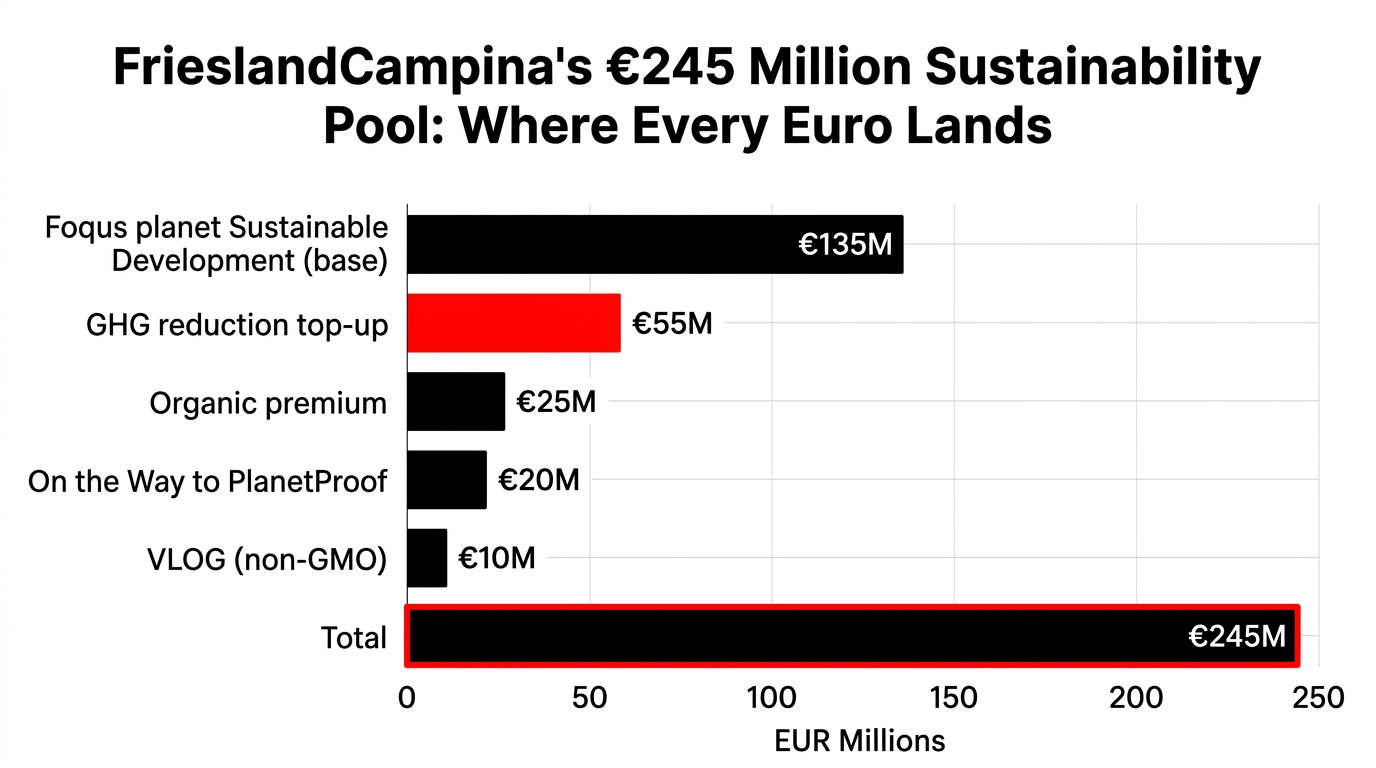
FrieslandCampina is a farmer‑owned co‑op with members in the Netherlands, Belgium, and Germany. In 2023, it channeled more than €245 million back into member pockets through sustainability‑linked premiums.
Here’s how that breaks down:
- About €190 million came through the Foqus planet Sustainable Development system, which is tied to nine indicators, including greenhouse gas emissions, animal health, and grazing.
- More than €55 million came through special milk flows like organic, On the Way to PlanetProof, and VLOG.
- Farms that hit the toughest GHG reduction targets earned bonuses up to €1.50 per 100 kg on top of the base Foqus planet rate, for a maximum of €3.50 per 100 kg.
Members also fund part of this pool themselves. A cooperative deposit of €0.60 per 100 kg — over €56 million in 2023 — is withheld and later allocated based on Foqus planet scores. Net of that deposit, roughly €2.03 per 100 kg in Foqus planet premiums still ends up back on the check — a mix of company and customer sustainability money flowing to farms.
The trade‑off is real: you gain a predictable sustainability formula you can plan around, but you accept more measurement, more reporting, and the upfront cooperative deposit before that money comes back. FC members decided the visibility and the premiums were worth the paperwork.
FrieslandCampina uses farm‑level data to support sustainability contracts with buyers such as Mars, McDonald’s, and Mondelēz, including a pledge with Mondelēz to cut on‑farm GHG emissions by about 14% by 2025 compared with 2019. They’re not just selling milk. They’re selling documented sustainability performance backed by farm data — and they share that value explicitly with the farmers who generated it.
What North American Programs Actually Pay — And How
North America isn’t empty of sustainability payments. But the structures look very different from a universal per‑100 kg premium.
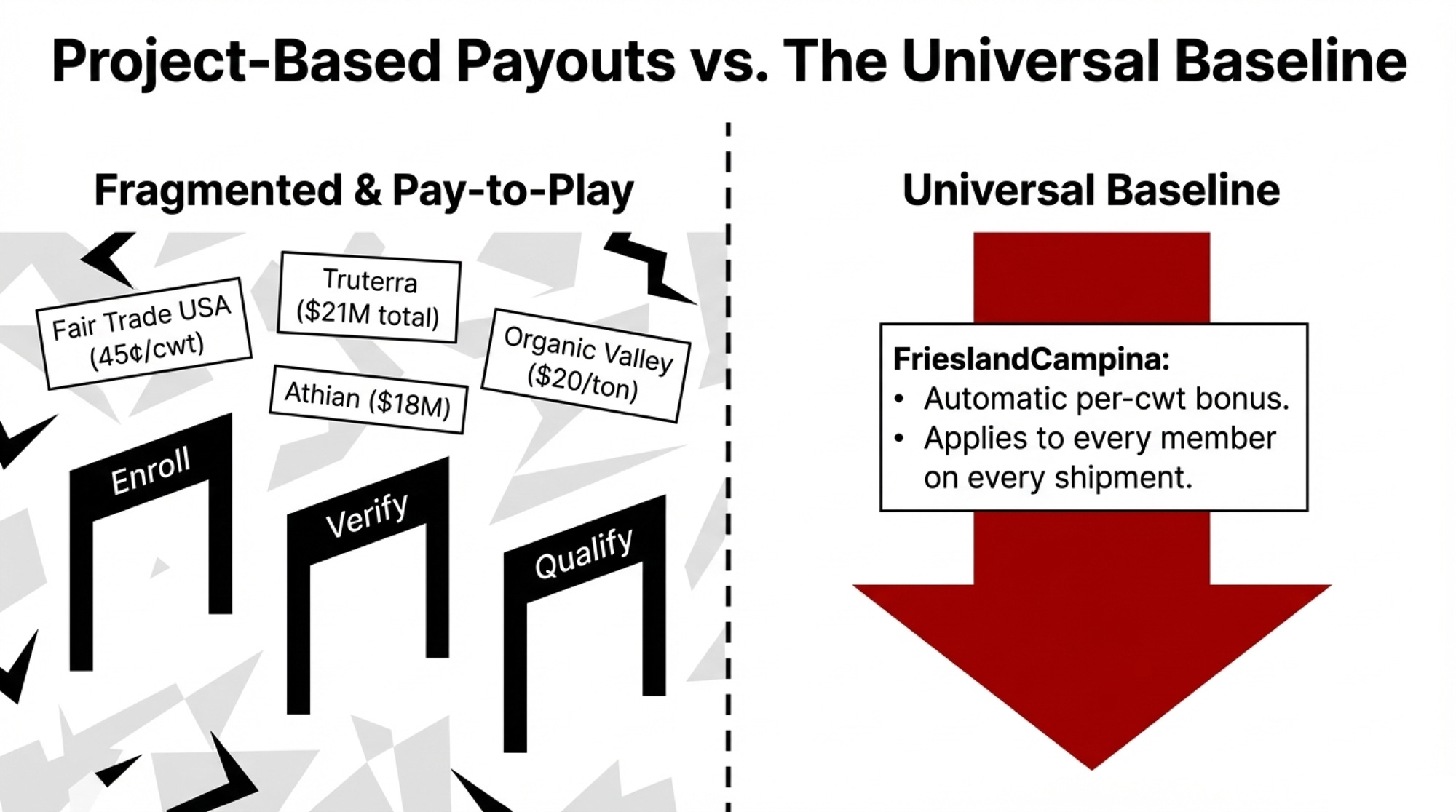
Fair Trade USA — 45¢/cwt for enrolled farms. In 2023, Fair Trade USA launched a dairy certification with Chobani that pays US$0.45 per cwt each month to participating farms, both organic and conventional. It’s real money and a clear line item, but only for producers who go through Fair Trade certification and ship into that specific program.
Truterra/Land O’Lakes — US$21M across three years. Land O’Lakes’ sustainability arm, Truterra, reports paying farmers more than US$21 million to sequester or reduce 1.1 million metric tons of carbon across its first three program years. Payments go to farms that enroll and meet practice and verification rules, not to every member on every cwt.
Organic Valley — US$20/ton insetting. Organic Valley’s Carbon Insetting Program pays member farms US$20 per metric ton of verified on‑farm carbon reduction, using funds from a US$25 million Partnerships for Climate‑Smart Commodities grant. Strong signal — but only for enrolled, verified projects.
Athian — US$18M in livestock carbon credits. Athian’s livestock carbon insetting platform has facilitated about US$18 million in payments to dairy and beef farms since 2024. Dairy Farmers of America bought the first verified livestock carbon credits in early 2024, generated on a Texas dairy after an Elanco protocol reduced nearly 1,150 metric tons of CO₂e.
Those examples matter. They prove that sustainability money isn’t theoretical in North America. But they’re all project‑based: you enroll, you qualify, you get paid. There’s still no equivalent to FrieslandCampina’s published per-100-kg sustainability bonus that automatically applies to every member and appears as a separate line item on every milk check.
| Program / Co-op | Geography | Payment Structure | Amount | Who Gets Paid | Visibility on Check |
| FrieslandCampina | Netherlands, Belgium, Germany | Universal per-100-kg premium | €2.63/100 kg (US$1.25/cwt) | All members | Separate line, monthly |
| Fair Trade USA | U.S. (Chobani program) | Per-cwt premium | US$0.45/cwt | Enroll only | Separate line for enrolled farms |
| Truterra / Land O’Lakes | U.S. | Carbon practice payments | US$21M / 3 years pool | Enroll + verify | Not disclosed per cwt |
| Organic Valley | U.S. | Carbon insetting | US$20/ton CO₂e reduced | Enroll + verify | Project payment, not per-cwt |
| Athian (DFA purchase) | U.S. (multi-state) | Carbon credit sales | US$18M facilitated | Enroll + verify | No standard line item |
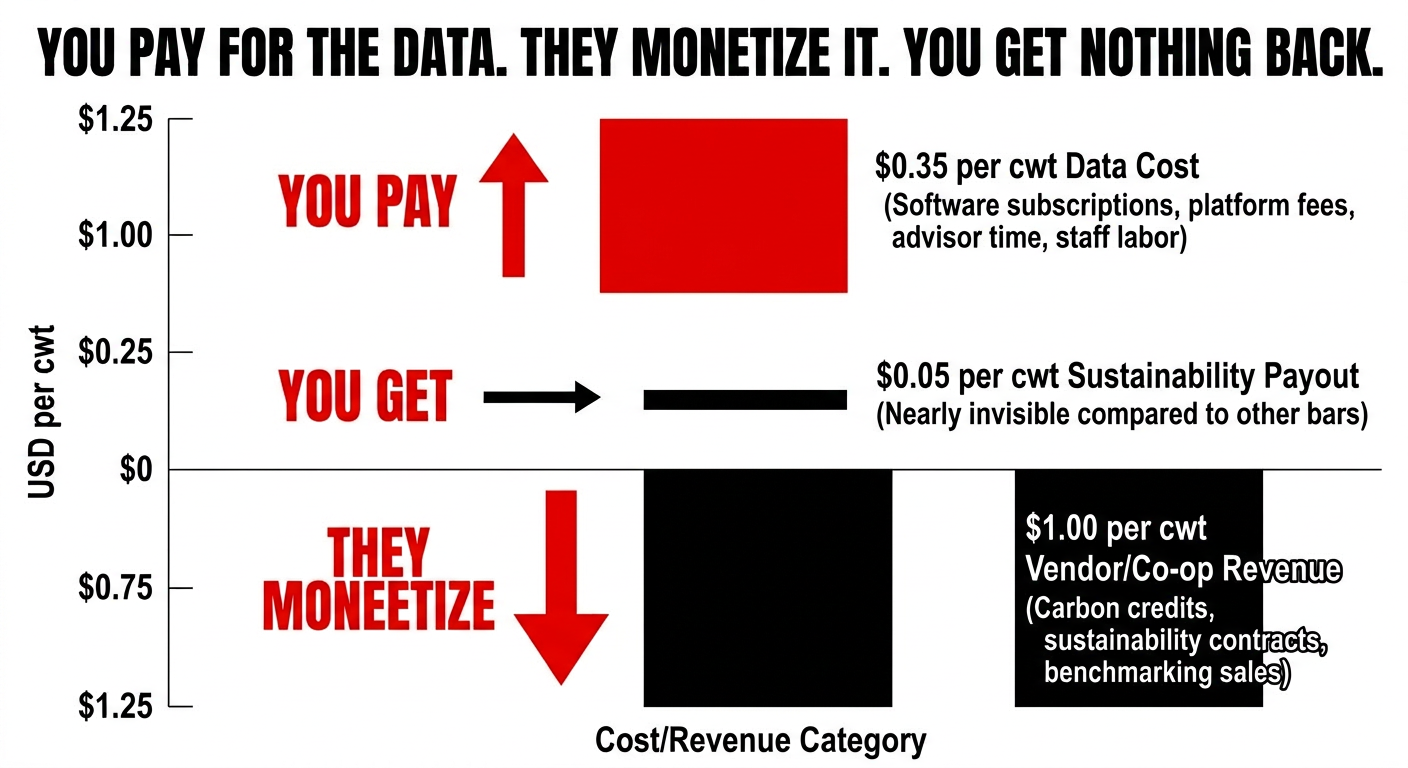
And meanwhile, a lot of you are paying for the hardware and software that generate the data these programs and your buyers depend on.
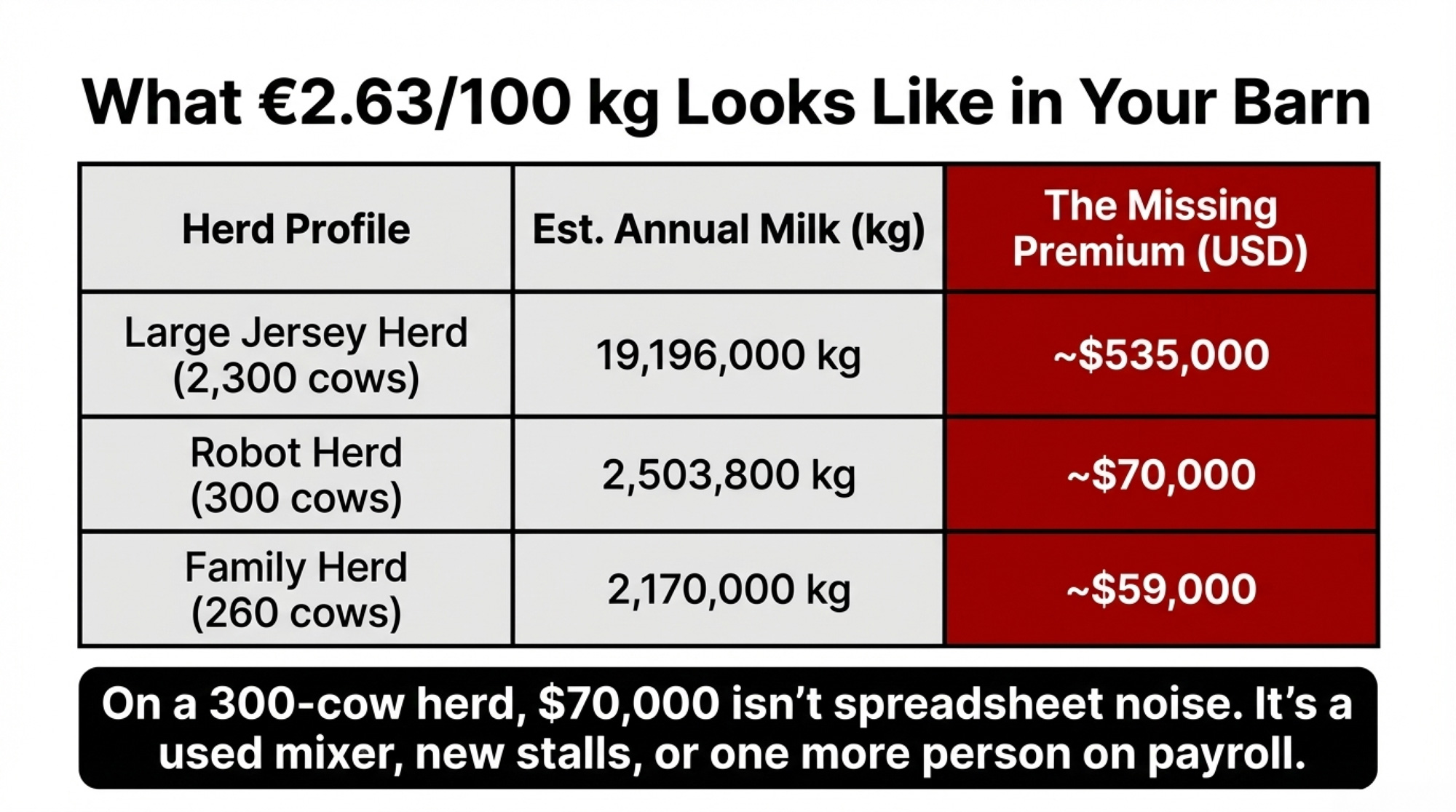
What Would €2.63/100 kg Look Like on Your Herd?
Let’s run the barn math, so this isn’t just a European story.
The American Jersey Cattle Association reports that Registered Jerseys averaged 18,400 pounds — roughly 8,346 kg— of actual milk per cow in 2023. At World Dairy Expo’s Knowledge Nook, connected‑data sessions featured producer panels speaking to technology use on herds ranging from a few hundred cows to several thousand. For this analysis, use three realistic herd sizes: about 2,300 cows, 300 cows on robots, and a 260‑cow family operation.
Apply the Jersey average and FrieslandCampina’s € 2.63-per-100-kg sustainability premium.
Step‑by‑step for a 300‑cow herd:
- Milk per cow per year: 8,346 kg.
- Total herd milk: 8,346 kg × 300 cows = 2,503,800 kg.
- Per‑100 kg units: 2,503,800 ÷ 100 = 25,038 units.
- Premium: 25,038 × €2.63 ≈ €65,857.
- At about US$1.07–1.09 per euro, that’s roughly US$70,000.
Now run it for the other herds — and for yours:
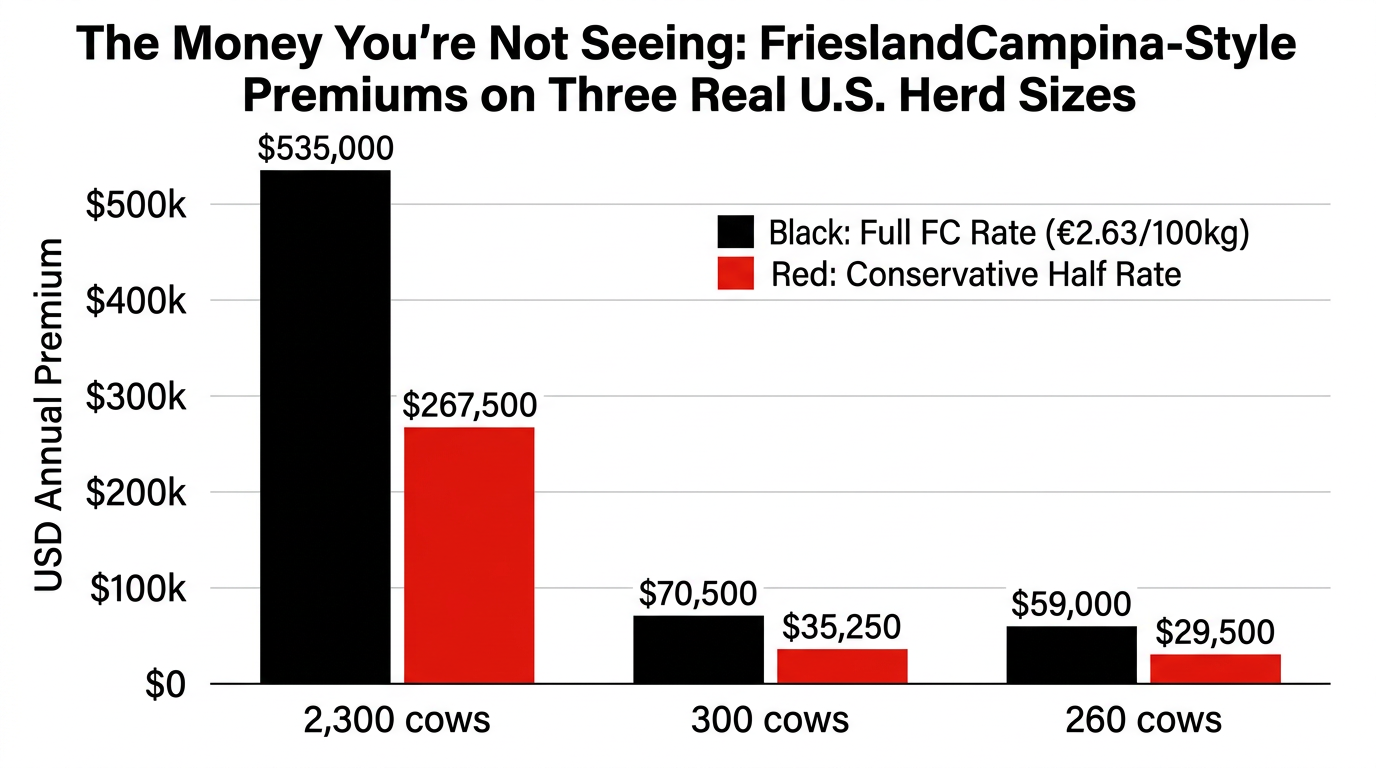
| Herd Example | Herd size | Est. annual milk (kg)* | Premium at €2.63/100 kg | USD equiv. (approx.) | Conservative (half rate) |
| Large Jersey herd | 2,300 cows | 19,196,000 | ≈€504,855 | ≈US$530–540,000 | ≈US$265–270,000 |
| 300‑cow robot herd | 300 cows | 2,503,800 | ≈€65,857 | ≈US$69–72,000 | ≈US$34–36,000 |
| 260‑cow family herd | 260 cows | ≈2,170,000 | ≈€55–57,000 | ≈US$58–60,000 | ≈US$29–30,000 |
| Your herd | _____ | _____ | _____ | _____ | _____ |
*Est. Annual milk = herd size × 8,346 kg/cow (2023 AJCA Jersey average). USD values use published 2023–24 exchange ranges where €245m ≈ US$263m (about US$1.07–1.09/euro) and are approximate.
On a 260‑ to 300‑cow herd, US$30–70,000 isn’t spreadsheet noise. That’s a used mixer, new stalls in a problem pen, or one more person on payroll. For a 2,300‑cow operation, a low‑six‑figure sustainability line item changes how you think about capital and debt paydown.
In cwt terms, 8,346 kg is about 184 cwt per cow per year. At €2.63 per 100 kg, you’re looking at roughly US$1.25–1.30 per cwt on the sustainability line. Even a conservative half‑rate — about US$0.60 per cwt — stacks up across a year’s shipments.
You can ballpark your own number in two steps:
- Last year’s total kg shipped ÷ 100 × €2.63 = “FrieslandCampina‑style” sustainability premium.
- Convert at the current euro rate, then halve it for a conservative benchmark.
| Herd Description | Herd Size (cows) | Annual Milk (kg) | Premium at €2.63/100 kg (USD approx.) | Conservative Half-Rate (USD) | Action |
| Large Jersey herd | 2,300 | 19,196,000 | $535,000 | $267,500 | Email co-op: “Where’s my $267k sustainability line?” |
| 300-cow robot herd | 300 | 2,503,800 | $70,500 | $35,250 | Email co-op: “Where’s my $35k sustainability line?” |
| 260-cow family herd | 260 | 2,170,000 | $59,000 | $29,500 | Email co-op: “Where’s my $29.5k sustainability line?” |
| YOUR HERD | _____ | _____ | $_____ | $_____ | Calc now. Email tonight. Demand details. |
You don’t have to be a fan of EU regulation to see what’s missing on your side of the ledger.
Two Data Models: Who Pays, Who Controls, Who Benefits
World Dairy Expo’s Knowledge Nook exists because farms are drowning in data and vendors are lining up with solutions. The hard question is who actually captures the value.
JoinData — farmer data co‑op
JoinData is a non‑profit data cooperative created in 2017 by Agrifirm, CRV, FrieslandCampina, LTO Nederland, and others. It connects more than 16,000 farmers with hundreds of data‑using organizations: processors, slaughterhouses, feed companies, sensor suppliers, accountants.
Farmers use the My JoinData portal to see which companies pull which data, and they can grant or revoke authorizations with a few clicks. Data‑using companies pay transport fees to access the pipe; those fees help fund the platform. Farmers pay a modest annual subscription — about €50 per year — to use the portal and manage permissions.
Companies that want the data write the bigger checks. Farmers keep control over who sees what.
Connected data platforms — data as paid SaaS
Knowledge Nook sessions in recent years have shown how quickly connected‑data offerings are expanding — from UNIFORM‑Agri’s simplified farm data management to DeLaval’s AI‑driven efficiency tools. These systems pull milking, sensors, activity monitoring, and herd management into a single dashboard.
Producers and advisors speaking in these sessions describe real operational wins: catching intake and rumination drops in dry‑cow pens earlier, tracking feed efficiency and daily income over feed cost instead of quarterly, and making ration changes faster when alerts pop up. Dry cows don’t give you daily tank weights — without data streams, some of those problems stay invisible until they cost money.
But the money flow is almost the opposite of JoinData:
- With JoinData, farmers pay a small flat fee and control authorizations; companies pay to access data through the pipe.
- With most SaaS platforms, farms pay the subscription; vendors aggregate multi‑farm data and decide how to monetize benchmarks, models, and “insights.”
As The Bullvine documented in “The $30,000 Question: Who Really Owns Your Farm’s Digital DNA?”, at least one Canadian vendor scenario involved a producer being quoted around US$30,000 to export historical data when exiting a robotic milking system. That’s not hypothetical. That’s how “your” data becomes a leverage point when contracts grant vendors broad rights to access and portability.
You’re not just a customer in those models. You’re the unpaid data factory.
Is Nebraska Writing the First Data‑Ownership Line Item for You?
That Knowledge Nook question — “Whose data is it?” — isn’t just a hallway conversation anymore. It’s being written into the proposed law.
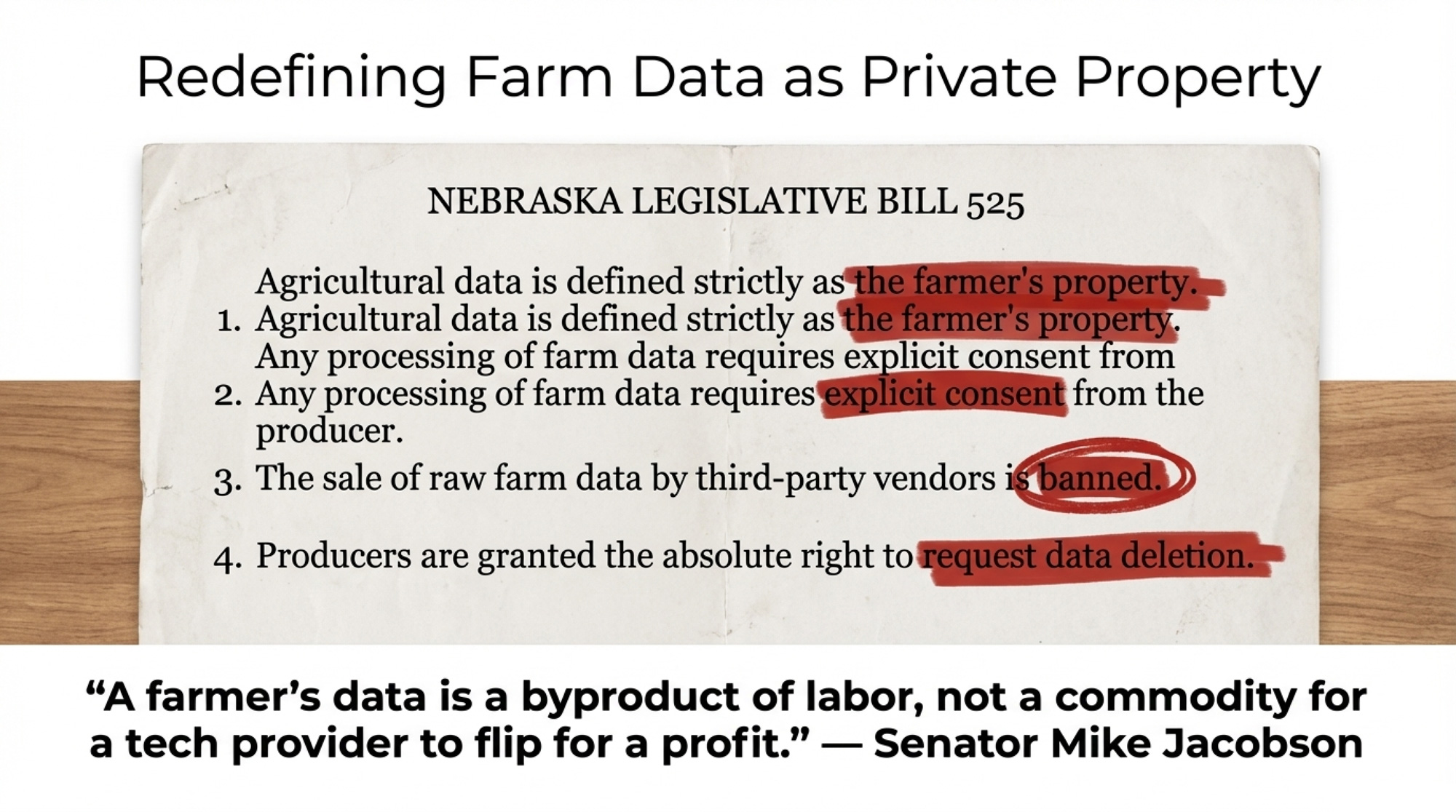
In January 2026, Nebraska Governor Jim Pillen told lawmakers he believes “Nebraska’s family farmers own that data — and we’re going to defend our producers from any misguided entity with other ideas.” Legislative Bill 525, introduced by Senator Mike Jacobson, is the first U.S. bill aimed squarely at agricultural data privacy.
The amended bill would:
- Recognize agricultural data as the farmer’s property.
- Require explicit consent before any company processes that data.
- Ban the sale of raw farm data.
- Give producers the right to request deletion of their data.
It covers crop yields, livestock metrics, GPS tracking, and financial data tied to the operation. In a February 2026 hearing, Jacobson framed it plainly: “A farmer’s data is a byproduct of labor, not a commodity for a tech provider to flip for a profit.”
Nebraska Farm Bureau’s Bruce Riecker drilled into the practical side: “Who owns the data? Who has the right to use it? How do they have the right to use it? And how do we protect the producers so that it can’t be used against them in some predatory way or malicious way?”
Manufacturers and platform providers are pushing back on the “ownership vs. control” distinction and on what counts as “aggregated” or “derived” data. They’re not wrong to worry about compliance cost and innovation friction. But the direction of travel is clear: at least one state is ready to say, in law, that the numbers coming off your fields and cows belong to you first.
LB525 won’t magically put a sustainability line on your milk check. It does set a precedent: the data that powers sustainability premiums and carbon markets is a byproduct of your labor, not free raw material for somebody else’s recurring‑revenue model. And if co‑op governance reformers are already pushing for transparency on milk check deductions and voting power, data ownership is the next frontier.
The 30/90/365‑Day Playbook for Your Own Milk Check
You can’t rewrite your co‑op’s premium structure tomorrow. You can start treating your data like the asset it actually is.
In the next 30 days
- Run your “FrieslandCampina gap” once. Take last year’s total kg shipped ÷ 100 × €2.63. Convert at the current euro rate. Halve it if you want a conservative benchmark. That number is what a FrieslandCampina‑style program would mean for a herd your size.
- Send one email to your board rep or member services. Ask three questions: What was the co‑op’s total sustainability revenue pool last year — including climate‑smart grants, branded premiums, and any carbon credit or insetting sales? What’s the average per‑cwt amount paid through to member farms? Where does it appear on individual member milk checks? FrieslandCampina publishes this data annually for its members. If your co‑op can’t answer, or won’t, that’s your first hard data point.
- Read your own fine print. Pull your milk supply agreement and any platform contracts. Circle three clauses: who owns the data your systems generate; who has rights to aggregated or anonymized insights; and whether you can export your data in a usable format within 30 days, at no extra cost. If those answers are fuzzy, you’re giving vendors more leverage than you realize.
In the next 90 days
- Calculate your data‑cost‑per‑cwt. Add up software subscriptions, extra advisor time to get systems talking, and staff time spent feeding data into platforms. Divide by total cwt shipped last year. If that number is a meaningful slice of your net margin and you still can’t find a sustainability line on your check, it’s time to start asking harder questions about who’s benefiting.
- Compare notes with three neighbors on the same truck. Ask whether they’ve ever seen a sustainability pool figure, know what the co‑op received from climate‑smart or carbon programs, or have any easier time exporting their own data. If nobody can get a clear answer, you’re looking at a structural issue, not a one‑off problem.
Over the next 365 days
- Push for three structural changes. When contracts or policies come up, push for: a separate sustainability line on your milk check; annual disclosure of total sustainability revenue and per‑cwt pass‑through; and a no‑fee, 30‑day export right for all your data from any co‑op‑mandated system.
- Watch Nebraska’s LB525 and your own state or provincial capitol. If LB525 passes, expect similar bills to surface elsewhere. If your farm organization has a legislative committee, ask whether agricultural data privacy is on their agenda. If it’s not, that’s a lobbying gap you can push to close.
- Decide your escalation threshold. If a year from now your data‑cost‑per‑cwt is still high and your co‑op still can’t answer those three questions, it may be time to go beyond polite emails — into organized member coalitions, board elections, and bylaw changes. That’s how other farmer groups have finally forced co‑ops to answer the hard questions.
What This Means for Your Operation
- If there’s no sustainability line on your check, you’re in a risk position you may not have sized. You’re generating data and paying to manage it, but you have no documented sustainability payout tied to it.
- North American sustainability money exists — it’s fragmented into specific programs. Fair Trade USA pays US$0.45/cwt to enrolled farms. Truterra has sent US$21 million to participating farmers. Organic Valley pays US$20/ton for verified reductions. Athian has facilitated US$18 million in livestock carbon credits. None of that is a universal per‑cwt formula for all members. That’s the structural gap.
- Treat data clauses the way you treat basis clauses. Before you sign another hardware or software contract, ask: if you needed to walk away in five years, how much would it cost to take your history with you? If the answer isn’t clear, you’re agreeing to more than just the monthly fee.
- Use your data‑cost‑per‑cwt as a trigger, not a trivia point. If that number is a meaningful chunk of your net margin and the sustainability line on your check is still blank, the economics deserve scrutiny — and you’re justified in pushing for changes at the co‑op and vendor level.
- Legislation is catching up to what you’ve felt in your gut. Nebraska’s LB525 says plainly that farm data is a byproduct of your labor, not a vendor’s commodity. Even if you never milk a cow in Nebraska, that logic applies to your operation.
Key Takeaways
- If your last three milk checks don’t show a sustainability premium line, you’re generating data and paying to manage it without any documented sustainability payout tied to it. The €2.63/100 kg benchmark gives you a concrete number to size that gap.
- FrieslandCampina and JoinData prove that farmer‑controlled data pipes and published sustainability formulas are workable at scale. “Embedded in the blend” is often a structural choice by your co‑op, not a requirement of the marketplace.
- Nebraska’s LB525 is the first serious U.S. attempt to say, in law, that your farm’s digital exhaust belongs to you. The same arguments Jacobson is trying to codify show up every time you sign a platform agreement without reading the data clauses.
- The easiest step you can take this week is to send one email. Ask your co‑op for the total sustainability pool, the per‑cwt pass‑through, and where it shows on the check. Their answer — or their silence — tells you a lot about how your data is being treated.
The Bottom Line
FrieslandCampina’s members know their sustainability number. It’s printed on the check, with a formula they can audit. Next time you open your milk statement, look for yours. If it’s not there, you now know how to calculate what’s missing — and who to ask why.
Complete references and supporting documentation are available upon request by contacting the editorial team at editor@thebullvine.com.
Learn More
- 76% of Your Dairy Checkoff Funds Cheese and Exports. How Much ROI Hits Your Fluid Milk Check? – Capture an immediate margin boost with four proven levers that reveal why national checkoff ROI rarely hits your driveway and show you how to pivot your herd toward high-value component and beef-on-dairy segments.
- The Great American Dairy Heist – Who Really Owns Your Milk Check in 2025? – Protect your operation from the 2028 processing shift by mastering a survival roadmap that exposes the structural forces consolidating milk revenue and delivers three specific strategies to maintain your competitive leverage.
- Revolutionizing Dairy Farming: How AI, Robotics, and Blockchain Are Shaping the Future of Agriculture in 2025 – Master the 99.8% precision revolution using AI-optimized genetics and sensor analytics to accelerate your herd’s progress by 300% while slashing the hidden mastitis and lameness costs that kill your net margin.
 The Sunday Read Dairy Professionals Don’t Skip.
 The Sunday Read Dairy Professionals Don’t Skip.
Every week, thousands of producers, breeders, and industry insiders open Bullvine Weekly for genetics insights, market shifts, and profit strategies they won’t find anywhere else. One email. Five minutes. Smarter decisions all week.




