







Only 14% of consumers believe dairy labels. Jasper Hill still gets $22 a wedge. If you aren’t turning welfare and certification into margin, you’re leaving money on the shelf.
Executive Summary: Valentine’s Day spending is hitting records, but only 14% of consumers believe sustainability claims on dairy labels, which means your “story” probably isn’t buying you much margin right now. Across U.S., Canadian, and European research, shoppers consistently rank animal welfare ahead of carbon when they choose dairy, and they’re willing to pay more when a credible certification backs that claim. That’s why organic, grass-fed, and welfare-certified brands like Jasper Hill, Maple Hill, Alexandre Family Farm, and AGW-certified herds are already seeing retail premiums of $2.63 per half gallon and farm-gate pay prices in the $40–$50/cwt range against a $14.70 conventional Class I base. At the same time, hot-button issues like cow–calf separation and child labor in cocoa are shaping how consumers judge the ethics of the cheese and chocolate they put on a Valentine’s board. You’ve already got programs like FARM and proAction running in the background, and pasture-based herds can add AGW, Validus, or Regenerative Organic Certification on top — but none of that pays unless you translate it into a plain-language welfare story consumers can find and trust. This piece gives you a concrete playbook for three types of operations — co-op shippers, regional/specialty suppliers, and direct-to-consumer farms — to turn welfare and certification into better contracts, stronger brands, and higher-value Valentine’s sales, rather than leaving money on the shelf.
Somewhere tonight, a shopper will pick up a $22 wedge of aged cheddar for their Valentine — and flip it over looking for a dairy animal welfare certification before they check the price. Valentine’s Day spending will hit a record $29.1 billion in 2026, up from $27.5 billion last year, with the average American budgeting $199.78 on gifts (National Retail Federation, January 2026, n=7,791 U.S. adults). Dairy is increasingly part of that haul: Wakefield Research data (December 2025, n=1,000 U.S. adults) commissioned by Wisconsin Cheese found 66% of Americans now call cheese their “love language,” and 64% would trade a dozen roses for a curated cheese board.
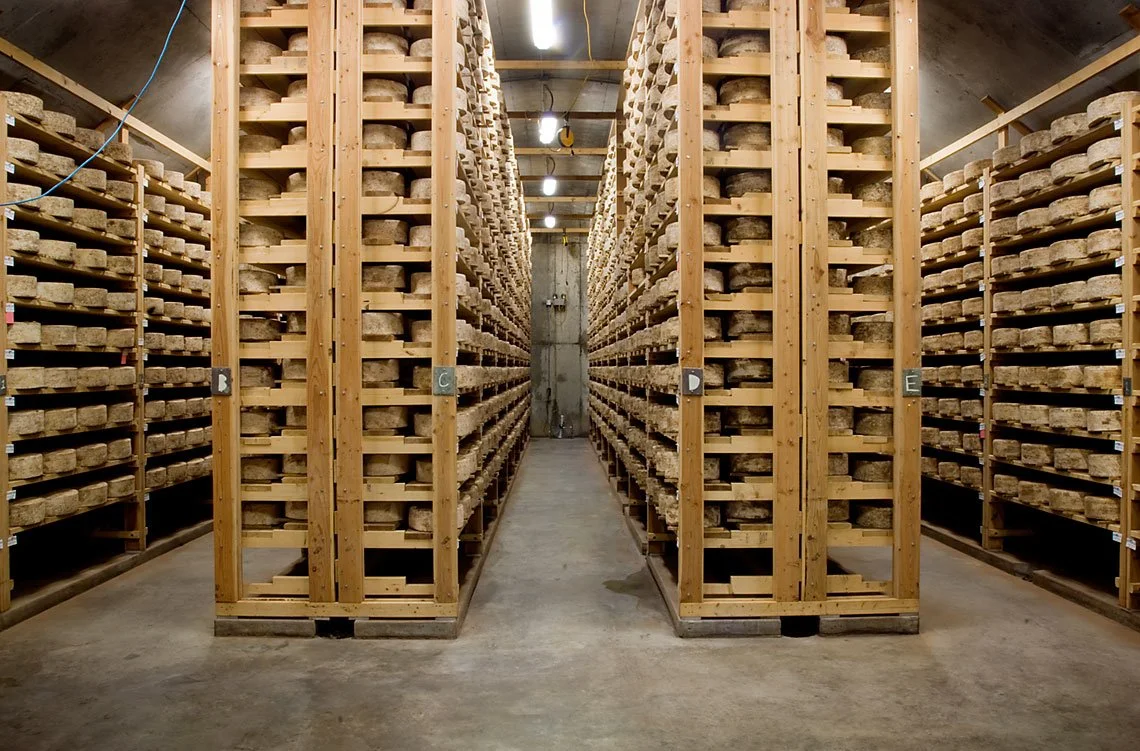
One farm has figured out how to make that moment work for them. In Greensboro, Vermont, brothers Andy and Mateo Kehler built Jasper Hill Farm into the gold standard of artisan dairy — pasture-based and regenerative, their cheeses aged in 22,000 square feet of underground cellars. Jasper Hill blue cheese was featured at the Obama White House state dinner for French President François Hollande in February 2014 — accompanying the dry-aged rib eye on a menu designed to showcase America’s best small-farm producers. Their Harbison won Best of Show at the 2018 American Cheese Society competition, topping 1,954 entries. Most dairy labels can’t survive that level of scrutiny. Jasper Hill’s can, and that difference is worth real money in 2026.

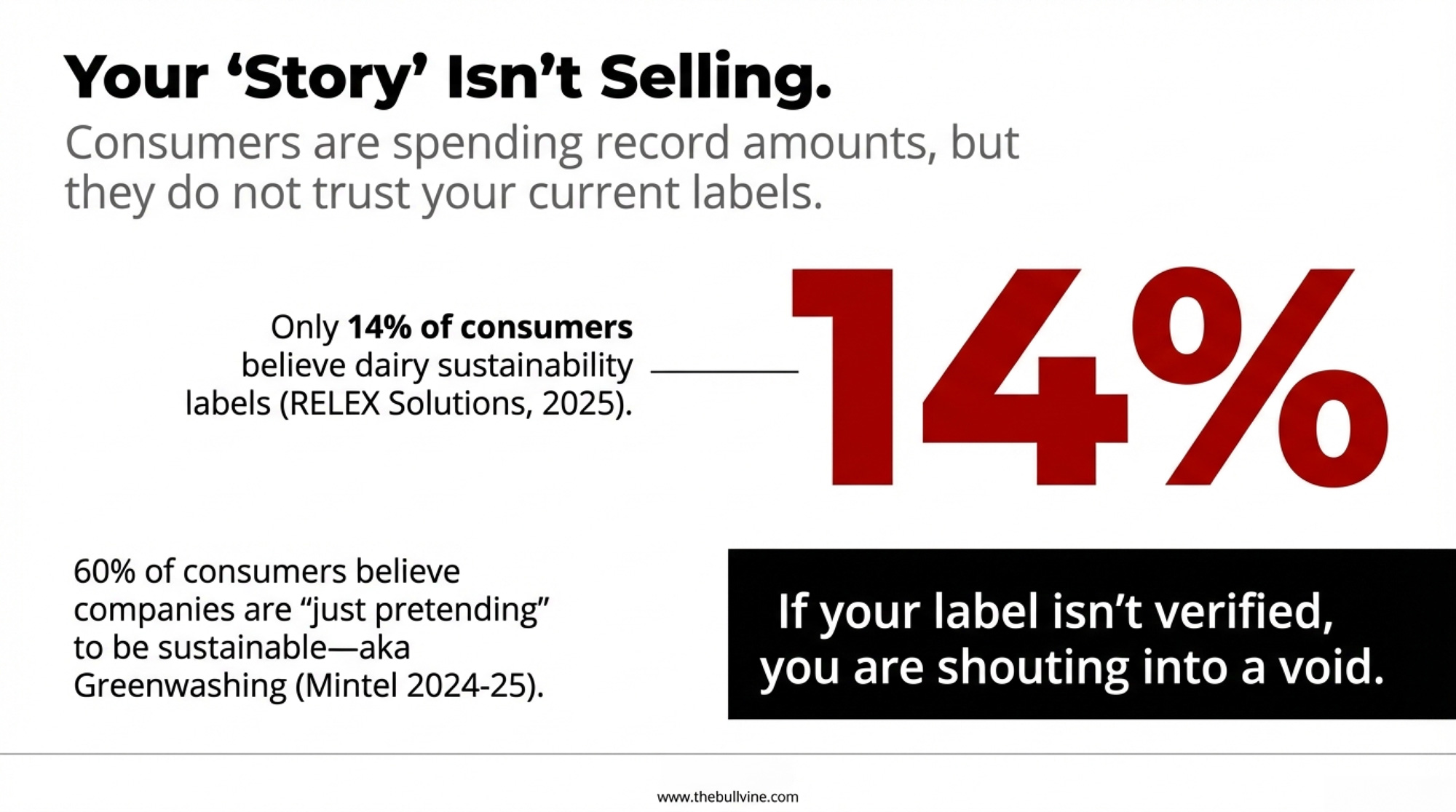
Feel-good spending numbers aside, only 14% of U.S. consumers fully trust grocery sustainability claims (RELEX Solutions, 2025 U.S. consumer survey), and Mintel’s Global Outlook on Sustainability: A Consumer Study 2024-25found 60% think companies are “just pretending” to be sustainable. Dairy animal welfare certification should be the credibility tool that closes this gap. For most operations, it isn’t — because most operations aren’t talking about it.
Dairy’s Valentine’s Moment — More Shelf Space, No Story Behind It
Candy still leads the Valentine’s gift list at 56%, followed by flowers and evenings out. But dairy keeps gaining ground in ways the commodity numbers don’t capture. In the UK, cheese volumes surged by an additional 1.2 million kg around Valentine’s compared to pre-COVID levels, with specialty and continental varieties accounting for 24% of that increase (AHDB, 2022 UK data).
Wisconsin Cheese’s “Wedges of Love” — a $100 curated box of nine artisan cheeses from producers like Roelli Cheese Haus and Uplands Cheese Company — was released in limited drops from January 20 through February 8, available while supplies lasted. As their Chief Marketing Officer, Suzanne Fanning put it, “cheese is always welcome to the party.” And when 62% of consumers say they’re bored of traditional Valentine’s gifts, the market opening for dairy is obvious.

The industry keeps putting cheese on the shelf without a credible story to back it up. As Jasper Hill Farm describes its approach on their website, great cheese starts with good milk, good milk starts with healthy animals, and healthy animals start with a healthy landscape. That’s not marketing copy—it’s a supply chain philosophy. It’s also exactly what consumers are hunting for when they flip over that label, and it’s what separates a $22 wedge from a $4 block in the same dairy case.
Under-35 Shoppers Read Your Label — Then Google It
Over 70% of consumers under 35 say they’re more likely to buy from brands demonstrating genuine sustainability commitments (The Dairy Mail, January 2025 analysis). Among Gen Z specifically, 64% say they’d pay more for eco-friendly products — and the same 64% would dump a brand exposed for unethical supply chain practices (Britopian, 2025, U.S. data).
This isn’t just survey talk. In the UK, one in ten consumers boycotted a go-to brand in the past year over sustainability concerns, and 17% actively check labels for certifications before buying (Speciality Food Magazine, November 2024 UK survey). Among 24-to-35-year-olds, 10% said they’d pay up to 50% more for verifiably sustainable products.
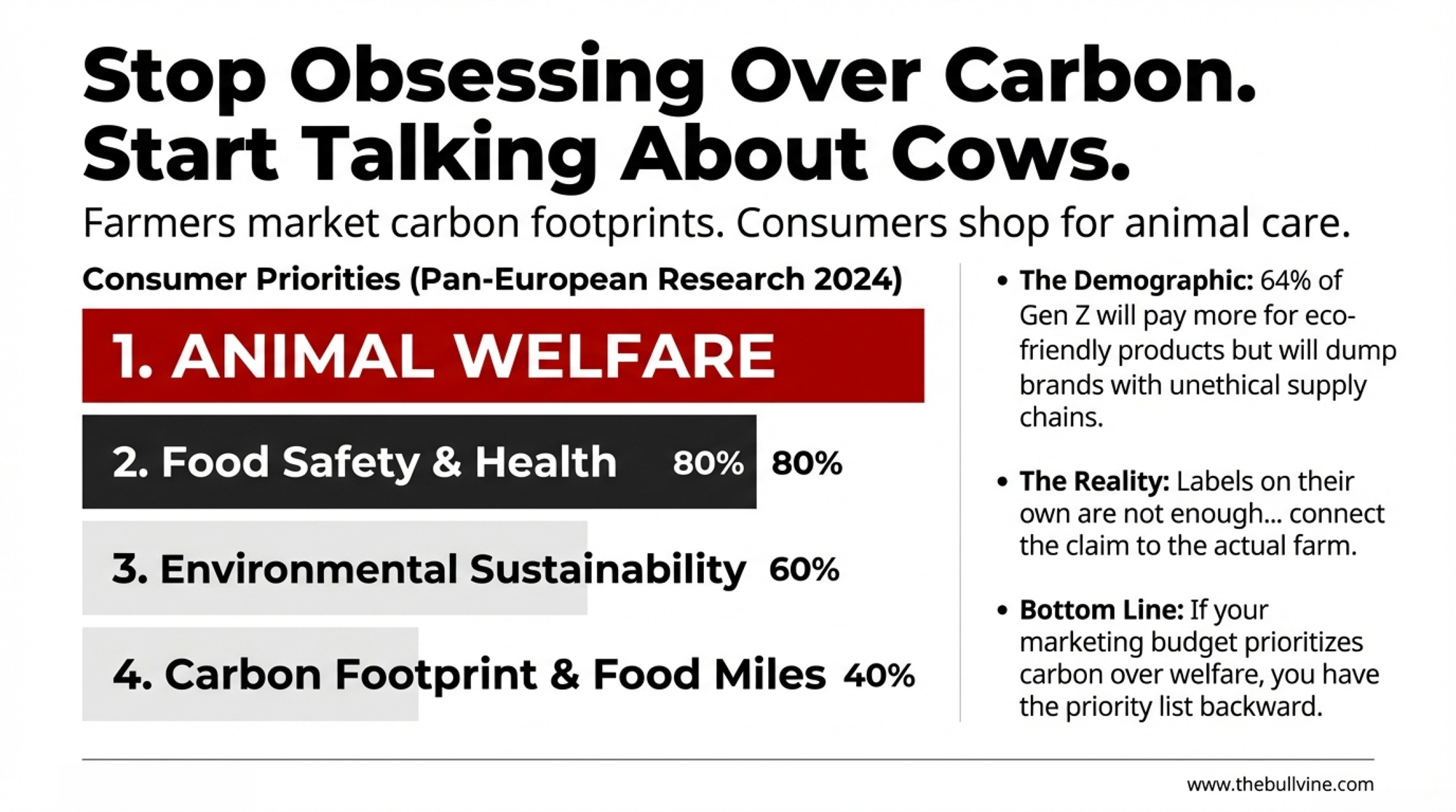
A 2024 pan-European study published in Agrarforschung Schweiz (Swiss Agricultural Research), surveying consumers across five countries, laid out what this demographic actually prioritizes when buying dairy:
- Animal welfare — ranked first, ahead of every other sustainability attribute
- Food safety and health — second and third, reflecting practical self-interest
- Environmental sustainability — important, but consistently ranked below welfare
- Carbon footprint, food miles, and organic certification — at the bottom of the list
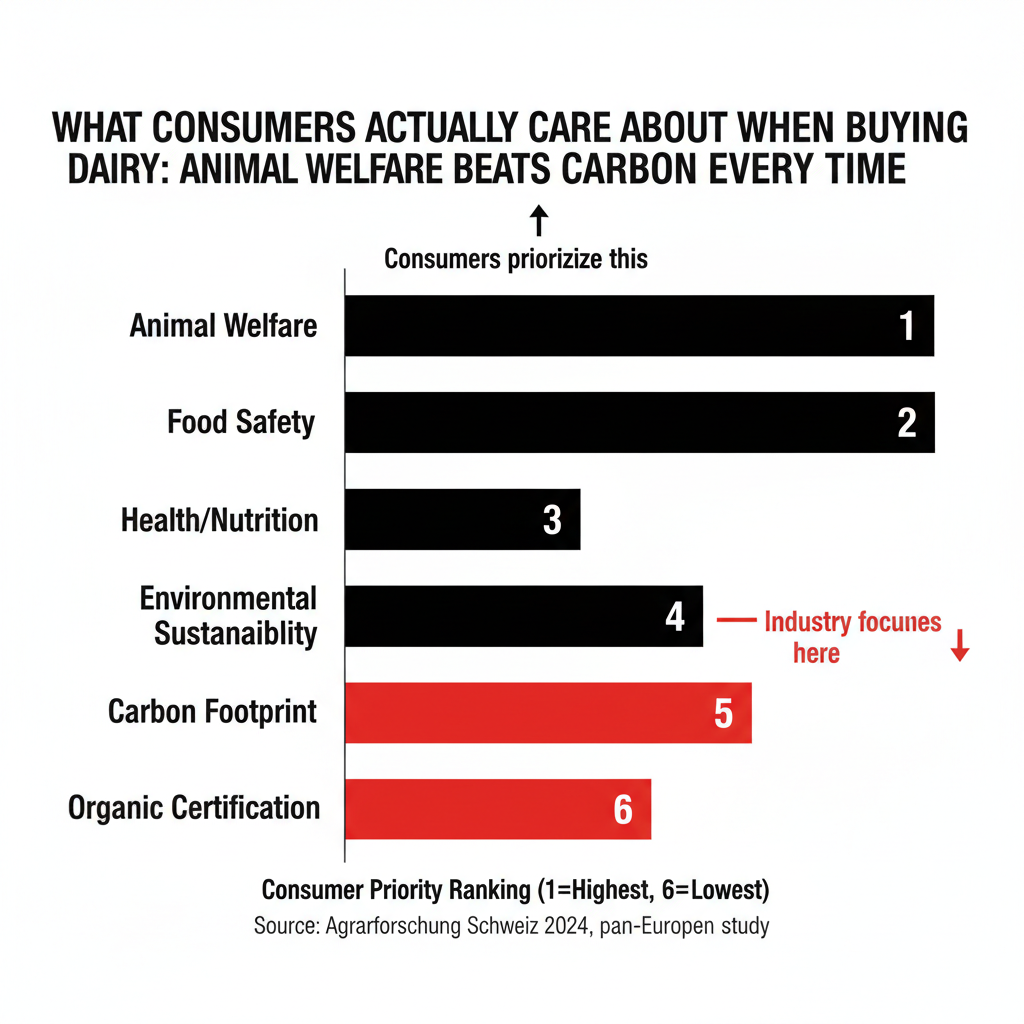
The researchers noted that “labels on their own are not enough to change behaviour” and recommended pairing labels with communication connecting the claim to the actual farm. If your marketing budget prioritizes carbon messaging over animal welfare communication, you’ve got the priority list exactly backwards.
Welfare Outranks Carbon — And the Premium Is Real
A November 2025 study in the Journal of Dairy Research found 70% of consumers expressed willingness to pay a premium for animal welfare-certified dairy, with women and younger consumers showing significantly higher interest; 91% agreed pasture access improves welfare. American Humane’s 2024 Farm Animal Welfare Survey (a nationally representative U.S. sample, November 2024) found 67% prefer humanely raised products, 67% emphasize the importance of third-party certification, and 58% are willing to pay more for humanely raised labeling.
Does willingness-to-pay always translate at the register? Anyone who’s watched a consumer reach for the cheaper jug knows the gap between survey answers and checkout behavior. But the premiums already flowing through the dairy case say this isn’t hypothetical anymore.
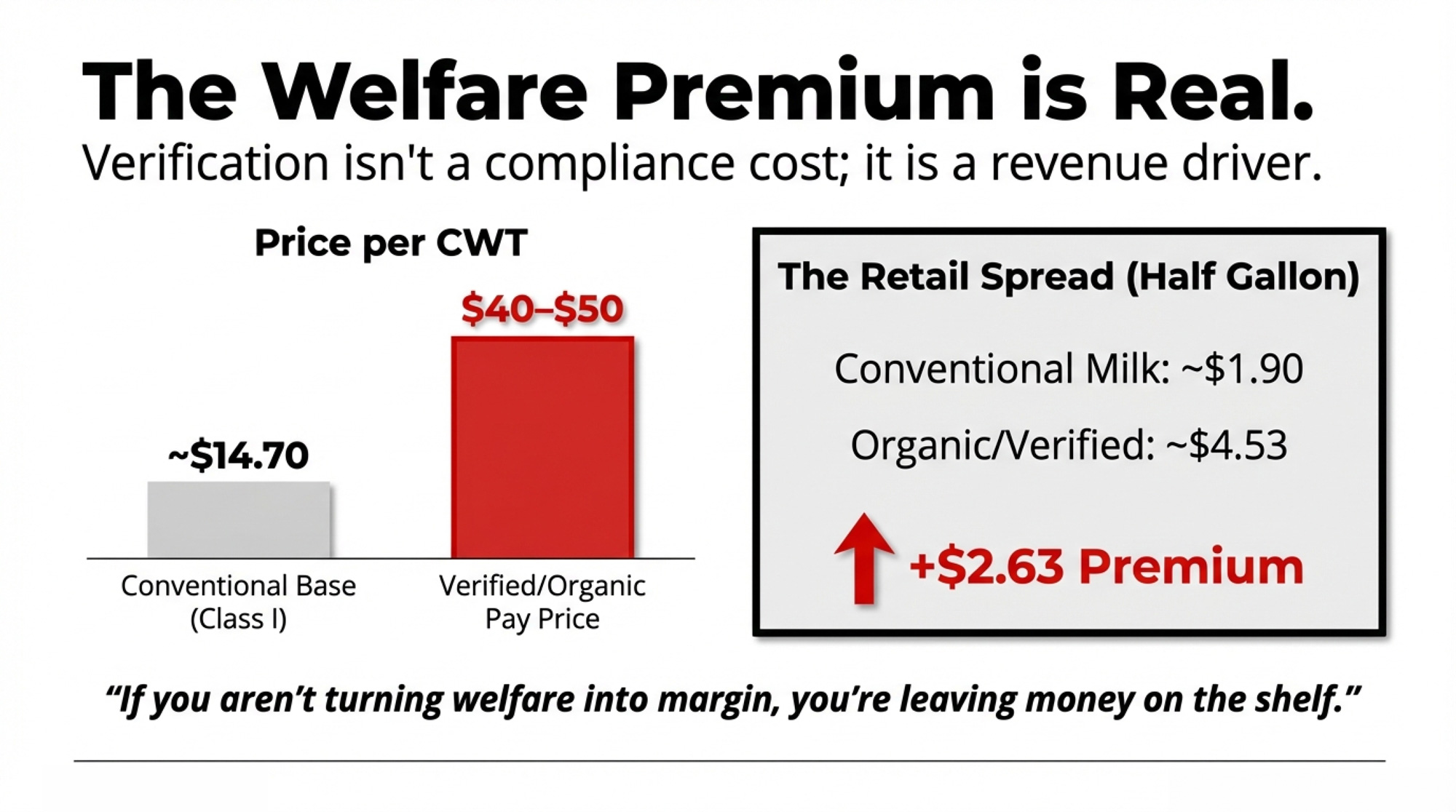
USDA AMS data from February 2026 shows organic half-gallon milk averaging $4.53 retail versus $1.90 for conventional — a $2.63 premium. Organic gallon milk: $8.66 versus $2.79, a $5.87 spread (USDA AMS, November 2025). Organic farm-gate pay prices in 2025 ranged from Horizon contracts at $40+/cwt to Maple Hill targeting $45/cwt and newcomer Origin Milk near $50/cwt (NODPA, May 2025) — against a conventional Class I base price of $14.70/cwt (USDA AMS, February 2026).
| Product/Certification Type | Retail Price (per unit) | Conventional Baseline | Retail Premium ($) | Farm-Gate Pay ($/cwt) |
| Conventional Milk | $1.90 (half-gal) | $1.90 | — | $14.70 |
| Organic (Horizon) | $4.53 (half-gal) | $1.90 | +$2.63 | $40.00+ |
| Maple Hill (Grass-Fed Organic) | $7.59 (half-gal) | $1.90 | +$5.69 | $45.00 |
| Alexandre Family Farm (Regenerative Organic) | $7.49–$8.89 (48–59 oz) | ~$1.52–$1.83 (equiv.) | +$5.97–$7.06 | $45.00–$50.00 |
| Origin Milk (Organic) | Not disclosed | $1.90 | Not disclosed | ~$50.00 |
| AGW-Certified (Autumn’s Harvest) | Premium pricing | Conventional | +20% sales lift | Processor-dependent |
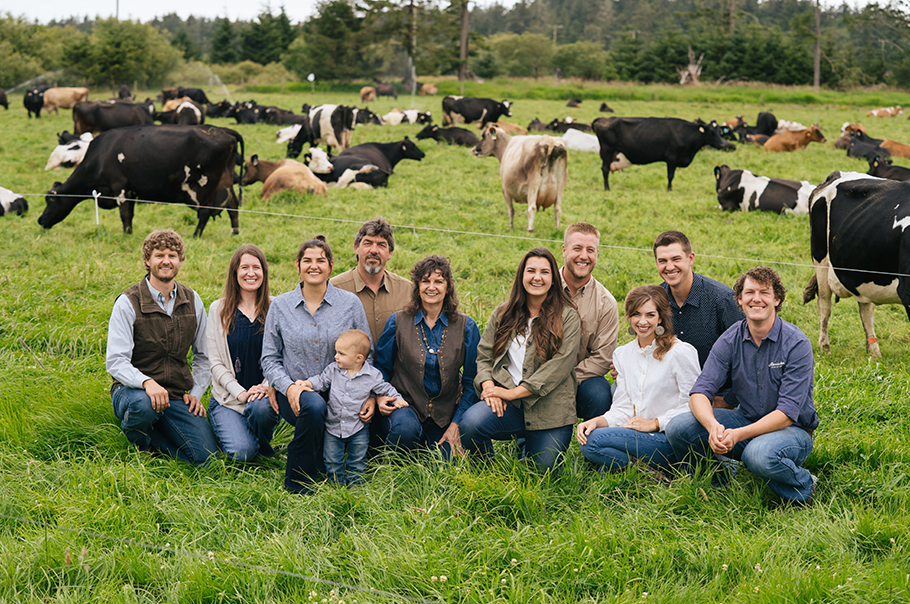
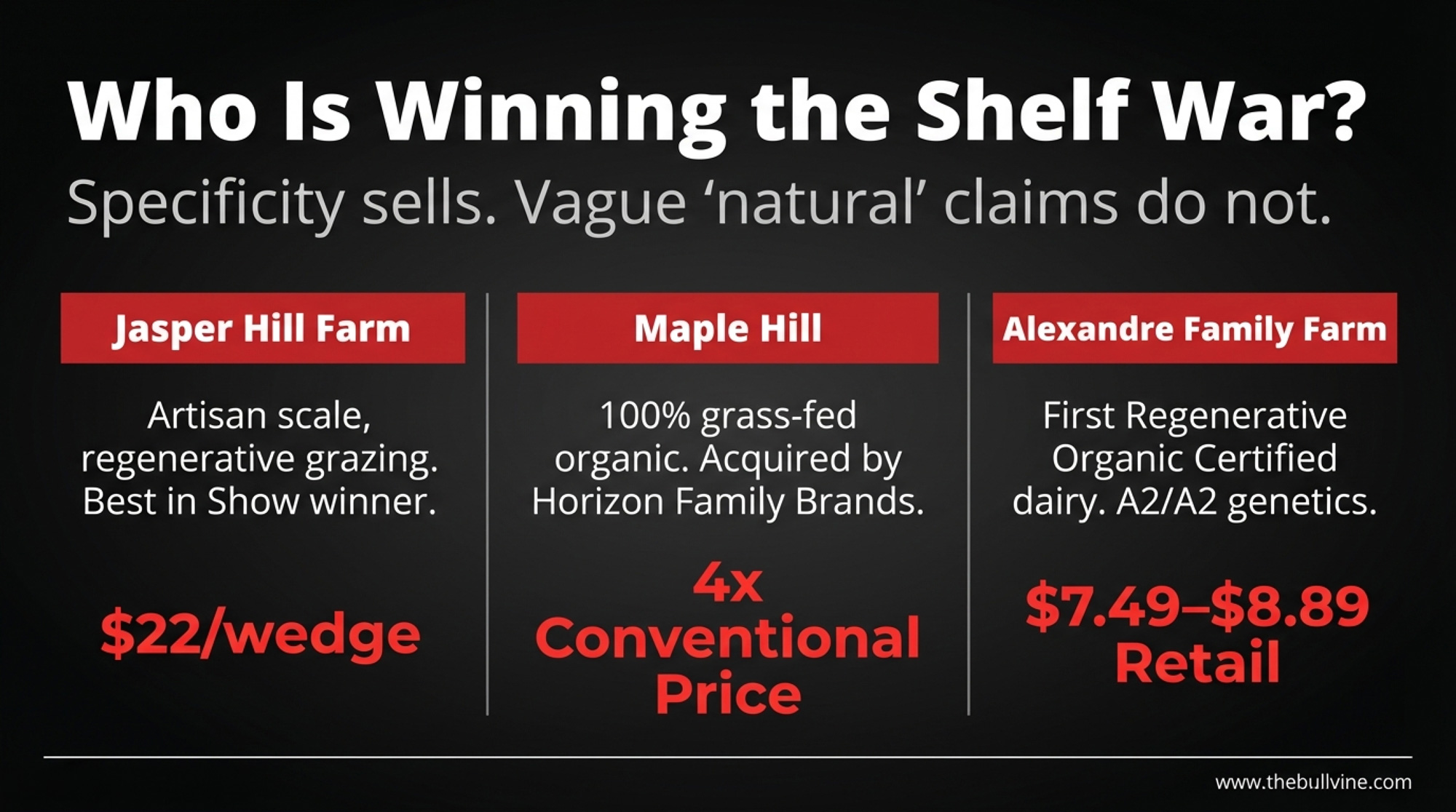
You can see it at the shelf. Maple Hill Creamery — now part of Horizon Family Brands after a December 2025 acquisition, but still marketed as 100% grass-fed organic and PCO certified — retails at $7.59 per half gallon at Target. Four times the conventional price. Alexandre Family Farm in Crescent City, California — the first Regenerative Organic Certified dairy in the U.S., pasture-based, A2/A2, a multi-generational family operation — retails at $7.49–$8.89 for 48–59 oz. Whether your operation captures any of that value or watches it flow to someone else’s label depends entirely on what story you’re telling.
About that Maple Hill acquisition. Platinum Equity bought the Horizon Organic and Wallaby brands from Danone in April 2024 and rebranded as Horizon Family Brands in August. By December 2025, they’d acquired Maple Hill as their first bolt-on — CEO Tyler Holm called its grass-fed expertise a complement to Horizon’s “capabilities and vision for the future.” When private equity is paying acquisition prices for grass-fed organic brands, the market is telling you something about where the value is heading.
Here’s the baseline most consumers have never heard of: 99% of U.S. domestic milk production already participates in the FARM Animal Care program, covering more than 31,000 dairy farms across 49 states. In Canada, proAction is mandatory on every dairy farm. The programs exist.
The consumer communication doesn’t. Jamie Jonker, then NMPF’s vice president of sustainability and scientific affairs, put it well in a FARM Program report: “Farmers have a great story to tell when it comes to animal care on their farms. The goal of animal-care programs, like the FARM Program, is not to be an additional burden for farmers, but rather to collect the data that provides positive proof of what we already know to be true: farmers take excellent care of their animals.”
That story is just not reaching the people buying your milk. The premium opportunity is real — but so is the risk, because the welfare story consumers hear most often isn’t the one you’d choose to tell.
Calf Separation: The Story Activists Tell When You Won’t
Anyone who’s walked through a maternity pen at 2 a.m. knows the bond is real — and that managing it responsibly is complicated. Early cow-calf separation followed by individual housing is still standard practice on most dairy operations. Public acceptance of it is remarkably low.
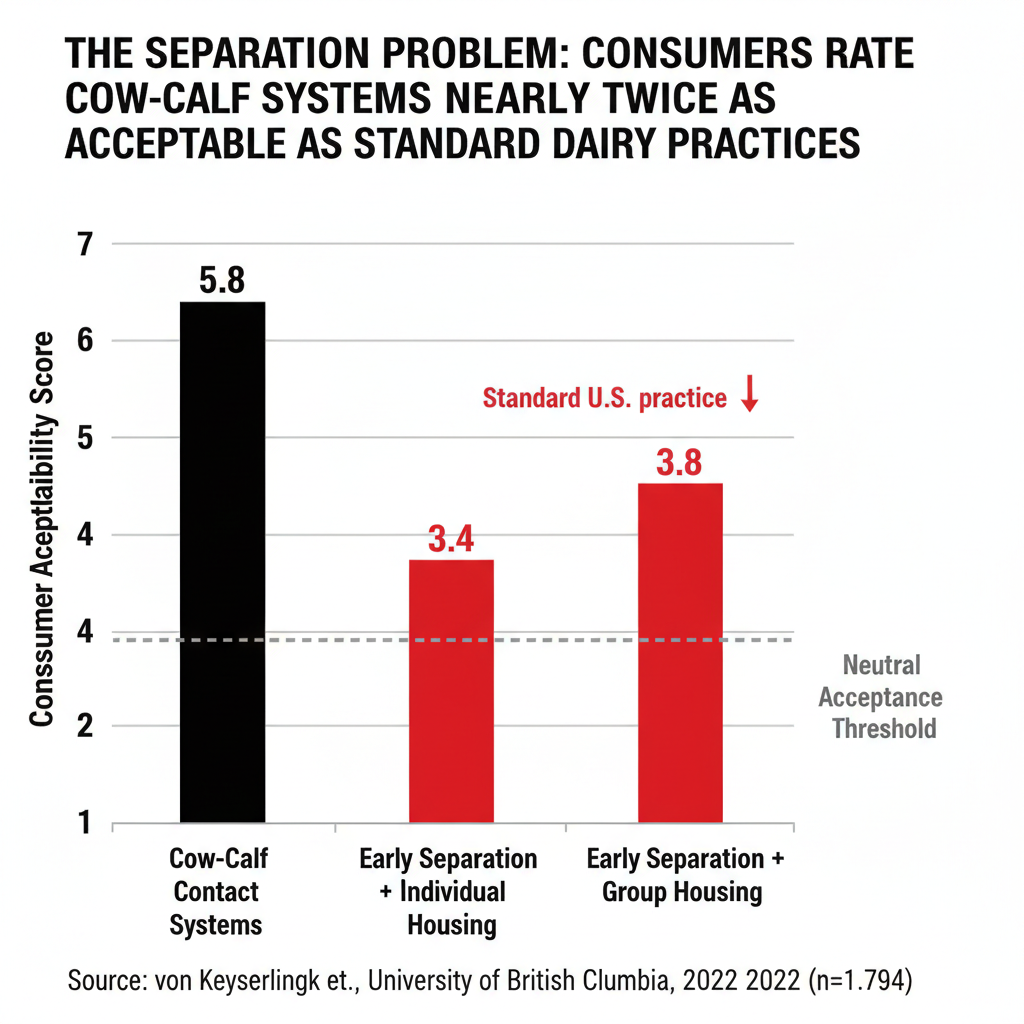
Dr. Marina (Nina) von Keyserlingk, NSERC Industrial Research Chair in Dairy Cattle Welfare at the University of British Columbia, published a 2022 study — a convenience sample of 307 Canadians plus a nationally representative sample of 1,487 Americans — and found that on a 7-point scale, cow-calf systems scored 5.7–5.8, while separation systems scored just 3.4–3.8 regardless of housing type. Faunalytics research confirmed the pattern: after visiting a working dairy farm, the most common new concern was calf separation, and exposure didn’t neutralize it. It amplified it.
The health argument for day-one separation? Muddier than either side wants to admit. A 2019 Journal of Dairy Sciencesystematic review by Beaver et al. found that extended cow-calf contact showed “beneficial or no effects” on calf health for scours and respiratory disease. A 2023 JDS perspective argued the practice “carries the risk of eroding public trust in the dairy industry if it is not addressed.”
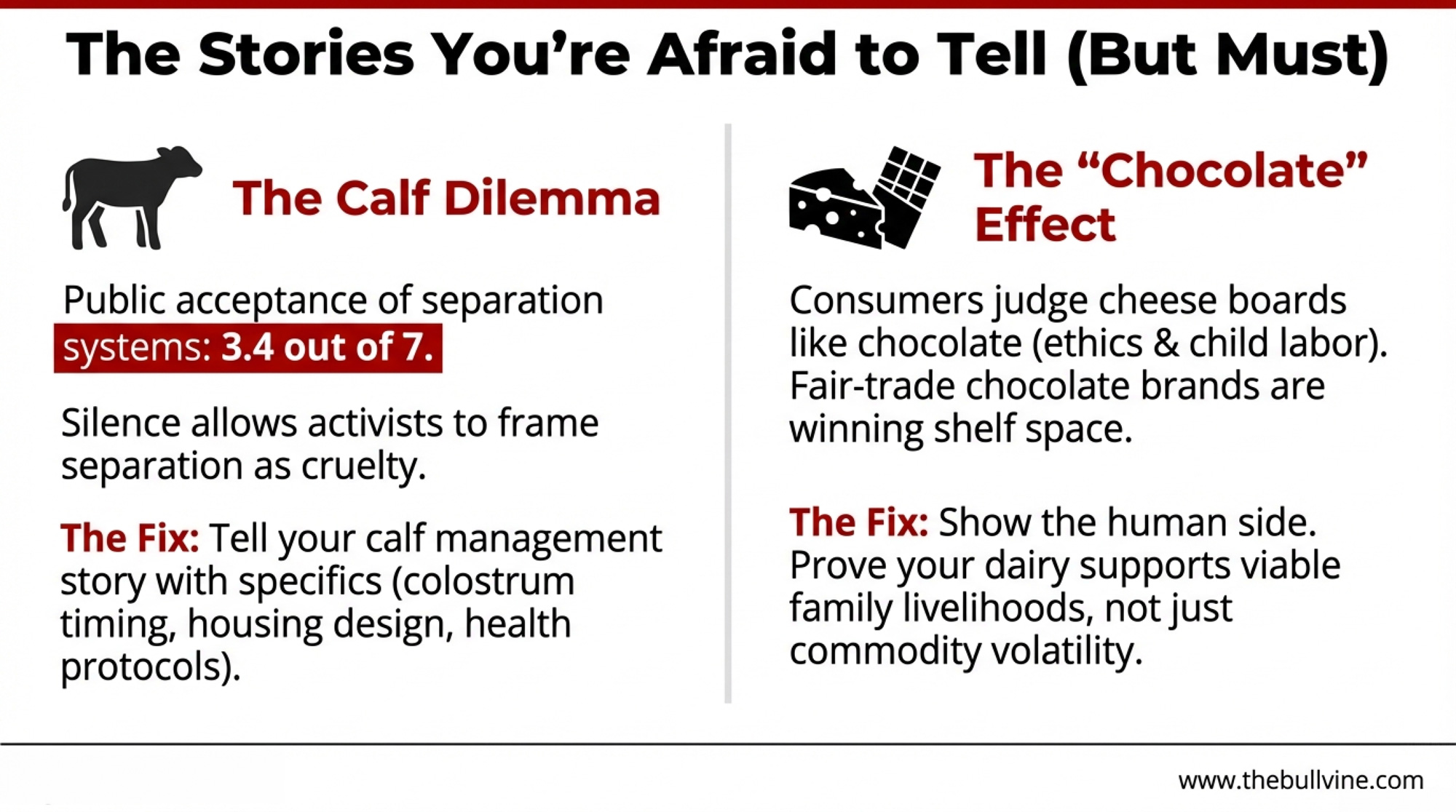
Advocacy groups know Valentine’s Day — a holiday built on bonding — is the perfect moment to run campaigns about separating mothers from their calves. The default “you don’t understand farming” response stopped working years ago. Telling your calf management story with specifics, before someone else tells it about you, is the only play that actually works.
Your Cheese Board’s Other Credibility Problem
The chocolate next to your cheese carries its own baggage — and it’s baggage that makes your label look worse by association. The U.S. Department of Labor estimates 1.56 million children work on cocoa farms in the Ivory Coast and Ghana (Forbes, February 2025). Hershey, Mars, and Nestlé have repeatedly missed self-imposed deadlines to eliminate child labor from their supply chains. Brands emphasizing fair-trade sourcing — Taza Chocolate and Divine Chocolate — are capturing more Valentine’s spend as consumers connect the dots.
Here’s why this matters if you’re a dairy producer: consumers are building their Valentine’s cheese boards with the same ethical lens they use for chocolate. If the fair-trade bar on the board tells a better sourcing story than the wedge sitting next to it, that’s a comparison you lose at the point of sale. Jasper Hill closes that gap with specifics: regenerative grazing, whey recycling, and partnerships with small neighboring dairies that get premium pay for premium milk. Their approach keeps family-scale operations in Greensboro connected to a viable livelihood instead of the volatile commodity market.
Third-Party Proof: The Only Labels That Work
Verified certification is the antidote to consumer skepticism. Not all certifications carry the same weight, though — and the operational requirements differ more than most producers realize.
| Certification | Cost to Farmer | Core Requirement | Audit Frequency |
| AGW Certified Animal Welfare Approved | Free — AGW covers all costs | Continuous outdoor pasture access, entire life | Annual on-farm audit |
| Validus CARE Certified | Processor-arranged | 80%+ compliance across welfare, environment, and worker care | Annual third-party audit |
| Canada proAction + Blue Cow | Included in DFC membership | 82 requirements across welfare, food safety, and biosecurity | Regular on-farm validation |
| Certified Grass-Fed Organic (OPT/EarthClaims) | Organic certification cost + verification | Zero grain, 60% DMI from pasture, 150-day grazing season | Annual third-party verification |
AGW carries one of the highest welfare ratings from Consumer Reports, and the barrier to entry is lower than you’d think. Steffen Schneider at Hawthorne Valley Farm in Ghent, New York, put it simply: “It’s a wonderful service to provide free to farmers. People know it and look for it.” Timothy Haws at Autumn’s Harvest Farm in Romulus, New York, reported a 20% increase in sales after getting certified: “People love it!” Not sure if your operation qualifies? AGW offers free eligibility assessments — the cost of finding out is a phone call.
In Canada, Dairy Farmers of Canada ran its first-ever proAction consumer communication campaign in 2024, reaching 14.4 million Canadians and hitting an all-time high for Blue Cow Logo recognition — highlighting 57 environmental practices and 82 program requirements. What all these certifications share is straightforward: somebody who doesn’t work for you shows up, checks the books, and puts their name on it.
The Greenwashing Trap: 60% of Consumers Think You’re Faking It
The trust numbers are ugly everywhere anyone’s bothered to measure. In the U.S., 31% of consumers don’t trust companies to be honest about their environmental impact (Mintel, Global Outlook on Sustainability 2024-25). Sixty percent agree that many companies are “just pretending.”
“60% of U.S. consumers agree that many companies are ‘just pretending’ to be sustainable.” — Mintel, Global Outlook on Sustainability: A Consumer Study 2024-25
In the UK and Germany, the Changing Markets Foundation’s “Feeding Us Greenwash” report (March 2023, YouGov polling) found trust in sustainability claims on meat and dairy averages roughly 15%, with 59% expressing high concern about greenwashing. The Foundation flagged JBS for net-zero claims, Nestlé for carbon-neutral KitKat labeling, and Danish Crown for calling pork “climate controlled” — plus widespread use of idyllic pasture imagery on products from confined operations.
You might not be Nestlé. But if your local co-op’s marketing materials feature rolling green pastures and contented cows while the actual operation looks nothing like the brochure, you’re the one holding the reputational risk when a journalist or advocacy group comes knocking. A 2025 Corporate Climate Responsibility Monitor found that major food companies “exploiting loopholes in voluntary standards,” and Danone stands out as one of the few dairy-adjacent companies to have set a specific methane-reduction target (30% from fresh milk by 2030). Mintel’s Richard Cope noted that greenwashing education now feeds consumer skepticism more than engagement. Numbers, not slogans.
What This Means for Your Operation
If you ship a commodity to a co-op, you don’t control the retail label, but you shape what your processor can credibly claim. Your co-op is sitting on a consumer-facing story that 99% of the U.S. milk supply already qualifies forthrough FARM, covering 31,000+ farms across 49 states. In Canada, proAction is mandatory.
Can’t change your system? Change your communication. DFC reached 14.4 million Canadians with proAction messaging in 2024. If your processor isn’t generating equivalent consumer-facing value, put this on your Q2 2026 board agenda with a specific ask: What’s our consumer-facing welfare communication plan? Which retail accounts are deploying it? And why isn’t 99% FARM participation translating into any brand value at the shelf?
If you sell through regional brands or specialty processors, this is where certification ROI gets tangible. AGW certification costs you nothing — no audit fees, no annual charges, plus free marketing support. The operational hurdle is real — you need pasture access, and you need to meet their welfare standards, full stop. If your operation is confinement-based, AGW isn’t your path. Look at Validus CARE or push your processor to leverage FARM communication instead. Timothy Haws at Autumn’s Harvest Farm reported a 20% sales increase after becoming AGW-certified. And organic dairy commands $2.63 per half gallon over conventional at retail (USDA AMS, February 2026), with farm-gate organic pay reaching $40–$50/cwt in 2025 versus a Class I base of $14.70. One caveat worth being honest about: organic transition takes 36 months and carries real costs during the conversion period. The premium exists, but the runway to capture it isn’t short.
If you sell direct-to-consumer or artisan, you own the customer relationship. Valentine’s is your moment. Build a holiday offer around the specifics that differentiate you — not a generic “sustainable” badge. Jasper Hill does it with regenerative grazing, whey recycling, and partnerships that keep neighboring small dairies viable. Alexandre Family Farm does it with Regenerative Organic Certification, A2/A2 genetics, and a multi-generational family story — retailing at $7.49–$8.89 for less than a half gallon. Wisconsin’s Roelli Cheese Haus does it with craft and provenance.
The trade-off nobody talks about: Telling your welfare story proactively invites scrutiny. Someone will ask harder questions. But the alternative — staying silent while advocacy groups and competitors write the narrative about your practices — is worse. The von Keyserlingk research is unambiguous: consumers who learn about standard dairy practices don’t become more accepting of them. They become more concerned. Control the story, or it controls you.
What to Do Before Next Valentine’s Day
- Build a holiday communication calendar now—and start six weeks out. Wisconsin Cheese launched “Wedges of Love” on January 20, a full 25 days before February 14. That’s the lead time that works. Valentine’s Day, Mother’s Day, and Christmas are your three highest-visibility moments. Plan your social media, farm tour invites, and retail signage around these dates—they’re when consumers are most emotionally primed to care about how their food is produced.
- Lead with animal welfare, not carbon. Pan-European research (Agrarforschung Schweiz, 2024) confirms consumers rank welfare above environmental sustainability when choosing dairy. If your messaging leads with carbon footprint, flip the order.
- Pursue the certification that fits your system. AGW costs nothing and delivers measurable results, but it requires pasture access. Confinement operations should push processors to activate FARM or Validus communication at retail. Canadian producers should demand that their co-op leverage proAction and the Blue Cow more aggressively.
- Get specific about calf management. Publish your calf care protocol on your website or in your direct-to-consumer materials. Vague assurances don’t work. Specifics — colostrum timing, housing design, health protocols, how long calves stay with dams, if applicable — do.
- Audit your own label for greenwashing risk. If you use words like “sustainable,” “humane,” or “natural” without third-party verification, you’re one investigative journalist away from a credibility crisis. Only 14% of consumers trust those claims as it stands. Either back them up or remove them.
- Run the premium math for your operation. Organic half-gallon commands $2.63 over conventional at retail. AGW-certified Autumn’s Harvest reported a 20% sales lift. Maple Hill retails at 4x conventional — and was attractive enough for Horizon Family Brands to acquire outright in December 2025. What would even a fraction of that premium mean for your bottom line?
Every Valentine’s Day, millions of consumers make choices that signal what they value. Those signals are getting louder, more specific, and harder to ignore. When a consumer picks up your product on February 14th, does your label tell a story that holds up — or one that falls apart the moment they Google it?
Key Takeaways
- Stop betting on vague claims. Only 14% of consumers believe dairy sustainability labels, but research shows they care most about animal welfare, not carbon slogans.
- Follow the money, not the noise. Welfare-backed and organic brands like Jasper Hill, Maple Hill, Alexandre Family Farm, and AGW-certified herds are already seeing $2.63/half-gallon retail premiums and $40–$50/cwt farm-gate pay versus a $14.70 Class I base.
- Use the programs you already have. FARM and proAction cover almost all U.S. and Canadian milk, and pasture-based herds can add AGW, Validus, or Regenerative Organic Certification on top — but they only pay if you turn them into a clear welfare story on your label, website, and social.
- Plan around “treat holidays.” Build a simple communication plan for Valentine’s Day, Mother’s Day, and Christmas that shows how you handle calves, pasture, and herd health — instead of letting activists or competitors define your practices.
- Pick one concrete next step. Call AGW for a free eligibility check, push your co-op to activate FARM or proAction in retail messaging, or publish your calf-care protocol so shoppers don’t have to guess.
Complete references and supporting documentation are available upon request by contacting the editorial team at editor@thebullvine.com.
Learn More
- Genetic Correlations Upended: Why Sticking with Old Breeding Indices Could Cost Your Dairy $486 Per Cow – And What the Data Really Proves – Gain $486 more lifetime profit per cow by shifting to the 2025 Net Merit formula. This analysis exposes the “profit killer” of conformation-heavy indices and arms you with a component-first strategy that prioritizes butterfat and feed efficiency.
- The $1750 Calf: Is Your 2026 Breeding Plan Leaving $800 a Head on the Table? – Secure your future herd while capturing massive beef-on-dairy premiums by weaponizing your genomic data. This guide breaks down the surgical breeding methods that turn surplus pregnancies into a high-margin revenue stream that significantly outpaces commodity milk income.
- Tech Reality Check: The Farm Technologies That Delivered ROI in 2024 (And Those That Failed) – Master your next capital investment with verified payback periods for robotics, sensors, and AI. This reality check delivers the brutal gap between glossy brochures and barn-floor returns, ensuring your technology drives measurable margin instead of just adding complexity.
 The Sunday Read Dairy Professionals Don’t Skip.
 The Sunday Read Dairy Professionals Don’t Skip.
Every week, thousands of producers, breeders, and industry insiders open Bullvine Weekly for genetics insights, market shifts, and profit strategies they won’t find anywhere else. One email. Five minutes. Smarter decisions all week.




