







Ditch land, boost profits: Small dairy farms thrive with capital-smart expansion and tech. New research reveals how.

Think the traditional path to dairy expansion is your only option? Think again. Research from Michigan State University exposes the fatal flaws in the “buy more land” model, revealing how smarter small farms are ditching conventional wisdom and doubling profitability with half the risk.
THE CONSOLIDATION CRUNCH: THE BRUTAL TRUTH ABOUT SMALL FARM SURVIVAL
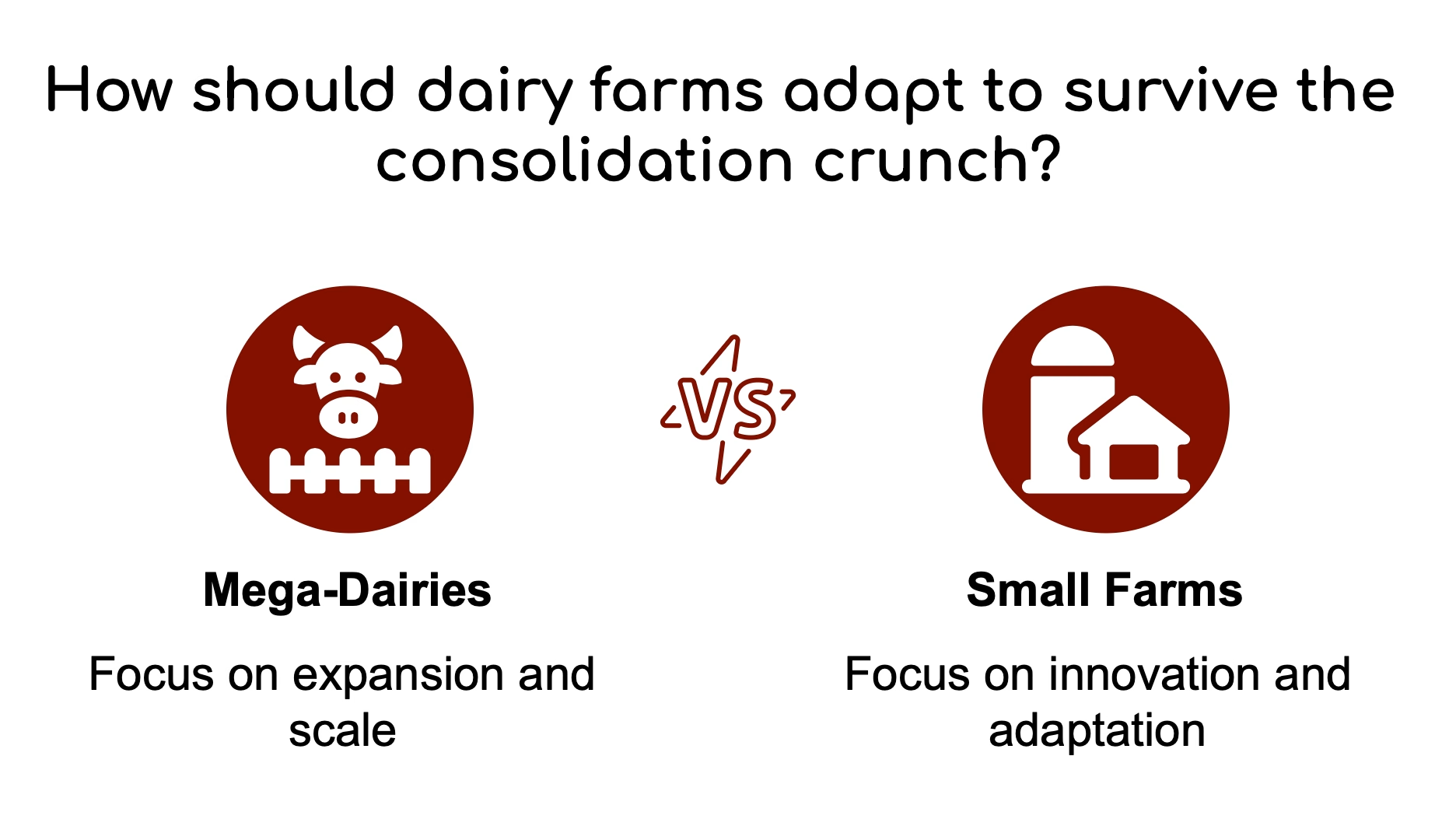
Let’s cut through the industry BS and face facts: the U.S. dairy sector is undergoing the most brutal consolidation in its history. Nearly 40% of American dairy farms have vanished since 2017, yet milk production continues to climb. This isn’t just evolution; it’s a systematic reshaping of who gets to survive in this industry.
The numbers don’t lie. The 834 largest dairies (2,500+ head) now produce over half of America’s milk by value, while farms with fewer than 100 cows cling to a measly 5% market share, down from 8% in 2017. With industry projections showing another 2.6% decline in dairy farm numbers by 2025, the message is clear: adapt or disappear.
But here’s what your banker won’t tell you: this “get big or get out” mantra is built on outdated assumptions actively destroying family farms. Think the only path forward is doubling your land base alongside your herd? Michigan State University research has just blown that theory to smithereens.
Are you still trying to compete with mega-dairies using their playbook? That’s like bringing a butter knife to a gunfight. The game has changed, and those clinging to Dad’s expansion strategy are signing death warrants.
While 15,000+ dairy farms disappeared between 2017 and 2022, milk production INCREASED by 5%. The consolidation isn’t slowing, it’s accelerating. Your expansion strategy must be fundamentally different from that of mega-dairies to survive.
EXPANSION MYTHS EXPOSED: WHAT THE RESEARCH ACTUALLY SHOWS

Michigan State’s Lynn Olthof and team put four real-world expansion strategies for 250-cow operations under the microscope. What they discovered should send shockwaves through the industry:
Myth #1: To expand properly, you must buy more land. REALITY: The most profitable expansion scenario avoided land acquisition entirely, focusing investment on productive assets while purchasing feed. According to the MSU study, this “no-land” approach delivered the highest annual net profit, lowest debt utilization, and most reliable positive cash flow across various market conditions.
Myth #2: Owning your feed base provides security and cost control. REALITY: The capital tied up in land (national average: $5,570 per acre in 2024) creates a massive opportunity cost that outweighs any feed security benefits. Cash flow keeps the lights on, not paper equity in land that doesn’t produce direct revenue.
Myth #3: Traditional expansion is the safest bet. REALITY: The conventional “double everything” approach leaves farms dangerously overleveraged and vulnerable to market downturns. It’s like overstocking your freestall barn during a heat wave, creating multiple stress points that eventually break your system.
Myth #4: Robots are too expensive for smaller farms. REALITY: While robotic milking systems require substantial upfront investment (5,000-0,000 per unit), they delivered the greatest operational predictability and lowest labor costs per hundredweight in the MSU study. Robots can reduce direct milking labor by approximately 60% for farms bleeding out from labor shortages and generate annual labor cost savings approaching $44,000.
Consider this: If your expansion strategy is the same one your grandfather would recognize, you’re planning to fail. The industry has been fundamentally transformed; yesterday’s winners are today’s casualties.
THE CAPITAL ALLOCATION REVOLUTION: WHERE SMART MONEY GOES

So, where should your hard-earned capital flow if the MSU numbers are flipping conventional wisdom?
At $5,570 per acre (national average for cropland), doubling your land base for a 250-cow expansion means sinking $1-2 million into dirt before buying a replacement heifer or building the first stall. Add another $1.5-$2 million for facilities and $1.3 million for cattle (with replacement heifers fetching a staggering $2,660-$4,000 per head in recent markets, according to USDA and market reports), and you’re looking at $4+ million of capital-much of it producing zero direct daily revenue.
Here’s where Andrew drops the truth bomb: Land acquisition is the silent killer of dairy farm expansions. It’s the financial equivalent of subclinical ketosis- quietly draining your profitability while you focus elsewhere.
Think of it this way: Every dollar tied up in land does not generate milk revenue. The Michigan State research confirms what forward-thinking farmers have discovered: redirecting that capital toward income-producing assets delivers substantially better returns. Their study conclusively demonstrated that the no-land expansion approach (Scenario B) yielded higher profits and, critically, the lowest debt utilization of all expansion strategies tested.
So, where should your capital go? Prioritize:
- Productive livestock – The engine of daily cash generation
- Efficient facilities – Focus on cow comfort and labor efficiency
- Strategic technology – Target bottlenecks with precision solutions
- Risk management – Protect your margins in volatile markets
Are you still building your expansion plans around land acquisition because “that’s how it’s always been done”? Wake up and smell the silage!
The MSU study revealed that farms focusing capital on productive assets rather than land acquisition consistently delivered higher profits, lower debt, and more reliable cash flow. Your most valuable asset isn’t dirt, it’s operational efficiency.
TECHNOLOGY DEPLOYMENT: THE NEW COMPETITIVE EDGE

Technology isn’t just for the big boys anymore. It’s the most powerful equalizer for smaller operations fighting to survive.
Activity monitors and health sensors ($75-$150/cow) deliver early disease detection and 35% improved heat detection accuracy. That’s like having a world-class herdsman monitoring every cow 24/7, but without the overtime pay or attitude problems.
Precision feeding systems slash feed waste by 10-20%. When feed represents 55-65% of your production costs, that’s not trivial; it’s the difference between profitability and writing farewell letters to your banker.
Genomic testing of heifer calves delivers net gains of $7-$259 per selected female after accounting for testing costs. Are you still selecting replacements based primarily on dam performance and “eye appeal”? That approach is as outdated as tie-stall barns and open-air milk cans.
But here’s the hard reality check: Technology without a strategy is expensive hardware collecting dust in your milkhouse. Small farms must target their tech investments at their specific pain points, not play follow-the-leader with the 10,000-cow operation down the road.
Have you crunched the numbers to determine which tech offers the highest ROI for YOUR operation? Or are you still making decisions based on what looks impressive at the equipment dealer’s booth?
THE VALUE-ADDED IMPERATIVE: STOP COMPETING ON VOLUME

Trying to out-produce mega-dairies on volume alone is a losing game, period. It’s like challenging a Holstein to a milk production contest when you’re a Jersey-you’re fighting a battle you’re physically incapable of winning.
The sustainable path forward requires capturing more value from each pound of milk you produce:
- The organic dairy market will hit $45.46 billion by 2033 (CAGR: 5.82%), according to verified market research
- The grass-fed dairy market is forecast to reach $6.98 billion by 2031 (CAGR: 6.01%)
- On-farm processing keeps more consumer dollars on your farm
- Direct-to-consumer models build loyal customers who don’t abandon you when milk prices tank
Bold truth: If you’re still viewing yourself as a milk producer rather than a food company with dairy expertise at its core, you’re planning your obsolescence. The successful small dairies of 2025 aren’t just producing more milk, they’re rethinking what business they’re actually in.
FINANCING THE FUTURE: BEYOND CONVENTIONAL LOANS
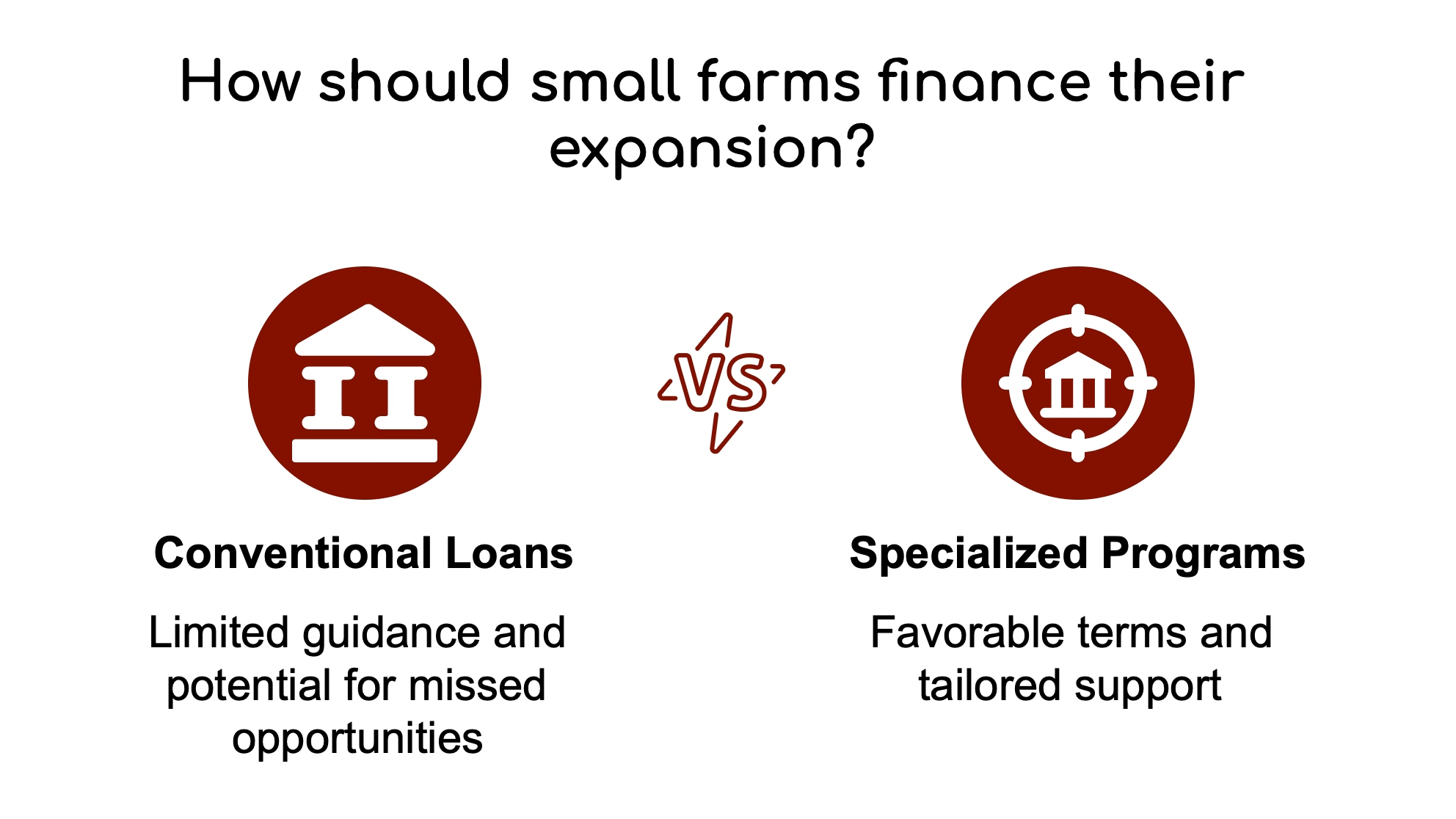
Expansion requires capital, and most small farms are capital-constrained. But too many farmers leave money on the table by not exploiting available programs:
- USDA FSA loans (Farm Ownership up to $600,000, Operating up to $400,000, Microloans up to $50,000) offer favorable terms specifically designed for agricultural operations
- USDA Value-Added Producer Grants provide up to $250,000 in working capital to develop and market value-added products like cheese or yogurt
- The Environmental Quality Incentives Program (EQIP) offers financial assistance for implementing conservation practices
- Risk Management Tools, including Dairy Margin Coverage (DMC), provide essential protection against margin compression, crucial for farms under 200 cows
The harsh reality: Your local commercial lender probably isn’t equipped to guide you through these specialized agricultural programs. And let’s be brutally honest, many small farms are leaving hundreds of thousands in potential support untapped because they don’t want to deal with the paperwork or “government involvement.”
Is your pride worth more than your farm’s future? Are you willing to let your operation fail rather than navigate some paperwork for programs specifically designed to help farms like yours?
THE SUSTAINABILITY ADVANTAGE: PROFIT FROM BEING GREEN
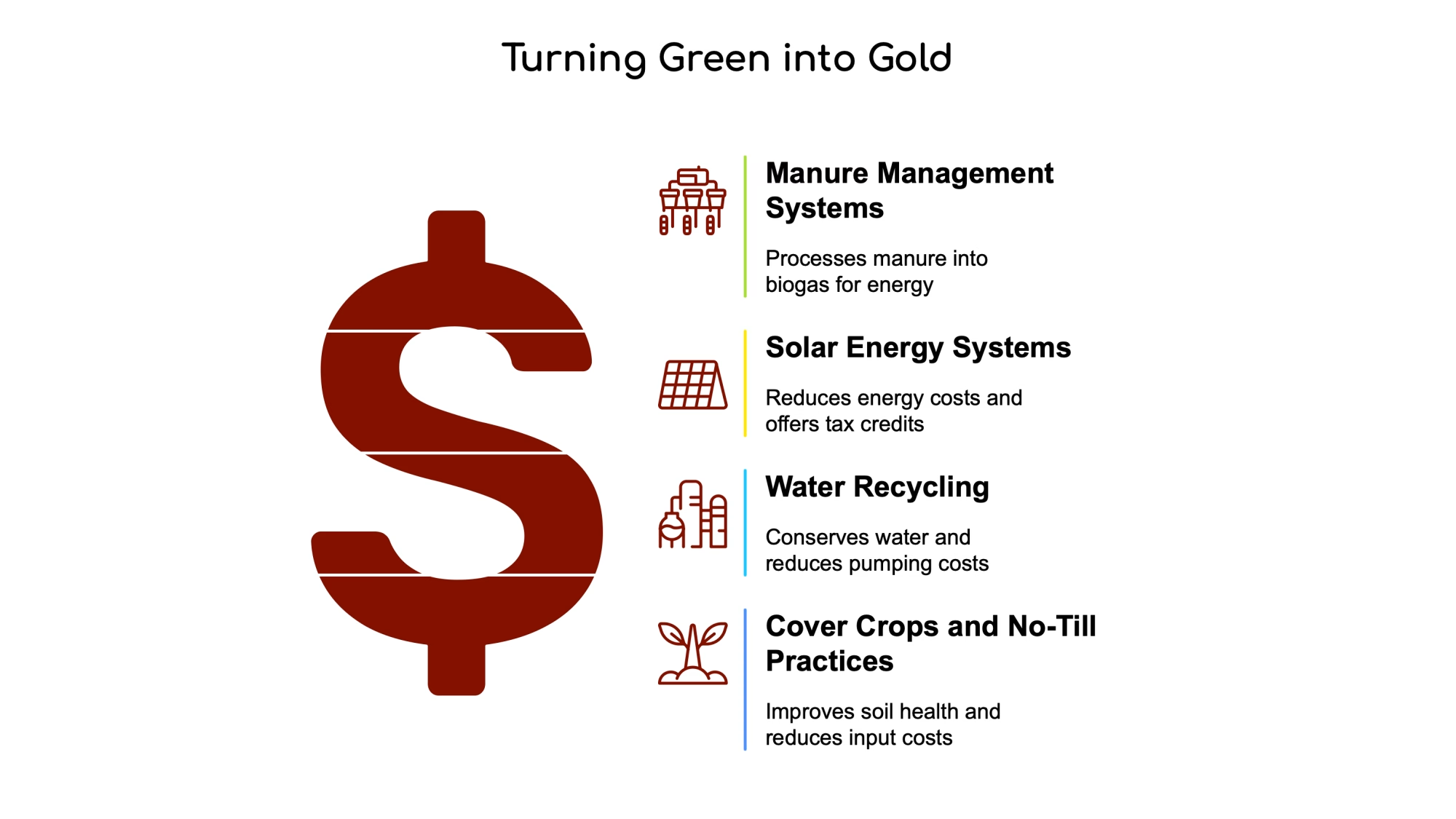
Environmental compliance isn’t optional anymore, but smart operators are turning regulatory requirements into competitive advantages:
- Manure management systems like anaerobic digesters process manure while producing biogas for energy. While substantial investments ($400,000 to $5 million) can offset significant energy costs or generate revenue if biogas is sold to the grid
- Solar energy systems can save mid-sized farms $3,000 annually and larger operations $100,000+, with payback periods typically 5-7 years and investment tax credits covering 26% of installation costs
- Water recycling reduces both freshwater consumption and energy costs for pumping
- Cover crops and no-till practices improve soil health while reducing input costs, with long-term use of cover crops yielding net benefits of $20-$90 per acre annually when forage benefits are included
Let’s be frank: Those viewing sustainability as an added cost or regulatory burden are missing the forest for the trees. The most progressive operations are discovering that sustainable practices are unlocking new revenue streams and slashing input costs.
Think of sustainability as preventative maintenance for your business, not immediately necessary to keep running today, but critical for long-term performance.
Environmental practices aren’t just compliance costs-they’re profit opportunities. Farms implementing comprehensive conservation practices are seeing enhanced operational efficiency, reduced input costs, and premium market access.
THE BOTTOM LINE: GROW SMARTER OR DISAPPEAR
The consolidation pressure reshaping America’s dairy landscape isn’t slowing down. The choice for small and mid-sized producers isn’t whether to change, but how quickly you can adapt to a transformed industry reality.
Research conclusively proves that the traditional expansion model, proportionally scaling land, animals, and infrastructure, delivers poorer financial results than more capital-efficient approaches.
For America’s small dairy farms, survival requires evolution beyond the mindset and methods that worked for previous generations. Those who embrace this transformation won’t just survive- they’ll redefine dairy’s future.
What This Means for Your Operation
- Challenge your assumptions about capital allocation. Is land acquisition really your best use of limited capital?
- Target technology investments at your specific bottlenecks, not what looks impressive to the neighbors.
- Explore value-added strategies that capture more consumer dollars rather than chasing volume.
- Build your expansion around workers’ strengths and weaknesses. Labor is now often the limiting factor, not land or capital.
- Think beyond production to embrace your role as a food producer, not just a raw material supplier.
Have you got the courage to break from convention? The dairy industry is littered with the remains of farms that followed the traditional playbook right into bankruptcy. Will you be next, or will you be bold enough to forge a different path?
The future belongs to those who understand that expansion isn’t about getting bigger, it’s about getting smarter. The question isn’t whether you can afford to change your approach. The real question is: Can you afford not to?
To watch the PDPW “Dairy Signal” podcast: The Dairy Signal | PDP
Key Takeaways:
- Skip land, buy feed: Expanding herds without land purchases (Scenario B) yields the highest profits and lowest debt.
- Robotics beat labor woes: Automated milking cuts labor costs 60% and boosts milk yield 5-10%.
- Niche markets pay premiums: Organic and grass-fed dairy markets are growing 5-6% annually.
- Sustainability = profit: Manure digesters and solar energy slash costs while meeting consumer demands.
- Grants over loans: USDA programs like VAPG and EQIP fund expansion without drowning farms in debt.
Executive Summary:
The U.S. dairy industry’s rapid consolidation is forcing small farms to rethink expansion. Michigan State University research proves traditional “buy more land” strategies underperform capital-efficient models, with farms avoiding land purchases achieving higher profits, lower debt, and better cash flow. Robotic milking systems address labor shortages, while niche markets (organic, grass-fed) and sustainability practices unlock premium pricing. To survive, small farms must prioritize strategic tech adoption, value-added diversification, and USDA grant programs-proving growth isn’t about scale, but smarter resource allocation.
Learn more:
- Why Expanding Your Dairy Farm Could Be a Nightmare: Here’s What You Need to Know
- Boosting Dairy Farm Profits: 7 Effective Strategies to Enhance Cash Flow
- Riverview Dairy’s Massive Expansion: A Death Knell for Small Dairy Farms?
 Join the Revolution!
 Join the Revolution!
Join over 30,000 successful dairy professionals who rely on Bullvine Weekly for their competitive edge. Delivered directly to your inbox each week, our exclusive industry insights help you make smarter decisions while saving precious hours every week. Never miss critical updates on milk production trends, breakthrough technologies, and profit-boosting strategies that top producers are already implementing. Subscribe now to transform your dairy operation’s efficiency and profitability—your future success is just one click away.




