








While 9% of farmers are veterans, only 3% work in dairy—yet their military skills perfectly match dairy’s toughest challenges. Here’s why.
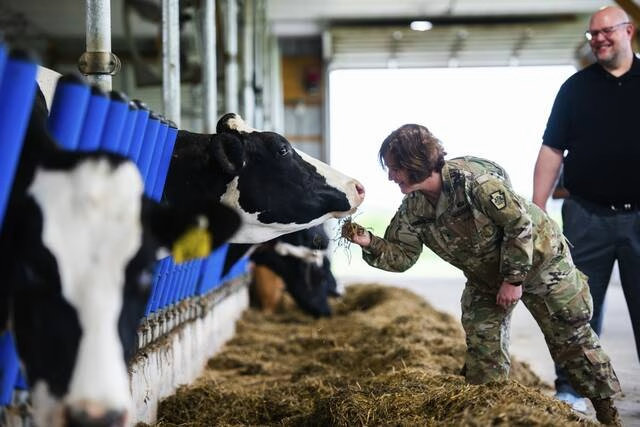
Here’s a reality check that should make every dairy producer pause mid-stride down the feed alley: while 9% of all U.S. agricultural producers have military service, only 3% of dairy producers claim such experience. We’re essentially ignoring a talent pool that’s been systematically trained for exactly what modern dairy farming demands—and wondering why we can’t find reliable workers.
Let’s be brutally honest about what’s happening in our industry. You’re struggling with a 30% annual labor turnover rate while sitting on one of American agriculture’s most underutilized recruitment goldmines. Military veterans aren’t just another labor source—they’re operational force multipliers who’ve been conditioned for the exact challenges destroying your competitors’ profitability.
The Uncomfortable Truth About Your Labor Crisis
Nobody wants to admit that your labor shortage isn’t about finding warm bodies to show up at 4 AM. It’s about finding people who can handle relentless pressure, master complex systems, and maintain standards when everything hits the fan—like during an H5N1 outbreak that can cost a 3,900-cow operation $737,500 in just 60 days.
The numbers from the 2022 Census of Agriculture are devastating:
- 305,753 total producers with military service across all agriculture
- Only 3% of dairy producers report military experience vs. 9% in general agriculture
- 20% decline in available dairy labor over the past decade
- 70% of farms report difficulty finding skilled workers
- Average dairy worker age: 50 years old
- Large herds growing productivity at 2.99% annually vs. just 0.63% for smaller operations
Want to know why? Operational discipline. The same trait that separates successful military units from failed ones is what separates profitable dairies from struggling ones.
Why Military Training Is Actually Dairy Management Training
Think I’m exaggerating? Consider Bob Miller, an Army Captain with two tours in Iraq who converted his Maryland dairy to A2/A2 Jerseys “in literally two years’ time,” built an on-farm creamery with his own hands, and now mentors other farmers through the Dairy Grazing Apprenticeship program. His perspective cuts to the core truth: “It takes a lot of discipline to be able to be a good soldier, and it takes a lot of discipline to be a good farmer. This is a duty.”
But here’s where it gets interesting—and where most dairy operations are missing the boat entirely.
Crisis Management That Actually Works (Not Just Panic Management)
Remember the H5N1 outbreak? Cornell University researchers studying a 3,900-cow Ohio herd found that clinical disease affected about 20% of cows, with milk losses of about 900 kg per cow over 60 days. The estimated economic loss was $950 per clinically affected cow, totaling $737,500 for the entire outbreak. Yet only 28% of farms consistently used PPE during the crisis.
This isn’t a knowledge problem—it’s a discipline problem, like knowing your breeding protocols but failing to execute them consistently.
Military crisis management follows structured SOPs that dairy farms desperately need:
- Rapid triage protocols (think fresh cow assessments but for threats)
- Clear chain of command during emergencies
- Strict adherence to biosecurity protocols under pressure
- Efficient resource allocation when supplies are limited
- After-action reviews to improve future responses
When mastitis hits your high producers or your milk truck breaks down during peak flush, do you want someone who “understands” protocols or someone who implements them with military precision regardless of circumstances?
Technical Aptitude That Scales with Modern Operations
Let’s face facts: modern dairy farming is equipment management with cows attached. Robotic milking systems, automated feed pushers, computerized breeding programs—your operation runs on complex equipment that demands troubleshooting skills, preventive maintenance schedules, and system optimization.
Military personnel don’t just operate equipment—they’re conditioned to maintain mission-critical systems under adverse conditions. The same technical mindset that keeps sophisticated military equipment operational can optimize your parlor throughput and prevent costly breakdowns during peak milking.
Leadership That Multiplies Team Effectiveness
Here’s where veterans really separate themselves from typical hires. They don’t just manage tasks—they improve entire team performance. It’s like having a bull that doesn’t just improve his own offspring but elevates your entire genetic program.
Veterans implement the “Tell, Show, Do, Review” training method, which has proven effective in dairy settings, maintain safety standards through consistent enforcement, and adapt quickly when plans change—like when weather forces feeding schedule adjustments.
Success Stories: What Right Looks Like
Land O’Lakes provides the gold standard approach. Their engagement with the DoD SkillBridge program has resulted in 13 current interns, 25 program completions, and seven full-time hires from the veteran community. They’re not just hiring bodies—they’re strategically recruiting operational talent.
Texas A&M’s “Battleground to Breaking Ground” program has assisted over 900 veterans and new farmers by providing intensified production and financial management training. This specialized training helps veterans qualify for USDA farm ownership loans faster by combining training with their prior military leadership experience.
The Dairy Grazing Apprenticeship program demonstrates how structured support creates success, pairing experienced farmers with newcomers for both technical training and crucial peer support. Bob Miller serves as a mentor in this program, specifically valuing apprentices interested in dairy and grazing.
The Barriers We’ve Built (And Why We’re Sabotaging Ourselves)
So, if veterans are such natural fits, why aren’t they filling your employment ads? We’ve created a perfect storm of barriers that keep them out—and then wonder why we can’t find good help.
The Capital Access Nightmare
Dairy farming is brutally capital-intensive, but here’s the kicker: the 2018 Farm Bill introduced “sunset clauses” limiting veteran eligibility for USDA preferences to just 10 years post-service. A veteran who served 20 years and took time to plan their transition might find themselves ineligible for programs designed to help them.
The Skills Translation Gap (We’re Speaking Different Languages)
This one’s entirely on us. Farm owners focus on “relevant dairy experience” while missing operational and leadership skills that actually drive performance. Military logistics coordination transfers directly to feed delivery scheduling. Equipment maintenance experience applies perfectly to parlor systems management.
Veterans themselves struggle to translate their experience into civilian language. Military achievements are measured in personnel management and mission completion—not revenue generation or cost savings.
What This Really Means for Your Bottom Line
The 2022 Census of Agriculture reveals that veterans in agriculture are 46% more likely to be self-employed than 25% for non-veterans, indicating strong entrepreneurial drive and commitment—exactly what you need in key management positions.
While your neighbors struggle with inconsistent labor and operational chaos, you could have team members who instinctively implement safety protocols, optimize logistical efficiency, and maintain performance standards under pressure.
The 6% gap between veteran participation in general agriculture (9%) versus dairy (3%) represents approximately 15,000 potential veteran dairy producers who could drive industry innovation and stability. We’re leaving talent on the table while complaining about labor shortages.
Your 30-Day Action Plan
Week 1: Assessment and Partnership Building
- Contact your local USDA office about veteran support programs
- Reach out to your state’s Department of Veterans Affairs agricultural liaison
- Connect with the Farmer Veteran Coalition (farmvetco.org)
- Review current job descriptions for military skill alignment
Week 2: Skills Translation Framework
Create resources mapping military specialties to dairy roles:
- Logistics specialists → Feed management and supply coordination
- Equipment operators → Milking system maintenance and troubleshooting
- Communications specialists → Herd records and data management
- Squad leaders → Crew supervision and training protocols
- Medics → Animal health monitoring and treatment implementation
Week 3: Program Integration
- Contact DoD SkillBridge program coordinators for structured internships
- Connect with Texas A&M’s “Battleground to Breaking Ground” program
- Explore Dairy Grazing Apprenticeship opportunities
- Investigate USDA Military Veterans Agricultural Liaison (MVAL) resources
Week 4: Environment Preparation
- Train existing staff on veteran transition awareness
- Establish clear structure and defined expectations
- Create supportive team environments that foster camaraderie
- Develop mentorship partnerships with experienced veteran farmers
Available Support Programs
| Program | Organization | Key Benefits |
| DoD SkillBridge | Department of Defense | Structured internships, proven results |
| USDA Farm Loans | USDA-FSA | Loan preferences, modified terms for veterans |
| AgVets Program | USDA-NIFA | Funds hands-on training programs for veterans |
| Farmer Veteran Coalition | Non-profit | Fellowship funds, equipment grants |
| Military Veterans Agricultural Liaison | USDA | Employment connections, program navigation |
The Bottom Line
Military veterans aren’t just another labor source—they’re operational assets who can transform how your dairy functions. The 2022 Census data proves veterans are significantly underrepresented in dairy (3%) compared to general agriculture (9%), representing a massive missed opportunity.
Veterans bring exactly what struggling dairy operations need: disciplined crisis management, technical problem-solving, and leadership capabilities that multiply team effectiveness. Their proven track record of 46% self-employment rates in agriculture demonstrates the entrepreneurial drive and commitment dairy farming demands.
The question isn’t whether veterans can succeed in dairy farming—the evidence is overwhelming. The question is whether you’ll be strategic enough to recruit, train, and retain this exceptional talent before your competitors figure it out.
Contact your local USDA office about veteran support programs this week. Reach out to veteran service organizations in your area. Start rewriting your job descriptions to attract operational talent rather than just dairy experience.
The veterans are ready to serve again—this time in service of America’s dairy industry. Are you ready to lead this recruitment revolution, or will you watch your competitors gain the advantage while you stick with traditional hiring approaches?
Connect with veteran agricultural programs through the Farmer Veteran Coalition (farmvetco.org) or your state’s Department of Veterans Affairs agricultural liaison. Your next game-changing hire might be waiting for marching orders.
Key Takeaways
- Massive Underrepresentation: Veterans make up 9% of all agricultural producers but only 3% of dairy producers, revealing approximately 15,000 potential veteran dairy farmers being overlooked by the industry.
- Perfect Skills Match: Military training in crisis management, operational discipline, technical systems, and leadership directly addresses dairy’s core challenges—from H5N1 outbreak response to managing complex milking parlor operations.
- Proven Success Potential: Veterans in agriculture are 46% more likely to be self-employed compared to 25% for non-veterans, demonstrating strong entrepreneurial drive ideal for dairy farm ownership and management.
- Significant Entry Barriers: High capital requirements, skills translation gaps, and policy limitations (like 10-year “sunset clauses” for veteran preferences) prevent qualified veterans from entering the capital-intensive dairy sector.
- Strategic Opportunity: Targeted recruitment, specialized training programs, and veteran-supportive policies could transform both the industry’s labor shortage and provide meaningful post-service careers for transitioning military personnel.
Executive Summary
The U.S. dairy industry faces a critical labor crisis with a 20% decline in available workers over the past decade and 70% of farms struggling to find skilled employees, yet it’s dramatically underutilizing military veterans who possess exactly the skills modern dairy operations demand. While 9% of all agricultural producers have military service, only 3% of dairy producers claim such experience, representing a massive missed opportunity. Veterans bring precisely what dairy farming requires: operational discipline for complex daily routines, crisis management expertise for disease outbreaks like H5N1, technical aptitude for increasingly sophisticated equipment, and leadership skills for team management. However, significant barriers prevent veteran integration, including substantial capital requirements for dairy startups, skills translation gaps between military and civilian employers, and policy limitations like “sunset clauses” in Farm Bill veteran preferences. Success stories like Army veteran Bob Miller, who transformed his family’s Maryland dairy into Nice Farms Creamery through strategic planning and disciplined execution, demonstrate the untapped potential of this “secret weapon.” The industry must implement targeted recruitment strategies, specialized training programs, and supportive policies to unlock this valuable talent pool and build a more resilient dairy future.
Learn more:
 Join the Revolution!
 Join the Revolution!
Join over 30,000 successful dairy professionals who rely on Bullvine Weekly for their competitive edge. Delivered directly to your inbox each week, our exclusive industry insights help you make smarter decisions while saving precious hours every week. Never miss critical updates on milk production trends, breakthrough technologies, and profit-boosting strategies that top producers are already implementing. Subscribe now to transform your dairy operation’s efficiency and profitability—your future success is just one click away.




