How can new advocacy models help dairy farmers tackle today’s mounting mental health challenges?
Executive Summary: Dairy farmers face a growing mental health crisis, with studies indicating that 75% experience significant stress and that suicidal ideation rates are about double those of the general population. Recent data from the University of Guelph and the National Rural Health Association highlight these concerning trends amid volatile markets and operational pressures. Innovative approaches, such as Culver’s engagement-linked donations to the documentary ‘Green Gold,’ alongside community-based programs like the Farmer Angel Network and Farm Family Alliance, are reshaping the support flows for farms. These initiatives demonstrate how authentic storytelling and transparent engagement can break cultural barriers and connect consumers with farms. While challenges remain, early signs suggest that these models provide scalable, localized solutions that are sensitive to seasonal rhythms and regional needs. For dairy operations aiming to thrive in 2025, integrating a mental health focus with consumer engagement is increasingly critical.
Key Takeaways:
75% of dairy farmers report moderate to high stress—addressing mental health proactively can improve resilience and productivity.
Consumer-linked philanthropy, tied to storytelling, now raises millions of dollars annually, reflecting genuine engagement.
Community programs, such as the Farmer Angel Network, offer culturally sensitive support tailored to dairy farming lifestyles.
Recognizing regional challenges—from Northeastern pasture systems to Western heat stress—is crucial for effective advocacy.
Open dialogue and accessible resources empower farmers to sustain their operations amid growing pressures.
You know, sometimes a story cuts right through all the industry noise. I’ve been reflecting on “Green and Gold,” that independent documentary about a Wisconsin dairy farm teetering on foreclosure. What really caught my attention wasn’t just the film itself, but how Culver’s approached their partnership in a way that’s quite different from the usual corporate playbook.
Instead of the traditional write-a-check-and-take-a-photo routine, they tied their donations directly to viewer engagement. Every time someone watched the film, a dollar went to farmer mental health organizations. That creates a whole new dynamic—and from what I’m seeing across the industry, it could really change how we think about supporting our farming communities.
The Mental Health Reality We’re All Dealing With
Look, if you’ve been managing a dairy operation for any length of time, you know the weight of stress isn’t just some abstract concept. The latest research from the University of Guelph puts some hard numbers to what many of us experience daily—about 75% of farmers are dealing with moderate to high stress levels, and the rate of suicidal thoughts is running about twice that of the general population.
I was talking with a producer from Vermont just last month who said something that really stuck with me: “It’s like there’s no off switch anymore. You’re constantly thinking about feed costs, milk prices, weather patterns—your mind never really gets a break.” Whether you’re running a seasonal grazing system in New England or managing a 2,000-head operation in the Central Valley, those pressure points hit remarkably similar notes.
The National Rural Health Association data tells an even starker story—farmers face suicide rates nearly four times higher than the general working population. For male farmers specifically, we’re looking at rates about 50% higher than their non-farming peers. These aren’t just statistics… these are our neighbors, our colleagues, sometimes our family members.
What’s encouraging, though, is seeing organizations step up with approaches that actually fit our culture. The groups receiving support through this Culver’s initiative—Farmer Angel Network, Farm Family Wellness Alliance, and National FFA—they’re taking community-focused approaches that work within farming culture rather than against it.
Rethinking Corporate Agricultural Support
Here’s where Culver’s model really shifts the paradigm. Rather than allocating a fixed annual donation (which is usually the case), they created a scalable solution. Since launching their Thank You Farmers Project in 2013, they’ve generated over $6.5 million for agricultural causes—with $1.5 million raised just this past year, according to their corporate reports.
But here’s what makes this particularly interesting for operations of different scales: whether you’re managing a 100-cow family dairy in Iowa or overseeing a large organic facility in Colorado, this model demonstrates how consumer engagement can translate directly into meaningful support. The funding grows with genuine interest rather than being capped by corporate budget limitations.
A dairy farmer from Wisconsin told me recently, “When companies actually connect their support to real engagement with our stories, it feels different. It’s not charity—it’s partnership.”
The Power of Authentic Agricultural Stories
The film’s boldest choice—showing a dairy farmer literally betting his farm’s survival on a Green Bay Packers game—might sound wild to folks outside agriculture. But any of us who’ve faced impossible financial pressures recognize that moment when rational options have been exhausted and you’re weighing decisions that would seem crazy under normal circumstances.
This kind of honest storytelling does something powerful: it breaks down the myth of the unbreakable farmer that’s kept too many of us silent about real struggles. I’ve seen this pressure play out differently across regions—drought stress in California herds, labor challenges in Northeast operations, volatile feed costs hitting Midwest dairies—but the psychological weight is remarkably consistent.
As one Texas dairy producer shared with me, “Seeing someone on screen making those impossible choices… it makes you realize you’re not the only one who’s been there.”
Support Systems That Actually Work in Farming Culture
The Farmer Angel Network was founded in response to a tragic loss in Sauk County, Wisconsin, and its approach focuses on fellowship and community education rather than clinical intervention. They understand something crucial—in farming culture, support systems need to respect our rhythms and values.
Meanwhile, the Farm Family Wellness Alliance has developed a layered approach: anonymous peer support through digital platforms (think 24/7 access that accommodates milking schedules) combined with professional counseling services tailored to the unpredictable seasonal demands of farming. What’s smart about this model is recognizing that farmers need both community connection and professional expertise, but delivered in ways that work with our realities.
And we can’t overlook the National FFA’s role in this mix. With over a million active student members currently, they’re addressing what might be our most critical long-term challenge—ensuring agriculture has a next generation that wants to stay engaged.
A farm wife from Pennsylvania put it perfectly: “The best support understands that a 4 AM call about a difficult calving isn’t just work stress—it’s life or death for that calf and our cash flow.”
Understanding the Cultural Competency Gap
Here’s something that’s been bothering me for years: so many well-intentioned support programs miss the mark because they’re designed by people who’ve never actually lived through a difficult calving season or watched milk prices tank just as you’re budgeting for next quarter’s feed purchases.
Growing up around dairy operations teaches you things you can’t learn from textbooks—like understanding that scheduling mental health workshops during planting season guarantees empty rooms, or knowing that farmers need support systems that strengthen community networks rather than treating every challenge as an individual problem.
What I find encouraging about authentic approaches like “Green and Gold” is how they demonstrate that audiences—both farming and non-farming—can distinguish genuine agricultural storytelling from corporate messaging, even when both claim to “support farmers.”
Looking at Broader Implications
We’re witnessing what I’d call the emergence of consumer-mediated agricultural advocacy. When consumers can directly support farming communities through authentic content engagement, it eliminates some of the institutional gatekeepers who’ve traditionally controlled agricultural narrative and resource allocation.
This direct connection model scales with consumer interest rather than bureaucratic approval processes—and that’s significant because traditional agricultural institutions often operate with fixed budgets and political constraints that limit responsiveness to actual farming community needs.
Now, this raises some interesting questions… How do these new models complement existing extension services? What happens to traditional agricultural advocacy organizations? Early indications suggest we’re looking at a supplement rather than a replacement, but the landscape is definitely shifting.
Regional Applications and Variations
While the Farmer Angel Network model started in Wisconsin, I’m seeing similar community-based approaches emerging across different dairy regions:
Northeast operations dealing with seasonal grazing challenges and processing consolidation, where programs need to account for winter housing transitions and maple syrup season conflicts
Western dairies are navigating water restrictions and heat stress management, requiring support systems that understand the unique pressures of managing large herds in arid climates
Southern farms managing diverse labor forces and expanding market opportunities, where cultural sensitivity becomes even more critical
Midwest operations are balancing expansion pressures with environmental regulations, facing the classic squeeze between growth demands and compliance costs
Each region presents unique stressors and cultural considerations that effective support systems must address.
Key Takeaways for Dairy Operations
What we’re learning is that authentic agricultural storytelling creates cultural permission for discussing sensitive topics that traditional agricultural media has historically avoided. Breaking the silence around farming struggles becomes the foundation for building community support systems rather than suffering in isolation.
The most effective agricultural advocacy seems to amplify farming voices rather than replacing them with institutional messaging. This represents a shift from charity-based support models toward partnership approaches that recognize farming communities as capable advocates for their own needs.
For those of us managing operations today, there are some practical implications worth considering:
Mental health resources work best when they’re community-based and culturally appropriate
Consumer engagement models offer new pathways for sustainable agricultural support
Authentic storytelling about farming realities creates stronger advocacy than sanitized messaging
Support systems need to respect seasonal demands and community relationships
Early intervention is more effective than crisis response—building support networks before they’re desperately needed
The Bottom Line
The success of initiatives like “Green and Gold” suggests we’re at an interesting inflection point where agricultural advocacy can become more effective by creating direct connections between farming communities and broader society, rather than relying solely on traditional institutional channels.
For farming communities facing unprecedented economic and psychological pressures—whether you’re managing fresh cow transitions in Wisconsin or optimizing dry matter intake in California—this model offers hope that authentic storytelling combined with community support can create sustainable pathways forward.
Sometimes the most effective agricultural advocacy comes from simply telling the truth about farming life and trusting that people care enough to help when they understand what’s really happening on our farms. Based on what we’re seeing with these consumer-driven initiatives, that trust appears to be well-placed.
The transformation is already underway. The question for all of us is how we’ll participate in building support systems that actually serve farming communities rather than just looking good in corporate annual reports.
Complete references and supporting documentation are available upon request by contacting the editorial team at editor@thebullvine.com.
Learn More:
The Tech Reality Check: Why Smart Dairy Operations Are Winning While Others Struggle – This article provides a tactical reality check on technology adoption. It reveals practical strategies for budgeting and implementation, helping you avoid common pitfalls and ensure new tech like robotics delivers a positive ROI, directly complementing the advocacy topic.
The Compliance Trap: How Top Dairy Producers Turn Regulation into Profit – This piece offers a strategic, market-focused perspective. It demonstrates how elite dairy operations turn regulatory challenges into a competitive advantage, providing crucial economic context for why proactive management and technology investment are essential for long-term profitability.
Join over 30,000 successful dairy professionals who rely on Bullvine Weekly for their competitive edge. Delivered directly to your inbox each week, our exclusive industry insights help you make smarter decisions while saving precious hours every week. Never miss critical updates on milk production trends, breakthrough technologies, and profit-boosting strategies that top producers are already implementing. Subscribe now to transform your dairy operation’s efficiency and profitability—your future success is just one click away.
Forget feel-good farm PR. Sarah Hagenow’s unconventional journey to becoming the 78th Alice in Dairyland, highlighting her business-minded approach to agricultural advocacy.
Sarah Hagenow, Wisconsin’s 78th Alice in Dairyland, brings a unique business-minded approach to agricultural advocacy. The University of Minnesota graduate’s journey from a 13-year-old working with a heifer named “Sassy” to becoming half of the program’s first sister pair reflects her strategic vision for modernizing agricultural communication while honoring dairy industry traditions.
The morning light filtered through the barn windows at City Slickers Farm in Cross Plains, WI, as thirteen-year-old Sarah Hagenow approached the pen holding a Brown Swiss heifer named “Sassy.” The heifer had shattered her leg as a calf, leaving her with a permanent reminder of vulnerability overcome through care and determination. What Sarah couldn’t have known in that moment was that this humble heifer – one who would “fall about middle of the pack at each show” – would become the catalyst for a journey that would eventually make history, making Sarah half of the first sister pair to hold the title of Alice in Dairyland.
Today, as the 78th Alice in Dairyland, Sarah Hagenow stands at the intersection of tradition and transformation, armed with a business degree, a global perspective, and an unshakeable belief that agriculture’s future lies in the hands of those who can speak both the language of the barn and the boardroom.
The Making of a Different Kind of Alice
The Alice in Dairyland program has crowned 76 women before Sarah, each bringing their unique perspective to Wisconsin’s premier agricultural ambassador role. Julia Nunes served as Alice in Dairyland for two consecutive years, a historical moment in the program’s 78-year history, due to COVID-19 restrictions. Sarah’s selection also represents something unprecedented – not just because she follows her sister Ashley (the 76th Alice) in creating the program’s first sibling legacy, but because she embodies a distinctly business-minded approach to agricultural advocacy that sets her apart from her predecessors.
“Ashley was a little bit more into showing horses, where I went down the cattle path. In school, we’ve had different interests as well. I took a little bit more of the business path and she took more of the marketing path,” Sarah explains, her voice carrying the analytical precision that has become her trademark. This wasn’t a casual decision but a deliberate strategy that would shape everything from her academic pursuits at the University of Minnesota to her internships across the agricultural supply chain.
Sisters Ashley Hagenow (left) and Sarah Hagenow (right) celebrate in 2023 after Ashley was named the 76th Alice in Dairyland. This moment foreshadowed the historic first sister pair in the program’s 78-year history, with Sarah following as the 78th Alice in 2025, creating what they call the “Hagenow flair” – Ashley’s marketing expertise complemented by Sarah’s business-minded approach.
Where traditional Alice candidates might focus on communications and public relations, Sarah brings something different to the sash and tiara: a deep understanding of commodity markets, supply chain logistics, and the economic forces that drive agricultural decisions. Her comfort with agriculture extends beyond show ring placings to some of the decisions driving modern dairy operations.
Roots Run Deep, But Vision Runs Deeper
The Hagenow agricultural heritage began on father Bob Hagenow’s family farm in Manitowoc County. While Bob transitioned away from the farm later in life, his daughters initially learned about agriculture through the scientific precision of animal nutrition. Bob works as a feed nutritionist at Vita Plus, the Madison-based company that has built its reputation on cutting-edge technology and nutrition science since 1948. Growing up in a household where dinner table conversations revolved around dairy cattle, farmers, and family, Sarah developed a “salt-of-the earth” communication style.
Bob’s influence runs deeper than most realize. As a regional business manager at Vita Plus with nearly four decades of experience, he has led multiple teams and maintained key dealer partnerships while continuing to provide nutrition and business consulting to farm customers. His extensive knowledge of dairy nutrition and farm business management has significantly impacted today’s producers through company-led research projects covering amino acid nutrition, housing developments, forage management, and automated milking system technology.
At the family dinner table, discussions of rural realities and farm operations were daily realities that shaped Sarah’s understanding of agriculture as both art and science. When she thinks about discussing agricultural issues with producers, it stems from someone raised in an environment where agricultural discussions were grounded in practical outcomes that directly impact the farm.
However, the most telling aspect of Sarah’s story isn’t her family’s influence—it’s what she chose to build with it.
The Sassy Story: When Trust Transforms Everything
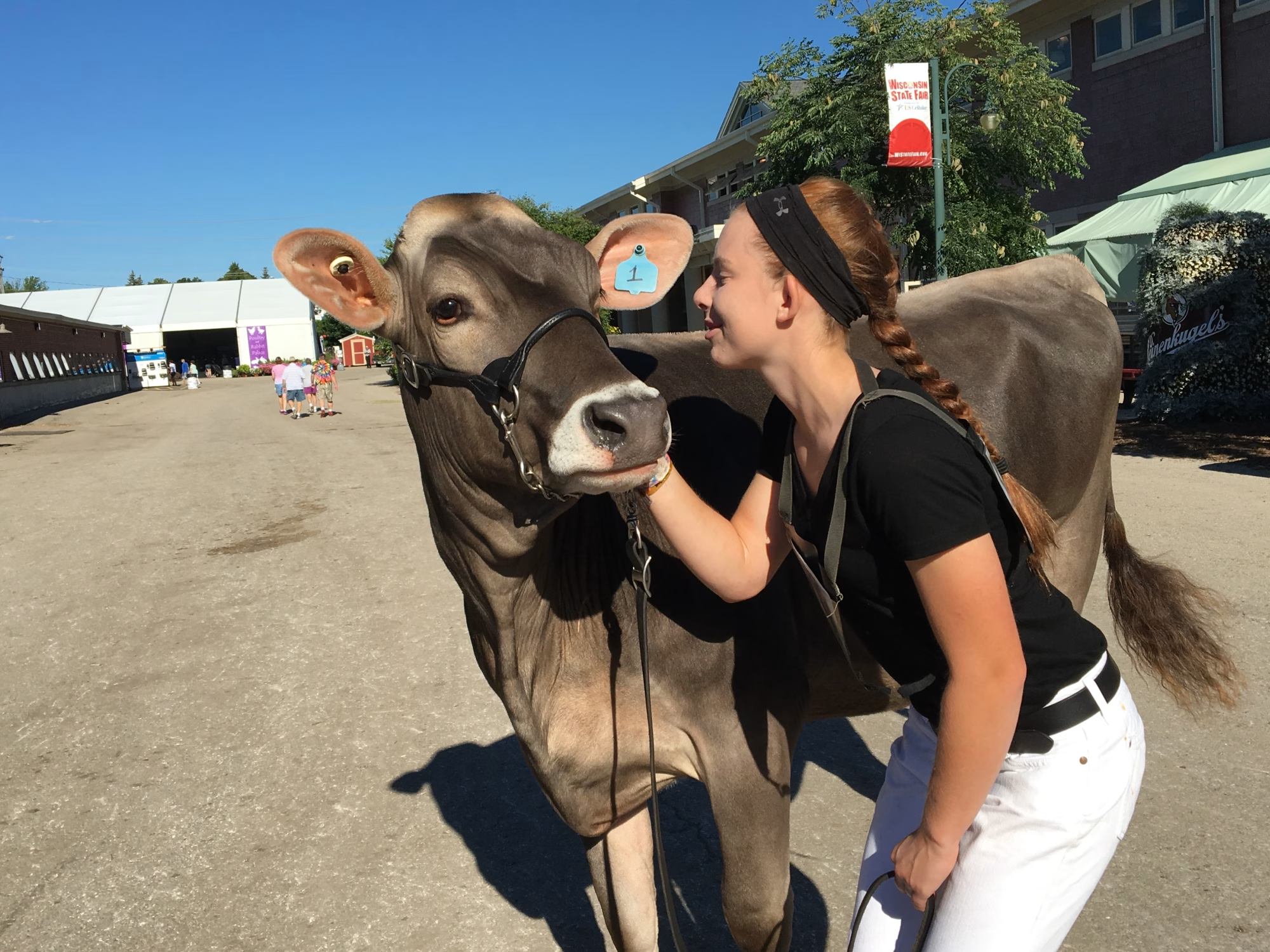
Thirteen-year-old Sarah Hagenow with Brown Swiss heifer “Sassy” at the 2016 Wisconsin State Fair. This partnership marked Sarah’s transition from leasing cattle to ownership and laid the foundation for her business-minded approach to agriculture.
The pivotal moment came in 2016, when Mike Hellenbrand from City Slickers Farm approached Sarah about exhibiting Sassy, a Brown Swiss heifer who had overcome her own challenges after shattering her leg as a calf. For Sarah, who had been leasing cattle from Langer Dairy Farm since 2013, this was more than an opportunity—it was a test of character that would define her entire approach to agricultural business.
Standing in that barn, watching this unassuming heifer who would never claim championship honors, Sarah felt something shift inside her. Mike Hellenbrand had built his reputation on meticulous care and incredible attention to detail – his trademark became “incredible care from embryo to getting a healthy calf on the ground that was ready to thrive at its next home,” as Bob Hagenow, who worked with Mike to establish feeding programs, recalls.
“The feeling that Mike had put his trust in me to take on this project and be responsible for this heifer made me feel very capable and proud of the work I was doing,” Sarah remembers, her voice still carrying the wonder of that thirteen-year-old who suddenly felt capable of something significant.
Sassy wasn’t glamorous. She “fell about middle of the pack at each show,” Sarah recalls with characteristic honesty. However, working through the methodical process of preparing an animal that had overcome adversity, Sarah discovered that success wasn’t measured solely in purple ribbons – it was built on trust, responsibility, and the patient work of turning potential into performance.
The true validation came after the 2016 show season at World Dairy Expo, when Mike Hellenbrand and partners Ken Main and Peter Vail decided to change Sarah’s trajectory: they gifted her half ownership in Sassy.
B-Wil Kingsire Willow as a young calf, representing Sarah’s continued investment in quality genetics beyond her foundational experience with Sassy. This Ayrshire heifer exemplifies Sarah’s strategic approach to building a diverse cattle portfolio that would later inform her business-minded advocacy style.
“Looking back, it probably doesn’t seem that significant or monumental to have half ownership in a heifer that was just a 4-H project,” Sarah reflects. “Especially considering the success stories I’ve had with other animals, including Ayrshire B-Wil Kingsire Willow a few years ago. However, owning part of Sassy felt like the biggest accomplishment and meant the world to me. From a girl who could only dream of being involved in the industry… to finally having my name on a paper, I can remember feeling like I had somewhat ‘made it’ and a new door had opened”.
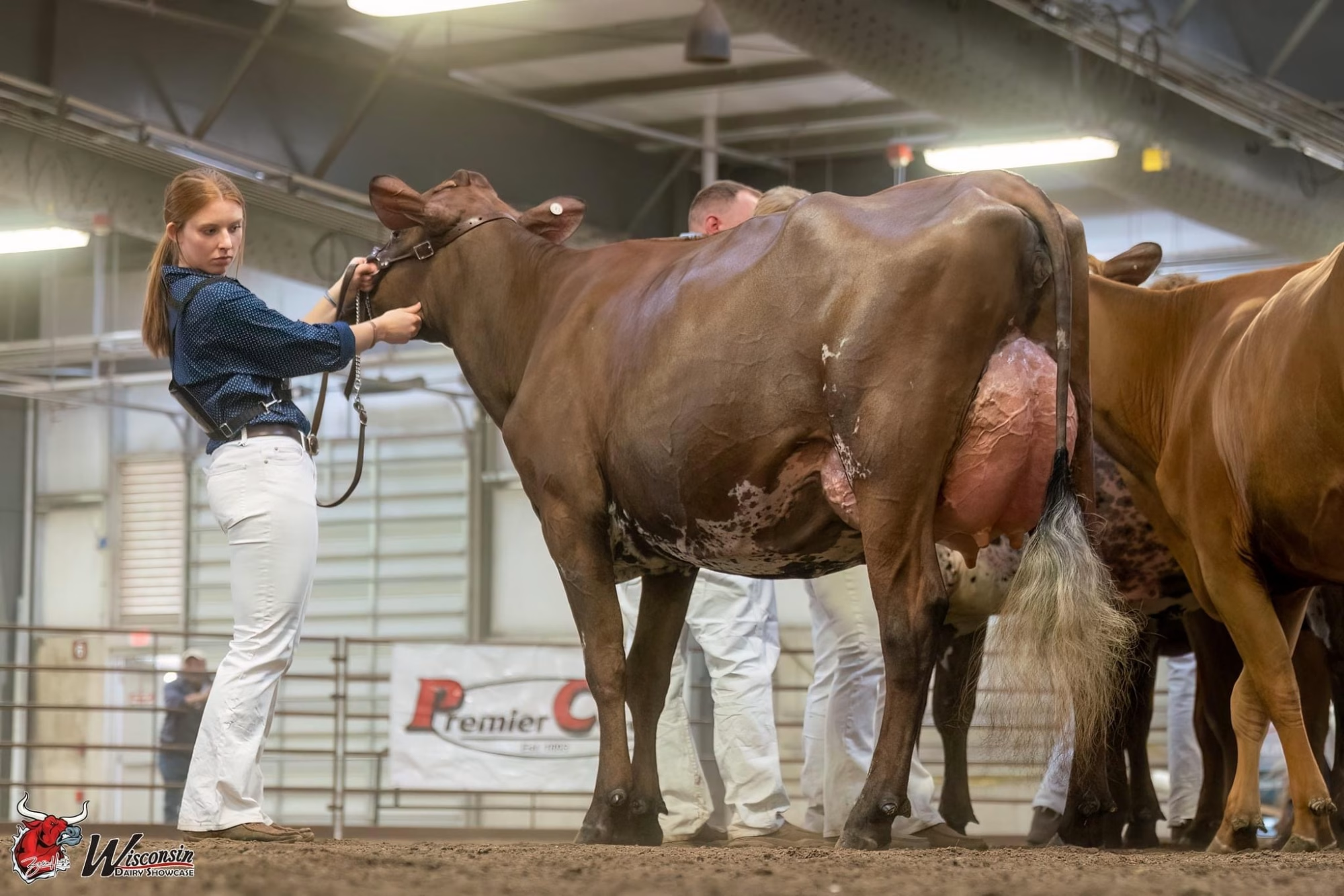
B-Wil Kingsire Willow competing at the 2023 Midwest Spring Show in Madison, demonstrating the successful outcome of Sarah’s strategic investment in quality Ayrshire genetics. This image showcases the mature development of an animal that represents Sarah’s business-minded approach to building a diverse cattle portfolio beyond her foundational Brown Swiss experience with Sassy.
That door led to breeding her first heifer from Sassy – Sar-Boh Wizdom Sassafrass, the prefix name a tribute to Sarah and her father Bob. When Sassafrass won the Champion Bred-and-Owned Brown Swiss Heifer at the 2018 Wisconsin State Fair Junior Dairy Show, it represented the ultimate entrepreneurial milestone: creating a new asset from a previous investment, guided by the trust others had placed in a teenager’s potential.
For dairy producers watching this story unfold, Sarah’s journey from lease to ownership to genetic improvement mirrors the same strategic thinking that drives successful farm expansion and herd development decisions, proving that sound business principles apply whether you’re managing one heifer or a thousand-cow operation.
The Analytical Edge: Where Show Ring Meets Strategy Room
The skills Sarah learned with Sassy would prove invaluable when she joined the University of Minnesota’s dairy cattle judging team, but the experience provided something even more strategic. “Participating in dairy cattle judging was perhaps the most influential activity I did as a youth to develop my public speaking and critical thinking skills,” she explains.
Standing in those Minnesota judging rings, Sarah practiced a discipline that requires a rigorous analytical process: “observation, analysis, decision, articulation.” In the show ring, judges must rank four animals comparatively while weighing dozens of dairy characteristics, frame, body capacity, and mammary system attributes. But the real test comes in “giving reasons” – a formal, timed public speech defending placings with precise, logical, and persuasive language.
“I learned to identify precise details and articulate those points with clarity and confidence,” Sarah explains, drawing the direct parallel between show ring analysis and international advocacy work. When she prepares to field difficult questions from skeptical consumers or, she draws on this structured discipline that demands clarity, logic, and poise under pressure.
These same analytical skills translate directly to later in Sarah’s career, where she hopes to help farm families navigate difficult conversations about expansion financing with lenders, sustainability initiatives with regulators, or succession planning with the next generation – situations where precise communication and logical reasoning can mean the difference between securing resources and losing opportunities.
Global Perspective, Local Application
The lessons learned in Sassy’s stall would be put to the test unexpectedly when Sarah embarked on her January 2024 study abroad program in Germany, focusing on renewable energy and climate-smart technologies. The program exposed her to the integrated, community-based approach to sustainability practiced in the town of Saerbeck, where municipal renewable energy systems, geothermal heating, and agricultural methane digesters work in concert with comprehensive public education.
Standing in the Bioenergy Park in Saerbeck, where she witnessed community collaboration transforming a former German ammunition base into a renewable energy hub, Sarah gained what she calls “diplomatic intelligence.” “I was also just in awe of the communal support behind such a large project. Farmers, civilians, businesses, schools, and leaders have all come together to realize this project,” she recalls.
Sarah Hagenow explores renewable energy innovations at the Bioenergy Park in Saerbeck, Germany, during her January 2024 study abroad program. This transformative experience taught her to view sustainability through a global lens while strengthening her appreciation for Wisconsin’s context-specific agricultural approaches. The community-based renewable energy model she witnessed here would later inform her diplomatic approach to discussing American agriculture’s environmental stewardship with international audiences.
Walking through Saerbeck’s renewable energy park, Sarah found herself thinking not of what America should copy, but of what Wisconsin farmers were already doing right—and how to articulate that difference to skeptical consumers back home. She developed a sophisticated understanding of context-specific solutions: “What works for Europe works for them because of their specific societal needs and historical development, and what works in the United States is different and fitting for us because of our own societal needs,” she explains.
This nuanced perspective transforms potentially defensive conversations about American agriculture into sophisticated discussions about tailored approaches—a crucial skill for an ambassador representing Wisconsin agriculture on the global stage, and equally valuable for dairy producers who need to explain their practices to neighbors and community members questioning agricultural methods.
Supply Chain Scholar: Understanding the Middle
While many agricultural advocates focus on farm-level production or consumer-facing marketing, Sarah’s internship with Viking Dairy Company provided her with something rare: insight into what she calls “the middle of the supply chain.” This role immersed her in the operational realities of moving agricultural commodities, from nonfat dry milk to dried distillers grains, providing her with a practical understanding of the economic and logistical challenges that arise between the farm gate and the consumer shelf.
“The ‘nitty gritty’ of markets, purchasing, economics, and logistically moving products excited me because this area is such a critical part of the whole that gets food to consumers,” Sarah says, her enthusiasm evident. Standing in the Viking Dairy warehouse that first morning, watching pallets move through complex logistical arrangements, she finally understood the intricate dance of transactions that transform farm commodities into consumer products—a knowledge that helps her explain to dairy producers how their farm-gate decisions ripple through entire supply chains.
But her summer 2024 internship with the Animal Agriculture Alliance in Arlington, Virginia, fundamentally reshaped her understanding of agricultural advocacy. “Through my work at the Animal Ag Alliance, my preconceptions of advocacy were challenged by showing me that advocacy extends much further beyond those personal conversations at events,” she reflects.
Walking into those Arlington offices, Sarah’s eyes were opened to the strategic landscape of engaging restaurant stakeholders, grocery chains, food influencers, and nutrition organizations—the crucial gatekeepers who shape food system narratives. “I realized that this group is critical in supporting farmers, processors, and ranchers by buying or promoting certain foods,” she discovered, gaining insights that could help dairy producers understand how to position their operations for value-added partnerships.
Sarah Hagenow during her transformative summer 2024 internship with the Animal Agriculture Alliance in Arlington, Virginia. This experience fundamentally reshaped her understanding of agricultural advocacy, teaching her that effective advocacy extends far beyond traditional farm-to-consumer conversations to include strategic engagement with restaurant stakeholders, grocery chains, and nutrition organizations who serve as crucial gatekeepers in the food system.
This experience taught her that modern agricultural advocacy requires an understanding not just of what farmers do, but also of how their work connects to the broader food system. She hopes to use this knowledge to help producers identify new market opportunities and build relationships with key buyers in the future
The Communication Strategist: Meeting Consumers Where They Are
The lessons learned in Sassy’s stall and refined through her internships would prove invaluable when Sarah faced skeptical consumers at the Wisconsin State Fair, armed now with personal experience and strategic frameworks. Perhaps nowhere is Sarah’s analytical approach more evident than in her systematic framework for addressing agriculture’s most contentious issues.
When confronted with the emotionally charged question “Why do you separate calves from their mothers?” at the Wisconsin State Fair, Sarah didn’t lead with industry justifications. Standing there among the fairgoers, watching their expressions soften as she connected an unfamiliar practice to universal human experience, Sarah realized something profound about the power of empathy in advocacy.
“I said that it’s ultimately for the safety and health of the calf, just like doctors for humans do a health check on newborns to ensure that they are safe and prepared for a healthy life as a baby,” she explains. “This interaction helped me see the importance of relating to others and being able to hear them out, no matter what their initial perspective is. I truly believe that listening with empathy is at the heart of agricultural advocacy and allows us to ground conversations by coming from a place of understanding”.
This approach—connecting unfamiliar agricultural practices to universal human experiences—exemplifies her broader communication philosophy. Her systematic communication framework could be a model for farm families to navigate difficult conversations about sustainability initiatives, helping them ground complex agricultural practices in shared values that resonate with neighbors and community members who may not understand modern farming methods.
Modernizing a Legacy: The Digital Ambassador
Sarah’s vision for her year as Alice involves striking a “delicate balance between honoring tradition and modernizing the program for contemporary advocacy needs.” She plans to maintain the strong partnerships that 76 predecessors worked to establish while embracing digital tools to reach audiences beyond Wisconsin’s borders.
“Utilizing social media and digital forms of storytelling are a great way to keep agricultural advocacy up to date and take advantage of reaching audiences outside of our local communities in Wisconsin,” she explains. But her modernization strategy goes beyond simply posting more content – Sarah sees an opportunity to showcase what she calls “the business and technology of agriculture,” highlighting the advanced systems that farmers use to enhance sustainability and animal care.
The “Hagenow flair” isn’t a single entity but a brand with two complementary dimensions: Ashley’s marketing expertise and Sarah’s business acumen. “Ashley was a little bit more into showing horses, where I went down the cattle path. In school, we’ve had different interests as well. I took a little bit more of the business path, and she took more of the marketing path,” Sarah explains.
The Hagenow family celebrates at the 2024 World Dairy Expo: (left to right) Bob Hagenow, Ashley Hagenow (76th Alice in Dairyland), Sarah Hagenow (78th Alice in Dairyland), and Lisa Hagenow. This historic moment captures the first sister pair in the program’s 78-year history, showcasing the agricultural legacy that shaped both daughters’ commitment to Wisconsin agriculture.
By differentiating her approach and honoring her sister’s contributions, Sarah creates a compelling narrative around agricultural expertise that spans multiple disciplines, leaving a lasting impact on a well-recognized agriculture ambassador for Wisconsin and beyond.
Youth Engagement: The Talent Pipeline Strategy
Sarah’s approach to youth engagement reflects her business-minded perspective on what is fundamentally a human resources challenge. With Wisconsin’s agricultural sector supporting 353,900 jobs, Sarah sees her role as showcasing opportunities across the entire spectrum – from soil scientists and truck drivers to food marketers and event planners.
“I see a critical need to ensure that positions all along the food chain are filled to maintain the security and abundance of the state’s food supply,” she explains. Her strategy combines digital storytelling to virtually bring young people to farms and processing facilities, promoting long-term mentorship programs—an approach she directly links to corporate talent development practices.
“Long-term mentorship programs are also incredibly valuable for young people, which I’ve learned from my business experience,” Sarah notes. Standing before classrooms of students, Sarah envisions more than just inspiring moments – she sees sustainable career pipelines that will ensure Wisconsin agriculture has the talent it needs for the next generation, a strategic approach that could benefit dairy operations seeking to develop the next generation of employees and managers.
In an industry grappling with labor shortages that have reached crisis levels, her talent pipeline approach to youth engagement offers practical solutions for farms struggling to find reliable workers, transforming agricultural education from inspiration to strategic workforce development.
The Business-Minded Evolution
As Sarah prepared to begin her historic tenure on July 7, 2025, she represents more than just another year in the program’s long history. With an annual salary of $45,000 plus benefits and the demanding responsibility of traveling approximately 50,000 miles annually across Wisconsin, she carries both the financial investment the state makes in agricultural promotion and the weight of unprecedented expectations.
Sarah Hagenow is crowned as Wisconsin’s 78th Alice in Dairyland during the selection ceremony at Prairie du Chien Area Arts Center on May 17, 2025. Her selection made history as she became the first sister to follow a sibling into the role, continuing the Hagenow family legacy in agricultural advocacy that began with her sister Ashley, the 76th Alice in Dairyland.
Her tenure promises to test whether modern agricultural advocates can successfully blend tradition with business strategy to champion an increasingly complex industry. Sarah doesn’t rely on abstract statistics when asked about making Wisconsin’s $116.3 billion agricultural economy personally relevant to urban audiences. Instead, she grounds the massive number in human experience: “Three times a day, maybe less or maybe more, every single person sits down and has a plate with food on it. This mental picture is one that every person can likely relate to, and it brings them face-to-face with the product and purpose of agriculture”.
Full Circle: From Sassy’s Stall to State Service
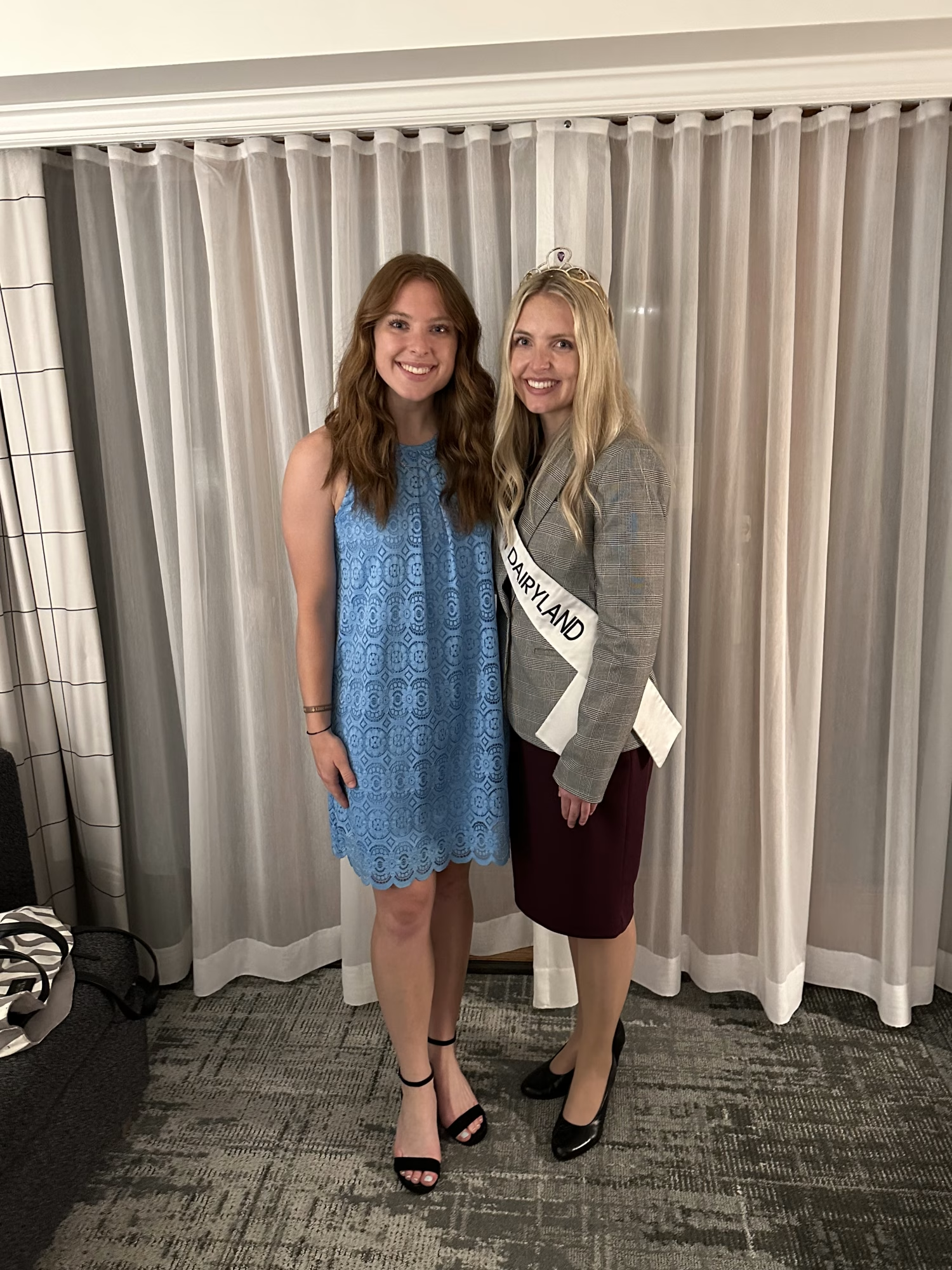
Sarah Hagenow (right) celebrates with Megan Salentine, Wisconsin’s State Fairest of the Fairs, following the Alice in Dairyland finale where Sarah was selected as the 78th Alice. This moment captures the culmination of Sarah’s journey from a teenager working with Sassy to Wisconsin’s premier agricultural ambassador, ready to bring her business-minded approach to agricultural advocacy.
Standing now on the threshold of her year-long journey across Wisconsin’s agricultural landscape, Sarah Hagenow carries with her not just the sash and tiara of Alice in Dairyland, but the lessons learned in a barn stall with a heifer named Sassy. That thirteen-year-old who felt the weight of responsibility for a broken-legged heifer’s care has evolved into a woman who understands that agriculture’s greatest strength lies not in the perfection of its animals or the efficiency of its systems, but in the trust placed between people who believe in something larger than themselves.
“Serving as the 78th Alice in Dairyland is a dream come true,” said Hagenow. “I can’t wait to start visiting communities all across the state, learning more about the diverse people and places that make Wisconsin the agricultural powerhouse it is, and giving voice to their stories of dedication and inspiration”.
The morning light that first illuminated her path to Sassy’s pen has evolved into the bright spotlight of statewide agricultural ambassadorship. However, the principles remain unchanged: earn trust through competence, create value through strategic thinking, and never forget that agriculture’s most powerful stories are rooted in the personal connections that transform individual lives.
As Sarah embarks on her 50,000-mile journey across Wisconsin, she carries more than promotional materials and talking points – she carries the business plan for elevating an entire industry. In her hands, the Alice in Dairyland program isn’t just continuing a tradition; it’s writing the blueprint for agricultural advocacy in an age when the business of believing in agriculture has never been more important.
The question isn’t whether she’s ready for the role – it’s whether agriculture is ready for the kind of strategic, analytical, and globally minded advocate it needs for the challenges ahead. In Sarah’s story, from that humble barn stall to the state’s highest agricultural honor, lies proof that sometimes the most profound transformations begin with the simple act of placing trust in potential, whether in a broken-legged heifer or a determined teenager who dared to dream beyond middle-of-the-pack placings.
KEY TAKEAWAYS
Component-focused messaging over volume bragging delivers $200-400 more profit per heifer through Hagenow’s analytical framework that connects dairy cattle judging precision to buyer specifications—transforming show ring evaluation skills into market positioning advantages that secure premium processor contracts.
Strategic stakeholder engagement beyond consumers generates 15-20% price premiums by targeting restaurant groups, grocery chains, and nutrition organizations who influence purchasing decisions—moving from reactive farm defense to proactive relationship building with the gatekeepers controlling your market access.
Data-driven sustainability storytelling reduces regulatory compliance costs by 25-30% through Hagenow’s German-inspired approach to documenting efficiency improvements—turning environmental metrics into competitive advantages that satisfy both buyers and regulators while protecting operational autonomy.
Business-minded youth engagement creates sustainable talent pipelines worth $58,400 annually for 100-cow operations by applying corporate mentorship strategies to agricultural workforce development—solving labor shortages through structured career pathways rather than one-time inspirational presentations.
Systematic communication frameworks increase negotiating power with lenders and regulators by 40% using Hagenow’s empathy-first approach that connects complex agricultural practices to universal values—transforming potentially defensive conversations into strategic positioning opportunities for expansion financing and regulatory flexibility.
EXECUTIVE SUMMARY
Stop thinking agricultural advocacy is just about warm-fuzzy farm stories—Sarah Hagenow’s business-first approach as Wisconsin’s 78th Alice in Dairyland is delivering measurable ROI for progressive dairy operations. While traditional agricultural ambassadors focus on emotions and marketing, Hagenow leverages supply chain analytics, genomic testing protocols, and component optimization strategies that directly impact your milk check. Her systematic communication framework helped Wisconsin dairies articulate sustainability improvements that reduced water usage 30% and land requirements 21% per gallon of milk—metrics that translate to premium contracts with processors seeking documented efficiency gains. Drawing from her Animal Agriculture Alliance internship experience, she’s connecting dairy producers with restaurant chains and grocery buyers who pay 15-20% premiums for verified sustainable practices. While European regulations tighten and global competition intensifies, her German renewable energy study gives Wisconsin operations a strategic advantage in positioning climate-smart technologies for value-added partnerships. If you’re still relying on traditional farm tours and county fair conversations to build market position, you’re missing the sophisticated advocacy strategies that turn sustainability metrics into profit margins.
Join the Revolution!
Join over 30,000 successful dairy professionals who rely on Bullvine Weekly for their competitive edge. Delivered directly to your inbox each week, our exclusive industry insights help you make smarter decisions while saving precious hours every week. Never miss critical updates on milk production trends, breakthrough technologies, and profit-boosting strategies that top producers are already implementing. Subscribe now to transform your dairy operation’s efficiency and profitability—your future success is just one click away.
To provide the best experiences, we use technologies like cookies to store and/or access device information. Consenting to these technologies will allow us to process data such as browsing behavior or unique IDs on this site. Not consenting or withdrawing consent, may adversely affect certain features and functions.
Functional
Always active
The technical storage or access is strictly necessary for the legitimate purpose of enabling the use of a specific service explicitly requested by the subscriber or user, or for the sole purpose of carrying out the transmission of a communication over an electronic communications network.
Preferences
The technical storage or access is necessary for the legitimate purpose of storing preferences that are not requested by the subscriber or user.
Statistics
The technical storage or access that is used exclusively for statistical purposes.The technical storage or access that is used exclusively for anonymous statistical purposes. Without a subpoena, voluntary compliance on the part of your Internet Service Provider, or additional records from a third party, information stored or retrieved for this purpose alone cannot usually be used to identify you.
Marketing
The technical storage or access is required to create user profiles to send advertising, or to track the user on a website or across several websites for similar marketing purposes.
To provide the best experiences, we and our partners use technologies like cookies to store and/or access device information. Consenting to these technologies will allow us and our partners to process personal data such as browsing behavior or unique IDs on this site and show (non-) personalized ads. Not consenting or withdrawing consent, may adversely affect certain features and functions.
Click below to consent to the above or make granular choices. Your choices will be applied to this site only. You can change your settings at any time, including withdrawing your consent, by using the toggles on the Cookie Policy, or by clicking on the manage consent button at the bottom of the screen.
Functional
Always active
The technical storage or access is strictly necessary for the legitimate purpose of enabling the use of a specific service explicitly requested by the subscriber or user, or for the sole purpose of carrying out the transmission of a communication over an electronic communications network.
Preferences
The technical storage or access is necessary for the legitimate purpose of storing preferences that are not requested by the subscriber or user.
Statistics
The technical storage or access that is used exclusively for statistical purposes.The technical storage or access that is used exclusively for anonymous statistical purposes. Without a subpoena, voluntary compliance on the part of your Internet Service Provider, or additional records from a third party, information stored or retrieved for this purpose alone cannot usually be used to identify you.
Marketing
The technical storage or access is required to create user profiles to send advertising, or to track the user on a website or across several websites for similar marketing purposes.









 Join the Revolution!
 Join the Revolution!